International Research Journal of Engineering and Technology (IRJET) e-ISSN: 2395-0056
Volume: 05 Issue: 12 | Dec 2018 www.irjet.net p-ISSN: 2395-0072
© 2018, IRJET | Impact Factor value: 7.211 | ISO 9001:2008 Certified Journal | Page 418
Design and Development of Open Differential for Transmission
System of Quad Bike
Utkarsha Chaudhari1, Prathamesh Sangelkar2, Prajval Vaskar3
1,2,3Department of Mechanical Engineering, Sinhgad Academy of Engineering, Kondhwa
---------------------------------------------------------------------***----------------------------------------------------------------------
Abstract – A differential is an important torque
transmitting device in most of the rear wheel drive vehicles.
An ATV is a vehicle which is used to ride in off-road terrains;
hence continuous application of traction isavitalfactorwhich
showcases its performative aspect. The paper describes
designing and manufacturing an open differential for an off
road ATV (Quad Bike) so that the vehicle maneuvers sharp
corners without losing traction to the driving wheels.
Key Words: Open differential, traction difference,
ANSYS, CREO, gear, pinion, centre pin.
1. INTRODUCTION
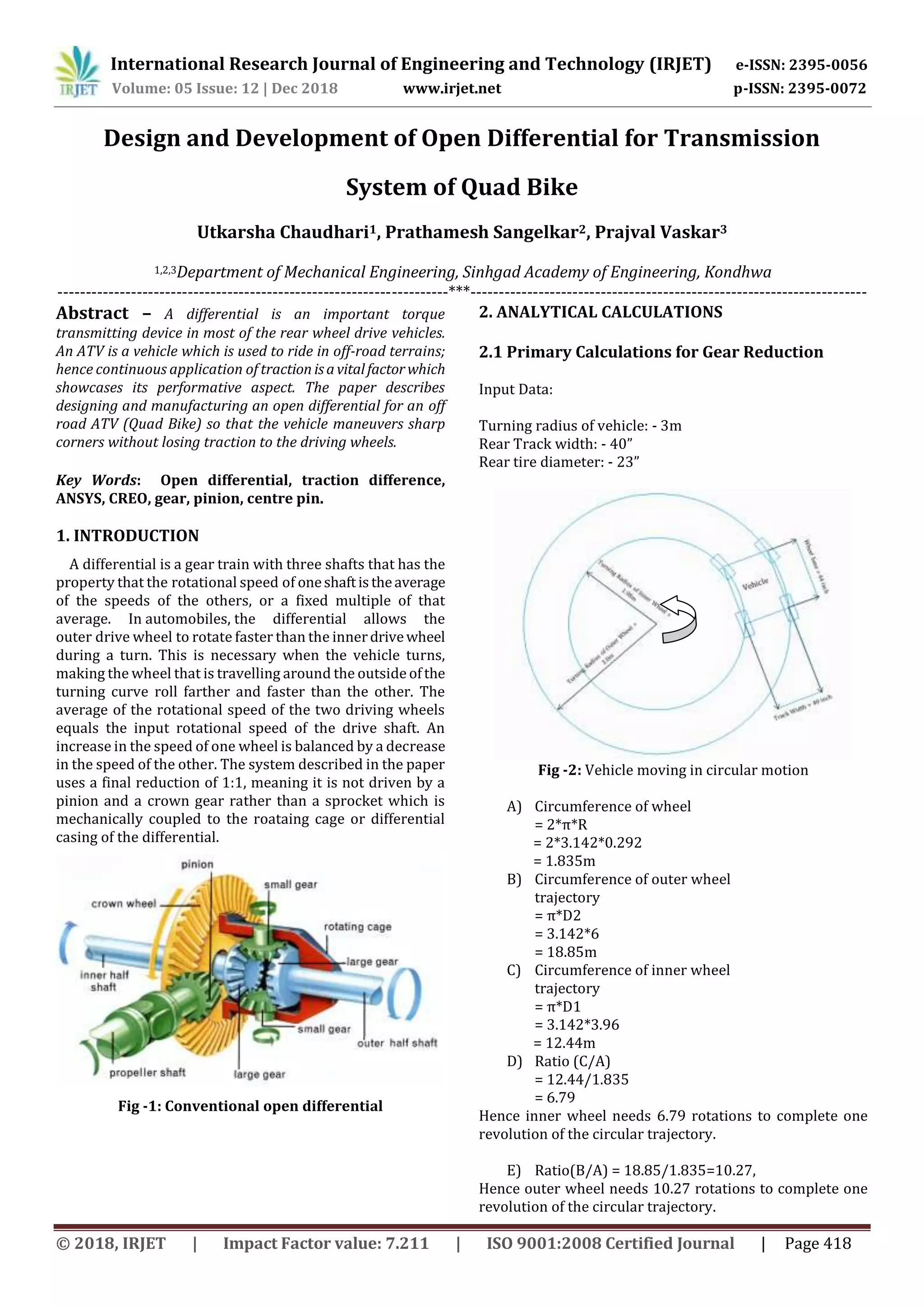
A differential is a gear train with three shafts that has the
property that the rotational speed of oneshaftistheaverage
of the speeds of the others, or a fixed multiple of that
average. In automobiles, the differential allows the
outer drive wheel to rotate faster than the innerdrivewheel
during a turn. This is necessary when the vehicle turns,
making the wheel that is travelling around the outsideofthe
turning curve roll farther and faster than the other. The
average of the rotational speed of the two driving wheels
equals the input rotational speed of the drive shaft. An
increase in the speed of one wheel is balanced by a decrease
in the speed of the other. The system described in the paper
uses a final reduction of 1:1, meaning it is not driven by a
pinion and a crown gear rather than a sprocket which is
mechanically coupled to the roataing cage or differential
casing of the differential.
Fig -1: Conventional open differential
2. ANALYTICAL CALCULATIONS
2.1 Primary Calculations for Gear Reduction
Input Data:
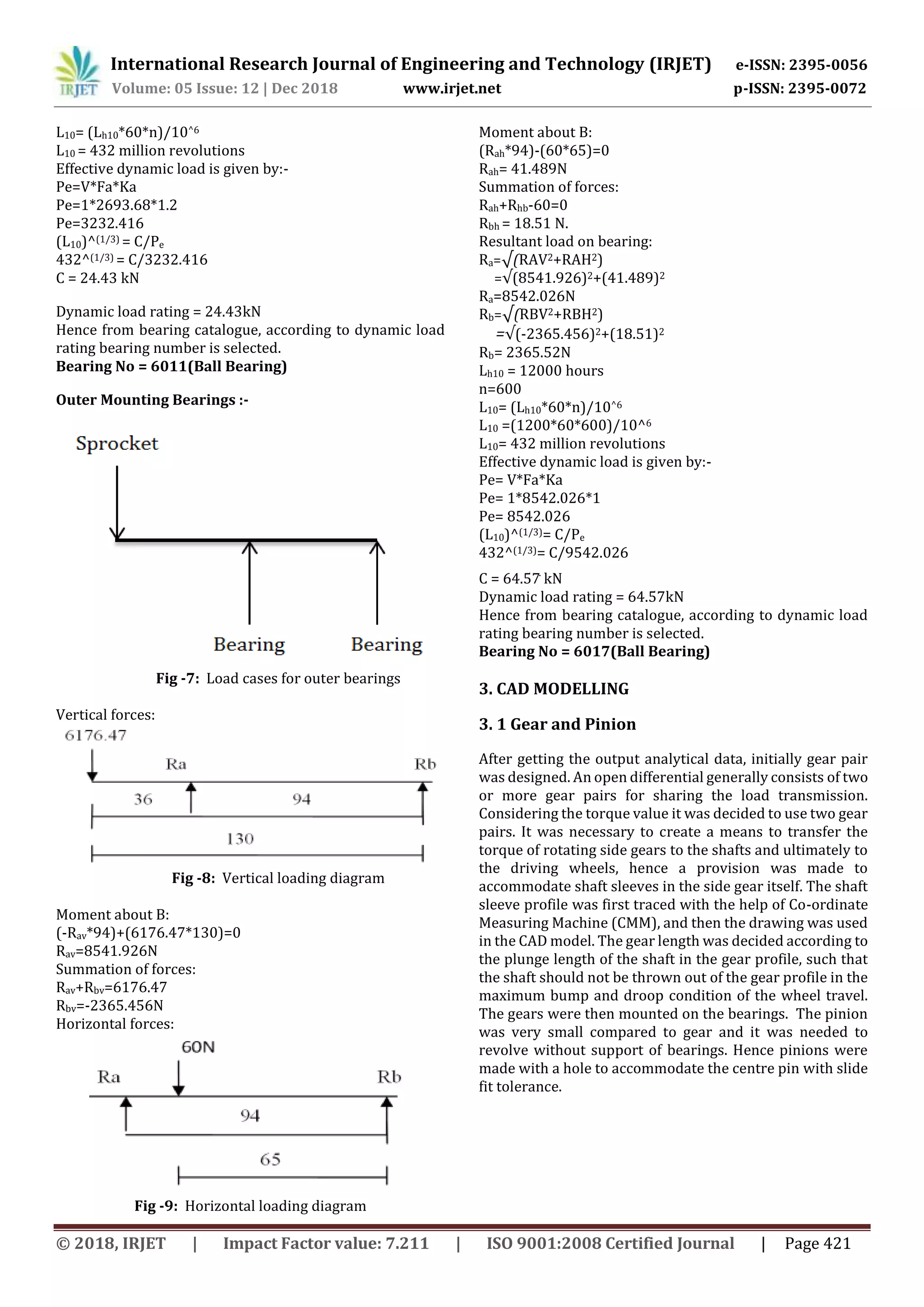
Turning radius of vehicle: - 3m
Rear Track width: - 40”
Rear tire diameter: - 23”
Fig -2: Vehicle moving in circular motion
A) Circumference of wheel
= 2*π*R
= 2*3.142*0.292
= 1.835m
B) Circumference of outer wheel
trajectory
= π*D2
= 3.142*6
= 18.85m
C) Circumference of inner wheel
trajectory
= π*D1
= 3.142*3.96
= 12.44m
D) Ratio (C/A)
= 12.44/1.835
= 6.79
Hence inner wheel needs 6.79 rotations to complete one
revolution of the circular trajectory.
E) Ratio(B/A) = 18.85/1.835=10.27,
Hence outer wheel needs 10.27 rotations to complete one
revolution of the circular trajectory.
International Research Journal of Engineering and Technology (IRJET) e-ISSN: 2395-0056
Volume: 05 Issue: 12 | Dec 2018 www.irjet.net p-ISSN: 2395-0072
© 2018, IRJET | Impact Factor value: 7.211 | ISO 9001:2008 Certified Journal | Page 419
F) Ratio(D/E) = 10.27/6.79 = 1.53,
Hence outer wheel rotates 1.53 times faster than inner
wheel.
Reduction between spider gears and side gears
= 1.53
= 1.8 (considering available modules.)
2.2 Material Selection for Gears
Table-1: Material Selection Chart
Material
Properties
20MnCr5
Steel
EN 8 Steel EN19 Steel
Tensile
yield
Strength
(Mpa)
750 433 470
Tensile
ultimate
Strength
(Mpa)
1000 650 745
Density
(kg/m3) 7850 7800 7800
Hence considering more tensile strength and more ultimate
strength with optimum material cost, 20MnCr5 steel was
finalized as gear material.
2.3 Gear Teeth Calculations
Fig-3: Bevel gear terminology
Assuming,
Pitch circle diameter of gear (Dg) = 72mm
No. of teeth on gear (Zg) = 18,
Pitch circle diameter of pinion (Dp) = 40mm
No. of teeth on pinion (Zp) = 10
Reduction = 1.8, Module = 4mm,
Addendum (ha)= 4mm, dedendum (hf)= 5mm (According
to stub involute profile)
According to design data book,
Material used = 20MnCr5,
Syt = 750Mpa
Sut = 1000Mpa.
Case hardness = 42HRc (Material to be case hardened for
pinion only.)
Pitch cone angles are,
γp = tan-1 (zp/zg)ASD
γp = tan-1 (10/18)
=29.05°
γg =60.95°
Beam strength (σb) = sut/3
=1000/3
(σb) =333.33N/mm^2
Virtual number of teeth on pinion (Z`p)
= Zp/cos (γp)
=10/cos(29.05)
Z`p = 11.439
Similarly,
Virtual number of teeth on gear (Z`g) = 37.069
The pinion is designed considering bending,
Dp = m*Zp
= 4*10
Dp = 40mm
Similarly,
Dg = 72mm
Pitch cone distance (Ao) =√(dp/2)^2+(dg/2)^2
=√40/2)^+(72/2)^
Ao = 41.182mm
Lewis form factor (Y`p) = 0.55-(2.64/z`)
= 0.55-(2.64/11.439)
∴ (z` is 20 for stub involute profile)
Y`p = 0.3192
Beam strength (Fb) = σb *b*m*Y`p[1-(b/Ao)]
=333.33*13.727*4Z*0.3192[1-(13.727/41.182)]
Fb=3894.768N
Ratio factor (Q`) = 2*Z`g/ (Z`p+Z`g)
= 2*37.069/ (11.439+37.069)
Q`= 1.5283
Load stress factor (K) = 0.16[BHN/100]^2
= 0.16[400/100]^2
K = 2.56N/mm^2
Wear strength (Fw)= 0.75*dp*b*Q*K/[cos(γp)]
=0.75*40*13.727*1.5283*2.56/0.8742
Fw=1843.047N
As,Fb>Fw; Gear pair is designed for pitting.
V= *dp*np/(60*1000)
=π*40*1080/(60*1000)
V=2.2619m/s
Tangential force (Ft) = P/V
= 12000/2.2619
Ft = 5305.165N
Velocity factor(Kv) = 6/(6+V)
= 6/(6+2.2619)
Kv = 0.72622
Effective load (Feff) = Ka*Km*Ft/Kv
= 1.25*1*5305.165/0.72622
Feff = 9131.40N
Hence, to avoid pitting failure we consider factor of safety of
1.75
International Research Journal of Engineering and Technology (IRJET) e-ISSN: 2395-0056
Volume: 05 Issue: 12 | Dec 2018 www.irjet.net p-ISSN: 2395-0072
© 2018, IRJET | Impact Factor value: 7.211 | ISO 9001:2008 Certified Journal | Page 420
Fw = Nf * Feff
= 1.75*9131.40
Fw = 15979.958N
Mean radius of bevel pinion (rmp)
=(dp/2)-[b*sin(γp)/2]
= (40/2)-[13.727*sin(29.05)/2]
rmp = 16.6672 mm
Similarly,
Mean radius of bevel gear (rmg)=29.99mm
According to IS grade 6, pitch error is given by the equation,
e = 8.0+0.63[m+0.25*√rm]
For pinion, ep =8.0+0.63[m+0.25*√rmp]
=8.0+0.63[4+0.25*√2*16.6672
ep = 11.429 m
Similarly,
For gear,eg =11.739µm
Pitch error on meshing teeth © = ep + eg
=11.426+11.72
e=23.168*10^-3mm
Ftmax = Ka*Km*Ft
= 1.25*1.* 5305.165
Ftmax = 6631.456N
For steel pinion and steel gear deformation factor is given
by,
C = 11000*e
= 11000*30*10^-3
C = 330N/mm
By using Buckingham’s equation, dynamic loading is given
by,
Fd = 21*V*(bC+Ftmax)/[21V+√bc+Ftmax]
=21*2.2619*(13.727*330+6631.456)/[21*2.2619+ 13.727*
330+6631.456]
Fd = 3461.79N
Feff = Ka*Km*Ft+Fd
= 1.25*1*5305.165+3247.176N
Feff = 10093.25N
Nf = Fw/Feff
=23997.64/12392.13
Nf= 1.583
Hence, design is safe
2.4 Bearing Calculations
Inner Bearings :
Fig-4: Free body diagram of differential
Forces on gear:-
Ft =p/v
=12*10^3/2.26
Ft =5305.16N
Radial forces on gear:-
Frp = Ft*tan (ϕ)*cos(γp)
=5305.16*tan(20)*cos(29.05)
Frp =1688N
Frg=Ft*tan(ϕ )cos(γg)
=5305.16*tan(20*cos(60.95)
Frg=937.602N
Axial forces on gear:-
Fag=Ftm*tan(ϕ)*sin(γp)
=5305.16*tan(20)*sin(29.05)
Fap=937.602N
Fag=Ftm*tan(ϕ)*sin(γp)
=5305.16*tan(20)*sin(60.95)
Fag=1688N
=5305.16*2.26
Resultant load on bearing:
Fig -5: Vertical loading diagram
Moment about A:
(Rbv*80)+(957.602*20)+(20*40)-(957.602*60)=0
Rbv = 468.801N
Similarly moment about B gives;
Rav = -448.801N
Fig -6: Horizontal loading diagram
Moment about B:
(Rah*80)+(5305.16*60)-(1688*36)-
(5305.16*20)+(1688*36)=0
Rah = -2652.58N
Rah = 103.782652.58N
Resultant load on bearing:
Ra= 2690.279 N
Rb=2693.68 KN
Lh10=12000
n = 600
International Research Journal of Engineering and Technology (IRJET) e-ISSN: 2395-0056
Volume: 05 Issue: 12 | Dec 2018 www.irjet.net p-ISSN: 2395-0072
© 2018, IRJET | Impact Factor value: 7.211 | ISO 9001:2008 Certified Journal | Page 421
L10= (Lh10*60*n)/10^6
L10 = 432 million revolutions
Effective dynamic load is given by:-
Pe=V*Fa*Ka
Pe=1*2693.68*1.2
Pe=3232.416
(L10)^(1/3) = C/Pe
432^(1/3) = C/3232.416
C = 24.43 kN
Dynamic load rating = 24.43kN
Hence from bearing catalogue, according to dynamic load
rating bearing number is selected.
Bearing No = 6011(Ball Bearing)
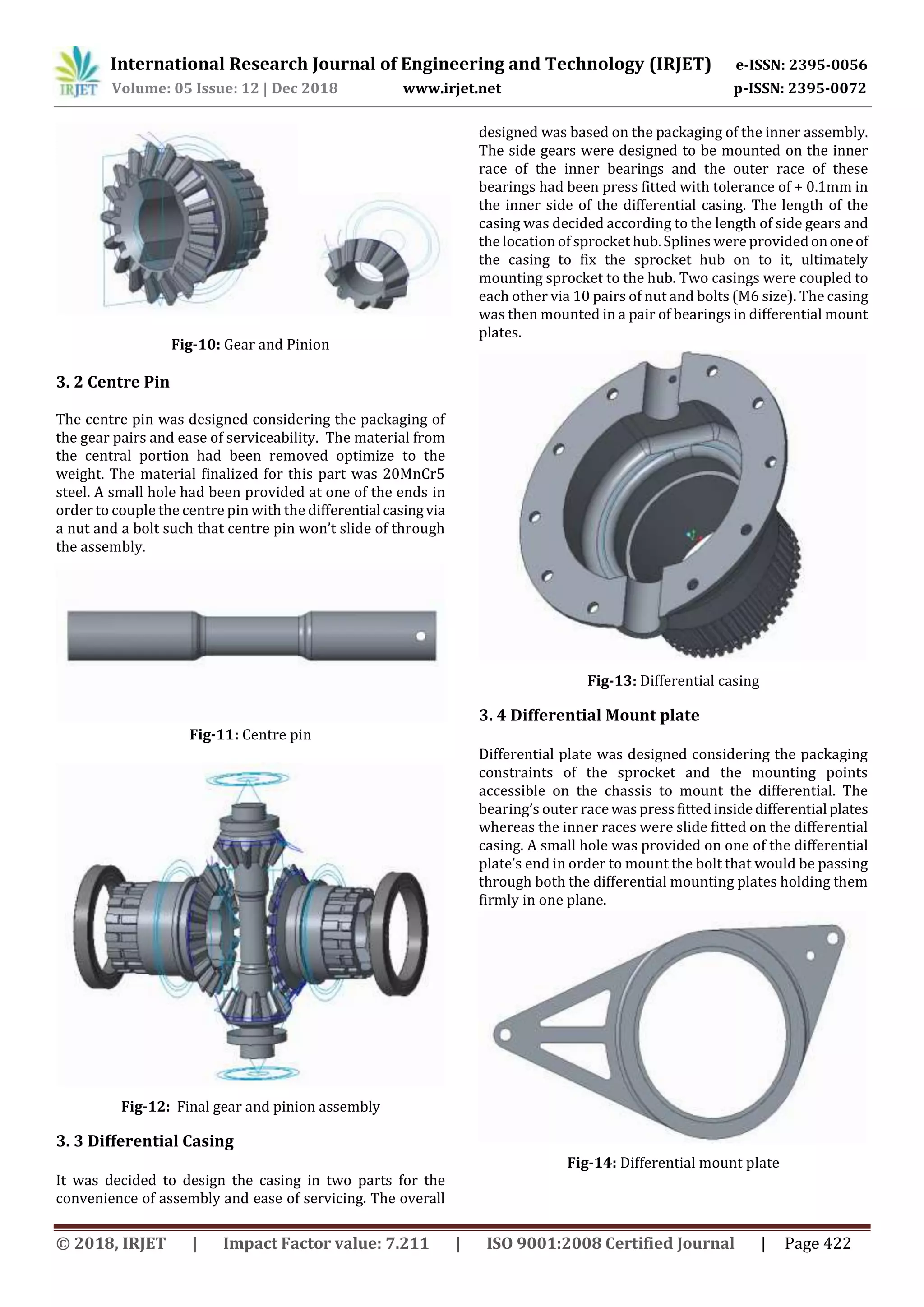
Outer Mounting Bearings :-
Fig -7: Load cases for outer bearings
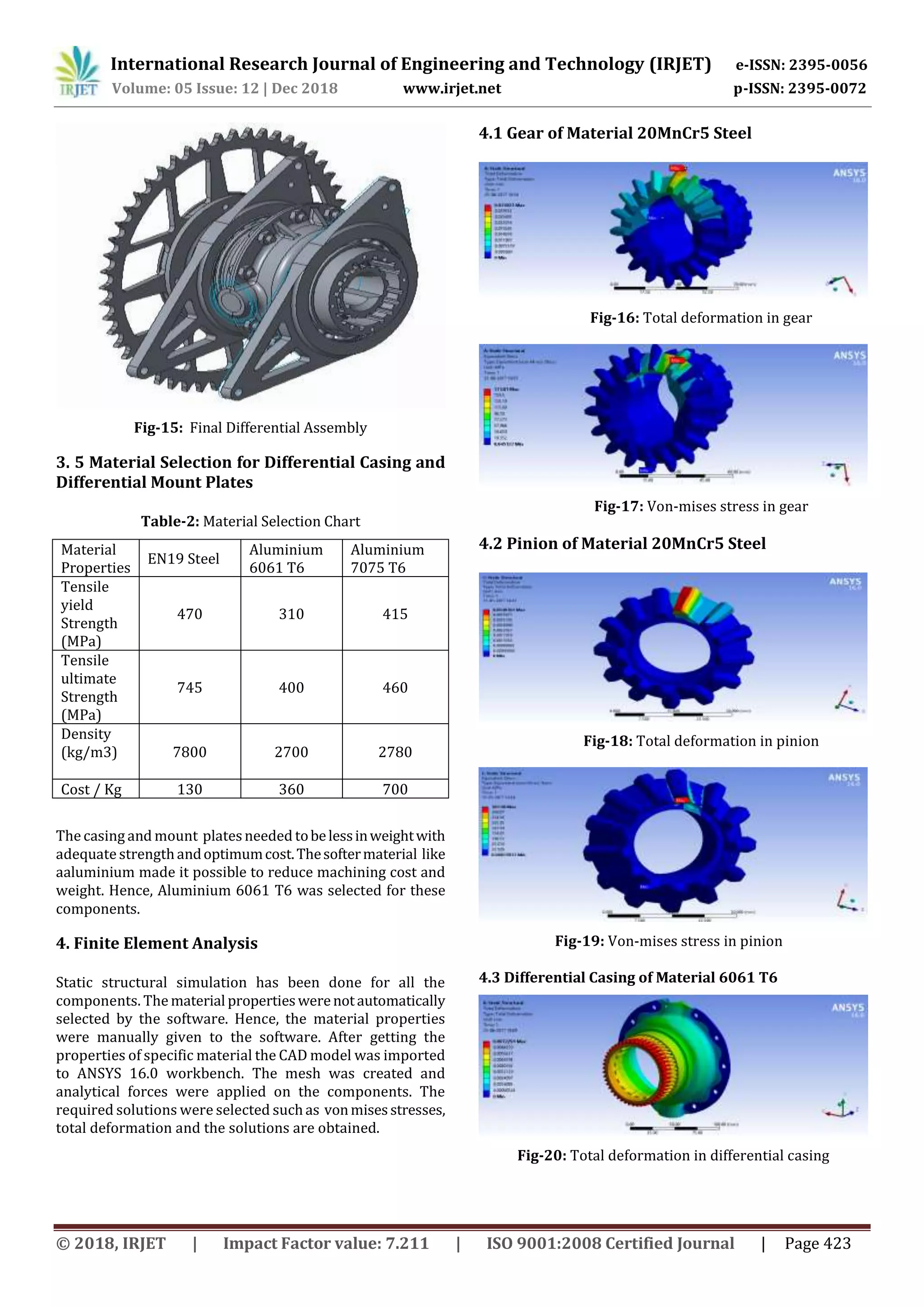
Vertical forces:
Fig -8: Vertical loading diagram
Moment about B:
(-Rav*94)+(6176.47*130)=0
Rav=8541.926N
Summation of forces:
Rav+Rbv=6176.47
Rbv=-2365.456N
Horizontal forces:
Fig -9: Horizontal loading diagram
Moment about B:
(Rah*94)-(60*65)=0
Rah= 41.489N
Summation of forces:
Rah+Rhb-60=0
Rbh = 18.51 N.
Resultant load on bearing:
Ra=√(RAV2+RAH2)
=√(8541.926)2+(41.489)2
Ra=8542.026N
Rb=√(RBV2+RBH2)
=√(-2365.456)2+(18.51)2
Rb= 2365.52N
Lh10 = 12000 hours
n=600
L10= (Lh10*60*n)/10^6
L10 =(1200*60*600)/10^6
L10= 432 million revolutions
Effective dynamic load is given by:-
Pe= V*Fa*Ka
Pe= 1*8542.026*1
Pe= 8542.026
(L10)^(1/3)= C/Pe
432^(1/3)= C/9542.026
C = 64.57 kN
Dynamic load rating = 64.57kN
Hence from bearing catalogue, according to dynamic load
rating bearing number is selected.
Bearing No = 6017(Ball Bearing)
3. CAD MODELLING
3. 1 Gear and Pinion
After getting the output analytical data, initially gear pair
was designed. An open differential generally consists of two
or more gear pairs for sharing the load transmission.
Considering the torque value it was decided to use two gear
pairs. It was necessary to create a means to transfer the
torque of rotating side gears to the shafts and ultimately to
the driving wheels, hence a provision was made to
accommodate shaft sleeves in the side gear itself. The shaft
sleeve profile was first traced with the help of Co-ordinate
Measuring Machine (CMM), and then the drawing was used
in the CAD model. The gear length was decided according to
the plunge length of the shaft in the gear profile, such that
the shaft should not be thrown out of the gear profile in the
maximum bump and droop condition of the wheel travel.
The gears were then mounted on the bearings. The pinion
was very small compared to gear and it was needed to
revolve without support of bearings. Hence pinions were
made with a hole to accommodate the centre pin with slide
fit tolerance.
International Research Journal of Engineering and Technology (IRJET) e-ISSN: 2395-0056
Volume: 05 Issue: 12 | Dec 2018 www.irjet.net p-ISSN: 2395-0072
© 2018, IRJET | Impact Factor value: 7.211 | ISO 9001:2008 Certified Journal | Page 422
Fig-10: Gear and Pinion
3. 2 Centre Pin
The centre pin was designed considering the packaging of
the gear pairs and ease of serviceability. The material from
the central portion had been removed optimize to the
weight. The material finalized for this part was 20MnCr5
steel. A small hole had been provided at one of the ends in
order to couple the centre pin with the differential casingvia
a nut and a bolt such that centre pin won’t slide of through
the assembly.
Fig-11: Centre pin
Fig-12: Final gear and pinion assembly
3. 3 Differential Casing
It was decided to design the casing in two parts for the
convenience of assembly and ease of servicing. The overall
designed was based on the packaging of the inner assembly.
The side gears were designed to be mounted on the inner
race of the inner bearings and the outer race of these
bearings had been press fitted with tolerance of + 0.1mm in
the inner side of the differential casing. The length of the
casing was decided according to the length of side gears and
the location of sprocket hub.Splines were providedononeof
the casing to fix the sprocket hub on to it, ultimately
mounting sprocket to the hub. Two casings were coupled to
each other via 10 pairs of nut and bolts (M6 size). The casing
was then mounted in a pair of bearings in differential mount
plates.
Fig-13: Differential casing
3. 4 Differential Mount plate
Differential plate was designed considering the packaging
constraints of the sprocket and the mounting points
accessible on the chassis to mount the differential. The
bearing’s outer racewaspressfittedinsidedifferential plates
whereas the inner races were slide fitted on the differential
casing. A small hole was provided on one of the differential
plate’s end in order to mount the bolt that would be passing
through both the differential mounting plates holding them
firmly in one plane.
Fig-14: Differential mount plate
International Research Journal of Engineering and Technology (IRJET) e-ISSN: 2395-0056
Volume: 05 Issue: 12 | Dec 2018 www.irjet.net p-ISSN: 2395-0072
© 2018, IRJET | Impact Factor value: 7.211 | ISO 9001:2008 Certified Journal | Page 423
Fig-15: Final Differential Assembly
3. 5 Material Selection for Differential Casing and
Differential Mount Plates
Table-2: Material Selection Chart
Material
Properties
EN19 Steel
Aluminium
6061 T6
Aluminium
7075 T6
Tensile
yield
Strength
(MPa)
470 310 415
Tensile
ultimate
Strength
(MPa)
745 400 460
Density
(kg/m3) 7800 2700 2780
Cost / Kg 130 360 700
The casing and mount platesneeded tobelessinweightwith
adequatestrengthandoptimumcost.Thesoftermaterial like
aaluminium made it possible to reduce machining cost and
weight. Hence, Aluminium 6061 T6 was selected for these
components.
4. Finite Element Analysis
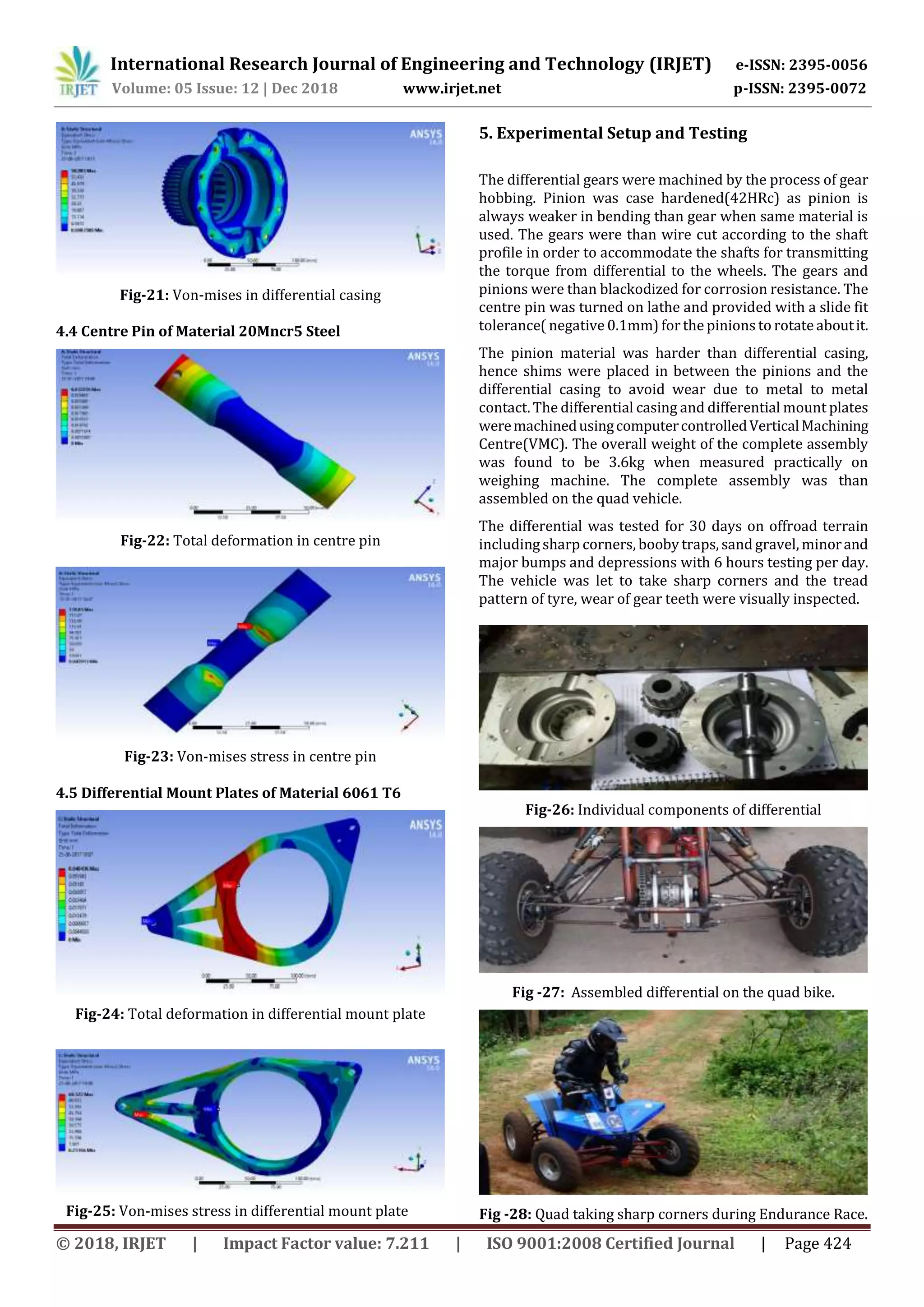
Static structural simulation has been done for all the
components. Thematerial propertieswerenotautomatically
selected by the software. Hence, the material properties
were manually given to the software. After getting the
properties of specific material the CAD model was imported
to ANSYS 16.0 workbench. The mesh was created and
analytical forces were applied on the components. The
required solutions were selected suchas vonmisesstresses,
total deformation and the solutions are obtained.
4.1 Gear of Material 20MnCr5 Steel
Fig-16: Total deformation in gear
Fig-17: Von-mises stress in gear
4.2 Pinion of Material 20MnCr5 Steel
Fig-18: Total deformation in pinion
Fig-19: Von-mises stress in pinion
4.3 Differential Casing of Material 6061 T6
Fig-20: Total deformation in differential casing
International Research Journal of Engineering and Technology (IRJET) e-ISSN: 2395-0056
Volume: 05 Issue: 12 | Dec 2018 www.irjet.net p-ISSN: 2395-0072
© 2018, IRJET | Impact Factor value: 7.211 | ISO 9001:2008 Certified Journal | Page 424
Fig-21: Von-mises in differential casing
4.4 Centre Pin of Material 20Mncr5 Steel
Fig-22: Total deformation in centre pin
Fig-23: Von-mises stress in centre pin
4.5 Differential Mount Plates of Material 6061 T6
Fig-24: Total deformation in differential mount plate
Fig-25: Von-mises stress in differential mount plate
5. Experimental Setup and Testing
The differential gears were machined by the process of gear
hobbing. Pinion was case hardened(42HRc) as pinion is
always weaker in bending than gear when same material is
used. The gears were than wire cut according to the shaft
profile in order to accommodate the shafts for transmitting
the torque from differential to the wheels. The gears and
pinions were than blackodized for corrosion resistance. The
centre pin was turned on lathe and provided with a slide fit
tolerance( negative 0.1mm) forthe pinions to rotateaboutit.
The pinion material was harder than differential casing,
hence shims were placed in between the pinions and the
differential casing to avoid wear due to metal to metal
contact. The differential casing and differential mount plates
weremachinedusingcomputercontrolledVerticalMachining
Centre(VMC). The overall weight of the complete assembly
was found to be 3.6kg when measured practically on
weighing machine. The complete assembly was than
assembled on the quad vehicle.
The differential was tested for 30 days on offroad terrain
including sharp corners, booby traps, sand gravel, minorand
major bumps and depressions with 6 hours testing per day.
The vehicle was let to take sharp corners and the tread
pattern of tyre, wear of gear teeth were visually inspected.
Fig-26: Individual components of differential
Fig -27: Assembled differential on the quad bike.
Fig -28: Quad taking sharp corners during Endurance Race.
International Research Journal of Engineering and Technology (IRJET) e-ISSN: 2395-0056
Volume: 05 Issue: 12 | Dec 2018 www.irjet.net p-ISSN: 2395-0072
© 2018, IRJET | Impact Factor value: 7.211 | ISO 9001:2008 Certified Journal | Page 425
6. CONCLUSION
The differential assembly, after implementation in quad
vehicle, satisfies the design requirements. It proves to be
durable on rough terrain and critical operating conditions.
No traction difference problem was observed and vehicle
could maneuver sharp turns without losing traction. Thus,
we can conclude that initial objective of differential for
transmission system of quad vehicle is satisfied and serves
as ground for further research on said system.
7. REFERENCES
[1] Milliken and Milliken, Race Car Vehicle Dynamics.
[2] C. Smith, “Tune to Win”, AERO publishers Inc.
[3] V.D. Kodgire, ‘Material Science and Metallurgy’
[4] V.B. Bhandari, ‘Design of Machine Elements’

IRJET- Design and Development of Open Differential for Transmission System of Quad Bike

  • 1.
    International Research Journalof Engineering and Technology (IRJET) e-ISSN: 2395-0056 Volume: 05 Issue: 12 | Dec 2018 www.irjet.net p-ISSN: 2395-0072 © 2018, IRJET | Impact Factor value: 7.211 | ISO 9001:2008 Certified Journal | Page 418 Design and Development of Open Differential for Transmission System of Quad Bike Utkarsha Chaudhari1, Prathamesh Sangelkar2, Prajval Vaskar3 1,2,3Department of Mechanical Engineering, Sinhgad Academy of Engineering, Kondhwa ---------------------------------------------------------------------***---------------------------------------------------------------------- Abstract – A differential is an important torque transmitting device in most of the rear wheel drive vehicles. An ATV is a vehicle which is used to ride in off-road terrains; hence continuous application of traction isavitalfactorwhich showcases its performative aspect. The paper describes designing and manufacturing an open differential for an off road ATV (Quad Bike) so that the vehicle maneuvers sharp corners without losing traction to the driving wheels. Key Words: Open differential, traction difference, ANSYS, CREO, gear, pinion, centre pin. 1. INTRODUCTION A differential is a gear train with three shafts that has the property that the rotational speed of oneshaftistheaverage of the speeds of the others, or a fixed multiple of that average. In automobiles, the differential allows the outer drive wheel to rotate faster than the innerdrivewheel during a turn. This is necessary when the vehicle turns, making the wheel that is travelling around the outsideofthe turning curve roll farther and faster than the other. The average of the rotational speed of the two driving wheels equals the input rotational speed of the drive shaft. An increase in the speed of one wheel is balanced by a decrease in the speed of the other. The system described in the paper uses a final reduction of 1:1, meaning it is not driven by a pinion and a crown gear rather than a sprocket which is mechanically coupled to the roataing cage or differential casing of the differential. Fig -1: Conventional open differential 2. ANALYTICAL CALCULATIONS 2.1 Primary Calculations for Gear Reduction Input Data: Turning radius of vehicle: - 3m Rear Track width: - 40” Rear tire diameter: - 23” Fig -2: Vehicle moving in circular motion A) Circumference of wheel = 2*π*R = 2*3.142*0.292 = 1.835m B) Circumference of outer wheel trajectory = π*D2 = 3.142*6 = 18.85m C) Circumference of inner wheel trajectory = π*D1 = 3.142*3.96 = 12.44m D) Ratio (C/A) = 12.44/1.835 = 6.79 Hence inner wheel needs 6.79 rotations to complete one revolution of the circular trajectory. E) Ratio(B/A) = 18.85/1.835=10.27, Hence outer wheel needs 10.27 rotations to complete one revolution of the circular trajectory.
  • 2.
    International Research Journalof Engineering and Technology (IRJET) e-ISSN: 2395-0056 Volume: 05 Issue: 12 | Dec 2018 www.irjet.net p-ISSN: 2395-0072 © 2018, IRJET | Impact Factor value: 7.211 | ISO 9001:2008 Certified Journal | Page 419 F) Ratio(D/E) = 10.27/6.79 = 1.53, Hence outer wheel rotates 1.53 times faster than inner wheel. Reduction between spider gears and side gears = 1.53 = 1.8 (considering available modules.) 2.2 Material Selection for Gears Table-1: Material Selection Chart Material Properties 20MnCr5 Steel EN 8 Steel EN19 Steel Tensile yield Strength (Mpa) 750 433 470 Tensile ultimate Strength (Mpa) 1000 650 745 Density (kg/m3) 7850 7800 7800 Hence considering more tensile strength and more ultimate strength with optimum material cost, 20MnCr5 steel was finalized as gear material. 2.3 Gear Teeth Calculations Fig-3: Bevel gear terminology Assuming, Pitch circle diameter of gear (Dg) = 72mm No. of teeth on gear (Zg) = 18, Pitch circle diameter of pinion (Dp) = 40mm No. of teeth on pinion (Zp) = 10 Reduction = 1.8, Module = 4mm, Addendum (ha)= 4mm, dedendum (hf)= 5mm (According to stub involute profile) According to design data book, Material used = 20MnCr5, Syt = 750Mpa Sut = 1000Mpa. Case hardness = 42HRc (Material to be case hardened for pinion only.) Pitch cone angles are, γp = tan-1 (zp/zg)ASD γp = tan-1 (10/18) =29.05° γg =60.95° Beam strength (σb) = sut/3 =1000/3 (σb) =333.33N/mm^2 Virtual number of teeth on pinion (Z`p) = Zp/cos (γp) =10/cos(29.05) Z`p = 11.439 Similarly, Virtual number of teeth on gear (Z`g) = 37.069 The pinion is designed considering bending, Dp = m*Zp = 4*10 Dp = 40mm Similarly, Dg = 72mm Pitch cone distance (Ao) =√(dp/2)^2+(dg/2)^2 =√40/2)^+(72/2)^ Ao = 41.182mm Lewis form factor (Y`p) = 0.55-(2.64/z`) = 0.55-(2.64/11.439) ∴ (z` is 20 for stub involute profile) Y`p = 0.3192 Beam strength (Fb) = σb *b*m*Y`p[1-(b/Ao)] =333.33*13.727*4Z*0.3192[1-(13.727/41.182)] Fb=3894.768N Ratio factor (Q`) = 2*Z`g/ (Z`p+Z`g) = 2*37.069/ (11.439+37.069) Q`= 1.5283 Load stress factor (K) = 0.16[BHN/100]^2 = 0.16[400/100]^2 K = 2.56N/mm^2 Wear strength (Fw)= 0.75*dp*b*Q*K/[cos(γp)] =0.75*40*13.727*1.5283*2.56/0.8742 Fw=1843.047N As,Fb>Fw; Gear pair is designed for pitting. V= *dp*np/(60*1000) =π*40*1080/(60*1000) V=2.2619m/s Tangential force (Ft) = P/V = 12000/2.2619 Ft = 5305.165N Velocity factor(Kv) = 6/(6+V) = 6/(6+2.2619) Kv = 0.72622 Effective load (Feff) = Ka*Km*Ft/Kv = 1.25*1*5305.165/0.72622 Feff = 9131.40N Hence, to avoid pitting failure we consider factor of safety of 1.75
  • 3.
    International Research Journalof Engineering and Technology (IRJET) e-ISSN: 2395-0056 Volume: 05 Issue: 12 | Dec 2018 www.irjet.net p-ISSN: 2395-0072 © 2018, IRJET | Impact Factor value: 7.211 | ISO 9001:2008 Certified Journal | Page 420 Fw = Nf * Feff = 1.75*9131.40 Fw = 15979.958N Mean radius of bevel pinion (rmp) =(dp/2)-[b*sin(γp)/2] = (40/2)-[13.727*sin(29.05)/2] rmp = 16.6672 mm Similarly, Mean radius of bevel gear (rmg)=29.99mm According to IS grade 6, pitch error is given by the equation, e = 8.0+0.63[m+0.25*√rm] For pinion, ep =8.0+0.63[m+0.25*√rmp] =8.0+0.63[4+0.25*√2*16.6672 ep = 11.429 m Similarly, For gear,eg =11.739µm Pitch error on meshing teeth © = ep + eg =11.426+11.72 e=23.168*10^-3mm Ftmax = Ka*Km*Ft = 1.25*1.* 5305.165 Ftmax = 6631.456N For steel pinion and steel gear deformation factor is given by, C = 11000*e = 11000*30*10^-3 C = 330N/mm By using Buckingham’s equation, dynamic loading is given by, Fd = 21*V*(bC+Ftmax)/[21V+√bc+Ftmax] =21*2.2619*(13.727*330+6631.456)/[21*2.2619+ 13.727* 330+6631.456] Fd = 3461.79N Feff = Ka*Km*Ft+Fd = 1.25*1*5305.165+3247.176N Feff = 10093.25N Nf = Fw/Feff =23997.64/12392.13 Nf= 1.583 Hence, design is safe 2.4 Bearing Calculations Inner Bearings : Fig-4: Free body diagram of differential Forces on gear:- Ft =p/v =12*10^3/2.26 Ft =5305.16N Radial forces on gear:- Frp = Ft*tan (ϕ)*cos(γp) =5305.16*tan(20)*cos(29.05) Frp =1688N Frg=Ft*tan(ϕ )cos(γg) =5305.16*tan(20*cos(60.95) Frg=937.602N Axial forces on gear:- Fag=Ftm*tan(ϕ)*sin(γp) =5305.16*tan(20)*sin(29.05) Fap=937.602N Fag=Ftm*tan(ϕ)*sin(γp) =5305.16*tan(20)*sin(60.95) Fag=1688N =5305.16*2.26 Resultant load on bearing: Fig -5: Vertical loading diagram Moment about A: (Rbv*80)+(957.602*20)+(20*40)-(957.602*60)=0 Rbv = 468.801N Similarly moment about B gives; Rav = -448.801N Fig -6: Horizontal loading diagram Moment about B: (Rah*80)+(5305.16*60)-(1688*36)- (5305.16*20)+(1688*36)=0 Rah = -2652.58N Rah = 103.782652.58N Resultant load on bearing: Ra= 2690.279 N Rb=2693.68 KN Lh10=12000 n = 600
  • 4.
    International Research Journalof Engineering and Technology (IRJET) e-ISSN: 2395-0056 Volume: 05 Issue: 12 | Dec 2018 www.irjet.net p-ISSN: 2395-0072 © 2018, IRJET | Impact Factor value: 7.211 | ISO 9001:2008 Certified Journal | Page 421 L10= (Lh10*60*n)/10^6 L10 = 432 million revolutions Effective dynamic load is given by:- Pe=V*Fa*Ka Pe=1*2693.68*1.2 Pe=3232.416 (L10)^(1/3) = C/Pe 432^(1/3) = C/3232.416 C = 24.43 kN Dynamic load rating = 24.43kN Hence from bearing catalogue, according to dynamic load rating bearing number is selected. Bearing No = 6011(Ball Bearing) Outer Mounting Bearings :- Fig -7: Load cases for outer bearings Vertical forces: Fig -8: Vertical loading diagram Moment about B: (-Rav*94)+(6176.47*130)=0 Rav=8541.926N Summation of forces: Rav+Rbv=6176.47 Rbv=-2365.456N Horizontal forces: Fig -9: Horizontal loading diagram Moment about B: (Rah*94)-(60*65)=0 Rah= 41.489N Summation of forces: Rah+Rhb-60=0 Rbh = 18.51 N. Resultant load on bearing: Ra=√(RAV2+RAH2) =√(8541.926)2+(41.489)2 Ra=8542.026N Rb=√(RBV2+RBH2) =√(-2365.456)2+(18.51)2 Rb= 2365.52N Lh10 = 12000 hours n=600 L10= (Lh10*60*n)/10^6 L10 =(1200*60*600)/10^6 L10= 432 million revolutions Effective dynamic load is given by:- Pe= V*Fa*Ka Pe= 1*8542.026*1 Pe= 8542.026 (L10)^(1/3)= C/Pe 432^(1/3)= C/9542.026 C = 64.57 kN Dynamic load rating = 64.57kN Hence from bearing catalogue, according to dynamic load rating bearing number is selected. Bearing No = 6017(Ball Bearing) 3. CAD MODELLING 3. 1 Gear and Pinion After getting the output analytical data, initially gear pair was designed. An open differential generally consists of two or more gear pairs for sharing the load transmission. Considering the torque value it was decided to use two gear pairs. It was necessary to create a means to transfer the torque of rotating side gears to the shafts and ultimately to the driving wheels, hence a provision was made to accommodate shaft sleeves in the side gear itself. The shaft sleeve profile was first traced with the help of Co-ordinate Measuring Machine (CMM), and then the drawing was used in the CAD model. The gear length was decided according to the plunge length of the shaft in the gear profile, such that the shaft should not be thrown out of the gear profile in the maximum bump and droop condition of the wheel travel. The gears were then mounted on the bearings. The pinion was very small compared to gear and it was needed to revolve without support of bearings. Hence pinions were made with a hole to accommodate the centre pin with slide fit tolerance.
  • 5.
    International Research Journalof Engineering and Technology (IRJET) e-ISSN: 2395-0056 Volume: 05 Issue: 12 | Dec 2018 www.irjet.net p-ISSN: 2395-0072 © 2018, IRJET | Impact Factor value: 7.211 | ISO 9001:2008 Certified Journal | Page 422 Fig-10: Gear and Pinion 3. 2 Centre Pin The centre pin was designed considering the packaging of the gear pairs and ease of serviceability. The material from the central portion had been removed optimize to the weight. The material finalized for this part was 20MnCr5 steel. A small hole had been provided at one of the ends in order to couple the centre pin with the differential casingvia a nut and a bolt such that centre pin won’t slide of through the assembly. Fig-11: Centre pin Fig-12: Final gear and pinion assembly 3. 3 Differential Casing It was decided to design the casing in two parts for the convenience of assembly and ease of servicing. The overall designed was based on the packaging of the inner assembly. The side gears were designed to be mounted on the inner race of the inner bearings and the outer race of these bearings had been press fitted with tolerance of + 0.1mm in the inner side of the differential casing. The length of the casing was decided according to the length of side gears and the location of sprocket hub.Splines were providedononeof the casing to fix the sprocket hub on to it, ultimately mounting sprocket to the hub. Two casings were coupled to each other via 10 pairs of nut and bolts (M6 size). The casing was then mounted in a pair of bearings in differential mount plates. Fig-13: Differential casing 3. 4 Differential Mount plate Differential plate was designed considering the packaging constraints of the sprocket and the mounting points accessible on the chassis to mount the differential. The bearing’s outer racewaspressfittedinsidedifferential plates whereas the inner races were slide fitted on the differential casing. A small hole was provided on one of the differential plate’s end in order to mount the bolt that would be passing through both the differential mounting plates holding them firmly in one plane. Fig-14: Differential mount plate
  • 6.
    International Research Journalof Engineering and Technology (IRJET) e-ISSN: 2395-0056 Volume: 05 Issue: 12 | Dec 2018 www.irjet.net p-ISSN: 2395-0072 © 2018, IRJET | Impact Factor value: 7.211 | ISO 9001:2008 Certified Journal | Page 423 Fig-15: Final Differential Assembly 3. 5 Material Selection for Differential Casing and Differential Mount Plates Table-2: Material Selection Chart Material Properties EN19 Steel Aluminium 6061 T6 Aluminium 7075 T6 Tensile yield Strength (MPa) 470 310 415 Tensile ultimate Strength (MPa) 745 400 460 Density (kg/m3) 7800 2700 2780 Cost / Kg 130 360 700 The casing and mount platesneeded tobelessinweightwith adequatestrengthandoptimumcost.Thesoftermaterial like aaluminium made it possible to reduce machining cost and weight. Hence, Aluminium 6061 T6 was selected for these components. 4. Finite Element Analysis Static structural simulation has been done for all the components. Thematerial propertieswerenotautomatically selected by the software. Hence, the material properties were manually given to the software. After getting the properties of specific material the CAD model was imported to ANSYS 16.0 workbench. The mesh was created and analytical forces were applied on the components. The required solutions were selected suchas vonmisesstresses, total deformation and the solutions are obtained. 4.1 Gear of Material 20MnCr5 Steel Fig-16: Total deformation in gear Fig-17: Von-mises stress in gear 4.2 Pinion of Material 20MnCr5 Steel Fig-18: Total deformation in pinion Fig-19: Von-mises stress in pinion 4.3 Differential Casing of Material 6061 T6 Fig-20: Total deformation in differential casing
  • 7.
    International Research Journalof Engineering and Technology (IRJET) e-ISSN: 2395-0056 Volume: 05 Issue: 12 | Dec 2018 www.irjet.net p-ISSN: 2395-0072 © 2018, IRJET | Impact Factor value: 7.211 | ISO 9001:2008 Certified Journal | Page 424 Fig-21: Von-mises in differential casing 4.4 Centre Pin of Material 20Mncr5 Steel Fig-22: Total deformation in centre pin Fig-23: Von-mises stress in centre pin 4.5 Differential Mount Plates of Material 6061 T6 Fig-24: Total deformation in differential mount plate Fig-25: Von-mises stress in differential mount plate 5. Experimental Setup and Testing The differential gears were machined by the process of gear hobbing. Pinion was case hardened(42HRc) as pinion is always weaker in bending than gear when same material is used. The gears were than wire cut according to the shaft profile in order to accommodate the shafts for transmitting the torque from differential to the wheels. The gears and pinions were than blackodized for corrosion resistance. The centre pin was turned on lathe and provided with a slide fit tolerance( negative 0.1mm) forthe pinions to rotateaboutit. The pinion material was harder than differential casing, hence shims were placed in between the pinions and the differential casing to avoid wear due to metal to metal contact. The differential casing and differential mount plates weremachinedusingcomputercontrolledVerticalMachining Centre(VMC). The overall weight of the complete assembly was found to be 3.6kg when measured practically on weighing machine. The complete assembly was than assembled on the quad vehicle. The differential was tested for 30 days on offroad terrain including sharp corners, booby traps, sand gravel, minorand major bumps and depressions with 6 hours testing per day. The vehicle was let to take sharp corners and the tread pattern of tyre, wear of gear teeth were visually inspected. Fig-26: Individual components of differential Fig -27: Assembled differential on the quad bike. Fig -28: Quad taking sharp corners during Endurance Race.
  • 8.
    International Research Journalof Engineering and Technology (IRJET) e-ISSN: 2395-0056 Volume: 05 Issue: 12 | Dec 2018 www.irjet.net p-ISSN: 2395-0072 © 2018, IRJET | Impact Factor value: 7.211 | ISO 9001:2008 Certified Journal | Page 425 6. CONCLUSION The differential assembly, after implementation in quad vehicle, satisfies the design requirements. It proves to be durable on rough terrain and critical operating conditions. No traction difference problem was observed and vehicle could maneuver sharp turns without losing traction. Thus, we can conclude that initial objective of differential for transmission system of quad vehicle is satisfied and serves as ground for further research on said system. 7. REFERENCES [1] Milliken and Milliken, Race Car Vehicle Dynamics. [2] C. Smith, “Tune to Win”, AERO publishers Inc. [3] V.D. Kodgire, ‘Material Science and Metallurgy’ [4] V.B. Bhandari, ‘Design of Machine Elements’