Chapter 1
Problems 1-1 through 1-4 are for student research.
1-5
(a) Point vehicles
Q =
cars
hour
=
v
x
=
42.1v − v2
0.324
Seek stationary point maximum
dQ
dv
= 0 =
42.1 − 2v
0.324
∴ v* = 21.05 mph
Q* =
42.1(21.05) − 21.052
0.324
= 1368 cars/h Ans.
(b)
Q =
v
x + l
=
0.324
v(42.1) − v2
+
l
v
−1
Maximize Q with l = 10/5280 mi
v Q
22.18 1221.431
22.19 1221.433
22.20 1221.435 ←
22.21 1221.435
22.22 1221.434
% loss of throughput =
1368 − 1221
1221
= 12% Ans.
(c) % increase in speed
22.2 − 21.05
21.05
= 5.5%
Modest change in optimal speed Ans.
xl
2
l
2
v
x
v
budy_sm_ch01.qxd 11/21/2006 15:23 Page 1
2 Solutions Manual • Instructor’s Solution Manual to Accompany Mechanical Engineering Design
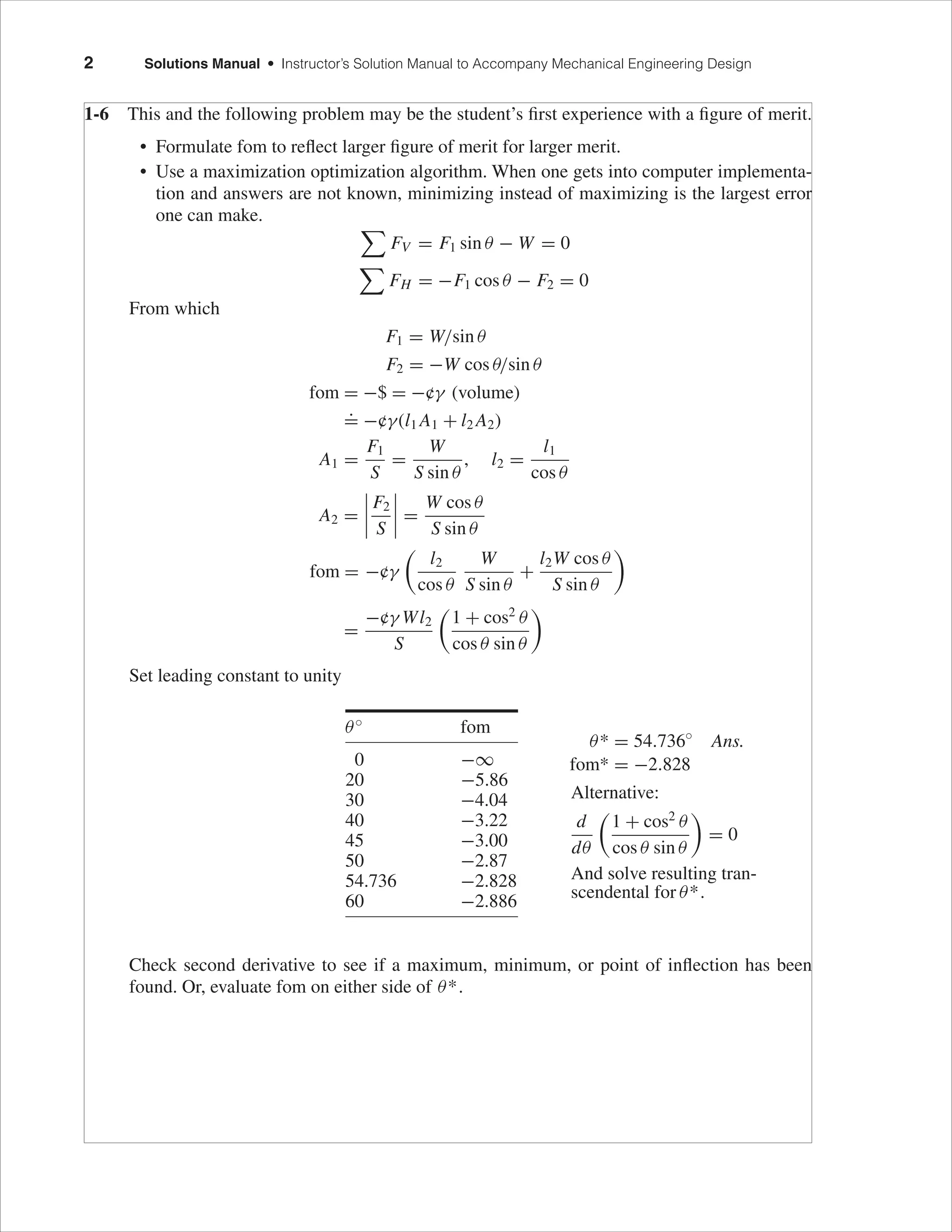
1-6 This and the following problem may be the student’s first experience with a figure of merit.
• Formulate fom to reflect larger figure of merit for larger merit.
• Use a maximization optimization algorithm. When one gets into computer implementa-
tion and answers are not known, minimizing instead of maximizing is the largest error
one can make.
FV = F1 sin θ − W = 0
FH = −F1 cos θ − F2 = 0
From which
F1 = W/sin θ
F2 = −W cos θ/sin θ
fom = −$ = −¢γ (volume)
.
= −¢γ(l1 A1 + l2 A2)
A1 =
F1
S
=
W
S sin θ
, l2 =
l1
cos θ
A2 =
F2
S
=
W cos θ
S sin θ
fom = −¢γ
l2
cos θ
W
S sin θ
+
l2W cos θ
S sin θ
=
−¢γ Wl2
S
1 + cos2
θ
cos θ sin θ
Set leading constant to unity
θ◦ fom
0 −∞
20 −5.86
30 −4.04
40 −3.22
45 −3.00
50 −2.87
54.736 −2.828
60 −2.886
Check second derivative to see if a maximum, minimum, or point of inflection has been
found. Or, evaluate fom on either side of θ*.
θ* = 54.736◦
Ans.
fom* = −2.828
Alternative:
d
dθ
1 + cos2
θ
cos θ sin θ
= 0
And solve resulting tran-
scendental for θ*.
budy_sm_ch01.qxd 11/21/2006 15:23 Page 2
Chapter 1 3
1-7
(a) x1 + x2 = X1 + e1 + X2 + e2
error = e = (x1 + x2) − (X1 + X2)
= e1 + e2 Ans.
(b) x1 − x2 = X1 + e1 − (X2 + e2)
e = (x1 − x2) − (X1 − X2) = e1 − e2 Ans.
(c) x1x2 = (X1 + e1)(X2 + e2)
e = x1x2 − X1 X2 = X1e2 + X2e1 + e1e2
.
= X1e2 + X2e1 = X1 X2
e1
X1
+
e2
X2
Ans.
(d)
x1
x2
=
X1 + e1
X2 + e2
=
X1
X2
1 + e1/X1
1 + e2/X2
1 +
e2
X2
−1
.
= 1 −
e2
X2
and 1 +
e1
X1
1 −
e2
X2
.
= 1 +
e1
X1
−
e2
X2
e =
x1
x2
−
X1
X2
.
=
X1
X2
e1
X1
−
e2
X2
Ans.
1-8
(a) x1 =
√
5 = 2.236 067 977 5
X1 = 2.23 3-correct digits
x2 =
√
6 = 2.449 487 742 78
X2 = 2.44 3-correct digits
x1 + x2 =
√
5 +
√
6 = 4.685 557 720 28
e1 = x1 − X1 =
√
5 − 2.23 = 0.006 067 977 5
e2 = x2 − X2 =
√
6 − 2.44 = 0.009 489 742 78
e = e1 + e2 =
√
5 − 2.23 +
√
6 − 2.44 = 0.015 557 720 28
Sum = x1 + x2 = X1 + X2 + e
= 2.23 + 2.44 + 0.015 557 720 28
= 4.685 557 720 28 (Checks) Ans.
(b) X1 = 2.24, X2 = 2.45
e1 =
√
5 − 2.24 = −0.003 932 022 50
e2 =
√
6 − 2.45 = −0.000 510 257 22
e = e1 + e2 = −0.004 442 279 72
Sum = X1 + X2 + e
= 2.24 + 2.45 + (−0.004 442 279 72)
= 4.685 557 720 28 Ans.
budy_sm_ch01.qxd 11/21/2006 15:23 Page 3
4 Solutions Manual • Instructor’s Solution Manual to Accompany Mechanical Engineering Design
1-9
(a) σ = 20(6.89) = 137.8 MPa
(b) F = 350(4.45) = 1558 N = 1.558 kN
(c) M = 1200 lbf · in (0.113) = 135.6 N · m
(d) A = 2.4(645) = 1548 mm2
(e) I = 17.4 in4
(2.54)4
= 724.2 cm4
(f) A = 3.6(1.610)2
= 9.332 km2
(g) E = 21(1000)(6.89) = 144.69(103
) MPa = 144.7 GPa
(h) v = 45 mi/h (1.61) = 72.45 km/h
(i) V = 60 in3
(2.54)3
= 983.2 cm3
= 0.983 liter
1-10
(a) l = 1.5/0.305 = 4.918 ft = 59.02 in
(b) σ = 600/6.89 = 86.96 kpsi
(c) p = 160/6.89 = 23.22 psi
(d) Z = 1.84(105
)/(25.4)3
= 11.23 in3
(e) w = 38.1/175 = 0.218 lbf/in
(f) δ = 0.05/25.4 = 0.00197 in
(g) v = 6.12/0.0051 = 1200 ft/min
(h) = 0.0021 in/in
(i) V = 30/(0.254)3
= 1831 in3
1-11
(a) σ =
200
15.3
= 13.1 MPa
(b) σ =
42(103
)
6(10−2)2
= 70(106
) N/m2
= 70 MPa
(c) y =
1200(800)3
(10−3
)3
3(207)109(64)103(10−3)4
= 1.546(10−2
) m = 15.5 mm
(d) θ =
1100(250)(10−3
)
79.3(109)(π/32)(25)4(10−3)4
= 9.043(10−2
) rad = 5.18◦
1-12
(a) σ =
600
20(6)
= 5 MPa
(b) I =
1
12
8(24)3
= 9216 mm4
(c) I =
π
64
324
(10−1
)4
= 5.147 cm4
(d) τ =
16(16)
π(253)(10−3)3
= 5.215(106
) N/m2
= 5.215 MPa
budy_sm_ch01.qxd 11/21/2006 15:23 Page 4
Chapter 1 5
1-13
(a) τ =
120(103
)
(π/4)(202)
= 382 MPa
(b) σ =
32(800)(800)(10−3
)
π(32)3(10−3)3
= 198.9(106
) N/m2
= 198.9 MPa
(c) Z =
π
32(36)
(364
− 264
) = 3334 mm3
(d) k =
(1.6)4
(10−3
)4
(79.3)(109
)
8(19.2)3(10−3)3(32)
= 286.8 N/m
budy_sm_ch01.qxd 11/21/2006 15:23 Page 5
FIRST PAGES
2-1 From Table A-20
Sut = 470 MPa (68 kpsi), Sy = 390 MPa (57 kpsi) Ans.
2-2 From Table A-20
Sut = 620 MPa (90 kpsi), Sy = 340 MPa (49.5 kpsi) Ans.
2-3 Comparison of yield strengths:
Sut of G10500 HR is
620
470
= 1.32 times larger than SAE1020 CD Ans.
Syt of SAE1020 CD is
390
340
= 1.15 times larger than G10500 HR Ans.
From Table A-20, the ductilities (reduction in areas) show,
SAE1020 CD is
40
35
= 1.14 times larger than G10500 Ans.
The stiffness values of these materials are identical Ans.
Table A-20 Table A-5
Sut Sy Ductility Stiffness
MPa (kpsi) MPa (kpsi) R% GPa (Mpsi)
SAE1020 CD 470(68) 390 (57) 40 207(30)
UNS10500 HR 620(90) 340(495) 35 207(30)
2-4 From Table A-21
1040 Q&T ¯Sy = 593 (86) MPa (kpsi) at 205◦
C (400◦
F) Ans.
2-5 From Table A-21
1040 Q&T R = 65% at 650◦
C (1200◦
F) Ans.
2-6 Using Table A-5, the specific strengths are:
UNS G10350 HR steel:
Sy
W
=
39.5(103
)
0.282
= 1.40(105
) in Ans.
2024 T4 aluminum:
Sy
W
=
43(103
)
0.098
= 4.39(105
) in Ans.
Ti-6Al-4V titanium:
Sy
W
=
140(103
)
0.16
= 8.75(105
) in Ans.
ASTM 30 gray cast iron has no yield strength. Ans.
Chapter 2
budynas_SM_ch02.qxd 11/22/2006 16:28 Page 6
FIRST PAGES
Chapter 2 7
2-7 The specific moduli are:
UNS G10350 HR steel:
E
W
=
30(106
)
0.282
= 1.06(108
) in Ans.
2024 T4 aluminum:
E
W
=
10.3(106
)
0.098
= 1.05(108
) in Ans.
Ti-6Al-4V titanium:
E
W
=
16.5(106
)
0.16
= 1.03(108
) in Ans.
Gray cast iron:
E
W
=
14.5(106
)
0.26
= 5.58(107
) in Ans.
2-8 2G(1 + ν) = E ⇒ ν =
E − 2G
2G
From Table A-5
Steel: ν =
30 − 2(11.5)
2(11.5)
= 0.304 Ans.
Aluminum: ν =
10.4 − 2(3.90)
2(3.90)
= 0.333 Ans.
Beryllium copper: ν =
18 − 2(7)
2(7)
= 0.286 Ans.
Gray cast iron: ν =
14.5 − 2(6)
2(6)
= 0.208 Ans.
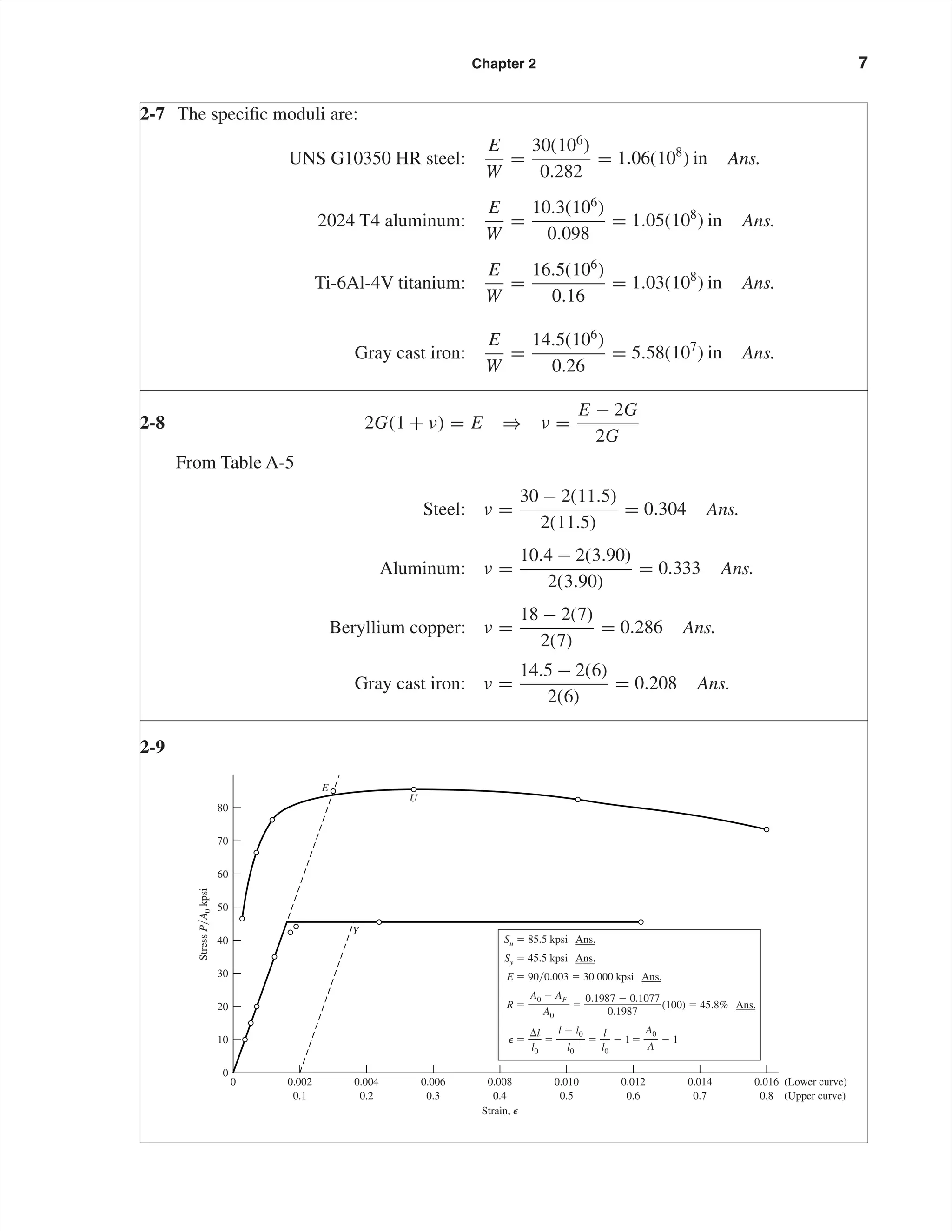
2-9
0
10
0 0.002
0.1
0.004
0.2
0.006
0.3
0.008
0.4
0.010
0.5
0.012
0.6
0.014
0.7
0.016
0.8
(Lower curve)
(Upper curve)
20
30
40
50
StressP͞A0kpsi
Strain, ⑀
60
70
80
E
Y
U
Su ϭ 85.5 kpsi Ans.
E ϭ 90͞0.003 ϭ 30 000 kpsi Ans.
Sy ϭ 45.5 kpsi Ans.
R ϭ (100) ϭ 45.8% Ans.
A0 Ϫ AF
A0
ϭ
0.1987 Ϫ 0.1077
0.1987
⑀ ϭ
⌬l
l0
ϭ
l Ϫ l0
l0
l
l0
ϭ Ϫ 1
A
A0
ϭ Ϫ 1
budynas_SM_ch02.qxd 11/22/2006 16:28 Page 7
FIRST PAGES
8 Solutions Manual • Instructor’s Solution Manual to Accompany Mechanical Engineering Design
2-10 To plot σtrue vs. ε, the following equations are applied to the data.
A0 =
π(0.503)2
4
= 0.1987 in2
Eq. (2-4) ε = ln
l
l0
for 0 ≤ L ≤ 0.0028 in
ε = ln
A0
A
for L > 0.0028 in
σtrue =
P
A
The results are summarized in the table below and plotted on the next page.
The last 5 points of data are used to plot log σ vs log ε
The curve fit gives m = 0.2306
log σ0 = 5.1852 ⇒ σ0 = 153.2 kpsi
Ans.
For 20% cold work, Eq. (2-10) and Eq. (2-13) give,
A = A0(1 − W) = 0.1987(1 − 0.2) = 0.1590 in2
ε = ln
A0
A
= ln
0.1987
0.1590
= 0.2231
Eq. (2-14):
Sy = σ0εm
= 153.2(0.2231)0.2306
= 108.4 kpsi Ans.
Eq. (2-15), with Su = 85.5 kpsi from Prob. 2-9,
Su =
Su
1 − W
=
85.5
1 − 0.2
= 106.9 kpsi Ans.
P L A ε σtrue log ε log σtrue
0 0 0.198713 0 0
1000 0.0004 0.198713 0.0002 5032.388 −3.69901 3.701774
2000 0.0006 0.198713 0.0003 10064.78 −3.52294 4.002804
3000 0.0010 0.198713 0.0005 15097.17 −3.30114 4.178895
4000 0.0013 0.198713 0.00065 20129.55 −3.18723 4.303834
7000 0.0023 0.198713 0.001149 35226.72 −2.93955 4.546872
8400 0.0028 0.198713 0.001399 42272.06 −2.85418 4.626053
8800 0.0036 0.1984 0.001575 44354.84 −2.80261 4.646941
9200 0.0089 0.1978 0.004604 46511.63 −2.33685 4.667562
9100 0.1963 0.012216 46357.62 −1.91305 4.666121
13200 0.1924 0.032284 68607.07 −1.49101 4.836369
15200 0.1875 0.058082 81066.67 −1.23596 4.908842
17000 0.1563 0.240083 108765.2 −0.61964 5.03649
16400 0.1307 0.418956 125478.2 −0.37783 5.098568
14800 0.1077 0.612511 137418.8 −0.21289 5.138046
budynas_SM_ch02.qxd 11/22/2006 16:28 Page 8
FIRST PAGES
Chapter 2 9
2-11 Tangent modulus at σ = 0 is
E0 =
σ
ε
.
=
5000 − 0
0.2(10−3) − 0
= 25(106
) psi
At σ = 20 kpsi
E20
.
=
(26 − 19)(103
)
(1.5 − 1)(10−3)
= 14.0(106
) psi Ans.
ε(10−3
) σ (kpsi)
0 0
0.20 5
0.44 10
0.80 16
1.0 19
1.5 26
2.0 32
2.8 40
3.4 46
4.0 49
5.0 54
log ␧
log␴
y ϭ 0.2306x ϩ 5.1852
4.8
4.9
5
5.1
5.2
Ϫ1.6 Ϫ1.4 Ϫ1.2 Ϫ1 Ϫ0.8 Ϫ0.6 Ϫ0.4 Ϫ0.2 0
␧true
␴true(psi)
0
20000
40000
60000
80000
100000
120000
140000
160000
0 0.1 0.2 0.3 0.4 0.5 0.6 0.7
␧ (10Ϫ3
)
(Sy)0.001 ϭ˙ 35 kpsi Ans.
␴(kpsi)
0
10
20
30
40
50
60
0 1 2 3 4 5
budynas_SM_ch02.qxd 11/22/2006 16:28 Page 9
FIRST PAGES
10 Solutions Manual • Instructor’s Solution Manual to Accompany Mechanical Engineering Design
2-12 Since |εo| = |εi |
ln
R + h
R + N
= ln
R
R + N
= −ln
R + N
R
R + h
R + N
=
R + N
R
(R + N)2
= R(R + h)
From which, N2
+ 2RN − Rh = 0
The roots are: N = R −1 ± 1 +
h
R
1/2
The + sign being significant,
N = R 1 +
h
R
1/2
− 1 Ans.
Substitute for N in
εo = ln
R + h
R + N
Gives ε0 = ln





R + h
R + R 1 +
h
R
1/2
− R





= ln 1 +
h
R
1/2
Ans.
These constitute a useful pair of equations in cold-forming situations, allowing the surface
strains to be found so that cold-working strength enhancement can be estimated.
2-13 From Table A-22
AISI 1212 Sy = 28.0 kpsi, σf = 106 kpsi, Sut = 61.5 kpsi
σ0 = 110 kpsi, m = 0.24, εf = 0.85
From Eq. (2-12) εu = m = 0.24
Eq. (2-10)
A0
Ai
=
1
1 − W
=
1
1 − 0.2
= 1.25
Eq. (2-13) εi = ln 1.25 = 0.2231 ⇒ εi < εu
Eq. (2-14) Sy = σ0εm
i = 110(0.2231)0.24
= 76.7 kpsi Ans.
Eq. (2-15) Su =
Su
1 − W
=
61.5
1 − 0.2
= 76.9 kpsi Ans.
2-14 For HB = 250,
Eq. (2-17) Su = 0.495 (250) = 124 kpsi
= 3.41 (250) = 853 MPa
Ans.
budynas_SM_ch02.qxd 11/22/2006 16:28 Page 10
FIRST PAGES
Chapter 2 11
2-15 For the data given,
HB = 2530 H2
B = 640 226
¯HB =
2530
10
= 253 ˆσH B =
640 226 − (2530)2/10
9
= 3.887
Eq. (2-17)
¯Su = 0.495(253) = 125.2 kpsi Ans.
¯σsu = 0.495(3.887) = 1.92 kpsi Ans.
2-16 From Prob. 2-15, ¯HB = 253 and ˆσHB = 3.887
Eq. (2-18)
¯Su = 0.23(253) − 12.5 = 45.7 kpsi Ans.
ˆσsu = 0.23(3.887) = 0.894 kpsi Ans.
2-17
(a) uR
.
=
45.52
2(30)
= 34.5 in · lbf/in3
Ans.
(b)
P L A A0/A − 1 ε σ = P/A0
0 0 0 0
1000 0.0004 0.0002 5032.39
2000 0.0006 0.0003 10064.78
3000 0.0010 0.0005 15097.17
4000 0.0013 0.00065 20129.55
7000 0.0023 0.00115 35226.72
8400 0.0028 0.0014 42272.06
8800 0.0036 0.0018 44285.02
9200 0.0089 0.00445 46297.97
9100 0.1963 0.012291 0.012291 45794.73
13200 0.1924 0.032811 0.032811 66427.53
15200 0.1875 0.059802 0.059802 76492.30
17000 0.1563 0.271355 0.271355 85550.60
16400 0.1307 0.520373 0.520373 82531.17
14800 0.1077 0.845059 0.845059 74479.35
budynas_SM_ch02.qxd 11/22/2006 16:28 Page 11
FIRST PAGES
12 Solutions Manual • Instructor’s Solution Manual to Accompany Mechanical Engineering Design
uT
.
=
5
i=1
Ai =
1
2
(43 000)(0.001 5) + 45 000(0.004 45 − 0.001 5)
+
1
2
(45 000 + 76 500)(0.059 8 − 0.004 45)
+ 81 000(0.4 − 0.059 8) + 80 000(0.845 − 0.4)
.
= 66.7(103
)in · lbf/in3
Ans.
␧
␴
0
20000
10000
30000
40000
50000
60000
70000
80000
90000
0 0.2 0.4 0.6 0.8
A3
A4 A5
Last 6 data points
First 9 data points
␧
␴
0
A1 A215000
10000
5000
20000
25000
30000
35000
40000
45000
50000
0 0.0020.001 0.003 0.004 0.005
␧
␴
0
20000
10000
30000
40000
50000
60000
70000
80000
90000
0 0.2 0.4
All data points
0.6 0.8
budynas_SM_ch02.qxd 11/22/2006 16:28 Page 12
FIRST PAGES
Chapter 2 13
2-18 m = Alρ
For stiffness, k = AE/l, or, A = kl/E.
Thus, m = kl2
ρ/E, and, M = E/ρ. Therefore, β = 1
From Fig. 2-16, ductile materials include Steel, Titanium, Molybdenum, Aluminum, and
Composites.
For strength, S = F/A, or, A = F/S.
Thus, m = Fl ρ/S, and, M = S/ρ.
From Fig. 2-19, lines parallel to S/ρ give for ductile materials, Steel, Nickel, Titanium, and
composites.
Common to both stiffness and strength are Steel, Titanium, Aluminum, and
Composites. Ans.
budynas_SM_ch02.qxd 11/22/2006 16:28 Page 13
FIRST PAGES
Chapter 3
3-1
1
RC
RA
RB
RD
C
A B
W
D
1
23
RB
RA
W
RB
RC
RA
2
1
W
RA
RBx
RBx RBy
RBy
RB
2
1
1
Scale of
corner magnified
W
A
B
(e)
(f)
(d)
W
A
RA RB
B
1
2
W
A
RA RB
B
11
2
(a) (b)
(c)
budynas_SM_ch03.qxd 11/28/2006 21:21 Page 14
FIRST PAGES
Chapter 3 15
3-2
(a) RA = 2 sin 60 = 1.732 kN Ans.
RB = 2 sin 30 = 1 kN Ans.
(b) S = 0.6 m
α = tan−1 0.6
0.4 + 0.6
= 30.96◦
RA
sin 135
=
800
sin 30.96
⇒ RA = 1100 N Ans.
RO
sin 14.04
=
800
sin 30.96
⇒ RO = 377 N Ans.
(c)
RO =
1.2
tan 30
= 2.078 kN Ans.
RA =
1.2
sin 30
= 2.4 kN Ans.
(d) Step 1: Find RA and RE
h =
4.5
tan 30
= 7.794 m
ۗ+ MA = 0
9RE − 7.794(400 cos 30) − 4.5(400 sin 30) = 0
RE = 400 N Ans.
Fx = 0 RAx + 400 cos 30 = 0 ⇒ RAx = −346.4 N
Fy = 0 RAy + 400 − 400 sin 30 = 0 ⇒ RAy = −200 N
RA = 346.42 + 2002 = 400 N Ans.
D
C
h
B
y
E xA
4.5 m
9 m
400 N
3
42
30°
60°
RAy
RA
RAx
RE
1.2 kN
60°
RA
RO
60°90°
30°
1.2 kN
RARO
45Њ Ϫ 30.96Њ ϭ 14.04Њ
135°
30.96°
30.96°
800 N
RA
RO
O
0.4 m
45°
800 N
␣
0.6 m
A
s
RA
RO
B
60°
90°
30°
2 kN
RA
RB
2
1
2 kN
60°30°
RA
RB
budynas_SM_ch03.qxd 11/28/2006 21:21 Page 15
FIRST PAGES
16 Solutions Manual • Instructor’s Solution Manual to Accompany Mechanical Engineering Design
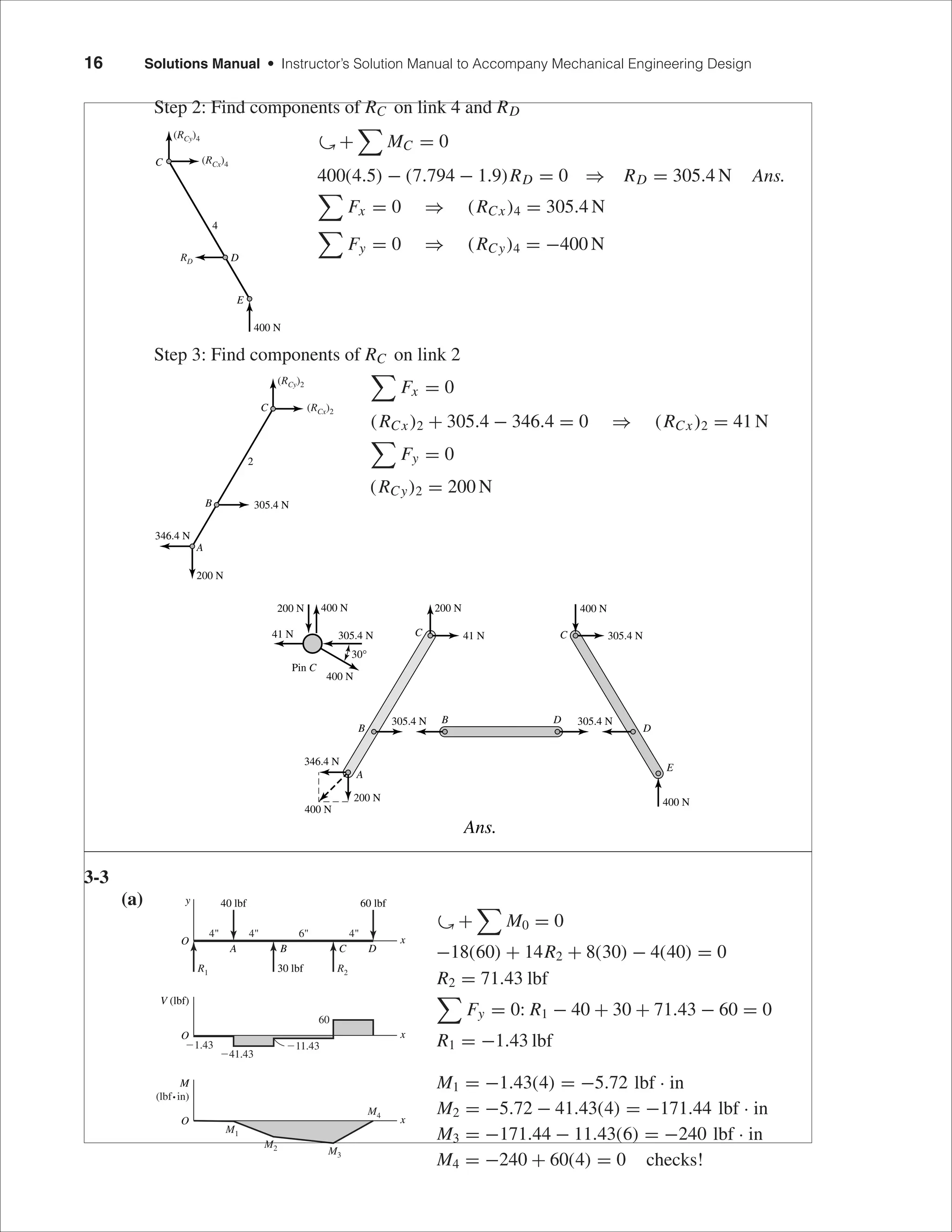
Step 2: Find components of RC on link 4 and RD
ۗ+ MC = 0
400(4.5) − (7.794 − 1.9)RD = 0 ⇒ RD = 305.4 N Ans.
Fx = 0 ⇒ (RCx)4 = 305.4 N
Fy = 0 ⇒ (RCy)4 = −400 N
Step 3: Find components of RC on link 2
Fx = 0
(RCx)2 + 305.4 − 346.4 = 0 ⇒ (RCx)2 = 41 N
Fy = 0
(RCy)2 = 200 N
3-3
(a)
ۗ+ M0 = 0
−18(60) + 14R2 + 8(30) − 4(40) = 0
R2 = 71.43 lbf
Fy = 0: R1 − 40 + 30 + 71.43 − 60 = 0
R1 = −1.43 lbf
M1 = −1.43(4) = −5.72 lbf · in
M2 = −5.72 − 41.43(4) = −171.44 lbf · in
M3 = −171.44 − 11.43(6) = −240 lbf · in
M4 = −240 + 60(4) = 0 checks!
4" 4" 6" 4"
Ϫ1.43
Ϫ41.43
Ϫ11.43
60
40 lbf 60 lbf
30 lbf
x
x
x
O
A B C D
y
R1 R2
M1
M2 M3
M4
O
V (lbf)
M
(lbf• in)
O
CC
DB
A
B D
E
305.4 N
346.4 N
305.4 N
41 N
400 N
200 N
400 N
200 N
400 N
Pin C
30°
305.4 N
400 N
400 N200 N
41 N
305.4 N
200 N
346.4 N
305.4 N
(RCx)2
(RCy)2
C
B
A
2
400 N
4
RD
(RCx)4
(RCy)4
D
C
E
Ans.
budynas_SM_ch03.qxd 11/28/2006 21:21 Page 16
FIRST PAGES
Chapter 3 17
(b) Fy = 0
R0 = 2 + 4(0.150) = 2.6kN
M0 = 0
M0 = 2000(0.2) + 4000(0.150)(0.425)
= 655 N · m
M1 = −655 + 2600(0.2) = −135 N · m
M2 = −135 + 600(0.150) = −45 N · m
M3 = −45 +
1
2
600(0.150) = 0 checks!
(c) M0 = 0: 10R2 − 6(1000) = 0 ⇒ R2 = 600 lbf
Fy = 0: R1 − 1000 + 600 = 0 ⇒ R1 = 400 lbf
M1 = 400(6) = 2400 lbf · ft
M2 = 2400 − 600(4) = 0 checks!
(d) ۗ+ MC = 0
−10R1 + 2(2000) + 8(1000) = 0
R1 = 1200 lbf
Fy = 0: 1200 − 1000 − 2000 + R2 = 0
R2 = 1800 lbf
M1 = 1200(2) = 2400 lbf · ft
M2 = 2400 + 200(6) = 3600 lbf · ft
M3 = 3600 − 1800(2) = 0 checks!
2000 lbf1000 lbf
R1
O
O
M1
M2
M3
R2
6 ft 2 ft2 ft
A B C
y
M
1200
Ϫ1800
200
x
x
x
6 ft 4 ft
A
O
O
O
B
Ϫ600
M1
M2
V (lbf)
1000 lbfy
R1 R2
400
M
(lbf•ft)
x
x
x
V (kN)
150 mm200 mm 150 mm
2.6
Ϫ655
M
(N•m)
0.6
M1
M2
M3
2 kN 4 kN/my
A
O
O
O
O
B C
RO
MO
x
x
x
budynas_SM_ch03.qxd 11/28/2006 21:21 Page 17
FIRST PAGES
18 Solutions Manual • Instructor’s Solution Manual to Accompany Mechanical Engineering Design
(e) ۗ+ MB = 0
−7R1 + 3(400) − 3(800) = 0
R1 = −171.4 lbf
Fy = 0: −171.4 − 400 + R2 − 800 = 0
R2 = 1371.4 lbf
M1 = −171.4(4) = −685.7 lbf · ft
M2 = −685.7 − 571.4(3) = −2400 lbf · ft
M3 = −2400 + 800(3) = 0 checks!
(f) Break at A
R1 = VA =
1
2
40(8) = 160 lbf
ۗ + MD = 0
12(160) − 10R2 + 320(5) = 0
R2 = 352 lbf
Fy = 0
−160 + 352 − 320 + R3 = 0
R3 = 128 lbf
M1 =
1
2
160(4) = 320 lbf · in
M2 = 320 −
1
2
160(4) = 0 checks! (hinge)
M3 = 0 − 160(2) = −320 lbf · in
M4 = −320 + 192(5) = 640 lbf · in
M5 = 640 − 128(5) = 0 checks!
40 lbf/in
V (lbf)
O
O
160
Ϫ160
Ϫ128
192
M
320 lbf
160 lbf 352 lbf 128 lbf
M1
M2
M3
M4
M5
x
x
x
8"
5"
2"
5"
40 lbf/in
160 lbf
O
A
y
B D
C
A
320 lbf
R2 R3
R1 VA
A
O
O
O
C
M
V (lbf)
800
Ϫ171.4
Ϫ571.4
3 ft 3 ft4 ft
800 lbf400 lbf
B
y
M1
M2
M3
R1 R2
x
x
x
budynas_SM_ch03.qxd 11/28/2006 21:21 Page 18
FIRST PAGES
Chapter 3 19
3-4
(a) q = R1 x −1
− 40 x − 4 −1
+ 30 x − 8 −1
+ R2 x − 14 −1
− 60 x − 18 −1
V = R1 − 40 x − 4 0
+ 30 x − 8 0
+ R2 x − 14 0
− 60 x − 18 0
(1)
M = R1x − 40 x − 4 1
+ 30 x − 8 1
+ R2 x − 14 1
− 60 x − 18 1
(2)
for x = 18+
V = 0 and M = 0 Eqs. (1) and (2) give
0 = R1 − 40 + 30 + R2 − 60 ⇒ R1 + R2 = 70 (3)
0 = R1(18) − 40(14) + 30(10) + 4R2 ⇒ 9R1 + 2R2 = 130 (4)
Solve (3) and (4) simultaneously to get R1 = −1.43 lbf, R2 = 71.43 lbf. Ans.
From Eqs. (1) and (2), at x = 0+
, V = R1 = −1.43 lbf, M = 0
x = 4+
: V = −1.43 − 40 = −41.43, M = −1.43x
x = 8+
: V = −1.43 − 40 + 30 = −11.43
M = −1.43(8) − 40(8 − 4)1
= −171.44
x = 14+
: V = −1.43 − 40 + 30 + 71.43 = 60
M = −1.43(14) − 40(14 − 4) + 30(14 − 8) = −240.
x = 18+
: V = 0, M = 0 See curves of V and M in Prob. 3-3 solution.
(b) q = R0 x −1
− M0 x −2
− 2000 x − 0.2 −1
− 4000 x − 0.35 0
+ 4000 x − 0.5 0
V = R0 − M0 x −1
− 2000 x − 0.2 0
− 4000 x − 0.35 1
+ 4000 x − 0.5 1
(1)
M = R0x − M0 − 2000 x − 0.2 1
− 2000 x − 0.35 2
+ 2000 x − 0.5 2
(2)
at x = 0.5+
m, V = M = 0, Eqs. (1) and (2) give
R0 − 2000 − 4000(0.5 − 0.35) = 0 ⇒ R1 = 2600 N = 2.6 kN Ans.
R0(0.5) − M0 − 2000(0.5 − 0.2) − 2000(0.5 − 0.35)2
= 0
with R0 = 2600 N, M0 = 655 N · m Ans.
With R0 and M0, Eqs. (1) and (2) give the same V and M curves as Prob. 3-3 (note for
V, M0 x −1
has no physical meaning).
(c) q = R1 x −1
− 1000 x − 6 −1
+ R2 x − 10 −1
V = R1 − 1000 x − 6 0
+ R2 x − 10 0
(1)
M = R1x − 1000 x − 6 1
+ R2 x − 10 1
(2)
at x = 10+
ft, V = M = 0, Eqs. (1) and (2) give
R1 − 1000 + R2 = 0 ⇒ R1 + R2 = 1000
10R1 − 1000(10 − 6) = 0 ⇒ R1 = 400 lbf, R2 = 1000 − 400 = 600 lbf
0 ≤ x ≤ 6: V = 400 lbf, M = 400x
6 ≤ x ≤ 10: V = 400 − 1000(x − 6)0
= 600 lbf
M = 400x − 1000(x − 6) = 6000 − 600x
See curves of Prob. 3-3 solution.
(d) q = R1 x −1
− 1000 x − 2 −1
− 2000 x − 8 −1
+ R2 x − 10 −1
V = R1 − 1000 x − 2 0
− 2000 x − 8 0
+ R2 x − 10 0
(1)
M = R1x − 1000 x − 2 1
− 2000 x − 8 1
+ R2 x − 10 1
(2)
budynas_SM_ch03.qxd 11/28/2006 21:21 Page 19
FIRST PAGES
20 Solutions Manual • Instructor’s Solution Manual to Accompany Mechanical Engineering Design
At x = 10+
, V = M = 0 from Eqs. (1) and (2)
R1 − 1000 − 2000 + R2 = 0 ⇒ R1 + R2 = 3000
10R1 − 1000(10 − 2) − 2000(10 − 8) = 0 ⇒ R1 = 1200 lbf,
R2 = 3000 − 1200 = 1800 lbf
0 ≤ x ≤ 2: V = 1200 lbf, M = 1200x lbf · ft
2 ≤ x ≤ 8: V = 1200 − 1000 = 200 lbf
M = 1200x − 1000(x − 2) = 200x + 2000 lbf · ft
8 ≤ x ≤ 10: V = 1200 − 1000 − 2000 = −1800 lbf
M = 1200x − 1000(x − 2) − 2000(x − 8) = −1800x + 18 000 lbf · ft
Plots are the same as in Prob. 3-3.
(e) q = R1 x −1
− 400 x − 4 −1
+ R2 x − 7 −1
− 800 x − 10 −1
V = R1 − 400 x − 4 0
+ R2 x − 7 0
− 800 x − 10 0
(1)
M = R1x − 400 x − 4 1
+ R2 x − 7 1
− 800 x − 10 1
(2)
at x = 10+
, V = M = 0
R1 − 400 + R2 − 800 = 0 ⇒ R1 + R2 = 1200 (3)
10R1 − 400(6) + R2(3) = 0 ⇒ 10R1 + 3R2 = 2400 (4)
Solve Eqs. (3) and (4) simultaneously: R1 = −171.4 lbf, R2 = 1371.4 lbf
0 ≤ x ≤ 4: V = −171.4 lbf, M = −171.4x lbf · ft
4 ≤ x ≤ 7: V = −171.4 − 400 = −571.4 lbf
M = −171.4x − 400(x − 4) lbf · ft = −571.4x + 1600
7 ≤ x ≤ 10: V = −171.4 − 400 + 1371.4 = 800 lbf
M = −171.4x − 400(x − 4) + 1371.4(x − 7) = 800x − 8000 lbf · ft
Plots are the same as in Prob. 3-3.
(f) q = R1 x −1
− 40 x 0
+ 40 x − 8 0
+ R2 x − 10 −1
− 320 x − 15 −1
+ R3 x − 20
V = R1 − 40x + 40 x − 8 1
+ R2 x − 10 0
− 320 x − 15 0
+ R3 x − 20 0
(1)
M = R1x − 20x2
+ 20 x − 8 2
+ R2 x − 10 1
− 320 x − 15 1
+ R3 x − 20 1
(2)
M = 0 at x = 8 in ∴ 8R1 − 20(8)2
= 0 ⇒ R1 = 160 lbf
at x = 20+
, V and M = 0
160 − 40(20) + 40(12) + R2 − 320 + R3 = 0 ⇒ R2 + R3 = 480
160(20) − 20(20)2
+ 20(12)2
+ 10R2 − 320(5) = 0 ⇒ R2 = 352 lbf
R3 = 480 − 352 = 128 lbf
0 ≤ x ≤ 8: V = 160 − 40x lbf, M = 160x − 20x2
lbf · in
8 ≤ x ≤ 10: V = 160 − 40x + 40(x − 8) = −160 lbf,
M = 160x − 20x2
+ 20(x − 8)2
= 1280 − 160x lbf · in
10 ≤ x ≤ 15: V = 160 − 40x + 40(x − 8) + 352 = 192 lbf
M = 160x − 20x2
+ 20(x − 8) + 352(x − 10) = 192x − 2240
budynas_SM_ch03.qxd 11/28/2006 21:21 Page 20
FIRST PAGES
Chapter 3 21
15 ≤ x ≤ 20: V = 160 − 40x + 40(x − 8) + 352 − 320 = −128 lbf
M = 160x − 20x2
− 20(x − 8) + 352(x − 10) − 320(x − 15)
= −128x + 2560
Plots of V and M are the same as in Prob. 3-3.
3-5 Solution depends upon the beam selected.
3-6
(a) Moment at center, xc = (l − 2a)/2
Mc =
w
2
l
2
(l − 2a) −
l
2
2
=
wl
2
l
4
− a
At reaction, |Mr | = wa2
/2
a = 2.25, l = 10 in, w = 100 lbf/in
Mc =
100(10)
2
10
4
− 2.25 = 125 lbf · in
Mr =
100(2.252
)
2
= 253.1 lbf · in Ans.
(b) Minimum occurs when Mc = |Mr |
wl
2
l
4
− a =
wa2
2
⇒ a2
+ al − 0.25l2
= 0
Taking the positive root
a =
1
2
−l + l2 + 4(0.25l2) =
l
2
√
2 − 1 = 0.2071l Ans.
for l = 10 in and w = 100 lbf, Mmin = (100/2)[(0.2071)(10)]2
= 214 lbf · in
3-7 For the ith wire from bottom, from summing forces vertically
(a)
Ti = (i + 1)W
From summing moments about point a,
Ma = W(l − xi ) − iW xi = 0
Giving,
xi =
l
i + 1
W iW
Ti
xi
a
budynas_SM_ch03.qxd 11/28/2006 21:21 Page 21
FIRST PAGES
22 Solutions Manual • Instructor’s Solution Manual to Accompany Mechanical Engineering Design
So
W =
l
1 + 1
=
l
2
x =
l
2 + 1
=
l
3
y =
l
3 + 1
=
l
4
z =
l
4 + 1
=
l
5
(b) With straight rigid wires, the mobile is not stable. Any perturbation can lead to all wires
becoming collinear. Consider a wire of length l bent at its string support:
Ma = 0
Ma =
iWl
i + 1
cos α −
ilW
i + 1
cos β = 0
iWl
i + 1
(cos α − cos β) = 0
Moment vanishes when α = β for any wire. Consider a ccw rotation angle β, which
makes α → α + β and β → α − β
Ma =
iWl
i + 1
[cos(α + β) − cos(α − β)]
=
2iWl
i + 1
sin α sin β
.
=
2iWlβ
i + 1
sin α
There exists a correcting moment of opposite sense to arbitrary rotation β. An equation
for an upward bend can be found by changing the sign of W. The moment will no longer
be correcting. A curved, convex-upward bend of wire will produce stable equilibrium
too, but the equation would change somewhat.
3-8
(a)
C =
12 + 6
2
= 9
CD =
12 − 6
2
= 3
R = 32 + 42 = 5
σ1 = 5 + 9 = 14
σ2 = 9 − 5 = 4
2␾s
(12, 4cw
)
C
R
D
␶2
␶1
␴1
␴␴2
2␾p
(6, 4ccw
)
y
x
␶cw
␶ccw
W
iW
il
i ϩ 1
Ti
␤␣
l
i ϩ 1
budynas_SM_ch03.qxd 11/28/2006 21:21 Page 22
FIRST PAGES
Chapter 3 23
φp =
1
2
tan−1 4
3
= 26.6◦
cw
τ1 = R = 5, φs = 45◦
− 26.6◦
= 18.4◦
ccw
(b)
C =
9 + 16
2
= 12.5
CD =
16 − 9
2
= 3.5
R = 52 + 3.52 = 6.10
σ1 = 6.1 + 12.5 = 18.6
φp =
1
2
tan−1 5
3.5
= 27.5◦
ccw
σ2 = 12.5 − 6.1 = 6.4
τ1 = R = 6.10, φs = 45◦
− 27.5◦
= 17.5◦
cw
(c)
C =
24 + 10
2
= 17
CD =
24 − 10
2
= 7
R = 72 + 62 = 9.22
σ1 = 17 + 9.22 = 26.22
σ2 = 17 − 9.22 = 7.78
2␾s
(24, 6cw
)
C
R
D
␶2
␶1
␴1␴2
2␾p
(10, 6ccw
)
y
x
␴
␶cw
␶ccw
x
12.5
12.5
6.10
17.5Њ
x
6.4
18.6
27.5Њ
2␾s
(16, 5ccw
)
C
R
D
␶2
␶1
␴1␴2
2␾p
(9, 5cw
)
y
x
␴
␶cw
␶ccw
9
5
9
9
9
18.4Њ
x
x
4
14
26.6Њ
budynas_SM_ch03.qxd 11/28/2006 21:21 Page 23
FIRST PAGES
24 Solutions Manual • Instructor’s Solution Manual to Accompany Mechanical Engineering Design
φp =
1
2
90 + tan−1 7
6
= 69.7◦
ccw
τ1 = R = 9.22, φs = 69.7◦
− 45◦
= 24.7◦
ccw
(d)
C =
9 + 19
2
= 14
CD =
19 − 9
2
= 5
R = 52 + 82 = 9.434
σ1 = 14 + 9.43 = 23.43
σ2 = 14 − 9.43 = 4.57
φp =
1
2
90 + tan−1 5
8
= 61.0◦
cw
τ1 = R = 9.434, φs = 61◦
− 45◦
= 16◦
cw
x
14
14
9.434
16Њ
x
23.43
4.57
61Њ
2␾s
(9, 8cw
)
C
R
D
␶2
␶1
␴1␴2
2␾p
(19, 8ccw
)
y
x
␴
␶cw
␶ccw
x
17
17
9.22
24.7Њ
x
26.22
7.78
69.7Њ
budynas_SM_ch03.qxd 11/28/2006 21:21 Page 24
FIRST PAGES
Chapter 3 25
3-9
(a)
C =
12 − 4
2
= 4
CD =
12 + 4
2
= 8
R = 82 + 72 = 10.63
σ1 = 4 + 10.63 = 14.63
σ2 = 4 − 10.63 = −6.63
φp =
1
2
90 + tan−1 8
7
= 69.4◦
ccw
τ1 = R = 10.63, φs = 69.4◦
− 45◦
= 24.4◦
ccw
(b)
C =
6 − 5
2
= 0.5
CD =
6 + 5
2
= 5.5
R = 5.52 + 82 = 9.71
σ1 = 0.5 + 9.71 = 10.21
σ2 = 0.5 − 9.71 = −9.21
φp =
1
2
tan−1 8
5.5
= 27.75◦
ccw
x
10.21
9.21
27.75Њ
2␾s
(Ϫ5, 8cw
)
C
R
D
␶2
␶1
␴1
␴
␴2
2␾p
(6, 8ccw
)
y
x
␶cw
␶ccw
x
4
4
10.63
24.4Њ
x
14.63
6.63
69.4Њ
2␾s
(12, 7cw
)
C
R
D
␶2
␶1
␴1
␴␴2
2␾p
(Ϫ4, 7ccw
)
y
x
␶cw
␶ccw
budynas_SM_ch03.qxd 11/28/2006 21:22 Page 25
FIRST PAGES
26 Solutions Manual • Instructor’s Solution Manual to Accompany Mechanical Engineering Design
τ1 = R = 9.71, φs = 45◦
− 27.75◦
= 17.25◦
cw
(c)
C =
−8 + 7
2
= −0.5
CD =
8 + 7
2
= 7.5
R = 7.52 + 62 = 9.60
σ1 = 9.60 − 0.5 = 9.10
σ2 = −0.5 − 9.6 = −10.1
φp =
1
2
90 + tan−1 7.5
6
= 70.67◦
cw
τ1 = R = 9.60, φs = 70.67◦
− 45◦
= 25.67◦
cw
(d)
C =
9 − 6
2
= 1.5
CD =
9 + 6
2
= 7.5
R = 7.52 + 32 = 8.078
σ1 = 1.5 + 8.078 = 9.58
σ2 = 1.5 − 8.078 = −6.58
2␾s
(9, 3cw
)
CR D
␶2
␶1
␴1␴2
2␾p
(Ϫ6, 3ccw
)
y
x
␴
␶cw
␶ccw
x
0.5
0.5
9.60
25.67Њ
x
10.1
9.1
70.67Њ
2␾s
(Ϫ8, 6cw
)
C
R
D
␶2
␶1
␴1␴2
2␾p
(7, 6ccw
)
x
y
␴
␶cw
␶ccw
x
0.5
0.5
9.71
17.25Њ
budynas_SM_ch03.qxd 11/28/2006 21:22 Page 26
FIRST PAGES
Chapter 3 27
φp =
1
2
tan−1 3
7.5
= 10.9◦
cw
τ1 = R = 8.078, φs = 45◦
− 10.9◦
= 34.1◦
ccw
3-10
(a)
C =
20 − 10
2
= 5
CD =
20 + 10
2
= 15
R = 152 + 82 = 17
σ1 = 5 + 17 = 22
σ2 = 5 − 17 = −12
φp =
1
2
tan−1 8
15
= 14.04◦
cw
τ1 = R = 17, φs = 45◦
− 14.04◦
= 30.96◦
ccw
5
17
5
30.96Њ
x
12
22
14.04Њ
x
2␾s (20, 8cw
)
C
R
D
␶2
␶1
␴1␴2
2␾p
(Ϫ10, 8ccw
)
y
x
␴
␶cw
␶ccw
x
1.5
8.08
1.5
34.1Њ
x
6.58
9.58
10.9Њ
budynas_SM_ch03.qxd 11/28/2006 21:22 Page 27
FIRST PAGES
28 Solutions Manual • Instructor’s Solution Manual to Accompany Mechanical Engineering Design
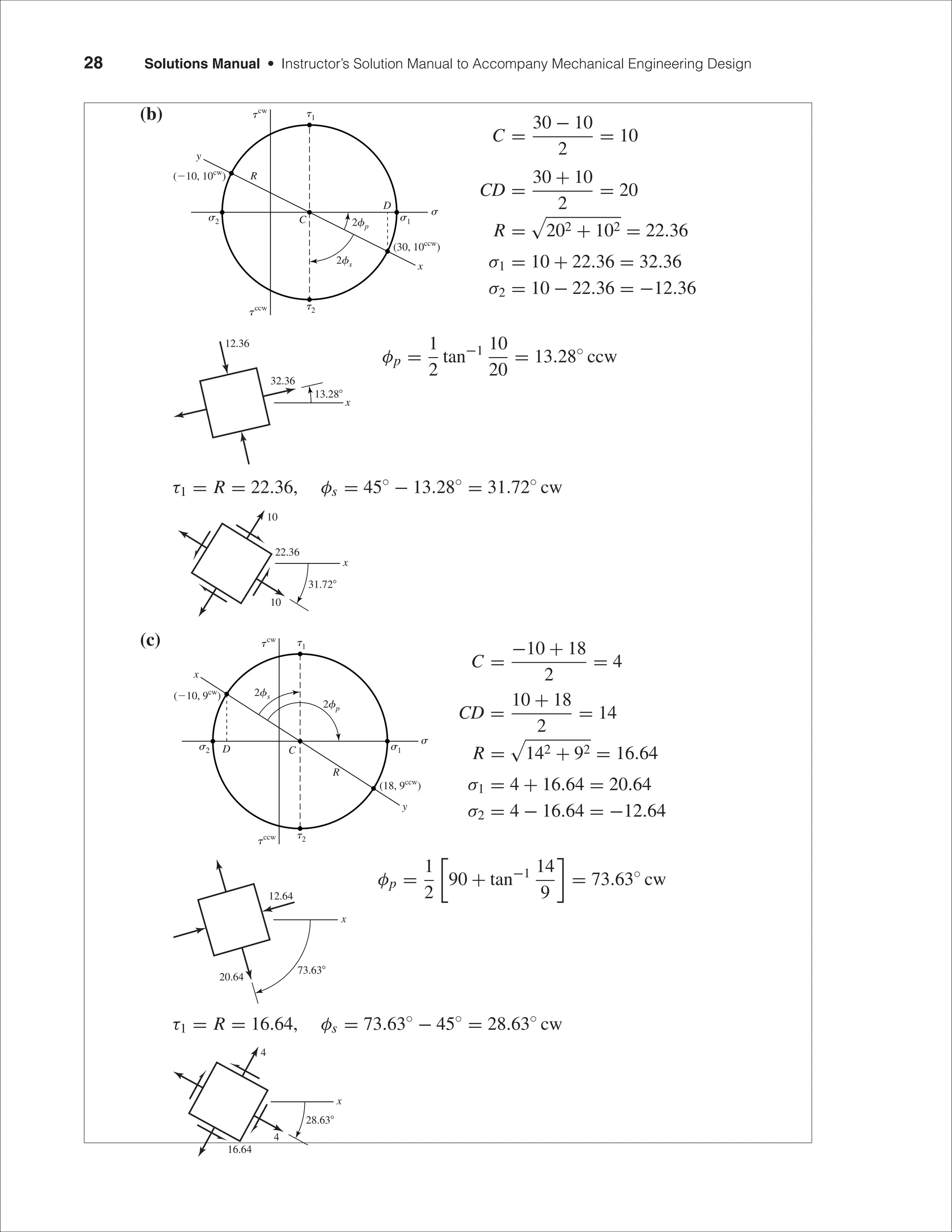
(b)
C =
30 − 10
2
= 10
CD =
30 + 10
2
= 20
R = 202 + 102 = 22.36
σ1 = 10 + 22.36 = 32.36
σ2 = 10 − 22.36 = −12.36
φp =
1
2
tan−1 10
20
= 13.28◦
ccw
τ1 = R = 22.36, φs = 45◦
− 13.28◦
= 31.72◦
cw
(c)
C =
−10 + 18
2
= 4
CD =
10 + 18
2
= 14
R = 142 + 92 = 16.64
σ1 = 4 + 16.64 = 20.64
σ2 = 4 − 16.64 = −12.64
φp =
1
2
90 + tan−1 14
9
= 73.63◦
cw
τ1 = R = 16.64, φs = 73.63◦
− 45◦
= 28.63◦
cw
4
x
16.64
4
28.63Њ
12.64
20.64
73.63Њ
x
2␾s(Ϫ10, 9cw
)
C
R
D
␶2
␶1
␴1␴2
2␾p
(18, 9ccw
)
y
x
␴
␶cw
␶ccw
10
10
22.36
31.72Њ
x
12.36
32.36
x
13.28Њ
2␾s
(Ϫ10, 10cw
)
C
R
D
␶2
␶1
␴1
␴
␴2 2␾p
(30, 10ccw
)
y
x
␶cw
␶ccw
budynas_SM_ch03.qxd 11/28/2006 21:22 Page 28
FIRST PAGES
Chapter 3 29
(d)
C =
−12 + 22
2
= 5
CD =
12 + 22
2
= 17
R = 172 + 122 = 20.81
σ1 = 5 + 20.81 = 25.81
σ2 = 5 − 20.81 = −15.81
φp =
1
2
90 + tan−1 17
12
= 72.39◦
cw
τ1 = R = 20.81, φs = 72.39◦
− 45◦
= 27.39◦
cw
3-11
(a)
(b)
C =
0 + 10
2
= 5
CD =
10 − 0
2
= 5
R = 52 + 42 = 6.40
σ1 = 5 + 6.40 = 11.40
σ2 = 0, σ3 = 5 − 6.40 = −1.40
τ1/3 = R = 6.40, τ1/2 =
11.40
2
= 5.70, τ2/3 =
1.40
2
= 0.70
␴1␴2
␴
␴3
D
x
y
␶
C
R
(0, 4cw
)
(10, 4ccw
)
␶2/3
␶1/2
␶1/3
␴x ϭ ␴1
␴
␴3 ϭ ␴y
␶
␴2 ϭ 0
Ϫ4 10y x
␶2/3 ϭ 2
␶1/2 ϭ 5
␶1/3 ϭ ϭ 7
14
2
5
20.81
5
27.39Њ
x
15.81
25.81
72.39Њ
x
2␾s(Ϫ12, 12cw
)
C
R
D
␶2
␶1
␴1␴2
2␾p
(22, 12ccw
)
y
x
␴
␶cw
␶ccw
budynas_SM_ch03.qxd 11/28/2006 21:22 Page 29
FIRST PAGES
30 Solutions Manual • Instructor’s Solution Manual to Accompany Mechanical Engineering Design
(c)
C =
−2 − 8
2
= −5
CD =
8 − 2
2
= 3
R = 32 + 42 = 5
σ1 = −5 + 5 = 0, σ2 = 0
σ3 = −5 − 5 = −10
τ1/3 =
10
2
= 5, τ1/2 = 0, τ2/3 = 5
(d)
C =
10 − 30
2
= −10
CD =
10 + 30
2
= 20
R = 202 + 102 = 22.36
σ1 = −10 + 22.36 = 12.36
σ2 = 0
σ3 = −10 − 22.36 = −32.36
τ1/3 = 22.36, τ1/2 =
12.36
2
= 6.18, τ2/3 =
32.36
2
= 16.18
3-12
(a)
C =
−80 − 30
2
= −55
CD =
80 − 30
2
= 25
R = 252 + 202 = 32.02
σ1 = 0
σ2 = −55 + 32.02 = −22.98 = −23.0
σ3 = −55 − 32.0 = −87.0
τ1/2 =
23
2
= 11.5, τ2/3 = 32.0, τ1/3 =
87
2
= 43.5
␴1
(Ϫ80, 20cw
)
(Ϫ30, 20ccw
)
C
D
R
␶2/3
␶1/2
␶1/3
␴2␴3
x
y
␶
␴
␴1
(Ϫ30, 10cw
)
(10, 10ccw
)
C D
R
␶2/3
␶1/2
␶␶1/3
␴2␴3
␴
y
x
␴1␴2
␴
␶
␴3
(Ϫ2, 4cw
)
Point is a circle
2 circles
C
D
y
x
(Ϫ8, 4ccw
)
budynas_SM_ch03.qxd 11/28/2006 21:22 Page 30
FIRST PAGES
Chapter 3 31
(b)
C =
30 − 60
2
= −15
CD =
60 + 30
2
= 45
R = 452 + 302 = 54.1
σ1 = −15 + 54.1 = 39.1
σ2 = 0
σ3 = −15 − 54.1 = −69.1
τ1/3 =
39.1 + 69.1
2
= 54.1, τ1/2 =
39.1
2
= 19.6, τ2/3 =
69.1
2
= 34.6
(c)
C =
40 + 0
2
= 20
CD =
40 − 0
2
= 20
R = 202 + 202 = 28.3
σ1 = 20 + 28.3 = 48.3
σ2 = 20 − 28.3 = −8.3
σ3 = σz = −30
τ1/3 =
48.3 + 30
2
= 39.1, τ1/2 = 28.3, τ2/3 =
30 − 8.3
2
= 10.9
(d)
C =
50
2
= 25
CD =
50
2
= 25
R = 252 + 302 = 39.1
σ1 = 25 + 39.1 = 64.1
σ2 = 25 − 39.1 = −14.1
σ3 = σz = −20
τ1/3 =
64.1 + 20
2
= 42.1, τ1/2 = 39.1, τ2/3 =
20 − 14.1
2
= 2.95
␴1
(50, 30cw
)
(0, 30ccw
)
C D
␶2/3
␶1/2
␶1/3
␴2␴3
x
y
␴
␶
␴1
(0, 20cw
)
(40, 20ccw
)
C
D
R
␶2/3
␶1/2
␶1/3
␴2␴3
y
x
␴
␶
␴1
␴
␶
(Ϫ60, 30ccw
)
(30, 30cw
)
C D
R
␶2/3
␶1/2
␶1/3
␴2␴3
x
y
budynas_SM_ch03.qxd 11/28/2006 21:22 Page 31
FIRST PAGES
32 Solutions Manual • Instructor’s Solution Manual to Accompany Mechanical Engineering Design
3-13
σ =
F
A
=
2000
(π/4)(0.52)
= 10 190 psi = 10.19 kpsi Ans.
δ =
FL
AE
= σ
L
E
= 10 190
72
30(106)
= 0.024 46 in Ans.
1 =
δ
L
=
0.024 46
72
= 340(10−6
) = 340µ Ans.
From Table A-5, ν = 0.292
2 = −ν 1 = −0.292(340) = −99.3µ Ans.
d = 2d = −99.3(10−6
)(0.5) = −49.6(10−6
) in Ans.
3-14 From Table A-5, E = 71.7 GPa
δ = σ
L
E
= 135(106
)
3
71.7(109)
= 5.65(10−3
) m = 5.65 mm Ans.
3-15 With σz = 0, solve the first two equations of Eq. (3-19) simultaneously. Place E on the left-
hand side of both equations, and using Cramer’s rule,
σx =
E x −ν
E y 1
1 −ν
−ν 1
=
E x + νE y
1 − ν2
=
E( x + ν y)
1 − ν2
Likewise,
σy =
E( y + ν x)
1 − ν2
From Table A-5, E = 207 GPa and ν = 0.292. Thus,
σx =
E( x + ν y)
1 − ν2
=
207(109
)[0.0021 + 0.292(−0.000 67)]
1 − 0.2922
(10−6
) = 431 MPa Ans.
σy =
207(109
)[−0.000 67 + 0.292(0.0021)]
1 − 0.2922
(10−6
) = −12.9 MPa Ans.
3-16 The engineer has assumed the stress to be uniform. That is,
Ft = −F cos θ + τ A = 0 ⇒ τ =
F
A
cos θ
When failure occurs in shear
Ssu =
F
A
cos θ
␶
␴
t
␪
F
budynas_SM_ch03.qxd 11/28/2006 21:22 Page 32
FIRST PAGES
Chapter 3 33
The uniform stress assumption is common practice but is not exact. If interested in the
details, see p. 570 of 6th edition.
3-17 From Eq. (3-15)
σ3
− (−2 + 6 − 4)σ2
+ [−2(6) + (−2)(−4) + 6(−4) − 32
− 22
− (−5)2
]σ
− [−2(6)(−4) + 2(3)(2)(−5) − (−2)(2)2
− 6(−5)2
− (−4)(3)2
] = 0
σ3
− 66σ + 118 = 0
Roots are: 7.012, 1.89, −8.903 kpsi Ans.
τ1/2 =
7.012 − 1.89
2
= 2.56 kpsi
τ2/3 =
8.903 + 1.89
2
= 5.40 kpsi
τmax = τ1/3 =
8.903 + 7.012
2
= 7.96 kpsi Ans.
Note: For Probs. 3-17 to 3-19, one can also find the eigenvalues of the matrix
[σ] =
σx τxy τzx
τxy σy τyz
τzx τyz σz
for the principal stresses
3-18 From Eq. (3-15)
σ3
− (10 + 0 + 10)σ2
+ 10(0) + 10(10) + 0(10) − 202
− −10
√
2
2
− 02
σ
− 10(0)(10) + 2(20) −10
√
2 (0) − 10 −10
√
2
2
− 0(0)2
− 10(20)2
= 0
σ3
− 20σ2
− 500σ + 6000 = 0
Roots are: 30, 10, −20 MPa Ans.
τ1/2 =
30 − 10
2
= 10 MPa
τ2/3 =
10 + 20
2
= 15 MPa
τmax = τ1/3 =
30 + 20
2
= 25 MPa Ans.
3010Ϫ20
␶2/3
␶1/2
␶1/3
␴ (MPa)
␶ (MPa)
7.0121.89
Ϫ8.903
␶2/3
␶1/2
␶1/3
␶ (kpsi)
␴ (kpsi)
budynas_SM_ch03.qxd 11/28/2006 21:22 Page 33
FIRST PAGES
34 Solutions Manual • Instructor’s Solution Manual to Accompany Mechanical Engineering Design
3-19 From Eq. (3-15)
σ3
− (1 + 4 + 4)σ2
+ [1(4) + 1(4) + 4(4) − 22
− (−4)2
− (−2)2
]σ
−[1(4)(4) + 2(2)(−4)(−2) − 1(−4)2
− 4(−2)2
− 4(2)2
] = 0
σ3
− 9σ2
= 0
Roots are: 9, 0, 0 kpsi
τ2/3 = 0, τ1/2 = τ1/3 = τmax =
9
2
= 4.5 kpsi Ans.
3-20
(a) R1 =
c
l
F Mmax = R1a =
ac
l
F
σ =
6M
bh2
=
6
bh2
ac
l
F ⇒ F =
σbh2
l
6ac
Ans.
(b)
Fm
F
=
(σm/σ)(bm/b) (hm/h)2
(lm/l)
(am/a) (cm/c)
=
1(s)(s)2
(s)
(s)(s)
= s2
Ans.
For equal stress, the model load varies by the square of the scale factor.
3-21
R1 =
wl
2
, Mmax|x=l/2 =
w
2
l
2
l −
l
2
=
wl2
8
σ =
6M
bh2
=
6
bh2
wl2
8
=
3Wl
4bh2
⇒ W =
4
3
σbh2
l
Ans.
Wm
W
=
(σm/σ)(bm/b) (hm/h)2
lm/l
=
1(s)(s)2
s
= s2
Ans.
wmlm
wl
= s2
⇒
wm
w
=
s2
s
= s Ans.
For equal stress, the model load w varies linearily with the scale factor.
␶2/3
␶(kpsi)
␴(kpsi)
␶1/2 ϭ ␶1/3
O 0 9
budynas_SM_ch03.qxd 11/28/2006 21:22 Page 34
FIRST PAGES
Chapter 3 35
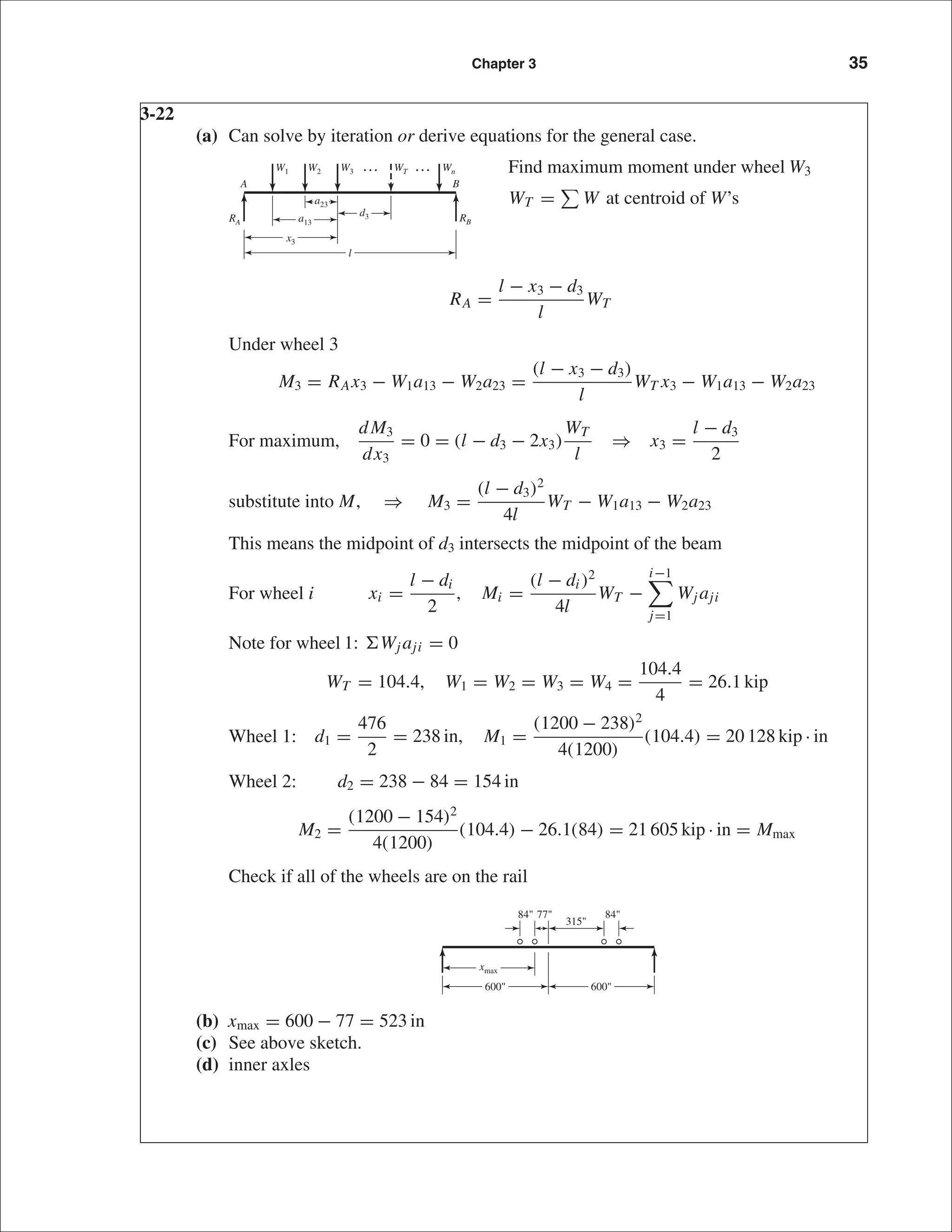
3-22
(a) Can solve by iteration or derive equations for the general case.
Find maximum moment under wheel W3
WT = W at centroid of W’s
RA =
l − x3 − d3
l
WT
Under wheel 3
M3 = RAx3 − W1a13 − W2a23 =
(l − x3 − d3)
l
WT x3 − W1a13 − W2a23
For maximum,
dM3
dx3
= 0 = (l − d3 − 2x3)
WT
l
⇒ x3 =
l − d3
2
substitute into M, ⇒ M3 =
(l − d3)2
4l
WT − W1a13 − W2a23
This means the midpoint of d3 intersects the midpoint of the beam
For wheel i xi =
l − di
2
, Mi =
(l − di )2
4l
WT −
i−1
j=1
Wjaji
Note for wheel 1: Wjaji = 0
WT = 104.4, W1 = W2 = W3 = W4 =
104.4
4
= 26.1 kip
Wheel 1: d1 =
476
2
= 238 in, M1 =
(1200 − 238)2
4(1200)
(104.4) = 20 128 kip · in
Wheel 2: d2 = 238 − 84 = 154 in
M2 =
(1200 − 154)2
4(1200)
(104.4) − 26.1(84) = 21 605 kip · in = Mmax
Check if all of the wheels are on the rail
(b) xmax = 600 − 77 = 523 in
(c) See above sketch.
(d) inner axles
600" 600"
84" 77" 84"
315"
xmax
RA
W1
A B
W3 . . . . . .W2 WT
d3
Wn
RB
a23
a13
x3
l
budynas_SM_ch03.qxd 11/28/2006 21:22 Page 35
FIRST PAGES
36 Solutions Manual • Instructor’s Solution Manual to Accompany Mechanical Engineering Design
3-23
(a)
Aa = Ab = 0.25(1.5) = 0.375 in2
A = 3(0.375) = 1.125 in2
¯y =
2(0.375)(0.75) + 0.375(0.5)
1.125
= 0.667 in
Ia =
0.25(1.5)3
12
= 0.0703 in4
Ib =
1.5(0.25)3
12
= 0.001 95 in4
I1 = 2[0.0703 + 0.375(0.083)2
] + [0.001 95 + 0.375(0.167)2
] = 0.158 in4
Ans.
σA =
10 000(0.667)
0.158
= 42(10)3
psi Ans.
σB =
10 000(0.667 − 0.375)
0.158
= 18.5(10)3
psi Ans.
σC =
10 000(0.167 − 0.125)
0.158
= 2.7(10)3
psi Ans.
σD = −
10 000(0.833)
0.158
= −52.7(10)3
psi Ans.
(b)
Here we treat the hole as a negative area.
Aa = 1.732 in2
Ab = 1.134
0.982
2
= 0.557 in2
D
C
B
A
y
11
a b
A
Ga Gb0.327"
0.25"
c1 ϭ 1.155"
c2 ϭ 0.577"
2"
1.732"
0.577"
0.982"
0.577"
1.134"
1
2
1 " 1
4
"
3
8
"
1
4
"
1
4
"
D
C
1 1
Ga
Gb
c1 ϭ 0.833"
0.167"
0.083"
0.5"
0.75"
1.5"
y ϭ c2 ϭ 0.667"
B
aa
b
A
budynas_SM_ch03.qxd 11/28/2006 21:22 Page 36
FIRST PAGES
Chapter 3 37
A = 1.732 − 0.557 = 1.175 in2
¯y =
1.732(0.577) − 0.557(0.577)
1.175
= 0.577 in Ans.
Ia =
bh3
36
=
2(1.732)3
36
= 0.289 in4
Ib =
1.134(0.982)3
36
= 0.0298 in4
I1 = Ia − Ib = 0.289 − 0.0298 = 0.259 in4
Ans.
because the centroids are coincident.
σA =
10 000(0.577)
0.259
= 22.3(10)3
psi Ans.
σB =
10 000(0.327)
0.259
= 12.6(10)3
psi Ans.
σC = −
10 000(0.982 − 0.327)
0.259
= −25.3(10)3
psi Ans.
σD = −
10 000(1.155)
0.259
= −44.6(10)3
psi Ans.
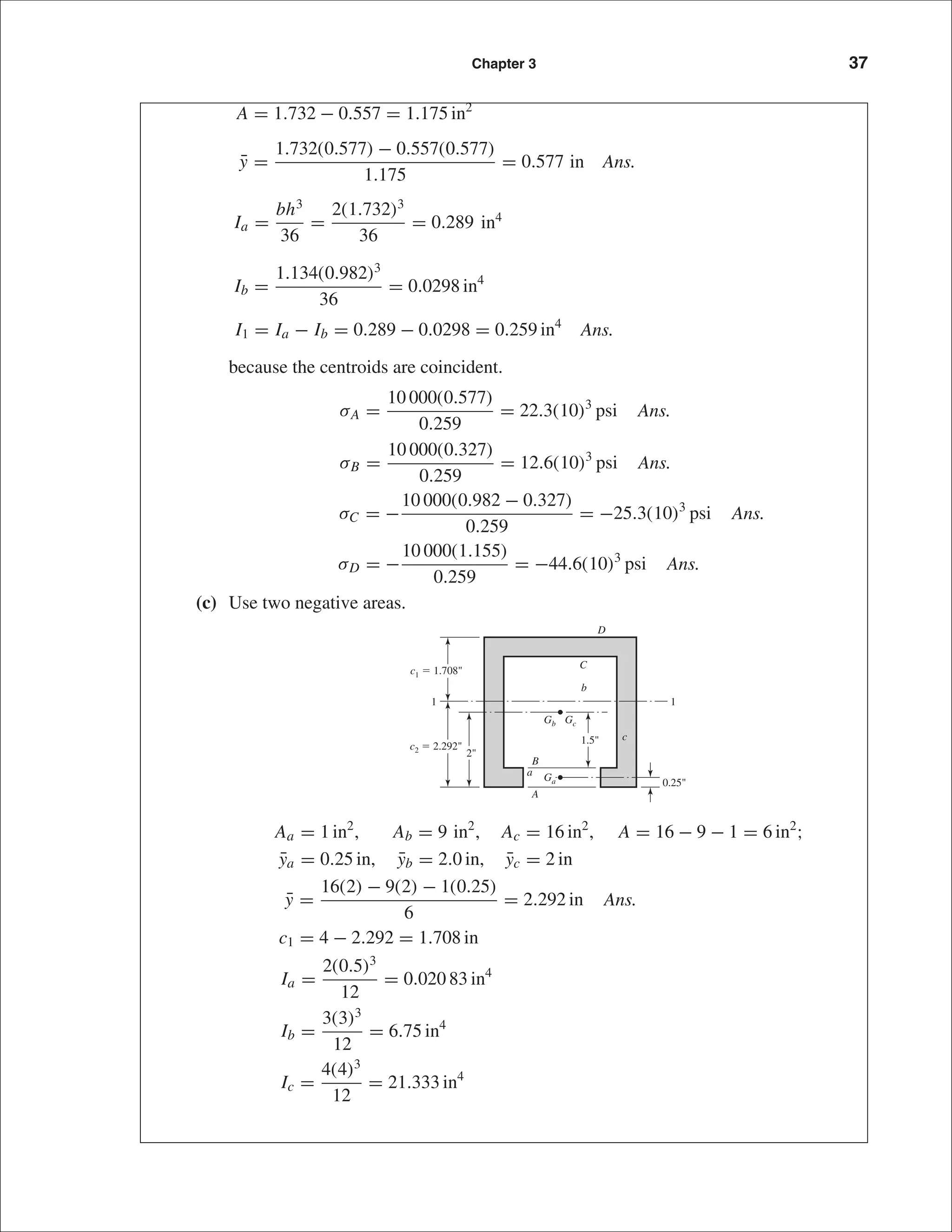
(c) Use two negative areas.
Aa = 1 in2
, Ab = 9 in2
, Ac = 16 in2
, A = 16 − 9 − 1 = 6 in2
;
¯ya = 0.25 in, ¯yb = 2.0 in, ¯yc = 2 in
¯y =
16(2) − 9(2) − 1(0.25)
6
= 2.292 in Ans.
c1 = 4 − 2.292 = 1.708 in
Ia =
2(0.5)3
12
= 0.020 83 in4
Ib =
3(3)3
12
= 6.75 in4
Ic =
4(4)3
12
= 21.333 in4
D
C
c
a
B
b
A
Ga
Gb Gc
c1 ϭ 1.708"
c2 ϭ 2.292"
2"
1.5"
0.25"
11
budynas_SM_ch03.qxd 11/28/2006 21:22 Page 37
FIRST PAGES
38 Solutions Manual • Instructor’s Solution Manual to Accompany Mechanical Engineering Design
I1 = [21.333 + 16(0.292)2
] − [6.75 + 9(0.292)2
]
− [0.020 83 + 1(2.292 − 0.25)2
]
= 10.99 in4
Ans.
σA =
10 000(2.292)
10.99
= 2086 psi Ans.
σB =
10 000(2.292 − 0.5)
10.99
= 1631 psi Ans.
σC = −
10 000(1.708 − 0.5)
10.99
= −1099 psi Ans.
σD = −
10 000(1.708)
10.99
= −1554 psi Ans.
(d) Use a as a negative area.
Aa = 6.928 in2
, Ab = 16 in2
, A = 9.072 in2
;
¯ya = 1.155 in, ¯yb = 2 in
¯y =
2(16) − 1.155(6.928)
9.072
= 2.645 in Ans.
c1 = 4 − 2.645 = 1.355 in
Ia =
bh3
36
=
4(3.464)3
36
= 4.618 in4
Ib =
4(4)3
12
= 21.33 in4
I1 = [21.33 + 16(0.645)2
] − [4.618 + 6.928(1.490)2
]
= 7.99 in4
Ans.
σA =
10 000(2.645)
7.99
= 3310 psi Ans.
σB = −
10 000(3.464 − 2.645)
7.99
= −1025 psi Ans.
σC = −
10 000(1.355)
7.99
= −1696 psi Ans.
3.464"
11
Ga
B
b
a
C
A
c1 ϭ 1.355"
c2 ϭ 2.645"
1.490"
1.155"
budynas_SM_ch03.qxd 11/28/2006 21:22 Page 38
FIRST PAGES
Chapter 3 39
(e) Aa = 6(1.25) = 7.5 in2
Ab = 3(1.5) = 4.5 in2
A = Ac + Ab = 12 in2
¯y =
3.625(7.5) + 1.5(4.5)
12
= 2.828 in Ans.
I =
1
12
(6)(1.25)3
+ 7.5(3.625 − 2.828)2
+
1
12
(1.5)(3)3
+ 4.5(2.828 − 1.5)2
= 17.05 in4
Ans.
σA =
10 000(2.828)
17.05
= 1659 psi Ans.
σB = −
10 000(3 − 2.828)
17.05
= −101 psi Ans.
σC = −
10 000(1.422)
17.05
= −834 psi Ans.
(f) Let a = total area
A = 1.5(3) − 1(1.25) = 3.25 in2
I = Ia − 2Ib =
1
12
(1.5)(3)3
−
1
12
(1.25)(1)3
= 3.271 in4
Ans.
σA =
10 000(1.5)
3.271
= 4586 psi, σD = −4586 psi
Ans.
σB =
10 000(0.5)
3.271
= 1529 psi, σC = −1529 psi
3-24
(a) The moment is maximum and constant between A and B
M = −50(20) = −1000 lbf · in, I =
1
12
(0.5)(2)3
= 0.3333 in4
ρ =
E I
M
=
1.6(106
)(0.3333)
1000
= 533.3 in
(x, y) = (30, −533.3) in Ans.
(b) The moment is maximum and constant between A and B
M = 50(5) = 250 lbf · in, I = 0.3333 in4
ρ =
1.6(106
)(0.3333)
250
= 2133 in Ans.
(x, y) = (20, 2133) in Ans.
C
B
A
b
a
b
D
c ϭ 1.5
c ϭ 1.5
1.5
a
b
A
B
C
c1 ϭ 1.422"
c2 ϭ 2.828"
budynas_SM_ch03.qxd 11/28/2006 21:22 Page 39
FIRST PAGES
40 Solutions Manual • Instructor’s Solution Manual to Accompany Mechanical Engineering Design
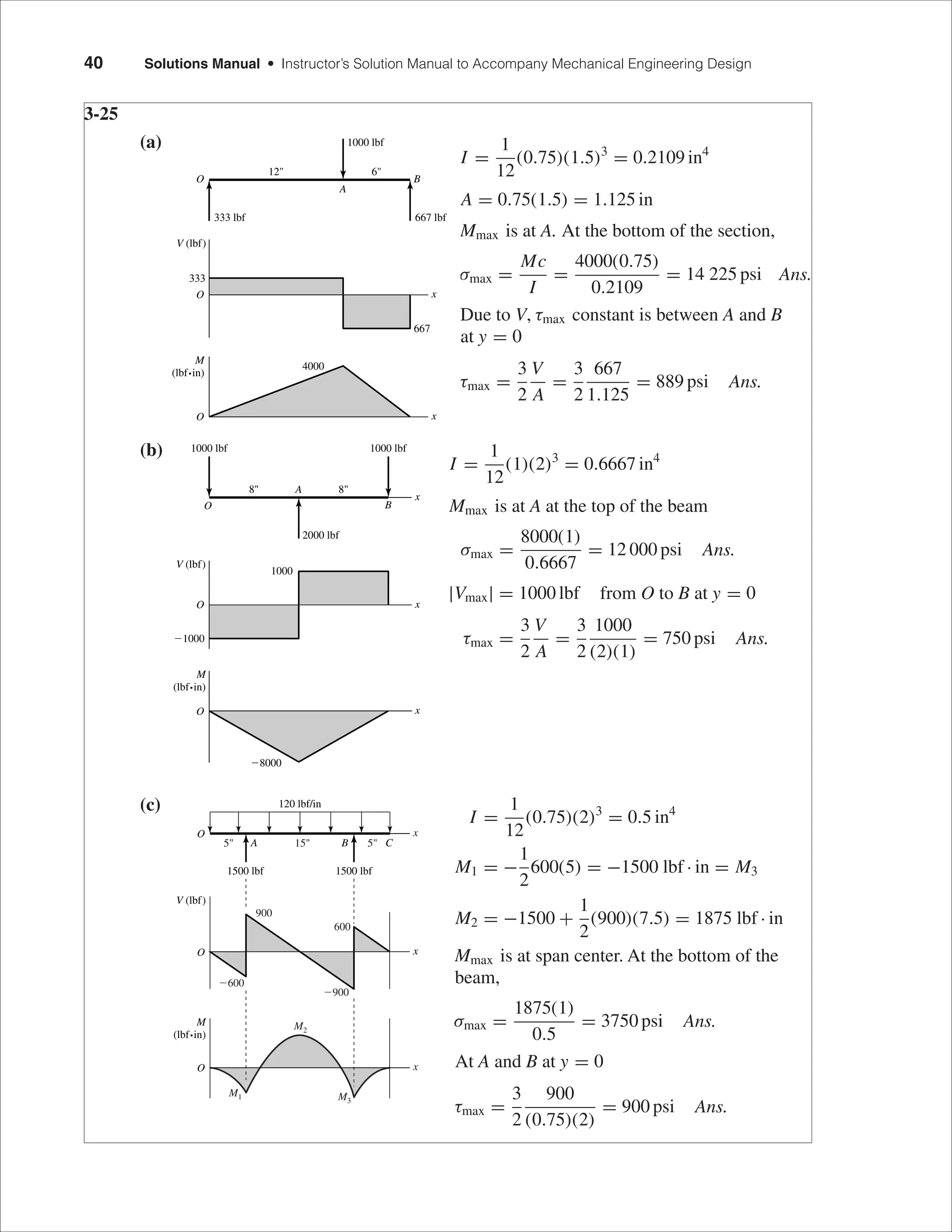
3-25
(a)
I =
1
12
(0.75)(1.5)3
= 0.2109 in4
A = 0.75(1.5) = 1.125 in
Mmax is at A. At the bottom of the section,
σmax =
Mc
I
=
4000(0.75)
0.2109
= 14 225 psi Ans.
Due to V, τmax constant is between A and B
at y = 0
τmax =
3
2
V
A
=
3
2
667
1.125
= 889 psi Ans.
(b)
I =
1
12
(1)(2)3
= 0.6667 in4
Mmax is at A at the top of the beam
σmax =
8000(1)
0.6667
= 12 000 psi Ans.
|Vmax| = 1000 lbf from O to B at y = 0
τmax =
3
2
V
A
=
3
2
1000
(2)(1)
= 750 psi Ans.
(c)
I =
1
12
(0.75)(2)3
= 0.5 in4
M1 = −
1
2
600(5) = −1500 lbf · in = M3
M2 = −1500 +
1
2
(900)(7.5) = 1875 lbf · in
Mmax is at span center. At the bottom of the
beam,
σmax =
1875(1)
0.5
= 3750 psi Ans.
At A and B at y = 0
τmax =
3
2
900
(0.75)(2)
= 900 psi Ans.
120 lbf/in
1500 lbf 1500 lbf
O
CBA
O
O
V (lbf)
M
(lbf•in)
5" 15" 5"
900
M1
M2
x
M3
Ϫ900
Ϫ600
600
x
x
1000 lbf 1000 lbf
1000
Ϫ1000
Ϫ8000
2000 lbf
O B
A
O
O
8" 8"
V (lbf)
M
(lbf•in)
x
x
x
1000 lbf
4000
333 lbf 667 lbf
O B
x
A
O
333
667
O
12" 6"
V (lbf)
M
(lbf•in)
x
budynas_SM_ch03.qxd 11/28/2006 21:22 Page 40
FIRST PAGES
Chapter 3 41
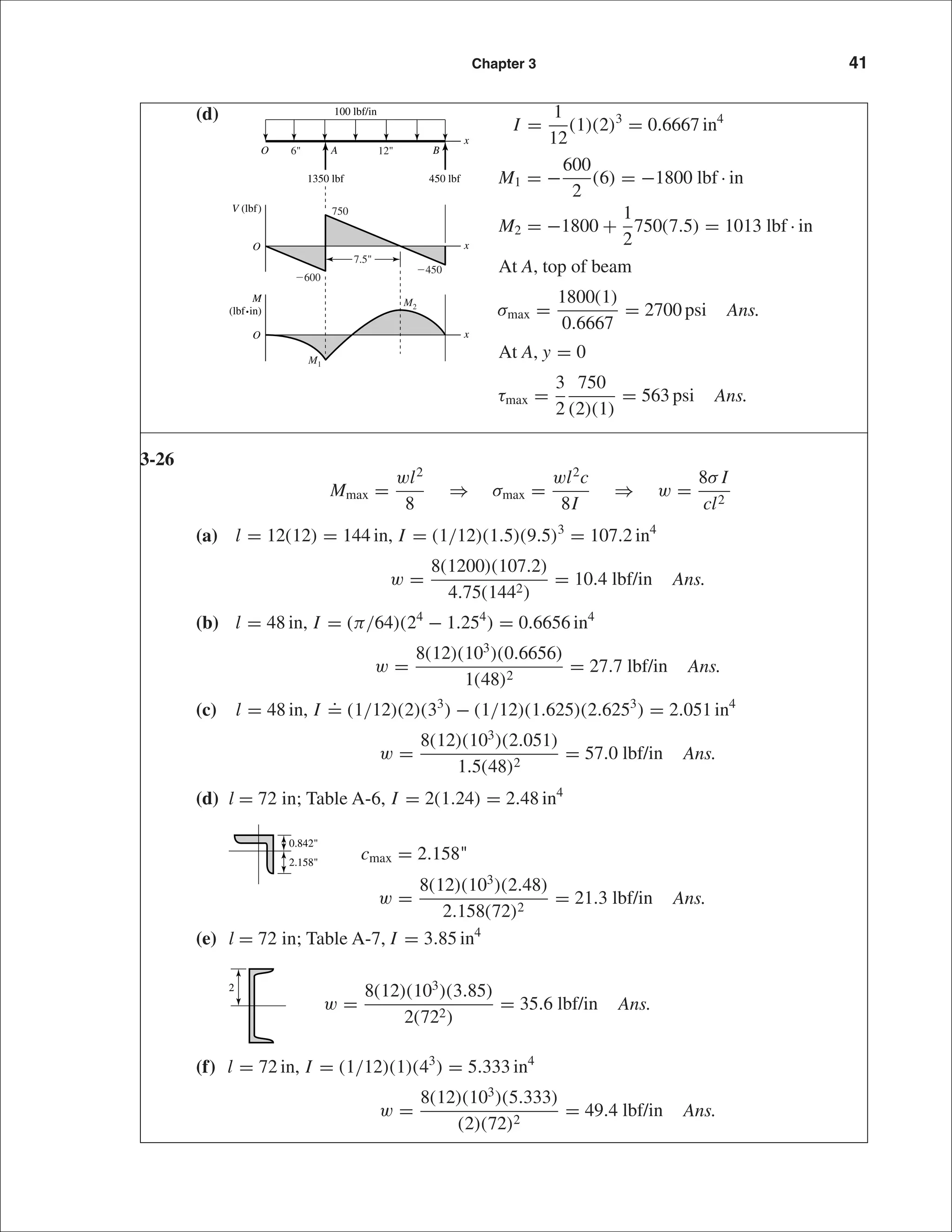
(d)
I =
1
12
(1)(2)3
= 0.6667 in4
M1 = −
600
2
(6) = −1800 lbf · in
M2 = −1800 +
1
2
750(7.5) = 1013 lbf · in
At A, top of beam
σmax =
1800(1)
0.6667
= 2700 psi Ans.
At A, y = 0
τmax =
3
2
750
(2)(1)
= 563 psi Ans.
3-26
Mmax =
wl2
8
⇒ σmax =
wl2
c
8I
⇒ w =
8σ I
cl2
(a) l = 12(12) = 144 in, I = (1/12)(1.5)(9.5)3
= 107.2 in4
w =
8(1200)(107.2)
4.75(1442)
= 10.4 lbf/in Ans.
(b) l = 48 in, I = (π/64)(24
− 1.254
) = 0.6656 in4
w =
8(12)(103
)(0.6656)
1(48)2
= 27.7 lbf/in Ans.
(c) l = 48 in, I
.
= (1/12)(2)(33
) − (1/12)(1.625)(2.6253
) = 2.051 in4
w =
8(12)(103
)(2.051)
1.5(48)2
= 57.0 lbf/in Ans.
(d) l = 72 in; Table A-6, I = 2(1.24) = 2.48 in4
cmax = 2.158"
w =
8(12)(103
)(2.48)
2.158(72)2
= 21.3 lbf/in Ans.
(e) l = 72 in; Table A-7, I = 3.85 in4
w =
8(12)(103
)(3.85)
2(722)
= 35.6 lbf/in Ans.
(f) l = 72 in, I = (1/12)(1)(43
) = 5.333 in4
w =
8(12)(103
)(5.333)
(2)(72)2
= 49.4 lbf/in Ans.
2
0.842"
2.158"
100 lbf/in
1350 lbf 450 lbf
O BA
O
O
V (lbf)
M
(lbf•in)
6" 12"
7.5"
750
M1
M2
Ϫ450
Ϫ600
x
x
x
budynas_SM_ch03.qxd 11/28/2006 21:22 Page 41
FIRST PAGES
42 Solutions Manual • Instructor’s Solution Manual to Accompany Mechanical Engineering Design
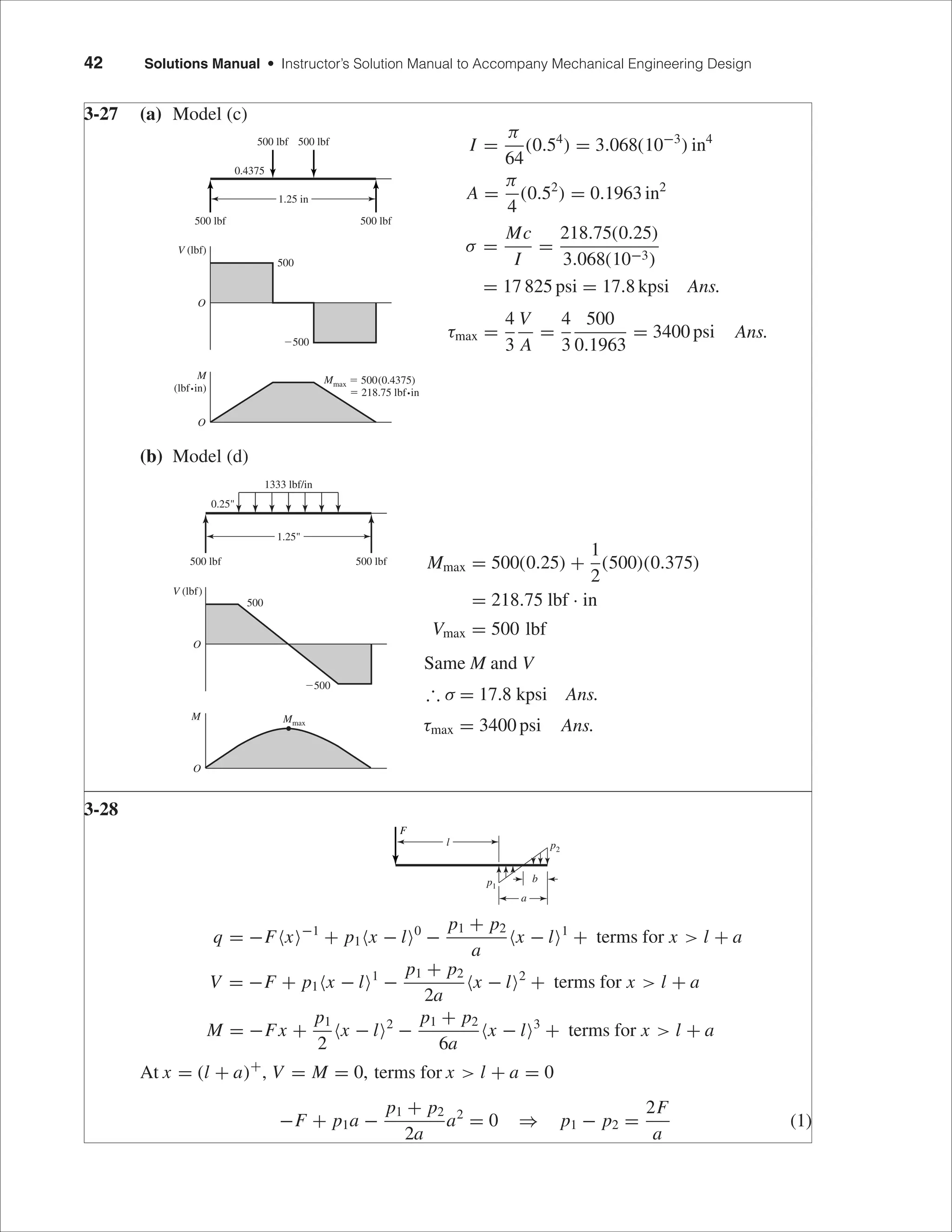
3-27 (a) Model (c)
I =
π
64
(0.54
) = 3.068(10−3
) in4
A =
π
4
(0.52
) = 0.1963 in2
σ =
Mc
I
=
218.75(0.25)
3.068(10−3)
= 17 825 psi = 17.8 kpsi Ans.
τmax =
4
3
V
A
=
4
3
500
0.1963
= 3400 psi Ans.
(b) Model (d)
Mmax = 500(0.25) +
1
2
(500)(0.375)
= 218.75 lbf · in
Vmax = 500 lbf
Same M and V
∴ σ = 17.8 kpsi Ans.
τmax = 3400 psi Ans.
3-28
q = −F x −1
+ p1 x − l 0
−
p1 + p2
a
x − l 1
+ terms for x > l + a
V = −F + p1 x − l 1
−
p1 + p2
2a
x − l 2
+ terms for x > l + a
M = −Fx +
p1
2
x − l 2
−
p1 + p2
6a
x − l 3
+ terms for x > l + a
At x = (l + a)+
, V = M = 0, terms for x > l + a = 0
−F + p1a −
p1 + p2
2a
a2
= 0 ⇒ p1 − p2 =
2F
a
(1)
l p2
p1
a
b
F
1.25"
500 lbf 500 lbf
0.25"
1333 lbf/in
500
Ϫ500
O
V (lbf)
O
M Mmax
1.25 in
500 lbf 500 lbf
500 lbf500 lbf
0.4375
500
Ϫ500
O
V (lbf)
O
M
(lbf•in)
Mmax ϭ 500(0.4375)
ϭ 218.75 lbf•in
budynas_SM_ch03.qxd 11/28/2006 21:22 Page 42
FIRST PAGES
Chapter 3 43
−F(l + a) +
p1a2
2
−
p1 + p2
6a
a3
= 0 ⇒ 2p1 − p2 =
6F(l + a)
a2
(2)
From (1) and (2) p1 =
2F
a2
(3l + 2a), p2 =
2F
a2
(3l + a) (3)
From similar triangles
b
p2
=
a
p1 + p2
⇒ b =
ap2
p1 + p2
(4)
Mmax occurs where V = 0
xmax = l + a − 2b
Mmax = −F(l + a − 2b) +
p1
2
(a − 2b)2
−
p1 + p2
6a
(a − 2b)3
= −Fl − F(a − 2b) +
p1
2
(a − 2b)2
−
p1 + p2
6a
(a − 2b)3
Normally Mmax = −Fl
The fractional increase in the magnitude is
=
F(a − 2b) − ( p1/2)(a − 2b)2
− [( p1 + p2)/6a](a − 2b)3
Fl
(5)
For example, consider F = 1500 lbf, a = 1.2 in, l = 1.5 in
(3) p1 =
2(1500)
1.22
[3(1.5) + 2(1.2)] = 14 375 lbf/in
p2 =
2(1500)
1.22
[3(1.5) + 1.2] = 11 875 lbf/in
(4) b = 1.2(11 875)/(14 375 + 11 875) = 0.5429 in
Substituting into (5) yields
= 0.036 89 or 3.7% higher than −Fl
a Ϫ 2bl
F
p2
p2
p1
p2
b b
budynas_SM_ch03.qxd 11/28/2006 21:22 Page 43
FIRST PAGES
3-29 R1 =
600(15)
2
+
20
15
3000 = 8500 lbf
R2 =
600(15)
2
−
5
15
3000 = 3500 lbf
a =
3500
600
= 5.833 ft
(a) ¯y =
1(12) + 5(12)
24
= 3 in
Iz =
1
3
[2(53
) + 6(33
) − 4(13
)] = 136 in4
At x = 5 ft, y = −3 in, σx = −
−15000(12)(−3)
136
= −3970 psi
y = 5 in, σx = −
−15000(12)5
136
= 6620 psi
At x = 14.17 ft, y = −3 in, σx = −
20420(12)(−3)
136
= 5405 psi
y = 5 in, σx = −
20420(12)5
136
= −9010 psi
Max tension = 6620 psi Ans.
Max compression = −9010 psi Ans.
(b) Vmax = 5500 lbf
Qn.a. = ¯yA = 2.5(5)(2) = 25 in3
τmax =
V Q
Ib
=
5500(25)
136(2)
= 506 psi Ans.
(c) τmax =
|σmax|
2
=
9010
2
= 4510 psi Ans.
z
5 in
44 Solutions Manual • Instructor’s Solution Manual to Accompany Mechanical Engineering Design
600 lbf/ft
3000 lbf
O
O
V (lbf)
M
(lbf•ft)
5' 15'
R1 R2
Ϫ3000 Ϫ3500
3500(5.833) ϭ 20420
Ϫ15000
5500
x
y
x
x
a
z
y
y
V
budynas_SM_ch03.qxd 11/28/2006 21:22 Page 44
FIRST PAGES
3-30
R1 =
c
l
F
M =
c
l
Fx 0 ≤ x ≤ a
σ =
6M
bh2
=
6(c/l)Fx
bh2
⇒ h =
6cFx
blσmax
0 ≤ x ≤ a Ans.
3-31 From Prob. 3-30, R1 = c
l F = V, 0 ≤ x ≤ a
τmax =
3
2
V
bh
=
3
2
(c/l)F
bh
∴ h =
3
2
Fc
lbτmax
Ans.
From Prob. 3-30=
6Fcx
lbσmax
sub in x = e and equate to h above
3
2
Fc
lbτmax
=
6Fce
lbσmax
e =
3
8
Fcσmax
lbτ2
max
Ans.
3-32
R1 =
b
l
F
M =
b
l
Fx
σmax =
32M
πd3
=
32
πd3
b
l
Fx
d =
32
π
bFx
lσmax
1/3
0 ≤ x ≤ a Ans.
3-33
Square: Am = (b − t)2
Tsq = 2Amtτall = 2(b − t)2
tτall
Round: Am = π(b − t)2
/4
Trd = 2π(b − t)2
tτall/4
t
b
t
b
R1
F
a b
l
R2
x
y
R1 R2
F
a c
l
h(x)
x
e
h
Chapter 3 45
budynas_SM_ch03.qxd 11/28/2006 21:22 Page 45
FIRST PAGES
46 Solutions Manual • Instructor’s Solution Manual to Accompany Mechanical Engineering Design
Ratio of torques
Tsq
Trd
=
2(b − t)2
tτall
π(b − t)2tτall/2
=
4
π
= 1.27
Twist per unit length
square:
θsq =
2Gθ1t
tτall
L
A m
= C
L
A m
= C
4(b − t)
(b − t)2
Round:
θrd = C
L
A m
= C
π(b − t)
π(b − t)2/4
= C
4(b − t)
(b − t)2
Ratio equals 1, twists are the same.
Note the weight ratio is
Wsq
Wrd
=
ρl(b − t)2
ρlπ(b − t)(t)
=
b − t
πt
thin-walled assumes b ≥ 20t
=
19
π
= 6.04 with b = 20t
= 2.86 with b = 10t
3-34 l = 40 in, τall = 11 500 psi, G = 11.5(106
) psi, t = 0.050 in
rm = ri + t/2 = ri + 0.025 for ri > 0
= 0 for ri = 0
Am = (1 − 0.05)2
− 4 r2
m −
π
4
r2
m = 0.952
− (4 − π)r2
m
Lm = 4(1 − 0.05 − 2rm + 2πrm/4) = 4[0.95 − (2 − π/2)rm]
Eq. (3-45): T = 2Amtτ = 2(0.05)(11 500)Am = 1150Am
Eq. (3-46):
θ(deg) = θ1 l
180
π
=
T Lml
4G A2
mt
180
π
=
T Lm(40)
4(11.5)(106)A2
m(0.05)
180
π
= 9.9645(10−4
)
T Lm
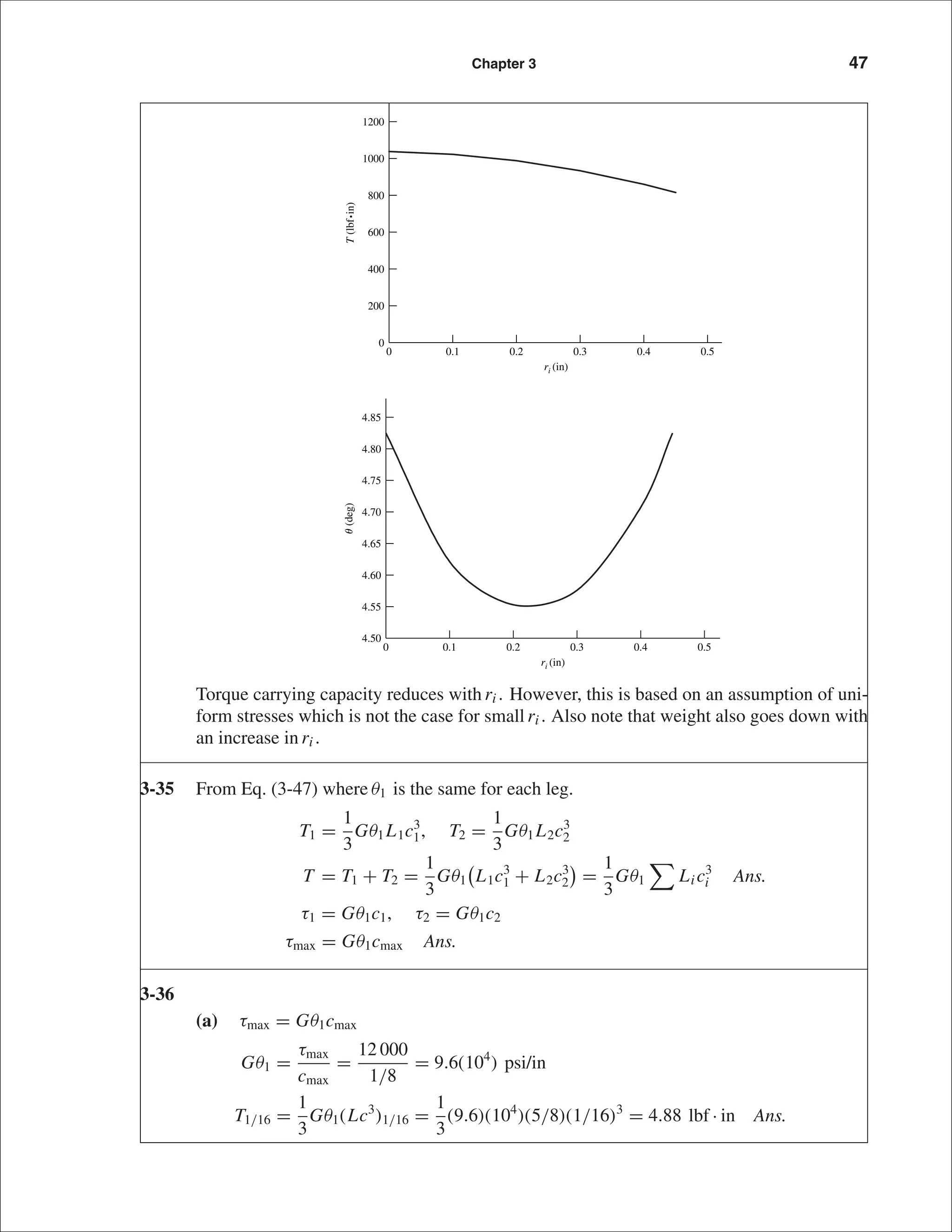
A2
m
Equations can then be put into a spreadsheet resulting in:
ri rm Am Lm ri T(lbf · in) ri θ(deg)
0 0 0.9025 3.8 0 1037.9 0 4.825
0.10 0.125 0.889087 3.585398 0.10 1022.5 0.10 4.621
0.20 0.225 0.859043 3.413717 0.20 987.9 0.20 4.553
0.30 0.325 0.811831 3.242035 0.30 933.6 0.30 4.576
0.40 0.425 0.747450 3.070354 0.40 859.6 0.40 4.707
0.45 0.475 0.708822 2.984513 0.45 815.1 0.45 4.825
budynas_SM_ch03.qxd 11/28/2006 21:22 Page 46
FIRST PAGES
Chapter 3 47
Torque carrying capacity reduces with ri . However, this is based on an assumption of uni-
form stresses which is not the case for smallri . Also note that weight also goes down with
an increase in ri .
3-35 From Eq. (3-47) where θ1 is the same for each leg.
T1 =
1
3
Gθ1L1c3
1, T2 =
1
3
Gθ1L2c3
2
T = T1 + T2 =
1
3
Gθ1 L1c3
1 + L2c3
2 =
1
3
Gθ1 Li c3
i Ans.
τ1 = Gθ1c1, τ2 = Gθ1c2
τmax = Gθ1cmax Ans.
3-36
(a) τmax = Gθ1cmax
Gθ1 =
τmax
cmax
=
12 000
1/8
= 9.6(104
) psi/in
T1/16 =
1
3
Gθ1(Lc3
)1/16 =
1
3
(9.6)(104
)(5/8)(1/16)3
= 4.88 lbf · in Ans.
ri (in)
␪(deg)
4.50
4.55
4.65
4.60
4.70
4.75
4.80
4.85
0 0.30.20.1 0.4 0.5
ri (in)
T(lbf•in)
0
400
200
600
800
1000
1200
0 0.30.20.1 0.4 0.5
budynas_SM_ch03.qxd 11/28/2006 21:22 Page 47
FIRST PAGES
48 Solutions Manual • Instructor’s Solution Manual to Accompany Mechanical Engineering Design
T1/8 =
1
3
(9.6)(104
)(5/8)(1/8)3
= 39.06 lbf · in Ans.
τ1/16 = 9.6(104
)1/16 = 6000 psi, τ1/8 = 9.6(104
)1/8 = 12 000 psi Ans.
(b) θ1 =
9.6(104
)
12(106)
= 87(10−3
) rad/in = 0.458◦/in Ans.
3-37 Separate strips: For each 1/16 in thick strip,
T =
Lc2
τ
3
=
(1)(1/16)2
(12 000)
3
= 15.625 lbf · in
∴ Tmax = 2(15.625) = 31.25 lbf · in Ans.
For each strip,
θ =
3Tl
Lc3G
=
3(15.625)(12)
(1)(1/16)3(12)(106)
= 0.192 rad Ans.
kt = T/θ = 31.25/0.192 = 162.8 lbf · in/rad Ans.
Solid strip: From Eq. (3-47),
Tmax =
Lc2
τ
3
=
1(1/8)2
12 000
3
= 62.5 lbf · in Ans.
θ = θ1 l =
τl
Gc
=
12 000(12)
12(106)(1/8)
= 0.0960 rad Ans.
kl = 62.5/0.0960 = 651 lbf · in/rad Ans.
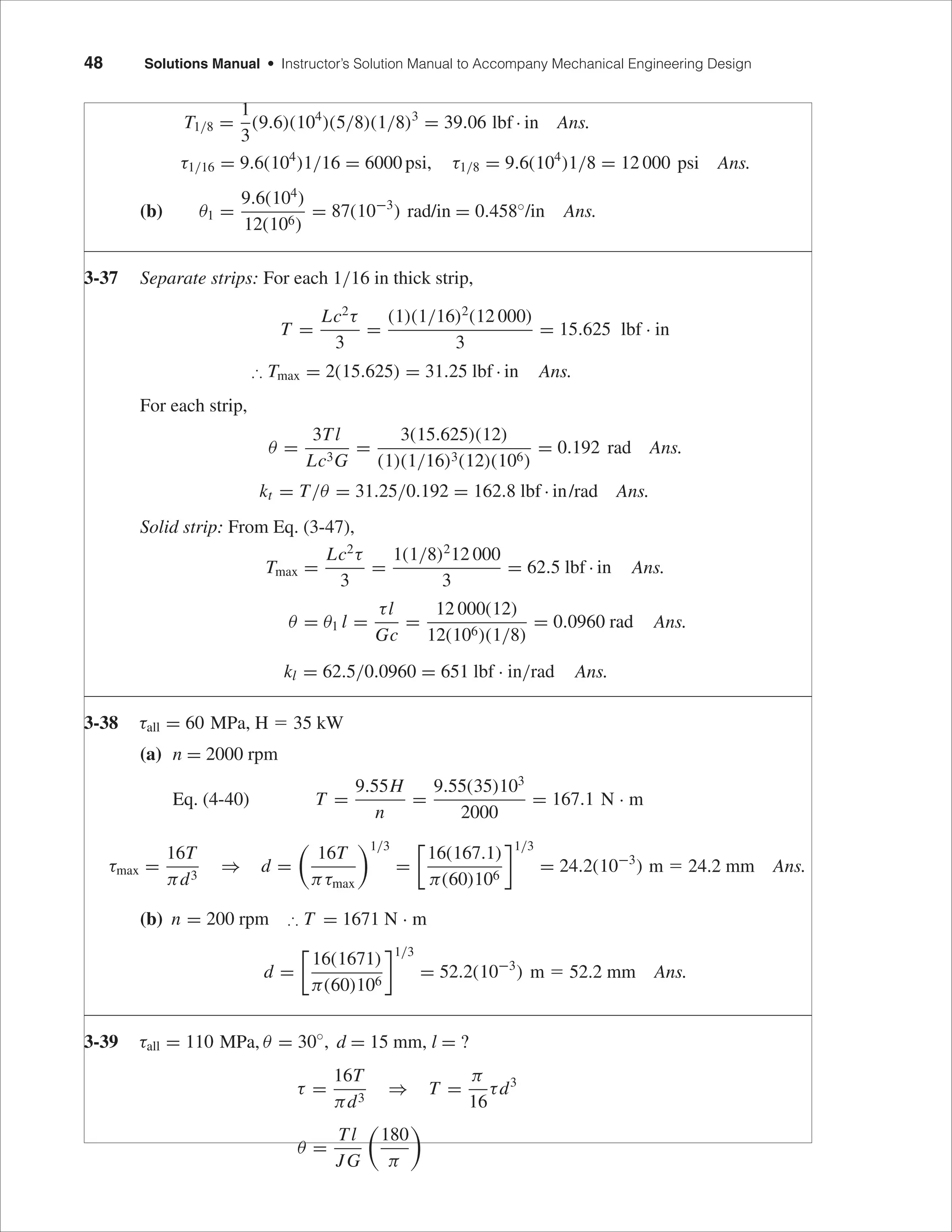
3-38 τall = 60 MPa, H ϭ 35 kW
(a) n = 2000 rpm
Eq. (4-40) T =
9.55H
n
=
9.55(35)103
2000
= 167.1 N · m
τmax =
16T
πd3
⇒ d =
16T
πτmax
1/3
=
16(167.1)
π(60)106
1/3
= 24.2(10−3
) m ϭ 24.2 mm Ans.
(b) n = 200 rpm ∴ T = 1671 N · m
d =
16(1671)
π(60)106
1/3
= 52.2(10−3
) m ϭ 52.2 mm Ans.
3-39 τall = 110 MPa, θ = 30◦
, d = 15 mm, l = ?
τ =
16T
πd3
⇒ T =
π
16
τd3
θ =
Tl
JG
180
π
budynas_SM_ch03.qxd 11/28/2006 21:22 Page 48
FIRST PAGES
Chapter 3 49
l =
π
180
JGθ
T
=
π
180
π
32
d4
Gθ
(π/16) τd3
=
π
360
dGθ
τ
=
π
360
(0.015)(79.3)(109
)(30)
110(106)
= 2.83 m Ans.
3-40 d = 3 in, replaced by 3 in hollow with t = 1/4 in
(a) Tsolid =
π
16
τ(33
) Thollow =
π
32
τ
(34
− 2.54
)
1.5
% T =
(π/16)(33
) − (π/32) [(34
− 2.54
)/1.5]
(π/16)(33)
(100) = 48.2% Ans.
(b) Wsolid = kd2
= k(32
), Whollow = k(32
− 2.52
)
% W =
k(32
) − k(32
− 2.52
)
k(32)
(100) = 69.4% Ans.
3-41 T = 5400 N · m, τall = 150 MPa
(a) τ =
Tc
J
⇒ 150(106
) =
5400(d/2)
(π/32)[d4 − (0.75d)4]
=
4.023(104
)
d3
d =
4.023(104
)
150(106)
1/3
= 6.45(10−2
)m = 64.5 mm
From Table A-17, the next preferred size is d = 80 mm; ID = 60 mm Ans.
(b) J =
π
32
(0.084
− 0.064
) = 2.749(10−6
) mm4
τi =
5400(0.030)
2.749(10−6)
= 58.9(106
) Pa = 58.9 MPa Ans.
3-42
(a) T =
63 025H
n
=
63 025(1)
5
= 12 605 lbf · in
τ =
16T
πd3
C
⇒ dC =
16T
πτ
1/3
=
16(12 605)
π(14 000)
1/3
= 1.66 in Ans.
From Table A-17, select 1 3/4 in
τstart =
16(2)(12 605)
π(1.753)
= 23.96(103
) psi = 23.96 kpsi
(b) design activity
budynas_SM_ch03.qxd 11/28/2006 21:22 Page 49
FIRST PAGES
50 Solutions Manual • Instructor’s Solution Manual to Accompany Mechanical Engineering Design
3-43 ω = 2πn/60 = 2π(8)/60 = 0.8378 rad/s
T =
H
ω
=
1000
0.8378
= 1194 N · m
dC =
16T
πτ
1/3
=
16(1194)
π(75)(106)
1/3
= 4.328(10−2
) m = 43.3 mm
From Table A-17, select 45 mm Ans.
3-44 s =
√
A, d = 4A/π
Square: Eq. (3-43) with b = c
τmax =
4.8T
c3
(τmax)sq =
4.8T
(A)3/2
Round: (τmax)rd =
16
π
T
d3
=
16T
π(4A/π)3/2
=
3.545T
(A)3/2
(τmax)sq
(τmax)rd
=
4.8
3.545
= 1.354
Square stress is 1.354 times the round stress Ans.
3-45 s =
√
A, d = 4A/π
Square: Eq. (3-44) with b = c, β = 0.141
θsq =
Tl
0.141c4G
=
Tl
0.141(A)4/2G
Round:
θrd =
Tl
JG
=
Tl
(π/32) (4A/π)4/2
G
=
6.2832Tl
(A)4/2G
θsq
θrd
=
1/0.141
6.2832
= 1.129
Square has greater θ by a factor of 1.13 Ans.
3-46 808 lbf
362.8 lbf
362.8 lbf
4.3 in
2.7 in
3.9 in 92.8 lbf
z
xy
E
Cz
Cx
Dz
Dx
D
Q
budynas_SM_ch03.qxd 11/28/2006 21:22 Page 50
FIRST PAGES
Chapter 3 51
MD
z
= 7Cx − 4.3(92.8) − 3.9(362.8) = 0
Cx = 259.1 lbf
MC
z
= −7Dx − 2.7(92.8) + 3.9(362.8) = 0
Dx = 166.3 lbf
MD
x
⇒ Cz =
4.3
7
808 = 496.3 lbf
MC
x
⇒ Dz =
2.7
7
808 = 311.7 lbf
Torque : T = 808(3.9) = 3151 lbf · in
Bending Q : M = 699.62 + 13402 = 1512 lbf · in
Torque:
τ =
16T
πd3
=
16(3151)
π(1.253)
= 8217 psi
Bending:
σb = ±
32(1512)
π(1.253)
= ±7885 psi
Axial:
σa = −
F
A
= −
362.8
(π/4)(1.252)
= −296 psi
|σmax| = 7885 + 296 = 8181 psi
τmax =
8181
2
2
+ 82172 = 9179 psi Ans.
My
496.3 lbf808 lbf311.7 lbf
311.7(4.3) ϭ 1340 lbf• in
D CQ
O
x
z
Mz
362.8 lbf
92.8 lbf
166.3 lbf
Ϫ166.3(4.3) ϭ Ϫ715.1 lbf• in
259.1 lbf
259.1(2.7) ϭ 699.6 lbf• in
D C
E
Q
O
x
y
x=4.3+
in
x=4.3+
in
budynas_SM_ch03.qxd 11/28/2006 21:22 Page 51
FIRST PAGES
52 Solutions Manual • Instructor’s Solution Manual to Accompany Mechanical Engineering Design
σmax =
7885 − 296
2
+
7885 − 296
2
2
+ 82172 = 12 845 psi Ans.
3-47
MB
z
= −5.6(362.8) + 1.3(92.8) + 3Ay = 0
Ay = 637.0 lbf
MA
z
= −2.6(362.8) + 1.3(92.8) + 3By = 0
By = 274.2 lbf
MB
y
= 0 ⇒ Az =
5.6
3
808 = 1508.3 lbf
MA
y
= 0 ⇒ Bz =
2.6
3
808 = 700.3 lbf
Torsion: T = 808(1.3) = 1050 lbf · in
τ =
16(1050)
π(13)
= 5348 psi
Bending: Mp = 92.8(1.3) = 120.6 lbf · in
MA = 3 B2
y + B2
z = 3 274.22 + 700.32
= 2256 lbf · in = Mmax
σb = ±
32(2256)
π(13)
= ±22 980 psi
Axial: σ = −
92.8
(π/4)12
= −120 psi
τmax =
−22980 − 120
2
2
+ 53482 = 12 730 psi Ans.
σmax =
22980 − 120
2
+
22980 − 120
2
2
+ 53482 = 24 049 psi Ans.
808 lbf
362.8 lbf
92.8 lbf
3 in
2.6 in 92.8 lbf
1.3 in
x
y
E
By
Ay
B
A
Bz
Az
P
z
tens.
inAP
tens
budynas_SM_ch03.qxd 11/28/2006 21:22 Page 52
FIRST PAGES
Chapter 3 53
3-48
Ft =
1000
2.5
= 400 lbf
Fn = 400 tan 20 = 145.6 lbf
Torque at C TC = 400(5) = 2000 lbf · in
P =
2000
3
= 666.7 lbf
(MA)z = 0 ⇒ 18RDy − 145.6(13) − 666.7(3) = 0 ⇒ RDy = 216.3 lbf
(MA)y = 0 ⇒ −18RDz + 400(13) = 0 ⇒ RDz = 288.9 lbf
Fy = 0 ⇒ RAy + 216.3 − 666.7 − 145.6 = 0 ⇒ RAy = 596.0 lbf
Fz = 0 ⇒ RAz + 288.9 − 400 = 0 ⇒ RAz = 111.1 lbf
MB = 3 5962 + 111.12 = 1819 lbf · in
MC = 5 216.32 + 288.92 = 1805 lbf · in
∴ Maximum stresses occur at B. Ans.
σB =
32MB
πd3
=
32(1819)
π(1.253)
= 9486 psi
τB =
16TB
πd3
=
16(2000)
π(1.253)
= 5215 psi
σmax =
σB
2
+
σB
2
2
+ τ2
B =
9486
2
+
9486
2
2
+ 52152 = 11 792 psi Ans.
τmax =
σB
2
2
+ τ2
B = 7049 psi Ans.
3-49 r = d/2
(a) For top, θ = 90◦
,
σr =
σ
2
[1 − 1 + (1 − 1)(1 − 3)cos 180] = 0 Ans.
10"
C
1000 lbf•in
2.5R
Ft
Fn ␾
Gear F
y
z
A
RAy
RAz
3"
Shaft ABCD
B
666.7 lbf
D x
5"400 lbf
145.6 lbf
C
RDy
RDz
2000 lbf•in
2000 lbf•in
budynas_SM_ch03.qxd 11/28/2006 21:22 Page 53
FIRST PAGES
54 Solutions Manual • Instructor’s Solution Manual to Accompany Mechanical Engineering Design
σθ =
σ
2
[1 + 1 − (1 + 3)cos 180] = 3σ Ans.
τrθ = −
σ
2
(1 − 1)(1 + 3)sin 180 = 0 Ans.
For side, θ = 0◦
,
σr =
σ
2
[1 − 1 + (1 − 1)(1 − 3)cos 0] = 0 Ans.
σθ =
σ
2
[1 + 1 − (1 + 3)cos 0] = −σ Ans.
τrθ = −
σ
2
(1 − 1)(1 + 3)sin 0 = 0 Ans.
(b)
σθ /σ =
1
2
1 +
100
4r2
− 1 +
3
16
104
r4
cos 180 =
1
2
2 +
25
r2
+
3
16
104
r4
r σθ /σ
5 3.000
6 2.071
7 1.646
8 1.424
9 1.297
10 1.219
11 1.167
12 1.132
13 1.107
14 1.088
15 1.074
16 1.063
17 1.054
18 1.048
19 1.042
20 1.037
r (mm)
␴␪͞␴
0
1.0
0.5
1.5
2.0
2.5
3.0
0 105 15 20
budynas_SM_ch03.qxd 11/28/2006 21:22 Page 54
FIRST PAGES
Chapter 3 55
(c)
σθ /σ =
1
2
1 +
100
4r2
− 1 +
3
16
104
r4
cos 0 =
1
2
25
r2
−
3
16
104
r4
r σθ /σ
5 Ϫ1.000
6 Ϫ0.376
7 Ϫ0.135
8 Ϫ0.034
9 0.011
10 0.031
11 0.039
12 0.042
13 0.041
14 0.039
15 0.037
16 0.035
17 0.032
18 0.030
19 0.027
20 0.025
3-50
D/d =
1.5
1
= 1.5
r/d =
1/8
1
= 0.125
Fig. A-15-8: Kts
.
= 1.39
Fig. A-15-9: Kt
.
= 1.60
σA = Kt
Mc
I
=
32Kt M
πd3
=
32(1.6)(200)(14)
π(13)
= 45 630 psi
τA = Kts
Tc
J
=
16KtsT
πd3
=
16(1.39)(200)(15)
π(13)
= 21 240 psi
σmax =
σA
2
+
σA
2
2
+ τ2
A =
45.63
2
+
45.63
2
2
+ 21.242
= 54.0 kpsi Ans.
τmax =
45.63
2
2
+ 21.242 = 31.2 kpsi Ans.
r (mm)
␴␪͞␴
Ϫ1.0
Ϫ0.6
Ϫ0.8
Ϫ0.4
Ϫ0.2
0
0.2
0 105 15 20
budynas_SM_ch03.qxd 11/28/2006 21:22 Page 55
FIRST PAGES
56 Solutions Manual • Instructor’s Solution Manual to Accompany Mechanical Engineering Design
3-51 As shown in Fig. 3-32, the maximum stresses occur at the inside fiber wherer = ri . There-
fore, from Eq. (3-50)
σt,max =
r2
i pi
r2
o − r2
i
1 +
r2
o
r2
i
= pi
r2
o + r2
i
r2
o − r2
i
Ans.
σr,max =
r2
i pi
r2
o − r2
i
1 −
r2
o
r2
i
= −pi Ans.
3-52 If pi = 0, Eq. (3-49) becomes
σt =
−por2
o − r2
i r2
o po/r2
r2
o − r2
i
= −
por2
o
r2
o − r2
i
1 +
r2
i
r2
The maximum tangential stress occurs at r = ri . So
σt,max = −
2por2
o
r2
o − r2
i
Ans.
For σr , we have
σr =
−por2
o + r2
i r2
o po/r2
r2
o − r2
i
=
por2
o
r2
o − r2
i
r2
i
r2
− 1
So σr = 0 at r = ri . Thus at r = ro
σr,max =
por2
o
r2
o − r2
i
r2
i − r2
o
r2
o
= −po Ans.
3-53
F = pA = πr2
av p
σ1 = σ2 =
F
Awall
=
πr2
av p
2πravt
=
prav
2t
Ans.
rav
p
t
F
budynas_SM_ch03.qxd 11/28/2006 21:23 Page 56
FIRST PAGES
Chapter 3 57
3-54 σt > σl > σr
τmax = (σt − σr )/2 at r = ri where σl is intermediate in value. From Prob. 4-50
τmax =
1
2
(σt, max − σr, max)
τmax =
pi
2
r2
o + r2
i
r2
o − r2
i
+ 1
Now solve for pi using ro = 75 mm, ri = 69 mm, and τmax = 25 MPa. This gives
pi = 3.84 MPa Ans.
3-55 Given ro = 5 in, ri = 4.625 in and referring to the solution of Prob. 3-54,
τmax =
350
2
(5)2
+ (4.625)2
(5)2 − (4.625)2
+ 1
= 2 424 psi Ans.
3-56 From Table A-20, Sy = 57 kpsi; also, ro = 0.875 in and ri = 0.625 in
From Prob. 3-52
σt,max = −
2por2
o
r2
o − r2
i
Rearranging
po =
r2
o − r2
i (0.8Sy)
2r2
o
Solving, gives po = 11 200 psi Ans.
3-57 From Table A-20, Sy = 390 MPa; also ro = 25 mm, ri = 20 mm.
From Prob. 3-51
σt,max = pi
r2
o + r2
i
r2
o − r2
i
therefore pi = 0.8Sy
r2
o − r2
i
r2
o + r2
i
solving gives pi = 68.5 MPa Ans.
3-58 Since σt and σr are both positive and σt > σr
τmax = (σt)max/2
where σt is max at ri
Eq. (3-55) for r = ri = 0.375 in
budynas_SM_ch03.qxd 11/28/2006 21:23 Page 57
FIRST PAGES
58 Solutions Manual • Instructor’s Solution Manual to Accompany Mechanical Engineering Design
(σt)max =
0.282
386
2π(7200)
60
2
3 + 0.292
8
× 0.3752
+ 52
+
(0.3752
)(52
)
0.3752
−
1 + 3(0.292)
3 + 0.292
(0.3752
) = 8556 psi
τmax =
8556
2
= 4278 psi Ans.
Radial stress: σr = k r2
i + r2
o −
r2
i r2
o
r2
− r2
Maxima:
dσr
dr
= k 2
r2
i r2
o
r3
− 2r = 0 ⇒ r =
√
riro = 0.375(5) = 1.3693 in
(σr )max =
0.282
386
2π(7200)
60
2
3 + 0.292
8
0.3752
+ 52
−
0.3752
(52
)
1.36932
− 1.36932
= 3656 psi Ans.
3-59 ω = 2π(2069)/60 = 216.7 rad/s,
ρ = 3320 kg/m3
, ν = 0.24, ri = 0.0125 m, ro = 0.15 m;
use Eq. (3-55)
σt = 3320(216.7)2 3 + 0.24
8
(0.0125)2
+ (0.15)2
+ (0.15)2
−
1 + 3(0.24)
3 + 0.24
(0.0125)2
(10)−6
= 2.85 MPa Ans.
3-60
ρ =
(6/16)
386(1/16)(π/4)(62 − 12)
= 5.655(10−4
) lbf · s2
/in
4
τmax is at bore and equals
σt
2
Eq. (3-55)
(σt)max = 5.655(10−4
)
2π(10 000)
60
2
3 + 0.20
8
0.52
+ 32
+ 32
−
1 + 3(0.20)
3 + 0.20
(0.5)2
= 4496 psi
τmax =
4496
2
= 2248 psi Ans.
budynas_SM_ch03.qxd 11/28/2006 21:23 Page 58
FIRST PAGES
Chapter 3 59
3-61 ω = 2π(3000)/60 = 314.2 rad/s
m =
0.282(1.25)(12)(0.125)
386
= 1.370(10−3
) lbf · s2
/in
F = mω2
r = 1.370(10−3
)(314.22
)(6)
= 811.5 lbf
Anom = (1.25 − 0.5)(1/8) = 0.093 75 in2
σnom =
811.5
0.093 75
= 8656 psi Ans.
Note: Stress concentration Fig. A-15-1 gives Kt
.
= 2.25 which increases σmax and fatigue.
3-62 to 3-67
ν = 0.292, E = 30 Mpsi (207 GPa), ri = 0
R = 0.75 in (20 mm), ro = 1.5 in (40 mm)
Eq. (3-57)
ppsi =
30(106
)δ
0.753
(1.52
− 0.752
)(0.752
− 0)
2(1.52 − 0)
= 1.5(107
)δ (1)
pPa =
207(109
)δ
0.0203
(0.042
− 0.022
)(0.022
− 0)
2(0.042 − 0)
= 3.881(1012
)δ (2)
3-62
δmax =
1
2
[40.042 − 40.000] = 0.021 mm Ans.
δmin =
1
2
[40.026 − 40.025] = 0.0005 mm Ans.
From (2)
pmax = 81.5 MPa, pmin = 1.94 MPa Ans.
3-63
δmax =
1
2
(1.5016 − 1.5000) = 0.0008 in Ans.
δmin =
1
2
(1.5010 − 1.5010) = 0 Ans.
Eq. (1) pmax = 12 000 psi, pmin = 0 Ans.
6"
F
␻
F
budynas_SM_ch03.qxd 11/28/2006 21:23 Page 59
FIRST PAGES
60 Solutions Manual • Instructor’s Solution Manual to Accompany Mechanical Engineering Design
3-64
δmax =
1
2
(40.059 − 40.000) = 0.0295 mm Ans.
δmin =
1
2
(40.043 − 40.025) = 0.009 mm Ans.
Eq. (2) pmax = 114.5 MPa, pmin = 34.9 MPa Ans.
3-65
δmax =
1
2
(1.5023 − 1.5000) = 0.001 15 in Ans.
δmin =
1
2
(1.5017 − 1.5010) = 0.000 35 in Ans.
Eq. (1) pmax = 17 250 psi pmin = 5250 psi Ans.
3-66
δmax =
1
2
(40.076 − 40.000) = 0.038 mm Ans.
δmin =
1
2
(40.060 − 40.025) = 0.0175 mm Ans.
Eq. (2) pmax = 147.5 MPa pmin = 67.9 MPa Ans.
3-67
δmax =
1
2
(1.5030 − 1.500) = 0.0015 in Ans.
δmin =
1
2
(1.5024 − 1.5010) = 0.0007 in Ans.
Eq. (1) pmax = 22 500 psi pmin = 10 500 psi Ans.
3-68
δ =
1
2
(1.002 − 1.000) = 0.001 in ri = 0, R = 0.5 in, ro = 1 in
ν = 0.292, E = 30 Mpsi
Eq. (3-57)
p =
30(106
)(0.001)
0.53
(12
− 0.52
)(0.52
− 0)
2(12 − 0)
= 2.25(104
) psi Ans.
Eq. (3-50) for outer member at ri = 0.5 in
(σt)o =
0.52
(2.25)(104
)
12 − 0.52
1 +
12
0.52
= 37 500 psi Ans.
budynas_SM_ch03.qxd 11/28/2006 21:23 Page 60
FIRST PAGES
Chapter 3 61
Inner member, from Prob. 3-52
(σt)i = −
por2
o
r2
o − r2
i
1 +
r2
i
r2
o
= −
2.25(104
)(0.52
)
0.52 − 0
1 +
0
0.52
= −22 500 psi Ans.
3-69
νi = 0.292, Ei = 30(106
) psi, νo = 0.211, Eo = 14.5(106
) psi
δ =
1
2
(1.002 − 1.000) = 0.001 in, ri = 0, R = 0.5, ro = 1
Eq. (3-56)
0.001 =
0.5
14.5(106)
12 + 0.52
12 − 0.52
+ 0.211 +
0.5
30(106)
0.52 + 0
0.52 − 0
− 0.292 p
p = 13 064 psi Ans.
Eq. (3-50) for outer member at ri = 0.5 in
(σt)o =
0.52
(13 064)
12 − 0.52
1 +
12
0.52
= 21 770 psi Ans.
Inner member, from Prob. 3-52
(σt)i = −
13 064(0.52)
0.52 − 0
1 +
0
0.52
= −13 064 psi Ans.
3-70
δmax =
1
2
(1.003 − 1.000) = 0.0015 in ri = 0, R = 0.5 in, ro = 1 in
δmin =
1
2
(1.002 − 1.001) = 0.0005 in
Eq. (3-57)
pmax =
30(106
)(0.0015)
0.53
(12
− 0.52
)(0.52
− 0)
2(12 − 0)
= 33 750 psi Ans.
Eq. (3-50) for outer member at r = 0.5 in
(σt)o =
0.52
(33 750)
12 − 0.52
1 +
12
0.52
= 56 250 psi Ans.
For inner member, from Prob. 3-52, with r = 0.5 in
(σt)i = −33 750 psi Ans.
For δmin all answers are 0.0005/0.0015 = 1/3 of above answers Ans.
budynas_SM_ch03.qxd 11/28/2006 21:23 Page 61
FIRST PAGES
62 Solutions Manual • Instructor’s Solution Manual to Accompany Mechanical Engineering Design
3-71
νi = 0.292, Ei = 30 Mpsi, νo = 0.334, Eo = 10.4 Mpsi
δmax =
1
2
(2.005 − 2.000) = 0.0025 in
δmin =
1
2
(2.003 − 2.002) = 0.0005 in
0.0025 =
1.0
10.4(106)
22 + 12
22 − 12
+ 0.334 +
1.0
30(106)
12 + 0
12 − 0
− 0.292 pmax
pmax = 11 576 psi Ans.
Eq. (3-50) for outer member at r = 1 in
(σt)o =
12
(11 576)
22 − 12
1 +
22
12
= 19 293 psi Ans.
Inner member from Prob. 3-52 with r = 1 in
(σt)i = −11 576 psi Ans.
For δmin all above answers are 0.0005/0.0025 = 1/5 Ans.
3-72
(a) Axial resistance
Normal force at fit interface
N = pA = p(2π Rl) = 2πpRl
Fully-developed friction force
Fax = f N = 2π f pRl Ans.
(b) Torsional resistance at fully developed friction is
T = f RN = 2π f pR2
l Ans.
3-73 d = 1 in, ri = 1.5 in, ro = 2.5 in.
From Table 3-4, for R = 0.5 in,
rc = 1.5 + 0.5 = 2 in
rn =
0.52
2 2 −
√
22 − 0.52
= 1.968 245 8 in
e = rc − rn = 2.0 − 1.968 245 8 = 0.031 754 in
ci = rn − ri = 1.9682 − 1.5 = 0.4682 in
co = ro − rn = 2.5 − 1.9682 = 0.5318 in
A = πd2
/4 = π(1)2
/4 = 0.7854 in2
M = Frc = 1000(2) = 2000 lbf · in
budynas_SM_ch03.qxd 11/28/2006 21:23 Page 62
FIRST PAGES
Chapter 3 63
Using Eq. (3-65)
σi =
F
A
+
Mci
Aeri
=
1000
0.7854
+
2000(0.4682)
0.7854(0.031 754)(1.5)
= 26 300 psi Ans.
σo =
F
A
−
Mco
Aero
=
1000
0.7854
−
2000(0.5318)
0.7854(0.031 754)(2.5)
= −15 800 psi Ans.
3-74 Section AA:
D = 0.75 in, ri = 0.75/2 = 0.375 in, ro = 0.75/2 + 0.25 = 0.625 in
From Table 3-4, for R = 0.125 in,
rc = (0.75 + 0.25)/2 = 0.500 in
rn =
0.1252
2 0.5 −
√
0.52 − 0.1252
= 0.492 061 5 in
e = 0.5 − rn = 0.007 939 in
co = ro − rn = 0.625 − 0.492 06 = 0.132 94 in
ci = rn − ri = 0.492 06 − 0.375 = 0.117 06 in
A = π(0.25)2
/4 = 0.049 087
M = Frc = 100(0.5) = 50 lbf · in
σi =
100
0.049 09
+
50(0.117 06)
0.049 09(0.007 939)(0.375)
= 42 100 psi Ans.
σo =
100
0.049 09
−
50(0.132 94)
0.049 09(0.007 939)(0.625)
= −25 250 psi Ans.
Section BB: Abscissa angle θ of line of radius centers is
θ = cos−1 r2 + d/2
r2 + d + D/2
= cos−1 0.375 + 0.25/2
0.375 + 0.25 + 0.75/2
= 60◦
M = F
D + d
2
cos θ = 100(0.5) cos 60◦
= 25 lbf · in
ri = r2 = 0.375 in
ro = r2 + d = 0.375 + 0.25 = 0.625 in
e = 0.007 939 in (as before)
σi =
Fcos θ
A
−
Mci
Aeri
=
100 cos 60◦
0.049 09
−
25(0.117 06)
0.049 09(0.007 939)0.375
= −19 000 psi Ans.
σo =
100 cos 60◦
0.049 09
+
25(0.132 94)
0.049 09(0.007 939)0.625
= 14 700 psi Ans.
On section BB, the shear stress due to the shear force is zero at the surface.
budynas_SM_ch03.qxd 11/28/2006 21:23 Page 63
FIRST PAGES
64 Solutions Manual • Instructor’s Solution Manual to Accompany Mechanical Engineering Design
3-75 ri = 0.125 in, ro = 0.125 + 0.1094 = 0.2344 in
From Table 3-4 for h = 0.1094
rc = 0.125 + 0.1094/2 = 0.1797 in
rn = 0.1094/ln(0.2344/0.125) = 0.174 006 in
e = rc − rn = 0.1797 − 0.174 006 = 0.005 694 in
ci = rn − ri = 0.174 006 − 0.125 = 0.049 006 in
co = ro − rn = 0.2344 − 0.174 006 = 0.060 394 in
A = 0.75(0.1094) = 0.082 050 in2
M = F(4 + h/2) = 3(4 + 0.1094/2) = 12.16 lbf · in
σi = −
3
0.082 05
−
12.16(0.0490)
0.082 05(0.005 694)(0.125)
= −10 240 psi Ans.
σo = −
3
0.082 05
+
12.16(0.0604)
0.082 05(0.005 694)(0.2344)
= 6670 psi Ans.
3-76 Find the resultant of F1 and F2.
Fx = F1x + F2x = 250 cos 60◦
+ 333 cos 0◦
= 458 lbf
Fy = F1y + F2y = 250 sin 60◦
+ 333 sin 0◦
= 216.5 lbf
F = (4582
+ 216.52
)1/2
= 506.6 lbf
This is the pin force on the lever which acts in a direction
θ = tan−1 Fy
Fx
= tan−1 216.5
458
= 25.3◦
On the 25.3◦ surface from F1
Ft = 250 cos(60◦ − 25.3◦) = 206 lbf
Fn = 250 sin(60◦
− 25.3◦
) = 142 lbf
rc = 1 + 3.5/2 = 2.75 in
A = 2[0.8125(0.375) + 1.25(0.375)]
= 1.546 875 in2
The denominator of Eq. (3-63), given below, has four additive parts.
rn =
A
(d A/r)
25.3Њ
206
507
142
2000 lbf•in
budynas_SM_ch03.qxd 11/28/2006 21:23 Page 64
FIRST PAGES
Chapter 3 65
For d A/r, add the results of the following equation for each of the four rectangles.
ro
ri
bdr
r
= b ln
ro
ri
, b = width
d A
r
= 0.375 ln
1.8125
1
+ 1.25 ln
2.1875
1.8125
+ 1.25 ln
3.6875
3.3125
+ 0.375 ln
4.5
3.6875
= 0.666 810 6
rn =
1.546 875
0.666 810 6
= 2.3198 in
e = rc − rn = 2.75 − 2.3198 = 0.4302 in
ci = rn − ri = 2.320 − 1 = 1.320 in
co = ro − rn = 4.5 − 2.320 = 2.180 in
Shear stress due to 206 lbf force is zero at inner and outer surfaces.
σi = −
142
1.547
+
2000(1.32)
1.547(0.4302)(1)
= 3875 psi Ans.
σo = −
142
1.547
−
2000(2.18)
1.547(0.4302)(4.5)
= −1548 psi Ans.
3-77
A = (6 − 2 − 1)(0.75) = 2.25 in2
rc =
6 + 2
2
= 4 in
Similar to Prob. 3-76,
d A
r
= 0.75 ln
3.5
2
+ 0.75 ln
6
4.5
= 0.635 473 4 in
rn =
A
(d A/r)
=
2.25
0.635 473 4
= 3.5407 in
e = 4 − 3.5407 = 0.4593 in
σi =
5000
2.25
+
20 000(3.5407 − 2)
2.25(0.4593)(2)
= 17 130 psi Ans.
σo =
5000
2.25
−
20 000(6 − 3.5407)
2.25(0.4593)(6)
= −5710 psi Ans.
3-78
A =
ro
ri
b dr =
6
2
2
r
dr = 2 ln
6
2
= 2.197 225 in2
budynas_SM_ch03.qxd 11/28/2006 21:23 Page 65
FIRST PAGES
66 Solutions Manual • Instructor’s Solution Manual to Accompany Mechanical Engineering Design
rc =
1
A
ro
ri
br dr =
1
2.197 225
6
2
2r
r
dr
=
2
2.197 225
(6 − 2) = 3.640 957 in
rn =
A
ro
ri
(b/r) dr
=
2.197 225
6
2 (2/r2) dr
=
2.197 225
2[1/2 − 1/6]
= 3.295 837 in
e = R − rn = 3.640 957 − 3.295 837 = 0.345 12
ci = rn − ri = 3.2958 − 2 = 1.2958 in
co = ro − rn = 6 − 3.2958 = 2.7042 in
σi =
20 000
2.197
+
20 000(3.641)(1.2958)
2.197(0.345 12)(2)
= 71 330 psi Ans.
σo =
20 000
2.197
−
20 000(3.641)(2.7042)
2.197(0.345 12)(6)
= −34 180 psi Ans.
3-79 rc = 12 in, M = 20(2 + 2) = 80 kip · in
From statics book, I =
π
4
a3
b =
π
4
(23
)1 = 2π in4
Inside: σi =
F
A
+
My
I
rc
ri
=
20
2π
+
80(2)
2π
12
10
= 33.7 kpsi Ans.
Outside: σo =
F
A
−
My
I
rc
ro
=
20
2π
−
80(2)
2π
12
14
= −18.6 kpsi Ans.
Note: A much more accurate solution (see the 7th edition) yields σi = 32.25 kpsi and
σo = −19.40 kpsi
3-80
For rectangle,
d A
r
= b lnro/ri
For circle,
A
(d A/r)
=
r2
2 rc − r2
c − r2
, Ao = πr2
∴
d A
r
= 2π rc − r2
c − r2
0.4"R
0.4"0.4"
1" 1"
budynas_SM_ch03.qxd 11/28/2006 21:23 Page 66
FIRST PAGES
Chapter 3 67
d A
r
= 1 ln
2.6
1
− 2π 1.8 − 1.82 − 0.42 = 0.672 723 4
A = 1(1.6) − π(0.42
) = 1.097 345 2 in2
rn =
1.097 345 2
0.672 723 4
= 1.6312 in
e = 1.8 − rn = 0.1688 in
ci = 1.6312 − 1 = 0.6312 in
co = 2.6 − 1.6312 = 0.9688 in
M = 3000(5.8) = 17 400 lbf · in
σi =
3
1.0973
+
17.4(0.6312)
1.0973(0.1688)(1)
= 62.03 kpsi Ans.
σo =
3
1.0973
−
17.4(0.9688)
1.0973(0.1688)(2.6)
= −32.27 kpsi Ans.
3-81 From Eq. (3-68)
a = K F1/3
= F1/3 3
8
2[(1 − ν2)/E]
2(1/d)
1/3
Use ν = 0.292, F in newtons, E in N/mm2
and d in mm, then
K =
3
8
[(1 − 0.2922
)/207 000]
1/25
1/3
= 0.0346
pmax =
3F
2πa2
=
3F
2π(K F1/3)2
=
3F1/3
2π K2
=
3F1/3
2π(0.0346)2
= 399F1/3
MPa = |σmax| Ans.
τmax = 0.3pmax
= 120F1/3
MPa Ans.
3-82 From Prob. 3-81,
K =
3
8
2[(1 − 0.2922
)/207 000]
1/25 + 0
1/3
= 0.0436
pmax =
3F1/3
2π K2
=
3F1/3
2π(0.0436)2
= 251F1/3
and so, σz = −251F1/3 MPa Ans.
τmax = 0.3(251)F1/3
= 75.3F1/3
MPa Ans.
z = 0.48a = 0.48(0.0436)181/3
= 0.055 mm Ans.
budynas_SM_ch03.qxd 11/28/2006 21:23 Page 67
FIRST PAGES
68 Solutions Manual • Instructor’s Solution Manual to Accompany Mechanical Engineering Design
3-83 ν1 = 0.334, E1 = 10.4 Mpsi, l = 2in, d1 = 1in, ν2 = 0.211, E2 = 14.5Mpsi, d2 = −8in.
With b = Kc F1/2, from Eq. (3-73),
Kc =
2
π(2)
(1 − 0.3342
)/[10.4(106
)] + (1 − 0.2112
)/[14.5(106
)]
1 − 0.125
1/2
= 0.000 234 6
Be sure to check σx for both ν1 and ν2. Shear stress is maximum in the aluminum roller. So,
τmax = 0.3pmax
pmax =
4000
0.3
= 13 300 psi
Since pmax = 2F/(πbl) we have
pmax =
2F
πlKc F1/2
=
2F1/2
πlKc
So,
F =
πlKc pmax
2
2
=
π(2)(0.000 234 6)(13 300)
2
2
= 96.1 lbf Ans.
3-84 Good class problem
3-85 From Table A-5, ν = 0.211
σx
pmax
= (1 + ν) −
1
2
= (1 + 0.211) −
1
2
= 0.711
σy
pmax
= 0.711
σz
pmax
= 1
These are principal stresses
τmax
pmax
=
1
2
(σ1 − σ3) =
1
2
(1 − 0.711) = 0.1445
budynas_SM_ch03.qxd 11/28/2006 21:23 Page 68
FIRST PAGES
Chapter 3 69
3-86 From TableA-5: ν1 = 0.211, ν2 = 0.292, E1 = 14.5(106) psi, E2 = 30(106) psi, d1 = 6 in,
d2 = ∞, l = 2 in
(a) Eq. (3-73): b =
2(800)
π(2)
(1 − 0.2112
)/14.5(106
) + (1 − 0.2922
)/[30(106
)]
1/6 + 1/∞
= 0.012 135 in
pmax =
2(800)
π(0.012 135)(2)
= 20 984 psi
For z = 0 in,
σx1 = −2ν1 pmax = −2(0.211)20 984 = −8855 psi in wheel
σx2 = −2(0.292)20 984 = −12 254 psi
In plate
σy = −pmax = −20 984 psi
σz = −20 984 psi
These are principal stresses.
(b) For z = 0.010 in,
σx1 = −4177 psi in wheel
σx2 = −5781 psi in plate
σy = −3604 psi
σz = −16 194 psi
budynas_SM_ch03.qxd 11/28/2006 21:23 Page 69
FIRST PAGES
Chapter 4
4-1
(a)
k =
F
y
; y =
F
k1
+
F
k2
+
F
k3
so k =
1
(1/k1) + (1/k2) + (1/k3)
Ans.
(b)
F = k1y + k2y + k3y
k = F/y = k1 + k2 + k3 Ans.
(c) 1
k
=
1
k1
+
1
k2 + k3
k =
1
k1
+
1
k2 + k3
−1
4-2 For a torsion bar, kT = T/θ = Fl/θ, and so θ = Fl/kT . For a cantilever, kC = F/δ,
δ = F/kC. For the assembly, k = F/y, y = F/k = lθ + δ
So y =
F
k
=
Fl2
kT
+
F
kC
Or k =
1
(l2/kT ) + (1/kC)
Ans.
4-3 For a torsion bar, k = T/θ = GJ/l where J = πd4
/32. So k = πd4
G/(32l) = Kd4
/l . The
springs, 1 and 2, are in parallel so
k = k1 + k2 = K
d4
l1
+ K
d4
l2
= Kd4 1
x
+
1
l − x
And θ =
T
k
=
T
Kd4
1
x
+
1
l − x
Then T = kθ =
Kd4
x
θ +
Kd4
θ
l − x
k2
k1
k3
F
k2
k1
k3
y
F
k1 k2 k3 y
budynas_SM_ch04.qxd 11/28/2006 20:50 Page 70
FIRST PAGES
Chapter 4 71
Thus T1 =
Kd4
x
θ; T2 =
Kd4
θ
l − x
If x = l/2, then T1 = T2. If x < l/2, then T1 > T2
Using τ = 16T/πd3
and θ = 32Tl/(Gπd4
) gives
T =
πd3
τ
16
and so
θall =
32l
Gπd4
·
πd3
τ
16
=
2lτall
Gd
Thus, if x < l/2, the allowable twist is
θall =
2xτall
Gd
Ans.
Since k = Kd4 1
x
+
1
l − x
=
πGd4
32
1
x
+
1
l − x
Ans.
Then the maximum torque is found to be
Tmax =
πd3
xτall
16
1
x
+
1
l − x
Ans.
4-4 Both legs have the same twist angle. From Prob. 4-3, for equal shear, d is linear in x. Thus,
d1 = 0.2d2 Ans.
k =
πG
32
(0.2d2)4
0.2l
+
d4
2
0.8l
=
πG
32l
1.258d4
2 Ans.
θall =
2(0.8l)τall
Gd2
Ans.
Tmax = kθall = 0.198d3
2 τall Ans.
4-5
A = πr2
= π(r1 + x tan α)2
dδ =
Fdx
AE
=
Fdx
Eπ(r1 + x tan α)2
δ =
F
π E
l
0
dx
(r1 + x tan α)2
=
F
π E
−
1
tan α(r1 + x tan α)
l
0
=
F
π E
1
r1(r1 + l tan α)
l
x
␣
dx
F
F
r1
budynas_SM_ch04.qxd 11/28/2006 20:50 Page 71
FIRST PAGES
72 Solutions Manual • Instructor’s Solution Manual to Accompany Mechanical Engineering Design
Then
k =
F
δ
=
π Er1(r1 + l tan α)
l
=
E A1
l
1 +
2l
d1
tan α Ans.
4-6
F = (T + dT) + w dx − T = 0
dT
dx
= −w
Solution is T = −wx + c
T|x=0 = P + wl = c
T = −wx + P + wl
T = P + w(l − x)
The infinitesmal stretch of the free body of original length dx is
dδ =
Tdx
AE
=
P + w(l − x)
AE
dx
Integrating,
δ =
l
0
[P + w(l − x)] dx
AE
δ =
Pl
AE
+
wl2
2AE
Ans.
4-7
M = wlx −
wl2
2
−
wx2
2
E I
dy
dx
=
wlx2
2
−
wl2
2
x −
wx3
6
+ C1,
dy
dx
= 0 at x = 0, ІC1 = 0
E I y =
wlx3
6
−
wl2
x2
4
−
wx4
24
+ C2, y = 0 at x = 0, ІC2 = 0
y =
wx2
24E I
(4lx − 6l2
− x2
) Ans.
l
x
dx
P
Enlarged free
body of length dx
w is cable’s weight
per foot
T ϩ dT
wdx
T
budynas_SM_ch04.qxd 11/28/2006 20:50 Page 72
FIRST PAGES
Chapter 4 73
4-8
M = M1 = MB
E I
dy
dx
= MB x + C1,
dy
dx
= 0 at x = 0, ІC1 = 0
E I y =
MB x2
2
+ C2, y = 0 at x = 0, ІC2 = 0
y =
MB x2
2E I
Ans.
4-9
ds = dx2 + dy2 = dx 1 +
dy
dx
2
Expand right-hand term by Binomial theorem
1 +
dy
dx
2 1/2
= 1 +
1
2
dy
dx
2
+ · · ·
Since dy/dx is small compared to 1, use only the first two terms,
dλ = ds − dx
= dx 1 +
1
2
dy
dx
2
− dx
=
1
2
dy
dx
2
dx
І λ =
1
2
l
0
dy
dx
2
dx Ans.
This contraction becomes important in a nonlinear, non-breaking extension spring.
4-10 y = Cx2
(4lx − x2
− 6l2
) where C =
w
24E I
dy
dx
= Cx(12lx − 4x2
− 12l2
) = 4Cx(3lx − x2
− 3l2
)
dy
dx
2
= 16C2
(15l2
x4
− 6lx5
− 18x3
l3
+ x6
+ 9l4
x2
)
λ =
1
2
l
0
dy
dx
2
dx = 8C2
l
0
(15l2
x4
− 6lx5
− 18x3
l3
+ x6
+ 9l4
x2
) dx
= 8C2 9
14
l7
= 8
w
24E I
2 9
14
l7
=
1
112
w
E I
2
l7
Ans.
y
ds
dy
dx
␭
budynas_SM_ch04.qxd 11/28/2006 20:50 Page 73
FIRST PAGES
74 Solutions Manual • Instructor’s Solution Manual to Accompany Mechanical Engineering Design
4-11 y = Cx(2lx2
− x3
− l3
) where C =
w
24E I
dy
dx
= C(6lx2
− 4x3
− l3
)
dy
dx
2
= C2
(36l2
x4
− 48lx5
− 12l4
x2
+ 16x6
+ 8x3
l3
+ l6
)
λ =
1
2
l
0
dy
dx
2
dx =
1
2
C2
l
0
(36l2
x4
− 48lx5
− 12l4
x2
+ 16x6
+ 8x3
l3
+ l6
) dx
= C2 17
70
l7
=
w
24E I
2 17
70
l7
=
17
40 320
w
E I
2
l7
Ans.
4-12
I = 2(5.56) = 11.12 in4
ymax = y1 + y2 = −
wl4
8E I
+
Fa2
6E I
(a − 3l)
Here w = 50/12 = 4.167 lbf/in, and a = 7(12) = 84 in, and l = 10(12) = 120 in.
y1 = −
4.167(120)4
8(30)(106)(11.12)
= −0.324 in
y2 = −
600(84)2
[3(120) − 84]
6(30)(106)(11.12)
= −0.584 in
So ymax = −0.324 − 0.584 = −0.908 in Ans.
M0 = −Fa − (wl2
/2)
= −600(84) − [4.167(120)2
/2]
= −80 400 lbf · in
c = 4 − 1.18 = 2.82 in
σmax =
−My
I
= −
(−80 400)(−2.82)
11.12
(10−3
)
= −20.4 kpsi Ans.
σmax is at the bottom of the section.
budynas_SM_ch04.qxd 11/28/2006 20:50 Page 74
FIRST PAGES
Chapter 4 75
4-13
RO =
7
10
(800) +
5
10
(600) = 860 lbf
RC =
3
10
(800) +
5
10
(600) = 540 lbf
M1 = 860(3)(12) = 30.96(103
) lbf · in
M2 = 30.96(103
) + 60(2)(12)
= 32.40(103
) lbf · in
σmax =
Mmax
Z
⇒ 6 =
32.40
Z
Z = 5.4 in3
y|x=5ft =
F1a[l − (l/2)]
6E Il
l
2
2
+ a2
− 2l
l
2
−
F2l3
48E I
−
1
16
=
800(36)(60)
6(30)(106)I (120)
[602
+ 362
− 1202
] −
600(1203
)
48(30)(106)I
I = 23.69 in4
⇒ I/2 = 11.84 in4
Select two 6 in-8.2 lbf/ft channels; from TableA-7, I = 2(13.1) = 26.2 in4
, Z = 2(4.38) in3
ymax =
23.69
26.2
−
1
16
= −0.0565 in
σmax =
32.40
2(4.38)
= 3.70 kpsi
4-14
I =
π
64
(404
) = 125.66(103
) mm4
Superpose beams A-9-6 and A-9-7,
yA =
1500(600)400
6(207)109(125.66)103(1000)
(4002
+ 6002
− 10002
)(103
)2
+
2000(400)
24(207)109(125.66)103
[2(1000)4002
− 4003
− 10003
]103
yA = −2.061 mm Ans.
y|x=500 =
1500(400)500
24(207)109(125.66)103(1000)
[5002
+ 4002
− 2(1000)500](103
)2
−
5(2000)10004
384(207)109(125.66)103
103
= −2.135 mm Ans.
% difference =
2.135 − 2.061
2.061
(100) = 3.59% Ans.
RC
M1 M2
RO
A
O
B
C
V (lbf)
M
(lbf•in)
800 lbf 600 lbf
3 ft
860
60
O
Ϫ540
2 ft 5 ft
budynas_SM_ch04.qxd 11/28/2006 20:50 Page 75
FIRST PAGES
76 Solutions Manual • Instructor’s Solution Manual to Accompany Mechanical Engineering Design
4-15
I =
1
12
(9)(353
) = 32. 156(103
) mm4
From Table A-9-10
yC = −
Fa2
3E I
(l + a)
dyAB
dx
=
Fa
6E Il
(l2
− 3x2
)
Thus,
θA =
Fal2
6E Il
=
Fal
6E I
yD = −θAa = −
Fa2
l
6E I
With both loads,
yD = −
Fa2
l
6E I
−
Fa2
3E I
(l + a)
= −
Fa2
6E I
(3l + 2a) = −
500(2502
)
6(207)(109)(32.156)(103)
[3(500) + 2(250)](103
)2
= −1.565 mm Ans.
yE =
2Fa(l/2)
6E Il
l2
−
l
2
2
=
Fal2
8E I
=
500(250)(5002
)(103
)2
8(207)(109)(32.156)(103)
= 0.587 mm Ans.
4-16 a = 36 in, l = 72 in, I = 13 in4
, E = 30 Mpsi
y =
F1a2
6E I
(a − 3l) −
F2l3
3E I
=
400(36)2
(36 − 216)
6(30)(106)(13)
−
400(72)3
3(30)(106)(13)
= −0.1675 in Ans.
4-17 I = 2(1.85) = 3.7 in4
Adding the weight of the channels, 2(5)/12 = 0.833 lbf/in,
yA = −
wl4
8E I
−
Fl3
3E I
= −
10.833(484)
8(30)(106)(3.7)
−
220(483)
3(30)(106)(3.7)
= −0.1378 in Ans.
␪A
a
D C
F
B a
EA
budynas_SM_ch04.qxd 11/28/2006 20:50 Page 76
FIRST PAGES
Chapter 4 77
4-18
I = πd4/64 = π(2)4/64 = 0.7854 in4
Tables A-9-5 and A-9-9
y = −
F2l3
48E I
+
F1a
24E I
(4a2
− 3l2
)
= −
120(40)3
48(30)(106)(0.7854)
+
85(10)(400 − 4800)
24(30)(106)(0.7854)
= −0.0134 in Ans.
4-19
(a) Useful relations
k =
F
y
=
48E I
l3
I =
kl3
48E
=
2400(48)3
48(30)106
= 0.1843 in4
From I = bh3
/12
h = 3
12(0.1843)
b
Form a table. First, Table A-17 gives likely available fractional sizes for b:
81
2, 9, 91
2, 10 in
For h:
1
2
,
9
16
,
5
8
,
11
16
,
3
4
For available b what is necessary h for required I?
(b)
I = 9(0.625)3/12 = 0.1831 in4
k =
48E I
l3
=
48(30)(106
)(0.1831)
483
= 2384 lbf/in
F =
4σ I
cl
=
4(90 000)(0.1831)
(0.625/2)(48)
= 4394 lbf
y =
F
k
=
4394
2384
= 1.84 in Ans.
choose 9"×
5
8
"
Ans.
b
3
12(0.1843)
b
8.5 0.638
9.0 0.626 ←
9.5 0.615
10.0 0.605
budynas_SM_ch04.qxd 11/28/2006 20:50 Page 77
FIRST PAGES
78 Solutions Manual • Instructor’s Solution Manual to Accompany Mechanical Engineering Design
4-20
Torque = (600 − 80)(9/2) = 2340 lbf · in
(T2 − T1)
12
2
= T2(1 − 0.125)(6) = 2340
T2 =
2340
6(0.875)
= 446 lbf, T1 = 0.125(446) = 56 lbf
M0 = 12(680) − 33(502) + 48R2 = 0
R2 =
33(502) − 12(680)
48
= 175 lbf
R1 = 680 − 502 + 175 = 353 lbf
We will treat this as two separate problems and then sum the results.
First, consider the 680 lbf load as acting alone.
zO A = −
Fbx
6E Il
(x2
+ b2
− l2
); here b = 36",
x = 12", l = 48", F = 680 lbf
Also,
I =
πd4
64
=
π(1.5)4
64
= 0.2485 in4
zA = −
680(36)(12)(144 + 1296 − 2304)
6(30)(106)(0.2485)(48)
= +0.1182 in
zAC = −
Fa(l − x)
6E Il
(x2
+ a2
− 2lx)
where a = 12" and x = 21 + 12 = 33"
zB = −
680(12)(15)(1089 + 144 − 3168)
6(30)(106)(0.2485)(48)
= +0.1103 in
Next, consider the 502 lbf load as acting alone.
680 lbf
A CBO
R1 ϭ 510 lbf R2 ϭ 170 lbf
12" 21" 15"
z
x
R2 ϭ 175 lbf680 lbf
A C
BO
R1 ϭ 353 lbf 502 lbf
12" 21" 15"
z
x
budynas_SM_ch04.qxd 11/28/2006 20:50 Page 78
FIRST PAGES
Chapter 4 79
zO B =
Fbx
6E Il
(x2
+ b2
− l2
), where b = 15",
x = 12", l = 48", I = 0.2485 in4
Then, zA =
502(15)(12)(144 + 225 − 2304)
6(30)(106)(0.2485)(48)
= −0.081 44 in
For zB use x = 33"
zB =
502(15)(33)(1089 + 225 − 2304)
6(30)(106)(0.2485)(48)
= −0.1146 in
Therefore, by superposition
zA = +0.1182 − 0.0814 = +0.0368 in Ans.
zB = +0.1103 − 0.1146 = −0.0043 in Ans.
4-21
(a) Calculate torques and moment of inertia
T = (400 − 50)(16/2) = 2800 lbf · in
(8T2 − T2)(10/2) = 2800 ⇒ T2 = 80 lbf, T1 = 8(80) = 640 lbf
I =
π
64
(1.254
) = 0.1198 in4
Due to 720 lbf, flip beamA-9-6 such that yAB → b = 9, x = 0,l = 20, F = −720 lbf
θB =
dy
dx x=0
= −
Fb
6E Il
(3x2
+ b2
− l2
)
= −
−720(9)
6(30)(106)(0.1198)(20)
(0 + 81 − 400) = −4.793(10−3
) rad
yC = −12θB = −0.057 52 in
Due to 450 lbf, use beam A-9-10,
yC = −
Fa2
3E I
(l + a) = −
450(144)(32)
3(30)(106)(0.1198)
= −0.1923 in
450 lbf720 lbf
9" 11" 12"
O
y
A
B
C
RO
RB
A CB
O
R1 R2
12"
502 lbf
21" 15"
z
x
budynas_SM_ch04.qxd 11/28/2006 20:50 Page 79
FIRST PAGES
80 Solutions Manual • Instructor’s Solution Manual to Accompany Mechanical Engineering Design
Adding the two deflections,
yC = −0.057 52 − 0.1923 = −0.2498 in Ans.
(b) At O:
Due to 450 lbf:
dy
dx x=0
=
Fa
6E Il
(l2
− 3x2
)
x=0
=
Fal
6E I
θO = −
720(11)(0 + 112
− 400)
6(30)(106)(0.1198)(20)
+
450(12)(20)
6(30)(106)(0.1198)
= 0.010 13 rad = 0.5805◦
At B:
θB = −4.793(10−3
) +
450(12)
6(30)(106)(0.1198)(20)
[202
− 3(202
)]
= −0.014 81 rad = 0.8485◦
I = 0.1198
0.8485◦
0.06◦
= 1.694 in4
d =
64I
π
1/4
=
64(1.694)
π
1/4
= 2.424 in
Use d = 2.5 in Ans.
I =
π
64
(2.54
) = 1.917 in4
yC = −0.2498
0.1198
1.917
= −0.015 61 in Ans.
4-22
(a) l = 36(12) = 432 in
ymax = −
5wl4
384E I
= −
5(5000/12)(432)4
384(30)(106)(5450)
= −1.16 in
The frame is bowed up 1.16 in with respect to the bolsters. It is fabricated upside down
and then inverted. Ans.
(b) The equation in xy-coordinates is for the center sill neutral surface
y =
wx
24E I
(2lx2
− x3
− l3
) Ans.
y
x
l
budynas_SM_ch04.qxd 11/28/2006 20:50 Page 80
FIRST PAGES
Chapter 4 81
Differentiating this equation and solving for the slope at the left bolster gives
Thus,
dy
dx
=
w
24E I
(6lx2
− 4x3
− l3
)
dy
dx x=0
= −
wl3
24E I
= −
(5000/12)(432)3
24(30)(106)(5450)
= −0.008 57
The slope at the right bolster is 0.00857, so equation at left end is y = −0.008 57x and
at the right end is y = 0.008 57(x − l). Ans.
4-23 From Table A-9-6,
yL =
Fbx
6E Il
(x2
+ b2
− l2
)
yL =
Fb
6E Il
(x3
+ b2
x − l2
x)
dyL
dx
=
Fb
6E Il
(3x2
+ b2
− l2
)
dyL
dx x=0
=
Fb(b2
− l2
)
6E Il
Let ξ =
Fb(b2 − l2)
6E Il
And set I =
πd4
L
64
And solve for dL
dL =
32Fb(b2 − l2)
3π Elξ
1/4
Ans.
For the other end view, observe the figure of Table A-9-6 from the back of the page, noting
that a and b interchange as do x and −x
dR =
32Fa(l2 − a2)
3π Elξ
1/4
Ans.
For a uniform diameter shaft the necessary diameter is the larger of dL and dR.
budynas_SM_ch04.qxd 11/28/2006 20:50 Page 81
FIRST PAGES
82 Solutions Manual • Instructor’s Solution Manual to Accompany Mechanical Engineering Design
4-24 Incorporating a design factor into the solution for dL of Prob. 4-23,
d =
32n
3π Elξ
Fb(l2
− b2
)
1/4
= (mm 10−3
)
kN mm3
GPa mm
103
(10−9
)
109(10−3)
1/4
d = 4
32(1.28)(3.5)(150)|(2502 − 1502)|
3π(207)(250)(0.001)
10−12
= 36.4 mm Ans.
4-25 The maximum occurs in the right section. Flip beam A-9-6 and use
y =
Fbx
6E Il
(x2
+ b2
− l2
) where b = 100 mm
dy
dx
=
Fb
6E Il
(3x2
+ b2
− l2
) = 0
Solving for x,
x =
l2 − b2
3
=
2502 − 1002
3
= 132.29 mm from right
y =
3.5(103
)(0.1)(0.132 29)
6(207)(109)(π/64)(0.03644)(0.25)
[0.132 292
+ 0.12
− 0.252
](103
)
= −0.0606 mm Ans.
4-26
x
y
z
F1
a2
b2
b1
a1
F2
3.5 kN
100
250
150
d
The slope at x = 0 due to F1 in the xy plane is
θxy =
F1b1 b2
1 − l2
6E Il
and in the xz plane due to F2 is
θxz =
F2b2 b2
2 − l2
6E Il
For small angles, the slopes add as vectors. Thus
θL = θ2
xy + θ2
xz
1/2
=


F1b1 b2
1 − l2
6E Il
2
+
F2b2 b2
2 − l2
6E Il
2


1/2
budynas_SM_ch04.qxd 11/28/2006 20:50 Page 82
FIRST PAGES
Chapter 4 83
Designating the slope constraint as ξ, we then have
ξ = |θL| =
1
6E Il
Fi bi b2
i − l2 2 1/2
Setting I = πd4
/64 and solving for d
d =
32
3π Elξ
Fi bi b2
i − l2 2 1/2 1/4
For the LH bearing, E = 30 Mpsi, ξ = 0.001, b1 = 12, b2 = 6, and l = 16. The result is
dL =1.31 in. Using a similar flip beam procedure, we get dR = 1.36 in for the RH bearing.
So use d = 1 3/8 in Ans.
4-27 I =
π
64
(1.3754
) = 0.17546 in4
. For the xy plane, use yBC of Table A-9-6
y =
100(4)(16 − 8)
6(30)(106)(0.17546)(16)
[82
+ 42
− 2(16)8] = −1.115(10−3
) in
For the xz plane use yAB
z =
300(6)(8)
6(30)(106)(0.17546)(16)
[82
+ 62
− 162
] = −4.445(10−3
) in
δ = (−1.115j − 4.445k)(10−3
) in
|δ| = 4.583(10−3
) in Ans.
4-28 dL =
32n
3π Elξ
Fi bi b2
i − l2 2 1/2 1/4
=
32(1.5)
3π(207)(109)(250)0.001
[3.5(150)(1502
− 2502
)]2
+ [2.7(75)(752
− 2502
)]2 1/2
(103
)3
1/4
= 39.2 mm
dR =
32(1.5)
3π(207)109(250)0.001
[3.5(100)(1002
− 2502
)]2
+ [2.7(175)(1752
− 2502
)]2 1/2
(103
)3
1/4
= 39.1 mm
Choose d ≥ 39.2 mm Ans.
4-29 From Table A-9-8 we have
yL =
MB x
6E Il
(x2
+ 3a2
− 6al + 2l2
)
dyL
dx
=
MB
6E Il
(3x2
+ 3a2
− 6al + 2l2
)
budynas_SM_ch04.qxd 11/28/2006 20:50 Page 83
FIRST PAGES
84 Solutions Manual • Instructor’s Solution Manual to Accompany Mechanical Engineering Design
At x = 0, the LH slope is
θL =
dyL
dx
=
MB
6E Il
(3a2
− 6al + 2l2
)
from which
ξ = |θL| =
MB
6E Il
(l2
− 3b2
)
Setting I = πd4
/64 and solving for d
d =
32MB(l2
− 3b2
)
3π Elξ
1/4
For a multiplicity of moments, the slopes add vectorially and
dL =
32
3π Elξ
Mi l2
− 3b2
i
2 1/2 1/4
dR =
32
3π Elξ
Mi 3a2
i − l2 2 1/2 1/4
The greatest slope is at the LH bearing. So
d =
32(1200)[92
− 3(42
)]
3π(30)(106)(9)(0.002)
1/4
= 0.706 in
So use d = 3/4 in Ans.
4-30
6FAC = 18(80)
FAC = 240 lbf
RO = 160 lbf
I =
1
12
(0.25)(23
) = 0.1667 in4
Initially, ignore the stretch of AC. From Table A-9-10
yB1 = −
Fa2
3E I
(l + a) = −
80(122
)
3(10)(106)(0.1667)
(6 + 12) = −0.041 47 in
Stretch of AC: δ =
FL
AE AC
=
240(12)
(π/4)(1/2)2
(10)(106)
= 1.4668(10−3
) in
Due to stretch of AC
By superposition,
yB2 = −3δ = −4.400(10−3
) in
yB = −0.041 47 − 0.0044 = −0.045 87 in Ans.
80 lbfFAC
126
B
RO
budynas_SM_ch04.qxd 11/28/2006 20:50 Page 84
FIRST PAGES
Chapter 4 85
4-31
θ =
T L
JG
=
(0.1F)(1.5)
(π/32)(0.0124)(79.3)(109)
= 9.292(10−4
)F
Due to twist
δB1 = 0.1(θ) = 9.292(10−5
)F
Due to bending
δB2 =
FL3
3E I
=
F(0.13
)
3(207)(109)(π/64)(0.0124)
= 1.582(10−6
)F
δB = 1.582(10−6
)F + 9.292(10−5
)F = 9.450(10−5
)F
k =
1
9.450(10−5)
= 10.58(103
) N/m = 10.58 kN/m Ans.
4-32
R1 =
Fb
l
R2 =
Fa
l
δ1 =
R1
k1
δ2 =
R2
k2
Spring deflection
yS = −δ1 +
δ1 − δ2
l
x = −
Fb
k1l
+
Fb
k1l2
−
Fa
k2l2
x
yAB =
Fbx
6E Il
(x2
+ b2
− l2
) +
Fx
l2
b
k1
−
a
k2
−
Fb
k1l
Ans.
yBC =
Fa(l − x)
6E Il
(x2
+ a2
− 2lx) +
Fx
l2
b
k1
−
a
k2
−
Fb
k1l
Ans.
4-33 See Prob. 4-32 for deflection due to springs. Replace Fb/l and Fa/l with wl/2
yS = −
wl
2k1
+
wl
2k1l
−
wl
2k2l
x =
wx
2
1
k1
+
1
k2
−
wl
2k1
y =
wx
24E I
(2lx2
− x3
− l3
) +
wx
2
1
k1
+
1
k2
−
wl
2k1
Ans.
F
ba CA B
l
R2
␦2␦1
R1
budynas_SM_ch04.qxd 11/28/2006 20:50 Page 85
FIRST PAGES
86 Solutions Manual • Instructor’s Solution Manual to Accompany Mechanical Engineering Design
4-34 Let the load be at x > l/2. The maximum deflection will be in Section AB (Table A-9-10)
yAB =
Fbx
6E Il
(x2
+ b2
− l2
)
dyAB
dx
=
Fb
6E Il
(3x2
+ b2
− l2
) = 0 ⇒ 3x2
+ b2
− l2
= 0
x =
l2 − b2
3
, xmax =
l2
3
= 0.577l Ans.
For x < l/2 xmin = l − 0.577l = 0.423l Ans.
4-35
MO = 50(10)(60) + 600(84)
= 80 400 lbf · in
RO = 50(10) + 600 = 1100 lbf
I = 11.12 in4
from Prob. 4-12
M = −80 400 + 1100x −
4.167x2
2
− 600 x − 84 1
E I
dy
dx
= −80 400x + 550x2
− 0.6944x3
− 300 x − 84 2
+ C1
dy
dx
= 0 at x = 0 І C1 = 0
E I y = −402 00x2
+ 183.33x3
− 0.1736x4
− 100 x − 84 3
+ C2
y = 0 at x = 0 І C2 = 0
yB =
1
30(106)(11.12)
[−40 200(1202
) + 183.33(1203
)
− 0.1736(1204
) − 100(120 − 84)3
]
= −0.9075 in Ans.
4-36 See Prob. 4-13 for reactions: RO = 860 lbf, RC = 540 lbf
M = 860x − 800 x − 36 1
− 600 x − 60 1
E I
dy
dx
= 430x2
− 400 x − 36 2
− 300 x − 60 2
+ C1
E I y = 143.33x3
− 133.33 x − 36 3
− 100 x − 60 3
+ C1x + C2
y = 0 at x = 0 ⇒ C2 = 0
y = 0 at x = 120 in ⇒ C1 = −1.2254(106
) lbf · in2
Substituting C1 and C2 and evaluating at x = 60,
E I y = 30(106
)I −
1
16
= 143.33(603
) − 133.33(60 − 36)3
− 1.2254(106
)(60)
I = 23.68 in4
Agrees with Prob. 4-13. The rest of the solution is the same.
10'
7'
RO
600 lbf50 lbf/ft
MO
O
A
B
budynas_SM_ch04.qxd 11/28/2006 20:50 Page 86
FIRST PAGES
Chapter 4 87
4-37
I =
π
64
(404
) = 125.66(103
) mm4
RO = 2(500) +
600
1000
1500 = 1900 N
M = 1900x −
2000
2
x2
− 1500 x − 0.4 1
where x is in meters
E I
dy
dx
= 950x2
−
1000
3
x3
− 750 x − 0.4 2
+ C1
E I y =
900
3
x3
−
250
3
x4
− 250 x − 0.4 3
+ C1x + C2
y = 0 at x = 0 ⇒ C2 = 0
y = 0 at x = 1 m ⇒ C1 = −179.33 N · m2
Substituting C1 and C2 and evaluating y at x = 0.4 m,
yA =
1
207(109)125.66(10−9)
950
3
(0.43
) −
250
3
(0.44
) − 179.33(0.4) 103
= −2.061 mm Ans.
y|x=500 =
1
207(109)125.66(10−9)
950
3
(0.53
) −
250
3
(0.54
)
− 250(0.5 − 0.4)3
− 179.33(0.5) 103
= −2.135 mm Ans.
% difference =
2.135 − 2.061
2.061
(100) = 3.59% Ans.
4-38
R1 =
w(l + a)[(l − a)/2)]
l
=
w
2l
(l2
− a2
)
R2 = w(l + a) −
w
2l
(l2
− a2
) =
w
2l
(l + a)2
M =
w
2l
(l2
− a2
)x −
wx2
2
+
w
2l
(l + a)2
x − l 1
E I
dy
dx
=
w
4l
(l2
− a2
)x2
−
w
6
x3
+
w
4l
(l + a)2
x − l 2
+ C1
E I y =
w
12l
(l2
− a2
)x3
−
w
24
x4
+
w
12l
(l + a)2
x − l 3
+ C1x + C2
y = 0 at x = 0 ⇒ C2 = 0
y = 0 at x = l
l Ϫ a
2
w(l ϩ a)
a
R2R1
budynas_SM_ch04.qxd 11/28/2006 20:50 Page 87
FIRST PAGES
88 Solutions Manual • Instructor’s Solution Manual to Accompany Mechanical Engineering Design
0 =
w
12l
(l2
− a2
)l3
−
w
24
l4
+ C1l ⇒ C1 =
wl
24
(2a2
− l2
)
y =
w
24E Il
[2(l2
− a2
)x3
− lx4
+ 2(l + a)2
x − l 3
+ l2
(2a2
− l2
)x] Ans.
4-39 RA = RB = 500 N, and I =
1
12
(9)353
= 32.156(103
) mm4
For first half of beam, M = −500x + 500 x − 0.25 1
where x is in meters
E I
dy
dx
= −250x2
+ 250 x − 0.25 2
+ C1
At x = 0.5 m, dy/dx = 0 ⇒ 0 = −250(0.52
) + 250(0.5 −0.250)2
+ C1 ⇒ C1 = 46.875 N · m2
E I y = −
250
3
x3
+
250
3
x − 0.25 3
+ 46.875x + C2
y = 0 at x = 0.25 m ⇒ 0 = −
250
3
0.253
+ 46.875(0.25) + C2 ⇒ C2 = −10.417 N · m3
∴ E I y = −
250
3
x3
+
250
3
x − 0.25 3
+ 46.875x − 10.42
Evaluating y at A and the center,
yA =
1
207(109)32. 156(10−9)
−
250
3
(03
) +
250
3
(0)3
+ 46.875(0) − 10.417 103
= −1.565 mm Ans.
y|x=0.5m =
1
207(109)32.156(10−9)
−
250
3
(0.53
) +
250
3
(0.5 − 0.25)3
+ 46.875(0.5) − 10.417 103
= −2.135 mm Ans.
4-40 From Prob. 4-30, RO = 160 lbf ↓, FAC = 240 lbf I = 0.1667 in4
M = −160x + 240 x − 6 1
E I
dy
dx
= −80x2
+ 120 x − 6 2
+ C1
E I y = −26.67x3
+ 40 x − 6 3
+ C1x + C2
y = 0 at x = 0 ⇒ C2 = 0
yA = −
FL
AE AC
= −
240(12)
(π/4)(1/2)2(10)(106)
= −1.4668(10−3
) in
at x = 6
10(106
)(0.1667)(−1.4668)(10−3
) = −26.67(63
) + C1(6)
C1 = 552.58 lbf · in2
budynas_SM_ch04.qxd 11/28/2006 20:50 Page 88
FIRST PAGES
Chapter 4 89
yB =
1
10(106)(0.1667)
[−26.67(183
) + 40(18 − 6)3
+ 552.58(18)]
= −0.045 87 in Ans.
4-41
I1 =
π
64
(1.54
) = 0.2485 in4
I2 =
π
64
(24
) = 0.7854 in4
R1 =
200
2
(12) = 1200 lbf
For 0 ≤ x ≤ 16 in, M = 1200x −
200
2
x − 4 2
M
I
=
1200x
I1
− 4800
1
I1
−
1
I2
x − 4 0
− 1200
1
I1
−
1
I2
x − 4 1
−
100
I2
x − 4 2
= 4829x − 13 204 x − 4 0
− 3301.1 x − 4 1
− 127.32 x − 4 2
E
dy
dx
= 2414.5x2
− 13 204 x − 4 1
− 1651 x − 4 2
− 42.44 x − 4 3
+ C1
Boundary Condition:
dy
dx
= 0 at x = 10 in
0 = 2414.5(102
) − 13 204(10 − 4)1
− 1651(10 − 4)2
− 42.44(10 − 4)3
+ C1
C1 = −9.362(104
)
Ey = 804.83x3
− 6602 x − 4 2
− 550.3 x − 4 3
− 10.61 x − 4 4
− 9.362(104
)x + C2
y = 0 at x = 0 ⇒ C2 = 0
For 0 ≤ x ≤ 16 in
y =
1
30(106)
[804.83x3
− 6602 x − 4 2
− 550.3 x − 4 3
− 10.61 x − 4 4
− 9.362(104
)x] Ans.
at x = 10 in
y|x=10 =
1
30(106)
[804.83(103
) − 6602(10 − 4)2
− 550.3(10 − 4)3
− 10.61(10 − 4)4
− 9.362(104
)(10)]
= −0.016 72 in Ans.
4-42 q = F x −1
− Fl x −2
− F x − l −1
Integrations produce
V = F x 0
− Fl x −1
− F x − l 0
M = F x 1
− Fl x 0
− F x − l 1
= Fx − Fl
x
MրI
budynas_SM_ch04.qxd 11/28/2006 20:50 Page 89
FIRST PAGES
90 Solutions Manual • Instructor’s Solution Manual to Accompany Mechanical Engineering Design
Plots for M and M/I are shown below
M/I can be expressed by singularity functions as
M
I
=
F
2I1
x −
Fl
2I1
−
Fl
4I1
x −
l
2
0
+
F
2I1
x −
l
2
1
where the step down and increase in slope at x = l/2 are given by the last two terms.
Since E d2
y/dx2
= M/I, two integrations yield
E
dy
dx
=
F
4I1
x2
−
Fl
2I1
x −
Fl
4I1
x −
l
2
1
+
F
4I1
x −
l
2
2
+ C1
Ey =
F
12I1
x3
−
Fl
4I1
x2
−
Fl
8I1
x −
l
2
2
+
F
12I1
x −
l
2
3
+ C1x + C2
At x = 0, y = dy/dx = 0. This gives C1 = C2 = 0, and
y =
F
24E I1
2x3
− 6lx2
− 3l x −
l
2
2
+ 2 x −
l
2
3
At x = l/2 and l,
y|x=l/2 =
F
24E I1
2
l
2
3
− 6l
l
2
2
− 3l(0) + 2(0) = −
5Fl3
96E I1
Ans.
y|x=l =
F
24E I1
2(l)3
− 6l(l)2
− 3l l −
l
2
2
+ 2 l −
l
2
3
= −
3Fl3
16E I1
Ans.
The answers are identical to Ex. 4-11.
4-43 Define δi j as the deflection in the direction of the load at station i due to a unit load at station j.
If U is the potential energy of strain for a body obeying Hooke’s law, apply P1 first. Then
U =
1
2
P1(P1δ11)
O
F
F
Fl
ϪFl
ϪFlր2
ϪFlր4I1
ϪFlր2I1
ϪFlր2I1
A
O
lր2 lր2
2I1
x
x
y
x
B I1 C
M
MրI
budynas_SM_ch04.qxd 11/28/2006 20:50 Page 90
FIRST PAGES
Chapter 4 91
When the second load is added, U becomes
U =
1
2
P1(P1δ11) +
1
2
P2(P2 δ22) + P1(P2 δ12)
For loading in the reverse order
U =
1
2
P2(P2 δ22) +
1
2
P1(P1δ11) + P2(P1 δ21)
Since the order of loading is immaterial U = U and
P1 P2δ12 = P2 P1δ21 when P1 = P2, δ12 = δ21
which states that the deflection at station 1 due to a unit load at station 2 is the same as the
deflection at station 2 due to a unit load at 1. δ is sometimes called an influence coefficient.
4-44
(a) From Table A-9-10
yAB =
Fcx(l2
− x2
)
6E Il
δ12 =
y
F x=a
=
ca(l2
− a2
)
6E Il
y2 = Fδ21 = Fδ12 =
Fca(l2
− a2
)
6E Il
Substituting I =
πd4
64
y2 =
400(7)(9)(232
− 92
)(64)
6(30)(106)(π)(2)4(23)
= 0.00347 in Ans.
(b) The slope of the shaft at left bearing at x = 0 is
θ =
Fb(b2 − l2)
6E Il
Viewing the illustration in Section 6 of Table A-9 from the back of the page provides
the correct view of this problem. Noting that a is to be interchanged with b and −x
with x leads to
θ =
Fa(l2 − a2)
6E Il
=
Fa(l2 − a2)(64)
6Eπd4l
θ =
400(9)(232
− 92
)(64)
6(30)(106)(π)(2)4(23)
= 0.000 496 in/in
So y2 = 7θ = 7(0.000 496) = 0.00347 in Ans.
400 lbf
9"
a
A B
c
21
x
b
7"
23"
y
budynas_SM_ch04.qxd 11/28/2006 20:50 Page 91
FIRST PAGES
92 Solutions Manual • Instructor’s Solution Manual to Accompany Mechanical Engineering Design
4-45 Place a dummy load Q at the center. Then,
M =
wx
2
(l − x) +
Qx
2
U = 2
l/2
0
M2
dx
2E I
, ymax =
∂U
∂Q Q=0
ymax = 2
l/2
0
2M
2E I
∂M
∂Q
dx
Q=0
ymax =
2
E I
l/2
0
wx
2
(l − x) +
Qx
2
x
2
dx
Q=0
Set Q = 0 and integrate
ymax =
w
2E I
lx3
3
−
x4
4
l/2
0
ymax =
5wl4
384E I
Ans.
4-46
I = 2(1.85) = 3.7 in4
Adding weight of channels of 0.833 lbf · in,
M = −Fx −
10.833
2
x2
= −Fx − 5.417x2 ∂M
∂F
= −x
δB =
1
E I
48
0
M
∂M
∂F
dx =
1
E I
48
0
(Fx + 5.417x2
)(x) dx
=
(220/3)(483
) + (5.417/4)(484
)
30(106)(3.7)
= 0.1378 in in direction of 220 lbf
І yB = −0.1378 in Ans.
4-47
IO B =
1
12
(0.25)(23
) = 0.1667 in4
, AAC =
π
4
1
2
2
= 0.196 35 in2
FAC = 3F,
∂FAC
∂F
= 3
right left
M = −F ¯x M = −2Fx
∂M
∂F
= −¯x
∂M
∂F
= −2x
FAC ϭ 3F
O
A B
F2F
x
6" 12"
x¯
budynas_SM_ch04.qxd 11/28/2006 20:50 Page 92
FIRST PAGES
Chapter 4 93
U =
1
2E I
l
0
M2
dx +
F2
AC LAC
2AAC E
δB =
∂U
∂F
=
1
E I
l
0
M
∂M
∂F
dx +
FAC(∂FAC/∂F)LAC
AAC E
=
1
E I
12
0
−F ¯x(−¯x) d ¯x +
6
0
(−2Fx)(−2x) dx +
3F(3)(12)
AAC E
=
1
E I
F
3
(123
) + 4F
63
3
+
108F
AAC E
=
864F
E I
+
108F
AAC E
=
864(80)
10(106)(0.1667)
+
108(80)
0.196 35(10)(106)
= 0.045 86 in Ans.
4-48
Torsion T = 0.1F
∂T
∂F
= 0.1
Bending M = −F ¯x
∂M
∂F
= −¯x
U =
1
2E I
M2
dx +
T2
L
2JG
δB =
∂U
∂F
=
1
E I
M
∂M
∂F
dx +
T(∂T/∂F)L
JG
=
1
E I
0.1
0
−F ¯x(−¯x) d ¯x +
0.1F(0.1)(1.5)
JG
=
F
3E I
(0.13
) +
0.015F
JG
Where
I =
π
64
(0.012)4
= 1.0179(10−9
) m4
J = 2I = 2.0358(10−9
) m4
δB = F
0.001
3(207)(109)(1.0179)(10−9)
+
0.015
2.0358(10−9)(79.3)(109)
= 9.45(10−5
)F
k =
1
9.45(10−5)
= 10.58(103
) N/m = 10.58 kN/m Ans.
x
F
budynas_SM_ch04.qxd 11/28/2006 20:50 Page 93
FIRST PAGES
94 Solutions Manual • Instructor’s Solution Manual to Accompany Mechanical Engineering Design
4-49 From Prob. 4-41, I1 = 0.2485 in4
, I2 = 0.7854 in4
For a dummy load ↑ Q at the center
0 ≤ x ≤ 10 in M = 1200x −
Q
2
x −
200
2
x − 4 2
,
∂M
∂Q
=
−x
2
y|x=10 =
∂U
∂Q Q=0
=
2
E
1
I1
4
0
(1200x) −
x
2
dx +
1
I2
10
4
[1200x − 100(x − 4)2
] −
x
2
dx
=
2
E
−
200(43
)
I1
−
1.566(105
)
I2
= −
2
30(106)
1.28(104
)
0.2485
+
1.566(105
)
0.7854
= −0.016 73 in Ans.
4-50
AB
M = Fx
∂M
∂F
= x
OA N =
3
5
F
∂N
∂F
=
3
5
T =
4
5
Fa
∂T
∂F
=
4
5
a
M1 =
4
5
F ¯x
∂M1
∂F
=
4
5
¯x
M2 =
3
5
Fa
∂M2
∂F
=
3
5
a
a
O
B
A
F
3
5
F
4
5
a
B
x
A
F
3
5
F
4
5
O
l
l
A
F
3
5
Fa
3
5
Fa
4
5
F
4
5
x
budynas_SM_ch04.qxd 11/28/2006 20:50 Page 94
FIRST PAGES
Chapter 4 95
δB =
∂u
∂F
=
1
E I
a
0
Fx(x) dx +
(3/5)F(3/5)l
AE
+
(4/5)Fa(4a/5)l
JG
+
1
E I
l
0
4
5
F ¯x
4
5
¯x d ¯x +
1
E I
l
0
3
5
Fa
3
5
a d ¯x
=
Fa3
3E I
+
9
25
Fl
AE
+
16
25
Fa2
l
JG
+
16
75
Fl3
E I
+
9
25
Fa2
l
E I
I =
π
64
d4
, J = 2I, A =
π
4
d2
δB =
64Fa3
3Eπd4
+
9
25
4Fl
πd2 E
+
16
25
32Fa2
l
πd4G
+
16
75
64Fl3
Eπd4
+
9
25
64Fa2
l
Eπd4
=
4F
75π Ed4
400a3
+ 27ld2
+ 384a2
l
E
G
+ 256l3
+ 432a2
l Ans.
4-51 The force applied to the copper and steel wire assembly is Fc + Fs = 250 lbf
Since δc = δs
FcL
3(π/4)(0.0801)2(17.2)(106)
=
Fs L
(π/4)(0.0625)2(30)(106)
Fc = 2.825Fs
∴ 3.825Fs = 250 ⇒ Fs = 65.36 lbf, Fc = 2.825Fs = 184.64 lbf
σc =
184.64
3(π/4)(0.0801)2
= 12 200 psi = 12.2 kpsi Ans.
σs =
65.36
(π/4)(0.06252)
= 21 300 psi = 21.3 kpsi Ans.
4-52
(a) Bolt stress σb = 0.9(85) = 76.5 kpsi Ans.
Bolt force Fb = 6(76.5)
π
4
(0.3752
) = 50.69 kips
Cylinder stress σc = −
Fb
Ac
= −
50.69
(π/4)(4.52 − 42)
= −15.19 kpsi Ans.
(b) Force from pressure
P =
π D2
4
p =
π(42
)
4
(600) = 7540 lbf = 7.54 kip
Fx = 0
Pb + Pc = 7.54 (1)
6 bolts
50.69 Ϫ Pc
50.69 ϩ Pb
x
P ϭ 7.54 kip
budynas_SM_ch04.qxd 11/28/2006 20:50 Page 95
FIRST PAGES
96 Solutions Manual • Instructor’s Solution Manual to Accompany Mechanical Engineering Design
Since δc = δb ,
PcL
(π/4)(4.52 − 42)E
=
PbL
6(π/4)(0.3752)E
Pc = 5.037Pb (2)
Substituting into Eq. (1)
6.037Pb = 7.54 ⇒ Pb = 1.249 kip; and from Eq. (2), Pc = 6.291 kip
Using the results of (a) above, the total bolt and cylinder stresses are
σb = 76.5 +
1.249
6(π/4)(0.3752)
= 78.4 kpsi Ans.
σc = −15.19 +
6.291
(π/4)(4.52 − 42)
= −13.3 kpsi Ans.
4-53
T = Tc + Ts and θc = θs
Also,
TcL
(G J)c
=
Ts L
(G J)s
Tc =
(G J)c
(G J)s
Ts
Substituting into equation for T ,
T = 1 +
(G J)c
(G J)s
Ts
%Ts =
Ts
T
=
(G J)s
(G J)s + (G J)c
Ans.
4-54
RO + RB = W (1)
δO A = δAB (2)
500RO
AE
=
750RB
AE
, RO =
3
2
RB
3
2
RB + RB = 3.5
RB =
7
5
= 1.4 kN Ans.
RO = 3.5 − 1.4 = 2.1 kN Ans.
σO = −
2100
12(50)
= −3.50 MPa Ans.
σB =
1400
12(50)
= 2.33 MPa Ans.
RB
W ϭ 3.5
750 mm
500 mm
RO
A
B
O
budynas_SM_ch04.qxd 11/28/2006 20:50 Page 96
FIRST PAGES
Chapter 4 97
4-55 Since θO A = θAB
TO A(4)
G J
=
TAB(6)
G J
, TO A =
3
2
TAB
Also TO A + TAB = 50
TAB
3
2
+ 1 = 50, TAB =
50
2.5
= 20 lbf · in Ans.
TO A =
3
2
TAB =
3
2
(20) = 30 lbf · in Ans.
4-56 Since θO A = θAB,
TO A(4)
G( π
321.54)
=
TAB(6)
G( π
321.754)
, TO A = 0.80966TAB
TO A + TAB = 50 ⇒ 0.80966 TAB + TAB = 50 ⇒ TAB = 27.63 lbf · in Ans.
TO A = 0.80966TAB = 0.80966(27.63) = 22.37 lbf · in Ans.
4-57
F1 = F2 ⇒
T1
r1
=
T2
r2
⇒
T1
1.25
=
T2
3
T2 =
3
1.25
T1
∴ θ1 +
3
1.25
θ2 =
4π
180
rad
T1(48)
(π/32)(7/8)4(11.5)(106)
+
3
1.25
(3/1.25)T1(48)
(π/32)(1.25)4(11.5)(106)
=
4π
180
T1 = 403.9 lbf · in
T2 =
3
1.25
T1 = 969.4 lbf · in
τ1 =
16T1
πd3
=
16(403.9)
π(7/8)3
= 3071 psi Ans.
τ2 =
16(969.4)
π(1.25)3
= 2528 psi Ans.
4-58
(1) Arbitrarily, choose RC as redundant reaction
10 kip 5 kip
FA FB RCRO x
budynas_SM_ch04.qxd 11/28/2006 20:50 Page 97
FIRST PAGES
98 Solutions Manual • Instructor’s Solution Manual to Accompany Mechanical Engineering Design
(2) Fx = 0, 10(103
) − 5(103
) − RO − RC = 0
RO + RC = 5(103
) lbf
(3) δC =
[10(103
) − 5(103
) − RC]20
AE
−
[5(103
) + RC]
AE
(10) −
RC(15)
AE
= 0
−45RC + 5(104
) = 0 ⇒ RC = 1111 lbf Ans.
RO = 5000 − 1111 = 3889 lbf Ans.
4-59
(1) Choose RB as redundant reaction
(2) RB + RC = wl (a) RB(l − a) −
wl2
2
+ MC = 0 (b)
(3) yB =
RB(l − a)3
3E I
+
w(l − a)2
24E I
[4l(l − a) − (l − a)2
− 6l2
] = 0
RB =
w
8(l − a)
[6l2
− 4l(l − a) + (l − a)2
]
=
w
8(l − a)
(3l2
+ 2al + a2
) Ans.
Substituting,
Eq. (a) RC = wl − RB =
w
8(l − a)
(5l2
− 10al − a2
) Ans.
Eq. (b) MC =
wl2
2
− RB(l − a) =
w
8
(l2
− 2al − a2
) Ans.
4-60
M = −
wx2
2
+ RB x − a 1
,
∂M
∂ RB
= x − a 1
∂U
∂ RB
=
1
E I
l
0
M
∂M
∂ RB
dx
=
1
E I
a
0
−wx2
2
(0) dx +
1
E I
l
a
−wx2
2
+ RB(x − a) (x − a) dx = 0
−
w
2
1
4
(l4
− a4
) −
a
3
(l3
− a3
) +
RB
3
(l − a)3
− (a − a)3
= 0
RB
A
a B C
RC
MC
x
w
RB
A
x
w
RC
CB
MC
a
l
budynas_SM_ch04.qxd 11/28/2006 20:50 Page 98
FIRST PAGES
Chapter 4 99
RB =
w
(l − a)3
[3(L4
− a4
) − 4a(l3
− a3
)] =
w
8(l − a)
(3l2
+ 2al + a2
) Ans.
RC = wl − RB =
w
8(l − a)
(5l2
− 10al − a2
) Ans.
MC =
wl2
2
− RB(l − a) =
w
8
(l2
− 2al − a2
) Ans.
4-61
A =
π
4
(0.0122
) = 1.131(10−4
) m2
(1) RA + FBE + FDF = 20 kN (a)
MA = 3FDF − 2(20) + FBE = 0
FBE + 3FDF = 40 kN (b)
(2) M = RAx + FBE x − 0.5 1
− 20(103
) x − 1 1
E I
dy
dx
= RA
x2
2
+
FBE
2
x − 0.5 2
− 10(103
) x − 1 2
+ C1
E I y = RA
x3
6
+
FBE
6
x − 0.5 3
−
10
3
(103
) x − 1 3
+ C1x + C2
(3) y = 0 at x = 0 І C2 = 0
yB = −
Fl
AE BE
= −
FBE(1)
1.131(10−4)209(109)
= −4.2305(10−8
)FBE
Substituting and evaluating at x = 0.5 m
E I yB = 209(109
)(8)(10−7
)(−4.2305)(10−8
)FBE = RA
0.53
6
+ C1(0.5)
2.0833(10−2
)RA + 7.0734(10−3
)FBE + 0.5C1 = 0 (c)
yD = −
Fl
AE DF
= −
FDF(1)
1.131(10−4)(209)(109)
= −4.2305(10−8
)FDF
Substituting and evaluating at x = 1.5 m
E I yD =−7.0734(10−3
)FDF = RA
1.53
6
+
FBE
6
(1.5 − 0.5)3
−
10
3
(103
)(1.5 − 1)3
+1.5C1
0.5625RA + 0.166 67FBE + 7.0734(10−3
)FDF + 1.5C1 = 416.67 (d)




1 1 1 0
0 1 3 0
2.0833(10−2
) 7.0734(10−3
) 0 0.5
0.5625 0.166 67 7.0734(10−3
) 1.5







RA
FBE
FDF
C1



=



20 000
40 000
0
416.67



FBE FDF
D
C
20 kN
500500 500
B
A
RA
budynas_SM_ch04.qxd 11/28/2006 20:50 Page 99
FIRST PAGES
100 Solutions Manual • Instructor’s Solution Manual to Accompany Mechanical Engineering Design
Solve simultaneously or use software
RA = −3885 N, FBE = 15 830 N, FDF = 8058 N, C1 = −62.045 N · m2
σBE =
15 830
(π/4)(122)
= 140 MPa Ans., σDF =
8058
(π/4)(122)
= 71.2 MPa Ans.
E I = 209(109
)(8)(10−7
) = 167.2(103
) N · m2
y =
1
167.2(103)
−
3885
6
x3
+
15 830
6
x − 0.5 3
−
10
3
(103
) x − 1 3
− 62.045x
B: x = 0.5 m, yB = −6.70(10−4
) m = −0.670 mm Ans.
C: x = 1 m, yC =
1
167.2(103)
−
3885
6
(13
) +
15 830
6
(1 − 0.5)3
− 62.045(1)
= −2.27(10−3
) m = −2.27 mm Ans.
D: x = 1.5, yD =
1
167.2(103)
−
3885
6
(1.53
) +
15 830
6
(1.5 − 0.5)3
−
10
3
(103
)(1.5 − 1)3
− 62.045(1.5)
= −3.39(10−4
) m = −0.339 mm Ans.
4-62
E I = 30(106
)(0.050) = 1.5(106
) lbf · in2
(1) RC + FBE − FFD = 500 (a)
3RC + 6FBE = 9(500) = 4500 (b)
(2) M = −500x + FBE x − 3 1
+ RC x − 6 1
E I
dy
dx
= −250x2
+
FBE
2
x − 3 2
+
RC
2
x − 6 2
+ C1
E I y = −
250
3
x3
+
FBE
6
x − 3 3
+
RC
6
x − 6 3
+ C1x + C2
yB =
Fl
AE BE
= −
FBE(2)
(π/4)(5/16)2(30)(106)
= −8.692(10−7
)FBE
Substituting and evaluating at x = 3 in
E I yB = 1.5(106
)[−8.692(10−7
)FBE] = −
250
3
(33
) + 3C1 + C2
1.3038FBE + 3C1 + C2 = 2250 (c)
FBE
A B
C D
FFDRC
3"3"
500 lbf
y
3"
x
budynas_SM_ch04.qxd 11/28/2006 20:50 Page 100
FIRST PAGES
Chapter 4 101
Since y = 0 at x = 6 in
E I y|=0 = −
250
3
(63
) +
FBE
6
(6 − 3)3
+ 6C1 + C2
4.5FBE + 6C1 + C2 = 1.8(104
) (d)
yD =
Fl
AE DF
=
FDF(2.5)
(π/4)(5/16)2(30)(106)
= 1.0865(10−6
)FDF
Substituting and evaluating at x = 9 in
E I yD = 1.5(106
)[1.0865(10−6
)FDF] = −
250
3
(93
) +
FBE
6
(9 − 3)3
+
RC
6
(9 − 6)3
+ 9C1 + C2
4.5RC + 36FBE − 1.6297FDF + 9C1 + C2 = 6.075(104
) (e)






1 1 −1 0 0
3 6 0 0 0
0 1.3038 0 3 1
0 4.5 0 6 1
4.5 36 −1.6297 9 1









RC
FBE
FDF
C1
C2



=



500
4500
2250
1.8(104
)
6.075(104
)



RC = −590.4 lbf, FBE = 1045.2 lbf, FDF = −45.2 lbf
C1 = 4136.4 lbf · in2
, C2 = −11 522 lbf · in3
σBE =
1045.2
(π/4)(5/16)2
= 13 627 psi = 13.6 kpsi Ans.
σDF = −
45.2
(π/4)(5/16)2
= −589 psi Ans.
yA =
1
1.5(106)
(−11 522) = −0.007 68 in Ans.
yB =
1
1.5(106)
−
250
3
(33
) + 4136.4(3) − 11 522 = −0.000 909 in Ans.
yD =
1
1.5(106)
−
250
3
(93
) +
1045.2
6
(9 − 3)3
+
−590.4
6
(9 − 6)3
+ 4136.4(9) − 11 522
= −4.93(10−5
) in Ans.
4-63
M = −P R sin θ + QR(1 − cos θ)
∂M
∂Q
= R(1 − cos θ)
F
Q (dummy load)
␪
budynas_SM_ch04.qxd 11/28/2006 20:50 Page 101
FIRST PAGES
102 Solutions Manual • Instructor’s Solution Manual to Accompany Mechanical Engineering Design
δQ =
∂U
∂Q Q=0
=
1
E I
π
0
(−P R sin θ)R(1 − cos θ)R dθ = −2
P R3
E I
Deflection is upward and equals 2(P R3
/E I) Ans.
4-64 Equation (4-28) becomes
U = 2
π
0
M2
R dθ
2E I
R/h > 10
where M = F R(1 − cos θ) and
∂M
∂F
= R(1 − cos θ)
δ =
∂U
∂F
=
2
E I
π
0
M
∂M
∂F
R dθ
=
2
E I
π
0
F R3
(1 − cos θ)2
dθ
=
3π F R3
E I
Since I = bh3
/12 = 4(6)3
/12 = 72 mm4
and R = 81/2 = 40.5 mm, we have
δ =
3π(40.5)3
F
131(72)
= 66.4F mm Ans.
where F is in kN.
4-65
M = −Px,
∂M
∂ P
= −x 0 ≤ x ≤ l
M = Pl + P R(1 − cos θ),
∂M
∂ P
= l + R(1 − cos θ) 0 ≤ θ ≤ l
δP =
1
E I
l
0
−Px(−x) dx +
π/2
0
P[l + R(1 − cos θ)]2
R dθ
=
P
12E I
{4l3
+ 3R[2πl2
+ 4(π − 2)l R + (3π − 8)R2
]} Ans.
P
x
l
R
␪
budynas_SM_ch04.qxd 11/28/2006 20:50 Page 102
FIRST PAGES
Chapter 4 103
4-66 A: Dummy load Q is applied at A. Bending in AB due only to Q which is zero.
M = P R sin θ + QR(1 + sin θ),
∂M
∂Q
= R(1 + sin θ), 0 ≤ θ ≤
π
2
(δA)V =
∂U
∂Q Q=0
=
1
E I
π/2
0
(P R sin θ)[R(1 + sin θ)]R dθ
=
P R3
E I
−cos θ +
θ
2
−
sin 2θ
4
π/2
0
=
P R3
E I
1 +
π
4
=
π + 4
4
P R3
E I
Ans.
B: M = P R sin θ,
∂M
∂ P
= R sin θ
(δB)V =
∂U
∂ P
=
1
E I
π/2
0
(P R sin θ)(R sin θ)R dθ
=
π
4
P R3
E I
Ans.
4-67
M = P R sin θ,
∂M
∂ P
= R sin θ 0 < θ <
π
2
T = P R(1 − cos θ),
∂T
∂ P
= R(1 − cos θ)
A
R
z
x
y
M
T
200 N
␪
200 N
P
Q
B
A
C
␪
budynas_SM_ch04.qxd 11/28/2006 20:50 Page 103
FIRST PAGES
104 Solutions Manual • Instructor’s Solution Manual to Accompany Mechanical Engineering Design
(δA)y = −
∂U
∂ P
= −
1
E I
π/2
0
P(R sin θ)2
R dθ +
1
G J
π/2
0
P[R(1 − cos θ)]2
R dθ
Integrating and substituting J = 2I and G = E/[2(1 + ν)]
(δA)y = −
P R3
E I
π
4
+ (1 + ν)
3π
4
− 2 = −[4π − 8 + (3π − 8)ν]
P R3
4E I
= −[4π − 8 + (3π − 8)(0.29)]
(200)(100)3
4(200)(103)(π/64)(5)4
= −40.6 mm
4-68 Consider the horizontal reaction, to be applied at B, subject to the constraint (δB)H = 0.
(a) (δB)H =
∂U
∂ H
= 0
Due to symmetry, consider half of the structure. F does not deflect horizontally.
M =
F R
2
(1 − cos θ) − H R sin θ,
∂M
∂ H
= −R sin θ, 0 < θ <
π
2
∂U
∂ H
=
1
E I
π/2
0
F R
2
(1 − cos θ) − H R sin θ (−R sin θ)R dθ = 0
−
F
2
+
F
4
+ H
π
4
= 0 ⇒ H =
F
π
Ans.
Reaction at A is the same where H goes to the left
(b) For 0 < θ <
π
2
, M =
F R
2
(1 − cos θ) −
F R
π
sin θ
M =
F R
2π
[π(1 − cos θ) − 2 sin θ] Ans.
Due to symmetry, the solution for the left side is identical.
(c)
∂M
∂F
=
R
2π
[π(1 − cos θ) − 2 sin θ]
δF =
∂U
∂F
=
2
E I
π/2
0
F R2
4π2
[π(1 − cos θ) − 2 sin θ]2
R dθ
=
F R3
2π2 E I
π/2
0
(π2
+ π2
cos2
θ + 4 sin2
θ − 2π2
cos θ
− 4π sin θ + 4π sin θ cos θ) dθ
=
F R3
2π2 E I
π2 π
2
+ π2 π
4
+ 4
π
4
− 2π2
− 4π + 2π
=
(3π2
− 8π − 4)
8π
F R3
E I
Ans.
F
A
B H
R
F
2
␪
budynas_SM_ch04.qxd 11/28/2006 20:50 Page 104
FIRST PAGES
Chapter 4 105
4-69 Must use Eq. (4-33)
A = 80(60) − 40(60) = 2400 mm2
R =
(25 + 40)(80)(60) − (25 + 20 + 30)(40)(60)
2400
= 55 mm
Section is equivalent to the “T” section of Table 3-4
rn =
60(20) + 20(60)
60 ln[(25 + 20)/25] + 20 ln[(80 + 25)/(25 + 20)]
= 45.9654 mm
e = R − rn = 9.035 mm
Iz =
1
12
(60)(203
) + 60(20)(30 − 10)2
+ 2
1
12
(10)(603
) + 10(60)(50 − 30)2
= 1.36(106
) mm4
For 0 ≤ x ≤ 100 mm
M = −Fx,
∂M
∂F
= −x; V = F,
∂V
∂F
= 1
For θ ≤ π/2
Fr = F cos θ,
∂Fr
∂F
= cos θ; Fθ = F sin θ,
∂Fθ
∂F
= sin θ
M = F(100 + 55 sin θ),
∂M
∂F
= (100 + 55 sin θ)
Use Eq. (5-34), integrate from 0 to π/2, double the results and add straight part
δ =
2
E
1
I
100
0
Fx2
dx +
100
0
(1)F(1) dx
2400(G/E)
+
π/2
0
F
(100 + 55 sin θ)2
2400(9.035)
dθ
+
π/2
0
F sin2
θ(55)
2400
dθ −
π/2
0
F(100 + 55 sin θ)
2400
sin θdθ
−
π/2
0
F sin θ(100 + 55 sin θ)
2400
dθ +
π/2
0
(1)F cos2
θ(55)
2400(G/E)
dθ
Substitute
I = 1.36(103
) mm2
, F = 30(103
) N, E = 207(103
) N/mm2
, G = 79(103
) N/mm2
δ =
2
207(103)
30(103
)
1003
3(1.36)(106)
+
207
79
100
2400
+
2.908(104
)
2400(9.035)
+
55
2400
π
4
−
2
2400
(143.197) +
207
79
55
2400
π
4
= 0.476 mm Ans.
F
F␪Fr
M
␪
100 mm
x
y
z
30 mm
50 mm
Straight section
budynas_SM_ch04.qxd 11/28/2006 20:50 Page 105
FIRST PAGES
106 Solutions Manual • Instructor’s Solution Manual to Accompany Mechanical Engineering Design
4-70
M = F R sin θ − QR(1 − cos θ),
∂M
∂Q
= −R(1 − cos θ)
Fθ = Q cos θ + F sin θ,
∂Fθ
∂Q
= cos θ
∂
∂Q
(M Fθ ) = [F R sin θ − QR(1 − cos θ)] cos θ
+ [−R(1 − cos θ)][Q cos θ + F sin θ]
Fr = F cos θ − Q sin θ,
∂Fr
∂Q
= −sin θ
From Eq. (4-33)
δ =
∂U
∂Q Q=0
=
1
AeE
π
0
(F R sin θ)[−R(1 − cos θ)] dθ +
R
AE
π
0
F sin θ cos θdθ
−
1
AE
π
0
[F R sin θ cos θ − F R sin θ(1 − cos θ)] dθ
+
C R
AG
π
0
−F cos θ sin θdθ
= −
2F R2
AeE
+ 0 +
2F R
AE
+ 0 = −
R
e
− 1
2F R
AE
Ans.
4-71 The cross section at A does not rotate, thus for a single quadrant we have
∂U
∂MA
= 0
The bending moment at an angle θ to the x axis is
M = MA −
F
2
(R − x) = MA −
F R
2
(1 − cos θ) (1)
because x = R cos θ. Next,
U =
M2
2E I
ds =
π/2
0
M2
2E I
R dθ
since ds = R dθ. Then
∂U
∂MA
=
R
E I
π/2
0
M
∂M
∂MA
dθ = 0
Q
F
M
R
Fr
F␪␪
budynas_SM_ch04.qxd 11/28/2006 20:50 Page 106
FIRST PAGES
Chapter 4 107
But ∂M/∂MA = 1. Therefore
π/2
0
M dθ =
π/2
0
MA −
F R
2
(1 − cos θ) dθ = 0
Since this term is zero, we have
MA =
F R
2
1 −
2
π
Substituting into Eq. (1)
M =
F R
2
cos θ −
2
π
The maximum occurs at B where θ = π/2. It is
MB = −
F R
π
Ans.
4-72 For one quadrant
M =
F R
2
cos θ −
2
π
;
∂M
∂F
=
R
2
cos θ −
2
π
δ =
∂U
∂F
= 4
π/2
0
M
E I
∂M
∂F
R dθ
=
F R3
E I
π/2
0
cos θ −
2
π
2
dθ
=
F R3
E I
π
4
−
2
π
Ans.
4-73
Pcr =
Cπ2
E I
l2
I =
π
64
(D4
− d4
) =
π D4
64
(1 − K4
)
Pcr =
Cπ2
E
l2
π D4
64
(1 − K4
)
D =
64Pcr l2
π3C E(1 − K4)
1/4
Ans.
budynas_SM_ch04.qxd 11/28/2006 20:50 Page 107
FIRST PAGES
108 Solutions Manual • Instructor’s Solution Manual to Accompany Mechanical Engineering Design
4-74
A =
π
4
D2
(1 − K2
), I =
π
64
D4
(1 − K4
) =
π
64
D4
(1 − K2
)(1 + K2
),
k2
=
I
A
=
D2
16
(1 + K2
)
From Eq. (4-43)
Pcr
(π/4)D2(1 − K2)
= Sy −
S2
y l2
4π2k2C E
= Sy −
S2
y l2
4π2(D2/16)(1 + K2)C E
4Pcr = π D2
(1 − K2
)Sy −
4S2
y l2
π D2
(1 − K2
)
π2 D2(1 + K2)C E
π D2
(1 − K2
)Sy = 4Pcr +
4S2
y l2
(1 − K2
)
π(1 + K2)C E
D =
4Pcr
πSy(1 − K2)
+
4S2
y l2
(1 − K2
)
π(1 + K2)C Eπ(1 − K2)Sy
1/2
= 2
Pcr
πSy(1 − K2)
+
Sy l2
π2C E(1 + K2)
1/2
Ans.
4-75 (a)
+ MA = 0, 2.5(180) −
3
√
32 + 1.752
FBO(1.75) = 0 ⇒ FBO = 297.7 lbf
Using nd = 5, design for Fcr = nd FBO = 5(297.7) = 1488 lbf, l = 32 + 1.752 =
3.473 ft, Sy = 24 kpsi
In plane: k = 0.2887h = 0.2887", C = 1.0
Try 1" × 1/2" section
l
k
=
3.473(12)
0.2887
= 144.4
l
k 1
=
2π2
(1)(30)(106
)
24(103)
1/2
= 157.1
Since (l/k)1 > (l/k) use Johnson formula
Pcr = (1)
1
2
24(103
) −
24(103
)
2π
144.4
2
1
1(30)(106)
= 6930 lbf
Try 1" × 1/4": Pcr = 3465 lbf
budynas_SM_ch04.qxd 11/28/2006 20:50 Page 108
FIRST PAGES
Chapter 4 109
Out of plane: k = 0.2887(0.5) = 0.1444 in, C = 1.2
l
k
=
3.473(12)
0.1444
= 289
Since (l/k)1 < (l/k) use Euler equation
Pcr = 1(0.5)
1.2(π2
)(30)(106
)
2892
= 2127 lbf
1/4" increases l/k by 2,
l
k
2
by 4, and A by 1/2
Try 1" × 3/8": k = 0.2887(0.375) = 0.1083 in
l
k
= 385, Pcr = 1(0.375)
1.2(π2
)(30)(106
)
3852
= 899 lbf (too low)
Use 1" × 1/2" Ans.
(b) σb = −
P
πdl
= −
298
π(0.5)(0.5)
= −379 psi No, bearing stress is not significant.
4-76 This is a design problem with no one distinct solution.
4-77
F = 800
π
4
(32
) = 5655 lbf, Sy = 37.5 kpsi
Pcr = nd F = 3(5655) = 17 000 lbf
(a) Assume Euler with C = 1
I =
π
64
d4
=
Pcr l2
Cπ2 E
⇒ d =
64Pcr l2
π3C E
1/4
=
64(17)(103
)(602
)
π3(1)(30)(106)
1/4
= 1.433 in
Use d = 1.5 in; k = d/4 = 0.375
l
k
=
60
0.375
= 160
l
k 1
=
2π2
(1)(30)(106
)
37.5(103)
1/2
= 126 ∴ use Euler
Pcr =
π2
(30)(106
)(π/64)(1.54
)
602
= 20 440 lbf
d = 1.5 in is satisfactory. Ans.
(b) d =
64(17)(103
)(182
)
π3(1)(30)(106)
1/4
= 0.785 in, so use 0.875 in
budynas_SM_ch04.qxd 11/28/2006 20:50 Page 109
FIRST PAGES
110 Solutions Manual • Instructor’s Solution Manual to Accompany Mechanical Engineering Design
k =
0.875
4
= 0.2188 in
l/k =
18
0.2188
= 82.3 try Johnson
Pcr =
π
4
(0.8752
) 37.5(103
) −
37.5(103
)
2π
82.3
2
1
1(30)(106)
= 17 714 lbf
Use d = 0.875 in Ans.
(c) n(a) =
20 440
5655
= 3.61 Ans.
n(b) =
17 714
5655
= 3.13 Ans.
4-78
4F sin θ = 3920
F =
3920
4 sin θ
In range of operation, F is maximum when θ = 15◦
Fmax =
3920
4 sin 15
= 3786 N per bar
Pcr = nd Fmax = 2.5(3786) = 9465 N
l = 300 mm, h = 25 mm
Try b = 5 mm: out of plane k = (5/
√
12) = 1.443 mm
l
k
=
300
1.443
= 207.8
l
k 1
=
(2π2
)(1.4)(207)(109
)
380(106)
1/2
= 123 ∴ use Euler
Pcr = (25)(5)
(1.4π2
)(207)(103
)
(207.8)2
= 8280 N
Try: 5.5 mm: k = 5.5/
√
12 = 1.588 mm
l
k
=
300
1.588
= 189
Pcr = 25(5.5)
(1.4π2
)(207)(103
)
1892
= 11 010 N
␪ ␪
W ϭ 9.8(400) ϭ 3920 N
2F
2 bars
2F
budynas_SM_ch04.qxd 11/28/2006 20:50 Page 110
FIRST PAGES
Chapter 4 111
Use 25 × 5.5 mm bars Ans. The factor of safety is thus
n =
11 010
3786
= 2.91 Ans.
4-79 F = 0 = 2000 + 10 000 − P ⇒ P = 12 000 lbf Ans.
MA = 12 000
5.68
2
− 10 000(5.68) + M = 0
M = 22 720 lbf · in
e =
M
P
=
22
12
720
000
= 1.893 in Ans.
From Table A-8, A = 4.271 in2
, I = 7.090 in4
k2
=
I
A
=
7.090
4.271
= 1.66 in2
σc = −
12 000
4.271
1 +
1.893(2)
1.66
= −9218 psi Ans.
σt = −
12 000
4.271
1 −
1.893(2)
1.66
= 3598 psi
4-80 This is a design problem so the solutions will differ.
4-81 For free fall with y ≤ h
Fy − m ¨y = 0
mg − m ¨y = 0, so ¨y = g
Using y = a + bt + ct2
, we have at t = 0, y = 0, and ˙y = 0, and so a = 0, b = 0, and
c = g/2. Thus
y =
1
2
gt2
and ˙y = gt for y ≤ h
At impact, y = h, t = (2h/g)1/2
, and v0 = (2gh)1/2
After contact, the differential equatioin (D.E.) is
mg − k(y − h) − m ¨y = 0 for y > h
mg
y
k(y Ϫ h)
mg
y
3598 ␴
Ϫ9218
PA C
M
2000 10,000
budynas_SM_ch04.qxd 11/28/2006 20:50 Page 111
FIRST PAGES
112 Solutions Manual • Instructor’s Solution Manual to Accompany Mechanical Engineering Design
Now let x = y − h; then ˙x = ˙y and ¨x = ¨y. So the D.E. is ¨x + (k/m)x = g with solution
ω = (k/m)1/2
and
x = A cos ωt + B sin ωt +
mg
k
At contact, t = 0, x = 0, and ˙x = v0 . Evaluating A and B then yields
x = −
mg
k
cos ωt +
v0
ω
sin ωt +
mg
k
or
y = −
W
k
cos ωt +
v0
ω
sin ωt +
W
k
+ h
and
˙y =
Wω
k
sin ωt + v0 cos ωt
To find ymax set ˙y = 0. Solving gives
tan ωt = −
v0k
Wω
or (ωt )* = tan−1
−
v0k
Wω
The first value of (ωt )* is a minimum and negative. So add π radians to it to find the
maximum.
Numerical example: h = 1 in, W = 30 lbf, k = 100 lbf/in. Then
ω = (k/m)1/2
= [100(386)/30]1/2
= 35.87 rad/s
W/k = 30/100 = 0.3
v0 = (2gh)1/2
= [2(386)(1)]1/2
= 27.78 in/s
Then
y = −0.3 cos 35.87t +
27.78
35.87
sin 35.87t + 0.3 + 1
For ymax
tan ωt = −
v0k
Wω
= −
27.78(100)
30(35.87)
= −2.58
(ωt )* = −1.20 rad (minimum)
(ωt )* = −1.20 + π = 1.940 (maximum)
Thent * = 1.940/35.87 = 0.0541 s. This means that the spring bottoms out at t * seconds.
Then (ωt )* = 35.87(0.0541) = 1.94 rad
So ymax = −0.3 cos 1.94 +
27.78
35.87
sin 1.94 + 0.3 + 1 = 2.130 in Ans.
The maximum spring force is Fmax = k(ymax − h) = 100(2.130 − 1) = 113 lbf Ans.
The action is illustrated by the graph below. Applications: Impact, such as a dropped
package or a pogo stick with a passive rider. The idea has also been used for a one-legged
robotic walking machine.
budynas_SM_ch04.qxd 11/28/2006 20:50 Page 112
FIRST PAGES
Chapter 4 113
4-82 Choose t = 0 at the instant of impact. At this instant, v1 = (2gh)1/2
. Using momentum,
m1v1 = m2v2 . Thus
W1
g
(2gh)1/2
=
W1 + W2
g
v2
v2 =
W1(2gh)1/2
W1 + W2
Therefore at t = 0, y = 0, and ˙y = v2
Let W = W1 + W2
Because the spring force at y = 0 includes a reaction to W2, the D.E. is
W
g
¨y = −ky + W1
With ω = (kg/W)1/2
the solution is
y = A cos ωt + B sin ωt + W1/k
˙y = −Aω sin ωt + Bω cos ωt
At t = 0, y = 0 ⇒ A = −W1/k
At t = 0, ˙y = v2 ⇒ v2 = Bω
Then
B =
v2
ω
=
W1(2gh)1/2
(W1 + W2)[kg/(W1 + W2)]1/2
We now have
y = −
W1
k
cos ωt + W1
2h
k(W1 + W2)
1/2
sin ωt +
W1
k
Transforming gives
y =
W1
k
2hk
W1 + W2
+ 1
1/2
cos(ωt − φ) +
W1
k
where φ is a phase angle. The maximum deflection of W2 and the maximum spring force
are thus
W1ky
y
W1 ϩ W2
Time of
release
Ϫ0.05 Ϫ0.01
2
0
1 0.01 0.05 Time tЈ
Speeds agree
Inflection point of trig curve
(The maximum speed about
this point is 29.8 in/s.)
Equilibrium,
rest deflection
During
contact
Free fall
ymax
y
budynas_SM_ch04.qxd 11/28/2006 20:50 Page 113
FIRST PAGES
114 Solutions Manual • Instructor’s Solution Manual to Accompany Mechanical Engineering Design
ymax =
W1
k
2hk
W1 + W2
+ 1
1/2
+
W1
k
Ans.
Fmax = kymax + W2 = W1
2hk
W1 + W2
+ 1
1/2
+ W1 + W2 Ans.
4-83 Assume x > y to get a free-body diagram.
Then
W
g
¨y = k1(x − y) − k2y
A particular solution for x = a is
y =
k1a
k1 + k2
Then the complementary plus the particular solution is
y = A cos ωt + B sin ωt +
k1a
k1 + k2
where ω =
(k1 + k2)g
W
1/2
At t = 0, y = 0, and ˙y = 0. Therefore B = 0 and
A = −
k1a
k1 + k2
Substituting,
y =
k1a
k1 + k2
(1 − cos ωt)
Since y is maximum when the cosine is −1
ymax =
2k1a
k1 + k2
Ans.
k1(x Ϫ y) k2y
W
y
x
budynas_SM_ch04.qxd 11/28/2006 20:50 Page 114
FIRST PAGES
Chapter 5
5-1
MSS: σ1 − σ3 = Sy/n ⇒ n =
Sy
σ1 − σ3
DE: n =
Sy
σ
σ = σ2
A − σAσB + σ2
B
1/2
= σ2
x − σxσy + σ2
y + 3τ2
xy
1/2
(a) MSS: σ1 = 12, σ2 = 6, σ3 = 0 kpsi
n =
50
12
= 4.17 Ans.
DE: σ = (122
− 6(12) + 62
)1/2
= 10.39 kpsi, n =
50
10.39
= 4.81 Ans.
(b) σA, σB =
12
2
±
12
2
2
+ (−8)2 = 16, −4 kpsi
σ1 = 16, σ2 = 0, σ3 = −4 kpsi
MSS: n =
50
16 − (−4)
= 2.5 Ans.
DE: σ = (122
+ 3(−82
))1/2
= 18.33 kpsi, n =
50
18.33
= 2.73 Ans.
(c) σA, σB =
−6 − 10
2
±
−6 + 10
2
2
+ (−5)2 = −2.615, −13.385 kpsi
σ1 = 0, σ2 = −2.615, σ3 = −13.385 kpsi
MSS: n =
50
0 − (−13.385)
= 3.74 Ans.
DE: σ = [(−6)2
− (−6)(−10) + (−10)2
+ 3(−5)2
]1/2
= 12.29 kpsi
n =
50
12.29
= 4.07 Ans.
(d) σA, σB =
12 + 4
2
±
12 − 4
2
2
+ 12 = 12.123, 3.877 kpsi
σ1 = 12.123, σ2 = 3.877, σ3 = 0 kpsi
MSS: n =
50
12.123 − 0
= 4.12 Ans.
DE: σ = [122
− 12(4) + 42
+ 3(12
)]1/2
= 10.72 kpsi
n =
50
10.72
= 4.66 Ans.
␴B
␴A
budynas_SM_ch05.qxd 11/29/2006 15:00 Page 115
FIRST PAGES
116 Solutions Manual • Instructor’s Solution Manual to Accompany Mechanical Engineering Design
5-2 Sy = 50 kpsi
MSS: σ1 − σ3 = Sy/n ⇒ n =
Sy
σ1 − σ3
DE: σ2
A − σAσB + σ2
B
1/2
= Sy/n ⇒ n = Sy/ σ2
A − σAσB + σ2
B
1/2
(a) MSS: σ1 = 12 kpsi, σ3 = 0, n =
50
12 − 0
= 4.17 Ans.
DE: n =
50
[122 − (12)(12) + 122]1/2
= 4.17 Ans.
(b) MSS: σ1 = 12 kpsi, σ3 = 0, n =
50
12
= 4.17 Ans.
DE: n =
50
[122 − (12)(6) + 62]1/2
= 4.81 Ans.
(c) MSS: σ1 = 12 kpsi, σ3 = −12 kpsi, n =
50
12 − (−12)
= 2.08 Ans.
DE: n =
50
[122 − (12)(−12) + (−12)2]1/3
= 2.41 Ans.
(d) MSS: σ1 = 0, σ3 = −12 kpsi, n =
50
−(−12)
= 4.17 Ans.
DE: n =
50
[(−6)2 − (−6)(−12) + (−12)2]1/2
= 4.81
5-3 Sy = 390 MPa
MSS: σ1 − σ3 = Sy/n ⇒ n =
Sy
σ1 − σ3
DE: σ2
A − σAσB + σ2
B
1/2
= Sy/n ⇒ n = Sy/ σ2
A − σAσB + σ2
B
1/2
(a) MSS: σ1 = 180 MPa, σ3 = 0, n =
390
180
= 2.17 Ans.
DE: n =
390
[1802 − 180(100) + 1002]1/2
= 2.50 Ans.
(b) σA, σB =
180
2
±
180
2
2
+ 1002 = 224.5, −44.5 MPa = σ1, σ3
MSS: n =
390
224.5 − (−44.5)
= 1.45 Ans.
DE: n =
390
[1802 + 3(1002)]1/2
= 1.56 Ans.
budynas_SM_ch05.qxd 11/29/2006 15:00 Page 116
FIRST PAGES
Chapter 5 117
(c) σA, σB = −
160
2
± −
160
2
2
+ 1002 = 48.06, −208.06 MPa = σ1, σ3
MSS: n =
390
48.06 − (−208.06)
= 1.52 Ans.
DE: n =
390
[−1602 + 3(1002)]1/2
= 1.65 Ans.
(d) σA, σB = 150, −150 MPa = σ1, σ3
MSS: n =
390
150 − (−150)
= 1.30 Ans.
DE: n =
390
[3(150)2]1/2
= 1.50 Ans.
5-4 Sy = 220 MPa
(a) σ1 = 100, σ2 = 80, σ3 = 0 MPa
MSS: n =
220
100 − 0
= 2.20 Ans.
DET: σ = [1002
− 100(80) + 802
]1/2
= 91.65 MPa
n =
220
91.65
= 2.40 Ans.
(b) σ1 = 100, σ2 = 10, σ3 = 0 MPa
MSS: n =
220
100
= 2.20 Ans.
DET: σ = [1002
− 100(10) + 102
]1/2
= 95.39 MPa
n =
220
95.39
= 2.31 Ans.
(c) σ1 = 100, σ2 = 0, σ3 = −80 MPa
MSS: n =
220
100 − (−80)
= 1.22 Ans.
DE: σ = [1002
− 100(−80) + (−80)2
]1/2
= 156.2 MPa
n =
220
156.2
= 1.41 Ans.
(d) σ1 = 0, σ2 = −80, σ3 = −100 MPa
MSS: n =
220
0 − (−100)
= 2.20 Ans.
DE: σ = [(−80)2
− (−80)(−100) + (−100)2
] = 91.65 MPa
n =
220
91.65
= 2.40 Ans.
budynas_SM_ch05.qxd 11/29/2006 15:00 Page 117
FIRST PAGES
118 Solutions Manual • Instructor’s Solution Manual to Accompany Mechanical Engineering Design
5-5
(a) MSS: n =
O B
O A
=
2.23
1.08
= 2.1
DE: n =
OC
O A
=
2.56
1.08
= 2.4
(b) MSS: n =
OE
O D
=
1.65
1.10
= 1.5
DE: n =
OF
O D
=
1.8
1.1
= 1.6
(c) MSS: n =
O H
OG
=
1.68
1.05
= 1.6
DE: n =
OI
OG
=
1.85
1.05
= 1.8
(d) MSS: n =
OK
O J
=
1.38
1.05
= 1.3
DE: n =
OL
O J
=
1.62
1.05
= 1.5
O
(a)
(b)
(d)
(c)
H
I
G
J
K
L
FE
D
A
B
C
Scale
1" ϭ 200 MPa
␴B
␴A
budynas_SM_ch05.qxd 11/29/2006 15:00 Page 118
FIRST PAGES
Chapter 5 119
5-6 Sy = 220 MPa
(a) MSS: n =
O B
O A
=
2.82
1.3
= 2.2
DE: n =
OC
O A
=
3.1
1.3
= 2.4
(b) MSS: n =
OE
O D
=
2.2
1
= 2.2
DE: n =
OF
O D
=
2.33
1
= 2.3
(c) MSS: n =
O H
OG
=
1.55
1.3
= 1.2
DE: n =
OI
OG
=
1.8
1.3
= 1.4
(d) MSS: n =
OK
O J
=
2.82
1.3
= 2.2
DE: n =
OL
O J
=
3.1
1.3
= 2.4
␴B
␴A
O
(a)
(b)
(c)
(d)
H
G
J
K
L
I
F
E
D
A
B
C
1" ϭ 100 MPa
budynas_SM_ch05.qxd 11/29/2006 15:00 Page 119
FIRST PAGES
120 Solutions Manual • Instructor’s Solution Manual to Accompany Mechanical Engineering Design
5-7 Sut = 30 kpsi, Suc = 100 kpsi; σA = 20 kpsi, σB = 6 kpsi
(a) MNS: Eq. (5-30a) n =
Sut
σx
=
30
20
= 1.5 Ans.
BCM: Eq. (5-31a) n =
30
20
= 1.5 Ans.
MM: Eq. (5-32a) n =
30
20
= 1.5 Ans.
(b) σx = 12 kpsi,τxy = −8 kpsi
σA, σB =
12
2
±
12
2
2
+ (−8)2 = 16, −4 kpsi
MNS: Eq. (5-30a) n =
30
16
= 1.88 Ans.
BCM: Eq. (5-31b)
1
n
=
16
30
−
(−4)
100
⇒ n = 1.74 Ans.
MM: Eq. (5-32a) n =
30
16
= 1.88 Ans.
(c) σx = −6 kpsi, σy = −10 kpsi,τxy = −5 kpsi
σA, σB =
−6 − 10
2
±
−6 + 10
2
2
+ (−5)2 = −2.61, −13.39 kpsi
MNS: Eq. (5-30b) n = −
100
−13.39
= 7.47 Ans.
BCM: Eq. (5-31c) n = −
100
−13.39
= 7.47 Ans.
MM: Eq. (5-32c) n = −
100
−13.39
= 7.47 Ans.
(d) σx = −12 kpsi,τxy = 8 kpsi
σA, σB = −
12
2
± −
12
2
2
+ 82 = 4, −16 kpsi
MNS: Eq. (5-30b) n =
−100
−16
= 6.25 Ans.
budynas_SM_ch05.qxd 11/29/2006 15:00 Page 120
FIRST PAGES
Chapter 5 121
BCM: Eq. (5-31b)
1
n
=
4
30
−
(−16)
100
⇒ n = 3.41 Ans.
MM: Eq. (5-32b)
1
n
=
(100 − 30)4
100(30)
−
−16
100
⇒ n = 3.95 Ans.
(c)
L
(d)
J
(b)
(a)
H
G
K
F
O
C
D
E
A
B1" ϭ 20 kpsi
␴B
␴A
budynas_SM_ch05.qxd 11/29/2006 15:00 Page 121
FIRST PAGES
122 Solutions Manual • Instructor’s Solution Manual to Accompany Mechanical Engineering Design
5-8 See Prob. 5-7 for plot.
(a) For all methods: n =
O B
O A
=
1.55
1.03
= 1.5
(b) BCM: n =
O D
OC
=
1.4
0.8
= 1.75
All other methods: n =
OE
OC
=
1.55
0.8
= 1.9
(c) For all methods: n =
OL
OK
=
5.2
0.68
= 7.6
(d) MNS: n =
O J
OF
=
5.12
0.82
= 6.2
BCM: n =
OG
OF
=
2.85
0.82
= 3.5
MM: n =
O H
OF
=
3.3
0.82
= 4.0
5-9 Given: Sy = 42 kpsi, Sut = 66.2 kpsi, εf = 0.90. Sinceεf > 0.05, the material is ductile and
thus we may follow convention by setting Syc = Syt.
Use DE theory for analytical solution. For σ , use Eq. (5-13) or (5-15) for plane stress and
Eq. (5-12) or (5-14) for general 3-D.
(a) σ = [92
− 9(−5) + (−5)2
]1/2
= 12.29 kpsi
n =
42
12.29
= 3.42 Ans.
(b) σ = [122
+ 3(32
)]1/2
= 13.08 kpsi
n =
42
13.08
= 3.21 Ans.
(c) σ = [(−4)2
− (−4)(−9) + (−9)2
+ 3(52
)]1/2
= 11.66 kpsi
n =
42
11.66
= 3.60 Ans.
(d) σ = [112
− (11)(4) + 42
+ 3(12
)]1/2
= 9.798
n =
42
9.798
= 4.29 Ans.
budynas_SM_ch05.qxd 11/29/2006 15:00 Page 122
FIRST PAGES
Chapter 5 123
For graphical solution, plot load lines on DE envelope as shown.
(a) σA = 9, σB = −5 kpsi
n =
O B
O A
=
3.5
1
= 3.5 Ans.
(b) σA, σB =
12
2
±
12
2
2
+ 32 = 12.7, −0.708 kpsi
n =
O D
OC
=
4.2
1.3
= 3.23
(c) σA, σB =
−4 − 9
2
±
4 − 9
2
2
+ 52 = −0.910, −12.09 kpsi
n =
OF
OE
=
4.5
1.25
= 3.6 Ans.
(d) σA, σB =
11 + 4
2
±
11 − 4
2
2
+ 12 = 11.14, 3.86 kpsi
n =
O H
OG
=
5.0
1.15
= 4.35 Ans.
5-10 This heat-treated steel exhibits Syt = 235 kpsi, Syc = 275 kpsi and εf = 0.06. The steel is
ductile (εf > 0.05) but of unequal yield strengths. The Ductile Coulomb-Mohr hypothesis
(DCM) of Fig. 5-19 applies — confine its use to first and fourth quadrants.
(c)
(a)
(b)
(d)
E
C
G
H
D
B
A
O
F
1 cm ϭ 10 kpsi
␴B
␴A
budynas_SM_ch05.qxd 11/29/2006 15:00 Page 123
FIRST PAGES
124 Solutions Manual • Instructor’s Solution Manual to Accompany Mechanical Engineering Design
(a) σx = 90 kpsi, σy = −50 kpsi, σz = 0 І σA = 90 kpsi and σB = −50 kpsi. For the
fourth quadrant, from Eq. (5-31b)
n =
1
(σA/Syt) − (σB/Suc)
=
1
(90/235) − (−50/275)
= 1.77 Ans.
(b) σx = 120 kpsi, τxy = −30 kpsi ccw. σA, σB = 127.1, −7.08 kpsi. For the fourth
quadrant
n =
1
(127.1/235) − (−7.08/275)
= 1.76 Ans.
(c) σx = −40 kpsi, σy = −90 kpsi, τxy = 50 kpsi. σA, σB = −9.10, −120.9 kpsi.
Although no solution exists for the third quadrant, use
n = −
Syc
σy
= −
275
−120.9
= 2.27 Ans.
(d) σx = 110 kpsi, σy = 40 kpsi, τxy = 10 kpsi cw. σA, σB = 111.4, 38.6 kpsi. For the
first quadrant
n =
Syt
σA
=
235
111.4
= 2.11 Ans.
Graphical Solution:
(a) n =
O B
O A
=
1.82
1.02
= 1.78
(b) n =
O D
OC
=
2.24
1.28
= 1.75
(c) n =
OF
OE
=
2.75
1.24
= 2.22
(d) n =
O H
OG
=
2.46
1.18
= 2.08
O
(d)
(b)
(a)
(c)
E
F
B
D
G
C
A
H
1 in ϭ 100 kpsi
␴B
␴A
budynas_SM_ch05.qxd 11/29/2006 15:00 Page 124
FIRST PAGES
Chapter 5 125
5-11 The material is brittle and exhibits unequal tensile and compressive strengths. Decision:
Use the Modified Mohr theory.
Sut = 22 kpsi, Suc = 83 kpsi
(a) σx = 9 kpsi, σy = −5 kpsi. σA, σB = 9, −5 kpsi. For the fourth quadrant,
|σB
σA
| = 5
9 < 1, use Eq. (5-32a)
n =
Sut
σA
=
22
9
= 2.44 Ans.
(b) σx = 12 kpsi, τxy = −3 kpsi ccw. σA, σB = 12.7, −0.708 kpsi. For the fourth quad-
rant, |σB
σA
| = 0.708
12.7 < 1,
n =
Sut
σA
=
22
12.7
= 1.73 Ans.
(c) σx = −4 kpsi, σy = −9 kpsi, τxy = 5 kpsi. σA, σB = −0.910, −12.09 kpsi. For the
third quadrant, no solution exists; however, use Eq. (6-32c)
n =
−83
−12.09
= 6.87 Ans.
(d) σx = 11kpsi, σy = 4kpsi,τxy = 1kpsi.σA, σB = 11.14, 3.86 kpsi. Forthefirstquadrant
n =
SA
σA
=
Syt
σA
=
22
11.14
= 1.97 Ans.
30
30
Sut ϭ 22
Sut ϭ 83
␴B
␴A
–50
–90
(d)
(b)
(a)
(c)
budynas_SM_ch05.qxd 11/29/2006 15:00 Page 125
FIRST PAGES
126 Solutions Manual • Instructor’s Solution Manual to Accompany Mechanical Engineering Design
5-12 Since εf < 0.05, the material is brittle. Thus, Sut
.
= Suc and we may use MM which is
basically the same as MNS.
(a) σA, σB = 9, −5 kpsi
n =
35
9
= 3.89 Ans.
(b) σA, σB = 12.7, −0.708 kpsi
n =
35
12.7
= 2.76 Ans.
(c) σA, σB = −0.910, −12.09 kpsi (3rd quadrant)
n =
36
12.09
= 2.98 Ans.
(d) σA, σB = 11.14, 3.86 kpsi
n =
35
11.14
= 3.14 Ans.
Graphical Solution:
(a) n =
O B
O A
=
4
1
= 4.0 Ans.
(b) n =
O D
OC
=
3.45
1.28
= 2.70 Ans.
(c) n =
OF
OE
=
3.7
1.3
= 2.85 Ans. (3rd quadrant)
(d) n =
O H
OG
=
3.6
1.15
= 3.13 Ans.
5-13 Sut = 30 kpsi, Suc = 109 kpsi
Use MM:
(a) σA, σB = 20, 20 kpsi
Eq. (5-32a): n =
30
20
= 1.5 Ans.
(b) σA, σB = ± (15)2 = 15, −15 kpsi
Eq. (5-32a) n =
30
15
= 2 Ans.
(c) σA, σB = −80, −80 kpsi
For the 3rd quadrant, there is no solution but use Eq. (5-32c).
Eq. (5-32c): n = −
109
−80
= 1.36 Ans.
O
G
C D
A
B
E
F
H
(a)
(c)
(b)
(d)
1 cm ϭ 10 kpsi
␴B
␴A
budynas_SM_ch05.qxd 11/29/2006 15:00 Page 126
FIRST PAGES
Chapter 5 127
(d) σA, σB = 15, −25 kpsi, |σB|σA| = 25/15 > 1,
Eq. (5-32b):
(109 − 30)15
109(30)
−
−25
109
=
1
n
n = 1.69 Ans.
(a) n =
O B
O A
=
4.25
2.83
= 1.50
(b) n =
O D
OC
=
4.24
2.12
= 2.00
(c) n =
OF
OE
=
15.5
11.3
= 1.37 (3rd quadrant)
(d) n =
O H
OG
=
4.9
2.9
= 1.69
5-14 Given: AISI 1006 CD steel, F = 0.55 N, P = 8.0 kN, and T = 30 N · m, applying the
DE theory to stress elements A and B with Sy = 280 MPa
A: σx =
32Fl
πd3
+
4P
πd2
=
32(0.55)(103
)(0.1)
π(0.0203)
+
4(8)(103
)
π(0.0202)
= 95.49(106
) Pa = 95.49 MPa
O
(d)
(b)
(a)
(c)
E
F
C
B
A
G
D
H
1 cm ϭ 10 kpsi
␴B
␴A
budynas_SM_ch05.qxd 11/29/2006 15:00 Page 127
FIRST PAGES
128 Solutions Manual • Instructor’s Solution Manual to Accompany Mechanical Engineering Design
τxy =
16T
πd3
=
16(30)
π(0.0203)
= 19.10(106
) Pa = 19.10 MPa
σ = σ2
x + 3τ2
xy
1/2
= [95.492
+ 3(19.1)2
]1/2
= 101.1 MPa
n =
Sy
σ
=
280
101.1
= 2.77 Ans.
B: σx =
4P
πd3
=
4(8)(103
)
π(0.0202)
= 25.47(106
) Pa = 25.47 MPa
τxy =
16T
πd3
+
4
3
V
A
=
16(30)
π(0.0203)
+
4
3
0.55(103
)
(π/4)(0.0202)
= 21.43(106
) Pa = 21.43 MPa
σ = [25.472
+ 3(21.432
)]1/2
= 45.02 MPa
n =
280
45.02
= 6.22 Ans.
5-15 Sy = 32 kpsi
At A, M = 6(190) = 1 140 lbf·in, T = 4(190) = 760 lbf · in.
σx =
32M
πd3
=
32(1140)
π(3/4)3
= 27 520 psi
τzx =
16T
πd3
=
16(760)
π(3/4)3
= 9175 psi
τmax =
27 520
2
2
+ 91752 = 16 540 psi
n =
Sy
2τmax
=
32
2(16.54)
= 0.967 Ans.
MSS predicts yielding
5-16 From Prob. 4-15, σx = 27.52 kpsi, τzx = 9.175 kpsi. For Eq. (5-15), adjusted for coordinates,
σ = 27.522
+ 3(9.175)2 1/2
= 31.78 kpsi
n =
Sy
σ
=
32
31.78
= 1.01 Ans.
DE predicts no yielding, but it is extremely close. Shaft size should be increased.
budynas_SM_ch05.qxd 11/29/2006 15:00 Page 128
FIRST PAGES
Chapter 5 129
5-17 Design decisions required:
• Material and condition
• Design factor
• Failure model
• Diameter of pin
Using F = 416 lbf from Ex. 5-3
σmax =
32M
πd3
d =
32M
πσmax
1/3
Decision 1: Select the same material and condition of Ex. 5-3 (AISI 1035 steel, Sy =
81 000).
Decision 2: Since we prefer the pin to yield, set nd a little larger than 1. Further explana-
tion will follow.
Decision 3: Use the Distortion Energy static failure theory.
Decision 4: Initially set nd = 1
σmax =
Sy
nd
=
Sy
1
= 81 000 psi
d =
32(416)(15)
π(81 000)
1/3
= 0.922 in
Choose preferred size of d = 1.000 in
F =
π(1)3
(81 000)
32(15)
= 530 lbf
n =
530
416
= 1.274
Set design factor to nd = 1.274
Adequacy Assessment:
σmax =
Sy
nd
=
81 000
1.274
= 63 580 psi
d =
32(416)(15)
π(63 580)
1/3
= 1.000 in (OK )
F =
π(1)3
(81 000)
32(15)
= 530 lbf
n =
530
416
= 1.274 (OK)
budynas_SM_ch05.qxd 11/29/2006 15:00 Page 129
FIRST PAGES
130 Solutions Manual • Instructor’s Solution Manual to Accompany Mechanical Engineering Design
5-18 For a thin walled cylinder made of AISI 1018 steel, Sy = 54 kpsi, Sut = 64 kpsi.
The state of stress is
σt =
pd
4t
=
p(8)
4(0.05)
= 40p, σl =
pd
8t
= 20p, σr = −p
These three are all principal stresses. Therefore,
σ =
1
√
2
[(σ1 − σ2)2
+ (σ2 − σ3)2
+ (σ3 − σ1)2
]1/2
=
1
√
2
[(40p − 20p)2
+ (20p + p)2
+ (−p − 40p)2
]
= 35.51p = 54 ⇒ p = 1.52 kpsi (for yield) Ans.
For rupture, 35.51p
.
= 64 ⇒ p
.
= 1.80 kpsi Ans.
5-19 For hot-forgedAISI steelw = 0.282 lbf/in3
, Sy = 30 kpsi and ν = 0.292. Then ρ = w/g =
0.282/386 lbf · s2
/in;ri = 3 in;ro = 5 in;r2
i = 9;r2
o = 25; 3 + ν = 3.292; 1 + 3ν =1.876.
Eq. (3-55) for r = ri becomes
σt = ρω2 3 + ν
8
2r2
o + r2
i 1 −
1 + 3ν
3 + ν
Rearranging and substituting the above values:
Sy
ω2
=
0.282
386
3.292
8
50 + 9 1 −
1.876
3.292
= 0.016 19
Setting the tangential stress equal to the yield stress,
ω =
30 000
0.016 19
1/2
= 1361 rad/s
or n = 60ω/2π = 60(1361)/(2π)
= 13 000 rev/min
Now check the stresses at r = (rori )1/2
, or r = [5(3)]1/2
= 3.873 in
σr = ρω2 3 + ν
8
(ro − ri )2
=
0.282ω2
386
3.292
8
(5 − 3)2
= 0.001 203ω2
Applying Eq. (3-55) for σt
σt = ω2 0.282
386
3.292
8
9 + 25 +
9(25)
15
−
1.876(15)
3.292
= 0.012 16ω2
budynas_SM_ch05.qxd 11/29/2006 15:00 Page 130
FIRST PAGES
Chapter 5 131
Using the Distortion-Energy theory
σ = σ2
t − σr σt + σ2
r
1/2
= 0.011 61ω2
Solving ω =
30 000
0.011 61
1/2
= 1607 rad/s
So the inner radius governs and n = 13 000 rev/min Ans.
5-20 For a thin-walled pressure vessel,
di = 3.5 − 2(0.065) = 3.37 in
σt =
p(di + t)
2t
σt =
500(3.37 + 0.065)
2(0.065)
= 13 212 psi
σl =
pdi
4t
=
500(3.37)
4(0.065)
= 6481 psi
σr = −pi = −500 psi
These are all principal stresses, thus,
σ =
1
√
2
{(13 212 − 6481)2
+ [6481 − (−500)]2
+ (−500 − 13 212)2
}1/2
σ = 11 876 psi
n =
Sy
σ
=
46 000
σ
=
46 000
11 876
= 3.87 Ans.
5-21 Table A-20 gives Sy as 320 MPa. The maximum significant stress condition occurs at ri
where σ1 = σr = 0, σ2 = 0, and σ3 = σt. From Eq. (3-49) for r = ri , pi = 0,
σt = −
2r2
o po
r2
o − r2
i
= −
2(1502
) po
1502 − 1002
= −3.6po
σ = 3.6po = Sy = 320
po =
320
3.6
= 88.9 MPa Ans.
5-22 Sut = 30 kpsi, w = 0.260 lbf/in3
, ν = 0.211, 3 + ν = 3.211, 1 + 3ν = 1.633. At the inner
radius, from Prob. 5-19
σt
ω2
= ρ
3 + ν
8
2r2
o + r2
i −
1 + 3ν
3 + ν
r2
i
budynas_SM_ch05.qxd 11/29/2006 15:00 Page 131
FIRST PAGES
132 Solutions Manual • Instructor’s Solution Manual to Accompany Mechanical Engineering Design
Here r2
o = 25, r2
i = 9, and so
σt
ω2
=
0.260
386
3.211
8
50 + 9 −
1.633(9)
3.211
= 0.0147
Since σr is of the same sign, we use M2M failure criteria in the first quadrant. From Table
A-24, Sut = 31 kpsi, thus,
ω =
31 000
0.0147
1/2
= 1452 rad/s
rpm = 60ω/(2π) = 60(1452)/(2π)
= 13 866 rev/min
Using the grade number of 30 for Sut = 30 000 kpsi gives a bursting speed of 13640 rev/min.
5-23 TC = (360 − 27)(3) = 1000 lbf · in, TB = (300 − 50)(4) = 1000 lbf · in
In xy plane, MB = 223(8) = 1784 lbf · in and MC = 127(6) = 762 lbf · in.
In the xz plane, MB = 848 lbf · in and MC = 1686 lbf · in. The resultants are
MB = [(1784)2
+ (848)2
]1/2
= 1975 lbf · in
MC = [(1686)2
+ (762)2
]1/2
= 1850 lbf · in
So point B governs and the stresses are
τxy =
16T
πd3
=
16(1000)
πd3
=
5093
d3
psi
σx =
32MB
πd3
=
32(1975)
πd3
=
20 120
d3
psi
Then
σA, σB =
σx
2
±
σx
2
2
+ τ2
xy
1/2
σA, σB =
1
d3



20.12
2
±
20.12
2
2
+ (5.09)2
1/2



=
(10.06 ± 11.27)
d3
kpsi · in3
B
A D
C
xz plane
106 lbf
8" 8" 6"
281 lbf
387 lbf
B
A D
C
223 lbf
8" 8" 6"
350 lbf
127 lbf
xy plane
y
budynas_SM_ch05.qxd 11/29/2006 15:00 Page 132
FIRST PAGES
Chapter 5 133
Then
σA =
10.06 + 11.27
d3
=
21.33
d3
kpsi
and
σB =
10.06 − 11.27
d3
= −
1.21
d3
kpsi
For this state of stress, use the Brittle-Coulomb-Mohr theory for illustration. Here we use
Sut(min) = 25 kpsi, Suc(min) = 97 kpsi, and Eq. (5-31b) to arrive at
21.33
25d3
−
−1.21
97d3
=
1
2.8
Solving gives d = 1.34 in. So use d = 1 3/8 in Ans.
Note that this has been solved as a statics problem. Fatigue will be considered in the next
chapter.
5-24 As in Prob. 5-23, we will assume this to be statics problem. Since the proportions are un-
changed, the bearing reactions will be the same as in Prob. 5-23. Thus
xy plane: MB = 223(4) = 892 lbf · in
xz plane: MB = 106(4) = 424 lbf · in
So
Mmax = [(892)2
+ (424)2
]1/2
= 988 lbf · in
σx =
32MB
πd3
=
32(988)
πd3
=
10 060
d3
psi
Since the torsional stress is unchanged,
τxz = 5.09/d3
kpsi
σA, σB =
1
d3



10.06
2
±
10.06
2
2
+ (5.09)2
1/2



σA = 12.19/d3
and σB = −2.13/d3
Using the Brittle-Coulomb-Mohr, as was used in Prob. 5-23, gives
12.19
25d3
−
−2.13
97d3
=
1
2.8
Solving gives d = 1 1/8 in. Ans.
5-25 (FA)t = 300 cos 20 = 281.9 lbf, (FA)r = 300 sin 20 = 102.6 lbf
T = 281.9(12) = 3383 lbf · in, (FC)t =
3383
5
= 676.6 lbf
(FC)r = 676.6 tan 20 = 246.3 lbf
budynas_SM_ch05.qxd 11/29/2006 15:00 Page 133
FIRST PAGES
134 Solutions Manual • Instructor’s Solution Manual to Accompany Mechanical Engineering Design
MA = 20 193.72 + 233.52 = 6068 lbf · in
MB = 10 246.32 + 676.62 = 7200 lbf · in (maximum)
σx =
32(7200)
πd3
=
73 340
d3
τxy =
16(3383)
πd3
=
17 230
d3
σ = σ2
x + 3τ2
xy
1/2
=
Sy
n
73 340
d3
2
+ 3
17 230
d3
2 1/2
=
79 180
d3
=
60 000
3.5
d = 1.665 in so use a standard diameter size of 1.75 in Ans.
5-26 From Prob. 5-25,
τmax =
σx
2
2
+ τ2
xy
1/2
=
Sy
2n
73 340
2d3
2
+
17 230
d3
2 1/2
=
40 516
d3
=
60 000
2(3.5)
d = 1.678 in so use 1.75 in Ans.
5-27 T = (270 − 50)(0.150) = 33 N · m, Sy = 370 MPa
(T1 − 0.15T1)(0.125) = 33 ⇒ T1 = 310.6 N, T2 = 0.15(310.6) = 46.6 N
(T1 + T2) cos 45 = 252.6 N
xz plane
z
107.0 N
174.4 N
252.6 N
320 N
300 400 150
y
163.4 N 89.2 N252.6 N
300 400 150
xy plane
A
B C
O
xy plane
x
y
A B C
ROy = 193.7 lbf
RBy = 158.1 lbf
281.9 lbf
20" 16" 10"
246.3 lbf
O
xz plane
x
z
A B C
ROz = 233.5 lbf
RBz = 807.5 lbf
O
102.6 lbf
20" 16" 10"
676.6 lbf
budynas_SM_ch05.qxd 11/29/2006 15:00 Page 134
FIRST PAGES
Chapter 5 135
MA = 0.3 163.42 + 1072 = 58.59 N · m (maximum)
MB = 0.15 89.22 + 174.42 = 29.38 N · m
σx =
32(58.59)
πd3
=
596.8
d3
τxy =
16(33)
πd3
=
168.1
d3
σ = σ2
x + 3τ2
xy
1/2
=
596.8
d3
2
+ 3
168.1
d3
2 1/2
=
664.0
d3
=
370(106
)
3.0
d = 17.5(10−3
) m = 17.5 mm, so use 18 mm Ans.
5-28 From Prob. 5-27,
τmax =
σx
2
2
+ τ2
xy
1/2
=
Sy
2n
596.8
2d3
2
+
168.1
d3
2 1/2
=
342.5
d3
=
370(106
)
2(3.0)
d = 17.7(10−3
) m = 17.7 mm, so use 18 mm Ans.
5-29 For the loading scheme shown in Figure (c),
Mmax =
F
2
a
2
+
b
4
=
4.4
2
(6 + 4.5)
= 23.1 N · m
For a stress element at A:
σx =
32M
πd3
=
32(23.1)(103
)
π(12)3
= 136.2 MPa
The shear at C is
τxy =
4(F/2)
3πd2/4
=
4(4.4/2)(103
)
3π(12)2/4
= 25.94 MPa
τmax =
136.2
2
2 1/2
= 68.1 MPa
Since Sy = 220 MPa, Ssy = 220/2 = 110 MPa, and
n =
Ssy
τmax
=
110
68.1
= 1.62 Ans.
x
y
A
B
V
M
C
budynas_SM_ch05.qxd 11/29/2006 15:00 Page 135
FIRST PAGES
136 Solutions Manual • Instructor’s Solution Manual to Accompany Mechanical Engineering Design
For the loading scheme depicted in Figure (d)
Mmax =
F
2
a + b
2
−
F
2
1
2
b
2
2
=
F
2
a
2
+
b
4
This result is the same as that obtained for Figure (c). At point B, we also have a surface
compression of
σy =
−F
A
=
−F
bd
−
−4.4(103
)
18(12)
= −20.4 MPa
With σx = −136.2 MPa. From a Mohrs circle diagram, τmax = 136.2/2 = 68.1 MPa.
n =
110
68.1
= 1.62 MPa Ans.
5-30 Based on Figure (c) and using Eq. (5-15)
σ = σ2
x
1/2
= (136.22
)1/2
= 136.2 MPa
n =
Sy
σ
=
220
136.2
= 1.62 Ans.
Based on Figure (d) and using Eq. (5-15) and the solution of Prob. 5-29,
σ = σ2
x − σxσy + σ2
y
1/2
= [(−136.2)2
− (−136.2)(−20.4) + (−20.4)2
]1/2
= 127.2 MPa
n =
Sy
σ
=
220
127.2
= 1.73 Ans.
5-31
When the ring is set, the hoop tension in the ring is
equal to the screw tension.
σt =
r2
i pi
r2
o − r2
i
1 +
r2
o
r2
We have the hoop tension at any radius. The differential hoop tension dF is
dF = wσt dr
F =
ro
ri
wσt dr =
wr2
i pi
r2
o − r2
i
ro
ri
1 +
r2
o
r2
dr = wri pi (1)
dF
r
w
budynas_SM_ch05.qxd 11/29/2006 15:00 Page 136
FIRST PAGES
Chapter 5 137
The screw equation is
Fi =
T
0.2d
(2)
From Eqs. (1) and (2)
pi =
F
wri
=
T
0.2dwri
dFx = f piri dθ
Fx =
2π
o
f pi wri dθ =
f Tw
0.2dwri
ri
2π
o
dθ
=
2π f T
0.2d
Ans.
5-32
(a) From Prob. 5-31, T = 0.2Fi d
Fi =
T
0.2d
=
190
0.2(0.25)
= 3800 lbf Ans.
(b) From Prob. 5-31, F = wri pi
pi =
F
wri
=
Fi
wri
=
3800
0.5(0.5)
= 15 200 psi Ans.
(c) σt =
r2
i pi
r2
o − r2
i
1 +
r2
o
r r=ri
=
pi r2
i + r2
o
r2
o − r2
i
=
15 200(0.52
+ 12
)
12 − 0.52
= 25 333 psi Ans.
σr = −pi = −15 200 psi
(d) τmax =
σ1 − σ3
2
=
σt − σr
2
=
25 333 − (−15 200)
2
= 20 267 psi Ans.
σ = σ2
A + σ2
B − σAσB
1/2
= [25 3332
+ (−15 200)2
− 25 333(−15 200)]1/2
= 35 466 psi Ans.
(e) Maximum Shear hypothesis
n =
Ssy
τmax
=
0.5Sy
τmax
=
0.5(63)
20.267
= 1.55 Ans.
Distortion Energy theory
n =
Sy
σ
=
63
35 466
= 1.78 Ans.
dFx
piri d␪
budynas_SM_ch05.qxd 11/29/2006 15:00 Page 137
FIRST PAGES
138 Solutions Manual • Instructor’s Solution Manual to Accompany Mechanical Engineering Design
5-33
The moment about the center caused by force F
is Fre where re is the effective radius. This is
balanced by the moment about the center
caused by the tangential (hoop) stress.
Fre =
ro
ri
rσtw dr
=
wpir2
i
r2
o − r2
i
ro
ri
r +
r2
o
r
dr
re =
wpir2
i
F r2
o − r2
i
r2
o − r2
i
2
+ r2
o ln
ro
ri
From Prob. 5-31, F = wri pi . Therefore,
re =
ri
r2
o − r2
i
r2
o − r2
i
2
+ r2
o ln
ro
ri
For the conditions of Prob. 5-31, ri = 0.5 and ro = 1 in
re =
0.5
12 − 0.52
12
− 0.52
2
+ 12
ln
1
0.5
= 0.712 in
5-34 δnom = 0.0005 in
(a) From Eq. (3-57)
p =
30(106
)(0.0005)
(13)
(1.52
− 12
)(12
− 0.52
)
2(1.52 − 0.52)
= 3516 psi Ans.
Inner member:
Eq. (3-58) (σt)i = −p
R2
+ r2
i
R2 − r2
i
= −3516
12
+ 0.52
12 − 0.52
= −5860 psi
(σr )i = −p = −3516 psi
Eq. (5-13) σi = σ2
A − σAσB + σ2
B
1/2
= [(−5860)2
− (−5860)(−3516) + (−3516)2
]1/2
= 5110 psi Ans.
Outer member:
Eq. (3-59) (σt)o = 3516
1.52
+ 12
1.52 − 12
= 9142 psi
(σr )o = −p = −3516 psi
Eq. (5-13) σo = [91422
− 9142(−3516) + (−3516)2
]1/2
= 11 320 psi Ans.
R
␴t
1
2
"
1"R
re
r
budynas_SM_ch05.qxd 11/29/2006 15:00 Page 138
FIRST PAGES
Chapter 5 139
(b) For a solid inner tube,
p =
30(106
)(0.0005)
1
(1.52
− 12
)(12
)
2(12)(1.52)
= 4167 psi Ans.
(σt)i = −p = −4167 psi, (σr )i = −4167 psi
σi = [(−4167)2
− (−4167)(−4167) + (−4167)2
]1/2
= 4167 psi Ans.
(σt)o = 4167
1.52
+ 12
1.52 − 12
= 10 830 psi, (σr )o = −4167 psi
σo = [10 8302
− 10 830(−4167) + (−4167)2
]1/2
= 13 410 psi Ans.
5-35 Using Eq. (3-57) with diametral values,
p =
207(103
)(0.02)
(503)
(752
− 502
)(502
− 252
)
2(752 − 252)
= 19.41 MPa Ans.
Eq. (3-58) (σt)i = −19.41
502
+ 252
502 − 252
= −32.35 MPa
(σr )i = −19.41 MPa
Eq. (5-13) σi = [(−32.35)2
− (−32.35)(−19.41) + (−19.41)2
]1/2
= 28.20 MPa Ans.
Eq. (3-59) (σt)o = 19.41
752
+ 502
752 − 502
= 50.47 MPa,
(σr )o = −19.41 MPa
σo = [50.472
− 50.47(−19.41) + (−19.41)2
]1/2
= 62.48 MPa Ans.
5-36 Max. shrink-fit conditions: Diametral interference δd = 50.01 − 49.97 = 0.04 mm. Equa-
tion (3-57) using diametral values:
p =
207(103
)0.04
503
(752
− 502
)(502
− 252
)
2(752 − 252)
= 38.81 MPa Ans.
Eq. (3-58): (σt)i = −38.81
502
+ 252
502 − 252
= −64.68 MPa
(σr )i = −38.81 MPa
Eq. (5-13):
σi = (−64.68)2
− (−64.68)(−38.81) + (−38.81)2 1/2
= 56.39 MPa Ans.
budynas_SM_ch05.qxd 11/29/2006 15:00 Page 139
FIRST PAGES
140 Solutions Manual • Instructor’s Solution Manual to Accompany Mechanical Engineering Design
5-37
δ =
1.9998
2
−
1.999
2
= 0.0004 in
Eq. (3-56)
0.0004 =
p(1)
14.5(106)
22
+ 12
22 − 12
+ 0.211 +
p(1)
30(106)
12
+ 0
12 − 0
− 0.292
p = 2613 psi
Applying Eq. (4-58) at R,
(σt)o = 2613
22
+ 12
22 − 12
= 4355 psi
(σr )o = −2613 psi, Sut = 20 kpsi, Suc = 83 kpsi
σo
σA
=
2613
4355
< 1, ∴ use Eq. (5-32a)
h = Sut/σA = 20/4.355 = 4.59 Ans.
5-38 E = 30(106
) psi, ν = 0.292, I = (π/64)(24
− 1.54
) = 0.5369 in4
Eq. (3-57) can be written in terms of diameters,
p =
Eδd
D
d2
o − D2
D2
− d2
i
2D2 d2
o − d2
i
=
30(106
)
1.75
(0.002 46)
(22
− 1.752
)(1.752
− 1.52
)
2(1.752)(22 − 1.52)
= 2997 psi = 2.997 kpsi
Outer member:
Outer radius: (σt)o =
1.752
(2.997)
22 − 1.752
(2) = 19.58 kpsi, (σr )o = 0
Inner radius: (σt)i =
1.752
(2.997)
22 − 1.752
1 +
22
1.752
= 22.58 kpsi, (σr )i = −2.997 kpsi
Bending:
ro: (σx)o =
6.000(2/2)
0.5369
= 11.18 kpsi
ri : (σx)i =
6.000(1.75/2)
0.5369
= 9.78 kpsi
Torsion: J = 2I = 1.0738 in4
ro: (τxy)o =
8.000(2/2)
1.0738
= 7.45 kpsi
ri : (τxy)i =
8.000(1.75/2)
1.0738
= 6.52 kpsi
budynas_SM_ch05.qxd 11/29/2006 15:00 Page 140
FIRST PAGES
Chapter 5 141
Outer radius is plane stress
σx = 11.18 kpsi, σy = 19.58 kpsi, τxy = 7.45 kpsi
Eq. (5-15) σ = [11.182
− (11.18)(19.58) + 19.582
+ 3(7.452
)]1/2
=
Sy
no
=
60
no
21.35 =
60
no
⇒ no = 2.81 Ans.
Inner radius, 3D state of stress
From Eq. (5-14) with τyz = τzx = 0
σ =
1
√
2
[(9.78 − 22.58)2
+ (22.58 + 2.997)2
+ (−2.997 − 9.78)2
+ 6(6.52)2
]1/2
=
60
ni
24.86 =
60
ni
⇒ ni = 2.41 Ans.
5-39 From Prob. 5-38: p = 2.997 kpsi, I = 0.5369 in4
, J = 1.0738 in4
Inner member:
Outer radius: (σt)o = −2.997
(0.8752
+ 0.752
)
(0.8752 − 0.752)
= −19.60 kpsi
(σr )o = −2.997 kpsi
Inner radius: (σt)i = −
2(2.997)(0.8752
)
0.8752 − 0.752
= −22.59 kpsi
(σr )i = 0
Bending:
ro: (σx)o =
6(0.875)
0.5369
= 9.78 kpsi
ri : (σx)i =
6(0.75)
0.5369
= 8.38 kpsi
Torsion:
ro: (τxy)o =
8(0.875)
1.0738
= 6.52 kpsi
ri : (τxy)i =
8(0.75)
1.0738
= 5.59 kpsi
yx
—2.997 kpsi
9.78 kpsi
22.58 kpsi
6.52 kpsi
z
budynas_SM_ch05.qxd 11/29/2006 15:00 Page 141
FIRST PAGES
142 Solutions Manual • Instructor’s Solution Manual to Accompany Mechanical Engineering Design
The inner radius is in plane stress: σx = 8.38 kpsi, σy = −22.59 kpsi, τxy = 5.59 kpsi
σi = [8.382
− (8.38)(−22.59) + (−22.59)2
+ 3(5.592
)]1/2
= 29.4 kpsi
ni =
Sy
σi
=
60
29.4
= 2.04 Ans.
Outer radius experiences a radial stress, σr
σo =
1
√
2
(−19.60 + 2.997)2
+ (−2.997 − 9.78)2
+ (9.78 + 19.60)2
+ 6(6.52)2 1/2
= 27.9 kpsi
no =
60
27.9
= 2.15 Ans.
5-40
σp =
1
2
2
KI
√
2πr
cos
θ
2
±
KI
√
2πr
sin
θ
2
cos
θ
2
sin
3θ
2
2
+
KI
√
2πr
sin
θ
2
cos
θ
2
cos
3θ
2
2 1/2
=
KI
√
2πr
cos
θ
2
± sin2 θ
2
cos2 θ
2
sin2 3θ
2
+ sin2 θ
2
cos2 θ
2
cos2 3θ
2
1/2
=
KI
√
2πr
cos
θ
2
± cos
θ
2
sin
θ
2
=
KI
√
2πr
cos
θ
2
1 ± sin
θ
2
Plane stress: The third principal stress is zero and
σ1 =
KI
√
2πr
cos
θ
2
1 + sin
θ
2
, σ2 =
KI
√
2πr
cos
θ
2
1 − sin
θ
2
, σ3 = 0 Ans.
Plane strain: σ1 and σ2 equations still valid however,
σ3 = ν(σx + σy) = 2ν
KI
√
2πr
cos
θ
2
Ans.
5-41 For θ = 0 and plane strain, the principal stress equations of Prob. 5-40 give
σ1 = σ2 =
KI
√
2πr
, σ3 = 2ν
KI
√
2πr
= 2νσ1
(a) DE:
1
√
2
[(σ1 − σ1)2
+ (σ1 − 2νσ1)2
+ (2νσ1 − σ1)2
]1/2
= Sy
σ1 − 2νσ1 = Sy
For ν =
1
3
, 1 − 2
1
3
σ1 = Sy ⇒ σ1 = 3Sy Ans.
budynas_SM_ch05.qxd 11/29/2006 15:00 Page 142
FIRST PAGES
Chapter 5 143
(b) MSS: σ1 − σ3 = Sy ⇒ σ1 − 2νσ1 = Sy
ν =
1
3
⇒ σ1 = 3Sy Ans.
σ3 =
2
3
σ1
Radius of largest circle
R =
1
2
σ1 −
2
3
σ1 =
σ1
6
5-42 (a) Ignoring stress concentration
F = Sy A = 160(4)(0.5) = 320 kips Ans.
(b) From Fig. 6-36: h/b = 1, a/b = 0.625/4 = 0.1563, β = 1.3
Eq. (6-51) 70 = 1.3
F
4(0.5)
π(0.625)
F = 76.9 kips Ans.
5-43 Given: a = 12.5 mm, KIc = 80 MPa ·
√
m, Sy = 1200 MPa, Sut = 1350 MPa
ro =
350
2
= 175 mm, ri =
350 − 50
2
= 150 mm
a/(ro − ri ) =
12.5
175 − 150
= 0.5
ri /ro =
150
175
= 0.857
Fig. 5-30: β
.
= 2.5
Eq. (5-37): KIc = βσ
√
πa
80 = 2.5σ π(0.0125)
σ = 161.5 MPa
Eq. (3-50) at r = ro:
σt =
r2
i pi
r2
o − r2
i
(2)
161.5 =
1502
pi (2)
1752 − 1502
pi = 29.2 MPa Ans.
␴1, ␴2
␴
␴1
␶
2
3
budynas_SM_ch05.qxd 11/29/2006 15:00 Page 143
FIRST PAGES
144 Solutions Manual • Instructor’s Solution Manual to Accompany Mechanical Engineering Design
5-44
(a) First convert the data to radial dimensions to agree with the formulations of Fig. 3-33.
Thus
ro = 0.5625 ± 0.001in
ri = 0.1875 ± 0.001in
Ro = 0.375 ± 0.0002in
Ri = 0.376 ± 0.0002in
The stochastic nature of the dimensions affects the δ = |Ri | − |Ro| relation in
Eq. (3-57) but not the others. Set R = (1/2)(Ri + Ro) = 0.3755. From Eq. (3-57)
p =
Eδ
R
r2
o − R2
R2
− r2
i
2R2 r2
o − r2
i
Substituting and solving with E = 30 Mpsi gives
p = 18.70(106
) δ
Since δ = Ri − Ro
¯δ = ¯Ri − ¯Ro = 0.376 − 0.375 = 0.001 in
and
ˆσδ =
0.0002
4
2
+
0.0002
4
2 1/2
= 0.000 070 7 in
Then
Cδ =
ˆσδ
¯δ
=
0.000 070 7
0.001
= 0.0707
The tangential inner-cylinder stress at the shrink-fit surface is given by
σit = −p
¯R2
+ ¯r2
i
¯R2 − ¯r2
i
= −18.70(106
) δ
0.37552
+ 0.18752
0.37552 − 0.18752
= −31.1(106
) δ
¯σit = −31.1(106
) ¯δ = −31.1(106
)(0.001)
= −31.1(103
) psi
Also
ˆσσit
= |Cδ ¯σit| = 0.0707(−31.1)103
= 2899 psi
σit = N(−31 100, 2899) psi Ans.
budynas_SM_ch05.qxd 11/29/2006 15:00 Page 144
FIRST PAGES
Chapter 5 145
(b) The tangential stress for the outer cylinder at the shrink-fit surface is given by
σot = p
¯r2
o + ¯R2
¯r2
o − ¯R2
= 18.70(106
) δ
0.56252
+ 0.37552
0.56252 − 0.37552
= 48.76(106
) δ psi
¯σot = 48.76(106
)(0.001) = 48.76(103
) psi
ˆσσot
= Cδ ¯σot = 0.0707(48.76)(103
) = 34.45 psi
І σot = N(48 760, 3445) psi Ans.
5-45 From Prob. 5-44, at the fit surface σot = N(48.8, 3.45) kpsi. The radial stress is the fit
pressure which was found to be
p = 18.70(106
) δ
¯p = 18.70(106
)(0.001) = 18.7(103
) psi
ˆσp = Cδ ¯p = 0.0707(18.70)(103
)
= 1322 psi
and so
p = N(18.7, 1.32) kpsi
and
σor = −N(18.7, 1.32) kpsi
These represent the principal stresses. The von Mises stress is next assessed.
¯σA = 48.8 kpsi, ¯σB = −18.7 kpsi
k = ¯σB/¯σA = −18.7/48.8 = −0.383
¯σ = ¯σA(1 − k + k2
)1/2
= 48.8[1 − (−0.383) + (−0.383)2
]1/2
= 60.4 kpsi
ˆσσ = Cp ¯σ = 0.0707(60.4) = 4.27 kpsi
Using the interference equation
z = −
¯S − ¯σ
ˆσ2
S + ˆσ2
σ
1/2
= −
95.5 − 60.4
[(6.59)2 + (4.27)2]1/2
= −4.5
pf = α = 0.000 003 40,
or about 3 chances in a million. Ans.
budynas_SM_ch05.qxd 11/29/2006 15:00 Page 145
FIRST PAGES
146 Solutions Manual • Instructor’s Solution Manual to Accompany Mechanical Engineering Design
5-46
σt =
pd
2t
=
6000N(1, 0.083 33)(0.75)
2(0.125)
= 18N(1, 0.083 33) kpsi
σl =
pd
4t
=
6000N(1, 0.083 33)(0.75)
4(0.125)
= 9N(1, 0.083 33) kpsi
σr = −p = −6000N(1, 0.083 33) kpsi
These three stresses are principal stresses whose variability is due to the loading. From
Eq. (5-12), we find the von Mises stress to be
σ =
(18 − 9)2
+ [9 − (−6)]2
+ (−6 − 18)2
2
1/2
= 21.0 kpsi
ˆσσ = Cp ¯σ = 0.083 33(21.0) = 1.75 kpsi
z = −
¯S − ¯σ
ˆσ2
S + ˆσ2
σ
1/2
=
50 − 21.0
(4.12 + 1.752)1/2
= −6.5
The reliability is very high
R = 1 − (6.5) = 1 − 4.02(10−11
)
.
= 1 Ans.
budynas_SM_ch05.qxd 11/29/2006 15:00 Page 146
FIRST PAGES
Chapter 6
Note to the instructor: Many of the problems in this chapter are carried over from the previous
edition. The solutions have changed slightly due to some minor changes. First, the calculation
of the endurance limit of a rotating-beam specimen Se is given by Se = 0.5Sut instead of
Se = 0.504Sut. Second, when the fatigue stress calculation is made for deterministic problems,
only one approach is given, which uses the notch sensitivity factor, q, together with Eq. (6-32).
Neuber’s equation, Eq. (6-33), is simply another form of this. These changes were made to hope-
fully make the calculations less confusing, and diminish the idea that stress life calculations are
precise.
6-1 HB = 490
Eq. (2-17): Sut = 0.495(490) = 242.6 kpsi > 212 kpsi
Eq. (6-8): Se = 100 kpsi
Table 6-2: a = 1.34, b = −0.085
Eq. (6-19): ka = 1.34(242.6)−0.085
= 0.840
Eq. (6-20): kb =
1/4
0.3
−0.107
= 1.02
Eq. (6-18): Se = kakbSe = 0.840(1.02)(100) = 85.7 kpsi Ans.
6-2
(a) Sut = 68 kpsi, Se = 0.5(68) = 34 kpsi Ans.
(b) Sut = 112 kpsi, Se = 0.5(112) = 56 kpsi Ans.
(c) 2024T3 has no endurance limit Ans.
(d) Eq. (6-8): Se = 100 kpsi Ans.
6-3
Eq. (2-11): σF = σ0εm = 115(0.90)0.22
= 112.4 kpsi
Eq. (6-8): Se = 0.5(66.2) = 33.1 kpsi
Eq. (6-12): b = −
log(112.4/33.1)
log(2 · 106)
= −0.084 26
Eq. (6-10): f =
112.4
66.2
(2 · 103
)−0.084 26
= 0.8949
Eq. (6-14): a =
[0.8949(66.2)]2
33.1
= 106.0 kpsi
Eq. (6-13): Sf = aNb
= 106.0(12 500)−0.084 26
= 47.9 kpsi Ans.
Eq. (6-16): N =
σa
a
1/b
=
36
106.0
−1/0.084 26
= 368 250 cycles Ans.
budynas_SM_ch06.qxd 11/29/2006 17:40 Page 147
FIRST PAGES
148 Solutions Manual • Instructor’s Solution Manual to Accompany Mechanical Engineering Design
6-4 From Sf = aNb
log Sf = log a + b log N
Substituting (1, Sut)
log Sut = log a + b log (1)
From which a = Sut
Substituting (103
, f Sut) and a = Sut
log f Sut = log Sut + b log 103
From which
b =
1
3
log f
∴ Sf = Sut N(log f )/3
1 ≤ N ≤ 103
For 500 cycles as in Prob. 6-3
Sf ≥ 66.2(500)(log 0.8949)/3
= 59.9 kpsi Ans.
6-5 Read from graph: (103
, 90) and (106
, 50). From S = aNb
log S1 = log a + b log N1
log S2 = log a + b log N2
From which
log a =
log S1 log N2 − log S2 log N1
log N2/N1
=
log 90 log 106
− log 50 log 103
log 106/103
= 2.2095
a = 10log a
= 102.2095
= 162.0
b =
log 50/90
3
= −0.085 09
(Sf )ax = 162−0.085 09
103
≤ N ≤ 106
in kpsi Ans.
Check:
103
(Sf )ax = 162(103
)−0.085 09
= 90 kpsi
106
(Sf )ax = 162(106
)−0.085 09
= 50 kpsi
The end points agree.
6-6
Eq. (6-8): Se = 0.5(710) = 355 MPa
Table 6-2: a = 4.51, b = −0.265
Eq. (6-19): ka = 4.51(710)−0.265
= 0.792
budynas_SM_ch06.qxd 11/29/2006 17:40 Page 148
FIRST PAGES
Chapter 6 149
Eq. (6-20): kb =
d
7.62
−0.107
=
32
7.62
−0.107
= 0.858
Eq. (6-18): Se = kakbSe = 0.792(0.858)(355) = 241 MPa Ans.
6-7 For AISI 4340 as forged steel,
Eq. (6-8): Se = 100 kpsi
Table 6-2: a = 39.9, b = −0.995
Eq. (6-19): ka = 39.9(260)−0.995
= 0.158
Eq. (6-20): kb =
0.75
0.30
−0.107
= 0.907
Each of the other Marin factors is unity.
Se = 0.158(0.907)(100) = 14.3 kpsi
For AISI 1040:
Se = 0.5(113) = 56.5 kpsi
ka = 39.9(113)−0.995
= 0.362
kb = 0.907 (same as 4340)
Each of the other Marin factors is unity.
Se = 0.362(0.907)(56.5) = 18.6 kpsi
Not only is AISI 1040 steel a contender, it has a superior endurance strength. Can you see
why?
6-8
(a) For an AISI 1018 CD-machined steel, the strengths are
Eq. (2-17): Sut = 440 MPa ⇒ HB =
440
3.41
= 129
Sy = 370 MPa
Ssu = 0.67(440) = 295 MPa
Fig. A-15-15:
r
d
=
2.5
20
= 0.125,
D
d
=
25
20
= 1.25, Kts = 1.4
Fig. 6-21: qs = 0.94
Eq. (6-32): Kf s = 1 + 0.94(1.4 − 1) = 1.376
For a purely reversing torque of 200 N · m
τmax =
Kf s16T
πd3
=
1.376(16)(200 × 103
N · mm)
π(20 mm)3
τmax = 175.2 MPa = τa
Se = 0.5(440) = 220 MPa
2.5 mm
20 mm 25 mm
budynas_SM_ch06.qxd 11/29/2006 17:40 Page 149
FIRST PAGES
150 Solutions Manual • Instructor’s Solution Manual to Accompany Mechanical Engineering Design
The Marin factors are
ka = 4.51(440)−0.265
= 0.899
kb =
20
7.62
−0.107
= 0.902
kc = 0.59, kd = 1, ke = 1
Eq. (6-18): Se = 0.899(0.902)(0.59)(220) = 105.3 MPa
Eq. (6-14): a =
[0.9(295)]2
105.3
= 669.4
Eq. (6-15): b = −
1
3
log
0.9(295)
105.3
= −0.133 88
Eq. (6-16): N =
175.2
669.4
1/−0.133 88
N = 22 300 cycles Ans.
(b) For an operating temperature of 450°C, the temperature modification factor, from
Table 6-4, is
kd = 0.843
Thus Se = 0.899(0.902)(0.59)(0.843)(220) = 88.7 MPa
a =
[0.9(295)]2
88.7
= 794.7
b = −
1
3
log
0.9(295)
88.7
= −0.158 71
N =
175.2
794.7
1/−0.15871
N = 13 700 cycles Ans.
6-9
f = 0.9
n = 1.5
N = 104
cycles
For AISI 1045 HR steel, Sut = 570 MPa and Sy = 310 MPa
Se = 0.5(570 MPa) = 285 MPa
Find an initial guess based on yielding:
σa = σmax =
Mc
I
=
M(b/2)
b(b3)/12
=
6M
b3
Mmax = (1 kN)(800 mm) = 800 N · m
F ϭ Ϯ1 kN
b
b
800 mm
budynas_SM_ch06.qxd 11/29/2006 17:40 Page 150
FIRST PAGES
Chapter 6 151
σmax =
Sy
n
⇒
6(800 × 103
N · mm)
b3
=
310 N/mm2
1.5
b = 28.5 mm
Eq. (6-25): de = 0.808b
Eq. (6-20): kb =
0.808b
7.62
−0.107
= 1.2714b−0.107
kb = 0.888
The remaining Marin factors are
ka = 57.7(570)−0.718
= 0.606
kc = kd = ke = kf = 1
Eq. (6-18): Se = 0.606(0.888)(285) = 153.4 MPa
Eq. (6-14): a =
[0.9(570)]2
153.4
= 1715.6
Eq. (6-15): b = −
1
3
log
0.9(570)
153.4
= −0.174 76
Eq. (6-13): Sf = aNb
= 1715.6[(104
)−0.174 76
] = 343.1 MPa
n =
Sf
σa
or σa =
Sf
n
6(800 × 103
)
b3
=
343.1
1.5
⇒ b = 27.6 mm
Check values for kb, Se, etc.
kb = 1.2714(27.6)−0.107
= 0.891
Se = 0.606(0.891)(285) = 153.9 MPa
a =
[0.9(570)]2
153.9
= 1710
b = −
1
3
log
0.9(570)
153.9
= −0.174 29
Sf = 1710[(104
)−0.174 29
] = 343.4 MPa
6(800 × 103
)
b3
=
343.4
1.5
b = 27.6 mm Ans.
6-10
12Fa Fa
10
60
1018
budynas_SM_ch06.qxd 11/29/2006 17:40 Page 151
FIRST PAGES
152 Solutions Manual • Instructor’s Solution Manual to Accompany Mechanical Engineering Design
Table A-20: Sut = 440 MPa, Sy = 370 MPa
Se = 0.5(440) = 220 MPa
Table 6-2: ka = 4.51(440)−0.265
= 0.899
kb = 1 (axial loading)
Eq. (6-26): kc = 0.85
Se = 0.899(1)(0.85)(220) = 168.1 MPa
Table A-15-1: d/w = 12/60 = 0.2, Kt = 2.5
From Fig. 6-20, q ˙= 0.82
Eq. (6-32): Kf = 1 + 0.82(2.5 − 1) = 2.23
σa = Kf
Fa
A
⇒
Se
nf
=
2.23Fa
10(60 − 12)
=
168.1
1.8
Fa = 20 100 N = 20.1 kN Ans.
Fa
A
=
Sy
ny
⇒
Fa
10(60 − 12)
=
370
1.8
Fa = 98 700 N = 98.7 kN Ans.
Largest force amplitude is 20.1 kN. Ans.
6-11 A priori design decisions:
The design decision will be: d
Material and condition: 1095 HR and from Table A-20 Sut = 120, Sy = 66 kpsi.
Design factor: nf = 1.6 per problem statement.
Life: (1150)(3) = 3450 cycles
Function: carry 10 000 lbf load
Preliminaries to iterative solution:
Se = 0.5(120) = 60 kpsi
ka = 2.70(120)−0.265
= 0.759
I
c
=
πd3
32
= 0.098 17d3
M(crit.) =
6
24
(10 000)(12) = 30 000 lbf · in
The critical location is in the middle of the shaft at the shoulder. From Fig. A-15-9: D/d =
1.5, r/d = 0.10, and Kt = 1.68. With no direct information concerning f, use f = 0.9.
For an initial trial, set d = 2.00 in
budynas_SM_ch06.qxd 11/29/2006 17:40 Page 152
FIRST PAGES
Chapter 6 153
kb =
2.00
0.30
−0.107
= 0.816
Se = 0.759(0.816)(60) = 37.2 kpsi
a =
[0.9(120)]2
37.2
= 313.5
b = −
1
3
log
0.9(120)
37.2
= −0.15429
Sf = 313.5(3450)−0.15429
= 89.2 kpsi
σ0 =
M
I/c
=
30
0.098 17d3
=
305.6
d3
=
305.6
23
= 38.2 kpsi
r =
d
10
=
2
10
= 0.2
Fig. 6-20: q ˙= 0.87
Eq. (6-32): Kf ˙= 1 + 0.87(1.68 − 1) = 1.59
σa = Kf σ0 = 1.59(38.2) = 60.7 kpsi
nf =
Sf
σa
=
89.2
60.7
= 1.47
Design is adequate unless more uncertainty prevails.
Choose d = 2.00 in Ans.
6-12
Yield: σmax = [1722
+ 3(1032
)]1/2
= 247.8 kpsi
ny = Sy/σmax = 413/247.8 = 1.67 Ans.
σa = 172 MPa σm =
√
3τm =
√
3(103) = 178.4 MPa
(a) Modified Goodman, Table 6-6
nf =
1
(172/276) + (178.4/551)
= 1.06 Ans.
(b) Gerber, Table 6-7
nf =
1
2
551
178.4
2
172
276



−1 + 1 +
2(178.4)(276)
551(172)
2



= 1.31 Ans.
(c) ASME-Elliptic, Table 6-8
nf =
1
(172/276)2 + (178.4/413)2
1/2
= 1.32 Ans.
budynas_SM_ch06.qxd 11/29/2006 17:40 Page 153
FIRST PAGES
154 Solutions Manual • Instructor’s Solution Manual to Accompany Mechanical Engineering Design
6-13
Yield: σmax = [692
+ 3(138)2
]1/2
= 248.8 MPa
ny =
Sy
σmax
=
413
248.8
= 1.66 Ans.
σa = 69 MPa, σm =
√
3(138) = 239 MPa
(a) Modified Goodman, Table 6-6
nf =
1
(69/276) + (239/551)
= 1.46 Ans.
(b) Gerber, Table 6-7
nf =
1
2
551
239
2
69
276



−1 + 1 +
2(239)(276)
551(69)
2



= 1.73 Ans.
(c) ASME-Elliptic, Table 6-8
nf =
1
(69/276)2 + (239/413)2
1/2
= 1.59 Ans.
6-14
Yield: σmax = [832
+ 3(103 + 69)2
]1/2
= 309.2 MPa
ny =
Sy
σmax
=
413
309.3
= 1.34 Ans.
σa = σ2
a + 3τ2
a = 832 + 3(692) = 145.5 MPa, σm =
√
3(103) = 178.4 MPa
(a) Modified Goodman, Table 6-6
nf =
1
(145.5/276) + (178.4/551)
= 1.18 Ans.
(b) Gerber, Table 6-7
nf =
1
2
551
178.4
2
145.5
276



−1 + 1 +
2(178.4)(276)
551(145.5)
2



= 1.47 Ans.
(c) ASME-Elliptic, Table 6-8
nf =
1
(145.5/276)2 + (178.4/413)2
1/2
= 1.47 Ans.
budynas_SM_ch06.qxd 11/29/2006 17:40 Page 154
FIRST PAGES
Chapter 6 155
6-15
σmax = σa =
√
3(207) = 358.5 MPa, σm = 0
Yield: 358.5 =
413
ny
⇒ ny = 1.15 Ans.
(a) Modified Goodman, Table 6-6
nf =
1
(358.5/276)
= 0.77 Ans.
(b) Gerber criterion of Table 6-7 does not work; therefore use Eq. (6-47).
nf
σa
Se
= 1 ⇒ nf =
Se
σa
=
276
358.5
= 0.77 Ans.
(c) ASME-Elliptic, Table 6-8
nf =
1
358.5/276
2
= 0.77 Ans.
Let f = 0.9 to assess the cycles to failure by fatigue
Eq. (6-14): a =
[0.9(551)]2
276
= 891.0 MPa
Eq. (6-15): b = −
1
3
log
0.9(551)
276
= −0.084 828
Eq. (6-16): N =
358.5
891.0
−1/0.084 828
= 45 800 cycles Ans.
6-16
σmax = [1032
+ 3(103)2
]1/2
= 206 MPa
ny =
Sy
σmax
=
413
206
= 2.00 Ans.
σa =
√
3(103) = 178.4 MPa, σm = 103 MPa
(a) Modified Goodman, Table 7-9
nf =
1
(178.4/276) + (103/551)
= 1.20 Ans.
(b) Gerber, Table 7-10
nf =
1
2
551
103
2
178.4
276



−1 + 1 +
2(103)(276)
551(178.4)
2



= 1.44 Ans.
(c) ASME-Elliptic, Table 7-11
nf =
1
(178.4/276)2 + (103/413)2
1/2
= 1.44 Ans.
budynas_SM_ch06.qxd 11/29/2006 17:40 Page 155
FIRST PAGES
156 Solutions Manual • Instructor’s Solution Manual to Accompany Mechanical Engineering Design
6-17 Table A-20: Sut = 64 kpsi, Sy = 54 kpsi
A = 0.375(1 − 0.25) = 0.2813 in2
σmax =
Fmax
A
=
3000
0.2813
(10−3
) = 10.67 kpsi
ny =
54
10.67
= 5.06 Ans.
Se = 0.5(64) = 32 kpsi
ka = 2.70(64)−0.265
= 0.897
kb = 1, kc = 0.85
Se = 0.897(1)(0.85)(32) = 24.4 kpsi
Table A-15-1: w = 1 in, d = 1/4 in, d/w = 0.25 І Kt = 2.45.
Fig. 6-20, with r = 0.125 in, q ˙= 0.8
Eq. (6-32): Kf = 1 + 0.8(2.45 − 1) = 2.16
σa = Kf
Fmax − Fmin
2A
= 2.16
3.000 − 0.800
2(0.2813)
= 8.45 kpsi
σm = Kf
Fmax + Fmin
2A
= 2.16
3.000 + 0.800
2(0.2813)
= 14.6 kpsi
(a) Gerber, Table 6-7
nf =
1
2
64
14.6
2
8.45
24.4

−1 + 1 +
2(14.6)(24.4)
8.45(64)
2


= 2.17 Ans.
(b) ASME-Elliptic, Table 6-8
nf =
1
(8.45/24.4)2 + (14.6/54)2
= 2.28 Ans.
6-18 Referring to the solution of Prob. 6-17, for load fluctuations of −800 to 3000 lbf
σa = 2.16
3.000 − (−0.800)
2(0.2813)
= 14.59 kpsi
σm = 2.16
3.000 + (−0.800)
2(0.2813)
= 8.45 kpsi
budynas_SM_ch06.qxd 11/29/2006 17:40 Page 156
FIRST PAGES
Chapter 6 157
(a) Table 6-7, DE-Gerber
nf =
1
2
64
8.45
2
14.59
24.4

−1 + 1 +
2(8.45)(24.4)
64(14.59)
2

 = 1.60 Ans.
(b) Table 6-8, DE-Elliptic
nf =
1
(14.59/24.4)2 + (8.45/54)2
= 1.62 Ans.
6-19 Referring to the solution of Prob. 6-17, for load fluctuations of 800 to −3000 lbf
σa = 2.16
0.800 − (−3.000)
2(0.2813)
= 14.59 kpsi
σm = 2.16
0.800 + (−3.000)
2(0.2813)
= −8.45 kpsi
(a) We have a compressive midrange stress for which the failure locus is horizontal at the
Se level.
nf =
Se
σa
=
24.4
14.59
= 1.67 Ans.
(b) Same as (a)
nf =
Se
σa
=
24.4
14.59
= 1.67 Ans.
6-20
Sut = 0.495(380) = 188.1 kpsi
Se = 0.5(188.1) = 94.05 kpsi
ka = 14.4(188.1)−0.718
= 0.335
For a non-rotating round bar in bending, Eq. (6-24) gives: de = 0.370d = 0.370(3/8) =
0.1388 in
kb =
0.1388
0.3
−0.107
= 1.086
Se = 0.335(1.086)(94.05) = 34.22 kpsi
Fa =
30 − 15
2
= 7.5 lbf, Fm =
30 + 15
2
= 22.5 lbf
σm =
32Mm
πd3
=
32(22.5)(16)
π(0.3753)
(10−3
) = 69.54 kpsi
budynas_SM_ch06.qxd 11/29/2006 17:40 Page 157
FIRST PAGES
158 Solutions Manual • Instructor’s Solution Manual to Accompany Mechanical Engineering Design
σa =
32(7.5)(16)
π(0.3753)
(10−3
) = 23.18 kpsi
r =
23.18
69.54
= 0.3330
(a) Modified Goodman, Table 6-6
nf =
1
(23.18/34.22) + (69.54/188.1)
= 0.955
Since finite failure is predicted, proceed to calculate N
From Fig. 6-18, for Sut = 188.1 kpsi, f = 0.778
Eq. (6-14): a =
[0.7781(188.1)]2
34.22
= 625.8 kpsi
Eq. (6-15): b = −
1
3
log
0.778(188.1)
34.22
= −0.210 36
σa
Sf
+
σm
Sut
= 1 ⇒ Sf =
σa
1 − (σm/Sut)
=
23.18
1 − (69.54/188.1)
= 36.78 kpsi
Eq. (7-15) with σa = Sf
N =
36.78
625.8
1/−0.210 36
= 710 000 cycles Ans.
(b) Gerber, Table 6-7
nf =
1
2
188.1
69.54
2
23.18
34.22



−1 + 1 +
2(69.54)(34.22)
188.1(23.18)
2



= 1.20 Thus, infinite life is predicted (N ≥ 106
cycles). Ans.
6-21
(a) I =
1
12
(18)(33
) = 40.5 mm4
y =
Fl3
3E I
⇒ F =
3E I y
l3
Fmin =
3(207)(109
)(40.5)(10−12
)(2)(10−3
)
(1003)(10−9)
= 50.3 N Ans.
Fmax =
6
2
(50.3) = 150.9 N Ans.
(b)
M = 0.1015F N · m
A = 3(18) = 54 mm2
F
FM
101.5 mm
budynas_SM_ch06.qxd 11/29/2006 17:40 Page 158
FIRST PAGES
Chapter 6 159
Curved beam: rn =
h
ln(ro/ri )
=
3
ln(6/3)
= 4.3281 mm
rc = 4.5 mm, e = rc − rn = 4.5 − 4.3281 = 0.1719 mm
σi = −
Mci
Aeri
−
F
A
= −
(0.1015F)(1.5 − 0.1719)
54(0.1719)(3)(10−3)
−
F
54
= −4.859F MPa
σo =
Mco
Aero
−
F
A
=
(0.1015F)(1.5 + 0.1719)
54(0.1719)(6)(10−3)
−
F
54
= 3.028F MPa
(σi )min = −4.859(150.9) = −733.2 MPa
(σi )max = −4.859(50.3) = −244.4 MPa
(σo)max = 3.028(150.9) = 456.9 MPa
(σo)min = 3.028(50.3) = 152.3 MPa
Eq. (2-17) Sut = 3.41(490) = 1671 MPa
Per the problem statement, estimate the yield as Sy = 0.9Sut = 0.9(1671) =
1504 MPa. Then from Eq. (6-8), Se = 700 MPa; Eq. (6-19), ka = 1.58(1671)−0.085
=
0.841; Eq. (6-25) de = 0.808[18(3)]1/2
= 5.938 mm; and Eq. (6-20), kb =
(5.938/7.62)−0.107
= 1.027.
Se = 0.841(1.027)(700) = 605 MPa
At Inner Radius (σi )a =
−733.2 + 244.4
2
= 244.4 MPa
(σi )m =
−733.2 − 244.4
2
= −488.8 MPa
Load line: σm = −244.4 − σa
Langer (yield) line: σm = σa − 1504 = −244.4 − σa
Intersection: σa = 629.8 MPa, σm = −874.2 MPa
(Note that σa is more than 605 MPa)
Yield: ny =
629.8
244.4
= 2.58
244.4
488.4
␴m
␴a
Ϫ1504
605
1504 MPa
budynas_SM_ch06.qxd 11/29/2006 17:40 Page 159
FIRST PAGES
160 Solutions Manual • Instructor’s Solution Manual to Accompany Mechanical Engineering Design
Fatigue: nf =
605
244.4
= 2.48 Thus, the spring is likely to fail in fatigue at the
inner radius. Ans.
At Outer Radius
(σo)a =
456.9 − 152.3
2
= 152.3 MPa
(σo)m =
456.9 + 152.3
2
= 304.6 MPa
Yield load line: σm = 152.3 + σa
Langer line: σm = 1504 − σa = 152.3 + σa
Intersection: σa = 675.9 MPa, σm = 828.2 MPa
ny =
675.9
152.3
= 4.44
Fatigue line: σa = [1 − (σm/Sut)2
]Se = σm − 152.3
605 1 −
σm
1671
2
= σm − 152.3
σ2
m + 4615.3σm − 3.4951(106
) = 0
σm =
−4615.3 + 4615.32 + 4(3.4951)(106)
2
= 662.2 MPa
σa = 662.2 − 152.3 = 509.9 MPa
nf =
509.9
152.3
= 3.35
Thus, the spring is not likely to fail in fatigue at the outer radius. Ans.
6-22 The solution at the inner radius is the same as in Prob. 6-21. At the outer radius, the yield
solution is the same.
Fatigue line: σa = 1 −
σm
Sut
Se = σm − 152.3
605 1 −
σm
1671
= σm − 152.3
1.362σm = 757.3 ⇒ σm = 556.0 MPa
σa = 556.0 − 152.3 = 403.7 MPa
nf =
403.7
152.3
= 2.65 Ans.
budynas_SM_ch06.qxd 11/29/2006 17:40 Page 160
FIRST PAGES
Chapter 6 161
6-23 Preliminaries:
Table A-20: Sut = 64 kpsi, Sy = 54 kpsi
Se = 0.5(64) = 32 kpsi
ka = 2.70(64)−0.265
= 0.897
kb = 1
kc = 0.85
Se = 0.897(1)(0.85)(32) = 24.4 kpsi
Fillet:
Fig. A-15-5: D = 3.75 in,d = 2.5 in, D/d = 3.75/2.5 = 1.5,and r/d = 0.25/2.5 = 0.10
∴ Kt = 2.1. Fig. 6-20 with r ϭ 0.25 in, q ˙= 0.82
Eq. (6-32): Kf = 1 + 0.82(2.1 − 1) = 1.90
σmax =
4
2.5(0.5)
= 3.2 kpsi
σmin =
−16
2.5(0.5)
= −12.8 kpsi
σa = 1.90
3.2 − (−12.8)
2
= 15.2 kpsi
σm = 1.90
3.2 + (−12.8)
2
= −9.12 kpsi
ny =
Sy
σmin
=
54
−12.8
= 4.22
Since the midrange stress is negative,
Sa = Se = 24.4 kpsi
nf =
Sa
σa
=
24.4
15.2
= 1.61
Hole:
Fig. A-15-1: d/w = 0.75/3.75 = 0.20, Kt = 2.5. Fig. 6-20, with r ϭ 0.375 in, q ˙= 0.85
Eq. (6-32): Kf = 1 + 0.85(2.5 − 1) = 2.28
σmax =
4
0.5(3.75 − 0.75)
= 2.67 kpsi
σmin =
−16
0.5(3.75 − 0.75)
= −10.67 kpsi
σa = 2.28
2.67 − (−10.67)
2
= 15.2 kpsi
σm = 2.28
2.67 + (−10.67)
2
= −9.12 kpsi
budynas_SM_ch06.qxd 11/29/2006 17:40 Page 161
FIRST PAGES
162 Solutions Manual • Instructor’s Solution Manual to Accompany Mechanical Engineering Design
Since the midrange stress is negative,
ny =
Sy
σmin
=
54
−10.67
= 5.06
Sa = Se = 24.4 kpsi
nf =
Sa
σa
=
24.4
15.2
= 1.61
Thus the design is controlled by the threat of fatigue equally at the fillet and the hole; the
minimum factor of safety is nf = 1.61. Ans.
6-24
(a) Curved beam in pure bending where M = −T
throughout. The maximum stress will occur at the
inner fiber where rc = 20 mm, but will be com-
pressive. The maximum tensile stress will occur at
the outer fiber where rc = 60 mm. Why?
Inner fiber where rc = 20 mm
rn =
h
ln(ro/ri )
=
5
ln (22.5/17.5)
= 19.8954 mm
e = 20 − 19.8954 = 0.1046 mm
ci = 19.8954 − 17.5 = 2.395 mm
A = 25 mm2
σi =
Mci
Aeri
=
−T(2.395)10−3
25(10−6)0.1046(10−3)17.5(10−3)
(10−6
) = −52.34 T (1)
where T is in N . m, and σi is in MPa.
σm =
1
2
(−52.34T) = −26.17T, σa = 26.17T
For the endurance limit, Se = 0.5(770) = 385 MPa
ka = 4.51(770)−0.265
= 0.775
de = 0.808[5(5)]1/2
= 4.04 mm
kb = (4.04/7.62)−0.107
= 1.07
Se = 0.775(1.07)385 = 319.3 MPa
For a compressive midrange component, σa = Se/nf . Thus,
26.17T = 319.3/3 ⇒ T = 4.07 N · m
T T
budynas_SM_ch06.qxd 11/29/2006 17:40 Page 162
FIRST PAGES
Chapter 6 163
Outer fiber where rc = 60 mm
rn =
5
ln(62.5/57.5)
= 59.96526 mm
e = 60 − 59.96526 = 0.03474 mm
co = 62.5 − 59.96526 = 2.535 mm
σo = −
Mci
Aeri
= −
−T(2.535)10−3
25(10−6)0.03474(10−3)62.5(10−3)
(10−6
) = 46.7 T
Comparing this with Eq. (1), we see that it is less in magnitude, but the midrange compo-
nent is tension.
σa = σm =
1
2
(46.7T) = 23.35T
Using Eq. (6-46), for modified Goodman, we have
23.35T
319.3
+
23.35T
770
=
1
3
⇒ T = 3.22 N · m Ans.
(b) Gerber, Eq. (6-47), at the outer fiber,
3(23.35T)
319.3
+
3(23.35T)
770
2
= 1
reduces to T2
+ 26.51T − 120.83 = 0
T =
1
2
−26.51 + 26.512 + 4(120.83) = 3.96 N · m Ans.
(c) To guard against yield, use T of part (b) and the inner stress.
ny =
420
52.34(3.96)
= 2.03 Ans.
6-25 From Prob. 6-24, Se = 319.3 MPa, Sy = 420 MPa, and Sut = 770 MPa
(a) Assuming the beam is straight,
σmax =
6M
bh2
=
6T
53[(10−3)3]
= 48(106
)T
Goodman:
24T
319.3
+
24T
770
=
1
3
⇒ T = 3.13 N · m Ans.
(b) Gerber:
3(24)T
319.3
+
3(24)T
770
2
= 1
T2
+ 25.79T − 114.37 = 1
T =
1
2
−25.79 + 25.792 + 4(114.37) = 3.86 N · m Ans.
budynas_SM_ch06.qxd 11/29/2006 17:40 Page 163
FIRST PAGES
164 Solutions Manual • Instructor’s Solution Manual to Accompany Mechanical Engineering Design
(c) Using σmax = 52.34(106
)T from Prob. 6-24,
ny =
420
52.34(3.86)
= 2.08 Ans.
6-26
(a) τmax =
16Kf sTmax
πd3
Fig. 6-21 for HB > 200, r = 3 mm, qs
.
= 1
Kf s = 1 + qs(Kts − 1)
Kf s = 1 + 1(1.6 − 1) = 1.6
Tmax = 2000(0.05) = 100 N · m, Tmin =
500
2000
(100) = 25 N · m
τmax =
16(1.6)(100)(10−6
)
π(0.02)3
= 101.9 MPa
τmin =
500
2000
(101.9) = 25.46 MPa
τm =
1
2
(101.9 + 25.46) = 63.68 MPa
τa =
1
2
(101.9 − 25.46) = 38.22 MPa
Ssu = 0.67Sut = 0.67(320) = 214.4 MPa
Ssy = 0.577Sy = 0.577(180) = 103.9 MPa
Se = 0.5(320) = 160 MPa
ka = 57.7(320)−0.718
= 0.917
de = 0.370(20) = 7.4 mm
kb =
7.4
7.62
−0.107
= 1.003
kc = 0.59
Se = 0.917(1.003)(0.59)(160) = 86.8 MPa
Modified Goodman, Table 6-6
nf =
1
(τa/Se) + (τm/Ssu)
=
1
(38.22/86.8) + (63.68/214.4)
= 1.36 Ans.
(b) Gerber, Table 6-7
nf =
1
2
Ssu
τm
2
τa
Se

−1 + 1 +
2τm Se
Ssuτa
2


=
1
2
214.4
63.68
2
38.22
86.8



−1 + 1 +
2(63.68)(86.8)
214.4(38.22)
2



= 1.70 Ans.
budynas_SM_ch06.qxd 11/29/2006 17:40 Page 164
FIRST PAGES
Chapter 6 165
6-27 Sy = 800 MPa, Sut = 1000 MPa
(a) From Fig. 6-20, for a notch radius of 3 mm and Sut = 1 GPa, q
.
= 0.92.
Kf = 1 + q(Kt − 1) = 1 + 0.92(3 − 1) = 2.84
σmax = −Kf
4P
πd2
= −
2.84(4)P
π(0.030)2
= −4018P
σm = −σa =
1
2
(−4018P) = −2009P
T = f P
D + d
4
Tmax = 0.3P
0.150 + 0.03
4
= 0.0135P
From Fig. 6-21, qs
.
= 0.95. Also, Kts is given as 1.8. Thus,
Kf s = 1 + qs(Kts − 1) = 1 + 0.95(1.8 − 1) = 1.76
τmax =
16Kf sT
πd3
=
16(1.76)(0.0135P)
π(0.03)3
= 4482P
τa = τm =
1
2
(4482P) = 2241P
Eqs. (6-55) and (6-56):
σa = σm = (σa/0.85)2
+ 3τ2
a
1/2
= (−2009P/0.85)2
+ 3(2241P)2 1/2
= 4545P
Se = 0.5(1000) = 500 MPa
ka = 4.51(1000)−0.265
= 0.723
kb =
30
7.62
−0.107
= 0.864
Se = 0.723(0.864)(500) = 312.3 MPa
Modified Goodman:
σa
Se
+
σm
Sut
=
1
n
4545P
312.3(106)
+
4545P
1000(106)
=
1
3
⇒ P = 17.5(103
) N = 16.1 kN Ans.
Yield (conservative): ny =
Sy
σa + σm
ny =
800(106
)
2(4545)(17.5)(103)
= 5.03 Ans.
(actual): σmax = σ2
max + 3τ2
max
1/2
= (−4018P)2
+ 3(4482P)2 1/2
= 8741P
ny =
Sy
σmax
=
800(106
)
8741(17.5)103
= 5.22
budynas_SM_ch06.qxd 11/29/2006 17:40 Page 165
FIRST PAGES
166 Solutions Manual • Instructor’s Solution Manual to Accompany Mechanical Engineering Design
(b) If the shaft is not rotating, τm = τa = 0.
σm = σa = −2009P
kb = 1 (axial)
kc = 0.85 (Since there is no tension, kc = 1 might be more appropriate.)
Se = 0.723(1)(0.85)(500) = 307.3 MPa
nf =
307.3(106
)
2009P
⇒ P =
307.3(106
)
3(2009)
= 51.0(103
) N
= 51.0 kN Ans.
Yield: ny =
800(106
)
2(2009)(51.0)(103)
= 3.90 Ans.
6-28 From Prob. 6-27, Kf = 2.84, Kf s = 1.76, Se = 312.3 MPa
σmax = −Kf
4Pmax
πd2
= −2.84
(4)(80)(10−3
)
π(0.030)2
= −321.4 MPa
σmin =
20
80
(−321.4) = −80.4 MPa
Tmax = f Pmax
D + d
4
= 0.3(80)(103
)
0.150 + 0.03
4
= 1080 N · m
Tmin =
20
80
(1080) = 270 N · m
τmax = Kf s
16Tmax
πd3
= 1.76
16(1080)
π(0.030)3
(10−6
) = 358.5 MPa
τmin =
20
80
(358.5) = 89.6 MPa
σa =
321.4 − 80.4
2
= 120.5 MPa
σm =
−321.4 − 80.4
2
= −200.9 MPa
τa =
358.5 − 89.6
2
= 134.5 MPa
τm =
358.5 + 89.6
2
= 224.1 MPa
307.3
␴m
␴a
Ϫ800
800
budynas_SM_ch06.qxd 11/29/2006 17:40 Page 166
FIRST PAGES
Chapter 6 167
Eqs. (6-55) and (6-56):
σa = (σa/0.85)2
+ 3τ2
a
1/2
= (120.5/0.85)2
+ 3(134.5)2 1/2
= 272.7 MPa
σm = (−200.9/0.85)2
+ 3(224.1)2 1/2
= 454.5 MPa
Goodman:
(σa)e =
σa
1 − σm/Sut
=
272.7
1 − 454.5/1000
= 499.9 MPa
Let f = 0.9
a =
[0.9(1000)]2
312.3
= 2594 MPa
b = −
1
3
log
0.9(1000)
312.3
= −0.1532
N =
(σa)e
a
1/b
=
499.9
2594
1/−0.1532
= 46 520 cycles Ans.
6-29
Sy = 490 MPa, Sut = 590 MPa, Se = 200 MPa
σm =
420 + 140
2
= 280 MPa, σa =
420 − 140
2
= 140 MPa
Goodman:
(σa)e =
σa
1 − σm/Sut
=
140
1 − (280/590)
= 266.5 MPa > Se ∴ finite life
a =
[0.9(590)]2
200
= 1409.8 MPa
b = −
1
3
log
0.9(590)
200
= −0.141 355
N =
266.5
1409.8
−1/0.143 55
= 131 200 cycles
Nremaining = 131 200 − 50 000 = 81 200 cycles
Second loading: (σm)2 =
350 + (−200)
2
= 75 MPa
(σa)2 =
350 − (−200)
2
= 275 MPa
(σa)e2 =
275
1 − (75/590)
= 315.0 MPa
budynas_SM_ch06.qxd 11/29/2006 17:40 Page 167
FIRST PAGES
168 Solutions Manual • Instructor’s Solution Manual to Accompany Mechanical Engineering Design
(a) Miner’s method
N2 =
315
1409.8
−1/0.141 355
= 40 200 cycles
n1
N1
+
n2
N2
= 1 ⇒
50 000
131 200
+
n2
40 200
= 1
n2 = 24 880 cycles Ans.
(b) Manson’s method
Two data points: 0.9(590 MPa), 103
cycles
266.5 MPa, 81 200 cycles
0.9(590)
266.5
=
a2(103
)b2
a2(81 200)b2
1.9925 = (0.012 315)b2
b2 =
log 1.9925
log 0.012 315
= −0.156 789
a2 =
266.5
(81 200)−0.156 789
= 1568.4 MPa
n2 =
315
1568.4
1/−0.156 789
= 27 950 cycles Ans.
6-30 (a) Miner’s method
a =
[0.9(76)]2
30
= 155.95 kpsi
b = −
1
3
log
0.9(76)
30
= −0.119 31
σ1 = 48 kpsi, N1 =
48
155.95
1/−0.119 31
= 19 460 cycles
σ2 = 38 kpsi, N2 =
38
155.95
1/−0.119 31
= 137 880 cycles
σ3 = 32 kpsi, N3 =
32
155.95
1/−0.119 31
= 582 150 cycles
n1
N1
+
n2
N2
+
n3
N3
= 1
4000
19 460
+
60 000
137 880
+
n3
582 150
= 1 ⇒ n3 = 209 160 cycles Ans.
(b) Manson’s method
The life remaining after the first cycle is NR1
= 19 460 − 4000 = 15 460 cycles. The
two data points required to define Se,1 are [0.9(76), 103
] and (48, 15 460).
0.9(76)
48
=
a2(103
)b2
a2(15 460)
⇒ 1.425 = (0.064 683)b2
budynas_SM_ch06.qxd 11/29/2006 17:40 Page 168
FIRST PAGES
Chapter 6 169
b2 =
log(1.425)
log(0.064 683)
= −0.129 342
a2 =
48
(15 460)−0.129 342
= 167.14 kpsi
N2 =
38
167.14
−1/0.129 342
= 94 110 cycles
NR2
= 94 110 − 60 000 = 34 110 cycles
0.9(76)
38
=
a3(103
)b3
a3(34 110)b3
⇒ 1.8 = (0.029 317)b3
b3 =
log 1.8
log(0.029 317)
= −0.166 531, a3 =
38
(34 110)−0.166 531
= 216.10 kpsi
N3 =
32
216.1
−1/0.166 531
= 95 740 cycles Ans.
6-31 Using Miner’s method
a =
[0.9(100)]2
50
= 162 kpsi
b = −
1
3
log
0.9(100)
50
= −0.085 091
σ1 = 70 kpsi, N1 =
70
162
1/−0.085 091
= 19 170 cycles
σ2 = 55 kpsi, N2 =
55
162
1/−0.085 091
= 326 250 cycles
σ3 = 40 kpsi, N3 → ∞
0.2N
19 170
+
0.5N
326 250
+
0.3N
∞
= 1
N = 83 570 cycles Ans.
6-32 Given Sut = 245LN(1, 0.0508) kpsi
From Table 7-13: a = 1.34, b = −0.086, C = 0.12
ka = 1.34 ¯S−0.086
ut LN(1, 0.120)
= 1.34(245)−0.086
LN(1, 0.12)
= 0.835LN(1, 0.12)
kb = 1.02 (as in Prob. 6-1)
Eq. (6-70) Se = 0.835(1.02)LN(1, 0.12)[107LN(1, 0.139)]
¯Se = 0.835(1.02)(107) = 91.1 kpsi
budynas_SM_ch06.qxd 11/29/2006 17:40 Page 169
FIRST PAGES
170 Solutions Manual • Instructor’s Solution Manual to Accompany Mechanical Engineering Design
Now
CSe
.
= (0.122
+ 0.1392
)1/2
= 0.184
Se = 91.1LN(1, 0.184) kpsi Ans.
6-33 A Priori Decisions:
• Material and condition:1018 CD, Sut = 440LN(1, 0.03), and
Sy = 370LN(1, 0.061) MPa
• Reliability goal: R = 0.999 (z = −3.09)
• Function:
Critical location—hole
• Variabilities:
Cka = 0.058
Ckc = 0.125
Cφ = 0.138
CSe = C2
ka + C2
kc + C2
φ
1/2
= (0.0582
+ 0.1252
+ 0.1382
)1/2
= 0.195
Ckc = 0.10
CFa = 0.20
Cσa = (0.102
+ 0.202
)1/2
= 0.234
Cn =
C2
Se + C2
σa
1 + C2
σa
=
0.1952 + 0.2342
1 + 0.2342
= 0.297
Resulting in a design factor nf of,
Eq. (6-88): nf = exp[−(−3.09) ln(1 + 0.2972) + ln 1 + 0.2972] = 2.56
• Decision: Set nf = 2.56
Now proceed deterministically using the mean values:
Table 6-10: ¯ka = 4.45(440)−0.265
= 0.887
kb = 1
Table 6-11: ¯kc = 1.43(440)−0.0778
= 0.891
Eq. (6-70): ¯Se = 0.506(440) = 222.6 MPa
Eq. (6-71): ¯Se = 0.887(1)0.891(222.6) = 175.9 MPa
From Prob. 6-10, Kf = 2.23. Thus,
¯σa = ¯Kf
¯Fa
A
= ¯Kf
¯Fa
t(60 − 12)
=
¯Se
¯nf
and, t =
¯nf ¯Kf ¯Fa
48 ¯Se
=
2.56(2.23)15(103
)
48(175.9)
= 10.14 mm
budynas_SM_ch06.qxd 11/29/2006 17:41 Page 170
FIRST PAGES
Chapter 6 171
Decision: Depending on availability, (1) select t = 10 mm, recalculate nf and R, and
determine whether the reduced reliability is acceptable, or, (2) select t = 11 mm or
larger, and determine whether the increase in cost and weight is acceptable. Ans.
6-34
Rotation is presumed. M and Sut are given as deterministic, but notice that σ is not; there-
fore, a reliability estimation can be made.
From Eq. (6-70):
Se = 0.506(110)LN(1, 0.138)
= 55.7LN(1, 0.138) kpsi
Table 6-10:
ka = 2.67(110)−0.265
LN(1, 0.058)
= 0.768LN(1, 0.058)
Based on d = 1 in, Eq. (6-20) gives
kb =
1
0.30
−0.107
= 0.879
Conservatism is not necessary
Se = 0.768[LN(1, 0.058)](0.879)(55.7)[LN(1, 0.138)]
¯Se = 37.6 kpsi
CSe = (0.0582
+ 0.1382
)1/2
= 0.150
Se = 37.6LN(1, 0.150)
Fig. A-15-14: D/d = 1.25, r/d = 0.125. Thus Kt = 1.70 and Eqs. (6-78), (6-79) and
Table 6-15 give
Kf =
1.70LN(1, 0.15)
1 + 2/
√
0.125 [(1.70 − 1)/(1.70)](3/110)
= 1.598LN(1, 0.15)
σ = Kf
32M
πd3
= 1.598[LN(1 − 0.15)]
32(1400)
π(1)3
= 22.8LN(1, 0.15) kpsi
From Eq. (5-43), p. 242:
z = −
ln (37.6/22.8) (1 + 0.152)/(1 + 0.152)
ln[(1 + 0.152)(1 + 0.152)]
= −2.37
1.25"
M M
1.00"
budynas_SM_ch06.qxd 11/29/2006 17:41 Page 171
FIRST PAGES
172 Solutions Manual • Instructor’s Solution Manual to Accompany Mechanical Engineering Design
From Table A-10, pf = 0.008 89
∴ R = 1 − 0.008 89 = 0.991 Ans.
Note: The correlation method uses only the mean of Sut; its variability is already included
in the 0.138. When a deterministic load, in this case M, is used in a reliability estimate, en-
gineers state, “For a Design Load of M, the reliability is 0.991.” They are in fact referring
to a Deterministic Design Load.
6-35 For completely reversed torsion, ka and kb of Prob. 6-34 apply, but kc must also be con-
sidered.
Eq. 6-74: kc = 0.328(110)0.125
LN(1, 0.125)
= 0.590LN(1, 0.125)
Note 0.590 is close to 0.577.
SSe = ka kb kc Se
= 0.768[LN(1, 0.058)](0.878)[0.590LN(1, 0.125)][55.7LN(1, 0.138)]
¯SSe = 0.768(0.878)(0.590)(55.7) = 22.2 kpsi
CSe = (0.0582
+ 0.1252
+ 0.1382
)1/2
= 0.195
SSe = 22.2LN(1, 0.195) kpsi
Fig. A-15-15: D/d = 1.25, r/d = 0.125, then Kts = 1.40. From Eqs. (6-78), (6-79) and
Table 6-15
Kts =
1.40LN(1, 0.15)
1 + 2/
√
0.125 [(1.4 − 1)/1.4](3/110)
= 1.34LN(1, 0.15)
τ = Kts
16T
πd3
τ = 1.34[LN(1, 0.15)]
16(1.4)
π(1)3
= 9.55LN(1, 0.15) kpsi
From Eq. (5-43), p. 242:
z = −
ln (22.2/9.55) (1 + 0.152)/(1 + 0.1952)
ln [(1 + 0.1952)(1 + 0.152)]
= −3.43
From Table A-10, pf = 0.0003
R = 1 − pf = 1 − 0.0003 = 0.9997 Ans.
For a design with completely-reversed torsion of 1400 lbf ·in, the reliability is 0.9997. The
improvement comes from a smaller stress-concentration factor in torsion. See the note at
the end of the solution of Prob. 6-34 for the reason for the phraseology.
budynas_SM_ch06.qxd 11/29/2006 17:41 Page 172
FIRST PAGES
Chapter 6 173
6-36
Sut = 58 kpsi
Se = 0.506(58)LN(1, 0.138)
= 29.3LN(1, 0.138) kpsi
Table 6-10: ka = 14.5(58)−0.719
LN(1, 0.11)
= 0.782LN(1, 0.11)
Eq. (6-24):
de = 0.37(1.25) = 0.463 in
kb =
0.463
0.30
−0.107
= 0.955
Se = 0.782[LN(1, 0.11)](0.955)[29.3LN(1, 0.138)]
¯Se = 0.782(0.955)(29.3) = 21.9 kpsi
CSe = (0.112
+ 0.1382
)1/2
= 0.150
Table A-16: d/D = 0, a/D = 0.1, A = 0.83 ∴ Kt = 2.27.
From Eqs. (6-78) and (6-79) and Table 6-15
Kf =
2.27LN(1, 0.10)
1 + 2/
√
0.125 [(2.27 − 1)/2.27](5/58)
= 1.783LN(1, 0.10)
Table A-16:
Z =
π AD3
32
=
π(0.83)(1.253
)
32
= 0.159 in3
σ = Kf
M
Z
= 1.783LN(1, 0.10)
1.6
0.159
= 17.95LN(1, 0.10) kpsi
¯σ = 17.95 kpsi
Cσ = 0.10
Eq. (5-43), p. 242: z = −
ln (21.9/17.95) (1 + 0.102)/(1 + 0.152)
ln[(1 + 0.152)(1 + 0.102)]
= −1.07
Table A-10: pf = 0.1423
R = 1 − pf = 1 − 0.1423 = 0.858 Ans.
For a completely-reversed design load Ma of 1400 lbf · in, the reliability estimate is 0.858.
M M
D
1
4
1
"
D
Non-rotating
1
8
"
budynas_SM_ch06.qxd 11/29/2006 17:41 Page 173
FIRST PAGES
174 Solutions Manual • Instructor’s Solution Manual to Accompany Mechanical Engineering Design
6-37 For a non-rotating bar subjected to completely reversed torsion of Ta = 2400 lbf · in
From Prob. 6-36:
Se = 29.3LN(1, 0.138) kpsi
ka = 0.782LN(1, 0.11)
kb = 0.955
For kc use Eq. (6-74):
kc = 0.328(58)0.125
LN(1, 0.125)
= 0.545LN(1, 0.125)
SSe = 0.782[LN(1, 0.11)](0.955)[0.545LN(1, 0.125)][29.3LN(1, 0.138)]
¯SSe = 0.782(0.955)(0.545)(29.3) = 11.9 kpsi
CSe = (0.112
+ 0.1252
+ 0.1382
)1/2
= 0.216
Table A-16: d/D = 0, a/D = 0.1, A = 0.92, Kts = 1.68
From Eqs. (6-78), (6-79), Table 6-15
Kf s =
1.68LN(1, 0.10)
1 + 2/
√
0.125 [(1.68 − 1)/1.68](5/58)
= 1.403LN(1, 0.10)
Table A-16:
Jnet =
π AD4
32
=
π(0.92)(1.254
)
32
= 0.2201
τa = Kf s
Tac
Jnet
= 1.403[LN(1, 0.10)]
2.4(1.25/2)
0.2201
= 9.56LN(1, 0.10) kpsi
From Eq. (5-43), p. 242:
z = −
ln (11.9/9.56) (1 + 0.102)/(1 + 0.2162)
ln[(1 + 0.102)(1 + 0.2162)]
= −0.85
Table A-10, pf = 0.1977
R = 1 − pf = 1 − 0.1977 = 0.80 Ans.
6-38 This is a very important task for the student to attempt before starting Part 3. It illustrates
the drawback of the deterministic factor of safety method. It also identifies the a priori de-
cisions and their consequences.
The range of force fluctuation in Prob. 6-23 is −16 to +4 kip, or 20 kip. Repeatedly-
applied Fa is 10 kip. The stochastic properties of this heat of AISI 1018 CD are given.
budynas_SM_ch06.qxd 11/29/2006 17:41 Page 174
FIRST PAGES
Chapter 6 175
Function Consequences
Axial Fa = 10 kip
Fatigue load CFa = 0
Ckc = 0.125
Overall reliability R ≥ 0.998; z = −3.09
with twin fillets CK f = 0.11
R ≥
√
0.998 ≥ 0.999
Cold rolled or machined Cka = 0.058
surfaces
Ambient temperature Ckd = 0
Use correlation method Cφ = 0.138
Stress amplitude CK f = 0.11
Cσa = 0.11
Significant strength Se CSe = (0.0582
+ 0.1252
+ 0.1382
)1/2
= 0.195
Choose the mean design factor which will meet the reliability goal
Cn =
0.1952 + 0.112
1 + 0.112
= 0.223
¯n = exp −(−3.09) ln(1 + 0.2232) + ln 1 + 0.2232
¯n = 2.02
Review the number and quantitative consequences of the designer’s a priori decisions to
accomplish this. The operative equation is the definition of the design factor
σa =
Se
n
¯σa =
¯Se
¯n
⇒
¯Kf Fa
w2h
=
¯Se
¯n
Solve for thickness h. To do so we need
¯ka = 2.67 ¯S−0.265
ut = 2.67(64)−0.265
= 0.887
kb = 1
¯kc = 1.23 ¯S−0.078
ut = 1.23(64)−0.078
= 0.889
¯kd = ¯ke = 1
¯Se = 0.887(1)(0.889)(1)(1)(0.506)(64) = 25.5 kpsi
Fig. A-15-5: D = 3.75 in, d = 2.5 in, D/d = 3.75/2.5 = 1.5, r/d = 0.25/2.5 = 0.10
budynas_SM_ch06.qxd 11/29/2006 17:41 Page 175
FIRST PAGES
176 Solutions Manual • Instructor’s Solution Manual to Accompany Mechanical Engineering Design
∴ Kt = 2.1
¯Kf =
2.1
1 + 2/
√
0.25 [(2.1 − 1)/(2.1)](4/64)
= 1.857
h =
¯Kf ¯nFa
w2
¯Se
=
1.857(2.02)(10)
2.5(25.5)
= 0.667 Ans.
This thickness separates ¯Se and ¯σa so as to realize the reliability goal of 0.999 at each
shoulder. The design decision is to make t the next available thickness of 1018 CD steel
strap from the same heat. This eliminates machining to the desired thickness and the extra
cost of thicker work stock will be less than machining the fares. Ask your steel supplier
what is available in this heat.
6-39
Fa = 1200 lbf
Sut = 80 kpsi
(a) Strength
ka = 2.67(80)−0.265
LN(1, 0.058)
= 0.836LN(1, 0.058)
kb = 1
kc = 1.23(80)−0.078
LN(1, 0.125)
= 0.874LN(1, 0.125)
Sa = 0.506(80)LN(1, 0.138)
= 40.5LN(1, 0.138) kpsi
Se = 0.836[LN(1, 0.058)](1)[0.874LN(1, 0.125)][40.5LN(1, 0.138)]
¯Se = 0.836(1)(0.874)(40.5) = 29.6 kpsi
CSe = (0.0582
+ 0.1252
+ 0.1382
)1/2
= 0.195
Stress: Fig. A-15-1; d/w = 0.75/1.5 = 0.5, Kt = 2.17. From Eqs. (6-78), (6-79) and
Table 6-15
Kf =
2.17LN(1, 0.10)
1 + 2/
√
0.375 [(2.17 − 1)/2.17](5/80)
= 1.95LN(1, 0.10)
σa =
Kf Fa
(w − d)t
, Cσ = 0.10
¯σa =
¯Kf Fa
(w − d)t
=
1.95(1.2)
(1.5 − 0.75)(0.25)
= 12.48 kpsi
1200 lbf
3
4
"
1
4
"
1
2
1
"
budynas_SM_ch06.qxd 11/29/2006 17:41 Page 176
FIRST PAGES
Chapter 6 177
¯Sa = ¯Se = 29.6 kpsi
z = −
ln ( ¯Sa/¯σa) 1 + C2
σ 1 + C2
S
ln 1 + C2
σ 1 + C2
S
= −
ln (29.6/12.48) (1 + 0.102)/(1 + 0.1952)
ln (1 + 0.102)(1 + 0.1952)
= −3.9
From Table A-20
pf = 4.481(10−5
)
R = 1 − 4.481(10−5
) = 0.999 955 Ans.
(b) All computer programs will differ in detail.
6-40 Each computer program will differ in detail. When the programs are working, the experi-
ence should reinforce that the decision regarding ¯nf is independent of mean values of
strength, stress or associated geometry. The reliability goal can be realized by noting the
impact of all those a priori decisions.
6-41 Such subprograms allow a simple call when the information is needed. The calling pro-
gram is often named an executive routine (executives tend to delegate chores to others and
only want the answers).
6-42 This task is similar to Prob. 6-41.
6-43 Again, a similar task.
6-44 The results of Probs. 6-41 to 6-44 will be the basis of a class computer aid for fatigue prob-
lems. The codes should be made available to the class through the library of the computer
network or main frame available to your students.
6-45 Peterson’s notch sensitivityq has very little statistical basis. This subroutine can be used to
show the variation in q, which is not apparent to those who embrace a deterministic q .
6-46 An additional program which is useful.
budynas_SM_ch06.qxd 11/29/2006 17:41 Page 177
FIRST PAGES
Chapter 7
7-1 (a) DE-Gerber, Eq. (7-10):
A = 4[2.2(600)]2
+ 3[1.8(400)]2 1/2
= 2920 lbf · in
B = 4[2.2(500)]2
+ 3[1.8(300)]2 1/2
= 2391 lbf · in
d =



8(2)(2920)
π(30 000)

1 + 1 +
2(2391)(30 000)
2920(100 000)
2 1/2





1/3
= 1.016 in Ans.
(b) DE-elliptic, Eq. (7-12) can be shown to be
d =
16n
π
A2
S2
e
+
B2
S2
y
1/3
=

16(2)
π
2920
30 000
2
+
2391
80 000
2


1/3
= 1.012 in Ans.
(c) DE-Soderberg, Eq. (7-14) can be shown to be
d =
16n
π
A
Se
+
B
Sy
1/3
=
16(2)
π
2920
30 000
+
2391
80 000
1/3
= 1.090 in Ans.
(d) DE-Goodman: Eq. (7-8) can be shown to be
d =
16n
π
A
Se
+
B
Sut
1/3
=
16(2)
π
2920
30 000
+
2391
100 000
1/3
= 1.073 in Ans.
Criterion d(in) Compared to DE-Gerber
DE-Gerber 1.016
DE-elliptic 1.012 0.4% lower less conservative
DE-Soderberg 1.090 7.3% higher more conservative
DE-Goodman 1.073 5.6% higher more conservative
budynas_SM_ch07.qxd 11/30/2006 15:31 Page 178
FIRST PAGES
Chapter 7 179
7-2 This problem has to be done by successive trials, since Se is a function of shaft size. The
material is SAE 2340 for which Sut = 1226 MPa, Sy = 1130 MPa, and HB ≥ 368.
Eq. (6-19): ka = 4.51(1226)−0.265
= 0.685
Trial #1: Choose dr = 22 mm
Eq. (6-20): kb =
22
7.62
−0.107
= 0.893
Eq. (6-18): Se = 0.685(0.893)(0.5)(1226) = 375 MPa
dr = d − 2r = 0.75D − 2D/20 = 0.65D
D =
dr
0.65
=
22
0.65
= 33.8 mm
r =
D
20
=
33.8
20
= 1.69 mm
Fig. A-15-14:
d = dr + 2r = 22 + 2(1.69) = 25.4 mm
d
dr
=
25.4
22
= 1.15
r
dr
=
1.69
22
= 0.077
Kt = 1.9
Fig. A-15-15: Kts = 1.5
Fig. 6-20: r = 1.69 mm, q = 0.90
Fig. 6-21: r = 1.69 mm, qs = 0.97
Eq. (6-32): Kf = 1 + 0.90(1.9 − 1) = 1.81
Kf s = 1 + 0.97(1.5 − 1) = 1.49
We select the DE-ASME Elliptic failure criteria.
Eq. (7-12) with d as dr , and Mm = Ta = 0,
dr =



16(2.5)
π
4
1.81(70)(103
)
375
2
+ 3
1.49(45)(103
)
1130
2 1/2



1/3
= 20.6 mm
budynas_SM_ch07.qxd 11/30/2006 15:31 Page 179
FIRST PAGES
180 Solutions Manual • Instructor’s Solution Manual to Accompany Mechanical Engineering Design
Trial #2: Choose dr = 20.6 mm
kb =
20.6
7.62
−0.107
= 0.899
Se = 0.685(0.899)(0.5)(1226) = 377.5 MPa
D =
dr
0.65
=
20.6
0.65
= 31.7 mm
r =
D
20
=
31.7
20
= 1.59 mm
Figs. A-15-14 and A-15-15:
d = dr + 2r = 20.6 + 2(1.59) = 23.8 mm
d
dr
=
23.8
20.6
= 1.16
r
dr
=
1.59
20.6
= 0.077
We are at the limit of readability of the figures so
Kt = 1.9, Kts = 1.5 q = 0.9, qs = 0.97
∴ Kf = 1.81 Kf s = 1.49
Using Eq. (7-12) produces dr = 20.5 mm. Further iteration produces no change.
Decisions:
dr = 20.5 mm
D =
20.5
0.65
= 31.5 mm, d = 0.75(31.5) = 23.6 mm
Use D = 32 mm, d = 24 mm, r = 1.6 mm Ans.
7-3 F cos 20°(d/2) = T, F = 2T/(d cos 20°) = 2(3000)/(6 cos 20°) = 1064 lbf
MC = 1064(4) = 4257 lbf · in
For sharp fillet radii at the shoulders, from Table 7-1, Kt = 2.7, and Kts = 2.2. Examining
Figs. 6-20 and 6-21, with Sut = 80 kpsi, conservatively estimateq = 0.8 andqs = 0.9. These
estimates can be checked once a specific fillet radius is determined.
Eq. (6-32): Kf = 1 + (0.8)(2.7 − 1) = 2.4
Kf s = 1 + (0.9)(2.2 − 1) = 2.1
(a) Static analysis using fatigue stress concentration factors:
From Eq. (7-15) with M = Mm, T = Tm, and Ma = Ta = 0,
σmax =
32Kf M
πd3
2
+ 3
16Kf sT
πd3
2 1/2
budynas_SM_ch07.qxd 11/30/2006 15:31 Page 180
FIRST PAGES
Chapter 7 181
Eq. (7-16): n =
Sy
σmax
=
Sy
32Kf M
πd3
2
+ 3
16Kf sT
πd3
2 1/2
Solving for d,
d =
16n
πSy
4(Kf M)2
+ 3(Kf sT)2 1/2
1/3
=
16(2.5)
π(60 000)
4(2.4)(4257)2
+ 3(2.1)(3000)2 1/2
1/3
= 1.700 in Ans.
(b) ka = 2.70(80)−0.265
= 0.845
Assume d = 2.00 in to estimate the size factor,
kb =
2
0.3
−0.107
= 0.816
Se = 0.845(0.816)(0.5)(80) = 27.6 kpsi
Selecting the DE-ASME Elliptic criteria, use Eq. (7-12) with Mm = Ta = 0.
d =



16(2.5)
π
4
2.4(4257)
27 600
2
+ 3
2.1(3000)
60 000
2 1/2



1/3
= 2.133 in
Revising kb results in d = 2.138 in Ans.
7-4 We have a design task of identifying bending moment and torsion diagrams which are pre-
liminary to an industrial roller shaft design.
F
y
C = 30(8) = 240 lbf
Fz
C = 0.4(240) = 96 lbf
T = Fz
C(2) = 96(2) = 192 lbf · in
Fz
B =
T
1.5
=
192
1.5
= 128 lbf
F
y
B = Fz
B tan 20° = 128 tan 20° = 46.6 lbf
z
y
F
y
B
Fz
B
Fz
C
F
y
C
budynas_SM_ch07.qxd 11/30/2006 15:31 Page 181
FIRST PAGES
182 Solutions Manual • Instructor’s Solution Manual to Accompany Mechanical Engineering Design
(a) xy-plane
MO = 240(5.75) − F
y
A(11.5) − 46.6(14.25) = 0
F
y
A =
240(5.75) − 46.6(14.25)
11.5
= 62.3 lbf
MA = F
y
O(11.5) − 46.6(2.75) − 240(5.75) = 0
F
y
O =
240(5.75) + 46.6(2.75)
11.5
= 131.1 lbf
Bending moment diagram
xz-plane
MO = 0
= 96(5.75) − Fz
A(11.5) + 128(14.25)
Fz
A =
96(5.75) + 128(14.25)
11.5
= 206.6 lbf
MA = 0
= Fz
O(11.5) + 128(2.75) − 96(5.75)
Fz
O =
96(5.75) − 128(2.75)
11.5
= 17.4 lbf
Bending moment diagram:
MC = 1002 + (−754)2 = 761 lbf · in
MA = (−128)2 + (−352)2 = 375 lbf · in
This approach over-estimates the bending moment at C, but not at A.
C
100
Ϫ352
A B
O
Mxz
(lbf•in)
x
11.5"
5.75"
C A
Fz
AFz
O
B
z
2.75"
96 128
O x
C
O
Ϫ754
Ϫ128
A B
Mxy
(lbf•in)
x
11.5"
5.75" AC
O
FA
y
FO
y
B
x
y
2.75"
240
46.6
budynas_SM_ch07.qxd 11/30/2006 15:31 Page 182
FIRST PAGES
Chapter 7 183
(b) xy-plane
Mxy = −131.1x + 15 x − 1.75 2
− 15 x − 9.75 2
− 62.3 x − 11.5 1
Mmax occurs at 6.12 in
Mmax = −516 lbf · in
MC = 131.1(5.75) − 15(5.75 − 1.75)2
= 514
Reduced from 754 lbf · in. The maximum occurs at x = 6.12 in rather than C, but it is
close enough.
xz-plane
Mxz = 17.4x − 6 x − 1.75 2
+ 6 x − 9.75 2
+ 206.6 x − 11.5 1
Let Mnet = M2
xy + M2
xz
Plot Mnet(x)
1.75 ≤ x ≤ 11.5 in
Mmax = 516 lbf · in
at x = 6.25 in
Torque: In both cases the torque rises from 0 to 192 lbf · in linearly across the roller and is
steady until the coupling keyway is encountered; then it falls linearly to 0 across the key. Ans.
7-5 This is a design problem, which can have many acceptable designs. See the solution for
Problem 7-7 for an example of the design process.
C
4.1
516
231
Ϫ352
374
O
O
A B
Mnet
(lbf•in)
x
1.75
30.5
Mxz
(lbf•in)
x
206.617.4
x
x
12812 lbf/in
C
Ϫ514
Ϫ128
Ϫ229
A B1.75
O
Mxy
(lbf•in)
x
x
62.3131.1
30 lbf/in
46.6
y
budynas_SM_ch07.qxd 11/30/2006 15:31 Page 183
FIRST PAGES
184 Solutions Manual • Instructor’s Solution Manual to Accompany Mechanical Engineering Design
7-6 If students have access to finite element or beam analysis software, have them model the shaft
to check deflections. If not, solve a simpler version of shaft. The 1" diameter sections will not
affect the results much, so model the 1" diameter as 1.25". Also, ignore the step in AB.
From Prob. 18-10, integrate Mxy and Mxz
xy plane, with dy/dx = y
E I y = −
131.1
2
(x2
) + 5 x − 1.75 3
− 5 x − 9.75 3
−
62.3
2
x − 11.5 2
+ C1 (1)
E I y = −
131.1
6
(x3
) +
5
4
x − 1.75 4
−
5
4
x − 9.75 4
−
62.3
6
x − 11.5 3
+ C1x + C2
y = 0 at x = 0 ⇒ C2 = 0
y = 0 at x = 11.5 ⇒ C1 = 1908.4 lbf · in3
From (1) x = 0: E I y = 1908.4
x = 11.5: E I y = −2153.1
xz plane (treating z ↑+)
E Iz =
17.4
2
(x2
) − 2 x − 1.75 3
+ 2 x − 9.75 3
+
206.6
2
x − 11.5 2
+ C3 (2)
E Iz =
17.4
6
(x3
) −
1
2
x − 1.75 4
+
1
2
x − 9.75 4
+
206.6
6
x − 11.5 3
+ C3x + C4
z = 0 at x = 0 ⇒ C4 = 0
z = 0 at x = 11.5 ⇒ C3 = 8.975 lbf · in3
From (2)
x = 0: E Iz = 8.975
x = 11.5: E Iz = −683.5
At O: E Iθ = 1908.42 + 8.9752 = 1908.4 lbf · in3
A: E Iθ = (−2153.1)2 + (−683.5)2 = 2259 lbf · in3
(dictates size)
θ =
2259
30(106)(π/64)(1.254)
= 0.000 628 rad
n =
0.001
0.000 628
= 1.59
Az
x
y
O
C
B
budynas_SM_ch07.qxd 11/30/2006 15:31 Page 184
FIRST PAGES
Chapter 7 185
At gear mesh, B
xy plane
With I = I1 in section OCA,
yA = −2153.1/E I1
Since yB/A is a cantilever, from Table A-9-1, with I = I2 in section AB
yB/A =
Fx(x − 2l)
2E I2
=
46.6
2E I2
(2.75)[2.75 − 2(2.75)] = −176.2/E I2
∴ yB = yA + yB/A = −
2153.1
30(106)(π/64)(1.254)
−
176.2
30(106)(π/64)(0.8754)
= −0.000 803 rad (magnitude greater than 0.0005 rad)
xz plane
zA = −
683.5
E I1
, zB/A = −
128(2.752
)
2E I2
= −
484
E I2
zB = −
683.5
30(106)(π/64)(1.254)
−
484
30(106)(π/64)(0.8754)
= −0.000 751 rad
θB = (−0.000 803)2 + (0.000 751)2 = 0.001 10 rad
Crowned teeth must be used.
Finite element results: Error in simplified model
θO = 5.47(10−4
) rad 3.0%
θA = 7.09(10−4
) rad 11.4%
θB = 1.10(10−3
) rad 0.0%
The simplified model yielded reasonable results.
Strength Sut = 72 kpsi, Sy = 39.5 kpsi
At the shoulder at A, x = 10.75 in. From Prob. 7-4,
Mxy = −209.3 lbf · in, Mxz = −293.0 lbf · in, T = 192 lbf · in
M = (−209.3)2 + (−293)2 = 360.0 lbf · in
Se = 0.5(72) = 36 kpsi
ka = 2.70(72)−0.265
= 0.869
z
A
B
x
128 lbf
C
O
x
y
A
B
C
O
46.6 lbf
budynas_SM_ch07.qxd 11/30/2006 15:31 Page 185
FIRST PAGES
186 Solutions Manual • Instructor’s Solution Manual to Accompany Mechanical Engineering Design
kb =
1
0.3
−0.107
= 0.879
kc = kd = ke = kf = 1
Se = 0.869(0.879)(36) = 27.5 kpsi
From Fig. A-15-8 with D/d = 1.25 and r/d = 0.03, Kts = 1.8.
From Fig. A-15-9 with D/d = 1.25 and r/d = 0.03, Kt = 2.3
From Fig. 6-20 with r = 0.03 in, q = 0.65.
From Fig. 6-21 with r = 0.03 in, qs = 0.83
Eq. (6-31): Kf = 1 + 0.65(2.3 − 1) = 1.85
Kf s = 1 + 0.83(1.8 − 1) = 1.66
Using DE-elliptic, Eq. (7-11) with Mm = Ta = 0,
1
n
=
16
π(13)
4
1.85(360)
27 500
2
+ 3
1.66(192)
39 500
2 1/2
n = 3.89
Perform a similar analysis at the profile keyway under the gear.
The main problem with the design is the undersized shaft overhang with excessive slope at
the gear. The use of crowned-teeth in the gears will eliminate this problem.
7-7 (a) One possible shaft layout is shown. Both bearings and the gear will be located against
shoulders. The gear and the motor will transmit the torque through keys. The bearings
can be lightly pressed onto the shaft. The left bearing will locate the shaft in the housing,
while the right bearing will float in the housing.
(b) From summing moments around the shaft axis, the tangential transmitted load through
the gear will be
Wt = T/(d/2) = 2500/(4/2) = 1250 lbf
The radial component of gear force is related by the pressure angle.
Wr = Wt tan φ = 1250 tan 20◦
= 455 lbf
W = [W2
r + W2
t ]1/2
= (4552
+ 12502
)1/2
= 1330 lbf
Reactions RA and RB , and the load W are all in the same plane. From force and moment
balance,
RA = 1330(2/11) = 242 lbf
RB = 1330(9/11) = 1088 lbf
Mmax = RA(9) = (242)(9) = 2178 lbf · in
budynas_SM_ch07.qxd 11/30/2006 17:09 Page 186
Chapter 7 187
Shear force, bending moment, and torque diagrams can now be obtained.
(c) Potential critical locations occur at each stress concentration (shoulders and keyways). To
be thorough, the stress at each potentially critical location should be evaluated. For now,
we will choose the most likely critical location, by observation of the loading situation,
to be in the keyway for the gear. At this point there is a large stress concentration, a large
bending moment, and the torque is present. The other locations either have small bend-
ing moments, or no torque. The stress concentration for the keyway is highest at the ends.
For simplicity, and to be conservative, we will use the maximum bending moment, even
though it will have dropped off a little at the end of the keyway.
(d) At the gear keyway, approximately 9 in from the left end of the shaft, the bending is com-
pletely reversed and the torque is steady.
Ma = 2178 lbf · in Tm = 2500 lbf · in Mm = Ta = 0
From Table 7-1, estimate stress concentrations for the end-milled keyseat to be
Kt = 2.2 and Kts = 3.0. For the relatively low strength steel specified (AISI 1020
CD), estimate notch sensitivities of q = 0.75 and qs = 0.9, obtained by observation of
Figs. 6-20 and 6-21. Assuming a typical radius at the bottom of the keyseat of
r/d = 0.02 (p. 361), these estimates for notch sensitivity are good for up to about 3 in
shaft diameter.
Eq. (6-32): Kf = 1 + 0.75(2.2 − 1) = 1.9
Kf s = 1 + 0.9(3.0 − 1) = 2.8
Eq. (6-19): ka = 2.70(68)−0.265
= 0.883
For estimating kb , guess d = 2 in.
kb = (2/0.3)−0.107
= 0.816
Se = (0.883)(0.816)(0.5)(68) = 24.5 kpsi
M
T
RBRA
2500 lbf•in
2178 lbf•in
242 lbf
Ϫ1088 lbf
9 in 2 in 6 in
V
W
Ans.
budynas_SM_ch07.qxd 11/30/2006 19:04 Page 187
FIRST PAGES
188 Solutions Manual • Instructor’s Solution Manual to Accompany Mechanical Engineering Design
Selecting the DE-Goodman criteria for a conservative first design,
Eq. (7-8): d =
16n
π
4(Kf Ma)2 1/2
Se
+
3(Kf sTm)2 1/2
Sut
1/3
d =
16n
π
4(1.9 · 2178)2 1/2
24 500
+
3(2.8 · 2500)2 1/2
68 000
1/3
d = 1.58 in Ans.
With this diameter, the estimates for notch sensitivity and size factor were conservative,
but close enough for a first iteration until deflections are checked.
Check for static failure.
Eq. (7-15): σmax =
32Kf Ma
πd3
2
+ 3
16Kf sTm
πd3
2 1/2
σmax =
32(1.9)(2178)
π(1.58)3
2
+ 3
16(2.8)(2500)
π(1.58)3
2 1/2
= 19.0 kpsi
ny = Sy/σmax = 57/19.0 = 3.0 Ans.
(e) Now estimate other diameters to provide typical shoulder supports for the gear and
bearings (p. 360). Also, estimate the gear and bearing widths.
(f) Entering this shaft geometry into beam analysis software (or Finite Element software),
the following deflections are determined:
Left bearing slope: 0.000532 rad
Right bearing slope: −0.000850 rad
Gear slope: −0.000545 rad
Right end of shaft slope: −0.000850 rad
Gear deflection: −0.00145 in
Right end of shaft deflection: 0.00510 in
Comparing these deflections to the recommendations in Table 7-2, everything is within
typical range except the gear slope is a little high for an uncrowned gear.
8
1.56
9
11 6
1.58
0.45
1.311.250
2.00
1.25
0.35
7
3
4
budynas_SM_ch07.qxd 11/30/2006 15:31 Page 188
FIRST PAGES
Chapter 7 189
(g) To use a non-crowned gear, the gear slope is recommended to be less than 0.0005 rad.
Since all other deflections are acceptable, we will target an increase in diameter only for
the long section between the left bearing and the gear. Increasing this diameter from the
proposed 1.56 in to 1.75 in, produces a gear slope of –0.000401 rad. All other deflections
are improved as well.
7-8 (a) Use the distortion-energy elliptic failure locus. The torque and moment loadings on the
shaft are shown in the solution to Prob. 7-7.
Candidate critical locations for strength:
• Pinion seat keyway
• Right bearing shoulder
• Coupling keyway
Table A-20 for 1030 HR: Sut = 68 kpsi, Sy = 37.5 kpsi, HB = 137
Eq. (6-8): Se = 0.5(68) = 34.0 kpsi
Eq. (6-19): ka = 2.70(68)−0.265
= 0.883
kc = kd = ke = 1
Pinion seat keyway
See Table 7-1 for keyway stress concentration factors
Kt = 2.2
Kts = 3.0
Profile keyway
For an end-mill profile keyway cutter of 0.010 in radius,
From Fig. 6-20: q = 0.50
From Fig. 6-21: qs = 0.65
Eq. (6-32):
Kf s = 1 + qs(Kts − 1)
= 1 + 0.65(3.0 − 1) = 2.3
Kf = 1 + 0.50(2.2 − 1) = 1.6
Eq. (6-20): kb =
1.875
0.30
−0.107
= 0.822
Eq. (6-18): Se = 0.883(0.822)(34.0) = 24.7 kpsi
Eq. (7-11):
1
n
=
16
π(1.8753)
4
1.6(2178)
24 700
2
+ 3
2.3(2500)
37 500
2 1/2
= 0.353, from which n = 2.83
budynas_SM_ch07.qxd 11/30/2006 15:31 Page 189
FIRST PAGES
190 Solutions Manual • Instructor’s Solution Manual to Accompany Mechanical Engineering Design
Right-hand bearing shoulder
The text does not give minimum and maximum shoulder diameters for 03-series bearings
(roller). Use D = 1.75 in.
r
d
=
0.030
1.574
= 0.019,
D
d
=
1.75
1.574
= 1.11
From Fig. A-15-9,
Kt = 2.4
From Fig. A-15-8,
Kts = 1.6
From Fig. 6-20, q = 0.65
From Fig. 6-21, qs = 0.83
Kf = 1 + 0.65(2.4 − 1) = 1.91
Kf s = 1 + 0.83(1.6 − 1) = 1.50
M = 2178
0.453
2
= 493 lbf · in
Eq. (7-11):
1
n
=
16
π(1.5743)
4
1.91(493)
24 700
2
+ 3
1.50(2500)
37 500
2 1/2
= 0.247, from which n = 4.05
Overhanging coupling keyway
There is no bending moment, thus Eq. (7-11) reduces to:
1
n
=
16
√
3Kf sTm
πd3Sy
=
16
√
3(1.50)(2500)
π(1.53)(37 500)
= 0.261 from which n = 3.83
(b) One could take pains to model this shaft exactly, using say finite element software.
However, for the bearings and the gear, the shaft is basically of uniform diameter, 1.875 in.
The reductions in diameter at the bearings will change the results insignificantly. Use
E = 30(106
) psi.
To the left of the load:
θAB =
Fb
6E Il
(3x2
+ b2
− l2
)
=
1449(2)(3x2
+ 22
− 112
)
6(30)(106)(π/64)(1.8254)(11)
= 2.4124(10−6
)(3x2
− 117)
At x = 0: θ = −2.823(10−4
) rad
At x = 9 in: θ = 3.040(10−4
) rad
budynas_SM_ch07.qxd 11/30/2006 15:31 Page 190
FIRST PAGES
Chapter 7 191
At x = 11 in: θ =
1449(9)(112
− 92
)
6(30)(106)(π/64)(1.8754)(11)
= 4.342(10−4
) rad
Obtain allowable slopes from Table 7-2.
Left bearing:
nf s =
Allowable slope
Actual slope
=
0.001
0.000 282 3
= 3.54
Right bearing:
nf s =
0.0008
0.000 434 2
= 1.84
Gear mesh slope:
Table 7-2 recommends a minimum relative slope of 0.0005 rad. While we don’t know the
slope on the next shaft, we know that it will need to have a larger diameter and be stiffer.
At the moment we can say
nf s <
0.0005
0.000 304
= 1.64
7-9 The solution to Problem 7-8 may be used as an example of the analysis process for a similar
situation.
7-10 If you have a finite element program available, it is highly recommended. Beam deflection
programs can be implemented but this is time consuming and the programs have narrow ap-
plications. Here we will demonstrate how the problem can be simplified and solved using
singularity functions.
Deflection: First we will ignore the steps near the bearings where the bending moments are
low. Thus let the 30 mm dia. be 35 mm. Secondly, the 55 mm dia. is very thin, 10 mm. The
full bending stresses will not develop at the outer fibers so full stiffness will not develop ei-
ther. Thus, ignore this step and let the diameter be 45 mm.
Statics: Left support: R1 = 7(315 − 140)/315 = 3.889 kN
Right support: R2 = 7(140)/315 = 3.111 kN
Determine the bending moment at each step.
x(mm) 0 40 100 140 210 275 315
M(N · m) 0 155.56 388.89 544.44 326.67 124.44 0
I35 = (π/64)(0.0354
) = 7.366(10−8
) m4
, I40 = 1.257(10−7
) m4
, I45 = 2.013(10−7
) m4
budynas_SM_ch07.qxd 11/30/2006 15:31 Page 191
FIRST PAGES
192 Solutions Manual • Instructor’s Solution Manual to Accompany Mechanical Engineering Design
Plot M/I as a function of x.
x(m) M/I (109
N/m3
) Step Slope Slope
0 0 52.8
0.04 2.112
0.04 1.2375 −0.8745 30.942 −21.86
0.1 3.094
0.1 1.932 −1.162 19.325 −11.617
0.14 2.705
0.14 2.705 0 −15.457 −34.78
0.21 1.623
0.21 2.6 0.977 −24.769 −9.312
0.275 0.99
0.275 1.6894 0.6994 −42.235 −17.47
0.315 0
The steps and the change of slopes are evaluated in the table. From these, the function M/I
can be generated:
M/I = 52.8x − 0.8745 x − 0.04 0
− 21.86 x − 0.04 1
− 1.162 x − 0.1 0
− 11.617 x − 0.1 1
− 34.78 x − 0.14 1
+ 0.977 x − 0.21 0
− 9.312 x − 0.21 1
+ 0.6994 x − 0.275 0
− 17.47 x − 0.275 1
109
Integrate twice:
E
dy
dx
= 26.4x2
− 0.8745 x − 0.04 1
− 10.93 x − 0.04 2
− 1.162 x − 0.1 1
− 5.81 x − 0.1 2
− 17.39 x − 0.14 2
+ 0.977 x − 0.21 1
− 4.655 x − 0.21 2
+ 0.6994 x − 0.275 1
− 8.735 x − 0.275 2
+ C1 109
(1)
Ey = 8.8x3
− 0.4373 x − 0.04 2
− 3.643 x − 0.04 3
− 0.581 x − 0.1 2
− 1.937 x − 0.1 3
− 5.797 x − 0.14 3
+ 0.4885 x − 0.21 2
− 1.552 x − 0.21 3
+ 0.3497 x − 0.275 2
− 2.912 x − 0.275 3
+ C1x + C2 109
Boundary conditions: y = 0 at x = 0 yields C2 = 0;
y = 0 at x = 0.315m yields C1 = −0.295 25 N/m2
.
Equation (1) with C1 = −0.295 25 provides the slopes at the bearings and gear. The fol-
lowing table gives the results in the second column. The third column gives the results from
a similar finite element model. The fourth column gives the result of a full model which
models the 35 and 55 mm diameter steps.
4
0
1
2
3
0 0.350.30.250.20.15
x (mm)
M͞I(109
N͞m3
)
0.10.05
budynas_SM_ch07.qxd 11/30/2006 15:31 Page 192
FIRST PAGES
Chapter 7 193
x (mm) θ (rad) F.E. Model Full F.E. Model
0 −0.0014260 −0.0014270 −0.0014160
140 −0.0001466 −0.0001467 −0.0001646
315 0.0013120 0.0013280 0.0013150
The main discrepancy between the results is at the gear location (x = 140 mm). The larger
value in the full model is caused by the stiffer 55 mm diameter step. As was stated earlier,
this step is not as stiff as modeling implicates, so the exact answer is somewhere between the
full model and the simplified model which in any event is a small value. As expected, mod-
eling the 30 mm dia. as 35 mm does not affect the results much.
It can be seen that the allowable slopes at the bearings are exceeded. Thus, either the load
has to be reduced or the shaft “beefed” up. If the allowable slope is 0.001 rad, then the max-
imum load should be Fmax = (0.001/0.001 46)7 = 4.79 kN. With a design factor this would
be reduced further.
To increase the stiffness of the shaft, increase the diameters by (0.001 46/0.001)1/4
=
1.097, from Eq. (7-18). Form a table:
Old d, mm 20.00 30.00 35.00 40.00 45.00 55.00
New ideal d, mm 21.95 32.92 38.41 43.89 49.38 60.35
Rounded up d, mm 22.00 34.00 40.00 44.00 50.00 62.00
Repeating the full finite element model results in
x = 0: θ = −9.30 × 10⁻⁴
rad
x = 140 mm: θ = −1.09 × 10⁻⁴
rad
x = 315 mm: θ = 8.65 × 10⁻⁴
rad
Well within our goal. Have the students try a goal of 0.0005 rad at the bearings.
Strength: Due to stress concentrations and reduced shaft diameters, there are a number of
locations to look at. A table of nominal stresses is given below. Note that torsion is only to
the right of the 7 kN load. Using σ = 32M/(πd3
) and τ = 16T/(πd3
),
x (mm) 0 15 40 100 110 140 210 275 300 330
σ (MPa) 0 22.0 37.0 61.9 47.8 60.9 52.0 39.6 17.6 0
τ (MPa) 0 0 0 0 0 6 8.5 12.7 20.2 68.1
σ (MPa) 0 22.0 37.0 61.9 47.8 61.8 53.1 45.3 39.2 118.0
Table A-20 for AISI 1020 CD steel: Sut = 470 MPa, Sy = 390 MPa
At x = 210 mm:
ka = 4.51(470)−0.265
= 0.883, kb = (40/7.62)−0.107
= 0.837
Se = 0.883(0.837)(0.5)(470) = 174 MPa
D/d = 45/40 = 1.125, r/d = 2/40 = 0.05.
From Figs. A-15-8 and A-15-9, Kt = 1.9 and Kts = 1.32.
budynas_SM_ch07.qxd 11/30/2006 15:31 Page 193
FIRST PAGES
194 Solutions Manual • Instructor’s Solution Manual to Accompany Mechanical Engineering Design
From Figs. 6-20 and 6-21, q = 0.75 and qs = 0.92,
Kf = 1 + 0.75(1.9 − 1) = 1.68, and Kf s = 1 + 0.92(1.32 − 1) = 1.29.
From Eq. (7-11), with Mm = Ta = 0,
1
n
=
16
π(0.04)3
4
1.68(326.67)
174(106)
2
+ 3
1.29(107)
390(106)
2 1/2
n = 1.98
At x = 330 mm: The von Mises stress is the highest but it comes from the steady torque
only.
D/d = 30/20 = 1.5, r/d = 2/20 = 0.1 ⇒ Kts = 1.42,
qs = 0.92 ⇒ Kf s = 1.39
1
n
=
16
π(0.02)3
√
3
1.39(107)
390(106)
n = 2.38
Check the other locations.
If worse-case is at x = 210 mm, the changes discussed for the slope criterion will im-
prove the strength issue.
7-11 and 7-12 With these design tasks each student will travel different paths and almost all
details will differ. The important points are
• The student gets a blank piece of paper, a statement of function, and some
constraints–explicit and implied. At this point in the course, this is a good experience.
• It is a good preparation for the capstone design course.
• The adequacy of their design must be demonstrated and possibly include a designer’s
notebook.
• Many of the fundaments of the course, based on this text and this course, are useful. The
student will find them useful and notice that he/she is doing it.
• Don’t let the students create a time sink for themselves. Tell them how far you want them
to go.
7-13 I used this task as a final exam when all of the students in the course had consistent test
scores going into the final examination; it was my expectation that they would not change
things much by taking the examination.
This problem is a learning experience. Following the task statement, the following guid-
ance was added.
• Take the first half hour, resisting the temptation of putting pencil to paper, and decide what
the problem really is.
• Take another twenty minutes to list several possible remedies.
• Pick one, and show your instructor how you would implement it.
budynas_SM_ch07.qxd 11/30/2006 15:31 Page 194
FIRST PAGES
Chapter 7 195
The students’ initial reaction is that he/she does not know much from the problem state-
ment. Then, slowly the realization sets in that they do know some important things that the
designer did not. They knew how it failed, where it failed, and that the design wasn’t good
enough; it was close, though.
Also, a fix at the bearing seat lead-in could transfer the problem to the shoulder fillet, and
the problem may not be solved.
To many students’ credit, they chose to keep the shaft geometry, and selected a new
material to realize about twice the Brinell hardness.
7-14 In Eq. (7-24) set
I =
πd4
64
, A =
πd2
4
to obtain
ω =
π
l
2
d
4
gE
γ
(1)
or
d =
4l2
ω
π2
γ
gE
(2)
(a) From Eq. (1) and Table A-5,
ω =
π
24
2
1
4
386(30)(106)
0.282
= 868 rad/s Ans.
(b) From Eq. (2),
d =
4(24)2
(2)(868)
π2
0.282
386(30)(106)
= 2 in Ans.
(c) From Eq. (2),
lω =
π2
4
d
l
gE
γ
Since d/l is the same regardless of the scale.
lω = constant = 24(868) = 20 832
ω =
20 832
12
= 1736 rad/s Ans.
Thus the first critical speed doubles.
7-15 From Prob. 7-14, ω = 868 rad/s
A = 0.7854 in2
, I = 0.04909 in4
, γ = 0.282 lbf/in3
,
E = 30(106
) psi, w = Aγl = 0.7854(0.282)(24) = 5.316 lbf
budynas_SM_ch07.qxd 11/30/2006 15:31 Page 195
FIRST PAGES
196 Solutions Manual • Instructor’s Solution Manual to Accompany Mechanical Engineering Design
One element:
Eq. (7-24) δ11 =
12(12)(242
− 122
− 122
)
6(30)(106)(0.049 09)(24)
= 1.956(10−4
) in/lbf
y1 = w1δ11 = 5.316(1.956)(10−4
) = 1.0398(10−3
) in
y2
1 = 1.0812(10−6
)
wy = 5.316(1.0398)(10−3
) = 5.528(10−3
)
wy2
= 5.316(1.0812)(10−6
) = 5.748(10−6
)
ω1 = g
wy
wy2
= 386
5.528(10−3)
5.748(10−6)
= 609 rad/s (30% low)
Two elements:
δ11 = δ22 =
18(6)(242
− 182
− 62
)
6(30)(106)(0.049 09)(24)
= 1.100(10−4
) in/lbf
δ12 = δ21 =
6(6)(242
− 62
− 62
)
6(30)(106)(0.049 09)(24)
= 8.556(10−5
) in/lbf
y1 = w1δ11 + w2δ12 = 2.658(1.100)(10−4
) + 2.658(8.556)(10−5
)
= 5.198(10−4
) in = y2,
y2
1 = y2
2 = 2.702(10−7
) in2
wy = 2(2.658)(5.198)(10−4
) = 2.763(10−3
)
wy2
= 2(2.658)(2.702)(10−7
) = 1.436(10−6
)
ω1 = 386
2.763(10−3)
1.436(10−6)
= 862 rad/s (0.7% low)
Three elements:
δ11 = δ33 =
20(4)(242
− 202
− 42
)
6(30)(106)(0.049 09)(24)
= 6.036(10−5
) in/lbf
δ22 =
12(12)(242
− 122
− 122
)
6(30)(106)(0.049 09)(24)
= 1.956(10−4
) in/lbf
δ12 = δ32 =
12(4)(242
− 122
− 42
)
6(30)(106)(0.049 09)(24)
= 9.416(10−5
) in/lbf
δ13 =
4(4)(242
− 42
− 42
)
6(30)(106)(0.049 09)(24)
= 4.104(10−5
) in/lbf
1.772 lbf1.772 lbf1.772 lbf
4"4" 8" 8"
2.658 lbf2.658 lbf
6" 6" 6" 6"
budynas_SM_ch07.qxd 11/30/2006 15:31 Page 196
FIRST PAGES
Chapter 7 197
y1 = 1.772[6.036(10−5
) + 9.416(10−5
) + 4.104(10−5
)] = 3.465(10−4
) in
y2 = 1.772[9.416(10−5
) + 1.956(10−4
) + 9.416(10−5
)] = 6.803(10−4
) in
y3 = 1.772[4.104(10−5
) + 9.416(10−5
) + 6.036(10−5
)] = 3.465(10−4
) in
wy = 2.433(10−3
), wy2
= 1.246(10−6
)
ω1 = 386
2.433(10−3)
1.246(10−6)
= 868 rad/s (same as in Prob. 7-14)
The point was to show that convergence is rapid using a static deflection beam equation.
The method works because:
• If a deflection curve is chosen which meets the boundary conditions of moment-free and
deflection-free ends, and in this problem, of symmetry, the strain energy is not very sensi-
tive to the equation used.
• Since the static bending equation is available, and meets the moment-free and deflection-
free ends, it works.
7-16 (a) For two bodies, Eq. (7-26) is
(m1δ11 − 1/ω2
) m2δ12
m1δ21 (m2δ22 − 1/ω2
)
= 0
Expanding the determinant yields,
1
ω2
2
− (m1δ11 + m2δ22)
1
ω2
1
+ m1m2(δ11δ22 − δ12δ21) = 0 (1)
Eq. (1) has two roots 1/ω2
1 and 1/ω2
2 . Thus
1
ω2
−
1
ω2
1
1
ω2
−
1
ω2
2
= 0
or,
1
ω2
2
+
1
ω2
1
+
1
ω2
2
1
ω
2
+
1
ω2
1
1
ω2
2
= 0 (2)
Equate the third terms of Eqs. (1) and (2), which must be identical.
1
ω2
1
1
ω2
2
= m1m2(δ11δ22 − δ12δ21) ⇒
1
ω2
2
= ω2
1m1m2(δ11δ22 − δ12δ21)
and it follows that
ω2 =
1
ω1
g2
w1w2(δ11δ22 − δ12δ21)
Ans.
(b) In Ex. 7-5, Part (b) the first critical speed of the two-disk shaft (w1 = 35 lbf,
w2 = 55 lbf) is ω1 = 124.7 rad/s. From part (a), using influence coefficients
ω2 =
1
124.7
3862
35(55)[2.061(3.534) − 2.2342](10−8)
= 466 rad/s Ans.
budynas_SM_ch07.qxd 11/30/2006 15:31 Page 197
FIRST PAGES
198 Solutions Manual • Instructor’s Solution Manual to Accompany Mechanical Engineering Design
7-17 In Eq. (7-22) the term I/A appears. For a hollow unform diameter shaft,
I
A
=
π d4
o − d4
i /64
π d2
o − d2
i /4
=
1
16
d2
o + d2
i d2
o − d2
i
d2
o − d2
i
=
1
4
d2
o + d2
i
This means that when a solid shaft is hollowed out, the critical speed increases beyond that
of the solid shaft. By how much?
1
4 d2
o + d2
i
1
4 d2
o
= 1 +
di
do
2
The possible values of di are 0 ≤ di ≤ do , so the range of critical speeds is
ωs
√
1 + 0 to about ωs
√
1 + 1
or from ωs to
√
2ωs . Ans.
7-18 All steps will be modeled using singularity functions with a spreadsheet. Programming both
loads will enable the user to first set the left load to 1, the right load to 0 and calculate δ11 and
δ21. Then setting left load to 0 and the right to 1 to get δ12 and δ22. The spreadsheet shown
on the next page shows the δ11 and δ21 calculation. Table for M/I vs x is easy to make. The
equation for M/I is:
M/I = D13x + C15 x − 1 0
+ E15 x − 1 1
+ E17 x − 2 1
+ C19 x − 9 0
+ E19 x − 9 1
+ E21 x − 14 1
+ C23 x − 15 0
+ E23 x − 15 1
Integrating twice gives the equation for Ey. Boundary conditions y = 0 at x = 0 and at
x = 16 inches provide integration constants (C2 = 0). Substitution back into the deflection
equation at x = 2, 14 inches provides the δ’s. The results are: δ11 − 2.917(10−7
),
δ12 = δ21 = 1.627(10−7
), δ22 = 2.231(10−7
). This can be verified by finite element analysis.
y1 = 20(2.917)(10−7
) + 35(1.627)(10−7
) = 1.153(10−5
)
y2 = 20(1.627)(10−7
) + 35(2.231)(10−7
) = 1.106(10−5
)
y2
1 = 1.329(10−10
), y2
2 = 1.224(10−10
)
wy = 6.177(10−4
), wy2
= 6.942(10−9
)
Neglecting the shaft, Eq. (7-23) gives
ω1 = 386
6.177(10−4)
6.942(10−9)
= 5860 rad/s or 55 970 rev/min Ans.
budynas_SM_ch07.qxd 11/30/2006 15:31 Page 198
FIRST PAGES
Chapter 7 199
A B C D E F G H I
1 F1 = 1 F2 = 0 R1 = 0.875 (left reaction)
2
3 x M I1 = I4 = 0.7854
4 0 0 I2 = 1.833
5 1 0.875 I3 = 2.861
6 2 1.75
7 9 0.875
8 14 0.25
9 15 0.125
10 16 0
11
12 x M/I step slope slope
13 0 0 1.114 082
14 1 1.114 082
15 1 0.477 36 −0.636 722 477 0.477 36 −0.636 72
16 2 0.954 719
17 2 0.954 719 0 −0.068 19 −0.545 55
18 9 0.477 36
19 9 0.305 837 −0.171 522 4 −0.043 69 0.024 503
20 14 0.087 382
21 14 0.087 382 0 −0.043 69 0
22 15 0.043 691
23 15 0.159 155 0.115 463 554 −0.159 15 −0.115 46
24 16 0
25
26 C1 = −4.906 001 093
27
28
29 δ11 = 2.91701E-07
30 δ21 = 1.6266E-07
Repeat for F1 = 0 and F2 = 1.
0.8
1
1.2
0
0.2
0.4
0.6
0 1614121086
x (in)
M(lbf•in)
42
budynas_SM_ch07.qxd 11/30/2006 15:31 Page 199
FIRST PAGES
200 Solutions Manual • Instructor’s Solution Manual to Accompany Mechanical Engineering Design
Modeling the shaft separately using 2 elements gives approximately
The spreadsheet can be easily modified to give
δ11 = 9.605(10−7
), δ12 = δ21 = 5.718(10−7
), δ22 = 5.472(10−7
)
y1 = 1.716(10−5
), y2 = 1.249(10−5
), y2
1 = 2.946(10−10
),
y2
2 = 1.561(10−10
), wy = 3.316(10−4
), wy2
= 5.052(10−9
)
ω1 = 386
3.316(10−4)
5.052(10−9)
= 5034 rad/s Ans.
A finite element model of the exact shaft gives ω1 = 5340 rad/s. The simple model is
5.7% low.
Combination Using Dunkerley’s equation, Eq. (7-32):
1
ω2
1
=
1
58602
+
1
50342
⇒ 3819 rad/s Ans.
7-19 We must not let the basis of the stress concentration factor, as presented, impose a view-
point on the designer. Table A-16 shows Kts as a decreasing monotonic as a function of
a/D. All is not what it seems.
Let us change the basis for data presentation to the full section rather than the net section.
τ = Ktsτ0 = Ktsτ0
Kts =
32T
π AD3
= Kts
32T
π D3
Therefore
Kts =
Kts
A
Form a table:
(a/D) A Kts Kts
0.050 0.95 1.77 1.86
0.075 0.93 1.71 1.84
0.100 0.92 1.68 1.83 ← minimum
0.125 0.89 1.64 1.84
0.150 0.87 1.62 1.86
0.175 0.85 1.60 1.88
0.200 0.83 1.58 1.90
R1 R2
11 lbf11.32 lbf
4.5" 3.5"
9"
3.5"4.5"
budynas_SM_ch07.qxd 11/30/2006 15:31 Page 200
FIRST PAGES
Chapter 7 201
Kts has the following attributes:
• It exhibits a minimum;
• It changes little over a wide range;
• Its minimum is a stationary point minimum at a/D
.
= 0.100;
• Our knowledge of the minima location is
0.075 ≤ (a/D) ≤ 0.125
We can form a design rule: in torsion, the pin diameter should be about 1/10 of the shaft
diameter, for greatest shaft capacity. However, it is not catastrophic if one forgets the rule.
7-20 Choose 15 mm as basic size, D, d. Table 7-9: fit is designated as 15H7/h6. From
Table A-11, the tolerance grades are D = 0.018 mm and d = 0.011 mm.
Hole: Eq. (7-36)
Dmax = D + D = 15 + 0.018 = 15.018 mm Ans.
Dmin = D = 15.000 mm Ans.
Shaft: From Table A-12, fundamental deviation δF = 0. From Eq. (2-39)
dmax = d + δF = 15.000 + 0 = 15.000 mm Ans.
dmin = d + δR − d = 15.000 + 0 − 0.011 = 14.989 mm Ans.
7-21 Choose 45 mm as basic size. Table 7-9 designates fit as 45H7/s6. From Table A-11, the
tolerance grades are D = 0.025 mm and d = 0.016 mm
Hole: Eq. (7-36)
Dmax = D + D = 45.000 + 0.025 = 45.025 mm Ans.
Dmin = D = 45.000 mm Ans.
Shaft: From Table A-12, fundamental deviation δF = +0.043 mm. From Eq. (7-38)
dmin = d + δF = 45.000 + 0.043 = 45.043 mm Ans.
dmax = d + δF + d = 45.000 + 0.043 + 0.016 = 45.059 mm Ans.
7-22 Choose 50 mm as basic size. From Table 7-9 fit is 50H7/g6. From Table A-11, the tolerance
grades are D = 0.025 mm and d = 0.016 mm.
Hole:
Dmax = D + D = 50 + 0.025 = 50.025 mm Ans.
Dmin = D = 50.000 mm Ans.
Shaft: From Table A-12 fundamental deviation = −0.009 mm
dmax = d + δF = 50.000 + (−0.009) = 49.991 mm Ans.
dmin = d + δF − d
= 50.000 + (−0.009) − 0.016
= 49.975 mm
budynas_SM_ch07.qxd 11/30/2006 15:31 Page 201
FIRST PAGES
202 Solutions Manual • Instructor’s Solution Manual to Accompany Mechanical Engineering Design
7-23 Choose the basic size as 1.000 in. From Table 7-9, for 1.0 in, the fit is H8/f7. From
Table A-13, the tolerance grades are D = 0.0013 in and d = 0.0008 in.
Hole:
Dmax = D + ( D)hole = 1.000 + 0.0013 = 1.0013 in Ans.
Dmin = D = 1.0000 in Ans.
Shaft: From Table A-14: Fundamental deviation = −0.0008 in
dmax = d + δF = 1.0000 + (−0.0008) = 0.9992 in Ans.
dmin = d + δF − d = 1.0000 + (−0.0008) − 0.0008 = 0.9984 in Ans.
Alternatively,
dmin = dmax − d = 0.9992 − 0.0008 = 0.9984 in. Ans.
7-24 (a) Basic size is D = d = 1.5 in.
Table 7-9: H7/s6 is specified for medium drive fit.
Table A-13: Tolerance grades are D = 0.001 in and d = 0.0006 in.
Table A-14: Fundamental deviation is δF = 0.0017 in.
Eq. (7-36): Dmax = D + D = 1.501 in Ans.
Dmin = D = 1.500 in Ans.
Eq. (7-37): dmax = d + δF + d = 1.5 + 0.0017 + 0.0006 = 1.5023 in Ans.
Eq. (7-38): dmin = d + δF = 1.5 + 0.0017 + 1.5017 in Ans.
(b) Eq. (7-42): δmin = dmin − Dmax = 1.5017 − 1.501 = 0.0007 in
Eq. (7-43): δmax = dmax − Dmin = 1.5023 − 1.500 = 0.0023 in
Eq. (7-40): pmax =
Eδmax
2d3
(d2
o − d2
)(d2
− d2
i )
d2
o − d2
i
=
(30)(106
)(0.0023)
2(1.5)3
(2.52
− 1.52
)(1.52
− 0)
2.52 − 0
= 14 720 psi Ans.
pmin =
Eδmin
2d3
d2
o − d2
d2
− d2
i
d2
o − d2
i
=
(30)(106
)(0.0007)
2(1.5)3
(2.52
− 1.52
)(1.52
− 0)
2.52 − 0
= 4480 psi Ans.
(c) For the shaft:
Eq. (7-44): σt,shaft = −p = −14 720 psi
Eq. (7-46): σr,shaft = −p = −14 720 psi
Eq. (5-13): σ = (σ2
1 − σ1σ2 + σ2
2 )1/2
= [(−14 720)2
− (−14 720)(−14 720) + (−14 720)2
]1/2
= 14 720 psi
n = Sy/σ = 57 000/14 720 = 3.9 Ans.
budynas_SM_ch07.qxd 11/30/2006 15:31 Page 202
FIRST PAGES
Chapter 7 203
For the hub:
Eq. (7-45): σt,hub = p
d2
o + d2
d2
o − d2
= (14 720)
2.52
+ 1.52
2.52 − 1.52
= 31 280 psi
Eq. (7-46): σr,hub = −p = −14 720 psi
Eq. (5-13): σ = (σ2
1 − σ1σ2 + σ2
2 )1/2
= [(31 280)2
− (31 280)(−14 720) + (−14 720)2
]1/2
= 40 689 psi
n = Sy/σ = 85 000/40 689 = 2.1 Ans.
(d) Eq. (7-49) T = (π/2) f pminld2
= (π/2)(0.3)(4480)(2)(1.5)2
= 9500 lbf · in Ans.
budynas_SM_ch07.qxd 11/30/2006 15:31 Page 203
FIRST PAGES
Chapter 8
8-1
(a) Thread depth = 2.5 mm Ans.
Width = 2.5 mm Ans.
dm = 25 − 1.25 − 1.25 = 22.5 mm
dr = 25 − 5 = 20 mm
l = p = 5 mm Ans.
(b) Thread depth = 2.5 mm Ans.
Width at pitch line = 2.5 mm Ans.
dm = 22.5 mm
dr = 20 mm
l = p = 5 mm Ans.
8-2 From Table 8-1,
dr = d − 1.226 869p
dm = d − 0.649 519p
¯d =
d − 1.226 869p + d − 0.649 519p
2
= d − 0.938 194p
At =
π ¯d2
4
=
π
4
(d − 0.938 194p)2
Ans.
8-3 From Eq. (c) of Sec. 8-2,
P = F
tan λ + f
1 − f tan λ
T =
Pdm
2
=
Fdm
2
tan λ + f
1 − f tan λ
e =
T0
T
=
Fl/(2π)
Fdm/2
1 − f tan λ
tan λ + f
= tan λ
1 − f tan λ
tan λ + f
Ans.
Using f = 0.08, form a table and plot the efficiency curve.
λ, deg. e
0 0
10 0.678
20 0.796
30 0.838
40 0.8517
45 0.8519
1
0 50
␭, deg.
e
5 mm
5 mm
2.5
2.5
2.5 mm
25 mm
5 mm
budynas_SM_ch08.qxd 11/30/2006 15:49 Page 204
FIRST PAGES
Chapter 8 205
8-4 Given F = 6 kN, l = 5 mm, and dm = 22.5 mm, the torque required to raise the load is
found using Eqs. (8-1) and (8-6)
TR =
6(22.5)
2
5 + π(0.08)(22.5)
π(22.5) − 0.08(5)
+
6(0.05)(40)
2
= 10.23 + 6 = 16.23 N · m Ans.
The torque required to lower the load, from Eqs. (8-2) and (8-6) is
TL =
6(22.5)
2
π(0.08)22.5 − 5
π(22.5) + 0.08(5)
+
6(0.05)(40)
2
= 0.622 + 6 = 6.622 N · m Ans.
Since TL is positive, the thread is self-locking. The efficiency is
Eq. (8-4): e =
6(5)
2π(16.23)
= 0.294 Ans.
8-5 Collar (thrust) bearings, at the bottom of the screws, must bear on the collars. The bottom seg-
ment of the screws must be in compression. Where as tension specimens and their grips must
be in tension. Both screws must be of the same-hand threads.
8-6 Screws rotate at an angular rate of
n =
1720
75
= 22.9 rev/min
(a) The lead is 0.5 in, so the linear speed of the press head is
V = 22.9(0.5) = 11.5 in/min Ans.
(b) F = 2500 lbf/screw
dm = 3 − 0.25 = 2.75 in
sec α = 1/cos(29/2) = 1.033
Eq. (8-5):
TR =
2500(2.75)
2
0.5 + π(0.05)(2.75)(1.033)
π(2.75) − 0.5(0.05)(1.033)
= 377.6 lbf · in
Eq. (8-6):
Tc = 2500(0.06)(5/2) = 375 lbf · in
Ttotal = 377.6 + 375 = 753 lbf · in/screw
Tmotor =
753(2)
75(0.95)
= 21.1 lbf · in
H =
Tn
63 025
=
21.1(1720)
63 025
= 0.58 hp Ans.
budynas_SM_ch08.qxd 11/30/2006 15:49 Page 205
FIRST PAGES
206 Solutions Manual • Instructor’s Solution Manual to Accompany Mechanical Engineering Design
8-7 The force F is perpendicular to the paper.
L = 3 −
1
8
−
1
4
−
7
32
= 2.406 in
T = 2.406F
M = L −
7
32
F = 2.406 −
7
32
F = 2.188F
Sy = 41 kpsi
σ = Sy =
32M
πd3
=
32(2.188)F
π(0.1875)3
= 41 000
F = 12.13 lbf
T = 2.406(12.13) = 29.2 lbf · in Ans.
(b) Eq. (8-5), 2α = 60◦
, l = 1/14 = 0.0714 in, f = 0.075, sec α = 1.155, p = 1/14 in
dm =
7
16
− 0.649 519
1
14
= 0.3911 in
TR =
Fclamp(0.3911)
2
Num
Den
Num = 0.0714 + π(0.075)(0.3911)(1.155)
Den = π(0.3911) − 0.075(0.0714)(1.155)
T = 0.028 45Fclamp
Fclamp =
T
0.028 45
=
29.2
0.028 45
= 1030 lbf Ans.
(c) The column has one end fixed and the other end pivoted. Base decision on the mean
diameter column. Input: C = 1.2, D = 0.391 in, Sy = 41 kpsi, E = 30(106
) psi,
L = 4.1875 in, k = D/4 = 0.097 75 in, L/k = 42.8.
For this J. B. Johnson column, the critical load represents the limiting clamping force
for bucking. Thus, Fclamp = Pcr = 4663 lbf.
(d) This is a subject for class discussion.
8-8 T = 6(2.75) = 16.5 lbf · in
dm =
5
8
−
1
12
= 0.5417 in
l =
1
6
= 0.1667 in, α =
29◦
2
= 14.5◦
, sec 14.5◦
= 1.033
1
4
"
3
16
D.
"7
16
"
2.406"
3"
budynas_SM_ch08.qxd 11/30/2006 15:49 Page 206
FIRST PAGES
Chapter 8 207
Eq. (8-5): T = 0.5417(F/2)
0.1667 + π(0.15)(0.5417)(1.033)
π(0.5417) − 0.15(0.1667)(1.033)
= 0.0696F
Eq. (8-6): Tc = 0.15(7/16)(F/2) = 0.032 81F
Ttotal = (0.0696 + 0.0328)F = 0.1024F
F =
16.5
0.1024
= 161 lbf Ans.
8-9 dm = 40 − 3 = 37 mm, l = 2(6) = 12 mm
From Eq. (8-1) and Eq. (8-6)
TR =
10(37)
2
12 + π(0.10)(37)
π(37) − 0.10(12)
+
10(0.15)(60)
2
= 38.0 + 45 = 83.0 N · m
Since n = V/l = 48/12 = 4 rev/s
ω = 2πn = 2π(4) = 8π rad/s
so the power is
H = Tω = 83.0(8π) = 2086 W Ans.
8-10
(a) dm = 36 − 3 = 33 mm, l = p = 6 mm
From Eqs. (8-1) and (8-6)
T =
33F
2
6 + π(0.14)(33)
π(33) − 0.14(6)
+
0.09(90)F
2
= (3.292 + 4.050)F = 7.34F N · m
ω = 2πn = 2π(1) = 2π rad/s
H = Tω
T =
H
ω
=
3000
2π
= 477 N · m
F =
477
7.34
= 65.0 kN Ans.
(b) e =
Fl
2πT
=
65.0(6)
2π(477)
= 0.130 Ans.
8-11
(a) LT = 2D +
1
4
= 2(0.5) + 0.25 = 1.25 in Ans.
(b) From Table A-32 the washer thickness is 0.109 in. Thus,
l = 0.5 + 0.5 + 0.109 = 1.109 in Ans.
(c) From Table A-31, H =
7
16
= 0.4375 in Ans.
budynas_SM_ch08.qxd 11/30/2006 15:49 Page 207
FIRST PAGES
208 Solutions Manual • Instructor’s Solution Manual to Accompany Mechanical Engineering Design
(d) l + H = 1.109 + 0.4375 = 1.5465 in
This would be rounded to 1.75 in per Table A-17. The bolt is long enough. Ans.
(e) ld = L − LT = 1.75 − 1.25 = 0.500 in Ans.
lt = l − ld = 1.109 − 0.500 = 0.609 in Ans.
These lengths are needed to estimate bolt spring rate kb .
Note: In an analysis problem, you need not know the fastener’s length at the outset,
although you can certainly check, if appropriate.
8-12
(a) LT = 2D + 6 = 2(14) + 6 = 34 mm Ans.
(b) From Table A-33, the maximum washer thickness is 3.5 mm. Thus, the grip is,
l = 14 + 14 + 3.5 = 31.5 mm Ans.
(c) From Table A-31, H = 12.8 mm
(d) l + H = 31.5 + 12.8 = 44.3 mm
Adding one or two threads and rounding up to L = 50 mm. The bolt is long enough.
Ans.
(e) ld = L − LT = 50 − 34 = 16 mm Ans.
lt = l − ld = 31.5 − 16 = 15.5 mm Ans.
These lengths are needed to estimate the bolt spring rate kb .
8-13
(a) LT = 2D +
1
4
= 2(0.5) + 0.25 = 1.25 in Ans.
(b) l > h +
d
2
= t1 +
d
2
= 0.875 +
0.5
2
= 1.125 in Ans.
(c) L > h + 1.5d = t1 + 1.5d = 0.875 + 1.5(0.5) = 1.625 in
From Table A-17, this rounds to 1.75 in. The cap screw is long enough. Ans.
(d) ld = L − LT = 1.75 − 1.25 = 0.500 in Ans.
lt = l − ld = 1.125 − 0.5 = 0.625 in Ans.
8-14
(a) LT = 2(12) + 6 = 30 mm Ans.
(b) l = h +
d
2
= t1 +
d
2
= 20 +
12
2
= 26 mm Ans.
(c) L > h + 1.5d = t1 + 1.5d = 20 + 1.5(12) = 38 mm
This rounds to 40 mm (Table A-17). The fastener is long enough. Ans.
(d) ld = L − LT = 40 − 30 = 10 mm Ans.
lT = l − ld = 26 − 10 = 16 mm Ans.
budynas_SM_ch08.qxd 11/30/2006 15:49 Page 208
FIRST PAGES
Chapter 8 209
8-15
(a) Ad = 0.7854(0.75)2
= 0.442 in2
Atube = 0.7854(1.1252
− 0.752
) = 0.552 in2
kb =
Ad E
grip
=
0.442(30)(106
)
13
= 1.02(106
) lbf/in Ans.
km =
AtubeE
13
=
0.552(30)(106
)
13
= 1.27(106
) lbf/in Ans.
C =
1.02
1.02 + 1.27
= 0.445 Ans.
(b) δ =
1
16
·
1
3
=
1
48
= 0.020 83 in
|δb| =
|P|l
AE b
=
(13 − 0.020 83)
0.442(30)(106)
|P| = 9.79(10−7
)|P| in
|δm| =
|P|l
AE m
=
|P|(13)
0.552(30)(106)
= 7.85(10−7
)|P| in
|δb| + |δm| = δ = 0.020 83
9.79(10−7
)|P| + 7.85(10−7
)|P| = 0.020 83
Fi = |P| =
0.020 83
9.79(10−7) + 7.85(10−7)
= 11 810 lbf Ans.
(c) At opening load P0
9.79(10−7
)P0 = 0.020 83
P0 =
0.020 83
9.79(10−7)
= 21 280 lbf Ans.
As a check use Fi = (1 − C)P0
P0 =
Fi
1 − C
=
11 810
1 − 0.445
= 21 280 lbf
8-16 The movement is known at one location when the nut is free to turn
δ = pt = t/N
Letting Nt represent the turn of the nut from snug tight, Nt = θ/360◦
and δ = Nt/N.
The elongation of the bolt δb is
δb =
Fi
kb
The advance of the nut along the bolt is the algebraic sum of |δb| and |δm|
Original bolt
Nut advance
A
A
␦
␦m
␦b
Equilibrium
Grip
budynas_SM_ch08.qxd 11/30/2006 15:49 Page 209
FIRST PAGES
210 Solutions Manual • Instructor’s Solution Manual to Accompany Mechanical Engineering Design
|δb| + |δm| =
Nt
N
Fi
kb
+
Fi
km
=
Nt
N
Nt = N Fi
1
kb
+
1
km
=
kb + km
kbkm
Fi N =
θ
360◦
Ans.
As a check invert Prob. 8-15. What Turn-of-Nut will induce Fi = 11 808 lbf?
Nt = 16(11 808)
1
1.02(106)
+
1
1.27(106)
= 0.334 turns
.
= 1/3 turn (checks)
The relationship between the Turn-of-Nut method and the Torque Wrench method is as
follows.
Nt =
kb + km
kbkm
Fi N (Turn-of-Nut)
T = K Fi d (Torque Wrench)
Eliminate Fi
Nt =
kb + km
kbkm
NT
Kd
=
θ
360◦
Ans.
8-17
(a) From Ex. 8-4, Fi = 14.4 kip, kb = 5.21(106
) lbf/in, km = 8.95(106
) lbf/in
Eq. (8-27): T = kFi d = 0.2(14.4)(103
)(5/8) = 1800 lbf · in Ans.
From Prob. 8-16,
t = N Fi
1
kb
+
1
km
= 16(14.4)(103
)
1
5.21(106)
+
1
8.95(106)
= 0.132 turns = 47.5◦
Ans.
Bolt group is (1.5)/(5/8) = 2.4 diameters. Answer is lower than RB&W
recommendations.
(b) From Ex. 8-5, Fi = 14.4 kip, kb = 6.78 Mlbf/in, and km = 17.4 Mlbf/in
T = 0.2(14.4)(103
)(5/8) = 1800 lbf · in Ans.
t = 11(14.4)(103
)
1
6.78(106)
+
1
17.4(106)
= 0.0325 = 11.7◦
Ans. Again lower than RB&W.
8-18 From Eq. (8-22) for the conical frusta, with d/l = 0.5
km
Ed (d/l)=0.5
=
0.5774π
2 ln {5[0.5774 + 0.5(0.5)]/[0.5774 + 2.5(0.5)]}
= 1.11
budynas_SM_ch08.qxd 11/30/2006 15:49 Page 210
FIRST PAGES
Chapter 8 211
Eq. (8-23), from the Wileman et al. finite element study, using the general expression,
km
Ed (d/l)=0.5
= 0.789 52 exp[0.629 14(0.5)] = 1.08
8-19 For cast iron, from Table 8-8: A = 0.778 71, B = 0.616 16, E = 14.5 Mpsi
km = 14.5(106
)(0.625)(0.778 71) exp 0.616 16
0.625
1.5
= 9.12(106
) lbf/in
This member’s spring rate applies to both members. We need km for the upper member
which represents half of the joint.
kci = 2km = 2[9.12(106
)] = 18.24(106
) lbf/in
For steel from Table 8-8: A = 0.787 15, B = 0.628 73, E = 30 Mpsi
km = 30(106
)(0.625)(0.787 15) exp 0.628 73
0.625
1.5
= 19.18(106
) lbf/in
ksteel = 2km = 2(19.18)(106
) = 38.36(106
) lbf/in
For springs in series
1
km
=
1
kci
+
1
ksteel
=
1
18.24(106)
+
1
38.36(106)
km = 12.4(106
) lbf/in Ans.
8-20 The external tensile load per bolt is
P =
1
10
π
4
(150)2
(6)(10−3
) = 10.6 kN
Also, l = 40 mm and from Table A-31, for d = 12 mm, H = 10.8 mm. No washer is
specified.
LT = 2D + 6 = 2(12) + 6 = 30 mm
l + H = 40 + 10.8 = 50.8 mm
Table A-17: L = 60 mm
ld = 60 − 30 = 30 mm
lt = 45 − 30 = 15 mm
Ad =
π(12)2
4
= 113 mm2
Table 8-1: At = 84.3 mm2
Eq. (8-17):
kb =
113(84.3)(207)
113(15) + 84.3(30)
= 466.8 MN/m
Steel: Using Eq. (8-23) for A = 0.787 15, B = 0.628 73 and E = 207 GPa
budynas_SM_ch08.qxd 11/30/2006 15:49 Page 211
FIRST PAGES
212 Solutions Manual • Instructor’s Solution Manual to Accompany Mechanical Engineering Design
Eq. (8-23): km = 207(12)(0.787 15) exp[(0.628 73)(12/40)] = 2361 MN/m
ks = 2km = 4722 MN/m
Cast iron: A = 0.778 71, B = 0.616 16, E = 100 GPa
km = 100(12)(0.778 71) exp[(0.616 16)(12/40)] = 1124 MN/m
kci = 2km = 2248 MN/m
1
km
=
1
ks
+
1
kci
⇒ km = 1523 MN/m
C =
466.8
466.8 + 1523
= 0.2346
Table 8-1: At = 84.3 mm2
, Table 8-11, Sp = 600 MPa
Eqs. (8-30) and (8-31): Fi = 0.75(84.3)(600)(10−3
) = 37.9 kN
Eq. (8-28):
n =
Sp At − Fi
C P
=
600(10−3
)(84.3) − 37.9
0.2346(10.6)
= 5.1 Ans.
8-21 Computer programs will vary.
8-22 D3 = 150 mm, A = 100 mm, B = 200 mm, C = 300 mm, D = 20 mm, E = 25 mm.
ISO 8.8 bolts: d = 12 mm, p = 1.75 mm, coarse pitch of p = 6 MPa.
P =
1
10
π
4
(1502
)(6)(10−3
) = 10.6 kN/bolt
l = D + E = 20 + 25 = 45 mm
LT = 2D + 6 = 2(12) + 6 = 30 mm
Table A-31: H = 10.8 mm
l + H = 45 + 10.8 = 55.8 mm
Table A-17: L = 60 mm
ld = 60 − 30 = 30 mm, lt = 45 − 30 = 15 mm, Ad = π(122
/4) = 113 mm2
Table 8-1: At = 84.3 mm2
2.5
dw
D1
22.5 25
45
20
budynas_SM_ch08.qxd 11/30/2006 15:49 Page 212
FIRST PAGES
Chapter 8 213
Eq. (8-17):
kb =
113(84.3)(207)
113(15) + 84.3(30)
= 466.8 MN/m
There are three frusta: dm = 1.5(12) = 18 mm
D1 = (20 tan 30◦
)2 + dw = (20 tan 30◦
)2 + 18 = 41.09 mm
Upper Frustum: t = 20 mm, E = 207 GPa, D = 1.5(12) = 18 mm
Eq. (8-20): k1 = 4470 MN/m
Central Frustum: t = 2.5 mm, D = 41.09 mm, E = 100 GPa (Table A-5) ⇒ k2 =
52 230 MN/m
Lower Frustum: t = 22.5 mm, E = 100 GPa, D = 18 mm ⇒ k3 = 2074 MN/m
From Eq. (8-18): km = [(1/4470) + (1/52 230) + (1/2074)]−1
= 1379 MN/m
Eq. (e), p. 421: C =
466.8
466.8 + 1379
= 0.253
Eqs. (8-30) and (8-31):
Fi = K Fp = K At Sp = 0.75(84.3)(600)(10−3
) = 37.9 kN
Eq. (8-28): n =
Sp At − Fi
C P
=
600(10−3
)(84.3) − 37.9
0.253(10.6)
= 4.73 Ans.
8-23 P =
1
8
π
4
(1202
)(6)(10−3
) = 8.48 kN
From Fig. 8-21, t1 = h = 20 mm and t2 = 25 mm
l = 20 + 12/2 = 26 mm
t = 0 (no washer), LT = 2(12) + 6 = 30 mm
L > h + 1.5d = 20 + 1.5(12) = 38 mm
Use 40 mm cap screws.
ld = 40 − 30 = 10 mm
lt = l − ld = 26 − 10 = 16 mm
Ad = 113 mm2
, At = 84.3 mm2
Eq. (8-17):
kb =
113(84.3)(207)
113(16) + 84.3(10)
= 744 MN/m Ans.
dw = 1.5(12) = 18 mm
D = 18 + 2(6)(tan 30) = 24.9 mm
l ϭ 26
t2 ϭ 25
h ϭ 20
13
13
7
6
D
12
budynas_SM_ch08.qxd 11/30/2006 15:49 Page 213
FIRST PAGES
214 Solutions Manual • Instructor’s Solution Manual to Accompany Mechanical Engineering Design
From Eq. (8-20):
Top frustum: D = 18, t = 13, E = 207 GPa ⇒ k1 = 5316 MN/m
Mid-frustum: t = 7, E = 207 GPa, D = 24.9 mm ⇒ k2 = 15 620 MN/m
Bottom frustum: D = 18, t = 6, E = 100 GPa ⇒ k3 = 3887 MN/m
km =
1
(1/5316) + (1/55 620) + (1/3887)
= 2158 MN/m Ans.
C =
744
744 + 2158
= 0.256 Ans.
From Prob. 8-22, Fi = 37.9 kN
n =
Sp At − Fi
C P
=
600(0.0843) − 37.9
0.256(8.48)
= 5.84 Ans.
8-24 Calculation of bolt stiffness:
H = 7/16 in
LT = 2(1/2) + 1/4 = 1 1/4 in
l = 1/2 + 5/8 + 0.095 = 1.22 in
L > 1.125 + 7/16 + 0.095 = 1.66 in
Use L = 1.75 in
ld = L − LT = 1.75 − 1.25 = 0.500 in
lt = 1.125 + 0.095 − 0.500 = 0.72 in
Ad = π(0.502
)/4 = 0.1963 in2
At = 0.1419 in2
(UNC)
kt =
At E
lt
=
0.1419(30)
0.72
= 5.9125 Mlbf/in
kd =
Ad E
ld
=
0.1963(30)
0.500
= 11.778 Mlbf/in
kb =
1
(1/5.9125) + (1/11.778)
= 3.936 Mlbf/in Ans.
5
8
1
2
0.095
3
4
1.454
1.327
3
4
0.860
1.22
0.61
budynas_SM_ch08.qxd 11/30/2006 15:49 Page 214
FIRST PAGES
Chapter 8 215
Member stiffness for four frusta and joint constant C using Eqs. (8-20) and (e).
Top frustum: D = 0.75, t = 0.5, d = 0.5, E = 30 ⇒ k1 = 33.30 Mlbf/in
2nd frustum: D = 1.327, t = 0.11, d = 0.5, E = 14.5 ⇒ k2 = 173.8 Mlbf/in
3rd frustum: D = 0.860, t = 0.515, E = 14.5 ⇒ k3 = 21.47 Mlbf/in
Fourth frustum: D = 0.75, t = 0.095, d = 0.5, E = 30 ⇒ k4 = 97.27 Mlbf/in
km =
4
i=1
1/ki
−1
= 10.79 Mlbf/in Ans.
C = 3.94/(3.94 + 10.79) = 0.267 Ans.
8-25
kb =
At E
l
=
0.1419(30)
0.845
= 5.04 Mlbf/in Ans.
From Fig. 8-21,
h =
1
2
+ 0.095 = 0.595 in
l = h +
d
2
= 0.595 +
0.5
2
= 0.845
D1 = 0.75 + 0.845 tan 30◦
= 1.238 in
l/2 = 0.845/2 = 0.4225 in
From Eq. (8-20):
Frustum 1: D= 0.75, t = 0.4225 in, d = 0.5 in, E = 30 Mpsi ⇒ k1 = 36.14 Mlbf/in
Frustum 2: D= 1.018 in, t = 0.1725 in, E = 70 Mpsi, d = 0.5 in ⇒ k2 = 134.6 Mlbf/in
Frustum 3: D= 0.75, t = 0.25 in, d = 0.5 in, E = 14.5 Mpsi ⇒ k3 = 23.49 Mlbf/in
km =
1
(1/36.14) + (1/134.6) + (1/23.49)
= 12.87 Mlbf/in Ans.
C =
5.04
5.04 + 12.87
= 0.281 Ans.
0.095"
0.1725"
0.25"
0.595"
0.5"
0.625"
0.4225"
0.845"
0.75"
1.018"
1.238"
Steel
Cast
iron
budynas_SM_ch08.qxd 11/30/2006 15:49 Page 215
FIRST PAGES
216 Solutions Manual • Instructor’s Solution Manual to Accompany Mechanical Engineering Design
8-26 Refer to Prob. 8-24 and its solution.Additional information: A = 3.5 in, Ds = 4.25 in, static
pressure 1500 psi, Db = 6 in,C (joint constant) = 0.267, ten SAE grade 5 bolts.
P =
1
10
π(4.252
)
4
(1500) = 2128 lbf
From Tables 8-2 and 8-9,
At = 0.1419 in2
Sp = 85 000 psi
Fi = 0.75(0.1419)(85) = 9.046 kip
From Eq. (8-28),
n =
Sp At − Fi
C P
=
85(0.1419) − 9.046
0.267(2.128)
= 5.31 Ans.
8-27 From Fig. 8-21, t1 = 0.25 in
h = 0.25 + 0.065 = 0.315 in
l = h + (d/2) = 0.315 + (3/16) = 0.5025 in
D1 = 1.5(0.375) + 0.577(0.5025) = 0.8524 in
D2 = 1.5(0.375) = 0.5625 in
l/2 = 0.5025/2 = 0.251 25 in
Frustum 1: Washer
E = 30 Mpsi, t = 0.065 in, D = 0.5625 in
k = 78.57 Mlbf/in (by computer)
Frustum 2: Cap portion
E = 14 Mpsi, t = 0.186 25 in
D = 0.5625 + 2(0.065)(0.577) = 0.6375 in
k = 23.46 Mlbf/in (by computer)
Frustum 3: Frame and Cap
E = 14 Mpsi, t = 0.251 25 in, D = 0.5625 in
k = 14.31 Mlbf/in (by computer)
km =
1
(1/78.57) + (1/23.46) + (1/14.31)
= 7.99 Mlbf/in Ans.
0.8524"
0.5625"
0.25125"
0.8524"
0.6375"
0.18625"
0.5625"
0.6375" 0.065"
budynas_SM_ch08.qxd 11/30/2006 15:49 Page 216
FIRST PAGES
Chapter 8 217
For the bolt, LT = 2(3/8) + (1/4) = 1 in. So the bolt is threaded all the way. Since
At = 0.0775 in2
kb =
0.0775(30)
0.5025
= 4.63 Mlbf/in Ans.
8-28
(a) Fb = RFb,max sin θ
Half of the external moment is contributed by the line load in the interval 0 ≤ θ ≤ π.
M
2
=
π
0
Fb R2
sin θ dθ =
π
0
Fb, max R2
sin2
θ dθ
M
2
=
π
2
Fb, max R2
from which Fb,max =
M
π R2
Fmax =
φ2
φ1
Fb R sin θ dθ =
M
π R2
φ2
φ1
R sin θ dθ =
M
π R
(cos φ1 − cos φ2)
Noting φ1 = 75◦
, φ2 = 105◦
Fmax =
12 000
π(8/2)
(cos 75◦
− cos 105◦
) = 494 lbf Ans.
(b) Fmax = Fb, max R φ =
M
π R2
(R)
2π
N
=
2M
RN
Fmax =
2(12 000)
(8/2)(12)
= 500 lbf Ans.
(c) F = Fmax sin θ
M = 2Fmax R[(1) sin2
90◦
+ 2 sin2
60◦
+ 2 sin2
30◦
+ (1) sin2
(0)] = 6Fmax R
from which
Fmax =
M
6R
=
12 000
6(8/2)
= 500 lbf Ans.
The simple general equation resulted from part (b)
Fmax =
2M
RN
8-29 (a) Table 8-11: Sp = 600 MPa
Eq. (8-30): Fi = 0.9At Sp = 0.9(245)(600)(10−3
) = 132.3 kN
Table (8-15): K = 0.18
Eq. (8-27) T = 0.18(132.3)(20) = 476 N · m Ans.
budynas_SM_ch08.qxd 11/30/2006 15:49 Page 217
FIRST PAGES
218 Solutions Manual • Instructor’s Solution Manual to Accompany Mechanical Engineering Design
(b) Washers:t = 3.4 mm, d = 20 mm, D = 30 mm, E = 207 GPa ⇒ k1 = 42 175 MN/m
Cast iron: t = 20 mm, d = 20 mm, D = 30 + 2(3.4) tan 30◦
= 33.93 mm,
E = 135 GPa ⇒ k2 = 7885 MN/m
Steel: t = 20 mm, d = 20 mm, D = 33.93 mm, E = 207 GPa ⇒ k3 = 12 090 MN/m
km = (2/42 175 + 1/7885 + 1/12 090)−1
= 3892 MN/m
Bolt: l = 46.8 mm. Nut: H = 18 mm. L > 46.8 + 18 = 64.8 mm. Use L = 80 mm.
LT = 2(20) + 6 = 46 mm, ld = 80 − 46 = 34 mm, lt = 46.8 − 34 = 12.8 mm,
At = 245 mm2
, Ad = π202
/4 = 314.2 mm2
kb =
Ad At E
Adlt + Atld
=
314.2(245)(207)
314.2(12.8) + 245(34)
= 1290 MN/m
C = 1290/(1290 + 3892) = 0.2489, Sp = 600 MPa, Fi = 132.3 kN
n =
Sp At − Fi
C(P/N)
=
600(0.245) − 132.3
0.2489(15/4)
= 15.7 Ans.
Bolts are a bit oversized for the load.
8-30 (a) ISO M 20 × 2.5 grade 8.8 coarse pitch bolts, lubricated.
Table 8-2 At = 245 mm2
Table 8-11 Sp = 600 MPa
Ad = π(20)2
/4 = 314.2 mm2
Fp = 245(0.600) = 147 kN
Fi = 0.90Fp = 0.90(147) = 132.3 kN
T = 0.18(132.3)(20) = 476 N · m Ans.
(b) L ≥ l + H = 48 + 18 = 66 mm. Therefore, set L = 80 mm per Table A-17.
LT = 2D + 6 = 2(20) + 6 = 46 mm
ld = L − LT = 80 − 46 = 34 mm
lt = l − ld = 48 − 34 = 14 mm
14
Not to
scale
80
48 grip
4634
budynas_SM_ch08.qxd 11/30/2006 15:49 Page 218
FIRST PAGES
Chapter 8 219
kb =
Ad At E
Adlt + Atld
=
314.2(245)(207)
314.2(14) + 245(34)
= 1251.9 MN/m
Use Wileman et al.
Eq. (8-23)
A = 0.787 15, B = 0.628 73
km
Ed
= A exp
Bd
LG
= 0.787 15 exp 0.628 73
20
48
= 1.0229
km = 1.0229(207)(20) = 4235 MN/m
C =
1251.9
1251.9 + 4235
= 0.228
Bolts carry 0.228 of the external load; members carry 0.772 of the external load. Ans.
Thus, the actual loads are
Fb = C P + Fi = 0.228(20) + 132.3 = 136.9 kN
Fm = (1 − C)P − Fi = (1 − 0.228)20 − 132.3 = −116.9 kN
8-31 Given pmax = 6 MPa, pmin = 0 and from Prob. 8-20 solution, C = 0.2346, Fi = 37.9 kN,
At = 84.3 mm2
.
For 6 MPa, P = 10.6 kN per bolt
σi =
Fi
At
=
37.9(103
)
84.3
= 450 MPa
Eq. (8-35):
σa =
C P
2At
=
0.2346(10.6)(103
)
2(84.3)
= 14.75 MPa
σm = σa + σi = 14.75 + 450 = 464.8 MPa
(a) Goodman Eq. (8-40) for 8.8 bolts with Se = 129 MPa, Sut = 830 MPa
Sa =
Se(Sut − σi )
Sut + Se
=
129(830 − 450)
830 + 129
= 51.12 MPa
nf =
Sa
σa
=
51.12
14.75
= 3.47 Ans.
24
24
30
30
budynas_SM_ch08.qxd 11/30/2006 15:49 Page 219
FIRST PAGES
220 Solutions Manual • Instructor’s Solution Manual to Accompany Mechanical Engineering Design
(b) Gerber Eq. (8-42)
Sa =
1
2Se
Sut S2
ut + 4Se(Se + σi ) − S2
ut − 2σi Se
=
1
2(129)
830 8302 + 4(129)(129 + 450) − 8302
− 2(450)(129)
= 76.99 MPa
nf =
76.99
14.75
= 5.22 Ans.
(c) ASME-elliptic Eq. (8-43) with Sp = 600 MPa
Sa =
Se
S2
p + S2
e
Sp S2
p + S2
e − σ2
i − σi Se
=
129
6002 + 1292
600 6002 + 1292 − 4502 − 450(129) = 65.87 MPa
nf =
65.87
14.75
= 4.47 Ans.
8-32
P =
pA
N
=
π D2
p
4N
=
π(0.92
)(550)
4(36)
= 9.72 kN/bolt
Table 8-11: Sp = 830 MPa, Sut = 1040 MPa, Sy = 940 MPa
Table 8-1: At = 58 mm2
Ad = π(102
)/4 = 78.5 mm2
l = D + E = 20 + 25 = 45 mm
LT = 2(10) + 6 = 26 mm
Table A-31: H = 8.4 mm
L ≥ l + H = 45 + 8.4 = 53.4 mm
Choose L = 60 mm from Table A-17
ld = L − LT = 60 − 26 = 34 mm
lt = l − ld = 45 − 34 = 11 mm
kb =
Ad At E
Adlt + Atld
=
78.5(58)(207)
78.5(11) + 58(34)
= 332.4 MN/m
2.5
22.5
22.5
25
20
15
10
budynas_SM_ch08.qxd 11/30/2006 15:49 Page 220
FIRST PAGES
Chapter 8 221
Frustum 1: Top, E = 207, t = 20 mm, d = 10 mm, D = 15 mm
k1 =
0.5774π(207)(10)
ln
1.155(20) + 15 − 10
1.155(20) + 15 + 10
15 + 10
15 − 10
= 3503 MN/m
Frustum 2: Middle, E = 96 GPa, D = 38.09 mm, t = 2.5 mm, d = 10 mm
k2 =
0.5774π(96)(10)
ln
1.155(2.5) + 38.09 − 10
1.155(2.5) + 38.09 + 10
38.09 + 10
38.09 − 10
= 44 044 MN/m
could be neglected due to its small influence on km.
Frustum 3: Bottom, E = 96 GPa, t = 22.5 mm, d = 10 mm, D = 15 mm
k3 =
0.5774π(96)(10)
ln
1.155(22.5) + 15 − 10
1.155(22.5) + 15 + 10
15 + 10
15 − 10
= 1567 MN/m
km =
1
(1/3503) + (1/44 044) + (1/1567)
= 1057 MN/m
C =
332.4
332.4 + 1057
= 0.239
Fi = 0.75At Sp = 0.75(58)(830)(10−3
) = 36.1 kN
Table 8-17: Se = 162 MPa
σi =
Fi
At
=
36.1(103
)
58
= 622 MPa
(a) Goodman Eq. (8-40)
Sa =
Se(Sut − σi )
Sut + Se
=
162(1040 − 622)
1040 + 162
= 56.34 MPa
nf =
56.34
20
= 2.82 Ans.
(b) Gerber Eq. (8-42)
Sa =
1
2Se
Sut S2
ut + 4Se(Se + σi ) − S2
ut − 2σi Se
=
1
2(162)
1040 10402 + 4(162)(162 + 622) − 10402
− 2(622)(162)
= 86.8 MPa
budynas_SM_ch08.qxd 11/30/2006 15:49 Page 221
FIRST PAGES
222 Solutions Manual • Instructor’s Solution Manual to Accompany Mechanical Engineering Design
σa =
C P
2At
=
0.239(9.72)(103
)
2(58)
= 20 MPa
nf =
Sa
σa
=
86.8
20
= 4.34 Ans.
(c) ASME elliptic
Sa =
Se
S2
p + S2
e
Sp S2
p + S2
e − σ2
i − σi Se
=
162
8302 + 1622
830 8302 + 1622 − 6222 − 622(162) = 84.90 MPa
nf =
84.90
20
= 4.24 Ans.
8-33 Let the repeatedly-applied load be designated as P. From Table A-22, Sut =
93.7 kpsi. Referring to the Figure of Prob. 3-74, the following notation will be used for the
radii of Section AA.
ri = 1 in, ro = 2 in, rc = 1.5 in
From Table 4-5, with R = 0.5 in
rn =
0.52
2 1.5 −
√
1.52 − 0.52
= 1.457 107 in
e = rc − rn = 1.5 − 1.457 107 = 0.042 893 in
co = ro − rn = 2 − 1.457 109 = 0.542 893 in
ci = rn − ri = 1.457 107 − 1 = 0.457 107 in
A = π(12
)/4 = 0.7854 in2
If P is the maximum load
M = Prc = 1.5P
σi =
P
A
1 +
rcci
eri
=
P
0.7854
1 +
1.5(0.457)
0.0429(1)
= 21.62P
σa = σm =
σi
2
=
21.62P
2
= 10.81P
(a) Eye: Section AA
ka = 14.4(93.7)−0.718
= 0.553
de = 0.37d = 0.37(1) = 0.37 in
kb =
0.37
0.30
−0.107
= 0.978
kc = 0.85
Se = 0.5(93.7) = 46.85 kpsi
Se = 0.553(0.978)(0.85)(46.85) = 21.5 kpsi
budynas_SM_ch08.qxd 11/30/2006 15:49 Page 222
FIRST PAGES
Chapter 8 223
Since no stress concentration exists, use a load line slope of 1. From Table 7-10 for
Gerber
Sa =
93.72
2(21.5)
⎡
⎣−1 + 1 +
2(21.5)
93.7
2
⎤
⎦ = 20.47 kpsi
Note the mere 5 percent degrading of Se in Sa
nf =
Sa
σa
=
20.47(103
)
10.81P
=
1894
P
Thread: Die cut. Table 8-17 gives 18.6 kpsi for rolled threads. Use Table 8-16 to find
Se for die cut threads
Se = 18.6(3.0/3.8) = 14.7 kpsi
Table 8-2:
At = 0.663 in2
σ = P/At = P/0.663 = 1.51P
σa = σm = σ/2 = 1.51P/2 = 0.755P
From Table 7-10, Gerber
Sa =
1202
2(14.7)
⎡
⎣−1 + 1 +
2(14.7)
120
2
⎤
⎦ = 14.5 kpsi
nf =
Sa
σa
=
14 500
0.755P
=
19 200
P
Comparing 1894/P with 19 200/P, we conclude that the eye is weaker in fatigue.
Ans.
(b) Strengthening steps can include heat treatment, cold forming, cross section change (a
round is a poor cross section for a curved bar in bending because the bulk of the mate-
rial is located where the stress is small). Ans.
(c) For nf = 2
P =
1894
2
= 947 lbf, max. load Ans.
8-34 (a) L ≥ 1.5 + 2(0.134) +
41
64
= 2.41 in. Use L = 21
2 in Ans.
(b) Four frusta: Two washers and two members
1.125"
D1
0.134"
1.280"
0.75"
budynas_SM_ch08.qxd 11/30/2006 15:49 Page 223
FIRST PAGES
224 Solutions Manual • Instructor’s Solution Manual to Accompany Mechanical Engineering Design
Washer: E = 30 Mpsi, t = 0.134 in, D = 1.125 in, d = 0.75 in
Eq. (8-20): k1 = 153.3 Mlbf/in
Member: E = 16 Mpsi, t = 0.75 in, D = 1.280 in, d = 0.75 in
Eq. (8-20): k2 = 35.5 Mlbf/in
km =
1
(2/153.3) + (2/35.5)
= 14.41 Mlbf/in Ans.
Bolt:
LT = 2(3/4) + 1/4 = 13
/4 in
l = 2(0.134) + 2(0.75) = 1.768 in
ld = L − LT = 2.50 − 1.75 = 0.75 in
lt = l − ld = 1.768 − 0.75 = 1.018 in
At = 0.373 in2
(Table 8-2)
Ad = π(0.75)2
/4 = 0.442 in2
kb =
Ad At E
Adlt + Atld
=
0.442(0.373)(30)
0.442(1.018) + 0.373(0.75)
= 6.78 Mlbf/in Ans.
C =
6.78
6.78 + 14.41
= 0.320 Ans.
(c) From Eq. (8-40), Goodman with Se = 18.6 kpsi, Sut = 120 kpsi
Sa =
18.6[120 − (25/0.373)]
120 + 18.6
= 7.11 kpsi
The stress components are
σa =
C P
2At
=
0.320(6)
2(0.373)
= 2.574 kpsi
σm = σa +
Fi
At
= 2.574 +
25
0.373
= 69.6 kpsi
nf =
Sa
σa
=
7.11
2.574
= 2.76 Ans.
(d) Eq. (8-42) for Gerber
Sa =
1
2(18.6)
120 1202 + 4(18.6) 18.6 +
25
0.373
− 1202
− 2
25
0.373
18.6
= 10.78 kpsi
nf =
10.78
2.574
= 4.19 Ans.
(e) nproof =
85
2.654 + 69.8
= 1.17 Ans.
budynas_SM_ch08.qxd 11/30/2006 15:49 Page 224
FIRST PAGES
Chapter 8 225
8-35
(a) Table 8-2: At = 0.1419 in2
Table 8-9: Sp = 85 kpsi, Sut = 120 kpsi
Table 8-17: Se = 18.6 kpsi
Fi = 0.75At Sp = 0.75(0.1419)(85) = 9.046 kip
C =
4.94
4.94 + 15.97
= 0.236
σa =
C P
2At
=
0.236P
2(0.1419)
= 0.832P kpsi
Eq. (8-40) for Goodman criterion
Sa =
18.6(120 − 9.046/0.1419)
120 + 18.6
= 7.55 kpsi
nf =
Sa
σa
=
7.55
0.832P
= 2 ⇒ P = 4.54 kip Ans.
(b) Eq. (8-42) for Gerber criterion
Sa =
1
2(18.6)
120 1202 + 4(18.6) 18.6 +
9.046
0.1419
− 1202
− 2
9.046
0.1419
18.6
= 11.32 kpsi
nf =
Sa
σa
=
11.32
0.832P
= 2
From which
P =
11.32
2(0.832)
= 6.80 kip Ans.
(c) σa = 0.832P = 0.832(6.80) = 5.66 kpsi
σm = Sa + σa = 11.32 + 63.75 = 75.07 kpsi
Load factor, Eq. (8-28)
n =
Sp At − Fi
C P
=
85(0.1419) − 9.046
0.236(6.80)
= 1.88 Ans.
Separation load factor, Eq. (8-29)
n =
Fi
(1 − C)P
=
9.046
6.80(1 − 0.236)
= 1.74 Ans.
8-36 Table 8-2: At = 0.969 in2
(coarse)
At = 1.073 in2
(fine)
Table 8-9: Sp = 74 kpsi, Sut = 105 kpsi
Table 8-17: Se = 16.3 kpsi
budynas_SM_ch08.qxd 11/30/2006 15:49 Page 225
FIRST PAGES
226 Solutions Manual • Instructor’s Solution Manual to Accompany Mechanical Engineering Design
Coarse thread, UNC
Fi = 0.75(0.969)(74) = 53.78 kip
σi =
Fi
At
=
53.78
0.969
= 55.5 kpsi
σa =
C P
2At
=
0.30P
2(0.969)
= 0.155P kpsi
Eq. (8-42):
Sa =
1
2(16.3)
105 1052 + 4(16.3)(16.3 + 55.5) − 1052
− 2(55.5)(16.3) = 9.96 kpsi
nf =
Sa
σa
=
9.96
0.155P
= 2
From which
P =
9.96
0.155(2)
= 32.13 kip Ans.
Fine thread, UNF
Fi = 0.75(1.073)(74) = 59.55 kip
σi =
59.55
1.073
= 55.5 kpsi
σa =
0.32P
2(1.073)
= 0.149P kpsi
Sa = 9.96 (as before)
nf =
Sa
σa
=
9.96
0.149P
= 2
From which
P =
9.96
0.149(2)
= 33.42 kip Ans.
Percent improvement
33.42 − 32.13
32.13
(100)
.
= 4% Ans.
8-37 For a M 30 × 3.5 ISO 8.8 bolt with P = 80 kN/bolt and C = 0.33
Table 8-1: At = 561 mm2
Table 8-11: Sp = 600 MPa
Sut = 830 MPa
Table 8-17: Se = 129 MPa
budynas_SM_ch08.qxd 11/30/2006 15:49 Page 226
FIRST PAGES
Chapter 8 227
Fi = 0.75(561)(10−3
)(600) = 252.45 kN
σi =
252.45(10−3
)
561
= 450 MPa
σa =
C P
2At
=
0.33(80)(103
)
2(561)
= 23.53 MPa
Eq. (8-42):
Sa =
1
2(129)
830 8302 + 4(129)(129 + 450) − 8302
− 2(450)(129) = 77.0 MPa
Fatigue factor of safety
nf =
Sa
σa
=
77.0
23.53
= 3.27 Ans.
Load factor from Eq. (8-28),
n =
Sp At − Fi
C P
=
600(10−3
)(561) − 252.45
0.33(80)
= 3.19 Ans.
Separation load factor from Eq. (8-29),
n =
Fi
(1 − C)P
=
252.45
(1 − 0.33)(80)
= 4.71 Ans.
8-38
(a) Table 8-2: At = 0.0775 in2
Table 8-9: Sp = 85 kpsi, Sut = 120 kpsi
Table 8-17: Se = 18.6 kpsi
Unthreaded grip
kb =
Ad E
l
=
π(0.375)2
(30)
4(13.5)
= 0.245 Mlbf/in per bolt Ans.
Am =
π
4
[(D + 2t)2
− D2
] =
π
4
(4.752
− 42
) = 5.154 in2
km =
Am E
l
=
5.154(30)
12
1
6
= 2.148 Mlbf/in/bolt. Ans.
(b) Fi = 0.75(0.0775)(85) = 4.94 kip
σi = 0.75(85) = 63.75 kpsi
P = pA =
2000
6
π
4
(4)2
= 4189 lbf/bolt
C =
0.245
0.245 + 2.148
= 0.102
σa =
C P
2At
=
0.102(4.189)
2(0.0775)
= 2.77 kpsi
budynas_SM_ch08.qxd 11/30/2006 15:49 Page 227
FIRST PAGES
228 Solutions Manual • Instructor’s Solution Manual to Accompany Mechanical Engineering Design
Eq. (8-40) for Goodman
Sa =
18.6(120 − 63.75)
120 + 18.6
= 7.55 kpsi
nf =
Sa
σa
=
7.55
2.77
= 2.73 Ans.
(c) From Eq. (8-42) for Gerber fatigue criterion,
Sa =
1
2(18.6)
120 1202 + 4(18.6)(18.6 + 63.75) − 1202
− 2(63.75)(18.6)
= 11.32 kpsi
nf =
Sa
σa
=
11.32
2.77
= 4.09 Ans.
(d) Pressure causing joint separation from Eq. (8-29)
n =
Fi
(1 − C)P
= 1
P =
Fi
1 − C
=
4.94
1 − 0.102
= 5.50 kip
p =
P
A
=
5500
π(42)/4
6 = 2626 psi Ans.
8-39 This analysis is important should the initial bolt tension fail. Members: Sy = 71 kpsi,
Ssy = 0.577(71) = 41.0 kpsi. Bolts: SAE grade 8, Sy = 130 kpsi, Ssy = 0.577(130) =
75.01 kpsi
Shear in bolts
As = 2
π(0.3752
)
4
= 0.221 in2
Fs =
As Ssy
n
=
0.221(75.01)
3
= 5.53 kip
Bearing on bolts
Ab = 2(0.375)(0.25) = 0.188 in2
Fb =
AbSyc
n
=
0.188(130)
2
= 12.2 kip
Bearing on member
Fb =
0.188(71)
2.5
= 5.34 kip
Tension of members
At = (1.25 − 0.375)(0.25) = 0.219 in2
Ft =
0.219(71)
3
= 5.18 kip
F = min(5.53, 12.2, 5.34, 5.18) = 5.18 kip Ans.
The tension in the members controls the design.
budynas_SM_ch08.qxd 11/30/2006 15:49 Page 228
FIRST PAGES
Chapter 8 229
8-40 Members: Sy = 32 kpsi
Bolts: Sy = 92 kpsi, Ssy = (0.577)92 = 53.08 kpsi
Shear of bolts
As = 2
π(0.375)2
4
= 0.221 in2
τ =
Fs
As
=
4
0.221
= 18.1 kpsi
n =
Ssy
τ
=
53.08
18.1
= 2.93 Ans.
Bearing on bolts
Ab = 2(0.25)(0.375) = 0.188 in2
σb =
−4
0.188
= −21.3 kpsi
n =
Sy
|σb|
=
92
|−21.3|
= 4.32 Ans.
Bearing on members
n =
Syc
|σb|
=
32
|−21.3|
= 1.50 Ans.
Tension of members
At = (2.375 − 0.75)(1/4) = 0.406 in2
σt =
4
0.406
= 9.85 kpsi
n =
Sy
At
=
32
9.85
= 3.25 Ans.
8-41 Members: Sy = 71 kpsi
Bolts: Sy = 92 kpsi, Ssy = 0.577(92) = 53.08 kpsi
Shear of bolts
F = Ssy A/n
Fs =
53.08(2)(π/4)(7/8)2
1.8
= 35.46 kip
Bearing on bolts
Fb =
2(7/8)(3/4)(92)
2.2
= 54.89 kip
Bearing on members
Fb =
2(7/8)(3/4)(71)
2.4
= 38.83 kip
budynas_SM_ch08.qxd 11/30/2006 15:49 Page 229
FIRST PAGES
230 Solutions Manual • Instructor’s Solution Manual to Accompany Mechanical Engineering Design
Tension in members
Ft =
(3 − 0.875)(3/4)(71)
2.6
= 43.52 kip
F = min(35.46, 54.89, 38.83, 43.52) = 35.46 kip Ans.
8-42 Members: Sy = 47 kpsi
Bolts: Sy = 92 kpsi, Ssy = 0.577(92) = 53.08 kpsi
Shear of bolts
Ad =
π(0.75)2
4
= 0.442 in2
τs =
20
3(0.442)
= 15.08 kpsi
n =
Ssy
τs
=
53.08
15.08
= 3.52 Ans.
Bearing on bolt
σb = −
20
3(3/4)(5/8)
= −14.22 kpsi
n = −
Sy
σb
= −
92
−14.22
= 6.47 Ans.
Bearing on members
σb = −
F
Ab
= −
20
3(3/4)(5/8)
= −14.22 kpsi
n = −
Sy
σb
= −
47
14.22
= 3.31 Ans.
Tension on members
σt =
F
A
=
20
(5/8)[7.5 − 3(3/4)]
= 6.10 kpsi
n =
Sy
σt
=
47
6.10
= 7.71 Ans.
8-43 Members: Sy = 57 kpsi
Bolts: Sy = 92 kpsi, Ssy = 0.577(92) = 53.08 kpsi
Shear of bolts
As = 3
π(3/8)2
4
= 0.3313 in2
τs =
F
A
=
5.4
0.3313
= 16.3 kpsi
n =
Ssy
τs
=
53.08
16.3
= 3.26 Ans.
budynas_SM_ch08.qxd 11/30/2006 15:49 Page 230
FIRST PAGES
Chapter 8 231
Bearing on bolt
Ab = 3
3
8
5
16
= 0.3516 in2
σb = −
F
Ab
= −
5.4
0.3516
= −15.36 kpsi
n = −
Sy
σb
= −
92
−15.36
= 5.99 Ans.
Bearing on members
Ab = 0.3516 in2
(From bearing on bolt calculations)
σb = −15.36 kpsi (From bearing on bolt calculations)
n = −
Sy
σb
= −
57
−15.36
= 3.71 Ans.
Tension in members
Failure across two bolts
A =
5
16
2
3
8
− 2
3
8
= 0.5078 in2
σ =
F
A
=
5.4
0.5078
= 10.63 kpsi
n =
Sy
σt
=
57
10.63
= 5.36 Ans.
8-44
By symmetry, R1 = R2 = 1.4 kN
MB = 0 1.4(250) − 50RA = 0 ⇒ RA = 7 kN
MA = 0 200(1.4) − 50RB = 0 ⇒ RB = 5.6 kN
Members: Sy = 370 MPa
Bolts: Sy = 420 MPa, Ssy = 0.577(420) = 242.3 MPa
Bolt shear: As =
π
4
(102
) = 78.54 mm2
τ =
7(103
)
78.54
= 89.13 MPa
n =
Ssy
τ
=
242.3
89.13
= 2.72
A B
1.4 kN
200 50
RB
RA
C
R1
350 350
R2
2.8 kN
budynas_SM_ch08.qxd 11/30/2006 15:49 Page 231
FIRST PAGES
232 Solutions Manual • Instructor’s Solution Manual to Accompany Mechanical Engineering Design
Bearing on member: Ab = td = 10(10) = 100 mm2
σb =
−7(103
)
100
= −70 MPa
n = −
Sy
σ
=
−370
−70
= 5.29
Strength of member
At A, M = 1.4(200) = 280 N · m
IA =
1
12
[10(503
) − 10(103
)] = 103.3(103
) mm4
σA =
Mc
IA
=
280(25)
103.3(103)
(103
) = 67.76 MPa
n =
Sy
σA
=
370
67.76
= 5.46
At C, M = 1.4(350) = 490 N · m
IC =
1
12
(10)(503
) = 104.2(103
) mm4
σC =
490(25)
104.2(103)
(103
) = 117.56 MPa
n =
Sy
σC
=
370
117.56
= 3.15 < 5.46 C more critical
n = min(2.72, 5.29, 3.15) = 2.72 Ans.
8-45
Fs = 3000 lbf
P =
3000(3)
7
= 1286 lbf
H =
7
16
in
l =
1
2
+
1
2
+ 0.095 = 1.095 in
L ≥ l + H = 1.095 + (7/16) = 1.532 in
1
2
"
1
2
"
1
3
4
"
l
3000 lbf
Fs
P
O
3"
7" 3"
Pivot about
this point
budynas_SM_ch08.qxd 11/30/2006 15:50 Page 232
FIRST PAGES
Chapter 8 233
Use 1
3
4
"
bolts
LT = 2D +
1
4
= 2(0.5) + 0.25 = 1.25 in
ld = 1.75 − 1.25 = 0.5
lt = 1.095 − 0.5 = 0.595
Ad =
π(0.5)2
4
= 0.1963 in2
At = 0.1419 in
kb =
Ad At E
Adlt + Atld
=
0.1963(0.1419)(30)
0.1963(0.595) + 0.1419(0.5)
= 4.451 Mlbf/in
Two identical frusta
A = 0.787 15, B = 0.628 73
km = Ed A exp 0.628 73
d
LG
= 30(0.5)(0.787 15) exp 0.628 73
0.5
1.095
km = 15.733 Mlbf/in
C =
4.451
4.451 + 15.733
= 0.2205
Sp = 85 kpsi
Fi = 0.75(0.1419)(85) = 9.046 kip
σi = 0.75(85) = 63.75 kpsi
σb =
C P + Fi
At
=
0.2205(1.286) + 9.046
0.1419
= 65.75 kpsi
τs =
Fs
As
=
3
0.1963
= 15.28 kpsi
von Mises stress
σ = σ2
b + 3τ2
s
1/2
= [65.742
+ 3(15.282
)]1/2
= 70.87 kpsi
Stress margin
m = Sp − σ = 85 − 70.87 = 14.1 kpsi Ans.
0.75"
0.5"
t ϭ 0.5475"
budynas_SM_ch08.qxd 11/30/2006 15:50 Page 233
FIRST PAGES
234 Solutions Manual • Instructor’s Solution Manual to Accompany Mechanical Engineering Design
8-46 2P(200) = 12(50)
P =
12(50)
2(200)
= 1.5 kN per bolt
Fs = 6 kN/bolt
Sp = 380 MPa
At = 245 mm2
, Ad =
π
4
(202
) = 314.2 mm2
Fi = 0.75(245)(380)(10−3
) = 69.83 kN
σi =
69.83(103
)
245
= 285 MPa
σb =
C P + Fi
At
=
0.30(1.5) + 69.83
245
(103
) = 287 MPa
τ =
Fs
Ad
=
6(103
)
314.2
= 19.1 MPa
σ = [2872
+ 3(19.12
)]1/2
= 289 MPa
m = Sp − σ = 380 − 289 = 91 MPa
Thus the bolt will not exceed the proof stress. Ans.
8-47 Using the result of Prob. 5-31 for lubricated assembly
Fx =
2π f T
0.18d
With a design factor of nd gives
T =
0.18nd Fxd
2π f
=
0.18(3)(1000)d
2π(0.12)
= 716d
or T/d = 716. Also
T
d
= K(0.75Sp At)
= 0.18(0.75)(85 000)At
= 11 475At
Form a table
Size At T/d = 11 475At n
1
4 Ϫ 28 0.0364 417.7 1.75
5
16 Ϫ 24 0.058 665.55 2.8
3
8 Ϫ 24 0.0878 1007.5 4.23
The factor of safety in the last column of the table comes from
n =
2π f (T/d)
0.18Fx
=
2π(0.12)(T/d)
0.18(1000)
= 0.0042(T/d)
12 kN
2Fs
2P
O
20050
budynas_SM_ch08.qxd 11/30/2006 15:50 Page 234
FIRST PAGES
Chapter 8 235
Select a 3
8
" − 24 UNF capscrew. The setting is given by
T = (11 475At)d = 1007.5(0.375) = 378 lbf · in
Given the coarse scale on a torque wrench, specify a torque wrench setting of 400 lbf · in.
Check the factor of safety
n =
2π f T
0.18Fxd
=
2π(0.12)(400)
0.18(1000)(0.375)
= 4.47
8-48
Bolts: Sp = 380 MPa, Sy = 420 MPa
Channel: t = 6.4 mm, Sy = 170 MPa
Cantilever: Sy = 190 MPa
Nut: H = 10.8 mm
FA = FB = FC = F/3
M = (50 + 26 + 125)F = 201F
FA = FC =
201F
2(50)
= 2.01F
FC = FC + FC =
1
3
+ 2.01 F = 2.343F
Bolts:
The shear bolt area is A = π(122
)/4 = 113.1 mm2
Ssy = 0.577(420) = 242.3 MPa
F =
Ssy
n
A
2.343
=
242.3(113.1)(10−3
)
2.8(2.343)
= 4.18 kN
Bearing on bolt: For a 12-mm bolt, at the channel,
Ab = td = (6.4)(12) = 76.8 mm2
F =
Sy
n
Ab
2.343
=
420
2.8
76.8(10−3
)
2.343
= 4.92 kN
Bearing on channel: Ab = 76.8 mm2
, Sy = 170 MPa
F =
170
2.8
76.8(10−3
)
2.343
= 1.99 kN
26
152
B
F'BF'A
A
M
C
F"A
F'C
F"C
50 50
budynas_SM_ch08.qxd 11/30/2006 15:50 Page 235
FIRST PAGES
236 Solutions Manual • Instructor’s Solution Manual to Accompany Mechanical Engineering Design
Bearing on cantilever:
Ab = 12(12) = 144 mm2
F =
190
2.8
(144)(10−3
)
2.343
= 4.17 kN
Bending of cantilever:
I =
1
12
(12)(503
− 123
) = 1.233(105
) mm4
I
c
=
1.233(105
)
25
= 4932
F =
M
151
=
4932(190)
2.8(151)(103)
= 2.22 kN
So F = 1.99 kN based on bearing on channel Ans.
8-49 F = 4 kN; M = 12(200) = 2400 N · m
FA = FB =
2400
64
= 37.5 kN
FA = FB = (4)2 + (37.5)2 = 37.7 kN Ans.
FO = 4 kN Ans.
Bolt shear:
As =
π(12)2
4
= 113 mm2
τ =
37.7(10)3
113
= 334 MPa Ans.
Bearing on member:
Ab = 12(8) = 96 mm2
σ = −
37.7(10)3
96
= −393 MPa Ans.
Bending stress in plate:
I =
bh3
12
−
bd3
12
− 2
bd3
12
+ a2
bd
=
8(136)3
12
−
8(12)3
12
− 2
8(12)3
12
+ (32)2
(8)(12)
= 1.48(10)6
mm4
Ans.
M = 12(200) = 2400 N · m
σ =
Mc
I
=
2400(68)
1.48(10)6
(10)3
= 110 MPa Ans.
a
h
a
b
d
F'A ϭ 4 kN
F"A ϭ 37.5 kN
F"B ϭ 37.5 kN
F'O ϭ 4 kN
32
32
A
O
B
F'B ϭ 4 kN
budynas_SM_ch08.qxd 11/30/2006 15:50 Page 236
FIRST PAGES
Chapter 8 237
8-50
Bearing on members: Sy = 54 kpsi, n =
54
9.6
= 5.63 Ans.
Bending of members: Considering the right-hand bolt
M = 300(15) = 4500 lbf · in
I =
0.375(2)3
12
−
0.375(0.5)3
12
= 0.246 in4
σ =
Mc
I
=
4500(1)
0.246
= 18 300 psi
n =
54(10)3
18 300
= 2.95 Ans.
8-51 The direct shear load per bolt is F = 2500/6 = 417 lbf. The moment is taken only by the
four outside bolts. This moment is M = 2500(5) = 12 500 lbf · in.
Thus F =
12 500
2(5)
= 1250 lbf and the resultant bolt load is
F = (417)2 + (1250)2 = 1318 lbf
Bolt strength, Sy = 57 kpsi; Channel strength, Sy = 46 kpsi; Plate strength, Sy = 45.5 kpsi
Shear of bolt: As = π(0.625)2
/4 = 0.3068 in2
n =
Ssy
τ
=
(0.577)(57 000)
1318/0.3068
= 7.66 Ans.
2"
3
8
"
1
2
"
FA = FB =
4950
3
= 1650 lbf
FA = 1500 lbf, FB = 1800 lbf
Bearing on bolt:
Ab =
1
2
3
8
= 0.1875 in2
σ = −
F
A
= −
1800
0.1875
= −9600 psi
n =
92
9.6
= 9.58 Ans.
Shear of bolt:
As =
π
4
(0.5)2
= 0.1963 in2
τ =
F
A
=
1800
0.1963
= 9170 psi
Ssy = 0.577(92) = 53.08 kpsi
n =
53.08
9.17
= 5.79 Ans.
F'A ϭ 150 lbf
A
B
F'B ϭ 150 lbf
y
x
O
F"B ϭ 1650 lbfF"A ϭ 1650 lbf
11
2
" 11
2
"
300 lbf
M ϭ 16.5(300)
ϭ 4950 lbf•in
V ϭ 300 lbf
161
2
"
budynas_SM_ch08.qxd 11/30/2006 15:50 Page 237
FIRST PAGES
238 Solutions Manual • Instructor’s Solution Manual to Accompany Mechanical Engineering Design
Bearing on bolt: Channel thickness is t = 3/16 in;
Ab = (0.625)(3/16) = 0.117 in2
; n =
57 000
1318/0.117
= 5.07 Ans.
Bearing on channel: n =
46 000
1318/0.117
= 4.08 Ans.
Bearing on plate: Ab = 0.625(1/4) = 0.1563 in2
n =
45 500
1318/0.1563
= 5.40 Ans.
Bending of plate:
I =
0.25(7.5)3
12
−
0.25(0.625)3
12
− 2
0.25(0.625)3
12
+
1
4
5
8
(2.5)2
= 6.821 in4
M = 6250 lbf · in per plate
σ =
Mc
I
=
6250(3.75)
6.821
= 3436 psi
n =
45 500
3436
= 13.2 Ans.
8-52 Specifying bolts, screws, dowels and rivets is the way a student learns about such compo-
nents. However, choosing an array a priori is based on experience. Here is a chance for
students to build some experience.
8-53 Now that the student can put an a priori decision of an array together with the specification
of fasteners.
8-54 A computer program will vary with computer language or software application.
5
8
D"
1
4
"
1
2
7
"
5"
budynas_SM_ch08.qxd 11/30/2006 15:50 Page 238
FIRST PAGES
Chapter 9
9-1 Eq. (9-3):
F = 0.707hlτ = 0.707(5/16)(4)(20) = 17.7 kip Ans.
9-2 Table 9-6: τall = 21.0 kpsi
f = 14.85h kip/in
= 14.85(5/16) = 4.64 kip/in
F = f l = 4.64(4) = 18.56 kip Ans.
9-3 Table A-20:
1018 HR: Sut = 58 kpsi, Sy = 32 kpsi
1018 CR: Sut = 64 kpsi, Sy = 54 kpsi
Cold-rolled properties degrade to hot-rolled properties in the neighborhood of the weld.
Table 9-4:
τall = min(0.30Sut, 0.40Sy)
= min[0.30(58), 0.40(32)]
= min(17.4, 12.8) = 12.8 kpsi
for both materials.
Eq. (9-3): F = 0.707hlτall
F = 0.707(5/16)(4)(12.8) = 11.3 kip Ans.
9-4 Eq. (9-3)
τ =
√
2F
hl
=
√
2(32)
(5/16)(4)(2)
= 18.1 kpsi Ans.
9-5 b = d = 2 in
(a) Primary shear Table 9-1
τy =
V
A
=
F
1.414(5/16)(2)
= 1.13F kpsi
F
7"
1.414
budynas_SM_ch09.qxd 12/01/2006 16:16 Page 239
FIRST PAGES
240 Solutions Manual • Instructor’s Solution Manual to Accompany Mechanical Engineering Design
Secondary shear Table 9-1
Ju =
d(3b2 + d2)
6
=
2[(3)(22) + 22]
6
= 5.333 in3
J = 0.707hJu = 0.707(5/16)(5.333) = 1.18 in4
τx = τy =
Mry
J
=
7F(1)
1.18
= 5.93F kpsi
Maximum shear
τmax = τ 2
x + (τy + τy )2
= F 5.932 + (1.13 + 5.93)2 = 9.22F kpsi
F =
τall
9.22
=
20
9.22
= 2.17 kip Ans. (1)
(b) For E7010 from Table 9-6, τall = 21 kpsi
Table A-20:
HR 1020 Bar: Sut = 55 kpsi, Sy = 30 kpsi
HR 1015 Support: Sut = 50 kpsi, Sy = 27.5 kpsi
Table 9-5, E7010 Electrode: Sut = 70 kpsi, Sy = 57 kpsi
The support controls the design.
Table 9-4:
τall = min[0.30(50), 0.40(27.5)] = min[15, 11] = 11 kpsi
The allowable load from Eq. (1) is
F =
τall
9.22
=
11
9.22
= 1.19 kip Ans.
9-6 b = d = 2 in
Primary shear
τy =
V
A
=
F
1.414(5/16)(2 + 2)
= 0.566F
Secondary shear
Table 9-1: Ju =
(b + d)3
6
=
(2 + 2)3
6
= 10.67 in3
J = 0.707hJu = 0.707(5/16)(10.67) = 2.36 in4
τx = τy =
Mry
J
=
(7F)(1)
2.36
= 2.97F
F
7"
budynas_SM_ch09.qxd 12/01/2006 16:16 Page 240
FIRST PAGES
Chapter 9 241
Maximum shear
τmax = τ 2
x + (τy + τy )2 = F 2.972 + (0.556 + 2.97)2 = 4.61F kpsi
F =
τall
4.61
Ans.
which is twice τmax/9.22 of Prob. 9-5.
9-7 Weldment, subjected to alternating fatigue, has throat area of
A = 0.707(6)(60 + 50 + 60) = 721 mm2
Members’endurance limit: AISI 1010 steel
Sut = 320 MPa, Se = 0.5(320) = 160 MPa
ka = 272(320)−0.995
= 0.875
kb = 1 (direct shear)
kc = 0.59 (shear)
kd = 1
kf =
1
Kf s
=
1
2.7
= 0.370
Sse = 0.875(1)(0.59)(0.37)(160) = 30.56 MPa
Electrode’s endurance: 6010
Sut = 62(6.89) = 427 MPa
Se = 0.5(427) = 213.5 MPa
ka = 272(427)−0.995
= 0.657
kb = 1 (direct shear)
kc = 0.59 (shear)
kd = 1
kf = 1/Kf s = 1/2.7 = 0.370
Sse = 0.657(1)(0.59)(0.37)(213.5) = 30.62 MPa
.
= 30.56
Thus, the members and the electrode are of equal strength. For a factor of safety of 1,
Fa = τa A = 30.6(721)(10−3
) = 22.1 kN Ans.
budynas_SM_ch09.qxd 12/01/2006 16:16 Page 241
FIRST PAGES
242 Solutions Manual • Instructor’s Solution Manual to Accompany Mechanical Engineering Design
9-8 Primary shear τ = 0 (why?)
Secondary shear
Table 9-1: Ju = 2πr3
= 2π(4)3
= 402 cm3
J = 0.707hJu = 0.707(0.5)(402) = 142 cm4
M = 200F N · m (F in kN)
τ =
Mr
2J
=
(200F)(4)
2(142)
= 2.82F (2 welds)
F =
τall
τ
=
140
2.82
= 49.2 kN Ans.
9-9 Rank
fom =
Ju
lh
=
a3
/12
ah
=
a2
12h
= 0.0833
a2
h
5
fom =
a(3a2
+ a2
)
6(2a)h
=
a2
3h
= 0.3333
a2
h
1
fom =
(2a)4
− 6a2
a2
12(a + a)2ah
=
5a2
24h
= 0.2083
a2
h
4
fom =
1
3ah
8a3
+ 6a3
+ a3
12
−
a4
2a + a
=
11
36
a2
h
= 0.3056
a2
h
2
fom =
(2a)3
6h
1
4a
=
8a3
24ah
=
a2
3h
= 0.3333
a2
h
1
fom =
2π(a/2)3
πah
=
a3
4ah
=
a2
4h
= 0.25
a2
h
3
These rankings apply to fillet weld patterns in torsion that have a square area a × a in
which to place weld metal. The object is to place as much metal as possible to the border.
If your area is rectangular, your goal is the same but the rankings may change.
Students will be surprised that the circular weld bead does not rank first.
9-10
fom =
Iu
lh
=
1
a
a3
12
1
h
=
1
12
a2
h
= 0.0833
a2
h
5
fom =
Iu
lh
=
1
2ah
a3
6
= 0.0833
a2
h
5
fom =
Iu
lh
=
1
2ah
a2
2
=
1
4
a2
h
= 0.25
a2
h
1
budynas_SM_ch09.qxd 12/01/2006 16:16 Page 242
FIRST PAGES
Chapter 9 243
fom =
Iu
lh
=
1
[2(2a)]h
a2
6
(3a + a) =
1
6
a2
h
= 0.1667
a2
h
2
¯x =
b
2
=
a
2
, ¯y =
d2
b + 2d
=
a2
3a
=
a
3
Iu =
2d3
3
− 2d2 a
3
+ (b + 2d)
a2
9
=
2a3
3
−
2a3
3
+ 3a
a2
9
=
a3
3
fom =
Iu
lh
=
a3
/3
3ah
=
1
9
a2
h
= 0.1111
a2
h
4
Iu = πr3
=
πa3
8
fom =
Iu
lh
=
πa3
/8
πah
=
a2
8h
= 0.125
a2
h
3
The CEE-section pattern was not ranked because the deflection of the beam is out-of-plane.
If you have a square area in which to place a fillet weldment pattern under bending, your
objective is to place as much material as possible away from the x-axis. If your area is rec-
tangular, your goal is the same, but the rankings may change.
9-11 Materials:
Attachment (1018 HR) Sy = 32 kpsi, Sut = 58 kpsi
Member (A36) Sy = 36 kpsi, Sut ranges from 58 to 80 kpsi, use 58.
The member and attachment are weak compared to the E60XX electrode.
Decision Specify E6010 electrode
Controlling property: τall = min[0.3(58), 0.4(32)] = min(16.6, 12.8) = 12.8 kpsi
For a static load the parallel and transverse fillets are the same. If n is the number of beads,
τ =
F
n(0.707)hl
= τall
nh =
F
0.707lτall
=
25
0.707(3)(12.8)
= 0.921
Make a table.
Number of beads Leg size
n h
1 0.921
2 0.460 →1/2"
3 0.307 →5/16"
4 0.230 →1/4"
Decision: Specify 1/4" leg size
Decision: Weld all-around
budynas_SM_ch09.qxd 12/01/2006 16:16 Page 243
FIRST PAGES
244 Solutions Manual • Instructor’s Solution Manual to Accompany Mechanical Engineering Design
Weldment Specifications:
Pattern: All-around square
Electrode: E6010
Type: Two parallel fillets Ans.
Two transverse fillets
Length of bead: 12 in
Leg: 1/4 in
For a figure of merit of, in terms of weldbead volume, is this design optimal?
9-12 Decision: Choose a parallel fillet weldment pattern. By so-doing, we’ve chosen an optimal
pattern (see Prob. 9-9) and have thus reduced a synthesis problem to an analysis problem:
Table 9-1: A = 1.414hd = 1.414(h)(3) = 4.24h in3
Primary shear
τy =
V
A
=
3000
4.24h
=
707
h
Secondary shear
Table 9-1: Ju =
d(3b2
+ d2
)
6
=
3[3(32
) + 32
]
6
= 18 in3
J = 0.707(h)(18) = 12.7h in4
τx =
Mry
J
=
3000(7.5)(1.5)
12.7h
=
2657
h
= τy
τmax = τ 2
x + (τy + τy )2 =
1
h
26572 + (707 + 2657)2 =
4287
h
Attachment (1018 HR): Sy = 32 kpsi, Sut = 58 kpsi
Member (A36): Sy = 36 kpsi
The attachment is weaker
Decision: Use E60XX electrode
τall = min[0.3(58), 0.4(32)] = 12.8 kpsi
τmax = τall =
4287
h
= 12 800 psi
h =
4287
12 800
= 0.335 in
Decision: Specify 3/8" leg size
Weldment Specifications:
Pattern: Parallel fillet welds
Electrode: E6010
Type: Fillet Ans.
Length of bead: 6 in
Leg size: 3/8 in
budynas_SM_ch09.qxd 12/01/2006 16:16 Page 244
FIRST PAGES
Chapter 9 245
9-13 An optimal square space (3" × 3") weldment pattern is ԽԽ or or ᮀ. In Prob. 9-12, there
was roundup of leg size to 3/8 in. Consider the member material to be structural A36 steel.
Decision: Use a parallel horizontal weld bead pattern for welding optimization and
convenience.
Materials:
Attachment (1018 HR): Sy = 32 kpsi, Sut = 58 kpsi
Member (A36): Sy = 36 kpsi, Sut 58–80 kpsi; use 58 kpsi
From Table 9-4 AISC welding code,
τall = min[0.3(58), 0.4(32)] = min(16.6, 12.8) = 12.8 kpsi
Select a stronger electrode material from Table 9-3.
Decision: Specify E6010
Throat area and other properties:
A = 1.414hd = 1.414(h)(3) = 4.24h in2
¯x = b/2 = 3/2 = 1.5 in
¯y = d/2 = 3/2 = 1.5 in
Ju =
d(3b2
+ d2
)
6
=
3[3(32
) + 32
]
6
= 18 in3
J = 0.707hJu = 0.707(h)(18) = 12.73h in4
Primary shear:
τx =
V
A
=
3000
4.24h
=
707.5
h
Secondary shear:
τ =
Mr
J
τx = τ cos 45◦
=
Mr
J
cos 45◦
=
Mrx
J
τx =
3000(6 + 1.5)(1.5)
12.73h
=
2651
h
τy = τx =
2651
h
ry
x
rx
r ␶ЈЈ
␶ЈЈ
␶Ј
y
x
x
␶ЈЈy
budynas_SM_ch09.qxd 12/01/2006 16:16 Page 245
FIRST PAGES
246 Solutions Manual • Instructor’s Solution Manual to Accompany Mechanical Engineering Design
τmax = (τx + τx)2 + τ 2
y
=
1
h
(2651 + 707.5)2 + 26512
=
4279
h
psi
Relate stress and strength:
τmax = τall
4279
h
= 12 800
h =
4279
12 800
= 0.334 in → 3/8 in
Weldment Specifications:
Pattern: Horizontal parallel weld tracks
Electrode: E6010
Type of weld: Two parallel fillet welds
Length of bead: 6 in
Leg size: 3/8 in
Additional thoughts:
Since the round-up in leg size was substantial, why not investigate a backward C weld
pattern. One might then expect shorter horizontal weld beads which will have the advan-
tage of allowing a shorter member (assuming the member has not yet been designed). This
will show the inter-relationship between attachment design and supporting members.
9-14 Materials:
Member (A36): Sy = 36 kpsi, Sut = 58 to 80 kpsi; use Sut = 58 kpsi
Attachment (1018 HR): Sy = 32 kpsi, Sut = 58 kpsi
τall = min[0.3(58), 0.4(32)] = 12.8 kpsi
Decision: Use E6010 electrode. From Table 9-3: Sy = 50 kpsi, Sut = 62 kpsi,
τall = min[0.3(62), 0.4(50)] = 20 kpsi
Decision: Since A36 and 1018 HR are weld metals to an unknown extent, use
τall = 12.8 kpsi
Decision: Use the most efficient weld pattern–square, weld-all-around. Choose 6" × 6" size.
Attachment length:
l1 = 6 + a = 6 + 6.25 = 12.25 in
Throat area and other properties:
A = 1.414h(b + d) = 1.414(h)(6 + 6) = 17.0h
¯x =
b
2
=
6
2
= 3 in, ¯y =
d
2
=
6
2
= 3 in
budynas_SM_ch09.qxd 12/01/2006 16:16 Page 246
FIRST PAGES
Chapter 9 247
Primary shear
τy =
V
A
=
F
A
=
20 000
17h
=
1176
h
psi
Secondary shear
Ju =
(b + d)3
6
=
(6 + 6)3
6
= 288 in3
J = 0.707h(288) = 203.6h in4
τx = τy =
Mry
J
=
20 000(6.25 + 3)(3)
203.6h
=
2726
h
psi
τmax = τ 2
x + (τy + τy)2 =
1
h
27262 + (2726 + 1176)2 =
4760
h
psi
Relate stress to strength
τmax = τall
4760
h
= 12 800
h =
4760
12 800
= 0.372 in
Decision:
Specify 3/8 in leg size
Specifications:
Pattern: All-around square weld bead track
Electrode: E6010
Type of weld: Fillet
Weld bead length: 24 in
Leg size: 3/8 in
Attachment length: 12.25 in
9-15 This is a good analysis task to test the students’ understanding
(1) Solicit information related to a priori decisions.
(2) Solicit design variables b and d.
(3) Find h and round and output all parameters on a single screen. Allow return to Step 1
or Step 2.
(4) When the iteration is complete, the final display can be the bulk of your adequacy
assessment.
Such a program can teach too.
9-16 The objective of this design task is to have the students teach themselves that the weld
patterns of Table 9-3 can be added or subtracted to obtain the properties of a comtem-
plated weld pattern. The instructor can control the level of complication. I have left the
budynas_SM_ch09.qxd 12/01/2006 16:16 Page 247
FIRST PAGES
248 Solutions Manual • Instructor’s Solution Manual to Accompany Mechanical Engineering Design
presentation of the drawing to you. Here is one possibility. Study the problem’s opportuni-
ties, then present this (or your sketch) with the problem assignment.
Use b1 as the design variable. Express properties as a function of b1 . From Table 9-3,
category 3:
A = 1.414h(b − b1)
¯x = b/2, ¯y = d/2
Iu =
bd2
2
−
b1d2
2
=
(b − b1)d2
2
I = 0.707hIu
τ =
V
A
=
F
1.414h(b − b1)
τ =
Mc
I
=
Fa(d/2)
0.707hIu
τmax = τ 2 + τ 2
Parametric study
Let a = 10 in, b = 8 in, d = 8 in, b1 = 2 in, τall = 12.8 kpsi, l = 2(8 − 2) = 12 in
A = 1.414h(8 − 2) = 8.48h in2
Iu = (8 − 2)(82
/2) = 192 in3
I = 0.707(h)(192) = 135.7h in4
τ =
10 000
8.48h
=
1179
h
psi
τ =
10 000(10)(8/2)
135.7h
=
2948
h
psi
τmax =
1
h
11792 + 29482 =
3175
h
= 12 800
from which h = 0.248 in. Do not round off the leg size – something to learn.
fom =
Iu
hl
=
192
0.248(12)
= 64.5
A = 8.48(0.248) = 2.10 in2
I = 135.7(0.248) = 33.65 in4
Section AA
A36
Body welds
not shown
8"
8"
1
2
"
a
A
A
10000 lbf
1018 HR
Attachment weld
pattern considered
b
b1
d
budynas_SM_ch09.qxd 12/01/2006 16:16 Page 248
FIRST PAGES
Chapter 9 249
vol =
h2
2
l =
0.2482
2
12 = 0.369 in3
I
vol
=
33.65
0.369
= 91.2 = eff
τ =
1179
0.248
= 4754 psi
τ =
2948
0.248
= 11 887 psi
τmax =
4127
0.248
.
= 12 800 psi
Now consider the case of uninterrupted welds,
b1 = 0
A = 1.414(h)(8 − 0) = 11.31h
Iu = (8 − 0)(82
/2) = 256 in3
I = 0.707(256)h = 181h in4
τ =
10 000
11.31h
=
884
h
τ =
10 000(10)(8/2)
181h
=
2210
h
τmax =
1
h
8842 + 22102 =
2380
h
= τall
h =
τmax
τall
=
2380
12 800
= 0.186 in
Do not round off h.
A = 11.31(0.186) = 2.10 in2
I = 181(0.186) = 33.67
τ =
884
0.186
= 4753 psi, vol =
0.1862
2
16 = 0.277 in3
τ =
2210
0.186
= 11 882 psi
fom =
Iu
hl
=
256
0.186(16)
= 86.0
eff =
I
(h2/2)l
=
33.67
(0.1862/2)16
= 121.7
Conclusions: To meet allowable stress limitations, I and A do not change, nor do τ and σ. To
meet the shortened bead length, h is increased proportionately. However, volume of bead laid
down increases as h2
. The uninterrupted bead is superior. In this example, we did not round h
and as a result we learned something. Our measures of merit are also sensitive to rounding.
When the design decision is made, rounding to the next larger standard weld fillet size will
decrease the merit.
budynas_SM_ch09.qxd 12/01/2006 16:16 Page 249
FIRST PAGES
250 Solutions Manual • Instructor’s Solution Manual to Accompany Mechanical Engineering Design
Had the weld bead gone around the corners, the situation would change. Here is a fol-
lowup task analyzing an alternative weld pattern.
9-17 From Table 9-2
For the box A = 1.414h(b + d)
Subtracting b1 from b and d1 from d
A = 1.414 h(b − b1 + d − d1)
Iu =
d2
6
(3b + d) −
d3
1
6
−
b1d2
2
=
1
2
(b − b1)d2
+
1
6
d3
− d3
1
length of bead l = 2(b − b1 + d − d1)
fom = Iu/hl
9-18 Computer programs will vary.
9-19 τall = 12 800 psi. Use Fig. 9-17(a) for general geometry, but employ beads and then ԽԽ
beads.
Horizontal parallel weld bead pattern
b = 6 in
d = 8 in
From Table 9-2, category 3
A = 1.414 hb = 1.414(h)(6) = 8.48 h in2
¯x = b/2 = 6/2 = 3 in, ¯y = d/2 = 8/2 = 4 in
Iu =
bd2
2
=
6(8)2
2
= 192 in3
I = 0.707hIu = 0.707(h)(192) = 135.7h in4
τ =
10 000
8.48h
=
1179
h
psi
6"
8"
b
b1
dd1
budynas_SM_ch09.qxd 12/01/2006 16:16 Page 250
FIRST PAGES
Chapter 9 251
τ =
Mc
I
=
10 000(10)(8/2)
135.7h
=
2948
h
psi
τmax = τ 2 + τ 2 =
1
h
(11792
+ 29482
)1/2
=
3175
h
psi
Equate the maximum and allowable shear stresses.
τmax = τall =
3175
h
= 12 800
from which h = 0.248 in. It follows that
I = 135.7(0.248) = 33.65 in4
The volume of the weld metal is
vol =
h2
l
2
=
0.2482
(6 + 6)
2
= 0.369 in3
The effectiveness, (eff)H , is
(eff)H =
I
vol
=
33.65
0.369
= 91.2 in
(fom )H =
Iu
hl
=
192
0.248(6 + 6)
= 64.5 in
Vertical parallel weld beads
b = 6 in
d = 8 in
From Table 9-2, category 2
A = 1.414hd = 1.414(h)(8) = 11.31h in2
¯x = b/2 = 6/2 = 3 in, ¯y = d/2 = 8/2 = 4 in
Iu =
d3
6
=
83
6
= 85.33 in3
I = 0.707hIu = 0.707(h)(85.33) = 60.3h
τ =
10 000
11.31h
=
884
h
psi
τ =
Mc
I
=
10 000(10)(8/2)
60.3 h
=
6633
h
psi
τmax = τ 2 + τ 2 =
1
h
(8842
+ 66332
)1/2
=
6692
h
psi
8"
6"
budynas_SM_ch09.qxd 12/01/2006 16:16 Page 251
FIRST PAGES
252 Solutions Manual • Instructor’s Solution Manual to Accompany Mechanical Engineering Design
Equating τmax to τall gives h = 0.523 in. It follows that
I = 60.3(0.523) = 31.5 in4
vol =
h2
l
2
=
0.5232
2
(8 + 8) = 2.19 in3
(eff)V =
I
vol
=
31.6
2.19
= 14.4 in
(fom )V =
Iu
hl
=
85.33
0.523(8 + 8)
= 10.2 in
The ratio of (eff)V/(eff)H is 14.4/91.2 = 0.158. The ratio (fom )V/(fom )H is
10.2/64.5 = 0.158. This is not surprising since
eff =
I
vol
=
I
(h2/2)l
=
0.707 hIu
(h2/2)l
= 1.414
Iu
hl
= 1.414 fom
The ratios (eff)V/(eff)H and (fom )V/(fom )H give the same information.
9-20 Because the loading is pure torsion, there is no primary shear. From Table 9-1, category 6:
Ju = 2πr3
= 2π(1)3
= 6.28 in3
J = 0.707 hJu = 0.707(0.25)(6.28)
= 1.11 in4
τ =
Tr
J
=
20(1)
1.11
= 18.0 kpsi Ans.
9-21 h = 0.375 in, d = 8 in, b = 1 in
From Table 9-2, category 2:
A = 1.414(0.375)(8) = 4.24 in2
Iu =
d3
6
=
83
6
= 85.3 in3
I = 0.707hIu = 0.707(0.375)(85.3) = 22.6 in4
τ =
F
A
=
5
4.24
= 1.18 kpsi
M = 5(6) = 30 kip · in
c = (1 + 8 + 1 − 2)/2 = 4 in
τ =
Mc
I
=
30(4)
22.6
= 5.31 kpsi
τmax = τ 2 + τ 2 = 1.182 + 5.312
= 5.44 kpsi Ans.
budynas_SM_ch09.qxd 12/01/2006 16:16 Page 252
FIRST PAGES
Chapter 9 253
6
4.8
7.2
A
B
G
1"
7.5"
9-22 h = 0.6 cm, b = 6 cm, d = 12 cm.
Table 9-3, category 5:
A = 0.707h(b + 2d)
= 0.707(0.6)[6 + 2(12)] = 12.7 cm2
¯y =
d2
b + 2d
=
122
6 + 2(12)
= 4.8 cm
Iu =
2d3
3
− 2d2
¯y + (b + 2d) ¯y2
=
2(12)3
3
− 2(122
)(4.8) + [6 + 2(12)]4.82
= 461 cm3
I = 0.707hIu = 0.707(0.6)(461) = 196 cm4
τ =
F
A
=
7.5(103)
12.7(102)
= 5.91 MPa
M = 7.5(120) = 900 N · m
cA = 7.2 cm, cB = 4.8 cm
The critical location is at A.
τA =
McA
I
=
900(7.2)
196
= 33.1 MPa
τmax = τ 2 + τ 2 = (5.912
+ 33.12
)1/2
= 33.6 MPa
n =
τall
τmax
=
120
33.6
= 3.57 Ans.
9-23 The largest possible weld size is 1/16 in. This is a small weld and thus difficult to accom-
plish. The bracket’s load-carrying capability is not known. There are geometry problems
associated with sheet metal folding, load-placement and location of the center of twist.
This is not available to us. We will identify the strongest possible weldment.
Use a rectangular, weld-all-around pattern – Table 9-2, category 6:
A = 1.414 h(b + d)
= 1.414(1/16)(1 + 7.5)
= 0.751 in2
¯x = b/2 = 0.5 in
¯y =
d
2
=
7.5
2
= 3.75 in
budynas_SM_ch09.qxd 12/01/2006 16:16 Page 253
FIRST PAGES
254 Solutions Manual • Instructor’s Solution Manual to Accompany Mechanical Engineering Design
Iu =
d2
6
(3b + d) =
7.52
6
[3(1) + 7.5] = 98.4 in3
I = 0.707hIu = 0.707(1/16)(98.4) = 4.35 in4
M = (3.75 + 0.5)W = 4.25W
τ =
V
A
=
W
0.751
= 1.332W
τ =
Mc
I
=
4.25W(7.5/2)
4.35
= 3.664W
τmax = τ 2 + τ 2 = W 1.3322 + 3.6642 = 3.90W
Material properties: The allowable stress given is low. Let’s demonstrate that.
For the A36 structural steel member, Sy = 36 kpsi and Sut = 58 kpsi. For the 1020 CD
attachment, use HR properties of Sy = 30 kpsi and Sut = 55. The E6010 electrode has
strengths of Sy = 50 and Sut = 62 kpsi.
Allowable stresses:
A36: τall = min[0.3(58), 0.4(36)]
= min(17.4, 14.4) = 14.4 kpsi
1020: τall = min[0.3(55), 0.4(30)]
τall = min(16.5, 12) = 12 kpsi
E6010: τall = min[0.3(62), 0.4(50)]
= min(18.6, 20) = 18.6 kpsi
Since Table 9-6 gives 18.0 kpsi as the allowable shear stress, use this lower value.
Therefore, the allowable shear stress is
τall = min(14.4, 12, 18.0) = 12 kpsi
However, the allowable stress in the problem statement is 0.9 kpsi which is low from the
weldment perspective. The load associated with this strength is
τmax = τall = 3.90W = 900
W =
900
3.90
= 231 lbf
If the welding can be accomplished (1/16 leg size is a small weld), the weld strength is
12 000 psi and the load W = 3047 lbf. Can the bracket carry such a load?
There are geometry problems associated with sheet metal folding. Load placement is
important and the center of twist has not been identified. Also, the load-carrying capability
of the top bend is unknown.
These uncertainties may require the use of a different weld pattern. Our solution pro-
vides the best weldment and thus insight for comparing a welded joint to one which em-
ploys screw fasteners.
budynas_SM_ch09.qxd 12/01/2006 16:16 Page 254
FIRST PAGES
Chapter 9 255
9-24
F = 100 lbf, τall = 3 kpsi
FB = 100(16/3) = 533.3 lbf
Fx
B = −533.3 cos 60◦
= −266.7 lbf
F
y
B = −533.3 cos 30◦
= −462 lbf
It follows that R
y
A = 562 lbf and Rx
A = 266.7 lbf, RA = 622 lbf
M = 100(16) = 1600 lbf · in
The OD of the tubes is 1 in. From Table 9-1, category 6:
A = 1.414(πhr)(2)
= 2(1.414)(πh)(1/2) = 4.44h in2
Ju = 2πr3
= 2π(1/2)3
= 0.785 in3
J = 2(0.707)hJu = 1.414(0.785)h = 1.11h in4
τ =
V
A
=
622
4.44h
=
140
h
τ =
Tc
J
=
Mc
J
=
1600(0.5)
1.11h
=
720.7
h
The shear stresses, τ and τ , are additive algebraically
τmax =
1
h
(140 + 720.7) =
861
h
psi
τmax = τall =
861
h
= 3000
h =
861
3000
= 0.287 → 5/16"
Decision: Use 5/16 in fillet welds Ans.
100
16
3
562
266.7
266.7
462
F
FB
B
A
Rx
A
R
y
A
60Њ
y
x
budynas_SM_ch09.qxd 12/01/2006 16:16 Page 255
FIRST PAGES
256 Solutions Manual • Instructor’s Solution Manual to Accompany Mechanical Engineering Design
9-25
For the pattern in bending shown, find the centroid G of the weld group.
¯x =
6(0.707)(1/4)(3) + 6(0.707)(3/8)(13)
6(0.707)(1/4) + 6(0.707)(3/8)
= 9 in
I1/4 = 2 IG + A2
¯x
= 2
0.707(1/4)(63
)
12
+ 0.707(1/4)(6)(62
)
= 82.7 in4
I3/8 = 2
0.707(3/8)(63
)
12
+ 0.707(3/8)(6)(42
)
= 60.4 in4
I = I1/4 + I3/8 = 82.7 + 60.4 = 143.1 in4
The critical location is at B. From Eq. (9-3),
τ =
F
2[6(0.707)(3/8 + 1/4)]
= 0.189F
τ =
Mc
I
=
(8F)(9)
143.1
= 0.503F
τmax = τ 2 + τ 2 = F 0.1892 + 0.5032 = 0.537F
Materials:
A36 Member: Sy = 36 kpsi
1015 HR Attachment: Sy = 27.5 kpsi
E6010 Electrode: Sy = 50 kpsi
τall = 0.577 min(36, 27.5, 50) = 15.9 kpsi
F =
τall/n
0.537
=
15.9/2
0.537
= 14.8 kip Ans.
9-26 Figure P9-26b is a free-body diagram of the bracket. Forces and moments that act on the
welds are equal, but of opposite sense.
(a) M = 1200(0.366) = 439 lbf · in Ans.
(b) Fy = 1200 sin 30◦
= 600 lbf Ans.
(c) Fx = 1200 cos 30◦
= 1039 lbf Ans.
3
8
"
3
8
"
1
4
"
1
4
"
7"9"
g
g
g
g
y
x
G
B
budynas_SM_ch09.qxd 12/01/2006 16:16 Page 256
FIRST PAGES
Chapter 9 257
(d) From Table 9-2, category 6:
A = 1.414(0.25)(0.25 + 2.5) = 0.972 in2
Iu =
d2
6
(3b + d) =
2.52
6
[3(0.25) + 2.5] = 3.39 in3
The second area moment about an axis through G and parallel to z is
I = 0.707hIu = 0.707(0.25)(3.39) = 0.599 in4
Ans.
(e) Refer to Fig. P.9-26b. The shear stress due to Fy is
τ1 =
Fy
A
=
600
0.972
= 617 psi
The shear stress along the throat due to Fx is
τ2 =
Fx
A
=
1039
0.972
= 1069 psi
The resultant of τ1 and τ2 is in the throat plane
τ = τ2
1 + τ2
2
1/2
= (6172
+ 10692
)1/2
= 1234 psi
The bending of the throat gives
τ =
Mc
I
=
439(1.25)
0.599
= 916 psi
The maximum shear stress is
τmax = (τ 2
+ τ 2
)1/2
= (12342
+ 9162
)1/2
= 1537 psi Ans.
(f) Materials:
1018 HR Member: Sy = 32 kpsi, Sut = 58 kpsi (Table A-20)
E6010 Electrode: Sy = 50 kpsi (Table 9-3)
n =
Ssy
τmax
=
0.577Sy
τmax
=
0.577(32)
1.537
= 12.0 Ans.
(g) Bending in the attachment near the base. The cross-sectional area is approximately
equal to bh.
A1
.
= bh = 0.25(2.5) = 0.625 in2
τxy =
Fx
A1
=
1039
0.625
= 1662 psi
I
c
=
bd2
6
=
0.25(2.5)2
6
= 0.260 in3
At location A
σy =
Fy
A1
+
M
I/c
σy =
600
0.625
+
439
0.260
= 2648 psi
budynas_SM_ch09.qxd 12/01/2006 16:16 Page 257
FIRST PAGES
258 Solutions Manual • Instructor’s Solution Manual to Accompany Mechanical Engineering Design
The von Mises stress σ is
σ = σ2
y + 3τ2
xy
1/2
= [26482
+ 3(1662)2
]1/2
= 3912 psi
Thus, the factor of safety is,
n =
Sy
σ
=
32
3.912
= 8.18 Ans.
The clip on the mooring line bears against the side of the 1/2-in hole. If the clip fills
the hole
σ =
F
td
=
−1200
0.25(0.50)
= −9600 psi
n = −
Sy
σ
= −
32(103
)
−9600
= 3.33 Ans.
Further investigation of this situation requires more detail than is included in the task
statement.
(h) In shear fatigue, the weakest constituent of the weld melt is 1018 with Sut = 58 kpsi
Se = 0.5Sut = 0.5(58) = 29 kpsi
Table 7-4:
ka = 14.4(58)−0.718
= 0.780
For the size factor estimate, we first employ Eq. (7-24) for the equivalent diameter.
de = 0.808
√
0.707hb = 0.808 0.707(2.5)(0.25) = 0.537 in
Eq. (7-19) is used next to find kb
kb =
de
0.30
−0.107
=
0.537
0.30
−0.107
= 0.940
The load factor for shear kc , is
kc = 0.59
The endurance strength in shear is
Sse = 0.780(0.940)(0.59)(29) = 12.5 kpsi
From Table 9-5, the shear stress-concentration factor is Kf s = 2.7. The loading is
repeatedly-applied.
τa = τm = Kf s
τmax
2
= 2.7
1.537
2
= 2.07 kpsi
Table 7-10: Gerber factor of safety nf , adjusted for shear, with Ssu = 0.67Sut
nf =
1
2
0.67(58)
2.07
2
2.07
12.5



−1 + 1 +
2(2.07)(12.5)
0.67(58)(2.07)
2



= 5.52 Ans.
Attachment metal should be checked for bending fatigue.
budynas_SM_ch09.qxd 12/01/2006 16:16 Page 258
FIRST PAGES
Chapter 9 259
9-27 Use b = d = 4 in. Since h = 5/8 in, the primary shear is
τ =
F
1.414(5/8)(4)
= 0.283F
The secondary shear calculations, for a moment arm of 14 in give
Ju =
4[3(42
) + 42
]
6
= 42.67 in3
J = 0.707hJu = 0.707(5/8)42.67 = 18.9 in4
τx = τy =
Mry
J
=
14F(2)
18.9
= 1.48F
Thus, the maximum shear and allowable load are:
τmax = F 1.482 + (0.283 + 1.48)2 = 2.30F
F =
τall
2.30
=
20
2.30
= 8.70 kip Ans.
From Prob. 9-5b, τall = 11 kpsi
Fall =
τall
2.30
=
11
2.30
= 4.78 kip
The allowable load has thus increased by a factor of 1.8 Ans.
9-28 Purchase the hook having the design shown in Fig. P9-28b. Referring to text Fig. 9-32a,
this design reduces peel stresses.
9-29 (a)
¯τ =
1
l
l/2
−l/2
Pω cosh(ωx)
4b sinh(ωl/2)
dx
= A1
l/2
−l/2
cosh(ωx) dx
=
A1
ω
sinh(ωx)
l/2
−l/2
=
A1
ω
[sinh(ωl/2) − sinh(−ωl/2)]
=
A1
ω
[sinh(ωl/2) − (−sinh(ωl/2))]
=
2A1 sinh(ωl/2)
ω
=
Pω
4bl sinh(ωl/2)
[2 sinh(ωl/2)]
¯τ =
P
2bl
Ans.
budynas_SM_ch09.qxd 12/01/2006 16:16 Page 259
FIRST PAGES
260 Solutions Manual • Instructor’s Solution Manual to Accompany Mechanical Engineering Design
(b) τ(l/2) =
Pω cosh(ωl/2)
4b sinh(ωl/2)
=
Pω
4b tanh(ωl/2)
Ans.
(c)
K =
τ(l/2)
¯τ
=
Pω
4b sinh(ωl/2)
2bl
P
K =
ωl/2
tanh(ωl/2)
Ans.
For computer programming, it can be useful to express the hyperbolic tangent in terms
of exponentials:
K =
ωl
2
exp(ωl/2) − exp(−ωl/2)
exp(ωl/2) + exp(−ωl/2)
Ans.
9-30 This is a computer programming exercise. All programs will vary.
budynas_SM_ch09.qxd 12/01/2006 16:16 Page 260
FIRST PAGES
Chapter 10
10-1
10-2 A = Sdm
dim(Auscu) = dim(S) dim(dm
) = kpsi · inm
dim(ASI) = dim(S1) dim dm
1 = MPa · mmm
ASI =
MPa
kpsi
·
mmm
inm Auscu = 6.894 757(25.40)m
Auscu
.
= 6.895(25.4)m
Auscu Ans.
For music wire, from Table 10-4:
Auscu = 201, m = 0.145; what is ASI?
ASI = 6.89(25.4)0.145
(201) = 2214 MPa · mmm
Ans.
10-3 Given: Music wire, d = 0.105 in, OD = 1.225 in, plain ground ends, Nt = 12 coils.
Table 10-1: Na = Nt − 1 = 12 − 1 = 11
Ls = dNt = 0.105(12) = 1.26 in
Table 10-4: A = 201, m = 0.145
(a) Eq. (10-14): Sut =
201
(0.105)0.145
= 278.7 kpsi
Table 10-6: Ssy = 0.45(278.7) = 125.4 kpsi
D = 1.225 − 0.105 = 1.120 in
C =
D
d
=
1.120
0.105
= 10.67
Eq. (10-6): KB =
4(10.67) + 2
4(10.67) − 3
= 1.126
Eq. (10-3): F|Ssy
=
πd3
Ssy
8KB D
=
π(0.105)3
(125.4)(103
)
8(1.126)(1.120)
= 45.2 lbf
Eq. (10-9): k =
d4
G
8D3 Na
=
(0.105)4
(11.75)(106
)
8(1.120)3(11)
= 11.55 lbf/in
L0 =
F|Ssy
k
+ Ls =
45.2
11.55
+ 1.26 = 5.17 in Ans.
1
2
"
4"
1"
1
2
"
4"
1"
budynas_SM_ch10.qxd 12/01/2006 17:23 Page 261
FIRST PAGES
262 Solutions Manual • Instructor’s Solution Manual to Accompany Mechanical Engineering Design
(b) F|Ssy
= 45.2 lbf Ans.
(c) k = 11.55 lbf/in Ans.
(d) (L0)cr =
2.63D
α
=
2.63(1.120)
0.5
= 5.89 in
Many designers provide (L0)cr/L0 ≥ 5 or more; therefore, plain ground ends are not
often used in machinery due to buckling uncertainty.
10-4 Referring to Prob. 10-3 solution, C = 10.67, Na = 11, Ssy = 125.4 kpsi, (L0)cr =
5.89 in and F = 45.2 lbf (at yield).
Eq. (10-18): 4 ≤ C ≤ 12 C = 10.67 O.K.
Eq. (10-19): 3 ≤ Na ≤ 15 Na = 11 O.K.
L0 = 5.17 in, Ls = 1.26 in
y1 =
F1
k
=
30
11.55
= 2.60 in
L1 = L0 − y1 = 5.17 − 2.60 = 2.57 in
ξ =
ys
y1
− 1 =
5.17 − 1.26
2.60
− 1 = 0.50
Eq. (10-20): ξ ≥ 0.15, ξ = 0.50 O.K.
From Eq. (10-3) for static service
τ1 = KB
8F1 D
πd3
= 1.126
8(30)(1.120)
π(0.105)3
= 83 224 psi
ns =
Ssy
τ1
=
125.4(103
)
83 224
= 1.51
Eq. (10-21): ns ≥ 1.2, ns = 1.51 O.K.
τs = τ1
45.2
30
= 83 224
45.2
30
= 125 391 psi
Ssy/τs = 125.4(103
)/125 391
.
= 1
Ssy/τs ≥ (ns)d: Not solid-safe. Not O.K.
L0 ≤ (L0)cr: 5.17 ≤ 5.89 Margin could be higher, Not O.K.
Design is unsatisfactory. Operate over a rod? Ans.
L0
L1
y1 F1
ys
Ls
Fs
budynas_SM_ch10.qxd 12/01/2006 17:23 Page 262
FIRST PAGES
Chapter 10 263
10-5 Static service spring with: HD steel wire, d = 2 mm, OD = 22 mm, Nt = 8.5 turns plain
and ground ends.
Preliminaries
Table 10-5: A = 1783 MPa · mmm
, m = 0.190
Eq. (10-14): Sut =
1783
(2)0.190
= 1563 MPa
Table 10-6: Ssy = 0.45(1563) = 703.4 MPa
Then,
D = OD − d = 22 − 2 = 20 mm
C = 20/2 = 10
KB =
4C + 2
4C − 3
=
4(10) + 2
4(10) − 3
= 1.135
Na = 8.5 − 1 = 7.5 turns
Ls = 2(8.5) = 17 mm
Eq. (10-21): Use ns = 1.2 for solid-safe property.
Fs =
πd3
Ssy/ns
8KB D
=
π(2)3
(703.4/1.2)
8(1.135)(20)
(10−3
)3
(106
)
10−3
= 81.12 N
k =
d4
G
8D3 Na
=
(2)4
(79.3)
8(20)3(7.5)
(10−3
)4
(109
)
(10−3)3
= 0.002 643(106
) = 2643 N/m
ys =
Fs
k
=
81.12
2643(10−3)
= 30.69 mm
(a) L0 = y + Ls = 30.69 + 17 = 47.7 mm Ans.
(b) Table 10-1: p =
L0
Nt
=
47.7
8.5
= 5.61 mm Ans.
(c) Fs = 81.12 N (from above) Ans.
(d) k = 2643 N/m (from above) Ans.
(e) Table 10-2 and Eq. (10-13):
(L0)cr =
2.63D
α
=
2.63(20)
0.5
= 105.2 mm
(L0)cr/L0 = 105.2/47.7 = 2.21
This is less than 5. Operate over a rod?
Plain and ground ends have a poor eccentric footprint. Ans.
10-6 Referring to Prob. 10-5 solution: C = 10, Na = 7.5, k = 2643 N/m, d = 2 mm,
D = 20 mm, Fs = 81.12 N and Nt = 8.5 turns.
Eq. (10-18): 4 ≤ C ≤ 12, C = 10 O.K.
budynas_SM_ch10.qxd 12/01/2006 17:23 Page 263
FIRST PAGES
264 Solutions Manual • Instructor’s Solution Manual to Accompany Mechanical Engineering Design
Eq. (10-19): 3 ≤ Na ≤ 15, Na = 7.5 O.K.
y1 =
F1
k
=
75
2643(10−3)
= 28.4 mm
(y)for yield =
81.12(1.2)
2643(10−3)
= 36.8 mm
ys =
81.12
2643(10−3)
= 30.69 mm
ξ =
(y)for yield
y1
− 1 =
36.8
28.4
− 1 = 0.296
Eq. (10-20): ξ ≥ 0.15, ξ = 0.296 O.K.
Table 10-6: Ssy = 0.45Sut O.K.
As-wound
τs = KB
8Fs D
πd3
= 1.135
8(81.12)(20)
π(2)3
10−3
(10−3)3(106)
= 586 MPa
Eq. (10-21):
Ssy
τs
=
703.4
586
= 1.2 O.K. (Basis for Prob. 10-5 solution)
Table 10-1: Ls = Ntd = 8.5(2) = 17 mm
L0 =
Fs
k
+ Ls =
81.12
2.643
+ 17 = 47.7 mm
2.63D
α
=
2.63(20)
0.5
= 105.2 mm
(L0)cr
L0
=
105.2
47.7
= 2.21
which is less than 5. Operate over a rod? Not O.K.
Plain and ground ends have a poor eccentric footprint. Ans.
10-7 Given: A228 (music wire), SQ&GRD ends, d = 0.006 in, OD = 0.036 in, L0 = 0.63 in,
Nt = 40 turns.
Table 10-4: A = 201 kpsi · inm
, m = 0.145
D = OD − d = 0.036 − 0.006 = 0.030 in
C = D/d = 0.030/0.006 = 5
KB =
4(5) + 2
4(5) − 3
= 1.294
Table 10-1: Na = Nt − 2 = 40 − 2 = 38 turns
Sut =
201
(0.006)0.145
= 422.1 kpsi
Ssy = 0.45(422.1) = 189.9 kpsi
k =
Gd4
8D3 Na
=
12(106
)(0.006)4
8(0.030)3(38)
= 1.895 lbf/in
budynas_SM_ch10.qxd 12/01/2006 17:23 Page 264
FIRST PAGES
Chapter 10 265
Table 10-1: Ls = Ntd = 40(0.006) = 0.240 in
Now Fs = kys where ys = L0 − Ls = 0.390 in. Thus,
τs = KB
8(kys)D
πd3
= 1.294
8(1.895)(0.39)(0.030)
π(0.006)3
(10−3
) = 338.2 kpsi (1)
τs > Ssy , that is, 338.2 > 189.9 kpsi; the spring is not solid-safe. Solving Eq. (1) for ys
gives
ys =
(τs/ns)(πd3
)
8KBkD
=
(189 900/1.2)(π)(0.006)3
8(1.294)(1.895)(0.030)
= 0.182 in
Using a design factor of 1.2,
L0 = Ls + ys = 0.240 + 0.182 = 0.422 in
The spring should be wound to a free length of 0.422 in. Ans.
10-8 Given: B159 (phosphor bronze), SQ&GRD ends, d = 0.012 in, OD = 0.120 in, L0 =
0.81 in, Nt = 15.1 turns.
Table 10-4: A = 145 kpsi · inm
, m = 0
Table 10-5: G = 6 Mpsi
D = OD − d = 0.120 − 0.012 = 0.108 in
C = D/d = 0.108/0.012 = 9
KB =
4(9) + 2
4(9) − 3
= 1.152
Table 10-1: Na = Nt − 2 = 15.1 − 2 = 13.1 turns
Sut =
145
0.0120
= 145 kpsi
Table 10-6: Ssy = 0.35(145) = 50.8 kpsi
k =
Gd4
8D3 Na
=
6(106
)(0.012)4
8(0.108)3(13.1)
= 0.942 lbf/in
Table 10-1: Ls = dNt = 0.012(15.1) = 0.181 in
Now Fs = kys , ys = L0 − Ls = 0.81 − 0.181 = 0.629 in
τs = KB
8(kys)D
πd3
= 1.152
8(0.942)(0.6)(0.108)
π(0.012)3
(10−3
) = 108.6 kpsi (1)
τs > Ssy , that is,108.6 > 50.8 kpsi; the spring is not solid safe. Solving Eq. (1) for ys gives
ys =
(Ssy/n)πd3
8KBkD
=
(50.8/1.2)(π)(0.012)3
(103
)
8(1.152)(0.942)(0.108)
= 0.245 in
L0 = Ls + ys = 0.181 + 0.245 = 0.426 in
Wind the spring to a free length of 0.426 in. Ans.
budynas_SM_ch10.qxd 12/01/2006 17:23 Page 265
FIRST PAGES
266 Solutions Manual • Instructor’s Solution Manual to Accompany Mechanical Engineering Design
10-9 Given: A313 (stainless steel), SQ&GRD ends, d = 0.040 in, OD = 0.240 in, L0 =
0.75 in, Nt = 10.4 turns.
Table 10-4: A = 169 kpsi · inm
, m = 0.146
Table 10-5: G = 10(106
) psi
D = OD − d = 0.240 − 0.040 = 0.200 in
C = D/d = 0.200/0.040 = 5
KB =
4(5) + 2
4(5) − 3
= 1.294
Table 10-6: Na = Nt − 2 = 10.4 − 2 = 8.4 turns
Sut =
169
(0.040)0.146
= 270.4 kpsi
Table 10-13: Ssy = 0.35(270.4) = 94.6 kpsi
k =
Gd4
8D3 Na
=
10(106
)(0.040)4
8(0.2)3(8.4)
= 47.62 lbf/in
Table 10-6: Ls = dNt = 0.040(10.4) = 0.416 in
Now Fs = kys , ys = L0 − Ls = 0.75 − 0.416 = 0.334 in
τs = KB
8(kys)D
πd3
= 1.294
8(47.62)(0.334)(0.2)
π(0.040)3
(10−3
) = 163.8 kpsi (1)
τs > Ssy , that is,163.8 > 94.6 kpsi; the spring is not solid-safe. Solving Eq. (1) for ys gives
ys =
(Ssy/n)(πd3
)
8KBkD
=
(94 600/1.2)(π)(0.040)3
8(1.294)(47.62)(0.2)
= 0.161 in
L0 = Ls + ys = 0.416 + 0.161 = 0.577 in
Wind the spring to a free length 0.577 in. Ans.
10-10 Given: A227 (hard drawn steel), d = 0.135 in, OD = 2.0 in, L0 = 2.94 in, Nt = 5.25
turns.
Table 10-4: A = 140 kpsi · inm
, m = 0.190
Table 10-5: G = 11.4(106
) psi
D = OD − d = 2 − 0.135 = 1.865 in
C = D/d = 1.865/0.135 = 13.81
KB =
4(13.81) + 2
4(13.81) − 3
= 1.096
Na = Nt − 2 = 5.25 − 2 = 3.25 turns
Sut =
140
(0.135)0.190
= 204.8 kpsi
budynas_SM_ch10.qxd 12/01/2006 17:23 Page 266
FIRST PAGES
Chapter 10 267
Table 10-6: Ssy = 0.45(204.8) = 92.2 kpsi
k =
Gd4
8D3 Na
=
11.4(106
)(0.135)4
8(1.865)3(3.25)
= 22.45 lbf/in
Table 10-1: Ls = dNt = 0.135(5.25) = 0.709 in
Now Fs = kys , ys = L0 − Ls = 2.94 − 0.709 = 2.231 in
τs = KB
8(kys)D
πd3
= 1.096
8(22.45)(2.231)(1.865)
π(0.135)3
(10−3
) = 106.0 kpsi (1)
τs > Ssy , that is,106 > 92.2 kpsi; the spring is not solid-safe. Solving Eq. (1) for ys gives
ys =
(Ssy/n)(πd3
)
8KBkD
=
(92 200/1.2)(π)(0.135)3
8(1.096)(22.45)(1.865)
= 1.612 in
L0 = Ls + ys = 0.709 + 1.612 = 2.321 in
Wind the spring to a free length of 2.32 in. Ans.
10-11 Given: A229 (OQ&T steel), SQ&GRD ends, d = 0.144 in, OD = 1.0 in, L0 = 3.75 in,
Nt = 13 turns.
Table 10-4: A = 147 kpsi · inm
, m = 0.187
Table 10-5: G = 11.4(106
) psi
D = OD − d = 1.0 − 0.144 = 0.856 in
C = D/d = 0.856/0.144 = 5.944
KB =
4(5.944) + 2
4(5.944) − 3
= 1.241
Table 10-1: Na = Nt − 2 = 13 − 2 = 11 turns
Sut =
147
(0.144)0.187
= 211.2 kpsi
Table 10-6: Ssy = 0.50(211.2) = 105.6 kpsi
k =
Gd4
8D3 Na
=
11.4(106
)(0.144)4
8(0.856)3(11)
= 88.8 lbf/in
Table 10-1: Ls = dNt = 0.144(13) = 1.872 in
Now Fs = kys, ys = L0 − Ls = 3.75 − 1.872 = 1.878 in
τs = KB
8(kys)D
πd3
= 1.241
8(88.8)(1.878)(0.856)
π(0.144)3
(10−3
) = 151.1 kpsi (1)
τs > Ssy , that is,151.1 > 105.6 kpsi; the spring is not solid-safe. Solving Eq. (1) for ys gives
ys =
(Ssy/n)(πd3
)
8KBkD
=
(105 600/1.2)(π)(0.144)3
8(1.241)(88.8)(0.856)
= 1.094 in
L0 = Ls + ys = 1.878 + 1.094 = 2.972 in
Wind the spring to a free length 2.972 in. Ans.
budynas_SM_ch10.qxd 12/01/2006 17:23 Page 267
FIRST PAGES
268 Solutions Manual • Instructor’s Solution Manual to Accompany Mechanical Engineering Design
10-12 Given: A232 (Cr-V steel), SQ&GRD ends, d = 0.192 in, OD = 3 in, L0 = 9 in, Nt =
8 turns.
Table 10-4: A = 169 kpsi · inm
, m = 0.168
Table 10-5: G = 11.2(106
) psi
D = OD − d = 3 − 0.192 = 2.808 in
C = D/d = 2.808/0.192 = 14.625 (large)
KB =
4(14.625) + 2
4(14.625) − 3
= 1.090
Table 10-1: Na = Nt − 2 = 8 − 2 = 6 turns
Sut =
169
(0.192)0.168
= 223.0 kpsi
Table 10-6: Ssy = 0.50(223.0) = 111.5 kpsi
k =
Gd4
8D3 Na
=
11.2(106
)(0.192)4
8(2.808)3(6)
= 14.32 lbf/in
Table 10-1: Ls = dNt = 0.192(8) = 1.536 in
Now Fs = kys, ys = L0 − Ls = 9 − 1.536 = 7.464 in
τs = KB
8(kys)D
πd3
= 1.090
8(14.32)(7.464)(2.808)
π(0.192)3
(10−3
) = 117.7 kpsi (1)
τs > Ssy, that is,117.7 > 111.5 kpsi; the spring is not solid safe. Solving Eq. (1) for ys gives
ys =
(Ssy/n)(πd3
)
8KBkD
=
(111 500/1.2)(π)(0.192)3
8(1.090)(14.32)(2.808)
= 5.892 in
L0 = Ls + ys = 1.536 + 5.892 = 7.428 in
Wind the spring to a free length of 7.428 in. Ans.
10-13 Given: A313 (stainless steel) SQ&GRD ends, d = 0.2 mm, OD = 0.91 mm, L0 =
15.9 mm, Nt = 40 turns.
Table 10-4: A = 1867 MPa · mmm
, m = 0.146
Table 10-5: G = 69.0 GPa
D = OD − d = 0.91 − 0.2 = 0.71 mm
C = D/d = 0.71/0.2 = 3.55 (small)
KB =
4(3.55) + 2
4(3.55) − 3
= 1.446
Na = Nt − 2 = 40 − 2 = 38 turns
Sut =
1867
(0.2)0.146
= 2361.5 MPa
budynas_SM_ch10.qxd 12/01/2006 17:23 Page 268
FIRST PAGES
Chapter 10 269
Table 10-6:
Ssy = 0.35(2361.5) = 826.5 MPa
k =
d4
G
8D3 Na
=
(0.2)4
(69.0)
8(0.71)3(38)
(10−3
)4
(109
)
(10−3)3
= 1.0147(10−3
)(106
) = 1014.7 N/m or 1.0147 N/mm
Ls = dNt = 0.2(40) = 8 mm
Fs = kys
ys = L0 − Ls = 15.9 − 8 = 7.9
τs = KB
8(kys)D
πd3
= 1.446
8(1.0147)(7.9)(0.71)
π(0.2)3
10−3
(10−3
)(10−3
)
(10−3)3
= 2620(1) = 2620 MPa (1)
τs > Ssy , that is,2620 > 826.5 MPa; the spring is not solid safe. Solve Eq. (1) for ys giving
ys =
(Ssy/n)(πd3
)
8KBkD
=
(826.5/1.2)(π)(0.2)3
8(1.446)(1.0147)(0.71)
= 2.08 mm
L0 = Ls + ys = 8.0 + 2.08 = 10.08 mm
Wind the spring to a free length of 10.08 mm. This only addresses the solid-safe criteria.
There are additional problems. Ans.
10-14 Given: A228 (music wire), SQ&GRD ends, d = 1 mm, OD = 6.10 mm, L0 = 19.1 mm,
Nt = 10.4 turns.
Table 10-4: A = 2211 MPa · mmm
, m = 0.145
Table 10-5: G = 81.7 GPa
D = OD − d = 6.10 − 1 = 5.1 mm
C = D/d = 5.1/1 = 5.1
Na = Nt − 2 = 10.4 − 2 = 8.4 turns
KB =
4(5.1) + 2
4(5.1) − 3
= 1.287
Sut =
2211
(1)0.145
= 2211 MPa
Table 10-6: Ssy = 0.45(2211) = 995 MPa
k =
d4
G
8D3 Na
=
(1)4
(81.7)
8(5.1)3(8.4)
(10−3
)4
(109
)
(10−3)3
= 0.009 165(106
)
= 9165 N/m or 9.165 N/mm
Ls = dNt = 1(10.4) = 10.4 mm
Fs = kys
budynas_SM_ch10.qxd 12/01/2006 17:23 Page 269
FIRST PAGES
270 Solutions Manual • Instructor’s Solution Manual to Accompany Mechanical Engineering Design
ys = L0 − Ls = 19.1 − 10.4 = 8.7 mm
τs = KB
8(kys)D
πd3
= 1.287
8(9.165)(8.7)(5.1)
π(1)3
= 1333 MPa (1)
τs > Ssy , that is, 1333 > 995 MPa; the spring is not solid safe. Solve Eq. (1) for ys giving
ys =
(Ssy/n)(πd3
)
8KBkD
=
(995/1.2)(π)(1)3
8(1.287)(9.165)(5.1)
= 5.43 mm
L0 = Ls + ys = 10.4 + 5.43 = 15.83 mm
Wind the spring to a free length of 15.83 mm. Ans.
10-15 Given: A229 (OQ&T spring steel), SQ&GRD ends, d = 3.4 mm, OD = 50.8 mm, L0 =
74.6 mm, Nt = 5.25.
Table 10-4: A = 1855 MPa · mmm
, m = 0.187
Table 10-5: G = 77.2 GPa
D = OD − d = 50.8 − 3.4 = 47.4 mm
C = D/d = 47.4/3.4 = 13.94 (large)
Na = Nt − 2 = 5.25 − 2 = 3.25 turns
KB =
4(13.94) + 2
4(13.94) − 3
= 1.095
Sut =
1855
(3.4)0.187
= 1476 MPa
Table 10-6: Ssy = 0.50(1476) = 737.8 MPa
k =
d4
G
8D3 Na
=
(3.4)4
(77.2)
8(47.4)3(3.25)
(10−3
)4
(109
)
(10−3)3
= 0.003 75(106
)
= 3750 N/m or 3.750 N/mm
Ls = dNt = 3.4(5.25) = 17.85
Fs = kys
ys = L0 − Ls = 74.6 − 17.85 = 56.75 mm
τs = KB
8(kys)D
πd3
= 1.095
8(3.750)(56.75)(47.4)
π(3.4)3
= 720.2 MPa (1)
τs < Ssy , that is, 720.2 < 737.8 MPa
budynas_SM_ch10.qxd 12/01/2006 17:23 Page 270
FIRST PAGES
Chapter 10 271
∴ The spring is solid safe. With ns = 1.2,
ys =
(Ssy/n)(πd3
)
8KBkD
=
(737.8/1.2)(π)(3.4)3
8(1.095)(3.75)(47.4)
= 48.76 mm
L0 = Ls + ys = 17.85 + 48.76 = 66.61 mm
Wind the spring to a free length of 66.61 mm. Ans.
10-16 Given: B159 (phosphor bronze), SQ&GRD ends, d = 3.7 mm, OD = 25.4 mm, L0 =
95.3 mm, Nt = 13 turns.
Table 10-4: A = 932 MPa · mmm
, m = 0.064
Table 10-5: G = 41.4 GPa
D = OD − d = 25.4 − 3.7 = 21.7 mm
C = D/d = 21.7/3.7 = 5.865
KB =
4(5.865) + 2
4(5.865) − 3
= 1.244
Na = Nt − 2 = 13 − 2 = 11 turns
Sut =
932
(3.7)0.064
= 857.1 MPa
Table 10-6: Ssy = 0.35(857.1) = 300 MPa
k =
d4
G
8D3 Na
=
(3.7)4
(41.4)
8(21.7)3(11)
(10−3
)4
(109
)
(10−3)3
= 0.008 629(106
)
= 8629 N/m or 8.629 N/mm
Ls = dNt = 3.7(13) = 48.1 mm
Fs = kys
ys = L0 − Ls = 95.3 − 48.1 = 47.2 mm
τs = KB
8(kys)D
πd3
= 1.244
8(8.629)(47.2)(21.7)
π(3.7)3
= 553 MPa (1)
τs > Ssy , that is, 553 > 300 MPa; the spring is not solid-safe. Solving Eq. (1) for ys gives
ys =
(Ssy/n)(πd3
)
8KBkD
=
(300/1.2)(π)(3.7)3
8(1.244)(8.629)(21.7)
= 21.35 mm
L0 = Ls + ys = 48.1 + 21.35 = 69.45 mm
Wind the spring to a free length of 69.45 mm. Ans.
budynas_SM_ch10.qxd 12/01/2006 17:23 Page 271
FIRST PAGES
272 Solutions Manual • Instructor’s Solution Manual to Accompany Mechanical Engineering Design
10-17 Given: A232 (Cr-V steel), SQ&GRD ends, d = 4.3 mm, OD = 76.2 mm, L0 =
228.6 mm, Nt = 8 turns.
Table 10-4: A = 2005 MPa · mmm
, m = 0.168
Table 10-5: G = 77.2 GPa
D = OD − d = 76.2 − 4.3 = 71.9 mm
C = D/d = 71.9/4.3 = 16.72 (large)
KB =
4(16.72) + 2
4(16.72) − 3
= 1.078
Na = Nt − 2 = 8 − 2 = 6 turns
Sut =
2005
(4.3)0.168
= 1569 MPa
Table 10-6:
Ssy = 0.50(1569) = 784.5 MPa
k =
d4
G
8D3 Na
=
(4.3)4
(77.2)
8(71.9)3(6)
(10−3
)4
(109
)
(10−3)3
= 0.001 479(106
)
= 1479 N/m or 1.479 N/mm
Ls = dNt = 4.3(8) = 34.4 mm
Fs = kys
ys = L0 − Ls = 228.6 − 34.4 = 194.2 mm
τs = KB
8(kys)D
πd3
= 1.078
8(1.479)(194.2)(71.9)
π(4.3)3
= 713.0 MPa (1)
τs < Ssy, that is, 713.0 < 784.5; the spring is solid safe. With ns = 1.2
Eq. (1) becomes
ys =
(Ssy/n)(πd3
)
8KBkD
=
(784.5/1.2)(π)(4.3)3
8(1.078)(1.479)(71.9)
= 178.1 mm
L0 = Ls + ys = 34.4 + 178.1 = 212.5 mm
Wind the spring to a free length of L0 = 212.5 mm. Ans.
10-18 For the wire diameter analyzed, G = 11.75 Mpsi per Table 10-5. Use squared and ground
ends. The following is a spread-sheet study using Fig. 10-3 for parts (a) and (b). For Na,
k = 20/2 = 10 lbf/in.
budynas_SM_ch10.qxd 12/01/2006 17:23 Page 272
FIRST PAGES
Chapter 10 273
(a) Spring over a Rod (b) Spring in a Hole
Source Parameter Values Source Parameter Values
d 0.075 0.08 0.085 d 0.075 0.08 0.085
D 0.875 0.88 0.885 D 0.875 0.870 0.865
ID 0.800 0.800 0.800 ID 0.800 0.790 0.780
OD 0.950 0.960 0.970 OD 0.950 0.950 0.950
Eq. (10-2) C 11.667 11.000 10.412 Eq. (10-2) C 11.667 10.875 10.176
Eq. (10-9) Na 6.937 8.828 11.061 Eq. (10-9) Na 6.937 9.136 11.846
Table 10-1 Nt 8.937 10.828 13.061 Table 10-1 Nt 8.937 11.136 13.846
Table 10-1 Ls 0.670 0.866 1.110 Table 10-1 Ls 0.670 0.891 1.177
1.15y + Ls L0 2.970 3.166 3.410 1.15y + Ls L0 2.970 3.191 3.477
Eq. (10-13) (L0)cr 4.603 4.629 4.655 Eq. (10-13) (L0)cr 4.603 4.576 4.550
Table 10-4 A 201.000 201.000 201.000 Table 10-4 A 201.000 201.000 201.000
Table 10-4 m 0.145 0.145 0.145 Table 10-4 m 0.145 0.145 0.145
Eq. (10-14) Sut 292.626 289.900 287.363 Eq. (10-14) Sut 292.626 289.900 287.363
Table 10-6 Ssy 131.681 130.455 129.313 Table 10-6 Ssy 131.681 130.455 129.313
Eq. (10-6) KB 1.115 1.122 1.129 Eq. (10-6) KB 1.115 1.123 1.133
Eq. (10-3) ns 0.973 1.155 1.357 Eq. (10-3) ns 0.973 1.167 1.384
Eq. (10-22) fom −0.282 −0.391 −0.536 Eq. (10-22) fom −0.282 −0.398 −0.555
For ns ≥ 1.2, the optimal size is d = 0.085 in for both cases.
10-19 From the figure: L0 = 120 mm, OD = 50 mm, and d = 3.4 mm. Thus
D = OD − d = 50 − 3.4 = 46.6 mm
(a) By counting, Nt = 12.5 turns. Since the ends are squared along1/4 turn on each end,
Na = 12.5 − 0.5 = 12 turns Ans.
p = 120/12 = 10 mm Ans.
The solid stack is 13 diameters across the top and 12 across the bottom.
Ls = 13(3.4) = 44.2 mm Ans.
(b) d = 3.4/25.4 = 0.1339 in and from Table 10-5, G = 78.6 GPa
k =
d4
G
8D3 Na
=
(3.4)4
(78.6)(109
)
8(46.6)3(12)
(10−3
) = 1080 N/m Ans.
(c) Fs = k(L0 − Ls) = 1080(120 − 44.2)(10−3
) = 81.9 N Ans.
(d) C = D/d = 46.6/3.4 = 13.71
KB =
4(13.71) + 2
4(13.71) − 3
= 1.096
τs =
8KB Fs D
πd3
=
8(1.096)(81.9)(46.6)
π(3.4)3
= 271 MPa Ans.
10-20 One approach is to select A227-47 HD steel for its low cost. Then, for y1 ≤ 3/8 at
F1 = 10 lbf, k ≥10/0.375 = 26.67 lbf/in. Try d = 0.080 in #14 gauge
budynas_SM_ch10.qxd 12/01/2006 17:23 Page 273
FIRST PAGES
274 Solutions Manual • Instructor’s Solution Manual to Accompany Mechanical Engineering Design
For a clearance of 0.05 in: ID = (7/16) + 0.05 = 0.4875 in; OD = 0.4875 + 0.16 =
0.6475 in
D = 0.4875 + 0.080 = 0.5675 in
C = 0.5675/0.08 = 7.094
G = 11.5 Mpsi
Na =
d4
G
8kD3
=
(0.08)4
(11.5)(106
)
8(26.67)(0.5675)3
= 12.0 turns
Nt = 12 + 2 = 14 turns, Ls = dNt = 0.08(14) = 1.12 in O.K.
L0 = 1.875 in, ys = 1.875 − 1.12 = 0.755 in
Fs = kys = 26.67(0.755) = 20.14 lbf
KB =
4(7.094) + 2
4(7.094) − 3
= 1.197
τs = KB
8Fs D
πd3
= 1.197
8(20.14)(0.5675)
π(0.08)3
= 68 046 psi
Table 10-4: A = 140 kpsi · inm
, m = 0.190
Ssy = 0.45
140
(0.080)0.190
= 101.8 kpsi
n =
101.8
68.05
= 1.50 > 1.2 O.K.
τ1 =
F1
Fs
τs =
10
20.14
(68.05) = 33.79 kpsi,
n1 =
101.8
33.79
= 3.01 > 1.5 O.K.
There is much latitude for reducing the amount of material. Iterate on y1 using a spread
sheet. The final results are: y1 = 0.32 in, k = 31.25 lbf/in, Na = 10.3 turns, Nt =
12.3 turns, Ls = 0.985 in, L0 = 1.820 in, ys = 0.835 in, Fs = 26.1 lbf, KB = 1.197,
τs = 88 190 kpsi, ns = 1.15, and n1 = 3.01.
ID = 0.4875 in, OD = 0.6475 in, d = 0.080 in
Try other sizes and/or materials.
10-21 A stock spring catalog may have over two hundred pages of compression springs with up
to 80 springs per page listed.
• Students should be aware that such catalogs exist.
• Many springs are selected from catalogs rather than designed.
• The wire size you want may not be listed.
• Catalogs may also be available on disk or the web through search routines. For exam-
ple, disks are available from Century Spring at
1 − (800) − 237 − 5225
www.centuryspring.com
• It is better to familiarize yourself with vendor resources rather than invent them yourself.
• Sample catalog pages can be given to students for study.
budynas_SM_ch10.qxd 12/01/2006 17:23 Page 274
FIRST PAGES
Chapter 10 275
10-22 For a coil radius given by:
R = R1 +
R2 − R1
2π N
θ
The torsion of a section is T = P R where dL = R dθ
δp =
∂U
∂ P
=
1
G J
T
∂T
∂ P
dL =
1
G J
2π N
0
P R3
dθ
=
P
G J
2π N
0
R1 +
R2 − R1
2π N
θ
3
dθ
=
P
G J
1
4
2π N
R2 − R1
R1 +
R2 − R1
2π N
θ
4 2π N
0
=
π PN
2G J(R2 − R1)
R4
2 − R4
1 =
π PN
2G J
(R1 + R2) R2
1 + R2
2
J =
π
32
d4
∴ δp =
16PN
Gd4
(R1 + R2) R2
1 + R2
2
k =
P
δp
=
d4
G
16N(R1 + R2) R2
1 + R2
2
Ans.
10-23 For a food service machinery application select A313 Stainless wire.
G = 10(106
) psi
Note that for 0.013 ≤ d ≤ 0.10 in A = 169, m = 0.146
0.10 < d ≤ 0.20 in A = 128, m = 0.263
Fa =
18 − 4
2
= 7 lbf, Fm =
18 + 4
2
= 11 lbf, r = 7/11
Try d = 0.080 in, Sut =
169
(0.08)0.146
= 244.4 kpsi
Ssu = 0.67Sut = 163.7 kpsi, Ssy = 0.35Sut = 85.5 kpsi
Try unpeened using Zimmerli’s endurance data: Ssa = 35 kpsi, Ssm = 55 kpsi
Gerber: Sse =
Ssa
1 − (Ssm/Ssu)2
=
35
1 − (55/163.7)2
= 39.5 kpsi
Ssa =
(7/11)2
(163.7)2
2(39.5)



−1 + 1 +
2(39.5)
(7/11)(163.7)
2



= 35.0 kpsi
α = Ssa/nf = 35.0/1.5 = 23.3 kpsi
β =
8Fa
πd2
(10−3
) =
8(7)
π(0.082)
(10−3
) = 2.785 kpsi
C =
2(23.3) − 2.785
4(2.785)
+
2(23.3) − 2.785
4(2.785)
2
−
3(23.3)
4(2.785)
= 6.97
D = Cd = 6.97(0.08) = 0.558 in
budynas_SM_ch10.qxd 12/01/2006 17:23 Page 275
FIRST PAGES
276 Solutions Manual • Instructor’s Solution Manual to Accompany Mechanical Engineering Design
KB =
4(6.97) + 2
4(6.97) − 3
= 1.201
τa = KB
8Fa D
πd3
= 1.201
8(7)(0.558)
π(0.083)
(10−3
) = 23.3 kpsi
nf = 35/23.3 = 1.50 checks
Na =
Gd4
8kD3
=
10(106
)(0.08)4
8(9.5)(0.558)3
= 31.02 turns
Nt = 31 + 2 = 33 turns, Ls = dNt = 0.08(33) = 2.64 in
ymax = Fmax/k = 18/9.5 = 1.895 in,
ys = (1 + ξ)ymax = (1 + 0.15)(1.895) = 2.179 in
L0 = 2.64 + 2.179 = 4.819 in
(L0)cr = 2.63
D
α
=
2.63(0.558)
0.5
= 2.935 in
τs = 1.15(18/7)τa = 1.15(18/7)(23.3) = 68.9 kpsi
ns = Ssy/τs = 85.5/68.9 = 1.24
f =
kg
π2d2 DNaγ
=
9.5(386)
π2(0.082)(0.558)(31.02)(0.283)
= 109 Hz
These steps are easily implemented on a spreadsheet, as shown below, for different
diameters.
d1 d2 d3 d4
d 0.080 0.0915 0.1055 0.1205
m 0.146 0.146 0.263 0.263
A 169.000 169.000 128.000 128.000
Sut 244.363 239.618 231.257 223.311
Ssu 163.723 160.544 154.942 149.618
Ssy 85.527 83.866 80.940 78.159
Sse 39.452 39.654 40.046 40.469
Ssa 35.000 35.000 35.000 35.000
α 23.333 23.333 23.333 23.333
β 2.785 2.129 1.602 1.228
C 6.977 9.603 13.244 17.702
D 0.558 0.879 1.397 2.133
KB 1.201 1.141 1.100 1.074
τa 23.333 23.333 23.333 23.333
nf 1.500 1.500 1.500 1.500
Na 30.893 13.594 5.975 2.858
Nt 32.993 15.594 7.975 4.858
Ls 2.639 1.427 0.841 0.585
ys 2.179 2.179 2.179 2.179
L0 4.818 3.606 3.020 2.764
(L0)cr 2.936 4.622 7.350 11.220
τs 69.000 69.000 69.000 69.000
ns 1.240 1.215 1.173 1.133
f (Hz) 108.895 114.578 118.863 121.775
budynas_SM_ch10.qxd 12/01/2006 17:23 Page 276
FIRST PAGES
Chapter 10 277
The shaded areas depict conditions outside the recommended design conditions. Thus,
one spring is satisfactory–A313, as wound, unpeened, squared and ground,
d = 0.0915 in, OD = 0.879 + 0.092 = 0.971 in, Nt = 15.59 turns
10-24 The steps are the same as in Prob. 10-23 except that the Gerber-Zimmerli criterion is
replaced with Goodman-Zimmerli:
Sse =
Ssa
1 − (Ssm/Ssu)
The problem then proceeds as in Prob. 10-23. The results for the wire sizes are shown
below (see solution to Prob. 10-23 for additional details).
Iteration of d for the first trial
d1 d2 d3 d4 d1 d2 d3 d4
d 0.080 0.0915 0.1055 0.1205 d 0.080 0.0915 0.1055 0.1205
m 0.146 0.146 0.263 0.263 KB 1.151 1.108 1.078 1.058
A 169.000 169.000 128.000 128.000 τa 29.008 29.040 29.090 29.127
Sut 244.363 239.618 231.257 223.311 nf 1.500 1.500 1.500 1.500
Ssu 163.723 160.544 154.942 149.618 Na 14.191 6.456 2.899 1.404
Ssy 85.527 83.866 80.940 78.159 Nt 16.191 8.456 4.899 3.404
Sse 52.706 53.239 54.261 55.345 Ls 1.295 0.774 0.517 0.410
Ssa 43.513 43.560 43.634 43.691 ys 2.179 2.179 2.179 2.179
α 29.008 29.040 29.090 29.127 L0 3.474 2.953 2.696 2.589
β 2.785 2.129 1.602 1.228 (L0)cr 3.809 5.924 9.354 14.219
C 9.052 12.309 16.856 22.433 τs 85.782 85.876 86.022 86.133
D 0.724 1.126 1.778 2.703 ns 0.997 0.977 0.941 0.907
f (Hz) 141.284 146.853 151.271 154.326
Without checking all of the design conditions, it is obvious that none of the wire sizes
satisfyns ≥ 1.2.Also, the Gerber line is closer to the yield line than the Goodman. Setting
nf = 1.5 for Goodman makes it impossible to reach the yield line (ns < 1). The table
below uses nf = 2.
Iteration of d for the second trial
d1 d2 d3 d4 d1 d2 d3 d4
d 0.080 0.0915 0.1055 0.1205 d 0.080 0.0915 0.1055 0.1205
m 0.146 0.146 0.263 0.263 KB 1.221 1.154 1.108 1.079
A 169.000 169.000 128.000 128.000 τa 21.756 21.780 21.817 21.845
Sut 244.363 239.618 231.257 223.311 nf 2.000 2.000 2.000 2.000
Ssu 163.723 160.544 154.942 149.618 Na 40.243 17.286 7.475 3.539
Ssy 85.527 83.866 80.940 78.159 Nt 42.243 19.286 9.475 5.539
Sse 52.706 53.239 54.261 55.345 Ls 3.379 1.765 1.000 0.667
Ssa 43.513 43.560 43.634 43.691 ys 2.179 2.179 2.179 2.179
α 21.756 21.780 21.817 21.845 L0 5.558 3.944 3.179 2.846
β 2.785 2.129 1.602 1.228 (L0)cr 2.691 4.266 6.821 10.449
C 6.395 8.864 12.292 16.485 τs 64.336 64.407 64.517 64.600
D 0.512 0.811 1.297 1.986 ns 1.329 1.302 1.255 1.210
f (Hz) 99.816 105.759 110.312 113.408
The satisfactory spring has design specifications of: A313, as wound, unpeened, squared
and ground, d = 0.0915 in, OD = 0.811 + 0.092 = 0.903 in, Nt = 19.3 turns.
budynas_SM_ch10.qxd 12/01/2006 17:23 Page 277
FIRST PAGES
278 Solutions Manual • Instructor’s Solution Manual to Accompany Mechanical Engineering Design
10-25 This is the same as Prob. 10-23 since Sse = Ssa = 35 kpsi. Therefore, design the spring
using: A313, as wound, un-peened, squared and ground, d = 0.915 in, OD = 0.971 in,
Nt = 15.59 turns.
10-26 For the Gerber fatigue-failure criterion, Ssu = 0.67Sut,
Sse =
Ssa
1 − (Ssm/Ssu)2
, Ssa =
r2
S2
su
2Sse

−1 + 1 +
2Sse
rSsu
2


The equation for Ssa is the basic difference. The last 2 columns of diameters of Ex. 10-5
are presented below with additional calculations.
d = 0.105 d = 0.112 d = 0.105 d = 0.112
Sut 278.691 276.096 Na 8.915 6.190
Ssu 186.723 184.984 Ls 1.146 0.917
Sse 38.325 38.394 L0 3.446 3.217
Ssy 125.411 124.243 (L0)cr 6.630 8.160
Ssa 34.658 34.652 KB 1.111 1.095
α 23.105 23.101 τa 23.105 23.101
β 1.732 1.523 nf 1.500 1.500
C 12.004 13.851 τs 70.855 70.844
D 1.260 1.551 ns 1.770 1.754
ID 1.155 1.439 fn 105.433 106.922
OD 1.365 1.663 fom −0.973 −1.022
There are only slight changes in the results.
10-27 As in Prob. 10-26, the basic change is Ssa.
For Goodman, Sse =
Ssa
1 − (Ssm/Ssu)
Recalculate Ssa with
Ssa =
rSseSsu
rSsu + Sse
Calculations for the last 2 diameters of Ex. 10-5 are given below.
d = 0.105 d = 0.112 d = 0.105 d = 0.112
Sut 278.691 276.096 Na 9.153 6.353
Ssu 186.723 184.984 Ls 1.171 0.936
Sse 49.614 49.810 L0 3.471 3.236
Ssy 125.411 124.243 (L0)cr 6.572 8.090
Ssa 34.386 34.380 KB 1.112 1.096
α 22.924 22.920 τa 22.924 22.920
β 1.732 1.523 nf 1.500 1.500
C 11.899 13.732 τs 70.301 70.289
D 1.249 1.538 ns 1.784 1.768
ID 1.144 1.426 fn 104.509 106.000
OD 1.354 1.650 fom −0.986 −1.034
There are only slight differences in the results.
budynas_SM_ch10.qxd 12/01/2006 17:23 Page 278
FIRST PAGES
Chapter 10 279
10-28 Use: E = 28.6 Mpsi, G = 11.5 Mpsi, A = 140 kpsi · inm
, m = 0.190, rel cost = 1.
Try d = 0.067 in, Sut =
140
(0.067)0.190
= 234.0 kpsi
Table 10-6: Ssy = 0.45Sut = 105.3 kpsi
Table 10-7: Sy = 0.75Sut = 175.5 kpsi
Eq. (10-34) with D/d = C and C1 = C
σA =
Fmax
πd2
[(K)A(16C) + 4] =
Sy
ny
4C2
− C − 1
4C(C − 1)
(16C) + 4 =
πd2
Sy
ny Fmax
4C2
− C − 1 = (C − 1)
πd2
Sy
4ny Fmax
− 1
C2
−
1
4
1 +
πd2
Sy
4ny Fmax
− 1 C +
1
4
πd2
Sy
4ny Fmax
− 2 = 0
C =
1
2


πd2
Sy
16ny Fmax
±
πd2Sy
16ny Fmax
2
−
πd2Sy
4ny Fmax
+ 2


=
1
2
π(0.0672
)(175.5)(103
)
16(1.5)(18)
+
π(0.067)2(175.5)(103)
16(1.5)(18)
2
−
π(0.067)2(175.5)(103)
4(1.5)(18)
+ 2



= 4.590
D = Cd = 0.3075 in
Fi =
πd3
τi
8D
=
πd3
8D
33 500
exp(0.105C)
± 1000 4 −
C − 3
6.5
Use the lowest Fi in the preferred range. This results in the best fom.
Fi =
π(0.067)3
8(0.3075)
33 500
exp[0.105(4.590)]
− 1000 4 −
4.590 − 3
6.5
= 6.505 lbf
For simplicity, we will round up to the next integer or half integer;
therefore, use Fi = 7 lbf
k =
18 − 7
0.5
= 22 lbf/in
Na =
d4
G
8kD3
=
(0.067)4
(11.5)(106
)
8(22)(0.3075)3
= 45.28 turns
Nb = Na −
G
E
= 45.28 −
11.5
28.6
= 44.88 turns
L0 = (2C − 1 + Nb)d = [2(4.590) − 1 + 44.88](0.067) = 3.555 in
L18 lbf = 3.555 + 0.5 = 4.055 in
take positive root
budynas_SM_ch10.qxd 12/01/2006 17:23 Page 279
FIRST PAGES
Body: KB =
4C + 2
4C − 3
=
4(4.590) + 2
4(4.590) − 3
= 1.326
τmax =
8KB Fmax D
πd3
=
8(1.326)(18)(0.3075)
π(0.067)3
(10−3
) = 62.1 kpsi
(ny)body =
Ssy
τmax
=
105.3
62.1
= 1.70
r2 = 2d = 2(0.067) = 0.134 in, C2 =
2r2
d
=
2(0.134)
0.067
= 4
(K)B =
4C2 − 1
4C2 − 4
=
4(4) − 1
4(4) − 4
= 1.25
τB = (K)B
8Fmax D
πd3
= 1.25
8(18)(0.3075)
π(0.067)3
(10−3
) = 58.58 kpsi
(ny)B =
Ssy
τB
=
105.3
58.58
= 1.80
fom = −(1)
π2
d2
(Nb + 2)D
4
= −
π2
(0.067)2
(44.88 + 2)(0.3075)
4
= −0.160
Several diameters, evaluated using a spreadsheet, are shown below.
d: 0.067 0.072 0.076 0.081 0.085 0.09 0.095 0.104
Sut 233.977 230.799 228.441 225.692 223.634 221.219 218.958 215.224
Ssy 105.290 103.860 102.798 101.561 100.635 99.548 98.531 96.851
Sy 175.483 173.100 171.331 169.269 167.726 165.914 164.218 161.418
C 4.589 5.412 6.099 6.993 7.738 8.708 9.721 11.650
D 0.307 0.390 0.463 0.566 0.658 0.784 0.923 1.212
Fi (calc) 6.505 5.773 5.257 4.675 4.251 3.764 3.320 2.621
Fi (rd) 7.0 6.0 5.5 5.0 4.5 4.0 3.5 3.0
k 22.000 24.000 25.000 26.000 27.000 28.000 29.000 30.000
Na 45.29 27.20 19.27 13.10 9.77 7.00 5.13 3.15
Nb 44.89 26.80 18.86 12.69 9.36 6.59 4.72 2.75
L0 3.556 2.637 2.285 2.080 2.026 2.071 2.201 2.605
L18 lbf 4.056 3.137 2.785 2.580 2.526 2.571 2.701 3.105
KB 1.326 1.268 1.234 1.200 1.179 1.157 1.139 1.115
τmax 62.118 60.686 59.707 58.636 57.875 57.019 56.249 55.031
(ny)body 1.695 1.711 1.722 1.732 1.739 1.746 1.752 1.760
τB 58.576 59.820 60.495 61.067 61.367 61.598 61.712 61.712
(ny)B 1.797 1.736 1.699 1.663 1.640 1.616 1.597 1.569
(ny)A 1.500 1.500 1.500 1.500 1.500 1.500 1.500 1.500
fom −0.160 −0.144 −0.138 −0.135 −0.133 −0.135 −0.138 −0.154
Except for the 0.067 in wire, all springs satisfy the requirements of length and number of
coils. The 0.085 in wire has the highest fom.
280 Solutions Manual • Instructor’s Solution Manual to Accompany Mechanical Engineering Design
budynas_SM_ch10.qxd 12/01/2006 17:23 Page 280
FIRST PAGES
Chapter 10 281
10-29 Given: Nb = 84 coils, Fi = 16 lbf, OQ&T steel, OD = 1.5 in, d = 0.162 in.
D = 1.5 −0.162 =1.338 in
(a) Eq. (10-39):
L0 = 2(D − d) + (Nb + 1)d
= 2(1.338 − 0.162) + (84 + 1)(0.162) = 16.12 in Ans.
or 2d + L0 = 2(0.162) + 16.12 = 16.45 in overall.
(b) C =
D
d
=
1.338
0.162
= 8.26
KB =
4(8.26) + 2
4(8.26) − 3
= 1.166
τi = KB
8Fi D
πd3
= 1.166
8(16)(1.338)
π(0.162)3
= 14 950 psi Ans.
(c) From Table 10-5 use: G = 11.4(106
) psi and E = 28.5(106
) psi
Na = Nb +
G
E
= 84 +
11.4
28.5
= 84.4 turns
k =
d4
G
8D3 Na
=
(0.162)4
(11.4)(106
)
8(1.338)3(84.4)
= 4.855 lbf/in Ans.
(d) Table 10-4: A = 147 psi · inm
, m = 0.187
Sut =
147
(0.162)0.187
= 207.1 kpsi
Sy = 0.75(207.1) = 155.3 kpsi
Ssy = 0.50(207.1) = 103.5 kpsi
Body
F =
πd3
Ssy
π KB D
=
π(0.162)3
(103.5)(103
)
8(1.166)(1.338)
= 110.8 lbf
Torsional stress on hook point B
C2 =
2r2
d
=
2(0.25 + 0.162/2)
0.162
= 4.086
(K)B =
4C2 − 1
4C2 − 4
=
4(4.086) − 1
4(4.086) − 4
= 1.243
F =
π(0.162)3
(103.5)(103
)
8(1.243)(1.338)
= 103.9 lbf
Normal stress on hook point A
C1 =
2r1
d
=
1.338
0.162
= 8.26
(K)A =
4C2
1 − C1 − 1
4C1(C1 − 1)
=
4(8.26)2
− 8.26 − 1
4(8.26)(8.26 − 1)
= 1.099
budynas_SM_ch10.qxd 12/01/2006 17:23 Page 281
FIRST PAGES
282 Solutions Manual • Instructor’s Solution Manual to Accompany Mechanical Engineering Design
Syt = σ = F
16(K)A D
πd3
+
4
πd2
F =
155.3(103
)
[16(1.099)(1.338)]/[π(0.162)3] + {4/[π(0.162)2]}
= 85.8 lbf
= min(110.8, 103.9, 85.8) = 85.8 lbf Ans.
(e) Eq. (10-48):
y =
F − Fi
k
=
85.8 − 16
4.855
= 14.4 in Ans.
10-30 Fmin = 9 lbf, Fmax = 18 lbf
Fa =
18 − 9
2
= 4.5 lbf, Fm =
18 + 9
2
= 13.5 lbf
A313 stainless: 0.013 ≤ d ≤ 0.1 A = 169 kpsi · inm
, m = 0.146
0.1 ≤ d ≤ 0.2 A = 128 kpsi · inm
, m = 0.263
E = 28 Mpsi, G = 10 Gpsi
Try d = 0.081 in and refer to the discussion following Ex. 10-7
Sut =
169
(0.081)0.146
= 243.9 kpsi
Ssu = 0.67Sut = 163.4 kpsi
Ssy = 0.35Sut = 85.4 kpsi
Sy = 0.55Sut = 134.2 kpsi
Table 10-8: Sr = 0.45Sut = 109.8 kpsi
Se =
Sr /2
1 − [Sr /(2Sut)]2
=
109.8/2
1 − [(109.8/2)/243.9]2
= 57.8 kpsi
r = Fa/Fm = 4.5/13.5 = 0.333
Table 6-7: Sa =
r2
S2
ut
2Se

−1 + 1 +
2Se
rSut
2


Sa =
(0.333)2
(243.92
)
2(57.8)

−1 + 1 +
2(57.8)
0.333(243.9)
2

 = 42.2 kpsi
Hook bending
(σa)A = Fa (K)A
16C
πd2
+
4
πd2
=
Sa
(nf )A
=
Sa
2
4.5
πd2
(4C2
− C − 1)16C
4C(C − 1)
+ 4 =
Sa
2
This equation reduces to a quadratic in C—see Prob. 10-28
budynas_SM_ch10.qxd 12/01/2006 17:23 Page 282
FIRST PAGES
Chapter 10 283
The useable root for C is
C = 0.5

πd2
Sa
144
+
πd2Sa
144
2
−
πd2Sa
36
+ 2


= 0.5



π(0.081)2
(42.2)(103
)
144
+
π(0.081)2(42.2)(103)
144
2
−
π(0.081)2(42.2)(103)
36
+ 2



= 4.91
D = Cd = 0.398 in
Fi =
πd3
τi
8D
=
πd3
8D
33 500
exp(0.105C)
± 1000 4 −
C − 3
6.5
Use the lowest Fi in the preferred range.
Fi =
π(0.081)3
8(0.398)
33 500
exp[0.105(4.91)]
− 1000 4 −
4.91 − 3
6.5
= 8.55 lbf
For simplicity we will round up to next 1/4 integer.
Fi = 8.75 lbf
k =
18 − 9
0.25
= 36 lbf/in
Na =
d4
G
8kD3
=
(0.081)4
(10)(106
)
8(36)(0.398)3
= 23.7 turns
Nb = Na −
G
E
= 23.7 −
10
28
= 23.3 turns
L0 = (2C − 1 + Nb)d = [2(4.91) − 1 + 23.3](0.081) = 2.602 in
Lmax = L0 + (Fmax − Fi )/k = 2.602 + (18 − 8.75)/36 = 2.859 in
(σa)A =
4.5(4)
πd2
4C2
− C − 1
C − 1
+ 1
=
18(10−3
)
π(0.0812)
4(4.912
) − 4.91 − 1
4.91 − 1
+ 1 = 21.1 kpsi
(nf )A =
Sa
(σa)A
=
42.2
21.1
= 2 checks
Body: KB =
4C + 2
4C − 3
=
4(4.91) + 2
4(4.91) − 3
= 1.300
τa =
8(1.300)(4.5)(0.398)
π(0.081)3
(10−3
) = 11.16 kpsi
τm =
Fm
Fa
τa =
13.5
4.5
(11.16) = 33.47 kpsi
budynas_SM_ch10.qxd 12/01/2006 17:23 Page 283
FIRST PAGES
284 Solutions Manual • Instructor’s Solution Manual to Accompany Mechanical Engineering Design
The repeating allowable stress from Table 7-8 is
Ssr = 0.30Sut = 0.30(243.9) = 73.17 kpsi
The Gerber intercept is
Sse =
73.17/2
1 − [(73.17/2)/163.4]2
= 38.5 kpsi
From Table 6-7,
(nf )body =
1
2
163.4
33.47
2
11.16
38.5



−1 + 1 +
2(33.47)(38.5)
163.4(11.16)
2



= 2.53
Let r2 = 2d = 2(0.081) = 0.162
C2 =
2r2
d
= 4, (K)B =
4(4) − 1
4(4) − 4
= 1.25
(τa)B =
(K)B
KB
τa =
1.25
1.30
(11.16) = 10.73 kpsi
(τm)B =
(K)B
KB
τm =
1.25
1.30
(33.47) = 32.18 kpsi
Table 10-8: (Ssr )B = 0.28Sut = 0.28(243.9) = 68.3 kpsi
(Sse)B =
68.3/2
1 − [(68.3/2)/163.4]2
= 35.7 kpsi
(nf )B =
1
2
163.4
32.18
2
10.73
35.7



−1 + 1 +
2(32.18)(35.7)
163.4(10.73)
2



= 2.51
Yield
Bending:
(σA)max =
4Fmax
πd2
(4C2
− C − 1)
C − 1
+ 1
=
4(18)
π(0.0812)
4(4.91)2
− 4.91 − 1
4.91 − 1
+ 1 (10−3
) = 84.4 kpsi
(ny)A =
134.2
84.4
= 1.59
Body:
τi = (Fi /Fa)τa = (8.75/4.5)(11.16) = 21.7 kpsi
r = τa/(τm − τi ) = 11.16/(33.47 − 21.7) = 0.948
(Ssa)y =
r
r + 1
(Ssy − τi ) =
0.948
0.948 + 1
(85.4 − 21.7) = 31.0 kpsi
(ny)body =
(Ssa)y
τa
=
31.0
11.16
= 2.78
Hook shear:
Ssy = 0.3Sut = 0.3(243.9) = 73.2 kpsi
τmax = (τa)B + (τm)B = 10.73 + 32.18 = 42.9 kpsi
budynas_SM_ch10.qxd 12/01/2006 17:23 Page 284
FIRST PAGES
Chapter 10 285
(ny)B =
73.2
42.9
= 1.71
fom = −
7.6π2
d2
(Nb + 2)D
4
= −
7.6π2
(0.081)2
(23.3 + 2)(0.398)
4
= −1.239
A tabulation of several wire sizes follow
d 0.081 0.085 0.092 0.098 0.105 0.12
Sut 243.920 242.210 239.427 237.229 234.851 230.317
Ssu 163.427 162.281 160.416 158.943 157.350 154.312
Sr 109.764 108.994 107.742 106.753 105.683 103.643
Se 57.809 57.403 56.744 56.223 55.659 54.585
Sa 42.136 41.841 41.360 40.980 40.570 39.786
C 4.903 5.484 6.547 7.510 8.693 11.451
D 0.397 0.466 0.602 0.736 0.913 1.374
OD 0.478 0.551 0.694 0.834 1.018 1.494
Fi (calc) 8.572 7.874 6.798 5.987 5.141 3.637
Fi (rd) 8.75 9.75 10.75 11.75 12.75 13.75
k 36.000 36.000 36.000 36.000 36.000 36.000
Na 23.86 17.90 11.38 8.03 5.55 2.77
Nb 23.50 17.54 11.02 7.68 5.19 2.42
L0 2.617 2.338 2.127 2.126 2.266 2.918
L18 lbf 2.874 2.567 2.328 2.300 2.412 3.036
(σa)A 21.068 20.920 20.680 20.490 20.285 19.893
(nf )A 2.000 2.000 2.000 2.000 2.000 2.000
KB 1.301 1.264 1.216 1.185 1.157 1.117
(τa)body 11.141 10.994 10.775 10.617 10.457 10.177
(τm)body 33.424 32.982 32.326 31.852 31.372 30.532
Ssr 73.176 72.663 71.828 71.169 70.455 69.095
Sse 38.519 38.249 37.809 37.462 37.087 36.371
(nf )body 2.531 2.547 2.569 2.583 2.596 2.616
(K)B 1.250 1.250 1.250 1.250 1.250 1.250
(τa)B 10.705 10.872 11.080 11.200 11.294 11.391
(τm)B 32.114 32.615 33.240 33.601 33.883 34.173
(Ssr )B 68.298 67.819 67.040 66.424 65.758 64.489
(Sse)B 35.708 35.458 35.050 34.728 34.380 33.717
(nf )B 2.519 2.463 2.388 2.341 2.298 2.235
Sy 134.156 133.215 131.685 130.476 129.168 126.674
(σA)max 84.273 83.682 82.720 81.961 81.139 79.573
(ny)A 1.592 1.592 1.592 1.592 1.592 1.592
τi 21.663 23.820 25.741 27.723 29.629 31.097
r 0.945 1.157 1.444 1.942 2.906 4.703
(Ssy)body 85.372 84.773 83.800 83.030 82.198 80.611
(Ssa)y 30.958 32.688 34.302 36.507 39.109 40.832
(ny)body 2.779 2.973 3.183 3.438 3.740 4.012
(Ssy)B 73.176 72.663 71.828 71.169 70.455 69.095
(τB)max 42.819 43.486 44.321 44.801 45.177 45.564
(ny)B 1.709 1.671 1.621 1.589 1.560 1.516
fom −1.246 −1.234 −1.245 −1.283 −1.357 −1.639
optimal fom
The shaded areas show the conditions not satisfied.
budynas_SM_ch10.qxd 12/01/2006 17:23 Page 285
FIRST PAGES
286 Solutions Manual • Instructor’s Solution Manual to Accompany Mechanical Engineering Design
10-31 For the hook,
M = F R sin θ, ∂M/∂F = R sin θ
δF =
1
E I
π/2
0
F R2
sin2
R dθ =
π
2
P R3
E I
The total deflection of the body and the two hooks
δ =
8FD3
Nb
d4G
+ 2
π
2
F R3
E I
=
8FD3
Nb
d4G
+
π F(D/2)3
E(π/64)(d4)
=
8FD3
d4G
Nb +
G
E
=
8FD3
Na
d4G
І Na = Nb +
G
E
QED
10-32 Table 10-4 for A227:
A = 140 kpsi · inm
, m = 0.190
Table 10-5: E = 28.5(106
) psi
Sut =
140
(0.162)0.190
= 197.8 kpsi
Eq. (10-57):
Sy = σall = 0.78(197.8) = 154.3 kpsi
D = 1.25 − 0.162 = 1.088 in
C = D/d = 1.088/0.162 = 6.72
Ki =
4C2
− C − 1
4C(C − 1)
=
4(6.72)2
− 6.72 − 1
4(6.72)(6.72 − 1)
= 1.125
From σ = Ki
32M
πd3
Solving for M for the yield condition,
My =
πd3
Sy
32Ki
=
π(0.162)3
(154 300)
32(1.125)
= 57.2 lbf · in
Count the turns when M = 0
N = 2.5 −
My
d4 E/(10.8DN)
from which
N =
2.5
1 + [10.8DMy/(d4 E)]
=
2.5
1 + {[10.8(1.088)(57.2)]/[(0.162)4(28.5)(106)]}
= 2.417 turns
F
␪
R ϭ D͞2
budynas_SM_ch10.qxd 12/01/2006 17:23 Page 286
FIRST PAGES
Chapter 10 287
This means (2.5 − 2.417)(360◦
) or 29.9◦
from closed. Treating the hand force as in the
middle of the grip
r = 1 +
3.5
2
= 2.75 in
F =
My
r
=
57.2
2.75
= 20.8 lbf Ans.
10-33 The spring material and condition are unknown. Given d = 0.081 in and OD = 0.500,
(a) D = 0.500 − 0.081 = 0.419 in
Using E = 28.6 Mpsi for an estimate
k =
d4
E
10.8DN
=
(0.081)4
(28.6)(106
)
10.8(0.419)(11)
= 24.7 lbf · in/turn
for each spring. The moment corresponding to a force of 8 lbf
Fr = (8/2)(3.3125) = 13.25 lbf · in/spring
The fraction windup turn is
n =
Fr
k
=
13.25
24.7
= 0.536 turns
The arm swings through an arc of slightly less than 180◦
, say 165◦
. This uses up
165/360 or 0.458 turns. So n = 0.536 − 0.458 = 0.078 turns are left (or
0.078(360◦
) = 28.1◦
). The original configuration of the spring was
Ans.
(b)
C =
0.419
0.081
= 5.17
Ki =
4(5.17)2
− 5.17 − 1
4(5.17)(5.17 − 1)
= 1.168
σ = Ki
32M
πd3
= 1.168
32(13.25)
π(0.081)3
= 296 623 psi Ans.
To achieve this stress level, the spring had to have set removed.
10-34 Consider half and double results
Straight section: M = 3F R,
∂M
∂ P
= 3RF
3FR
L͞2
28.1Њ
budynas_SM_ch10.qxd 12/01/2006 17:23 Page 287
FIRST PAGES
288 Solutions Manual • Instructor’s Solution Manual to Accompany Mechanical Engineering Design
Upper 180◦
section:
M = F[R + R(1 − cos φ)]
= F R(2 − cos φ),
∂M
∂ P
= R(2 − cos φ)
Lower section: M = F R sin θ
∂M
∂ P
= R sin θ
Considering bending only:
δ =
2
E I
L/2
0
9F R2
dx +
π
0
F R2
(2 − cos φ)2
R dφ +
π/2
0
F(R sin θ)2
R dθ
=
2F
E I
9
2
R2
L + R3
4π − 4 sin φ
π
0
+
π
2
+ R3 π
4
=
2F R2
E I
19π
4
R +
9
2
L =
F R2
2E I
(19π R + 18L) Ans.
10-35 Computer programs will vary.
10-36 Computer programs will vary.
␾
␪
F
R
budynas_SM_ch10.qxd 12/01/2006 17:23 Page 288
FIRST PAGES
Chapter 11
11-1 For the deep-groove 02-series ball bearing with R = 0.90, the design life xD, in multiples
of rating life, is
xD =
30 000(300)(60)
106
= 540 Ans.
The design radial load FD is
FD = 1.2(1.898) = 2.278 kN
From Eq. (11-6),
C10 = 2.278
540
0.02 + 4.439[ln(1/0.9)]1/1.483
1/3
= 18.59 kN Ans.
Table 11-2: Choose a 02-30 mm with C10 = 19.5 kN. Ans.
Eq. (11-18):
R = exp −
540(2.278/19.5)3
− 0.02
4.439
1.483
= 0.919 Ans.
11-2 For the Angular-contact 02-series ball bearing as described, the rating life multiple is
xD =
50 000(480)(60)
106
= 1440
The design load is radial and equal to
FD = 1.4(610) = 854 lbf = 3.80 kN
Eq. (11-6):
C10 = 854
1440
0.02 + 4.439[ln(1/0.9)]1/1.483
1/3
= 9665 lbf = 43.0 kN
Table 11-2: Select a 02-55 mm with C10 = 46.2 kN. Ans.
Using Eq. (11-18),
R = exp −
1440(3.8/46.2)3
− 0.02
4.439
1.483
= 0.927 Ans.
budynas_SM_ch11.qxd 12/04/2006 15:25 Page 289
FIRST PAGES
290 Solutions Manual • Instructor’s Solution Manual to Accompany Mechanical Engineering Design
11-3 For the straight-Roller 03-series bearing selection, xD = 1440 rating lives from Prob. 11-2
solution.
FD = 1.4(1650) = 2310 lbf = 10.279 kN
C10 = 10.279
1440
1
3/10
= 91.1 kN
Table 11-3: Select a 03-55 mm with C10 = 102 kN. Ans.
Using Eq. (11-18),
R = exp −
1440(10.28/102)10/3
− 0.02
4.439
1.483
= 0.942 Ans.
11-4 We can choose a reliability goal of
√
0.90 = 0.95 for each bearing. We make the selec-
tions, find the existing reliabilities, multiply them together, and observe that the reliability
goal is exceeded due to the roundup of capacity upon table entry.
Another possibility is to use the reliability of one bearing, say R1. Then set the relia-
bility goal of the second as
R2 =
0.90
R1
or vice versa. This gives three pairs of selections to compare in terms of cost, geometry im-
plications, etc.
11-5 Establish a reliability goal of
√
0.90 = 0.95 for each bearing. For a 02-series angular con-
tact ball bearing,
C10 = 854
1440
0.02 + 4.439[ln(1/0.95)]1/1.483
1/3
= 11 315 lbf = 50.4 kN
Select a 02-60 mm angular-contact bearing with C10 = 55.9 kN.
RA = exp −
1440(3.8/55.9)3
− 0.02
4.439
1.483
= 0.969
For a 03-series straight-roller bearing,
C10 = 10.279
1440
0.02 + 4.439[ln(1/0.95)]1/1.483
3/10
= 105.2 kN
Select a 03-60 mm straight-roller bearing with C10 = 123 kN.
RB = exp −
1440(10.28/123)10/3
− 0.02
4.439
1.483
= 0.977
budynas_SM_ch11.qxd 12/04/2006 15:25 Page 290
FIRST PAGES
Chapter 11 291
The overall reliability is R = 0.969(0.977) = 0.947, which exceeds the goal. Note, using
RA from this problem, and RB from Prob. 11-3, R = 0.969(0.942) = 0.913, which still
exceeds the goal. Likewise, using RB from this problem, and RA from Prob. 11-2,
R = 0.927(0.977) = 0.906.
The point is that the designer has choices. Discover them before making the selection de-
cision. Did the answer to Prob. 11-4 uncover the possibilities?
11-6 Choose a 02-series ball bearing from manufacturer #2, having a service factor of 1. For
Fr = 8 kN and Fa = 4 kN
xD =
5000(900)(60)
106
= 270
Eq. (11-5):
C10 = 8
270
0.02 + 4.439[ln(1/0.90)]1/1.483
1/3
= 51.8 kN
Trial #1: From Table (11-2) make a tentative selection of a deep-groove 02-70 mm with
C0 = 37.5 kN.
Fa
C0
=
4
37.5
= 0.107
Table 11-1:
Fa/(V Fr ) = 0.5 > e
X2 = 0.56, Y2 = 1.46
Eq. (11-9):
Fe = 0.56(1)(8) + 1.46(4) = 10.32 kN
Eq. (11-6): For R = 0.90,
C10 = 10.32
270
1
1/3
= 66.7 kN > 61.8 kN
Trial #2: From Table 11-2 choose a 02-80 mm having C10 = 70.2 and C0 = 45.0.
Check:
Fa
C0
=
4
45
= 0.089
Table 11-1: X2 = 0.56, Y2 = 1.53
Fe = 0.56(8) + 1.53(4) = 10.60 kN
Eq. (11-6):
C10 = 10.60
270
1
1/3
= 68.51 kN < 70.2 kN
∴ Selection stands.
Decision: Specify a 02-80 mm deep-groove ball bearing. Ans.
budynas_SM_ch11.qxd 12/04/2006 15:25 Page 291
FIRST PAGES
292 Solutions Manual • Instructor’s Solution Manual to Accompany Mechanical Engineering Design
11-7 From Prob. 11-6, xD = 270 and the final value of Fe is 10.60 kN.
C10 = 10.6
270
0.02 + 4.439[ln(1/0.96)]1/1.483
1/3
= 84.47 kN
Table 11-2: Choose a deep-groove ball bearing, based upon C10 load ratings.
Trial #1:
Tentatively select a 02-90 mm.
C10 = 95.6, C0 = 62 kN
Fa
C0
=
4
62
= 0.0645
From Table 11-1, interpolate for Y2.
Fa/C0 Y2
0.056 1.71
0.0645 Y2
0.070 1.63
Y2 − 1.71
1.63 − 1.71
=
0.0645 − 0.056
0.070 − 0.056
= 0.607
Y2 = 1.71 + 0.607(1.63 − 1.71) = 1.661
Fe = 0.56(8) + 1.661(4) = 11.12 kN
C10 = 11.12
270
0.02 + 4.439[ln(1/0.96)]1/1.483
1/3
= 88.61 kN < 95.6 kN
Bearing is OK.
Decision: Specify a deep-groove 02-90 mm ball bearing. Ans.
11-8 For the straight cylindrical roller bearing specified with a service factor of 1, R = 0.90 and
Fr = 12 kN
xD =
4000(750)(60)
106
= 180
C10 = 12
180
1
3/10
= 57.0 kN Ans.
budynas_SM_ch11.qxd 12/04/2006 15:25 Page 292
FIRST PAGES
Chapter 11 293
11-9
Assume concentrated forces as shown.
Pz = 8(24) = 192 lbf
Py = 8(30) = 240 lbf
T = 192(2) = 384 lbf · in
T x
= −384 + 1.5F cos 20◦
= 0
F =
384
1.5(0.940)
= 272 lbf
Mz
O = 5.75Py + 11.5R
y
A − 14.25F sin 20◦
= 0;
thus 5.75(240) + 11.5R
y
A − 14.25(272)(0.342) = 0
R
y
A = −4.73 lbf
M
y
O = −5.75Pz − 11.5Rz
A − 14.25F cos 20◦
= 0;
thus −5.75(192) − 11.5Rz
A − 14.25(272)(0.940) = 0
Rz
A = −413 lbf; RA = [(−413)2
+ (−4.73)2
]1/2
= 413 lbf
Fz
= Rz
O + Pz + Rz
A + F cos 20◦
= 0
Rz
O + 192 − 413 + 272(0.940) = 0
Rz
O = −34.7 lbf
Fy
= R
y
O + Py + R
y
A − F sin 20◦
= 0
R
y
O + 240 − 4.73 − 272(0.342) = 0
R
y
O = −142 lbf
RO = [(−34.6)2
+ (−142)2
]1/2
= 146 lbf
So the reaction at A governs.
Reliability Goal:
√
0.92 = 0.96
FD = 1.2(413) = 496 lbf
B
O
z
11
1
2
"
Rz
O
R
y
O
Pz
Py
T
F
20Њ
R
y
A
R
z
A
A
T
y
2
3
4
"
x
budynas_SM_ch11.qxd 12/04/2006 15:25 Page 293
FIRST PAGES
294 Solutions Manual • Instructor’s Solution Manual to Accompany Mechanical Engineering Design
xD = 30 000(300)(60/106
) = 540
C10 = 496
540
0.02 + 4.439[ln(1/0.96)]1/1.483
1/3
= 4980 lbf = 22.16 kN
A 02-35 bearing will do.
Decision: Specify an angular-contact 02-35 mm ball bearing for the locations at A and O.
Check combined reliability. Ans.
11-10 For a combined reliability goal of 0.90, use
√
0.90 = 0.95 for the individual bearings.
x0 =
50 000(480)(60)
106
= 1440
The resultant of the given forces are RO = [(−387)2
+ 4672
]1/2
= 607 lbf
and RB = [3162
+ (−1615)2
]1/2
= 1646 lbf.
At O: Fe = 1.4(607) = 850 lbf
Ball: C10 = 850
1440
0.02 + 4.439[ln(1/0.95)]1/1.483
1/3
= 11 262 lbf or 50.1 kN
Select a 02-60 mm angular-contact ball bearing with a basic load rating of 55.9 kN. Ans.
At B: Fe = 1.4(1646) = 2304 lbf
Roller: C10 = 2304
1440
0.02 + 4.439[ln(1/0.95)]1/1.483
3/10
= 23 576 lbf or 104.9 kN
Select a 02-80 mm cylindrical roller or a 03-60 mm cylindrical roller. The 03-series roller
has the same bore as the 02-series ball. Ans.
z
20
16
10
O
FA
RO
RB
B
A
C
y
x
FC
20Њ
budynas_SM_ch11.qxd 12/04/2006 15:25 Page 294
FIRST PAGES
Chapter 11 295
11-11 The reliability of the individual bearings is R =
√
0.999 = 0.9995
From statics,
R
y
O = −163.4 N, Rz
O = 107 N, RO = 195 N
R
y
E = −89.2 N, Rz
E = −174.4 N, RE = 196 N
xD =
60 000(1200)(60)
106
= 4320
C10 = 0.196
4340
0.02 + 4.439[ln(1/0.9995)]1/1.483
1/3
= 8.9 kN
A 02-25 mm deep-groove ball bearing has a basic load rating of 14.0 kN which is ample.
An extra-light bearing could also be investigated.
11-12 Given:
Fr A = 560 lbf or 2.492 kN
Fr B = 1095 lbf or 4.873 kN
Trial #1: Use KA = KB = 1.5 and from Table 11-6 choose an indirect mounting.
0.47Fr A
KA
< ? >
0.47Fr B
KB
− (−1)(0)
0.47(2.492)
1.5
< ? >
0.47(4.873)
1.5
0.781 < 1.527 Therefore use the upper line of Table 11-6.
FaA = FaB =
0.47Fr B
KB
= 1.527 kN
PA = 0.4Fr A + KA FaA = 0.4(2.492) + 1.5(1.527) = 3.29 kN
PB = Fr B = 4.873 kN
150
300
400
A
O
Fz
A
F
y
A
E
Rz
E
R
y
E
FC
C
Rz
O
R
y
O
z
x
y
budynas_SM_ch11.qxd 12/04/2006 15:25 Page 295
FIRST PAGES
296 Solutions Manual • Instructor’s Solution Manual to Accompany Mechanical Engineering Design
Fig. 11-16: fT = 0.8
Fig. 11-17: fV = 1.07
Thus, a3l = fT fV = 0.8(1.07) = 0.856
Individual reliability: Ri =
√
0.9 = 0.95
Eq. (11-17):
(C10)A = 1.4(3.29)
40 000(400)(60)
4.48(0.856)(1 − 0.95)2/3(90)(106)
0.3
= 11.40 kN
(C10)B = 1.4(4.873)
40 000(400)(60)
4.48(0.856)(1 − 0.95)2/3(90)(106)
0.3
= 16.88 kN
From Fig. 11-15, choose cone 32305 and cup 32305 which provide Fr = 17.4 kN and
K = 1.95. With K = 1.95 for both bearings, a second trial validates the choice of cone
32305 and cup 32305. Ans.
11-13
R =
√
0.95 = 0.975
T = 240(12)(cos 20◦
) = 2706 lbf · in
F =
2706
6 cos 25◦
= 498 lbf
In xy-plane:
MO = −82.1(16) − 210(30) + 42R
y
C = 0
R
y
C = 181 lbf
R
y
O = 82 + 210 − 181 = 111 lbf
In xz-plane:
MO = 226(16) − 452(30) − 42Rz
c = 0
Rz
C = −237 lbf
Rz
O = 226 − 451 + 237 = 12 lbf
RO = (1112
+ 122
)1/2
= 112 lbf Ans.
RC = (1812
+ 2372
)1/2
= 298 lbf Ans.
FeO = 1.2(112) = 134.4 lbf
FeC = 1.2(298) = 357.6 lbf
xD =
40 000(200)(60)
106
= 480
z
14"
16"
12"
Rz
O
R
z
C
R
y
O
A
B
C
R
y
C
O
451
210
226
T
T
82.1
x
y
budynas_SM_ch11.qxd 12/04/2006 15:25 Page 296
FIRST PAGES
Chapter 11 297
(C10)O = 134.4
480
0.02 + 4.439[ln(1/0.975)]1/1.483
1/3
= 1438 lbf or 6.398 kN
(C10)C = 357.6
480
0.02 + 4.439[ln(1/0.975)]1/1.483
1/3
= 3825 lbf or 17.02 kN
Bearing at O: Choose a deep-groove 02-12 mm. Ans.
Bearing at C: Choose a deep-groove 02-30 mm. Ans.
There may be an advantage to the identical 02-30 mm bearings in a gear-reduction unit.
11-14 Shafts subjected to thrust can be constrained by bearings, one of which supports the thrust.
The shaft floats within the endplay of the second (Roller) bearing. Since the thrust force
here is larger than any radial load, the bearing absorbing the thrust is heavily loaded com-
pared to the other bearing. The second bearing is thus oversized and does not contribute
measurably to the chance of failure. This is predictable. The reliability goal is not
√
0.99,
but 0.99 for the ball bearing. The reliability of the roller is 1. Beginning here saves effort.
Bearing at A (Ball)
Fr = (362
+ 2122
)1/2
= 215 lbf = 0.957 kN
Fa = 555 lbf = 2.47 kN
Trial #1:
Tentatively select a 02-85 mm angular-contact with C10 = 90.4 kN and C0 = 63.0 kN.
Fa
C0
=
2.47
63.0
= 0.0392
xD =
25 000(600)(60)
106
= 900
Table 11-1: X2 = 0.56, Y2 = 1.88
Fe = 0.56(0.957) + 1.88(2.47) = 5.18 kN
FD = fA Fe = 1.3(5.18) = 6.73 kN
C10 = 6.73
900
0.02 + 4.439[ln(1/0.99)]1/1.483
1/3
= 107.7 kN > 90.4 kN
Trial #2:
Tentatively select a 02-95 mm angular-contact ball with C10 = 121 kN and C0 = 85 kN.
Fa
C0
=
2.47
85
= 0.029
budynas_SM_ch11.qxd 12/04/2006 15:25 Page 297
FIRST PAGES
298 Solutions Manual • Instructor’s Solution Manual to Accompany Mechanical Engineering Design
Table 11-1: Y2 = 1.98
Fe = 0.56(0.957) + 1.98(2.47) = 5.43 kN
FD = 1.3(5.43) = 7.05 kN
C10 = 7.05
900
0.02 + 4.439[ln(1/0.99)]1/1.483
1/3
= 113 kN < 121 kN O.K.
Select a 02-95 mm angular-contact ball bearing. Ans.
Bearing at B (Roller): Any bearing will do since R = 1. Let’s prove it. From Eq. (11-18)
when
af FD
C10
3
xD < x0 R = 1
The smallest 02-series roller has a C10 = 16.8 kN for a basic load rating.
0.427
16.8
3
(900) < ? > 0.02
0.0148 < 0.02 ∴ R = 1
Spotting this early avoided rework from
√
0.99 = 0.995.
Any 02-series roller bearing will do. Same bore or outside diameter is a common choice.
(Why?) Ans.
11-15 Hoover Ball-bearing Division uses the same 2-parameter Weibull model as Timken:
b = 1.5, θ = 4.48. We have some data. Let’s estimate parameters b and θ from it. In
Fig. 11-5, we will use line AB. In this case, B is to the right of A.
For F = 18 kN, (x)1 =
115(2000)(16)
106
= 13.8
This establishes point 1 on the R = 0.90 line.
1
0
10
2
10
18
1 2
39.6
100
1
10
13.8 72
1
100 x
2 log x
F
A B
log F
R ϭ 0.90
R ϭ 0.20
budynas_SM_ch11.qxd 12/04/2006 15:25 Page 298
FIRST PAGES
Chapter 11 299
The R = 0.20 locus is above and parallel to the R = 0.90 locus. For the two-parameter
Weibull distribution, x0 = 0 and points A and B are related by [see Eq. (20-25)]:
xA = θ[ln(1/0.90)]1/b
(1)
xB = θ[ln(1/0.20)]1/b
and xB/xA is in the same ratio as 600/115. Eliminating θ
b =
ln[ln(1/0.20)/ ln(1/0.90)]
ln(600/115)
= 1.65 Ans.
Solving for θ in Eq. (1)
θ =
xA
[ln(1/RA)]1/1.65
=
1
[ln(1/0.90)]1/1.65
= 3.91 Ans.
Therefore, for the data at hand,
R = exp −
x
3.91
1.65
Check R at point B: xB = (600/115) = 5.217
R = exp −
5.217
3.91
1.65
= 0.20
Note also, for point 2 on the R = 0.20 line.
log(5.217) − log(1) = log(xm)2 − log(13.8)
(xm)2 = 72
11-16 This problem is rich in useful variations. Here is one.
Decision: Make straight roller bearings identical on a given shaft. Use a reliability goal of
(0.99)1/6
= 0.9983.
Shaft a
Fr
A = (2392
+ 1112
)1/2
= 264 lbf or 1.175 kN
Fr
B = (5022
+ 10752
)1/2
= 1186 lbf or 5.28 kN
Thus the bearing at B controls
xD =
10 000(1200)(60)
106
= 720
0.02 + 4.439[ln(1/0.9983)]1/1.483
= 0.080 26
C10 = 1.2(5.2)
720
0.080 26
0.3
= 97.2 kN
Select either a 02-80 mm with C10 = 106 kN or a 03-55 mm with C10 = 102 kN. Ans.
budynas_SM_ch11.qxd 12/04/2006 15:25 Page 299
FIRST PAGES
300 Solutions Manual • Instructor’s Solution Manual to Accompany Mechanical Engineering Design
Shaft b
Fr
C = (8742
+ 22742
)1/2
= 2436 lbf or 10.84 kN
Fr
D = (3932
+ 6572
)1/2
= 766 lbf or 3.41 kN
The bearing at C controls
xD =
10 000(240)(60)
106
= 144
C10 = 1.2(10.84)
144
0.0826
0.3
= 122 kN
Select either a 02-90 mm with C10 = 142 kN or a 03-60 mm with C10 = 123 kN. Ans.
Shaft c
Fr
E = (11132
+ 23852
)1/2
= 2632 lbf or 11.71 kN
Fr
F = (4172
+ 8952
)1/2
= 987 lbf or 4.39 kN
The bearing at E controls
xD = 10 000(80)(60/106
) = 48
C10 = 1.2(11.71)
48
0.0826
0.3
= 94.8 kN
Select a 02-80 mm with C10 = 106 kN or a 03-60 mm with C10 = 123 kN. Ans.
11-17 The horizontal separation of the R = 0.90 loci in a log F-log x plot such as Fig. 11-5
will be demonstrated. We refer to the solution of Prob. 11-15 to plot point G (F =
18 kN, xG = 13.8). We know that (C10)1 = 39.6 kN, x1 = 1. This establishes the unim-
proved steel R = 0.90 locus, line AG. For the improved steel
(xm)1 =
360(2000)(60)
106
= 43.2
We plot point G (F = 18 kN, xG = 43.2), and draw the R = 0.90 locus AmG parallel
to AG
1
0
10
2
10
18
G GЈ
39.6
55.8
100
1
10
13.8
1
100
2
x
log x
F
A
Am
Improved steel
log F
Unimproved steel
43.2
R ϭ 0.90
R ϭ 0.90
1
3
1
3
budynas_SM_ch11.qxd 12/04/2006 15:25 Page 300
FIRST PAGES
Chapter 11 301
We can calculate (C10)m by similar triangles.
log(C10)m − log 18
log 43.2 − log 1
=
log 39.6 − log 18
log 13.8 − log 1
log(C10)m =
log 43.2
log 13.8
log
39.6
18
+ log 18
(C10)m = 55.8 kN
The usefulness of this plot is evident. The improvement is 43.2/13.8 = 3.13 fold in life.
This result is also available by (L10)m/(L10)1 as 360/115 or 3.13 fold, but the plot shows
the improvement is for all loading. Thus, the manufacturer’s assertion that there is at least
a 3-fold increase in life has been demonstrated by the sample data given. Ans.
11-18 Express Eq. (11-1) as
Fa
1 L1 = Ca
10L10 = K
For a ball bearing, a = 3 and for a 02-30 mm angular contact bearing, C10 = 20.3 kN.
K = (20.3)3
(106
) = 8.365(109
)
At a load of 18 kN, life L1 is given by:
L1 =
K
Fa
1
=
8.365(109
)
183
= 1.434(106
) rev
For a load of 30 kN, life L2 is:
L2 =
8.365(109
)
303
= 0.310(106
) rev
In this case, Eq. (7-57) – the Palmgren-Miner cycle ratio summation rule – can be ex-
pressed as
l1
L1
+
l2
L2
= 1
Substituting,
200 000
1.434(106)
+
l2
0.310(106)
= 1
l2 = 0.267(106
) rev Ans.
11-19 Total life in revolutions
Let:
l = total turns
f1 = fraction of turns at F1
f2 = fraction of turns at F2
budynas_SM_ch11.qxd 12/04/2006 15:25 Page 301
FIRST PAGES
302 Solutions Manual • Instructor’s Solution Manual to Accompany Mechanical Engineering Design
From the solution of Prob. 11-18, L1 = 1.434(106
) rev and L2 = 0.310(106
) rev.
Palmgren-Miner rule:
l1
L1
+
l2
L2
=
f1l
L1
+
f2l
L2
= 1
from which
l =
1
f1/L1 + f2/L2
l =
1
{0.40/[1.434(106)]} + {0.60/[0.310(106)]}
= 451 585 rev Ans.
Total life in loading cycles
4 min at 2000 rev/min = 8000 rev
6 min
10 min/cycle
at 2000 rev/min =
12 000 rev
20 000 rev/cycle
451 585 rev
20 000 rev/cycle
= 22.58 cycles Ans.
Total life in hours
10
min
cycle
22.58 cycles
60 min/h
= 3.76 h Ans.
11-20 While we made some use of the log F-log x plot in Probs. 11-15 and 11-17, the principal
use of Fig. 11-5 is to understand equations (11-6) and (11-7) in the discovery of the cata-
log basic load rating for a case at hand.
Point D
FD = 495.6 lbf
log FD = log 495.6 = 2.70
xD =
30 000(300)(60)
106
= 540
log xD = log 540 = 2.73
KD = F3
DxD = (495.6)3
(540)
= 65.7(109
) lbf3
· turns
log KD = log[65.7(109
)] = 10.82
FD has the following uses: Fdesign, Fdesired, Fe when a thrust load is present. It can include
application factor af , or not. It depends on context.
budynas_SM_ch11.qxd 12/04/2006 15:25 Page 302
FIRST PAGES
Chapter 11 303
Point B
xB = 0.02 + 4.439[ln(1/0.99)]1/1.483
= 0.220 turns
log xB = log 0.220 = −0.658
FB = FD
xD
xB
1/3
= 495.6
540
0.220
1/3
= 6685 lbf
Note: Example 11-3 used Eq. (11-7). Whereas, here we basically used Eq. (11-6).
log FB = log(6685) = 3.825
KD = 66853
(0.220) = 65.7(109
) lbf3
· turns (as it should)
Point A
FA = FB = C10 = 6685 lbf
log C10 = log(6685) = 3.825
xA = 1
log xA = log(1) = 0
K10 = F3
AxA = C3
10(1) = 66853
= 299(109
) lbf3
· turns
Note that KD/K10 = 65.7(109
)/[299(109
)] = 0.220, which is xB. This is worth knowing
since
K10 =
KD
xB
log K10 = log[299(109
)] = 11.48
Now C10 = 6685 lbf = 29.748 kN, which is required for a reliability goal of 0.99. If we
select an angular contact 02-40 mm ball bearing, then C10 = 31.9 kN = 7169 lbf.
0.1
Ϫ1
Ϫ0.658
1
0
10
1
102
2
102
2
103
495.6
6685
3
104
4
103
3
x
log x
F
A
D
B
log F
540
budynas_SM_ch11.qxd 12/04/2006 15:25 Page 303
FIRST PAGES
Chapter 12
12-1 Given dmax = 1.000 in and bmin = 1.0015 in, the minimum radial clearance is
cmin =
bmin − dmax
2
=
1.0015 − 1.000
2
= 0.000 75 in
Also l/d = 1
r ˙= 1.000/2 = 0.500
r/c = 0.500/0.000 75 = 667
N = 1100/60 = 18.33 rev/s
P = W/(ld) = 250/[(1)(1)] = 250 psi
Eq. (12-7): S = (6672
)
8(10−6
)(18.33)
250
= 0.261
Fig. 12-16: h0/c = 0.595
Fig. 12-19: Q/(rcNl) = 3.98
Fig. 12-18: f r/c = 5.8
Fig. 12-20: Qs/Q = 0.5
h0 = 0.595(0.000 75) = 0.000 466 in Ans.
f =
5.8
r/c
=
5.8
667
= 0.0087
The power loss in Btu/s is
H =
2π f Wr N
778(12)
=
2π(0.0087)(250)(0.5)(18.33)
778(12)
= 0.0134 Btu/s Ans.
Q = 3.98rcNl = 3.98(0.5)(0.000 75)(18.33)(1) = 0.0274 in3
/s
Qs = 0.5(0.0274) = 0.0137 in3
/s Ans.
12-2
cmin =
bmin − dmax
2
=
1.252 − 1.250
2
= 0.001 in
r
.
= 1.25/2 = 0.625 in
r/c = 0.625/0.001 = 625
N = 1150/60 = 19.167 rev/s
P =
400
1.25(2.5)
= 128 psi
l/d = 2.5/1.25 = 2
S =
(6252
)(10)(10−6
)(19.167)
128
= 0.585
budynas_SM_ch12.qxd 12/04/2006 15:24 Page 304
FIRST PAGES
Chapter 12 305
The interpolation formula of Eq. (12-16) will have to be used. From Figs. 12-16, 12-21,
and 12-19
For l/d = ∞, ho/c = 0.96, P/pmax = 0.84,
Q
rcNl
= 3.09
l/d = 1, ho/c = 0.77, P/pmax = 0.52,
Q
rcNl
= 3.6
l/d =
1
2
, ho/c = 0.54, P/pmax = 0.42,
Q
rcNl
= 4.4
l/d =
1
4
, ho/c = 0.31, P/pmax = 0.28,
Q
rcNl
= 5.25
Equation (12-16) is easily programmed by code or by using a spreadsheet. The results are:
l/d y∞ y1 y1/2 y1/4 yl/d
ho/c 2 0.96 0.77 0.54 0.31 0.88
P/pmax 2 0.84 0.52 0.42 0.28 0.64
Q/rcNl 2 3.09 3.60 4.40 5.25 3.28
∴ ho = 0.88(0.001) = 0.000 88 in Ans.
pmax =
128
0.64
= 200 psi Ans.
Q = 3.28(0.625)(0.001)(19.167)(2.5) = 0.098 in3
/s Ans.
12-3
cmin =
bmin − dmax
2
=
3.005 − 3.000
2
= 0.0025 in
r
.
= 3.000/2 = 1.500 in
l/d = 1.5/3 = 0.5
r/c = 1.5/0.0025 = 600
N = 600/60 = 10 rev/s
P =
800
1.5(3)
= 177.78 psi
Fig. 12-12: SAE 10, µ = 1.75 µreyn
S = (6002
)
1.75(10−6
)(10)
177.78
= 0.0354
Figs. 12-16 and 12-21: ho/c = 0.11, P/pmax = 0.21
ho = 0.11(0.0025) = 0.000 275 in Ans.
pmax = 177.78/0.21 = 847 psi Ans.
budynas_SM_ch12.qxd 12/04/2006 15:24 Page 305
FIRST PAGES
306 Solutions Manual • Instructor’s Solution Manual to Accompany Mechanical Engineering Design
Fig. 12-12: SAE 40, µ = 4.5 µreyn
S = 0.0354
4.5
1.75
= 0.0910
ho/c = 0.19, P/pmax = 0.275
ho = 0.19(0.0025) = 0.000 475 in Ans.
pmax = 177.78/0.275 = 646 psi Ans.
12-4
cmin =
bmin − dmax
2
=
3.006 − 3.000
2
= 0.003
r
.
= 3.000/2 = 1.5 in
l/d = 1
r/c = 1.5/0.003 = 500
N = 750/60 = 12.5 rev/s
P =
600
3(3)
= 66.7 psi
Fig. 12-14: SAE 10W, µ = 2.1 µreyn
S = (5002
)
2.1(10−6
)(12.5)
66.7
= 0.0984
From Figs. 12-16 and 12-21:
ho/c = 0.34, P/pmax = 0.395
ho = 0.34(0.003) = 0.001 020 in Ans.
pmax =
66.7
0.395
= 169 psi Ans.
Fig. 12-14: SAE 20W-40, µ = 5.05 µreyn
S = (5002
)
5.05(10−6
)(12.5)
66.7
= 0.237
From Figs. 12-16 and 12-21:
ho/c = 0.57, P/pmax = 0.47
ho = 0.57(0.003) = 0.001 71 in Ans.
pmax =
66.7
0.47
= 142 psi Ans.
budynas_SM_ch12.qxd 12/04/2006 15:24 Page 306
FIRST PAGES
Chapter 12 307
12-5
cmin =
bmin − dmax
2
=
2.0024 − 2
2
= 0.0012 in
r
.
=
d
2
=
2
2
= 1 in, l/d = 1/2 = 0.50
r/c = 1/0.0012 = 833
N = 800/60 = 13.33 rev/s
P =
600
2(1)
= 300 psi
Fig. 12-12: SAE 20, µ = 3.75 µreyn
S = (8332
)
3.75(10−6
)(13.3)
300
= 0.115
From Figs. 12-16, 12-18 and 12-19:
ho/c = 0.23, r f/c = 3.8, Q/(rcNl) = 5.3
ho = 0.23(0.0012) = 0.000 276 in Ans.
f =
3.8
833
= 0.004 56
The power loss due to friction is
H =
2π f Wr N
778(12)
=
2π(0.004 56)(600)(1)(13.33)
778(12)
= 0.0245 Btu/s Ans.
Q = 5.3rcNl
= 5.3(1)(0.0012)(13.33)(1)
= 0.0848 in3
/s Ans.
12-6
cmin =
bmin − dmax
2
=
25.04 − 25
2
= 0.02 mm
r ˙= d/2 = 25/2 = 12.5 mm, l/d = 1
r/c = 12.5/0.02 = 625
N = 1200/60 = 20 rev/s
P =
1250
252
= 2 MPa
For µ = 50 mPa · s, S = (6252
)
50(10−3
)(20)
2(106)
= 0.195
From Figs. 12-16, 12-18 and 12-20:
ho/c = 0.52, f r/c = 4.5, Qs/Q = 0.57
ho = 0.52(0.02) = 0.0104 mm Ans.
f =
4.5
625
= 0.0072
T = f Wr = 0.0072(1.25)(12.5) = 0.1125 N · m
budynas_SM_ch12.qxd 12/04/2006 15:24 Page 307
FIRST PAGES
308 Solutions Manual • Instructor’s Solution Manual to Accompany Mechanical Engineering Design
The power loss due to friction is
H = 2πT N = 2π(0.1125)(20) = 14.14 W Ans.
Qs = 0.57Q The side flow is 57% of Q Ans.
12-7
cmin =
bmin − dmax
2
=
30.05 − 30.00
2
= 0.025 mm
r =
d
2
=
30
2
= 15 mm
r
c
=
15
0.025
= 600
N =
1120
60
= 18.67 rev/s
P =
2750
30(50)
= 1.833 MPa
S = (6002
)
60(10−3
)(18.67)
1.833(106)
= 0.22
l
d
=
50
30
= 1.67
This l/d requires use of the interpolation of Raimondi and Boyd, Eq. (12-16).
From Fig. 12-16, the ho/c values are:
y1/4 = 0.18, y1/2 = 0.34, y1 = 0.54, y∞ = 0.89
Substituting into Eq. (12-16),
ho
c
= 0.659
From Fig. 12-18, the f r/c values are:
y1/4 = 7.4, y1/2 = 6.0, y1 = 5.0, y∞ = 4.0
Substituting into Eq. (12-16),
f r
c
= 4.59
From Fig. 12-19, the Q/(rcNl) values are:
y1/4 = 5.65, y1/2 = 5.05, y1 = 4.05, y∞ = 2.95
Substituting into Eq. (12-16),
Q
rcN l
= 3.605
ho = 0.659(0.025) = 0.0165 mm Ans.
f = 4.59/600 = 0.007 65 Ans.
Q = 3.605(15)(0.025)(18.67)(50) = 1263 mm3
/s Ans.
budynas_SM_ch12.qxd 12/04/2006 15:24 Page 308
FIRST PAGES
Chapter 12 309
12-8
cmin =
bmin − dmax
2
=
75.10 − 75
2
= 0.05 mm
l/d = 36/75 ˙= 0.5 (close enough)
r = d/2 = 75/2 = 37.5 mm
r/c = 37.5/0.05 = 750
N = 720/60 = 12 rev/s
P =
2000
75(36)
= 0.741 MPa
Fig. 12-13: SAE 20, µ = 18.5 mPa · s
S = (7502
)
18.5(10−3
)(12)
0.741(106)
= 0.169
From Figures 12-16, 12-18 and 12-21:
ho/c = 0.29, f r/c = 5.1, P/pmax = 0.315
ho = 0.29(0.05) = 0.0145 mm Ans.
f = 5.1/750 = 0.0068
T = f Wr = 0.0068(2)(37.5) = 0.51 N · m
The heat loss rate equals the rate of work on the film
Hloss = 2πT N = 2π(0.51)(12) = 38.5 W Ans.
pmax = 0.741/0.315 = 2.35 MPa Ans.
Fig. 12-13: SAE 40, µ = 37 MPa · s
S = 0.169(37)/18.5 = 0.338
From Figures 12-16, 12-18 and 12-21:
ho/c = 0.42, f r/c = 8.5, P/pmax = 0.38
ho = 0.42(0.05) = 0.021 mm Ans.
f = 8.5/750 = 0.0113
T = f Wr = 0.0113(2)(37.5) = 0.85 N · m
Hloss = 2πT N = 2π(0.85)(12) = 64 W Ans.
pmax = 0.741/0.38 = 1.95 MPa Ans.
12-9
cmin =
bmin − dmax
2
=
50.05 − 50
2
= 0.025 mm
r = d/2 = 50/2 = 25 mm
r/c = 25/0.025 = 1000
l/d = 25/50 = 0.5, N = 840/60 = 14 rev/s
P =
2000
25(50)
= 1.6 MPa
budynas_SM_ch12.qxd 12/04/2006 15:24 Page 309
FIRST PAGES
310 Solutions Manual • Instructor’s Solution Manual to Accompany Mechanical Engineering Design
Fig. 12-13: SAE 30, µ = 34 mPa · s
S = (10002
)
34(10−3
)(14)
1.6(106)
= 0.2975
From Figures 12-16, 12-18, 12-19 and 12-20:
ho/c = 0.40, f r/c = 7.8, Qs/Q = 0.74, Q/(rcNl) = 4.9
ho = 0.40(0.025) = 0.010 mm Ans.
f = 7.8/1000 = 0.0078
T = f Wr = 0.0078(2)(25) = 0.39 N · m
H = 2πT N = 2π(0.39)(14) = 34.3 W Ans.
Q = 4.9rcNl = 4.9(25)(0.025)(14)(25) = 1072 mm2
/s
Qs = 0.74(1072) = 793 mm3
/s Ans.
12-10 Consider the bearings as specified by
minimum f: d+0
−td
, b+tb
−0
maximum W: d +0
−td
, b+tb
−0
and differing only in d and d .
Preliminaries:
l/d = 1
P = 700/(1.252
) = 448 psi
N = 3600/60 = 60 rev/s
Fig. 12-16:
minimum f: S ˙= 0.08
maximum W: S ˙= 0.20
Fig. 12-12: µ = 1.38(10−6
) reyn
µN/P = 1.38(10−6
)(60/448) = 0.185(10−6
)
Eq. (12-7):
r
c
=
S
µN/P
For minimum f:
r
c
=
0.08
0.185(10−6)
= 658
c = 0.625/658 = 0.000 950
.
= 0.001 in
budynas_SM_ch12.qxd 12/04/2006 15:24 Page 310
FIRST PAGES
Chapter 12 311
If this is cmin,
b − d = 2(0.001) = 0.002 in
The median clearance is
¯c = cmin +
td + tb
2
= 0.001 +
td + tb
2
and the clearance range for this bearing is
c =
td + tb
2
which is a function only of the tolerances.
For maximum W:
r
c
=
0.2
0.185(10−6)
= 1040
c = 0.625/1040 = 0.000 600
.
= 0.0005 in
If this is cmin
b − d = 2cmin = 2(0.0005) = 0.001 in
¯c = cmin +
td + tb
2
= 0.0005 +
td + tb
2
c =
td + tb
2
The difference (mean) in clearance between the two clearance ranges, crange, is
crange = 0.001 +
td + tb
2
− 0.0005 +
td + tb
2
= 0.0005 in
For the minimum f bearing
b − d = 0.002 in
or
d = b − 0.002 in
For the maximum W bearing
d = b − 0.001 in
For the same b, tb and td, we need to change the journal diameter by 0.001 in.
d − d = b − 0.001 − (b − 0.002)
= 0.001 in
Increasing d of the minimum friction bearing by 0.001 in, defines d of the maximum load
bearing. Thus, the clearance range provides for bearing dimensions which are attainable
in manufacturing. Ans.
budynas_SM_ch12.qxd 12/04/2006 15:24 Page 311
FIRST PAGES
312 Solutions Manual • Instructor’s Solution Manual to Accompany Mechanical Engineering Design
12-11 Given: SAE 30, N = 8 rev/s, Ts = 60°C, l/d = 1, d = 80 mm, b = 80.08 mm,
W = 3000 N
cmin =
bmin − dmax
2
=
80.08 − 80
2
= 0.04 mm
r = d/2 = 80/2 = 40 mm
r
c
=
40
0.04
= 1000
P =
3000
80(80)
= 0.469 MPa
Trial #1: From Figure 12-13 for T = 81°C, µ = 12 mPa · s
T = 2(81°C − 60°C) = 42°C
S = (10002
)
12(10−3
)(8)
0.469(106)
= 0.2047
From Fig. 12-24,
0.120 T
P
= 0.349 + 6.009(0.2047) + 0.0475(0.2047)2
= 1.58
T = 1.58
0.469
0.120
= 6.2°C
Discrepancy = 42°C − 6.2°C = 35.8°C
Trial #2: From Figure 12-13 for T = 68°C, µ = 20 mPa · s,
T = 2(68°C − 60°C) = 16°C
S = 0.2047
20
12
= 0.341
From Fig. 12-24,
0.120 T
P
= 0.349 + 6.009(0.341) + 0.0475(0.341)2
= 2.4
T = 2.4
0.469
0.120
= 9.4°C
Discrepancy = 16°C − 9.4°C = 6.6°C
Trial #3: µ = 21 mPa · s, T = 65°C
T = 2(65°C − 60°C) = 10°C
S = 0.2047
21
12
= 0.358
budynas_SM_ch12.qxd 12/04/2006 15:24 Page 312
FIRST PAGES
Chapter 12 313
From Fig. 12-24,
0.120 T
P
= 0.349 + 6.009(0.358) + 0.0475(0.358)2
= 2.5
T = 2.5
0.469
0.120
= 9.8°C
Discrepancy = 10°C − 9.8°C = 0.2°C O.K.
Tav = 65°C Ans.
T1 = Tav − T/2 = 65°C − (10°C/2) = 60°C
T2 = Tav + T/2 = 65°C + (10°C/2) = 70°C
S = 0.358
From Figures 12-16, 12-18, 12-19 and 12-20:
ho
c
= 0.68, f r/c = 7.5,
Q
rcN l
= 3.8,
Qs
Q
= 0.44
ho = 0.68(0.04) = 0.0272 mm Ans.
f =
7.5
1000
= 0.0075
T = f Wr = 0.0075(3)(40) = 0.9 N · m
H = 2πT N = 2π(0.9)(8) = 45.2 W Ans.
Q = 3.8(40)(0.04)(8)(80) = 3891 mm3
/s
Qs = 0.44(3891) = 1712 mm3
/s Ans.
12-12 Given:d = 2.5 in,b = 2.504 in,cmin = 0.002 in, W = 1200 lbf,SAE = 20,Ts = 110°F,
N = 1120 rev/min, and l = 2.5 in.
For a trial film temperature Tf = 150°F
Tf µ S T (From Fig. 12-24)
150 2.421 0.0921 18.5
Tav = Ts +
T
2
= 110°F +
18.5°F
2
= 119.3°F
Tf − Tav = 150°F − 119.3°F
which is not 0.1 or less, therefore try averaging
(Tf )new =
150°F + 119.3°F
2
= 134.6°F
budynas_SM_ch12.qxd 12/04/2006 15:24 Page 313
FIRST PAGES
314 Solutions Manual • Instructor’s Solution Manual to Accompany Mechanical Engineering Design
Proceed with additional trials
Trial New
Tf µ S T Tav Tf
150.0 2.421 0.0921 18.5 119.3 134.6
134.6 3.453 0.1310 23.1 121.5 128.1
128.1 4.070 0.1550 25.8 122.9 125.5
125.5 4.255 0.1650 27.0 123.5 124.5
124.5 4.471 0.1700 27.5 123.8 124.1
124.1 4.515 0.1710 27.7 123.9 124.0
124.0 4.532 0.1720 27.8 123.7 123.9
Note that the convergence begins rapidly. There are ways to speed this, but at this point
they would only add complexity. Depending where you stop, you can enter the analysis.
(a) µ = 4.541(10−6
) reyn, S = 0.1724
From Fig. 12-16:
ho
c
= 0.482, ho = 0.482(0.002) = 0.000 964 in
From Fig. 12-17: φ = 56° Ans.
(b) e = c − ho = 0.002 − 0.000 964 = 0.001 04 in Ans.
(c) From Fig. 12-18:
f r
c
= 4.10, f = 4.10(0.002/1.25) = 0.006 56 Ans.
(d) T = f Wr = 0.006 56(1200)(1.25) = 9.84 lbf · in
H =
2πT N
778(12)
=
2π(9.84)(1120/60)
778(12)
= 0.124 Btu/s Ans.
(e) From Fig. 12-19:
Q
rcNl
= 4.16, Q = 4.16(1.25)(0.002)
1120
60
(2.5)
= 0.485 in3
/s Ans.
From Fig. 12-20:
Qs
Q
= 0.6, Qs = 0.6(0.485) = 0.291 in3
/s Ans.
(f) From Fig. 12-21:
P
pmax
= 0.45, pmax =
1200
2.52(0.45)
= 427 psi Ans.
φpmax
= 16° Ans.
(g) φp0
= 82° Ans.
(h) Tf = 123.9°F Ans.
(i) Ts + T = 110°F + 27.8°F = 137.8°F Ans.
budynas_SM_ch12.qxd 12/04/2006 15:24 Page 314
FIRST PAGES
Chapter 12 315
12-13 Given:d = 1.250 in, td = 0.001in,b = 1.252 in, tb = 0.003in, l = 1.25in, W = 250lbf,
N = 1750 rev/min, SAE 10 lubricant, sump temperature Ts = 120°F.
Below is a partial tabular summary for comparison purposes.
cmin c cmax
0.001 in 0.002 in 0.003 in
Tf 132.2 125.8 124.0
T 24.3 11.5 7.96
Tmax 144.3 131.5 128.0
µ 2.587 3.014 3.150
S 0.184 0.0537 0.0249
0.499 0.7750 0.873
f r
c
4.317 1.881 1.243
Q
rcNjl
4.129 4.572 4.691
Qs
Q
0.582 0.824 0.903
ho
c
0.501 0.225 0.127
f 0.0069 0.006 0.0059
Q 0.0941 0.208 0.321
Qs 0.0548 0.172 0.290
ho 0.000501 0.000495 0.000382
Note the variations on each line. There is not a bearing, but an ensemble of many bear-
ings, due to the random assembly of toleranced bushings and journals. Fortunately the
distribution is bounded; the extreme cases, cmin and cmax, coupled with c provide the
charactistic description for the designer. All assemblies must be satisfactory.
The designer does not specify a journal-bushing bearing, but an ensemble of bearings.
12-14 Computer programs will vary—Fortran based, MATLAB, spreadsheet, etc.
12-15 In a step-by-step fashion, we are building a skill for natural circulation bearings.
• Given the average film temperature, establish the bearing properties.
• Given a sump temperature, find the average film temperature, then establish the bearing
properties.
• Now we acknowledge the environmental temperature’s role in establishing the sump
temperature. Sec. 12-9 and Ex. 12-5 address this problem.
The task is to iteratively find the average film temperature, Tf , which makes Hgen and
Hloss equal. The steps for determining cmin are provided within Trial #1 through Trial #3
on the following page.
budynas_SM_ch12.qxd 12/04/2006 15:24 Page 315
FIRST PAGES
316 Solutions Manual • Instructor’s Solution Manual to Accompany Mechanical Engineering Design
Trial #1:
• Choose a value of Tf .
• Find the corresponding viscosity.
• Find the Sommerfeld number.
• Find f r/c, then
Hgen =
2545
1050
W N c
f r
c
• Find Q/(rcNl) and Qs/Q. From Eq. (12-15)
T =
0.103P( f r/c)
(1 − 0.5Qs/Q)[Q/(rcNjl)]
Hloss =
¯hCR A(Tf − T∞)
1 + α
• Display Tf , S, Hgen, Hloss
Trial #2: Choose another Tf , repeating above drill.
Trial #3:
Plot the results of the first two trials.
Choose (Tf )3 from plot. Repeat the drill. Plot the results of Trial #3 on the above graph.
If you are not within 0.1°F, iterate again. Otherwise, stop, and find all the properties of
the bearing for the first clearance, cmin . See if Trumpler conditions are satisfied, and if so,
analyze ¯c and cmax .
The bearing ensemble in the current problem statement meets Trumpler’s criteria
(for nd = 2).
This adequacy assessment protocol can be used as a design tool by giving the students
additional possible bushing sizes.
b (in) tb (in)
2.254 0.004
2.004 0.004
1.753 0.003
Otherwise, the design option includes reducingl/d to save on the cost of journal machin-
ing and vender-supplied bushings.
H Hgen
Hloss, linear with Tf
(Tf)1 (Tf)3 (Tf)2
Tf
budynas_SM_ch12.qxd 12/04/2006 15:24 Page 316
FIRST PAGES
Chapter 12 317
12-16 Continue to build a skill with pressure-fed bearings, that of finding the average tempera-
ture of the fluid film. First examine the case for c = cmin
Trial #1:
• Choose an initial Tf .
• Find the viscosity.
• Find the Sommerfeld number.
• Find f r/c, ho/c, and .
• From Eq. (12-24), find T .
Tav = Ts +
T
2
• Display Tf , S, T, and Tav.
Trial #2:
• Choose another Tf . Repeat the drill, and display the second set of values for Tf ,
S, T, and Tav.
• Plot Tav vs Tf :
Trial #3:
Pick the third Tf from the plot and repeat the procedure. If(Tf )3 and(Tav)3 differ by more
than 0.1°F, plot the results for Trials #2 and #3 and try again. If they are within 0.1°F, de-
termine the bearing parameters, check the Trumpler criteria, and compare Hloss with the
lubricant’s cooling capacity.
Repeat the entire procedure for c = cmax to assess the cooling capacity for the maxi-
mum radial clearance. Finally, examine c = ¯c to characterize the ensemble of bearings.
12-17 An adequacy assessment associated with a design task is required. Trumpler’s criteria
will do.
d = 50.00+0.00
−0.05 mm, b = 50.084+0.010
−0.000 mm
SAE 30, N = 2880 rev/min or 48 rev/s, W = 10 kN
cmin =
bmin − dmax
2
=
50.084 − 50
2
= 0.042 mm
r = d/2 = 50/2 = 25 mm
r/c = 25/0.042 = 595
l =
1
2
(55 − 5) = 25 mm
l /d = 25/50 = 0.5
p =
W
4rl
=
10(106
)
4(0.25)(0.25)
= 4000 kPa
Tav
2
1
Tf(Tf)1(Tf)2 (Tf)3
Tav ϭ Tf
budynas_SM_ch12.qxd 12/04/2006 15:24 Page 317
FIRST PAGES
318 Solutions Manual • Instructor’s Solution Manual to Accompany Mechanical Engineering Design
Trial #1: Choose (Tf )1 = 79°C. From Fig. 12-13, µ = 13 mPa · s.
S = (5952
)
13(10−3
)(48)
4000(103)
= 0.055
From Figs. 12-18 and 12-16:
f r
c
= 2.3, = 0.85.
From Eq. (12-25), T =
978(106
)
1 + 1.5 2
( f r/c)SW2
psr4
=
978(106
)
1 + 1.5(0.85)2
2.3(0.055)(102
)
200(25)4
= 76.0°C
Tav = Ts + T/2 = 55°C + (76°C/2) = 93°C
Trial #2: Choose (Tf )2 = 100°C. From Fig. 12-13, µ = 7 mPa · s.
S = 0.055
7
13
= 0.0296
From Figs. 12-18 and 12-16:
f r
c
= 1.6, = 0.90
T =
978(106
)
1 + 1.5(0.9)2
1.6(0.0296)(102
)
200(25)4
= 26.8°C
Tav = 55°C +
26.8°C
2
= 68.4°C
Trial #3: Thus, the plot gives (Tf )3 = 85°C. From Fig. 12-13, µ = 10.8 mPa · s.
S = 0.055
10.8
13
= 0.0457
From Figs. 12-18 and 12-16:
f r
c
= 2.2, = 0.875
T =
978(106
)
1 + 1.5(0.8752)
2.2(0.0457)(102
)
200(25)4
= 58.6°C
Tav = 55°C +
58.6°C
2
= 84.3°C
Result is close. Choose ¯Tf =
85°C + 84.3°C
2
= 84.7°C
100
Tav
Tf60 70 80 90 100
(79ЊC, 93ЊC)
(79ЊC, 79ЊC)
85ЊC
(100ЊC, 68.4ЊC)
(100ЊC, 100ЊC)
90
80
70
Tav ϭ Tf
budynas_SM_ch12.qxd 12/04/2006 15:24 Page 318
FIRST PAGES
Chapter 12 319
Fig. 12-13: µ = 10.8 MPa · s
S = 0.055
10.8
13
= 0.0457
f r
c
= 2.23, = 0.874,
ho
c
= 0.13
T =
978(106
)
1 + 1.5(0.8742)
2.23(0.0457)(102
)
200(254)
= 59.5°C
Tav = 55°C +
59.5°C
2
= 84.7°C O.K.
From Eq. (12-22)
Qs = (1 + 1.5 2
)
πpsrc3
3µl
= [1 + 1.5(0.8742
)]
π(200)(0.0423
)(25)
3(10)(10−6)(25)
= 3334 mm3
/s
ho = 0.13(0.042) = 0.005 46 mm or 0.000 215 in
Trumpler:
ho = 0.0002 + 0.000 04(50/25.4)
= 0.000 279 in Not O.K.
Tmax = Ts + T = 55°C + 63.7°C = 118.7°C or 245.7°F O.K.
Pst = 4000 kPa or 581 psi Not O.K.
n = 1, as done Not O.K.
There is no point in proceeding further.
12-18 So far, we’ve performed elements of the design task. Now let’s do it more completely.
First, remember our viewpoint.
The values of the unilateral tolerances, tb and td, reflect the routine capabilities of the
bushing vendor and the in-house capabilities. While the designer has to live with these,
his approach should not depend on them. They can be incorporated later.
First we shall find the minimum size of the journal which satisfies Trumpler’s con-
straint of Pst ≤ 300 psi.
Pst =
W
2dl
≤ 300
W
2d2 l /d
≤ 300 ⇒ d ≥
W
600(l /d)
dmin =
900
2(300)(0.5)
= 1.73 in
budynas_SM_ch12.qxd 12/04/2006 15:24 Page 319
FIRST PAGES
320 Solutions Manual • Instructor’s Solution Manual to Accompany Mechanical Engineering Design
In this problem we will take journal diameter as the nominal value and the bushing bore
as a variable. In the next problem, we will take the bushing bore as nominal and the jour-
nal diameter as free.
To determine where the constraints are, we will set tb = td = 0, and thereby shrink
the design window to a point.
We set d = 2.000 in
b = d + 2cmin = d + 2c
nd = 2 (This makes Trumpler’s nd ≤ 2 tight)
and construct a table.
c b d ¯Tf
*
Tmax ho Pst Tmax n fom
0.0010 2.0020 2 215.50 312.0 × × −5.74
0.0011 2.0022 2 206.75 293.0 × −6.06
0.0012 2.0024 2 198.50 277.0 × −6.37
0.0013 2.0026 2 191.40 262.8 × −6.66
0.0014 2.0028 2 185.23 250.4 × −6.94
0.0015 2.0030 2 179.80 239.6 × −7.20
0.0016 2.0032 2 175.00 230.1 × −7.45
0.0017 2.0034 2 171.13 220.3 × −7.65
0.0018 2.0036 2 166.92 213.9 −7.91
0.0019 2.0038 2 163.50 206.9 −8.12
0.0020 2.0040 2 160.40 200.6 −8.32
*Sample calculation for the first entry of this column.
Iteration yields: ¯Tf = 215.5°F
With ¯Tf = 215.5°F, from Table 12-1
µ = 0.0136(10−6
) exp[1271.6/(215.5 + 95)] = 0.817(10−6
) reyn
N = 3000/60 = 50 rev/s, P =
900
4
= 225 psi
S =
1
0.001
2
0.817(10−6
)(50)
225
= 0.182
From Figs. 12-16 and 12-18: = 0.7, f r/c = 5.5
Eq. (12–24):
TF =
0.0123(5.5)(0.182)(9002
)
[1 + 1.5(0.72)](30)(14)
= 191.6°F
Tav = 120°F +
191.6°F
2
= 215.8°F
.
= 215.5°F
For the nominal 2-in bearing, the various clearances show that we have been in contact
with the recurving of (ho)min. The figure of merit (the parasitic friction torque plus the
pumping torque negated) is best at c = 0.0018 in. For the nominal 2-in bearing, we will
place the top of the design window at cmin = 0.002 in, and b = d + 2(0.002) = 2.004 in.
At this point, add the b and d unilateral tolerances:
d = 2.000+0.000
−0.001 in, b = 2.004+0.003
−0.000 in
budynas_SM_ch12.qxd 12/04/2006 15:24 Page 320
FIRST PAGES
Chapter 12 321
Now we can check the performance at cmin , ¯c, and cmax . Of immediate interest is the fom
of the median clearance assembly, −9.82, as compared to any other satisfactory bearing
ensemble.
If a nominal 1.875 in bearing is possible, construct another table with tb = 0 and
td = 0.
c b d ¯Tf Tmax ho Pst Tmax fos fom
0.0020 1.879 1.875 157.2 194.30 × −7.36
0.0030 1.881 1.875 138.6 157.10 −8.64
0.0035 1.882 1.875 133.5 147.10 −9.05
0.0040 1.883 1.875 130.0 140.10 −9.32
0.0050 1.885 1.875 125.7 131.45 −9.59
0.0055 1.886 1.875 124.4 128.80 −9.63
0.0060 1.887 1.875 123.4 126.80 × −9.64
The range of clearance is 0.0030 < c < 0.0055 in. That is enough room to fit in our de-
sign window.
d = 1.875+0.000
−0.001 in, b = 1.881+0.003
−0.000 in
The ensemble median assembly has fom = −9.31.
We just had room to fit in a design window based upon the (ho)min constraint. Further
reduction in nominal diameter will preclude any smaller bearings. A table constructed for a
d = 1.750 in journal will prove this.
We choose the nominal 1.875-in bearing ensemble because it has the largest figure
of merit. Ans.
12-19 This is the same as Prob. 12-18 but uses design variables of nominal bushing bore b and
radial clearance c.
The approach is similar to that of Prob. 12-18 and the tables will change slightly. In the
table for a nominal b = 1.875 in, note that at c = 0.003 the constraints are “loose.” Set
b = 1.875 in
d = 1.875 − 2(0.003) = 1.869 in
For the ensemble
b = 1.875+0.003
−0.001, d = 1.869+0.000
−0.001
Analyze at cmin = 0.003, ¯c = 0.004 in and cmax = 0.005 in
At cmin = 0.003 in: ¯Tf = 138.4°F, µ = 3.160, S = 0.0297, Hloss = 1035 Btu/h and the
Trumpler conditions are met.
At ¯c = 0.004 in: ¯Tf = 130°F, µ = 3.872, S = 0.0205, Hloss = 1106 Btu/h, fom =
−9.246 and the Trumpler conditions are O.K.
At cmax = 0.005 in: ¯Tf = 125.68°F, µ = 4.325 µreyn, S = 0.014 66, Hloss =
1129 Btu/h and the Trumpler conditions are O.K.
The ensemble figure of merit is slightly better; this bearing is slightly smaller. The lubri-
cant cooler has sufficient capacity.
budynas_SM_ch12.qxd 12/04/2006 15:24 Page 321
FIRST PAGES
322 Solutions Manual • Instructor’s Solution Manual to Accompany Mechanical Engineering Design
12-20 From Table 12-1, Seireg and Dandage, µ0 = 0.0141(106
) reyn and b = 1360.0
µ(µreyn) = 0.0141 exp[1360/(T + 95)] (T in °F)
= 0.0141 exp[1360/(1.8C + 127)] (C in °C)
µ(mPa · s) = 6.89(0.0141) exp[1360/(1.8C + 127)] (C in °C)
For SAE 30 at 79°C
µ = 6.89(0.0141) exp{1360/[1.8(79) + 127]}
= 15.2 mPa · s Ans.
12-21 Originally
d = 2.000+0.000
−0.001 in, b = 2.005+0.003
−0.000 in
Doubled,
d = 4.000+0.000
−0.002 in, b = 4.010+0.006
−0.000
The radial load quadrupled to 3600 lbf when the analyses for parts (a) and (b) were carried
out. Some of the results are:
Trumpler
Part ¯c µ S ¯Tf f r/c Qs ho/c Hloss ho ho f
(a) 0.007 3.416 0.0310 135.1 0.1612 6.56 0.1032 0.897 9898 0.000722 0.000360 0.00567
(b) 0.0035 3.416 0.0310 135.1 0.1612 0.870 0.1032 0.897 1237 0.000361 0.000280 0.00567
The side flow Qs differs because there is a c3
term and consequently an 8-fold increase.
Hloss is related by a9898/1237 or an 8-fold increase. The existingho is related by a 2-fold
increase. Trumpler’s (ho)min is related by a 1.286-fold increase
fom = −82.37 for double size
fom = −10.297 for original size} an 8-fold increase for double-size
12-22 From Table 12-8: K = 0.6(10−10
) in3
· min/(lbf · ft · h). P = 500/[(1)(1)] = 500 psi,
V = π DN/12 = π(1)(200)/12 = 52.4 ft/min
Tables 12-10 and 12-11: f1 = 1.8, f2 = 1
Table 12-12: PVmax = 46 700 psi · ft/min, Pmax = 3560 psi, Vmax = 100 ft/min
Pmax =
4
π
F
DL
=
4(500)
π(1)(1)
= 637 psi < 3560 psi O.K.
P =
F
DL
= 500 psi V = 52.4 ft/min
PV = 500(52.4) = 26 200 psi · ft/min < 46 700 psi · ft/min O.K.
budynas_SM_ch12.qxd 12/04/2006 15:24 Page 322
FIRST PAGES
Chapter 12 323
Solving Eq. (12-32) for t
t =
π DLw
4 f1 f2 K V F
=
π(1)(1)(0.005)
4(1.8)(1)(0.6)(10−10)(52.4)(500)
= 1388 h = 83 270 min
Cycles = Nt = 200(83 270) = 16.7 rev Ans.
12-23 Estimate bushing length with f1 = f2 = 1, and K = 0.6(10−10
) in3
· min/(lbf · ft · h)
Eq. (12-32): L =
1(1)(0.6)(10−10
)(2)(100)(400)(1000)
3(0.002)
= 0.80 in
From Eq. (12-38), with fs = 0.03 from Table 12-9 applying nd = 2 to F
and ¯hCR = 2.7 Btu/(h · ft2
· °F)
L
.
=
720(0.03)(2)(100)(400)
778(2.7)(300 − 70)
= 3.58 in
0.80 ≤ L ≤ 3.58 in
Trial 1: Let L = 1 in, D = 1 in
Pmax =
4(2)(100)
π(1)(1)
= 255 psi < 3560 psi O.K.
P =
2(100)
1(1)
= 200 psi
V =
π(1)(400)
12
= 104.7 ft/min > 100 ft/min Not O.K.
Trial 2: Try D = 7/8 in, L = 1 in
Pmax =
4(2)(100)
π(7/8)(1)
= 291 psi < 3560 psi O.K.
P =
2(100)
7/8(1)
= 229 psi
V =
π(7/8)(400)
12
= 91.6 ft/min < 100 ft/min O.K.
PV = 229(91.6) = 20 976 psi · ft/min < 46 700 psi · ft/min O.K.
⇒ f1 = 1.3 + (1.8 − 1.3)
91.6 − 33
100 − 33
= 1.74
L = 0.80(1.74) = 1.39 in
V f1
33 1.3
91.6 f1
100 1.8
budynas_SM_ch12.qxd 12/04/2006 15:24 Page 323
FIRST PAGES
324 Solutions Manual • Instructor’s Solution Manual to Accompany Mechanical Engineering Design
Trial 3: Try D = 7/8 in, L = 1.5 in
Pmax =
4(2)(100)
π(7/8)(1.5)
= 194 psi < 3560 psi O.K.
P =
2(100)
7/8(1.5)
= 152 psi, V = 91.6 ft/min
PV = 152(91.6) = 13 923 psi · ft/min < 46 700 psi · ft/min O.K.
D = 7/8 in, L = 1.5 in is acceptable Ans.
Suggestion: Try smaller sizes.
budynas_SM_ch12.qxd 12/04/2006 15:24 Page 324
FIRST PAGES
Chapter 13
13-1
dP = 17/8 = 2.125 in
dG =
N2
N3
dP =
1120
544
(2.125) = 4.375 in
NG = PdG = 8(4.375) = 35 teeth Ans.
C = (2.125 + 4.375)/2 = 3.25 in Ans.
13-2
nG = 1600(15/60) = 400 rev/min Ans.
p = πm = 3π mm Ans.
C = [3(15 + 60)]/2 = 112.5 mm Ans.
13-3
NG = 20(2.80) = 56 teeth Ans.
dG = NGm = 56(4) = 224 mm Ans.
dP = NPm = 20(4) = 80 mm Ans.
C = (224 + 80)/2 = 152 mm Ans.
13-4 Mesh: a = 1/P = 1/3 = 0.3333 in Ans.
b = 1.25/P = 1.25/3 = 0.4167 in Ans.
c = b − a = 0.0834 in Ans.
p = π/P = π/3 = 1.047 in Ans.
t = p/2 = 1.047/2 = 0.523 in Ans.
Pinion Base-Circle: d1 = N1/P = 21/3 = 7 in
d1b = 7 cos 20° = 6.578 in Ans.
Gear Base-Circle: d2 = N2/P = 28/3 = 9.333 in
d2b = 9.333 cos 20° = 8.770 in Ans.
Base pitch: pb = pc cos φ = (π/3) cos 20° = 0.984 in Ans.
Contact Ratio: mc = Lab/pb = 1.53/0.984 = 1.55 Ans.
See the next page for a drawing of the gears and the arc lengths.
budynas_SM_ch13.qxd 12/04/2006 15:23 Page 325
FIRST PAGES
326 Solutions Manual • Instructor’s Solution Manual to Accompany Mechanical Engineering Design
13-5
(a) AO =
14/6
2
2
+
32/6
2
2 1/2
= 2.910 in Ans.
(b) γ = tan−1
(14/32) = 23.63° Ans.
= tan−1
(32/14) = 66.37° Ans.
(c) dP = 14/6 = 2.333 in,
dG = 32/6 = 5.333 in Ans.
(d) From Table 13-3, 0.3AO = 0.873 in and 10/P = 10/6 = 1.67
0.873 < 1.67 ∴ F = 0.873 in Ans.
13-6
(a) pn = π/5 = 0.6283 in
pt = pn/cos ψ = 0.6283/cos 30° = 0.7255 in
px = pt/tan ψ = 0.7255/tan 30° = 1.25 in
30Њ
P G
2
1
3
"
5
1
3
"
AO
⌫
␥
10.5Њ
Arc of approach ϭ 0.87 in Ans.
Arc of recess ϭ 0.77 in Ans.
Arc of action ϭ 1.64 in Ans.
Lab ϭ 1.53 in
10Њ
O2
O1
14Њ 12.6Њ
P
BA
budynas_SM_ch13.qxd 12/04/2006 15:23 Page 326
FIRST PAGES
Chapter 13 327
(b) Eq. (13-7): pnb = pn cos φn = 0.6283 cos 20° = 0.590 in Ans.
(c) Pt = Pn cos ψ = 5 cos 30° = 4.33 teeth/in
φt = tan−1
(tan φn/cos ψ) = tan−1
(tan 20°/cos 30◦
) = 22.8° Ans.
(d) Table 13-4:
a = 1/5 = 0.200 in Ans.
b = 1.25/5 = 0.250 in Ans.
dP =
17
5 cos 30°
= 3.926 in Ans.
dG =
34
5 cos 30°
= 7.852 in Ans.
13-7
NP = 19 teeth, NG = 57 teeth, φn = 14.5°, Pn = 10 teeth/in
(a) pn = π/10 = 0.3142 in Ans.
pt =
pn
cos ψ
=
0.3142
cos 20°
= 0.3343 in Ans.
px =
pt
tan ψ
=
0.3343
tan 20°
= 0.9185 in Ans.
(b) Pt = Pn cos ψ = 10 cos 20° = 9.397 teeth/in Ans.
φt = tan−1 tan 14.5°
cos 20°
= 15.39° Ans.
(c) a = 1/10 = 0.100 in Ans.
b = 1.25/10 = 0.125 in Ans.
dP =
19
10 cos 20°
= 2.022 in Ans.
dG =
57
10 cos 20°
= 6.066 in Ans.
G
20Њ
P
budynas_SM_ch13.qxd 12/04/2006 15:23 Page 327
FIRST PAGES
328 Solutions Manual • Instructor’s Solution Manual to Accompany Mechanical Engineering Design
13-8 (a) The smallest pinion tooth count that will run with itself is found from Eq. (13-10)
NP ≥
2k
3 sin2
φ
1 + 1 + 3 sin2
φ
≥
2(1)
3 sin2
20°
1 + 1 + 3 sin2
20°
≥ 12.32 → 13 teeth Ans.
(b) The smallest pinion that will mesh with a gear ratio of mG = 2.5, from Eq. (13-11) is
NP ≥
2(1)
[1 + 2(2.5)] sin2
20°
2.5 + 2.52 + [1 + 2(2.5)] sin2
20°
≥ 14.64 → 15 pinion teeth Ans.
The largest gear-tooth count possible to mesh with this pinion, from Eq. (13-12) is
NG ≤
N2
P sin2
φ − 4k2
4k − 2NP sin2
φ
≤
152
sin2
20° − 4(1)2
4(1) − 2(15) sin2
20°
≤ 45.49 → 45 teeth Ans.
(c) The smallest pinion that will mesh with a rack, from Eq. (13-13)
NP ≥
2k
sin2
φ
=
2(1)
sin2
20°
≥ 17.097 → 18 teeth Ans.
13-9 φn = 20°, ψ = 30°, φt = tan−1
(tan 20°/cos 30°) = 22.80°
(a) The smallest pinion tooth count that will run itself is found from Eq. (13-21)
NP ≥
2k cos ψ
3 sin2
φt
1 + 1 + 3 sin2
φt
≥
2(1) cos 30°
3 sin2
22.80°
1 + 1 + 3 sin2
22.80°
≥ 8.48 → 9 teeth Ans.
(b) The smallest pinion that will mesh with a gear ratio of m = 2.5, from Eq. (13-22) is
NP ≥
2(1) cos 30°
[1 + 2(2.5)] sin2 22.80°
2.5 + 2.52 + [1 + 2(2.5)] sin2 22.80°
≥ 9.95 → 10 teeth Ans.
The largest gear-tooth count possible to mesh with this pinion, from Eq. (13-23) is
NG ≤
102
sin2
22.80° − 4(1) cos2
30°
4(1) cos2 30° − 2(20) sin2
22.80°
≤ 26.08 → 26 teeth Ans.
budynas_SM_ch13.qxd 12/04/2006 17:17 Page 328
FIRST PAGES
Chapter 13 329
(c) The smallest pinion that will mesh with a rack, from Eq. (13-24) is
NP ≥
2(1) cos 30°
sin2
22.80°
≥ 11.53 → 12 teeth Ans.
13-10 Pressure Angle: φt = tan−1 tan 20°
cos 30°
= 22.796°
Program Eq. (13-24) on a computer using a spreadsheet or code and increment NP. The
first value of NP that can be doubled is NP = 10 teeth, where NG ≤ 26.01 teeth. So NG =
20 teeth will work. Higher tooth counts will work also, for example 11:22, 12:24, etc.
Use 10:20 Ans.
13-11 Refer to Prob. 13-10 solution. The first value of NP that can be multiplied by 6 is
NP = 11 teeth where NG ≤ 93.6 teeth. So NG = 66 teeth.
Use 11:66 Ans.
13-12 Begin with the more general relation, Eq. (13-24), for full depth teeth.
NG =
N2
P sin2
φt − 4 cos2
ψ
4 cos ψ − 2NP sin2
φt
For a rack, set the denominator to zero
4 cos ψ − 2NP sin2
φt = 0
From which
sin φt =
2 cos ψ
NP
φt = sin−1 2 cos ψ
NP
For NP = 9 teeth and ψ = 0 for spur gears,
φt = sin−1 2(1)
9
= 28.126° Ans.
13-13
(a) pn = πmn = 3π mm Ans.
pt = 3π/cos 25° = 10.4 mm Ans.
px = 10.4/tan 25° = 22.3 mm Ans.
18T 32T
␺ ϭ 25Њ, ␾n ϭ 20Њ, m ϭ 3 mm
budynas_SM_ch13.qxd 12/04/2006 15:23 Page 329
FIRST PAGES
330 Solutions Manual • Instructor’s Solution Manual to Accompany Mechanical Engineering Design
(b) mt = 10.4/π = 3.310 mm Ans.
φt = tan−1 tan 20°
cos 25°
= 21.88° Ans.
(c) dP = 3.310(18) = 59.58 mm Ans.
dG = 3.310(32) = 105.92 mm Ans.
13-14 (a) The axial force of 2 on shaft a is in the negative direction. The axial force of 3 on
shaft b is in the positive direction of z. Ans.
The axial force of gear 4 on shaft b is in the positive z-direction. The axial force of
gear 5 on shaft c is in the negative z-direction. Ans.
(b) nc = n5 =
14
54
16
36
(900) = +103.7 rev/min ccw Ans.
(c) dP2 = 14/(10 cos 30°) = 1.6166 in
dG3 = 54/(10 cos 30°) = 6.2354 in
Cab =
1.6166 + 6.2354
2
= 3.926 in Ans.
dP4 = 16/(6 cos 25°) = 2.9423 in
dG5 = 36/(6 cos 25°) = 6.6203 in
Cbc = 4.781 in Ans.
13-15 e =
20
40
8
17
20
60
=
4
51
nd =
4
51
(600) = 47.06 rev/min cw Ans.
5
4
c
b
z
a
3
z
2
b
budynas_SM_ch13.qxd 12/04/2006 15:23 Page 330
FIRST PAGES
Chapter 13 331
13-16
e =
6
10
18
38
20
48
3
36
=
3
304
na =
3
304
(1200) = 11.84 rev/min cw Ans.
13-17
(a) nc =
12
40
·
1
1
(540) = 162 rev/min cw about x. Ans.
(b) dP = 12/(8 cos 23°) = 1.630 in
dG = 40/(8 cos 23°) = 5.432 in
dP + dG
2
= 3.531 in Ans.
(c) d =
32
4
= 8 in at the large end of the teeth. Ans.
13-18 (a) The planet gears act as keys and the wheel speeds are the same as that of the ring gear.
Thus
nA = n3 = 1200(17/54) = 377.8 rev/min Ans.
(b) nF = n5 = 0, nL = n6, e = −1
−1 =
n6 − 377.8
0 − 377.8
377.8 = n6 − 377.8
n6 = 755.6 rev/min Ans.
Alternatively, the velocity of the center of gear 4 is v4c ∝ N6n3 . The velocity of the
left edge of gear 4 is zero since the left wheel is resting on the ground. Thus, the ve-
locity of the right edge of gear 4 is2v4c ∝ 2N6n3. This velocity, divided by the radius
of gear 6 ∝ N6, is angular velocity of gear 6–the speed of wheel 6.
∴ n6 =
2N6n3
N6
= 2n3 = 2(377.8) = 755.6 rev/min Ans.
(c) The wheel spins freely on icy surfaces, leaving no traction for the other wheel. The
car is stalled. Ans.
13-19 (a) The motive power is divided equally among four wheels instead of two.
(b) Locking the center differential causes 50 percent of the power to be applied to the
rear wheels and 50 percent to the front wheels. If one of the rear wheels, rests on
a slippery surface such as ice, the other rear wheel has no traction. But the front
wheels still provide traction, and so you have two-wheel drive. However, if the rear
differential is locked, you have 3-wheel drive because the rear-wheel power is now
distributed 50-50.
budynas_SM_ch13.qxd 12/04/2006 15:23 Page 331
FIRST PAGES
332 Solutions Manual • Instructor’s Solution Manual to Accompany Mechanical Engineering Design
13-20 Let gear 2 be first, then nF = n2 = 0. Let gear 6 be last, then nL = n6 = −12 rev/min.
e =
20
30
16
34
=
16
51
, e =
nL − nA
nF − nA
(0 − nA)
16
51
= −12 − nA
nA =
−12
35/51
= −17.49 rev/min (negative indicates cw) Ans.
13-21 Let gear 2 be first, then nF = n2 = 180 rev/min. Let gear 6 be last, then nL = n6 = 0.
e =
20
30
16
34
=
16
51
, e =
nL − nA
nF − nA
(180 − nA)
16
51
= (0 − nA)
nA = −
16
35
180 = −82.29 rev/min
The negative sign indicates opposite n2 ∴ nA = 82.29 rev/min cw Ans.
13-22 N5 = 12 + 2(16) + 2(12) = 68 teeth Ans.
Let gear 2 be first, nF = n2 = 320 rev/min. Let gear 5 be last, nL = n5 = 0
e =
12
16
16
12
12
68
=
3
17
, e =
nL − nA
nF − nA
320 − nA =
17
3
(0 − nA)
nA = −
3
14
(320) = −68.57 rev/min
The negative sign indicates opposite of n2 ∴ nA = 68.57 rev/min cw Ans.
13-23 Let nF = n2 then nL = n7 = 0.
e = −
24
18
18
30
36
54
= −
8
15
e =
nL − n5
nF − n5
= −
8
15
0 − 5
n2 − 5
= −
8
15
⇒ n2 = 5 +
15
8
(5) = 14.375 turns in same direction
13-24 (a) ω = 2πn/60
H = Tω = 2πTn/60 (T in N · m, H in W)
budynas_SM_ch13.qxd 12/04/2006 15:23 Page 332
FIRST PAGES
Chapter 13 333
So T =
60H(103
)
2πn
= 9550H/n (H in kW, n in rev/min)
Ta =
9550(75)
1800
= 398 N · m
r2 =
mN2
2
=
5(17)
2
= 42.5 mm
So
Ft
32 =
Ta
r2
=
398
42.5
= 9.36 kN
F3b = −Fb3 = 2(9.36) = 18.73 kN in the positive x-direction. Ans.
See the figure in part (b).
(b) r4 =
mN4
2
=
5(51)
2
= 127.5 mm
Tc4 = 9.36(127.5) = 1193 N · m ccw
∴ T4c = 1193 N · m cw Ans.
Note: The solution is independent of the pressure angle.
9.36
4
c
Tc4 ϭ 1193
b
9.36
O
3
Ft
43
9.36
18.73
Ft
23
Fb3
9.36
2
a
Ta2
398 N•m
Ft
32
budynas_SM_ch13.qxd 12/04/2006 15:23 Page 333
FIRST PAGES
334 Solutions Manual • Instructor’s Solution Manual to Accompany Mechanical Engineering Design
13-25
d =
N
6
d2 = 4 in, d4 = 4 in, d5 = 6 in, d6 = 24 in
e =
24
24
24
36
36
144
= 1/6, nP = n2 = 1000 rev/min
nL = n6 = 0
e =
nL − nA
nF − nA
=
0 − nA
1000 − nA
nA = −200 rev/min
Input torque: T2 =
63 025H
n
T2 =
63 025(25)
1000
= 1576 lbf · in
For 100 percent gear efficiency
Tarm =
63 025(25)
200
= 7878 lbf · in
Gear 2
Wt
=
1576
2
= 788 lbf
Fr
32 = 788 tan 20° = 287 lbf
Gear 4
FA4 = 2Wt
= 2(788) = 1576 lbf
4
n4
FA4
Wt
Wt
Fr
Fr
2
T2 ϭ 1576 lbf•inn2
Ft
a2
Wt
Fr
a2 Fr
42
2 4
5
6
budynas_SM_ch13.qxd 12/04/2006 15:23 Page 334
FIRST PAGES
Chapter 13 335
Gear 5
Arm
Tout = 1576(9) − 1576(4) = 7880 lbf · in Ans.
13-26 Given: P = 2 teeth/in, nP = 1800 rev/min cw, N2 = 18T, N3 = 32T, N4 = 18T,
N5 = 48T.
Pitch Diameters: d2 = 18/2 = 9 in; d3 = 32/2 = 16 in; d4 = 18/2 = 9 in; d5 =
48/2 = 24 in.
Gear 2
Ta2 = 63 025(200)/1800 = 7003 lbf · in
Wt
= 7003/4.5 = 1556 lbf
Wr
= 1556 tan 20° = 566 lbf
Gears 3 and 4
Wt
(4.5) = 1556(8), Wt
= 2766 lbf
Wr
= 2766 tan 20◦
= 1007 lbf
Ans.
b
3
4
y
x
Wr
ϭ 566 lbf
Wt
ϭ 1556 lbf
Wt
ϭ 2766 lbf
Wr
ϭ 1007 lbf
2
a
Wt
ϭ 1556 lbf
Wr
ϭ 566 lbf
Ta2 ϭ 7003 lbf•in
4" 5"
1576 lbf
1576 lbf
Tout
ϩϩϩ
5 Wt
ϭ 788 lbf
Fr
ϭ 287 lbf
2Wt
ϭ 1576 lbf
Wt
Fr
budynas_SM_ch13.qxd 12/04/2006 15:23 Page 335
FIRST PAGES
336 Solutions Manual • Instructor’s Solution Manual to Accompany Mechanical Engineering Design
13-27 Given: P = 5 teeth/in, N2 = 18T, N3 = 45T, φn = 20°, H = 32 hp, n2 =
1800 rev/min.
Gear 2
Tin =
63 025(32)
1800
= 1120 lbf · in
dP =
18
5
= 3.600 in
dG =
45
5
= 9.000 in
Wt
32 =
1120
3.6/2
= 622 lbf
Wr
32 = 622 tan 20° = 226 lbf
Ft
a2 = Wt
32 = 622 lbf, Fr
a2 = Wr
32 = 226 lbf
Fa2 = (6222
+ 2262
)1/2
= 662 lbf
Each bearing on shaft a has the same radial load of RA = RB = 662/2 = 331lbf.
Gear 3
Wt
23 = Wt
32 = 622 lbf
Wr
23 = Wr
32 = 226 lbf
Fb3 = Fb2 = 662 lbf
RC = RD = 662/2 = 331 lbf
Each bearing on shaft b has the same radial load which is equal to the radial load of bear-
ings, A and B. Thus, all four bearings have the same radial load of 331 lbf. Ans.
13-28 Given: P = 4 teeth/in, φn = 20◦
, NP = 20T, n2 = 900 rev/min.
d2 =
NP
P
=
20
4
= 5.000 in
Tin =
63 025(30)(2)
900
= 4202 lbf · in
Wt
32 = Tin/(d2/2) = 4202/(5/2) = 1681 lbf
Wr
32 = 1681 tan 20◦
= 612 lbf
3
2
y
x
y
z
3
Tout ϭ Wt
23r3
ϭ 2799 lbf•in
b Fb
t
3
Wt
23
Wr
23
Fb
r
3
2
a
Tin
Wt
32
Wr
32
Fr
a2
Ft
a2
budynas_SM_ch13.qxd 12/04/2006 15:23 Page 336
FIRST PAGES
Chapter 13 337
The motor mount resists the equivalent forces and torque. The radial force due to torque
Fr
=
4202
14(2)
= 150 lbf
Forces reverse with rotational
sense as torque reverses.
The compressive loads at A and D are absorbed by the base plate, not the bolts. For Wt
32 ,
the tensions in C and D are
MAB = 0 1681(4.875 + 15.25) − 2F(15.25) = 0 F = 1109 lbf
If Wt
32 reverses, 15.25 in changes to 13.25 in, 4.815 in changes to 2.875 in, and the forces
change direction. For A and B,
1681(2.875) − 2F1(13.25) = 0 ⇒ F1 = 182.4 lbf
For Wr
32
B
C
1681 lbf4.87515.25"
F
F
D
F1
F1
A
C
D
A
B
150
14"
150
150
4202 lbf•in
150
y
2 612 lbf
4202 lbf•in
1681 lbf
z
Equivalent
y
z 2
Wt
32 ϭ 1681 lbf
Wr
32 ϭ 612 lbf
Load on 2
due to 3
budynas_SM_ch13.qxd 12/04/2006 15:23 Page 337
FIRST PAGES
338 Solutions Manual • Instructor’s Solution Manual to Accompany Mechanical Engineering Design
M = 612(4.875 + 11.25/2) = 6426 lbf · in
a = (14/2)2 + (11.25/2)2 = 8.98 in
F2 =
6426
4(8.98)
= 179 lbf
At C and D, the shear forces are:
FS1 = [153 + 179(5.625/8.98)]2 + [179(7/8.98)]2
= 300 lbf
At A and B, the shear forces are:
FS2 = [153 − 179(5.625/8.98)]2 + [179(7/8.98)]2
= 145 lbf
The shear forces are independent of the rotational sense.
The bolt tensions and the shear forces for cw rotation are,
Tension (lbf) Shear (lbf)
A 0 145
B 0 145
C 1109 300
D 1109 300
For ccw rotation,
Tension (lbf) Shear (lbf)
A 182 145
B 182 145
C 0 300
D 0 300
C
a
D
153 lbf
153 lbf
F2
F2F2
F2
612
4
ϭ 153 lbf
4.875
11.25
14
612 lbf
153 lbf
budynas_SM_ch13.qxd 12/04/2006 15:23 Page 338
FIRST PAGES
Chapter 13 339
13-29 Tin = 63 025H/n = 63 025(2.5)/240 = 656.5 lbf · in
Wt
= T/r = 656.5/2 = 328.3 lbf
γ = tan−1
(2/4) = 26.565°
= tan−1
(4/2) = 63.435°
a = 2 + (1.5 cos 26.565°)/2 = 2.67 in
Wr
= 328.3 tan 20° cos 26.565° = 106.9 lbf
Wa
= 328.3 tan 20° sin 26.565° = 53.4 lbf
W = 106.9i − 53.4j + 328.3k lbf
RAG = −2i + 5.17j, RAB = 2.5j
M4 = RAG × W + RAB × FB + T = 0
Solving gives
RAB × FB = 2.5Fz
Bi − 2.5Fx
Bk
RAG × W = 1697i + 656.6j − 445.9k
So
(1697i + 656.6j − 445.9k) + 2.5Fz
Bi − 2.5Fx
Bk + Tj = 0
Fz
B = −1697/2.5 = −678.8 lbf
T = −656.6 lbf · in
Fx
B = −445.9/2.5 = −178.4 lbf
So
FB = [(−678.8)2
+ (−178.4)2
]1/2
= 702 lbf Ans.
FA = −(FB + W)
= −(−178.4i − 678.8k + 106.9i − 53.4j + 328.3k)
= 71.5i + 53.4j + 350.5k
FA (radial) = (71.52
+ 350.52
)1/2
= 358 lbf Ans.
FA (thrust) = 53.4 lbf Ans.
13-30
d2 = 15/10 = 1.5 in, Wt
= 30 lbf, d3 =
25
10
= 2.5 in
γ = tan−1 0.75
1.25
= 30.96°, = 59.04°
DE =
9
16
+ 0.5 cos 59.04° = 0.8197 in
1.25
0.75
␥
y
2
2
1
2
B
A
G
WtWr
Wa
Tin
Not to scale
xz
a
F
y
A
Fz
A
Fz
B
Fx
A
Fx
B
budynas_SM_ch13.qxd 12/04/2006 15:23 Page 339
FIRST PAGES
340 Solutions Manual • Instructor’s Solution Manual to Accompany Mechanical Engineering Design
Wr
= 30 tan 20° cos 59.04° = 5.617 lbf
Wa
= 30 tan 20° sin 59.04° = 9.363 lbf
W = −5.617i − 9.363j + 30k
RDG = 0.8197j + 1.25i
RDC = −0.625j
MD = RDG × W + RDC × FC + T = 0
RDG × W = 24.591i − 37.5j − 7.099k
RDC × FC = −0.625Fz
Ci + 0.625Fx
Ck
T = 37.5 lbf · in Ans.
FC = 11.4i + 39.3k lbf Ans.
FC = (11.42
+ 39.32
)1/2
= 40.9 lbf Ans.
F = 0 FD = −5.78i + 9.363j − 69.3k lbf
FD (radial) = [(−5.78)2
+ (−69.3)2
]1/2
= 69.5 lbf Ans.
FD (thrust) = Wa
= 9.363 lbf Ans.
13-31 Sketch gear 2 pictorially.
Pt = Pn cos ψ = 4 cos 30° = 3.464 teeth/in
φt = tan−1 tan φn
cos ψ
= tan−1 tan 20°
cos 30°
= 22.80°
Sketch gear 3 pictorially,
dP =
18
3.464
= 5.196 in
Wa
TG
Wr
Wt
x
3
yz
Wa
Wr
T
Wt
x
y
z
2
Wr
Wa
Wt
z
C
D
E
G
x
y
5"
8
0.8197"
1.25"
Not to scale
Fx
D
Fz
D
Fx
C Fz
C
F
y
D
budynas_SM_ch13.qxd 12/04/2006 15:23 Page 340
FIRST PAGES
Chapter 13 341
Pinion (Gear 2)
Wr
= Wt
tan φt = 800 tan 22.80° = 336 lbf
Wa
= Wt
tan ψ = 800 tan 30° = 462 lbf
W = −336i − 462j + 800k lbf Ans.
W = [(−336)2
+ (−462)2
+ 8002
]1/2
= 983 lbf Ans.
Gear 3
W = 336i + 462j − 800k lbf Ans.
W = 983 lbf Ans.
dG =
32
3.464
= 9.238 in
TG = Wt
r = 800(9.238) = 7390 lbf · in
13-32 From Prob. 13-31 solution,
Notice that the idler shaft reaction contains a couple tending to turn the shaft end-over-
end. Also the idler teeth are bent both ways. Idlers are more severely loaded than other
gears, belying their name. Thus be cautious.
13-33
Gear 3:
Pt = Pn cos ψ = 7 cos 30° = 6.062 teeth/in
tan φt =
tan 20°
cos 30°
= 0.4203, φt = 22.8°
d3 =
54
6.062
= 8.908 in
Wt
= 500 lbf
Wa
= 500 tan 30° = 288.7 lbf
Wr
= 500 tan 22.8° = 210.2 lbf
W3 = 210.2i + 288.7j − 500k lbf Ans.
Gear 4:
d4 =
14
6.062
= 2.309 in
z
y
x
Wt
Wr
Wa
Wt
Wr
Wa
r4
r3
800
336
462
4
800800
336336
4623
462
800
2
336
462
budynas_SM_ch13.qxd 12/04/2006 15:23 Page 341
FIRST PAGES
342 Solutions Manual • Instructor’s Solution Manual to Accompany Mechanical Engineering Design
Wt
= 500
8.908
2.309
= 1929 lbf
Wa
= 1929 tan 30° = 1114 lbf
Wr
= 1929 tan 22.8° = 811 lbf
W4 = −811i + 1114j − 1929k lbf Ans.
13-34
Pt = 6 cos 30° = 5.196 teeth/in
d3 =
42
5.196
= 8.083 in
φt = 22.8°
d2 =
16
5.196
= 3.079 in
T2 =
63 025(25)
1720
= 916 lbf · in
Wt
=
T
r
=
916
3.079/2
= 595 lbf
Wa
= 595 tan 30° = 344 lbf
Wr
= 595 tan 22.8° = 250 lbf
W = 344i + 250j + 595k lbf
RDC = 6i, RDG = 3i − 4.04j
MD = RDC × FC + RDG × W + T = 0 (1)
RDG × W = −2404i − 1785j + 2140k
RDC × FC = −6Fz
Cj + 6F
y
Ck
G
C
D
x
z
y
Wr
Wa
Wt
4.04"
3"
3"
F
y
C
Fx
C
Fz
C
Fz
T
D
F
y
D
T3
C
AB
D
T2
y
3
2
x
budynas_SM_ch13.qxd 12/04/2006 15:23 Page 342
FIRST PAGES
Chapter 13 343
Substituting and solving Eq. (1) gives
T = 2404i lbf · in
Fz
C = −297.5 lbf
F
y
C = −356.7 lbf
F = FD + FC + W = 0
Substituting and solving gives
Fx
C = −344 lbf
F
y
D = 106.7 lbf
Fz
D = −297.5 lbf
So
FC = −344i − 356.7j − 297.5k lbf Ans.
FD = 106.7j − 297.5k lbf Ans.
13-35 Pt = 8 cos 15° = 7.727 teeth/in
d2 = 16/7.727 = 2.07 in
d3 = 36/7.727 = 4.66 in
d4 = 28/7.727 = 3.62 in
T2 =
63 025(7.5)
1720
= 274.8 lbf · in
Wt
=
274.8
2.07/2
= 266 lbf
y
Ft
c4
Fr
c4
Fa
c4
4
Fa
34
Fr
34
Ft
34
z
x
c
y
2
z
x
a
Fa
a2
Ft
a2
Fr
a2
Fa
32
Fr
32
Ft
32
budynas_SM_ch13.qxd 12/04/2006 15:23 Page 343
FIRST PAGES
344 Solutions Manual • Instructor’s Solution Manual to Accompany Mechanical Engineering Design
Wr
= 266 tan 20° = 96.8 lbf
Wa
= 266 tan 15° = 71.3 lbf
F2a = −266i − 96.8j − 71.3k lbf Ans.
F3b = (266 − 96.8)i − (266 − 96.8)j
= 169i − 169j lbf Ans.
F4c = 96.8i + 266j + 71.3k lbf Ans.
13-36
d2 =
N
Pn cos ψ
=
14
8 cos 30°
= 2.021 in, d3 =
36
8 cos 30°
= 5.196 in
d4 =
15
5 cos 15°
= 3.106 in, d5 =
45
5 cos 15°
= 9.317 in
For gears 2 and 3: φt = tan−1
(tan φn/cos ψ) = tan−1
(tan 20°/cos 30◦
) = 22.8°,
For gears 4 and 5: φt = tan−1
(tan 20°/cos 15°) = 20.6°,
Ft
23 = T2/r = 1200/(2.021/2) = 1188 lbf
Ft
54 = 1188
5.196
3.106
= 1987 lbf
Fr
23 = Ft
23 tan φt = 1188 tan 22.8° = 499 lbf
Fr
54 = 1986 tan 20.6° = 746 lbf
Fa
23 = Ft
23 tan ψ = 1188 tan 30° = 686 lbf
Fa
54 = 1986 tan 15° = 532 lbf
C
x
y
z
b
Ft
23
Fr
23
Fa
23
Ft
54
Fa
54
Fr
54
D
G
H
3"
2"
3
2.6"R
1.55"R
4
3
1"
2
F
y
DFx
D
Fx
C
F
y
C
Fz
D
y
Fr
43
Fx
b3
F
y
b3
Fa
23
Fr
23
Ft
23
Ft
43
Fa
43
3
Fb3
z
x
b
budynas_SM_ch13.qxd 12/04/2006 15:23 Page 344
FIRST PAGES
Chapter 13 345
Next, designate the points of action on gears 4 and 3, respectively, as points G and H,
as shown. Position vectors are
RCG = 1.553j − 3k
RC H = −2.598j − 6.5k
RC D = −8.5k
Force vectors are
F54 = −1986i − 748j + 532k
F23 = −1188i + 500j − 686k
FC = Fx
Ci + F
y
Cj
FD = Fx
Di + F
y
Dj + Fz
Dk
Now, a summation of moments about bearing C gives
MC = RCG × F54 + RC H × F23 + RC D × FD = 0
The terms for this equation are found to be
RCG × F54 = −1412i + 5961j + 3086k
RC H × F23 = 5026i + 7722j − 3086k
RC D × FD = 8.5F
y
Di − 8.5Fx
Dj
When these terms are placed back into the moment equation, the k terms, representing
the shaft torque, cancel. The i and j terms give
F
y
D = −
3614
8.5
= −425 lbf Ans.
Fx
D =
(13 683)
8.5
= 1610 lbf Ans.
Next, we sum the forces to zero.
F = FC + F54 + F23 + FD = 0
Substituting, gives
Fx
Ci + F
y
Cj + (−1987i − 746j + 532k) + (−1188i + 499j − 686k)
+ (1610i − 425j + Fz
Dk) = 0
Solving gives
Fx
C = 1987 + 1188 − 1610 = 1565 lbf
F
y
C = 746 − 499 + 425 = 672 lbf
Fz
D = −532 + 686 = 154 lbf Ans.
budynas_SM_ch13.qxd 12/04/2006 15:23 Page 345
FIRST PAGES
346 Solutions Manual • Instructor’s Solution Manual to Accompany Mechanical Engineering Design
13-37
VW =
πdW nW
60
=
π(0.100)(600)
60
= π m/s
WWt =
H
VW
=
2000
π
= 637 N
L = px NW = 25(1) = 25 mm
λ = tan−1 L
πdW
= tan−1 25
π(100)
= 4.550° lead angle
W =
WWt
cos φn sin λ + f cos λ
VS =
VW
cos λ
=
π
cos 4.550°
= 3.152 m/s
In ft/min: VS = 3.28(3.152) = 10.33 ft/s = 620 ft/min
Use f = 0.043 from curve A of Fig. 13-42. Then from the first of Eq. (13-43)
W =
637
cos 14.5°(sin 4.55°) + 0.043 cos 4.55°
= 5323 N
W y
= W sin φn = 5323 sin 14.5° = 1333 N
Wz
= 5323[cos 14.5°(cos 4.55°) − 0.043 sin 4.55°] = 5119 N
The force acting against the worm is
W = −637i + 1333j + 5119k N
Thus A is the thrust bearing. Ans.
RAG = −0.05j − 0.10k, RAB = −0.20k
MA = RAG × W + RAB × FB + T = 0
RAG × W = −122.6i + 63.7j − 31.85k
RAB × FB = 0.2F
y
Bi − 0.2Fx
Bj
Substituting and solving gives
T = 31.85 N · m Ans.
Fx
B = 318.5 N, F
y
B = 613 N
So FB = 318.5i + 613j N Ans.
Or FB = [(613)2
+ (318.5)2
]1/2
= 691 N radial
F = FA + W + RB = 0
FA = −(W + FB) = −(−637i + 1333j + 5119k + 318.5i + 613j)
= 318.5i − 1946j − 5119k Ans.
B
G
A x
y
z
Worm shaft diagram
100
100
Wr
Wt
Wa
50
budynas_SM_ch13.qxd 12/04/2006 15:23 Page 346
FIRST PAGES
Chapter 13 347
Radial Fr
A = 318.5i − 1946j N,
Fr
A = [(318.5)2
+ (−1946)2
]1/2
= 1972 N
Thrust Fa
A = −5119 N
13-38 From Prob. 13-37
WG = 637i − 1333j − 5119k N
pt = px
So dG =
NG px
π
=
48(25)
π
= 382 mm
Bearing D to take thrust load
MD = RDG × WG + RDC × FC + T = 0
RDG = −0.0725i + 0.191j
RDC = −0.1075i
The position vectors are in meters.
RDG × WG = −977.7i − 371.1j − 25.02k
RDC × FC = 0.1075 Fz
Cj − 0.1075F
y
Ck
Putting it together and solving
Gives
T = 977.7 N · m Ans.
FC = −233j + 3450k N, FC = 3460 N Ans.
F = FC + WG + FD = 0
FD = −(FC + WG) = −637i + 1566j + 1669k N Ans.
Radial Fr
D = 1566j + 1669k N
Or Fr
D = 2289 N (total radial)
Ft
D = −637i N (thrust)
G
x
y
z
FD
FC
WG
D
C
72.5
191
35
Not to scale
budynas_SM_ch13.qxd 12/04/2006 15:23 Page 347
FIRST PAGES
348 Solutions Manual • Instructor’s Solution Manual to Accompany Mechanical Engineering Design
13-39
VW =
π(1.5)(900)
12
= 353.4 ft/min
Wx
= WWt =
33 000(0.5)
353.4
= 46.69 lbf
pt = px =
π
10
= 0.314 16 in
L = 0.314 16(2) = 0.628 in
λ = tan−1 0.628
π(1.5)
= 7.59°
W =
46.7
cos 14.5° sin 7.59° + 0.05 cos 7.59°
= 263 lbf
W y
= 263 sin 14.5◦
= 65.8 lbf
Wz
= 263[cos 14.5◦
(cos 7.59◦
) − 0.05 sin 7.59◦
] = 251 lbf
So W = 46.7i + 65.8j + 251k lbf Ans.
T = 46.7(0.75) = 35 lbf · in Ans.
13-40 Computer programs will vary.
x
y
z
WWt
G
0.75"
T
y
z
budynas_SM_ch13.qxd 12/04/2006 15:24 Page 348
FIRST PAGES
Chapter 14
14-1
d =
N
P
=
22
6
= 3.667 in
Table 14-2: Y = 0.331
V =
πdn
12
=
π(3.667)(1200)
12
= 1152 ft/min
Eq. (14-4b): Kv =
1200 + 1152
1200
= 1.96
Wt
=
T
d/2
=
63 025H
nd/2
=
63 025(15)
1200(3.667/2)
= 429.7 lbf
Eq. (14-7):
σ =
KvWt P
FY
=
1.96(429.7)(6)
2(0.331)
= 7633 psi = 7.63 kpsi Ans.
14-2
d =
16
12
= 1.333 in, Y = 0.296
V =
π(1.333)(700)
12
= 244.3 ft/min
Eq. (14-4b): Kv =
1200 + 244.3
1200
= 1.204
Wt
=
63 025H
nd/2
=
63 025(1.5)
700(1.333/2)
= 202.6 lbf
Eq. (14-7):
σ =
KvWt P
FY
=
1.204(202.6)(12)
0.75(0.296)
= 13 185 psi = 13.2 kpsi Ans.
14-3
d = mN = 1.25(18) = 22.5 mm, Y = 0.309
V =
π(22.5)(10−3
)(1800)
60
= 2.121 m/s
Eq. (14-6b): Kv =
6.1 + 2.121
6.1
= 1.348
Wt
=
60H
πdn
=
60(0.5)(103
)
π(22.5)(10−3)(1800)
= 235.8 N
Eq. (14-8): σ =
KvWt
FmY
=
1.348(235.8)
12(1.25)(0.309)
= 68.6 MPa Ans.
budynas_SM_ch14.qxd 12/05/2006 17:39 Page 349
FIRST PAGES
350 Solutions Manual • Instructor’s Solution Manual to Accompany Mechanical Engineering Design
14-4
d = 5(15) = 75 mm, Y = 0.290
V =
π(75)(10−3
)(200)
60
= 0.7854 m/s
Assume steel and apply Eq. (14-6b):
Kv =
6.1 + 0.7854
6.1
= 1.129
Wt
=
60H
πdn
=
60(5)(103
)
π(75)(10−3)(200)
= 6366 N
Eq. (14-8): σ =
KvWt
FmY
=
1.129(6366)
60(5)(0.290)
= 82.6 MPa Ans.
14-5
d = 1(16) = 16 mm, Y = 0.296
V =
π(16)(10−3
)(400)
60
= 0.335 m/s
Assume steel and apply Eq. (14-6b):
Kv =
6.1 + 0.335
6.1
= 1.055
Wt
=
60H
πdn
=
60(0.15)(103
)
π(16)(10−3)(400)
= 447.6 N
Eq. (14-8): F =
KvWt
σmY
=
1.055(447.6)
150(1)(0.296)
= 10.6 mm
From Table A-17, use F = 11 mm Ans.
14-6
d = 1.5(17) = 25.5 mm, Y = 0.303
V =
π(25.5)(10−3
)(400)
60
= 0.534 m/s
Eq. (14-6b): Kv =
6.1 + 0.534
6.1
= 1.088
Wt
=
60H
πdn
=
60(0.25)(103
)
π(25.5)(10−3)(400)
= 468 N
Eq. (14-8): F =
KvWt
σmY
=
1.088(468)
75(1.5)(0.303)
= 14.9 mm
Use F = 15 mm Ans.
budynas_SM_ch14.qxd 12/05/2006 17:39 Page 350
FIRST PAGES
Chapter 14 351
14-7
d =
24
5
= 4.8 in, Y = 0.337
V =
π(4.8)(50)
12
= 62.83 ft/min
Eq. (14-4b): Kv =
1200 + 62.83
1200
= 1.052
Wt
=
63 025H
nd/2
=
63 025(6)
50(4.8/2)
= 3151 lbf
Eq. (14-7): F =
KvWt P
σY
=
1.052(3151)(5)
20(103)(0.337)
= 2.46 in
Use F = 2.5 in Ans.
14-8
d =
16
5
= 3.2 in, Y = 0.296
V =
π(3.2)(600)
12
= 502.7 ft/min
Eq. (14-4b): Kv =
1200 + 502.7
1200
= 1.419
Wt
=
63 025(15)
600(3.2/2)
= 984.8 lbf
Eq. (14-7): F =
KvWt P
σY
=
1.419(984.8)(5)
10(103)(0.296)
= 2.38 in
Use F = 2.5 in Ans.
14-9 Try P = 8 which gives d = 18/8 = 2.25 in and Y = 0.309.
V =
π(2.25)(600)
12
= 353.4 ft/min
Eq. (14-4b): Kv =
1200 + 353.4
1200
= 1.295
Wt
=
63 025(2.5)
600(2.25/2)
= 233.4 lbf
Eq. (14-7): F =
KvWt P
σY
=
1.295(233.4)(8)
10(103)(0.309)
= 0.783 in
budynas_SM_ch14.qxd 12/05/2006 17:39 Page 351
FIRST PAGES
Using coarse integer pitches from Table 13-2, the following table is formed.
P d V Kv Wt
F
2 9.000 1413.717 2.178 58.356 0.082
3 6.000 942.478 1.785 87.535 0.152
4 4.500 706.858 1.589 116.713 0.240
6 3.000 471.239 1.393 175.069 0.473
8 2.250 353.429 1.295 233.426 0.782
10 1.800 282.743 1.236 291.782 1.167
12 1.500 235.619 1.196 350.139 1.627
16 1.125 176.715 1.147 466.852 2.773
Other considerations may dictate the selection. Good candidates are P = 8 (F = 7/8 in)
and P = 10 (F = 1.25 in). Ans.
14-10 Try m = 2 mm which gives d = 2(18) = 36 mm and Y = 0.309.
V =
π(36)(10−3
)(900)
60
= 1.696 m/s
Eq. (14-6b): Kv =
6.1 + 1.696
6.1
= 1.278
Wt
=
60(1.5)(103
)
π(36)(10−3)(900)
= 884 N
Eq. (14-8): F =
1.278(884)
75(2)(0.309)
= 24.4 mm
Using the preferred module sizes from Table 13-2:
m d V Kv Wt
F
1.00 18.0 0.848 1.139 1768.388 86.917
1.25 22.5 1.060 1.174 1414.711 57.324
1.50 27.0 1.272 1.209 1178.926 40.987
2.00 36.0 1.696 1.278 884.194 24.382
3.00 54.0 2.545 1.417 589.463 12.015
4.00 72.0 3.393 1.556 442.097 7.422
5.00 90.0 4.241 1.695 353.678 5.174
6.00 108.0 5.089 1.834 294.731 3.888
8.00 144.0 6.786 2.112 221.049 2.519
10.00 180.0 8.482 2.391 176.839 1.824
12.00 216.0 10.179 2.669 147.366 1.414
16.00 288.0 13.572 3.225 110.524 0.961
20.00 360.0 16.965 3.781 88.419 0.721
25.00 450.0 21.206 4.476 70.736 0.547
32.00 576.0 27.143 5.450 55.262 0.406
40.00 720.0 33.929 6.562 44.210 0.313
50.00 900.0 42.412 7.953 35.368 0.243
Other design considerations may dictate the size selection. For the present design,
m = 2 mm (F = 25 mm) is a good selection. Ans.
352 Solutions Manual • Instructor’s Solution Manual to Accompany Mechanical Engineering Design
budynas_SM_ch14.qxd 12/05/2006 17:39 Page 352
FIRST PAGES
Chapter 14 353
14-11
dP =
22
6
= 3.667 in, dG =
60
6
= 10 in
V =
π(3.667)(1200)
12
= 1152 ft/min
Eq. (14-4b): Kv =
1200 + 1152
1200
= 1.96
Wt
=
63 025(15)
1200(3.667/2)
= 429.7 lbf
Table 14-8: Cp = 2100 psi [Note: using Eq. (14-13) can result in wide variation in
Cp due to wide variation in cast iron properties]
Eq. (14-12): r1 =
3.667 sin 20°
2
= 0.627 in, r2 =
10 sin 20°
2
= 1.710 in
Eq. (14-14): σC = −Cp
KvWt
F cos φ
1
r1
+
1
r2
1/2
= −2100
1.96(429.7)
2 cos 20°
1
0.627
+
1
1.710
1/2
= −65.6(103
) psi = −65.6 kpsi Ans.
14-12
dP =
16
12
= 1.333 in, dG =
48
12
= 4 in
V =
π(1.333)(700)
12
= 244.3 ft/min
Eq. (14-4b): Kv =
1200 + 244.3
1200
= 1.204
Wt
=
63 025(1.5)
700(1.333/2)
= 202.6 lbf
Table 14-8: Cp = 2100
√
psi (see note in Prob. 14-11 solution)
Eq. (14-12): r1 =
1.333 sin 20°
2
= 0.228 in, r2 =
4 sin 20°
2
= 0.684 in
Eq. (14-14):
σC = −2100
1.202(202.6)
F cos 20°
1
0.228
+
1
0.684
1/2
= −100(103
)
F =
2100
100(103)
2
1.202(202.6)
cos 20°
1
0.228
+
1
0.684
= 0.668 in
Use F = 0.75 in Ans.
budynas_SM_ch14.qxd 12/05/2006 17:39 Page 353
FIRST PAGES
14-13
dP =
24
5
= 4.8 in, dG =
48
5
= 9.6 in
Eq. (14-4a):
V =
π(4.8)(50)
12
= 62.83 ft/min
Kv =
600 + 62.83
600
= 1.105
Wt
=
63 025H
50(4.8/2)
= 525.2H
Table 14-8: Cp = 1960
√
psi (see note in Prob. 14-11 solution)
Eq. (14-12): r1 =
4.8 sin 20◦
2
= 0.821 in, r2 = 2r1 = 1.642 in
Eq. (14-14): −100(103
) = −1960
1.105(525.2H)
2.5 cos 20◦
1
0.821
+
1
1.642
1/2
H = 5.77 hp Ans.
14-14
dP = 4(20) = 80 mm, dG = 4(32) = 128 mm
V =
π(80)(10−3
)(1000)
60
= 4.189 m/s
Kv =
3.05 + 4.189
3.05
= 2.373
Wt
=
60(10)(103
)
π(80)(10−3)(1000)
= 2387 N
Cp = 163
√
MPa (see note in Prob. 14-11 solution)
r1 =
80 sin 20°
2
= 13.68 mm, r2 =
128 sin 20°
2
= 21.89 mm
σC = −163
2.373(2387)
50 cos 20°
1
13.68
+
1
21.89
1/2
= −617 MPa Ans.
14-15 The pinion controls the design.
Bending YP = 0.303, YG = 0.359
dP =
17
12
= 1.417 in, dG =
30
12
= 2.500 in
V =
πdPn
12
=
π(1.417)(525)
12
= 194.8 ft/min
Eq. (14-4b): Kv =
1200 + 194.8
1200
= 1.162
Eq. (6-8): Se = 0.5(76) = 38 kpsi
Eq. (6-19): ka = 2.70(76)−0.265
= 0.857
Eq. (14-6a):
Table 14-8:
Eq. (14-12):
Eq. (14-14):
354 Solutions Manual • Instructor’s Solution Manual to Accompany Mechanical Engineering Design
budynas_SM_ch14.qxd 12/05/2006 17:39 Page 354
FIRST PAGES
Chapter 14 355
l =
2.25
Pd
=
2.25
12
= 0.1875 in
x =
3YP
2P
=
3(0.303)
2(12)
= 0.0379 in
t = 4(0.1875)(0.0379) = 0.1686 in
de = 0.808 0.875(0.1686) = 0.310 in
kb =
0.310
0.30
−0.107
= 0.996
kc = kd = ke = 1, kf1
= 1.66 (see Ex. 14-2)
rf =
0.300
12
= 0.025 in (see Ex. 14-2)
r
d
=
rf
t
=
0.025
0.1686
= 0.148
Approximate D/d = ∞ with D/d = 3; from Fig. A-15-6, Kt = 1.68.
From Fig. 6-20, with Sut = 76 kpsi and r = 0.025 in, q = 0.62. From Eq. (6-32)
Kf = 1 + 0.62(1.68 − 1) = 1.42
Miscellaneous-Effects Factor:
kf = kf 1kf 2 = 1.65
1
1.323
= 1.247
Se = 0.857(0.996)(1)(1)(1)(1.247)(38 000)
= 40 450 psi
σall =
40 770
2.25
= 18 120 psi
Wt
=
FYPσall
Kv Pd
=
0.875(0.303)(18 120)
1.162(12)
= 345 lbf
H =
345(194.8)
33 000
= 2.04 hp Ans.
Wear
ν1 = ν2 = 0.292, E1 = E2 = 30(106
) psi
Eq. (14-13): Cp =





1
2π
1 − 0.2922
30(106)





= 2285 psi
r1 =
dP
2
sin φ =
1.417
2
sin 20° = 0.242 in
r2 =
dG
2
sin φ =
2.500
2
sin 20° = 0.428
1
r1
+
1
r2
=
1
0.242
+
1
0.428
= 6.469 in−1
Eq. (14-12):
Eq. (7-17):
Eq. (14-3):
Eq. (b), p. 717:
Eq. (6-25):
Eq. (6-20):
budynas_SM_ch14.qxd 12/05/2006 17:39 Page 355
FIRST PAGES
From Eq. (6-68),
(SC)108 = 0.4HB − 10 kpsi
= [0.4(149) − 10](103
) = 49 600 psi
Eq. (14-14):
σC,all = −
(SC)108
√
n
=
−49 600
√
2.25
= −33 067 psi
Wt
=
−33 067
2285
2
0.875 cos 20°
1.162(6.469)
= 22.6 lbf
H =
22.6(194.8)
33 000
= 0.133 hp Ans.
Rating power (pinion controls):
H1 = 2.04 hp
H2 = 0.133 hp
Hall = (min 2.04, 0.133) = 0.133 hp Ans.
See Prob. 14-15 solution for equation numbers.
Pinion controls: YP = 0.322, YG = 0.447
Bending dP = 20/3 = 6.667 in, dG = 33.333 in
V = πdPn/12 = π(6.667)(870)/12 = 1519 ft/min
Kv = (1200 + 1519)/1200 = 2.266
Se = 0.5(113) = 56.5 kpsi
ka = 2.70(113)−0.265
= 0.771
l = 2.25/Pd = 2.25/3 = 0.75 in
x = 3(0.322)/[2(3)] = 0.161 in
t = 4(0.75)(0.161) = 0.695 in
de = 0.808 2.5(0.695) = 1.065 in
kb = (1.065/0.30)−0.107
= 0.873
kc = kd = ke = 1
rf = 0.300/3 = 0.100 in
r
d
=
rf
t
=
0.100
0.695
= 0.144
From Table A-15-6, Kt = 1.75; Fig. 6-20, q = 0.85; Eq. (6-32), Kf = 1.64
kf 2 = 1/1.597, kf = kf 1kf 2 = 1.66/1.597 = 1.039
Se = 0.771(0.873)(1)(1)(1)(1.039)(56 500) = 39 500 psi
σall = Se/n = 39 500/1.5 = 26 330 psi
Wt
=
FYPσall
Kv Pd
=
2.5(0.322)(26 330)
2.266(3)
= 3118 lbf
H = Wt
V/33 000 = 3118(1519)/33 000 = 144 hp Ans.
356 Solutions Manual • Instructor’s Solution Manual to Accompany Mechanical Engineering Design
14-16
budynas_SM_ch14.qxd 12/05/2006 17:39 Page 356
FIRST PAGES
Chapter 14 357
Wear
Cp = 2285 psi
r1 = (6.667/2) sin 20° = 1.140 in
r2 = (33.333/2) sin 20° = 5.700 in
SC = [0.4(262) − 10](103
) = 94 800 psi
σC,all = −SC/
√
nd = −94 800/
√
1.5 = −77 404 psi
Wt
=
σC,all
Cp
2
F cos φ
Kv
1
1/r1 + 1/r2
=
−77 404
2300
2
2.5 cos 20°
2.266
1
1/1.140 + 1/5.700
= 1115 lbf
H =
Wt V
33 000
=
1115(1519)
33 000
= 51.3 hp Ans.
For 108
cycles (revolutions of the pinion), the power based on wear is 51.3 hp.
Rating power–pinion controls
H1 = 144 hp
H2 = 51.3 hp
Hrated = min(144, 51.3) = 51.3 hp Ans.
14-17 Given: φ = 20°, n = 1145 rev/min, m = 6 mm, F = 75 mm, NP = 16 milled teeth,
NG = 30T, Sut = 900 MPa, HB = 260, nd = 3, YP = 0.296, and YG = 0.359.
Pinion bending
dP = mNP = 6(16) = 96 mm
dG = 6(30) = 180 mm
V =
πdPn
12
=
π(96)(1145)(10−3
)(12)
(12)(60)
= 5.76 m/s
Eq. (14-6b): Kv =
6.1 + 5.76
6.1
= 1.944
Se = 0.5(900) = 450 MPa
a = 4.45, b = −0.265
ka = 4.51(900)−0.265
= 0.744
l = 2.25m = 2.25(6) = 13.5 mm
x = 3Ym/2 = 3(0.296)6/2 = 2.664 mm
t =
√
4lx = 4(13.5)(2.664) = 12.0 mm
de = 0.808 75(12.0) = 24.23 mm
Eq. (14-13):
Eq. (14-12):
Eq. (6-68):
budynas_SM_ch14.qxd 12/05/2006 17:39 Page 357
FIRST PAGES
kb =
24.23
7.62
−0.107
= 0.884
kc = kd = ke = 1
rf = 0.300m = 0.300(6) = 1.8 mm
From Fig. A-15-6 for r/d = rf /t = 1.8/12 = 0.15, Kt = 1.68.
Figure 6-20, q = 0.86; Eq. (6-32),
Kf = 1 + 0.86(1.68 − 1) = 1.58
kf 1 = 1.66 (Gerber failure criterion)
kf 2 = 1/Kf = 1/1.537 = 0.651
kf = kf 1kf 2 = 1.66(0.651) = 1.08
Se = 0.744(0.884)(1)(1)(1)(1.08)(450) = 319.6 MPa
σall =
Se
nd
=
319.6
1.3
= 245.8 MPa
Eq. (14-8): Wt
=
FYmσall
Kv
=
75(0.296)(6)(245.8)
1.944
= 16 840 N
H =
Tn
9.55
=
16 840(96/2)(1145)
9.55(106)
= 96.9 kW Ans.
Wear: Pinion and gear
Eq. (14-12): r1 = (96/2) sin 20◦
= 16.42 mm
r2 = (180/2) sin 20◦
= 30.78 mm
Eq. (14-13), with E = 207(103
) MPa and ν = 0.292, gives
Cp =
1
2π(1 − 0.2922)/(207 × 103)
= 190
√
MPa
Eq. (6-68): SC = 6.89[0.4(260) − 10] = 647.7 MPa
σC,all = −
SC
√
n
= −
647.7
√
1.3
= −568 MPa
Eq. (14-14): Wt
=
σC,all
Cp
2
F cos φ
Kv
1
1/r1 + 1/r2
=
−568
191
2
75 cos 20◦
1.944
1
1/16.42 + 1/30.78
= 3433 N
T =
WtdP
2
=
3433(96)
2
= 164 784 N · mm = 164.8 N · m
H =
Tn
9.55
=
164.8(1145)
9.55
= 19 758.7 W = 19.8 kW Ans.
Thus, wear controls the gearset power rating; H = 19.8 kW. Ans.
358 Solutions Manual • Instructor’s Solution Manual to Accompany Mechanical Engineering Design
budynas_SM_ch14.qxd 12/05/2006 17:39 Page 358
FIRST PAGES
Chapter 14 359
14-18 Preliminaries: NP = 17, NG = 51
dP =
N
Pd
=
17
6
= 2.833 in
dG =
51
6
= 8.500 in
V = πdPn/12 = π(2.833)(1120)/12 = 830.7 ft/min
Eq. (14-4b): Kv = (1200 + 830.7)/1200 = 1.692
σall =
Sy
nd
=
90 000
2
= 45 000 psi
Table 14-2: YP = 0.303, YG = 0.410
Eq. (14-7): Wt
=
FYPσall
Kv Pd
=
2(0.303)(45 000)
1.692(6)
= 2686 lbf
H =
WtV
33 000
=
2686(830.7)
33 000
= 67.6 hp
Based on yielding in bending, the power is 67.6 hp.
(a) Pinion fatigue
Bending
Eq. (2-17): Sut
.
= 0.5HB = 0.5(232) = 116 kpsi
Eq. (6-8): Se = 0.5Sut = 0.5(116) = 58 kpsi
Eq. (6-19): a = 2.70, b = −0.265, ka = 2.70(116)−0.265
= 0.766
Table 13-1: l =
1
Pd
+
1.25
Pd
=
2.25
Pd
=
2.25
6
= 0.375 in
Eq. (14-3): x =
3YP
2Pd
=
3(0.303)
2(6)
= 0.0758
Eq. (b), p. 717: t =
√
4lx = 4(0.375)(0.0758) = 0.337 in
Eq. (6-25): de = 0.808
√
Ft = 0.808 2(0.337) = 0.663 in
Eq. (6-20): kb =
0.663
0.30
−0.107
= 0.919
kc = kd = ke = 1. Assess two components contributing to kf . First, based upon
one-way bending and the Gerber failure criterion, kf 1 = 1.66 (see Ex. 14-2). Second,
due to stress-concentration,
rf =
0.300
Pd
=
0.300
6
= 0.050 in (see Ex. 14-2)
Fig. A-15-6:
r
d
=
rf
t
=
0.05
0.338
= 0.148
budynas_SM_ch14.qxd 12/05/2006 17:39 Page 359
FIRST PAGES
Estimate D/d = ∞ by setting D/d = 3, Kt = 1.68. From Fig. 6-20, q = 0.86, and
Eq. (6-32)
Kf = 1 + 0.86(1.68 − 1) = 1.58
kf 2 =
1
Kf
=
1
1.58
= 0.633
kf = kf 1kf 2 = 1.66(0.633) = 1.051
Se = 0.766(0.919)(1)(1)(1)(1.051)(58) = 42.9 kpsi
σall =
Se
nd
=
42.9
2
= 21.5 kpsi
Wt
=
FYPσall
Kv Pd
=
2(0.303)(21 500)
1.692(6)
= 1283 lbf
H =
Wt V
33 000
=
1283(830.7)
33 000
= 32.3 hp Ans.
(b) Pinion fatigue
Wear
From Table A-5 for steel: ν = 0.292, E = 30(106
) psi
Eq. (14-13) or Table 14-8:
Cp =
1
2π[(1 − 0.2922)/30(106)]
1/2
= 2285 psi
In preparation for Eq. (14-14):
Eq. (14-12): r1 =
dP
2
sin φ =
2.833
2
sin 20◦
= 0.485 in
r2 =
dG
2
sin φ =
8.500
2
sin 20◦
= 1.454 in
1
r1
+
1
r2
=
1
0.485
+
1
1.454
= 2.750 in
Eq. (6-68): (SC)108 = 0.4HB − 10 kpsi
In terms of gear notation
σC = [0.4(232) − 10]103
= 82 800 psi
We will introduce the design factor of nd = 2 and because it is a contact stress apply it
to the load Wt
by dividing by
√
2.
σC,all = −
σc
√
2
= −
82 800
√
2
= −58 548 psi
360 Solutions Manual • Instructor’s Solution Manual to Accompany Mechanical Engineering Design
budynas_SM_ch14.qxd 12/05/2006 17:39 Page 360
FIRST PAGES
Chapter 14 361
Solve Eq. (14-14) for Wt
:
Wt
=
−58 548
2285
2
2 cos 20◦
1.692(2.750)
= 265 lbf
Hall =
265(830.7)
33 000
= 6.67 hp Ans.
For 108
cycles (turns of pinion), the allowable power is 6.67 hp.
(c) Gear fatigue due to bending and wear
Bending
Eq. (14-3): x =
3YG
2Pd
=
3(0.4103)
2(6)
= 0.1026 in
Eq. (b), p. 717: t = 4(0.375)(0.1026) = 0.392 in
Eq. (6-25): de = 0.808 2(0.392) = 0.715 in
Eq. (6-20): kb =
0.715
0.30
−0.107
= 0.911
kc = kd = ke = 1
r
d
=
rf
t
=
0.050
0.392
= 0.128
Approximate D/d = ∞ by setting D/d = 3 for Fig. A-15-6; Kt = 1.80. Use Kf =
1.80.
kf 2 =
1
1.80
= 0.556, kf = 1.66(0.556) = 0.923
Se = 0.766(0.911)(1)(1)(1)(0.923)(58) = 37.36 kpsi
σall =
Se
nd
=
37.36
2
= 18.68 kpsi
Wt
=
FYGσall
Kv − Pd
=
2(0.4103)(18 680)
1.692(6)
= 1510 lbf
Hall =
1510(830.7)
33 000
= 38.0 hp Ans.
The gear is thus stronger than the pinion in bending.
Wear Since the material of the pinion and the gear are the same, and the contact
stresses are the same, the allowable power transmission of both is the same. Thus,
Hall = 6.67 hp for 108
revolutions of each. As yet, we have no way to establish SC for
108
/3 revolutions.
budynas_SM_ch14.qxd 12/05/2006 17:39 Page 361
FIRST PAGES
(d) Pinion bending: H1 = 32.3 hp
Pinion wear: H2 = 6.67 hp
Gear bending: H3 = 38.0 hp
Gear wear: H4 = 6.67 hp
Power rating of the gear set is thus
Hrated = min(32.3, 6.67, 38.0, 6.67) = 6.67 hp Ans.
14-19 dP = 16/6 = 2.667 in, dG = 48/6 = 8 in
V =
π(2.667)(300)
12
= 209.4 ft/min
Wt
=
33 000(5)
209.4
= 787.8 lbf
Assuming uniform loading, Ko = 1. From Eq. (14-28),
Qv = 6, B = 0.25(12 − 6)2/3
= 0.8255
A = 50 + 56(1 − 0.8255) = 59.77
Eq. (14-27):
Kv =
59.77 +
√
209.4
59.77
0.8255
= 1.196
From Table 14-2,
NP = 16T, YP = 0.296
NG = 48T, YG = 0.4056
From Eq. (a), Sec. 14-10 with F = 2 in
(Ks)P = 1.192
2
√
0.296
6
0.0535
= 1.088
(Ks)G = 1.192
2
√
0.4056
6
0.0535
= 1.097
From Eq. (14-30) with Cmc = 1
Cpf =
2
10(2.667)
− 0.0375 + 0.0125(2) = 0.0625
Cpm = 1, Cma = 0.093 (Fig. 14-11), Ce = 1
Km = 1 + 1[0.0625(1) + 0.093(1)] = 1.156
Assuming constant thickness of the gears → KB = 1
mG = NG/NP = 48/16 = 3
With N (pinion) = 108
cycles and N (gear) = 108
/3, Fig. 14-14 provides the relations:
(YN )P = 1.3558(108
)−0.0178
= 0.977
(YN )G = 1.3558(108
/3)−0.0178
= 0.996
362 Solutions Manual • Instructor’s Solution Manual to Accompany Mechanical Engineering Design
budynas_SM_ch14.qxd 12/05/2006 17:39 Page 362
FIRST PAGES
Chapter 14 363
Fig. 14-6: JP = 0.27, JG ˙= 0.38
From Table 14-10 for R = 0.9, KR = 0.85
KT = Cf = 1
Eq. (14-23) with mN = 1 I =
cos 20◦ sin 20◦
2
3
3 + 1
= 0.1205
Table 14-8: Cp = 2300 psi
Strength: Grade 1 steel with HBP = HBG = 200
Fig. 14-2: (St)P = (St)G = 77.3(200) + 12 800 = 28 260 psi
Fig. 14-5: (Sc)P = (Sc)G = 322(200) + 29 100 = 93 500 psi
Fig. 14-15: (ZN )P = 1.4488(108
)−0.023
= 0.948
(ZN )G = 1.4488(108
/3)−0.023
= 0.973
Fig. 14-12: HBP/HBG = 1 ∴ CH = 1
Pinion tooth bending
Eq. (14-15):
(σ)P = Wt
KoKv Ks
Pd
F
Km KB
J
= 787.8(1)(1.196)(1.088)
6
2
(1.156)(1)
0.27
= 13 167 psi Ans.
Factor of safety from Eq. (14-41)
(SF)P =
StYN /(KT KR)
σ
=
28 260(0.977)/[(1)(0.85)]
13 167
= 2.47 Ans.
Gear tooth bending
(σ)G = 787.8(1)(1.196)(1.097)
6
2
(1.156)(1)
0.38
= 9433 psi Ans.
(SF)G =
28 260(0.996)/[(1)(0.85)]
9433
= 3.51 Ans.
Pinion tooth wear
Eq. (14-16): (σc)P = Cp Wt
KoKv Ks
Km
dP F
Cf
I
1/2
P
= 2300 787.8(1)(1.196)(1.088)
1.156
2.667(2)
1
0.1205
1/2
= 98 760 psi Ans.
Eq. (14-42):
(SH )P =
Sc ZN /(KT KR)
σc P
=
93 500(0.948)/[(1)(0.85)]
98 760
= 1.06 Ans.
budynas_SM_ch14.qxd 12/05/2006 17:39 Page 363
FIRST PAGES
Gear tooth wear
(σc)G =
(Ks)G
(Ks)P
1/2
(σc)P =
1.097
1.088
1/2
(98 760) = 99 170 psi Ans.
(SH )G =
93 500(0.973)(1)/[(1)(0.85)]
99 170
= 1.08 Ans.
The hardness of the pinion and the gear should be increased.
14-20 dP = 2.5(20) = 50 mm, dG = 2.5(36) = 90 mm
V =
πdPnP
60
=
π(50)(10−3
)(100)
60
= 0.2618 m/s
Wt
=
60(120)
π(50)(10−3)(100)
= 458.4 N
Eq. (14-28): Ko = 1, Qv = 6, B = 0.25(12 − 6)2/3
= 0.8255
A = 50 + 56(1 − 0.8255) = 59.77
Eq. (14-27): Kv =
59.77 +
√
200(0.2618)
59.77
0.8255
= 1.099
Table 14-2: YP = 0.322, YG = 0.3775
Similar to Eq. (a) of Sec. 14-10 but for SI units:
Ks =
1
kb
= 0.8433 mF
√
Y
0.0535
(Ks)P = 0.8433 2.5(18)
√
0.322
0.0535
= 1.003 use 1
(Ks)G = 0.8433 2.5(18)
√
0.3775
0.0535
> 1 use 1
Cmc = 1, F = 18/25.4 = 0.709 in, Cpf =
18
10(50)
− 0.025 = 0.011
Cpm = 1, Cma = 0.247 + 0.0167(0.709) − 0.765(10−4
)(0.7092
) = 0.259
Ce = 1
KH = 1 + 1[0.011(1) + 0.259(1)] = 1.27
Eq. (14-40): KB = 1, mG = NG/NP = 36/20 = 1.8
Fig. 14-14: (YN )P = 1.3558(108
)−0.0178
= 0.977
(YN )G = 1.3558(108
/1.8)−0.0178
= 0.987
Fig. 14-6: (YJ )P = 0.33, (YJ )G = 0.38
Eq. (14-38): YZ = 0.658 − 0.0759 ln(1 − 0.95) = 0.885
Yθ = ZR = 1Sec. 14-15:
364 Solutions Manual • Instructor’s Solution Manual to Accompany Mechanical Engineering Design
budynas_SM_ch14.qxd 12/05/2006 17:39 Page 364
FIRST PAGES
Chapter 14 365
Eq. (14-16):
Eq. (14-42):
Eq. (14-23) with mN = 1:
ZI =
cos 20◦ sin 20◦
2
1.8
1.8 + 1
= 0.103
Table 14-8: ZE = 191
√
MPa
Strength Grade 1 steel, given HBP = HBG = 200
Fig. 14-2: (σF P)P = (σF P)G = 0.533(200) + 88.3 = 194.9 MPa
Fig. 14-5: (σH P)P = (σH P)G = 2.22(200) + 200 = 644 MPa
Fig. 14-15: (ZN )P = 1.4488(108
)−0.023
= 0.948
(ZN )G = 1.4488(108
/1.8)−0.023
= 0.961
Fig. 14-12: HBP/HBG = 1 ∴ ZW = 1
Pinion tooth bending
(σ)P = Wt
KoKv Ks
1
bmt
KH KB
YJ P
= 458.4(1)(1.099)(1)
1
18(2.5)
1.27(1)
0.33
= 43.08 MPa Ans.
(SF)P =
σF P
σ
YN
Yθ YZ P
=
194.9
43.08
0.977
1(0.885)
= 4.99 Ans.
Gear tooth bending
(σ)G = 458.4(1)(1.099)(1)
1
18(2.5)
1.27(1)
0.38
= 37.42 MPa Ans.
(SF)G =
194.9
37.42
0.987
1(0.885)
= 5.81 Ans.
Pinion tooth wear
(σc)P = ZE Wt KoKv Ks
KH
dw1b
ZR
ZI
P
= 191 458.4(1)(1.099)(1)
1.27
50(18)
1
0.103
= 501.8 MPa Ans.
(SH )P =
σH P
σc
ZN ZW
Yθ YZ P
=
644
501.8
0.948(1)
1(0.885)
= 1.37 Ans.
Gear tooth wear
(σc)G =
(Ks)G
(Ks)P
1/2
(σc)P =
1
1
1/2
(501.8) = 501.8 MPa Ans.
(SH )G =
644
501.8
0.961(1)
1(0.885)
= 1.39 Ans.
Eq. (14-15):
Eq. (14-41):
budynas_SM_ch14.qxd 12/05/2006 17:39 Page 365
FIRST PAGES
14-21
Pt = Pn cos ψ = 6 cos 30° = 5.196 teeth/in
dP =
16
5.196
= 3.079 in, dG =
48
16
(3.079) = 9.238 in
V =
π(3.079)(300)
12
= 241.8 ft/min
Wt
=
33 000(5)
241.8
= 682.3 lbf, Kv =
59.77 +
√
241.8
59.77
0.8255
= 1.210
From Prob. 14-19:
YP = 0.296, YG = 0.4056
(Ks)P = 1.088, (Ks)G = 1.097, KB = 1
mG = 3, (YN )P = 0.977, (YN )G = 0.996, KR = 0.85
(St)P = (St)G = 28 260 psi, CH = 1, (Sc)P = (Sc)G = 93 500 psi
(ZN )P = 0.948, (ZN )G = 0.973, Cp = 2300
√
psi
The pressure angle is:
Eq. (13-19): φt = tan−1 tan 20°
cos 30°
= 22.80°
(rb)P =
3.079
2
cos 22.8° = 1.419 in, (rb)G = 3(rb)P = 4.258 in
a = 1/Pn = 1/6 = 0.167 in
Eq. (14-25):
Z =
3.079
2
+ 0.167
2
− 1.4192
1/2
+
9.238
2
+ 0.167
2
− 4.2582
1/2
−
3.079
2
+
9.238
2
sin 22.8°
= 0.9479 + 2.1852 − 2.3865 = 0.7466 Conditions O.K. for use
pN = pn cos φn =
π
6
cos 20° = 0.4920 in
Eq. (14-21): mN =
pN
0.95Z
=
0.492
0.95(0.7466)
= 0.6937
Eq. (14-23): I =
sin 22.8° cos 22.8°
2(0.6937)
3
3 + 1
= 0.193
Fig. 14-7: JP ˙= 0.45, JG ˙= 0.54
366 Solutions Manual • Instructor’s Solution Manual to Accompany Mechanical Engineering Design
budynas_SM_ch14.qxd 12/05/2006 17:39 Page 366
FIRST PAGES
Chapter 14 367
Fig. 14-8: Corrections are 0.94 and 0.98
JP = 0.45(0.94) = 0.423, JG = 0.54(0.98) = 0.529
Cmc = 1, Cpf =
2
10(3.079)
− 0.0375 + 0.0125(2) = 0.0525
Cpm = 1, Cma = 0.093, Ce = 1
Km = 1 + (1)[0.0525(1) + 0.093(1)] = 1.146
Pinion tooth bending
(σ)P = 682.3(1)(1.21)(1.088)
5.196
2
1.146(1)
0.423
= 6323 psi Ans.
(SF)P =
28 260(0.977)/[1(0.85)]
6323
= 5.14 Ans.
Gear tooth bending
(σ)G = 682.3(1)(1.21)(1.097)
5.196
2
1.146(1)
0.529
= 5097 psi Ans.
(SF)G =
28 260(0.996)/[1(0.85)]
5097
= 6.50 Ans.
Pinion tooth wear
(σc)P = 2300 682.3(1)(1.21)(1.088)
1.146
3.078(2)
1
0.193
1/2
= 67 700 psi Ans.
(SH )P =
93 500(0.948)/[(1)(0.85)]
67 700
= 1.54 Ans.
Gear tooth wear
(σc)G =
1.097
1.088
1/2
(67 700) = 67 980 psi Ans.
(SH )G =
93 500(0.973)/[(1)(0.85)]
67 980
= 1.57 Ans.
14-22 Given: NP = 17T, NG = 51T, R = 0.99 at 108
cycles, HB = 232 through-hardening
Grade 1, core and case, both gears.
Table 14-2: YP = 0.303, YG = 0.4103
Fig. 14-6: JP = 0.292, JG = 0.396
dP = NP/P = 17/6 = 2.833 in, dG = 51/6 = 8.5 in
Pinion bending
From Fig. 14-2:
0.99(St)107 = 77.3HB + 12 800
= 77.3(232) + 12 800 = 30 734 psi
budynas_SM_ch14.qxd 12/05/2006 17:39 Page 367
FIRST PAGES
Fig. 14-14: YN = 1.6831(108
)−0.0323
= 0.928
V = πdPn/12 = π(2.833)(1120/12) = 830.7 ft/min
KT = KR = 1, SF = 2, SH =
√
2
σall =
30 734(0.928)
2(1)(1)
= 14 261 psi
Qv = 5, B = 0.25(12 − 5)2/3
= 0.9148
A = 50 + 56(1 − 0.9148) = 54.77
Kv =
54.77 +
√
830.7
54.77
0.9148
= 1.472
Ks = 1.192
2
√
0.303
6
0.0535
= 1.089 ⇒ use 1
Km = Cm f = 1 + Cmc(Cpf Cpm + CmaCe)
Cmc = 1
Cpf =
F
10d
− 0.0375 + 0.0125F
=
2
10(2.833)
− 0.0375 + 0.0125(2)
= 0.0581
Cpm = 1
Cma = 0.127 + 0.0158(2) − 0.093(10−4
)(22
) = 0.1586
Ce = 1
Km = 1 + 1[0.0581(1) + 0.1586(1)] = 1.2167
Eq. (14-15):
Kβ = 1
Wt
=
F JPσall
KoKv Ks Pd Km KB
=
2(0.292)(14 261)
1(1.472)(1)(6)(1.2167)(1)
= 775 lbf
H =
Wt V
33 000
=
775(830.7)
33 000
= 19.5 hp
Pinion wear
Fig. 14-15: ZN = 2.466N−0.056
= 2.466(108
)−0.056
= 0.879
MG = 51/17 = 3
I =
sin 20◦ cos 20◦
2
3
3 + 1
= 1.205, CH = 1
368 Solutions Manual • Instructor’s Solution Manual to Accompany Mechanical Engineering Design
budynas_SM_ch14.qxd 12/05/2006 17:39 Page 368
FIRST PAGES
Chapter 14 369
Fig. 14-5: 0.99(Sc)107 = 322HB + 29 100
= 322(232) + 29 100 = 103 804 psi
σc,all =
103 804(0.879)
√
2(1)(1)
= 64 519 psi
Eq. (14-16): Wt
=
σc,all
Cp
2
FdP I
KoKv Ks KmCf
=
64 519
2300
2
2(2.833)(0.1205)
1(1.472)(1)(1.2167)(1)
= 300 lbf
H =
Wt V
33 000
=
300(830.7)
33 000
= 7.55 hp
The pinion controls therefore Hrated = 7.55 hp Ans.
14-23
l = 2.25/Pd, x =
3Y
2Pd
t =
√
4lx = 4
2.25
Pd
3Y
2Pd
=
3.674
Pd
√
Y
de = 0.808
√
Ft = 0.808 F
3.674
Pd
√
Y = 1.5487
F
√
Y
Pd
kb =


1.5487 F
√
Y/Pd
0.30


−0.107
= 0.8389
F
√
Y
Pd
−0.0535
Ks =
1
kb
= 1.192
F
√
Y
Pd
0.0535
Ans.
14-24 YP = 0.331, YG = 0.422, JP = 0.345, JG = 0.410, Ko = 1.25. The service conditions
are adequately described by Ko. Set SF = SH = 1.
dP = 22/4 = 5.500 in
dG = 60/4 = 15.000 in
V =
π(5.5)(1145)
12
= 1649 ft/min
Pinion bending
0.99(St)107 = 77.3HB + 12 800 = 77.3(250) + 12 800 = 32 125 psi
YN = 1.6831[3(109
)]−0.0323
= 0.832
budynas_SM_ch14.qxd 12/05/2006 17:39 Page 369
FIRST PAGES
Eq. (14-17): (σall)P =
32 125(0.832)
1(1)(1)
= 26 728 psi
B = 0.25(12 − 6)2/3
= 0.8255
A = 50 + 56(1 − 0.8255) = 59.77
Kv =
59.77 +
√
1649
59.77
0.8255
= 1.534
Ks = 1, Cm = 1
Cmc =
F
10d
− 0.0375 + 0.0125F
=
3.25
10(5.5)
− 0.0375 + 0.0125(3.25) = 0.0622
Cma = 0.127 + 0.0158(3.25) − 0.093(10−4
)(3.252
) = 0.178
Ce = 1
Km = Cm f = 1 + (1)[0.0622(1) + 0.178(1)] = 1.240
KB = 1, KT = 1
Eq. (14-15): Wt
1 =
26 728(3.25)(0.345)
1.25(1.534)(1)(4)(1.240)
= 3151 lbf
H1 =
3151(1649)
33 000
= 157.5 hp
Gear bending By similar reasoning, Wt
2 = 3861 lbf and H2 = 192.9 hp
Pinion wear
mG = 60/22 = 2.727
I =
cos 20◦ sin 20◦
2
2.727
1 + 2.727
= 0.1176
0.99(Sc)107 = 322(250) + 29 100 = 109 600 psi
(ZN )P = 2.466[3(109
)]−0.056
= 0.727
(ZN )G = 2.466[3(109
)/2.727]−0.056
= 0.769
(σc,all)P =
109 600(0.727)
1(1)(1)
= 79 679 psi
Wt
3 =
σc,all
Cp
2
FdP I
KoKv Ks KmCf
=
79 679
2300
2
3.25(5.5)(0.1176)
1.25(1.534)(1)(1.24)(1)
= 1061 lbf
H3 =
1061(1649)
33 000
= 53.0 hp
370 Solutions Manual • Instructor’s Solution Manual to Accompany Mechanical Engineering Design
budynas_SM_ch14.qxd 12/05/2006 17:39 Page 370
FIRST PAGES
Chapter 14 371
Gear wear
Similarly, Wt
4 = 1182 lbf, H4 = 59.0 hp
Rating
Hrated = min(H1, H2, H3, H4)
= min(157.5, 192.9, 53, 59) = 53 hp Ans.
Note differing capacities. Can these be equalized?
14-25 From Prob. 14-24:
Wt
1 = 3151 lbf, Wt
2 = 3861 lbf,
Wt
3 = 1061 lbf, Wt
4 = 1182 lbf
Wt
=
33 000Ko H
V
=
33 000(1.25)(40)
1649
= 1000 lbf
Pinion bending: The factor of safety, based on load and stress, is
(SF)P =
Wt
1
1000
=
3151
1000
= 3.15
Gear bending based on load and stress
(SF)G =
Wt
2
1000
=
3861
1000
= 3.86
Pinion wear
based on load: n3 =
Wt
3
1000
=
1061
1000
= 1.06
based on stress: (SH )P =
√
1.06 = 1.03
Gear wear
based on load: n4 =
Wt
4
1000
=
1182
1000
= 1.18
based on stress: (SH )G =
√
1.18 = 1.09
Factors of safety are used to assess the relative threat of loss of function 3.15, 3.86, 1.06,
1.18 where the threat is from pinion wear. By comparison, the AGMA safety factors
(SF)P, (SF)G, (SH )P, (SH )G
are
3.15, 3.86, 1.03, 1.09 or 3.15, 3.86, 1.061/2
, 1.181/2
and the threat is again from pinion wear. Depending on the magnitude of the numbers,
using SF and SH as defined by AGMA, does not necessarily lead to the same conclusion
concerning threat. Therefore be cautious.
budynas_SM_ch14.qxd 12/05/2006 17:39 Page 371
FIRST PAGES
14-26 Solution summary from Prob. 14-24: n = 1145 rev/min, Ko = 1.25, Grade 1 materials,
NP = 22T, NG = 60T, mG = 2.727, YP = 0.331, YG = 0.422, JP = 0.345,
JG = 0.410, Pd = 4T/in, F = 3.25 in, Qv = 6, (Nc)P = 3(109
), R = 0.99
Pinion HB: 250 core, 390 case
Gear HB: 250 core, 390 case
Km = 1.240, KT = 1, KB = 1, dP = 5.500 in, dG = 15.000 in,
V = 1649 ft/min, Kv = 1.534, (Ks)P = (Ks)G = 1, (YN )P = 0.832,
(YN )G = 0.859, KR = 1
Bending
(σall)P = 26 728 psi (St)P = 32 125 psi
(σall)G = 27 546 psi (St)G = 32 125 psi
Wt
1 = 3151 lbf, H1 = 157.5 hp
Wt
2 = 3861 lbf, H2 = 192.9 hp
Wear
φ = 20◦
, I = 0.1176, (ZN )P = 0.727,
(ZN )G = 0.769, CP = 2300 psi
(Sc)P = Sc = 322(390) + 29 100 = 154 680 psi
(σc,all)P =
154 680(0.727)
1(1)(1)
= 112 450 psi
(σc,all)G =
154 680(0.769)
1(1)(1)
= 118 950 psi
Wt
3 =
112 450
79 679
2
(1061) = 2113 lbf, H3 =
2113(1649)
33 000
= 105.6 hp
Wt
4 =
118 950
109 600(0.769)
2
(1182) = 2354 lbf, H4 =
2354(1649)
33 000
= 117.6 hp
Rated power
Hrated = min(157.5, 192.9, 105.6, 117.6) = 105.6 hp Ans.
Prob. 14-24
Hrated = min(157.5, 192.9, 53.0, 59.0) = 53 hp
The rated power approximately doubled.
14-27 The gear and the pinion are 9310 grade 1, carburized and case-hardened to obtain Brinell
285 core and Brinell 580–600 case.
Table 14-3:
0.99(St)107 = 55 000 psi
372 Solutions Manual • Instructor’s Solution Manual to Accompany Mechanical Engineering Design
budynas_SM_ch14.qxd 12/05/2006 17:39 Page 372
FIRST PAGES
Chapter 14 373
Modification of St by (YN )P = 0.832 produces
(σall)P = 45 657 psi,
Similarly for (YN )G = 0.859
(σall)G = 47 161 psi, and
Wt
1 = 4569 lbf, H1 = 228 hp
Wt
2 = 5668 lbf, H2 = 283 hp
From Table 14-8, Cp = 2300 psi. Also, from Table 14-6:
0.99(Sc)107 = 180 000 psi
Modification of Sc by (YN ) produces
(σc,all)P = 130 525 psi
(σc,all)G = 138 069 psi
and
Wt
3 = 2489 lbf, H3 = 124.3 hp
Wt
4 = 2767 lbf, H4 = 138.2 hp
Rating
Hrated = min(228, 283, 124, 138) = 124 hp Ans.
14-28 Grade 2 9310 carburized and case-hardened to 285 core and 580 case in Prob. 14-27.
Summary:
Table 14-3: 0.99(St)107 = 65 000 psi
(σall)P = 53 959 psi
(σall)G = 55 736 psi
and it follows that
Wt
1 = 5399.5 lbf, H1 = 270 hp
Wt
2 = 6699 lbf, H2 = 335 hp
From Table 14-8, Cp = 2300 psi. Also, from Table 14-6:
Sc = 225 000 psi
(σc,all)P = 181 285 psi
(σc,all)G = 191 762 psi
Consequently,
Wt
3 = 4801 lbf, H3 = 240 hp
Wt
4 = 5337 lbf, H4 = 267 hp
Rating
Hrated = min(270, 335, 240, 267) = 240 hp. Ans.
budynas_SM_ch14.qxd 12/05/2006 17:39 Page 373
FIRST PAGES
14-29 n = 1145 rev/min, Ko = 1.25, NP = 22T, NG = 60T, mG = 2.727, dP = 2.75 in,
dG = 7.5 in, YP = 0.331, YG = 0.422, JP = 0.335, JG = 0.405, P = 8T/in,
F = 1.625 in, HB = 250, case and core, both gears. Cm = 1, F/dP = 0.0591,
Cf = 0.0419, Cpm = 1, Cma = 0.152, Ce = 1, Km = 1.1942, KT = 1,
Kβ = 1, Ks = 1, V = 824 ft/min, (YN )P = 0.8318, (YN )G = 0.859, KR = 1,
I = 0.117 58
0.99(St)107 = 32 125 psi
(σall)P = 26 668 psi
(σall)G = 27 546 psi
and it follows that
Wt
1 = 879.3 lbf, H1 = 21.97 hp
Wt
2 = 1098 lbf, H2 = 27.4 hp
For wear
Wt
3 = 304 lbf, H3 = 7.59 hp
Wt
4 = 340 lbf, H4 = 8.50 hp
Rating
Hrated = min(21.97, 27.4, 7.59, 8.50) = 7.59 hp
In Prob. 14-24, Hrated = 53 hp
Thus
7.59
53.0
= 0.1432 =
1
6.98
, not
1
8
Ans.
The transmitted load rating is
Wt
rated = min(879.3, 1098, 304, 340) = 304 lbf
In Prob. 14-24
Wt
rated = 1061 lbf
Thus
304
1061
= 0.2865 =
1
3.49
, not
1
4
, Ans.
14-30 SP = SH = 1, Pd = 4, JP = 0.345, JG = 0.410, Ko = 1.25
Bending
Table 14-4: 0.99(St)107 = 13 000 psi
(σall)P = (σall)G =
13 000(1)
1(1)(1)
= 13 000 psi
Wt
1 =
σall F JP
KoKv Ks Pd Km KB
=
13 000(3.25)(0.345)
1.25(1.534)(1)(4)(1.24)(1)
= 1533 lbf
H1 =
1533(1649)
33 000
= 76.6 hp
Wt
2 = Wt
1 JG/JP = 1533(0.410)/0.345 = 1822 lbf
H2 = H1 JG/JP = 76.6(0.410)/0.345 = 91.0 hp
374 Solutions Manual • Instructor’s Solution Manual to Accompany Mechanical Engineering Design
budynas_SM_ch14.qxd 12/05/2006 17:39 Page 374
FIRST PAGES
Chapter 14 375
Wear
Table 14-8: Cp = 1960 psi
Table 14-7: 0.99(Sc)107 = 75 000 psi = (σc,all)P = (σc,all)G
Wt
3 =
(σc,all)P
Cp
2
FdpI
KoKv Ks KmCf
Wt
3 =
75 000
1960
2
3.25(5.5)(0.1176)
1.25(1.534)(1)(1.24)(1)
= 1295 lbf
Wt
4 = Wt
3 = 1295 lbf
H4 = H3 =
1295(1649)
33 000
= 64.7 hp
Rating
Hrated = min(76.7, 94.4, 64.7, 64.7) = 64.7 hp Ans.
Notice that the balance between bending and wear power is improved due to CI’s more
favorable Sc/St ratio. Also note that the life is 107
pinion revolutions which is (1/300) of
3(109
). Longer life goals require power derating.
14-31 From Table A-24a, Eav = 11.8(106
)
For φ = 14.5◦
and HB = 156
SC =
1.4(81)
2 sin 14.5°/[11.8(106)]
= 51 693 psi
For φ = 20◦
SC =
1.4(112)
2 sin 20°/[11.8(106)]
= 52 008 psi
SC = 0.32(156) = 49.9 kpsi
14-32 Programs will vary.
14-33
(YN )P = 0.977, (YN )G = 0.996
(St)P = (St)G = 82.3(250) + 12 150 = 32 725 psi
(σall)P =
32 725(0.977)
1(0.85)
= 37 615 psi
Wt
1 =
37 615(1.5)(0.423)
1(1.404)(1.043)(8.66)(1.208)(1)
= 1558 lbf
H1 =
1558(925)
33 000
= 43.7 hp
budynas_SM_ch14.qxd 12/05/2006 17:39 Page 375
FIRST PAGES
(σall)G =
32 725(0.996)
1(0.85)
= 38 346 psi
Wt
2 =
38 346(1.5)(0.5346)
1(1.404)(1.043)(8.66)(1.208)(1)
= 2007 lbf
H2 =
2007(925)
33 000
= 56.3 hp
(ZN )P = 0.948, (ZN )G = 0.973
Table 14-6: 0.99(Sc)107 = 150 000 psi
(σc,allow)P = 150 000
0.948(1)
1(0.85)
= 167 294 psi
Wt
3 =
167 294
2300
2
1.963(1.5)(0.195)
1(1.404)(1.043)
= 2074 lbf
H3 =
2074(925)
33 000
= 58.1 hp
(σc,allow)G =
0.973
0.948
(167 294) = 171 706 psi
Wt
4 =
171 706
2300
2
1.963(1.5)(0.195)
1(1.404)(1.052)
= 2167 lbf
H4 =
2167(925)
33 000
= 60.7 hp
Hrated = min(43.7, 56.3, 58.1, 60.7) = 43.7 hp Ans.
Pinion bending controlling
14-34
(YN )P = 1.6831(108
)−0.0323
= 0.928
(YN )G = 1.6831(108
/3.059)−0.0323
= 0.962
Table 14-3: St = 55 000 psi
(σall)P =
55 000(0.928)
1(0.85)
= 60 047 psi
Wt
1 =
60 047(1.5)(0.423)
1(1.404)(1.043)(8.66)(1.208)(1)
= 2487 lbf
H1 =
2487(925)
33 000
= 69.7 hp
(σall)G =
0.962
0.928
(60 047) = 62 247 psi
Wt
2 =
62 247
60 047
0.5346
0.423
(2487) = 3258 lbf
H2 =
3258
2487
(69.7) = 91.3 hp
376 Solutions Manual • Instructor’s Solution Manual to Accompany Mechanical Engineering Design
budynas_SM_ch14.qxd 12/05/2006 17:39 Page 376
FIRST PAGES
Chapter 14 377
Table 14-6: Sc = 180 000 psi
(ZN )P = 2.466(108
)−0.056
= 0.8790
(ZN )G = 2.466(108
/3.059)−0.056
= 0.9358
(σc,all)P =
180 000(0.8790)
1(0.85)
= 186 141 psi
Wt
3 =
186 141
2300
2
1.963(1.5)(0.195)
1(1.404)(1.043)
= 2568 lbf
H3 =
2568(925)
33 000
= 72.0 hp
(σc,all)G =
0.9358
0.8790
(186 141) = 198 169 psi
Wt
4 =
198 169
186 141
2
1.043
1.052
(2568) = 2886 lbf
H4 =
2886(925)
33 000
= 80.9 hp
Hrated = min(69.7, 91.3, 72, 80.9) = 69.7 hp Ans.
Pinion bending controlling
14-35 (YN )P = 0.928, (YN )G = 0.962 (See Prob. 14-34)
Table 14-3: St = 65 000 psi
(σall)P =
65 000(0.928)
1(0.85)
= 70 965 psi
Wt
1 =
70 965(1.5)(0.423)
1(1.404)(1.043)(8.66)(1.208)
= 2939 lbf
H1 =
2939(925)
33 000
= 82.4 hp
(σall)G =
65 000(0.962)
1(0.85)
= 73 565 psi
Wt
2 =
73 565
70 965
0.5346
0.423
(2939) = 3850 lbf
H2 =
3850
2939
(82.4) = 108 hp
budynas_SM_ch14.qxd 12/05/2006 17:39 Page 377
FIRST PAGES
Table 14-6: Sc = 225 000 psi
(ZN )P = 0.8790, (ZN )G = 0.9358
(σc,all)P =
225 000(0.879)
1(0.85)
= 232 676 psi
Wt
3 =
232 676
2300
2
1.963(1.5)(0.195)
1(1.404)(1.043)
= 4013 lbf
H3 =
4013(925)
33 000
= 112.5 hp
(σc,all)G =
0.9358
0.8790
(232 676) = 247 711 psi
Wt
4 =
247 711
232 676
2
1.043
1.052
(4013) = 4509 lbf
H4 =
4509(925)
33 000
= 126 hp
Hrated = min(82.4, 108, 112.5, 126) = 82.4 hp Ans.
The bending of the pinion is the controlling factor.
378 Solutions Manual • Instructor’s Solution Manual to Accompany Mechanical Engineering Design
budynas_SM_ch14.qxd 12/05/2006 17:39 Page 378
FIRST PAGES
Chapter 15
15-1 Given: Uncrowned, through-hardened 300 Brinell core and case, Grade 1, NC = 109
rev of
pinion at R = 0.999, NP = 20 teeth, NG = 60 teeth, Qv = 6, Pd = 6 teeth/in, shaft angle
90°, np = 900 rev/min, JP = 0.249 and JG = 0.216 (Fig. 15-7), F = 1.25 in, SF =
SH = 1, Ko = 1.
Mesh dP = 20/6 = 3.333 in
dG = 60/6 = 10.000 in
Eq. (15-7): vt = π(3.333)(900/12) = 785.3 ft/min
Eq. (15-6): B = 0.25(12 − 6)2/3
= 0.8255
A = 50 + 56(1 − 0.8255) = 59.77
Eq. (15-5): Kv =
59.77 +
√
785.3
59.77
0.8255
= 1.374
Eq. (15-8): vt,max = [59.77 + (6 − 3)]2
= 3940 ft/min
Since 785.3 < 3904, Kv = 1.374 is valid. The size factor for bending is:
Eq. (15-10): Ks = 0.4867 + 0.2132/6 = 0.5222
For one gear straddle-mounted, the load-distribution factor is:
Eq. (15-11): Km = 1.10 + 0.0036(1.25)2
= 1.106
Eq. (15-15): (KL)P = 1.6831(109
)−0.0323
= 0.862
(KL)G = 1.6831(109
/3)−0.0323
= 0.893
Eq. (15-14): (CL)P = 3.4822(109
)−0.0602
= 1
(CL)G = 3.4822(109
/3)−0.0602
= 1.069
Eq. (15-19): KR = 0.50 − 0.25 log(1 − 0.999) = 1.25 (or Table 15-3)
CR = KR =
√
1.25 = 1.118
Bending
Fig. 15-13: 0.99St = sat = 44(300) + 2100 = 15 300 psi
Eq. (15-4): (σall)P = swt =
sat KL
SF KT KR
=
15 300(0.862)
1(1)(1.25)
= 10 551 psi
Eq. (15-3): Wt
P =
(σall)P FKx JP
Pd KoKv Ks Km
=
10 551(1.25)(1)(0.249)
6(1)(1.374)(0.5222)(1.106)
= 690 lbf
H1 =
690(785.3)
33 000
= 16.4 hp
Eq. (15-4): (σall)G =
15 300(0.893)
1(1)(1.25)
= 10 930 psi
budynas_SM_ch15.qxd 12/05/2006 17:42 Page 379
FIRST PAGES
380 Solutions Manual • Instructor’s Solution Manual to Accompany Mechanical Engineering Design
Wt
G =
10 930(1.25)(1)(0.216)
6(1)(1.374)(0.5222)(1.106)
= 620 lbf
H2 =
620(785.3)
33 000
= 14.8 hp Ans.
The gear controls the bending rating.
15-2 Refer to Prob. 15-1 for the gearset specifications.
Wear
Fig. 15-12: sac = 341(300) + 23 620 = 125 920 psi
For the pinion, CH = 1. From Prob. 15-1, CR = 1.118. Thus, from Eq. (15-2):
(σc,all)P =
sac(CL)PCH
SH KT CR
(σc,all)P =
125 920(1)(1)
1(1)(1.118)
= 112 630 psi
For the gear, from Eq. (15-16),
B1 = 0.008 98(300/300) − 0.008 29 = 0.000 69
CH = 1 + 0.000 69(3 − 1) = 1.001 38
And Prob. 15-1, (CL)G = 1.0685. Equation (15-2) thus gives
(σc,all)G =
sac(CL)GCH
SH KT CR
(σc,all)G =
125 920(1.0685)(1.001 38)
1(1)(1.118)
= 120 511 psi
For steel: Cp = 2290 psi
Eq. (15-9): Cs = 0.125(1.25) + 0.4375 = 0.593 75
Fig. 15-6: I = 0.083
Eq. (15-12): Cxc = 2
Eq. (15-1): Wt
P =
(σc,all)P
Cp
2
FdP I
KoKv KmCsCxc
=
112 630
2290
2
1.25(3.333)(0.083)
1(1.374)(1.106)(0.5937)(2)
= 464 lbf
H3 =
464(785.3)
33 000
= 11.0 hp
Wt
G =
120 511
2290
2
1.25(3.333)(0.083)
1(1.374)(1.106)(0.593 75)(2)
= 531 lbf
H4 =
531(785.3)
33 000
= 12.6 hp
budynas_SM_ch15.qxd 12/05/2006 17:42 Page 380
FIRST PAGES
Chapter 15 381
The pinion controls wear: H = 11.0 hp Ans.
The power rating of the mesh, considering the power ratings found in Prob. 15-1, is
H = min(16.4, 14.8, 11.0, 12.6) = 11.0 hp Ans.
15-3 AGMA 2003-B97 does not fully address cast iron gears, however, approximate compar-
isons can be useful. This problem is similar to Prob. 15-1, but not identical. We will orga-
nize the method. A follow-up could consist of completing Probs. 15-1 and 15-2 with
identical pinions, and cast iron gears.
Given: Uncrowned, straight teeth, Pd = 6 teeth/in, NP = 30 teeth, NG = 60 teeth, ASTM
30 cast iron, material Grade 1, shaft angle 90°, F = 1.25, nP = 900 rev/min, φn = 20◦,
one gear straddle-mounted, Ko = 1, JP = 0.268, JG = 0.228, SF = 2, SH =
√
2.
Mesh dP = 30/6 = 5.000 in
dG = 60/6 = 10.000 in
vt = π(5)(900/12) = 1178 ft/min
Set NL = 107
cycles for the pinion. For R = 0.99,
Table 15-7: sat = 4500 psi
Table 15-5: sac = 50 000 psi
Eq. (15-4): swt =
sat KL
SF KT KR
=
4500(1)
2(1)(1)
= 2250 psi
The velocity factor Kv represents stress augmentation due to mislocation of tooth profiles
along the pitch surface and the resulting “falling” of teeth into engagement. Equation (5-67)
shows that the induced bending moment in a cantilever (tooth) varies directly with
√
E of the
tooth material. If only the material varies (cast iron vs. steel) in the same geometry, I is the
same. From the Lewis equation of Section 14-1,
σ =
M
I/c
=
KvWt P
FY
We expect the ratio σCI/σsteel to be
σCI
σsteel
=
(Kv)CI
(Kv)steel
=
ECI
Esteel
In the case of ASTM class 30, from Table A-24(a)
(ECI)av = (13 + 16.2)/2 = 14.7 kpsi
Then
(Kv)CI =
14.7
30
(Kv)steel = 0.7(Kv)steel
budynas_SM_ch15.qxd 12/05/2006 17:42 Page 381
FIRST PAGES
382 Solutions Manual • Instructor’s Solution Manual to Accompany Mechanical Engineering Design
Our modeling is rough, but it convinces us that (Kv)CI < (Kv)steel, but we are not sure of
the value of (Kv)CI. We will use Kv for steel as a basis for a conservative rating.
Eq. (15-6): B = 0.25(12 − 6)2/3
= 0.8255
A = 50 + 56(1 − 0.8255) = 59.77
Eq. (15-5): Kv =
59.77 +
√
1178
59.77
0.8255
= 1.454
Pinion bending (σall)P = swt = 2250 psi
From Prob. 15-1, Kx = 1, Km = 1.106, Ks = 0.5222
Eq. (15-3): Wt
P =
(σall)P FKx JP
Pd KoKv Ks Km
=
2250(1.25)(1)(0.268)
6(1)(1.454)(0.5222)(1.106)
= 149.6 lbf
H1 =
149.6(1178)
33 000
= 5.34 hp
Gear bending
Wt
G = Wt
P
JG
JP
= 149.6
0.228
0.268
= 127.3 lbf
H2 =
127.3(1178)
33 000
= 4.54 hp
The gear controls in bending fatigue.
H = 4.54 hp Ans.
15-4 Continuing Prob. 15-3,
Table 15-5: sac = 50 000 psi
swt = σc,all =
50 000
√
2
= 35 355 psi
Eq. (15-1): Wt
=
σc,all
Cp
2
FdP I
KoKv KmCsCxc
Fig. 15-6: I = 0.86
Eq. (15-9) Cs = 0.125(1.25) + 0.4375 = 0.593 75
Eq. (15-10) Ks = 0.4867 + 0.2132/6 = 0.5222
Eq. (15-11) Km = 1.10 + 0.0036(1.25)2
= 1.106
Eq. (15-12) Cxc = 2
From Table 14-8: Cp = 1960 psi
budynas_SM_ch15.qxd 12/05/2006 17:42 Page 382
FIRST PAGES
Chapter 15 383
Thus, Wt
=
35 355
1960
2
1.25(5.000)(0.086)
1(1.454)(1.106)(0.59375)(2)
= 91.6 lbf
H3 = H4 =
91.6(1178)
33 000
= 3.27 hp Ans.
Rating Based on results of Probs. 15-3 and 15-4,
H = min(5.34, 4.54, 3.27, 3.27) = 3.27 hp Ans.
The mesh is weakest in wear fatigue.
15-5 Uncrowned, through-hardened to 180 Brinell (core and case), Grade 1,109
rev of pinion at
R = 0.999, NP = z1 = 22 teeth, NG = z2 = 24 teeth, Qv = 5, met = 4 mm, shaft angle
90°, n1 = 1800 rev/min, SF = 1, SH = SF =
√
1, JP = YJ1 = 0.23, JG = YJ2 =
0.205, F = b = 25 mm, Ko = KA = KT = Kθ = 1 and Cp = 190
√
MPa.
Mesh dP = de1 = mz1 = 4(22) = 88 mm
dG = met z2 = 4(24) = 96 mm
Eq. (15-7): vet = 5.236(10−5
)(88)(1800) = 8.29 m/s
Eq. (15-6): B = 0.25(12 − 5)2/3
= 0.9148
A = 50 + 56(1 − 0.9148) = 54.77
Eq. (15-5): Kv =
54.77 +
√
200(8.29)
54.77
0.9148
= 1.663
Eq. (15-10): Ks = Yx = 0.4867 + 0.008 339(4) = 0.520
Eq. (15-11) with Kmb = 1 (both straddle-mounted),
Km = KHβ = 1 + 5.6(10−6
)(252
) = 1.0035
From Fig. 15-8,
(CL)P = (ZNT )P = 3.4822(109
)−0.0602
= 1.00
(CL)G = (ZNT )G = 3.4822[109
(22/24)]−0.0602
= 1.0054
Eq. (15-12): Cxc = Zxc = 2 (uncrowned)
Eq. (15-19): KR = YZ = 0.50 − 0.25 log (1 − 0.999) = 1.25
CR = ZZ = YZ =
√
1.25 = 1.118
From Fig. 15-10, CH = Zw = 1
Eq. (15-9): Zx = 0.004 92(25) + 0.4375 = 0.560
Wear of Pinion
Fig. 15-12: σH lim = 2.35HB + 162.89
= 2.35(180) + 162.89 = 585.9 MPa
Fig. 15-6: I = ZI = 0.066
Eq. (15-2): (σH )P =
(σH lim)P(ZNT )P ZW
SH Kθ ZZ
=
585.9(1)(1)
√
1(1)(1.118)
= 524.1 MPa
Eq. (15-1): Wt
P =
σH
Cp
2
bde1 ZI
1000KA Kv KHβ Zx Zxc
budynas_SM_ch15.qxd 12/05/2006 17:42 Page 383
FIRST PAGES
384 Solutions Manual • Instructor’s Solution Manual to Accompany Mechanical Engineering Design
The constant 1000 expresses Wt in kN
Wt
P =
524.1
190
2
25(88)(0.066)
1000(1)(1.663)(1.0035)(0.56)(2)
= 0.591 kN
Eq. (13-36): H3 =
πdn Wt
60 000
=
π(88)1800(0.591)
60 000
= 4.90 kW
Wear of Gear σH lim = 585.9 MPa
(σH )G =
585.9(1.0054)
√
1(1)(1.118)
= 526.9 MPa
Wt
G = Wt
P
(σH )G
(σH )P
= 0.591
526.9
524.1
= 0.594 kN
H4 =
π(88)1800(0.594)
60 000
= 4.93 kW
Thus in wear, the pinion controls the power rating; H = 4.90 kW Ans.
We will rate the gear set after solving Prob. 15-6.
15-6 Refer to Prob. 15-5 for terms not defined below.
Bending of Pinion
Eq. (15-15): (KL)P = (YNT )P = 1.6831(109
)−0.0323
= 0.862
(KL)G = (YNT )G = 1.6831[109
(22/24)]−0.0323
= 0.864
Fig. 15-13: σF lim = 0.30HB + 14.48
= 0.30(180) + 14.48 = 68.5 MPa
Eq. (15-13): Kx = Yβ = 1
From Prob. 15-5: YZ = 1.25, vet = 8.29 m/s
KA = 1, Kv = 1.663, Kθ = 1, Yx = 0.52, KHβ = 1.0035, YJ1 = 0.23
Eq. (5-4): (σF)P =
σF limYNT
SF Kθ YZ
=
68.5(0.862)
1(1)(1.25)
= 47.2 MPa
Eq. (5-3): Wt
p =
(σF)PbmetYβYJ1
1000KA KvYx KHβ
=
47.2(25)(4)(1)(0.23)
1000(1)(1.663)(0.52)(1.0035)
= 1.25 kN
H1 =
π(88)1800(1.25)
60 000
= 10.37 kW
Bending of Gear
σF lim = 68.5 MPa
(σF)G =
68.5(0.864)
1(1)(1.25)
= 47.3 MPa
Wt
G =
47.3(25)(4)(1)(0.205)
1000(1)(1.663)(0.52)(1.0035)
= 1.12 kN
H2 =
π(88)1800(1.12)
60 000
= 9.29 kW
budynas_SM_ch15.qxd 12/05/2006 17:42 Page 384
FIRST PAGES
Chapter 15 385
Rating of mesh is
Hrating = min(10.37, 9.29, 4.90, 4.93) = 4.90 kW Ans.
with pinion wear controlling.
15-7
(a) (SF)P =
σall
σ P
= (SF)G =
σall
σ G
(sat KL/KT KR)P
(Wt Pd KoKv Ks Km/FKx J)P
=
(sat KL/KT KR)G
(Wt Pd KoKv Ks Km/FKx J)G
All terms cancel except for sat, KL , and J,
(sat)P(KL)P JP = (sat)G(KL)G JG
From which
(sat)G =
(sat)P(KL)P JP
(KL)G JG
= (sat)P
JP
JG
m
β
G
Where β = −0.0178 or β = −0.0323 as appropriate. This equation is the same as
Eq. (14-44). Ans.
(b) In bending
Wt
=
σall
SF
FKx J
Pd KoKv Ks Km 11
=
sat
SF
KL
KT KR
FKx J
Pd KoKv Ks Km 11
(1)
In wear
sacCLCU
SH KT CR 22
= Cp
Wt KoKv KmCsCxc
FdP I
1/2
22
Squaring and solving for Wt
gives
Wt
=
s2
acC2
LC2
H
S2
H K2
T C2
RC2
P 22
FdP I
KoKv KmCsCxc 22
(2)
Equating the right-hand sides of Eqs. (1) and (2) and canceling terms, and recognizing
that CR = KR and PddP = NP,
we obtain
(sac)22 =
Cp
(CL)22
S2
H
SF
(sat)11(KL)11Kx J11KT CsCxc
C2
H NP Ks I
For equal Wt
in bending and wear
S2
H
SF
=
√
SF
2
SF
= 1
So we get
(sac)G =
Cp
(CL)GCH
(sat)P(KL)P JP Kx KT CsCxc
NP I Ks
Ans.
budynas_SM_ch15.qxd 12/05/2006 17:42 Page 385
FIRST PAGES
386 Solutions Manual • Instructor’s Solution Manual to Accompany Mechanical Engineering Design
(c)
(SH )P = (SH )G =
σc,all
σc P
=
σc,all
σc G
Substituting in the right-hand equality gives
[sacCL/(CR KT )]P
Cp Wt KoKv KmCsCxc/(FdP I)
P
=
[sacCLCH /(CR KT )]G
Cp Wt KoKv KmCsCxc/(FdP I)
G
Denominators cancel leaving
(sac)P(CL)P = (sac)G(CL)GCH
Solving for (sac)P gives,
(sac)P = (sac)G
(CL)G
(CL)P
CH (1)
From Eq. (15-14), (CL)P = 3.4822N−0.0602
L , (CL)G = 3.4822(NL/mG)−0.0602
. Thus,
(sac)P = (sac)G(1/mG)−0.0602
CH = (sac)Gm0.0602
G CH Ans.
This equation is the transpose of Eq. (14-45).
15-8
Core Case
Pinion (HB)11 (HB)12
Gear (HB)21 (HB)22
Given (HB)11 = 300 Brinell
Eq. (15-23): (sat)P = 44(300) + 2100 = 15 300 psi
From Prob. 15-7,
(sat)G = (sat)P
JP
JG
m−0.0323
G = 15 300
0.249
0.216
3−0.0323
= 17 023 psi
(HB)21 =
17 023 − 2100
44
= 339 Brinell Ans.
(sac)G =
2290
1.0685(1)
15 300(0.862)(0.249)(1)(0.593 25)(2)
20(0.086)(0.5222)
= 141 160 psi
(HB)22 =
141 160 − 23 600
341
= 345 Brinell Ans.
(sac)P = (sac)Gm0.0602
G CH
.
= 141 160(30.0602
)(1) = 150 811 psi
(HB)12 =
150 811 − 23 600
341
= 373 Brinell Ans.
Care Case
Pinion 300 373 Ans.
Gear 339 345
budynas_SM_ch15.qxd 12/05/2006 17:42 Page 386
FIRST PAGES
Chapter 15 387
15-9 Pinion core
(sat)P = 44(300) + 2100 = 15 300 psi
(σall)P =
15 300(0.862)
1(1)(1.25)
= 10 551 psi
Wt
=
10 551(1.25)(0.249)
6(1)(1.374)(0.5222)(1.106)
= 689.7 lbf
Gear core
(sat)G = 44(352) + 2100 = 17 588 psi
(σall)G =
17 588(0.893)
1(1)(1.25)
= 12 565 psi
Wt
=
12 565(1.25)(0.216)
6(1)(1.374)(0.5222)(1.106)
= 712.5 lbf
Pinion case
(sac)P = 341(372) + 23 620 = 150 472 psi
(σc,all)P =
150 472(1)
1(1)(1.118)
= 134 590 psi
Wt
=
134 590
2290
2
1.25(3.333)(0.086)
1(1.374)(1.106)(0.593 75)(2)
= 685.8 lbf
Gear case
(sac)G = 341(344) + 23 620 = 140 924 psi
(σc,all)G =
140 924(1.0685)(1)
1(1)(1.118)
= 134 685 psi
W t
=
134 685
2290
2
1.25(3.333)(0.086)
1(1.374)(1.106)(0.593 75)(2)
= 686.8 lbf
The rating load would be
Wt
rated = min(689.7, 712.5, 685.8, 686.8) = 685.8 lbf
which is slightly less than intended.
Pinion core
(sat)P = 15 300 psi (as before)
(σall)P = 10 551 (as before)
Wt
= 689.7 (as before)
Gear core
(sat)G = 44(339) + 2100 = 17 016 psi
(σall)G =
17 016(0.893)
1(1)(1.25)
= 12 156 psi
Wt
=
12 156(1.25)(0.216)
6(1)(1.374)(0.5222)(1.106)
= 689.3 lbf
budynas_SM_ch15.qxd 12/05/2006 17:42 Page 387
FIRST PAGES
388 Solutions Manual • Instructor’s Solution Manual to Accompany Mechanical Engineering Design
Pinion case
(sac)P = 341(373) + 23 620 = 150 813 psi
(σc,all)P =
150 813(1)
1(1)(1.118)
= 134 895 psi
Wt
=
134 895
2290
2
1.25(3.333)(0.086)
1(1.374)(1.106)(0.593 75)(2)
= 689.0 lbf
Gear case
(sac)G = 341(345) + 23 620 = 141 265 psi
(σc,all)G =
141 265(1.0685)(1)
1(1)(1.118)
= 135 010 psi
Wt
=
135 010
2290
2
1.25(3.333)(0.086)
1(1.1374)(1.106)(0.593 75)(2)
= 690.1 lbf
The equations developed within Prob. 15-7 are effective.
15-10 The catalog rating is 5.2 hp at 1200 rev/min for a straight bevel gearset. Also given:
NP = 20 teeth, NG = 40 teeth, φn = 20◦
, F = 0.71 in, JP = 0.241, JG = 0.201,
Pd = 10 teeth/in, through-hardened to 300 Brinell-General Industrial Service, and
Qv = 5 uncrowned.
Mesh
dP = 20/10 = 2.000 in, dG = 40/10 = 4.000 in
vt =
πdPnP
12
=
π(2)(1200)
12
= 628.3 ft/min
Ko = 1, SF = 1, SH = 1
Eq. (15-6): B = 0.25(12 − 5)2/3
= 0.9148
A = 50 + 56(1 − 0.9148) = 54.77
Eq. (15-5): Kv =
54.77 +
√
628.3
54.77
0.9148
= 1.412
Eq. (15-10): Ks = 0.4867 + 0.2132/10 = 0.508
Eq. (15-11): Km = 1.25 + 0.0036(0.71)2
= 1.252
where Kmb = 1.25
Eq. (15-15): (KL)P = 1.6831(109
)−0.0323
= 0.862
(KL)G = 1.6831(109
/2)−0.0323
= 0.881
Eq. (15-14): (CL)P = 3.4822(109
)−0.0602
= 1.000
(CL)G = 3.4822(109
/2)−0.0602
= 1.043
budynas_SM_ch15.qxd 12/05/2006 17:42 Page 388
FIRST PAGES
Chapter 15 389
Analyze for 109
pinion cycles at 0.999 reliability
Eq. (15-19): KR = 0.50 − 0.25 log(1 − 0.999) = 1.25
CR = KR =
√
1.25 = 1.118
Bending
Pinion:
Eq. (15-23): (sat)P = 44(300) + 2100 = 15 300 psi
Eq. (15-4): (swt)P =
15 300(0.862)
1(1)(1.25)
= 10 551 psi
Eq. (15-3): Wt
=
(swt)P FKx JP
Pd KoKv Ks Km
=
10 551(0.71)(1)(0.241)
10(1)(1.412)(0.508)(1.252)
= 201 lbf
H1 =
201(628.3)
33 000
= 3.8 hp
Gear:
(sat)G = 15 300 psi
Eq. (15-4): (swt)G =
15 300(0.881)
1(1)(1.25)
= 10 783 psi
Eq. (15-3): Wt
=
10 783(0.71)(1)(0.201)
10(1)(1.412)(0.508)(1.252)
= 171.4 lbf
H2 =
171.4(628.3)
33 000
= 3.3 hp
Wear
Pinion:
(CH )G = 1, I = 0.078, Cp = 2290 psi, Cxc = 2
Cs = 0.125(0.71) + 0.4375 = 0.526 25
Eq. (15-22): (sac)P = 341(300) + 23 620 = 125 920 psi
(σc,all)P =
125 920(1)(1)
1(1)(1.118)
= 112 630 psi
Eq. (15-1): Wt
=
(σc,all)P
Cp
2
FdP I
KoKv KmCsCxc
=
112 630
2290
2
0.71(2.000)(0.078)
1(1.412)(1.252)(0.526 25)(2)
= 144.0 lbf
H3 =
144(628.3)
33 000
= 2.7 hp
budynas_SM_ch15.qxd 12/05/2006 17:42 Page 389
FIRST PAGES
390 Solutions Manual • Instructor’s Solution Manual to Accompany Mechanical Engineering Design
Gear:
(sac)G = 125 920 psi
(σc,all) =
125 920(1.043)(1)
1(1)(1.118)
= 117 473 psi
Wt
=
117 473
2290
2
0.71(2.000)(0.078)
1(1.412)(1.252)(0.526 25)(2)
= 156.6 lbf
H4 =
156.6(628.3)
33 000
= 3.0 hp
Rating:
H = min(3.8, 3.3, 2.7, 3.0) = 2.7 hp
Pinion wear controls the power rating. While the basis of the catalog rating is unknown,
it is overly optimistic (by a factor of 1.9).
15-11 From Ex. 15-1, the core hardness of both the pinion and gear is 180 Brinell. So (HB)11
and (HB)21 are 180 Brinell and the bending stress numbers are:
(sat)P = 44(180) + 2100 = 10 020 psi
(sat)G = 10 020 psi
The contact strength of the gear case, based upon the equation derived in Prob. 15-7, is
(sac)G =
Cp
(CL)GCH
S2
H
SF
(sat)P(KL)P Kx JP KT CsCxc
NP I Ks
Substituting (sat)P from above and the values of the remaining terms from Ex. 15-1,
2290
1.32(1)
1.52
1.5
10 020(1)(1)(0.216)(1)(0.575)(2)
25(0.065)(0.529)
= 114 331 psi
(HB)22 =
114 331 − 23 620
341
= 266 Brinell
The pinion contact strength is found using the relation from Prob. 15-7:
(sac)P = (sac)Gm0.0602
G CH = 114 331(1)0.0602
(1) = 114 331 psi
(HB)12 =
114 331 − 23 600
341
= 266 Brinell
Core Case
Pinion 180 266
Gear 180 266
Realization of hardnesses
The response of students to this part of the question would be a function of the extent
to which heat-treatment procedures were covered in their materials and manufacturing
budynas_SM_ch15.qxd 12/05/2006 17:42 Page 390
FIRST PAGES
Chapter 15 391
prerequisites, and how quantitative it was. The most important thing is to have the stu-
dent think about it.
The instructor can comment in class when students curiosity is heightened. Options
that will surface may include:
• Select a through-hardening steel which will meet or exceed core hardness in the hot-
rolled condition, then heat-treating to gain the additional 86 points of Brinell hardness
by bath-quenching, then tempering, then generating the teeth in the blank.
• Flame or induction hardening are possibilities.
• The hardness goal for the case is sufficiently modest that carburizing and case harden-
ing may be too costly. In this case the material selection will be different.
• The initial step in a nitriding process brings the core hardness to 33–38 Rockwell
C-scale (about 300–350 Brinell) which is too much.
Emphasize that development procedures are necessary in order to tune the “BlackArt”
to the occasion. Manufacturing personnel know what to do and the direction of adjust-
ments, but how much is obtained by asking the gear (or gear blank). Refer your students
to D. W. Dudley, Gear Handbook, library reference section, for descriptions of heat-
treating processes.
15-12 Computer programs will vary.
15-13 A design program would ask the user to make the a priori decisions, as indicated in
Sec. 15-5, p. 786, SMED8. The decision set can be organized as follows:
A priori decisions
• Function: H, Ko, rpm, mG, temp., NL, R
• Design factor: nd (SF = nd, SH =
√
nd)
• Tooth system: Involute, Straight Teeth, Crowning, φn
• Straddling: Kmb
• Tooth count: NP(NG = mG NP)
Design decisions
• Pitch and Face: Pd, F
• Quality number: Qv
• Pinion hardness: (HB)1, (HB)3
• Gear hardness: (HB)2, (HB)4
budynas_SM_ch15.qxd 12/05/2006 17:42 Page 391
FIRST PAGES
392
Firstgatheralloftheequationsoneneeds,thenarrangethembeforecoding.Findtherequiredhardnesses,expresstheconsequencesofthe
chosenhardnesses,andallowforrevisionsasappropriate.
PinionBendingGearBendingPinionWearGearWear
Load-inducedst=
Wt
PKoKvKmKs
FKxJP
=s11st=
Wt
PKoKvKmKs
FKxJG
=s21σc=Cp
Wt
KoKvCsCxc
FdPI
1/2
=s12s22=s12
stress(Allowable
stress)
Tabulated(sat)P=
s11SFKTKR
(KL)P
(sat)G=
s21SFKTKR
(KL)G
(sac)P=
s12SHKTCR
(CL)P(CH)P
(sac)G=
s22SHKTCR
(CL)G(CH)Gstrength
AssociatedBhn=



(sat)P−2100
44
(sat)P−5980
48
Bhn=



(sat)G−2100
44
(sat)G−5980
48
Bhn=



(sac)P−23620
341
(sac)P−29560
363.6
Bhn=



(sac)G−23620
341
(sac)G−29560
363.6
1
hardness
Chosen(HB)11(HB)21(HB)12(HB)22
hardness
Newtabulated(sat1)P=44(HB)11+2100
48(HB)11+5980
(sat1)G=44(HB)21+2100
48(HB)21+5980
(sac1)P=341(HB)12+23620
363.6(HB)12+29560
(sac1)G=341(HB)22+23620
363.6(HB)22+29560strength
Factorofn11=
σall
σ
=
(sat1)P(KL)P
s11KTKR
n21=
(sat1)G(KL)G
s21KTKR
n12=
(sac1)P(CL)P(CH)P
s12KTCR
2
n22=
(sac1)G(CL)G(CH)G
s22KTCR
2
safety
Note:SF=nd,SH=SF
budynas_SM_ch15.qxd 12/05/2006 17:42 Page 392
FIRST PAGES
Chapter 15 393
15-14 NW = 1, NG = 56, Pt = 8 teeth/in, d = 1.5 in, Ho = 1hp, φn = 20◦
, ta = 70◦
F,
Ka = 1.25, nd = 1, Fe = 2 in, A = 850 in2
(a) mG = NG/NW = 56, D = NG/Pt = 56/8 = 7.0 in
px = π/8 = 0.3927 in, C = 1.5 + 7 = 8.5 in
Eq. (15-39): a = px/π = 0.3927/π = 0.125 in
Eq. (15-40): b = 0.3683px = 0.1446 in
Eq. (15-41): ht = 0.6866px = 0.2696 in
Eq. (15-42): do = 1.5 + 2(0.125) = 1.75 in
Eq. (15-43): dr = 3 − 2(0.1446) = 2.711 in
Eq. (15-44): Dt = 7 + 2(0.125) = 7.25 in
Eq. (15-45): Dr = 7 − 2(0.1446) = 6.711 in
Eq. (15-46): c = 0.1446 − 0.125 = 0.0196 in
Eq. (15-47): (FW )max = 2 2(7)0.125 = 2.646 in
VW = π(1.5)(1725/12) = 677.4 ft/min
VG =
π(7)(1725/56)
12
= 56.45 ft/min
Eq. (13-28): L = px NW = 0.3927 in, λ = tan−1 0.3927
π(1.5)
= 4.764◦
Pn =
Pt
cos λ
=
8
cos 4.764°
= 8.028
pn =
π
Pn
= 0.3913 in
Eq. (15-62): Vs =
π(1.5)(1725)
12 cos 4.764°
= 679.8 ft/min
(b) Eq. (15-38): f = 0.103 exp −0.110(679.8)0.450
+ 0.012 = 0.0250
Eq. (15-54): The efficiency is,
e =
cos φn − f tan λ
cos φn + f cot λ
=
cos 20° − 0.0250 tan 4.764°
cos 20° + 0.0250 cot 4.764°
= 0.7563 Ans.
Eq. (15-58): Wt
G =
33 000 nd HoKa
VGe
=
33 000(1)(1)(1.25)
56.45(0.7563)
= 966 lbf Ans.
Eq. (15-57): Wt
W = Wt
G
cos φn sin λ + f cos λ
cos φn cos λ − f sin λ
= 966
cos 20° sin 4.764° + 0.025 cos 4.764°
cos 20° cos 4.764° − 0.025 sin 4.764°
= 106.4 lbf Ans.
budynas_SM_ch15.qxd 12/05/2006 17:42 Page 393
FIRST PAGES
394 Solutions Manual • Instructor’s Solution Manual to Accompany Mechanical Engineering Design
(c) Eq. (15-33): Cs = 1190 − 477 log 7.0 = 787
Eq. (15-36): Cm = 0.0107 −562 + 56(56) + 5145 = 0.767
Eq. (15-37): Cv = 0.659 exp[−0.0011(679.8)] = 0.312
Eq. (15-38): (Wt
)all = 787(7)0.8
(2)(0.767)(0.312) = 1787 lbf
Since Wt
G < (Wt
)all, the mesh will survive at least 25000 h.
Eq. (15-61): Wf =
0.025(966)
0.025 sin 4.764° − cos 20° cos 4.764°
= −29.5 lbf
Eq. (15-63): Hf =
29.5(679.8)
33 000
= 0.608 hp
HW =
106.4(677.4)
33 000
= 2.18 hp
HG =
966(56.45)
33 000
= 1.65 hp
The mesh is sufficient Ans.
Pn = Pt/cos λ = 8/cos 4.764◦
= 8.028
pn = π/8.028 = 0.3913 in
σG =
966
0.3913(0.5)(0.125)
= 39 500 psi
The stress is high. At the rated horsepower,
σG =
1
1.65
39 500 = 23 940 psi acceptable
(d) Eq. (15-52): Amin = 43.2(8.5)1.7
= 1642 in2
< 1700 in2
Eq. (15-49): Hloss = 33 000(1 − 0.7563)(2.18) = 17 530 ft · lbf/min
Assuming a fan exists on the worm shaft,
Eq. (15-50): ¯hC R =
1725
3939
+ 0.13 = 0.568 ft · lbf/(min · in2
· ◦
F)
Eq. (15-51): ts = 70 +
17 530
0.568(1700)
= 88.2◦
F Ans.
budynas_SM_ch15.qxd 12/05/2006 17:42 Page 394
FIRST PAGES
395
15-15to15-22
Problemstatementvaluesof25hp,1125rev/min,mG=10,Ka=1.25,nd=1.1,φn=20°,ta=70°Farenotreferencedinthetable.
Parameters
Selected15-1515-1615-1715-1815-1915-2015-2115-22
#1px1.751.751.751.751.751.751.751.75
#2dW3.603.603.603.603.604.103.603.60
#3FG2.401.681.431.692.402.252.42.4
#4A20002000200020002000200025002600
FANFAN
HW38.238.238.238.238.238.041.241.2
HG36.236.236.236.236.236.137.737.7
Hf1.871.471.971.971.971.853.593.59
NW33333333
NG3030303030303030
KW1258050115185
Cs6078541000
Cm0.7590.7590.759
Cv0.2360.2360.236
VG492492492492492563492492
Wt
G24302430243024302430212025242524
Wt
W11891189118911891189103812841284
f0.01930.01930.01930.01930.01930.01830.0340.034
e0.9480.9480.9480.9480.9480.9510.9130.913
(Pt)G1.7951.7951.7951.7951.7951.5711.7951.795
Pn1.9791.9791.9791.9791.9791.7321.9791.979
C-to-C10.15610.15610.15610.15610.15611.610.15610.156
ts177177177177177171179.6179.6
L5.255.255.255.255.256.05.255.25
λ24.924.924.924.924.924.9824.924.9
σG51037290856572475103415853015301
dG16.7116.7116.7116.7116.7119.09916.716.71
budynas_SM_ch15.qxd 12/05/2006 17:42 Page 395
FIRST PAGES
Chapter 16
16-1
(a) θ1 = 0°, θ2 = 120°, θa = 90°, sin θa = 1, a = 5 in
Eq. (16-2): Mf =
0.28pa(1.5)(6)
1
120°
0°
sin θ(6 − 5 cos θ) dθ
= 17.96pa lbf · in
Eq. (16-3): MN =
pa(1.5)(6)(5)
1
120°
0°
sin2
θ dθ = 56.87pa lbf · in
c = 2(5 cos 30◦
) = 8.66 in
Eq. (16-4): F =
56.87pa − 17.96pa
8.66
= 4.49pa
pa = F/4.49 = 500/4.49 = 111.4 psi for cw rotation
Eq. (16-7): 500 =
56.87pa + 17.96pa
8.66
pa = 57.9 psi for ccw rotation
A maximum pressure of 111.4 psioccurs on the RH shoe for cw rotation. Ans.
(b) RH shoe:
Eq. (16-6): TR =
0.28(111.4)(1.5)(6)2
(cos 0◦ − cos 120◦)
1
= 2530 lbf · in Ans.
LH shoe:
Eq. (16-6): TL =
0.28(57.9)(1.5)(6)2
(cos 0◦ − cos 120◦)
1
= 1310 lbf · in Ans.
Ttotal = 2530 + 1310 = 3840 lbf · in Ans.
(c) Force vectors not to scale
x
y
Fy
Ry
Rx
R
Fx
F
Secondary
shoe
30Њ
y
x
Rx
Fy
Fx
F
Ry
R
Primary
shoe
30Њ
budynas_SM_ch16.qxd 12/05/2006 17:45 Page 396
FIRST PAGES
Chapter 16 397
RH shoe: Fx = 500 sin 30° = 250 lbf, Fy = 500 cos 30° = 433 lbf
Eqs. (16-8): A =
1
2
sin2
θ
120◦
0◦
= 0.375, B =
θ
2
−
1
4
sin 2θ
2π/3 rad
0
= 1.264
Eqs. (16-9): Rx =
111.4(1.5)(6)
1
[0.375 − 0.28(1.264)] − 250 = −229 lbf
Ry =
111.4(1.5)(6)
1
[1.264 + 0.28(0.375)] − 433 = 940 lbf
R = [(−229)2
+ (940)2
]1/2
= 967 lbf Ans.
LH shoe: Fx = 250 lbf, Fy = 433 lbf
Eqs. (16-10): Rx =
57.9(1.5)(6)
1
[0.375 + 0.28(1.264)] − 250 = 130 lbf
Ry =
57.9(1.5)(6)
1
[1.264 − 0.28(0.375)] − 433 = 171 lbf
R = [(130)2
+ (171)2
]1/2
= 215 lbf Ans.
16-2 θ1 = 15°, θ2 = 105°, θa = 90°, sin θa = 1, a = 5 in
Eq. (16-2): Mf =
0.28pa(1.5)(6)
1
105°
15°
sin θ(6 − 5 cos θ) dθ = 13.06pa
Eq. (16-3): MN =
pa(1.5)(6)(5)
1
105°
15°
sin2
θ dθ = 46.59pa
c = 2(5 cos 30°) = 8.66 in
Eq. (16-4): F =
46.59pa − 13.06pa
8.66
= 3.872pa
RH shoe:
pa = 500/3.872 = 129.1 psi on RH shoe for cw rotation Ans.
Eq. (16-6): TR =
0.28(129.1)(1.5)(62
)(cos 15° − cos 105°)
1
= 2391 lbf · in
LH shoe:
500 =
46.59pa + 13.06pa
8.66
⇒ pa = 72.59 psi on LH shoe for ccw rotation Ans.
TL =
0.28(72.59)(1.5)(62
)(cos 15° − cos 105°)
1
= 1344 lbf · in
Ttotal = 2391 + 1344 = 3735 lbf · in Ans.
Comparing this result with that of Prob. 16-1, a 2.7% reduction in torque is achieved by
using 25% less braking material.
budynas_SM_ch16.qxd 12/05/2006 17:45 Page 397
FIRST PAGES
398 Solutions Manual • Instructor’s Solution Manual to Accompany Mechanical Engineering Design
16-3 Given: θ1 = 0°, θ2 = 120°, θa = 90°, sin θa = 1, a = R = 90 mm, f = 0.30,
F = 1000 N = 1 kN, r = 280/2 = 140 mm, counter-clockwise rotation.
LH shoe:
Mf =
f pabr
sin θa
r(1 − cos θ2) −
a
2
sin2
θ2
=
0.30pa(0.030)(0.140)
1
0.140(1 − cos 120◦
) −
0.090
2
sin2
120°
= 0.000 222pa N · m
MN =
pabra
sin θa
θ2
2
−
1
4
sin 2θ2
=
pa(0.030)(0.140)(0.090)
1
120°
2
π
180
−
1
4
sin 2(120°)
= 4.777(10−4
) pa N · m
c = 2r cos
180◦ − θ2
2
= 2(0.090) cos 30◦
= 0.155 88 m
F = 1 = pa
4.777(10−4
) − 2.22(10−4
)
0.155 88
= 1.64(10−3
) pa
pa = 1/1.64(10−3
) = 610 kPa
TL =
f pabr2
(cos θ1 − cos θ2)
sin θa
=
0.30(610)(103
)(0.030)(0.1402
)
1
[1 − (−0.5)]
= 161.4 N · m Ans.
RH shoe:
Mf = 2.22(10−4
) pa N · m
MN = 4.77(10−4
) pa N · m
c = 0.155 88 m
F = 1 = pa
4.77(10−4
) + 2.22(10−4
)
0.155 88
= 4.49(10−3
) pa
pa =
1
4.49(10−3)
= 222.8 kPa Ans.
TR = (222.8/610)(161.4) = 59.0 N · m Ans.
budynas_SM_ch16.qxd 12/05/2006 17:45 Page 398
FIRST PAGES
Chapter 16 399
16-4
(a) Given: θ1 = 10°, θ2 = 75°, θa = 75°, pa = 106
Pa, f = 0.24,
b = 0.075 m (shoe width), a = 0.150 m, r = 0.200 m, d = 0.050 m, c = 0.165 m.
Some of the terms needed are evaluated as:
A = r
θ2
θ1
sin θ dθ − a
θ2
θ1
sin θ cos θ dθ = r −cos θ
θ2
θ1
− a
1
2
sin2
θ
θ2
θ1
= 200 −cos θ
75°
10°
− 150
1
2
sin2
θ
75°
10°
= 77.5 mm
B =
θ2
θ1
sin2
θ dθ =
θ
2
−
1
4
sin 2θ
75π/180 rad
10π/180 rad
= 0.528
C =
θ2
θ1
sin θ cos θ dθ = 0.4514
Now converting to pascals and meters, we have from Eq. (16-2),
Mf =
f pabr
sin θa
A =
0.24[(10)6
](0.075)(0.200)
sin 75°
(0.0775) = 289 N · m
From Eq. (16-3),
MN =
pabra
sin θa
B =
[(10)6
](0.075)(0.200)(0.150)
sin 75°
(0.528) = 1230 N · m
Finally, using Eq. (16-4), we have
F =
MN − Mf
c
=
1230 − 289
165
= 5.70 kN Ans.
(b) Use Eq. (16-6) for the primary shoe.
T =
f pabr2
(cos θ1 − cos θ2)
sin θa
=
0.24[(10)6
](0.075)(0.200)2
(cos 10° − cos 75°)
sin 75°
= 541 N · m
For the secondary shoe, we must first find pa.
Substituting
MN =
1230
106
pa and Mf =
289
106
pa into Eq. (16-7),
5.70 =
(1230/106
) pa + (289/106
) pa
165
, solving gives pa = 619(10)3
Pa
Then
T =
0.24[0.619(10)6
](0.075)(0.200)2
(cos 10° − cos 75°)
sin 75°
= 335 N · m
so the braking capacity is Ttotal = 2(541) + 2(335) = 1750 N · m Ans.
budynas_SM_ch16.qxd 12/05/2006 17:45 Page 399
FIRST PAGES
400 Solutions Manual • Instructor’s Solution Manual to Accompany Mechanical Engineering Design
(c) Primary shoes:
Rx =
pabr
sin θa
(C − f B) − Fx
=
(106
)(0.075)(0.200)
sin 75°
[0.4514 − 0.24(0.528)](10)−3
− 5.70 = −0.658 kN
Ry =
pabr
sin θa
(B + f C) − Fy
=
(106
)(0.075)(0.200)
sin 75°
[0.528 + 0.24(0.4514)](10)−3
− 0 = 9.88 kN
Secondary shoes:
Rx =
pabr
sin θa
(C + f B) − Fx
=
[0.619(10)6
](0.075)(0.200)
sin 75°
[0.4514 + 0.24(0.528)](10)−3
− 5.70
= −0.143 kN
Ry =
pabr
sin θa
(B − f C) − Fy
=
[0.619(10)6
](0.075)(0.200)
sin 75°
[0.528 − 0.24(0.4514)](10)−3
− 0
= 4.03 kN
Note from figure that +y for secondary shoe is opposite to
+y for primary shoe.
Combining horizontal and vertical components,
RH = −0.658 − 0.143 = −0.801 kN
RV = 9.88 − 4.03 = 5.85 kN
R = (0.801)2 + (5.85)2
= 5.90 kN Ans.
16-5 Preliminaries: θ1 = 45° − tan−1
(150/200) = 8.13°, θ2 = 98.13°
θa = 90°, a = [(150)2
+ (200)2
]1/2
= 250 mm
Eq. (16-8): A =
1
2
sin2
θ
98.13°
8.13°
= 0.480
Let C =
θ2
θ1
sin θ dθ = − cos θ
98.13°
8.13°
= 1.1314
y
y
x
x
R
RV
RH
budynas_SM_ch16.qxd 12/05/2006 17:45 Page 400
FIRST PAGES
Chapter 16 401
Eq. (16-2):
Mf =
f pabr
sin θa
(rC − aA) =
0.25pa(0.030)(0.150)
sin 90°
[0.15(1.1314) − 0.25(0.48)]
= 5.59(10−5
) pa N · m
Eq. (16-8): B =
θ
2
−
1
4
sin 2θ
98.13π/180 rad
8.13π/180 rad
= 0.925
Eq. (16-3): MN =
pabra
sin θa
B =
pa(0.030)(0.150)(0.250)
1
(0.925)
= 1.0406(10−3
) pa N · m
Using F = (MN − Mf )/c, we obtain
400 =
104.06 − 5.59
0.5(105)
pa or pa = 203 kPa Ans.
T =
f pabr2
C
sin θa
=
0.25(203)(103
)(0.030)(0.150)2
1
(1.1314)
= 38.76 N · m Ans.
16-6 For +3ˆσf :
f = ¯f + 3ˆσf = 0.25 + 3(0.025) = 0.325
Mf = 5.59(10−5
) pa
0.325
0.25
= 7.267(10−5
) pa
Eq. (16-4):
400 =
104.06 − 7.267
105(0.500)
pa
pa = 207 kPa
T = 38.75
207
203
0.325
0.25
= 51.4 N · m Ans.
Similarly, for −3ˆσf :
f = ¯f − 3ˆσf = 0.25 − 3(0.025) = 0.175
Mf = 3.913(10−5
) pa
pa = 200 kPa
T = 26.7 N · m Ans.
16-7 Preliminaries: θ2 = 180° − 30° − tan−1
(3/12) = 136°, θ1 = 20° − tan−1
(3/12) = 6°,
θa = 90◦
, a = [(3)2
+ (12)2
]1/2
= 12.37 in, r = 10 in, f = 0.30, b = 2 in.
Eq. (16-2): Mf =
0.30(150)(2)(10)
sin 90°
136◦
6°
sin θ(10 − 12.37 cos θ) dθ
= 12 800 lbf · in
budynas_SM_ch16.qxd 12/05/2006 17:45 Page 401
FIRST PAGES
402 Solutions Manual • Instructor’s Solution Manual to Accompany Mechanical Engineering Design
Eq. (16-3): MN =
150(2)(10)(12.37)
sin 90°
136°
6°
sin2
θ dθ = 53 300 lbf · in
LH shoe:
cL = 12 + 12 + 4 = 28 in
Now note that Mf is cw and MN is ccw. Thus,
FL =
53 300 − 12 800
28
= 1446 lbf
Eq. (16-6): TL =
0.30(150)(2)(10)2
(cos 6° − cos 136°)
sin 90°
= 15 420 lbf · in
RH shoe:
MN = 53 300
pa
150
= 355.3pa, Mf = 12 800
pa
150
= 85.3pa
On this shoe, both MN and Mf are ccw.
Also cR = (24 − 2 tan 14°) cos 14° = 22.8 in
Fact = FL sin 14° = 361 lbf Ans.
FR = FL/ cos 14° = 1491 lbf
Thus 1491 =
355.3 + 85.3
22.8
pa ⇒ pa = 77.2 psi
Then TR =
0.30(77.2)(2)(10)2
(cos 6° − cos 136°)
sin 90°
= 7940 lbf · in
Ttotal = 15 420 + 7940 = 23 400 lbf · in Ans.
16-8
Mf = 2
θ2
0
( f dN)(a cos θ − r) where dN = pbr dθ
= 2 f pbr
θ2
0
(a cos θ − r) dθ = 0
From which
a
θ2
0
cos θ dθ = r
θ2
0
dθ
a =
rθ2
sin θ2
=
r(60°)(π/180)
sin 60°
= 1.209r
Eq. (16-15)
a =
4r sin 60°
2(60)(π/180) + sin[2(60)]
= 1.170r
16"
14Њ
FL ϭ 1446 lbf
Fact ϭ 361 lbf
FR
ϭ 1491 lbf
4"
budynas_SM_ch16.qxd 12/05/2006 17:45 Page 402
FIRST PAGES
Chapter 16 403
16-9
(a) Counter-clockwise rotation, θ2 = π/4 rad, r = 13.5/2 = 6.75 in
a =
4r sin θ2
2θ2 + sin 2θ2
=
4(6.75) sin(π/4)
2π/4 + sin(2π/4)
= 7.426 in
e = 2(7.426) = 14.85 in Ans.
(b)
α = tan−1
(3/14.85) = 11.4°
MR = 0 = 3Fx
− 6.375P
Fx
= 2.125P
Fx = 0 = −Fx
+ Rx
Rx
= Fx
= 2.125P
Fy
= Fx
tan 11.4◦
= 0.428P
Fy = −P − Fy
+ Ry
Ry
= P + 0.428P = 1.428P
Left shoe lever.
MR = 0 = 7.78Sx
− 15.28Fx
Sx
=
15.28
7.78
(2.125P) = 4.174P
Sy
= f Sx
= 0.30(4.174P)
= 1.252P
Fy = 0 = Ry
+ Sy
+ Fy
Ry
= −Fy
− Sy
= −0.428P − 1.252P
= −1.68P
Fx = 0 = Rx
− Sx
+ Fx
Rx
= Sx
− Fx
= 4.174P − 2.125P
= 2.049P
Rx
Sx
Sy
Ry
Fx
Fy
7.78"
15.28"
1.428P
2.125P
2.125P
0.428P
P
0.428P
2.125P
tie rod2.125P
0.428P
␣
6.375"
Actuation
leverRx
Ry
Fx
Fy
3"
P
budynas_SM_ch16.qxd 12/05/2006 17:45 Page 403
FIRST PAGES
404 Solutions Manual • Instructor’s Solution Manual to Accompany Mechanical Engineering Design
(c) The direction of brake pulley rotation affects the sense of Sy
, which has no effect on
the brake shoe lever moment and hence, no effect on Sx
or the brake torque.
The brake shoe levers carry identical bending moments but the left lever carries a
tension while the right carries compression (column loading). The right lever is de-
signed and used as a left lever, producing interchangeable levers (identical levers). But
do not infer from these identical loadings.
16-10 r = 13.5/2 = 6.75 in, b = 7.5 in, θ2 = 45°
From Table 16-3 for a rigid, molded nonasbestos use a conservative estimate of
pa = 100 psi, f = 0.31.
In Eq. (16-16):
2θ2 + sin 2θ2 = 2(π/4) + sin 2(45°) = 2.571
From Prob. 16-9 solution,
N = Sx
= 4.174P =
pabr
2
(2.571) = 1.285pabr
P =
1.285
4.174
(100)(7.5)(6.75) = 1560 lbf Ans.
Applying Eq. (16-18) for two shoes,
T = 2af N = 2(7.426)(0.31)(4.174)(1560)
= 29 980 lbf · in Ans.
16-11 From Eq. (16-22),
P1 =
pabD
2
=
90(4)(14)
2
= 2520 lbf Ans.
f φ = 0.25(π)(270°/180°) = 1.178
Eq. (16-19): P2 = P1 exp(− f φ) = 2520 exp(−1.178) = 776 lbf Ans.
T =
(P1 − P2)D
2
=
(2520 − 776)14
2
= 12 200 lbf · in Ans.
Ans.
1.252P
2.049P
4.174P
2.68P
Right shoe lever
2.125P
1.428P
2.049P
4.174P
1.252P
1.68P
Left shoe lever
2.125P
0.428P
budynas_SM_ch16.qxd 12/05/2006 17:45 Page 404
FIRST PAGES
Chapter 16 405
16-12 Given: D = 300 mm, f = 0.28, b = 80 mm, φ = 270°, P1 = 7600 N.
f φ = 0.28(π)(270◦
/180◦
) = 1.319
P2 = P1 exp(− f φ) = 7600 exp(−1.319) = 2032 N
pa =
2P1
bD
=
2(7600)
80(300)
= 0.6333 N/mm2
or 633kPa Ans.
T = (P1 − P2)
D
2
= (7600 − 2032)
300
2
= 835 200 N · mm or 835.2 N · m Ans.
16-13
α = cos−1 125
200
= 51.32°
φ = 270° − 51.32° = 218.7°
f φ = 0.30(218.7)
π
180°
= 1.145
P2 =
(125 + 275)F
125
=
(125 + 275)400
125
= 1280 N Ans.
P1 = P2 exp( f φ) = 1280 exp(1.145) = 4022 N
T = (P1 − P2)
D
2
= (4022 − 1280)
250
2
= 342 750 N · mm or 343 N · m Ans.
16-14
(a)
Eq. (16-22): P1 =
pabD
2
=
70(3)(16)
2
= 1680 lbf
f φ = 0.20(3π/2) = 0.942
D = 16", b = 3"
n = 200 rev/min
f = 0.20, pa = 70 psi
P1
P2
P1
P2
P
P1 P2
␣
F
200
125 275
P2
P1
125
budynas_SM_ch16.qxd 12/05/2006 17:45 Page 405
FIRST PAGES
406 Solutions Manual • Instructor’s Solution Manual to Accompany Mechanical Engineering Design
Eq. (16-14): P2 = P1 exp(− f φ) = 1680 exp(−0.942) = 655 lbf
T = (P1 − P2)
D
2
= (1680 − 655)
16
2
= 8200 lbf · in Ans.
H =
Tn
63 025
=
8200(200)
63 025
= 26.0 hp Ans.
P =
3P1
10
=
3(1680)
10
= 504 lbf Ans.
(b)
The radial load on the bearing pair is 1803 lbf. If the bearing is straddle mounted with
the drum at center span, the bearing radial load is 1803/2 = 901 lbf.
(c) Eq. (16-22):
p =
2P
bD
p|θ=0° =
2P1
3(16)
=
2(1680)
3(16)
= 70 psi Ans.
As it should be
p|θ=270° =
2P2
3(16)
=
2(655)
3(16)
= 27.3 psi Ans.
16-15 Given: φ =270°, b=2.125 in, f =0.20, T =150 lbf · ft, D=8.25 in, c2 = 2.25 in
Notice that the pivoting rocker is not located on the vertical centerline of the drum.
(a) To have the band tighten for ccw rotation, it is necessary to have c1 < c2 . When fric-
tion is fully developed,
P1
P2
= exp( f φ) = exp[0.2(3π/2)] = 2.566
Net torque on drum due to brake band:
T = TP1
− TP2
= 13 440 − 5240
= 8200 lbf · in
1803 lbf
8200 lbf•in
1680 lbf
655 lbf
Force of shaft on the drum: 1680 and 655 lbf
TP1
= 1680(8) = 13 440 lbf · in
TP2
= 655(8) = 5240 lbf · in
1680 lbf
1803 lbf
655 lbf
13,440 lbf•in 5240 lbf•in
Force of belt on the drum:
R = (16802
+ 6552
)1/2
= 1803 lbf
1680 lbf
655 lbf
budynas_SM_ch16.qxd 12/05/2006 17:45 Page 406
FIRST PAGES
Chapter 16 407
If friction is not fully developed
P1/P2 ≤ exp( f φ)
To help visualize what is going on let’s add a force W parallel to P1, at a lever arm of
c3 . Now sum moments about the rocker pivot.
M = 0 = c3W + c1 P1 − c2 P2
From which
W =
c2 P2 − c1 P1
c3
The device is self locking for ccw rotation if W is no longer needed, that is, W ≤ 0.
It follows from the equation above
P1
P2
≥
c2
c1
When friction is fully developed
2.566 = 2.25/c1
c1 =
2.25
2.566
= 0.877 in
When P1/P2 is less than 2.566, friction is not fully developed. Suppose P1/P2 = 2.25,
then
c1 =
2.25
2.25
= 1 in
We don’t want to be at the point of slip, and we need the band to tighten.
c2
P1/P2
≤ c1 ≤ c2
When the developed friction is very small, P1/P2 → 1 and c1 → c2 Ans.
(b) Rocker has c1 = 1 in
P1
P2
=
c2
c1
=
2.25
1
= 2.25
f =
ln(P1/P2)
φ
=
ln 2.25
3π/2
= 0.172
Friction is not fully developed, no slip.
T = (P1 − P2)
D
2
= P2
P1
P2
− 1
D
2
Solve for P2
P2 =
2T
[(P1/P2) − 1]D
=
2(150)(12)
(2.25 − 1)(8.25)
= 349 lbf
P1 = 2.25P2 = 2.25(349) = 785 lbf
p =
2P1
bD
=
2(785)
2.125(8.25)
= 89.6 psi Ans.
budynas_SM_ch16.qxd 12/05/2006 17:45 Page 407
FIRST PAGES
408 Solutions Manual • Instructor’s Solution Manual to Accompany Mechanical Engineering Design
(c) The torque ratio is 150(12)/100 or 18-fold.
P2 =
349
18
= 19.4 lbf
P1 = 2.25P2 = 2.25(19.4) = 43.6 lbf
p =
89.6
18
= 4.98 psi Ans.
Comment:
As the torque opposed by the locked brake increases, P2 and P1 increase (although
ratio is still 2.25), then p follows. The brake can self-destruct. Protection could be
provided by a shear key.
16-16
(a) From Eq. (16-23), since F =
πpad
2
(D − d)
then
pa =
2F
πd(D − d)
and it follows that
pa =
2(5000)
π(225)(300 − 225)
= 0.189 N/mm2
or 189 000 N/m2
or 189 kPa Ans.
T =
F f
4
(D + d) =
5000(0.25)
4
(300 + 225)
= 164 043 N · mm or 164 N · m Ans.
(b) From Eq. (16-26),
F =
πpa
4
(D2
− d2
)
pa =
4F
π(D2 − d2)
=
4(5000)
π(3002 − 2252)
= 0.162 N/mm2
= 162 kPa Ans.
From Eq. (16-27),
T =
π
12
f pa(D3
− d3
) =
π
12
(0.25)(162)(103
)(3003
− 2253
)(10−3
)3
= 166 N · m Ans.
16-17
(a) Eq. (16-23):
F =
πpad
2
(D − d) =
π(120)(4)
2
(6.5 − 4) = 1885 lbf Ans.
budynas_SM_ch16.qxd 12/05/2006 17:45 Page 408
FIRST PAGES
Chapter 16 409
Eq. (16-24):
T =
π f pad
8
(D2
− d2
)N =
π(0.24)(120)(4)
8
(6.52
− 42
)(6)
= 7125 lbf · in Ans.
(b) T =
π(0.24)(120d)
8
(6.52
− d2
)(6)
d, in T, lbf · in
2 5191
3 6769
4 7125 Ans.
5 5853
6 2545
(c) The torque-diameter curve exhibits a stationary point maximum in the range of
diameter d. The clutch has nearly optimal proportions.
16-18
(a)
T =
π f pad(D2
− d2
)N
8
= C D2
d − Cd3
Differentiating with respect to d and equating to zero gives
dT
dd
= C D2
− 3Cd2
= 0
d* =
D
√
3
Ans.
d2
T
dd2
= −6 Cd
which is negative for all positive d. We have a stationary point maximum.
(b) d* =
6.5
√
3
= 3.75 in Ans.
T* =
π(0.24)(120) 6.5/
√
3
8
[6.52
− (6.52
/3)](6) = 7173 lbf · in
(c) The table indicates a maximum within the range:
3 ≤ d ≤ 5 in
(d) Consider: 0.45 ≤
d
D
≤ 0.80
budynas_SM_ch16.qxd 12/05/2006 17:45 Page 409
FIRST PAGES
410 Solutions Manual • Instructor’s Solution Manual to Accompany Mechanical Engineering Design
Multiply through by D
0.45D ≤ d ≤ 0.80D
0.45(6.5) ≤ d ≤ 0.80(6.5)
2.925 ≤ d ≤ 5.2 in
d
D
∗
= d∗
/D =
1
√
3
= 0.577
which lies within the common range of clutches.
Yes. Ans.
16-19 Given: d = 0.306 m, l = 0.060 m, T = 0.200 kN · m, D = 0.330 m, f = 0.26.
α = tan−1 12
60
= 11.31°
Uniform wear
Eq. (16-45):
0.200 =
π(0.26)(0.306) pa
8 sin 11.31°
(0.3302
− 0.3062
) = 0.002 432pa
pa =
0.200
0.002 432
= 82.2 kPa Ans.
Eq. (16-44):
F =
πpad
2
(D − d) =
π(82.2)(0.306)
2
(0.330 − 0.306) = 0.949 kN Ans.
Uniform pressure
Eq. (16-48):
0.200 =
π(0.26) pa
12 sin 11.31°
(0.3303
− 0.3063
) = 0.002 53pa
pa =
0.200
0.002 53
= 79.1 kPa Ans.
Eq. (16-47):
F =
πpa
4
(D2
− d2
) =
π(79.1)
4
(0.3302
− 0.3062
) = 0.948 kN Ans.
16-20 Uniform wear
Eq. (16-34): T =
1
2
(θ2 − θ1) f pari r2
o − r2
i
165
153
12
60
Not to scale
␣
CL
budynas_SM_ch16.qxd 12/05/2006 17:45 Page 410
FIRST PAGES
Chapter 16 411
Eq. (16-33): F = (θ2 − θ1) pari (ro − ri )
Thus,
T
f FD
=
(1/2)(θ2 − θ1) f pari r2
o − r2
i
f (θ2 − θ1) pari (ro − ri )(D)
=
ro + ri
2D
=
D/2 + d/2
2D
=
1
4
1 +
d
D
O.K. Ans.
Uniform pressure
Eq. (16-38): T =
1
3
(θ2 − θ1) f pa r3
o − r3
i
Eq. (16-37):
F =
1
2
(θ2 − θ1) pa r2
o − r2
i
T
f FD
=
(1/3)(θ2 − θ1) f pa r3
o − r3
i
(1/2) f (θ2 − θ1) pa r2
o − r2
i D
=
2
3
(D/2)3
− (d/2)3
[(D/2)2 − (d/2)2 D]
=
2(D/2)3
(1 − (d/D)3
)
3(D/2)2[1 − (d/D)2]D
=
1
3
1 − (d/D)3
1 − (d/D)2
O.K. Ans.
16-21 ω = 2πn/60 = 2π 500/60 = 52.4 rad/s
T =
H
ω
=
2(103
)
52.4
= 38.2 N · m
Key:
F =
T
r
=
38.2
12
= 3.18 kN
Average shear stress in key is
τ =
3.18(103
)
6(40)
= 13.2 MPa Ans.
Average bearing stress is
σb = −
F
Ab
= −
3.18(103
)
3(40)
= −26.5 MPa Ans.
Let one jaw carry the entire load.
rav =
1
2
26
2
+
45
2
= 17.75 mm
F =
T
rav
=
38.2
17.75
= 2.15 kN
budynas_SM_ch16.qxd 12/05/2006 17:45 Page 411
FIRST PAGES
412 Solutions Manual • Instructor’s Solution Manual to Accompany Mechanical Engineering Design
The bearing and shear stress estimates are
σb =
−2.15(103
)
10(22.5 − 13)
= −22.6 MPa Ans.
τ =
2.15(103
)
10[0.25π(17.75)2]
= 0.869 MPa Ans.
16-22 ω1 = 2πn/60 = 2π(1800)/60 = 188.5 rad/s
ω2 = 0
From Eq. (16-51),
I1 I2
I1 + I2
=
Tt1
ω1 − ω2
=
320(8.3)
188.5 − 0
= 14.09 N · m · s2
Eq. (16-52):
E = 14.09
188.52
2
(10−3
) = 250 kJ
Eq. (16-55):
T =
E
Cpm
=
250(103
)
500(18)
= 27.8◦
C Ans.
16-23
n =
n1 + n2
2
=
260 + 240
2
= 250 rev/min
Cs =
260 − 240
250
= 0.08 Ans.
ω = 2π(250)/60 = 26.18 rad/s
I =
E2 − E1
Csω2
=
5000(12)
0.08(26.18)2
= 1094 lbf · in · s2
Ix =
m
8
d2
o + d2
i =
W
8g
d2
o + d2
i
W =
8gI
d2
o + d2
i
=
8(386)(1094)
602 + 562
= 502 lbf
w = 0.260 lbf/in3
for cast iron
V =
W
w
=
502
0.260
= 1931 in3
Also, V =
πt
4
d2
o − d2
i =
πt
4
602
− 562
= 364t in3
Equating the expressions for volume and solving for t,
t =
1931
364
= 5.3 in Ans.
budynas_SM_ch16.qxd 12/05/2006 17:45 Page 412
FIRST PAGES
Chapter 16 413
16-24 (a) The useful work performed in one revolution of the crank shaft is
U = 35(2000)(8)(0.15) = 84(103
) in · lbf
Accounting for friction, the total work done in one revolution is
U = 84(103
)/(1 − 0.16) = 100(103
) in · lbf
Since 15% of the crank shaft stroke is 7.5% of a crank shaft revolution, the energy
fluctuation is
E2 − E1 = 84(103
) − 100(103
)(0.075) = 76.5(103
) in · lbf Ans.
(b) For the flywheel
n = 6(90) = 540 rev/min
ω =
2πn
60
=
2π(540)
60
= 56.5 rad/s
Since Cs = 0.10
I =
E2 − E1
Csω2
=
76.5(103
)
0.10(56.5)2
= 239.6 lbf · in · s2
Assuming all the mass is concentrated at the effective diameter, d,
I =
md2
4
W =
4gI
d2
=
4(386)(239.6)
482
= 161 lbf Ans.
16-25 Use Ex. 16-6 and Table 16-6 data for one cylinder of a 3-cylinder engine.
Cs = 0.30
n = 2400 rev/min or 251 rad/s
Tm =
3(3368)
4π
= 804 in · lbf Ans.
E2 − E1 = 3(3531) = 10 590 in · lbf
I =
E2 − E1
Csω2
=
10 590
0.30(2512)
= 0.560 in · lbf · s2
Ans.
16-26 (a)
(1)
(T2)1 = −F21rP = −
T2
rG
rP =
T2
−n
Ans.
rP
rG
T1
F12
F21
T2
budynas_SM_ch16.qxd 12/05/2006 17:45 Page 413
FIRST PAGES
414 Solutions Manual • Instructor’s Solution Manual to Accompany Mechanical Engineering Design
(2) Equivalent energy
(1/2)I2ω2
2 = (1/2)(I2)1 w2
1
(I2)1 =
ω2
2
ω2
1
I2 =
I2
n2
Ans.
(3)
IG
IP
=
rG
rP
2
mG
mP
=
rG
rP
2
rG
rP
2
= n4
From (2) (I2)1 =
IG
n2
=
n4
IP
n2
= n2
IP Ans.
(b) Ie = IM + IP + n2
IP +
IL
n2
Ans.
(c) Ie = 10 + 1 + 102
(1) +
100
102
= 10 + 1 + 100 + 1 = 112
reflected load inertia
reflected gear inertia Ans.
pinion inertia
armature inertia
16-27 (a) Reflect IL , IG2 to the center shaft
Reflect the center shaft to the motor shaft
Ie = IM + IP + n2
IP +
IP
n2
+
m2
n2
IP +
IL
m2n2
Ans.
IP
IM ϩ n2
IP ϩ
IP ϩ m2
IP ϩ IL͞m2
n2
IP IG1
IM
n
IP ϩ m2
IP ϩ
IL
m2
rP
rG
IL
budynas_SM_ch16.qxd 12/05/2006 17:45 Page 414
FIRST PAGES
Chapter 16 415
(b) For R = constant = nm, Ie = IM + IP + n2
IP +
IP
n2
+
R2
IP
n4
+
IL
R2
Ans.
(c) For R = 10,
∂Ie
∂n
= 0 + 0 + 2n(1) −
2(1)
n3
−
4(102
)(1)
n5
+ 0 = 0
n6
− n2
− 200 = 0
From which
n* = 2.430 Ans.
m* =
10
2.430
= 4.115 Ans.
Notice that n*and m* are independent of IL .
16-28 From Prob. 16-27,
Ie = IM + IP + n2
IP +
IP
n2
+
R2
IP
n4
+
IL
R2
= 10 + 1 + n2
(1) +
1
n2
+
100(1)
n4
+
100
102
= 10 + 1 + n2
+
1
n2
+
100
n4
+ 1
n Ie
1.00 114.00
1.50 34.40
2.00 22.50
2.43 20.90
3.00 22.30
4.00 28.50
5.00 37.20
6.00 48.10
7.00 61.10
8.00 76.00
9.00 93.00
10.00 112.02
Optimizing the partitioning of a double reduction lowered the gear-train inertia to
20.9/112 = 0.187, or to 19% of that of a single reduction. This includes the two addi-
tional gears.
16-29 Figure 16-29 applies,
t2 = 10 s, t1 = 0.5 s
t2 − t1
t1
=
10 − 0.5
0.5
= 19
Ie
n0 1 2
2.43
4 6 8 10
100
20.9
budynas_SM_ch16.qxd 12/05/2006 17:45 Page 415
FIRST PAGES
416 Solutions Manual • Instructor’s Solution Manual to Accompany Mechanical Engineering Design
The load torque, as seen by the motor shaft (Rule 1, Prob. 16-26), is
TL =
1300(12)
10
= 1560 lbf · in
The rated motor torque Tr is
Tr =
63 025(3)
1125
= 168.07 lbf · in
For Eqs. (16-65):
ωr =
2π
60
(1125) = 117.81 rad/s
ωs =
2π
60
(1200) = 125.66 rad/s
a =
−Tr
ωs − ωr
= −
168.07
125.66 − 117.81
= −21.41
b =
Tr ωs
ωs − ωr
=
168.07(125.66)
125.66 − 117.81
= 2690.4 lbf · in
The linear portion of the squirrel-cage motor characteristic can now be expressed as
TM = −21.41ω + 2690.4 lbf · in
Eq. (16-68):
T2 = 168.07
1560 − 168.07
1560 − T2
19
One root is 168.07 which is for infinite time. The root for 10 s is wanted. Use a successive
substitution method
T2 New T2
0.00 19.30
19.30 24.40
24.40 26.00
26.00 26.50
26.50 26.67
Continue until convergence.
T2 = 26.771
Eq. (16-69):
I =
−21.41(10 − 0.5)
ln(26.771/168.07)
= 110.72 in · lbf · s/rad
ω =
T − b
a
budynas_SM_ch16.qxd 12/05/2006 17:45 Page 416
FIRST PAGES
Chapter 16 417
ωmax =
T2 − b
a
=
26.771 − 2690.4
−21.41
= 124.41 rad/s Ans.
ωmin = 117.81 rad/s Ans.
¯ω =
124.41 + 117.81
2
= 121.11 rad/s
Cs =
ωmax − ωmin
(ωmax + ωmin)/2
=
124.41 − 117.81
(124.41 + 117.81)/2
= 0.0545 Ans.
E1 =
1
2
Iω2
r =
1
2
(110.72)(117.81)2
= 768 352 in · lbf
E2 =
1
2
Iω2
2 =
1
2
(110.72)(124.41)2
= 856 854 in · lbf
E = E1 − E2 = 768 352 − 856 854 = −88 502 in · lbf
Eq. (16-64):
E = Cs I ¯ω2
= 0.0545(110.72)(121.11)2
= 88 508 in · lbf, close enough Ans.
During the punch
T =
63 025H
n
H =
TL ¯ω(60/2π)
63 025
=
1560(121.11)(60/2π)
63 025
= 28.6 hp
The gear train has to be sized for 28.6 hp under shock conditions since the flywheel is on
the motor shaft. From Table A-18,
I =
m
8
d2
o + d2
i =
W
8g
d2
o + d2
i
W =
8gI
d2
o + d2
i
=
8(386)(110.72)
d2
o + d2
i
If a mean diameter of the flywheel rim of 30 in is acceptable, try a rim thickness of 4 in
di = 30 − (4/2) = 28 in
do = 30 + (4/2) = 32 in
W =
8(386)(110.72)
322 + 282
= 189.1 lbf
Rim volume V is given by
V =
πl
4
d2
o − d2
i =
πl
4
(322
− 282
) = 188.5l
budynas_SM_ch16.qxd 12/05/2006 17:45 Page 417
FIRST PAGES
418 Solutions Manual • Instructor’s Solution Manual to Accompany Mechanical Engineering Design
where l is the rim width as shown in Table A-18. The specific weight of cast iron is
γ = 0.260 lbf · in3
, therefore the volume of cast iron is
V =
W
γ
=
189.1
0.260
= 727.3 in3
Thus
188.5l = 727.3
l =
727.3
188.5
= 3.86 in wide
Proportions can be varied.
16-30 Prob. 16-29 solution has I for the motor shaft flywheel as
I = 110.72 in · lbf · s2
/rad
A flywheel located on the crank shaft needs an inertia of 102
I (Prob. 16-26, rule 2)
I = 102
(110.72) = 11 072 in · lbf · s2
/rad
A 100-fold inertia increase. On the other hand, the gear train has to transmit 3 hp under
shock conditions.
Stating the problem is most of the solution. Satisfy yourself that on the crankshaft:
TL = 1300(12) = 15 600 lbf · in
Tr = 10(168.07) = 1680.7 lbf · in
ωr = 117.81/10 = 11.781 rad/s
ωs = 125.66/10 = 12.566 rad/s
a = −21.41(100) = −2141
b = 2690.35(10) = 26903.5
TM = −2141ωc + 26 903.5 lbf · in
T2 = 1680.6
15 600 − 1680.5
15 600 − T2
19
The root is 10(26.67) = 266.7 lbf · in
¯ω = 121.11/10 = 12.111 rad/s
Cs = 0.0549 (same)
ωmax = 121.11/10 = 12.111 rad/s Ans.
ωmin = 117.81/10 = 11.781 rad/s Ans.
E1, E2, E and peak power are the same.
From Table A-18
W =
8gI
d2
o + d2
i
=
8(386)(11 072)
d2
o + d2
i
budynas_SM_ch16.qxd 12/05/2006 17:45 Page 418
FIRST PAGES
Chapter 16 419
Scaling will affect do and di , but the gear ratio changed I. Scale up the flywheel in the
Prob. 16-29 solution by a factor of 2.5. Thickness becomes 4(2.5) = 10 in.
¯d = 30(2.5) = 75 in
do = 75 + (10/2) = 80 in
di = 75 − (10/2) = 70 in
W =
8(386)(11 072)
802 + 702
= 3026 lbf
v =
3026
0.26
= 11 638 in3
V =
π
4
l(802
− 702
) = 1178l
l =
11 638
1178
= 9.88 in
Proportions can be varied. The weight has increased 3026/189.1 or about 16-fold while
the moment of inertia I increased 100-fold. The gear train transmits a steady 3 hp. But the
motor armature has its inertia magnified 100-fold, and during the punch there are decel-
eration stresses in the train. With no motor armature information, we cannot comment.
16-31 This can be the basis for a class discussion.
budynas_SM_ch16.qxd 12/05/2006 17:45 Page 419
FIRST PAGES
Chapter 17
17-1 Given: F-1 Polyamide, b = 6 in, d = 2 in @ 1750 rev/min
C = 9(12) = 108 in, vel. ratio 0.5, Hnom = 2 hp, Ks = 1.25, nd = 1
Table 17-2: t = 0.05 in, dmin = 1.0 in, Fa = 35 lbf/in,
γ = 0.035 lbf/in3
, f = 0.5
Table 17-4: Cp = 0.70
w = 12γ bt = 12(0.035)(6)(0.05) = 0.126 lbf/ft
θd = 3.123 rad, exp( f θ) = 4.766 (perhaps)
V =
πdn
12
=
π(2)(1750)
12
= 916.3 ft/min
(a) Eq. (e), p. 865: Fc =
w
32.17
V
60
2
=
0.126
32.17
916.3
60
2
= 0.913 lbf Ans.
T =
63 025HnomKsnd
n
=
63 025(2)(1.25)(1)
1750
= 90.0 lbf · in
F =
2T
d
=
2(90)
2
= 90 lbf
Eq. (17-12): (F1)a = bFaCpCv = 6(35)(0.70)(1) = 147 lbf Ans.
F2 = F1a − F = 147 − 90 = 57 lbf Ans.
Do not use Eq. (17-9) because we do not yet know f .
Eq. (i), p. 866: Fi =
F1a + F2
2
− Fc =
147 + 57
2
− 0.913 = 101.1 lbf Ans.
Eq. (17-7): f =
1
θd
ln
(F1)a − Fc
F2 − Fc
=
1
3.123
ln
147 − 0.913
57 − 0.913
= 0.307
The friction is thus undeveloped.
(b) The transmitted horsepower is,
H =
( F)V
33 000
=
90(916.3)
33 000
= 2.5 hp Ans.
nf s =
H
HnomKs
=
2.5
2(1.25)
= 1
From Eq. (17-2), L = 225.3 in Ans.
(c) From Eq. (17-13), dip =
3C2
w
2Fi
where C is the center-to-center distance in feet.
dip =
3(108/12)2
(0.126)
2(101.1)
= 0.151 in Ans.
budynas_SM_ch17.qxd 12/06/2006 17:29 Page 420
FIRST PAGES
Chapter 17 421
Comment: The friction is under-developed. Narrowing the belt width to 5 in (if size is
available) will increase f . The limit of narrowing is bmin = 4.680 in, whence
w = 0.0983 lbf/ft (F1)a = 114.7 lbf
Fc = 0.712 lbf F2 = 24.6 lbf
T = 90 lbf · in (same) f = f = 0.50
F = (F1)a − F2 = 90 lbf dip = 0.173 in
Fi = 68.9 lbf
Longer life can be obtained with a 6-inch wide belt by reducing Fi to attain f = 0.50.
Prob. 17-8 develops an equation we can use here
Fi =
( F + Fc) exp( f θ) − Fc
exp( f θ) − 1
F2 = F1 − F
Fi =
F1 + F2
2
− Fc
f =
1
θd
ln
F1 − Fc
F2 − Fc
dip =
3(C D/12)2
w
2Fi
which in this case gives
F1 = 114.9 lbf Fc = 0.913 lbf
F2 = 24.8 lbf f = 0.50
Fi = 68.9 lbf dip = 0.222 in
So, reducing Fi from 101.1 lbf to 68.9 lbf will bring the undeveloped friction up to
0.50, with a corresponding dip of 0.222 in. Having reduced F1 and F2 , the endurance
of the belt is improved. Power, service factor and design factor have remained in tack.
17-2 There are practical limitations on doubling the iconic scale. We can double pulley diame-
ters and the center-to-center distance. With the belt we could:
• Use the same A-3 belt and double its width;
• Change the belt to A-5 which has a thickness 0.25 in rather than 2(0.13) = 0.26 in, and
an increased Fa ;
• Double the thickness and double tabulated Fa which is based on table thickness.
The object of the problem is to reveal where the non-proportionalities occur and the nature
of scaling a flat belt drive.
We will utilize the third alternative, choosing anA-3 polyamide belt of double thickness,
assuming it is available. We will also remember to double the tabulated Fa from 100 lbf/in to
200 lbf/in.
budynas_SM_ch17.qxd 12/06/2006 17:29 Page 421
FIRST PAGES
422 Solutions Manual • Instructor’s Solution Manual to Accompany Mechanical Engineering Design
Ex. 17-2: b = 10 in, d = 16 in, D = 32 in,
Polyamide A-3, t = 0.13 in, γ = 0.042, Fa =
100 lbf/in, Cp = 0.94, Cv = 1, f = 0.8
T =
63 025(60)(1.15)(1.05)
860
= 5313 lbf · in
w = 12 γ bt = 12(0.042)(10)(0.13)
= 0.655 lbf/ft
V = πdn/12 = π(16)(860/12) = 3602 ft/min
θd = 3.037 rad
For fully-developed friction:
exp( f θd) = [0.8(3.037)] = 11.35
Fc =
wV2
g
=
0.655(3602/60)2
32.174
= 73.4 lbf
(F1)a = F1 = bFaCpCv
= 10(100)(0.94)(1) = 940 lbf
F = 2T/D = 2(5313)/(16) = 664 lbf
F2 = F1 − F = 940 − 664 = 276 lbf
Fi =
F1 + F2
2
− Fc
=
940 + 276
2
− 73.4 = 535 lbf
Transmitted power H (or Ha):
H =
F(V)
33 000
=
664(3602)
33 000
= 72.5 hp
f =
1
θd
ln
F1 − Fc
F2 − Fc
=
1
3.037
ln
940 − 73.4
276 − 73.4
= 0.479 undeveloped
Note, in this as well as in the double-size case,
exp( f θd) is not used. It will show up if we
relax Fi (and change other parameters to trans-
mit the required power), in order to bring f up
to f = 0.80, and increase belt life.
You may wish to suggest to your students
that solving comparison problems in this man-
ner assists in the design process.
Doubled: b = 20 in, d = 32 in, D = 72 in,
Polyamide A-3, t = 0.26 in, γ = 0.042,
Fa = 2(100) = 200 lbf/in, Cp = 1, Cv = 1,
f = 0.8
T = 4(5313) = 21 252 lbf · in
w = 12(0.042)(20)(0.26) = 2.62 lbf/ft
V = π(32)(860/12) = 7205 ft/min
θ = 3.037 rad
For fully-developed friction:
exp( f θd) = exp[0.8(3.037)] = 11.35
Fc =
wV2
g
=
0.262(7205/60)2
32.174
= 1174.3 lbf
(F1)a = 20(200)(1)(1)
= 4000 lbf = F1
F = 2T/D = 2(21 252)/(32) = 1328.3 lbf
F2 = F1 − F = 4000 − 1328.3 = 2671.7 lbf
Fi =
F1 + F2
2
− Fc
=
4000 + 2671.7
2
− 1174.3 = 2161.6 lbf
Transmitted power H:
H =
F(V)
33 000
=
1328.3(7205)
33 000
= 290 hp
f =
1
θd
ln
F1 − Fc
F2 − Fc
=
1
3.037
ln
4000 − 1174.3
2671.7 − 1174.3
= 0.209 undeveloped
There was a small change in Cp .
Parameter Change Parameter Change
V 2-fold F 2-fold
Fc 16-fold Fi 4-fold
F1 4.26-fold Ht 4-fold
F2 9.7-fold f 0.48-fold
Note the change in Fc !
In assigning this problem, you could outline (or solicit) the three alternatives just mentioned
and assign the one of your choice–alternative 3:
budynas_SM_ch17.qxd 12/06/2006 17:29 Page 422
FIRST PAGES
Chapter 17 423
17-3
As a design task, the decision set on p. 873 is useful.
A priori decisions:
• Function: Hnom = 60 hp, n = 380 rev/min, C = 192 in, Ks = 1.1
• Design factor: nd = 1
• Initial tension: Catenary
• Belt material: Polyamide A-3, Fa = 100 lbf/in, γ = 0.042 lbf/in3
, f = 0.8
• Drive geometry: d = D = 48 in
• Belt thickness: t = 0.13 in
Design variable: Belt width of 6 in
Use a method of trials. Initially choose b = 6 in
V =
πdn
12
=
π(48)(380)
12
= 4775 ft/min
w = 12γ bt = 12(0.042)(6)(0.13) = 0.393 lbf/ft
Fc =
wV2
g
=
0.393(4775/60)2
32.174
= 77.4 lbf
T =
63 025HnomKsnd
n
=
63 025(60)(1.1)(1)
380
= 10 946 lbf · in
F =
2T
d
=
2(10 946)
48
= 456.1 lbf
F1 = (F1)a = bFaCpCv = 6(100)(1)(1) = 600 lbf
F2 = F1 − F = 600 − 456.1 = 143.9 lbf
Transmitted power H
H =
F(V)
33 000
=
456.1(4775)
33 000
= 66 hp
Fi =
F1 + F2
2
− Fc =
600 + 143.9
2
− 77.4 = 294.6 lbf
f =
1
θd
ln
F1 − Fc
F2 − Fc
=
1
π
ln
600 − 77.4
143.9 − 77.4
= 0.656
Eq. (17-2): L = [4(192)2
− (48 − 48)2
]1/2
+ 0.5[48(π) + 48(π)] = 534.8 in
Friction is not fully developed, so bmin is just a little smaller than 6 in (5.7 in). Not having
a figure of merit, we choose the most narrow belt available (6 in). We can improve the
48"
192"
budynas_SM_ch17.qxd 12/06/2006 17:29 Page 423
FIRST PAGES
424 Solutions Manual • Instructor’s Solution Manual to Accompany Mechanical Engineering Design
design by reducing the initial tension, which reduces F1 and F2, thereby increasing belt life.
This will bring f to 0.80
F1 =
( F + Fc) exp( f θ) − Fc
exp( f θ) − 1
exp( f θ) = exp(0.80π) = 12.345
Therefore
F1 =
(456.1 + 77.4)(12.345) − 77.4
12.345 − 1
= 573.7 lbf
F2 = F1 − F = 573.7 − 456.1 = 117.6 lbf
Fi =
F1 + F2
2
− Fc =
573.7 + 117.6
2
− 77.4 = 268.3 lbf
These are small reductions since f is close to f, but improvements nevertheless.
dip =
3C2
w
2Fi
=
3(192/12)2
(0.393)
2(268.3)
= 0.562 in
17-4 From the last equation given in the Problem Statement,
exp( f φ) =
1
1 − {2T/[d(a0 − a2)b]}
1 −
2T
d(a0 − a2)b
exp( f φ) = 1
2T
d(a0 − a2)b
exp( f φ) = exp( f φ) − 1
b =
1
a0 − a2
2T
d
exp( f φ)
exp( f φ) − 1
But 2T/d = 33 000Hd/V
Thus,
b =
1
a0 − a2
33 000Hd
V
exp( f φ)
exp( f φ) − 1
Q.E.D.
17-5 Refer to Ex. 17-1 on p. 870 for the values used below.
(a) The maximum torque prior to slip is,
T =
63 025HnomKsnd
n
=
63 025(15)(1.25)(1.1)
1750
= 742.8 lbf · in Ans.
The corresponding initial tension is,
Fi =
T
D
exp( f θ) + 1
exp( f θ) − 1
=
742.8
6
11.17 + 1
11.17 − 1
= 148.1 lbf Ans.
budynas_SM_ch17.qxd 12/06/2006 17:29 Page 424
FIRST PAGES
Chapter 17 425
(b) See Prob. 17-4 statement. The final relation can be written
bmin =
1
FaCpCv − (12γ t/32.174)(V/60)2
33 000Ha exp( f θ)
V[exp( f θ) − 1]
=
1
100(0.7)(1) −{[12(0.042)(0.13)]/32.174}(2749/60)2
33 000(20.6)(11.17)
2749(11.17 − 1)
= 4.13 in Ans.
This is the minimum belt width since the belt is at the point of slip. The design must
round up to an available width.
Eq. (17-1):
θd = π − 2 sin−1 D − d
2C
= π − 2 sin−1 18 − 6
2(96)
= 3.016 511 rad
θD = π + 2 sin−1 D − d
2C
= π + 2 sin−1 18 − 6
2(96)
= 3.266 674
Eq. (17-2):
L = [4(96)2
− (18 − 6)2
]1/2
+
1
2
[18(3.266 674) + 6(3.016 511)]
= 230.074 in Ans.
(c) F =
2T
d
=
2(742.8)
6
= 247.6 lbf
(F1)a = bFaCpCv = F1 = 4.13(100)(0.70)(1) = 289.1 lbf
F2 = F1 − F = 289.1 − 247.6 = 41.5 lbf
Fc = 25.6
0.271
0.393
= 17.7 lbf
Fi =
F1 + F2
2
− Fc =
289.1 + 41.5
2
− 17.7 = 147.6 lbf
Transmitted belt power H
H =
F(V)
33 000
=
247.6(2749)
33 000
= 20.6 hp
nf s =
H
HnomKs
=
20.6
15(1.25)
= 1.1
budynas_SM_ch17.qxd 12/06/2006 17:29 Page 425
FIRST PAGES
426 Solutions Manual • Instructor’s Solution Manual to Accompany Mechanical Engineering Design
If you only change the belt width, the parameters in the following table change as shown.
Ex. 17-1 This Problem
b 6.00 4.13
w 0.393 0.271
Fc 25.6 17.6
(F1)a 420 289
F2 172.4 42
Fi 270.6 147.7
f 0.33* 0.80**
dip 0.139 0.176
*Friction underdeveloped
**Friction fully developed
17-6 The transmitted power is the same.
n-Fold
b = 6 in b = 12 in Change
Fc 25.65 51.3 2
Fi 270.35 664.9 2.46
(F1)a 420 840 2
F2 172.4 592.4 3.44
Ha 20.62 20.62 1
nfs 1.1 1.1 1
f 0.139 0.125 0.90
dip 0.328 0.114 0.34
If we relax Fi to develop full friction ( f = 0.80) and obtain longer life, then
n-Fold
b = 6 in b = 12 in Change
Fc 25.6 51.3 2
Fi 148.1 148.1 1
F1 297.6 323.2 1.09
F2 50 75.6 1.51
f 0.80 0.80 1
dip 0.255 0.503 2
budynas_SM_ch17.qxd 12/06/2006 17:29 Page 426
FIRST PAGES
Chapter 17 427
17-7
Find the resultant of F1 and F2 :
α = sin−1 D − d
2C
sin α =
D − d
2C
cos α ˙= 1 −
1
2
D − d
2C
2
Rx
= F1 cos α + F2 cos α = (F1 + F2) 1 −
1
2
D − d
2C
2
Ans.
Ry
= F1 sin α − F2 sin α = (F1 − F2)
D − d
2C
Ans.
From Ex. 17-2, d = 16 in, D = 36 in, C = 16(12) = 192 in, F1 = 940 lbf, F2 = 276 lbf
α = sin−1 36 − 16
2(192)
= 2.9855◦
Rx
= (940 + 276) 1 −
1
2
36 − 16
2(192)
2
= 1214.4 lbf
Ry
= (940 − 276)
36 − 16
2(192)
= 34.6 lbf
T = (F1 − F2)
d
2
= (940 − 276)
16
2
= 5312 lbf · in
17-8 Begin with Eq. (17-10),
F1 = Fc + Fi
2 exp( f θ)
exp( f θ) − 1
Introduce Eq. (17-9):
F1 = Fc +
T
D
exp( f θ) + 1
exp( f θ) − 1
2 exp( f θ)
exp( f θ) + 1
= Fc +
2T
D
exp( f θ)
exp( f θ) − 1
F1 = Fc + F
exp( f θ)
exp( f θ) − 1
d D
C
F1
Rx
Ry
x
y
F2
␣
␣
budynas_SM_ch17.qxd 12/06/2006 17:29 Page 427
FIRST PAGES
428 Solutions Manual • Instructor’s Solution Manual to Accompany Mechanical Engineering Design
Now add and subtract Fc
exp( f θ)
exp( f θ) − 1
F1 = Fc + Fc
exp( f θ)
exp( f θ) − 1
+ F
exp( f θ)
exp( f θ) − 1
− Fc
exp( f θ)
exp( f θ) − 1
F1 = (Fc + F)
exp( f θ)
exp( f θ) − 1
+ Fc − Fc
exp( f θ)
exp( f θ) − 1
F1 = (Fc + F)
exp( f θ)
exp( f θ) − 1
−
Fc
exp( f θ) − 1
F1 =
(Fc + F) exp( f θ) − Fc
exp( f θ) − 1
Q.E.D.
From Ex. 17-2: θd = 3.037 rad, F = 664 lbf, exp( f θ) = exp[0.80(3.037)] = 11.35,
and Fc = 73.4 lbf.
F1 =
(73.4 + 664)(11.35 − 73.4)
(11.35 − 1)
= 802 lbf
F2 = F1 − F = 802 − 664 = 138 lbf
Fi =
802 + 138
2
− 73.4 = 396.6 lbf
f =
1
θd
ln
F1 − Fc
F2 − Fc
=
1
3.037
ln
802 − 73.4
138 − 73.4
= 0.80 Ans.
17-9 This is a good class project. Form four groups, each with a belt to design. Once each group
agrees internally, all four should report their designs including the forces and torques on the
line shaft. If you give them the pulley locations, they could design the line shaft.
17-10 If you have the students implement a computer program, the design problem selections
may differ, and the students will be able to explore them. For Ks = 1.25, nd = 1.1,
d = 14 in and D = 28 in, a polyamideA-5 belt, 8 inches wide, will do(bmin = 6.58 in)
17-11 An efficiency of less than unity lowers the output for a given input. Since the object of the
drive is the output, the efficiency must be incorporated such that the belt’s capacity is
increased. The design power would thus be expressed as
Hd =
HnomKsnd
eff
Ans.
17-12 Some perspective on the size of Fc can be obtained from
Fc =
w
g
V
60
2
=
12γ bt
g
V
60
2
budynas_SM_ch17.qxd 12/06/2006 17:29 Page 428
FIRST PAGES
Chapter 17 429
An approximate comparison of non-metal and metal belts is presented in the table
below.
Non-metal Metal
γ, lbf/in3
0.04 0.280
b, in 5.00 1.000
t, in 0.20 0.005
The ratio w/wm is
w
wm
=
12(0.04)(5)(0.2)
12(0.28)(1)(0.005)
˙= 29
The second contribution to Fc is the belt peripheral velocity which tends to be low in
metal belts used in instrument, printer, plotter and similar drives. The velocity ratio
squared influences any Fc/(Fc)m ratio.
It is common for engineers to treat Fc as negligible compared to other tensions in the
belting problem. However, when developing a computer code, one should include Fc .
17-13 Eq. (17-8):
F = F1 − F2 = (F1 − Fc)
exp( f θ) − 1
exp( f θ)
Assuming negligible centrifugal force and setting F1 = ab from step 3,
bmin =
F
a
exp( f θ)
exp( f θ) − 1
(1)
Also, Hd = HnomKsnd =
( F)V
33 000
F =
33 000HnomKsnd
V
Substituting into (1), bmin =
1
a
33 000Hd
V
exp( f θ)
exp( f θ) − 1
Ans.
17-14 The decision set for the friction metal flat-belt drive is:
A priori decisions
• Function: Hnom = 1 hp, n = 1750 rev/min, V R = 2, C ˙= 15 in, Ks = 1.2,
Np = 106
belt passes.
• Design factor: nd = 1.05
• Belt material and properties: 301/302 stainless steel
Table 17-8: Sy = 175 000 psi, E = 28 Mpsi, ν = 0.285
budynas_SM_ch17.qxd 12/06/2006 17:29 Page 429
FIRST PAGES
430 Solutions Manual • Instructor’s Solution Manual to Accompany Mechanical Engineering Design
• Drive geometry: d = 2 in, D = 4 in
• Belt thickness: t = 0.003 in
Design variables:
• Belt width b
• Belt loop periphery
Preliminaries
Hd = HnomKsnd = 1(1.2)(1.05) = 1.26 hp
T =
63 025(1.26)
1750
= 45.38 lbf · in
A 15 in center-to-center distance corresponds to a belt loop periphery of 39.5 in. The
40 in loop available corresponds to a 15.254 in center distance.
θd = π − 2 sin−1 4 − 2
2(15.254)
= 3.010 rad
θD = π + 2 sin−1 4 − 2
2(15.274)
= 3.273 rad
For full friction development
exp( f θd) = exp[0.35(3.010)] = 2.868
V =
πdn
12
=
π(2)(1750)
12
= 916.3 ft/s
Sy = 175 000 psi
Eq. (17-15):
Sf = 14.17(106
)(106
)−0.407
= 51 212 psi
From selection step 3
a = Sf −
Et
(1 − ν2)d
t = 51 212 −
28(106
)(0.003)
(1 − 0.2852)(2)
(0.003)
= 16.50 lbf/in of belt width
(F1)a = ab = 16.50b
For full friction development, from Prob. 17-13,
bmin =
F
a
exp( f θd)
exp( f θd) − 1
F =
2T
d
=
2(45.38)
2
= 45.38 lbf
So
bmin =
45.38
16.50
2.868
2.868 − 1
= 4.23 in
budynas_SM_ch17.qxd 12/06/2006 17:29 Page 430
FIRST PAGES
Chapter 17 431
Decision #1: b = 4.5 in
F1 = (F1)a = ab = 16.5(4.5) = 74.25 lbf
F2 = F1 − F = 74.25 − 45.38 = 28.87 lbf
Fi =
F1 + F2
2
=
74.25 + 28.87
2
= 51.56 lbf
Existing friction
f =
1
θd
ln
F1
F2
=
1
3.010
ln
74.25
28.87
= 0.314
Ht =
( F)V
33 000
=
45.38(916.3)
33 000
= 1.26 hp
nf s =
Ht
HnomKs
=
1.26
1(1.2)
= 1.05
This is a non-trivial point. The methodology preserved the factor of safety corresponding
to nd = 1.1 even as we rounded bmin up to b.
Decision #2 was taken care of with the adjustment of the center-to-center distance to
accommodate the belt loop. Use Eq. (17-2) as is and solve for C to assist in this. Remem-
ber to subsequently recalculate θd and θD .
17-15 Decision set:
A priori decisions
• Function: Hnom = 5 hp, N = 1125 rev/min, V R = 3, C ˙= 20 in, Ks = 1.25,
Np = 106
belt passes
• Design factor: nd = 1.1
• Belt material: BeCu, Sy = 170 000 psi, E = 17(106
) psi, ν = 0.220
• Belt geometry: d = 3 in, D = 9 in
• Belt thickness: t = 0.003 in
Design decisions
• Belt loop periphery
• Belt width b
Preliminaries:
Hd = HnomKsnd = 5(1.25)(1.1) = 6.875 hp
T =
63 025(6.875)
1125
= 385.2 lbf · in
Decision #1: Choose a 60-in belt loop with a center-to-center distance of 20.3 in.
θd = π − 2 sin−1 9 − 3
2(20.3)
= 2.845 rad
θD = π + 2 sin−1 9 − 3
2(20.3)
= 3.438 rad
budynas_SM_ch17.qxd 12/06/2006 17:29 Page 431
FIRST PAGES
432 Solutions Manual • Instructor’s Solution Manual to Accompany Mechanical Engineering Design
For full friction development:
exp( f θd) = exp[0.32(2.845)] = 2.485
V =
πdn
12
=
π(3)(1125)
12
= 883.6 ft/min
Sf = 56 670 psi
From selection step 3
a = Sf −
Et
(1 − ν2)d
t = 56 670 −
17(106
)(0.003)
(1 − 0.222)(3)
(0.003) = 116.4 lbf/in
F =
2T
d
=
2(385.2)
3
= 256.8 lbf
bmin =
F
a
exp( f θd)
exp( f θd) − 1
=
256.8
116.4
2.485
2.485 − 1
= 3.69 in
Decision #2: b = 4 in
F1 = (F1)a = ab = 116.4(4) = 465.6 lbf
F2 = F1 − F = 465.6 − 256.8 = 208.8 lbf
Fi =
F1 + F2
2
=
465.6 + 208.8
2
= 337.3 lbf
Existing friction
f =
1
θd
ln
F1
F2
=
1
2.845
ln
465.6
208.8
= 0.282
H =
( F)V
33 000
=
256.8(883.6)
33 000
= 6.88 hp
nf s =
H
5(1.25)
=
6.88
5(1.25)
= 1.1
Fi can be reduced only to the point at which f = f = 0.32. From Eq. (17-9)
Fi =
T
d
exp( f θd) + 1
exp( f θd) − 1
=
385.2
3
2.485 + 1
2.485 − 1
= 301.3 lbf
Eq. (17-10):
F1 = Fi
2 exp( f θd)
exp( f θd) + 1
= 301.3
2(2.485)
2.485 + 1
= 429.7 lbf
F2 = F1 − F = 429.7 − 256.8 = 172.9 lbf
and f = f = 0.32
17-16 This solution is the result of a series of five design tasks involving different belt thick-
nesses. The results are to be compared as a matter of perspective. These design tasks are
accomplished in the same manner as in Probs. 17-14 and 17-15 solutions.
budynas_SM_ch17.qxd 12/06/2006 17:29 Page 432
FIRST PAGES
Chapter 17 433
The details will not be presented here, but the table is provided as a means of learning.
Five groups of students could each be assigned a belt thickness. You can form a table from
their results or use the table below
t, in
0.002 0.003 0.005 0.008 0.010
b 4.000 3.500 4.000 1.500 1.500
CD 20.300 20.300 20.300 18.700 20.200
a 109.700 131.900 110.900 194.900 221.800
d 3.000 3.000 3.000 5.000 6.000
D 9.000 9.000 9.000 15.000 18.000
Fi 310.600 333.300 315.200 215.300 268.500
F1 439.000 461.700 443.600 292.300 332.700
F2 182.200 209.000 186.800 138.200 204.300
nf s 1.100 1.100 1.100 1.100 1.100
L 60.000 60.000 60.000 70.000 80.000
f 0.309 0.285 0.304 0.288 0.192
Fi 301.200 301.200 301.200 195.700 166.600
F1 429.600 429.600 429.600 272.700 230.800
F2 172.800 172.800 172.800 118.700 102.400
f 0.320 0.320 0.320 0.320 0.320
The first three thicknesses result in the same adjusted Fi , F1 and F2 (why?). We have no
figure of merit, but the costs of the belt and the pulleys is about the same for these three
thicknesses. Since the same power is transmitted and the belts are widening, belt forces
are lessening.
17-17 This is a design task. The decision variables would be belt length and belt section, which
could be combined into one, such as B90. The number of belts is not an issue.
We have no figure of merit, which is not practical in a text for this application. I sug-
gest you gather sheave dimensions and costs and V-belt costs from a principal vendor and
construct a figure of merit based on the costs. Here is one trial.
Preliminaries: For a single V-belt drive with Hnom = 3 hp, n = 3100 rev/min,
D = 12 in, and d = 6.2 in, choose a B90 belt, Ks = 1.3 and nd = 1.
Lp = 90 + 1.8 = 91.8 in
Eq. (17-16b):
C = 0.25



91.8 −
π
2
(12 + 6.2) + 91.8 −
π
2
(12 + 6.2)
2
− 2(12 − 6.2)2



= 31.47 in
θd = π − 2 sin−1 12 − 6.2
2(31.47)
= 2.9570 rad
exp( f θd) = exp[0.5123(2.9570)] = 4.5489
V =
πdn
12
=
π(6.2)(3100)
12
= 5031.8 ft/min
budynas_SM_ch17.qxd 12/06/2006 17:29 Page 433
FIRST PAGES
434 Solutions Manual • Instructor’s Solution Manual to Accompany Mechanical Engineering Design
Table 17-13:
Angle θ = θd
180°
π
= (2.957 rad)
180°
π
= 169.42°
The footnote regression equation gives K1 without interpolation:
K1 = 0.143 543 + 0.007 468(169.42°) − 0.000 015 052(169.42°)2
= 0.9767
The design power is
Hd = HnomKsnd = 3(1.3)(1) = 3.9 hp
From Table 17-14 for B90, K2 = 1. From Table 17-12 take a marginal entry of Htab = 4,
although extrapolation would give a slightly lower Htab .
Eq. (17-17): Ha = K1K2 Htab
= 0.9767(1)(4) = 3.91 hp
The allowable Fa is given by
Fa =
63 025Ha
n(d/2)
=
63 025(3.91)
3100(6.2/2)
= 25.6 lbf
The allowable torque Ta is
Ta =
Fad
2
=
25.6(6.2)
2
= 79.4 lbf · in
From Table 17-16, Kc = 0.965. Thus, Eq. (17-21) gives,
Fc = 0.965
5031.8
1000
2
= 24.4 lbf
At incipient slip, Eq. (17-9) provides:
Fi =
T
d
exp( f θ) + 1
exp( f θ) − 1
=
79.4
6.2
4.5489 + 1
4.5489 − 1
= 20.0 lbf
Eq. (17-10):
F1 = Fc + Fi
2 exp( f θ)
exp( f θ) + 1
= 24.4 + 20
2(4.5489)
4.5489 + 1
= 57.2 lbf
Thus, F2 = F1 − Fa = 57.2 − 25.6 = 31.6 lbf
Eq. (17-26): nf s =
Ha Nb
Hd
=
(3.91)(1)
3.9
= 1.003 Ans.
If we had extrapolated for Htab, the factor of safety would have been slightly less
than one.
Life Use Table 17-16 to find equivalent tensions T1 and T2 .
T1 = F1 + (Fb)1 = F1 +
Kb
d
= 57.2 +
576
6.2
= 150.1 lbf
T2 = F1 + (Fb)2 = F1 +
Kb
D
= 57.2 +
576
12
= 105.2 lbf
budynas_SM_ch17.qxd 12/06/2006 17:29 Page 434
FIRST PAGES
Chapter 17 435
From Eq. (17-27), the number of belt passes is:
NP =
1193
150.1
−10.929
+
1193
105.2
−10.929 −1
= 6.76(109
)
From Eq. (17-28) for NP > 109
,
t =
NP Lp
720V
>
109
(91.8)
720(5031.8)
t > 25 340 h Ans.
Suppose nf s was too small. Compare these results with a 2-belt solution.
Htab = 4 hp/belt, Ta = 39.6 lbf · in/belt,
Fa = 12.8 lbf/belt, Ha = 3.91 hp/belt
nf s =
Nb Ha
Hd
=
Nb Ha
HnomKs
=
2(3.91)
3(1.3)
= 2.0
Also, F1 = 40.8 lbf/belt, F2 = 28.0 lbf/belt,
Fi = 9.99 lbf/belt, Fc = 24.4 lbf/belt
(Fb)1 = 92.9 lbf/belt, (Fb)2 = 48 lbf/belt
T1 = 133.7 lbf/belt, T2 = 88.8 lbf/belt
NP = 2.39(1010
) passes, t > 605 600 h
Initial tension of the drive:
(Fi )drive = Nb Fi = 2(9.99) = 20 lbf
17-18 Given: two B85 V-belts with d = 5.4 in, D = 16 in, n = 1200 rev/min, and Ks = 1.25
Table 17-11: Lp = 85 + 1.8 = 86.8 in
Eq. (17-17b):
C = 0.25



86.8 −
π
2
(16 + 5.4) + 86.8 −
π
2
(16 + 5.4)
2
− 2(16 − 5.4)2



= 26.05 in Ans.
Eq. (17-1):
θd = 180° − 2 sin−1 16 − 5.4
2(26.05)
= 156.5°
From table 17-13 footnote:
K1 = 0.143 543 + 0.007 468(156.5°) − 0.000 015 052(156.5°)2
= 0.944
Table 17-14: K2 = 1
Belt speed: V =
π(5.4)(1200)
12
= 1696 ft/min
budynas_SM_ch17.qxd 12/06/2006 17:29 Page 435
FIRST PAGES
436 Solutions Manual • Instructor’s Solution Manual to Accompany Mechanical Engineering Design
Use Table 17-12 to interpolate for Htab.
Htab = 1.59 +
2.62 − 1.59
2000 − 1000
(1696 − 1000) = 2.31 hp/belt
Ha = K1K2 Nb Htab = 1(0.944)(2)(2.31) = 4.36 hp
Assuming nd = 1
Hd = Ks Hnomnd = 1.25(1)Hnom
For a factor of safety of one,
Ha = Hd
4.36 = 1.25Hnom
Hnom =
4.36
1.25
= 3.49 hp Ans.
17-19 Given: Hnom = 60 hp, n = 400 rev/min, Ks = 1.4, d = D = 26 in on 12 ft centers.
Designtask:specifyV-beltandnumberofstrands(belts).Tentativedecision:Use D360 belts.
Table 17-11: Lp = 360 + 3.3 = 363.3 in
Eq. (17-16b):
C = 0.25



363.3 −
π
2
(26 + 26) + 363.3 −
π
2
(26 + 26)
2
− 2(26 − 26)2



= 140.8 in (nearly 144 in)
θd = π, θD = π, exp[0.5123π] = 5.0,
V =
πdn
12
=
π(26)(400)
12
= 2722.7 ft/min
Table 17-13: For θ = 180°, K1 = 1
Table 17-14: For D360, K2 = 1.10
Table 17-12: Htab = 16.94 hp by interpolation
Thus, Ha = K1K2 Htab = 1(1.1)(16.94) = 18.63 hp
Hd = Ks Hnom = 1.4(60) = 84 hp
Number of belts, Nb
Nb =
Ks Hnom
K1K2 Htab
=
Hd
Ha
=
84
18.63
= 4.51
Round up to five belts. It is left to the reader to repeat the above for belts such as C360
and E360.
Fa =
63 025Ha
n(d/2)
=
63 025(18.63)
400(26/2)
= 225.8 lbf/belt
Ta =
( Fa)d
2
=
225.8(26)
2
= 2935 lbf · in/belt
budynas_SM_ch17.qxd 12/06/2006 17:29 Page 436
FIRST PAGES
Chapter 17 437
Eq. (17-21):
Fc = 3.498
V
1000
2
= 3.498
2722.7
1000
2
= 25.9 lbf/belt
At fully developed friction, Eq. (17-9) gives
Fi =
T
d
exp( f θ) + 1
exp( f θ) − 1
=
2935
26
5 + 1
5 − 1
= 169.3 lbf/belt
Eq. (17-10): F1 = Fc + Fi
2 exp( f θ)
exp( f θ) + 1
= 25.9 + 169.3
2(5)
5 + 1
= 308.1 lbf/belt
F2 = F1 − Fa = 308.1 − 225.8 = 82.3 lbf/belt
nf s =
Ha Nb
Hd
=
(185.63)
84
= 1.109 Ans.
Reminder: Initial tension is for the drive
(Fi )drive = Nb Fi = 5(169.3) = 846.5 lbf
A 360 belt is at the right-hand edge of the range of center-to-center pulley distances.
D ≤ C ≤ 3(D + d)
26 ≤ C ≤ 3(26 + 26)
17-20 Preliminaries: D ˙= 60 in, 14-in wide rim, Hnom = 50 hp, n = 875 rev/min, Ks = 1.2,
nd = 1.1, mG = 875/170 = 5.147, d ˙= 60/5.147 = 11.65 in
(a) From Table 17-9, an 11-in sheave exceeds C-section minimum diameter and pre-
cludes D- and E-section V-belts.
Decision: Use d = 11 in, C270 belts
Table 17-11: Lp = 270 + 2.9 = 272.9 in
C = 0.25



272.9 −
π
2
(60 + 11) + 272.9 −
π
2
(60 + 11)
2
− 2(60 − 11)2



= 76.78 in
This fits in the range
D < C < 3(D + d)
60 < C < 3(60 + 11)
60 in < C < 213 in
θd = π − 2 sin−1 60 − 11
2(76.78)
= 2.492 rad
θD = π + 2 sin−1 60 − 11
2(76.78)
= 3.791 rad
exp[0.5123(2.492)] = 3.5846
budynas_SM_ch17.qxd 12/06/2006 17:29 Page 437
FIRST PAGES
438 Solutions Manual • Instructor’s Solution Manual to Accompany Mechanical Engineering Design
For the flat on flywheel
exp[0.13(3.791)] = 1.637
V =
πdn
12
=
π(11)(875)
12
= 2519.8 ft/min
Table 17-13: Regression equation gives K1 = 0.90
Table 17-14: K2 = 1.15
Table 17-12: Htab = 7.83 hp/belt by interpolation
Eq. (17-17): Ha = K1K2 Htab = 0.905(1.15)(7.83) = 8.15 hp
Eq. (17-19): Hd = HnomKsnd = 50(1.2)(1.1) = 66 hp
Eq. (17-20): Nb =
Hd
Ha
=
66
8.15
= 8.1 belts
Decision: Use 9 belts. On a per belt basis,
Fa =
63 025Ha
n(d/2)
=
63 025(8.15)
875(11/2)
= 106.7 lbf/belt
Ta =
Fad
2
=
106.7(11)
2
= 586.9 lbf per belt
Fc = 1.716
V
1000
2
= 1.716
2519.8
1000
2
= 10.9 lbf/belt
At fully developed friction, Eq. (17-9) gives
Fi =
T
d
exp( f θd) + 1
exp( f θd) − 1
=
586.9
11
3.5846 + 1
3.5846 − 1
= 94.6 lbf/belt
Eq. (17-10):
F1 = Fc + Fi
2 exp( f θd)
exp( f θd) + 1
= 10.9 + 94.6
2(3.5846)
3.5846 + 1
= 158.8 lbf/belt
F2 = F1 − Fa = 158.8 − 106.7 = 52.1 lbf/belt
nf s =
Nb Ha
Hd
=
9(8.15)
66
= 1.11 O.K. Ans.
Durability:
(Fb)1 = 145.45 lbf/belt, (Fb)2 = 76.7 lbf/belt
T1 = 304.4 lbf/belt, T2 = 185.6 lbf/belt
and t > 150 000 h
Remember: (Fi )drive = 9(94.6) = 851.4 lbf
Table 17-9: C-section belts are 7/8" wide. Check sheave groove spacing to see if
14"-width is accommodating.
budynas_SM_ch17.qxd 12/06/2006 17:29 Page 438
FIRST PAGES
Chapter 17 439
(b) The fully developed friction torque on the flywheel using the flats of the V-belts is
Tflat = Fi
exp( f θ) − 1
exp( f θ) + 1
= 60(94.6)
1.637 − 1
1.637 + 1
= 1371 lbf · in per belt
The flywheel torque should be
Tfly = mGTa = 5.147(586.9) = 3021 lbf · in per belt
but it is not. There are applications, however, in which it will work. For example,
make the flywheel controlling. Yes. Ans.
17-21
(a) S is the spliced-in string segment length
De is the equatorial diameter
D is the spliced string diameter
δ is the radial clearance
S + π De = π D = π(De + 2δ) = π De + 2πδ
From which
δ =
S
2π
The radial clearance is thus independent of De .
δ =
12(6)
2π
= 11.5 in Ans.
This is true whether the sphere is the earth, the moon or a marble. Thinking in terms
of a radial or diametral increment removes the basic size from the problem. Viewpoint
again!
(b) and (c)
Table 17-9: For an E210 belt, the thickness is 1 in.
dP − di =
210 + 4.5
π
−
210
π
=
4.5
π
2δ =
4.5
π
δ =
4.5
2π
= 0.716 in
0.716"
1"
dp
Dp
␦
␦
Pitch surface
60"
DЈ
S
De ␦
budynas_SM_ch17.qxd 12/06/2006 17:29 Page 439
FIRST PAGES
440 Solutions Manual • Instructor’s Solution Manual to Accompany Mechanical Engineering Design
The pitch diameter of the flywheel is
DP − 2δ = D
DP = D + 2δ = 60 + 2(0.716) = 61.43 in
We could make a table:
Diametral Section
Growth A B C D E
2δ
1.3
π
1.8
π
2.9
π
3.3
π
4.5
π
The velocity ratio for the D-section belt of Prob. 17-20 is
mG =
D + 2δ
d
=
60 + 3.3/π
11
= 5.55 Ans.
for the V-flat drive as compared to ma = 60/11 = 5.455 for the VV drive.
The pitch diameter of the pulley is still d = 11 in, so the new angle of wrap, θd, is
θd = π − 2 sin−1 D + 2δ − d
2C
Ans.
θD = π + 2 sin−1 D + 2δ − d
2C
Ans.
Equations (17-16a) and (17-16b) are modified as follows
Lp = 2C +
π
2
(D + 2δ + d) +
(D + δ − d)2
4C
Ans.
Cp = 0.25



Lp −
π
2
(D + 2δ + d)
+ Lp −
π
2
(D + 2δ + d)
2
− 2(D + 2δ − d)2



Ans.
The changes are small, but if you are writing a computer code for a V-flat drive,
remember that θd and θD changes are exponential.
17-22 This design task involves specifying a drive to couple an electric motor running at
1720 rev/min to a blower running at 240 rev/min, transmitting two horsepower with a
center distance of at least 22 inches. Instead of focusing on the steps, we will display two
different designs side-by-side for study. Parameters are in a “per belt” basis with per drive
quantities shown along side, where helpful.
budynas_SM_ch17.qxd 12/06/2006 17:29 Page 440
FIRST PAGES
Chapter 17 441
Parameter Four A-90 Belts Two A-120 Belts
mG 7.33 7.142
Ks 1.1 1.1
nd 1.1 1.1
K1 0.877 0.869
K2 1.05 1.15
d, in 3.0 4.2
D, in 22 30
θd, rad 2.333 2.287
V, ft/min 1350.9 1891
exp( f θd) 3.304 3.2266
Lp, in 91.3 101.3
C, in 24.1 31
Htab, uncorr. 0.783 1.662
Nb Htab, uncorr. 3.13 3.326
Ta, lbf · in 26.45(105.8) 60.87(121.7)
Fa, lbf 17.6(70.4) 29.0(58)
Ha, hp 0.721(2.88) 1.667(3.33)
nf s 1.192 1.372
F1, lbf 26.28(105.2) 44(88)
F2, lbf 8.67(34.7) 15(30)
(Fb)1, lbf 73.3(293.2) 52.4(109.8)
(Fb)2, lbf 10(40) 7.33(14.7)
Fc, lbf 1.024 2.0
Fi , lbf 16.45(65.8) 27.5(55)
T1, lbf · in 99.2 96.4
T2, lbf · in 36.3 57.4
N , passes 1.61(109
) 2.3(109
)
t > h 93 869 89 080
Conclusions:
• Smaller sheaves lead to more belts.
• Larger sheaves lead to larger D and larger V.
• Larger sheaves lead to larger tabulated power.
• The discrete numbers of belts obscures some of the variation. The factors of safety
exceed the design factor by differing amounts.
17-23 In Ex. 17-5theselected chainwas 140-3,making the pitch of this 140 chain14/8 = 1.75 in.
Table 17-19 confirms.
17-24
(a) Eq. (17-32): H1 = 0.004N1.08
1 n0.9
1 p(3−0.07p)
Eq. (17-33): H2 =
1000Kr N1.5
1 p0.8
n1.5
1
budynas_SM_ch17.qxd 12/06/2006 17:29 Page 441
FIRST PAGES
442 Solutions Manual • Instructor’s Solution Manual to Accompany Mechanical Engineering Design
Equating and solving for n1 gives
n1 =
0.25(106
)Kr N0.42
1
p(2.2−0.07p)
1/2.4
Ans.
(b) For a No. 60 chain, p = 6/8 = 0.75 in, N1 = 17, Kr = 17
n1 =
0.25(106
)(17)(17)0.42
0.75[2.2−0.07(0.75)]
1/2.4
= 1227 rev/min Ans.
Table 17-20 confirms that this point occurs at 1200 ± 200 rev/min.
(c) Life predictions using Eq. (17-40) are possible at speeds greater than 1227 rev/min.
Ans.
17-25 Given: a double strand No. 60 roller chain with p = 0.75 in, N1 = 13 teeth at 300 rev/min,
N2 = 52 teeth.
(a) Table 17-20: Htab = 6.20 hp
Table 17-22: K1 = 0.75
Table 17-23: K2 = 1.7
Use Ks = 1
Eq. (17-37):
Ha = K1K2 Htab = 0.75(1.7)(6.20) = 7.91 hp Ans.
(b) Eqs. (17-35) and (17-36) with L/p = 82
A =
13 + 52
2
− 82 = −49.5[
C =
p
4

49.5 + 49.52 − 8
52 − 13
2π
2

 = 23.95p
C = 23.95(0.75) = 17.96 in, round up to 18 in Ans.
(c) For 30 percent less power transmission,
H = 0.7(7.91) = 5.54 hp
T =
63 025(5.54)
300
= 1164 lbf · in Ans.
Eq. (17-29):
D =
0.75
sin(180◦/13)
= 3.13 in
F =
T
r
=
1164
3.13/2
= 744 lbf Ans.
budynas_SM_ch17.qxd 12/06/2006 17:29 Page 442
FIRST PAGES
Chapter 17 443
17-26 Given: No. 40-4 chain, N1 = 21 teeth for n = 2000 rev/min, N2 = 84 teeth,
h = 20 000 hours.
(a) Chain pitch is p = 4/8 = 0.500 in and C ˙= 20 in.
Eq. (17-34):
L
p
=
2(20)
0.5
+
21 + 84
2
+
(84 − 21)2
4π2(20/0.5)
= 135 pitches (or links)
L = 135(0.500) = 67.5 in Ans.
(b) Table 17-20: Htab = 7.72 hp (post-extreme power)
Eq. (17-40): Since K1 is required, the N3.75
1 term is omitted.
const =
7.722.5
(15 000)
135
= 18 399
Htab =
18 399(135)
20 000
1/2.5
= 6.88 hp Ans.
(c) Table 17-22:
K1 =
21
17
1.5
= 1.37
Table 17-23: K2 = 3.3
Ha = K1K2 Htab = 1.37(3.3)(6.88) = 31.1 hp Ans.
(d) V =
N1 pn
12
=
21(0.5)(2000)
12
= 1750 ft/min
F1 =
33 000(31.1)
1750
= 586 lbf Ans.
17-27 This is our first design/selection task for chain drives. A possible decision set:
A priori decisions
• Function: Hnom, n1, space, life, Ks
• Design factor: nd
• Sprockets: Tooth counts N1 and N2, factors K1 and K2
Decision variables
• Chain number
• Strand count
• Lubrication type
• Chain length in pitches
Function: Motor with Hnom = 25 hp at n = 700 rev/min; pump at n = 140 rev/min;
mG = 700/140 = 5
Design Factor: nd = 1.1
Sprockets: Tooth count N2 = mG N1 = 5(17) = 85 teeth–odd and unavailable. Choose
84 teeth. Decision: N1 = 17, N2 = 84
budynas_SM_ch17.qxd 12/06/2006 17:29 Page 443
FIRST PAGES
444 Solutions Manual • Instructor’s Solution Manual to Accompany Mechanical Engineering Design
Evaluate K1 and K2
Eq. (17-38): Hd = HnomKsnd
Eq. (17-37): Ha = K1K2 Htab
Equate Hd to Ha and solve for Htab :
Htab =
Ksnd Hnom
K1K2
Table 17-22: K1 = 1
Table 17-23: K2 = 1, 1.7, 2.5, 3.3 for 1 through 4 strands
Htab =
1.5(1.1)(25)
(1)K2
=
41.25
K2
Prepare a table to help with the design decisions:
Chain Lub.
Strands K2 Htab No. Htab nf s Type
1 1.0 41.3 100 59.4 1.58 B
2 1.7 24.3 80 31.0 1.40 B
3 2.5 16.5 80 31.0 2.07 B
4 3.3 12.5 60 13.3 1.17 B
Design Decisions
We need a figure of merit to help with the choice. If the best was 4 strands of No. 60
chain, then
Decision #1 and #2: Choose four strand No. 60 roller chain with nf s = 1.17.
nf s =
K1K2 Htab
Ks Hnom
=
1(3.3)(13.3)
1.5(25)
= 1.17
Decision #3: Choose Type B lubrication
Analysis:
Table 17-20: Htab = 13.3 hp
Table 17-19: p = 0.75 in
Try C = 30 in in Eq. (17-34):
L
p
=
2C
p
+
N1 + N2
2
+
(N2 − N1)2
4π2C/p
= 2(30/0.75) +
17 + 84
2
+
(84 − 17)2
4π2(30/0.75)
= 133.3 → 134
From Eq. (17-35) with p = 0.75 in,C = 30.26 in.
Decision #4: Choose C = 30.26 in.
budynas_SM_ch17.qxd 12/06/2006 17:29 Page 444
FIRST PAGES
Chapter 17 445
17-28 Follow the decision set outlined in Prob. 17-27 solution. We will form two tables, the first
for a 15 000 h life goal, and a second for a 50 000 h life goal. The comparison is useful.
Function: Hnom = 50 hp at n = 1800 rev/min, npump = 900 rev/min
mG = 1800/900 = 2, Ks = 1.2
life = 15 000 h, then repeat with life = 50 000 h
Design factor: nd = 1.1
Sprockets: N1 = 19 teeth, N2 = 38 teeth
Table 17-22 (post extreme):
K1 =
N1
17
1.5
=
19
17
1.5
= 1.18
Table 17-23:
K2 = 1, 1.7, 2.5, 3.3, 3.9, 4.6, 6.0
Decision variables for 15 000 h life goal:
Htab =
Ksnd Hnom
K1K2
=
1.2(1.1)(50)
1.18K2
=
55.9
K2
(1)
nf s =
K1K2 Htab
Ks Hnom
=
1.18K2 Htab
1.2(50)
= 0.0197K2 Htab
Form a table for a 15 000 h life goal using these equations.
K2 Htab Chain # Htab nf s Lub
1 1.0 55.90 120 21.6 0.423 C
2 1.7 32.90 120 21.6 0.923 C
3 2.5 22.40 120 21.6 1.064 C
4 3.3 16.90 120 21.6 1.404 C
5 3.9 14.30 80 15.6 1.106 C
6 4.6 12.20 60 12.4 1.126 C
8 6.0 9.32 60 12.4 1.416 C
There are 4 possibilities where nf s ≥ 1.1
Decision variables for 50 000h life goal
From Eq. (17-40), the power-life tradeoff is:
(Htab)2.5
15 000 = (Htab)2.5
50 000
Htab =
15 000
50 000
(Htab)2.5
1/2.5
= 0.618 Htab
Substituting from (1),
Htab = 0.618
55.9
K2
=
34.5
K2
budynas_SM_ch17.qxd 12/06/2006 17:29 Page 445
FIRST PAGES
446 Solutions Manual • Instructor’s Solution Manual to Accompany Mechanical Engineering Design
The H notation is only necessary because we constructed the first table, which we nor-
mally would not do.
nf s =
K1K2 Htab
Ks Hnom
=
K1K2(0.618Htab)
Ks Hnom
= 0.618[(0.0197)K2 Htab] = 0.0122K2 Htab
Form a table for a 50 000 h life goal.
K2 Htab Chain # Htab nf s Lub
1 1.0 34.50 120 21.6 0.264 C
2 1.7 20.30 120 21.6 0.448 C
3 2.5 13.80 120 21.6 0.656 C
4 3.3 10.50 120 21.6 0.870 C
5 3.9 8.85 120 21.6 1.028 C
6 4.6 7.60 120 21.6 1.210 C
8 6.0 5.80 80 15.6 1.140 C
There are two possibilities in the second table with nf s ≥ 1.1. (The tables allow for the
identification of a longer life one of the outcomes.) We need a figure of merit to help with
the choice; costs of sprockets and chains are thus needed, but is more information than
we have.
Decision #1: #80 Chain (smaller installation) Ans.
nf s = 0.0122K2 Htab = 0.0122(8.0)(15.6) = 1.14 O.K.
Decision #2: 8-Strand, No. 80 Ans.
Decision #3: Type C Lubrication Ans.
Decision #4: p = 1.0 in, C is in midrange of 40 pitches
L
p
=
2C
p
+
N1 + N2
2
+
(N2 − N1)2
4π2C/p
= 2(40) +
19 + 38
2
+
(38 − 19)2
4π2(40)
= 108.7 ⇒ 110 even integer Ans.
Eq. (17-36):
A =
N1 + N2
2
−
L
p
=
19 + 38
2
− 110 = −81.5
Eq. (17-35):
C
p
=
1
4

81.5 + 81.52 − 8
38 − 19
2π
2

 = 40.64
C = p(C/p) = 1.0(40.64) = 40.64 in (for reference) Ans.
budynas_SM_ch17.qxd 12/06/2006 17:29 Page 446
FIRST PAGES
Chapter 17 447
17-29 The objective of the problem is to explore factors of safety in wire rope. We will express
strengths as tensions.
(a) Monitor steel 2-in 6 × 19 rope, 480 ft long
Table 17-2: Minimum diameter of a sheave is 30d = 30(2) = 60 in, preferably
45(2) = 90 in. The hoist abuses the wire when it is bent around a sheave. Table 17-24
gives the nominal tensile strength as 106 kpsi. The ultimate load is
Fu = (Su)nom Anom = 106
π(2)2
4
= 333 kip Ans.
The tensile loading of the wire is given by Eq. (17-46)
Ft =
W
m
+ wl 1 +
a
g
W = 4(2) = 8 kip, m = 1
Table (17-24):
wl = 1.60d2
l = 1.60(22
)(480) = 3072 lbf or 3.072 kip
Therefore,
Ft = (8 + 3.072) 1 +
2
32.2
= 11.76 kip Ans.
Eq. (17-48):
Fb =
Er dw Am
D
and for the 72-in drum
Fb =
12(106
)(2/13)(0.38)(22
)(10−3
)
72
= 39 kip Ans.
For use in Eq. (17-44), from Fig. 17-21
( p/Su) = 0.0014
Su = 240 kpsi, p. 908
Ff =
0.0014(240)(2)(72)
2
= 24.2 kip Ans.
(b) Factors of safety
Static, no bending:
n =
Fu
Ft
=
333
11.76
= 28.3 Ans.
Static, with bending:
Eq. (17-49): ns =
Fu − Fb
Ft
=
333 − 39
11.76
= 25.0 Ans.
budynas_SM_ch17.qxd 12/06/2006 17:29 Page 447
FIRST PAGES
448 Solutions Manual • Instructor’s Solution Manual to Accompany Mechanical Engineering Design
Fatigue without bending:
nf =
Ff
Ft
=
24.2
11.76
= 2.06 Ans.
Fatigue, with bending: For a life of 0.1(106
) cycles, from Fig. 17-21
( p/Su) = 4/1000 = 0.004
Ff =
0.004(240)(2)(72)
2
= 69.1 kip
Eq. (17-50): nf =
69.1 − 39
11.76
= 2.56 Ans.
If we were to use the endurance strength at 106
cycles (Ff = 24.2 kip) the factor of
safety would be less than 1 indicating 106
cycle life impossible.
Comments:
• There are a number of factors of safety used in wire rope analysis. They are differ-
ent, with different meanings. There is no substitute for knowing exactly which fac-
tor of safety is written or spoken.
• Static performance of a rope in tension is impressive.
• In this problem, at the drum, we have a finite life.
• The remedy for fatigue is the use of smaller diameter ropes, with multiple ropes
supporting the load. See Ex. 17-6 for the effectiveness of this approach. It will also
be used in Prob. 17-30.
• Remind students that wire ropes do not fail suddenly due to fatigue. The outer
wires gradually show wear and breaks; such ropes should be retired. Periodic in-
spections prevent fatigue failures by parting of the rope.
17-30 Since this is a design task, a decision set is useful.
A priori decisions
• Function: load, height, acceleration, velocity, life goal
• Design Factor: nd
• Material: IPS, PS, MPS or other
• Rope: Lay, number of strands, number of wires per strand
Decision variables:
• Nominal wire size: d
• Number of load-supporting wires: m
From experience with Prob. 17-29, a 1-in diameter rope is not likely to have much of a
life, so approach the problem with the d and m decisions open.
Function: 5000 lbf load, 90 foot lift,acceleration = 4 ft/s2
,velocity = 2 ft/s, life
goal = 105
cycles
Design Factor: nd = 2
Material: IPS
Rope: Regular lay, 1-in plow-steel 6 × 19 hoisting
budynas_SM_ch17.qxd 12/06/2006 17:29 Page 448
FIRST PAGES
Chapter 17 449
Design variables
Choose 30-in Dmin. Table 17-27: w = 1.60d2
lbf/ft
wl = 1.60d2
l = 1.60d2
(90) = 144d2
lbf, ea.
Eq. (17-46):
Ft =
W
m
+ wl 1 +
a
g
=
5000
m
+ 144d2
1 +
4
32.2
=
5620
m
+ 162d2
lbf, each wire
Eq. (17-47):
Ff =
( p/Su)Su Dd
2
From Fig. 17-21 for 105
cycles, p/Su = 0.004; from p. 908, Su = 240 000 psi, based on
metal area.
Ff =
0.004(240 000)(30d)
2
= 14 400d lbf each wire
Eq. (17-48) and Table 17-27:
Fb =
Ewdw Am
D
=
12(106
)(0.067d)(0.4d2
)
30
= 10 720d3
lbf, each wire
Eq. (17-45):
nf =
Ff − Fb
Ft
=
14 400d − 10 720d3
(5620/m) + 162d2
We could use a computer program to build a table similar to that of Ex. 17-6. Alterna-
tively, we could recognize that 162d2
is small compared to 5620/m, and therefore elimi-
nate the 162d2
term.
nf ˙=
14 400d − 10 720d3
5620/m
=
m
5620
(14 400d − 10 720d3
)
Maximize nf ,
∂nf
∂d
= 0 =
m
5620
[14 400 − 3(10 720)d2
]
From which
d* =
14 400
32 160
= 0.669 in
Back-substituting
nf =
m
5620
[14 400(0.669) − 10 720(0.6693
)] = 1.14 m
Thus nf =1.14, 2.28, 3.42, 4.56 for m =1, 2, 3, 4 respectively. If we choose d =0.50 in,
then m = 2.
nf =
14 400(0.5) − 10 720(0.53
)
(5620/2) + 162(0.5)2
= 2.06
budynas_SM_ch17.qxd 12/06/2006 17:29 Page 449
FIRST PAGES
450 Solutions Manual • Instructor’s Solution Manual to Accompany Mechanical Engineering Design
This exceeds nd = 2
Decision #1: d = 1/2 in
Decision #2: m = 2 ropes supporting load. Rope should be inspected weekly for any
signs of fatigue (broken outer wires).
Comment: Table 17-25 gives n for freight elevators in terms of velocity.
Fu = (Su)nom Anom = 106 000
πd2
4
= 83 252d2
lbf, each wire
n =
Fu
Ft
=
83 452(0.5)2
(5620/2) + 162(0.5)2
= 7.32
By comparison, interpolation for 120 ft/min gives 7.08-close. The category of construc-
tion hoists is not addressed in Table 17-25. We should investigate this before proceeding
further.
17-31 2000 ft lift, 72 in drum, 6 × 19 MS rope. Cage and load 8000 lbf, acceleration = 2 ft/s2
.
(a) Table 17-24: (Su)nom = 106 kpsi; Su = 240 kpsi (p. 1093, metal area); Fig. 17-22:
( p/Su)106 = 0.0014
Ff =
0.0014(240)(72)d
2
= 12.1d kip
Table 17-24: wl = 1.6d2
2000(10−3
) = 3.2d2
kip
Eq. (17-46): Ft = (W + wl) 1 +
a
g
= (8 + 3.2d2
) 1 +
2
32.2
= 8.5 + 3.4d2
kip
Note that bending is not included.
n =
Ff
Ft
=
12.1d
8.5 + 3.4d2
← maximum n Ans.
d, in n
0.500 0.650
1.000 1.020
1.500 1.124
1.625 1.125
1.750 1.120
2.000 1.095
budynas_SM_ch17.qxd 12/06/2006 17:29 Page 450
FIRST PAGES
Chapter 17 451
(b) Try m = 4 strands
Ft =
8
4
+ 3.2d2
1 +
2
32.2
= 2.12 + 3.4d2
kip
Ff = 12.1d kip
n =
12.1d
2.12 + 3.4d2
Comparing tables, multiple ropes supporting the load increases the factor of safety,
and reduces the corresponding wire rope diameter, a useful perspective.
17-32
n =
ad
b/m + cd2
dn
dd
=
(b/m + cd2
)a − ad(2cd)
(b/m + cd2)2
= 0
From which
d* =
b
mc
Ans.
n* =
a
√
b/(mc)
(b/m) + c[b/(mc)]
=
a
2
m
bc
Ans.
These results agree closely with Prob. 17-31 solution. The small differences are due to
rounding in Prob. 17-31.
17-33 From Prob. 17-32 solution:
n1 =
ad
b/m + cd2
Solve the above equation for m
m =
b
ad/n1 − cd2
(1)
dm
ad
= 0 =
[(ad/n1) − ad2
](0) − b[(a/n1) − 2cd]
[(ad/n1) − cd2]2
← maximum n Ans.
d, in n
0.5000 2.037
0.5625 2.130
0.6250 2.193
0.7500 2.250
0.8750 2.242
1.0000 2.192
budynas_SM_ch17.qxd 12/06/2006 17:29 Page 451
FIRST PAGES
452 Solutions Manual • Instructor’s Solution Manual to Accompany Mechanical Engineering Design
From which d* =
a
2cn1
Ans.
Substituting this result for d in Eq. (1) gives
m* =
4bcn1
a2
Ans.
17-34
Am = 0.40d2
= 0.40(22
) = 1.6 in2
Er = 12 Mpsi, w = 1.6d2
= 1.6(22
) = 6.4 lbf/ft
wl = 6.4(480) = 3072 lbf
Treat the rest of the system as rigid, so that all of the stretch is due to the cage weighing
1000 lbf and the wire’s weight. From Prob. 4-6
δ1 =
Pl
AE
+
(wl)l
2AE
=
1000(480)(12)
1.6(12)(106)
+
3072(480)(12)
2(1.6)(12)(106)
= 0.3 + 0.461 = 0.761 in
due to cage and wire. The stretch due to the wire, the cart and the cage is
δ2 =
9000(480)(12)
1.6(12)(106)
+ 0.761 = 3.461 in Ans.
17-35 to 17-38 Computer programs will vary.
budynas_SM_ch17.qxd 12/06/2006 17:29 Page 452
FIRST PAGES
(b) f/(N x) = f/(69 · 10) = f/690
Eq. (20-9) ¯x =
8480
69
= 122.9 kcycles
Eq. (20-10) sx =
1 104 600 − 84802
/69
69 − 1
1/2
= 30.3 kcycles Ans.
x f fx f x2
f/(N x)
60 2 120 7200 0.0029
70 1 70 4900 0.0015
80 3 240 19200 0.0043
90 5 450 40500 0.0072
100 8 800 80000 0.0116
110 12 1320 145200 0.0174
120 6 720 86400 0.0087
130 10 1300 169000 0.0145
140 8 1120 156800 0.0116
150 5 750 112500 0.0174
160 2 320 51200 0.0029
170 3 510 86700 0.0043
180 2 360 64 800 0.0029
190 1 190 36100 0.0015
200 0 0 0 0
210 1 210 44100 0.0015
69 8480 1104 600
Chapter 20
20-1
(a)
0
60 210190 200180170160150140130120110100908070
2
4
6
8
10
12
budynas_SM_ch20.qxd 12/06/2006 18:53 Page 1
FIRST PAGES
2 Solutions Manual • Instructor’s Solution Manual to Accompany Mechanical Engineering Design
20-2 Data represents a 7-class histogram with N = 197.
20-3
Form a table:
¯x =
4548
58
= 78.4 kpsi
sx =
359 088 − 45482
/58
58 − 1
1/2
= 6.57 kpsi
From Eq. (20-14)
f (x) =
1
6.57
√
2π
exp −
1
2
x − 78.4
6.57
2
x f fx f x2
64 2 128 8192
68 6 408 27744
72 6 432 31104
76 9 684 51984
80 19 1520 121600
84 10 840 70560
88 4 352 30976
92 2 184 16928
58 4548 359088
x f fx f x2
174 6 1044 181656
182 9 1638 298116
190 44 8360 1588400
198 67 13266 2626688
206 53 10918 2249108
214 12 2568 549552
220 6 1320 290400
197 39114 7789900
¯x =
39 114
197
= 198.55 kpsi Ans.
sx =
7 783 900 − 39 1142
/197
197 − 1
1/2
= 9.55 kpsi Ans.
budynas_SM_ch20.qxd 12/06/2006 18:53 Page 2
FIRST PAGES
Chapter 20 3
20-4 (a)
y f fy f y2
y f/(Nw) f(y) g(y)
5.625 1 5.625 31.64063 5.625 0.072 727 0.001 262 0.000 295
5.875 0 0 0 5.875 0 0.008586 0.004 088
6.125 0 0 0 6.125 0 0.042038 0.031 194
6.375 3 19.125 121.9219 6.375 0.218 182 0.148 106 0.140 262
6.625 3 19.875 131.6719 6.625 0.218 182 0.375 493 0.393 667
6.875 6 41.25 283.5938 6.875 0.436 364 0.685 057 0.725 002
7.125 14 99.75 710.7188 7.125 1.018 182 0.899 389 0.915 128
7.375 15 110.625 815.8594 7.375 1.090 909 0.849 697 0.822 462
7.625 10 76.25 581.4063 7.625 0.727 273 0.577 665 0.544 251
7.875 2 15.75 124.0313 7.875 0.145 455 0.282 608 0.273 138
8.125 1 8.125 66.01563 8.125 0.072727 0.099492 0.10672
55 396.375 2866.859
For a normal distribution,
¯y = 396.375/55 = 7.207, sy =
2866.859 − (396.3752
/55)
55 − 1
1/2
= 0.4358
f (y) =
1
0.4358
√
2π
exp −
1
2
x − 7.207
0.4358
2
For a lognormal distribution,
¯x = ln 7.206 818 − ln
√
1 + 0.060 4742 = 1.9732, sx = ln
√
1 + 0.060 4742 = 0.0604
g(y) =
1
x(0.0604)(
√
2π)
exp −
1
2
ln x − 1.9732
0.0604
2
(b) Histogram
0
0.2
0.4
0.6
0.8
1
1.2
5.63 5.88 6.13 6.38 6.63 6.88
log N
7.13 7.38 7.63 7.88 8.13
Data
N
LN
f
budynas_SM_ch20.qxd 12/06/2006 18:53 Page 3
FIRST PAGES
4 Solutions Manual • Instructor’s Solution Manual to Accompany Mechanical Engineering Design
20-5 Distribution is uniform in interval 0.5000 to 0.5008 in, range numbers are a = 0.5000,
b = 0.5008 in.
(a) Eq. (20-22) µx =
a + b
2
=
0.5000 + 0.5008
2
= 0.5004
Eq. (20-23) σx =
b − a
2
√
3
=
0.5008 − 0.5000
2
√
3
= 0.000 231
(b) PDF from Eq. (20-20)
f (x) =
1250 0.5000 ≤ x ≤ 0.5008 in
0 otherwise
(c) CDF from Eq. (20-21)
F(x) =



0 x < 0.5000
(x − 0.5)/0.0008 0.5000 ≤ x ≤ 0.5008
1 x > 0.5008
If all smaller diameters are removed by inspection, a = 0.5002, b = 0.5008
µx =
0.5002 + 0.5008
2
= 0.5005 in
ˆσx =
0.5008 − 0.5002
2
√
3
= 0.000 173 in
f (x) =
1666.7 0.5002 ≤ x ≤ 0.5008
0 otherwise
F(x) =



0 x < 0.5002
1666.7(x − 0.5002) 0.5002 ≤ x ≤ 0.5008
1 x > 0.5008
20-6 Dimensions produced are due to tool dulling and wear. When parts are mixed, the distrib-
ution is uniform. From Eqs. (20-22) and (20-23),
a = µx −
√
3s = 0.6241 −
√
3(0.000 581) = 0.6231 in
b = µx +
√
3s = 0.6241 +
√
3(0.000 581) = 0.6251 in
We suspect the dimension was
0.623
0.625
in Ans.
budynas_SM_ch20.qxd 12/06/2006 18:53 Page 4
FIRST PAGES
Chapter 20 5
20-7 F(x) = 0.555x − 33 mm
(a) Since F(x) is linear, the distribution is uniform at x = a
F(a) = 0 = 0.555(a) − 33
∴ a = 59.46 mm. Therefore, at x = b
F(b) = 1 = 0.555b − 33
∴ b = 61.26 mm. Therefore,
F(x) =



0 x < 59.46 mm
0.555x − 33 59.46 ≤ x ≤ 61.26 mm
1 x > 61.26 mm
The PDF is dF/dx, thus the range numbers are:
f (x) =
0.555 59.46 ≤ x ≤ 61.26 mm
0 otherwise
Ans.
From the range numbers,
µx =
59.46 + 61.26
2
= 60.36 mm Ans.
ˆσx =
61.26 − 59.46
2
√
3
= 0.520 mm Ans.
1
(b) σ is an uncorrelated quotient ¯F = 3600 lbf, ¯A = 0.112 in2
CF = 300/3600 = 0.083 33, CA = 0.001/0.112 = 0.008 929
From Table 20-6, for σ
¯σ =
µF
µA
=
3600
0.112
= 32 143 psi Ans.
ˆσσ = 32 143
(0.083332
+ 0.0089292
)
(1 + 0.0089292)
1/2
= 2694 psi Ans.
Cσ = 2694/32 143 = 0.0838 Ans.
Since F and A are lognormal, division is closed and σ is lognormal too.
σ = LN(32 143, 2694) psi Ans.
budynas_SM_ch20.qxd 12/06/2006 18:53 Page 5
FIRST PAGES
6 Solutions Manual • Instructor’s Solution Manual to Accompany Mechanical Engineering Design
20-8 Cramer’s rule
a1 =
y x2
xy x3
x x2
x2
x3
=
y x3
− xy x2
x x3 − ( x2)2
Ans.
a2 =
x y
x2
xy
x x2
x2
x3
=
x xy − y x2
x x3 − ( x2)2
Ans.
Ϫ0.05
0
0.05
0.1
0.15
0.2
0.25
0.3
0 0.2 0.4 0.6 0.8 1
Data
Regression
x
y
x y x2
x3
xy
0 0.01 0 0 0
0.2 0.15 0.04 0.008 0.030
0.4 0.25 0.16 0.064 0.100
0.6 0.25 0.36 0.216 0.150
0.8 0.17 0.64 0.512 0.136
1.0 −0.01 1.00 1.000 −0.010
3.0 0.82 2.20 1.800 0.406
a1 = 1.040 714 a2 = −1.046 43 Ans.
Data Regression
x y y
0 0.01 0
0.2 0.15 0.166 286
0.4 0.25 0.248 857
0.6 0.25 0.247 714
0.8 0.17 0.162 857
1.0 −0.01 −0.005 71
budynas_SM_ch20.qxd 12/06/2006 18:53 Page 6
FIRST PAGES
Chapter 20 7
20-9
0
20
40
60
80
100
120
140
0 100 200
Su
SeЈ
300 400
Data
Regression
Data Regression
Su Se Se S2
u Su Se
0 20.35675
60 30 39.08078 3600 1800
64 48 40.32905 4096 3072
65 29.5 40.64112 4225 1917.5
82 45 45.94626 6724 3690
101 51 51.87554 10201 5151
119 50 57.49275 14161 5950
120 48 57.80481 14400 5760
130 67 60.92548 16900 8710
134 60 62.17375 17956 8040
145 64 65.60649 21025 9280
180 84 76.52884 32400 15120
195 78 81.20985 38025 15210
205 96 84.33052 42025 19680
207 87 84.95466 42849 18009
210 87 85.89086 44100 18270
213 75 86.82706 45369 15975
225 99 90.57187 50625 22275
225 87 90.57187 50625 19575
227 116 91.196 51529 26332
230 105 92.1322 52900 24150
238 109 94.62874 56644 25942
242 106 95.87701 58564 25652
265 105 103.0546 70225 27825
280 96 107.7356 78400 26880
295 99 112.4166 87025 29205
325 114 121.7786 105625 37050
325 117 121.7786 105625 38025
355 122 131.1406 126025 43310
5462 2274.5 1251868 501855.5
m = 0.312067 b = 20.35675 Ans.
budynas_SM_ch20.qxd 12/06/2006 18:53 Page 7
FIRST PAGES
8 Solutions Manual • Instructor’s Solution Manual to Accompany Mechanical Engineering Design
20-10 E = y − a0 − a2x2 2
∂E
∂a0
= −2 y − a0 − a2x2
= 0
y − na0 − a2 x2
= 0 ⇒ y = na0 + a2 x2
∂E
∂a2
= 2 y − a0 − a2x2
(2x) = 0 ⇒ xy = a0 x + a2 x3
Ans.
Cramer’s rule
a0 =
y x2
xy x3
n x2
x x3
=
x3
y − x2
xy
n x3 − x x2
a2 =
n y
x xy
n x2
x x3
=
n xy − x y
n x3 − x x2
a0 =
800 000(56) − 12 000(2400)
4(800 000) − 200(12 000)
= 20
a2 =
4(2400) − 200(56)
4(800 000) − 200(12 000)
= −0.002
Data
Regression
0
5
10
15
y
x
20
25
0 20 40 60 80 100
Data Regression
x y y x2
x3
xy
20 19 19.2 400 8000 380
40 17 16.8 1600 64000 680
60 13 12.8 3600 216000 780
80 7 7.2 6400 512000 560
200 56 12000 800000 2400
budynas_SM_ch20.qxd 12/06/2006 18:53 Page 8
FIRST PAGES
Chapter 20 9
20-11
Data Regression
x y y x2
y2
xy x − ¯x (x − ¯x)2
0.2 7.1 7.931803 0.04 50.41 1.42 −0.633333 0.401111111
0.4 10.3 9.884918 0.16 106.09 4.12 −0.433333 0.187777778
0.6 12.1 11.838032 0.36 146.41 7.26 −0.233333 0.054444444
0.8 13.8 13.791147 0.64 190.44 11.04 −0.033333 0.001111111
1 16.2 15.744262 1.00 262.44 16.20 0.166666 0.027777778
2 25.2 25.509836 4.00 635.04 50.40 1.166666 1.361111111
5 84.7 6.2 1390.83 90.44 0 2.033333333
ˆm = ¯k =
6(90.44) − 5(84.7)
6(6.2) − (5)2
= 9.7656
ˆb = ¯Fi =
84.7 − 9.7656(5)
6
= 5.9787
(a) ¯x =
5
6
; ¯y =
84.7
6
= 14.117
Eq. (20-37)
syx =
1390.83 − 5.9787(84.7) − 9.7656(90.44)
6 − 2
= 0.556
Eq. (20-36)
sˆb = 0.556
1
6
+
(5/6)2
2.0333
= 0.3964 lbf
Fi = (5.9787, 0.3964) lbf Ans.
F
x0
5
10
15
20
25
30
0 10.5 1.5 2 2.5
Data
Regression
budynas_SM_ch20.qxd 12/06/2006 18:53 Page 9
FIRST PAGES
(b) Eq. (20-35)
s ˆm =
0.556
√
2.0333
= 0.3899 lbf/in
k = (9.7656, 0.3899) lbf/in Ans.
20-12 The expression = δ/l is of the form x/y. Now δ = (0.0015, 0.000 092) in, unspecified
distribution; l = (2.000, 0.0081) in, unspecified distribution;
Cx = 0.000 092/0.0015 = 0.0613
Cy = 0.0081/2.000 = 0.000 75
From Table 20-6, ¯ = 0.0015/2.000 = 0.000 75
ˆσ = 0.000 75
0.06132
+ 0.004 052
1 + 0.004 052
1/2
= 4.607(10−5
) = 0.000 046
We can predict ¯ and ˆσ but not the distribution of .
20-13 σ = E
= (0.0005, 0.000 034) distribution unspecified; E = (29.5, 0.885) Mpsi, distribution
unspecified;
Cx = 0.000 034/0.0005 = 0.068,
Cy = 0.0885/29.5 = 0.030
σ is of the form x, y
Table 20-6
¯σ = ¯ ¯E = 0.0005(29.5)106
= 14 750 psi
ˆσσ = 14 750(0.0682
+ 0.0302
+ 0.0682
+ 0.0302
)1/2
= 1096.7 psi
Cσ = 1096.7/14 750 = 0.074 35
20-14
δ =
Fl
AE
F = (14.7, 1.3) kip, A = (0.226, 0.003)in2
, l = (1.5, 0.004) in, E = (29.5, 0.885) Mpsi dis-
tributions unspecified.
CF = 1.3/14.7 = 0.0884; CA = 0.003/0.226 = 0.0133; Cl = 0.004/1.5 = 0.00267;
CE = 0.885/29.5 = 0.03
Mean of δ:
δ =
Fl
AE
= Fl
1
A
1
E
10 Solutions Manual • Instructor’s Solution Manual to Accompany Mechanical Engineering Design
budynas_SM_ch20.qxd 12/06/2006 18:53 Page 10
FIRST PAGES
Chapter 20 11
From Table 20-6,
¯δ = ¯F ¯l(1/ ¯A)(1/ ¯E)
¯δ = 14 700(1.5)
1
0.226
1
29.5(106)
= 0.003 31 in Ans.
For the standard deviation, using the first-order terms in Table 20-6,
ˆσδ
.
=
¯F ¯l
¯A ¯E
C2
F + C2
l + C2
A + C2
E
1/2
= ¯δ C2
F + C2
l + C2
A + C2
E
1/2
ˆσδ = 0.003 31(0.08842
+ 0.002672
+ 0.01332
+ 0.032
)1/2
= 0.000 313 in Ans.
COV
Cδ = 0.000 313/0.003 31 = 0.0945 Ans.
Force COV dominates. There is no distributional information on δ.
20-15 M = (15000, 1350) lbf · in, distribution unspecified; d = (2.00, 0.005) in distribution
unspecified.
σ =
32M
πd3
, CM =
1350
15 000
= 0.09, Cd =
0.005
2.00
= 0.0025
σ is of the form x/y, Table 20-6.
Mean:
¯σ =
32 ¯M
πd3
.
=
32 ¯M
π ¯d3
=
32(15 000)
π(23)
= 19 099 psi Ans.
Standard Deviation:
ˆσσ = ¯σ C2
M + C2
d3 1 + C2
d3
1/2
From Table 20-6, Cd3
.
= 3Cd = 3(0.0025) = 0.0075
ˆσσ = ¯σ C2
M + (3Cd)2
(1 + (3Cd))2 1/2
= 19 099[(0.092
+ 0.00752
)/(1 + 0.00752
)]1/2
= 1725 psi Ans.
COV:
Cσ =
1725
19 099
= 0.0903 Ans.
Stress COV dominates. No information of distribution of σ.
budynas_SM_ch20.qxd 12/06/2006 18:53 Page 11
FIRST PAGES
12 Solutions Manual • Instructor’s Solution Manual to Accompany Mechanical Engineering Design
20-16
Fraction discarded is α + β. The area under the PDF was unity. Having discarded α + β
fraction, the ordinates to the truncated PDF are multiplied by a.
a =
1
1 − (α + β)
New PDF, g(x), is given by
g(x) =
f (x)/[1 − (α + β)] x1 ≤ x ≤ x2
0 otherwise
More formal proof: g(x) has the property
1 =
x2
x1
g(x) dx = a
x2
x1
f (x) dx
1 = a
∞
−∞
f (x) dx −
x1
0
f (x) dx −
∞
x2
f (x) dx
1 = a {1 − F(x1) − [1 − F(x2)]}
a =
1
F(x2) − F(x1)
=
1
(1 − β) − α
=
1
1 − (α + β)
20-17
(a) d = U[0.748, 0.751]
µd =
0.751 + 0.748
2
= 0.7495 in
ˆσd =
0.751 − 0.748
2
√
3
= 0.000 866 in
f (x) =
1
b − a
=
1
0.751 − 0.748
= 333.3 in−1
F(x) =
x − 0.748
0.751 − 0.748
= 333.3(x − 0.748)
x1
f(x)
x
x2
␣ ␤
budynas_SM_ch20.qxd 12/06/2006 18:53 Page 12
FIRST PAGES
Chapter 20 13
(b) F(x1) = F(0.748) = 0
F(x2) = (0.750 − 0.748)333.3 = 0.6667
If g(x) is truncated, PDF becomes
g(x) =
f (x)
F(x2) − F(x1)
=
333.3
0.6667 − 0
= 500 in−1
µx =
a + b
2
=
0.748 + 0.750
2
= 0.749 in
ˆσx =
b − a
2
√
3
=
0.750 − 0.748
2
√
3
= 0.000 577 in
20-18 From Table A-10, 8.1% corresponds to z1 = −1.4 and 5.5% corresponds to z2 = +1.6.
k1 = µ + z1 ˆσ
k2 = µ + z2 ˆσ
From which
µ =
z2k1 − z1k2
z2 − z1
=
1.6(9) − (−1.4)11
1.6 − (−1.4)
= 9.933
ˆσ =
k2 − k1
z2 − z1
=
11 − 9
1.6 − (−1.4)
= 0.6667
The original density function is
f (k) =
1
0.6667
√
2π
exp −
1
2
k − 9.933
0.6667
2
Ans.
20-19 From Prob. 20-1, µ = 122.9 kcycles and ˆσ = 30.3 kcycles.
z10 =
x10 − µ
ˆσ
=
x10 − 122.9
30.3
x10 = 122.9 + 30.3z10
From Table A-10, for 10 percent failure, z10 = −1.282
x10 = 122.9 + 30.3(−1.282)
= 84.1 kcycles Ans.
0.748
g(x) ϭ 500
x
f(x) ϭ 333.3
0.749 0.750 0.751
budynas_SM_ch20.qxd 12/06/2006 18:53 Page 13
FIRST PAGES
14 Solutions Manual • Instructor’s Solution Manual to Accompany Mechanical Engineering Design
20-20
x f fx f x2
x f/(Nw) f(x)
60 2 120 7200 60 0.002899 0.000399
70 1 70 4900 70 0.001449 0.001206
80 3 240 19200 80 0.004348 0.003009
90 5 450 40500 90 0.007246 0.006204
100 8 800 80000 100 0.011594 0.010567
110 12 1320 145200 110 0.017391 0.014871
120 6 720 86400 120 0.008696 0.017292
130 10 1300 169000 130 0.014493 0.016612
140 8 1120 156800 140 0.011594 0.013185
150 5 750 112500 150 0.007246 0.008647
160 2 320 51200 160 0.002899 0.004685
170 3 510 86700 170 0.004348 0.002097
180 2 360 64800 180 0.002899 0.000776
190 1 190 36100 190 0.001449 0.000237
200 0 0 0 200 0 5.98E-05
210 1 210 44100 210 0.001449 1.25E-05
69 8480
¯x = 122.8986 sx = 22.88719
x f/(Nw) f(x) x f/(Nw) f(x)
55 0 0.000214 145 0.011594 0.010935
55 0.002899 0.000214 145 0.007246 0.010935
65 0.002899 0.000711 155 0.007246 0.006518
65 0.001449 0.000711 155 0.002899 0.006518
75 0.001449 0.001951 165 0.002899 0.00321
75 0.004348 0.001951 165 0.004348 0.00321
85 0.004348 0.004425 175 0.004348 0.001306
85 0.007246 0.004425 175 0.002899 0.001306
95 0.007246 0.008292 185 0.002899 0.000439
95 0.011594 0.008292 185 0.001449 0.000439
105 0.011594 0.012839 195 0.001449 0.000122
105 0.017391 0.012839 195 0 0.000122
115 0.017391 0.016423 205 0 2.8E-05
115 0.008696 0.016423 205 0.001499 2.8E-05
125 0.008696 0.017357 215 0.001499 5.31E-06
125 0.014493 0.017357 215 0 5.31E-06
135 0.014493 0.015157
135 0.011594 0.015157
budynas_SM_ch20.qxd 12/06/2006 18:53 Page 14
FIRST PAGES
Chapter 20 15
20-21
x f fx f x2
f/(Nw) f (x)
174 6 1044 181656 0.003807 0.001642
182 9 1638 298116 0.005711 0.009485
190 44 8360 1588400 0.027919 0.027742
198 67 13266 2626668 0.042513 0.041068
206 53 10918 2249108 0.033629 0.030773
214 12 2568 549552 0.007614 0.011671
222 6 1332 295704 0.003807 0.002241
1386 197 39126 7789204
¯x = 198.6091 sx = 9.695071
x f/(Nw) f (x)
170 0 0.000529
170 0.003807 0.000529
178 0.003807 0.004297
178 0.005711 0.004297
186 0.005711 0.017663
186 0.027919 0.017663
194 0.027919 0.036752
194 0.042513 0.036752
202 0.042513 0.038708
202 0.033629 0.038708
210 0.033629 0.020635
210 0.007614 0.020635
218 0.007614 0.005568
218 0.003807 0.005568
226 0.003807 0.00076
226 0 0.00076
Data
PDF
0
0.005
0.01
0.015
0.02
0.025
0.03
0.035
0.04
0.045
150 170 190 210
x
230
f
Histogram
PDF
0
0.002
0.004
0.006
0.008
0.01
0.012
0.014
0.016
0.018
f
x
0.02
0 50 100 150 200 250
budynas_SM_ch20.qxd 12/06/2006 18:53 Page 15
FIRST PAGES
16 Solutions Manual • Instructor’s Solution Manual to Accompany Mechanical Engineering Design
20-22
x f fx f x2
f/(Nw) f(x)
64 2 128 8192 0.008621 0.00548
68 6 408 27744 0.025862 0.017299
72 6 432 31104 0.025862 0.037705
76 9 684 51984 0.038793 0.056742
80 19 1520 121600 0.081897 0.058959
84 10 840 70560 0.043103 0.042298
88 4 352 30976 0.017241 0.020952
92 2 184 16928 0.008621 0.007165
624 58 4548 359088
¯x = 78.41379 sx = 6.572229
x f/(Nw) f(x) x f/(Nw) f(x)
62 0 0.002684 82 0.081897 0.052305
62 0.008621 0.002684 82 0.043103 0.052305
66 0.008621 0.010197 86 0.043103 0.03118
66 0.025862 0.010197 86 0.017241 0.03118
70 0.025862 0.026749 90 0.017241 0.012833
70 0.025862 0.026749 90 0.008621 0.012833
74 0.025862 0.048446 94 0.008621 0.003647
74 0.038793 0.048446 94 0 0.003647
78 0.038793 0.060581
78 0.081897 0.060581
20-23
¯σ =
4 ¯P
πd2
=
4(40)
π(12)
= 50.93 kpsi
ˆσσ =
4 ˆσP
πd2
=
4(8.5)
π(12)
= 10.82 kpsi
ˆσsy
= 5.9 kpsi
Data
PDF
x0
0.01
0.02
0.03
0.04
0.05
0.06
0.07
0.08
0.09
60 70 80 90 100
f
budynas_SM_ch20.qxd 12/06/2006 18:53 Page 16
FIRST PAGES
Chapter 20 17
For no yield, m = Sy − σ ≥ 0
z =
m − µm
ˆσm
=
0 − µm
ˆσm
= −
µm
ˆσm
µm = ¯Sy − ¯σ = 27.47 kpsi,
ˆσm = ˆσ2
σ + ˆσ2
Sy
1/2
= 12.32 kpsi
z =
−27.47
12.32
= −2.230
From Table A-10, pf = 0.0129
R = 1 − pf = 1 − 0.0129 = 0.987 Ans.
20-24 For a lognormal distribution,
Eq. (20-18) µy = ln µx − ln 1 + C2
x
Eq. (20-19) ˆσy = ln 1 + C2
x
From Prob. (20-23)
µm = ¯Sy − ¯σ = µx
µy = ln ¯Sy − ln 1 + C2
Sy
− ln ¯σ − ln 1 + C2
σ
= ln
¯Sy
¯σ
1 + C2
σ
1 + C2
Sy
ˆσy = ln 1 + C2
Sy
+ ln 1 + C2
σ
1/2
= ln 1 + C2
Sy
1 + C2
σ
z = −
µ
ˆσ
= −
ln
¯Sy
¯σ
1 + C2
σ
1 + C2
Sy
ln 1 + C2
Sy
1 + C2
σ
¯σ =
4 ¯P
πd2
=
4(30)
π(12)
= 38.197 kpsi
ˆσσ =
4 ˆσP
πd2
=
4(5.1)
π(12)
= 6.494 kpsi
Cσ =
6.494
38.197
= 0.1700
CSy
=
3.81
49.6
= 0.076 81
0
m
budynas_SM_ch20.qxd 12/06/2006 18:53 Page 17
FIRST PAGES
18 Solutions Manual • Instructor’s Solution Manual to Accompany Mechanical Engineering Design
z = −
ln

 49.6
38.197
1 + 0.1702
1 + 0.076 812


ln (1 + 0.076 812)(1 + 0.1702)
= −1.470
From Table A-10
pf = 0.0708
R = 1 − pf = 0.929 Ans.
20-25
x n nx nx2
93 19 1767 164 311
95 25 2375 225 625
97 38 3685 357 542
99 17 1683 166 617
101 12 1212 122 412
103 10 1030 106 090
105 5 525 55 125
107 4 428 45 796
109 4 436 47 524
111 2 222 24 624
136 13364 1315 704
¯x = 13 364/136 = 98.26 kpsi
sx =
1 315 704 − 13 3642
/136
135
1/2
= 4.30 kpsi
Under normal hypothesis,
z0.01 = (x0.01 − 98.26)/4.30
x0.01 = 98.26 + 4.30z0.01
= 98.26 + 4.30(−2.3267)
= 88.26
.
= 88.3 kpsi Ans.
20-26 From Prob. 20-25, µx = 98.26 kpsi, and ˆσx = 4.30 kpsi.
Cx = ˆσx/µx = 4.30/98.26 = 0.043 76
From Eqs. (20-18) and (20-19),
µy = ln(98.26) − 0.043 762
/2 = 4.587
ˆσy = ln(1 + 0.043 762) = 0.043 74
For a yield strength exceeded by 99% of the population,
z0.01 = (ln x0.01 − µy)/ˆσy ⇒ ln x0.01 = µy + ˆσyz0.01
budynas_SM_ch20.qxd 12/06/2006 18:53 Page 18
FIRST PAGES
Chapter 20 19
From Table A-10, for 1% failure, z0.01 = −2.326. Thus,
ln x0.01 = 4.587 + 0.043 74(−2.326) = 4.485
x0.01 = 88.7 kpsi Ans.
The normal PDF is given by Eq. (20-14) as
f (x) =
1
4.30
√
2π
exp −
1
2
x − 98.26
4.30
2
For the lognormal distribution, from Eq. (20-17), defining g(x),
g(x) =
1
x(0.043 74)
√
2π
exp −
1
2
ln x − 4.587
0.043 74
2
x (kpsi) f/(Nw) f (x) g(x) x (kpsi) f/(Nw) f (x) g(x)
92 0.00000 0.03215 0.03263 102 0.03676 0.06356 0.06134
92 0.06985 0.03215 0.03263 104 0.03676 0.03806 0.03708
94 0.06985 0.05680 0.05890 104 0.01838 0.03806 0.03708
94 0.09191 0.05680 0.05890 106 0.01838 0.01836 0.01869
96 0.09191 0.08081 0.08308 106 0.01471 0.01836 0.01869
96 0.13971 0.08081 0.08308 108 0.01471 0.00713 0.00793
98 0.13971 0.09261 0.09297 108 0.01471 0.00713 0.00793
98 0.06250 0.09261 0.09297 110 0.01471 0.00223 0.00286
100 0.06250 0.08548 0.08367 110 0.00735 0.00223 0.00286
100 0.04412 0.08548 0.08367 112 0.00735 0.00056 0.00089
102 0.04412 0.06356 0.06134 112 0.00000 0.00056 0.00089
Note: rows are repeated to draw histogram
The normal and lognormal are almost the same. However the data is quite skewed and
perhaps a Weibull distribution should be explored. For a method of establishing the
f(x)
g(x)
Histogram
0
0.02
0.04
0.06
0.08
0.1
0.12
0.14
0.16
90 92 94 96 98 100 102 104 106 108
x (kpsi)
Probabilitydensity
110 112
budynas_SM_ch20.qxd 12/06/2006 18:53 Page 19
FIRST PAGES
20 Solutions Manual • Instructor’s Solution Manual to Accompany Mechanical Engineering Design
Weibull parameters see Shigley, J. E., and C. R. Mischke, Mechanical Engineering Design,
McGraw-Hill, 5th ed., 1989, Sec. 4-12.
20-27 Let x = (S fe)104
x0 = 79 kpsi, θ = 86.2 kpsi, b = 2.6
Eq. (20-28)
¯x = x0 + (θ − x0) (1 + 1/b)
¯x = 79 + (86.2 − 79) (1 + 1/2.6)
= 79 + 7.2 (1.38)
From Table A-34, (1.38) = 0.88854
¯x = 79 + 7.2(0.888 54) = 85.4 kpsi Ans.
Eq. (20-29)
ˆσx = (θ − x0)[ (1 + 2/b) − 2
(1 + 1/b)]1/2
= (86.2 − 79)[ (1 + 2/2.6) − 2
(1 + 1/2.6)]1/2
= 7.2[0.923 76 − 0.888 542
]1/2
= 2.64 kpsi Ans.
Cx =
ˆσx
¯x
=
2.64
85.4
= 0.031 Ans.
20-28
x = Sut
x0 = 27.7, θ = 46.2, b = 4.38
µx = 27.7 + (46.2 − 27.7) (1 + 1/4.38)
= 27.7 + 18.5 (1.23)
= 27.7 + 18.5(0.910 75)
= 44.55 kpsi Ans.
ˆσx = (46.2 − 27.7)[ (1 + 2/4.38) − 2
(1 + 1/4.38)]1/2
= 18.5[ (1.46) − 2
(1.23)]1/2
= 18.5[0.8856 − 0.910 752
]1/2
= 4.38 kpsi Ans.
Cx =
4.38
44.55
= 0.098 Ans.
From the Weibull survival equation
R = exp −
x − x0
θ − x0
b
= 1 − p
budynas_SM_ch20.qxd 12/06/2006 19:32 Page 20
FIRST PAGES
Chapter 20 21
R40 = exp −
x40 − x0
θ − x0
b
= 1 − p40
= exp −
40 − 27.7
46.2 − 27.7
4.38
= 0.846
p40 = 1 − R40 = 1 − 0.846 = 0.154 = 15.4% Ans.
20-29
x = Sut
x0 = 151.9, θ = 193.6, b = 8
µx = 151.9 + (193.6 − 151.9) (1 + 1/8)
= 151.9 + 41.7 (1.125)
= 151.9 + 41.7(0.941 76)
= 191.2 kpsi Ans.
ˆσx = (193.6 − 151.9)[ (1 + 2/8) − 2
(1 + 1/8)]1/2
= 41.7[ (1.25) − 2
(1.125)]1/2
= 41.7[0.906 40 − 0.941 762
]1/2
= 5.82 kpsi Ans.
Cx =
5.82
191.2
= 0.030
20-30
x = Sut
x0 = 47.6, θ = 125.6, b = 11.84
¯x = 47.6 + (125.6 − 47.6) (1 + 1/11.84)
¯x = 47.6 + 78 (1.08)
= 47.6 + 78(0.959 73) = 122.5 kpsi
ˆσx = (125.6 − 47.6)[ (1 + 2/11.84) − 2
(1 + 1/11.84)]1/2
= 78[ (1.08) − 2
(1.17)]1/2
= 78(0.959 73 − 0.936 702
)1/2
= 22.4 kpsi
From Prob. 20-28
p = 1 − exp −
x − x0
θ − θ0
b
= 1 − exp −
100 − 47.6
125.6 − 47.6
11.84
= 0.0090 Ans.
budynas_SM_ch20.qxd 12/06/2006 19:48 Page 21
FIRST PAGES
22 Solutions Manual • Instructor’s Solution Manual to Accompany Mechanical Engineering Design
y = Sy
y0 = 64.1, θ = 81.0, b = 3.77
¯y = 64.1 + (81.0 − 64.1) (1 + 1/3.77)
= 64.1 + 16.9 (1.27)
= 64.1 + 16.9(0.902 50)
= 79.35 kpsi
σy = (81 − 64.1)[ (1 + 2/3.77) − (1 + 1/3.77)]1/2
σy = 16.9[(0.887 57) − 0.902 502
]1/2
= 4.57 kpsi
p = 1 − exp −
y − y0
θ − y0
3.77
p = 1 − exp −
70 − 64.1
81 − 64.1
3.77
= 0.019 Ans.
20-31 x = Sut = W[122.3, 134.6, 3.64] kpsi, p(x > 120) = 1 = 100% since x0 > 120 kpsi
p(x > 133) = exp −
133 − 122.3
134.6 − 122.3
3.64
= 0.548 = 54.8% Ans.
20-32 Using Eqs. (20-28) and (20-29) and Table A-34,
µn = n0 + (θ − n0) (1 + 1/b) = 36.9 + (133.6 − 36.9) (1 + 1/2.66) = 122.85 kcycles
ˆσn = (θ − n0)[ (1 + 2/b) − 2
(1 + 1/b)] = 34.79 kcycles
For the Weibull density function, Eq. (2-27),
fW (n) =
2.66
133.6 − 36.9
n − 36.9
133.6 − 36.9
2.66−1
exp −
n − 36.9
133.6 − 36.9
2.66
For the lognormal distribution, Eqs. (20-18) and (20-19) give,
µy = ln(122.85) − (34.79/122.85)2
/2 = 4.771
ˆσy = [1 + (34.79/122.85)2] = 0.2778
From Eq. (20-17), the lognormal PDF is
fLN (n) =
1
0.2778 n
√
2π
exp −
1
2
ln n − 4.771
0.2778
2
We form a table of densities fW (n) and fLN (n) and plot.
budynas_SM_ch20.qxd 12/06/2006 19:48 Page 22
FIRST PAGES
Chapter 20 23
n(kcycles) fW (n) fLN (n)
40 9.1E-05 1.82E-05
50 0.000991 0.000241
60 0.002498 0.001233
70 0.004380 0.003501
80 0.006401 0.006739
90 0.008301 0.009913
100 0.009822 0.012022
110 0.010750 0.012644
120 0.010965 0.011947
130 0.010459 0.010399
140 0.009346 0.008492
150 0.007827 0.006597
160 0.006139 0.004926
170 0.004507 0.003564
180 0.003092 0.002515
190 0.001979 0.001739
200 0.001180 0.001184
210 0.000654 0.000795
220 0.000336 0.000529
The Weibull L10 life comes from Eq. (20-26) with a reliability of R = 0.90. Thus,
n0.10 = 36.9 + (133 − 36.9)[ln(1/0.90)]1/2.66
= 78.1 kcycles Ans.
The lognormal L10 life comes from the definition of the z variable. That is,
ln n0 = µy + ˆσyz or n0 = exp(µy + ˆσyz)
From Table A-10, for R = 0.90, z = −1.282. Thus,
n0 = exp[4.771 + 0.2778(−1.282)] = 82.7 kcycles Ans.
f(n)
n, kcycles
0
0.004
0.002
0.006
0.008
0.010
0.012
0.014
0 10050 150 200
LN
W
250
budynas_SM_ch20.qxd 12/06/2006 19:48 Page 23
FIRST PAGES
24 Solutions Manual • Instructor’s Solution Manual to Accompany Mechanical Engineering Design
20-33 Form a table
x g(x)
i L(10−5
) fi fi x(10−5
) fi x2
(10−10
) (105
)
1 3.05 3 9.15 27.9075 0.0557
2 3.55 7 24.85 88.2175 0.1474
3 4.05 11 44.55 180.4275 0.2514
4 4.55 16 72.80 331.24 0.3168
5 5.05 21 106.05 535.5525 0.3216
6 5.55 13 72.15 400.4325 0.2789
7 6.05 13 78.65 475.8325 0.2151
8 6.55 6 39.30 257.415 0.1517
9 7.05 2 14.10 99.405 0.1000
10 7.55 0 0 0 0.0625
11 8.05 4 32.20 259.21 0.0375
12 8.55 3 25.65 219.3075 0.0218
13 9.05 0 0 0 0.0124
14 9.55 0 0 0 0.0069
15 10.05 1 10.05 101.0025 0.0038
100 529.50 2975.95
¯x = 529.5(105
)/100 = 5.295(105
) cycles Ans.
sx =
2975.95(1010
) − [529.5(105
)]2
/100
100 − 1
1/2
= 1.319(105
) cycles Ans.
Cx = s/¯x = 1.319/5.295 = 0.249
µy = ln 5.295(105
) − 0.2492
/2 = 13.149
ˆσy = ln(1 + 0.2492) = 0.245
g(x) =
1
x ˆσy
√
2π
exp −
1
2
ln x − µy
ˆσy
2
g(x) =
1.628
x
exp −
1
2
ln x − 13.149
0.245
2
budynas_SM_ch20.qxd 12/06/2006 18:53 Page 24
FIRST PAGES
Chapter 20 25
20-34
x = Su = W[70.3, 84.4, 2.01]
Eq. (20-28) µx = 70.3 + (84.4 − 70.3) (1 + 1/2.01)
= 70.3 + (84.4 − 70.3) (1.498)
= 70.3 + (84.4 − 70.3)0.886 17
= 82.8 kpsi Ans.
Eq. (20-29) ˆσx = (84.4 − 70.3)[ (1 + 2/2.01) − 2
(1 + 1/2.01)]1/2
ˆσx = 14.1[0.997 91 − 0.886 172
]1/2
= 6.502 kpsi
Cx =
6.502
82.8
= 0.079 Ans.
20-35 Take the Weibull equation for the standard deviation
ˆσx = (θ − x0)[ (1 + 2/b) − 2
(1 + 1/b)]1/2
and the mean equation solved for ¯x − x0
¯x − x0 = (θ − x0) (1 + 1/b)
Dividing the first by the second,
ˆσx
¯x − x0
=
[ (1 + 2/b) − 2
(1 + 1/b)]1/2
(1 + 1/b)
4.2
49 − 33.8
=
(1 + 2/b)
2(1 + 1/b)
− 1 =
√
R = 0.2763
0
0.1
0.2
0.3
0.4
0.5
105
g(x)
x, cycles
Superposed
histogram
and PDF
3.05(105
) 10.05(105
)
budynas_SM_ch20.qxd 12/06/2006 18:53 Page 25
FIRST PAGES
26 Solutions Manual • Instructor’s Solution Manual to Accompany Mechanical Engineering Design
Make a table and solve for b iteratively
b
.
= 4.068 Using MathCad Ans.
θ = x0 +
¯x − x0
(1 + 1/b)
= 33.8 +
49 − 33.8
(1 + 1/4.068)
= 49.8 kpsi Ans.
20-36
x = Sy = W[34.7, 39, 2.93] kpsi
¯x = 34.7 + (39 − 34.7) (1 + 1/2.93)
= 34.7 + 4.3 (1.34)
= 34.7 + 4.3(0.892 22) = 38.5 kpsi
ˆσx = (39 − 34.7)[ (1 + 2/2.93) − 2
(1 + 1/2.93)]1/2
= 4.3[ (1.68) − 2
(1.34)]1/2
= 4.3[0.905 00 − 0.892 222
]1/2
= 1.42 kpsi Ans.
Cx = 1.42/38.5 = 0.037 Ans.
20-37
x (Mrev) f f x f x2
1 11 11 11
2 22 44 88
3 38 114 342
4 57 228 912
5 31 155 775
6 19 114 684
7 15 105 735
8 12 96 768
9 11 99 891
10 9 90 900
11 7 77 847
12 5 60 720
Sum 78 237 1193 7673
µx = 1193(106
)/237 = 5.034(106
) cycles
ˆσx =
7673(1012) − [1193(106)]2/237
237 − 1
= 2.658(106
) cycles
Cx = 2.658/5.034 = 0.528
b 1 + 2/b 1 + 1/b (1 + 2/b) (1 + 1/b)
3 1.67 1.33 0.90330 0.89338 0.363
4 1.5 1.25 0.88623 0.90640 0.280
4.1 1.49 1.24 0.88595 0.90852 0.271
budynas_SM_ch20.qxd 12/06/2006 18:53 Page 26
FIRST PAGES
Chapter 20 27
From Eqs. (20-18) and (20-19),
µy = ln[5.034(106
)] − 0.5282
/2 = 15.292
ˆσy = ln(1 + 0.5282) = 0.496
From Eq. (20-17), defining g(x),
g (x) =
1
x(0.496)
√
2π
exp −
1
2
ln x − 15.292
0.496
2
x(Mrev) f/(Nw) g(x) · (106
)
0.5 0.00000 0.00011
0.5 0.04641 0.00011
1.5 0.04641 0.05204
1.5 0.09283 0.05204
2.5 0.09283 0.16992
2.5 0.16034 0.16992
3.5 0.16034 0.20754
3.5 0.24051 0.20754
4.5 0.24051 0.17848
4.5 0.13080 0.17848
5.5 0.13080 0.13158
5.5 0.08017 0.13158
6.5 0.08017 0.09011
6.5 0.06329 0.09011
7.5 0.06329 0.05953
7.5 0.05063 0.05953
8.5 0.05063 0.03869
8.5 0.04641 0.03869
9.5 0.04641 0.02501
9.5 0.03797 0.02501
10.5 0.03797 0.01618
10.5 0.02954 0.01618
11.5 0.02954 0.01051
11.5 0.02110 0.01051
12.5 0.02110 0.00687
12.5 0.00000 0.00687
z =
ln x − µy
ˆσy
⇒ ln x = µy + ˆσyz = 15.292 + 0.496z
L10 life, where 10% of bearings fail, from Table A-10, z = −1.282. Thus,
ln x = 15.292 + 0.496(−1.282) = 14.66
∴ x = 2.32 × 10⁶
rev Ans.
Histogram
PDF
x, Mrev
g(x)(106
)
0
0.05
0.1
0.15
0.2
0.25
0 2 4 6 8 10 12
budynas_SM_ch20.qxd 12/06/2006 18:53 Page 27

Solutions completo elementos de maquinas de shigley 8th edition

  • 1.
    Chapter 1 Problems 1-1through 1-4 are for student research. 1-5 (a) Point vehicles Q = cars hour = v x = 42.1v − v2 0.324 Seek stationary point maximum dQ dv = 0 = 42.1 − 2v 0.324 ∴ v* = 21.05 mph Q* = 42.1(21.05) − 21.052 0.324 = 1368 cars/h Ans. (b) Q = v x + l = 0.324 v(42.1) − v2 + l v −1 Maximize Q with l = 10/5280 mi v Q 22.18 1221.431 22.19 1221.433 22.20 1221.435 ← 22.21 1221.435 22.22 1221.434 % loss of throughput = 1368 − 1221 1221 = 12% Ans. (c) % increase in speed 22.2 − 21.05 21.05 = 5.5% Modest change in optimal speed Ans. xl 2 l 2 v x v budy_sm_ch01.qxd 11/21/2006 15:23 Page 1
  • 2.
    2 Solutions Manual• Instructor’s Solution Manual to Accompany Mechanical Engineering Design 1-6 This and the following problem may be the student’s first experience with a figure of merit. • Formulate fom to reflect larger figure of merit for larger merit. • Use a maximization optimization algorithm. When one gets into computer implementa- tion and answers are not known, minimizing instead of maximizing is the largest error one can make. FV = F1 sin θ − W = 0 FH = −F1 cos θ − F2 = 0 From which F1 = W/sin θ F2 = −W cos θ/sin θ fom = −$ = −¢γ (volume) . = −¢γ(l1 A1 + l2 A2) A1 = F1 S = W S sin θ , l2 = l1 cos θ A2 = F2 S = W cos θ S sin θ fom = −¢γ l2 cos θ W S sin θ + l2W cos θ S sin θ = −¢γ Wl2 S 1 + cos2 θ cos θ sin θ Set leading constant to unity θ◦ fom 0 −∞ 20 −5.86 30 −4.04 40 −3.22 45 −3.00 50 −2.87 54.736 −2.828 60 −2.886 Check second derivative to see if a maximum, minimum, or point of inflection has been found. Or, evaluate fom on either side of θ*. θ* = 54.736◦ Ans. fom* = −2.828 Alternative: d dθ 1 + cos2 θ cos θ sin θ = 0 And solve resulting tran- scendental for θ*. budy_sm_ch01.qxd 11/21/2006 15:23 Page 2
  • 3.
    Chapter 1 3 1-7 (a)x1 + x2 = X1 + e1 + X2 + e2 error = e = (x1 + x2) − (X1 + X2) = e1 + e2 Ans. (b) x1 − x2 = X1 + e1 − (X2 + e2) e = (x1 − x2) − (X1 − X2) = e1 − e2 Ans. (c) x1x2 = (X1 + e1)(X2 + e2) e = x1x2 − X1 X2 = X1e2 + X2e1 + e1e2 . = X1e2 + X2e1 = X1 X2 e1 X1 + e2 X2 Ans. (d) x1 x2 = X1 + e1 X2 + e2 = X1 X2 1 + e1/X1 1 + e2/X2 1 + e2 X2 −1 . = 1 − e2 X2 and 1 + e1 X1 1 − e2 X2 . = 1 + e1 X1 − e2 X2 e = x1 x2 − X1 X2 . = X1 X2 e1 X1 − e2 X2 Ans. 1-8 (a) x1 = √ 5 = 2.236 067 977 5 X1 = 2.23 3-correct digits x2 = √ 6 = 2.449 487 742 78 X2 = 2.44 3-correct digits x1 + x2 = √ 5 + √ 6 = 4.685 557 720 28 e1 = x1 − X1 = √ 5 − 2.23 = 0.006 067 977 5 e2 = x2 − X2 = √ 6 − 2.44 = 0.009 489 742 78 e = e1 + e2 = √ 5 − 2.23 + √ 6 − 2.44 = 0.015 557 720 28 Sum = x1 + x2 = X1 + X2 + e = 2.23 + 2.44 + 0.015 557 720 28 = 4.685 557 720 28 (Checks) Ans. (b) X1 = 2.24, X2 = 2.45 e1 = √ 5 − 2.24 = −0.003 932 022 50 e2 = √ 6 − 2.45 = −0.000 510 257 22 e = e1 + e2 = −0.004 442 279 72 Sum = X1 + X2 + e = 2.24 + 2.45 + (−0.004 442 279 72) = 4.685 557 720 28 Ans. budy_sm_ch01.qxd 11/21/2006 15:23 Page 3
  • 4.
    4 Solutions Manual• Instructor’s Solution Manual to Accompany Mechanical Engineering Design 1-9 (a) σ = 20(6.89) = 137.8 MPa (b) F = 350(4.45) = 1558 N = 1.558 kN (c) M = 1200 lbf · in (0.113) = 135.6 N · m (d) A = 2.4(645) = 1548 mm2 (e) I = 17.4 in4 (2.54)4 = 724.2 cm4 (f) A = 3.6(1.610)2 = 9.332 km2 (g) E = 21(1000)(6.89) = 144.69(103 ) MPa = 144.7 GPa (h) v = 45 mi/h (1.61) = 72.45 km/h (i) V = 60 in3 (2.54)3 = 983.2 cm3 = 0.983 liter 1-10 (a) l = 1.5/0.305 = 4.918 ft = 59.02 in (b) σ = 600/6.89 = 86.96 kpsi (c) p = 160/6.89 = 23.22 psi (d) Z = 1.84(105 )/(25.4)3 = 11.23 in3 (e) w = 38.1/175 = 0.218 lbf/in (f) δ = 0.05/25.4 = 0.00197 in (g) v = 6.12/0.0051 = 1200 ft/min (h) = 0.0021 in/in (i) V = 30/(0.254)3 = 1831 in3 1-11 (a) σ = 200 15.3 = 13.1 MPa (b) σ = 42(103 ) 6(10−2)2 = 70(106 ) N/m2 = 70 MPa (c) y = 1200(800)3 (10−3 )3 3(207)109(64)103(10−3)4 = 1.546(10−2 ) m = 15.5 mm (d) θ = 1100(250)(10−3 ) 79.3(109)(π/32)(25)4(10−3)4 = 9.043(10−2 ) rad = 5.18◦ 1-12 (a) σ = 600 20(6) = 5 MPa (b) I = 1 12 8(24)3 = 9216 mm4 (c) I = π 64 324 (10−1 )4 = 5.147 cm4 (d) τ = 16(16) π(253)(10−3)3 = 5.215(106 ) N/m2 = 5.215 MPa budy_sm_ch01.qxd 11/21/2006 15:23 Page 4
  • 5.
    Chapter 1 5 1-13 (a)τ = 120(103 ) (π/4)(202) = 382 MPa (b) σ = 32(800)(800)(10−3 ) π(32)3(10−3)3 = 198.9(106 ) N/m2 = 198.9 MPa (c) Z = π 32(36) (364 − 264 ) = 3334 mm3 (d) k = (1.6)4 (10−3 )4 (79.3)(109 ) 8(19.2)3(10−3)3(32) = 286.8 N/m budy_sm_ch01.qxd 11/21/2006 15:23 Page 5
  • 6.
    FIRST PAGES 2-1 FromTable A-20 Sut = 470 MPa (68 kpsi), Sy = 390 MPa (57 kpsi) Ans. 2-2 From Table A-20 Sut = 620 MPa (90 kpsi), Sy = 340 MPa (49.5 kpsi) Ans. 2-3 Comparison of yield strengths: Sut of G10500 HR is 620 470 = 1.32 times larger than SAE1020 CD Ans. Syt of SAE1020 CD is 390 340 = 1.15 times larger than G10500 HR Ans. From Table A-20, the ductilities (reduction in areas) show, SAE1020 CD is 40 35 = 1.14 times larger than G10500 Ans. The stiffness values of these materials are identical Ans. Table A-20 Table A-5 Sut Sy Ductility Stiffness MPa (kpsi) MPa (kpsi) R% GPa (Mpsi) SAE1020 CD 470(68) 390 (57) 40 207(30) UNS10500 HR 620(90) 340(495) 35 207(30) 2-4 From Table A-21 1040 Q&T ¯Sy = 593 (86) MPa (kpsi) at 205◦ C (400◦ F) Ans. 2-5 From Table A-21 1040 Q&T R = 65% at 650◦ C (1200◦ F) Ans. 2-6 Using Table A-5, the specific strengths are: UNS G10350 HR steel: Sy W = 39.5(103 ) 0.282 = 1.40(105 ) in Ans. 2024 T4 aluminum: Sy W = 43(103 ) 0.098 = 4.39(105 ) in Ans. Ti-6Al-4V titanium: Sy W = 140(103 ) 0.16 = 8.75(105 ) in Ans. ASTM 30 gray cast iron has no yield strength. Ans. Chapter 2 budynas_SM_ch02.qxd 11/22/2006 16:28 Page 6
  • 7.
    FIRST PAGES Chapter 27 2-7 The specific moduli are: UNS G10350 HR steel: E W = 30(106 ) 0.282 = 1.06(108 ) in Ans. 2024 T4 aluminum: E W = 10.3(106 ) 0.098 = 1.05(108 ) in Ans. Ti-6Al-4V titanium: E W = 16.5(106 ) 0.16 = 1.03(108 ) in Ans. Gray cast iron: E W = 14.5(106 ) 0.26 = 5.58(107 ) in Ans. 2-8 2G(1 + ν) = E ⇒ ν = E − 2G 2G From Table A-5 Steel: ν = 30 − 2(11.5) 2(11.5) = 0.304 Ans. Aluminum: ν = 10.4 − 2(3.90) 2(3.90) = 0.333 Ans. Beryllium copper: ν = 18 − 2(7) 2(7) = 0.286 Ans. Gray cast iron: ν = 14.5 − 2(6) 2(6) = 0.208 Ans. 2-9 0 10 0 0.002 0.1 0.004 0.2 0.006 0.3 0.008 0.4 0.010 0.5 0.012 0.6 0.014 0.7 0.016 0.8 (Lower curve) (Upper curve) 20 30 40 50 StressP͞A0kpsi Strain, ⑀ 60 70 80 E Y U Su ϭ 85.5 kpsi Ans. E ϭ 90͞0.003 ϭ 30 000 kpsi Ans. Sy ϭ 45.5 kpsi Ans. R ϭ (100) ϭ 45.8% Ans. A0 Ϫ AF A0 ϭ 0.1987 Ϫ 0.1077 0.1987 ⑀ ϭ ⌬l l0 ϭ l Ϫ l0 l0 l l0 ϭ Ϫ 1 A A0 ϭ Ϫ 1 budynas_SM_ch02.qxd 11/22/2006 16:28 Page 7
  • 8.
    FIRST PAGES 8 SolutionsManual • Instructor’s Solution Manual to Accompany Mechanical Engineering Design 2-10 To plot σtrue vs. ε, the following equations are applied to the data. A0 = π(0.503)2 4 = 0.1987 in2 Eq. (2-4) ε = ln l l0 for 0 ≤ L ≤ 0.0028 in ε = ln A0 A for L > 0.0028 in σtrue = P A The results are summarized in the table below and plotted on the next page. The last 5 points of data are used to plot log σ vs log ε The curve fit gives m = 0.2306 log σ0 = 5.1852 ⇒ σ0 = 153.2 kpsi Ans. For 20% cold work, Eq. (2-10) and Eq. (2-13) give, A = A0(1 − W) = 0.1987(1 − 0.2) = 0.1590 in2 ε = ln A0 A = ln 0.1987 0.1590 = 0.2231 Eq. (2-14): Sy = σ0εm = 153.2(0.2231)0.2306 = 108.4 kpsi Ans. Eq. (2-15), with Su = 85.5 kpsi from Prob. 2-9, Su = Su 1 − W = 85.5 1 − 0.2 = 106.9 kpsi Ans. P L A ε σtrue log ε log σtrue 0 0 0.198713 0 0 1000 0.0004 0.198713 0.0002 5032.388 −3.69901 3.701774 2000 0.0006 0.198713 0.0003 10064.78 −3.52294 4.002804 3000 0.0010 0.198713 0.0005 15097.17 −3.30114 4.178895 4000 0.0013 0.198713 0.00065 20129.55 −3.18723 4.303834 7000 0.0023 0.198713 0.001149 35226.72 −2.93955 4.546872 8400 0.0028 0.198713 0.001399 42272.06 −2.85418 4.626053 8800 0.0036 0.1984 0.001575 44354.84 −2.80261 4.646941 9200 0.0089 0.1978 0.004604 46511.63 −2.33685 4.667562 9100 0.1963 0.012216 46357.62 −1.91305 4.666121 13200 0.1924 0.032284 68607.07 −1.49101 4.836369 15200 0.1875 0.058082 81066.67 −1.23596 4.908842 17000 0.1563 0.240083 108765.2 −0.61964 5.03649 16400 0.1307 0.418956 125478.2 −0.37783 5.098568 14800 0.1077 0.612511 137418.8 −0.21289 5.138046 budynas_SM_ch02.qxd 11/22/2006 16:28 Page 8
  • 9.
    FIRST PAGES Chapter 29 2-11 Tangent modulus at σ = 0 is E0 = σ ε . = 5000 − 0 0.2(10−3) − 0 = 25(106 ) psi At σ = 20 kpsi E20 . = (26 − 19)(103 ) (1.5 − 1)(10−3) = 14.0(106 ) psi Ans. ε(10−3 ) σ (kpsi) 0 0 0.20 5 0.44 10 0.80 16 1.0 19 1.5 26 2.0 32 2.8 40 3.4 46 4.0 49 5.0 54 log ␧ log␴ y ϭ 0.2306x ϩ 5.1852 4.8 4.9 5 5.1 5.2 Ϫ1.6 Ϫ1.4 Ϫ1.2 Ϫ1 Ϫ0.8 Ϫ0.6 Ϫ0.4 Ϫ0.2 0 ␧true ␴true(psi) 0 20000 40000 60000 80000 100000 120000 140000 160000 0 0.1 0.2 0.3 0.4 0.5 0.6 0.7 ␧ (10Ϫ3 ) (Sy)0.001 ϭ˙ 35 kpsi Ans. ␴(kpsi) 0 10 20 30 40 50 60 0 1 2 3 4 5 budynas_SM_ch02.qxd 11/22/2006 16:28 Page 9
  • 10.
    FIRST PAGES 10 SolutionsManual • Instructor’s Solution Manual to Accompany Mechanical Engineering Design 2-12 Since |εo| = |εi | ln R + h R + N = ln R R + N = −ln R + N R R + h R + N = R + N R (R + N)2 = R(R + h) From which, N2 + 2RN − Rh = 0 The roots are: N = R −1 ± 1 + h R 1/2 The + sign being significant, N = R 1 + h R 1/2 − 1 Ans. Substitute for N in εo = ln R + h R + N Gives ε0 = ln      R + h R + R 1 + h R 1/2 − R      = ln 1 + h R 1/2 Ans. These constitute a useful pair of equations in cold-forming situations, allowing the surface strains to be found so that cold-working strength enhancement can be estimated. 2-13 From Table A-22 AISI 1212 Sy = 28.0 kpsi, σf = 106 kpsi, Sut = 61.5 kpsi σ0 = 110 kpsi, m = 0.24, εf = 0.85 From Eq. (2-12) εu = m = 0.24 Eq. (2-10) A0 Ai = 1 1 − W = 1 1 − 0.2 = 1.25 Eq. (2-13) εi = ln 1.25 = 0.2231 ⇒ εi < εu Eq. (2-14) Sy = σ0εm i = 110(0.2231)0.24 = 76.7 kpsi Ans. Eq. (2-15) Su = Su 1 − W = 61.5 1 − 0.2 = 76.9 kpsi Ans. 2-14 For HB = 250, Eq. (2-17) Su = 0.495 (250) = 124 kpsi = 3.41 (250) = 853 MPa Ans. budynas_SM_ch02.qxd 11/22/2006 16:28 Page 10
  • 11.
    FIRST PAGES Chapter 211 2-15 For the data given, HB = 2530 H2 B = 640 226 ¯HB = 2530 10 = 253 ˆσH B = 640 226 − (2530)2/10 9 = 3.887 Eq. (2-17) ¯Su = 0.495(253) = 125.2 kpsi Ans. ¯σsu = 0.495(3.887) = 1.92 kpsi Ans. 2-16 From Prob. 2-15, ¯HB = 253 and ˆσHB = 3.887 Eq. (2-18) ¯Su = 0.23(253) − 12.5 = 45.7 kpsi Ans. ˆσsu = 0.23(3.887) = 0.894 kpsi Ans. 2-17 (a) uR . = 45.52 2(30) = 34.5 in · lbf/in3 Ans. (b) P L A A0/A − 1 ε σ = P/A0 0 0 0 0 1000 0.0004 0.0002 5032.39 2000 0.0006 0.0003 10064.78 3000 0.0010 0.0005 15097.17 4000 0.0013 0.00065 20129.55 7000 0.0023 0.00115 35226.72 8400 0.0028 0.0014 42272.06 8800 0.0036 0.0018 44285.02 9200 0.0089 0.00445 46297.97 9100 0.1963 0.012291 0.012291 45794.73 13200 0.1924 0.032811 0.032811 66427.53 15200 0.1875 0.059802 0.059802 76492.30 17000 0.1563 0.271355 0.271355 85550.60 16400 0.1307 0.520373 0.520373 82531.17 14800 0.1077 0.845059 0.845059 74479.35 budynas_SM_ch02.qxd 11/22/2006 16:28 Page 11
  • 12.
    FIRST PAGES 12 SolutionsManual • Instructor’s Solution Manual to Accompany Mechanical Engineering Design uT . = 5 i=1 Ai = 1 2 (43 000)(0.001 5) + 45 000(0.004 45 − 0.001 5) + 1 2 (45 000 + 76 500)(0.059 8 − 0.004 45) + 81 000(0.4 − 0.059 8) + 80 000(0.845 − 0.4) . = 66.7(103 )in · lbf/in3 Ans. ␧ ␴ 0 20000 10000 30000 40000 50000 60000 70000 80000 90000 0 0.2 0.4 0.6 0.8 A3 A4 A5 Last 6 data points First 9 data points ␧ ␴ 0 A1 A215000 10000 5000 20000 25000 30000 35000 40000 45000 50000 0 0.0020.001 0.003 0.004 0.005 ␧ ␴ 0 20000 10000 30000 40000 50000 60000 70000 80000 90000 0 0.2 0.4 All data points 0.6 0.8 budynas_SM_ch02.qxd 11/22/2006 16:28 Page 12
  • 13.
    FIRST PAGES Chapter 213 2-18 m = Alρ For stiffness, k = AE/l, or, A = kl/E. Thus, m = kl2 ρ/E, and, M = E/ρ. Therefore, β = 1 From Fig. 2-16, ductile materials include Steel, Titanium, Molybdenum, Aluminum, and Composites. For strength, S = F/A, or, A = F/S. Thus, m = Fl ρ/S, and, M = S/ρ. From Fig. 2-19, lines parallel to S/ρ give for ductile materials, Steel, Nickel, Titanium, and composites. Common to both stiffness and strength are Steel, Titanium, Aluminum, and Composites. Ans. budynas_SM_ch02.qxd 11/22/2006 16:28 Page 13
  • 14.
    FIRST PAGES Chapter 3 3-1 1 RC RA RB RD C AB W D 1 23 RB RA W RB RC RA 2 1 W RA RBx RBx RBy RBy RB 2 1 1 Scale of corner magnified W A B (e) (f) (d) W A RA RB B 1 2 W A RA RB B 11 2 (a) (b) (c) budynas_SM_ch03.qxd 11/28/2006 21:21 Page 14
  • 15.
    FIRST PAGES Chapter 315 3-2 (a) RA = 2 sin 60 = 1.732 kN Ans. RB = 2 sin 30 = 1 kN Ans. (b) S = 0.6 m α = tan−1 0.6 0.4 + 0.6 = 30.96◦ RA sin 135 = 800 sin 30.96 ⇒ RA = 1100 N Ans. RO sin 14.04 = 800 sin 30.96 ⇒ RO = 377 N Ans. (c) RO = 1.2 tan 30 = 2.078 kN Ans. RA = 1.2 sin 30 = 2.4 kN Ans. (d) Step 1: Find RA and RE h = 4.5 tan 30 = 7.794 m ۗ+ MA = 0 9RE − 7.794(400 cos 30) − 4.5(400 sin 30) = 0 RE = 400 N Ans. Fx = 0 RAx + 400 cos 30 = 0 ⇒ RAx = −346.4 N Fy = 0 RAy + 400 − 400 sin 30 = 0 ⇒ RAy = −200 N RA = 346.42 + 2002 = 400 N Ans. D C h B y E xA 4.5 m 9 m 400 N 3 42 30° 60° RAy RA RAx RE 1.2 kN 60° RA RO 60°90° 30° 1.2 kN RARO 45Њ Ϫ 30.96Њ ϭ 14.04Њ 135° 30.96° 30.96° 800 N RA RO O 0.4 m 45° 800 N ␣ 0.6 m A s RA RO B 60° 90° 30° 2 kN RA RB 2 1 2 kN 60°30° RA RB budynas_SM_ch03.qxd 11/28/2006 21:21 Page 15
  • 16.
    FIRST PAGES 16 SolutionsManual • Instructor’s Solution Manual to Accompany Mechanical Engineering Design Step 2: Find components of RC on link 4 and RD ۗ+ MC = 0 400(4.5) − (7.794 − 1.9)RD = 0 ⇒ RD = 305.4 N Ans. Fx = 0 ⇒ (RCx)4 = 305.4 N Fy = 0 ⇒ (RCy)4 = −400 N Step 3: Find components of RC on link 2 Fx = 0 (RCx)2 + 305.4 − 346.4 = 0 ⇒ (RCx)2 = 41 N Fy = 0 (RCy)2 = 200 N 3-3 (a) ۗ+ M0 = 0 −18(60) + 14R2 + 8(30) − 4(40) = 0 R2 = 71.43 lbf Fy = 0: R1 − 40 + 30 + 71.43 − 60 = 0 R1 = −1.43 lbf M1 = −1.43(4) = −5.72 lbf · in M2 = −5.72 − 41.43(4) = −171.44 lbf · in M3 = −171.44 − 11.43(6) = −240 lbf · in M4 = −240 + 60(4) = 0 checks! 4" 4" 6" 4" Ϫ1.43 Ϫ41.43 Ϫ11.43 60 40 lbf 60 lbf 30 lbf x x x O A B C D y R1 R2 M1 M2 M3 M4 O V (lbf) M (lbf• in) O CC DB A B D E 305.4 N 346.4 N 305.4 N 41 N 400 N 200 N 400 N 200 N 400 N Pin C 30° 305.4 N 400 N 400 N200 N 41 N 305.4 N 200 N 346.4 N 305.4 N (RCx)2 (RCy)2 C B A 2 400 N 4 RD (RCx)4 (RCy)4 D C E Ans. budynas_SM_ch03.qxd 11/28/2006 21:21 Page 16
  • 17.
    FIRST PAGES Chapter 317 (b) Fy = 0 R0 = 2 + 4(0.150) = 2.6kN M0 = 0 M0 = 2000(0.2) + 4000(0.150)(0.425) = 655 N · m M1 = −655 + 2600(0.2) = −135 N · m M2 = −135 + 600(0.150) = −45 N · m M3 = −45 + 1 2 600(0.150) = 0 checks! (c) M0 = 0: 10R2 − 6(1000) = 0 ⇒ R2 = 600 lbf Fy = 0: R1 − 1000 + 600 = 0 ⇒ R1 = 400 lbf M1 = 400(6) = 2400 lbf · ft M2 = 2400 − 600(4) = 0 checks! (d) ۗ+ MC = 0 −10R1 + 2(2000) + 8(1000) = 0 R1 = 1200 lbf Fy = 0: 1200 − 1000 − 2000 + R2 = 0 R2 = 1800 lbf M1 = 1200(2) = 2400 lbf · ft M2 = 2400 + 200(6) = 3600 lbf · ft M3 = 3600 − 1800(2) = 0 checks! 2000 lbf1000 lbf R1 O O M1 M2 M3 R2 6 ft 2 ft2 ft A B C y M 1200 Ϫ1800 200 x x x 6 ft 4 ft A O O O B Ϫ600 M1 M2 V (lbf) 1000 lbfy R1 R2 400 M (lbf•ft) x x x V (kN) 150 mm200 mm 150 mm 2.6 Ϫ655 M (N•m) 0.6 M1 M2 M3 2 kN 4 kN/my A O O O O B C RO MO x x x budynas_SM_ch03.qxd 11/28/2006 21:21 Page 17
  • 18.
    FIRST PAGES 18 SolutionsManual • Instructor’s Solution Manual to Accompany Mechanical Engineering Design (e) ۗ+ MB = 0 −7R1 + 3(400) − 3(800) = 0 R1 = −171.4 lbf Fy = 0: −171.4 − 400 + R2 − 800 = 0 R2 = 1371.4 lbf M1 = −171.4(4) = −685.7 lbf · ft M2 = −685.7 − 571.4(3) = −2400 lbf · ft M3 = −2400 + 800(3) = 0 checks! (f) Break at A R1 = VA = 1 2 40(8) = 160 lbf ۗ + MD = 0 12(160) − 10R2 + 320(5) = 0 R2 = 352 lbf Fy = 0 −160 + 352 − 320 + R3 = 0 R3 = 128 lbf M1 = 1 2 160(4) = 320 lbf · in M2 = 320 − 1 2 160(4) = 0 checks! (hinge) M3 = 0 − 160(2) = −320 lbf · in M4 = −320 + 192(5) = 640 lbf · in M5 = 640 − 128(5) = 0 checks! 40 lbf/in V (lbf) O O 160 Ϫ160 Ϫ128 192 M 320 lbf 160 lbf 352 lbf 128 lbf M1 M2 M3 M4 M5 x x x 8" 5" 2" 5" 40 lbf/in 160 lbf O A y B D C A 320 lbf R2 R3 R1 VA A O O O C M V (lbf) 800 Ϫ171.4 Ϫ571.4 3 ft 3 ft4 ft 800 lbf400 lbf B y M1 M2 M3 R1 R2 x x x budynas_SM_ch03.qxd 11/28/2006 21:21 Page 18
  • 19.
    FIRST PAGES Chapter 319 3-4 (a) q = R1 x −1 − 40 x − 4 −1 + 30 x − 8 −1 + R2 x − 14 −1 − 60 x − 18 −1 V = R1 − 40 x − 4 0 + 30 x − 8 0 + R2 x − 14 0 − 60 x − 18 0 (1) M = R1x − 40 x − 4 1 + 30 x − 8 1 + R2 x − 14 1 − 60 x − 18 1 (2) for x = 18+ V = 0 and M = 0 Eqs. (1) and (2) give 0 = R1 − 40 + 30 + R2 − 60 ⇒ R1 + R2 = 70 (3) 0 = R1(18) − 40(14) + 30(10) + 4R2 ⇒ 9R1 + 2R2 = 130 (4) Solve (3) and (4) simultaneously to get R1 = −1.43 lbf, R2 = 71.43 lbf. Ans. From Eqs. (1) and (2), at x = 0+ , V = R1 = −1.43 lbf, M = 0 x = 4+ : V = −1.43 − 40 = −41.43, M = −1.43x x = 8+ : V = −1.43 − 40 + 30 = −11.43 M = −1.43(8) − 40(8 − 4)1 = −171.44 x = 14+ : V = −1.43 − 40 + 30 + 71.43 = 60 M = −1.43(14) − 40(14 − 4) + 30(14 − 8) = −240. x = 18+ : V = 0, M = 0 See curves of V and M in Prob. 3-3 solution. (b) q = R0 x −1 − M0 x −2 − 2000 x − 0.2 −1 − 4000 x − 0.35 0 + 4000 x − 0.5 0 V = R0 − M0 x −1 − 2000 x − 0.2 0 − 4000 x − 0.35 1 + 4000 x − 0.5 1 (1) M = R0x − M0 − 2000 x − 0.2 1 − 2000 x − 0.35 2 + 2000 x − 0.5 2 (2) at x = 0.5+ m, V = M = 0, Eqs. (1) and (2) give R0 − 2000 − 4000(0.5 − 0.35) = 0 ⇒ R1 = 2600 N = 2.6 kN Ans. R0(0.5) − M0 − 2000(0.5 − 0.2) − 2000(0.5 − 0.35)2 = 0 with R0 = 2600 N, M0 = 655 N · m Ans. With R0 and M0, Eqs. (1) and (2) give the same V and M curves as Prob. 3-3 (note for V, M0 x −1 has no physical meaning). (c) q = R1 x −1 − 1000 x − 6 −1 + R2 x − 10 −1 V = R1 − 1000 x − 6 0 + R2 x − 10 0 (1) M = R1x − 1000 x − 6 1 + R2 x − 10 1 (2) at x = 10+ ft, V = M = 0, Eqs. (1) and (2) give R1 − 1000 + R2 = 0 ⇒ R1 + R2 = 1000 10R1 − 1000(10 − 6) = 0 ⇒ R1 = 400 lbf, R2 = 1000 − 400 = 600 lbf 0 ≤ x ≤ 6: V = 400 lbf, M = 400x 6 ≤ x ≤ 10: V = 400 − 1000(x − 6)0 = 600 lbf M = 400x − 1000(x − 6) = 6000 − 600x See curves of Prob. 3-3 solution. (d) q = R1 x −1 − 1000 x − 2 −1 − 2000 x − 8 −1 + R2 x − 10 −1 V = R1 − 1000 x − 2 0 − 2000 x − 8 0 + R2 x − 10 0 (1) M = R1x − 1000 x − 2 1 − 2000 x − 8 1 + R2 x − 10 1 (2) budynas_SM_ch03.qxd 11/28/2006 21:21 Page 19
  • 20.
    FIRST PAGES 20 SolutionsManual • Instructor’s Solution Manual to Accompany Mechanical Engineering Design At x = 10+ , V = M = 0 from Eqs. (1) and (2) R1 − 1000 − 2000 + R2 = 0 ⇒ R1 + R2 = 3000 10R1 − 1000(10 − 2) − 2000(10 − 8) = 0 ⇒ R1 = 1200 lbf, R2 = 3000 − 1200 = 1800 lbf 0 ≤ x ≤ 2: V = 1200 lbf, M = 1200x lbf · ft 2 ≤ x ≤ 8: V = 1200 − 1000 = 200 lbf M = 1200x − 1000(x − 2) = 200x + 2000 lbf · ft 8 ≤ x ≤ 10: V = 1200 − 1000 − 2000 = −1800 lbf M = 1200x − 1000(x − 2) − 2000(x − 8) = −1800x + 18 000 lbf · ft Plots are the same as in Prob. 3-3. (e) q = R1 x −1 − 400 x − 4 −1 + R2 x − 7 −1 − 800 x − 10 −1 V = R1 − 400 x − 4 0 + R2 x − 7 0 − 800 x − 10 0 (1) M = R1x − 400 x − 4 1 + R2 x − 7 1 − 800 x − 10 1 (2) at x = 10+ , V = M = 0 R1 − 400 + R2 − 800 = 0 ⇒ R1 + R2 = 1200 (3) 10R1 − 400(6) + R2(3) = 0 ⇒ 10R1 + 3R2 = 2400 (4) Solve Eqs. (3) and (4) simultaneously: R1 = −171.4 lbf, R2 = 1371.4 lbf 0 ≤ x ≤ 4: V = −171.4 lbf, M = −171.4x lbf · ft 4 ≤ x ≤ 7: V = −171.4 − 400 = −571.4 lbf M = −171.4x − 400(x − 4) lbf · ft = −571.4x + 1600 7 ≤ x ≤ 10: V = −171.4 − 400 + 1371.4 = 800 lbf M = −171.4x − 400(x − 4) + 1371.4(x − 7) = 800x − 8000 lbf · ft Plots are the same as in Prob. 3-3. (f) q = R1 x −1 − 40 x 0 + 40 x − 8 0 + R2 x − 10 −1 − 320 x − 15 −1 + R3 x − 20 V = R1 − 40x + 40 x − 8 1 + R2 x − 10 0 − 320 x − 15 0 + R3 x − 20 0 (1) M = R1x − 20x2 + 20 x − 8 2 + R2 x − 10 1 − 320 x − 15 1 + R3 x − 20 1 (2) M = 0 at x = 8 in ∴ 8R1 − 20(8)2 = 0 ⇒ R1 = 160 lbf at x = 20+ , V and M = 0 160 − 40(20) + 40(12) + R2 − 320 + R3 = 0 ⇒ R2 + R3 = 480 160(20) − 20(20)2 + 20(12)2 + 10R2 − 320(5) = 0 ⇒ R2 = 352 lbf R3 = 480 − 352 = 128 lbf 0 ≤ x ≤ 8: V = 160 − 40x lbf, M = 160x − 20x2 lbf · in 8 ≤ x ≤ 10: V = 160 − 40x + 40(x − 8) = −160 lbf, M = 160x − 20x2 + 20(x − 8)2 = 1280 − 160x lbf · in 10 ≤ x ≤ 15: V = 160 − 40x + 40(x − 8) + 352 = 192 lbf M = 160x − 20x2 + 20(x − 8) + 352(x − 10) = 192x − 2240 budynas_SM_ch03.qxd 11/28/2006 21:21 Page 20
  • 21.
    FIRST PAGES Chapter 321 15 ≤ x ≤ 20: V = 160 − 40x + 40(x − 8) + 352 − 320 = −128 lbf M = 160x − 20x2 − 20(x − 8) + 352(x − 10) − 320(x − 15) = −128x + 2560 Plots of V and M are the same as in Prob. 3-3. 3-5 Solution depends upon the beam selected. 3-6 (a) Moment at center, xc = (l − 2a)/2 Mc = w 2 l 2 (l − 2a) − l 2 2 = wl 2 l 4 − a At reaction, |Mr | = wa2 /2 a = 2.25, l = 10 in, w = 100 lbf/in Mc = 100(10) 2 10 4 − 2.25 = 125 lbf · in Mr = 100(2.252 ) 2 = 253.1 lbf · in Ans. (b) Minimum occurs when Mc = |Mr | wl 2 l 4 − a = wa2 2 ⇒ a2 + al − 0.25l2 = 0 Taking the positive root a = 1 2 −l + l2 + 4(0.25l2) = l 2 √ 2 − 1 = 0.2071l Ans. for l = 10 in and w = 100 lbf, Mmin = (100/2)[(0.2071)(10)]2 = 214 lbf · in 3-7 For the ith wire from bottom, from summing forces vertically (a) Ti = (i + 1)W From summing moments about point a, Ma = W(l − xi ) − iW xi = 0 Giving, xi = l i + 1 W iW Ti xi a budynas_SM_ch03.qxd 11/28/2006 21:21 Page 21
  • 22.
    FIRST PAGES 22 SolutionsManual • Instructor’s Solution Manual to Accompany Mechanical Engineering Design So W = l 1 + 1 = l 2 x = l 2 + 1 = l 3 y = l 3 + 1 = l 4 z = l 4 + 1 = l 5 (b) With straight rigid wires, the mobile is not stable. Any perturbation can lead to all wires becoming collinear. Consider a wire of length l bent at its string support: Ma = 0 Ma = iWl i + 1 cos α − ilW i + 1 cos β = 0 iWl i + 1 (cos α − cos β) = 0 Moment vanishes when α = β for any wire. Consider a ccw rotation angle β, which makes α → α + β and β → α − β Ma = iWl i + 1 [cos(α + β) − cos(α − β)] = 2iWl i + 1 sin α sin β . = 2iWlβ i + 1 sin α There exists a correcting moment of opposite sense to arbitrary rotation β. An equation for an upward bend can be found by changing the sign of W. The moment will no longer be correcting. A curved, convex-upward bend of wire will produce stable equilibrium too, but the equation would change somewhat. 3-8 (a) C = 12 + 6 2 = 9 CD = 12 − 6 2 = 3 R = 32 + 42 = 5 σ1 = 5 + 9 = 14 σ2 = 9 − 5 = 4 2␾s (12, 4cw ) C R D ␶2 ␶1 ␴1 ␴␴2 2␾p (6, 4ccw ) y x ␶cw ␶ccw W iW il i ϩ 1 Ti ␤␣ l i ϩ 1 budynas_SM_ch03.qxd 11/28/2006 21:21 Page 22
  • 23.
    FIRST PAGES Chapter 323 φp = 1 2 tan−1 4 3 = 26.6◦ cw τ1 = R = 5, φs = 45◦ − 26.6◦ = 18.4◦ ccw (b) C = 9 + 16 2 = 12.5 CD = 16 − 9 2 = 3.5 R = 52 + 3.52 = 6.10 σ1 = 6.1 + 12.5 = 18.6 φp = 1 2 tan−1 5 3.5 = 27.5◦ ccw σ2 = 12.5 − 6.1 = 6.4 τ1 = R = 6.10, φs = 45◦ − 27.5◦ = 17.5◦ cw (c) C = 24 + 10 2 = 17 CD = 24 − 10 2 = 7 R = 72 + 62 = 9.22 σ1 = 17 + 9.22 = 26.22 σ2 = 17 − 9.22 = 7.78 2␾s (24, 6cw ) C R D ␶2 ␶1 ␴1␴2 2␾p (10, 6ccw ) y x ␴ ␶cw ␶ccw x 12.5 12.5 6.10 17.5Њ x 6.4 18.6 27.5Њ 2␾s (16, 5ccw ) C R D ␶2 ␶1 ␴1␴2 2␾p (9, 5cw ) y x ␴ ␶cw ␶ccw 9 5 9 9 9 18.4Њ x x 4 14 26.6Њ budynas_SM_ch03.qxd 11/28/2006 21:21 Page 23
  • 24.
    FIRST PAGES 24 SolutionsManual • Instructor’s Solution Manual to Accompany Mechanical Engineering Design φp = 1 2 90 + tan−1 7 6 = 69.7◦ ccw τ1 = R = 9.22, φs = 69.7◦ − 45◦ = 24.7◦ ccw (d) C = 9 + 19 2 = 14 CD = 19 − 9 2 = 5 R = 52 + 82 = 9.434 σ1 = 14 + 9.43 = 23.43 σ2 = 14 − 9.43 = 4.57 φp = 1 2 90 + tan−1 5 8 = 61.0◦ cw τ1 = R = 9.434, φs = 61◦ − 45◦ = 16◦ cw x 14 14 9.434 16Њ x 23.43 4.57 61Њ 2␾s (9, 8cw ) C R D ␶2 ␶1 ␴1␴2 2␾p (19, 8ccw ) y x ␴ ␶cw ␶ccw x 17 17 9.22 24.7Њ x 26.22 7.78 69.7Њ budynas_SM_ch03.qxd 11/28/2006 21:21 Page 24
  • 25.
    FIRST PAGES Chapter 325 3-9 (a) C = 12 − 4 2 = 4 CD = 12 + 4 2 = 8 R = 82 + 72 = 10.63 σ1 = 4 + 10.63 = 14.63 σ2 = 4 − 10.63 = −6.63 φp = 1 2 90 + tan−1 8 7 = 69.4◦ ccw τ1 = R = 10.63, φs = 69.4◦ − 45◦ = 24.4◦ ccw (b) C = 6 − 5 2 = 0.5 CD = 6 + 5 2 = 5.5 R = 5.52 + 82 = 9.71 σ1 = 0.5 + 9.71 = 10.21 σ2 = 0.5 − 9.71 = −9.21 φp = 1 2 tan−1 8 5.5 = 27.75◦ ccw x 10.21 9.21 27.75Њ 2␾s (Ϫ5, 8cw ) C R D ␶2 ␶1 ␴1 ␴ ␴2 2␾p (6, 8ccw ) y x ␶cw ␶ccw x 4 4 10.63 24.4Њ x 14.63 6.63 69.4Њ 2␾s (12, 7cw ) C R D ␶2 ␶1 ␴1 ␴␴2 2␾p (Ϫ4, 7ccw ) y x ␶cw ␶ccw budynas_SM_ch03.qxd 11/28/2006 21:22 Page 25
  • 26.
    FIRST PAGES 26 SolutionsManual • Instructor’s Solution Manual to Accompany Mechanical Engineering Design τ1 = R = 9.71, φs = 45◦ − 27.75◦ = 17.25◦ cw (c) C = −8 + 7 2 = −0.5 CD = 8 + 7 2 = 7.5 R = 7.52 + 62 = 9.60 σ1 = 9.60 − 0.5 = 9.10 σ2 = −0.5 − 9.6 = −10.1 φp = 1 2 90 + tan−1 7.5 6 = 70.67◦ cw τ1 = R = 9.60, φs = 70.67◦ − 45◦ = 25.67◦ cw (d) C = 9 − 6 2 = 1.5 CD = 9 + 6 2 = 7.5 R = 7.52 + 32 = 8.078 σ1 = 1.5 + 8.078 = 9.58 σ2 = 1.5 − 8.078 = −6.58 2␾s (9, 3cw ) CR D ␶2 ␶1 ␴1␴2 2␾p (Ϫ6, 3ccw ) y x ␴ ␶cw ␶ccw x 0.5 0.5 9.60 25.67Њ x 10.1 9.1 70.67Њ 2␾s (Ϫ8, 6cw ) C R D ␶2 ␶1 ␴1␴2 2␾p (7, 6ccw ) x y ␴ ␶cw ␶ccw x 0.5 0.5 9.71 17.25Њ budynas_SM_ch03.qxd 11/28/2006 21:22 Page 26
  • 27.
    FIRST PAGES Chapter 327 φp = 1 2 tan−1 3 7.5 = 10.9◦ cw τ1 = R = 8.078, φs = 45◦ − 10.9◦ = 34.1◦ ccw 3-10 (a) C = 20 − 10 2 = 5 CD = 20 + 10 2 = 15 R = 152 + 82 = 17 σ1 = 5 + 17 = 22 σ2 = 5 − 17 = −12 φp = 1 2 tan−1 8 15 = 14.04◦ cw τ1 = R = 17, φs = 45◦ − 14.04◦ = 30.96◦ ccw 5 17 5 30.96Њ x 12 22 14.04Њ x 2␾s (20, 8cw ) C R D ␶2 ␶1 ␴1␴2 2␾p (Ϫ10, 8ccw ) y x ␴ ␶cw ␶ccw x 1.5 8.08 1.5 34.1Њ x 6.58 9.58 10.9Њ budynas_SM_ch03.qxd 11/28/2006 21:22 Page 27
  • 28.
    FIRST PAGES 28 SolutionsManual • Instructor’s Solution Manual to Accompany Mechanical Engineering Design (b) C = 30 − 10 2 = 10 CD = 30 + 10 2 = 20 R = 202 + 102 = 22.36 σ1 = 10 + 22.36 = 32.36 σ2 = 10 − 22.36 = −12.36 φp = 1 2 tan−1 10 20 = 13.28◦ ccw τ1 = R = 22.36, φs = 45◦ − 13.28◦ = 31.72◦ cw (c) C = −10 + 18 2 = 4 CD = 10 + 18 2 = 14 R = 142 + 92 = 16.64 σ1 = 4 + 16.64 = 20.64 σ2 = 4 − 16.64 = −12.64 φp = 1 2 90 + tan−1 14 9 = 73.63◦ cw τ1 = R = 16.64, φs = 73.63◦ − 45◦ = 28.63◦ cw 4 x 16.64 4 28.63Њ 12.64 20.64 73.63Њ x 2␾s(Ϫ10, 9cw ) C R D ␶2 ␶1 ␴1␴2 2␾p (18, 9ccw ) y x ␴ ␶cw ␶ccw 10 10 22.36 31.72Њ x 12.36 32.36 x 13.28Њ 2␾s (Ϫ10, 10cw ) C R D ␶2 ␶1 ␴1 ␴ ␴2 2␾p (30, 10ccw ) y x ␶cw ␶ccw budynas_SM_ch03.qxd 11/28/2006 21:22 Page 28
  • 29.
    FIRST PAGES Chapter 329 (d) C = −12 + 22 2 = 5 CD = 12 + 22 2 = 17 R = 172 + 122 = 20.81 σ1 = 5 + 20.81 = 25.81 σ2 = 5 − 20.81 = −15.81 φp = 1 2 90 + tan−1 17 12 = 72.39◦ cw τ1 = R = 20.81, φs = 72.39◦ − 45◦ = 27.39◦ cw 3-11 (a) (b) C = 0 + 10 2 = 5 CD = 10 − 0 2 = 5 R = 52 + 42 = 6.40 σ1 = 5 + 6.40 = 11.40 σ2 = 0, σ3 = 5 − 6.40 = −1.40 τ1/3 = R = 6.40, τ1/2 = 11.40 2 = 5.70, τ2/3 = 1.40 2 = 0.70 ␴1␴2 ␴ ␴3 D x y ␶ C R (0, 4cw ) (10, 4ccw ) ␶2/3 ␶1/2 ␶1/3 ␴x ϭ ␴1 ␴ ␴3 ϭ ␴y ␶ ␴2 ϭ 0 Ϫ4 10y x ␶2/3 ϭ 2 ␶1/2 ϭ 5 ␶1/3 ϭ ϭ 7 14 2 5 20.81 5 27.39Њ x 15.81 25.81 72.39Њ x 2␾s(Ϫ12, 12cw ) C R D ␶2 ␶1 ␴1␴2 2␾p (22, 12ccw ) y x ␴ ␶cw ␶ccw budynas_SM_ch03.qxd 11/28/2006 21:22 Page 29
  • 30.
    FIRST PAGES 30 SolutionsManual • Instructor’s Solution Manual to Accompany Mechanical Engineering Design (c) C = −2 − 8 2 = −5 CD = 8 − 2 2 = 3 R = 32 + 42 = 5 σ1 = −5 + 5 = 0, σ2 = 0 σ3 = −5 − 5 = −10 τ1/3 = 10 2 = 5, τ1/2 = 0, τ2/3 = 5 (d) C = 10 − 30 2 = −10 CD = 10 + 30 2 = 20 R = 202 + 102 = 22.36 σ1 = −10 + 22.36 = 12.36 σ2 = 0 σ3 = −10 − 22.36 = −32.36 τ1/3 = 22.36, τ1/2 = 12.36 2 = 6.18, τ2/3 = 32.36 2 = 16.18 3-12 (a) C = −80 − 30 2 = −55 CD = 80 − 30 2 = 25 R = 252 + 202 = 32.02 σ1 = 0 σ2 = −55 + 32.02 = −22.98 = −23.0 σ3 = −55 − 32.0 = −87.0 τ1/2 = 23 2 = 11.5, τ2/3 = 32.0, τ1/3 = 87 2 = 43.5 ␴1 (Ϫ80, 20cw ) (Ϫ30, 20ccw ) C D R ␶2/3 ␶1/2 ␶1/3 ␴2␴3 x y ␶ ␴ ␴1 (Ϫ30, 10cw ) (10, 10ccw ) C D R ␶2/3 ␶1/2 ␶␶1/3 ␴2␴3 ␴ y x ␴1␴2 ␴ ␶ ␴3 (Ϫ2, 4cw ) Point is a circle 2 circles C D y x (Ϫ8, 4ccw ) budynas_SM_ch03.qxd 11/28/2006 21:22 Page 30
  • 31.
    FIRST PAGES Chapter 331 (b) C = 30 − 60 2 = −15 CD = 60 + 30 2 = 45 R = 452 + 302 = 54.1 σ1 = −15 + 54.1 = 39.1 σ2 = 0 σ3 = −15 − 54.1 = −69.1 τ1/3 = 39.1 + 69.1 2 = 54.1, τ1/2 = 39.1 2 = 19.6, τ2/3 = 69.1 2 = 34.6 (c) C = 40 + 0 2 = 20 CD = 40 − 0 2 = 20 R = 202 + 202 = 28.3 σ1 = 20 + 28.3 = 48.3 σ2 = 20 − 28.3 = −8.3 σ3 = σz = −30 τ1/3 = 48.3 + 30 2 = 39.1, τ1/2 = 28.3, τ2/3 = 30 − 8.3 2 = 10.9 (d) C = 50 2 = 25 CD = 50 2 = 25 R = 252 + 302 = 39.1 σ1 = 25 + 39.1 = 64.1 σ2 = 25 − 39.1 = −14.1 σ3 = σz = −20 τ1/3 = 64.1 + 20 2 = 42.1, τ1/2 = 39.1, τ2/3 = 20 − 14.1 2 = 2.95 ␴1 (50, 30cw ) (0, 30ccw ) C D ␶2/3 ␶1/2 ␶1/3 ␴2␴3 x y ␴ ␶ ␴1 (0, 20cw ) (40, 20ccw ) C D R ␶2/3 ␶1/2 ␶1/3 ␴2␴3 y x ␴ ␶ ␴1 ␴ ␶ (Ϫ60, 30ccw ) (30, 30cw ) C D R ␶2/3 ␶1/2 ␶1/3 ␴2␴3 x y budynas_SM_ch03.qxd 11/28/2006 21:22 Page 31
  • 32.
    FIRST PAGES 32 SolutionsManual • Instructor’s Solution Manual to Accompany Mechanical Engineering Design 3-13 σ = F A = 2000 (π/4)(0.52) = 10 190 psi = 10.19 kpsi Ans. δ = FL AE = σ L E = 10 190 72 30(106) = 0.024 46 in Ans. 1 = δ L = 0.024 46 72 = 340(10−6 ) = 340µ Ans. From Table A-5, ν = 0.292 2 = −ν 1 = −0.292(340) = −99.3µ Ans. d = 2d = −99.3(10−6 )(0.5) = −49.6(10−6 ) in Ans. 3-14 From Table A-5, E = 71.7 GPa δ = σ L E = 135(106 ) 3 71.7(109) = 5.65(10−3 ) m = 5.65 mm Ans. 3-15 With σz = 0, solve the first two equations of Eq. (3-19) simultaneously. Place E on the left- hand side of both equations, and using Cramer’s rule, σx = E x −ν E y 1 1 −ν −ν 1 = E x + νE y 1 − ν2 = E( x + ν y) 1 − ν2 Likewise, σy = E( y + ν x) 1 − ν2 From Table A-5, E = 207 GPa and ν = 0.292. Thus, σx = E( x + ν y) 1 − ν2 = 207(109 )[0.0021 + 0.292(−0.000 67)] 1 − 0.2922 (10−6 ) = 431 MPa Ans. σy = 207(109 )[−0.000 67 + 0.292(0.0021)] 1 − 0.2922 (10−6 ) = −12.9 MPa Ans. 3-16 The engineer has assumed the stress to be uniform. That is, Ft = −F cos θ + τ A = 0 ⇒ τ = F A cos θ When failure occurs in shear Ssu = F A cos θ ␶ ␴ t ␪ F budynas_SM_ch03.qxd 11/28/2006 21:22 Page 32
  • 33.
    FIRST PAGES Chapter 333 The uniform stress assumption is common practice but is not exact. If interested in the details, see p. 570 of 6th edition. 3-17 From Eq. (3-15) σ3 − (−2 + 6 − 4)σ2 + [−2(6) + (−2)(−4) + 6(−4) − 32 − 22 − (−5)2 ]σ − [−2(6)(−4) + 2(3)(2)(−5) − (−2)(2)2 − 6(−5)2 − (−4)(3)2 ] = 0 σ3 − 66σ + 118 = 0 Roots are: 7.012, 1.89, −8.903 kpsi Ans. τ1/2 = 7.012 − 1.89 2 = 2.56 kpsi τ2/3 = 8.903 + 1.89 2 = 5.40 kpsi τmax = τ1/3 = 8.903 + 7.012 2 = 7.96 kpsi Ans. Note: For Probs. 3-17 to 3-19, one can also find the eigenvalues of the matrix [σ] = σx τxy τzx τxy σy τyz τzx τyz σz for the principal stresses 3-18 From Eq. (3-15) σ3 − (10 + 0 + 10)σ2 + 10(0) + 10(10) + 0(10) − 202 − −10 √ 2 2 − 02 σ − 10(0)(10) + 2(20) −10 √ 2 (0) − 10 −10 √ 2 2 − 0(0)2 − 10(20)2 = 0 σ3 − 20σ2 − 500σ + 6000 = 0 Roots are: 30, 10, −20 MPa Ans. τ1/2 = 30 − 10 2 = 10 MPa τ2/3 = 10 + 20 2 = 15 MPa τmax = τ1/3 = 30 + 20 2 = 25 MPa Ans. 3010Ϫ20 ␶2/3 ␶1/2 ␶1/3 ␴ (MPa) ␶ (MPa) 7.0121.89 Ϫ8.903 ␶2/3 ␶1/2 ␶1/3 ␶ (kpsi) ␴ (kpsi) budynas_SM_ch03.qxd 11/28/2006 21:22 Page 33
  • 34.
    FIRST PAGES 34 SolutionsManual • Instructor’s Solution Manual to Accompany Mechanical Engineering Design 3-19 From Eq. (3-15) σ3 − (1 + 4 + 4)σ2 + [1(4) + 1(4) + 4(4) − 22 − (−4)2 − (−2)2 ]σ −[1(4)(4) + 2(2)(−4)(−2) − 1(−4)2 − 4(−2)2 − 4(2)2 ] = 0 σ3 − 9σ2 = 0 Roots are: 9, 0, 0 kpsi τ2/3 = 0, τ1/2 = τ1/3 = τmax = 9 2 = 4.5 kpsi Ans. 3-20 (a) R1 = c l F Mmax = R1a = ac l F σ = 6M bh2 = 6 bh2 ac l F ⇒ F = σbh2 l 6ac Ans. (b) Fm F = (σm/σ)(bm/b) (hm/h)2 (lm/l) (am/a) (cm/c) = 1(s)(s)2 (s) (s)(s) = s2 Ans. For equal stress, the model load varies by the square of the scale factor. 3-21 R1 = wl 2 , Mmax|x=l/2 = w 2 l 2 l − l 2 = wl2 8 σ = 6M bh2 = 6 bh2 wl2 8 = 3Wl 4bh2 ⇒ W = 4 3 σbh2 l Ans. Wm W = (σm/σ)(bm/b) (hm/h)2 lm/l = 1(s)(s)2 s = s2 Ans. wmlm wl = s2 ⇒ wm w = s2 s = s Ans. For equal stress, the model load w varies linearily with the scale factor. ␶2/3 ␶(kpsi) ␴(kpsi) ␶1/2 ϭ ␶1/3 O 0 9 budynas_SM_ch03.qxd 11/28/2006 21:22 Page 34
  • 35.
    FIRST PAGES Chapter 335 3-22 (a) Can solve by iteration or derive equations for the general case. Find maximum moment under wheel W3 WT = W at centroid of W’s RA = l − x3 − d3 l WT Under wheel 3 M3 = RAx3 − W1a13 − W2a23 = (l − x3 − d3) l WT x3 − W1a13 − W2a23 For maximum, dM3 dx3 = 0 = (l − d3 − 2x3) WT l ⇒ x3 = l − d3 2 substitute into M, ⇒ M3 = (l − d3)2 4l WT − W1a13 − W2a23 This means the midpoint of d3 intersects the midpoint of the beam For wheel i xi = l − di 2 , Mi = (l − di )2 4l WT − i−1 j=1 Wjaji Note for wheel 1: Wjaji = 0 WT = 104.4, W1 = W2 = W3 = W4 = 104.4 4 = 26.1 kip Wheel 1: d1 = 476 2 = 238 in, M1 = (1200 − 238)2 4(1200) (104.4) = 20 128 kip · in Wheel 2: d2 = 238 − 84 = 154 in M2 = (1200 − 154)2 4(1200) (104.4) − 26.1(84) = 21 605 kip · in = Mmax Check if all of the wheels are on the rail (b) xmax = 600 − 77 = 523 in (c) See above sketch. (d) inner axles 600" 600" 84" 77" 84" 315" xmax RA W1 A B W3 . . . . . .W2 WT d3 Wn RB a23 a13 x3 l budynas_SM_ch03.qxd 11/28/2006 21:22 Page 35
  • 36.
    FIRST PAGES 36 SolutionsManual • Instructor’s Solution Manual to Accompany Mechanical Engineering Design 3-23 (a) Aa = Ab = 0.25(1.5) = 0.375 in2 A = 3(0.375) = 1.125 in2 ¯y = 2(0.375)(0.75) + 0.375(0.5) 1.125 = 0.667 in Ia = 0.25(1.5)3 12 = 0.0703 in4 Ib = 1.5(0.25)3 12 = 0.001 95 in4 I1 = 2[0.0703 + 0.375(0.083)2 ] + [0.001 95 + 0.375(0.167)2 ] = 0.158 in4 Ans. σA = 10 000(0.667) 0.158 = 42(10)3 psi Ans. σB = 10 000(0.667 − 0.375) 0.158 = 18.5(10)3 psi Ans. σC = 10 000(0.167 − 0.125) 0.158 = 2.7(10)3 psi Ans. σD = − 10 000(0.833) 0.158 = −52.7(10)3 psi Ans. (b) Here we treat the hole as a negative area. Aa = 1.732 in2 Ab = 1.134 0.982 2 = 0.557 in2 D C B A y 11 a b A Ga Gb0.327" 0.25" c1 ϭ 1.155" c2 ϭ 0.577" 2" 1.732" 0.577" 0.982" 0.577" 1.134" 1 2 1 " 1 4 " 3 8 " 1 4 " 1 4 " D C 1 1 Ga Gb c1 ϭ 0.833" 0.167" 0.083" 0.5" 0.75" 1.5" y ϭ c2 ϭ 0.667" B aa b A budynas_SM_ch03.qxd 11/28/2006 21:22 Page 36
  • 37.
    FIRST PAGES Chapter 337 A = 1.732 − 0.557 = 1.175 in2 ¯y = 1.732(0.577) − 0.557(0.577) 1.175 = 0.577 in Ans. Ia = bh3 36 = 2(1.732)3 36 = 0.289 in4 Ib = 1.134(0.982)3 36 = 0.0298 in4 I1 = Ia − Ib = 0.289 − 0.0298 = 0.259 in4 Ans. because the centroids are coincident. σA = 10 000(0.577) 0.259 = 22.3(10)3 psi Ans. σB = 10 000(0.327) 0.259 = 12.6(10)3 psi Ans. σC = − 10 000(0.982 − 0.327) 0.259 = −25.3(10)3 psi Ans. σD = − 10 000(1.155) 0.259 = −44.6(10)3 psi Ans. (c) Use two negative areas. Aa = 1 in2 , Ab = 9 in2 , Ac = 16 in2 , A = 16 − 9 − 1 = 6 in2 ; ¯ya = 0.25 in, ¯yb = 2.0 in, ¯yc = 2 in ¯y = 16(2) − 9(2) − 1(0.25) 6 = 2.292 in Ans. c1 = 4 − 2.292 = 1.708 in Ia = 2(0.5)3 12 = 0.020 83 in4 Ib = 3(3)3 12 = 6.75 in4 Ic = 4(4)3 12 = 21.333 in4 D C c a B b A Ga Gb Gc c1 ϭ 1.708" c2 ϭ 2.292" 2" 1.5" 0.25" 11 budynas_SM_ch03.qxd 11/28/2006 21:22 Page 37
  • 38.
    FIRST PAGES 38 SolutionsManual • Instructor’s Solution Manual to Accompany Mechanical Engineering Design I1 = [21.333 + 16(0.292)2 ] − [6.75 + 9(0.292)2 ] − [0.020 83 + 1(2.292 − 0.25)2 ] = 10.99 in4 Ans. σA = 10 000(2.292) 10.99 = 2086 psi Ans. σB = 10 000(2.292 − 0.5) 10.99 = 1631 psi Ans. σC = − 10 000(1.708 − 0.5) 10.99 = −1099 psi Ans. σD = − 10 000(1.708) 10.99 = −1554 psi Ans. (d) Use a as a negative area. Aa = 6.928 in2 , Ab = 16 in2 , A = 9.072 in2 ; ¯ya = 1.155 in, ¯yb = 2 in ¯y = 2(16) − 1.155(6.928) 9.072 = 2.645 in Ans. c1 = 4 − 2.645 = 1.355 in Ia = bh3 36 = 4(3.464)3 36 = 4.618 in4 Ib = 4(4)3 12 = 21.33 in4 I1 = [21.33 + 16(0.645)2 ] − [4.618 + 6.928(1.490)2 ] = 7.99 in4 Ans. σA = 10 000(2.645) 7.99 = 3310 psi Ans. σB = − 10 000(3.464 − 2.645) 7.99 = −1025 psi Ans. σC = − 10 000(1.355) 7.99 = −1696 psi Ans. 3.464" 11 Ga B b a C A c1 ϭ 1.355" c2 ϭ 2.645" 1.490" 1.155" budynas_SM_ch03.qxd 11/28/2006 21:22 Page 38
  • 39.
    FIRST PAGES Chapter 339 (e) Aa = 6(1.25) = 7.5 in2 Ab = 3(1.5) = 4.5 in2 A = Ac + Ab = 12 in2 ¯y = 3.625(7.5) + 1.5(4.5) 12 = 2.828 in Ans. I = 1 12 (6)(1.25)3 + 7.5(3.625 − 2.828)2 + 1 12 (1.5)(3)3 + 4.5(2.828 − 1.5)2 = 17.05 in4 Ans. σA = 10 000(2.828) 17.05 = 1659 psi Ans. σB = − 10 000(3 − 2.828) 17.05 = −101 psi Ans. σC = − 10 000(1.422) 17.05 = −834 psi Ans. (f) Let a = total area A = 1.5(3) − 1(1.25) = 3.25 in2 I = Ia − 2Ib = 1 12 (1.5)(3)3 − 1 12 (1.25)(1)3 = 3.271 in4 Ans. σA = 10 000(1.5) 3.271 = 4586 psi, σD = −4586 psi Ans. σB = 10 000(0.5) 3.271 = 1529 psi, σC = −1529 psi 3-24 (a) The moment is maximum and constant between A and B M = −50(20) = −1000 lbf · in, I = 1 12 (0.5)(2)3 = 0.3333 in4 ρ = E I M = 1.6(106 )(0.3333) 1000 = 533.3 in (x, y) = (30, −533.3) in Ans. (b) The moment is maximum and constant between A and B M = 50(5) = 250 lbf · in, I = 0.3333 in4 ρ = 1.6(106 )(0.3333) 250 = 2133 in Ans. (x, y) = (20, 2133) in Ans. C B A b a b D c ϭ 1.5 c ϭ 1.5 1.5 a b A B C c1 ϭ 1.422" c2 ϭ 2.828" budynas_SM_ch03.qxd 11/28/2006 21:22 Page 39
  • 40.
    FIRST PAGES 40 SolutionsManual • Instructor’s Solution Manual to Accompany Mechanical Engineering Design 3-25 (a) I = 1 12 (0.75)(1.5)3 = 0.2109 in4 A = 0.75(1.5) = 1.125 in Mmax is at A. At the bottom of the section, σmax = Mc I = 4000(0.75) 0.2109 = 14 225 psi Ans. Due to V, τmax constant is between A and B at y = 0 τmax = 3 2 V A = 3 2 667 1.125 = 889 psi Ans. (b) I = 1 12 (1)(2)3 = 0.6667 in4 Mmax is at A at the top of the beam σmax = 8000(1) 0.6667 = 12 000 psi Ans. |Vmax| = 1000 lbf from O to B at y = 0 τmax = 3 2 V A = 3 2 1000 (2)(1) = 750 psi Ans. (c) I = 1 12 (0.75)(2)3 = 0.5 in4 M1 = − 1 2 600(5) = −1500 lbf · in = M3 M2 = −1500 + 1 2 (900)(7.5) = 1875 lbf · in Mmax is at span center. At the bottom of the beam, σmax = 1875(1) 0.5 = 3750 psi Ans. At A and B at y = 0 τmax = 3 2 900 (0.75)(2) = 900 psi Ans. 120 lbf/in 1500 lbf 1500 lbf O CBA O O V (lbf) M (lbf•in) 5" 15" 5" 900 M1 M2 x M3 Ϫ900 Ϫ600 600 x x 1000 lbf 1000 lbf 1000 Ϫ1000 Ϫ8000 2000 lbf O B A O O 8" 8" V (lbf) M (lbf•in) x x x 1000 lbf 4000 333 lbf 667 lbf O B x A O 333 667 O 12" 6" V (lbf) M (lbf•in) x budynas_SM_ch03.qxd 11/28/2006 21:22 Page 40
  • 41.
    FIRST PAGES Chapter 341 (d) I = 1 12 (1)(2)3 = 0.6667 in4 M1 = − 600 2 (6) = −1800 lbf · in M2 = −1800 + 1 2 750(7.5) = 1013 lbf · in At A, top of beam σmax = 1800(1) 0.6667 = 2700 psi Ans. At A, y = 0 τmax = 3 2 750 (2)(1) = 563 psi Ans. 3-26 Mmax = wl2 8 ⇒ σmax = wl2 c 8I ⇒ w = 8σ I cl2 (a) l = 12(12) = 144 in, I = (1/12)(1.5)(9.5)3 = 107.2 in4 w = 8(1200)(107.2) 4.75(1442) = 10.4 lbf/in Ans. (b) l = 48 in, I = (π/64)(24 − 1.254 ) = 0.6656 in4 w = 8(12)(103 )(0.6656) 1(48)2 = 27.7 lbf/in Ans. (c) l = 48 in, I . = (1/12)(2)(33 ) − (1/12)(1.625)(2.6253 ) = 2.051 in4 w = 8(12)(103 )(2.051) 1.5(48)2 = 57.0 lbf/in Ans. (d) l = 72 in; Table A-6, I = 2(1.24) = 2.48 in4 cmax = 2.158" w = 8(12)(103 )(2.48) 2.158(72)2 = 21.3 lbf/in Ans. (e) l = 72 in; Table A-7, I = 3.85 in4 w = 8(12)(103 )(3.85) 2(722) = 35.6 lbf/in Ans. (f) l = 72 in, I = (1/12)(1)(43 ) = 5.333 in4 w = 8(12)(103 )(5.333) (2)(72)2 = 49.4 lbf/in Ans. 2 0.842" 2.158" 100 lbf/in 1350 lbf 450 lbf O BA O O V (lbf) M (lbf•in) 6" 12" 7.5" 750 M1 M2 Ϫ450 Ϫ600 x x x budynas_SM_ch03.qxd 11/28/2006 21:22 Page 41
  • 42.
    FIRST PAGES 42 SolutionsManual • Instructor’s Solution Manual to Accompany Mechanical Engineering Design 3-27 (a) Model (c) I = π 64 (0.54 ) = 3.068(10−3 ) in4 A = π 4 (0.52 ) = 0.1963 in2 σ = Mc I = 218.75(0.25) 3.068(10−3) = 17 825 psi = 17.8 kpsi Ans. τmax = 4 3 V A = 4 3 500 0.1963 = 3400 psi Ans. (b) Model (d) Mmax = 500(0.25) + 1 2 (500)(0.375) = 218.75 lbf · in Vmax = 500 lbf Same M and V ∴ σ = 17.8 kpsi Ans. τmax = 3400 psi Ans. 3-28 q = −F x −1 + p1 x − l 0 − p1 + p2 a x − l 1 + terms for x > l + a V = −F + p1 x − l 1 − p1 + p2 2a x − l 2 + terms for x > l + a M = −Fx + p1 2 x − l 2 − p1 + p2 6a x − l 3 + terms for x > l + a At x = (l + a)+ , V = M = 0, terms for x > l + a = 0 −F + p1a − p1 + p2 2a a2 = 0 ⇒ p1 − p2 = 2F a (1) l p2 p1 a b F 1.25" 500 lbf 500 lbf 0.25" 1333 lbf/in 500 Ϫ500 O V (lbf) O M Mmax 1.25 in 500 lbf 500 lbf 500 lbf500 lbf 0.4375 500 Ϫ500 O V (lbf) O M (lbf•in) Mmax ϭ 500(0.4375) ϭ 218.75 lbf•in budynas_SM_ch03.qxd 11/28/2006 21:22 Page 42
  • 43.
    FIRST PAGES Chapter 343 −F(l + a) + p1a2 2 − p1 + p2 6a a3 = 0 ⇒ 2p1 − p2 = 6F(l + a) a2 (2) From (1) and (2) p1 = 2F a2 (3l + 2a), p2 = 2F a2 (3l + a) (3) From similar triangles b p2 = a p1 + p2 ⇒ b = ap2 p1 + p2 (4) Mmax occurs where V = 0 xmax = l + a − 2b Mmax = −F(l + a − 2b) + p1 2 (a − 2b)2 − p1 + p2 6a (a − 2b)3 = −Fl − F(a − 2b) + p1 2 (a − 2b)2 − p1 + p2 6a (a − 2b)3 Normally Mmax = −Fl The fractional increase in the magnitude is = F(a − 2b) − ( p1/2)(a − 2b)2 − [( p1 + p2)/6a](a − 2b)3 Fl (5) For example, consider F = 1500 lbf, a = 1.2 in, l = 1.5 in (3) p1 = 2(1500) 1.22 [3(1.5) + 2(1.2)] = 14 375 lbf/in p2 = 2(1500) 1.22 [3(1.5) + 1.2] = 11 875 lbf/in (4) b = 1.2(11 875)/(14 375 + 11 875) = 0.5429 in Substituting into (5) yields = 0.036 89 or 3.7% higher than −Fl a Ϫ 2bl F p2 p2 p1 p2 b b budynas_SM_ch03.qxd 11/28/2006 21:22 Page 43
  • 44.
    FIRST PAGES 3-29 R1= 600(15) 2 + 20 15 3000 = 8500 lbf R2 = 600(15) 2 − 5 15 3000 = 3500 lbf a = 3500 600 = 5.833 ft (a) ¯y = 1(12) + 5(12) 24 = 3 in Iz = 1 3 [2(53 ) + 6(33 ) − 4(13 )] = 136 in4 At x = 5 ft, y = −3 in, σx = − −15000(12)(−3) 136 = −3970 psi y = 5 in, σx = − −15000(12)5 136 = 6620 psi At x = 14.17 ft, y = −3 in, σx = − 20420(12)(−3) 136 = 5405 psi y = 5 in, σx = − 20420(12)5 136 = −9010 psi Max tension = 6620 psi Ans. Max compression = −9010 psi Ans. (b) Vmax = 5500 lbf Qn.a. = ¯yA = 2.5(5)(2) = 25 in3 τmax = V Q Ib = 5500(25) 136(2) = 506 psi Ans. (c) τmax = |σmax| 2 = 9010 2 = 4510 psi Ans. z 5 in 44 Solutions Manual • Instructor’s Solution Manual to Accompany Mechanical Engineering Design 600 lbf/ft 3000 lbf O O V (lbf) M (lbf•ft) 5' 15' R1 R2 Ϫ3000 Ϫ3500 3500(5.833) ϭ 20420 Ϫ15000 5500 x y x x a z y y V budynas_SM_ch03.qxd 11/28/2006 21:22 Page 44
  • 45.
    FIRST PAGES 3-30 R1 = c l F M= c l Fx 0 ≤ x ≤ a σ = 6M bh2 = 6(c/l)Fx bh2 ⇒ h = 6cFx blσmax 0 ≤ x ≤ a Ans. 3-31 From Prob. 3-30, R1 = c l F = V, 0 ≤ x ≤ a τmax = 3 2 V bh = 3 2 (c/l)F bh ∴ h = 3 2 Fc lbτmax Ans. From Prob. 3-30= 6Fcx lbσmax sub in x = e and equate to h above 3 2 Fc lbτmax = 6Fce lbσmax e = 3 8 Fcσmax lbτ2 max Ans. 3-32 R1 = b l F M = b l Fx σmax = 32M πd3 = 32 πd3 b l Fx d = 32 π bFx lσmax 1/3 0 ≤ x ≤ a Ans. 3-33 Square: Am = (b − t)2 Tsq = 2Amtτall = 2(b − t)2 tτall Round: Am = π(b − t)2 /4 Trd = 2π(b − t)2 tτall/4 t b t b R1 F a b l R2 x y R1 R2 F a c l h(x) x e h Chapter 3 45 budynas_SM_ch03.qxd 11/28/2006 21:22 Page 45
  • 46.
    FIRST PAGES 46 SolutionsManual • Instructor’s Solution Manual to Accompany Mechanical Engineering Design Ratio of torques Tsq Trd = 2(b − t)2 tτall π(b − t)2tτall/2 = 4 π = 1.27 Twist per unit length square: θsq = 2Gθ1t tτall L A m = C L A m = C 4(b − t) (b − t)2 Round: θrd = C L A m = C π(b − t) π(b − t)2/4 = C 4(b − t) (b − t)2 Ratio equals 1, twists are the same. Note the weight ratio is Wsq Wrd = ρl(b − t)2 ρlπ(b − t)(t) = b − t πt thin-walled assumes b ≥ 20t = 19 π = 6.04 with b = 20t = 2.86 with b = 10t 3-34 l = 40 in, τall = 11 500 psi, G = 11.5(106 ) psi, t = 0.050 in rm = ri + t/2 = ri + 0.025 for ri > 0 = 0 for ri = 0 Am = (1 − 0.05)2 − 4 r2 m − π 4 r2 m = 0.952 − (4 − π)r2 m Lm = 4(1 − 0.05 − 2rm + 2πrm/4) = 4[0.95 − (2 − π/2)rm] Eq. (3-45): T = 2Amtτ = 2(0.05)(11 500)Am = 1150Am Eq. (3-46): θ(deg) = θ1 l 180 π = T Lml 4G A2 mt 180 π = T Lm(40) 4(11.5)(106)A2 m(0.05) 180 π = 9.9645(10−4 ) T Lm A2 m Equations can then be put into a spreadsheet resulting in: ri rm Am Lm ri T(lbf · in) ri θ(deg) 0 0 0.9025 3.8 0 1037.9 0 4.825 0.10 0.125 0.889087 3.585398 0.10 1022.5 0.10 4.621 0.20 0.225 0.859043 3.413717 0.20 987.9 0.20 4.553 0.30 0.325 0.811831 3.242035 0.30 933.6 0.30 4.576 0.40 0.425 0.747450 3.070354 0.40 859.6 0.40 4.707 0.45 0.475 0.708822 2.984513 0.45 815.1 0.45 4.825 budynas_SM_ch03.qxd 11/28/2006 21:22 Page 46
  • 47.
    FIRST PAGES Chapter 347 Torque carrying capacity reduces with ri . However, this is based on an assumption of uni- form stresses which is not the case for smallri . Also note that weight also goes down with an increase in ri . 3-35 From Eq. (3-47) where θ1 is the same for each leg. T1 = 1 3 Gθ1L1c3 1, T2 = 1 3 Gθ1L2c3 2 T = T1 + T2 = 1 3 Gθ1 L1c3 1 + L2c3 2 = 1 3 Gθ1 Li c3 i Ans. τ1 = Gθ1c1, τ2 = Gθ1c2 τmax = Gθ1cmax Ans. 3-36 (a) τmax = Gθ1cmax Gθ1 = τmax cmax = 12 000 1/8 = 9.6(104 ) psi/in T1/16 = 1 3 Gθ1(Lc3 )1/16 = 1 3 (9.6)(104 )(5/8)(1/16)3 = 4.88 lbf · in Ans. ri (in) ␪(deg) 4.50 4.55 4.65 4.60 4.70 4.75 4.80 4.85 0 0.30.20.1 0.4 0.5 ri (in) T(lbf•in) 0 400 200 600 800 1000 1200 0 0.30.20.1 0.4 0.5 budynas_SM_ch03.qxd 11/28/2006 21:22 Page 47
  • 48.
    FIRST PAGES 48 SolutionsManual • Instructor’s Solution Manual to Accompany Mechanical Engineering Design T1/8 = 1 3 (9.6)(104 )(5/8)(1/8)3 = 39.06 lbf · in Ans. τ1/16 = 9.6(104 )1/16 = 6000 psi, τ1/8 = 9.6(104 )1/8 = 12 000 psi Ans. (b) θ1 = 9.6(104 ) 12(106) = 87(10−3 ) rad/in = 0.458◦/in Ans. 3-37 Separate strips: For each 1/16 in thick strip, T = Lc2 τ 3 = (1)(1/16)2 (12 000) 3 = 15.625 lbf · in ∴ Tmax = 2(15.625) = 31.25 lbf · in Ans. For each strip, θ = 3Tl Lc3G = 3(15.625)(12) (1)(1/16)3(12)(106) = 0.192 rad Ans. kt = T/θ = 31.25/0.192 = 162.8 lbf · in/rad Ans. Solid strip: From Eq. (3-47), Tmax = Lc2 τ 3 = 1(1/8)2 12 000 3 = 62.5 lbf · in Ans. θ = θ1 l = τl Gc = 12 000(12) 12(106)(1/8) = 0.0960 rad Ans. kl = 62.5/0.0960 = 651 lbf · in/rad Ans. 3-38 τall = 60 MPa, H ϭ 35 kW (a) n = 2000 rpm Eq. (4-40) T = 9.55H n = 9.55(35)103 2000 = 167.1 N · m τmax = 16T πd3 ⇒ d = 16T πτmax 1/3 = 16(167.1) π(60)106 1/3 = 24.2(10−3 ) m ϭ 24.2 mm Ans. (b) n = 200 rpm ∴ T = 1671 N · m d = 16(1671) π(60)106 1/3 = 52.2(10−3 ) m ϭ 52.2 mm Ans. 3-39 τall = 110 MPa, θ = 30◦ , d = 15 mm, l = ? τ = 16T πd3 ⇒ T = π 16 τd3 θ = Tl JG 180 π budynas_SM_ch03.qxd 11/28/2006 21:22 Page 48
  • 49.
    FIRST PAGES Chapter 349 l = π 180 JGθ T = π 180 π 32 d4 Gθ (π/16) τd3 = π 360 dGθ τ = π 360 (0.015)(79.3)(109 )(30) 110(106) = 2.83 m Ans. 3-40 d = 3 in, replaced by 3 in hollow with t = 1/4 in (a) Tsolid = π 16 τ(33 ) Thollow = π 32 τ (34 − 2.54 ) 1.5 % T = (π/16)(33 ) − (π/32) [(34 − 2.54 )/1.5] (π/16)(33) (100) = 48.2% Ans. (b) Wsolid = kd2 = k(32 ), Whollow = k(32 − 2.52 ) % W = k(32 ) − k(32 − 2.52 ) k(32) (100) = 69.4% Ans. 3-41 T = 5400 N · m, τall = 150 MPa (a) τ = Tc J ⇒ 150(106 ) = 5400(d/2) (π/32)[d4 − (0.75d)4] = 4.023(104 ) d3 d = 4.023(104 ) 150(106) 1/3 = 6.45(10−2 )m = 64.5 mm From Table A-17, the next preferred size is d = 80 mm; ID = 60 mm Ans. (b) J = π 32 (0.084 − 0.064 ) = 2.749(10−6 ) mm4 τi = 5400(0.030) 2.749(10−6) = 58.9(106 ) Pa = 58.9 MPa Ans. 3-42 (a) T = 63 025H n = 63 025(1) 5 = 12 605 lbf · in τ = 16T πd3 C ⇒ dC = 16T πτ 1/3 = 16(12 605) π(14 000) 1/3 = 1.66 in Ans. From Table A-17, select 1 3/4 in τstart = 16(2)(12 605) π(1.753) = 23.96(103 ) psi = 23.96 kpsi (b) design activity budynas_SM_ch03.qxd 11/28/2006 21:22 Page 49
  • 50.
    FIRST PAGES 50 SolutionsManual • Instructor’s Solution Manual to Accompany Mechanical Engineering Design 3-43 ω = 2πn/60 = 2π(8)/60 = 0.8378 rad/s T = H ω = 1000 0.8378 = 1194 N · m dC = 16T πτ 1/3 = 16(1194) π(75)(106) 1/3 = 4.328(10−2 ) m = 43.3 mm From Table A-17, select 45 mm Ans. 3-44 s = √ A, d = 4A/π Square: Eq. (3-43) with b = c τmax = 4.8T c3 (τmax)sq = 4.8T (A)3/2 Round: (τmax)rd = 16 π T d3 = 16T π(4A/π)3/2 = 3.545T (A)3/2 (τmax)sq (τmax)rd = 4.8 3.545 = 1.354 Square stress is 1.354 times the round stress Ans. 3-45 s = √ A, d = 4A/π Square: Eq. (3-44) with b = c, β = 0.141 θsq = Tl 0.141c4G = Tl 0.141(A)4/2G Round: θrd = Tl JG = Tl (π/32) (4A/π)4/2 G = 6.2832Tl (A)4/2G θsq θrd = 1/0.141 6.2832 = 1.129 Square has greater θ by a factor of 1.13 Ans. 3-46 808 lbf 362.8 lbf 362.8 lbf 4.3 in 2.7 in 3.9 in 92.8 lbf z xy E Cz Cx Dz Dx D Q budynas_SM_ch03.qxd 11/28/2006 21:22 Page 50
  • 51.
    FIRST PAGES Chapter 351 MD z = 7Cx − 4.3(92.8) − 3.9(362.8) = 0 Cx = 259.1 lbf MC z = −7Dx − 2.7(92.8) + 3.9(362.8) = 0 Dx = 166.3 lbf MD x ⇒ Cz = 4.3 7 808 = 496.3 lbf MC x ⇒ Dz = 2.7 7 808 = 311.7 lbf Torque : T = 808(3.9) = 3151 lbf · in Bending Q : M = 699.62 + 13402 = 1512 lbf · in Torque: τ = 16T πd3 = 16(3151) π(1.253) = 8217 psi Bending: σb = ± 32(1512) π(1.253) = ±7885 psi Axial: σa = − F A = − 362.8 (π/4)(1.252) = −296 psi |σmax| = 7885 + 296 = 8181 psi τmax = 8181 2 2 + 82172 = 9179 psi Ans. My 496.3 lbf808 lbf311.7 lbf 311.7(4.3) ϭ 1340 lbf• in D CQ O x z Mz 362.8 lbf 92.8 lbf 166.3 lbf Ϫ166.3(4.3) ϭ Ϫ715.1 lbf• in 259.1 lbf 259.1(2.7) ϭ 699.6 lbf• in D C E Q O x y x=4.3+ in x=4.3+ in budynas_SM_ch03.qxd 11/28/2006 21:22 Page 51
  • 52.
    FIRST PAGES 52 SolutionsManual • Instructor’s Solution Manual to Accompany Mechanical Engineering Design σmax = 7885 − 296 2 + 7885 − 296 2 2 + 82172 = 12 845 psi Ans. 3-47 MB z = −5.6(362.8) + 1.3(92.8) + 3Ay = 0 Ay = 637.0 lbf MA z = −2.6(362.8) + 1.3(92.8) + 3By = 0 By = 274.2 lbf MB y = 0 ⇒ Az = 5.6 3 808 = 1508.3 lbf MA y = 0 ⇒ Bz = 2.6 3 808 = 700.3 lbf Torsion: T = 808(1.3) = 1050 lbf · in τ = 16(1050) π(13) = 5348 psi Bending: Mp = 92.8(1.3) = 120.6 lbf · in MA = 3 B2 y + B2 z = 3 274.22 + 700.32 = 2256 lbf · in = Mmax σb = ± 32(2256) π(13) = ±22 980 psi Axial: σ = − 92.8 (π/4)12 = −120 psi τmax = −22980 − 120 2 2 + 53482 = 12 730 psi Ans. σmax = 22980 − 120 2 + 22980 − 120 2 2 + 53482 = 24 049 psi Ans. 808 lbf 362.8 lbf 92.8 lbf 3 in 2.6 in 92.8 lbf 1.3 in x y E By Ay B A Bz Az P z tens. inAP tens budynas_SM_ch03.qxd 11/28/2006 21:22 Page 52
  • 53.
    FIRST PAGES Chapter 353 3-48 Ft = 1000 2.5 = 400 lbf Fn = 400 tan 20 = 145.6 lbf Torque at C TC = 400(5) = 2000 lbf · in P = 2000 3 = 666.7 lbf (MA)z = 0 ⇒ 18RDy − 145.6(13) − 666.7(3) = 0 ⇒ RDy = 216.3 lbf (MA)y = 0 ⇒ −18RDz + 400(13) = 0 ⇒ RDz = 288.9 lbf Fy = 0 ⇒ RAy + 216.3 − 666.7 − 145.6 = 0 ⇒ RAy = 596.0 lbf Fz = 0 ⇒ RAz + 288.9 − 400 = 0 ⇒ RAz = 111.1 lbf MB = 3 5962 + 111.12 = 1819 lbf · in MC = 5 216.32 + 288.92 = 1805 lbf · in ∴ Maximum stresses occur at B. Ans. σB = 32MB πd3 = 32(1819) π(1.253) = 9486 psi τB = 16TB πd3 = 16(2000) π(1.253) = 5215 psi σmax = σB 2 + σB 2 2 + τ2 B = 9486 2 + 9486 2 2 + 52152 = 11 792 psi Ans. τmax = σB 2 2 + τ2 B = 7049 psi Ans. 3-49 r = d/2 (a) For top, θ = 90◦ , σr = σ 2 [1 − 1 + (1 − 1)(1 − 3)cos 180] = 0 Ans. 10" C 1000 lbf•in 2.5R Ft Fn ␾ Gear F y z A RAy RAz 3" Shaft ABCD B 666.7 lbf D x 5"400 lbf 145.6 lbf C RDy RDz 2000 lbf•in 2000 lbf•in budynas_SM_ch03.qxd 11/28/2006 21:22 Page 53
  • 54.
    FIRST PAGES 54 SolutionsManual • Instructor’s Solution Manual to Accompany Mechanical Engineering Design σθ = σ 2 [1 + 1 − (1 + 3)cos 180] = 3σ Ans. τrθ = − σ 2 (1 − 1)(1 + 3)sin 180 = 0 Ans. For side, θ = 0◦ , σr = σ 2 [1 − 1 + (1 − 1)(1 − 3)cos 0] = 0 Ans. σθ = σ 2 [1 + 1 − (1 + 3)cos 0] = −σ Ans. τrθ = − σ 2 (1 − 1)(1 + 3)sin 0 = 0 Ans. (b) σθ /σ = 1 2 1 + 100 4r2 − 1 + 3 16 104 r4 cos 180 = 1 2 2 + 25 r2 + 3 16 104 r4 r σθ /σ 5 3.000 6 2.071 7 1.646 8 1.424 9 1.297 10 1.219 11 1.167 12 1.132 13 1.107 14 1.088 15 1.074 16 1.063 17 1.054 18 1.048 19 1.042 20 1.037 r (mm) ␴␪͞␴ 0 1.0 0.5 1.5 2.0 2.5 3.0 0 105 15 20 budynas_SM_ch03.qxd 11/28/2006 21:22 Page 54
  • 55.
    FIRST PAGES Chapter 355 (c) σθ /σ = 1 2 1 + 100 4r2 − 1 + 3 16 104 r4 cos 0 = 1 2 25 r2 − 3 16 104 r4 r σθ /σ 5 Ϫ1.000 6 Ϫ0.376 7 Ϫ0.135 8 Ϫ0.034 9 0.011 10 0.031 11 0.039 12 0.042 13 0.041 14 0.039 15 0.037 16 0.035 17 0.032 18 0.030 19 0.027 20 0.025 3-50 D/d = 1.5 1 = 1.5 r/d = 1/8 1 = 0.125 Fig. A-15-8: Kts . = 1.39 Fig. A-15-9: Kt . = 1.60 σA = Kt Mc I = 32Kt M πd3 = 32(1.6)(200)(14) π(13) = 45 630 psi τA = Kts Tc J = 16KtsT πd3 = 16(1.39)(200)(15) π(13) = 21 240 psi σmax = σA 2 + σA 2 2 + τ2 A = 45.63 2 + 45.63 2 2 + 21.242 = 54.0 kpsi Ans. τmax = 45.63 2 2 + 21.242 = 31.2 kpsi Ans. r (mm) ␴␪͞␴ Ϫ1.0 Ϫ0.6 Ϫ0.8 Ϫ0.4 Ϫ0.2 0 0.2 0 105 15 20 budynas_SM_ch03.qxd 11/28/2006 21:22 Page 55
  • 56.
    FIRST PAGES 56 SolutionsManual • Instructor’s Solution Manual to Accompany Mechanical Engineering Design 3-51 As shown in Fig. 3-32, the maximum stresses occur at the inside fiber wherer = ri . There- fore, from Eq. (3-50) σt,max = r2 i pi r2 o − r2 i 1 + r2 o r2 i = pi r2 o + r2 i r2 o − r2 i Ans. σr,max = r2 i pi r2 o − r2 i 1 − r2 o r2 i = −pi Ans. 3-52 If pi = 0, Eq. (3-49) becomes σt = −por2 o − r2 i r2 o po/r2 r2 o − r2 i = − por2 o r2 o − r2 i 1 + r2 i r2 The maximum tangential stress occurs at r = ri . So σt,max = − 2por2 o r2 o − r2 i Ans. For σr , we have σr = −por2 o + r2 i r2 o po/r2 r2 o − r2 i = por2 o r2 o − r2 i r2 i r2 − 1 So σr = 0 at r = ri . Thus at r = ro σr,max = por2 o r2 o − r2 i r2 i − r2 o r2 o = −po Ans. 3-53 F = pA = πr2 av p σ1 = σ2 = F Awall = πr2 av p 2πravt = prav 2t Ans. rav p t F budynas_SM_ch03.qxd 11/28/2006 21:23 Page 56
  • 57.
    FIRST PAGES Chapter 357 3-54 σt > σl > σr τmax = (σt − σr )/2 at r = ri where σl is intermediate in value. From Prob. 4-50 τmax = 1 2 (σt, max − σr, max) τmax = pi 2 r2 o + r2 i r2 o − r2 i + 1 Now solve for pi using ro = 75 mm, ri = 69 mm, and τmax = 25 MPa. This gives pi = 3.84 MPa Ans. 3-55 Given ro = 5 in, ri = 4.625 in and referring to the solution of Prob. 3-54, τmax = 350 2 (5)2 + (4.625)2 (5)2 − (4.625)2 + 1 = 2 424 psi Ans. 3-56 From Table A-20, Sy = 57 kpsi; also, ro = 0.875 in and ri = 0.625 in From Prob. 3-52 σt,max = − 2por2 o r2 o − r2 i Rearranging po = r2 o − r2 i (0.8Sy) 2r2 o Solving, gives po = 11 200 psi Ans. 3-57 From Table A-20, Sy = 390 MPa; also ro = 25 mm, ri = 20 mm. From Prob. 3-51 σt,max = pi r2 o + r2 i r2 o − r2 i therefore pi = 0.8Sy r2 o − r2 i r2 o + r2 i solving gives pi = 68.5 MPa Ans. 3-58 Since σt and σr are both positive and σt > σr τmax = (σt)max/2 where σt is max at ri Eq. (3-55) for r = ri = 0.375 in budynas_SM_ch03.qxd 11/28/2006 21:23 Page 57
  • 58.
    FIRST PAGES 58 SolutionsManual • Instructor’s Solution Manual to Accompany Mechanical Engineering Design (σt)max = 0.282 386 2π(7200) 60 2 3 + 0.292 8 × 0.3752 + 52 + (0.3752 )(52 ) 0.3752 − 1 + 3(0.292) 3 + 0.292 (0.3752 ) = 8556 psi τmax = 8556 2 = 4278 psi Ans. Radial stress: σr = k r2 i + r2 o − r2 i r2 o r2 − r2 Maxima: dσr dr = k 2 r2 i r2 o r3 − 2r = 0 ⇒ r = √ riro = 0.375(5) = 1.3693 in (σr )max = 0.282 386 2π(7200) 60 2 3 + 0.292 8 0.3752 + 52 − 0.3752 (52 ) 1.36932 − 1.36932 = 3656 psi Ans. 3-59 ω = 2π(2069)/60 = 216.7 rad/s, ρ = 3320 kg/m3 , ν = 0.24, ri = 0.0125 m, ro = 0.15 m; use Eq. (3-55) σt = 3320(216.7)2 3 + 0.24 8 (0.0125)2 + (0.15)2 + (0.15)2 − 1 + 3(0.24) 3 + 0.24 (0.0125)2 (10)−6 = 2.85 MPa Ans. 3-60 ρ = (6/16) 386(1/16)(π/4)(62 − 12) = 5.655(10−4 ) lbf · s2 /in 4 τmax is at bore and equals σt 2 Eq. (3-55) (σt)max = 5.655(10−4 ) 2π(10 000) 60 2 3 + 0.20 8 0.52 + 32 + 32 − 1 + 3(0.20) 3 + 0.20 (0.5)2 = 4496 psi τmax = 4496 2 = 2248 psi Ans. budynas_SM_ch03.qxd 11/28/2006 21:23 Page 58
  • 59.
    FIRST PAGES Chapter 359 3-61 ω = 2π(3000)/60 = 314.2 rad/s m = 0.282(1.25)(12)(0.125) 386 = 1.370(10−3 ) lbf · s2 /in F = mω2 r = 1.370(10−3 )(314.22 )(6) = 811.5 lbf Anom = (1.25 − 0.5)(1/8) = 0.093 75 in2 σnom = 811.5 0.093 75 = 8656 psi Ans. Note: Stress concentration Fig. A-15-1 gives Kt . = 2.25 which increases σmax and fatigue. 3-62 to 3-67 ν = 0.292, E = 30 Mpsi (207 GPa), ri = 0 R = 0.75 in (20 mm), ro = 1.5 in (40 mm) Eq. (3-57) ppsi = 30(106 )δ 0.753 (1.52 − 0.752 )(0.752 − 0) 2(1.52 − 0) = 1.5(107 )δ (1) pPa = 207(109 )δ 0.0203 (0.042 − 0.022 )(0.022 − 0) 2(0.042 − 0) = 3.881(1012 )δ (2) 3-62 δmax = 1 2 [40.042 − 40.000] = 0.021 mm Ans. δmin = 1 2 [40.026 − 40.025] = 0.0005 mm Ans. From (2) pmax = 81.5 MPa, pmin = 1.94 MPa Ans. 3-63 δmax = 1 2 (1.5016 − 1.5000) = 0.0008 in Ans. δmin = 1 2 (1.5010 − 1.5010) = 0 Ans. Eq. (1) pmax = 12 000 psi, pmin = 0 Ans. 6" F ␻ F budynas_SM_ch03.qxd 11/28/2006 21:23 Page 59
  • 60.
    FIRST PAGES 60 SolutionsManual • Instructor’s Solution Manual to Accompany Mechanical Engineering Design 3-64 δmax = 1 2 (40.059 − 40.000) = 0.0295 mm Ans. δmin = 1 2 (40.043 − 40.025) = 0.009 mm Ans. Eq. (2) pmax = 114.5 MPa, pmin = 34.9 MPa Ans. 3-65 δmax = 1 2 (1.5023 − 1.5000) = 0.001 15 in Ans. δmin = 1 2 (1.5017 − 1.5010) = 0.000 35 in Ans. Eq. (1) pmax = 17 250 psi pmin = 5250 psi Ans. 3-66 δmax = 1 2 (40.076 − 40.000) = 0.038 mm Ans. δmin = 1 2 (40.060 − 40.025) = 0.0175 mm Ans. Eq. (2) pmax = 147.5 MPa pmin = 67.9 MPa Ans. 3-67 δmax = 1 2 (1.5030 − 1.500) = 0.0015 in Ans. δmin = 1 2 (1.5024 − 1.5010) = 0.0007 in Ans. Eq. (1) pmax = 22 500 psi pmin = 10 500 psi Ans. 3-68 δ = 1 2 (1.002 − 1.000) = 0.001 in ri = 0, R = 0.5 in, ro = 1 in ν = 0.292, E = 30 Mpsi Eq. (3-57) p = 30(106 )(0.001) 0.53 (12 − 0.52 )(0.52 − 0) 2(12 − 0) = 2.25(104 ) psi Ans. Eq. (3-50) for outer member at ri = 0.5 in (σt)o = 0.52 (2.25)(104 ) 12 − 0.52 1 + 12 0.52 = 37 500 psi Ans. budynas_SM_ch03.qxd 11/28/2006 21:23 Page 60
  • 61.
    FIRST PAGES Chapter 361 Inner member, from Prob. 3-52 (σt)i = − por2 o r2 o − r2 i 1 + r2 i r2 o = − 2.25(104 )(0.52 ) 0.52 − 0 1 + 0 0.52 = −22 500 psi Ans. 3-69 νi = 0.292, Ei = 30(106 ) psi, νo = 0.211, Eo = 14.5(106 ) psi δ = 1 2 (1.002 − 1.000) = 0.001 in, ri = 0, R = 0.5, ro = 1 Eq. (3-56) 0.001 = 0.5 14.5(106) 12 + 0.52 12 − 0.52 + 0.211 + 0.5 30(106) 0.52 + 0 0.52 − 0 − 0.292 p p = 13 064 psi Ans. Eq. (3-50) for outer member at ri = 0.5 in (σt)o = 0.52 (13 064) 12 − 0.52 1 + 12 0.52 = 21 770 psi Ans. Inner member, from Prob. 3-52 (σt)i = − 13 064(0.52) 0.52 − 0 1 + 0 0.52 = −13 064 psi Ans. 3-70 δmax = 1 2 (1.003 − 1.000) = 0.0015 in ri = 0, R = 0.5 in, ro = 1 in δmin = 1 2 (1.002 − 1.001) = 0.0005 in Eq. (3-57) pmax = 30(106 )(0.0015) 0.53 (12 − 0.52 )(0.52 − 0) 2(12 − 0) = 33 750 psi Ans. Eq. (3-50) for outer member at r = 0.5 in (σt)o = 0.52 (33 750) 12 − 0.52 1 + 12 0.52 = 56 250 psi Ans. For inner member, from Prob. 3-52, with r = 0.5 in (σt)i = −33 750 psi Ans. For δmin all answers are 0.0005/0.0015 = 1/3 of above answers Ans. budynas_SM_ch03.qxd 11/28/2006 21:23 Page 61
  • 62.
    FIRST PAGES 62 SolutionsManual • Instructor’s Solution Manual to Accompany Mechanical Engineering Design 3-71 νi = 0.292, Ei = 30 Mpsi, νo = 0.334, Eo = 10.4 Mpsi δmax = 1 2 (2.005 − 2.000) = 0.0025 in δmin = 1 2 (2.003 − 2.002) = 0.0005 in 0.0025 = 1.0 10.4(106) 22 + 12 22 − 12 + 0.334 + 1.0 30(106) 12 + 0 12 − 0 − 0.292 pmax pmax = 11 576 psi Ans. Eq. (3-50) for outer member at r = 1 in (σt)o = 12 (11 576) 22 − 12 1 + 22 12 = 19 293 psi Ans. Inner member from Prob. 3-52 with r = 1 in (σt)i = −11 576 psi Ans. For δmin all above answers are 0.0005/0.0025 = 1/5 Ans. 3-72 (a) Axial resistance Normal force at fit interface N = pA = p(2π Rl) = 2πpRl Fully-developed friction force Fax = f N = 2π f pRl Ans. (b) Torsional resistance at fully developed friction is T = f RN = 2π f pR2 l Ans. 3-73 d = 1 in, ri = 1.5 in, ro = 2.5 in. From Table 3-4, for R = 0.5 in, rc = 1.5 + 0.5 = 2 in rn = 0.52 2 2 − √ 22 − 0.52 = 1.968 245 8 in e = rc − rn = 2.0 − 1.968 245 8 = 0.031 754 in ci = rn − ri = 1.9682 − 1.5 = 0.4682 in co = ro − rn = 2.5 − 1.9682 = 0.5318 in A = πd2 /4 = π(1)2 /4 = 0.7854 in2 M = Frc = 1000(2) = 2000 lbf · in budynas_SM_ch03.qxd 11/28/2006 21:23 Page 62
  • 63.
    FIRST PAGES Chapter 363 Using Eq. (3-65) σi = F A + Mci Aeri = 1000 0.7854 + 2000(0.4682) 0.7854(0.031 754)(1.5) = 26 300 psi Ans. σo = F A − Mco Aero = 1000 0.7854 − 2000(0.5318) 0.7854(0.031 754)(2.5) = −15 800 psi Ans. 3-74 Section AA: D = 0.75 in, ri = 0.75/2 = 0.375 in, ro = 0.75/2 + 0.25 = 0.625 in From Table 3-4, for R = 0.125 in, rc = (0.75 + 0.25)/2 = 0.500 in rn = 0.1252 2 0.5 − √ 0.52 − 0.1252 = 0.492 061 5 in e = 0.5 − rn = 0.007 939 in co = ro − rn = 0.625 − 0.492 06 = 0.132 94 in ci = rn − ri = 0.492 06 − 0.375 = 0.117 06 in A = π(0.25)2 /4 = 0.049 087 M = Frc = 100(0.5) = 50 lbf · in σi = 100 0.049 09 + 50(0.117 06) 0.049 09(0.007 939)(0.375) = 42 100 psi Ans. σo = 100 0.049 09 − 50(0.132 94) 0.049 09(0.007 939)(0.625) = −25 250 psi Ans. Section BB: Abscissa angle θ of line of radius centers is θ = cos−1 r2 + d/2 r2 + d + D/2 = cos−1 0.375 + 0.25/2 0.375 + 0.25 + 0.75/2 = 60◦ M = F D + d 2 cos θ = 100(0.5) cos 60◦ = 25 lbf · in ri = r2 = 0.375 in ro = r2 + d = 0.375 + 0.25 = 0.625 in e = 0.007 939 in (as before) σi = Fcos θ A − Mci Aeri = 100 cos 60◦ 0.049 09 − 25(0.117 06) 0.049 09(0.007 939)0.375 = −19 000 psi Ans. σo = 100 cos 60◦ 0.049 09 + 25(0.132 94) 0.049 09(0.007 939)0.625 = 14 700 psi Ans. On section BB, the shear stress due to the shear force is zero at the surface. budynas_SM_ch03.qxd 11/28/2006 21:23 Page 63
  • 64.
    FIRST PAGES 64 SolutionsManual • Instructor’s Solution Manual to Accompany Mechanical Engineering Design 3-75 ri = 0.125 in, ro = 0.125 + 0.1094 = 0.2344 in From Table 3-4 for h = 0.1094 rc = 0.125 + 0.1094/2 = 0.1797 in rn = 0.1094/ln(0.2344/0.125) = 0.174 006 in e = rc − rn = 0.1797 − 0.174 006 = 0.005 694 in ci = rn − ri = 0.174 006 − 0.125 = 0.049 006 in co = ro − rn = 0.2344 − 0.174 006 = 0.060 394 in A = 0.75(0.1094) = 0.082 050 in2 M = F(4 + h/2) = 3(4 + 0.1094/2) = 12.16 lbf · in σi = − 3 0.082 05 − 12.16(0.0490) 0.082 05(0.005 694)(0.125) = −10 240 psi Ans. σo = − 3 0.082 05 + 12.16(0.0604) 0.082 05(0.005 694)(0.2344) = 6670 psi Ans. 3-76 Find the resultant of F1 and F2. Fx = F1x + F2x = 250 cos 60◦ + 333 cos 0◦ = 458 lbf Fy = F1y + F2y = 250 sin 60◦ + 333 sin 0◦ = 216.5 lbf F = (4582 + 216.52 )1/2 = 506.6 lbf This is the pin force on the lever which acts in a direction θ = tan−1 Fy Fx = tan−1 216.5 458 = 25.3◦ On the 25.3◦ surface from F1 Ft = 250 cos(60◦ − 25.3◦) = 206 lbf Fn = 250 sin(60◦ − 25.3◦ ) = 142 lbf rc = 1 + 3.5/2 = 2.75 in A = 2[0.8125(0.375) + 1.25(0.375)] = 1.546 875 in2 The denominator of Eq. (3-63), given below, has four additive parts. rn = A (d A/r) 25.3Њ 206 507 142 2000 lbf•in budynas_SM_ch03.qxd 11/28/2006 21:23 Page 64
  • 65.
    FIRST PAGES Chapter 365 For d A/r, add the results of the following equation for each of the four rectangles. ro ri bdr r = b ln ro ri , b = width d A r = 0.375 ln 1.8125 1 + 1.25 ln 2.1875 1.8125 + 1.25 ln 3.6875 3.3125 + 0.375 ln 4.5 3.6875 = 0.666 810 6 rn = 1.546 875 0.666 810 6 = 2.3198 in e = rc − rn = 2.75 − 2.3198 = 0.4302 in ci = rn − ri = 2.320 − 1 = 1.320 in co = ro − rn = 4.5 − 2.320 = 2.180 in Shear stress due to 206 lbf force is zero at inner and outer surfaces. σi = − 142 1.547 + 2000(1.32) 1.547(0.4302)(1) = 3875 psi Ans. σo = − 142 1.547 − 2000(2.18) 1.547(0.4302)(4.5) = −1548 psi Ans. 3-77 A = (6 − 2 − 1)(0.75) = 2.25 in2 rc = 6 + 2 2 = 4 in Similar to Prob. 3-76, d A r = 0.75 ln 3.5 2 + 0.75 ln 6 4.5 = 0.635 473 4 in rn = A (d A/r) = 2.25 0.635 473 4 = 3.5407 in e = 4 − 3.5407 = 0.4593 in σi = 5000 2.25 + 20 000(3.5407 − 2) 2.25(0.4593)(2) = 17 130 psi Ans. σo = 5000 2.25 − 20 000(6 − 3.5407) 2.25(0.4593)(6) = −5710 psi Ans. 3-78 A = ro ri b dr = 6 2 2 r dr = 2 ln 6 2 = 2.197 225 in2 budynas_SM_ch03.qxd 11/28/2006 21:23 Page 65
  • 66.
    FIRST PAGES 66 SolutionsManual • Instructor’s Solution Manual to Accompany Mechanical Engineering Design rc = 1 A ro ri br dr = 1 2.197 225 6 2 2r r dr = 2 2.197 225 (6 − 2) = 3.640 957 in rn = A ro ri (b/r) dr = 2.197 225 6 2 (2/r2) dr = 2.197 225 2[1/2 − 1/6] = 3.295 837 in e = R − rn = 3.640 957 − 3.295 837 = 0.345 12 ci = rn − ri = 3.2958 − 2 = 1.2958 in co = ro − rn = 6 − 3.2958 = 2.7042 in σi = 20 000 2.197 + 20 000(3.641)(1.2958) 2.197(0.345 12)(2) = 71 330 psi Ans. σo = 20 000 2.197 − 20 000(3.641)(2.7042) 2.197(0.345 12)(6) = −34 180 psi Ans. 3-79 rc = 12 in, M = 20(2 + 2) = 80 kip · in From statics book, I = π 4 a3 b = π 4 (23 )1 = 2π in4 Inside: σi = F A + My I rc ri = 20 2π + 80(2) 2π 12 10 = 33.7 kpsi Ans. Outside: σo = F A − My I rc ro = 20 2π − 80(2) 2π 12 14 = −18.6 kpsi Ans. Note: A much more accurate solution (see the 7th edition) yields σi = 32.25 kpsi and σo = −19.40 kpsi 3-80 For rectangle, d A r = b lnro/ri For circle, A (d A/r) = r2 2 rc − r2 c − r2 , Ao = πr2 ∴ d A r = 2π rc − r2 c − r2 0.4"R 0.4"0.4" 1" 1" budynas_SM_ch03.qxd 11/28/2006 21:23 Page 66
  • 67.
    FIRST PAGES Chapter 367 d A r = 1 ln 2.6 1 − 2π 1.8 − 1.82 − 0.42 = 0.672 723 4 A = 1(1.6) − π(0.42 ) = 1.097 345 2 in2 rn = 1.097 345 2 0.672 723 4 = 1.6312 in e = 1.8 − rn = 0.1688 in ci = 1.6312 − 1 = 0.6312 in co = 2.6 − 1.6312 = 0.9688 in M = 3000(5.8) = 17 400 lbf · in σi = 3 1.0973 + 17.4(0.6312) 1.0973(0.1688)(1) = 62.03 kpsi Ans. σo = 3 1.0973 − 17.4(0.9688) 1.0973(0.1688)(2.6) = −32.27 kpsi Ans. 3-81 From Eq. (3-68) a = K F1/3 = F1/3 3 8 2[(1 − ν2)/E] 2(1/d) 1/3 Use ν = 0.292, F in newtons, E in N/mm2 and d in mm, then K = 3 8 [(1 − 0.2922 )/207 000] 1/25 1/3 = 0.0346 pmax = 3F 2πa2 = 3F 2π(K F1/3)2 = 3F1/3 2π K2 = 3F1/3 2π(0.0346)2 = 399F1/3 MPa = |σmax| Ans. τmax = 0.3pmax = 120F1/3 MPa Ans. 3-82 From Prob. 3-81, K = 3 8 2[(1 − 0.2922 )/207 000] 1/25 + 0 1/3 = 0.0436 pmax = 3F1/3 2π K2 = 3F1/3 2π(0.0436)2 = 251F1/3 and so, σz = −251F1/3 MPa Ans. τmax = 0.3(251)F1/3 = 75.3F1/3 MPa Ans. z = 0.48a = 0.48(0.0436)181/3 = 0.055 mm Ans. budynas_SM_ch03.qxd 11/28/2006 21:23 Page 67
  • 68.
    FIRST PAGES 68 SolutionsManual • Instructor’s Solution Manual to Accompany Mechanical Engineering Design 3-83 ν1 = 0.334, E1 = 10.4 Mpsi, l = 2in, d1 = 1in, ν2 = 0.211, E2 = 14.5Mpsi, d2 = −8in. With b = Kc F1/2, from Eq. (3-73), Kc = 2 π(2) (1 − 0.3342 )/[10.4(106 )] + (1 − 0.2112 )/[14.5(106 )] 1 − 0.125 1/2 = 0.000 234 6 Be sure to check σx for both ν1 and ν2. Shear stress is maximum in the aluminum roller. So, τmax = 0.3pmax pmax = 4000 0.3 = 13 300 psi Since pmax = 2F/(πbl) we have pmax = 2F πlKc F1/2 = 2F1/2 πlKc So, F = πlKc pmax 2 2 = π(2)(0.000 234 6)(13 300) 2 2 = 96.1 lbf Ans. 3-84 Good class problem 3-85 From Table A-5, ν = 0.211 σx pmax = (1 + ν) − 1 2 = (1 + 0.211) − 1 2 = 0.711 σy pmax = 0.711 σz pmax = 1 These are principal stresses τmax pmax = 1 2 (σ1 − σ3) = 1 2 (1 − 0.711) = 0.1445 budynas_SM_ch03.qxd 11/28/2006 21:23 Page 68
  • 69.
    FIRST PAGES Chapter 369 3-86 From TableA-5: ν1 = 0.211, ν2 = 0.292, E1 = 14.5(106) psi, E2 = 30(106) psi, d1 = 6 in, d2 = ∞, l = 2 in (a) Eq. (3-73): b = 2(800) π(2) (1 − 0.2112 )/14.5(106 ) + (1 − 0.2922 )/[30(106 )] 1/6 + 1/∞ = 0.012 135 in pmax = 2(800) π(0.012 135)(2) = 20 984 psi For z = 0 in, σx1 = −2ν1 pmax = −2(0.211)20 984 = −8855 psi in wheel σx2 = −2(0.292)20 984 = −12 254 psi In plate σy = −pmax = −20 984 psi σz = −20 984 psi These are principal stresses. (b) For z = 0.010 in, σx1 = −4177 psi in wheel σx2 = −5781 psi in plate σy = −3604 psi σz = −16 194 psi budynas_SM_ch03.qxd 11/28/2006 21:23 Page 69
  • 70.
    FIRST PAGES Chapter 4 4-1 (a) k= F y ; y = F k1 + F k2 + F k3 so k = 1 (1/k1) + (1/k2) + (1/k3) Ans. (b) F = k1y + k2y + k3y k = F/y = k1 + k2 + k3 Ans. (c) 1 k = 1 k1 + 1 k2 + k3 k = 1 k1 + 1 k2 + k3 −1 4-2 For a torsion bar, kT = T/θ = Fl/θ, and so θ = Fl/kT . For a cantilever, kC = F/δ, δ = F/kC. For the assembly, k = F/y, y = F/k = lθ + δ So y = F k = Fl2 kT + F kC Or k = 1 (l2/kT ) + (1/kC) Ans. 4-3 For a torsion bar, k = T/θ = GJ/l where J = πd4 /32. So k = πd4 G/(32l) = Kd4 /l . The springs, 1 and 2, are in parallel so k = k1 + k2 = K d4 l1 + K d4 l2 = Kd4 1 x + 1 l − x And θ = T k = T Kd4 1 x + 1 l − x Then T = kθ = Kd4 x θ + Kd4 θ l − x k2 k1 k3 F k2 k1 k3 y F k1 k2 k3 y budynas_SM_ch04.qxd 11/28/2006 20:50 Page 70
  • 71.
    FIRST PAGES Chapter 471 Thus T1 = Kd4 x θ; T2 = Kd4 θ l − x If x = l/2, then T1 = T2. If x < l/2, then T1 > T2 Using τ = 16T/πd3 and θ = 32Tl/(Gπd4 ) gives T = πd3 τ 16 and so θall = 32l Gπd4 · πd3 τ 16 = 2lτall Gd Thus, if x < l/2, the allowable twist is θall = 2xτall Gd Ans. Since k = Kd4 1 x + 1 l − x = πGd4 32 1 x + 1 l − x Ans. Then the maximum torque is found to be Tmax = πd3 xτall 16 1 x + 1 l − x Ans. 4-4 Both legs have the same twist angle. From Prob. 4-3, for equal shear, d is linear in x. Thus, d1 = 0.2d2 Ans. k = πG 32 (0.2d2)4 0.2l + d4 2 0.8l = πG 32l 1.258d4 2 Ans. θall = 2(0.8l)τall Gd2 Ans. Tmax = kθall = 0.198d3 2 τall Ans. 4-5 A = πr2 = π(r1 + x tan α)2 dδ = Fdx AE = Fdx Eπ(r1 + x tan α)2 δ = F π E l 0 dx (r1 + x tan α)2 = F π E − 1 tan α(r1 + x tan α) l 0 = F π E 1 r1(r1 + l tan α) l x ␣ dx F F r1 budynas_SM_ch04.qxd 11/28/2006 20:50 Page 71
  • 72.
    FIRST PAGES 72 SolutionsManual • Instructor’s Solution Manual to Accompany Mechanical Engineering Design Then k = F δ = π Er1(r1 + l tan α) l = E A1 l 1 + 2l d1 tan α Ans. 4-6 F = (T + dT) + w dx − T = 0 dT dx = −w Solution is T = −wx + c T|x=0 = P + wl = c T = −wx + P + wl T = P + w(l − x) The infinitesmal stretch of the free body of original length dx is dδ = Tdx AE = P + w(l − x) AE dx Integrating, δ = l 0 [P + w(l − x)] dx AE δ = Pl AE + wl2 2AE Ans. 4-7 M = wlx − wl2 2 − wx2 2 E I dy dx = wlx2 2 − wl2 2 x − wx3 6 + C1, dy dx = 0 at x = 0, ІC1 = 0 E I y = wlx3 6 − wl2 x2 4 − wx4 24 + C2, y = 0 at x = 0, ІC2 = 0 y = wx2 24E I (4lx − 6l2 − x2 ) Ans. l x dx P Enlarged free body of length dx w is cable’s weight per foot T ϩ dT wdx T budynas_SM_ch04.qxd 11/28/2006 20:50 Page 72
  • 73.
    FIRST PAGES Chapter 473 4-8 M = M1 = MB E I dy dx = MB x + C1, dy dx = 0 at x = 0, ІC1 = 0 E I y = MB x2 2 + C2, y = 0 at x = 0, ІC2 = 0 y = MB x2 2E I Ans. 4-9 ds = dx2 + dy2 = dx 1 + dy dx 2 Expand right-hand term by Binomial theorem 1 + dy dx 2 1/2 = 1 + 1 2 dy dx 2 + · · · Since dy/dx is small compared to 1, use only the first two terms, dλ = ds − dx = dx 1 + 1 2 dy dx 2 − dx = 1 2 dy dx 2 dx І λ = 1 2 l 0 dy dx 2 dx Ans. This contraction becomes important in a nonlinear, non-breaking extension spring. 4-10 y = Cx2 (4lx − x2 − 6l2 ) where C = w 24E I dy dx = Cx(12lx − 4x2 − 12l2 ) = 4Cx(3lx − x2 − 3l2 ) dy dx 2 = 16C2 (15l2 x4 − 6lx5 − 18x3 l3 + x6 + 9l4 x2 ) λ = 1 2 l 0 dy dx 2 dx = 8C2 l 0 (15l2 x4 − 6lx5 − 18x3 l3 + x6 + 9l4 x2 ) dx = 8C2 9 14 l7 = 8 w 24E I 2 9 14 l7 = 1 112 w E I 2 l7 Ans. y ds dy dx ␭ budynas_SM_ch04.qxd 11/28/2006 20:50 Page 73
  • 74.
    FIRST PAGES 74 SolutionsManual • Instructor’s Solution Manual to Accompany Mechanical Engineering Design 4-11 y = Cx(2lx2 − x3 − l3 ) where C = w 24E I dy dx = C(6lx2 − 4x3 − l3 ) dy dx 2 = C2 (36l2 x4 − 48lx5 − 12l4 x2 + 16x6 + 8x3 l3 + l6 ) λ = 1 2 l 0 dy dx 2 dx = 1 2 C2 l 0 (36l2 x4 − 48lx5 − 12l4 x2 + 16x6 + 8x3 l3 + l6 ) dx = C2 17 70 l7 = w 24E I 2 17 70 l7 = 17 40 320 w E I 2 l7 Ans. 4-12 I = 2(5.56) = 11.12 in4 ymax = y1 + y2 = − wl4 8E I + Fa2 6E I (a − 3l) Here w = 50/12 = 4.167 lbf/in, and a = 7(12) = 84 in, and l = 10(12) = 120 in. y1 = − 4.167(120)4 8(30)(106)(11.12) = −0.324 in y2 = − 600(84)2 [3(120) − 84] 6(30)(106)(11.12) = −0.584 in So ymax = −0.324 − 0.584 = −0.908 in Ans. M0 = −Fa − (wl2 /2) = −600(84) − [4.167(120)2 /2] = −80 400 lbf · in c = 4 − 1.18 = 2.82 in σmax = −My I = − (−80 400)(−2.82) 11.12 (10−3 ) = −20.4 kpsi Ans. σmax is at the bottom of the section. budynas_SM_ch04.qxd 11/28/2006 20:50 Page 74
  • 75.
    FIRST PAGES Chapter 475 4-13 RO = 7 10 (800) + 5 10 (600) = 860 lbf RC = 3 10 (800) + 5 10 (600) = 540 lbf M1 = 860(3)(12) = 30.96(103 ) lbf · in M2 = 30.96(103 ) + 60(2)(12) = 32.40(103 ) lbf · in σmax = Mmax Z ⇒ 6 = 32.40 Z Z = 5.4 in3 y|x=5ft = F1a[l − (l/2)] 6E Il l 2 2 + a2 − 2l l 2 − F2l3 48E I − 1 16 = 800(36)(60) 6(30)(106)I (120) [602 + 362 − 1202 ] − 600(1203 ) 48(30)(106)I I = 23.69 in4 ⇒ I/2 = 11.84 in4 Select two 6 in-8.2 lbf/ft channels; from TableA-7, I = 2(13.1) = 26.2 in4 , Z = 2(4.38) in3 ymax = 23.69 26.2 − 1 16 = −0.0565 in σmax = 32.40 2(4.38) = 3.70 kpsi 4-14 I = π 64 (404 ) = 125.66(103 ) mm4 Superpose beams A-9-6 and A-9-7, yA = 1500(600)400 6(207)109(125.66)103(1000) (4002 + 6002 − 10002 )(103 )2 + 2000(400) 24(207)109(125.66)103 [2(1000)4002 − 4003 − 10003 ]103 yA = −2.061 mm Ans. y|x=500 = 1500(400)500 24(207)109(125.66)103(1000) [5002 + 4002 − 2(1000)500](103 )2 − 5(2000)10004 384(207)109(125.66)103 103 = −2.135 mm Ans. % difference = 2.135 − 2.061 2.061 (100) = 3.59% Ans. RC M1 M2 RO A O B C V (lbf) M (lbf•in) 800 lbf 600 lbf 3 ft 860 60 O Ϫ540 2 ft 5 ft budynas_SM_ch04.qxd 11/28/2006 20:50 Page 75
  • 76.
    FIRST PAGES 76 SolutionsManual • Instructor’s Solution Manual to Accompany Mechanical Engineering Design 4-15 I = 1 12 (9)(353 ) = 32. 156(103 ) mm4 From Table A-9-10 yC = − Fa2 3E I (l + a) dyAB dx = Fa 6E Il (l2 − 3x2 ) Thus, θA = Fal2 6E Il = Fal 6E I yD = −θAa = − Fa2 l 6E I With both loads, yD = − Fa2 l 6E I − Fa2 3E I (l + a) = − Fa2 6E I (3l + 2a) = − 500(2502 ) 6(207)(109)(32.156)(103) [3(500) + 2(250)](103 )2 = −1.565 mm Ans. yE = 2Fa(l/2) 6E Il l2 − l 2 2 = Fal2 8E I = 500(250)(5002 )(103 )2 8(207)(109)(32.156)(103) = 0.587 mm Ans. 4-16 a = 36 in, l = 72 in, I = 13 in4 , E = 30 Mpsi y = F1a2 6E I (a − 3l) − F2l3 3E I = 400(36)2 (36 − 216) 6(30)(106)(13) − 400(72)3 3(30)(106)(13) = −0.1675 in Ans. 4-17 I = 2(1.85) = 3.7 in4 Adding the weight of the channels, 2(5)/12 = 0.833 lbf/in, yA = − wl4 8E I − Fl3 3E I = − 10.833(484) 8(30)(106)(3.7) − 220(483) 3(30)(106)(3.7) = −0.1378 in Ans. ␪A a D C F B a EA budynas_SM_ch04.qxd 11/28/2006 20:50 Page 76
  • 77.
    FIRST PAGES Chapter 477 4-18 I = πd4/64 = π(2)4/64 = 0.7854 in4 Tables A-9-5 and A-9-9 y = − F2l3 48E I + F1a 24E I (4a2 − 3l2 ) = − 120(40)3 48(30)(106)(0.7854) + 85(10)(400 − 4800) 24(30)(106)(0.7854) = −0.0134 in Ans. 4-19 (a) Useful relations k = F y = 48E I l3 I = kl3 48E = 2400(48)3 48(30)106 = 0.1843 in4 From I = bh3 /12 h = 3 12(0.1843) b Form a table. First, Table A-17 gives likely available fractional sizes for b: 81 2, 9, 91 2, 10 in For h: 1 2 , 9 16 , 5 8 , 11 16 , 3 4 For available b what is necessary h for required I? (b) I = 9(0.625)3/12 = 0.1831 in4 k = 48E I l3 = 48(30)(106 )(0.1831) 483 = 2384 lbf/in F = 4σ I cl = 4(90 000)(0.1831) (0.625/2)(48) = 4394 lbf y = F k = 4394 2384 = 1.84 in Ans. choose 9"× 5 8 " Ans. b 3 12(0.1843) b 8.5 0.638 9.0 0.626 ← 9.5 0.615 10.0 0.605 budynas_SM_ch04.qxd 11/28/2006 20:50 Page 77
  • 78.
    FIRST PAGES 78 SolutionsManual • Instructor’s Solution Manual to Accompany Mechanical Engineering Design 4-20 Torque = (600 − 80)(9/2) = 2340 lbf · in (T2 − T1) 12 2 = T2(1 − 0.125)(6) = 2340 T2 = 2340 6(0.875) = 446 lbf, T1 = 0.125(446) = 56 lbf M0 = 12(680) − 33(502) + 48R2 = 0 R2 = 33(502) − 12(680) 48 = 175 lbf R1 = 680 − 502 + 175 = 353 lbf We will treat this as two separate problems and then sum the results. First, consider the 680 lbf load as acting alone. zO A = − Fbx 6E Il (x2 + b2 − l2 ); here b = 36", x = 12", l = 48", F = 680 lbf Also, I = πd4 64 = π(1.5)4 64 = 0.2485 in4 zA = − 680(36)(12)(144 + 1296 − 2304) 6(30)(106)(0.2485)(48) = +0.1182 in zAC = − Fa(l − x) 6E Il (x2 + a2 − 2lx) where a = 12" and x = 21 + 12 = 33" zB = − 680(12)(15)(1089 + 144 − 3168) 6(30)(106)(0.2485)(48) = +0.1103 in Next, consider the 502 lbf load as acting alone. 680 lbf A CBO R1 ϭ 510 lbf R2 ϭ 170 lbf 12" 21" 15" z x R2 ϭ 175 lbf680 lbf A C BO R1 ϭ 353 lbf 502 lbf 12" 21" 15" z x budynas_SM_ch04.qxd 11/28/2006 20:50 Page 78
  • 79.
    FIRST PAGES Chapter 479 zO B = Fbx 6E Il (x2 + b2 − l2 ), where b = 15", x = 12", l = 48", I = 0.2485 in4 Then, zA = 502(15)(12)(144 + 225 − 2304) 6(30)(106)(0.2485)(48) = −0.081 44 in For zB use x = 33" zB = 502(15)(33)(1089 + 225 − 2304) 6(30)(106)(0.2485)(48) = −0.1146 in Therefore, by superposition zA = +0.1182 − 0.0814 = +0.0368 in Ans. zB = +0.1103 − 0.1146 = −0.0043 in Ans. 4-21 (a) Calculate torques and moment of inertia T = (400 − 50)(16/2) = 2800 lbf · in (8T2 − T2)(10/2) = 2800 ⇒ T2 = 80 lbf, T1 = 8(80) = 640 lbf I = π 64 (1.254 ) = 0.1198 in4 Due to 720 lbf, flip beamA-9-6 such that yAB → b = 9, x = 0,l = 20, F = −720 lbf θB = dy dx x=0 = − Fb 6E Il (3x2 + b2 − l2 ) = − −720(9) 6(30)(106)(0.1198)(20) (0 + 81 − 400) = −4.793(10−3 ) rad yC = −12θB = −0.057 52 in Due to 450 lbf, use beam A-9-10, yC = − Fa2 3E I (l + a) = − 450(144)(32) 3(30)(106)(0.1198) = −0.1923 in 450 lbf720 lbf 9" 11" 12" O y A B C RO RB A CB O R1 R2 12" 502 lbf 21" 15" z x budynas_SM_ch04.qxd 11/28/2006 20:50 Page 79
  • 80.
    FIRST PAGES 80 SolutionsManual • Instructor’s Solution Manual to Accompany Mechanical Engineering Design Adding the two deflections, yC = −0.057 52 − 0.1923 = −0.2498 in Ans. (b) At O: Due to 450 lbf: dy dx x=0 = Fa 6E Il (l2 − 3x2 ) x=0 = Fal 6E I θO = − 720(11)(0 + 112 − 400) 6(30)(106)(0.1198)(20) + 450(12)(20) 6(30)(106)(0.1198) = 0.010 13 rad = 0.5805◦ At B: θB = −4.793(10−3 ) + 450(12) 6(30)(106)(0.1198)(20) [202 − 3(202 )] = −0.014 81 rad = 0.8485◦ I = 0.1198 0.8485◦ 0.06◦ = 1.694 in4 d = 64I π 1/4 = 64(1.694) π 1/4 = 2.424 in Use d = 2.5 in Ans. I = π 64 (2.54 ) = 1.917 in4 yC = −0.2498 0.1198 1.917 = −0.015 61 in Ans. 4-22 (a) l = 36(12) = 432 in ymax = − 5wl4 384E I = − 5(5000/12)(432)4 384(30)(106)(5450) = −1.16 in The frame is bowed up 1.16 in with respect to the bolsters. It is fabricated upside down and then inverted. Ans. (b) The equation in xy-coordinates is for the center sill neutral surface y = wx 24E I (2lx2 − x3 − l3 ) Ans. y x l budynas_SM_ch04.qxd 11/28/2006 20:50 Page 80
  • 81.
    FIRST PAGES Chapter 481 Differentiating this equation and solving for the slope at the left bolster gives Thus, dy dx = w 24E I (6lx2 − 4x3 − l3 ) dy dx x=0 = − wl3 24E I = − (5000/12)(432)3 24(30)(106)(5450) = −0.008 57 The slope at the right bolster is 0.00857, so equation at left end is y = −0.008 57x and at the right end is y = 0.008 57(x − l). Ans. 4-23 From Table A-9-6, yL = Fbx 6E Il (x2 + b2 − l2 ) yL = Fb 6E Il (x3 + b2 x − l2 x) dyL dx = Fb 6E Il (3x2 + b2 − l2 ) dyL dx x=0 = Fb(b2 − l2 ) 6E Il Let ξ = Fb(b2 − l2) 6E Il And set I = πd4 L 64 And solve for dL dL = 32Fb(b2 − l2) 3π Elξ 1/4 Ans. For the other end view, observe the figure of Table A-9-6 from the back of the page, noting that a and b interchange as do x and −x dR = 32Fa(l2 − a2) 3π Elξ 1/4 Ans. For a uniform diameter shaft the necessary diameter is the larger of dL and dR. budynas_SM_ch04.qxd 11/28/2006 20:50 Page 81
  • 82.
    FIRST PAGES 82 SolutionsManual • Instructor’s Solution Manual to Accompany Mechanical Engineering Design 4-24 Incorporating a design factor into the solution for dL of Prob. 4-23, d = 32n 3π Elξ Fb(l2 − b2 ) 1/4 = (mm 10−3 ) kN mm3 GPa mm 103 (10−9 ) 109(10−3) 1/4 d = 4 32(1.28)(3.5)(150)|(2502 − 1502)| 3π(207)(250)(0.001) 10−12 = 36.4 mm Ans. 4-25 The maximum occurs in the right section. Flip beam A-9-6 and use y = Fbx 6E Il (x2 + b2 − l2 ) where b = 100 mm dy dx = Fb 6E Il (3x2 + b2 − l2 ) = 0 Solving for x, x = l2 − b2 3 = 2502 − 1002 3 = 132.29 mm from right y = 3.5(103 )(0.1)(0.132 29) 6(207)(109)(π/64)(0.03644)(0.25) [0.132 292 + 0.12 − 0.252 ](103 ) = −0.0606 mm Ans. 4-26 x y z F1 a2 b2 b1 a1 F2 3.5 kN 100 250 150 d The slope at x = 0 due to F1 in the xy plane is θxy = F1b1 b2 1 − l2 6E Il and in the xz plane due to F2 is θxz = F2b2 b2 2 − l2 6E Il For small angles, the slopes add as vectors. Thus θL = θ2 xy + θ2 xz 1/2 =   F1b1 b2 1 − l2 6E Il 2 + F2b2 b2 2 − l2 6E Il 2   1/2 budynas_SM_ch04.qxd 11/28/2006 20:50 Page 82
  • 83.
    FIRST PAGES Chapter 483 Designating the slope constraint as ξ, we then have ξ = |θL| = 1 6E Il Fi bi b2 i − l2 2 1/2 Setting I = πd4 /64 and solving for d d = 32 3π Elξ Fi bi b2 i − l2 2 1/2 1/4 For the LH bearing, E = 30 Mpsi, ξ = 0.001, b1 = 12, b2 = 6, and l = 16. The result is dL =1.31 in. Using a similar flip beam procedure, we get dR = 1.36 in for the RH bearing. So use d = 1 3/8 in Ans. 4-27 I = π 64 (1.3754 ) = 0.17546 in4 . For the xy plane, use yBC of Table A-9-6 y = 100(4)(16 − 8) 6(30)(106)(0.17546)(16) [82 + 42 − 2(16)8] = −1.115(10−3 ) in For the xz plane use yAB z = 300(6)(8) 6(30)(106)(0.17546)(16) [82 + 62 − 162 ] = −4.445(10−3 ) in δ = (−1.115j − 4.445k)(10−3 ) in |δ| = 4.583(10−3 ) in Ans. 4-28 dL = 32n 3π Elξ Fi bi b2 i − l2 2 1/2 1/4 = 32(1.5) 3π(207)(109)(250)0.001 [3.5(150)(1502 − 2502 )]2 + [2.7(75)(752 − 2502 )]2 1/2 (103 )3 1/4 = 39.2 mm dR = 32(1.5) 3π(207)109(250)0.001 [3.5(100)(1002 − 2502 )]2 + [2.7(175)(1752 − 2502 )]2 1/2 (103 )3 1/4 = 39.1 mm Choose d ≥ 39.2 mm Ans. 4-29 From Table A-9-8 we have yL = MB x 6E Il (x2 + 3a2 − 6al + 2l2 ) dyL dx = MB 6E Il (3x2 + 3a2 − 6al + 2l2 ) budynas_SM_ch04.qxd 11/28/2006 20:50 Page 83
  • 84.
    FIRST PAGES 84 SolutionsManual • Instructor’s Solution Manual to Accompany Mechanical Engineering Design At x = 0, the LH slope is θL = dyL dx = MB 6E Il (3a2 − 6al + 2l2 ) from which ξ = |θL| = MB 6E Il (l2 − 3b2 ) Setting I = πd4 /64 and solving for d d = 32MB(l2 − 3b2 ) 3π Elξ 1/4 For a multiplicity of moments, the slopes add vectorially and dL = 32 3π Elξ Mi l2 − 3b2 i 2 1/2 1/4 dR = 32 3π Elξ Mi 3a2 i − l2 2 1/2 1/4 The greatest slope is at the LH bearing. So d = 32(1200)[92 − 3(42 )] 3π(30)(106)(9)(0.002) 1/4 = 0.706 in So use d = 3/4 in Ans. 4-30 6FAC = 18(80) FAC = 240 lbf RO = 160 lbf I = 1 12 (0.25)(23 ) = 0.1667 in4 Initially, ignore the stretch of AC. From Table A-9-10 yB1 = − Fa2 3E I (l + a) = − 80(122 ) 3(10)(106)(0.1667) (6 + 12) = −0.041 47 in Stretch of AC: δ = FL AE AC = 240(12) (π/4)(1/2)2 (10)(106) = 1.4668(10−3 ) in Due to stretch of AC By superposition, yB2 = −3δ = −4.400(10−3 ) in yB = −0.041 47 − 0.0044 = −0.045 87 in Ans. 80 lbfFAC 126 B RO budynas_SM_ch04.qxd 11/28/2006 20:50 Page 84
  • 85.
    FIRST PAGES Chapter 485 4-31 θ = T L JG = (0.1F)(1.5) (π/32)(0.0124)(79.3)(109) = 9.292(10−4 )F Due to twist δB1 = 0.1(θ) = 9.292(10−5 )F Due to bending δB2 = FL3 3E I = F(0.13 ) 3(207)(109)(π/64)(0.0124) = 1.582(10−6 )F δB = 1.582(10−6 )F + 9.292(10−5 )F = 9.450(10−5 )F k = 1 9.450(10−5) = 10.58(103 ) N/m = 10.58 kN/m Ans. 4-32 R1 = Fb l R2 = Fa l δ1 = R1 k1 δ2 = R2 k2 Spring deflection yS = −δ1 + δ1 − δ2 l x = − Fb k1l + Fb k1l2 − Fa k2l2 x yAB = Fbx 6E Il (x2 + b2 − l2 ) + Fx l2 b k1 − a k2 − Fb k1l Ans. yBC = Fa(l − x) 6E Il (x2 + a2 − 2lx) + Fx l2 b k1 − a k2 − Fb k1l Ans. 4-33 See Prob. 4-32 for deflection due to springs. Replace Fb/l and Fa/l with wl/2 yS = − wl 2k1 + wl 2k1l − wl 2k2l x = wx 2 1 k1 + 1 k2 − wl 2k1 y = wx 24E I (2lx2 − x3 − l3 ) + wx 2 1 k1 + 1 k2 − wl 2k1 Ans. F ba CA B l R2 ␦2␦1 R1 budynas_SM_ch04.qxd 11/28/2006 20:50 Page 85
  • 86.
    FIRST PAGES 86 SolutionsManual • Instructor’s Solution Manual to Accompany Mechanical Engineering Design 4-34 Let the load be at x > l/2. The maximum deflection will be in Section AB (Table A-9-10) yAB = Fbx 6E Il (x2 + b2 − l2 ) dyAB dx = Fb 6E Il (3x2 + b2 − l2 ) = 0 ⇒ 3x2 + b2 − l2 = 0 x = l2 − b2 3 , xmax = l2 3 = 0.577l Ans. For x < l/2 xmin = l − 0.577l = 0.423l Ans. 4-35 MO = 50(10)(60) + 600(84) = 80 400 lbf · in RO = 50(10) + 600 = 1100 lbf I = 11.12 in4 from Prob. 4-12 M = −80 400 + 1100x − 4.167x2 2 − 600 x − 84 1 E I dy dx = −80 400x + 550x2 − 0.6944x3 − 300 x − 84 2 + C1 dy dx = 0 at x = 0 І C1 = 0 E I y = −402 00x2 + 183.33x3 − 0.1736x4 − 100 x − 84 3 + C2 y = 0 at x = 0 І C2 = 0 yB = 1 30(106)(11.12) [−40 200(1202 ) + 183.33(1203 ) − 0.1736(1204 ) − 100(120 − 84)3 ] = −0.9075 in Ans. 4-36 See Prob. 4-13 for reactions: RO = 860 lbf, RC = 540 lbf M = 860x − 800 x − 36 1 − 600 x − 60 1 E I dy dx = 430x2 − 400 x − 36 2 − 300 x − 60 2 + C1 E I y = 143.33x3 − 133.33 x − 36 3 − 100 x − 60 3 + C1x + C2 y = 0 at x = 0 ⇒ C2 = 0 y = 0 at x = 120 in ⇒ C1 = −1.2254(106 ) lbf · in2 Substituting C1 and C2 and evaluating at x = 60, E I y = 30(106 )I − 1 16 = 143.33(603 ) − 133.33(60 − 36)3 − 1.2254(106 )(60) I = 23.68 in4 Agrees with Prob. 4-13. The rest of the solution is the same. 10' 7' RO 600 lbf50 lbf/ft MO O A B budynas_SM_ch04.qxd 11/28/2006 20:50 Page 86
  • 87.
    FIRST PAGES Chapter 487 4-37 I = π 64 (404 ) = 125.66(103 ) mm4 RO = 2(500) + 600 1000 1500 = 1900 N M = 1900x − 2000 2 x2 − 1500 x − 0.4 1 where x is in meters E I dy dx = 950x2 − 1000 3 x3 − 750 x − 0.4 2 + C1 E I y = 900 3 x3 − 250 3 x4 − 250 x − 0.4 3 + C1x + C2 y = 0 at x = 0 ⇒ C2 = 0 y = 0 at x = 1 m ⇒ C1 = −179.33 N · m2 Substituting C1 and C2 and evaluating y at x = 0.4 m, yA = 1 207(109)125.66(10−9) 950 3 (0.43 ) − 250 3 (0.44 ) − 179.33(0.4) 103 = −2.061 mm Ans. y|x=500 = 1 207(109)125.66(10−9) 950 3 (0.53 ) − 250 3 (0.54 ) − 250(0.5 − 0.4)3 − 179.33(0.5) 103 = −2.135 mm Ans. % difference = 2.135 − 2.061 2.061 (100) = 3.59% Ans. 4-38 R1 = w(l + a)[(l − a)/2)] l = w 2l (l2 − a2 ) R2 = w(l + a) − w 2l (l2 − a2 ) = w 2l (l + a)2 M = w 2l (l2 − a2 )x − wx2 2 + w 2l (l + a)2 x − l 1 E I dy dx = w 4l (l2 − a2 )x2 − w 6 x3 + w 4l (l + a)2 x − l 2 + C1 E I y = w 12l (l2 − a2 )x3 − w 24 x4 + w 12l (l + a)2 x − l 3 + C1x + C2 y = 0 at x = 0 ⇒ C2 = 0 y = 0 at x = l l Ϫ a 2 w(l ϩ a) a R2R1 budynas_SM_ch04.qxd 11/28/2006 20:50 Page 87
  • 88.
    FIRST PAGES 88 SolutionsManual • Instructor’s Solution Manual to Accompany Mechanical Engineering Design 0 = w 12l (l2 − a2 )l3 − w 24 l4 + C1l ⇒ C1 = wl 24 (2a2 − l2 ) y = w 24E Il [2(l2 − a2 )x3 − lx4 + 2(l + a)2 x − l 3 + l2 (2a2 − l2 )x] Ans. 4-39 RA = RB = 500 N, and I = 1 12 (9)353 = 32.156(103 ) mm4 For first half of beam, M = −500x + 500 x − 0.25 1 where x is in meters E I dy dx = −250x2 + 250 x − 0.25 2 + C1 At x = 0.5 m, dy/dx = 0 ⇒ 0 = −250(0.52 ) + 250(0.5 −0.250)2 + C1 ⇒ C1 = 46.875 N · m2 E I y = − 250 3 x3 + 250 3 x − 0.25 3 + 46.875x + C2 y = 0 at x = 0.25 m ⇒ 0 = − 250 3 0.253 + 46.875(0.25) + C2 ⇒ C2 = −10.417 N · m3 ∴ E I y = − 250 3 x3 + 250 3 x − 0.25 3 + 46.875x − 10.42 Evaluating y at A and the center, yA = 1 207(109)32. 156(10−9) − 250 3 (03 ) + 250 3 (0)3 + 46.875(0) − 10.417 103 = −1.565 mm Ans. y|x=0.5m = 1 207(109)32.156(10−9) − 250 3 (0.53 ) + 250 3 (0.5 − 0.25)3 + 46.875(0.5) − 10.417 103 = −2.135 mm Ans. 4-40 From Prob. 4-30, RO = 160 lbf ↓, FAC = 240 lbf I = 0.1667 in4 M = −160x + 240 x − 6 1 E I dy dx = −80x2 + 120 x − 6 2 + C1 E I y = −26.67x3 + 40 x − 6 3 + C1x + C2 y = 0 at x = 0 ⇒ C2 = 0 yA = − FL AE AC = − 240(12) (π/4)(1/2)2(10)(106) = −1.4668(10−3 ) in at x = 6 10(106 )(0.1667)(−1.4668)(10−3 ) = −26.67(63 ) + C1(6) C1 = 552.58 lbf · in2 budynas_SM_ch04.qxd 11/28/2006 20:50 Page 88
  • 89.
    FIRST PAGES Chapter 489 yB = 1 10(106)(0.1667) [−26.67(183 ) + 40(18 − 6)3 + 552.58(18)] = −0.045 87 in Ans. 4-41 I1 = π 64 (1.54 ) = 0.2485 in4 I2 = π 64 (24 ) = 0.7854 in4 R1 = 200 2 (12) = 1200 lbf For 0 ≤ x ≤ 16 in, M = 1200x − 200 2 x − 4 2 M I = 1200x I1 − 4800 1 I1 − 1 I2 x − 4 0 − 1200 1 I1 − 1 I2 x − 4 1 − 100 I2 x − 4 2 = 4829x − 13 204 x − 4 0 − 3301.1 x − 4 1 − 127.32 x − 4 2 E dy dx = 2414.5x2 − 13 204 x − 4 1 − 1651 x − 4 2 − 42.44 x − 4 3 + C1 Boundary Condition: dy dx = 0 at x = 10 in 0 = 2414.5(102 ) − 13 204(10 − 4)1 − 1651(10 − 4)2 − 42.44(10 − 4)3 + C1 C1 = −9.362(104 ) Ey = 804.83x3 − 6602 x − 4 2 − 550.3 x − 4 3 − 10.61 x − 4 4 − 9.362(104 )x + C2 y = 0 at x = 0 ⇒ C2 = 0 For 0 ≤ x ≤ 16 in y = 1 30(106) [804.83x3 − 6602 x − 4 2 − 550.3 x − 4 3 − 10.61 x − 4 4 − 9.362(104 )x] Ans. at x = 10 in y|x=10 = 1 30(106) [804.83(103 ) − 6602(10 − 4)2 − 550.3(10 − 4)3 − 10.61(10 − 4)4 − 9.362(104 )(10)] = −0.016 72 in Ans. 4-42 q = F x −1 − Fl x −2 − F x − l −1 Integrations produce V = F x 0 − Fl x −1 − F x − l 0 M = F x 1 − Fl x 0 − F x − l 1 = Fx − Fl x MրI budynas_SM_ch04.qxd 11/28/2006 20:50 Page 89
  • 90.
    FIRST PAGES 90 SolutionsManual • Instructor’s Solution Manual to Accompany Mechanical Engineering Design Plots for M and M/I are shown below M/I can be expressed by singularity functions as M I = F 2I1 x − Fl 2I1 − Fl 4I1 x − l 2 0 + F 2I1 x − l 2 1 where the step down and increase in slope at x = l/2 are given by the last two terms. Since E d2 y/dx2 = M/I, two integrations yield E dy dx = F 4I1 x2 − Fl 2I1 x − Fl 4I1 x − l 2 1 + F 4I1 x − l 2 2 + C1 Ey = F 12I1 x3 − Fl 4I1 x2 − Fl 8I1 x − l 2 2 + F 12I1 x − l 2 3 + C1x + C2 At x = 0, y = dy/dx = 0. This gives C1 = C2 = 0, and y = F 24E I1 2x3 − 6lx2 − 3l x − l 2 2 + 2 x − l 2 3 At x = l/2 and l, y|x=l/2 = F 24E I1 2 l 2 3 − 6l l 2 2 − 3l(0) + 2(0) = − 5Fl3 96E I1 Ans. y|x=l = F 24E I1 2(l)3 − 6l(l)2 − 3l l − l 2 2 + 2 l − l 2 3 = − 3Fl3 16E I1 Ans. The answers are identical to Ex. 4-11. 4-43 Define δi j as the deflection in the direction of the load at station i due to a unit load at station j. If U is the potential energy of strain for a body obeying Hooke’s law, apply P1 first. Then U = 1 2 P1(P1δ11) O F F Fl ϪFl ϪFlր2 ϪFlր4I1 ϪFlր2I1 ϪFlր2I1 A O lր2 lր2 2I1 x x y x B I1 C M MրI budynas_SM_ch04.qxd 11/28/2006 20:50 Page 90
  • 91.
    FIRST PAGES Chapter 491 When the second load is added, U becomes U = 1 2 P1(P1δ11) + 1 2 P2(P2 δ22) + P1(P2 δ12) For loading in the reverse order U = 1 2 P2(P2 δ22) + 1 2 P1(P1δ11) + P2(P1 δ21) Since the order of loading is immaterial U = U and P1 P2δ12 = P2 P1δ21 when P1 = P2, δ12 = δ21 which states that the deflection at station 1 due to a unit load at station 2 is the same as the deflection at station 2 due to a unit load at 1. δ is sometimes called an influence coefficient. 4-44 (a) From Table A-9-10 yAB = Fcx(l2 − x2 ) 6E Il δ12 = y F x=a = ca(l2 − a2 ) 6E Il y2 = Fδ21 = Fδ12 = Fca(l2 − a2 ) 6E Il Substituting I = πd4 64 y2 = 400(7)(9)(232 − 92 )(64) 6(30)(106)(π)(2)4(23) = 0.00347 in Ans. (b) The slope of the shaft at left bearing at x = 0 is θ = Fb(b2 − l2) 6E Il Viewing the illustration in Section 6 of Table A-9 from the back of the page provides the correct view of this problem. Noting that a is to be interchanged with b and −x with x leads to θ = Fa(l2 − a2) 6E Il = Fa(l2 − a2)(64) 6Eπd4l θ = 400(9)(232 − 92 )(64) 6(30)(106)(π)(2)4(23) = 0.000 496 in/in So y2 = 7θ = 7(0.000 496) = 0.00347 in Ans. 400 lbf 9" a A B c 21 x b 7" 23" y budynas_SM_ch04.qxd 11/28/2006 20:50 Page 91
  • 92.
    FIRST PAGES 92 SolutionsManual • Instructor’s Solution Manual to Accompany Mechanical Engineering Design 4-45 Place a dummy load Q at the center. Then, M = wx 2 (l − x) + Qx 2 U = 2 l/2 0 M2 dx 2E I , ymax = ∂U ∂Q Q=0 ymax = 2 l/2 0 2M 2E I ∂M ∂Q dx Q=0 ymax = 2 E I l/2 0 wx 2 (l − x) + Qx 2 x 2 dx Q=0 Set Q = 0 and integrate ymax = w 2E I lx3 3 − x4 4 l/2 0 ymax = 5wl4 384E I Ans. 4-46 I = 2(1.85) = 3.7 in4 Adding weight of channels of 0.833 lbf · in, M = −Fx − 10.833 2 x2 = −Fx − 5.417x2 ∂M ∂F = −x δB = 1 E I 48 0 M ∂M ∂F dx = 1 E I 48 0 (Fx + 5.417x2 )(x) dx = (220/3)(483 ) + (5.417/4)(484 ) 30(106)(3.7) = 0.1378 in in direction of 220 lbf І yB = −0.1378 in Ans. 4-47 IO B = 1 12 (0.25)(23 ) = 0.1667 in4 , AAC = π 4 1 2 2 = 0.196 35 in2 FAC = 3F, ∂FAC ∂F = 3 right left M = −F ¯x M = −2Fx ∂M ∂F = −¯x ∂M ∂F = −2x FAC ϭ 3F O A B F2F x 6" 12" x¯ budynas_SM_ch04.qxd 11/28/2006 20:50 Page 92
  • 93.
    FIRST PAGES Chapter 493 U = 1 2E I l 0 M2 dx + F2 AC LAC 2AAC E δB = ∂U ∂F = 1 E I l 0 M ∂M ∂F dx + FAC(∂FAC/∂F)LAC AAC E = 1 E I 12 0 −F ¯x(−¯x) d ¯x + 6 0 (−2Fx)(−2x) dx + 3F(3)(12) AAC E = 1 E I F 3 (123 ) + 4F 63 3 + 108F AAC E = 864F E I + 108F AAC E = 864(80) 10(106)(0.1667) + 108(80) 0.196 35(10)(106) = 0.045 86 in Ans. 4-48 Torsion T = 0.1F ∂T ∂F = 0.1 Bending M = −F ¯x ∂M ∂F = −¯x U = 1 2E I M2 dx + T2 L 2JG δB = ∂U ∂F = 1 E I M ∂M ∂F dx + T(∂T/∂F)L JG = 1 E I 0.1 0 −F ¯x(−¯x) d ¯x + 0.1F(0.1)(1.5) JG = F 3E I (0.13 ) + 0.015F JG Where I = π 64 (0.012)4 = 1.0179(10−9 ) m4 J = 2I = 2.0358(10−9 ) m4 δB = F 0.001 3(207)(109)(1.0179)(10−9) + 0.015 2.0358(10−9)(79.3)(109) = 9.45(10−5 )F k = 1 9.45(10−5) = 10.58(103 ) N/m = 10.58 kN/m Ans. x F budynas_SM_ch04.qxd 11/28/2006 20:50 Page 93
  • 94.
    FIRST PAGES 94 SolutionsManual • Instructor’s Solution Manual to Accompany Mechanical Engineering Design 4-49 From Prob. 4-41, I1 = 0.2485 in4 , I2 = 0.7854 in4 For a dummy load ↑ Q at the center 0 ≤ x ≤ 10 in M = 1200x − Q 2 x − 200 2 x − 4 2 , ∂M ∂Q = −x 2 y|x=10 = ∂U ∂Q Q=0 = 2 E 1 I1 4 0 (1200x) − x 2 dx + 1 I2 10 4 [1200x − 100(x − 4)2 ] − x 2 dx = 2 E − 200(43 ) I1 − 1.566(105 ) I2 = − 2 30(106) 1.28(104 ) 0.2485 + 1.566(105 ) 0.7854 = −0.016 73 in Ans. 4-50 AB M = Fx ∂M ∂F = x OA N = 3 5 F ∂N ∂F = 3 5 T = 4 5 Fa ∂T ∂F = 4 5 a M1 = 4 5 F ¯x ∂M1 ∂F = 4 5 ¯x M2 = 3 5 Fa ∂M2 ∂F = 3 5 a a O B A F 3 5 F 4 5 a B x A F 3 5 F 4 5 O l l A F 3 5 Fa 3 5 Fa 4 5 F 4 5 x budynas_SM_ch04.qxd 11/28/2006 20:50 Page 94
  • 95.
    FIRST PAGES Chapter 495 δB = ∂u ∂F = 1 E I a 0 Fx(x) dx + (3/5)F(3/5)l AE + (4/5)Fa(4a/5)l JG + 1 E I l 0 4 5 F ¯x 4 5 ¯x d ¯x + 1 E I l 0 3 5 Fa 3 5 a d ¯x = Fa3 3E I + 9 25 Fl AE + 16 25 Fa2 l JG + 16 75 Fl3 E I + 9 25 Fa2 l E I I = π 64 d4 , J = 2I, A = π 4 d2 δB = 64Fa3 3Eπd4 + 9 25 4Fl πd2 E + 16 25 32Fa2 l πd4G + 16 75 64Fl3 Eπd4 + 9 25 64Fa2 l Eπd4 = 4F 75π Ed4 400a3 + 27ld2 + 384a2 l E G + 256l3 + 432a2 l Ans. 4-51 The force applied to the copper and steel wire assembly is Fc + Fs = 250 lbf Since δc = δs FcL 3(π/4)(0.0801)2(17.2)(106) = Fs L (π/4)(0.0625)2(30)(106) Fc = 2.825Fs ∴ 3.825Fs = 250 ⇒ Fs = 65.36 lbf, Fc = 2.825Fs = 184.64 lbf σc = 184.64 3(π/4)(0.0801)2 = 12 200 psi = 12.2 kpsi Ans. σs = 65.36 (π/4)(0.06252) = 21 300 psi = 21.3 kpsi Ans. 4-52 (a) Bolt stress σb = 0.9(85) = 76.5 kpsi Ans. Bolt force Fb = 6(76.5) π 4 (0.3752 ) = 50.69 kips Cylinder stress σc = − Fb Ac = − 50.69 (π/4)(4.52 − 42) = −15.19 kpsi Ans. (b) Force from pressure P = π D2 4 p = π(42 ) 4 (600) = 7540 lbf = 7.54 kip Fx = 0 Pb + Pc = 7.54 (1) 6 bolts 50.69 Ϫ Pc 50.69 ϩ Pb x P ϭ 7.54 kip budynas_SM_ch04.qxd 11/28/2006 20:50 Page 95
  • 96.
    FIRST PAGES 96 SolutionsManual • Instructor’s Solution Manual to Accompany Mechanical Engineering Design Since δc = δb , PcL (π/4)(4.52 − 42)E = PbL 6(π/4)(0.3752)E Pc = 5.037Pb (2) Substituting into Eq. (1) 6.037Pb = 7.54 ⇒ Pb = 1.249 kip; and from Eq. (2), Pc = 6.291 kip Using the results of (a) above, the total bolt and cylinder stresses are σb = 76.5 + 1.249 6(π/4)(0.3752) = 78.4 kpsi Ans. σc = −15.19 + 6.291 (π/4)(4.52 − 42) = −13.3 kpsi Ans. 4-53 T = Tc + Ts and θc = θs Also, TcL (G J)c = Ts L (G J)s Tc = (G J)c (G J)s Ts Substituting into equation for T , T = 1 + (G J)c (G J)s Ts %Ts = Ts T = (G J)s (G J)s + (G J)c Ans. 4-54 RO + RB = W (1) δO A = δAB (2) 500RO AE = 750RB AE , RO = 3 2 RB 3 2 RB + RB = 3.5 RB = 7 5 = 1.4 kN Ans. RO = 3.5 − 1.4 = 2.1 kN Ans. σO = − 2100 12(50) = −3.50 MPa Ans. σB = 1400 12(50) = 2.33 MPa Ans. RB W ϭ 3.5 750 mm 500 mm RO A B O budynas_SM_ch04.qxd 11/28/2006 20:50 Page 96
  • 97.
    FIRST PAGES Chapter 497 4-55 Since θO A = θAB TO A(4) G J = TAB(6) G J , TO A = 3 2 TAB Also TO A + TAB = 50 TAB 3 2 + 1 = 50, TAB = 50 2.5 = 20 lbf · in Ans. TO A = 3 2 TAB = 3 2 (20) = 30 lbf · in Ans. 4-56 Since θO A = θAB, TO A(4) G( π 321.54) = TAB(6) G( π 321.754) , TO A = 0.80966TAB TO A + TAB = 50 ⇒ 0.80966 TAB + TAB = 50 ⇒ TAB = 27.63 lbf · in Ans. TO A = 0.80966TAB = 0.80966(27.63) = 22.37 lbf · in Ans. 4-57 F1 = F2 ⇒ T1 r1 = T2 r2 ⇒ T1 1.25 = T2 3 T2 = 3 1.25 T1 ∴ θ1 + 3 1.25 θ2 = 4π 180 rad T1(48) (π/32)(7/8)4(11.5)(106) + 3 1.25 (3/1.25)T1(48) (π/32)(1.25)4(11.5)(106) = 4π 180 T1 = 403.9 lbf · in T2 = 3 1.25 T1 = 969.4 lbf · in τ1 = 16T1 πd3 = 16(403.9) π(7/8)3 = 3071 psi Ans. τ2 = 16(969.4) π(1.25)3 = 2528 psi Ans. 4-58 (1) Arbitrarily, choose RC as redundant reaction 10 kip 5 kip FA FB RCRO x budynas_SM_ch04.qxd 11/28/2006 20:50 Page 97
  • 98.
    FIRST PAGES 98 SolutionsManual • Instructor’s Solution Manual to Accompany Mechanical Engineering Design (2) Fx = 0, 10(103 ) − 5(103 ) − RO − RC = 0 RO + RC = 5(103 ) lbf (3) δC = [10(103 ) − 5(103 ) − RC]20 AE − [5(103 ) + RC] AE (10) − RC(15) AE = 0 −45RC + 5(104 ) = 0 ⇒ RC = 1111 lbf Ans. RO = 5000 − 1111 = 3889 lbf Ans. 4-59 (1) Choose RB as redundant reaction (2) RB + RC = wl (a) RB(l − a) − wl2 2 + MC = 0 (b) (3) yB = RB(l − a)3 3E I + w(l − a)2 24E I [4l(l − a) − (l − a)2 − 6l2 ] = 0 RB = w 8(l − a) [6l2 − 4l(l − a) + (l − a)2 ] = w 8(l − a) (3l2 + 2al + a2 ) Ans. Substituting, Eq. (a) RC = wl − RB = w 8(l − a) (5l2 − 10al − a2 ) Ans. Eq. (b) MC = wl2 2 − RB(l − a) = w 8 (l2 − 2al − a2 ) Ans. 4-60 M = − wx2 2 + RB x − a 1 , ∂M ∂ RB = x − a 1 ∂U ∂ RB = 1 E I l 0 M ∂M ∂ RB dx = 1 E I a 0 −wx2 2 (0) dx + 1 E I l a −wx2 2 + RB(x − a) (x − a) dx = 0 − w 2 1 4 (l4 − a4 ) − a 3 (l3 − a3 ) + RB 3 (l − a)3 − (a − a)3 = 0 RB A a B C RC MC x w RB A x w RC CB MC a l budynas_SM_ch04.qxd 11/28/2006 20:50 Page 98
  • 99.
    FIRST PAGES Chapter 499 RB = w (l − a)3 [3(L4 − a4 ) − 4a(l3 − a3 )] = w 8(l − a) (3l2 + 2al + a2 ) Ans. RC = wl − RB = w 8(l − a) (5l2 − 10al − a2 ) Ans. MC = wl2 2 − RB(l − a) = w 8 (l2 − 2al − a2 ) Ans. 4-61 A = π 4 (0.0122 ) = 1.131(10−4 ) m2 (1) RA + FBE + FDF = 20 kN (a) MA = 3FDF − 2(20) + FBE = 0 FBE + 3FDF = 40 kN (b) (2) M = RAx + FBE x − 0.5 1 − 20(103 ) x − 1 1 E I dy dx = RA x2 2 + FBE 2 x − 0.5 2 − 10(103 ) x − 1 2 + C1 E I y = RA x3 6 + FBE 6 x − 0.5 3 − 10 3 (103 ) x − 1 3 + C1x + C2 (3) y = 0 at x = 0 І C2 = 0 yB = − Fl AE BE = − FBE(1) 1.131(10−4)209(109) = −4.2305(10−8 )FBE Substituting and evaluating at x = 0.5 m E I yB = 209(109 )(8)(10−7 )(−4.2305)(10−8 )FBE = RA 0.53 6 + C1(0.5) 2.0833(10−2 )RA + 7.0734(10−3 )FBE + 0.5C1 = 0 (c) yD = − Fl AE DF = − FDF(1) 1.131(10−4)(209)(109) = −4.2305(10−8 )FDF Substituting and evaluating at x = 1.5 m E I yD =−7.0734(10−3 )FDF = RA 1.53 6 + FBE 6 (1.5 − 0.5)3 − 10 3 (103 )(1.5 − 1)3 +1.5C1 0.5625RA + 0.166 67FBE + 7.0734(10−3 )FDF + 1.5C1 = 416.67 (d)     1 1 1 0 0 1 3 0 2.0833(10−2 ) 7.0734(10−3 ) 0 0.5 0.5625 0.166 67 7.0734(10−3 ) 1.5        RA FBE FDF C1    =    20 000 40 000 0 416.67    FBE FDF D C 20 kN 500500 500 B A RA budynas_SM_ch04.qxd 11/28/2006 20:50 Page 99
  • 100.
    FIRST PAGES 100 SolutionsManual • Instructor’s Solution Manual to Accompany Mechanical Engineering Design Solve simultaneously or use software RA = −3885 N, FBE = 15 830 N, FDF = 8058 N, C1 = −62.045 N · m2 σBE = 15 830 (π/4)(122) = 140 MPa Ans., σDF = 8058 (π/4)(122) = 71.2 MPa Ans. E I = 209(109 )(8)(10−7 ) = 167.2(103 ) N · m2 y = 1 167.2(103) − 3885 6 x3 + 15 830 6 x − 0.5 3 − 10 3 (103 ) x − 1 3 − 62.045x B: x = 0.5 m, yB = −6.70(10−4 ) m = −0.670 mm Ans. C: x = 1 m, yC = 1 167.2(103) − 3885 6 (13 ) + 15 830 6 (1 − 0.5)3 − 62.045(1) = −2.27(10−3 ) m = −2.27 mm Ans. D: x = 1.5, yD = 1 167.2(103) − 3885 6 (1.53 ) + 15 830 6 (1.5 − 0.5)3 − 10 3 (103 )(1.5 − 1)3 − 62.045(1.5) = −3.39(10−4 ) m = −0.339 mm Ans. 4-62 E I = 30(106 )(0.050) = 1.5(106 ) lbf · in2 (1) RC + FBE − FFD = 500 (a) 3RC + 6FBE = 9(500) = 4500 (b) (2) M = −500x + FBE x − 3 1 + RC x − 6 1 E I dy dx = −250x2 + FBE 2 x − 3 2 + RC 2 x − 6 2 + C1 E I y = − 250 3 x3 + FBE 6 x − 3 3 + RC 6 x − 6 3 + C1x + C2 yB = Fl AE BE = − FBE(2) (π/4)(5/16)2(30)(106) = −8.692(10−7 )FBE Substituting and evaluating at x = 3 in E I yB = 1.5(106 )[−8.692(10−7 )FBE] = − 250 3 (33 ) + 3C1 + C2 1.3038FBE + 3C1 + C2 = 2250 (c) FBE A B C D FFDRC 3"3" 500 lbf y 3" x budynas_SM_ch04.qxd 11/28/2006 20:50 Page 100
  • 101.
    FIRST PAGES Chapter 4101 Since y = 0 at x = 6 in E I y|=0 = − 250 3 (63 ) + FBE 6 (6 − 3)3 + 6C1 + C2 4.5FBE + 6C1 + C2 = 1.8(104 ) (d) yD = Fl AE DF = FDF(2.5) (π/4)(5/16)2(30)(106) = 1.0865(10−6 )FDF Substituting and evaluating at x = 9 in E I yD = 1.5(106 )[1.0865(10−6 )FDF] = − 250 3 (93 ) + FBE 6 (9 − 3)3 + RC 6 (9 − 6)3 + 9C1 + C2 4.5RC + 36FBE − 1.6297FDF + 9C1 + C2 = 6.075(104 ) (e)       1 1 −1 0 0 3 6 0 0 0 0 1.3038 0 3 1 0 4.5 0 6 1 4.5 36 −1.6297 9 1          RC FBE FDF C1 C2    =    500 4500 2250 1.8(104 ) 6.075(104 )    RC = −590.4 lbf, FBE = 1045.2 lbf, FDF = −45.2 lbf C1 = 4136.4 lbf · in2 , C2 = −11 522 lbf · in3 σBE = 1045.2 (π/4)(5/16)2 = 13 627 psi = 13.6 kpsi Ans. σDF = − 45.2 (π/4)(5/16)2 = −589 psi Ans. yA = 1 1.5(106) (−11 522) = −0.007 68 in Ans. yB = 1 1.5(106) − 250 3 (33 ) + 4136.4(3) − 11 522 = −0.000 909 in Ans. yD = 1 1.5(106) − 250 3 (93 ) + 1045.2 6 (9 − 3)3 + −590.4 6 (9 − 6)3 + 4136.4(9) − 11 522 = −4.93(10−5 ) in Ans. 4-63 M = −P R sin θ + QR(1 − cos θ) ∂M ∂Q = R(1 − cos θ) F Q (dummy load) ␪ budynas_SM_ch04.qxd 11/28/2006 20:50 Page 101
  • 102.
    FIRST PAGES 102 SolutionsManual • Instructor’s Solution Manual to Accompany Mechanical Engineering Design δQ = ∂U ∂Q Q=0 = 1 E I π 0 (−P R sin θ)R(1 − cos θ)R dθ = −2 P R3 E I Deflection is upward and equals 2(P R3 /E I) Ans. 4-64 Equation (4-28) becomes U = 2 π 0 M2 R dθ 2E I R/h > 10 where M = F R(1 − cos θ) and ∂M ∂F = R(1 − cos θ) δ = ∂U ∂F = 2 E I π 0 M ∂M ∂F R dθ = 2 E I π 0 F R3 (1 − cos θ)2 dθ = 3π F R3 E I Since I = bh3 /12 = 4(6)3 /12 = 72 mm4 and R = 81/2 = 40.5 mm, we have δ = 3π(40.5)3 F 131(72) = 66.4F mm Ans. where F is in kN. 4-65 M = −Px, ∂M ∂ P = −x 0 ≤ x ≤ l M = Pl + P R(1 − cos θ), ∂M ∂ P = l + R(1 − cos θ) 0 ≤ θ ≤ l δP = 1 E I l 0 −Px(−x) dx + π/2 0 P[l + R(1 − cos θ)]2 R dθ = P 12E I {4l3 + 3R[2πl2 + 4(π − 2)l R + (3π − 8)R2 ]} Ans. P x l R ␪ budynas_SM_ch04.qxd 11/28/2006 20:50 Page 102
  • 103.
    FIRST PAGES Chapter 4103 4-66 A: Dummy load Q is applied at A. Bending in AB due only to Q which is zero. M = P R sin θ + QR(1 + sin θ), ∂M ∂Q = R(1 + sin θ), 0 ≤ θ ≤ π 2 (δA)V = ∂U ∂Q Q=0 = 1 E I π/2 0 (P R sin θ)[R(1 + sin θ)]R dθ = P R3 E I −cos θ + θ 2 − sin 2θ 4 π/2 0 = P R3 E I 1 + π 4 = π + 4 4 P R3 E I Ans. B: M = P R sin θ, ∂M ∂ P = R sin θ (δB)V = ∂U ∂ P = 1 E I π/2 0 (P R sin θ)(R sin θ)R dθ = π 4 P R3 E I Ans. 4-67 M = P R sin θ, ∂M ∂ P = R sin θ 0 < θ < π 2 T = P R(1 − cos θ), ∂T ∂ P = R(1 − cos θ) A R z x y M T 200 N ␪ 200 N P Q B A C ␪ budynas_SM_ch04.qxd 11/28/2006 20:50 Page 103
  • 104.
    FIRST PAGES 104 SolutionsManual • Instructor’s Solution Manual to Accompany Mechanical Engineering Design (δA)y = − ∂U ∂ P = − 1 E I π/2 0 P(R sin θ)2 R dθ + 1 G J π/2 0 P[R(1 − cos θ)]2 R dθ Integrating and substituting J = 2I and G = E/[2(1 + ν)] (δA)y = − P R3 E I π 4 + (1 + ν) 3π 4 − 2 = −[4π − 8 + (3π − 8)ν] P R3 4E I = −[4π − 8 + (3π − 8)(0.29)] (200)(100)3 4(200)(103)(π/64)(5)4 = −40.6 mm 4-68 Consider the horizontal reaction, to be applied at B, subject to the constraint (δB)H = 0. (a) (δB)H = ∂U ∂ H = 0 Due to symmetry, consider half of the structure. F does not deflect horizontally. M = F R 2 (1 − cos θ) − H R sin θ, ∂M ∂ H = −R sin θ, 0 < θ < π 2 ∂U ∂ H = 1 E I π/2 0 F R 2 (1 − cos θ) − H R sin θ (−R sin θ)R dθ = 0 − F 2 + F 4 + H π 4 = 0 ⇒ H = F π Ans. Reaction at A is the same where H goes to the left (b) For 0 < θ < π 2 , M = F R 2 (1 − cos θ) − F R π sin θ M = F R 2π [π(1 − cos θ) − 2 sin θ] Ans. Due to symmetry, the solution for the left side is identical. (c) ∂M ∂F = R 2π [π(1 − cos θ) − 2 sin θ] δF = ∂U ∂F = 2 E I π/2 0 F R2 4π2 [π(1 − cos θ) − 2 sin θ]2 R dθ = F R3 2π2 E I π/2 0 (π2 + π2 cos2 θ + 4 sin2 θ − 2π2 cos θ − 4π sin θ + 4π sin θ cos θ) dθ = F R3 2π2 E I π2 π 2 + π2 π 4 + 4 π 4 − 2π2 − 4π + 2π = (3π2 − 8π − 4) 8π F R3 E I Ans. F A B H R F 2 ␪ budynas_SM_ch04.qxd 11/28/2006 20:50 Page 104
  • 105.
    FIRST PAGES Chapter 4105 4-69 Must use Eq. (4-33) A = 80(60) − 40(60) = 2400 mm2 R = (25 + 40)(80)(60) − (25 + 20 + 30)(40)(60) 2400 = 55 mm Section is equivalent to the “T” section of Table 3-4 rn = 60(20) + 20(60) 60 ln[(25 + 20)/25] + 20 ln[(80 + 25)/(25 + 20)] = 45.9654 mm e = R − rn = 9.035 mm Iz = 1 12 (60)(203 ) + 60(20)(30 − 10)2 + 2 1 12 (10)(603 ) + 10(60)(50 − 30)2 = 1.36(106 ) mm4 For 0 ≤ x ≤ 100 mm M = −Fx, ∂M ∂F = −x; V = F, ∂V ∂F = 1 For θ ≤ π/2 Fr = F cos θ, ∂Fr ∂F = cos θ; Fθ = F sin θ, ∂Fθ ∂F = sin θ M = F(100 + 55 sin θ), ∂M ∂F = (100 + 55 sin θ) Use Eq. (5-34), integrate from 0 to π/2, double the results and add straight part δ = 2 E 1 I 100 0 Fx2 dx + 100 0 (1)F(1) dx 2400(G/E) + π/2 0 F (100 + 55 sin θ)2 2400(9.035) dθ + π/2 0 F sin2 θ(55) 2400 dθ − π/2 0 F(100 + 55 sin θ) 2400 sin θdθ − π/2 0 F sin θ(100 + 55 sin θ) 2400 dθ + π/2 0 (1)F cos2 θ(55) 2400(G/E) dθ Substitute I = 1.36(103 ) mm2 , F = 30(103 ) N, E = 207(103 ) N/mm2 , G = 79(103 ) N/mm2 δ = 2 207(103) 30(103 ) 1003 3(1.36)(106) + 207 79 100 2400 + 2.908(104 ) 2400(9.035) + 55 2400 π 4 − 2 2400 (143.197) + 207 79 55 2400 π 4 = 0.476 mm Ans. F F␪Fr M ␪ 100 mm x y z 30 mm 50 mm Straight section budynas_SM_ch04.qxd 11/28/2006 20:50 Page 105
  • 106.
    FIRST PAGES 106 SolutionsManual • Instructor’s Solution Manual to Accompany Mechanical Engineering Design 4-70 M = F R sin θ − QR(1 − cos θ), ∂M ∂Q = −R(1 − cos θ) Fθ = Q cos θ + F sin θ, ∂Fθ ∂Q = cos θ ∂ ∂Q (M Fθ ) = [F R sin θ − QR(1 − cos θ)] cos θ + [−R(1 − cos θ)][Q cos θ + F sin θ] Fr = F cos θ − Q sin θ, ∂Fr ∂Q = −sin θ From Eq. (4-33) δ = ∂U ∂Q Q=0 = 1 AeE π 0 (F R sin θ)[−R(1 − cos θ)] dθ + R AE π 0 F sin θ cos θdθ − 1 AE π 0 [F R sin θ cos θ − F R sin θ(1 − cos θ)] dθ + C R AG π 0 −F cos θ sin θdθ = − 2F R2 AeE + 0 + 2F R AE + 0 = − R e − 1 2F R AE Ans. 4-71 The cross section at A does not rotate, thus for a single quadrant we have ∂U ∂MA = 0 The bending moment at an angle θ to the x axis is M = MA − F 2 (R − x) = MA − F R 2 (1 − cos θ) (1) because x = R cos θ. Next, U = M2 2E I ds = π/2 0 M2 2E I R dθ since ds = R dθ. Then ∂U ∂MA = R E I π/2 0 M ∂M ∂MA dθ = 0 Q F M R Fr F␪␪ budynas_SM_ch04.qxd 11/28/2006 20:50 Page 106
  • 107.
    FIRST PAGES Chapter 4107 But ∂M/∂MA = 1. Therefore π/2 0 M dθ = π/2 0 MA − F R 2 (1 − cos θ) dθ = 0 Since this term is zero, we have MA = F R 2 1 − 2 π Substituting into Eq. (1) M = F R 2 cos θ − 2 π The maximum occurs at B where θ = π/2. It is MB = − F R π Ans. 4-72 For one quadrant M = F R 2 cos θ − 2 π ; ∂M ∂F = R 2 cos θ − 2 π δ = ∂U ∂F = 4 π/2 0 M E I ∂M ∂F R dθ = F R3 E I π/2 0 cos θ − 2 π 2 dθ = F R3 E I π 4 − 2 π Ans. 4-73 Pcr = Cπ2 E I l2 I = π 64 (D4 − d4 ) = π D4 64 (1 − K4 ) Pcr = Cπ2 E l2 π D4 64 (1 − K4 ) D = 64Pcr l2 π3C E(1 − K4) 1/4 Ans. budynas_SM_ch04.qxd 11/28/2006 20:50 Page 107
  • 108.
    FIRST PAGES 108 SolutionsManual • Instructor’s Solution Manual to Accompany Mechanical Engineering Design 4-74 A = π 4 D2 (1 − K2 ), I = π 64 D4 (1 − K4 ) = π 64 D4 (1 − K2 )(1 + K2 ), k2 = I A = D2 16 (1 + K2 ) From Eq. (4-43) Pcr (π/4)D2(1 − K2) = Sy − S2 y l2 4π2k2C E = Sy − S2 y l2 4π2(D2/16)(1 + K2)C E 4Pcr = π D2 (1 − K2 )Sy − 4S2 y l2 π D2 (1 − K2 ) π2 D2(1 + K2)C E π D2 (1 − K2 )Sy = 4Pcr + 4S2 y l2 (1 − K2 ) π(1 + K2)C E D = 4Pcr πSy(1 − K2) + 4S2 y l2 (1 − K2 ) π(1 + K2)C Eπ(1 − K2)Sy 1/2 = 2 Pcr πSy(1 − K2) + Sy l2 π2C E(1 + K2) 1/2 Ans. 4-75 (a) + MA = 0, 2.5(180) − 3 √ 32 + 1.752 FBO(1.75) = 0 ⇒ FBO = 297.7 lbf Using nd = 5, design for Fcr = nd FBO = 5(297.7) = 1488 lbf, l = 32 + 1.752 = 3.473 ft, Sy = 24 kpsi In plane: k = 0.2887h = 0.2887", C = 1.0 Try 1" × 1/2" section l k = 3.473(12) 0.2887 = 144.4 l k 1 = 2π2 (1)(30)(106 ) 24(103) 1/2 = 157.1 Since (l/k)1 > (l/k) use Johnson formula Pcr = (1) 1 2 24(103 ) − 24(103 ) 2π 144.4 2 1 1(30)(106) = 6930 lbf Try 1" × 1/4": Pcr = 3465 lbf budynas_SM_ch04.qxd 11/28/2006 20:50 Page 108
  • 109.
    FIRST PAGES Chapter 4109 Out of plane: k = 0.2887(0.5) = 0.1444 in, C = 1.2 l k = 3.473(12) 0.1444 = 289 Since (l/k)1 < (l/k) use Euler equation Pcr = 1(0.5) 1.2(π2 )(30)(106 ) 2892 = 2127 lbf 1/4" increases l/k by 2, l k 2 by 4, and A by 1/2 Try 1" × 3/8": k = 0.2887(0.375) = 0.1083 in l k = 385, Pcr = 1(0.375) 1.2(π2 )(30)(106 ) 3852 = 899 lbf (too low) Use 1" × 1/2" Ans. (b) σb = − P πdl = − 298 π(0.5)(0.5) = −379 psi No, bearing stress is not significant. 4-76 This is a design problem with no one distinct solution. 4-77 F = 800 π 4 (32 ) = 5655 lbf, Sy = 37.5 kpsi Pcr = nd F = 3(5655) = 17 000 lbf (a) Assume Euler with C = 1 I = π 64 d4 = Pcr l2 Cπ2 E ⇒ d = 64Pcr l2 π3C E 1/4 = 64(17)(103 )(602 ) π3(1)(30)(106) 1/4 = 1.433 in Use d = 1.5 in; k = d/4 = 0.375 l k = 60 0.375 = 160 l k 1 = 2π2 (1)(30)(106 ) 37.5(103) 1/2 = 126 ∴ use Euler Pcr = π2 (30)(106 )(π/64)(1.54 ) 602 = 20 440 lbf d = 1.5 in is satisfactory. Ans. (b) d = 64(17)(103 )(182 ) π3(1)(30)(106) 1/4 = 0.785 in, so use 0.875 in budynas_SM_ch04.qxd 11/28/2006 20:50 Page 109
  • 110.
    FIRST PAGES 110 SolutionsManual • Instructor’s Solution Manual to Accompany Mechanical Engineering Design k = 0.875 4 = 0.2188 in l/k = 18 0.2188 = 82.3 try Johnson Pcr = π 4 (0.8752 ) 37.5(103 ) − 37.5(103 ) 2π 82.3 2 1 1(30)(106) = 17 714 lbf Use d = 0.875 in Ans. (c) n(a) = 20 440 5655 = 3.61 Ans. n(b) = 17 714 5655 = 3.13 Ans. 4-78 4F sin θ = 3920 F = 3920 4 sin θ In range of operation, F is maximum when θ = 15◦ Fmax = 3920 4 sin 15 = 3786 N per bar Pcr = nd Fmax = 2.5(3786) = 9465 N l = 300 mm, h = 25 mm Try b = 5 mm: out of plane k = (5/ √ 12) = 1.443 mm l k = 300 1.443 = 207.8 l k 1 = (2π2 )(1.4)(207)(109 ) 380(106) 1/2 = 123 ∴ use Euler Pcr = (25)(5) (1.4π2 )(207)(103 ) (207.8)2 = 8280 N Try: 5.5 mm: k = 5.5/ √ 12 = 1.588 mm l k = 300 1.588 = 189 Pcr = 25(5.5) (1.4π2 )(207)(103 ) 1892 = 11 010 N ␪ ␪ W ϭ 9.8(400) ϭ 3920 N 2F 2 bars 2F budynas_SM_ch04.qxd 11/28/2006 20:50 Page 110
  • 111.
    FIRST PAGES Chapter 4111 Use 25 × 5.5 mm bars Ans. The factor of safety is thus n = 11 010 3786 = 2.91 Ans. 4-79 F = 0 = 2000 + 10 000 − P ⇒ P = 12 000 lbf Ans. MA = 12 000 5.68 2 − 10 000(5.68) + M = 0 M = 22 720 lbf · in e = M P = 22 12 720 000 = 1.893 in Ans. From Table A-8, A = 4.271 in2 , I = 7.090 in4 k2 = I A = 7.090 4.271 = 1.66 in2 σc = − 12 000 4.271 1 + 1.893(2) 1.66 = −9218 psi Ans. σt = − 12 000 4.271 1 − 1.893(2) 1.66 = 3598 psi 4-80 This is a design problem so the solutions will differ. 4-81 For free fall with y ≤ h Fy − m ¨y = 0 mg − m ¨y = 0, so ¨y = g Using y = a + bt + ct2 , we have at t = 0, y = 0, and ˙y = 0, and so a = 0, b = 0, and c = g/2. Thus y = 1 2 gt2 and ˙y = gt for y ≤ h At impact, y = h, t = (2h/g)1/2 , and v0 = (2gh)1/2 After contact, the differential equatioin (D.E.) is mg − k(y − h) − m ¨y = 0 for y > h mg y k(y Ϫ h) mg y 3598 ␴ Ϫ9218 PA C M 2000 10,000 budynas_SM_ch04.qxd 11/28/2006 20:50 Page 111
  • 112.
    FIRST PAGES 112 SolutionsManual • Instructor’s Solution Manual to Accompany Mechanical Engineering Design Now let x = y − h; then ˙x = ˙y and ¨x = ¨y. So the D.E. is ¨x + (k/m)x = g with solution ω = (k/m)1/2 and x = A cos ωt + B sin ωt + mg k At contact, t = 0, x = 0, and ˙x = v0 . Evaluating A and B then yields x = − mg k cos ωt + v0 ω sin ωt + mg k or y = − W k cos ωt + v0 ω sin ωt + W k + h and ˙y = Wω k sin ωt + v0 cos ωt To find ymax set ˙y = 0. Solving gives tan ωt = − v0k Wω or (ωt )* = tan−1 − v0k Wω The first value of (ωt )* is a minimum and negative. So add π radians to it to find the maximum. Numerical example: h = 1 in, W = 30 lbf, k = 100 lbf/in. Then ω = (k/m)1/2 = [100(386)/30]1/2 = 35.87 rad/s W/k = 30/100 = 0.3 v0 = (2gh)1/2 = [2(386)(1)]1/2 = 27.78 in/s Then y = −0.3 cos 35.87t + 27.78 35.87 sin 35.87t + 0.3 + 1 For ymax tan ωt = − v0k Wω = − 27.78(100) 30(35.87) = −2.58 (ωt )* = −1.20 rad (minimum) (ωt )* = −1.20 + π = 1.940 (maximum) Thent * = 1.940/35.87 = 0.0541 s. This means that the spring bottoms out at t * seconds. Then (ωt )* = 35.87(0.0541) = 1.94 rad So ymax = −0.3 cos 1.94 + 27.78 35.87 sin 1.94 + 0.3 + 1 = 2.130 in Ans. The maximum spring force is Fmax = k(ymax − h) = 100(2.130 − 1) = 113 lbf Ans. The action is illustrated by the graph below. Applications: Impact, such as a dropped package or a pogo stick with a passive rider. The idea has also been used for a one-legged robotic walking machine. budynas_SM_ch04.qxd 11/28/2006 20:50 Page 112
  • 113.
    FIRST PAGES Chapter 4113 4-82 Choose t = 0 at the instant of impact. At this instant, v1 = (2gh)1/2 . Using momentum, m1v1 = m2v2 . Thus W1 g (2gh)1/2 = W1 + W2 g v2 v2 = W1(2gh)1/2 W1 + W2 Therefore at t = 0, y = 0, and ˙y = v2 Let W = W1 + W2 Because the spring force at y = 0 includes a reaction to W2, the D.E. is W g ¨y = −ky + W1 With ω = (kg/W)1/2 the solution is y = A cos ωt + B sin ωt + W1/k ˙y = −Aω sin ωt + Bω cos ωt At t = 0, y = 0 ⇒ A = −W1/k At t = 0, ˙y = v2 ⇒ v2 = Bω Then B = v2 ω = W1(2gh)1/2 (W1 + W2)[kg/(W1 + W2)]1/2 We now have y = − W1 k cos ωt + W1 2h k(W1 + W2) 1/2 sin ωt + W1 k Transforming gives y = W1 k 2hk W1 + W2 + 1 1/2 cos(ωt − φ) + W1 k where φ is a phase angle. The maximum deflection of W2 and the maximum spring force are thus W1ky y W1 ϩ W2 Time of release Ϫ0.05 Ϫ0.01 2 0 1 0.01 0.05 Time tЈ Speeds agree Inflection point of trig curve (The maximum speed about this point is 29.8 in/s.) Equilibrium, rest deflection During contact Free fall ymax y budynas_SM_ch04.qxd 11/28/2006 20:50 Page 113
  • 114.
    FIRST PAGES 114 SolutionsManual • Instructor’s Solution Manual to Accompany Mechanical Engineering Design ymax = W1 k 2hk W1 + W2 + 1 1/2 + W1 k Ans. Fmax = kymax + W2 = W1 2hk W1 + W2 + 1 1/2 + W1 + W2 Ans. 4-83 Assume x > y to get a free-body diagram. Then W g ¨y = k1(x − y) − k2y A particular solution for x = a is y = k1a k1 + k2 Then the complementary plus the particular solution is y = A cos ωt + B sin ωt + k1a k1 + k2 where ω = (k1 + k2)g W 1/2 At t = 0, y = 0, and ˙y = 0. Therefore B = 0 and A = − k1a k1 + k2 Substituting, y = k1a k1 + k2 (1 − cos ωt) Since y is maximum when the cosine is −1 ymax = 2k1a k1 + k2 Ans. k1(x Ϫ y) k2y W y x budynas_SM_ch04.qxd 11/28/2006 20:50 Page 114
  • 115.
    FIRST PAGES Chapter 5 5-1 MSS:σ1 − σ3 = Sy/n ⇒ n = Sy σ1 − σ3 DE: n = Sy σ σ = σ2 A − σAσB + σ2 B 1/2 = σ2 x − σxσy + σ2 y + 3τ2 xy 1/2 (a) MSS: σ1 = 12, σ2 = 6, σ3 = 0 kpsi n = 50 12 = 4.17 Ans. DE: σ = (122 − 6(12) + 62 )1/2 = 10.39 kpsi, n = 50 10.39 = 4.81 Ans. (b) σA, σB = 12 2 ± 12 2 2 + (−8)2 = 16, −4 kpsi σ1 = 16, σ2 = 0, σ3 = −4 kpsi MSS: n = 50 16 − (−4) = 2.5 Ans. DE: σ = (122 + 3(−82 ))1/2 = 18.33 kpsi, n = 50 18.33 = 2.73 Ans. (c) σA, σB = −6 − 10 2 ± −6 + 10 2 2 + (−5)2 = −2.615, −13.385 kpsi σ1 = 0, σ2 = −2.615, σ3 = −13.385 kpsi MSS: n = 50 0 − (−13.385) = 3.74 Ans. DE: σ = [(−6)2 − (−6)(−10) + (−10)2 + 3(−5)2 ]1/2 = 12.29 kpsi n = 50 12.29 = 4.07 Ans. (d) σA, σB = 12 + 4 2 ± 12 − 4 2 2 + 12 = 12.123, 3.877 kpsi σ1 = 12.123, σ2 = 3.877, σ3 = 0 kpsi MSS: n = 50 12.123 − 0 = 4.12 Ans. DE: σ = [122 − 12(4) + 42 + 3(12 )]1/2 = 10.72 kpsi n = 50 10.72 = 4.66 Ans. ␴B ␴A budynas_SM_ch05.qxd 11/29/2006 15:00 Page 115
  • 116.
    FIRST PAGES 116 SolutionsManual • Instructor’s Solution Manual to Accompany Mechanical Engineering Design 5-2 Sy = 50 kpsi MSS: σ1 − σ3 = Sy/n ⇒ n = Sy σ1 − σ3 DE: σ2 A − σAσB + σ2 B 1/2 = Sy/n ⇒ n = Sy/ σ2 A − σAσB + σ2 B 1/2 (a) MSS: σ1 = 12 kpsi, σ3 = 0, n = 50 12 − 0 = 4.17 Ans. DE: n = 50 [122 − (12)(12) + 122]1/2 = 4.17 Ans. (b) MSS: σ1 = 12 kpsi, σ3 = 0, n = 50 12 = 4.17 Ans. DE: n = 50 [122 − (12)(6) + 62]1/2 = 4.81 Ans. (c) MSS: σ1 = 12 kpsi, σ3 = −12 kpsi, n = 50 12 − (−12) = 2.08 Ans. DE: n = 50 [122 − (12)(−12) + (−12)2]1/3 = 2.41 Ans. (d) MSS: σ1 = 0, σ3 = −12 kpsi, n = 50 −(−12) = 4.17 Ans. DE: n = 50 [(−6)2 − (−6)(−12) + (−12)2]1/2 = 4.81 5-3 Sy = 390 MPa MSS: σ1 − σ3 = Sy/n ⇒ n = Sy σ1 − σ3 DE: σ2 A − σAσB + σ2 B 1/2 = Sy/n ⇒ n = Sy/ σ2 A − σAσB + σ2 B 1/2 (a) MSS: σ1 = 180 MPa, σ3 = 0, n = 390 180 = 2.17 Ans. DE: n = 390 [1802 − 180(100) + 1002]1/2 = 2.50 Ans. (b) σA, σB = 180 2 ± 180 2 2 + 1002 = 224.5, −44.5 MPa = σ1, σ3 MSS: n = 390 224.5 − (−44.5) = 1.45 Ans. DE: n = 390 [1802 + 3(1002)]1/2 = 1.56 Ans. budynas_SM_ch05.qxd 11/29/2006 15:00 Page 116
  • 117.
    FIRST PAGES Chapter 5117 (c) σA, σB = − 160 2 ± − 160 2 2 + 1002 = 48.06, −208.06 MPa = σ1, σ3 MSS: n = 390 48.06 − (−208.06) = 1.52 Ans. DE: n = 390 [−1602 + 3(1002)]1/2 = 1.65 Ans. (d) σA, σB = 150, −150 MPa = σ1, σ3 MSS: n = 390 150 − (−150) = 1.30 Ans. DE: n = 390 [3(150)2]1/2 = 1.50 Ans. 5-4 Sy = 220 MPa (a) σ1 = 100, σ2 = 80, σ3 = 0 MPa MSS: n = 220 100 − 0 = 2.20 Ans. DET: σ = [1002 − 100(80) + 802 ]1/2 = 91.65 MPa n = 220 91.65 = 2.40 Ans. (b) σ1 = 100, σ2 = 10, σ3 = 0 MPa MSS: n = 220 100 = 2.20 Ans. DET: σ = [1002 − 100(10) + 102 ]1/2 = 95.39 MPa n = 220 95.39 = 2.31 Ans. (c) σ1 = 100, σ2 = 0, σ3 = −80 MPa MSS: n = 220 100 − (−80) = 1.22 Ans. DE: σ = [1002 − 100(−80) + (−80)2 ]1/2 = 156.2 MPa n = 220 156.2 = 1.41 Ans. (d) σ1 = 0, σ2 = −80, σ3 = −100 MPa MSS: n = 220 0 − (−100) = 2.20 Ans. DE: σ = [(−80)2 − (−80)(−100) + (−100)2 ] = 91.65 MPa n = 220 91.65 = 2.40 Ans. budynas_SM_ch05.qxd 11/29/2006 15:00 Page 117
  • 118.
    FIRST PAGES 118 SolutionsManual • Instructor’s Solution Manual to Accompany Mechanical Engineering Design 5-5 (a) MSS: n = O B O A = 2.23 1.08 = 2.1 DE: n = OC O A = 2.56 1.08 = 2.4 (b) MSS: n = OE O D = 1.65 1.10 = 1.5 DE: n = OF O D = 1.8 1.1 = 1.6 (c) MSS: n = O H OG = 1.68 1.05 = 1.6 DE: n = OI OG = 1.85 1.05 = 1.8 (d) MSS: n = OK O J = 1.38 1.05 = 1.3 DE: n = OL O J = 1.62 1.05 = 1.5 O (a) (b) (d) (c) H I G J K L FE D A B C Scale 1" ϭ 200 MPa ␴B ␴A budynas_SM_ch05.qxd 11/29/2006 15:00 Page 118
  • 119.
    FIRST PAGES Chapter 5119 5-6 Sy = 220 MPa (a) MSS: n = O B O A = 2.82 1.3 = 2.2 DE: n = OC O A = 3.1 1.3 = 2.4 (b) MSS: n = OE O D = 2.2 1 = 2.2 DE: n = OF O D = 2.33 1 = 2.3 (c) MSS: n = O H OG = 1.55 1.3 = 1.2 DE: n = OI OG = 1.8 1.3 = 1.4 (d) MSS: n = OK O J = 2.82 1.3 = 2.2 DE: n = OL O J = 3.1 1.3 = 2.4 ␴B ␴A O (a) (b) (c) (d) H G J K L I F E D A B C 1" ϭ 100 MPa budynas_SM_ch05.qxd 11/29/2006 15:00 Page 119
  • 120.
    FIRST PAGES 120 SolutionsManual • Instructor’s Solution Manual to Accompany Mechanical Engineering Design 5-7 Sut = 30 kpsi, Suc = 100 kpsi; σA = 20 kpsi, σB = 6 kpsi (a) MNS: Eq. (5-30a) n = Sut σx = 30 20 = 1.5 Ans. BCM: Eq. (5-31a) n = 30 20 = 1.5 Ans. MM: Eq. (5-32a) n = 30 20 = 1.5 Ans. (b) σx = 12 kpsi,τxy = −8 kpsi σA, σB = 12 2 ± 12 2 2 + (−8)2 = 16, −4 kpsi MNS: Eq. (5-30a) n = 30 16 = 1.88 Ans. BCM: Eq. (5-31b) 1 n = 16 30 − (−4) 100 ⇒ n = 1.74 Ans. MM: Eq. (5-32a) n = 30 16 = 1.88 Ans. (c) σx = −6 kpsi, σy = −10 kpsi,τxy = −5 kpsi σA, σB = −6 − 10 2 ± −6 + 10 2 2 + (−5)2 = −2.61, −13.39 kpsi MNS: Eq. (5-30b) n = − 100 −13.39 = 7.47 Ans. BCM: Eq. (5-31c) n = − 100 −13.39 = 7.47 Ans. MM: Eq. (5-32c) n = − 100 −13.39 = 7.47 Ans. (d) σx = −12 kpsi,τxy = 8 kpsi σA, σB = − 12 2 ± − 12 2 2 + 82 = 4, −16 kpsi MNS: Eq. (5-30b) n = −100 −16 = 6.25 Ans. budynas_SM_ch05.qxd 11/29/2006 15:00 Page 120
  • 121.
    FIRST PAGES Chapter 5121 BCM: Eq. (5-31b) 1 n = 4 30 − (−16) 100 ⇒ n = 3.41 Ans. MM: Eq. (5-32b) 1 n = (100 − 30)4 100(30) − −16 100 ⇒ n = 3.95 Ans. (c) L (d) J (b) (a) H G K F O C D E A B1" ϭ 20 kpsi ␴B ␴A budynas_SM_ch05.qxd 11/29/2006 15:00 Page 121
  • 122.
    FIRST PAGES 122 SolutionsManual • Instructor’s Solution Manual to Accompany Mechanical Engineering Design 5-8 See Prob. 5-7 for plot. (a) For all methods: n = O B O A = 1.55 1.03 = 1.5 (b) BCM: n = O D OC = 1.4 0.8 = 1.75 All other methods: n = OE OC = 1.55 0.8 = 1.9 (c) For all methods: n = OL OK = 5.2 0.68 = 7.6 (d) MNS: n = O J OF = 5.12 0.82 = 6.2 BCM: n = OG OF = 2.85 0.82 = 3.5 MM: n = O H OF = 3.3 0.82 = 4.0 5-9 Given: Sy = 42 kpsi, Sut = 66.2 kpsi, εf = 0.90. Sinceεf > 0.05, the material is ductile and thus we may follow convention by setting Syc = Syt. Use DE theory for analytical solution. For σ , use Eq. (5-13) or (5-15) for plane stress and Eq. (5-12) or (5-14) for general 3-D. (a) σ = [92 − 9(−5) + (−5)2 ]1/2 = 12.29 kpsi n = 42 12.29 = 3.42 Ans. (b) σ = [122 + 3(32 )]1/2 = 13.08 kpsi n = 42 13.08 = 3.21 Ans. (c) σ = [(−4)2 − (−4)(−9) + (−9)2 + 3(52 )]1/2 = 11.66 kpsi n = 42 11.66 = 3.60 Ans. (d) σ = [112 − (11)(4) + 42 + 3(12 )]1/2 = 9.798 n = 42 9.798 = 4.29 Ans. budynas_SM_ch05.qxd 11/29/2006 15:00 Page 122
  • 123.
    FIRST PAGES Chapter 5123 For graphical solution, plot load lines on DE envelope as shown. (a) σA = 9, σB = −5 kpsi n = O B O A = 3.5 1 = 3.5 Ans. (b) σA, σB = 12 2 ± 12 2 2 + 32 = 12.7, −0.708 kpsi n = O D OC = 4.2 1.3 = 3.23 (c) σA, σB = −4 − 9 2 ± 4 − 9 2 2 + 52 = −0.910, −12.09 kpsi n = OF OE = 4.5 1.25 = 3.6 Ans. (d) σA, σB = 11 + 4 2 ± 11 − 4 2 2 + 12 = 11.14, 3.86 kpsi n = O H OG = 5.0 1.15 = 4.35 Ans. 5-10 This heat-treated steel exhibits Syt = 235 kpsi, Syc = 275 kpsi and εf = 0.06. The steel is ductile (εf > 0.05) but of unequal yield strengths. The Ductile Coulomb-Mohr hypothesis (DCM) of Fig. 5-19 applies — confine its use to first and fourth quadrants. (c) (a) (b) (d) E C G H D B A O F 1 cm ϭ 10 kpsi ␴B ␴A budynas_SM_ch05.qxd 11/29/2006 15:00 Page 123
  • 124.
    FIRST PAGES 124 SolutionsManual • Instructor’s Solution Manual to Accompany Mechanical Engineering Design (a) σx = 90 kpsi, σy = −50 kpsi, σz = 0 І σA = 90 kpsi and σB = −50 kpsi. For the fourth quadrant, from Eq. (5-31b) n = 1 (σA/Syt) − (σB/Suc) = 1 (90/235) − (−50/275) = 1.77 Ans. (b) σx = 120 kpsi, τxy = −30 kpsi ccw. σA, σB = 127.1, −7.08 kpsi. For the fourth quadrant n = 1 (127.1/235) − (−7.08/275) = 1.76 Ans. (c) σx = −40 kpsi, σy = −90 kpsi, τxy = 50 kpsi. σA, σB = −9.10, −120.9 kpsi. Although no solution exists for the third quadrant, use n = − Syc σy = − 275 −120.9 = 2.27 Ans. (d) σx = 110 kpsi, σy = 40 kpsi, τxy = 10 kpsi cw. σA, σB = 111.4, 38.6 kpsi. For the first quadrant n = Syt σA = 235 111.4 = 2.11 Ans. Graphical Solution: (a) n = O B O A = 1.82 1.02 = 1.78 (b) n = O D OC = 2.24 1.28 = 1.75 (c) n = OF OE = 2.75 1.24 = 2.22 (d) n = O H OG = 2.46 1.18 = 2.08 O (d) (b) (a) (c) E F B D G C A H 1 in ϭ 100 kpsi ␴B ␴A budynas_SM_ch05.qxd 11/29/2006 15:00 Page 124
  • 125.
    FIRST PAGES Chapter 5125 5-11 The material is brittle and exhibits unequal tensile and compressive strengths. Decision: Use the Modified Mohr theory. Sut = 22 kpsi, Suc = 83 kpsi (a) σx = 9 kpsi, σy = −5 kpsi. σA, σB = 9, −5 kpsi. For the fourth quadrant, |σB σA | = 5 9 < 1, use Eq. (5-32a) n = Sut σA = 22 9 = 2.44 Ans. (b) σx = 12 kpsi, τxy = −3 kpsi ccw. σA, σB = 12.7, −0.708 kpsi. For the fourth quad- rant, |σB σA | = 0.708 12.7 < 1, n = Sut σA = 22 12.7 = 1.73 Ans. (c) σx = −4 kpsi, σy = −9 kpsi, τxy = 5 kpsi. σA, σB = −0.910, −12.09 kpsi. For the third quadrant, no solution exists; however, use Eq. (6-32c) n = −83 −12.09 = 6.87 Ans. (d) σx = 11kpsi, σy = 4kpsi,τxy = 1kpsi.σA, σB = 11.14, 3.86 kpsi. Forthefirstquadrant n = SA σA = Syt σA = 22 11.14 = 1.97 Ans. 30 30 Sut ϭ 22 Sut ϭ 83 ␴B ␴A –50 –90 (d) (b) (a) (c) budynas_SM_ch05.qxd 11/29/2006 15:00 Page 125
  • 126.
    FIRST PAGES 126 SolutionsManual • Instructor’s Solution Manual to Accompany Mechanical Engineering Design 5-12 Since εf < 0.05, the material is brittle. Thus, Sut . = Suc and we may use MM which is basically the same as MNS. (a) σA, σB = 9, −5 kpsi n = 35 9 = 3.89 Ans. (b) σA, σB = 12.7, −0.708 kpsi n = 35 12.7 = 2.76 Ans. (c) σA, σB = −0.910, −12.09 kpsi (3rd quadrant) n = 36 12.09 = 2.98 Ans. (d) σA, σB = 11.14, 3.86 kpsi n = 35 11.14 = 3.14 Ans. Graphical Solution: (a) n = O B O A = 4 1 = 4.0 Ans. (b) n = O D OC = 3.45 1.28 = 2.70 Ans. (c) n = OF OE = 3.7 1.3 = 2.85 Ans. (3rd quadrant) (d) n = O H OG = 3.6 1.15 = 3.13 Ans. 5-13 Sut = 30 kpsi, Suc = 109 kpsi Use MM: (a) σA, σB = 20, 20 kpsi Eq. (5-32a): n = 30 20 = 1.5 Ans. (b) σA, σB = ± (15)2 = 15, −15 kpsi Eq. (5-32a) n = 30 15 = 2 Ans. (c) σA, σB = −80, −80 kpsi For the 3rd quadrant, there is no solution but use Eq. (5-32c). Eq. (5-32c): n = − 109 −80 = 1.36 Ans. O G C D A B E F H (a) (c) (b) (d) 1 cm ϭ 10 kpsi ␴B ␴A budynas_SM_ch05.qxd 11/29/2006 15:00 Page 126
  • 127.
    FIRST PAGES Chapter 5127 (d) σA, σB = 15, −25 kpsi, |σB|σA| = 25/15 > 1, Eq. (5-32b): (109 − 30)15 109(30) − −25 109 = 1 n n = 1.69 Ans. (a) n = O B O A = 4.25 2.83 = 1.50 (b) n = O D OC = 4.24 2.12 = 2.00 (c) n = OF OE = 15.5 11.3 = 1.37 (3rd quadrant) (d) n = O H OG = 4.9 2.9 = 1.69 5-14 Given: AISI 1006 CD steel, F = 0.55 N, P = 8.0 kN, and T = 30 N · m, applying the DE theory to stress elements A and B with Sy = 280 MPa A: σx = 32Fl πd3 + 4P πd2 = 32(0.55)(103 )(0.1) π(0.0203) + 4(8)(103 ) π(0.0202) = 95.49(106 ) Pa = 95.49 MPa O (d) (b) (a) (c) E F C B A G D H 1 cm ϭ 10 kpsi ␴B ␴A budynas_SM_ch05.qxd 11/29/2006 15:00 Page 127
  • 128.
    FIRST PAGES 128 SolutionsManual • Instructor’s Solution Manual to Accompany Mechanical Engineering Design τxy = 16T πd3 = 16(30) π(0.0203) = 19.10(106 ) Pa = 19.10 MPa σ = σ2 x + 3τ2 xy 1/2 = [95.492 + 3(19.1)2 ]1/2 = 101.1 MPa n = Sy σ = 280 101.1 = 2.77 Ans. B: σx = 4P πd3 = 4(8)(103 ) π(0.0202) = 25.47(106 ) Pa = 25.47 MPa τxy = 16T πd3 + 4 3 V A = 16(30) π(0.0203) + 4 3 0.55(103 ) (π/4)(0.0202) = 21.43(106 ) Pa = 21.43 MPa σ = [25.472 + 3(21.432 )]1/2 = 45.02 MPa n = 280 45.02 = 6.22 Ans. 5-15 Sy = 32 kpsi At A, M = 6(190) = 1 140 lbf·in, T = 4(190) = 760 lbf · in. σx = 32M πd3 = 32(1140) π(3/4)3 = 27 520 psi τzx = 16T πd3 = 16(760) π(3/4)3 = 9175 psi τmax = 27 520 2 2 + 91752 = 16 540 psi n = Sy 2τmax = 32 2(16.54) = 0.967 Ans. MSS predicts yielding 5-16 From Prob. 4-15, σx = 27.52 kpsi, τzx = 9.175 kpsi. For Eq. (5-15), adjusted for coordinates, σ = 27.522 + 3(9.175)2 1/2 = 31.78 kpsi n = Sy σ = 32 31.78 = 1.01 Ans. DE predicts no yielding, but it is extremely close. Shaft size should be increased. budynas_SM_ch05.qxd 11/29/2006 15:00 Page 128
  • 129.
    FIRST PAGES Chapter 5129 5-17 Design decisions required: • Material and condition • Design factor • Failure model • Diameter of pin Using F = 416 lbf from Ex. 5-3 σmax = 32M πd3 d = 32M πσmax 1/3 Decision 1: Select the same material and condition of Ex. 5-3 (AISI 1035 steel, Sy = 81 000). Decision 2: Since we prefer the pin to yield, set nd a little larger than 1. Further explana- tion will follow. Decision 3: Use the Distortion Energy static failure theory. Decision 4: Initially set nd = 1 σmax = Sy nd = Sy 1 = 81 000 psi d = 32(416)(15) π(81 000) 1/3 = 0.922 in Choose preferred size of d = 1.000 in F = π(1)3 (81 000) 32(15) = 530 lbf n = 530 416 = 1.274 Set design factor to nd = 1.274 Adequacy Assessment: σmax = Sy nd = 81 000 1.274 = 63 580 psi d = 32(416)(15) π(63 580) 1/3 = 1.000 in (OK ) F = π(1)3 (81 000) 32(15) = 530 lbf n = 530 416 = 1.274 (OK) budynas_SM_ch05.qxd 11/29/2006 15:00 Page 129
  • 130.
    FIRST PAGES 130 SolutionsManual • Instructor’s Solution Manual to Accompany Mechanical Engineering Design 5-18 For a thin walled cylinder made of AISI 1018 steel, Sy = 54 kpsi, Sut = 64 kpsi. The state of stress is σt = pd 4t = p(8) 4(0.05) = 40p, σl = pd 8t = 20p, σr = −p These three are all principal stresses. Therefore, σ = 1 √ 2 [(σ1 − σ2)2 + (σ2 − σ3)2 + (σ3 − σ1)2 ]1/2 = 1 √ 2 [(40p − 20p)2 + (20p + p)2 + (−p − 40p)2 ] = 35.51p = 54 ⇒ p = 1.52 kpsi (for yield) Ans. For rupture, 35.51p . = 64 ⇒ p . = 1.80 kpsi Ans. 5-19 For hot-forgedAISI steelw = 0.282 lbf/in3 , Sy = 30 kpsi and ν = 0.292. Then ρ = w/g = 0.282/386 lbf · s2 /in;ri = 3 in;ro = 5 in;r2 i = 9;r2 o = 25; 3 + ν = 3.292; 1 + 3ν =1.876. Eq. (3-55) for r = ri becomes σt = ρω2 3 + ν 8 2r2 o + r2 i 1 − 1 + 3ν 3 + ν Rearranging and substituting the above values: Sy ω2 = 0.282 386 3.292 8 50 + 9 1 − 1.876 3.292 = 0.016 19 Setting the tangential stress equal to the yield stress, ω = 30 000 0.016 19 1/2 = 1361 rad/s or n = 60ω/2π = 60(1361)/(2π) = 13 000 rev/min Now check the stresses at r = (rori )1/2 , or r = [5(3)]1/2 = 3.873 in σr = ρω2 3 + ν 8 (ro − ri )2 = 0.282ω2 386 3.292 8 (5 − 3)2 = 0.001 203ω2 Applying Eq. (3-55) for σt σt = ω2 0.282 386 3.292 8 9 + 25 + 9(25) 15 − 1.876(15) 3.292 = 0.012 16ω2 budynas_SM_ch05.qxd 11/29/2006 15:00 Page 130
  • 131.
    FIRST PAGES Chapter 5131 Using the Distortion-Energy theory σ = σ2 t − σr σt + σ2 r 1/2 = 0.011 61ω2 Solving ω = 30 000 0.011 61 1/2 = 1607 rad/s So the inner radius governs and n = 13 000 rev/min Ans. 5-20 For a thin-walled pressure vessel, di = 3.5 − 2(0.065) = 3.37 in σt = p(di + t) 2t σt = 500(3.37 + 0.065) 2(0.065) = 13 212 psi σl = pdi 4t = 500(3.37) 4(0.065) = 6481 psi σr = −pi = −500 psi These are all principal stresses, thus, σ = 1 √ 2 {(13 212 − 6481)2 + [6481 − (−500)]2 + (−500 − 13 212)2 }1/2 σ = 11 876 psi n = Sy σ = 46 000 σ = 46 000 11 876 = 3.87 Ans. 5-21 Table A-20 gives Sy as 320 MPa. The maximum significant stress condition occurs at ri where σ1 = σr = 0, σ2 = 0, and σ3 = σt. From Eq. (3-49) for r = ri , pi = 0, σt = − 2r2 o po r2 o − r2 i = − 2(1502 ) po 1502 − 1002 = −3.6po σ = 3.6po = Sy = 320 po = 320 3.6 = 88.9 MPa Ans. 5-22 Sut = 30 kpsi, w = 0.260 lbf/in3 , ν = 0.211, 3 + ν = 3.211, 1 + 3ν = 1.633. At the inner radius, from Prob. 5-19 σt ω2 = ρ 3 + ν 8 2r2 o + r2 i − 1 + 3ν 3 + ν r2 i budynas_SM_ch05.qxd 11/29/2006 15:00 Page 131
  • 132.
    FIRST PAGES 132 SolutionsManual • Instructor’s Solution Manual to Accompany Mechanical Engineering Design Here r2 o = 25, r2 i = 9, and so σt ω2 = 0.260 386 3.211 8 50 + 9 − 1.633(9) 3.211 = 0.0147 Since σr is of the same sign, we use M2M failure criteria in the first quadrant. From Table A-24, Sut = 31 kpsi, thus, ω = 31 000 0.0147 1/2 = 1452 rad/s rpm = 60ω/(2π) = 60(1452)/(2π) = 13 866 rev/min Using the grade number of 30 for Sut = 30 000 kpsi gives a bursting speed of 13640 rev/min. 5-23 TC = (360 − 27)(3) = 1000 lbf · in, TB = (300 − 50)(4) = 1000 lbf · in In xy plane, MB = 223(8) = 1784 lbf · in and MC = 127(6) = 762 lbf · in. In the xz plane, MB = 848 lbf · in and MC = 1686 lbf · in. The resultants are MB = [(1784)2 + (848)2 ]1/2 = 1975 lbf · in MC = [(1686)2 + (762)2 ]1/2 = 1850 lbf · in So point B governs and the stresses are τxy = 16T πd3 = 16(1000) πd3 = 5093 d3 psi σx = 32MB πd3 = 32(1975) πd3 = 20 120 d3 psi Then σA, σB = σx 2 ± σx 2 2 + τ2 xy 1/2 σA, σB = 1 d3    20.12 2 ± 20.12 2 2 + (5.09)2 1/2    = (10.06 ± 11.27) d3 kpsi · in3 B A D C xz plane 106 lbf 8" 8" 6" 281 lbf 387 lbf B A D C 223 lbf 8" 8" 6" 350 lbf 127 lbf xy plane y budynas_SM_ch05.qxd 11/29/2006 15:00 Page 132
  • 133.
    FIRST PAGES Chapter 5133 Then σA = 10.06 + 11.27 d3 = 21.33 d3 kpsi and σB = 10.06 − 11.27 d3 = − 1.21 d3 kpsi For this state of stress, use the Brittle-Coulomb-Mohr theory for illustration. Here we use Sut(min) = 25 kpsi, Suc(min) = 97 kpsi, and Eq. (5-31b) to arrive at 21.33 25d3 − −1.21 97d3 = 1 2.8 Solving gives d = 1.34 in. So use d = 1 3/8 in Ans. Note that this has been solved as a statics problem. Fatigue will be considered in the next chapter. 5-24 As in Prob. 5-23, we will assume this to be statics problem. Since the proportions are un- changed, the bearing reactions will be the same as in Prob. 5-23. Thus xy plane: MB = 223(4) = 892 lbf · in xz plane: MB = 106(4) = 424 lbf · in So Mmax = [(892)2 + (424)2 ]1/2 = 988 lbf · in σx = 32MB πd3 = 32(988) πd3 = 10 060 d3 psi Since the torsional stress is unchanged, τxz = 5.09/d3 kpsi σA, σB = 1 d3    10.06 2 ± 10.06 2 2 + (5.09)2 1/2    σA = 12.19/d3 and σB = −2.13/d3 Using the Brittle-Coulomb-Mohr, as was used in Prob. 5-23, gives 12.19 25d3 − −2.13 97d3 = 1 2.8 Solving gives d = 1 1/8 in. Ans. 5-25 (FA)t = 300 cos 20 = 281.9 lbf, (FA)r = 300 sin 20 = 102.6 lbf T = 281.9(12) = 3383 lbf · in, (FC)t = 3383 5 = 676.6 lbf (FC)r = 676.6 tan 20 = 246.3 lbf budynas_SM_ch05.qxd 11/29/2006 15:00 Page 133
  • 134.
    FIRST PAGES 134 SolutionsManual • Instructor’s Solution Manual to Accompany Mechanical Engineering Design MA = 20 193.72 + 233.52 = 6068 lbf · in MB = 10 246.32 + 676.62 = 7200 lbf · in (maximum) σx = 32(7200) πd3 = 73 340 d3 τxy = 16(3383) πd3 = 17 230 d3 σ = σ2 x + 3τ2 xy 1/2 = Sy n 73 340 d3 2 + 3 17 230 d3 2 1/2 = 79 180 d3 = 60 000 3.5 d = 1.665 in so use a standard diameter size of 1.75 in Ans. 5-26 From Prob. 5-25, τmax = σx 2 2 + τ2 xy 1/2 = Sy 2n 73 340 2d3 2 + 17 230 d3 2 1/2 = 40 516 d3 = 60 000 2(3.5) d = 1.678 in so use 1.75 in Ans. 5-27 T = (270 − 50)(0.150) = 33 N · m, Sy = 370 MPa (T1 − 0.15T1)(0.125) = 33 ⇒ T1 = 310.6 N, T2 = 0.15(310.6) = 46.6 N (T1 + T2) cos 45 = 252.6 N xz plane z 107.0 N 174.4 N 252.6 N 320 N 300 400 150 y 163.4 N 89.2 N252.6 N 300 400 150 xy plane A B C O xy plane x y A B C ROy = 193.7 lbf RBy = 158.1 lbf 281.9 lbf 20" 16" 10" 246.3 lbf O xz plane x z A B C ROz = 233.5 lbf RBz = 807.5 lbf O 102.6 lbf 20" 16" 10" 676.6 lbf budynas_SM_ch05.qxd 11/29/2006 15:00 Page 134
  • 135.
    FIRST PAGES Chapter 5135 MA = 0.3 163.42 + 1072 = 58.59 N · m (maximum) MB = 0.15 89.22 + 174.42 = 29.38 N · m σx = 32(58.59) πd3 = 596.8 d3 τxy = 16(33) πd3 = 168.1 d3 σ = σ2 x + 3τ2 xy 1/2 = 596.8 d3 2 + 3 168.1 d3 2 1/2 = 664.0 d3 = 370(106 ) 3.0 d = 17.5(10−3 ) m = 17.5 mm, so use 18 mm Ans. 5-28 From Prob. 5-27, τmax = σx 2 2 + τ2 xy 1/2 = Sy 2n 596.8 2d3 2 + 168.1 d3 2 1/2 = 342.5 d3 = 370(106 ) 2(3.0) d = 17.7(10−3 ) m = 17.7 mm, so use 18 mm Ans. 5-29 For the loading scheme shown in Figure (c), Mmax = F 2 a 2 + b 4 = 4.4 2 (6 + 4.5) = 23.1 N · m For a stress element at A: σx = 32M πd3 = 32(23.1)(103 ) π(12)3 = 136.2 MPa The shear at C is τxy = 4(F/2) 3πd2/4 = 4(4.4/2)(103 ) 3π(12)2/4 = 25.94 MPa τmax = 136.2 2 2 1/2 = 68.1 MPa Since Sy = 220 MPa, Ssy = 220/2 = 110 MPa, and n = Ssy τmax = 110 68.1 = 1.62 Ans. x y A B V M C budynas_SM_ch05.qxd 11/29/2006 15:00 Page 135
  • 136.
    FIRST PAGES 136 SolutionsManual • Instructor’s Solution Manual to Accompany Mechanical Engineering Design For the loading scheme depicted in Figure (d) Mmax = F 2 a + b 2 − F 2 1 2 b 2 2 = F 2 a 2 + b 4 This result is the same as that obtained for Figure (c). At point B, we also have a surface compression of σy = −F A = −F bd − −4.4(103 ) 18(12) = −20.4 MPa With σx = −136.2 MPa. From a Mohrs circle diagram, τmax = 136.2/2 = 68.1 MPa. n = 110 68.1 = 1.62 MPa Ans. 5-30 Based on Figure (c) and using Eq. (5-15) σ = σ2 x 1/2 = (136.22 )1/2 = 136.2 MPa n = Sy σ = 220 136.2 = 1.62 Ans. Based on Figure (d) and using Eq. (5-15) and the solution of Prob. 5-29, σ = σ2 x − σxσy + σ2 y 1/2 = [(−136.2)2 − (−136.2)(−20.4) + (−20.4)2 ]1/2 = 127.2 MPa n = Sy σ = 220 127.2 = 1.73 Ans. 5-31 When the ring is set, the hoop tension in the ring is equal to the screw tension. σt = r2 i pi r2 o − r2 i 1 + r2 o r2 We have the hoop tension at any radius. The differential hoop tension dF is dF = wσt dr F = ro ri wσt dr = wr2 i pi r2 o − r2 i ro ri 1 + r2 o r2 dr = wri pi (1) dF r w budynas_SM_ch05.qxd 11/29/2006 15:00 Page 136
  • 137.
    FIRST PAGES Chapter 5137 The screw equation is Fi = T 0.2d (2) From Eqs. (1) and (2) pi = F wri = T 0.2dwri dFx = f piri dθ Fx = 2π o f pi wri dθ = f Tw 0.2dwri ri 2π o dθ = 2π f T 0.2d Ans. 5-32 (a) From Prob. 5-31, T = 0.2Fi d Fi = T 0.2d = 190 0.2(0.25) = 3800 lbf Ans. (b) From Prob. 5-31, F = wri pi pi = F wri = Fi wri = 3800 0.5(0.5) = 15 200 psi Ans. (c) σt = r2 i pi r2 o − r2 i 1 + r2 o r r=ri = pi r2 i + r2 o r2 o − r2 i = 15 200(0.52 + 12 ) 12 − 0.52 = 25 333 psi Ans. σr = −pi = −15 200 psi (d) τmax = σ1 − σ3 2 = σt − σr 2 = 25 333 − (−15 200) 2 = 20 267 psi Ans. σ = σ2 A + σ2 B − σAσB 1/2 = [25 3332 + (−15 200)2 − 25 333(−15 200)]1/2 = 35 466 psi Ans. (e) Maximum Shear hypothesis n = Ssy τmax = 0.5Sy τmax = 0.5(63) 20.267 = 1.55 Ans. Distortion Energy theory n = Sy σ = 63 35 466 = 1.78 Ans. dFx piri d␪ budynas_SM_ch05.qxd 11/29/2006 15:00 Page 137
  • 138.
    FIRST PAGES 138 SolutionsManual • Instructor’s Solution Manual to Accompany Mechanical Engineering Design 5-33 The moment about the center caused by force F is Fre where re is the effective radius. This is balanced by the moment about the center caused by the tangential (hoop) stress. Fre = ro ri rσtw dr = wpir2 i r2 o − r2 i ro ri r + r2 o r dr re = wpir2 i F r2 o − r2 i r2 o − r2 i 2 + r2 o ln ro ri From Prob. 5-31, F = wri pi . Therefore, re = ri r2 o − r2 i r2 o − r2 i 2 + r2 o ln ro ri For the conditions of Prob. 5-31, ri = 0.5 and ro = 1 in re = 0.5 12 − 0.52 12 − 0.52 2 + 12 ln 1 0.5 = 0.712 in 5-34 δnom = 0.0005 in (a) From Eq. (3-57) p = 30(106 )(0.0005) (13) (1.52 − 12 )(12 − 0.52 ) 2(1.52 − 0.52) = 3516 psi Ans. Inner member: Eq. (3-58) (σt)i = −p R2 + r2 i R2 − r2 i = −3516 12 + 0.52 12 − 0.52 = −5860 psi (σr )i = −p = −3516 psi Eq. (5-13) σi = σ2 A − σAσB + σ2 B 1/2 = [(−5860)2 − (−5860)(−3516) + (−3516)2 ]1/2 = 5110 psi Ans. Outer member: Eq. (3-59) (σt)o = 3516 1.52 + 12 1.52 − 12 = 9142 psi (σr )o = −p = −3516 psi Eq. (5-13) σo = [91422 − 9142(−3516) + (−3516)2 ]1/2 = 11 320 psi Ans. R ␴t 1 2 " 1"R re r budynas_SM_ch05.qxd 11/29/2006 15:00 Page 138
  • 139.
    FIRST PAGES Chapter 5139 (b) For a solid inner tube, p = 30(106 )(0.0005) 1 (1.52 − 12 )(12 ) 2(12)(1.52) = 4167 psi Ans. (σt)i = −p = −4167 psi, (σr )i = −4167 psi σi = [(−4167)2 − (−4167)(−4167) + (−4167)2 ]1/2 = 4167 psi Ans. (σt)o = 4167 1.52 + 12 1.52 − 12 = 10 830 psi, (σr )o = −4167 psi σo = [10 8302 − 10 830(−4167) + (−4167)2 ]1/2 = 13 410 psi Ans. 5-35 Using Eq. (3-57) with diametral values, p = 207(103 )(0.02) (503) (752 − 502 )(502 − 252 ) 2(752 − 252) = 19.41 MPa Ans. Eq. (3-58) (σt)i = −19.41 502 + 252 502 − 252 = −32.35 MPa (σr )i = −19.41 MPa Eq. (5-13) σi = [(−32.35)2 − (−32.35)(−19.41) + (−19.41)2 ]1/2 = 28.20 MPa Ans. Eq. (3-59) (σt)o = 19.41 752 + 502 752 − 502 = 50.47 MPa, (σr )o = −19.41 MPa σo = [50.472 − 50.47(−19.41) + (−19.41)2 ]1/2 = 62.48 MPa Ans. 5-36 Max. shrink-fit conditions: Diametral interference δd = 50.01 − 49.97 = 0.04 mm. Equa- tion (3-57) using diametral values: p = 207(103 )0.04 503 (752 − 502 )(502 − 252 ) 2(752 − 252) = 38.81 MPa Ans. Eq. (3-58): (σt)i = −38.81 502 + 252 502 − 252 = −64.68 MPa (σr )i = −38.81 MPa Eq. (5-13): σi = (−64.68)2 − (−64.68)(−38.81) + (−38.81)2 1/2 = 56.39 MPa Ans. budynas_SM_ch05.qxd 11/29/2006 15:00 Page 139
  • 140.
    FIRST PAGES 140 SolutionsManual • Instructor’s Solution Manual to Accompany Mechanical Engineering Design 5-37 δ = 1.9998 2 − 1.999 2 = 0.0004 in Eq. (3-56) 0.0004 = p(1) 14.5(106) 22 + 12 22 − 12 + 0.211 + p(1) 30(106) 12 + 0 12 − 0 − 0.292 p = 2613 psi Applying Eq. (4-58) at R, (σt)o = 2613 22 + 12 22 − 12 = 4355 psi (σr )o = −2613 psi, Sut = 20 kpsi, Suc = 83 kpsi σo σA = 2613 4355 < 1, ∴ use Eq. (5-32a) h = Sut/σA = 20/4.355 = 4.59 Ans. 5-38 E = 30(106 ) psi, ν = 0.292, I = (π/64)(24 − 1.54 ) = 0.5369 in4 Eq. (3-57) can be written in terms of diameters, p = Eδd D d2 o − D2 D2 − d2 i 2D2 d2 o − d2 i = 30(106 ) 1.75 (0.002 46) (22 − 1.752 )(1.752 − 1.52 ) 2(1.752)(22 − 1.52) = 2997 psi = 2.997 kpsi Outer member: Outer radius: (σt)o = 1.752 (2.997) 22 − 1.752 (2) = 19.58 kpsi, (σr )o = 0 Inner radius: (σt)i = 1.752 (2.997) 22 − 1.752 1 + 22 1.752 = 22.58 kpsi, (σr )i = −2.997 kpsi Bending: ro: (σx)o = 6.000(2/2) 0.5369 = 11.18 kpsi ri : (σx)i = 6.000(1.75/2) 0.5369 = 9.78 kpsi Torsion: J = 2I = 1.0738 in4 ro: (τxy)o = 8.000(2/2) 1.0738 = 7.45 kpsi ri : (τxy)i = 8.000(1.75/2) 1.0738 = 6.52 kpsi budynas_SM_ch05.qxd 11/29/2006 15:00 Page 140
  • 141.
    FIRST PAGES Chapter 5141 Outer radius is plane stress σx = 11.18 kpsi, σy = 19.58 kpsi, τxy = 7.45 kpsi Eq. (5-15) σ = [11.182 − (11.18)(19.58) + 19.582 + 3(7.452 )]1/2 = Sy no = 60 no 21.35 = 60 no ⇒ no = 2.81 Ans. Inner radius, 3D state of stress From Eq. (5-14) with τyz = τzx = 0 σ = 1 √ 2 [(9.78 − 22.58)2 + (22.58 + 2.997)2 + (−2.997 − 9.78)2 + 6(6.52)2 ]1/2 = 60 ni 24.86 = 60 ni ⇒ ni = 2.41 Ans. 5-39 From Prob. 5-38: p = 2.997 kpsi, I = 0.5369 in4 , J = 1.0738 in4 Inner member: Outer radius: (σt)o = −2.997 (0.8752 + 0.752 ) (0.8752 − 0.752) = −19.60 kpsi (σr )o = −2.997 kpsi Inner radius: (σt)i = − 2(2.997)(0.8752 ) 0.8752 − 0.752 = −22.59 kpsi (σr )i = 0 Bending: ro: (σx)o = 6(0.875) 0.5369 = 9.78 kpsi ri : (σx)i = 6(0.75) 0.5369 = 8.38 kpsi Torsion: ro: (τxy)o = 8(0.875) 1.0738 = 6.52 kpsi ri : (τxy)i = 8(0.75) 1.0738 = 5.59 kpsi yx —2.997 kpsi 9.78 kpsi 22.58 kpsi 6.52 kpsi z budynas_SM_ch05.qxd 11/29/2006 15:00 Page 141
  • 142.
    FIRST PAGES 142 SolutionsManual • Instructor’s Solution Manual to Accompany Mechanical Engineering Design The inner radius is in plane stress: σx = 8.38 kpsi, σy = −22.59 kpsi, τxy = 5.59 kpsi σi = [8.382 − (8.38)(−22.59) + (−22.59)2 + 3(5.592 )]1/2 = 29.4 kpsi ni = Sy σi = 60 29.4 = 2.04 Ans. Outer radius experiences a radial stress, σr σo = 1 √ 2 (−19.60 + 2.997)2 + (−2.997 − 9.78)2 + (9.78 + 19.60)2 + 6(6.52)2 1/2 = 27.9 kpsi no = 60 27.9 = 2.15 Ans. 5-40 σp = 1 2 2 KI √ 2πr cos θ 2 ± KI √ 2πr sin θ 2 cos θ 2 sin 3θ 2 2 + KI √ 2πr sin θ 2 cos θ 2 cos 3θ 2 2 1/2 = KI √ 2πr cos θ 2 ± sin2 θ 2 cos2 θ 2 sin2 3θ 2 + sin2 θ 2 cos2 θ 2 cos2 3θ 2 1/2 = KI √ 2πr cos θ 2 ± cos θ 2 sin θ 2 = KI √ 2πr cos θ 2 1 ± sin θ 2 Plane stress: The third principal stress is zero and σ1 = KI √ 2πr cos θ 2 1 + sin θ 2 , σ2 = KI √ 2πr cos θ 2 1 − sin θ 2 , σ3 = 0 Ans. Plane strain: σ1 and σ2 equations still valid however, σ3 = ν(σx + σy) = 2ν KI √ 2πr cos θ 2 Ans. 5-41 For θ = 0 and plane strain, the principal stress equations of Prob. 5-40 give σ1 = σ2 = KI √ 2πr , σ3 = 2ν KI √ 2πr = 2νσ1 (a) DE: 1 √ 2 [(σ1 − σ1)2 + (σ1 − 2νσ1)2 + (2νσ1 − σ1)2 ]1/2 = Sy σ1 − 2νσ1 = Sy For ν = 1 3 , 1 − 2 1 3 σ1 = Sy ⇒ σ1 = 3Sy Ans. budynas_SM_ch05.qxd 11/29/2006 15:00 Page 142
  • 143.
    FIRST PAGES Chapter 5143 (b) MSS: σ1 − σ3 = Sy ⇒ σ1 − 2νσ1 = Sy ν = 1 3 ⇒ σ1 = 3Sy Ans. σ3 = 2 3 σ1 Radius of largest circle R = 1 2 σ1 − 2 3 σ1 = σ1 6 5-42 (a) Ignoring stress concentration F = Sy A = 160(4)(0.5) = 320 kips Ans. (b) From Fig. 6-36: h/b = 1, a/b = 0.625/4 = 0.1563, β = 1.3 Eq. (6-51) 70 = 1.3 F 4(0.5) π(0.625) F = 76.9 kips Ans. 5-43 Given: a = 12.5 mm, KIc = 80 MPa · √ m, Sy = 1200 MPa, Sut = 1350 MPa ro = 350 2 = 175 mm, ri = 350 − 50 2 = 150 mm a/(ro − ri ) = 12.5 175 − 150 = 0.5 ri /ro = 150 175 = 0.857 Fig. 5-30: β . = 2.5 Eq. (5-37): KIc = βσ √ πa 80 = 2.5σ π(0.0125) σ = 161.5 MPa Eq. (3-50) at r = ro: σt = r2 i pi r2 o − r2 i (2) 161.5 = 1502 pi (2) 1752 − 1502 pi = 29.2 MPa Ans. ␴1, ␴2 ␴ ␴1 ␶ 2 3 budynas_SM_ch05.qxd 11/29/2006 15:00 Page 143
  • 144.
    FIRST PAGES 144 SolutionsManual • Instructor’s Solution Manual to Accompany Mechanical Engineering Design 5-44 (a) First convert the data to radial dimensions to agree with the formulations of Fig. 3-33. Thus ro = 0.5625 ± 0.001in ri = 0.1875 ± 0.001in Ro = 0.375 ± 0.0002in Ri = 0.376 ± 0.0002in The stochastic nature of the dimensions affects the δ = |Ri | − |Ro| relation in Eq. (3-57) but not the others. Set R = (1/2)(Ri + Ro) = 0.3755. From Eq. (3-57) p = Eδ R r2 o − R2 R2 − r2 i 2R2 r2 o − r2 i Substituting and solving with E = 30 Mpsi gives p = 18.70(106 ) δ Since δ = Ri − Ro ¯δ = ¯Ri − ¯Ro = 0.376 − 0.375 = 0.001 in and ˆσδ = 0.0002 4 2 + 0.0002 4 2 1/2 = 0.000 070 7 in Then Cδ = ˆσδ ¯δ = 0.000 070 7 0.001 = 0.0707 The tangential inner-cylinder stress at the shrink-fit surface is given by σit = −p ¯R2 + ¯r2 i ¯R2 − ¯r2 i = −18.70(106 ) δ 0.37552 + 0.18752 0.37552 − 0.18752 = −31.1(106 ) δ ¯σit = −31.1(106 ) ¯δ = −31.1(106 )(0.001) = −31.1(103 ) psi Also ˆσσit = |Cδ ¯σit| = 0.0707(−31.1)103 = 2899 psi σit = N(−31 100, 2899) psi Ans. budynas_SM_ch05.qxd 11/29/2006 15:00 Page 144
  • 145.
    FIRST PAGES Chapter 5145 (b) The tangential stress for the outer cylinder at the shrink-fit surface is given by σot = p ¯r2 o + ¯R2 ¯r2 o − ¯R2 = 18.70(106 ) δ 0.56252 + 0.37552 0.56252 − 0.37552 = 48.76(106 ) δ psi ¯σot = 48.76(106 )(0.001) = 48.76(103 ) psi ˆσσot = Cδ ¯σot = 0.0707(48.76)(103 ) = 34.45 psi І σot = N(48 760, 3445) psi Ans. 5-45 From Prob. 5-44, at the fit surface σot = N(48.8, 3.45) kpsi. The radial stress is the fit pressure which was found to be p = 18.70(106 ) δ ¯p = 18.70(106 )(0.001) = 18.7(103 ) psi ˆσp = Cδ ¯p = 0.0707(18.70)(103 ) = 1322 psi and so p = N(18.7, 1.32) kpsi and σor = −N(18.7, 1.32) kpsi These represent the principal stresses. The von Mises stress is next assessed. ¯σA = 48.8 kpsi, ¯σB = −18.7 kpsi k = ¯σB/¯σA = −18.7/48.8 = −0.383 ¯σ = ¯σA(1 − k + k2 )1/2 = 48.8[1 − (−0.383) + (−0.383)2 ]1/2 = 60.4 kpsi ˆσσ = Cp ¯σ = 0.0707(60.4) = 4.27 kpsi Using the interference equation z = − ¯S − ¯σ ˆσ2 S + ˆσ2 σ 1/2 = − 95.5 − 60.4 [(6.59)2 + (4.27)2]1/2 = −4.5 pf = α = 0.000 003 40, or about 3 chances in a million. Ans. budynas_SM_ch05.qxd 11/29/2006 15:00 Page 145
  • 146.
    FIRST PAGES 146 SolutionsManual • Instructor’s Solution Manual to Accompany Mechanical Engineering Design 5-46 σt = pd 2t = 6000N(1, 0.083 33)(0.75) 2(0.125) = 18N(1, 0.083 33) kpsi σl = pd 4t = 6000N(1, 0.083 33)(0.75) 4(0.125) = 9N(1, 0.083 33) kpsi σr = −p = −6000N(1, 0.083 33) kpsi These three stresses are principal stresses whose variability is due to the loading. From Eq. (5-12), we find the von Mises stress to be σ = (18 − 9)2 + [9 − (−6)]2 + (−6 − 18)2 2 1/2 = 21.0 kpsi ˆσσ = Cp ¯σ = 0.083 33(21.0) = 1.75 kpsi z = − ¯S − ¯σ ˆσ2 S + ˆσ2 σ 1/2 = 50 − 21.0 (4.12 + 1.752)1/2 = −6.5 The reliability is very high R = 1 − (6.5) = 1 − 4.02(10−11 ) . = 1 Ans. budynas_SM_ch05.qxd 11/29/2006 15:00 Page 146
  • 147.
    FIRST PAGES Chapter 6 Noteto the instructor: Many of the problems in this chapter are carried over from the previous edition. The solutions have changed slightly due to some minor changes. First, the calculation of the endurance limit of a rotating-beam specimen Se is given by Se = 0.5Sut instead of Se = 0.504Sut. Second, when the fatigue stress calculation is made for deterministic problems, only one approach is given, which uses the notch sensitivity factor, q, together with Eq. (6-32). Neuber’s equation, Eq. (6-33), is simply another form of this. These changes were made to hope- fully make the calculations less confusing, and diminish the idea that stress life calculations are precise. 6-1 HB = 490 Eq. (2-17): Sut = 0.495(490) = 242.6 kpsi > 212 kpsi Eq. (6-8): Se = 100 kpsi Table 6-2: a = 1.34, b = −0.085 Eq. (6-19): ka = 1.34(242.6)−0.085 = 0.840 Eq. (6-20): kb = 1/4 0.3 −0.107 = 1.02 Eq. (6-18): Se = kakbSe = 0.840(1.02)(100) = 85.7 kpsi Ans. 6-2 (a) Sut = 68 kpsi, Se = 0.5(68) = 34 kpsi Ans. (b) Sut = 112 kpsi, Se = 0.5(112) = 56 kpsi Ans. (c) 2024T3 has no endurance limit Ans. (d) Eq. (6-8): Se = 100 kpsi Ans. 6-3 Eq. (2-11): σF = σ0εm = 115(0.90)0.22 = 112.4 kpsi Eq. (6-8): Se = 0.5(66.2) = 33.1 kpsi Eq. (6-12): b = − log(112.4/33.1) log(2 · 106) = −0.084 26 Eq. (6-10): f = 112.4 66.2 (2 · 103 )−0.084 26 = 0.8949 Eq. (6-14): a = [0.8949(66.2)]2 33.1 = 106.0 kpsi Eq. (6-13): Sf = aNb = 106.0(12 500)−0.084 26 = 47.9 kpsi Ans. Eq. (6-16): N = σa a 1/b = 36 106.0 −1/0.084 26 = 368 250 cycles Ans. budynas_SM_ch06.qxd 11/29/2006 17:40 Page 147
  • 148.
    FIRST PAGES 148 SolutionsManual • Instructor’s Solution Manual to Accompany Mechanical Engineering Design 6-4 From Sf = aNb log Sf = log a + b log N Substituting (1, Sut) log Sut = log a + b log (1) From which a = Sut Substituting (103 , f Sut) and a = Sut log f Sut = log Sut + b log 103 From which b = 1 3 log f ∴ Sf = Sut N(log f )/3 1 ≤ N ≤ 103 For 500 cycles as in Prob. 6-3 Sf ≥ 66.2(500)(log 0.8949)/3 = 59.9 kpsi Ans. 6-5 Read from graph: (103 , 90) and (106 , 50). From S = aNb log S1 = log a + b log N1 log S2 = log a + b log N2 From which log a = log S1 log N2 − log S2 log N1 log N2/N1 = log 90 log 106 − log 50 log 103 log 106/103 = 2.2095 a = 10log a = 102.2095 = 162.0 b = log 50/90 3 = −0.085 09 (Sf )ax = 162−0.085 09 103 ≤ N ≤ 106 in kpsi Ans. Check: 103 (Sf )ax = 162(103 )−0.085 09 = 90 kpsi 106 (Sf )ax = 162(106 )−0.085 09 = 50 kpsi The end points agree. 6-6 Eq. (6-8): Se = 0.5(710) = 355 MPa Table 6-2: a = 4.51, b = −0.265 Eq. (6-19): ka = 4.51(710)−0.265 = 0.792 budynas_SM_ch06.qxd 11/29/2006 17:40 Page 148
  • 149.
    FIRST PAGES Chapter 6149 Eq. (6-20): kb = d 7.62 −0.107 = 32 7.62 −0.107 = 0.858 Eq. (6-18): Se = kakbSe = 0.792(0.858)(355) = 241 MPa Ans. 6-7 For AISI 4340 as forged steel, Eq. (6-8): Se = 100 kpsi Table 6-2: a = 39.9, b = −0.995 Eq. (6-19): ka = 39.9(260)−0.995 = 0.158 Eq. (6-20): kb = 0.75 0.30 −0.107 = 0.907 Each of the other Marin factors is unity. Se = 0.158(0.907)(100) = 14.3 kpsi For AISI 1040: Se = 0.5(113) = 56.5 kpsi ka = 39.9(113)−0.995 = 0.362 kb = 0.907 (same as 4340) Each of the other Marin factors is unity. Se = 0.362(0.907)(56.5) = 18.6 kpsi Not only is AISI 1040 steel a contender, it has a superior endurance strength. Can you see why? 6-8 (a) For an AISI 1018 CD-machined steel, the strengths are Eq. (2-17): Sut = 440 MPa ⇒ HB = 440 3.41 = 129 Sy = 370 MPa Ssu = 0.67(440) = 295 MPa Fig. A-15-15: r d = 2.5 20 = 0.125, D d = 25 20 = 1.25, Kts = 1.4 Fig. 6-21: qs = 0.94 Eq. (6-32): Kf s = 1 + 0.94(1.4 − 1) = 1.376 For a purely reversing torque of 200 N · m τmax = Kf s16T πd3 = 1.376(16)(200 × 103 N · mm) π(20 mm)3 τmax = 175.2 MPa = τa Se = 0.5(440) = 220 MPa 2.5 mm 20 mm 25 mm budynas_SM_ch06.qxd 11/29/2006 17:40 Page 149
  • 150.
    FIRST PAGES 150 SolutionsManual • Instructor’s Solution Manual to Accompany Mechanical Engineering Design The Marin factors are ka = 4.51(440)−0.265 = 0.899 kb = 20 7.62 −0.107 = 0.902 kc = 0.59, kd = 1, ke = 1 Eq. (6-18): Se = 0.899(0.902)(0.59)(220) = 105.3 MPa Eq. (6-14): a = [0.9(295)]2 105.3 = 669.4 Eq. (6-15): b = − 1 3 log 0.9(295) 105.3 = −0.133 88 Eq. (6-16): N = 175.2 669.4 1/−0.133 88 N = 22 300 cycles Ans. (b) For an operating temperature of 450°C, the temperature modification factor, from Table 6-4, is kd = 0.843 Thus Se = 0.899(0.902)(0.59)(0.843)(220) = 88.7 MPa a = [0.9(295)]2 88.7 = 794.7 b = − 1 3 log 0.9(295) 88.7 = −0.158 71 N = 175.2 794.7 1/−0.15871 N = 13 700 cycles Ans. 6-9 f = 0.9 n = 1.5 N = 104 cycles For AISI 1045 HR steel, Sut = 570 MPa and Sy = 310 MPa Se = 0.5(570 MPa) = 285 MPa Find an initial guess based on yielding: σa = σmax = Mc I = M(b/2) b(b3)/12 = 6M b3 Mmax = (1 kN)(800 mm) = 800 N · m F ϭ Ϯ1 kN b b 800 mm budynas_SM_ch06.qxd 11/29/2006 17:40 Page 150
  • 151.
    FIRST PAGES Chapter 6151 σmax = Sy n ⇒ 6(800 × 103 N · mm) b3 = 310 N/mm2 1.5 b = 28.5 mm Eq. (6-25): de = 0.808b Eq. (6-20): kb = 0.808b 7.62 −0.107 = 1.2714b−0.107 kb = 0.888 The remaining Marin factors are ka = 57.7(570)−0.718 = 0.606 kc = kd = ke = kf = 1 Eq. (6-18): Se = 0.606(0.888)(285) = 153.4 MPa Eq. (6-14): a = [0.9(570)]2 153.4 = 1715.6 Eq. (6-15): b = − 1 3 log 0.9(570) 153.4 = −0.174 76 Eq. (6-13): Sf = aNb = 1715.6[(104 )−0.174 76 ] = 343.1 MPa n = Sf σa or σa = Sf n 6(800 × 103 ) b3 = 343.1 1.5 ⇒ b = 27.6 mm Check values for kb, Se, etc. kb = 1.2714(27.6)−0.107 = 0.891 Se = 0.606(0.891)(285) = 153.9 MPa a = [0.9(570)]2 153.9 = 1710 b = − 1 3 log 0.9(570) 153.9 = −0.174 29 Sf = 1710[(104 )−0.174 29 ] = 343.4 MPa 6(800 × 103 ) b3 = 343.4 1.5 b = 27.6 mm Ans. 6-10 12Fa Fa 10 60 1018 budynas_SM_ch06.qxd 11/29/2006 17:40 Page 151
  • 152.
    FIRST PAGES 152 SolutionsManual • Instructor’s Solution Manual to Accompany Mechanical Engineering Design Table A-20: Sut = 440 MPa, Sy = 370 MPa Se = 0.5(440) = 220 MPa Table 6-2: ka = 4.51(440)−0.265 = 0.899 kb = 1 (axial loading) Eq. (6-26): kc = 0.85 Se = 0.899(1)(0.85)(220) = 168.1 MPa Table A-15-1: d/w = 12/60 = 0.2, Kt = 2.5 From Fig. 6-20, q ˙= 0.82 Eq. (6-32): Kf = 1 + 0.82(2.5 − 1) = 2.23 σa = Kf Fa A ⇒ Se nf = 2.23Fa 10(60 − 12) = 168.1 1.8 Fa = 20 100 N = 20.1 kN Ans. Fa A = Sy ny ⇒ Fa 10(60 − 12) = 370 1.8 Fa = 98 700 N = 98.7 kN Ans. Largest force amplitude is 20.1 kN. Ans. 6-11 A priori design decisions: The design decision will be: d Material and condition: 1095 HR and from Table A-20 Sut = 120, Sy = 66 kpsi. Design factor: nf = 1.6 per problem statement. Life: (1150)(3) = 3450 cycles Function: carry 10 000 lbf load Preliminaries to iterative solution: Se = 0.5(120) = 60 kpsi ka = 2.70(120)−0.265 = 0.759 I c = πd3 32 = 0.098 17d3 M(crit.) = 6 24 (10 000)(12) = 30 000 lbf · in The critical location is in the middle of the shaft at the shoulder. From Fig. A-15-9: D/d = 1.5, r/d = 0.10, and Kt = 1.68. With no direct information concerning f, use f = 0.9. For an initial trial, set d = 2.00 in budynas_SM_ch06.qxd 11/29/2006 17:40 Page 152
  • 153.
    FIRST PAGES Chapter 6153 kb = 2.00 0.30 −0.107 = 0.816 Se = 0.759(0.816)(60) = 37.2 kpsi a = [0.9(120)]2 37.2 = 313.5 b = − 1 3 log 0.9(120) 37.2 = −0.15429 Sf = 313.5(3450)−0.15429 = 89.2 kpsi σ0 = M I/c = 30 0.098 17d3 = 305.6 d3 = 305.6 23 = 38.2 kpsi r = d 10 = 2 10 = 0.2 Fig. 6-20: q ˙= 0.87 Eq. (6-32): Kf ˙= 1 + 0.87(1.68 − 1) = 1.59 σa = Kf σ0 = 1.59(38.2) = 60.7 kpsi nf = Sf σa = 89.2 60.7 = 1.47 Design is adequate unless more uncertainty prevails. Choose d = 2.00 in Ans. 6-12 Yield: σmax = [1722 + 3(1032 )]1/2 = 247.8 kpsi ny = Sy/σmax = 413/247.8 = 1.67 Ans. σa = 172 MPa σm = √ 3τm = √ 3(103) = 178.4 MPa (a) Modified Goodman, Table 6-6 nf = 1 (172/276) + (178.4/551) = 1.06 Ans. (b) Gerber, Table 6-7 nf = 1 2 551 178.4 2 172 276    −1 + 1 + 2(178.4)(276) 551(172) 2    = 1.31 Ans. (c) ASME-Elliptic, Table 6-8 nf = 1 (172/276)2 + (178.4/413)2 1/2 = 1.32 Ans. budynas_SM_ch06.qxd 11/29/2006 17:40 Page 153
  • 154.
    FIRST PAGES 154 SolutionsManual • Instructor’s Solution Manual to Accompany Mechanical Engineering Design 6-13 Yield: σmax = [692 + 3(138)2 ]1/2 = 248.8 MPa ny = Sy σmax = 413 248.8 = 1.66 Ans. σa = 69 MPa, σm = √ 3(138) = 239 MPa (a) Modified Goodman, Table 6-6 nf = 1 (69/276) + (239/551) = 1.46 Ans. (b) Gerber, Table 6-7 nf = 1 2 551 239 2 69 276    −1 + 1 + 2(239)(276) 551(69) 2    = 1.73 Ans. (c) ASME-Elliptic, Table 6-8 nf = 1 (69/276)2 + (239/413)2 1/2 = 1.59 Ans. 6-14 Yield: σmax = [832 + 3(103 + 69)2 ]1/2 = 309.2 MPa ny = Sy σmax = 413 309.3 = 1.34 Ans. σa = σ2 a + 3τ2 a = 832 + 3(692) = 145.5 MPa, σm = √ 3(103) = 178.4 MPa (a) Modified Goodman, Table 6-6 nf = 1 (145.5/276) + (178.4/551) = 1.18 Ans. (b) Gerber, Table 6-7 nf = 1 2 551 178.4 2 145.5 276    −1 + 1 + 2(178.4)(276) 551(145.5) 2    = 1.47 Ans. (c) ASME-Elliptic, Table 6-8 nf = 1 (145.5/276)2 + (178.4/413)2 1/2 = 1.47 Ans. budynas_SM_ch06.qxd 11/29/2006 17:40 Page 154
  • 155.
    FIRST PAGES Chapter 6155 6-15 σmax = σa = √ 3(207) = 358.5 MPa, σm = 0 Yield: 358.5 = 413 ny ⇒ ny = 1.15 Ans. (a) Modified Goodman, Table 6-6 nf = 1 (358.5/276) = 0.77 Ans. (b) Gerber criterion of Table 6-7 does not work; therefore use Eq. (6-47). nf σa Se = 1 ⇒ nf = Se σa = 276 358.5 = 0.77 Ans. (c) ASME-Elliptic, Table 6-8 nf = 1 358.5/276 2 = 0.77 Ans. Let f = 0.9 to assess the cycles to failure by fatigue Eq. (6-14): a = [0.9(551)]2 276 = 891.0 MPa Eq. (6-15): b = − 1 3 log 0.9(551) 276 = −0.084 828 Eq. (6-16): N = 358.5 891.0 −1/0.084 828 = 45 800 cycles Ans. 6-16 σmax = [1032 + 3(103)2 ]1/2 = 206 MPa ny = Sy σmax = 413 206 = 2.00 Ans. σa = √ 3(103) = 178.4 MPa, σm = 103 MPa (a) Modified Goodman, Table 7-9 nf = 1 (178.4/276) + (103/551) = 1.20 Ans. (b) Gerber, Table 7-10 nf = 1 2 551 103 2 178.4 276    −1 + 1 + 2(103)(276) 551(178.4) 2    = 1.44 Ans. (c) ASME-Elliptic, Table 7-11 nf = 1 (178.4/276)2 + (103/413)2 1/2 = 1.44 Ans. budynas_SM_ch06.qxd 11/29/2006 17:40 Page 155
  • 156.
    FIRST PAGES 156 SolutionsManual • Instructor’s Solution Manual to Accompany Mechanical Engineering Design 6-17 Table A-20: Sut = 64 kpsi, Sy = 54 kpsi A = 0.375(1 − 0.25) = 0.2813 in2 σmax = Fmax A = 3000 0.2813 (10−3 ) = 10.67 kpsi ny = 54 10.67 = 5.06 Ans. Se = 0.5(64) = 32 kpsi ka = 2.70(64)−0.265 = 0.897 kb = 1, kc = 0.85 Se = 0.897(1)(0.85)(32) = 24.4 kpsi Table A-15-1: w = 1 in, d = 1/4 in, d/w = 0.25 І Kt = 2.45. Fig. 6-20, with r = 0.125 in, q ˙= 0.8 Eq. (6-32): Kf = 1 + 0.8(2.45 − 1) = 2.16 σa = Kf Fmax − Fmin 2A = 2.16 3.000 − 0.800 2(0.2813) = 8.45 kpsi σm = Kf Fmax + Fmin 2A = 2.16 3.000 + 0.800 2(0.2813) = 14.6 kpsi (a) Gerber, Table 6-7 nf = 1 2 64 14.6 2 8.45 24.4  −1 + 1 + 2(14.6)(24.4) 8.45(64) 2   = 2.17 Ans. (b) ASME-Elliptic, Table 6-8 nf = 1 (8.45/24.4)2 + (14.6/54)2 = 2.28 Ans. 6-18 Referring to the solution of Prob. 6-17, for load fluctuations of −800 to 3000 lbf σa = 2.16 3.000 − (−0.800) 2(0.2813) = 14.59 kpsi σm = 2.16 3.000 + (−0.800) 2(0.2813) = 8.45 kpsi budynas_SM_ch06.qxd 11/29/2006 17:40 Page 156
  • 157.
    FIRST PAGES Chapter 6157 (a) Table 6-7, DE-Gerber nf = 1 2 64 8.45 2 14.59 24.4  −1 + 1 + 2(8.45)(24.4) 64(14.59) 2   = 1.60 Ans. (b) Table 6-8, DE-Elliptic nf = 1 (14.59/24.4)2 + (8.45/54)2 = 1.62 Ans. 6-19 Referring to the solution of Prob. 6-17, for load fluctuations of 800 to −3000 lbf σa = 2.16 0.800 − (−3.000) 2(0.2813) = 14.59 kpsi σm = 2.16 0.800 + (−3.000) 2(0.2813) = −8.45 kpsi (a) We have a compressive midrange stress for which the failure locus is horizontal at the Se level. nf = Se σa = 24.4 14.59 = 1.67 Ans. (b) Same as (a) nf = Se σa = 24.4 14.59 = 1.67 Ans. 6-20 Sut = 0.495(380) = 188.1 kpsi Se = 0.5(188.1) = 94.05 kpsi ka = 14.4(188.1)−0.718 = 0.335 For a non-rotating round bar in bending, Eq. (6-24) gives: de = 0.370d = 0.370(3/8) = 0.1388 in kb = 0.1388 0.3 −0.107 = 1.086 Se = 0.335(1.086)(94.05) = 34.22 kpsi Fa = 30 − 15 2 = 7.5 lbf, Fm = 30 + 15 2 = 22.5 lbf σm = 32Mm πd3 = 32(22.5)(16) π(0.3753) (10−3 ) = 69.54 kpsi budynas_SM_ch06.qxd 11/29/2006 17:40 Page 157
  • 158.
    FIRST PAGES 158 SolutionsManual • Instructor’s Solution Manual to Accompany Mechanical Engineering Design σa = 32(7.5)(16) π(0.3753) (10−3 ) = 23.18 kpsi r = 23.18 69.54 = 0.3330 (a) Modified Goodman, Table 6-6 nf = 1 (23.18/34.22) + (69.54/188.1) = 0.955 Since finite failure is predicted, proceed to calculate N From Fig. 6-18, for Sut = 188.1 kpsi, f = 0.778 Eq. (6-14): a = [0.7781(188.1)]2 34.22 = 625.8 kpsi Eq. (6-15): b = − 1 3 log 0.778(188.1) 34.22 = −0.210 36 σa Sf + σm Sut = 1 ⇒ Sf = σa 1 − (σm/Sut) = 23.18 1 − (69.54/188.1) = 36.78 kpsi Eq. (7-15) with σa = Sf N = 36.78 625.8 1/−0.210 36 = 710 000 cycles Ans. (b) Gerber, Table 6-7 nf = 1 2 188.1 69.54 2 23.18 34.22    −1 + 1 + 2(69.54)(34.22) 188.1(23.18) 2    = 1.20 Thus, infinite life is predicted (N ≥ 106 cycles). Ans. 6-21 (a) I = 1 12 (18)(33 ) = 40.5 mm4 y = Fl3 3E I ⇒ F = 3E I y l3 Fmin = 3(207)(109 )(40.5)(10−12 )(2)(10−3 ) (1003)(10−9) = 50.3 N Ans. Fmax = 6 2 (50.3) = 150.9 N Ans. (b) M = 0.1015F N · m A = 3(18) = 54 mm2 F FM 101.5 mm budynas_SM_ch06.qxd 11/29/2006 17:40 Page 158
  • 159.
    FIRST PAGES Chapter 6159 Curved beam: rn = h ln(ro/ri ) = 3 ln(6/3) = 4.3281 mm rc = 4.5 mm, e = rc − rn = 4.5 − 4.3281 = 0.1719 mm σi = − Mci Aeri − F A = − (0.1015F)(1.5 − 0.1719) 54(0.1719)(3)(10−3) − F 54 = −4.859F MPa σo = Mco Aero − F A = (0.1015F)(1.5 + 0.1719) 54(0.1719)(6)(10−3) − F 54 = 3.028F MPa (σi )min = −4.859(150.9) = −733.2 MPa (σi )max = −4.859(50.3) = −244.4 MPa (σo)max = 3.028(150.9) = 456.9 MPa (σo)min = 3.028(50.3) = 152.3 MPa Eq. (2-17) Sut = 3.41(490) = 1671 MPa Per the problem statement, estimate the yield as Sy = 0.9Sut = 0.9(1671) = 1504 MPa. Then from Eq. (6-8), Se = 700 MPa; Eq. (6-19), ka = 1.58(1671)−0.085 = 0.841; Eq. (6-25) de = 0.808[18(3)]1/2 = 5.938 mm; and Eq. (6-20), kb = (5.938/7.62)−0.107 = 1.027. Se = 0.841(1.027)(700) = 605 MPa At Inner Radius (σi )a = −733.2 + 244.4 2 = 244.4 MPa (σi )m = −733.2 − 244.4 2 = −488.8 MPa Load line: σm = −244.4 − σa Langer (yield) line: σm = σa − 1504 = −244.4 − σa Intersection: σa = 629.8 MPa, σm = −874.2 MPa (Note that σa is more than 605 MPa) Yield: ny = 629.8 244.4 = 2.58 244.4 488.4 ␴m ␴a Ϫ1504 605 1504 MPa budynas_SM_ch06.qxd 11/29/2006 17:40 Page 159
  • 160.
    FIRST PAGES 160 SolutionsManual • Instructor’s Solution Manual to Accompany Mechanical Engineering Design Fatigue: nf = 605 244.4 = 2.48 Thus, the spring is likely to fail in fatigue at the inner radius. Ans. At Outer Radius (σo)a = 456.9 − 152.3 2 = 152.3 MPa (σo)m = 456.9 + 152.3 2 = 304.6 MPa Yield load line: σm = 152.3 + σa Langer line: σm = 1504 − σa = 152.3 + σa Intersection: σa = 675.9 MPa, σm = 828.2 MPa ny = 675.9 152.3 = 4.44 Fatigue line: σa = [1 − (σm/Sut)2 ]Se = σm − 152.3 605 1 − σm 1671 2 = σm − 152.3 σ2 m + 4615.3σm − 3.4951(106 ) = 0 σm = −4615.3 + 4615.32 + 4(3.4951)(106) 2 = 662.2 MPa σa = 662.2 − 152.3 = 509.9 MPa nf = 509.9 152.3 = 3.35 Thus, the spring is not likely to fail in fatigue at the outer radius. Ans. 6-22 The solution at the inner radius is the same as in Prob. 6-21. At the outer radius, the yield solution is the same. Fatigue line: σa = 1 − σm Sut Se = σm − 152.3 605 1 − σm 1671 = σm − 152.3 1.362σm = 757.3 ⇒ σm = 556.0 MPa σa = 556.0 − 152.3 = 403.7 MPa nf = 403.7 152.3 = 2.65 Ans. budynas_SM_ch06.qxd 11/29/2006 17:40 Page 160
  • 161.
    FIRST PAGES Chapter 6161 6-23 Preliminaries: Table A-20: Sut = 64 kpsi, Sy = 54 kpsi Se = 0.5(64) = 32 kpsi ka = 2.70(64)−0.265 = 0.897 kb = 1 kc = 0.85 Se = 0.897(1)(0.85)(32) = 24.4 kpsi Fillet: Fig. A-15-5: D = 3.75 in,d = 2.5 in, D/d = 3.75/2.5 = 1.5,and r/d = 0.25/2.5 = 0.10 ∴ Kt = 2.1. Fig. 6-20 with r ϭ 0.25 in, q ˙= 0.82 Eq. (6-32): Kf = 1 + 0.82(2.1 − 1) = 1.90 σmax = 4 2.5(0.5) = 3.2 kpsi σmin = −16 2.5(0.5) = −12.8 kpsi σa = 1.90 3.2 − (−12.8) 2 = 15.2 kpsi σm = 1.90 3.2 + (−12.8) 2 = −9.12 kpsi ny = Sy σmin = 54 −12.8 = 4.22 Since the midrange stress is negative, Sa = Se = 24.4 kpsi nf = Sa σa = 24.4 15.2 = 1.61 Hole: Fig. A-15-1: d/w = 0.75/3.75 = 0.20, Kt = 2.5. Fig. 6-20, with r ϭ 0.375 in, q ˙= 0.85 Eq. (6-32): Kf = 1 + 0.85(2.5 − 1) = 2.28 σmax = 4 0.5(3.75 − 0.75) = 2.67 kpsi σmin = −16 0.5(3.75 − 0.75) = −10.67 kpsi σa = 2.28 2.67 − (−10.67) 2 = 15.2 kpsi σm = 2.28 2.67 + (−10.67) 2 = −9.12 kpsi budynas_SM_ch06.qxd 11/29/2006 17:40 Page 161
  • 162.
    FIRST PAGES 162 SolutionsManual • Instructor’s Solution Manual to Accompany Mechanical Engineering Design Since the midrange stress is negative, ny = Sy σmin = 54 −10.67 = 5.06 Sa = Se = 24.4 kpsi nf = Sa σa = 24.4 15.2 = 1.61 Thus the design is controlled by the threat of fatigue equally at the fillet and the hole; the minimum factor of safety is nf = 1.61. Ans. 6-24 (a) Curved beam in pure bending where M = −T throughout. The maximum stress will occur at the inner fiber where rc = 20 mm, but will be com- pressive. The maximum tensile stress will occur at the outer fiber where rc = 60 mm. Why? Inner fiber where rc = 20 mm rn = h ln(ro/ri ) = 5 ln (22.5/17.5) = 19.8954 mm e = 20 − 19.8954 = 0.1046 mm ci = 19.8954 − 17.5 = 2.395 mm A = 25 mm2 σi = Mci Aeri = −T(2.395)10−3 25(10−6)0.1046(10−3)17.5(10−3) (10−6 ) = −52.34 T (1) where T is in N . m, and σi is in MPa. σm = 1 2 (−52.34T) = −26.17T, σa = 26.17T For the endurance limit, Se = 0.5(770) = 385 MPa ka = 4.51(770)−0.265 = 0.775 de = 0.808[5(5)]1/2 = 4.04 mm kb = (4.04/7.62)−0.107 = 1.07 Se = 0.775(1.07)385 = 319.3 MPa For a compressive midrange component, σa = Se/nf . Thus, 26.17T = 319.3/3 ⇒ T = 4.07 N · m T T budynas_SM_ch06.qxd 11/29/2006 17:40 Page 162
  • 163.
    FIRST PAGES Chapter 6163 Outer fiber where rc = 60 mm rn = 5 ln(62.5/57.5) = 59.96526 mm e = 60 − 59.96526 = 0.03474 mm co = 62.5 − 59.96526 = 2.535 mm σo = − Mci Aeri = − −T(2.535)10−3 25(10−6)0.03474(10−3)62.5(10−3) (10−6 ) = 46.7 T Comparing this with Eq. (1), we see that it is less in magnitude, but the midrange compo- nent is tension. σa = σm = 1 2 (46.7T) = 23.35T Using Eq. (6-46), for modified Goodman, we have 23.35T 319.3 + 23.35T 770 = 1 3 ⇒ T = 3.22 N · m Ans. (b) Gerber, Eq. (6-47), at the outer fiber, 3(23.35T) 319.3 + 3(23.35T) 770 2 = 1 reduces to T2 + 26.51T − 120.83 = 0 T = 1 2 −26.51 + 26.512 + 4(120.83) = 3.96 N · m Ans. (c) To guard against yield, use T of part (b) and the inner stress. ny = 420 52.34(3.96) = 2.03 Ans. 6-25 From Prob. 6-24, Se = 319.3 MPa, Sy = 420 MPa, and Sut = 770 MPa (a) Assuming the beam is straight, σmax = 6M bh2 = 6T 53[(10−3)3] = 48(106 )T Goodman: 24T 319.3 + 24T 770 = 1 3 ⇒ T = 3.13 N · m Ans. (b) Gerber: 3(24)T 319.3 + 3(24)T 770 2 = 1 T2 + 25.79T − 114.37 = 1 T = 1 2 −25.79 + 25.792 + 4(114.37) = 3.86 N · m Ans. budynas_SM_ch06.qxd 11/29/2006 17:40 Page 163
  • 164.
    FIRST PAGES 164 SolutionsManual • Instructor’s Solution Manual to Accompany Mechanical Engineering Design (c) Using σmax = 52.34(106 )T from Prob. 6-24, ny = 420 52.34(3.86) = 2.08 Ans. 6-26 (a) τmax = 16Kf sTmax πd3 Fig. 6-21 for HB > 200, r = 3 mm, qs . = 1 Kf s = 1 + qs(Kts − 1) Kf s = 1 + 1(1.6 − 1) = 1.6 Tmax = 2000(0.05) = 100 N · m, Tmin = 500 2000 (100) = 25 N · m τmax = 16(1.6)(100)(10−6 ) π(0.02)3 = 101.9 MPa τmin = 500 2000 (101.9) = 25.46 MPa τm = 1 2 (101.9 + 25.46) = 63.68 MPa τa = 1 2 (101.9 − 25.46) = 38.22 MPa Ssu = 0.67Sut = 0.67(320) = 214.4 MPa Ssy = 0.577Sy = 0.577(180) = 103.9 MPa Se = 0.5(320) = 160 MPa ka = 57.7(320)−0.718 = 0.917 de = 0.370(20) = 7.4 mm kb = 7.4 7.62 −0.107 = 1.003 kc = 0.59 Se = 0.917(1.003)(0.59)(160) = 86.8 MPa Modified Goodman, Table 6-6 nf = 1 (τa/Se) + (τm/Ssu) = 1 (38.22/86.8) + (63.68/214.4) = 1.36 Ans. (b) Gerber, Table 6-7 nf = 1 2 Ssu τm 2 τa Se  −1 + 1 + 2τm Se Ssuτa 2   = 1 2 214.4 63.68 2 38.22 86.8    −1 + 1 + 2(63.68)(86.8) 214.4(38.22) 2    = 1.70 Ans. budynas_SM_ch06.qxd 11/29/2006 17:40 Page 164
  • 165.
    FIRST PAGES Chapter 6165 6-27 Sy = 800 MPa, Sut = 1000 MPa (a) From Fig. 6-20, for a notch radius of 3 mm and Sut = 1 GPa, q . = 0.92. Kf = 1 + q(Kt − 1) = 1 + 0.92(3 − 1) = 2.84 σmax = −Kf 4P πd2 = − 2.84(4)P π(0.030)2 = −4018P σm = −σa = 1 2 (−4018P) = −2009P T = f P D + d 4 Tmax = 0.3P 0.150 + 0.03 4 = 0.0135P From Fig. 6-21, qs . = 0.95. Also, Kts is given as 1.8. Thus, Kf s = 1 + qs(Kts − 1) = 1 + 0.95(1.8 − 1) = 1.76 τmax = 16Kf sT πd3 = 16(1.76)(0.0135P) π(0.03)3 = 4482P τa = τm = 1 2 (4482P) = 2241P Eqs. (6-55) and (6-56): σa = σm = (σa/0.85)2 + 3τ2 a 1/2 = (−2009P/0.85)2 + 3(2241P)2 1/2 = 4545P Se = 0.5(1000) = 500 MPa ka = 4.51(1000)−0.265 = 0.723 kb = 30 7.62 −0.107 = 0.864 Se = 0.723(0.864)(500) = 312.3 MPa Modified Goodman: σa Se + σm Sut = 1 n 4545P 312.3(106) + 4545P 1000(106) = 1 3 ⇒ P = 17.5(103 ) N = 16.1 kN Ans. Yield (conservative): ny = Sy σa + σm ny = 800(106 ) 2(4545)(17.5)(103) = 5.03 Ans. (actual): σmax = σ2 max + 3τ2 max 1/2 = (−4018P)2 + 3(4482P)2 1/2 = 8741P ny = Sy σmax = 800(106 ) 8741(17.5)103 = 5.22 budynas_SM_ch06.qxd 11/29/2006 17:40 Page 165
  • 166.
    FIRST PAGES 166 SolutionsManual • Instructor’s Solution Manual to Accompany Mechanical Engineering Design (b) If the shaft is not rotating, τm = τa = 0. σm = σa = −2009P kb = 1 (axial) kc = 0.85 (Since there is no tension, kc = 1 might be more appropriate.) Se = 0.723(1)(0.85)(500) = 307.3 MPa nf = 307.3(106 ) 2009P ⇒ P = 307.3(106 ) 3(2009) = 51.0(103 ) N = 51.0 kN Ans. Yield: ny = 800(106 ) 2(2009)(51.0)(103) = 3.90 Ans. 6-28 From Prob. 6-27, Kf = 2.84, Kf s = 1.76, Se = 312.3 MPa σmax = −Kf 4Pmax πd2 = −2.84 (4)(80)(10−3 ) π(0.030)2 = −321.4 MPa σmin = 20 80 (−321.4) = −80.4 MPa Tmax = f Pmax D + d 4 = 0.3(80)(103 ) 0.150 + 0.03 4 = 1080 N · m Tmin = 20 80 (1080) = 270 N · m τmax = Kf s 16Tmax πd3 = 1.76 16(1080) π(0.030)3 (10−6 ) = 358.5 MPa τmin = 20 80 (358.5) = 89.6 MPa σa = 321.4 − 80.4 2 = 120.5 MPa σm = −321.4 − 80.4 2 = −200.9 MPa τa = 358.5 − 89.6 2 = 134.5 MPa τm = 358.5 + 89.6 2 = 224.1 MPa 307.3 ␴m ␴a Ϫ800 800 budynas_SM_ch06.qxd 11/29/2006 17:40 Page 166
  • 167.
    FIRST PAGES Chapter 6167 Eqs. (6-55) and (6-56): σa = (σa/0.85)2 + 3τ2 a 1/2 = (120.5/0.85)2 + 3(134.5)2 1/2 = 272.7 MPa σm = (−200.9/0.85)2 + 3(224.1)2 1/2 = 454.5 MPa Goodman: (σa)e = σa 1 − σm/Sut = 272.7 1 − 454.5/1000 = 499.9 MPa Let f = 0.9 a = [0.9(1000)]2 312.3 = 2594 MPa b = − 1 3 log 0.9(1000) 312.3 = −0.1532 N = (σa)e a 1/b = 499.9 2594 1/−0.1532 = 46 520 cycles Ans. 6-29 Sy = 490 MPa, Sut = 590 MPa, Se = 200 MPa σm = 420 + 140 2 = 280 MPa, σa = 420 − 140 2 = 140 MPa Goodman: (σa)e = σa 1 − σm/Sut = 140 1 − (280/590) = 266.5 MPa > Se ∴ finite life a = [0.9(590)]2 200 = 1409.8 MPa b = − 1 3 log 0.9(590) 200 = −0.141 355 N = 266.5 1409.8 −1/0.143 55 = 131 200 cycles Nremaining = 131 200 − 50 000 = 81 200 cycles Second loading: (σm)2 = 350 + (−200) 2 = 75 MPa (σa)2 = 350 − (−200) 2 = 275 MPa (σa)e2 = 275 1 − (75/590) = 315.0 MPa budynas_SM_ch06.qxd 11/29/2006 17:40 Page 167
  • 168.
    FIRST PAGES 168 SolutionsManual • Instructor’s Solution Manual to Accompany Mechanical Engineering Design (a) Miner’s method N2 = 315 1409.8 −1/0.141 355 = 40 200 cycles n1 N1 + n2 N2 = 1 ⇒ 50 000 131 200 + n2 40 200 = 1 n2 = 24 880 cycles Ans. (b) Manson’s method Two data points: 0.9(590 MPa), 103 cycles 266.5 MPa, 81 200 cycles 0.9(590) 266.5 = a2(103 )b2 a2(81 200)b2 1.9925 = (0.012 315)b2 b2 = log 1.9925 log 0.012 315 = −0.156 789 a2 = 266.5 (81 200)−0.156 789 = 1568.4 MPa n2 = 315 1568.4 1/−0.156 789 = 27 950 cycles Ans. 6-30 (a) Miner’s method a = [0.9(76)]2 30 = 155.95 kpsi b = − 1 3 log 0.9(76) 30 = −0.119 31 σ1 = 48 kpsi, N1 = 48 155.95 1/−0.119 31 = 19 460 cycles σ2 = 38 kpsi, N2 = 38 155.95 1/−0.119 31 = 137 880 cycles σ3 = 32 kpsi, N3 = 32 155.95 1/−0.119 31 = 582 150 cycles n1 N1 + n2 N2 + n3 N3 = 1 4000 19 460 + 60 000 137 880 + n3 582 150 = 1 ⇒ n3 = 209 160 cycles Ans. (b) Manson’s method The life remaining after the first cycle is NR1 = 19 460 − 4000 = 15 460 cycles. The two data points required to define Se,1 are [0.9(76), 103 ] and (48, 15 460). 0.9(76) 48 = a2(103 )b2 a2(15 460) ⇒ 1.425 = (0.064 683)b2 budynas_SM_ch06.qxd 11/29/2006 17:40 Page 168
  • 169.
    FIRST PAGES Chapter 6169 b2 = log(1.425) log(0.064 683) = −0.129 342 a2 = 48 (15 460)−0.129 342 = 167.14 kpsi N2 = 38 167.14 −1/0.129 342 = 94 110 cycles NR2 = 94 110 − 60 000 = 34 110 cycles 0.9(76) 38 = a3(103 )b3 a3(34 110)b3 ⇒ 1.8 = (0.029 317)b3 b3 = log 1.8 log(0.029 317) = −0.166 531, a3 = 38 (34 110)−0.166 531 = 216.10 kpsi N3 = 32 216.1 −1/0.166 531 = 95 740 cycles Ans. 6-31 Using Miner’s method a = [0.9(100)]2 50 = 162 kpsi b = − 1 3 log 0.9(100) 50 = −0.085 091 σ1 = 70 kpsi, N1 = 70 162 1/−0.085 091 = 19 170 cycles σ2 = 55 kpsi, N2 = 55 162 1/−0.085 091 = 326 250 cycles σ3 = 40 kpsi, N3 → ∞ 0.2N 19 170 + 0.5N 326 250 + 0.3N ∞ = 1 N = 83 570 cycles Ans. 6-32 Given Sut = 245LN(1, 0.0508) kpsi From Table 7-13: a = 1.34, b = −0.086, C = 0.12 ka = 1.34 ¯S−0.086 ut LN(1, 0.120) = 1.34(245)−0.086 LN(1, 0.12) = 0.835LN(1, 0.12) kb = 1.02 (as in Prob. 6-1) Eq. (6-70) Se = 0.835(1.02)LN(1, 0.12)[107LN(1, 0.139)] ¯Se = 0.835(1.02)(107) = 91.1 kpsi budynas_SM_ch06.qxd 11/29/2006 17:40 Page 169
  • 170.
    FIRST PAGES 170 SolutionsManual • Instructor’s Solution Manual to Accompany Mechanical Engineering Design Now CSe . = (0.122 + 0.1392 )1/2 = 0.184 Se = 91.1LN(1, 0.184) kpsi Ans. 6-33 A Priori Decisions: • Material and condition:1018 CD, Sut = 440LN(1, 0.03), and Sy = 370LN(1, 0.061) MPa • Reliability goal: R = 0.999 (z = −3.09) • Function: Critical location—hole • Variabilities: Cka = 0.058 Ckc = 0.125 Cφ = 0.138 CSe = C2 ka + C2 kc + C2 φ 1/2 = (0.0582 + 0.1252 + 0.1382 )1/2 = 0.195 Ckc = 0.10 CFa = 0.20 Cσa = (0.102 + 0.202 )1/2 = 0.234 Cn = C2 Se + C2 σa 1 + C2 σa = 0.1952 + 0.2342 1 + 0.2342 = 0.297 Resulting in a design factor nf of, Eq. (6-88): nf = exp[−(−3.09) ln(1 + 0.2972) + ln 1 + 0.2972] = 2.56 • Decision: Set nf = 2.56 Now proceed deterministically using the mean values: Table 6-10: ¯ka = 4.45(440)−0.265 = 0.887 kb = 1 Table 6-11: ¯kc = 1.43(440)−0.0778 = 0.891 Eq. (6-70): ¯Se = 0.506(440) = 222.6 MPa Eq. (6-71): ¯Se = 0.887(1)0.891(222.6) = 175.9 MPa From Prob. 6-10, Kf = 2.23. Thus, ¯σa = ¯Kf ¯Fa A = ¯Kf ¯Fa t(60 − 12) = ¯Se ¯nf and, t = ¯nf ¯Kf ¯Fa 48 ¯Se = 2.56(2.23)15(103 ) 48(175.9) = 10.14 mm budynas_SM_ch06.qxd 11/29/2006 17:41 Page 170
  • 171.
    FIRST PAGES Chapter 6171 Decision: Depending on availability, (1) select t = 10 mm, recalculate nf and R, and determine whether the reduced reliability is acceptable, or, (2) select t = 11 mm or larger, and determine whether the increase in cost and weight is acceptable. Ans. 6-34 Rotation is presumed. M and Sut are given as deterministic, but notice that σ is not; there- fore, a reliability estimation can be made. From Eq. (6-70): Se = 0.506(110)LN(1, 0.138) = 55.7LN(1, 0.138) kpsi Table 6-10: ka = 2.67(110)−0.265 LN(1, 0.058) = 0.768LN(1, 0.058) Based on d = 1 in, Eq. (6-20) gives kb = 1 0.30 −0.107 = 0.879 Conservatism is not necessary Se = 0.768[LN(1, 0.058)](0.879)(55.7)[LN(1, 0.138)] ¯Se = 37.6 kpsi CSe = (0.0582 + 0.1382 )1/2 = 0.150 Se = 37.6LN(1, 0.150) Fig. A-15-14: D/d = 1.25, r/d = 0.125. Thus Kt = 1.70 and Eqs. (6-78), (6-79) and Table 6-15 give Kf = 1.70LN(1, 0.15) 1 + 2/ √ 0.125 [(1.70 − 1)/(1.70)](3/110) = 1.598LN(1, 0.15) σ = Kf 32M πd3 = 1.598[LN(1 − 0.15)] 32(1400) π(1)3 = 22.8LN(1, 0.15) kpsi From Eq. (5-43), p. 242: z = − ln (37.6/22.8) (1 + 0.152)/(1 + 0.152) ln[(1 + 0.152)(1 + 0.152)] = −2.37 1.25" M M 1.00" budynas_SM_ch06.qxd 11/29/2006 17:41 Page 171
  • 172.
    FIRST PAGES 172 SolutionsManual • Instructor’s Solution Manual to Accompany Mechanical Engineering Design From Table A-10, pf = 0.008 89 ∴ R = 1 − 0.008 89 = 0.991 Ans. Note: The correlation method uses only the mean of Sut; its variability is already included in the 0.138. When a deterministic load, in this case M, is used in a reliability estimate, en- gineers state, “For a Design Load of M, the reliability is 0.991.” They are in fact referring to a Deterministic Design Load. 6-35 For completely reversed torsion, ka and kb of Prob. 6-34 apply, but kc must also be con- sidered. Eq. 6-74: kc = 0.328(110)0.125 LN(1, 0.125) = 0.590LN(1, 0.125) Note 0.590 is close to 0.577. SSe = ka kb kc Se = 0.768[LN(1, 0.058)](0.878)[0.590LN(1, 0.125)][55.7LN(1, 0.138)] ¯SSe = 0.768(0.878)(0.590)(55.7) = 22.2 kpsi CSe = (0.0582 + 0.1252 + 0.1382 )1/2 = 0.195 SSe = 22.2LN(1, 0.195) kpsi Fig. A-15-15: D/d = 1.25, r/d = 0.125, then Kts = 1.40. From Eqs. (6-78), (6-79) and Table 6-15 Kts = 1.40LN(1, 0.15) 1 + 2/ √ 0.125 [(1.4 − 1)/1.4](3/110) = 1.34LN(1, 0.15) τ = Kts 16T πd3 τ = 1.34[LN(1, 0.15)] 16(1.4) π(1)3 = 9.55LN(1, 0.15) kpsi From Eq. (5-43), p. 242: z = − ln (22.2/9.55) (1 + 0.152)/(1 + 0.1952) ln [(1 + 0.1952)(1 + 0.152)] = −3.43 From Table A-10, pf = 0.0003 R = 1 − pf = 1 − 0.0003 = 0.9997 Ans. For a design with completely-reversed torsion of 1400 lbf ·in, the reliability is 0.9997. The improvement comes from a smaller stress-concentration factor in torsion. See the note at the end of the solution of Prob. 6-34 for the reason for the phraseology. budynas_SM_ch06.qxd 11/29/2006 17:41 Page 172
  • 173.
    FIRST PAGES Chapter 6173 6-36 Sut = 58 kpsi Se = 0.506(58)LN(1, 0.138) = 29.3LN(1, 0.138) kpsi Table 6-10: ka = 14.5(58)−0.719 LN(1, 0.11) = 0.782LN(1, 0.11) Eq. (6-24): de = 0.37(1.25) = 0.463 in kb = 0.463 0.30 −0.107 = 0.955 Se = 0.782[LN(1, 0.11)](0.955)[29.3LN(1, 0.138)] ¯Se = 0.782(0.955)(29.3) = 21.9 kpsi CSe = (0.112 + 0.1382 )1/2 = 0.150 Table A-16: d/D = 0, a/D = 0.1, A = 0.83 ∴ Kt = 2.27. From Eqs. (6-78) and (6-79) and Table 6-15 Kf = 2.27LN(1, 0.10) 1 + 2/ √ 0.125 [(2.27 − 1)/2.27](5/58) = 1.783LN(1, 0.10) Table A-16: Z = π AD3 32 = π(0.83)(1.253 ) 32 = 0.159 in3 σ = Kf M Z = 1.783LN(1, 0.10) 1.6 0.159 = 17.95LN(1, 0.10) kpsi ¯σ = 17.95 kpsi Cσ = 0.10 Eq. (5-43), p. 242: z = − ln (21.9/17.95) (1 + 0.102)/(1 + 0.152) ln[(1 + 0.152)(1 + 0.102)] = −1.07 Table A-10: pf = 0.1423 R = 1 − pf = 1 − 0.1423 = 0.858 Ans. For a completely-reversed design load Ma of 1400 lbf · in, the reliability estimate is 0.858. M M D 1 4 1 " D Non-rotating 1 8 " budynas_SM_ch06.qxd 11/29/2006 17:41 Page 173
  • 174.
    FIRST PAGES 174 SolutionsManual • Instructor’s Solution Manual to Accompany Mechanical Engineering Design 6-37 For a non-rotating bar subjected to completely reversed torsion of Ta = 2400 lbf · in From Prob. 6-36: Se = 29.3LN(1, 0.138) kpsi ka = 0.782LN(1, 0.11) kb = 0.955 For kc use Eq. (6-74): kc = 0.328(58)0.125 LN(1, 0.125) = 0.545LN(1, 0.125) SSe = 0.782[LN(1, 0.11)](0.955)[0.545LN(1, 0.125)][29.3LN(1, 0.138)] ¯SSe = 0.782(0.955)(0.545)(29.3) = 11.9 kpsi CSe = (0.112 + 0.1252 + 0.1382 )1/2 = 0.216 Table A-16: d/D = 0, a/D = 0.1, A = 0.92, Kts = 1.68 From Eqs. (6-78), (6-79), Table 6-15 Kf s = 1.68LN(1, 0.10) 1 + 2/ √ 0.125 [(1.68 − 1)/1.68](5/58) = 1.403LN(1, 0.10) Table A-16: Jnet = π AD4 32 = π(0.92)(1.254 ) 32 = 0.2201 τa = Kf s Tac Jnet = 1.403[LN(1, 0.10)] 2.4(1.25/2) 0.2201 = 9.56LN(1, 0.10) kpsi From Eq. (5-43), p. 242: z = − ln (11.9/9.56) (1 + 0.102)/(1 + 0.2162) ln[(1 + 0.102)(1 + 0.2162)] = −0.85 Table A-10, pf = 0.1977 R = 1 − pf = 1 − 0.1977 = 0.80 Ans. 6-38 This is a very important task for the student to attempt before starting Part 3. It illustrates the drawback of the deterministic factor of safety method. It also identifies the a priori de- cisions and their consequences. The range of force fluctuation in Prob. 6-23 is −16 to +4 kip, or 20 kip. Repeatedly- applied Fa is 10 kip. The stochastic properties of this heat of AISI 1018 CD are given. budynas_SM_ch06.qxd 11/29/2006 17:41 Page 174
  • 175.
    FIRST PAGES Chapter 6175 Function Consequences Axial Fa = 10 kip Fatigue load CFa = 0 Ckc = 0.125 Overall reliability R ≥ 0.998; z = −3.09 with twin fillets CK f = 0.11 R ≥ √ 0.998 ≥ 0.999 Cold rolled or machined Cka = 0.058 surfaces Ambient temperature Ckd = 0 Use correlation method Cφ = 0.138 Stress amplitude CK f = 0.11 Cσa = 0.11 Significant strength Se CSe = (0.0582 + 0.1252 + 0.1382 )1/2 = 0.195 Choose the mean design factor which will meet the reliability goal Cn = 0.1952 + 0.112 1 + 0.112 = 0.223 ¯n = exp −(−3.09) ln(1 + 0.2232) + ln 1 + 0.2232 ¯n = 2.02 Review the number and quantitative consequences of the designer’s a priori decisions to accomplish this. The operative equation is the definition of the design factor σa = Se n ¯σa = ¯Se ¯n ⇒ ¯Kf Fa w2h = ¯Se ¯n Solve for thickness h. To do so we need ¯ka = 2.67 ¯S−0.265 ut = 2.67(64)−0.265 = 0.887 kb = 1 ¯kc = 1.23 ¯S−0.078 ut = 1.23(64)−0.078 = 0.889 ¯kd = ¯ke = 1 ¯Se = 0.887(1)(0.889)(1)(1)(0.506)(64) = 25.5 kpsi Fig. A-15-5: D = 3.75 in, d = 2.5 in, D/d = 3.75/2.5 = 1.5, r/d = 0.25/2.5 = 0.10 budynas_SM_ch06.qxd 11/29/2006 17:41 Page 175
  • 176.
    FIRST PAGES 176 SolutionsManual • Instructor’s Solution Manual to Accompany Mechanical Engineering Design ∴ Kt = 2.1 ¯Kf = 2.1 1 + 2/ √ 0.25 [(2.1 − 1)/(2.1)](4/64) = 1.857 h = ¯Kf ¯nFa w2 ¯Se = 1.857(2.02)(10) 2.5(25.5) = 0.667 Ans. This thickness separates ¯Se and ¯σa so as to realize the reliability goal of 0.999 at each shoulder. The design decision is to make t the next available thickness of 1018 CD steel strap from the same heat. This eliminates machining to the desired thickness and the extra cost of thicker work stock will be less than machining the fares. Ask your steel supplier what is available in this heat. 6-39 Fa = 1200 lbf Sut = 80 kpsi (a) Strength ka = 2.67(80)−0.265 LN(1, 0.058) = 0.836LN(1, 0.058) kb = 1 kc = 1.23(80)−0.078 LN(1, 0.125) = 0.874LN(1, 0.125) Sa = 0.506(80)LN(1, 0.138) = 40.5LN(1, 0.138) kpsi Se = 0.836[LN(1, 0.058)](1)[0.874LN(1, 0.125)][40.5LN(1, 0.138)] ¯Se = 0.836(1)(0.874)(40.5) = 29.6 kpsi CSe = (0.0582 + 0.1252 + 0.1382 )1/2 = 0.195 Stress: Fig. A-15-1; d/w = 0.75/1.5 = 0.5, Kt = 2.17. From Eqs. (6-78), (6-79) and Table 6-15 Kf = 2.17LN(1, 0.10) 1 + 2/ √ 0.375 [(2.17 − 1)/2.17](5/80) = 1.95LN(1, 0.10) σa = Kf Fa (w − d)t , Cσ = 0.10 ¯σa = ¯Kf Fa (w − d)t = 1.95(1.2) (1.5 − 0.75)(0.25) = 12.48 kpsi 1200 lbf 3 4 " 1 4 " 1 2 1 " budynas_SM_ch06.qxd 11/29/2006 17:41 Page 176
  • 177.
    FIRST PAGES Chapter 6177 ¯Sa = ¯Se = 29.6 kpsi z = − ln ( ¯Sa/¯σa) 1 + C2 σ 1 + C2 S ln 1 + C2 σ 1 + C2 S = − ln (29.6/12.48) (1 + 0.102)/(1 + 0.1952) ln (1 + 0.102)(1 + 0.1952) = −3.9 From Table A-20 pf = 4.481(10−5 ) R = 1 − 4.481(10−5 ) = 0.999 955 Ans. (b) All computer programs will differ in detail. 6-40 Each computer program will differ in detail. When the programs are working, the experi- ence should reinforce that the decision regarding ¯nf is independent of mean values of strength, stress or associated geometry. The reliability goal can be realized by noting the impact of all those a priori decisions. 6-41 Such subprograms allow a simple call when the information is needed. The calling pro- gram is often named an executive routine (executives tend to delegate chores to others and only want the answers). 6-42 This task is similar to Prob. 6-41. 6-43 Again, a similar task. 6-44 The results of Probs. 6-41 to 6-44 will be the basis of a class computer aid for fatigue prob- lems. The codes should be made available to the class through the library of the computer network or main frame available to your students. 6-45 Peterson’s notch sensitivityq has very little statistical basis. This subroutine can be used to show the variation in q, which is not apparent to those who embrace a deterministic q . 6-46 An additional program which is useful. budynas_SM_ch06.qxd 11/29/2006 17:41 Page 177
  • 178.
    FIRST PAGES Chapter 7 7-1(a) DE-Gerber, Eq. (7-10): A = 4[2.2(600)]2 + 3[1.8(400)]2 1/2 = 2920 lbf · in B = 4[2.2(500)]2 + 3[1.8(300)]2 1/2 = 2391 lbf · in d =    8(2)(2920) π(30 000)  1 + 1 + 2(2391)(30 000) 2920(100 000) 2 1/2      1/3 = 1.016 in Ans. (b) DE-elliptic, Eq. (7-12) can be shown to be d = 16n π A2 S2 e + B2 S2 y 1/3 =  16(2) π 2920 30 000 2 + 2391 80 000 2   1/3 = 1.012 in Ans. (c) DE-Soderberg, Eq. (7-14) can be shown to be d = 16n π A Se + B Sy 1/3 = 16(2) π 2920 30 000 + 2391 80 000 1/3 = 1.090 in Ans. (d) DE-Goodman: Eq. (7-8) can be shown to be d = 16n π A Se + B Sut 1/3 = 16(2) π 2920 30 000 + 2391 100 000 1/3 = 1.073 in Ans. Criterion d(in) Compared to DE-Gerber DE-Gerber 1.016 DE-elliptic 1.012 0.4% lower less conservative DE-Soderberg 1.090 7.3% higher more conservative DE-Goodman 1.073 5.6% higher more conservative budynas_SM_ch07.qxd 11/30/2006 15:31 Page 178
  • 179.
    FIRST PAGES Chapter 7179 7-2 This problem has to be done by successive trials, since Se is a function of shaft size. The material is SAE 2340 for which Sut = 1226 MPa, Sy = 1130 MPa, and HB ≥ 368. Eq. (6-19): ka = 4.51(1226)−0.265 = 0.685 Trial #1: Choose dr = 22 mm Eq. (6-20): kb = 22 7.62 −0.107 = 0.893 Eq. (6-18): Se = 0.685(0.893)(0.5)(1226) = 375 MPa dr = d − 2r = 0.75D − 2D/20 = 0.65D D = dr 0.65 = 22 0.65 = 33.8 mm r = D 20 = 33.8 20 = 1.69 mm Fig. A-15-14: d = dr + 2r = 22 + 2(1.69) = 25.4 mm d dr = 25.4 22 = 1.15 r dr = 1.69 22 = 0.077 Kt = 1.9 Fig. A-15-15: Kts = 1.5 Fig. 6-20: r = 1.69 mm, q = 0.90 Fig. 6-21: r = 1.69 mm, qs = 0.97 Eq. (6-32): Kf = 1 + 0.90(1.9 − 1) = 1.81 Kf s = 1 + 0.97(1.5 − 1) = 1.49 We select the DE-ASME Elliptic failure criteria. Eq. (7-12) with d as dr , and Mm = Ta = 0, dr =    16(2.5) π 4 1.81(70)(103 ) 375 2 + 3 1.49(45)(103 ) 1130 2 1/2    1/3 = 20.6 mm budynas_SM_ch07.qxd 11/30/2006 15:31 Page 179
  • 180.
    FIRST PAGES 180 SolutionsManual • Instructor’s Solution Manual to Accompany Mechanical Engineering Design Trial #2: Choose dr = 20.6 mm kb = 20.6 7.62 −0.107 = 0.899 Se = 0.685(0.899)(0.5)(1226) = 377.5 MPa D = dr 0.65 = 20.6 0.65 = 31.7 mm r = D 20 = 31.7 20 = 1.59 mm Figs. A-15-14 and A-15-15: d = dr + 2r = 20.6 + 2(1.59) = 23.8 mm d dr = 23.8 20.6 = 1.16 r dr = 1.59 20.6 = 0.077 We are at the limit of readability of the figures so Kt = 1.9, Kts = 1.5 q = 0.9, qs = 0.97 ∴ Kf = 1.81 Kf s = 1.49 Using Eq. (7-12) produces dr = 20.5 mm. Further iteration produces no change. Decisions: dr = 20.5 mm D = 20.5 0.65 = 31.5 mm, d = 0.75(31.5) = 23.6 mm Use D = 32 mm, d = 24 mm, r = 1.6 mm Ans. 7-3 F cos 20°(d/2) = T, F = 2T/(d cos 20°) = 2(3000)/(6 cos 20°) = 1064 lbf MC = 1064(4) = 4257 lbf · in For sharp fillet radii at the shoulders, from Table 7-1, Kt = 2.7, and Kts = 2.2. Examining Figs. 6-20 and 6-21, with Sut = 80 kpsi, conservatively estimateq = 0.8 andqs = 0.9. These estimates can be checked once a specific fillet radius is determined. Eq. (6-32): Kf = 1 + (0.8)(2.7 − 1) = 2.4 Kf s = 1 + (0.9)(2.2 − 1) = 2.1 (a) Static analysis using fatigue stress concentration factors: From Eq. (7-15) with M = Mm, T = Tm, and Ma = Ta = 0, σmax = 32Kf M πd3 2 + 3 16Kf sT πd3 2 1/2 budynas_SM_ch07.qxd 11/30/2006 15:31 Page 180
  • 181.
    FIRST PAGES Chapter 7181 Eq. (7-16): n = Sy σmax = Sy 32Kf M πd3 2 + 3 16Kf sT πd3 2 1/2 Solving for d, d = 16n πSy 4(Kf M)2 + 3(Kf sT)2 1/2 1/3 = 16(2.5) π(60 000) 4(2.4)(4257)2 + 3(2.1)(3000)2 1/2 1/3 = 1.700 in Ans. (b) ka = 2.70(80)−0.265 = 0.845 Assume d = 2.00 in to estimate the size factor, kb = 2 0.3 −0.107 = 0.816 Se = 0.845(0.816)(0.5)(80) = 27.6 kpsi Selecting the DE-ASME Elliptic criteria, use Eq. (7-12) with Mm = Ta = 0. d =    16(2.5) π 4 2.4(4257) 27 600 2 + 3 2.1(3000) 60 000 2 1/2    1/3 = 2.133 in Revising kb results in d = 2.138 in Ans. 7-4 We have a design task of identifying bending moment and torsion diagrams which are pre- liminary to an industrial roller shaft design. F y C = 30(8) = 240 lbf Fz C = 0.4(240) = 96 lbf T = Fz C(2) = 96(2) = 192 lbf · in Fz B = T 1.5 = 192 1.5 = 128 lbf F y B = Fz B tan 20° = 128 tan 20° = 46.6 lbf z y F y B Fz B Fz C F y C budynas_SM_ch07.qxd 11/30/2006 15:31 Page 181
  • 182.
    FIRST PAGES 182 SolutionsManual • Instructor’s Solution Manual to Accompany Mechanical Engineering Design (a) xy-plane MO = 240(5.75) − F y A(11.5) − 46.6(14.25) = 0 F y A = 240(5.75) − 46.6(14.25) 11.5 = 62.3 lbf MA = F y O(11.5) − 46.6(2.75) − 240(5.75) = 0 F y O = 240(5.75) + 46.6(2.75) 11.5 = 131.1 lbf Bending moment diagram xz-plane MO = 0 = 96(5.75) − Fz A(11.5) + 128(14.25) Fz A = 96(5.75) + 128(14.25) 11.5 = 206.6 lbf MA = 0 = Fz O(11.5) + 128(2.75) − 96(5.75) Fz O = 96(5.75) − 128(2.75) 11.5 = 17.4 lbf Bending moment diagram: MC = 1002 + (−754)2 = 761 lbf · in MA = (−128)2 + (−352)2 = 375 lbf · in This approach over-estimates the bending moment at C, but not at A. C 100 Ϫ352 A B O Mxz (lbf•in) x 11.5" 5.75" C A Fz AFz O B z 2.75" 96 128 O x C O Ϫ754 Ϫ128 A B Mxy (lbf•in) x 11.5" 5.75" AC O FA y FO y B x y 2.75" 240 46.6 budynas_SM_ch07.qxd 11/30/2006 15:31 Page 182
  • 183.
    FIRST PAGES Chapter 7183 (b) xy-plane Mxy = −131.1x + 15 x − 1.75 2 − 15 x − 9.75 2 − 62.3 x − 11.5 1 Mmax occurs at 6.12 in Mmax = −516 lbf · in MC = 131.1(5.75) − 15(5.75 − 1.75)2 = 514 Reduced from 754 lbf · in. The maximum occurs at x = 6.12 in rather than C, but it is close enough. xz-plane Mxz = 17.4x − 6 x − 1.75 2 + 6 x − 9.75 2 + 206.6 x − 11.5 1 Let Mnet = M2 xy + M2 xz Plot Mnet(x) 1.75 ≤ x ≤ 11.5 in Mmax = 516 lbf · in at x = 6.25 in Torque: In both cases the torque rises from 0 to 192 lbf · in linearly across the roller and is steady until the coupling keyway is encountered; then it falls linearly to 0 across the key. Ans. 7-5 This is a design problem, which can have many acceptable designs. See the solution for Problem 7-7 for an example of the design process. C 4.1 516 231 Ϫ352 374 O O A B Mnet (lbf•in) x 1.75 30.5 Mxz (lbf•in) x 206.617.4 x x 12812 lbf/in C Ϫ514 Ϫ128 Ϫ229 A B1.75 O Mxy (lbf•in) x x 62.3131.1 30 lbf/in 46.6 y budynas_SM_ch07.qxd 11/30/2006 15:31 Page 183
  • 184.
    FIRST PAGES 184 SolutionsManual • Instructor’s Solution Manual to Accompany Mechanical Engineering Design 7-6 If students have access to finite element or beam analysis software, have them model the shaft to check deflections. If not, solve a simpler version of shaft. The 1" diameter sections will not affect the results much, so model the 1" diameter as 1.25". Also, ignore the step in AB. From Prob. 18-10, integrate Mxy and Mxz xy plane, with dy/dx = y E I y = − 131.1 2 (x2 ) + 5 x − 1.75 3 − 5 x − 9.75 3 − 62.3 2 x − 11.5 2 + C1 (1) E I y = − 131.1 6 (x3 ) + 5 4 x − 1.75 4 − 5 4 x − 9.75 4 − 62.3 6 x − 11.5 3 + C1x + C2 y = 0 at x = 0 ⇒ C2 = 0 y = 0 at x = 11.5 ⇒ C1 = 1908.4 lbf · in3 From (1) x = 0: E I y = 1908.4 x = 11.5: E I y = −2153.1 xz plane (treating z ↑+) E Iz = 17.4 2 (x2 ) − 2 x − 1.75 3 + 2 x − 9.75 3 + 206.6 2 x − 11.5 2 + C3 (2) E Iz = 17.4 6 (x3 ) − 1 2 x − 1.75 4 + 1 2 x − 9.75 4 + 206.6 6 x − 11.5 3 + C3x + C4 z = 0 at x = 0 ⇒ C4 = 0 z = 0 at x = 11.5 ⇒ C3 = 8.975 lbf · in3 From (2) x = 0: E Iz = 8.975 x = 11.5: E Iz = −683.5 At O: E Iθ = 1908.42 + 8.9752 = 1908.4 lbf · in3 A: E Iθ = (−2153.1)2 + (−683.5)2 = 2259 lbf · in3 (dictates size) θ = 2259 30(106)(π/64)(1.254) = 0.000 628 rad n = 0.001 0.000 628 = 1.59 Az x y O C B budynas_SM_ch07.qxd 11/30/2006 15:31 Page 184
  • 185.
    FIRST PAGES Chapter 7185 At gear mesh, B xy plane With I = I1 in section OCA, yA = −2153.1/E I1 Since yB/A is a cantilever, from Table A-9-1, with I = I2 in section AB yB/A = Fx(x − 2l) 2E I2 = 46.6 2E I2 (2.75)[2.75 − 2(2.75)] = −176.2/E I2 ∴ yB = yA + yB/A = − 2153.1 30(106)(π/64)(1.254) − 176.2 30(106)(π/64)(0.8754) = −0.000 803 rad (magnitude greater than 0.0005 rad) xz plane zA = − 683.5 E I1 , zB/A = − 128(2.752 ) 2E I2 = − 484 E I2 zB = − 683.5 30(106)(π/64)(1.254) − 484 30(106)(π/64)(0.8754) = −0.000 751 rad θB = (−0.000 803)2 + (0.000 751)2 = 0.001 10 rad Crowned teeth must be used. Finite element results: Error in simplified model θO = 5.47(10−4 ) rad 3.0% θA = 7.09(10−4 ) rad 11.4% θB = 1.10(10−3 ) rad 0.0% The simplified model yielded reasonable results. Strength Sut = 72 kpsi, Sy = 39.5 kpsi At the shoulder at A, x = 10.75 in. From Prob. 7-4, Mxy = −209.3 lbf · in, Mxz = −293.0 lbf · in, T = 192 lbf · in M = (−209.3)2 + (−293)2 = 360.0 lbf · in Se = 0.5(72) = 36 kpsi ka = 2.70(72)−0.265 = 0.869 z A B x 128 lbf C O x y A B C O 46.6 lbf budynas_SM_ch07.qxd 11/30/2006 15:31 Page 185
  • 186.
    FIRST PAGES 186 SolutionsManual • Instructor’s Solution Manual to Accompany Mechanical Engineering Design kb = 1 0.3 −0.107 = 0.879 kc = kd = ke = kf = 1 Se = 0.869(0.879)(36) = 27.5 kpsi From Fig. A-15-8 with D/d = 1.25 and r/d = 0.03, Kts = 1.8. From Fig. A-15-9 with D/d = 1.25 and r/d = 0.03, Kt = 2.3 From Fig. 6-20 with r = 0.03 in, q = 0.65. From Fig. 6-21 with r = 0.03 in, qs = 0.83 Eq. (6-31): Kf = 1 + 0.65(2.3 − 1) = 1.85 Kf s = 1 + 0.83(1.8 − 1) = 1.66 Using DE-elliptic, Eq. (7-11) with Mm = Ta = 0, 1 n = 16 π(13) 4 1.85(360) 27 500 2 + 3 1.66(192) 39 500 2 1/2 n = 3.89 Perform a similar analysis at the profile keyway under the gear. The main problem with the design is the undersized shaft overhang with excessive slope at the gear. The use of crowned-teeth in the gears will eliminate this problem. 7-7 (a) One possible shaft layout is shown. Both bearings and the gear will be located against shoulders. The gear and the motor will transmit the torque through keys. The bearings can be lightly pressed onto the shaft. The left bearing will locate the shaft in the housing, while the right bearing will float in the housing. (b) From summing moments around the shaft axis, the tangential transmitted load through the gear will be Wt = T/(d/2) = 2500/(4/2) = 1250 lbf The radial component of gear force is related by the pressure angle. Wr = Wt tan φ = 1250 tan 20◦ = 455 lbf W = [W2 r + W2 t ]1/2 = (4552 + 12502 )1/2 = 1330 lbf Reactions RA and RB , and the load W are all in the same plane. From force and moment balance, RA = 1330(2/11) = 242 lbf RB = 1330(9/11) = 1088 lbf Mmax = RA(9) = (242)(9) = 2178 lbf · in budynas_SM_ch07.qxd 11/30/2006 17:09 Page 186
  • 187.
    Chapter 7 187 Shearforce, bending moment, and torque diagrams can now be obtained. (c) Potential critical locations occur at each stress concentration (shoulders and keyways). To be thorough, the stress at each potentially critical location should be evaluated. For now, we will choose the most likely critical location, by observation of the loading situation, to be in the keyway for the gear. At this point there is a large stress concentration, a large bending moment, and the torque is present. The other locations either have small bend- ing moments, or no torque. The stress concentration for the keyway is highest at the ends. For simplicity, and to be conservative, we will use the maximum bending moment, even though it will have dropped off a little at the end of the keyway. (d) At the gear keyway, approximately 9 in from the left end of the shaft, the bending is com- pletely reversed and the torque is steady. Ma = 2178 lbf · in Tm = 2500 lbf · in Mm = Ta = 0 From Table 7-1, estimate stress concentrations for the end-milled keyseat to be Kt = 2.2 and Kts = 3.0. For the relatively low strength steel specified (AISI 1020 CD), estimate notch sensitivities of q = 0.75 and qs = 0.9, obtained by observation of Figs. 6-20 and 6-21. Assuming a typical radius at the bottom of the keyseat of r/d = 0.02 (p. 361), these estimates for notch sensitivity are good for up to about 3 in shaft diameter. Eq. (6-32): Kf = 1 + 0.75(2.2 − 1) = 1.9 Kf s = 1 + 0.9(3.0 − 1) = 2.8 Eq. (6-19): ka = 2.70(68)−0.265 = 0.883 For estimating kb , guess d = 2 in. kb = (2/0.3)−0.107 = 0.816 Se = (0.883)(0.816)(0.5)(68) = 24.5 kpsi M T RBRA 2500 lbf•in 2178 lbf•in 242 lbf Ϫ1088 lbf 9 in 2 in 6 in V W Ans. budynas_SM_ch07.qxd 11/30/2006 19:04 Page 187
  • 188.
    FIRST PAGES 188 SolutionsManual • Instructor’s Solution Manual to Accompany Mechanical Engineering Design Selecting the DE-Goodman criteria for a conservative first design, Eq. (7-8): d = 16n π 4(Kf Ma)2 1/2 Se + 3(Kf sTm)2 1/2 Sut 1/3 d = 16n π 4(1.9 · 2178)2 1/2 24 500 + 3(2.8 · 2500)2 1/2 68 000 1/3 d = 1.58 in Ans. With this diameter, the estimates for notch sensitivity and size factor were conservative, but close enough for a first iteration until deflections are checked. Check for static failure. Eq. (7-15): σmax = 32Kf Ma πd3 2 + 3 16Kf sTm πd3 2 1/2 σmax = 32(1.9)(2178) π(1.58)3 2 + 3 16(2.8)(2500) π(1.58)3 2 1/2 = 19.0 kpsi ny = Sy/σmax = 57/19.0 = 3.0 Ans. (e) Now estimate other diameters to provide typical shoulder supports for the gear and bearings (p. 360). Also, estimate the gear and bearing widths. (f) Entering this shaft geometry into beam analysis software (or Finite Element software), the following deflections are determined: Left bearing slope: 0.000532 rad Right bearing slope: −0.000850 rad Gear slope: −0.000545 rad Right end of shaft slope: −0.000850 rad Gear deflection: −0.00145 in Right end of shaft deflection: 0.00510 in Comparing these deflections to the recommendations in Table 7-2, everything is within typical range except the gear slope is a little high for an uncrowned gear. 8 1.56 9 11 6 1.58 0.45 1.311.250 2.00 1.25 0.35 7 3 4 budynas_SM_ch07.qxd 11/30/2006 15:31 Page 188
  • 189.
    FIRST PAGES Chapter 7189 (g) To use a non-crowned gear, the gear slope is recommended to be less than 0.0005 rad. Since all other deflections are acceptable, we will target an increase in diameter only for the long section between the left bearing and the gear. Increasing this diameter from the proposed 1.56 in to 1.75 in, produces a gear slope of –0.000401 rad. All other deflections are improved as well. 7-8 (a) Use the distortion-energy elliptic failure locus. The torque and moment loadings on the shaft are shown in the solution to Prob. 7-7. Candidate critical locations for strength: • Pinion seat keyway • Right bearing shoulder • Coupling keyway Table A-20 for 1030 HR: Sut = 68 kpsi, Sy = 37.5 kpsi, HB = 137 Eq. (6-8): Se = 0.5(68) = 34.0 kpsi Eq. (6-19): ka = 2.70(68)−0.265 = 0.883 kc = kd = ke = 1 Pinion seat keyway See Table 7-1 for keyway stress concentration factors Kt = 2.2 Kts = 3.0 Profile keyway For an end-mill profile keyway cutter of 0.010 in radius, From Fig. 6-20: q = 0.50 From Fig. 6-21: qs = 0.65 Eq. (6-32): Kf s = 1 + qs(Kts − 1) = 1 + 0.65(3.0 − 1) = 2.3 Kf = 1 + 0.50(2.2 − 1) = 1.6 Eq. (6-20): kb = 1.875 0.30 −0.107 = 0.822 Eq. (6-18): Se = 0.883(0.822)(34.0) = 24.7 kpsi Eq. (7-11): 1 n = 16 π(1.8753) 4 1.6(2178) 24 700 2 + 3 2.3(2500) 37 500 2 1/2 = 0.353, from which n = 2.83 budynas_SM_ch07.qxd 11/30/2006 15:31 Page 189
  • 190.
    FIRST PAGES 190 SolutionsManual • Instructor’s Solution Manual to Accompany Mechanical Engineering Design Right-hand bearing shoulder The text does not give minimum and maximum shoulder diameters for 03-series bearings (roller). Use D = 1.75 in. r d = 0.030 1.574 = 0.019, D d = 1.75 1.574 = 1.11 From Fig. A-15-9, Kt = 2.4 From Fig. A-15-8, Kts = 1.6 From Fig. 6-20, q = 0.65 From Fig. 6-21, qs = 0.83 Kf = 1 + 0.65(2.4 − 1) = 1.91 Kf s = 1 + 0.83(1.6 − 1) = 1.50 M = 2178 0.453 2 = 493 lbf · in Eq. (7-11): 1 n = 16 π(1.5743) 4 1.91(493) 24 700 2 + 3 1.50(2500) 37 500 2 1/2 = 0.247, from which n = 4.05 Overhanging coupling keyway There is no bending moment, thus Eq. (7-11) reduces to: 1 n = 16 √ 3Kf sTm πd3Sy = 16 √ 3(1.50)(2500) π(1.53)(37 500) = 0.261 from which n = 3.83 (b) One could take pains to model this shaft exactly, using say finite element software. However, for the bearings and the gear, the shaft is basically of uniform diameter, 1.875 in. The reductions in diameter at the bearings will change the results insignificantly. Use E = 30(106 ) psi. To the left of the load: θAB = Fb 6E Il (3x2 + b2 − l2 ) = 1449(2)(3x2 + 22 − 112 ) 6(30)(106)(π/64)(1.8254)(11) = 2.4124(10−6 )(3x2 − 117) At x = 0: θ = −2.823(10−4 ) rad At x = 9 in: θ = 3.040(10−4 ) rad budynas_SM_ch07.qxd 11/30/2006 15:31 Page 190
  • 191.
    FIRST PAGES Chapter 7191 At x = 11 in: θ = 1449(9)(112 − 92 ) 6(30)(106)(π/64)(1.8754)(11) = 4.342(10−4 ) rad Obtain allowable slopes from Table 7-2. Left bearing: nf s = Allowable slope Actual slope = 0.001 0.000 282 3 = 3.54 Right bearing: nf s = 0.0008 0.000 434 2 = 1.84 Gear mesh slope: Table 7-2 recommends a minimum relative slope of 0.0005 rad. While we don’t know the slope on the next shaft, we know that it will need to have a larger diameter and be stiffer. At the moment we can say nf s < 0.0005 0.000 304 = 1.64 7-9 The solution to Problem 7-8 may be used as an example of the analysis process for a similar situation. 7-10 If you have a finite element program available, it is highly recommended. Beam deflection programs can be implemented but this is time consuming and the programs have narrow ap- plications. Here we will demonstrate how the problem can be simplified and solved using singularity functions. Deflection: First we will ignore the steps near the bearings where the bending moments are low. Thus let the 30 mm dia. be 35 mm. Secondly, the 55 mm dia. is very thin, 10 mm. The full bending stresses will not develop at the outer fibers so full stiffness will not develop ei- ther. Thus, ignore this step and let the diameter be 45 mm. Statics: Left support: R1 = 7(315 − 140)/315 = 3.889 kN Right support: R2 = 7(140)/315 = 3.111 kN Determine the bending moment at each step. x(mm) 0 40 100 140 210 275 315 M(N · m) 0 155.56 388.89 544.44 326.67 124.44 0 I35 = (π/64)(0.0354 ) = 7.366(10−8 ) m4 , I40 = 1.257(10−7 ) m4 , I45 = 2.013(10−7 ) m4 budynas_SM_ch07.qxd 11/30/2006 15:31 Page 191
  • 192.
    FIRST PAGES 192 SolutionsManual • Instructor’s Solution Manual to Accompany Mechanical Engineering Design Plot M/I as a function of x. x(m) M/I (109 N/m3 ) Step Slope Slope 0 0 52.8 0.04 2.112 0.04 1.2375 −0.8745 30.942 −21.86 0.1 3.094 0.1 1.932 −1.162 19.325 −11.617 0.14 2.705 0.14 2.705 0 −15.457 −34.78 0.21 1.623 0.21 2.6 0.977 −24.769 −9.312 0.275 0.99 0.275 1.6894 0.6994 −42.235 −17.47 0.315 0 The steps and the change of slopes are evaluated in the table. From these, the function M/I can be generated: M/I = 52.8x − 0.8745 x − 0.04 0 − 21.86 x − 0.04 1 − 1.162 x − 0.1 0 − 11.617 x − 0.1 1 − 34.78 x − 0.14 1 + 0.977 x − 0.21 0 − 9.312 x − 0.21 1 + 0.6994 x − 0.275 0 − 17.47 x − 0.275 1 109 Integrate twice: E dy dx = 26.4x2 − 0.8745 x − 0.04 1 − 10.93 x − 0.04 2 − 1.162 x − 0.1 1 − 5.81 x − 0.1 2 − 17.39 x − 0.14 2 + 0.977 x − 0.21 1 − 4.655 x − 0.21 2 + 0.6994 x − 0.275 1 − 8.735 x − 0.275 2 + C1 109 (1) Ey = 8.8x3 − 0.4373 x − 0.04 2 − 3.643 x − 0.04 3 − 0.581 x − 0.1 2 − 1.937 x − 0.1 3 − 5.797 x − 0.14 3 + 0.4885 x − 0.21 2 − 1.552 x − 0.21 3 + 0.3497 x − 0.275 2 − 2.912 x − 0.275 3 + C1x + C2 109 Boundary conditions: y = 0 at x = 0 yields C2 = 0; y = 0 at x = 0.315m yields C1 = −0.295 25 N/m2 . Equation (1) with C1 = −0.295 25 provides the slopes at the bearings and gear. The fol- lowing table gives the results in the second column. The third column gives the results from a similar finite element model. The fourth column gives the result of a full model which models the 35 and 55 mm diameter steps. 4 0 1 2 3 0 0.350.30.250.20.15 x (mm) M͞I(109 N͞m3 ) 0.10.05 budynas_SM_ch07.qxd 11/30/2006 15:31 Page 192
  • 193.
    FIRST PAGES Chapter 7193 x (mm) θ (rad) F.E. Model Full F.E. Model 0 −0.0014260 −0.0014270 −0.0014160 140 −0.0001466 −0.0001467 −0.0001646 315 0.0013120 0.0013280 0.0013150 The main discrepancy between the results is at the gear location (x = 140 mm). The larger value in the full model is caused by the stiffer 55 mm diameter step. As was stated earlier, this step is not as stiff as modeling implicates, so the exact answer is somewhere between the full model and the simplified model which in any event is a small value. As expected, mod- eling the 30 mm dia. as 35 mm does not affect the results much. It can be seen that the allowable slopes at the bearings are exceeded. Thus, either the load has to be reduced or the shaft “beefed” up. If the allowable slope is 0.001 rad, then the max- imum load should be Fmax = (0.001/0.001 46)7 = 4.79 kN. With a design factor this would be reduced further. To increase the stiffness of the shaft, increase the diameters by (0.001 46/0.001)1/4 = 1.097, from Eq. (7-18). Form a table: Old d, mm 20.00 30.00 35.00 40.00 45.00 55.00 New ideal d, mm 21.95 32.92 38.41 43.89 49.38 60.35 Rounded up d, mm 22.00 34.00 40.00 44.00 50.00 62.00 Repeating the full finite element model results in x = 0: θ = −9.30 × 10⁻⁴ rad x = 140 mm: θ = −1.09 × 10⁻⁴ rad x = 315 mm: θ = 8.65 × 10⁻⁴ rad Well within our goal. Have the students try a goal of 0.0005 rad at the bearings. Strength: Due to stress concentrations and reduced shaft diameters, there are a number of locations to look at. A table of nominal stresses is given below. Note that torsion is only to the right of the 7 kN load. Using σ = 32M/(πd3 ) and τ = 16T/(πd3 ), x (mm) 0 15 40 100 110 140 210 275 300 330 σ (MPa) 0 22.0 37.0 61.9 47.8 60.9 52.0 39.6 17.6 0 τ (MPa) 0 0 0 0 0 6 8.5 12.7 20.2 68.1 σ (MPa) 0 22.0 37.0 61.9 47.8 61.8 53.1 45.3 39.2 118.0 Table A-20 for AISI 1020 CD steel: Sut = 470 MPa, Sy = 390 MPa At x = 210 mm: ka = 4.51(470)−0.265 = 0.883, kb = (40/7.62)−0.107 = 0.837 Se = 0.883(0.837)(0.5)(470) = 174 MPa D/d = 45/40 = 1.125, r/d = 2/40 = 0.05. From Figs. A-15-8 and A-15-9, Kt = 1.9 and Kts = 1.32. budynas_SM_ch07.qxd 11/30/2006 15:31 Page 193
  • 194.
    FIRST PAGES 194 SolutionsManual • Instructor’s Solution Manual to Accompany Mechanical Engineering Design From Figs. 6-20 and 6-21, q = 0.75 and qs = 0.92, Kf = 1 + 0.75(1.9 − 1) = 1.68, and Kf s = 1 + 0.92(1.32 − 1) = 1.29. From Eq. (7-11), with Mm = Ta = 0, 1 n = 16 π(0.04)3 4 1.68(326.67) 174(106) 2 + 3 1.29(107) 390(106) 2 1/2 n = 1.98 At x = 330 mm: The von Mises stress is the highest but it comes from the steady torque only. D/d = 30/20 = 1.5, r/d = 2/20 = 0.1 ⇒ Kts = 1.42, qs = 0.92 ⇒ Kf s = 1.39 1 n = 16 π(0.02)3 √ 3 1.39(107) 390(106) n = 2.38 Check the other locations. If worse-case is at x = 210 mm, the changes discussed for the slope criterion will im- prove the strength issue. 7-11 and 7-12 With these design tasks each student will travel different paths and almost all details will differ. The important points are • The student gets a blank piece of paper, a statement of function, and some constraints–explicit and implied. At this point in the course, this is a good experience. • It is a good preparation for the capstone design course. • The adequacy of their design must be demonstrated and possibly include a designer’s notebook. • Many of the fundaments of the course, based on this text and this course, are useful. The student will find them useful and notice that he/she is doing it. • Don’t let the students create a time sink for themselves. Tell them how far you want them to go. 7-13 I used this task as a final exam when all of the students in the course had consistent test scores going into the final examination; it was my expectation that they would not change things much by taking the examination. This problem is a learning experience. Following the task statement, the following guid- ance was added. • Take the first half hour, resisting the temptation of putting pencil to paper, and decide what the problem really is. • Take another twenty minutes to list several possible remedies. • Pick one, and show your instructor how you would implement it. budynas_SM_ch07.qxd 11/30/2006 15:31 Page 194
  • 195.
    FIRST PAGES Chapter 7195 The students’ initial reaction is that he/she does not know much from the problem state- ment. Then, slowly the realization sets in that they do know some important things that the designer did not. They knew how it failed, where it failed, and that the design wasn’t good enough; it was close, though. Also, a fix at the bearing seat lead-in could transfer the problem to the shoulder fillet, and the problem may not be solved. To many students’ credit, they chose to keep the shaft geometry, and selected a new material to realize about twice the Brinell hardness. 7-14 In Eq. (7-24) set I = πd4 64 , A = πd2 4 to obtain ω = π l 2 d 4 gE γ (1) or d = 4l2 ω π2 γ gE (2) (a) From Eq. (1) and Table A-5, ω = π 24 2 1 4 386(30)(106) 0.282 = 868 rad/s Ans. (b) From Eq. (2), d = 4(24)2 (2)(868) π2 0.282 386(30)(106) = 2 in Ans. (c) From Eq. (2), lω = π2 4 d l gE γ Since d/l is the same regardless of the scale. lω = constant = 24(868) = 20 832 ω = 20 832 12 = 1736 rad/s Ans. Thus the first critical speed doubles. 7-15 From Prob. 7-14, ω = 868 rad/s A = 0.7854 in2 , I = 0.04909 in4 , γ = 0.282 lbf/in3 , E = 30(106 ) psi, w = Aγl = 0.7854(0.282)(24) = 5.316 lbf budynas_SM_ch07.qxd 11/30/2006 15:31 Page 195
  • 196.
    FIRST PAGES 196 SolutionsManual • Instructor’s Solution Manual to Accompany Mechanical Engineering Design One element: Eq. (7-24) δ11 = 12(12)(242 − 122 − 122 ) 6(30)(106)(0.049 09)(24) = 1.956(10−4 ) in/lbf y1 = w1δ11 = 5.316(1.956)(10−4 ) = 1.0398(10−3 ) in y2 1 = 1.0812(10−6 ) wy = 5.316(1.0398)(10−3 ) = 5.528(10−3 ) wy2 = 5.316(1.0812)(10−6 ) = 5.748(10−6 ) ω1 = g wy wy2 = 386 5.528(10−3) 5.748(10−6) = 609 rad/s (30% low) Two elements: δ11 = δ22 = 18(6)(242 − 182 − 62 ) 6(30)(106)(0.049 09)(24) = 1.100(10−4 ) in/lbf δ12 = δ21 = 6(6)(242 − 62 − 62 ) 6(30)(106)(0.049 09)(24) = 8.556(10−5 ) in/lbf y1 = w1δ11 + w2δ12 = 2.658(1.100)(10−4 ) + 2.658(8.556)(10−5 ) = 5.198(10−4 ) in = y2, y2 1 = y2 2 = 2.702(10−7 ) in2 wy = 2(2.658)(5.198)(10−4 ) = 2.763(10−3 ) wy2 = 2(2.658)(2.702)(10−7 ) = 1.436(10−6 ) ω1 = 386 2.763(10−3) 1.436(10−6) = 862 rad/s (0.7% low) Three elements: δ11 = δ33 = 20(4)(242 − 202 − 42 ) 6(30)(106)(0.049 09)(24) = 6.036(10−5 ) in/lbf δ22 = 12(12)(242 − 122 − 122 ) 6(30)(106)(0.049 09)(24) = 1.956(10−4 ) in/lbf δ12 = δ32 = 12(4)(242 − 122 − 42 ) 6(30)(106)(0.049 09)(24) = 9.416(10−5 ) in/lbf δ13 = 4(4)(242 − 42 − 42 ) 6(30)(106)(0.049 09)(24) = 4.104(10−5 ) in/lbf 1.772 lbf1.772 lbf1.772 lbf 4"4" 8" 8" 2.658 lbf2.658 lbf 6" 6" 6" 6" budynas_SM_ch07.qxd 11/30/2006 15:31 Page 196
  • 197.
    FIRST PAGES Chapter 7197 y1 = 1.772[6.036(10−5 ) + 9.416(10−5 ) + 4.104(10−5 )] = 3.465(10−4 ) in y2 = 1.772[9.416(10−5 ) + 1.956(10−4 ) + 9.416(10−5 )] = 6.803(10−4 ) in y3 = 1.772[4.104(10−5 ) + 9.416(10−5 ) + 6.036(10−5 )] = 3.465(10−4 ) in wy = 2.433(10−3 ), wy2 = 1.246(10−6 ) ω1 = 386 2.433(10−3) 1.246(10−6) = 868 rad/s (same as in Prob. 7-14) The point was to show that convergence is rapid using a static deflection beam equation. The method works because: • If a deflection curve is chosen which meets the boundary conditions of moment-free and deflection-free ends, and in this problem, of symmetry, the strain energy is not very sensi- tive to the equation used. • Since the static bending equation is available, and meets the moment-free and deflection- free ends, it works. 7-16 (a) For two bodies, Eq. (7-26) is (m1δ11 − 1/ω2 ) m2δ12 m1δ21 (m2δ22 − 1/ω2 ) = 0 Expanding the determinant yields, 1 ω2 2 − (m1δ11 + m2δ22) 1 ω2 1 + m1m2(δ11δ22 − δ12δ21) = 0 (1) Eq. (1) has two roots 1/ω2 1 and 1/ω2 2 . Thus 1 ω2 − 1 ω2 1 1 ω2 − 1 ω2 2 = 0 or, 1 ω2 2 + 1 ω2 1 + 1 ω2 2 1 ω 2 + 1 ω2 1 1 ω2 2 = 0 (2) Equate the third terms of Eqs. (1) and (2), which must be identical. 1 ω2 1 1 ω2 2 = m1m2(δ11δ22 − δ12δ21) ⇒ 1 ω2 2 = ω2 1m1m2(δ11δ22 − δ12δ21) and it follows that ω2 = 1 ω1 g2 w1w2(δ11δ22 − δ12δ21) Ans. (b) In Ex. 7-5, Part (b) the first critical speed of the two-disk shaft (w1 = 35 lbf, w2 = 55 lbf) is ω1 = 124.7 rad/s. From part (a), using influence coefficients ω2 = 1 124.7 3862 35(55)[2.061(3.534) − 2.2342](10−8) = 466 rad/s Ans. budynas_SM_ch07.qxd 11/30/2006 15:31 Page 197
  • 198.
    FIRST PAGES 198 SolutionsManual • Instructor’s Solution Manual to Accompany Mechanical Engineering Design 7-17 In Eq. (7-22) the term I/A appears. For a hollow unform diameter shaft, I A = π d4 o − d4 i /64 π d2 o − d2 i /4 = 1 16 d2 o + d2 i d2 o − d2 i d2 o − d2 i = 1 4 d2 o + d2 i This means that when a solid shaft is hollowed out, the critical speed increases beyond that of the solid shaft. By how much? 1 4 d2 o + d2 i 1 4 d2 o = 1 + di do 2 The possible values of di are 0 ≤ di ≤ do , so the range of critical speeds is ωs √ 1 + 0 to about ωs √ 1 + 1 or from ωs to √ 2ωs . Ans. 7-18 All steps will be modeled using singularity functions with a spreadsheet. Programming both loads will enable the user to first set the left load to 1, the right load to 0 and calculate δ11 and δ21. Then setting left load to 0 and the right to 1 to get δ12 and δ22. The spreadsheet shown on the next page shows the δ11 and δ21 calculation. Table for M/I vs x is easy to make. The equation for M/I is: M/I = D13x + C15 x − 1 0 + E15 x − 1 1 + E17 x − 2 1 + C19 x − 9 0 + E19 x − 9 1 + E21 x − 14 1 + C23 x − 15 0 + E23 x − 15 1 Integrating twice gives the equation for Ey. Boundary conditions y = 0 at x = 0 and at x = 16 inches provide integration constants (C2 = 0). Substitution back into the deflection equation at x = 2, 14 inches provides the δ’s. The results are: δ11 − 2.917(10−7 ), δ12 = δ21 = 1.627(10−7 ), δ22 = 2.231(10−7 ). This can be verified by finite element analysis. y1 = 20(2.917)(10−7 ) + 35(1.627)(10−7 ) = 1.153(10−5 ) y2 = 20(1.627)(10−7 ) + 35(2.231)(10−7 ) = 1.106(10−5 ) y2 1 = 1.329(10−10 ), y2 2 = 1.224(10−10 ) wy = 6.177(10−4 ), wy2 = 6.942(10−9 ) Neglecting the shaft, Eq. (7-23) gives ω1 = 386 6.177(10−4) 6.942(10−9) = 5860 rad/s or 55 970 rev/min Ans. budynas_SM_ch07.qxd 11/30/2006 15:31 Page 198
  • 199.
    FIRST PAGES Chapter 7199 A B C D E F G H I 1 F1 = 1 F2 = 0 R1 = 0.875 (left reaction) 2 3 x M I1 = I4 = 0.7854 4 0 0 I2 = 1.833 5 1 0.875 I3 = 2.861 6 2 1.75 7 9 0.875 8 14 0.25 9 15 0.125 10 16 0 11 12 x M/I step slope slope 13 0 0 1.114 082 14 1 1.114 082 15 1 0.477 36 −0.636 722 477 0.477 36 −0.636 72 16 2 0.954 719 17 2 0.954 719 0 −0.068 19 −0.545 55 18 9 0.477 36 19 9 0.305 837 −0.171 522 4 −0.043 69 0.024 503 20 14 0.087 382 21 14 0.087 382 0 −0.043 69 0 22 15 0.043 691 23 15 0.159 155 0.115 463 554 −0.159 15 −0.115 46 24 16 0 25 26 C1 = −4.906 001 093 27 28 29 δ11 = 2.91701E-07 30 δ21 = 1.6266E-07 Repeat for F1 = 0 and F2 = 1. 0.8 1 1.2 0 0.2 0.4 0.6 0 1614121086 x (in) M(lbf•in) 42 budynas_SM_ch07.qxd 11/30/2006 15:31 Page 199
  • 200.
    FIRST PAGES 200 SolutionsManual • Instructor’s Solution Manual to Accompany Mechanical Engineering Design Modeling the shaft separately using 2 elements gives approximately The spreadsheet can be easily modified to give δ11 = 9.605(10−7 ), δ12 = δ21 = 5.718(10−7 ), δ22 = 5.472(10−7 ) y1 = 1.716(10−5 ), y2 = 1.249(10−5 ), y2 1 = 2.946(10−10 ), y2 2 = 1.561(10−10 ), wy = 3.316(10−4 ), wy2 = 5.052(10−9 ) ω1 = 386 3.316(10−4) 5.052(10−9) = 5034 rad/s Ans. A finite element model of the exact shaft gives ω1 = 5340 rad/s. The simple model is 5.7% low. Combination Using Dunkerley’s equation, Eq. (7-32): 1 ω2 1 = 1 58602 + 1 50342 ⇒ 3819 rad/s Ans. 7-19 We must not let the basis of the stress concentration factor, as presented, impose a view- point on the designer. Table A-16 shows Kts as a decreasing monotonic as a function of a/D. All is not what it seems. Let us change the basis for data presentation to the full section rather than the net section. τ = Ktsτ0 = Ktsτ0 Kts = 32T π AD3 = Kts 32T π D3 Therefore Kts = Kts A Form a table: (a/D) A Kts Kts 0.050 0.95 1.77 1.86 0.075 0.93 1.71 1.84 0.100 0.92 1.68 1.83 ← minimum 0.125 0.89 1.64 1.84 0.150 0.87 1.62 1.86 0.175 0.85 1.60 1.88 0.200 0.83 1.58 1.90 R1 R2 11 lbf11.32 lbf 4.5" 3.5" 9" 3.5"4.5" budynas_SM_ch07.qxd 11/30/2006 15:31 Page 200
  • 201.
    FIRST PAGES Chapter 7201 Kts has the following attributes: • It exhibits a minimum; • It changes little over a wide range; • Its minimum is a stationary point minimum at a/D . = 0.100; • Our knowledge of the minima location is 0.075 ≤ (a/D) ≤ 0.125 We can form a design rule: in torsion, the pin diameter should be about 1/10 of the shaft diameter, for greatest shaft capacity. However, it is not catastrophic if one forgets the rule. 7-20 Choose 15 mm as basic size, D, d. Table 7-9: fit is designated as 15H7/h6. From Table A-11, the tolerance grades are D = 0.018 mm and d = 0.011 mm. Hole: Eq. (7-36) Dmax = D + D = 15 + 0.018 = 15.018 mm Ans. Dmin = D = 15.000 mm Ans. Shaft: From Table A-12, fundamental deviation δF = 0. From Eq. (2-39) dmax = d + δF = 15.000 + 0 = 15.000 mm Ans. dmin = d + δR − d = 15.000 + 0 − 0.011 = 14.989 mm Ans. 7-21 Choose 45 mm as basic size. Table 7-9 designates fit as 45H7/s6. From Table A-11, the tolerance grades are D = 0.025 mm and d = 0.016 mm Hole: Eq. (7-36) Dmax = D + D = 45.000 + 0.025 = 45.025 mm Ans. Dmin = D = 45.000 mm Ans. Shaft: From Table A-12, fundamental deviation δF = +0.043 mm. From Eq. (7-38) dmin = d + δF = 45.000 + 0.043 = 45.043 mm Ans. dmax = d + δF + d = 45.000 + 0.043 + 0.016 = 45.059 mm Ans. 7-22 Choose 50 mm as basic size. From Table 7-9 fit is 50H7/g6. From Table A-11, the tolerance grades are D = 0.025 mm and d = 0.016 mm. Hole: Dmax = D + D = 50 + 0.025 = 50.025 mm Ans. Dmin = D = 50.000 mm Ans. Shaft: From Table A-12 fundamental deviation = −0.009 mm dmax = d + δF = 50.000 + (−0.009) = 49.991 mm Ans. dmin = d + δF − d = 50.000 + (−0.009) − 0.016 = 49.975 mm budynas_SM_ch07.qxd 11/30/2006 15:31 Page 201
  • 202.
    FIRST PAGES 202 SolutionsManual • Instructor’s Solution Manual to Accompany Mechanical Engineering Design 7-23 Choose the basic size as 1.000 in. From Table 7-9, for 1.0 in, the fit is H8/f7. From Table A-13, the tolerance grades are D = 0.0013 in and d = 0.0008 in. Hole: Dmax = D + ( D)hole = 1.000 + 0.0013 = 1.0013 in Ans. Dmin = D = 1.0000 in Ans. Shaft: From Table A-14: Fundamental deviation = −0.0008 in dmax = d + δF = 1.0000 + (−0.0008) = 0.9992 in Ans. dmin = d + δF − d = 1.0000 + (−0.0008) − 0.0008 = 0.9984 in Ans. Alternatively, dmin = dmax − d = 0.9992 − 0.0008 = 0.9984 in. Ans. 7-24 (a) Basic size is D = d = 1.5 in. Table 7-9: H7/s6 is specified for medium drive fit. Table A-13: Tolerance grades are D = 0.001 in and d = 0.0006 in. Table A-14: Fundamental deviation is δF = 0.0017 in. Eq. (7-36): Dmax = D + D = 1.501 in Ans. Dmin = D = 1.500 in Ans. Eq. (7-37): dmax = d + δF + d = 1.5 + 0.0017 + 0.0006 = 1.5023 in Ans. Eq. (7-38): dmin = d + δF = 1.5 + 0.0017 + 1.5017 in Ans. (b) Eq. (7-42): δmin = dmin − Dmax = 1.5017 − 1.501 = 0.0007 in Eq. (7-43): δmax = dmax − Dmin = 1.5023 − 1.500 = 0.0023 in Eq. (7-40): pmax = Eδmax 2d3 (d2 o − d2 )(d2 − d2 i ) d2 o − d2 i = (30)(106 )(0.0023) 2(1.5)3 (2.52 − 1.52 )(1.52 − 0) 2.52 − 0 = 14 720 psi Ans. pmin = Eδmin 2d3 d2 o − d2 d2 − d2 i d2 o − d2 i = (30)(106 )(0.0007) 2(1.5)3 (2.52 − 1.52 )(1.52 − 0) 2.52 − 0 = 4480 psi Ans. (c) For the shaft: Eq. (7-44): σt,shaft = −p = −14 720 psi Eq. (7-46): σr,shaft = −p = −14 720 psi Eq. (5-13): σ = (σ2 1 − σ1σ2 + σ2 2 )1/2 = [(−14 720)2 − (−14 720)(−14 720) + (−14 720)2 ]1/2 = 14 720 psi n = Sy/σ = 57 000/14 720 = 3.9 Ans. budynas_SM_ch07.qxd 11/30/2006 15:31 Page 202
  • 203.
    FIRST PAGES Chapter 7203 For the hub: Eq. (7-45): σt,hub = p d2 o + d2 d2 o − d2 = (14 720) 2.52 + 1.52 2.52 − 1.52 = 31 280 psi Eq. (7-46): σr,hub = −p = −14 720 psi Eq. (5-13): σ = (σ2 1 − σ1σ2 + σ2 2 )1/2 = [(31 280)2 − (31 280)(−14 720) + (−14 720)2 ]1/2 = 40 689 psi n = Sy/σ = 85 000/40 689 = 2.1 Ans. (d) Eq. (7-49) T = (π/2) f pminld2 = (π/2)(0.3)(4480)(2)(1.5)2 = 9500 lbf · in Ans. budynas_SM_ch07.qxd 11/30/2006 15:31 Page 203
  • 204.
    FIRST PAGES Chapter 8 8-1 (a)Thread depth = 2.5 mm Ans. Width = 2.5 mm Ans. dm = 25 − 1.25 − 1.25 = 22.5 mm dr = 25 − 5 = 20 mm l = p = 5 mm Ans. (b) Thread depth = 2.5 mm Ans. Width at pitch line = 2.5 mm Ans. dm = 22.5 mm dr = 20 mm l = p = 5 mm Ans. 8-2 From Table 8-1, dr = d − 1.226 869p dm = d − 0.649 519p ¯d = d − 1.226 869p + d − 0.649 519p 2 = d − 0.938 194p At = π ¯d2 4 = π 4 (d − 0.938 194p)2 Ans. 8-3 From Eq. (c) of Sec. 8-2, P = F tan λ + f 1 − f tan λ T = Pdm 2 = Fdm 2 tan λ + f 1 − f tan λ e = T0 T = Fl/(2π) Fdm/2 1 − f tan λ tan λ + f = tan λ 1 − f tan λ tan λ + f Ans. Using f = 0.08, form a table and plot the efficiency curve. λ, deg. e 0 0 10 0.678 20 0.796 30 0.838 40 0.8517 45 0.8519 1 0 50 ␭, deg. e 5 mm 5 mm 2.5 2.5 2.5 mm 25 mm 5 mm budynas_SM_ch08.qxd 11/30/2006 15:49 Page 204
  • 205.
    FIRST PAGES Chapter 8205 8-4 Given F = 6 kN, l = 5 mm, and dm = 22.5 mm, the torque required to raise the load is found using Eqs. (8-1) and (8-6) TR = 6(22.5) 2 5 + π(0.08)(22.5) π(22.5) − 0.08(5) + 6(0.05)(40) 2 = 10.23 + 6 = 16.23 N · m Ans. The torque required to lower the load, from Eqs. (8-2) and (8-6) is TL = 6(22.5) 2 π(0.08)22.5 − 5 π(22.5) + 0.08(5) + 6(0.05)(40) 2 = 0.622 + 6 = 6.622 N · m Ans. Since TL is positive, the thread is self-locking. The efficiency is Eq. (8-4): e = 6(5) 2π(16.23) = 0.294 Ans. 8-5 Collar (thrust) bearings, at the bottom of the screws, must bear on the collars. The bottom seg- ment of the screws must be in compression. Where as tension specimens and their grips must be in tension. Both screws must be of the same-hand threads. 8-6 Screws rotate at an angular rate of n = 1720 75 = 22.9 rev/min (a) The lead is 0.5 in, so the linear speed of the press head is V = 22.9(0.5) = 11.5 in/min Ans. (b) F = 2500 lbf/screw dm = 3 − 0.25 = 2.75 in sec α = 1/cos(29/2) = 1.033 Eq. (8-5): TR = 2500(2.75) 2 0.5 + π(0.05)(2.75)(1.033) π(2.75) − 0.5(0.05)(1.033) = 377.6 lbf · in Eq. (8-6): Tc = 2500(0.06)(5/2) = 375 lbf · in Ttotal = 377.6 + 375 = 753 lbf · in/screw Tmotor = 753(2) 75(0.95) = 21.1 lbf · in H = Tn 63 025 = 21.1(1720) 63 025 = 0.58 hp Ans. budynas_SM_ch08.qxd 11/30/2006 15:49 Page 205
  • 206.
    FIRST PAGES 206 SolutionsManual • Instructor’s Solution Manual to Accompany Mechanical Engineering Design 8-7 The force F is perpendicular to the paper. L = 3 − 1 8 − 1 4 − 7 32 = 2.406 in T = 2.406F M = L − 7 32 F = 2.406 − 7 32 F = 2.188F Sy = 41 kpsi σ = Sy = 32M πd3 = 32(2.188)F π(0.1875)3 = 41 000 F = 12.13 lbf T = 2.406(12.13) = 29.2 lbf · in Ans. (b) Eq. (8-5), 2α = 60◦ , l = 1/14 = 0.0714 in, f = 0.075, sec α = 1.155, p = 1/14 in dm = 7 16 − 0.649 519 1 14 = 0.3911 in TR = Fclamp(0.3911) 2 Num Den Num = 0.0714 + π(0.075)(0.3911)(1.155) Den = π(0.3911) − 0.075(0.0714)(1.155) T = 0.028 45Fclamp Fclamp = T 0.028 45 = 29.2 0.028 45 = 1030 lbf Ans. (c) The column has one end fixed and the other end pivoted. Base decision on the mean diameter column. Input: C = 1.2, D = 0.391 in, Sy = 41 kpsi, E = 30(106 ) psi, L = 4.1875 in, k = D/4 = 0.097 75 in, L/k = 42.8. For this J. B. Johnson column, the critical load represents the limiting clamping force for bucking. Thus, Fclamp = Pcr = 4663 lbf. (d) This is a subject for class discussion. 8-8 T = 6(2.75) = 16.5 lbf · in dm = 5 8 − 1 12 = 0.5417 in l = 1 6 = 0.1667 in, α = 29◦ 2 = 14.5◦ , sec 14.5◦ = 1.033 1 4 " 3 16 D. "7 16 " 2.406" 3" budynas_SM_ch08.qxd 11/30/2006 15:49 Page 206
  • 207.
    FIRST PAGES Chapter 8207 Eq. (8-5): T = 0.5417(F/2) 0.1667 + π(0.15)(0.5417)(1.033) π(0.5417) − 0.15(0.1667)(1.033) = 0.0696F Eq. (8-6): Tc = 0.15(7/16)(F/2) = 0.032 81F Ttotal = (0.0696 + 0.0328)F = 0.1024F F = 16.5 0.1024 = 161 lbf Ans. 8-9 dm = 40 − 3 = 37 mm, l = 2(6) = 12 mm From Eq. (8-1) and Eq. (8-6) TR = 10(37) 2 12 + π(0.10)(37) π(37) − 0.10(12) + 10(0.15)(60) 2 = 38.0 + 45 = 83.0 N · m Since n = V/l = 48/12 = 4 rev/s ω = 2πn = 2π(4) = 8π rad/s so the power is H = Tω = 83.0(8π) = 2086 W Ans. 8-10 (a) dm = 36 − 3 = 33 mm, l = p = 6 mm From Eqs. (8-1) and (8-6) T = 33F 2 6 + π(0.14)(33) π(33) − 0.14(6) + 0.09(90)F 2 = (3.292 + 4.050)F = 7.34F N · m ω = 2πn = 2π(1) = 2π rad/s H = Tω T = H ω = 3000 2π = 477 N · m F = 477 7.34 = 65.0 kN Ans. (b) e = Fl 2πT = 65.0(6) 2π(477) = 0.130 Ans. 8-11 (a) LT = 2D + 1 4 = 2(0.5) + 0.25 = 1.25 in Ans. (b) From Table A-32 the washer thickness is 0.109 in. Thus, l = 0.5 + 0.5 + 0.109 = 1.109 in Ans. (c) From Table A-31, H = 7 16 = 0.4375 in Ans. budynas_SM_ch08.qxd 11/30/2006 15:49 Page 207
  • 208.
    FIRST PAGES 208 SolutionsManual • Instructor’s Solution Manual to Accompany Mechanical Engineering Design (d) l + H = 1.109 + 0.4375 = 1.5465 in This would be rounded to 1.75 in per Table A-17. The bolt is long enough. Ans. (e) ld = L − LT = 1.75 − 1.25 = 0.500 in Ans. lt = l − ld = 1.109 − 0.500 = 0.609 in Ans. These lengths are needed to estimate bolt spring rate kb . Note: In an analysis problem, you need not know the fastener’s length at the outset, although you can certainly check, if appropriate. 8-12 (a) LT = 2D + 6 = 2(14) + 6 = 34 mm Ans. (b) From Table A-33, the maximum washer thickness is 3.5 mm. Thus, the grip is, l = 14 + 14 + 3.5 = 31.5 mm Ans. (c) From Table A-31, H = 12.8 mm (d) l + H = 31.5 + 12.8 = 44.3 mm Adding one or two threads and rounding up to L = 50 mm. The bolt is long enough. Ans. (e) ld = L − LT = 50 − 34 = 16 mm Ans. lt = l − ld = 31.5 − 16 = 15.5 mm Ans. These lengths are needed to estimate the bolt spring rate kb . 8-13 (a) LT = 2D + 1 4 = 2(0.5) + 0.25 = 1.25 in Ans. (b) l > h + d 2 = t1 + d 2 = 0.875 + 0.5 2 = 1.125 in Ans. (c) L > h + 1.5d = t1 + 1.5d = 0.875 + 1.5(0.5) = 1.625 in From Table A-17, this rounds to 1.75 in. The cap screw is long enough. Ans. (d) ld = L − LT = 1.75 − 1.25 = 0.500 in Ans. lt = l − ld = 1.125 − 0.5 = 0.625 in Ans. 8-14 (a) LT = 2(12) + 6 = 30 mm Ans. (b) l = h + d 2 = t1 + d 2 = 20 + 12 2 = 26 mm Ans. (c) L > h + 1.5d = t1 + 1.5d = 20 + 1.5(12) = 38 mm This rounds to 40 mm (Table A-17). The fastener is long enough. Ans. (d) ld = L − LT = 40 − 30 = 10 mm Ans. lT = l − ld = 26 − 10 = 16 mm Ans. budynas_SM_ch08.qxd 11/30/2006 15:49 Page 208
  • 209.
    FIRST PAGES Chapter 8209 8-15 (a) Ad = 0.7854(0.75)2 = 0.442 in2 Atube = 0.7854(1.1252 − 0.752 ) = 0.552 in2 kb = Ad E grip = 0.442(30)(106 ) 13 = 1.02(106 ) lbf/in Ans. km = AtubeE 13 = 0.552(30)(106 ) 13 = 1.27(106 ) lbf/in Ans. C = 1.02 1.02 + 1.27 = 0.445 Ans. (b) δ = 1 16 · 1 3 = 1 48 = 0.020 83 in |δb| = |P|l AE b = (13 − 0.020 83) 0.442(30)(106) |P| = 9.79(10−7 )|P| in |δm| = |P|l AE m = |P|(13) 0.552(30)(106) = 7.85(10−7 )|P| in |δb| + |δm| = δ = 0.020 83 9.79(10−7 )|P| + 7.85(10−7 )|P| = 0.020 83 Fi = |P| = 0.020 83 9.79(10−7) + 7.85(10−7) = 11 810 lbf Ans. (c) At opening load P0 9.79(10−7 )P0 = 0.020 83 P0 = 0.020 83 9.79(10−7) = 21 280 lbf Ans. As a check use Fi = (1 − C)P0 P0 = Fi 1 − C = 11 810 1 − 0.445 = 21 280 lbf 8-16 The movement is known at one location when the nut is free to turn δ = pt = t/N Letting Nt represent the turn of the nut from snug tight, Nt = θ/360◦ and δ = Nt/N. The elongation of the bolt δb is δb = Fi kb The advance of the nut along the bolt is the algebraic sum of |δb| and |δm| Original bolt Nut advance A A ␦ ␦m ␦b Equilibrium Grip budynas_SM_ch08.qxd 11/30/2006 15:49 Page 209
  • 210.
    FIRST PAGES 210 SolutionsManual • Instructor’s Solution Manual to Accompany Mechanical Engineering Design |δb| + |δm| = Nt N Fi kb + Fi km = Nt N Nt = N Fi 1 kb + 1 km = kb + km kbkm Fi N = θ 360◦ Ans. As a check invert Prob. 8-15. What Turn-of-Nut will induce Fi = 11 808 lbf? Nt = 16(11 808) 1 1.02(106) + 1 1.27(106) = 0.334 turns . = 1/3 turn (checks) The relationship between the Turn-of-Nut method and the Torque Wrench method is as follows. Nt = kb + km kbkm Fi N (Turn-of-Nut) T = K Fi d (Torque Wrench) Eliminate Fi Nt = kb + km kbkm NT Kd = θ 360◦ Ans. 8-17 (a) From Ex. 8-4, Fi = 14.4 kip, kb = 5.21(106 ) lbf/in, km = 8.95(106 ) lbf/in Eq. (8-27): T = kFi d = 0.2(14.4)(103 )(5/8) = 1800 lbf · in Ans. From Prob. 8-16, t = N Fi 1 kb + 1 km = 16(14.4)(103 ) 1 5.21(106) + 1 8.95(106) = 0.132 turns = 47.5◦ Ans. Bolt group is (1.5)/(5/8) = 2.4 diameters. Answer is lower than RB&W recommendations. (b) From Ex. 8-5, Fi = 14.4 kip, kb = 6.78 Mlbf/in, and km = 17.4 Mlbf/in T = 0.2(14.4)(103 )(5/8) = 1800 lbf · in Ans. t = 11(14.4)(103 ) 1 6.78(106) + 1 17.4(106) = 0.0325 = 11.7◦ Ans. Again lower than RB&W. 8-18 From Eq. (8-22) for the conical frusta, with d/l = 0.5 km Ed (d/l)=0.5 = 0.5774π 2 ln {5[0.5774 + 0.5(0.5)]/[0.5774 + 2.5(0.5)]} = 1.11 budynas_SM_ch08.qxd 11/30/2006 15:49 Page 210
  • 211.
    FIRST PAGES Chapter 8211 Eq. (8-23), from the Wileman et al. finite element study, using the general expression, km Ed (d/l)=0.5 = 0.789 52 exp[0.629 14(0.5)] = 1.08 8-19 For cast iron, from Table 8-8: A = 0.778 71, B = 0.616 16, E = 14.5 Mpsi km = 14.5(106 )(0.625)(0.778 71) exp 0.616 16 0.625 1.5 = 9.12(106 ) lbf/in This member’s spring rate applies to both members. We need km for the upper member which represents half of the joint. kci = 2km = 2[9.12(106 )] = 18.24(106 ) lbf/in For steel from Table 8-8: A = 0.787 15, B = 0.628 73, E = 30 Mpsi km = 30(106 )(0.625)(0.787 15) exp 0.628 73 0.625 1.5 = 19.18(106 ) lbf/in ksteel = 2km = 2(19.18)(106 ) = 38.36(106 ) lbf/in For springs in series 1 km = 1 kci + 1 ksteel = 1 18.24(106) + 1 38.36(106) km = 12.4(106 ) lbf/in Ans. 8-20 The external tensile load per bolt is P = 1 10 π 4 (150)2 (6)(10−3 ) = 10.6 kN Also, l = 40 mm and from Table A-31, for d = 12 mm, H = 10.8 mm. No washer is specified. LT = 2D + 6 = 2(12) + 6 = 30 mm l + H = 40 + 10.8 = 50.8 mm Table A-17: L = 60 mm ld = 60 − 30 = 30 mm lt = 45 − 30 = 15 mm Ad = π(12)2 4 = 113 mm2 Table 8-1: At = 84.3 mm2 Eq. (8-17): kb = 113(84.3)(207) 113(15) + 84.3(30) = 466.8 MN/m Steel: Using Eq. (8-23) for A = 0.787 15, B = 0.628 73 and E = 207 GPa budynas_SM_ch08.qxd 11/30/2006 15:49 Page 211
  • 212.
    FIRST PAGES 212 SolutionsManual • Instructor’s Solution Manual to Accompany Mechanical Engineering Design Eq. (8-23): km = 207(12)(0.787 15) exp[(0.628 73)(12/40)] = 2361 MN/m ks = 2km = 4722 MN/m Cast iron: A = 0.778 71, B = 0.616 16, E = 100 GPa km = 100(12)(0.778 71) exp[(0.616 16)(12/40)] = 1124 MN/m kci = 2km = 2248 MN/m 1 km = 1 ks + 1 kci ⇒ km = 1523 MN/m C = 466.8 466.8 + 1523 = 0.2346 Table 8-1: At = 84.3 mm2 , Table 8-11, Sp = 600 MPa Eqs. (8-30) and (8-31): Fi = 0.75(84.3)(600)(10−3 ) = 37.9 kN Eq. (8-28): n = Sp At − Fi C P = 600(10−3 )(84.3) − 37.9 0.2346(10.6) = 5.1 Ans. 8-21 Computer programs will vary. 8-22 D3 = 150 mm, A = 100 mm, B = 200 mm, C = 300 mm, D = 20 mm, E = 25 mm. ISO 8.8 bolts: d = 12 mm, p = 1.75 mm, coarse pitch of p = 6 MPa. P = 1 10 π 4 (1502 )(6)(10−3 ) = 10.6 kN/bolt l = D + E = 20 + 25 = 45 mm LT = 2D + 6 = 2(12) + 6 = 30 mm Table A-31: H = 10.8 mm l + H = 45 + 10.8 = 55.8 mm Table A-17: L = 60 mm ld = 60 − 30 = 30 mm, lt = 45 − 30 = 15 mm, Ad = π(122 /4) = 113 mm2 Table 8-1: At = 84.3 mm2 2.5 dw D1 22.5 25 45 20 budynas_SM_ch08.qxd 11/30/2006 15:49 Page 212
  • 213.
    FIRST PAGES Chapter 8213 Eq. (8-17): kb = 113(84.3)(207) 113(15) + 84.3(30) = 466.8 MN/m There are three frusta: dm = 1.5(12) = 18 mm D1 = (20 tan 30◦ )2 + dw = (20 tan 30◦ )2 + 18 = 41.09 mm Upper Frustum: t = 20 mm, E = 207 GPa, D = 1.5(12) = 18 mm Eq. (8-20): k1 = 4470 MN/m Central Frustum: t = 2.5 mm, D = 41.09 mm, E = 100 GPa (Table A-5) ⇒ k2 = 52 230 MN/m Lower Frustum: t = 22.5 mm, E = 100 GPa, D = 18 mm ⇒ k3 = 2074 MN/m From Eq. (8-18): km = [(1/4470) + (1/52 230) + (1/2074)]−1 = 1379 MN/m Eq. (e), p. 421: C = 466.8 466.8 + 1379 = 0.253 Eqs. (8-30) and (8-31): Fi = K Fp = K At Sp = 0.75(84.3)(600)(10−3 ) = 37.9 kN Eq. (8-28): n = Sp At − Fi C P = 600(10−3 )(84.3) − 37.9 0.253(10.6) = 4.73 Ans. 8-23 P = 1 8 π 4 (1202 )(6)(10−3 ) = 8.48 kN From Fig. 8-21, t1 = h = 20 mm and t2 = 25 mm l = 20 + 12/2 = 26 mm t = 0 (no washer), LT = 2(12) + 6 = 30 mm L > h + 1.5d = 20 + 1.5(12) = 38 mm Use 40 mm cap screws. ld = 40 − 30 = 10 mm lt = l − ld = 26 − 10 = 16 mm Ad = 113 mm2 , At = 84.3 mm2 Eq. (8-17): kb = 113(84.3)(207) 113(16) + 84.3(10) = 744 MN/m Ans. dw = 1.5(12) = 18 mm D = 18 + 2(6)(tan 30) = 24.9 mm l ϭ 26 t2 ϭ 25 h ϭ 20 13 13 7 6 D 12 budynas_SM_ch08.qxd 11/30/2006 15:49 Page 213
  • 214.
    FIRST PAGES 214 SolutionsManual • Instructor’s Solution Manual to Accompany Mechanical Engineering Design From Eq. (8-20): Top frustum: D = 18, t = 13, E = 207 GPa ⇒ k1 = 5316 MN/m Mid-frustum: t = 7, E = 207 GPa, D = 24.9 mm ⇒ k2 = 15 620 MN/m Bottom frustum: D = 18, t = 6, E = 100 GPa ⇒ k3 = 3887 MN/m km = 1 (1/5316) + (1/55 620) + (1/3887) = 2158 MN/m Ans. C = 744 744 + 2158 = 0.256 Ans. From Prob. 8-22, Fi = 37.9 kN n = Sp At − Fi C P = 600(0.0843) − 37.9 0.256(8.48) = 5.84 Ans. 8-24 Calculation of bolt stiffness: H = 7/16 in LT = 2(1/2) + 1/4 = 1 1/4 in l = 1/2 + 5/8 + 0.095 = 1.22 in L > 1.125 + 7/16 + 0.095 = 1.66 in Use L = 1.75 in ld = L − LT = 1.75 − 1.25 = 0.500 in lt = 1.125 + 0.095 − 0.500 = 0.72 in Ad = π(0.502 )/4 = 0.1963 in2 At = 0.1419 in2 (UNC) kt = At E lt = 0.1419(30) 0.72 = 5.9125 Mlbf/in kd = Ad E ld = 0.1963(30) 0.500 = 11.778 Mlbf/in kb = 1 (1/5.9125) + (1/11.778) = 3.936 Mlbf/in Ans. 5 8 1 2 0.095 3 4 1.454 1.327 3 4 0.860 1.22 0.61 budynas_SM_ch08.qxd 11/30/2006 15:49 Page 214
  • 215.
    FIRST PAGES Chapter 8215 Member stiffness for four frusta and joint constant C using Eqs. (8-20) and (e). Top frustum: D = 0.75, t = 0.5, d = 0.5, E = 30 ⇒ k1 = 33.30 Mlbf/in 2nd frustum: D = 1.327, t = 0.11, d = 0.5, E = 14.5 ⇒ k2 = 173.8 Mlbf/in 3rd frustum: D = 0.860, t = 0.515, E = 14.5 ⇒ k3 = 21.47 Mlbf/in Fourth frustum: D = 0.75, t = 0.095, d = 0.5, E = 30 ⇒ k4 = 97.27 Mlbf/in km = 4 i=1 1/ki −1 = 10.79 Mlbf/in Ans. C = 3.94/(3.94 + 10.79) = 0.267 Ans. 8-25 kb = At E l = 0.1419(30) 0.845 = 5.04 Mlbf/in Ans. From Fig. 8-21, h = 1 2 + 0.095 = 0.595 in l = h + d 2 = 0.595 + 0.5 2 = 0.845 D1 = 0.75 + 0.845 tan 30◦ = 1.238 in l/2 = 0.845/2 = 0.4225 in From Eq. (8-20): Frustum 1: D= 0.75, t = 0.4225 in, d = 0.5 in, E = 30 Mpsi ⇒ k1 = 36.14 Mlbf/in Frustum 2: D= 1.018 in, t = 0.1725 in, E = 70 Mpsi, d = 0.5 in ⇒ k2 = 134.6 Mlbf/in Frustum 3: D= 0.75, t = 0.25 in, d = 0.5 in, E = 14.5 Mpsi ⇒ k3 = 23.49 Mlbf/in km = 1 (1/36.14) + (1/134.6) + (1/23.49) = 12.87 Mlbf/in Ans. C = 5.04 5.04 + 12.87 = 0.281 Ans. 0.095" 0.1725" 0.25" 0.595" 0.5" 0.625" 0.4225" 0.845" 0.75" 1.018" 1.238" Steel Cast iron budynas_SM_ch08.qxd 11/30/2006 15:49 Page 215
  • 216.
    FIRST PAGES 216 SolutionsManual • Instructor’s Solution Manual to Accompany Mechanical Engineering Design 8-26 Refer to Prob. 8-24 and its solution.Additional information: A = 3.5 in, Ds = 4.25 in, static pressure 1500 psi, Db = 6 in,C (joint constant) = 0.267, ten SAE grade 5 bolts. P = 1 10 π(4.252 ) 4 (1500) = 2128 lbf From Tables 8-2 and 8-9, At = 0.1419 in2 Sp = 85 000 psi Fi = 0.75(0.1419)(85) = 9.046 kip From Eq. (8-28), n = Sp At − Fi C P = 85(0.1419) − 9.046 0.267(2.128) = 5.31 Ans. 8-27 From Fig. 8-21, t1 = 0.25 in h = 0.25 + 0.065 = 0.315 in l = h + (d/2) = 0.315 + (3/16) = 0.5025 in D1 = 1.5(0.375) + 0.577(0.5025) = 0.8524 in D2 = 1.5(0.375) = 0.5625 in l/2 = 0.5025/2 = 0.251 25 in Frustum 1: Washer E = 30 Mpsi, t = 0.065 in, D = 0.5625 in k = 78.57 Mlbf/in (by computer) Frustum 2: Cap portion E = 14 Mpsi, t = 0.186 25 in D = 0.5625 + 2(0.065)(0.577) = 0.6375 in k = 23.46 Mlbf/in (by computer) Frustum 3: Frame and Cap E = 14 Mpsi, t = 0.251 25 in, D = 0.5625 in k = 14.31 Mlbf/in (by computer) km = 1 (1/78.57) + (1/23.46) + (1/14.31) = 7.99 Mlbf/in Ans. 0.8524" 0.5625" 0.25125" 0.8524" 0.6375" 0.18625" 0.5625" 0.6375" 0.065" budynas_SM_ch08.qxd 11/30/2006 15:49 Page 216
  • 217.
    FIRST PAGES Chapter 8217 For the bolt, LT = 2(3/8) + (1/4) = 1 in. So the bolt is threaded all the way. Since At = 0.0775 in2 kb = 0.0775(30) 0.5025 = 4.63 Mlbf/in Ans. 8-28 (a) Fb = RFb,max sin θ Half of the external moment is contributed by the line load in the interval 0 ≤ θ ≤ π. M 2 = π 0 Fb R2 sin θ dθ = π 0 Fb, max R2 sin2 θ dθ M 2 = π 2 Fb, max R2 from which Fb,max = M π R2 Fmax = φ2 φ1 Fb R sin θ dθ = M π R2 φ2 φ1 R sin θ dθ = M π R (cos φ1 − cos φ2) Noting φ1 = 75◦ , φ2 = 105◦ Fmax = 12 000 π(8/2) (cos 75◦ − cos 105◦ ) = 494 lbf Ans. (b) Fmax = Fb, max R φ = M π R2 (R) 2π N = 2M RN Fmax = 2(12 000) (8/2)(12) = 500 lbf Ans. (c) F = Fmax sin θ M = 2Fmax R[(1) sin2 90◦ + 2 sin2 60◦ + 2 sin2 30◦ + (1) sin2 (0)] = 6Fmax R from which Fmax = M 6R = 12 000 6(8/2) = 500 lbf Ans. The simple general equation resulted from part (b) Fmax = 2M RN 8-29 (a) Table 8-11: Sp = 600 MPa Eq. (8-30): Fi = 0.9At Sp = 0.9(245)(600)(10−3 ) = 132.3 kN Table (8-15): K = 0.18 Eq. (8-27) T = 0.18(132.3)(20) = 476 N · m Ans. budynas_SM_ch08.qxd 11/30/2006 15:49 Page 217
  • 218.
    FIRST PAGES 218 SolutionsManual • Instructor’s Solution Manual to Accompany Mechanical Engineering Design (b) Washers:t = 3.4 mm, d = 20 mm, D = 30 mm, E = 207 GPa ⇒ k1 = 42 175 MN/m Cast iron: t = 20 mm, d = 20 mm, D = 30 + 2(3.4) tan 30◦ = 33.93 mm, E = 135 GPa ⇒ k2 = 7885 MN/m Steel: t = 20 mm, d = 20 mm, D = 33.93 mm, E = 207 GPa ⇒ k3 = 12 090 MN/m km = (2/42 175 + 1/7885 + 1/12 090)−1 = 3892 MN/m Bolt: l = 46.8 mm. Nut: H = 18 mm. L > 46.8 + 18 = 64.8 mm. Use L = 80 mm. LT = 2(20) + 6 = 46 mm, ld = 80 − 46 = 34 mm, lt = 46.8 − 34 = 12.8 mm, At = 245 mm2 , Ad = π202 /4 = 314.2 mm2 kb = Ad At E Adlt + Atld = 314.2(245)(207) 314.2(12.8) + 245(34) = 1290 MN/m C = 1290/(1290 + 3892) = 0.2489, Sp = 600 MPa, Fi = 132.3 kN n = Sp At − Fi C(P/N) = 600(0.245) − 132.3 0.2489(15/4) = 15.7 Ans. Bolts are a bit oversized for the load. 8-30 (a) ISO M 20 × 2.5 grade 8.8 coarse pitch bolts, lubricated. Table 8-2 At = 245 mm2 Table 8-11 Sp = 600 MPa Ad = π(20)2 /4 = 314.2 mm2 Fp = 245(0.600) = 147 kN Fi = 0.90Fp = 0.90(147) = 132.3 kN T = 0.18(132.3)(20) = 476 N · m Ans. (b) L ≥ l + H = 48 + 18 = 66 mm. Therefore, set L = 80 mm per Table A-17. LT = 2D + 6 = 2(20) + 6 = 46 mm ld = L − LT = 80 − 46 = 34 mm lt = l − ld = 48 − 34 = 14 mm 14 Not to scale 80 48 grip 4634 budynas_SM_ch08.qxd 11/30/2006 15:49 Page 218
  • 219.
    FIRST PAGES Chapter 8219 kb = Ad At E Adlt + Atld = 314.2(245)(207) 314.2(14) + 245(34) = 1251.9 MN/m Use Wileman et al. Eq. (8-23) A = 0.787 15, B = 0.628 73 km Ed = A exp Bd LG = 0.787 15 exp 0.628 73 20 48 = 1.0229 km = 1.0229(207)(20) = 4235 MN/m C = 1251.9 1251.9 + 4235 = 0.228 Bolts carry 0.228 of the external load; members carry 0.772 of the external load. Ans. Thus, the actual loads are Fb = C P + Fi = 0.228(20) + 132.3 = 136.9 kN Fm = (1 − C)P − Fi = (1 − 0.228)20 − 132.3 = −116.9 kN 8-31 Given pmax = 6 MPa, pmin = 0 and from Prob. 8-20 solution, C = 0.2346, Fi = 37.9 kN, At = 84.3 mm2 . For 6 MPa, P = 10.6 kN per bolt σi = Fi At = 37.9(103 ) 84.3 = 450 MPa Eq. (8-35): σa = C P 2At = 0.2346(10.6)(103 ) 2(84.3) = 14.75 MPa σm = σa + σi = 14.75 + 450 = 464.8 MPa (a) Goodman Eq. (8-40) for 8.8 bolts with Se = 129 MPa, Sut = 830 MPa Sa = Se(Sut − σi ) Sut + Se = 129(830 − 450) 830 + 129 = 51.12 MPa nf = Sa σa = 51.12 14.75 = 3.47 Ans. 24 24 30 30 budynas_SM_ch08.qxd 11/30/2006 15:49 Page 219
  • 220.
    FIRST PAGES 220 SolutionsManual • Instructor’s Solution Manual to Accompany Mechanical Engineering Design (b) Gerber Eq. (8-42) Sa = 1 2Se Sut S2 ut + 4Se(Se + σi ) − S2 ut − 2σi Se = 1 2(129) 830 8302 + 4(129)(129 + 450) − 8302 − 2(450)(129) = 76.99 MPa nf = 76.99 14.75 = 5.22 Ans. (c) ASME-elliptic Eq. (8-43) with Sp = 600 MPa Sa = Se S2 p + S2 e Sp S2 p + S2 e − σ2 i − σi Se = 129 6002 + 1292 600 6002 + 1292 − 4502 − 450(129) = 65.87 MPa nf = 65.87 14.75 = 4.47 Ans. 8-32 P = pA N = π D2 p 4N = π(0.92 )(550) 4(36) = 9.72 kN/bolt Table 8-11: Sp = 830 MPa, Sut = 1040 MPa, Sy = 940 MPa Table 8-1: At = 58 mm2 Ad = π(102 )/4 = 78.5 mm2 l = D + E = 20 + 25 = 45 mm LT = 2(10) + 6 = 26 mm Table A-31: H = 8.4 mm L ≥ l + H = 45 + 8.4 = 53.4 mm Choose L = 60 mm from Table A-17 ld = L − LT = 60 − 26 = 34 mm lt = l − ld = 45 − 34 = 11 mm kb = Ad At E Adlt + Atld = 78.5(58)(207) 78.5(11) + 58(34) = 332.4 MN/m 2.5 22.5 22.5 25 20 15 10 budynas_SM_ch08.qxd 11/30/2006 15:49 Page 220
  • 221.
    FIRST PAGES Chapter 8221 Frustum 1: Top, E = 207, t = 20 mm, d = 10 mm, D = 15 mm k1 = 0.5774π(207)(10) ln 1.155(20) + 15 − 10 1.155(20) + 15 + 10 15 + 10 15 − 10 = 3503 MN/m Frustum 2: Middle, E = 96 GPa, D = 38.09 mm, t = 2.5 mm, d = 10 mm k2 = 0.5774π(96)(10) ln 1.155(2.5) + 38.09 − 10 1.155(2.5) + 38.09 + 10 38.09 + 10 38.09 − 10 = 44 044 MN/m could be neglected due to its small influence on km. Frustum 3: Bottom, E = 96 GPa, t = 22.5 mm, d = 10 mm, D = 15 mm k3 = 0.5774π(96)(10) ln 1.155(22.5) + 15 − 10 1.155(22.5) + 15 + 10 15 + 10 15 − 10 = 1567 MN/m km = 1 (1/3503) + (1/44 044) + (1/1567) = 1057 MN/m C = 332.4 332.4 + 1057 = 0.239 Fi = 0.75At Sp = 0.75(58)(830)(10−3 ) = 36.1 kN Table 8-17: Se = 162 MPa σi = Fi At = 36.1(103 ) 58 = 622 MPa (a) Goodman Eq. (8-40) Sa = Se(Sut − σi ) Sut + Se = 162(1040 − 622) 1040 + 162 = 56.34 MPa nf = 56.34 20 = 2.82 Ans. (b) Gerber Eq. (8-42) Sa = 1 2Se Sut S2 ut + 4Se(Se + σi ) − S2 ut − 2σi Se = 1 2(162) 1040 10402 + 4(162)(162 + 622) − 10402 − 2(622)(162) = 86.8 MPa budynas_SM_ch08.qxd 11/30/2006 15:49 Page 221
  • 222.
    FIRST PAGES 222 SolutionsManual • Instructor’s Solution Manual to Accompany Mechanical Engineering Design σa = C P 2At = 0.239(9.72)(103 ) 2(58) = 20 MPa nf = Sa σa = 86.8 20 = 4.34 Ans. (c) ASME elliptic Sa = Se S2 p + S2 e Sp S2 p + S2 e − σ2 i − σi Se = 162 8302 + 1622 830 8302 + 1622 − 6222 − 622(162) = 84.90 MPa nf = 84.90 20 = 4.24 Ans. 8-33 Let the repeatedly-applied load be designated as P. From Table A-22, Sut = 93.7 kpsi. Referring to the Figure of Prob. 3-74, the following notation will be used for the radii of Section AA. ri = 1 in, ro = 2 in, rc = 1.5 in From Table 4-5, with R = 0.5 in rn = 0.52 2 1.5 − √ 1.52 − 0.52 = 1.457 107 in e = rc − rn = 1.5 − 1.457 107 = 0.042 893 in co = ro − rn = 2 − 1.457 109 = 0.542 893 in ci = rn − ri = 1.457 107 − 1 = 0.457 107 in A = π(12 )/4 = 0.7854 in2 If P is the maximum load M = Prc = 1.5P σi = P A 1 + rcci eri = P 0.7854 1 + 1.5(0.457) 0.0429(1) = 21.62P σa = σm = σi 2 = 21.62P 2 = 10.81P (a) Eye: Section AA ka = 14.4(93.7)−0.718 = 0.553 de = 0.37d = 0.37(1) = 0.37 in kb = 0.37 0.30 −0.107 = 0.978 kc = 0.85 Se = 0.5(93.7) = 46.85 kpsi Se = 0.553(0.978)(0.85)(46.85) = 21.5 kpsi budynas_SM_ch08.qxd 11/30/2006 15:49 Page 222
  • 223.
    FIRST PAGES Chapter 8223 Since no stress concentration exists, use a load line slope of 1. From Table 7-10 for Gerber Sa = 93.72 2(21.5) ⎡ ⎣−1 + 1 + 2(21.5) 93.7 2 ⎤ ⎦ = 20.47 kpsi Note the mere 5 percent degrading of Se in Sa nf = Sa σa = 20.47(103 ) 10.81P = 1894 P Thread: Die cut. Table 8-17 gives 18.6 kpsi for rolled threads. Use Table 8-16 to find Se for die cut threads Se = 18.6(3.0/3.8) = 14.7 kpsi Table 8-2: At = 0.663 in2 σ = P/At = P/0.663 = 1.51P σa = σm = σ/2 = 1.51P/2 = 0.755P From Table 7-10, Gerber Sa = 1202 2(14.7) ⎡ ⎣−1 + 1 + 2(14.7) 120 2 ⎤ ⎦ = 14.5 kpsi nf = Sa σa = 14 500 0.755P = 19 200 P Comparing 1894/P with 19 200/P, we conclude that the eye is weaker in fatigue. Ans. (b) Strengthening steps can include heat treatment, cold forming, cross section change (a round is a poor cross section for a curved bar in bending because the bulk of the mate- rial is located where the stress is small). Ans. (c) For nf = 2 P = 1894 2 = 947 lbf, max. load Ans. 8-34 (a) L ≥ 1.5 + 2(0.134) + 41 64 = 2.41 in. Use L = 21 2 in Ans. (b) Four frusta: Two washers and two members 1.125" D1 0.134" 1.280" 0.75" budynas_SM_ch08.qxd 11/30/2006 15:49 Page 223
  • 224.
    FIRST PAGES 224 SolutionsManual • Instructor’s Solution Manual to Accompany Mechanical Engineering Design Washer: E = 30 Mpsi, t = 0.134 in, D = 1.125 in, d = 0.75 in Eq. (8-20): k1 = 153.3 Mlbf/in Member: E = 16 Mpsi, t = 0.75 in, D = 1.280 in, d = 0.75 in Eq. (8-20): k2 = 35.5 Mlbf/in km = 1 (2/153.3) + (2/35.5) = 14.41 Mlbf/in Ans. Bolt: LT = 2(3/4) + 1/4 = 13 /4 in l = 2(0.134) + 2(0.75) = 1.768 in ld = L − LT = 2.50 − 1.75 = 0.75 in lt = l − ld = 1.768 − 0.75 = 1.018 in At = 0.373 in2 (Table 8-2) Ad = π(0.75)2 /4 = 0.442 in2 kb = Ad At E Adlt + Atld = 0.442(0.373)(30) 0.442(1.018) + 0.373(0.75) = 6.78 Mlbf/in Ans. C = 6.78 6.78 + 14.41 = 0.320 Ans. (c) From Eq. (8-40), Goodman with Se = 18.6 kpsi, Sut = 120 kpsi Sa = 18.6[120 − (25/0.373)] 120 + 18.6 = 7.11 kpsi The stress components are σa = C P 2At = 0.320(6) 2(0.373) = 2.574 kpsi σm = σa + Fi At = 2.574 + 25 0.373 = 69.6 kpsi nf = Sa σa = 7.11 2.574 = 2.76 Ans. (d) Eq. (8-42) for Gerber Sa = 1 2(18.6) 120 1202 + 4(18.6) 18.6 + 25 0.373 − 1202 − 2 25 0.373 18.6 = 10.78 kpsi nf = 10.78 2.574 = 4.19 Ans. (e) nproof = 85 2.654 + 69.8 = 1.17 Ans. budynas_SM_ch08.qxd 11/30/2006 15:49 Page 224
  • 225.
    FIRST PAGES Chapter 8225 8-35 (a) Table 8-2: At = 0.1419 in2 Table 8-9: Sp = 85 kpsi, Sut = 120 kpsi Table 8-17: Se = 18.6 kpsi Fi = 0.75At Sp = 0.75(0.1419)(85) = 9.046 kip C = 4.94 4.94 + 15.97 = 0.236 σa = C P 2At = 0.236P 2(0.1419) = 0.832P kpsi Eq. (8-40) for Goodman criterion Sa = 18.6(120 − 9.046/0.1419) 120 + 18.6 = 7.55 kpsi nf = Sa σa = 7.55 0.832P = 2 ⇒ P = 4.54 kip Ans. (b) Eq. (8-42) for Gerber criterion Sa = 1 2(18.6) 120 1202 + 4(18.6) 18.6 + 9.046 0.1419 − 1202 − 2 9.046 0.1419 18.6 = 11.32 kpsi nf = Sa σa = 11.32 0.832P = 2 From which P = 11.32 2(0.832) = 6.80 kip Ans. (c) σa = 0.832P = 0.832(6.80) = 5.66 kpsi σm = Sa + σa = 11.32 + 63.75 = 75.07 kpsi Load factor, Eq. (8-28) n = Sp At − Fi C P = 85(0.1419) − 9.046 0.236(6.80) = 1.88 Ans. Separation load factor, Eq. (8-29) n = Fi (1 − C)P = 9.046 6.80(1 − 0.236) = 1.74 Ans. 8-36 Table 8-2: At = 0.969 in2 (coarse) At = 1.073 in2 (fine) Table 8-9: Sp = 74 kpsi, Sut = 105 kpsi Table 8-17: Se = 16.3 kpsi budynas_SM_ch08.qxd 11/30/2006 15:49 Page 225
  • 226.
    FIRST PAGES 226 SolutionsManual • Instructor’s Solution Manual to Accompany Mechanical Engineering Design Coarse thread, UNC Fi = 0.75(0.969)(74) = 53.78 kip σi = Fi At = 53.78 0.969 = 55.5 kpsi σa = C P 2At = 0.30P 2(0.969) = 0.155P kpsi Eq. (8-42): Sa = 1 2(16.3) 105 1052 + 4(16.3)(16.3 + 55.5) − 1052 − 2(55.5)(16.3) = 9.96 kpsi nf = Sa σa = 9.96 0.155P = 2 From which P = 9.96 0.155(2) = 32.13 kip Ans. Fine thread, UNF Fi = 0.75(1.073)(74) = 59.55 kip σi = 59.55 1.073 = 55.5 kpsi σa = 0.32P 2(1.073) = 0.149P kpsi Sa = 9.96 (as before) nf = Sa σa = 9.96 0.149P = 2 From which P = 9.96 0.149(2) = 33.42 kip Ans. Percent improvement 33.42 − 32.13 32.13 (100) . = 4% Ans. 8-37 For a M 30 × 3.5 ISO 8.8 bolt with P = 80 kN/bolt and C = 0.33 Table 8-1: At = 561 mm2 Table 8-11: Sp = 600 MPa Sut = 830 MPa Table 8-17: Se = 129 MPa budynas_SM_ch08.qxd 11/30/2006 15:49 Page 226
  • 227.
    FIRST PAGES Chapter 8227 Fi = 0.75(561)(10−3 )(600) = 252.45 kN σi = 252.45(10−3 ) 561 = 450 MPa σa = C P 2At = 0.33(80)(103 ) 2(561) = 23.53 MPa Eq. (8-42): Sa = 1 2(129) 830 8302 + 4(129)(129 + 450) − 8302 − 2(450)(129) = 77.0 MPa Fatigue factor of safety nf = Sa σa = 77.0 23.53 = 3.27 Ans. Load factor from Eq. (8-28), n = Sp At − Fi C P = 600(10−3 )(561) − 252.45 0.33(80) = 3.19 Ans. Separation load factor from Eq. (8-29), n = Fi (1 − C)P = 252.45 (1 − 0.33)(80) = 4.71 Ans. 8-38 (a) Table 8-2: At = 0.0775 in2 Table 8-9: Sp = 85 kpsi, Sut = 120 kpsi Table 8-17: Se = 18.6 kpsi Unthreaded grip kb = Ad E l = π(0.375)2 (30) 4(13.5) = 0.245 Mlbf/in per bolt Ans. Am = π 4 [(D + 2t)2 − D2 ] = π 4 (4.752 − 42 ) = 5.154 in2 km = Am E l = 5.154(30) 12 1 6 = 2.148 Mlbf/in/bolt. Ans. (b) Fi = 0.75(0.0775)(85) = 4.94 kip σi = 0.75(85) = 63.75 kpsi P = pA = 2000 6 π 4 (4)2 = 4189 lbf/bolt C = 0.245 0.245 + 2.148 = 0.102 σa = C P 2At = 0.102(4.189) 2(0.0775) = 2.77 kpsi budynas_SM_ch08.qxd 11/30/2006 15:49 Page 227
  • 228.
    FIRST PAGES 228 SolutionsManual • Instructor’s Solution Manual to Accompany Mechanical Engineering Design Eq. (8-40) for Goodman Sa = 18.6(120 − 63.75) 120 + 18.6 = 7.55 kpsi nf = Sa σa = 7.55 2.77 = 2.73 Ans. (c) From Eq. (8-42) for Gerber fatigue criterion, Sa = 1 2(18.6) 120 1202 + 4(18.6)(18.6 + 63.75) − 1202 − 2(63.75)(18.6) = 11.32 kpsi nf = Sa σa = 11.32 2.77 = 4.09 Ans. (d) Pressure causing joint separation from Eq. (8-29) n = Fi (1 − C)P = 1 P = Fi 1 − C = 4.94 1 − 0.102 = 5.50 kip p = P A = 5500 π(42)/4 6 = 2626 psi Ans. 8-39 This analysis is important should the initial bolt tension fail. Members: Sy = 71 kpsi, Ssy = 0.577(71) = 41.0 kpsi. Bolts: SAE grade 8, Sy = 130 kpsi, Ssy = 0.577(130) = 75.01 kpsi Shear in bolts As = 2 π(0.3752 ) 4 = 0.221 in2 Fs = As Ssy n = 0.221(75.01) 3 = 5.53 kip Bearing on bolts Ab = 2(0.375)(0.25) = 0.188 in2 Fb = AbSyc n = 0.188(130) 2 = 12.2 kip Bearing on member Fb = 0.188(71) 2.5 = 5.34 kip Tension of members At = (1.25 − 0.375)(0.25) = 0.219 in2 Ft = 0.219(71) 3 = 5.18 kip F = min(5.53, 12.2, 5.34, 5.18) = 5.18 kip Ans. The tension in the members controls the design. budynas_SM_ch08.qxd 11/30/2006 15:49 Page 228
  • 229.
    FIRST PAGES Chapter 8229 8-40 Members: Sy = 32 kpsi Bolts: Sy = 92 kpsi, Ssy = (0.577)92 = 53.08 kpsi Shear of bolts As = 2 π(0.375)2 4 = 0.221 in2 τ = Fs As = 4 0.221 = 18.1 kpsi n = Ssy τ = 53.08 18.1 = 2.93 Ans. Bearing on bolts Ab = 2(0.25)(0.375) = 0.188 in2 σb = −4 0.188 = −21.3 kpsi n = Sy |σb| = 92 |−21.3| = 4.32 Ans. Bearing on members n = Syc |σb| = 32 |−21.3| = 1.50 Ans. Tension of members At = (2.375 − 0.75)(1/4) = 0.406 in2 σt = 4 0.406 = 9.85 kpsi n = Sy At = 32 9.85 = 3.25 Ans. 8-41 Members: Sy = 71 kpsi Bolts: Sy = 92 kpsi, Ssy = 0.577(92) = 53.08 kpsi Shear of bolts F = Ssy A/n Fs = 53.08(2)(π/4)(7/8)2 1.8 = 35.46 kip Bearing on bolts Fb = 2(7/8)(3/4)(92) 2.2 = 54.89 kip Bearing on members Fb = 2(7/8)(3/4)(71) 2.4 = 38.83 kip budynas_SM_ch08.qxd 11/30/2006 15:49 Page 229
  • 230.
    FIRST PAGES 230 SolutionsManual • Instructor’s Solution Manual to Accompany Mechanical Engineering Design Tension in members Ft = (3 − 0.875)(3/4)(71) 2.6 = 43.52 kip F = min(35.46, 54.89, 38.83, 43.52) = 35.46 kip Ans. 8-42 Members: Sy = 47 kpsi Bolts: Sy = 92 kpsi, Ssy = 0.577(92) = 53.08 kpsi Shear of bolts Ad = π(0.75)2 4 = 0.442 in2 τs = 20 3(0.442) = 15.08 kpsi n = Ssy τs = 53.08 15.08 = 3.52 Ans. Bearing on bolt σb = − 20 3(3/4)(5/8) = −14.22 kpsi n = − Sy σb = − 92 −14.22 = 6.47 Ans. Bearing on members σb = − F Ab = − 20 3(3/4)(5/8) = −14.22 kpsi n = − Sy σb = − 47 14.22 = 3.31 Ans. Tension on members σt = F A = 20 (5/8)[7.5 − 3(3/4)] = 6.10 kpsi n = Sy σt = 47 6.10 = 7.71 Ans. 8-43 Members: Sy = 57 kpsi Bolts: Sy = 92 kpsi, Ssy = 0.577(92) = 53.08 kpsi Shear of bolts As = 3 π(3/8)2 4 = 0.3313 in2 τs = F A = 5.4 0.3313 = 16.3 kpsi n = Ssy τs = 53.08 16.3 = 3.26 Ans. budynas_SM_ch08.qxd 11/30/2006 15:49 Page 230
  • 231.
    FIRST PAGES Chapter 8231 Bearing on bolt Ab = 3 3 8 5 16 = 0.3516 in2 σb = − F Ab = − 5.4 0.3516 = −15.36 kpsi n = − Sy σb = − 92 −15.36 = 5.99 Ans. Bearing on members Ab = 0.3516 in2 (From bearing on bolt calculations) σb = −15.36 kpsi (From bearing on bolt calculations) n = − Sy σb = − 57 −15.36 = 3.71 Ans. Tension in members Failure across two bolts A = 5 16 2 3 8 − 2 3 8 = 0.5078 in2 σ = F A = 5.4 0.5078 = 10.63 kpsi n = Sy σt = 57 10.63 = 5.36 Ans. 8-44 By symmetry, R1 = R2 = 1.4 kN MB = 0 1.4(250) − 50RA = 0 ⇒ RA = 7 kN MA = 0 200(1.4) − 50RB = 0 ⇒ RB = 5.6 kN Members: Sy = 370 MPa Bolts: Sy = 420 MPa, Ssy = 0.577(420) = 242.3 MPa Bolt shear: As = π 4 (102 ) = 78.54 mm2 τ = 7(103 ) 78.54 = 89.13 MPa n = Ssy τ = 242.3 89.13 = 2.72 A B 1.4 kN 200 50 RB RA C R1 350 350 R2 2.8 kN budynas_SM_ch08.qxd 11/30/2006 15:49 Page 231
  • 232.
    FIRST PAGES 232 SolutionsManual • Instructor’s Solution Manual to Accompany Mechanical Engineering Design Bearing on member: Ab = td = 10(10) = 100 mm2 σb = −7(103 ) 100 = −70 MPa n = − Sy σ = −370 −70 = 5.29 Strength of member At A, M = 1.4(200) = 280 N · m IA = 1 12 [10(503 ) − 10(103 )] = 103.3(103 ) mm4 σA = Mc IA = 280(25) 103.3(103) (103 ) = 67.76 MPa n = Sy σA = 370 67.76 = 5.46 At C, M = 1.4(350) = 490 N · m IC = 1 12 (10)(503 ) = 104.2(103 ) mm4 σC = 490(25) 104.2(103) (103 ) = 117.56 MPa n = Sy σC = 370 117.56 = 3.15 < 5.46 C more critical n = min(2.72, 5.29, 3.15) = 2.72 Ans. 8-45 Fs = 3000 lbf P = 3000(3) 7 = 1286 lbf H = 7 16 in l = 1 2 + 1 2 + 0.095 = 1.095 in L ≥ l + H = 1.095 + (7/16) = 1.532 in 1 2 " 1 2 " 1 3 4 " l 3000 lbf Fs P O 3" 7" 3" Pivot about this point budynas_SM_ch08.qxd 11/30/2006 15:50 Page 232
  • 233.
    FIRST PAGES Chapter 8233 Use 1 3 4 " bolts LT = 2D + 1 4 = 2(0.5) + 0.25 = 1.25 in ld = 1.75 − 1.25 = 0.5 lt = 1.095 − 0.5 = 0.595 Ad = π(0.5)2 4 = 0.1963 in2 At = 0.1419 in kb = Ad At E Adlt + Atld = 0.1963(0.1419)(30) 0.1963(0.595) + 0.1419(0.5) = 4.451 Mlbf/in Two identical frusta A = 0.787 15, B = 0.628 73 km = Ed A exp 0.628 73 d LG = 30(0.5)(0.787 15) exp 0.628 73 0.5 1.095 km = 15.733 Mlbf/in C = 4.451 4.451 + 15.733 = 0.2205 Sp = 85 kpsi Fi = 0.75(0.1419)(85) = 9.046 kip σi = 0.75(85) = 63.75 kpsi σb = C P + Fi At = 0.2205(1.286) + 9.046 0.1419 = 65.75 kpsi τs = Fs As = 3 0.1963 = 15.28 kpsi von Mises stress σ = σ2 b + 3τ2 s 1/2 = [65.742 + 3(15.282 )]1/2 = 70.87 kpsi Stress margin m = Sp − σ = 85 − 70.87 = 14.1 kpsi Ans. 0.75" 0.5" t ϭ 0.5475" budynas_SM_ch08.qxd 11/30/2006 15:50 Page 233
  • 234.
    FIRST PAGES 234 SolutionsManual • Instructor’s Solution Manual to Accompany Mechanical Engineering Design 8-46 2P(200) = 12(50) P = 12(50) 2(200) = 1.5 kN per bolt Fs = 6 kN/bolt Sp = 380 MPa At = 245 mm2 , Ad = π 4 (202 ) = 314.2 mm2 Fi = 0.75(245)(380)(10−3 ) = 69.83 kN σi = 69.83(103 ) 245 = 285 MPa σb = C P + Fi At = 0.30(1.5) + 69.83 245 (103 ) = 287 MPa τ = Fs Ad = 6(103 ) 314.2 = 19.1 MPa σ = [2872 + 3(19.12 )]1/2 = 289 MPa m = Sp − σ = 380 − 289 = 91 MPa Thus the bolt will not exceed the proof stress. Ans. 8-47 Using the result of Prob. 5-31 for lubricated assembly Fx = 2π f T 0.18d With a design factor of nd gives T = 0.18nd Fxd 2π f = 0.18(3)(1000)d 2π(0.12) = 716d or T/d = 716. Also T d = K(0.75Sp At) = 0.18(0.75)(85 000)At = 11 475At Form a table Size At T/d = 11 475At n 1 4 Ϫ 28 0.0364 417.7 1.75 5 16 Ϫ 24 0.058 665.55 2.8 3 8 Ϫ 24 0.0878 1007.5 4.23 The factor of safety in the last column of the table comes from n = 2π f (T/d) 0.18Fx = 2π(0.12)(T/d) 0.18(1000) = 0.0042(T/d) 12 kN 2Fs 2P O 20050 budynas_SM_ch08.qxd 11/30/2006 15:50 Page 234
  • 235.
    FIRST PAGES Chapter 8235 Select a 3 8 " − 24 UNF capscrew. The setting is given by T = (11 475At)d = 1007.5(0.375) = 378 lbf · in Given the coarse scale on a torque wrench, specify a torque wrench setting of 400 lbf · in. Check the factor of safety n = 2π f T 0.18Fxd = 2π(0.12)(400) 0.18(1000)(0.375) = 4.47 8-48 Bolts: Sp = 380 MPa, Sy = 420 MPa Channel: t = 6.4 mm, Sy = 170 MPa Cantilever: Sy = 190 MPa Nut: H = 10.8 mm FA = FB = FC = F/3 M = (50 + 26 + 125)F = 201F FA = FC = 201F 2(50) = 2.01F FC = FC + FC = 1 3 + 2.01 F = 2.343F Bolts: The shear bolt area is A = π(122 )/4 = 113.1 mm2 Ssy = 0.577(420) = 242.3 MPa F = Ssy n A 2.343 = 242.3(113.1)(10−3 ) 2.8(2.343) = 4.18 kN Bearing on bolt: For a 12-mm bolt, at the channel, Ab = td = (6.4)(12) = 76.8 mm2 F = Sy n Ab 2.343 = 420 2.8 76.8(10−3 ) 2.343 = 4.92 kN Bearing on channel: Ab = 76.8 mm2 , Sy = 170 MPa F = 170 2.8 76.8(10−3 ) 2.343 = 1.99 kN 26 152 B F'BF'A A M C F"A F'C F"C 50 50 budynas_SM_ch08.qxd 11/30/2006 15:50 Page 235
  • 236.
    FIRST PAGES 236 SolutionsManual • Instructor’s Solution Manual to Accompany Mechanical Engineering Design Bearing on cantilever: Ab = 12(12) = 144 mm2 F = 190 2.8 (144)(10−3 ) 2.343 = 4.17 kN Bending of cantilever: I = 1 12 (12)(503 − 123 ) = 1.233(105 ) mm4 I c = 1.233(105 ) 25 = 4932 F = M 151 = 4932(190) 2.8(151)(103) = 2.22 kN So F = 1.99 kN based on bearing on channel Ans. 8-49 F = 4 kN; M = 12(200) = 2400 N · m FA = FB = 2400 64 = 37.5 kN FA = FB = (4)2 + (37.5)2 = 37.7 kN Ans. FO = 4 kN Ans. Bolt shear: As = π(12)2 4 = 113 mm2 τ = 37.7(10)3 113 = 334 MPa Ans. Bearing on member: Ab = 12(8) = 96 mm2 σ = − 37.7(10)3 96 = −393 MPa Ans. Bending stress in plate: I = bh3 12 − bd3 12 − 2 bd3 12 + a2 bd = 8(136)3 12 − 8(12)3 12 − 2 8(12)3 12 + (32)2 (8)(12) = 1.48(10)6 mm4 Ans. M = 12(200) = 2400 N · m σ = Mc I = 2400(68) 1.48(10)6 (10)3 = 110 MPa Ans. a h a b d F'A ϭ 4 kN F"A ϭ 37.5 kN F"B ϭ 37.5 kN F'O ϭ 4 kN 32 32 A O B F'B ϭ 4 kN budynas_SM_ch08.qxd 11/30/2006 15:50 Page 236
  • 237.
    FIRST PAGES Chapter 8237 8-50 Bearing on members: Sy = 54 kpsi, n = 54 9.6 = 5.63 Ans. Bending of members: Considering the right-hand bolt M = 300(15) = 4500 lbf · in I = 0.375(2)3 12 − 0.375(0.5)3 12 = 0.246 in4 σ = Mc I = 4500(1) 0.246 = 18 300 psi n = 54(10)3 18 300 = 2.95 Ans. 8-51 The direct shear load per bolt is F = 2500/6 = 417 lbf. The moment is taken only by the four outside bolts. This moment is M = 2500(5) = 12 500 lbf · in. Thus F = 12 500 2(5) = 1250 lbf and the resultant bolt load is F = (417)2 + (1250)2 = 1318 lbf Bolt strength, Sy = 57 kpsi; Channel strength, Sy = 46 kpsi; Plate strength, Sy = 45.5 kpsi Shear of bolt: As = π(0.625)2 /4 = 0.3068 in2 n = Ssy τ = (0.577)(57 000) 1318/0.3068 = 7.66 Ans. 2" 3 8 " 1 2 " FA = FB = 4950 3 = 1650 lbf FA = 1500 lbf, FB = 1800 lbf Bearing on bolt: Ab = 1 2 3 8 = 0.1875 in2 σ = − F A = − 1800 0.1875 = −9600 psi n = 92 9.6 = 9.58 Ans. Shear of bolt: As = π 4 (0.5)2 = 0.1963 in2 τ = F A = 1800 0.1963 = 9170 psi Ssy = 0.577(92) = 53.08 kpsi n = 53.08 9.17 = 5.79 Ans. F'A ϭ 150 lbf A B F'B ϭ 150 lbf y x O F"B ϭ 1650 lbfF"A ϭ 1650 lbf 11 2 " 11 2 " 300 lbf M ϭ 16.5(300) ϭ 4950 lbf•in V ϭ 300 lbf 161 2 " budynas_SM_ch08.qxd 11/30/2006 15:50 Page 237
  • 238.
    FIRST PAGES 238 SolutionsManual • Instructor’s Solution Manual to Accompany Mechanical Engineering Design Bearing on bolt: Channel thickness is t = 3/16 in; Ab = (0.625)(3/16) = 0.117 in2 ; n = 57 000 1318/0.117 = 5.07 Ans. Bearing on channel: n = 46 000 1318/0.117 = 4.08 Ans. Bearing on plate: Ab = 0.625(1/4) = 0.1563 in2 n = 45 500 1318/0.1563 = 5.40 Ans. Bending of plate: I = 0.25(7.5)3 12 − 0.25(0.625)3 12 − 2 0.25(0.625)3 12 + 1 4 5 8 (2.5)2 = 6.821 in4 M = 6250 lbf · in per plate σ = Mc I = 6250(3.75) 6.821 = 3436 psi n = 45 500 3436 = 13.2 Ans. 8-52 Specifying bolts, screws, dowels and rivets is the way a student learns about such compo- nents. However, choosing an array a priori is based on experience. Here is a chance for students to build some experience. 8-53 Now that the student can put an a priori decision of an array together with the specification of fasteners. 8-54 A computer program will vary with computer language or software application. 5 8 D" 1 4 " 1 2 7 " 5" budynas_SM_ch08.qxd 11/30/2006 15:50 Page 238
  • 239.
    FIRST PAGES Chapter 9 9-1Eq. (9-3): F = 0.707hlτ = 0.707(5/16)(4)(20) = 17.7 kip Ans. 9-2 Table 9-6: τall = 21.0 kpsi f = 14.85h kip/in = 14.85(5/16) = 4.64 kip/in F = f l = 4.64(4) = 18.56 kip Ans. 9-3 Table A-20: 1018 HR: Sut = 58 kpsi, Sy = 32 kpsi 1018 CR: Sut = 64 kpsi, Sy = 54 kpsi Cold-rolled properties degrade to hot-rolled properties in the neighborhood of the weld. Table 9-4: τall = min(0.30Sut, 0.40Sy) = min[0.30(58), 0.40(32)] = min(17.4, 12.8) = 12.8 kpsi for both materials. Eq. (9-3): F = 0.707hlτall F = 0.707(5/16)(4)(12.8) = 11.3 kip Ans. 9-4 Eq. (9-3) τ = √ 2F hl = √ 2(32) (5/16)(4)(2) = 18.1 kpsi Ans. 9-5 b = d = 2 in (a) Primary shear Table 9-1 τy = V A = F 1.414(5/16)(2) = 1.13F kpsi F 7" 1.414 budynas_SM_ch09.qxd 12/01/2006 16:16 Page 239
  • 240.
    FIRST PAGES 240 SolutionsManual • Instructor’s Solution Manual to Accompany Mechanical Engineering Design Secondary shear Table 9-1 Ju = d(3b2 + d2) 6 = 2[(3)(22) + 22] 6 = 5.333 in3 J = 0.707hJu = 0.707(5/16)(5.333) = 1.18 in4 τx = τy = Mry J = 7F(1) 1.18 = 5.93F kpsi Maximum shear τmax = τ 2 x + (τy + τy )2 = F 5.932 + (1.13 + 5.93)2 = 9.22F kpsi F = τall 9.22 = 20 9.22 = 2.17 kip Ans. (1) (b) For E7010 from Table 9-6, τall = 21 kpsi Table A-20: HR 1020 Bar: Sut = 55 kpsi, Sy = 30 kpsi HR 1015 Support: Sut = 50 kpsi, Sy = 27.5 kpsi Table 9-5, E7010 Electrode: Sut = 70 kpsi, Sy = 57 kpsi The support controls the design. Table 9-4: τall = min[0.30(50), 0.40(27.5)] = min[15, 11] = 11 kpsi The allowable load from Eq. (1) is F = τall 9.22 = 11 9.22 = 1.19 kip Ans. 9-6 b = d = 2 in Primary shear τy = V A = F 1.414(5/16)(2 + 2) = 0.566F Secondary shear Table 9-1: Ju = (b + d)3 6 = (2 + 2)3 6 = 10.67 in3 J = 0.707hJu = 0.707(5/16)(10.67) = 2.36 in4 τx = τy = Mry J = (7F)(1) 2.36 = 2.97F F 7" budynas_SM_ch09.qxd 12/01/2006 16:16 Page 240
  • 241.
    FIRST PAGES Chapter 9241 Maximum shear τmax = τ 2 x + (τy + τy )2 = F 2.972 + (0.556 + 2.97)2 = 4.61F kpsi F = τall 4.61 Ans. which is twice τmax/9.22 of Prob. 9-5. 9-7 Weldment, subjected to alternating fatigue, has throat area of A = 0.707(6)(60 + 50 + 60) = 721 mm2 Members’endurance limit: AISI 1010 steel Sut = 320 MPa, Se = 0.5(320) = 160 MPa ka = 272(320)−0.995 = 0.875 kb = 1 (direct shear) kc = 0.59 (shear) kd = 1 kf = 1 Kf s = 1 2.7 = 0.370 Sse = 0.875(1)(0.59)(0.37)(160) = 30.56 MPa Electrode’s endurance: 6010 Sut = 62(6.89) = 427 MPa Se = 0.5(427) = 213.5 MPa ka = 272(427)−0.995 = 0.657 kb = 1 (direct shear) kc = 0.59 (shear) kd = 1 kf = 1/Kf s = 1/2.7 = 0.370 Sse = 0.657(1)(0.59)(0.37)(213.5) = 30.62 MPa . = 30.56 Thus, the members and the electrode are of equal strength. For a factor of safety of 1, Fa = τa A = 30.6(721)(10−3 ) = 22.1 kN Ans. budynas_SM_ch09.qxd 12/01/2006 16:16 Page 241
  • 242.
    FIRST PAGES 242 SolutionsManual • Instructor’s Solution Manual to Accompany Mechanical Engineering Design 9-8 Primary shear τ = 0 (why?) Secondary shear Table 9-1: Ju = 2πr3 = 2π(4)3 = 402 cm3 J = 0.707hJu = 0.707(0.5)(402) = 142 cm4 M = 200F N · m (F in kN) τ = Mr 2J = (200F)(4) 2(142) = 2.82F (2 welds) F = τall τ = 140 2.82 = 49.2 kN Ans. 9-9 Rank fom = Ju lh = a3 /12 ah = a2 12h = 0.0833 a2 h 5 fom = a(3a2 + a2 ) 6(2a)h = a2 3h = 0.3333 a2 h 1 fom = (2a)4 − 6a2 a2 12(a + a)2ah = 5a2 24h = 0.2083 a2 h 4 fom = 1 3ah 8a3 + 6a3 + a3 12 − a4 2a + a = 11 36 a2 h = 0.3056 a2 h 2 fom = (2a)3 6h 1 4a = 8a3 24ah = a2 3h = 0.3333 a2 h 1 fom = 2π(a/2)3 πah = a3 4ah = a2 4h = 0.25 a2 h 3 These rankings apply to fillet weld patterns in torsion that have a square area a × a in which to place weld metal. The object is to place as much metal as possible to the border. If your area is rectangular, your goal is the same but the rankings may change. Students will be surprised that the circular weld bead does not rank first. 9-10 fom = Iu lh = 1 a a3 12 1 h = 1 12 a2 h = 0.0833 a2 h 5 fom = Iu lh = 1 2ah a3 6 = 0.0833 a2 h 5 fom = Iu lh = 1 2ah a2 2 = 1 4 a2 h = 0.25 a2 h 1 budynas_SM_ch09.qxd 12/01/2006 16:16 Page 242
  • 243.
    FIRST PAGES Chapter 9243 fom = Iu lh = 1 [2(2a)]h a2 6 (3a + a) = 1 6 a2 h = 0.1667 a2 h 2 ¯x = b 2 = a 2 , ¯y = d2 b + 2d = a2 3a = a 3 Iu = 2d3 3 − 2d2 a 3 + (b + 2d) a2 9 = 2a3 3 − 2a3 3 + 3a a2 9 = a3 3 fom = Iu lh = a3 /3 3ah = 1 9 a2 h = 0.1111 a2 h 4 Iu = πr3 = πa3 8 fom = Iu lh = πa3 /8 πah = a2 8h = 0.125 a2 h 3 The CEE-section pattern was not ranked because the deflection of the beam is out-of-plane. If you have a square area in which to place a fillet weldment pattern under bending, your objective is to place as much material as possible away from the x-axis. If your area is rec- tangular, your goal is the same, but the rankings may change. 9-11 Materials: Attachment (1018 HR) Sy = 32 kpsi, Sut = 58 kpsi Member (A36) Sy = 36 kpsi, Sut ranges from 58 to 80 kpsi, use 58. The member and attachment are weak compared to the E60XX electrode. Decision Specify E6010 electrode Controlling property: τall = min[0.3(58), 0.4(32)] = min(16.6, 12.8) = 12.8 kpsi For a static load the parallel and transverse fillets are the same. If n is the number of beads, τ = F n(0.707)hl = τall nh = F 0.707lτall = 25 0.707(3)(12.8) = 0.921 Make a table. Number of beads Leg size n h 1 0.921 2 0.460 →1/2" 3 0.307 →5/16" 4 0.230 →1/4" Decision: Specify 1/4" leg size Decision: Weld all-around budynas_SM_ch09.qxd 12/01/2006 16:16 Page 243
  • 244.
    FIRST PAGES 244 SolutionsManual • Instructor’s Solution Manual to Accompany Mechanical Engineering Design Weldment Specifications: Pattern: All-around square Electrode: E6010 Type: Two parallel fillets Ans. Two transverse fillets Length of bead: 12 in Leg: 1/4 in For a figure of merit of, in terms of weldbead volume, is this design optimal? 9-12 Decision: Choose a parallel fillet weldment pattern. By so-doing, we’ve chosen an optimal pattern (see Prob. 9-9) and have thus reduced a synthesis problem to an analysis problem: Table 9-1: A = 1.414hd = 1.414(h)(3) = 4.24h in3 Primary shear τy = V A = 3000 4.24h = 707 h Secondary shear Table 9-1: Ju = d(3b2 + d2 ) 6 = 3[3(32 ) + 32 ] 6 = 18 in3 J = 0.707(h)(18) = 12.7h in4 τx = Mry J = 3000(7.5)(1.5) 12.7h = 2657 h = τy τmax = τ 2 x + (τy + τy )2 = 1 h 26572 + (707 + 2657)2 = 4287 h Attachment (1018 HR): Sy = 32 kpsi, Sut = 58 kpsi Member (A36): Sy = 36 kpsi The attachment is weaker Decision: Use E60XX electrode τall = min[0.3(58), 0.4(32)] = 12.8 kpsi τmax = τall = 4287 h = 12 800 psi h = 4287 12 800 = 0.335 in Decision: Specify 3/8" leg size Weldment Specifications: Pattern: Parallel fillet welds Electrode: E6010 Type: Fillet Ans. Length of bead: 6 in Leg size: 3/8 in budynas_SM_ch09.qxd 12/01/2006 16:16 Page 244
  • 245.
    FIRST PAGES Chapter 9245 9-13 An optimal square space (3" × 3") weldment pattern is ԽԽ or or ᮀ. In Prob. 9-12, there was roundup of leg size to 3/8 in. Consider the member material to be structural A36 steel. Decision: Use a parallel horizontal weld bead pattern for welding optimization and convenience. Materials: Attachment (1018 HR): Sy = 32 kpsi, Sut = 58 kpsi Member (A36): Sy = 36 kpsi, Sut 58–80 kpsi; use 58 kpsi From Table 9-4 AISC welding code, τall = min[0.3(58), 0.4(32)] = min(16.6, 12.8) = 12.8 kpsi Select a stronger electrode material from Table 9-3. Decision: Specify E6010 Throat area and other properties: A = 1.414hd = 1.414(h)(3) = 4.24h in2 ¯x = b/2 = 3/2 = 1.5 in ¯y = d/2 = 3/2 = 1.5 in Ju = d(3b2 + d2 ) 6 = 3[3(32 ) + 32 ] 6 = 18 in3 J = 0.707hJu = 0.707(h)(18) = 12.73h in4 Primary shear: τx = V A = 3000 4.24h = 707.5 h Secondary shear: τ = Mr J τx = τ cos 45◦ = Mr J cos 45◦ = Mrx J τx = 3000(6 + 1.5)(1.5) 12.73h = 2651 h τy = τx = 2651 h ry x rx r ␶ЈЈ ␶ЈЈ ␶Ј y x x ␶ЈЈy budynas_SM_ch09.qxd 12/01/2006 16:16 Page 245
  • 246.
    FIRST PAGES 246 SolutionsManual • Instructor’s Solution Manual to Accompany Mechanical Engineering Design τmax = (τx + τx)2 + τ 2 y = 1 h (2651 + 707.5)2 + 26512 = 4279 h psi Relate stress and strength: τmax = τall 4279 h = 12 800 h = 4279 12 800 = 0.334 in → 3/8 in Weldment Specifications: Pattern: Horizontal parallel weld tracks Electrode: E6010 Type of weld: Two parallel fillet welds Length of bead: 6 in Leg size: 3/8 in Additional thoughts: Since the round-up in leg size was substantial, why not investigate a backward C weld pattern. One might then expect shorter horizontal weld beads which will have the advan- tage of allowing a shorter member (assuming the member has not yet been designed). This will show the inter-relationship between attachment design and supporting members. 9-14 Materials: Member (A36): Sy = 36 kpsi, Sut = 58 to 80 kpsi; use Sut = 58 kpsi Attachment (1018 HR): Sy = 32 kpsi, Sut = 58 kpsi τall = min[0.3(58), 0.4(32)] = 12.8 kpsi Decision: Use E6010 electrode. From Table 9-3: Sy = 50 kpsi, Sut = 62 kpsi, τall = min[0.3(62), 0.4(50)] = 20 kpsi Decision: Since A36 and 1018 HR are weld metals to an unknown extent, use τall = 12.8 kpsi Decision: Use the most efficient weld pattern–square, weld-all-around. Choose 6" × 6" size. Attachment length: l1 = 6 + a = 6 + 6.25 = 12.25 in Throat area and other properties: A = 1.414h(b + d) = 1.414(h)(6 + 6) = 17.0h ¯x = b 2 = 6 2 = 3 in, ¯y = d 2 = 6 2 = 3 in budynas_SM_ch09.qxd 12/01/2006 16:16 Page 246
  • 247.
    FIRST PAGES Chapter 9247 Primary shear τy = V A = F A = 20 000 17h = 1176 h psi Secondary shear Ju = (b + d)3 6 = (6 + 6)3 6 = 288 in3 J = 0.707h(288) = 203.6h in4 τx = τy = Mry J = 20 000(6.25 + 3)(3) 203.6h = 2726 h psi τmax = τ 2 x + (τy + τy)2 = 1 h 27262 + (2726 + 1176)2 = 4760 h psi Relate stress to strength τmax = τall 4760 h = 12 800 h = 4760 12 800 = 0.372 in Decision: Specify 3/8 in leg size Specifications: Pattern: All-around square weld bead track Electrode: E6010 Type of weld: Fillet Weld bead length: 24 in Leg size: 3/8 in Attachment length: 12.25 in 9-15 This is a good analysis task to test the students’ understanding (1) Solicit information related to a priori decisions. (2) Solicit design variables b and d. (3) Find h and round and output all parameters on a single screen. Allow return to Step 1 or Step 2. (4) When the iteration is complete, the final display can be the bulk of your adequacy assessment. Such a program can teach too. 9-16 The objective of this design task is to have the students teach themselves that the weld patterns of Table 9-3 can be added or subtracted to obtain the properties of a comtem- plated weld pattern. The instructor can control the level of complication. I have left the budynas_SM_ch09.qxd 12/01/2006 16:16 Page 247
  • 248.
    FIRST PAGES 248 SolutionsManual • Instructor’s Solution Manual to Accompany Mechanical Engineering Design presentation of the drawing to you. Here is one possibility. Study the problem’s opportuni- ties, then present this (or your sketch) with the problem assignment. Use b1 as the design variable. Express properties as a function of b1 . From Table 9-3, category 3: A = 1.414h(b − b1) ¯x = b/2, ¯y = d/2 Iu = bd2 2 − b1d2 2 = (b − b1)d2 2 I = 0.707hIu τ = V A = F 1.414h(b − b1) τ = Mc I = Fa(d/2) 0.707hIu τmax = τ 2 + τ 2 Parametric study Let a = 10 in, b = 8 in, d = 8 in, b1 = 2 in, τall = 12.8 kpsi, l = 2(8 − 2) = 12 in A = 1.414h(8 − 2) = 8.48h in2 Iu = (8 − 2)(82 /2) = 192 in3 I = 0.707(h)(192) = 135.7h in4 τ = 10 000 8.48h = 1179 h psi τ = 10 000(10)(8/2) 135.7h = 2948 h psi τmax = 1 h 11792 + 29482 = 3175 h = 12 800 from which h = 0.248 in. Do not round off the leg size – something to learn. fom = Iu hl = 192 0.248(12) = 64.5 A = 8.48(0.248) = 2.10 in2 I = 135.7(0.248) = 33.65 in4 Section AA A36 Body welds not shown 8" 8" 1 2 " a A A 10000 lbf 1018 HR Attachment weld pattern considered b b1 d budynas_SM_ch09.qxd 12/01/2006 16:16 Page 248
  • 249.
    FIRST PAGES Chapter 9249 vol = h2 2 l = 0.2482 2 12 = 0.369 in3 I vol = 33.65 0.369 = 91.2 = eff τ = 1179 0.248 = 4754 psi τ = 2948 0.248 = 11 887 psi τmax = 4127 0.248 . = 12 800 psi Now consider the case of uninterrupted welds, b1 = 0 A = 1.414(h)(8 − 0) = 11.31h Iu = (8 − 0)(82 /2) = 256 in3 I = 0.707(256)h = 181h in4 τ = 10 000 11.31h = 884 h τ = 10 000(10)(8/2) 181h = 2210 h τmax = 1 h 8842 + 22102 = 2380 h = τall h = τmax τall = 2380 12 800 = 0.186 in Do not round off h. A = 11.31(0.186) = 2.10 in2 I = 181(0.186) = 33.67 τ = 884 0.186 = 4753 psi, vol = 0.1862 2 16 = 0.277 in3 τ = 2210 0.186 = 11 882 psi fom = Iu hl = 256 0.186(16) = 86.0 eff = I (h2/2)l = 33.67 (0.1862/2)16 = 121.7 Conclusions: To meet allowable stress limitations, I and A do not change, nor do τ and σ. To meet the shortened bead length, h is increased proportionately. However, volume of bead laid down increases as h2 . The uninterrupted bead is superior. In this example, we did not round h and as a result we learned something. Our measures of merit are also sensitive to rounding. When the design decision is made, rounding to the next larger standard weld fillet size will decrease the merit. budynas_SM_ch09.qxd 12/01/2006 16:16 Page 249
  • 250.
    FIRST PAGES 250 SolutionsManual • Instructor’s Solution Manual to Accompany Mechanical Engineering Design Had the weld bead gone around the corners, the situation would change. Here is a fol- lowup task analyzing an alternative weld pattern. 9-17 From Table 9-2 For the box A = 1.414h(b + d) Subtracting b1 from b and d1 from d A = 1.414 h(b − b1 + d − d1) Iu = d2 6 (3b + d) − d3 1 6 − b1d2 2 = 1 2 (b − b1)d2 + 1 6 d3 − d3 1 length of bead l = 2(b − b1 + d − d1) fom = Iu/hl 9-18 Computer programs will vary. 9-19 τall = 12 800 psi. Use Fig. 9-17(a) for general geometry, but employ beads and then ԽԽ beads. Horizontal parallel weld bead pattern b = 6 in d = 8 in From Table 9-2, category 3 A = 1.414 hb = 1.414(h)(6) = 8.48 h in2 ¯x = b/2 = 6/2 = 3 in, ¯y = d/2 = 8/2 = 4 in Iu = bd2 2 = 6(8)2 2 = 192 in3 I = 0.707hIu = 0.707(h)(192) = 135.7h in4 τ = 10 000 8.48h = 1179 h psi 6" 8" b b1 dd1 budynas_SM_ch09.qxd 12/01/2006 16:16 Page 250
  • 251.
    FIRST PAGES Chapter 9251 τ = Mc I = 10 000(10)(8/2) 135.7h = 2948 h psi τmax = τ 2 + τ 2 = 1 h (11792 + 29482 )1/2 = 3175 h psi Equate the maximum and allowable shear stresses. τmax = τall = 3175 h = 12 800 from which h = 0.248 in. It follows that I = 135.7(0.248) = 33.65 in4 The volume of the weld metal is vol = h2 l 2 = 0.2482 (6 + 6) 2 = 0.369 in3 The effectiveness, (eff)H , is (eff)H = I vol = 33.65 0.369 = 91.2 in (fom )H = Iu hl = 192 0.248(6 + 6) = 64.5 in Vertical parallel weld beads b = 6 in d = 8 in From Table 9-2, category 2 A = 1.414hd = 1.414(h)(8) = 11.31h in2 ¯x = b/2 = 6/2 = 3 in, ¯y = d/2 = 8/2 = 4 in Iu = d3 6 = 83 6 = 85.33 in3 I = 0.707hIu = 0.707(h)(85.33) = 60.3h τ = 10 000 11.31h = 884 h psi τ = Mc I = 10 000(10)(8/2) 60.3 h = 6633 h psi τmax = τ 2 + τ 2 = 1 h (8842 + 66332 )1/2 = 6692 h psi 8" 6" budynas_SM_ch09.qxd 12/01/2006 16:16 Page 251
  • 252.
    FIRST PAGES 252 SolutionsManual • Instructor’s Solution Manual to Accompany Mechanical Engineering Design Equating τmax to τall gives h = 0.523 in. It follows that I = 60.3(0.523) = 31.5 in4 vol = h2 l 2 = 0.5232 2 (8 + 8) = 2.19 in3 (eff)V = I vol = 31.6 2.19 = 14.4 in (fom )V = Iu hl = 85.33 0.523(8 + 8) = 10.2 in The ratio of (eff)V/(eff)H is 14.4/91.2 = 0.158. The ratio (fom )V/(fom )H is 10.2/64.5 = 0.158. This is not surprising since eff = I vol = I (h2/2)l = 0.707 hIu (h2/2)l = 1.414 Iu hl = 1.414 fom The ratios (eff)V/(eff)H and (fom )V/(fom )H give the same information. 9-20 Because the loading is pure torsion, there is no primary shear. From Table 9-1, category 6: Ju = 2πr3 = 2π(1)3 = 6.28 in3 J = 0.707 hJu = 0.707(0.25)(6.28) = 1.11 in4 τ = Tr J = 20(1) 1.11 = 18.0 kpsi Ans. 9-21 h = 0.375 in, d = 8 in, b = 1 in From Table 9-2, category 2: A = 1.414(0.375)(8) = 4.24 in2 Iu = d3 6 = 83 6 = 85.3 in3 I = 0.707hIu = 0.707(0.375)(85.3) = 22.6 in4 τ = F A = 5 4.24 = 1.18 kpsi M = 5(6) = 30 kip · in c = (1 + 8 + 1 − 2)/2 = 4 in τ = Mc I = 30(4) 22.6 = 5.31 kpsi τmax = τ 2 + τ 2 = 1.182 + 5.312 = 5.44 kpsi Ans. budynas_SM_ch09.qxd 12/01/2006 16:16 Page 252
  • 253.
    FIRST PAGES Chapter 9253 6 4.8 7.2 A B G 1" 7.5" 9-22 h = 0.6 cm, b = 6 cm, d = 12 cm. Table 9-3, category 5: A = 0.707h(b + 2d) = 0.707(0.6)[6 + 2(12)] = 12.7 cm2 ¯y = d2 b + 2d = 122 6 + 2(12) = 4.8 cm Iu = 2d3 3 − 2d2 ¯y + (b + 2d) ¯y2 = 2(12)3 3 − 2(122 )(4.8) + [6 + 2(12)]4.82 = 461 cm3 I = 0.707hIu = 0.707(0.6)(461) = 196 cm4 τ = F A = 7.5(103) 12.7(102) = 5.91 MPa M = 7.5(120) = 900 N · m cA = 7.2 cm, cB = 4.8 cm The critical location is at A. τA = McA I = 900(7.2) 196 = 33.1 MPa τmax = τ 2 + τ 2 = (5.912 + 33.12 )1/2 = 33.6 MPa n = τall τmax = 120 33.6 = 3.57 Ans. 9-23 The largest possible weld size is 1/16 in. This is a small weld and thus difficult to accom- plish. The bracket’s load-carrying capability is not known. There are geometry problems associated with sheet metal folding, load-placement and location of the center of twist. This is not available to us. We will identify the strongest possible weldment. Use a rectangular, weld-all-around pattern – Table 9-2, category 6: A = 1.414 h(b + d) = 1.414(1/16)(1 + 7.5) = 0.751 in2 ¯x = b/2 = 0.5 in ¯y = d 2 = 7.5 2 = 3.75 in budynas_SM_ch09.qxd 12/01/2006 16:16 Page 253
  • 254.
    FIRST PAGES 254 SolutionsManual • Instructor’s Solution Manual to Accompany Mechanical Engineering Design Iu = d2 6 (3b + d) = 7.52 6 [3(1) + 7.5] = 98.4 in3 I = 0.707hIu = 0.707(1/16)(98.4) = 4.35 in4 M = (3.75 + 0.5)W = 4.25W τ = V A = W 0.751 = 1.332W τ = Mc I = 4.25W(7.5/2) 4.35 = 3.664W τmax = τ 2 + τ 2 = W 1.3322 + 3.6642 = 3.90W Material properties: The allowable stress given is low. Let’s demonstrate that. For the A36 structural steel member, Sy = 36 kpsi and Sut = 58 kpsi. For the 1020 CD attachment, use HR properties of Sy = 30 kpsi and Sut = 55. The E6010 electrode has strengths of Sy = 50 and Sut = 62 kpsi. Allowable stresses: A36: τall = min[0.3(58), 0.4(36)] = min(17.4, 14.4) = 14.4 kpsi 1020: τall = min[0.3(55), 0.4(30)] τall = min(16.5, 12) = 12 kpsi E6010: τall = min[0.3(62), 0.4(50)] = min(18.6, 20) = 18.6 kpsi Since Table 9-6 gives 18.0 kpsi as the allowable shear stress, use this lower value. Therefore, the allowable shear stress is τall = min(14.4, 12, 18.0) = 12 kpsi However, the allowable stress in the problem statement is 0.9 kpsi which is low from the weldment perspective. The load associated with this strength is τmax = τall = 3.90W = 900 W = 900 3.90 = 231 lbf If the welding can be accomplished (1/16 leg size is a small weld), the weld strength is 12 000 psi and the load W = 3047 lbf. Can the bracket carry such a load? There are geometry problems associated with sheet metal folding. Load placement is important and the center of twist has not been identified. Also, the load-carrying capability of the top bend is unknown. These uncertainties may require the use of a different weld pattern. Our solution pro- vides the best weldment and thus insight for comparing a welded joint to one which em- ploys screw fasteners. budynas_SM_ch09.qxd 12/01/2006 16:16 Page 254
  • 255.
    FIRST PAGES Chapter 9255 9-24 F = 100 lbf, τall = 3 kpsi FB = 100(16/3) = 533.3 lbf Fx B = −533.3 cos 60◦ = −266.7 lbf F y B = −533.3 cos 30◦ = −462 lbf It follows that R y A = 562 lbf and Rx A = 266.7 lbf, RA = 622 lbf M = 100(16) = 1600 lbf · in The OD of the tubes is 1 in. From Table 9-1, category 6: A = 1.414(πhr)(2) = 2(1.414)(πh)(1/2) = 4.44h in2 Ju = 2πr3 = 2π(1/2)3 = 0.785 in3 J = 2(0.707)hJu = 1.414(0.785)h = 1.11h in4 τ = V A = 622 4.44h = 140 h τ = Tc J = Mc J = 1600(0.5) 1.11h = 720.7 h The shear stresses, τ and τ , are additive algebraically τmax = 1 h (140 + 720.7) = 861 h psi τmax = τall = 861 h = 3000 h = 861 3000 = 0.287 → 5/16" Decision: Use 5/16 in fillet welds Ans. 100 16 3 562 266.7 266.7 462 F FB B A Rx A R y A 60Њ y x budynas_SM_ch09.qxd 12/01/2006 16:16 Page 255
  • 256.
    FIRST PAGES 256 SolutionsManual • Instructor’s Solution Manual to Accompany Mechanical Engineering Design 9-25 For the pattern in bending shown, find the centroid G of the weld group. ¯x = 6(0.707)(1/4)(3) + 6(0.707)(3/8)(13) 6(0.707)(1/4) + 6(0.707)(3/8) = 9 in I1/4 = 2 IG + A2 ¯x = 2 0.707(1/4)(63 ) 12 + 0.707(1/4)(6)(62 ) = 82.7 in4 I3/8 = 2 0.707(3/8)(63 ) 12 + 0.707(3/8)(6)(42 ) = 60.4 in4 I = I1/4 + I3/8 = 82.7 + 60.4 = 143.1 in4 The critical location is at B. From Eq. (9-3), τ = F 2[6(0.707)(3/8 + 1/4)] = 0.189F τ = Mc I = (8F)(9) 143.1 = 0.503F τmax = τ 2 + τ 2 = F 0.1892 + 0.5032 = 0.537F Materials: A36 Member: Sy = 36 kpsi 1015 HR Attachment: Sy = 27.5 kpsi E6010 Electrode: Sy = 50 kpsi τall = 0.577 min(36, 27.5, 50) = 15.9 kpsi F = τall/n 0.537 = 15.9/2 0.537 = 14.8 kip Ans. 9-26 Figure P9-26b is a free-body diagram of the bracket. Forces and moments that act on the welds are equal, but of opposite sense. (a) M = 1200(0.366) = 439 lbf · in Ans. (b) Fy = 1200 sin 30◦ = 600 lbf Ans. (c) Fx = 1200 cos 30◦ = 1039 lbf Ans. 3 8 " 3 8 " 1 4 " 1 4 " 7"9" g g g g y x G B budynas_SM_ch09.qxd 12/01/2006 16:16 Page 256
  • 257.
    FIRST PAGES Chapter 9257 (d) From Table 9-2, category 6: A = 1.414(0.25)(0.25 + 2.5) = 0.972 in2 Iu = d2 6 (3b + d) = 2.52 6 [3(0.25) + 2.5] = 3.39 in3 The second area moment about an axis through G and parallel to z is I = 0.707hIu = 0.707(0.25)(3.39) = 0.599 in4 Ans. (e) Refer to Fig. P.9-26b. The shear stress due to Fy is τ1 = Fy A = 600 0.972 = 617 psi The shear stress along the throat due to Fx is τ2 = Fx A = 1039 0.972 = 1069 psi The resultant of τ1 and τ2 is in the throat plane τ = τ2 1 + τ2 2 1/2 = (6172 + 10692 )1/2 = 1234 psi The bending of the throat gives τ = Mc I = 439(1.25) 0.599 = 916 psi The maximum shear stress is τmax = (τ 2 + τ 2 )1/2 = (12342 + 9162 )1/2 = 1537 psi Ans. (f) Materials: 1018 HR Member: Sy = 32 kpsi, Sut = 58 kpsi (Table A-20) E6010 Electrode: Sy = 50 kpsi (Table 9-3) n = Ssy τmax = 0.577Sy τmax = 0.577(32) 1.537 = 12.0 Ans. (g) Bending in the attachment near the base. The cross-sectional area is approximately equal to bh. A1 . = bh = 0.25(2.5) = 0.625 in2 τxy = Fx A1 = 1039 0.625 = 1662 psi I c = bd2 6 = 0.25(2.5)2 6 = 0.260 in3 At location A σy = Fy A1 + M I/c σy = 600 0.625 + 439 0.260 = 2648 psi budynas_SM_ch09.qxd 12/01/2006 16:16 Page 257
  • 258.
    FIRST PAGES 258 SolutionsManual • Instructor’s Solution Manual to Accompany Mechanical Engineering Design The von Mises stress σ is σ = σ2 y + 3τ2 xy 1/2 = [26482 + 3(1662)2 ]1/2 = 3912 psi Thus, the factor of safety is, n = Sy σ = 32 3.912 = 8.18 Ans. The clip on the mooring line bears against the side of the 1/2-in hole. If the clip fills the hole σ = F td = −1200 0.25(0.50) = −9600 psi n = − Sy σ = − 32(103 ) −9600 = 3.33 Ans. Further investigation of this situation requires more detail than is included in the task statement. (h) In shear fatigue, the weakest constituent of the weld melt is 1018 with Sut = 58 kpsi Se = 0.5Sut = 0.5(58) = 29 kpsi Table 7-4: ka = 14.4(58)−0.718 = 0.780 For the size factor estimate, we first employ Eq. (7-24) for the equivalent diameter. de = 0.808 √ 0.707hb = 0.808 0.707(2.5)(0.25) = 0.537 in Eq. (7-19) is used next to find kb kb = de 0.30 −0.107 = 0.537 0.30 −0.107 = 0.940 The load factor for shear kc , is kc = 0.59 The endurance strength in shear is Sse = 0.780(0.940)(0.59)(29) = 12.5 kpsi From Table 9-5, the shear stress-concentration factor is Kf s = 2.7. The loading is repeatedly-applied. τa = τm = Kf s τmax 2 = 2.7 1.537 2 = 2.07 kpsi Table 7-10: Gerber factor of safety nf , adjusted for shear, with Ssu = 0.67Sut nf = 1 2 0.67(58) 2.07 2 2.07 12.5    −1 + 1 + 2(2.07)(12.5) 0.67(58)(2.07) 2    = 5.52 Ans. Attachment metal should be checked for bending fatigue. budynas_SM_ch09.qxd 12/01/2006 16:16 Page 258
  • 259.
    FIRST PAGES Chapter 9259 9-27 Use b = d = 4 in. Since h = 5/8 in, the primary shear is τ = F 1.414(5/8)(4) = 0.283F The secondary shear calculations, for a moment arm of 14 in give Ju = 4[3(42 ) + 42 ] 6 = 42.67 in3 J = 0.707hJu = 0.707(5/8)42.67 = 18.9 in4 τx = τy = Mry J = 14F(2) 18.9 = 1.48F Thus, the maximum shear and allowable load are: τmax = F 1.482 + (0.283 + 1.48)2 = 2.30F F = τall 2.30 = 20 2.30 = 8.70 kip Ans. From Prob. 9-5b, τall = 11 kpsi Fall = τall 2.30 = 11 2.30 = 4.78 kip The allowable load has thus increased by a factor of 1.8 Ans. 9-28 Purchase the hook having the design shown in Fig. P9-28b. Referring to text Fig. 9-32a, this design reduces peel stresses. 9-29 (a) ¯τ = 1 l l/2 −l/2 Pω cosh(ωx) 4b sinh(ωl/2) dx = A1 l/2 −l/2 cosh(ωx) dx = A1 ω sinh(ωx) l/2 −l/2 = A1 ω [sinh(ωl/2) − sinh(−ωl/2)] = A1 ω [sinh(ωl/2) − (−sinh(ωl/2))] = 2A1 sinh(ωl/2) ω = Pω 4bl sinh(ωl/2) [2 sinh(ωl/2)] ¯τ = P 2bl Ans. budynas_SM_ch09.qxd 12/01/2006 16:16 Page 259
  • 260.
    FIRST PAGES 260 SolutionsManual • Instructor’s Solution Manual to Accompany Mechanical Engineering Design (b) τ(l/2) = Pω cosh(ωl/2) 4b sinh(ωl/2) = Pω 4b tanh(ωl/2) Ans. (c) K = τ(l/2) ¯τ = Pω 4b sinh(ωl/2) 2bl P K = ωl/2 tanh(ωl/2) Ans. For computer programming, it can be useful to express the hyperbolic tangent in terms of exponentials: K = ωl 2 exp(ωl/2) − exp(−ωl/2) exp(ωl/2) + exp(−ωl/2) Ans. 9-30 This is a computer programming exercise. All programs will vary. budynas_SM_ch09.qxd 12/01/2006 16:16 Page 260
  • 261.
    FIRST PAGES Chapter 10 10-1 10-2A = Sdm dim(Auscu) = dim(S) dim(dm ) = kpsi · inm dim(ASI) = dim(S1) dim dm 1 = MPa · mmm ASI = MPa kpsi · mmm inm Auscu = 6.894 757(25.40)m Auscu . = 6.895(25.4)m Auscu Ans. For music wire, from Table 10-4: Auscu = 201, m = 0.145; what is ASI? ASI = 6.89(25.4)0.145 (201) = 2214 MPa · mmm Ans. 10-3 Given: Music wire, d = 0.105 in, OD = 1.225 in, plain ground ends, Nt = 12 coils. Table 10-1: Na = Nt − 1 = 12 − 1 = 11 Ls = dNt = 0.105(12) = 1.26 in Table 10-4: A = 201, m = 0.145 (a) Eq. (10-14): Sut = 201 (0.105)0.145 = 278.7 kpsi Table 10-6: Ssy = 0.45(278.7) = 125.4 kpsi D = 1.225 − 0.105 = 1.120 in C = D d = 1.120 0.105 = 10.67 Eq. (10-6): KB = 4(10.67) + 2 4(10.67) − 3 = 1.126 Eq. (10-3): F|Ssy = πd3 Ssy 8KB D = π(0.105)3 (125.4)(103 ) 8(1.126)(1.120) = 45.2 lbf Eq. (10-9): k = d4 G 8D3 Na = (0.105)4 (11.75)(106 ) 8(1.120)3(11) = 11.55 lbf/in L0 = F|Ssy k + Ls = 45.2 11.55 + 1.26 = 5.17 in Ans. 1 2 " 4" 1" 1 2 " 4" 1" budynas_SM_ch10.qxd 12/01/2006 17:23 Page 261
  • 262.
    FIRST PAGES 262 SolutionsManual • Instructor’s Solution Manual to Accompany Mechanical Engineering Design (b) F|Ssy = 45.2 lbf Ans. (c) k = 11.55 lbf/in Ans. (d) (L0)cr = 2.63D α = 2.63(1.120) 0.5 = 5.89 in Many designers provide (L0)cr/L0 ≥ 5 or more; therefore, plain ground ends are not often used in machinery due to buckling uncertainty. 10-4 Referring to Prob. 10-3 solution, C = 10.67, Na = 11, Ssy = 125.4 kpsi, (L0)cr = 5.89 in and F = 45.2 lbf (at yield). Eq. (10-18): 4 ≤ C ≤ 12 C = 10.67 O.K. Eq. (10-19): 3 ≤ Na ≤ 15 Na = 11 O.K. L0 = 5.17 in, Ls = 1.26 in y1 = F1 k = 30 11.55 = 2.60 in L1 = L0 − y1 = 5.17 − 2.60 = 2.57 in ξ = ys y1 − 1 = 5.17 − 1.26 2.60 − 1 = 0.50 Eq. (10-20): ξ ≥ 0.15, ξ = 0.50 O.K. From Eq. (10-3) for static service τ1 = KB 8F1 D πd3 = 1.126 8(30)(1.120) π(0.105)3 = 83 224 psi ns = Ssy τ1 = 125.4(103 ) 83 224 = 1.51 Eq. (10-21): ns ≥ 1.2, ns = 1.51 O.K. τs = τ1 45.2 30 = 83 224 45.2 30 = 125 391 psi Ssy/τs = 125.4(103 )/125 391 . = 1 Ssy/τs ≥ (ns)d: Not solid-safe. Not O.K. L0 ≤ (L0)cr: 5.17 ≤ 5.89 Margin could be higher, Not O.K. Design is unsatisfactory. Operate over a rod? Ans. L0 L1 y1 F1 ys Ls Fs budynas_SM_ch10.qxd 12/01/2006 17:23 Page 262
  • 263.
    FIRST PAGES Chapter 10263 10-5 Static service spring with: HD steel wire, d = 2 mm, OD = 22 mm, Nt = 8.5 turns plain and ground ends. Preliminaries Table 10-5: A = 1783 MPa · mmm , m = 0.190 Eq. (10-14): Sut = 1783 (2)0.190 = 1563 MPa Table 10-6: Ssy = 0.45(1563) = 703.4 MPa Then, D = OD − d = 22 − 2 = 20 mm C = 20/2 = 10 KB = 4C + 2 4C − 3 = 4(10) + 2 4(10) − 3 = 1.135 Na = 8.5 − 1 = 7.5 turns Ls = 2(8.5) = 17 mm Eq. (10-21): Use ns = 1.2 for solid-safe property. Fs = πd3 Ssy/ns 8KB D = π(2)3 (703.4/1.2) 8(1.135)(20) (10−3 )3 (106 ) 10−3 = 81.12 N k = d4 G 8D3 Na = (2)4 (79.3) 8(20)3(7.5) (10−3 )4 (109 ) (10−3)3 = 0.002 643(106 ) = 2643 N/m ys = Fs k = 81.12 2643(10−3) = 30.69 mm (a) L0 = y + Ls = 30.69 + 17 = 47.7 mm Ans. (b) Table 10-1: p = L0 Nt = 47.7 8.5 = 5.61 mm Ans. (c) Fs = 81.12 N (from above) Ans. (d) k = 2643 N/m (from above) Ans. (e) Table 10-2 and Eq. (10-13): (L0)cr = 2.63D α = 2.63(20) 0.5 = 105.2 mm (L0)cr/L0 = 105.2/47.7 = 2.21 This is less than 5. Operate over a rod? Plain and ground ends have a poor eccentric footprint. Ans. 10-6 Referring to Prob. 10-5 solution: C = 10, Na = 7.5, k = 2643 N/m, d = 2 mm, D = 20 mm, Fs = 81.12 N and Nt = 8.5 turns. Eq. (10-18): 4 ≤ C ≤ 12, C = 10 O.K. budynas_SM_ch10.qxd 12/01/2006 17:23 Page 263
  • 264.
    FIRST PAGES 264 SolutionsManual • Instructor’s Solution Manual to Accompany Mechanical Engineering Design Eq. (10-19): 3 ≤ Na ≤ 15, Na = 7.5 O.K. y1 = F1 k = 75 2643(10−3) = 28.4 mm (y)for yield = 81.12(1.2) 2643(10−3) = 36.8 mm ys = 81.12 2643(10−3) = 30.69 mm ξ = (y)for yield y1 − 1 = 36.8 28.4 − 1 = 0.296 Eq. (10-20): ξ ≥ 0.15, ξ = 0.296 O.K. Table 10-6: Ssy = 0.45Sut O.K. As-wound τs = KB 8Fs D πd3 = 1.135 8(81.12)(20) π(2)3 10−3 (10−3)3(106) = 586 MPa Eq. (10-21): Ssy τs = 703.4 586 = 1.2 O.K. (Basis for Prob. 10-5 solution) Table 10-1: Ls = Ntd = 8.5(2) = 17 mm L0 = Fs k + Ls = 81.12 2.643 + 17 = 47.7 mm 2.63D α = 2.63(20) 0.5 = 105.2 mm (L0)cr L0 = 105.2 47.7 = 2.21 which is less than 5. Operate over a rod? Not O.K. Plain and ground ends have a poor eccentric footprint. Ans. 10-7 Given: A228 (music wire), SQ&GRD ends, d = 0.006 in, OD = 0.036 in, L0 = 0.63 in, Nt = 40 turns. Table 10-4: A = 201 kpsi · inm , m = 0.145 D = OD − d = 0.036 − 0.006 = 0.030 in C = D/d = 0.030/0.006 = 5 KB = 4(5) + 2 4(5) − 3 = 1.294 Table 10-1: Na = Nt − 2 = 40 − 2 = 38 turns Sut = 201 (0.006)0.145 = 422.1 kpsi Ssy = 0.45(422.1) = 189.9 kpsi k = Gd4 8D3 Na = 12(106 )(0.006)4 8(0.030)3(38) = 1.895 lbf/in budynas_SM_ch10.qxd 12/01/2006 17:23 Page 264
  • 265.
    FIRST PAGES Chapter 10265 Table 10-1: Ls = Ntd = 40(0.006) = 0.240 in Now Fs = kys where ys = L0 − Ls = 0.390 in. Thus, τs = KB 8(kys)D πd3 = 1.294 8(1.895)(0.39)(0.030) π(0.006)3 (10−3 ) = 338.2 kpsi (1) τs > Ssy , that is, 338.2 > 189.9 kpsi; the spring is not solid-safe. Solving Eq. (1) for ys gives ys = (τs/ns)(πd3 ) 8KBkD = (189 900/1.2)(π)(0.006)3 8(1.294)(1.895)(0.030) = 0.182 in Using a design factor of 1.2, L0 = Ls + ys = 0.240 + 0.182 = 0.422 in The spring should be wound to a free length of 0.422 in. Ans. 10-8 Given: B159 (phosphor bronze), SQ&GRD ends, d = 0.012 in, OD = 0.120 in, L0 = 0.81 in, Nt = 15.1 turns. Table 10-4: A = 145 kpsi · inm , m = 0 Table 10-5: G = 6 Mpsi D = OD − d = 0.120 − 0.012 = 0.108 in C = D/d = 0.108/0.012 = 9 KB = 4(9) + 2 4(9) − 3 = 1.152 Table 10-1: Na = Nt − 2 = 15.1 − 2 = 13.1 turns Sut = 145 0.0120 = 145 kpsi Table 10-6: Ssy = 0.35(145) = 50.8 kpsi k = Gd4 8D3 Na = 6(106 )(0.012)4 8(0.108)3(13.1) = 0.942 lbf/in Table 10-1: Ls = dNt = 0.012(15.1) = 0.181 in Now Fs = kys , ys = L0 − Ls = 0.81 − 0.181 = 0.629 in τs = KB 8(kys)D πd3 = 1.152 8(0.942)(0.6)(0.108) π(0.012)3 (10−3 ) = 108.6 kpsi (1) τs > Ssy , that is,108.6 > 50.8 kpsi; the spring is not solid safe. Solving Eq. (1) for ys gives ys = (Ssy/n)πd3 8KBkD = (50.8/1.2)(π)(0.012)3 (103 ) 8(1.152)(0.942)(0.108) = 0.245 in L0 = Ls + ys = 0.181 + 0.245 = 0.426 in Wind the spring to a free length of 0.426 in. Ans. budynas_SM_ch10.qxd 12/01/2006 17:23 Page 265
  • 266.
    FIRST PAGES 266 SolutionsManual • Instructor’s Solution Manual to Accompany Mechanical Engineering Design 10-9 Given: A313 (stainless steel), SQ&GRD ends, d = 0.040 in, OD = 0.240 in, L0 = 0.75 in, Nt = 10.4 turns. Table 10-4: A = 169 kpsi · inm , m = 0.146 Table 10-5: G = 10(106 ) psi D = OD − d = 0.240 − 0.040 = 0.200 in C = D/d = 0.200/0.040 = 5 KB = 4(5) + 2 4(5) − 3 = 1.294 Table 10-6: Na = Nt − 2 = 10.4 − 2 = 8.4 turns Sut = 169 (0.040)0.146 = 270.4 kpsi Table 10-13: Ssy = 0.35(270.4) = 94.6 kpsi k = Gd4 8D3 Na = 10(106 )(0.040)4 8(0.2)3(8.4) = 47.62 lbf/in Table 10-6: Ls = dNt = 0.040(10.4) = 0.416 in Now Fs = kys , ys = L0 − Ls = 0.75 − 0.416 = 0.334 in τs = KB 8(kys)D πd3 = 1.294 8(47.62)(0.334)(0.2) π(0.040)3 (10−3 ) = 163.8 kpsi (1) τs > Ssy , that is,163.8 > 94.6 kpsi; the spring is not solid-safe. Solving Eq. (1) for ys gives ys = (Ssy/n)(πd3 ) 8KBkD = (94 600/1.2)(π)(0.040)3 8(1.294)(47.62)(0.2) = 0.161 in L0 = Ls + ys = 0.416 + 0.161 = 0.577 in Wind the spring to a free length 0.577 in. Ans. 10-10 Given: A227 (hard drawn steel), d = 0.135 in, OD = 2.0 in, L0 = 2.94 in, Nt = 5.25 turns. Table 10-4: A = 140 kpsi · inm , m = 0.190 Table 10-5: G = 11.4(106 ) psi D = OD − d = 2 − 0.135 = 1.865 in C = D/d = 1.865/0.135 = 13.81 KB = 4(13.81) + 2 4(13.81) − 3 = 1.096 Na = Nt − 2 = 5.25 − 2 = 3.25 turns Sut = 140 (0.135)0.190 = 204.8 kpsi budynas_SM_ch10.qxd 12/01/2006 17:23 Page 266
  • 267.
    FIRST PAGES Chapter 10267 Table 10-6: Ssy = 0.45(204.8) = 92.2 kpsi k = Gd4 8D3 Na = 11.4(106 )(0.135)4 8(1.865)3(3.25) = 22.45 lbf/in Table 10-1: Ls = dNt = 0.135(5.25) = 0.709 in Now Fs = kys , ys = L0 − Ls = 2.94 − 0.709 = 2.231 in τs = KB 8(kys)D πd3 = 1.096 8(22.45)(2.231)(1.865) π(0.135)3 (10−3 ) = 106.0 kpsi (1) τs > Ssy , that is,106 > 92.2 kpsi; the spring is not solid-safe. Solving Eq. (1) for ys gives ys = (Ssy/n)(πd3 ) 8KBkD = (92 200/1.2)(π)(0.135)3 8(1.096)(22.45)(1.865) = 1.612 in L0 = Ls + ys = 0.709 + 1.612 = 2.321 in Wind the spring to a free length of 2.32 in. Ans. 10-11 Given: A229 (OQ&T steel), SQ&GRD ends, d = 0.144 in, OD = 1.0 in, L0 = 3.75 in, Nt = 13 turns. Table 10-4: A = 147 kpsi · inm , m = 0.187 Table 10-5: G = 11.4(106 ) psi D = OD − d = 1.0 − 0.144 = 0.856 in C = D/d = 0.856/0.144 = 5.944 KB = 4(5.944) + 2 4(5.944) − 3 = 1.241 Table 10-1: Na = Nt − 2 = 13 − 2 = 11 turns Sut = 147 (0.144)0.187 = 211.2 kpsi Table 10-6: Ssy = 0.50(211.2) = 105.6 kpsi k = Gd4 8D3 Na = 11.4(106 )(0.144)4 8(0.856)3(11) = 88.8 lbf/in Table 10-1: Ls = dNt = 0.144(13) = 1.872 in Now Fs = kys, ys = L0 − Ls = 3.75 − 1.872 = 1.878 in τs = KB 8(kys)D πd3 = 1.241 8(88.8)(1.878)(0.856) π(0.144)3 (10−3 ) = 151.1 kpsi (1) τs > Ssy , that is,151.1 > 105.6 kpsi; the spring is not solid-safe. Solving Eq. (1) for ys gives ys = (Ssy/n)(πd3 ) 8KBkD = (105 600/1.2)(π)(0.144)3 8(1.241)(88.8)(0.856) = 1.094 in L0 = Ls + ys = 1.878 + 1.094 = 2.972 in Wind the spring to a free length 2.972 in. Ans. budynas_SM_ch10.qxd 12/01/2006 17:23 Page 267
  • 268.
    FIRST PAGES 268 SolutionsManual • Instructor’s Solution Manual to Accompany Mechanical Engineering Design 10-12 Given: A232 (Cr-V steel), SQ&GRD ends, d = 0.192 in, OD = 3 in, L0 = 9 in, Nt = 8 turns. Table 10-4: A = 169 kpsi · inm , m = 0.168 Table 10-5: G = 11.2(106 ) psi D = OD − d = 3 − 0.192 = 2.808 in C = D/d = 2.808/0.192 = 14.625 (large) KB = 4(14.625) + 2 4(14.625) − 3 = 1.090 Table 10-1: Na = Nt − 2 = 8 − 2 = 6 turns Sut = 169 (0.192)0.168 = 223.0 kpsi Table 10-6: Ssy = 0.50(223.0) = 111.5 kpsi k = Gd4 8D3 Na = 11.2(106 )(0.192)4 8(2.808)3(6) = 14.32 lbf/in Table 10-1: Ls = dNt = 0.192(8) = 1.536 in Now Fs = kys, ys = L0 − Ls = 9 − 1.536 = 7.464 in τs = KB 8(kys)D πd3 = 1.090 8(14.32)(7.464)(2.808) π(0.192)3 (10−3 ) = 117.7 kpsi (1) τs > Ssy, that is,117.7 > 111.5 kpsi; the spring is not solid safe. Solving Eq. (1) for ys gives ys = (Ssy/n)(πd3 ) 8KBkD = (111 500/1.2)(π)(0.192)3 8(1.090)(14.32)(2.808) = 5.892 in L0 = Ls + ys = 1.536 + 5.892 = 7.428 in Wind the spring to a free length of 7.428 in. Ans. 10-13 Given: A313 (stainless steel) SQ&GRD ends, d = 0.2 mm, OD = 0.91 mm, L0 = 15.9 mm, Nt = 40 turns. Table 10-4: A = 1867 MPa · mmm , m = 0.146 Table 10-5: G = 69.0 GPa D = OD − d = 0.91 − 0.2 = 0.71 mm C = D/d = 0.71/0.2 = 3.55 (small) KB = 4(3.55) + 2 4(3.55) − 3 = 1.446 Na = Nt − 2 = 40 − 2 = 38 turns Sut = 1867 (0.2)0.146 = 2361.5 MPa budynas_SM_ch10.qxd 12/01/2006 17:23 Page 268
  • 269.
    FIRST PAGES Chapter 10269 Table 10-6: Ssy = 0.35(2361.5) = 826.5 MPa k = d4 G 8D3 Na = (0.2)4 (69.0) 8(0.71)3(38) (10−3 )4 (109 ) (10−3)3 = 1.0147(10−3 )(106 ) = 1014.7 N/m or 1.0147 N/mm Ls = dNt = 0.2(40) = 8 mm Fs = kys ys = L0 − Ls = 15.9 − 8 = 7.9 τs = KB 8(kys)D πd3 = 1.446 8(1.0147)(7.9)(0.71) π(0.2)3 10−3 (10−3 )(10−3 ) (10−3)3 = 2620(1) = 2620 MPa (1) τs > Ssy , that is,2620 > 826.5 MPa; the spring is not solid safe. Solve Eq. (1) for ys giving ys = (Ssy/n)(πd3 ) 8KBkD = (826.5/1.2)(π)(0.2)3 8(1.446)(1.0147)(0.71) = 2.08 mm L0 = Ls + ys = 8.0 + 2.08 = 10.08 mm Wind the spring to a free length of 10.08 mm. This only addresses the solid-safe criteria. There are additional problems. Ans. 10-14 Given: A228 (music wire), SQ&GRD ends, d = 1 mm, OD = 6.10 mm, L0 = 19.1 mm, Nt = 10.4 turns. Table 10-4: A = 2211 MPa · mmm , m = 0.145 Table 10-5: G = 81.7 GPa D = OD − d = 6.10 − 1 = 5.1 mm C = D/d = 5.1/1 = 5.1 Na = Nt − 2 = 10.4 − 2 = 8.4 turns KB = 4(5.1) + 2 4(5.1) − 3 = 1.287 Sut = 2211 (1)0.145 = 2211 MPa Table 10-6: Ssy = 0.45(2211) = 995 MPa k = d4 G 8D3 Na = (1)4 (81.7) 8(5.1)3(8.4) (10−3 )4 (109 ) (10−3)3 = 0.009 165(106 ) = 9165 N/m or 9.165 N/mm Ls = dNt = 1(10.4) = 10.4 mm Fs = kys budynas_SM_ch10.qxd 12/01/2006 17:23 Page 269
  • 270.
    FIRST PAGES 270 SolutionsManual • Instructor’s Solution Manual to Accompany Mechanical Engineering Design ys = L0 − Ls = 19.1 − 10.4 = 8.7 mm τs = KB 8(kys)D πd3 = 1.287 8(9.165)(8.7)(5.1) π(1)3 = 1333 MPa (1) τs > Ssy , that is, 1333 > 995 MPa; the spring is not solid safe. Solve Eq. (1) for ys giving ys = (Ssy/n)(πd3 ) 8KBkD = (995/1.2)(π)(1)3 8(1.287)(9.165)(5.1) = 5.43 mm L0 = Ls + ys = 10.4 + 5.43 = 15.83 mm Wind the spring to a free length of 15.83 mm. Ans. 10-15 Given: A229 (OQ&T spring steel), SQ&GRD ends, d = 3.4 mm, OD = 50.8 mm, L0 = 74.6 mm, Nt = 5.25. Table 10-4: A = 1855 MPa · mmm , m = 0.187 Table 10-5: G = 77.2 GPa D = OD − d = 50.8 − 3.4 = 47.4 mm C = D/d = 47.4/3.4 = 13.94 (large) Na = Nt − 2 = 5.25 − 2 = 3.25 turns KB = 4(13.94) + 2 4(13.94) − 3 = 1.095 Sut = 1855 (3.4)0.187 = 1476 MPa Table 10-6: Ssy = 0.50(1476) = 737.8 MPa k = d4 G 8D3 Na = (3.4)4 (77.2) 8(47.4)3(3.25) (10−3 )4 (109 ) (10−3)3 = 0.003 75(106 ) = 3750 N/m or 3.750 N/mm Ls = dNt = 3.4(5.25) = 17.85 Fs = kys ys = L0 − Ls = 74.6 − 17.85 = 56.75 mm τs = KB 8(kys)D πd3 = 1.095 8(3.750)(56.75)(47.4) π(3.4)3 = 720.2 MPa (1) τs < Ssy , that is, 720.2 < 737.8 MPa budynas_SM_ch10.qxd 12/01/2006 17:23 Page 270
  • 271.
    FIRST PAGES Chapter 10271 ∴ The spring is solid safe. With ns = 1.2, ys = (Ssy/n)(πd3 ) 8KBkD = (737.8/1.2)(π)(3.4)3 8(1.095)(3.75)(47.4) = 48.76 mm L0 = Ls + ys = 17.85 + 48.76 = 66.61 mm Wind the spring to a free length of 66.61 mm. Ans. 10-16 Given: B159 (phosphor bronze), SQ&GRD ends, d = 3.7 mm, OD = 25.4 mm, L0 = 95.3 mm, Nt = 13 turns. Table 10-4: A = 932 MPa · mmm , m = 0.064 Table 10-5: G = 41.4 GPa D = OD − d = 25.4 − 3.7 = 21.7 mm C = D/d = 21.7/3.7 = 5.865 KB = 4(5.865) + 2 4(5.865) − 3 = 1.244 Na = Nt − 2 = 13 − 2 = 11 turns Sut = 932 (3.7)0.064 = 857.1 MPa Table 10-6: Ssy = 0.35(857.1) = 300 MPa k = d4 G 8D3 Na = (3.7)4 (41.4) 8(21.7)3(11) (10−3 )4 (109 ) (10−3)3 = 0.008 629(106 ) = 8629 N/m or 8.629 N/mm Ls = dNt = 3.7(13) = 48.1 mm Fs = kys ys = L0 − Ls = 95.3 − 48.1 = 47.2 mm τs = KB 8(kys)D πd3 = 1.244 8(8.629)(47.2)(21.7) π(3.7)3 = 553 MPa (1) τs > Ssy , that is, 553 > 300 MPa; the spring is not solid-safe. Solving Eq. (1) for ys gives ys = (Ssy/n)(πd3 ) 8KBkD = (300/1.2)(π)(3.7)3 8(1.244)(8.629)(21.7) = 21.35 mm L0 = Ls + ys = 48.1 + 21.35 = 69.45 mm Wind the spring to a free length of 69.45 mm. Ans. budynas_SM_ch10.qxd 12/01/2006 17:23 Page 271
  • 272.
    FIRST PAGES 272 SolutionsManual • Instructor’s Solution Manual to Accompany Mechanical Engineering Design 10-17 Given: A232 (Cr-V steel), SQ&GRD ends, d = 4.3 mm, OD = 76.2 mm, L0 = 228.6 mm, Nt = 8 turns. Table 10-4: A = 2005 MPa · mmm , m = 0.168 Table 10-5: G = 77.2 GPa D = OD − d = 76.2 − 4.3 = 71.9 mm C = D/d = 71.9/4.3 = 16.72 (large) KB = 4(16.72) + 2 4(16.72) − 3 = 1.078 Na = Nt − 2 = 8 − 2 = 6 turns Sut = 2005 (4.3)0.168 = 1569 MPa Table 10-6: Ssy = 0.50(1569) = 784.5 MPa k = d4 G 8D3 Na = (4.3)4 (77.2) 8(71.9)3(6) (10−3 )4 (109 ) (10−3)3 = 0.001 479(106 ) = 1479 N/m or 1.479 N/mm Ls = dNt = 4.3(8) = 34.4 mm Fs = kys ys = L0 − Ls = 228.6 − 34.4 = 194.2 mm τs = KB 8(kys)D πd3 = 1.078 8(1.479)(194.2)(71.9) π(4.3)3 = 713.0 MPa (1) τs < Ssy, that is, 713.0 < 784.5; the spring is solid safe. With ns = 1.2 Eq. (1) becomes ys = (Ssy/n)(πd3 ) 8KBkD = (784.5/1.2)(π)(4.3)3 8(1.078)(1.479)(71.9) = 178.1 mm L0 = Ls + ys = 34.4 + 178.1 = 212.5 mm Wind the spring to a free length of L0 = 212.5 mm. Ans. 10-18 For the wire diameter analyzed, G = 11.75 Mpsi per Table 10-5. Use squared and ground ends. The following is a spread-sheet study using Fig. 10-3 for parts (a) and (b). For Na, k = 20/2 = 10 lbf/in. budynas_SM_ch10.qxd 12/01/2006 17:23 Page 272
  • 273.
    FIRST PAGES Chapter 10273 (a) Spring over a Rod (b) Spring in a Hole Source Parameter Values Source Parameter Values d 0.075 0.08 0.085 d 0.075 0.08 0.085 D 0.875 0.88 0.885 D 0.875 0.870 0.865 ID 0.800 0.800 0.800 ID 0.800 0.790 0.780 OD 0.950 0.960 0.970 OD 0.950 0.950 0.950 Eq. (10-2) C 11.667 11.000 10.412 Eq. (10-2) C 11.667 10.875 10.176 Eq. (10-9) Na 6.937 8.828 11.061 Eq. (10-9) Na 6.937 9.136 11.846 Table 10-1 Nt 8.937 10.828 13.061 Table 10-1 Nt 8.937 11.136 13.846 Table 10-1 Ls 0.670 0.866 1.110 Table 10-1 Ls 0.670 0.891 1.177 1.15y + Ls L0 2.970 3.166 3.410 1.15y + Ls L0 2.970 3.191 3.477 Eq. (10-13) (L0)cr 4.603 4.629 4.655 Eq. (10-13) (L0)cr 4.603 4.576 4.550 Table 10-4 A 201.000 201.000 201.000 Table 10-4 A 201.000 201.000 201.000 Table 10-4 m 0.145 0.145 0.145 Table 10-4 m 0.145 0.145 0.145 Eq. (10-14) Sut 292.626 289.900 287.363 Eq. (10-14) Sut 292.626 289.900 287.363 Table 10-6 Ssy 131.681 130.455 129.313 Table 10-6 Ssy 131.681 130.455 129.313 Eq. (10-6) KB 1.115 1.122 1.129 Eq. (10-6) KB 1.115 1.123 1.133 Eq. (10-3) ns 0.973 1.155 1.357 Eq. (10-3) ns 0.973 1.167 1.384 Eq. (10-22) fom −0.282 −0.391 −0.536 Eq. (10-22) fom −0.282 −0.398 −0.555 For ns ≥ 1.2, the optimal size is d = 0.085 in for both cases. 10-19 From the figure: L0 = 120 mm, OD = 50 mm, and d = 3.4 mm. Thus D = OD − d = 50 − 3.4 = 46.6 mm (a) By counting, Nt = 12.5 turns. Since the ends are squared along1/4 turn on each end, Na = 12.5 − 0.5 = 12 turns Ans. p = 120/12 = 10 mm Ans. The solid stack is 13 diameters across the top and 12 across the bottom. Ls = 13(3.4) = 44.2 mm Ans. (b) d = 3.4/25.4 = 0.1339 in and from Table 10-5, G = 78.6 GPa k = d4 G 8D3 Na = (3.4)4 (78.6)(109 ) 8(46.6)3(12) (10−3 ) = 1080 N/m Ans. (c) Fs = k(L0 − Ls) = 1080(120 − 44.2)(10−3 ) = 81.9 N Ans. (d) C = D/d = 46.6/3.4 = 13.71 KB = 4(13.71) + 2 4(13.71) − 3 = 1.096 τs = 8KB Fs D πd3 = 8(1.096)(81.9)(46.6) π(3.4)3 = 271 MPa Ans. 10-20 One approach is to select A227-47 HD steel for its low cost. Then, for y1 ≤ 3/8 at F1 = 10 lbf, k ≥10/0.375 = 26.67 lbf/in. Try d = 0.080 in #14 gauge budynas_SM_ch10.qxd 12/01/2006 17:23 Page 273
  • 274.
    FIRST PAGES 274 SolutionsManual • Instructor’s Solution Manual to Accompany Mechanical Engineering Design For a clearance of 0.05 in: ID = (7/16) + 0.05 = 0.4875 in; OD = 0.4875 + 0.16 = 0.6475 in D = 0.4875 + 0.080 = 0.5675 in C = 0.5675/0.08 = 7.094 G = 11.5 Mpsi Na = d4 G 8kD3 = (0.08)4 (11.5)(106 ) 8(26.67)(0.5675)3 = 12.0 turns Nt = 12 + 2 = 14 turns, Ls = dNt = 0.08(14) = 1.12 in O.K. L0 = 1.875 in, ys = 1.875 − 1.12 = 0.755 in Fs = kys = 26.67(0.755) = 20.14 lbf KB = 4(7.094) + 2 4(7.094) − 3 = 1.197 τs = KB 8Fs D πd3 = 1.197 8(20.14)(0.5675) π(0.08)3 = 68 046 psi Table 10-4: A = 140 kpsi · inm , m = 0.190 Ssy = 0.45 140 (0.080)0.190 = 101.8 kpsi n = 101.8 68.05 = 1.50 > 1.2 O.K. τ1 = F1 Fs τs = 10 20.14 (68.05) = 33.79 kpsi, n1 = 101.8 33.79 = 3.01 > 1.5 O.K. There is much latitude for reducing the amount of material. Iterate on y1 using a spread sheet. The final results are: y1 = 0.32 in, k = 31.25 lbf/in, Na = 10.3 turns, Nt = 12.3 turns, Ls = 0.985 in, L0 = 1.820 in, ys = 0.835 in, Fs = 26.1 lbf, KB = 1.197, τs = 88 190 kpsi, ns = 1.15, and n1 = 3.01. ID = 0.4875 in, OD = 0.6475 in, d = 0.080 in Try other sizes and/or materials. 10-21 A stock spring catalog may have over two hundred pages of compression springs with up to 80 springs per page listed. • Students should be aware that such catalogs exist. • Many springs are selected from catalogs rather than designed. • The wire size you want may not be listed. • Catalogs may also be available on disk or the web through search routines. For exam- ple, disks are available from Century Spring at 1 − (800) − 237 − 5225 www.centuryspring.com • It is better to familiarize yourself with vendor resources rather than invent them yourself. • Sample catalog pages can be given to students for study. budynas_SM_ch10.qxd 12/01/2006 17:23 Page 274
  • 275.
    FIRST PAGES Chapter 10275 10-22 For a coil radius given by: R = R1 + R2 − R1 2π N θ The torsion of a section is T = P R where dL = R dθ δp = ∂U ∂ P = 1 G J T ∂T ∂ P dL = 1 G J 2π N 0 P R3 dθ = P G J 2π N 0 R1 + R2 − R1 2π N θ 3 dθ = P G J 1 4 2π N R2 − R1 R1 + R2 − R1 2π N θ 4 2π N 0 = π PN 2G J(R2 − R1) R4 2 − R4 1 = π PN 2G J (R1 + R2) R2 1 + R2 2 J = π 32 d4 ∴ δp = 16PN Gd4 (R1 + R2) R2 1 + R2 2 k = P δp = d4 G 16N(R1 + R2) R2 1 + R2 2 Ans. 10-23 For a food service machinery application select A313 Stainless wire. G = 10(106 ) psi Note that for 0.013 ≤ d ≤ 0.10 in A = 169, m = 0.146 0.10 < d ≤ 0.20 in A = 128, m = 0.263 Fa = 18 − 4 2 = 7 lbf, Fm = 18 + 4 2 = 11 lbf, r = 7/11 Try d = 0.080 in, Sut = 169 (0.08)0.146 = 244.4 kpsi Ssu = 0.67Sut = 163.7 kpsi, Ssy = 0.35Sut = 85.5 kpsi Try unpeened using Zimmerli’s endurance data: Ssa = 35 kpsi, Ssm = 55 kpsi Gerber: Sse = Ssa 1 − (Ssm/Ssu)2 = 35 1 − (55/163.7)2 = 39.5 kpsi Ssa = (7/11)2 (163.7)2 2(39.5)    −1 + 1 + 2(39.5) (7/11)(163.7) 2    = 35.0 kpsi α = Ssa/nf = 35.0/1.5 = 23.3 kpsi β = 8Fa πd2 (10−3 ) = 8(7) π(0.082) (10−3 ) = 2.785 kpsi C = 2(23.3) − 2.785 4(2.785) + 2(23.3) − 2.785 4(2.785) 2 − 3(23.3) 4(2.785) = 6.97 D = Cd = 6.97(0.08) = 0.558 in budynas_SM_ch10.qxd 12/01/2006 17:23 Page 275
  • 276.
    FIRST PAGES 276 SolutionsManual • Instructor’s Solution Manual to Accompany Mechanical Engineering Design KB = 4(6.97) + 2 4(6.97) − 3 = 1.201 τa = KB 8Fa D πd3 = 1.201 8(7)(0.558) π(0.083) (10−3 ) = 23.3 kpsi nf = 35/23.3 = 1.50 checks Na = Gd4 8kD3 = 10(106 )(0.08)4 8(9.5)(0.558)3 = 31.02 turns Nt = 31 + 2 = 33 turns, Ls = dNt = 0.08(33) = 2.64 in ymax = Fmax/k = 18/9.5 = 1.895 in, ys = (1 + ξ)ymax = (1 + 0.15)(1.895) = 2.179 in L0 = 2.64 + 2.179 = 4.819 in (L0)cr = 2.63 D α = 2.63(0.558) 0.5 = 2.935 in τs = 1.15(18/7)τa = 1.15(18/7)(23.3) = 68.9 kpsi ns = Ssy/τs = 85.5/68.9 = 1.24 f = kg π2d2 DNaγ = 9.5(386) π2(0.082)(0.558)(31.02)(0.283) = 109 Hz These steps are easily implemented on a spreadsheet, as shown below, for different diameters. d1 d2 d3 d4 d 0.080 0.0915 0.1055 0.1205 m 0.146 0.146 0.263 0.263 A 169.000 169.000 128.000 128.000 Sut 244.363 239.618 231.257 223.311 Ssu 163.723 160.544 154.942 149.618 Ssy 85.527 83.866 80.940 78.159 Sse 39.452 39.654 40.046 40.469 Ssa 35.000 35.000 35.000 35.000 α 23.333 23.333 23.333 23.333 β 2.785 2.129 1.602 1.228 C 6.977 9.603 13.244 17.702 D 0.558 0.879 1.397 2.133 KB 1.201 1.141 1.100 1.074 τa 23.333 23.333 23.333 23.333 nf 1.500 1.500 1.500 1.500 Na 30.893 13.594 5.975 2.858 Nt 32.993 15.594 7.975 4.858 Ls 2.639 1.427 0.841 0.585 ys 2.179 2.179 2.179 2.179 L0 4.818 3.606 3.020 2.764 (L0)cr 2.936 4.622 7.350 11.220 τs 69.000 69.000 69.000 69.000 ns 1.240 1.215 1.173 1.133 f (Hz) 108.895 114.578 118.863 121.775 budynas_SM_ch10.qxd 12/01/2006 17:23 Page 276
  • 277.
    FIRST PAGES Chapter 10277 The shaded areas depict conditions outside the recommended design conditions. Thus, one spring is satisfactory–A313, as wound, unpeened, squared and ground, d = 0.0915 in, OD = 0.879 + 0.092 = 0.971 in, Nt = 15.59 turns 10-24 The steps are the same as in Prob. 10-23 except that the Gerber-Zimmerli criterion is replaced with Goodman-Zimmerli: Sse = Ssa 1 − (Ssm/Ssu) The problem then proceeds as in Prob. 10-23. The results for the wire sizes are shown below (see solution to Prob. 10-23 for additional details). Iteration of d for the first trial d1 d2 d3 d4 d1 d2 d3 d4 d 0.080 0.0915 0.1055 0.1205 d 0.080 0.0915 0.1055 0.1205 m 0.146 0.146 0.263 0.263 KB 1.151 1.108 1.078 1.058 A 169.000 169.000 128.000 128.000 τa 29.008 29.040 29.090 29.127 Sut 244.363 239.618 231.257 223.311 nf 1.500 1.500 1.500 1.500 Ssu 163.723 160.544 154.942 149.618 Na 14.191 6.456 2.899 1.404 Ssy 85.527 83.866 80.940 78.159 Nt 16.191 8.456 4.899 3.404 Sse 52.706 53.239 54.261 55.345 Ls 1.295 0.774 0.517 0.410 Ssa 43.513 43.560 43.634 43.691 ys 2.179 2.179 2.179 2.179 α 29.008 29.040 29.090 29.127 L0 3.474 2.953 2.696 2.589 β 2.785 2.129 1.602 1.228 (L0)cr 3.809 5.924 9.354 14.219 C 9.052 12.309 16.856 22.433 τs 85.782 85.876 86.022 86.133 D 0.724 1.126 1.778 2.703 ns 0.997 0.977 0.941 0.907 f (Hz) 141.284 146.853 151.271 154.326 Without checking all of the design conditions, it is obvious that none of the wire sizes satisfyns ≥ 1.2.Also, the Gerber line is closer to the yield line than the Goodman. Setting nf = 1.5 for Goodman makes it impossible to reach the yield line (ns < 1). The table below uses nf = 2. Iteration of d for the second trial d1 d2 d3 d4 d1 d2 d3 d4 d 0.080 0.0915 0.1055 0.1205 d 0.080 0.0915 0.1055 0.1205 m 0.146 0.146 0.263 0.263 KB 1.221 1.154 1.108 1.079 A 169.000 169.000 128.000 128.000 τa 21.756 21.780 21.817 21.845 Sut 244.363 239.618 231.257 223.311 nf 2.000 2.000 2.000 2.000 Ssu 163.723 160.544 154.942 149.618 Na 40.243 17.286 7.475 3.539 Ssy 85.527 83.866 80.940 78.159 Nt 42.243 19.286 9.475 5.539 Sse 52.706 53.239 54.261 55.345 Ls 3.379 1.765 1.000 0.667 Ssa 43.513 43.560 43.634 43.691 ys 2.179 2.179 2.179 2.179 α 21.756 21.780 21.817 21.845 L0 5.558 3.944 3.179 2.846 β 2.785 2.129 1.602 1.228 (L0)cr 2.691 4.266 6.821 10.449 C 6.395 8.864 12.292 16.485 τs 64.336 64.407 64.517 64.600 D 0.512 0.811 1.297 1.986 ns 1.329 1.302 1.255 1.210 f (Hz) 99.816 105.759 110.312 113.408 The satisfactory spring has design specifications of: A313, as wound, unpeened, squared and ground, d = 0.0915 in, OD = 0.811 + 0.092 = 0.903 in, Nt = 19.3 turns. budynas_SM_ch10.qxd 12/01/2006 17:23 Page 277
  • 278.
    FIRST PAGES 278 SolutionsManual • Instructor’s Solution Manual to Accompany Mechanical Engineering Design 10-25 This is the same as Prob. 10-23 since Sse = Ssa = 35 kpsi. Therefore, design the spring using: A313, as wound, un-peened, squared and ground, d = 0.915 in, OD = 0.971 in, Nt = 15.59 turns. 10-26 For the Gerber fatigue-failure criterion, Ssu = 0.67Sut, Sse = Ssa 1 − (Ssm/Ssu)2 , Ssa = r2 S2 su 2Sse  −1 + 1 + 2Sse rSsu 2   The equation for Ssa is the basic difference. The last 2 columns of diameters of Ex. 10-5 are presented below with additional calculations. d = 0.105 d = 0.112 d = 0.105 d = 0.112 Sut 278.691 276.096 Na 8.915 6.190 Ssu 186.723 184.984 Ls 1.146 0.917 Sse 38.325 38.394 L0 3.446 3.217 Ssy 125.411 124.243 (L0)cr 6.630 8.160 Ssa 34.658 34.652 KB 1.111 1.095 α 23.105 23.101 τa 23.105 23.101 β 1.732 1.523 nf 1.500 1.500 C 12.004 13.851 τs 70.855 70.844 D 1.260 1.551 ns 1.770 1.754 ID 1.155 1.439 fn 105.433 106.922 OD 1.365 1.663 fom −0.973 −1.022 There are only slight changes in the results. 10-27 As in Prob. 10-26, the basic change is Ssa. For Goodman, Sse = Ssa 1 − (Ssm/Ssu) Recalculate Ssa with Ssa = rSseSsu rSsu + Sse Calculations for the last 2 diameters of Ex. 10-5 are given below. d = 0.105 d = 0.112 d = 0.105 d = 0.112 Sut 278.691 276.096 Na 9.153 6.353 Ssu 186.723 184.984 Ls 1.171 0.936 Sse 49.614 49.810 L0 3.471 3.236 Ssy 125.411 124.243 (L0)cr 6.572 8.090 Ssa 34.386 34.380 KB 1.112 1.096 α 22.924 22.920 τa 22.924 22.920 β 1.732 1.523 nf 1.500 1.500 C 11.899 13.732 τs 70.301 70.289 D 1.249 1.538 ns 1.784 1.768 ID 1.144 1.426 fn 104.509 106.000 OD 1.354 1.650 fom −0.986 −1.034 There are only slight differences in the results. budynas_SM_ch10.qxd 12/01/2006 17:23 Page 278
  • 279.
    FIRST PAGES Chapter 10279 10-28 Use: E = 28.6 Mpsi, G = 11.5 Mpsi, A = 140 kpsi · inm , m = 0.190, rel cost = 1. Try d = 0.067 in, Sut = 140 (0.067)0.190 = 234.0 kpsi Table 10-6: Ssy = 0.45Sut = 105.3 kpsi Table 10-7: Sy = 0.75Sut = 175.5 kpsi Eq. (10-34) with D/d = C and C1 = C σA = Fmax πd2 [(K)A(16C) + 4] = Sy ny 4C2 − C − 1 4C(C − 1) (16C) + 4 = πd2 Sy ny Fmax 4C2 − C − 1 = (C − 1) πd2 Sy 4ny Fmax − 1 C2 − 1 4 1 + πd2 Sy 4ny Fmax − 1 C + 1 4 πd2 Sy 4ny Fmax − 2 = 0 C = 1 2   πd2 Sy 16ny Fmax ± πd2Sy 16ny Fmax 2 − πd2Sy 4ny Fmax + 2   = 1 2 π(0.0672 )(175.5)(103 ) 16(1.5)(18) + π(0.067)2(175.5)(103) 16(1.5)(18) 2 − π(0.067)2(175.5)(103) 4(1.5)(18) + 2    = 4.590 D = Cd = 0.3075 in Fi = πd3 τi 8D = πd3 8D 33 500 exp(0.105C) ± 1000 4 − C − 3 6.5 Use the lowest Fi in the preferred range. This results in the best fom. Fi = π(0.067)3 8(0.3075) 33 500 exp[0.105(4.590)] − 1000 4 − 4.590 − 3 6.5 = 6.505 lbf For simplicity, we will round up to the next integer or half integer; therefore, use Fi = 7 lbf k = 18 − 7 0.5 = 22 lbf/in Na = d4 G 8kD3 = (0.067)4 (11.5)(106 ) 8(22)(0.3075)3 = 45.28 turns Nb = Na − G E = 45.28 − 11.5 28.6 = 44.88 turns L0 = (2C − 1 + Nb)d = [2(4.590) − 1 + 44.88](0.067) = 3.555 in L18 lbf = 3.555 + 0.5 = 4.055 in take positive root budynas_SM_ch10.qxd 12/01/2006 17:23 Page 279
  • 280.
    FIRST PAGES Body: KB= 4C + 2 4C − 3 = 4(4.590) + 2 4(4.590) − 3 = 1.326 τmax = 8KB Fmax D πd3 = 8(1.326)(18)(0.3075) π(0.067)3 (10−3 ) = 62.1 kpsi (ny)body = Ssy τmax = 105.3 62.1 = 1.70 r2 = 2d = 2(0.067) = 0.134 in, C2 = 2r2 d = 2(0.134) 0.067 = 4 (K)B = 4C2 − 1 4C2 − 4 = 4(4) − 1 4(4) − 4 = 1.25 τB = (K)B 8Fmax D πd3 = 1.25 8(18)(0.3075) π(0.067)3 (10−3 ) = 58.58 kpsi (ny)B = Ssy τB = 105.3 58.58 = 1.80 fom = −(1) π2 d2 (Nb + 2)D 4 = − π2 (0.067)2 (44.88 + 2)(0.3075) 4 = −0.160 Several diameters, evaluated using a spreadsheet, are shown below. d: 0.067 0.072 0.076 0.081 0.085 0.09 0.095 0.104 Sut 233.977 230.799 228.441 225.692 223.634 221.219 218.958 215.224 Ssy 105.290 103.860 102.798 101.561 100.635 99.548 98.531 96.851 Sy 175.483 173.100 171.331 169.269 167.726 165.914 164.218 161.418 C 4.589 5.412 6.099 6.993 7.738 8.708 9.721 11.650 D 0.307 0.390 0.463 0.566 0.658 0.784 0.923 1.212 Fi (calc) 6.505 5.773 5.257 4.675 4.251 3.764 3.320 2.621 Fi (rd) 7.0 6.0 5.5 5.0 4.5 4.0 3.5 3.0 k 22.000 24.000 25.000 26.000 27.000 28.000 29.000 30.000 Na 45.29 27.20 19.27 13.10 9.77 7.00 5.13 3.15 Nb 44.89 26.80 18.86 12.69 9.36 6.59 4.72 2.75 L0 3.556 2.637 2.285 2.080 2.026 2.071 2.201 2.605 L18 lbf 4.056 3.137 2.785 2.580 2.526 2.571 2.701 3.105 KB 1.326 1.268 1.234 1.200 1.179 1.157 1.139 1.115 τmax 62.118 60.686 59.707 58.636 57.875 57.019 56.249 55.031 (ny)body 1.695 1.711 1.722 1.732 1.739 1.746 1.752 1.760 τB 58.576 59.820 60.495 61.067 61.367 61.598 61.712 61.712 (ny)B 1.797 1.736 1.699 1.663 1.640 1.616 1.597 1.569 (ny)A 1.500 1.500 1.500 1.500 1.500 1.500 1.500 1.500 fom −0.160 −0.144 −0.138 −0.135 −0.133 −0.135 −0.138 −0.154 Except for the 0.067 in wire, all springs satisfy the requirements of length and number of coils. The 0.085 in wire has the highest fom. 280 Solutions Manual • Instructor’s Solution Manual to Accompany Mechanical Engineering Design budynas_SM_ch10.qxd 12/01/2006 17:23 Page 280
  • 281.
    FIRST PAGES Chapter 10281 10-29 Given: Nb = 84 coils, Fi = 16 lbf, OQ&T steel, OD = 1.5 in, d = 0.162 in. D = 1.5 −0.162 =1.338 in (a) Eq. (10-39): L0 = 2(D − d) + (Nb + 1)d = 2(1.338 − 0.162) + (84 + 1)(0.162) = 16.12 in Ans. or 2d + L0 = 2(0.162) + 16.12 = 16.45 in overall. (b) C = D d = 1.338 0.162 = 8.26 KB = 4(8.26) + 2 4(8.26) − 3 = 1.166 τi = KB 8Fi D πd3 = 1.166 8(16)(1.338) π(0.162)3 = 14 950 psi Ans. (c) From Table 10-5 use: G = 11.4(106 ) psi and E = 28.5(106 ) psi Na = Nb + G E = 84 + 11.4 28.5 = 84.4 turns k = d4 G 8D3 Na = (0.162)4 (11.4)(106 ) 8(1.338)3(84.4) = 4.855 lbf/in Ans. (d) Table 10-4: A = 147 psi · inm , m = 0.187 Sut = 147 (0.162)0.187 = 207.1 kpsi Sy = 0.75(207.1) = 155.3 kpsi Ssy = 0.50(207.1) = 103.5 kpsi Body F = πd3 Ssy π KB D = π(0.162)3 (103.5)(103 ) 8(1.166)(1.338) = 110.8 lbf Torsional stress on hook point B C2 = 2r2 d = 2(0.25 + 0.162/2) 0.162 = 4.086 (K)B = 4C2 − 1 4C2 − 4 = 4(4.086) − 1 4(4.086) − 4 = 1.243 F = π(0.162)3 (103.5)(103 ) 8(1.243)(1.338) = 103.9 lbf Normal stress on hook point A C1 = 2r1 d = 1.338 0.162 = 8.26 (K)A = 4C2 1 − C1 − 1 4C1(C1 − 1) = 4(8.26)2 − 8.26 − 1 4(8.26)(8.26 − 1) = 1.099 budynas_SM_ch10.qxd 12/01/2006 17:23 Page 281
  • 282.
    FIRST PAGES 282 SolutionsManual • Instructor’s Solution Manual to Accompany Mechanical Engineering Design Syt = σ = F 16(K)A D πd3 + 4 πd2 F = 155.3(103 ) [16(1.099)(1.338)]/[π(0.162)3] + {4/[π(0.162)2]} = 85.8 lbf = min(110.8, 103.9, 85.8) = 85.8 lbf Ans. (e) Eq. (10-48): y = F − Fi k = 85.8 − 16 4.855 = 14.4 in Ans. 10-30 Fmin = 9 lbf, Fmax = 18 lbf Fa = 18 − 9 2 = 4.5 lbf, Fm = 18 + 9 2 = 13.5 lbf A313 stainless: 0.013 ≤ d ≤ 0.1 A = 169 kpsi · inm , m = 0.146 0.1 ≤ d ≤ 0.2 A = 128 kpsi · inm , m = 0.263 E = 28 Mpsi, G = 10 Gpsi Try d = 0.081 in and refer to the discussion following Ex. 10-7 Sut = 169 (0.081)0.146 = 243.9 kpsi Ssu = 0.67Sut = 163.4 kpsi Ssy = 0.35Sut = 85.4 kpsi Sy = 0.55Sut = 134.2 kpsi Table 10-8: Sr = 0.45Sut = 109.8 kpsi Se = Sr /2 1 − [Sr /(2Sut)]2 = 109.8/2 1 − [(109.8/2)/243.9]2 = 57.8 kpsi r = Fa/Fm = 4.5/13.5 = 0.333 Table 6-7: Sa = r2 S2 ut 2Se  −1 + 1 + 2Se rSut 2   Sa = (0.333)2 (243.92 ) 2(57.8)  −1 + 1 + 2(57.8) 0.333(243.9) 2   = 42.2 kpsi Hook bending (σa)A = Fa (K)A 16C πd2 + 4 πd2 = Sa (nf )A = Sa 2 4.5 πd2 (4C2 − C − 1)16C 4C(C − 1) + 4 = Sa 2 This equation reduces to a quadratic in C—see Prob. 10-28 budynas_SM_ch10.qxd 12/01/2006 17:23 Page 282
  • 283.
    FIRST PAGES Chapter 10283 The useable root for C is C = 0.5  πd2 Sa 144 + πd2Sa 144 2 − πd2Sa 36 + 2   = 0.5    π(0.081)2 (42.2)(103 ) 144 + π(0.081)2(42.2)(103) 144 2 − π(0.081)2(42.2)(103) 36 + 2    = 4.91 D = Cd = 0.398 in Fi = πd3 τi 8D = πd3 8D 33 500 exp(0.105C) ± 1000 4 − C − 3 6.5 Use the lowest Fi in the preferred range. Fi = π(0.081)3 8(0.398) 33 500 exp[0.105(4.91)] − 1000 4 − 4.91 − 3 6.5 = 8.55 lbf For simplicity we will round up to next 1/4 integer. Fi = 8.75 lbf k = 18 − 9 0.25 = 36 lbf/in Na = d4 G 8kD3 = (0.081)4 (10)(106 ) 8(36)(0.398)3 = 23.7 turns Nb = Na − G E = 23.7 − 10 28 = 23.3 turns L0 = (2C − 1 + Nb)d = [2(4.91) − 1 + 23.3](0.081) = 2.602 in Lmax = L0 + (Fmax − Fi )/k = 2.602 + (18 − 8.75)/36 = 2.859 in (σa)A = 4.5(4) πd2 4C2 − C − 1 C − 1 + 1 = 18(10−3 ) π(0.0812) 4(4.912 ) − 4.91 − 1 4.91 − 1 + 1 = 21.1 kpsi (nf )A = Sa (σa)A = 42.2 21.1 = 2 checks Body: KB = 4C + 2 4C − 3 = 4(4.91) + 2 4(4.91) − 3 = 1.300 τa = 8(1.300)(4.5)(0.398) π(0.081)3 (10−3 ) = 11.16 kpsi τm = Fm Fa τa = 13.5 4.5 (11.16) = 33.47 kpsi budynas_SM_ch10.qxd 12/01/2006 17:23 Page 283
  • 284.
    FIRST PAGES 284 SolutionsManual • Instructor’s Solution Manual to Accompany Mechanical Engineering Design The repeating allowable stress from Table 7-8 is Ssr = 0.30Sut = 0.30(243.9) = 73.17 kpsi The Gerber intercept is Sse = 73.17/2 1 − [(73.17/2)/163.4]2 = 38.5 kpsi From Table 6-7, (nf )body = 1 2 163.4 33.47 2 11.16 38.5    −1 + 1 + 2(33.47)(38.5) 163.4(11.16) 2    = 2.53 Let r2 = 2d = 2(0.081) = 0.162 C2 = 2r2 d = 4, (K)B = 4(4) − 1 4(4) − 4 = 1.25 (τa)B = (K)B KB τa = 1.25 1.30 (11.16) = 10.73 kpsi (τm)B = (K)B KB τm = 1.25 1.30 (33.47) = 32.18 kpsi Table 10-8: (Ssr )B = 0.28Sut = 0.28(243.9) = 68.3 kpsi (Sse)B = 68.3/2 1 − [(68.3/2)/163.4]2 = 35.7 kpsi (nf )B = 1 2 163.4 32.18 2 10.73 35.7    −1 + 1 + 2(32.18)(35.7) 163.4(10.73) 2    = 2.51 Yield Bending: (σA)max = 4Fmax πd2 (4C2 − C − 1) C − 1 + 1 = 4(18) π(0.0812) 4(4.91)2 − 4.91 − 1 4.91 − 1 + 1 (10−3 ) = 84.4 kpsi (ny)A = 134.2 84.4 = 1.59 Body: τi = (Fi /Fa)τa = (8.75/4.5)(11.16) = 21.7 kpsi r = τa/(τm − τi ) = 11.16/(33.47 − 21.7) = 0.948 (Ssa)y = r r + 1 (Ssy − τi ) = 0.948 0.948 + 1 (85.4 − 21.7) = 31.0 kpsi (ny)body = (Ssa)y τa = 31.0 11.16 = 2.78 Hook shear: Ssy = 0.3Sut = 0.3(243.9) = 73.2 kpsi τmax = (τa)B + (τm)B = 10.73 + 32.18 = 42.9 kpsi budynas_SM_ch10.qxd 12/01/2006 17:23 Page 284
  • 285.
    FIRST PAGES Chapter 10285 (ny)B = 73.2 42.9 = 1.71 fom = − 7.6π2 d2 (Nb + 2)D 4 = − 7.6π2 (0.081)2 (23.3 + 2)(0.398) 4 = −1.239 A tabulation of several wire sizes follow d 0.081 0.085 0.092 0.098 0.105 0.12 Sut 243.920 242.210 239.427 237.229 234.851 230.317 Ssu 163.427 162.281 160.416 158.943 157.350 154.312 Sr 109.764 108.994 107.742 106.753 105.683 103.643 Se 57.809 57.403 56.744 56.223 55.659 54.585 Sa 42.136 41.841 41.360 40.980 40.570 39.786 C 4.903 5.484 6.547 7.510 8.693 11.451 D 0.397 0.466 0.602 0.736 0.913 1.374 OD 0.478 0.551 0.694 0.834 1.018 1.494 Fi (calc) 8.572 7.874 6.798 5.987 5.141 3.637 Fi (rd) 8.75 9.75 10.75 11.75 12.75 13.75 k 36.000 36.000 36.000 36.000 36.000 36.000 Na 23.86 17.90 11.38 8.03 5.55 2.77 Nb 23.50 17.54 11.02 7.68 5.19 2.42 L0 2.617 2.338 2.127 2.126 2.266 2.918 L18 lbf 2.874 2.567 2.328 2.300 2.412 3.036 (σa)A 21.068 20.920 20.680 20.490 20.285 19.893 (nf )A 2.000 2.000 2.000 2.000 2.000 2.000 KB 1.301 1.264 1.216 1.185 1.157 1.117 (τa)body 11.141 10.994 10.775 10.617 10.457 10.177 (τm)body 33.424 32.982 32.326 31.852 31.372 30.532 Ssr 73.176 72.663 71.828 71.169 70.455 69.095 Sse 38.519 38.249 37.809 37.462 37.087 36.371 (nf )body 2.531 2.547 2.569 2.583 2.596 2.616 (K)B 1.250 1.250 1.250 1.250 1.250 1.250 (τa)B 10.705 10.872 11.080 11.200 11.294 11.391 (τm)B 32.114 32.615 33.240 33.601 33.883 34.173 (Ssr )B 68.298 67.819 67.040 66.424 65.758 64.489 (Sse)B 35.708 35.458 35.050 34.728 34.380 33.717 (nf )B 2.519 2.463 2.388 2.341 2.298 2.235 Sy 134.156 133.215 131.685 130.476 129.168 126.674 (σA)max 84.273 83.682 82.720 81.961 81.139 79.573 (ny)A 1.592 1.592 1.592 1.592 1.592 1.592 τi 21.663 23.820 25.741 27.723 29.629 31.097 r 0.945 1.157 1.444 1.942 2.906 4.703 (Ssy)body 85.372 84.773 83.800 83.030 82.198 80.611 (Ssa)y 30.958 32.688 34.302 36.507 39.109 40.832 (ny)body 2.779 2.973 3.183 3.438 3.740 4.012 (Ssy)B 73.176 72.663 71.828 71.169 70.455 69.095 (τB)max 42.819 43.486 44.321 44.801 45.177 45.564 (ny)B 1.709 1.671 1.621 1.589 1.560 1.516 fom −1.246 −1.234 −1.245 −1.283 −1.357 −1.639 optimal fom The shaded areas show the conditions not satisfied. budynas_SM_ch10.qxd 12/01/2006 17:23 Page 285
  • 286.
    FIRST PAGES 286 SolutionsManual • Instructor’s Solution Manual to Accompany Mechanical Engineering Design 10-31 For the hook, M = F R sin θ, ∂M/∂F = R sin θ δF = 1 E I π/2 0 F R2 sin2 R dθ = π 2 P R3 E I The total deflection of the body and the two hooks δ = 8FD3 Nb d4G + 2 π 2 F R3 E I = 8FD3 Nb d4G + π F(D/2)3 E(π/64)(d4) = 8FD3 d4G Nb + G E = 8FD3 Na d4G І Na = Nb + G E QED 10-32 Table 10-4 for A227: A = 140 kpsi · inm , m = 0.190 Table 10-5: E = 28.5(106 ) psi Sut = 140 (0.162)0.190 = 197.8 kpsi Eq. (10-57): Sy = σall = 0.78(197.8) = 154.3 kpsi D = 1.25 − 0.162 = 1.088 in C = D/d = 1.088/0.162 = 6.72 Ki = 4C2 − C − 1 4C(C − 1) = 4(6.72)2 − 6.72 − 1 4(6.72)(6.72 − 1) = 1.125 From σ = Ki 32M πd3 Solving for M for the yield condition, My = πd3 Sy 32Ki = π(0.162)3 (154 300) 32(1.125) = 57.2 lbf · in Count the turns when M = 0 N = 2.5 − My d4 E/(10.8DN) from which N = 2.5 1 + [10.8DMy/(d4 E)] = 2.5 1 + {[10.8(1.088)(57.2)]/[(0.162)4(28.5)(106)]} = 2.417 turns F ␪ R ϭ D͞2 budynas_SM_ch10.qxd 12/01/2006 17:23 Page 286
  • 287.
    FIRST PAGES Chapter 10287 This means (2.5 − 2.417)(360◦ ) or 29.9◦ from closed. Treating the hand force as in the middle of the grip r = 1 + 3.5 2 = 2.75 in F = My r = 57.2 2.75 = 20.8 lbf Ans. 10-33 The spring material and condition are unknown. Given d = 0.081 in and OD = 0.500, (a) D = 0.500 − 0.081 = 0.419 in Using E = 28.6 Mpsi for an estimate k = d4 E 10.8DN = (0.081)4 (28.6)(106 ) 10.8(0.419)(11) = 24.7 lbf · in/turn for each spring. The moment corresponding to a force of 8 lbf Fr = (8/2)(3.3125) = 13.25 lbf · in/spring The fraction windup turn is n = Fr k = 13.25 24.7 = 0.536 turns The arm swings through an arc of slightly less than 180◦ , say 165◦ . This uses up 165/360 or 0.458 turns. So n = 0.536 − 0.458 = 0.078 turns are left (or 0.078(360◦ ) = 28.1◦ ). The original configuration of the spring was Ans. (b) C = 0.419 0.081 = 5.17 Ki = 4(5.17)2 − 5.17 − 1 4(5.17)(5.17 − 1) = 1.168 σ = Ki 32M πd3 = 1.168 32(13.25) π(0.081)3 = 296 623 psi Ans. To achieve this stress level, the spring had to have set removed. 10-34 Consider half and double results Straight section: M = 3F R, ∂M ∂ P = 3RF 3FR L͞2 28.1Њ budynas_SM_ch10.qxd 12/01/2006 17:23 Page 287
  • 288.
    FIRST PAGES 288 SolutionsManual • Instructor’s Solution Manual to Accompany Mechanical Engineering Design Upper 180◦ section: M = F[R + R(1 − cos φ)] = F R(2 − cos φ), ∂M ∂ P = R(2 − cos φ) Lower section: M = F R sin θ ∂M ∂ P = R sin θ Considering bending only: δ = 2 E I L/2 0 9F R2 dx + π 0 F R2 (2 − cos φ)2 R dφ + π/2 0 F(R sin θ)2 R dθ = 2F E I 9 2 R2 L + R3 4π − 4 sin φ π 0 + π 2 + R3 π 4 = 2F R2 E I 19π 4 R + 9 2 L = F R2 2E I (19π R + 18L) Ans. 10-35 Computer programs will vary. 10-36 Computer programs will vary. ␾ ␪ F R budynas_SM_ch10.qxd 12/01/2006 17:23 Page 288
  • 289.
    FIRST PAGES Chapter 11 11-1For the deep-groove 02-series ball bearing with R = 0.90, the design life xD, in multiples of rating life, is xD = 30 000(300)(60) 106 = 540 Ans. The design radial load FD is FD = 1.2(1.898) = 2.278 kN From Eq. (11-6), C10 = 2.278 540 0.02 + 4.439[ln(1/0.9)]1/1.483 1/3 = 18.59 kN Ans. Table 11-2: Choose a 02-30 mm with C10 = 19.5 kN. Ans. Eq. (11-18): R = exp − 540(2.278/19.5)3 − 0.02 4.439 1.483 = 0.919 Ans. 11-2 For the Angular-contact 02-series ball bearing as described, the rating life multiple is xD = 50 000(480)(60) 106 = 1440 The design load is radial and equal to FD = 1.4(610) = 854 lbf = 3.80 kN Eq. (11-6): C10 = 854 1440 0.02 + 4.439[ln(1/0.9)]1/1.483 1/3 = 9665 lbf = 43.0 kN Table 11-2: Select a 02-55 mm with C10 = 46.2 kN. Ans. Using Eq. (11-18), R = exp − 1440(3.8/46.2)3 − 0.02 4.439 1.483 = 0.927 Ans. budynas_SM_ch11.qxd 12/04/2006 15:25 Page 289
  • 290.
    FIRST PAGES 290 SolutionsManual • Instructor’s Solution Manual to Accompany Mechanical Engineering Design 11-3 For the straight-Roller 03-series bearing selection, xD = 1440 rating lives from Prob. 11-2 solution. FD = 1.4(1650) = 2310 lbf = 10.279 kN C10 = 10.279 1440 1 3/10 = 91.1 kN Table 11-3: Select a 03-55 mm with C10 = 102 kN. Ans. Using Eq. (11-18), R = exp − 1440(10.28/102)10/3 − 0.02 4.439 1.483 = 0.942 Ans. 11-4 We can choose a reliability goal of √ 0.90 = 0.95 for each bearing. We make the selec- tions, find the existing reliabilities, multiply them together, and observe that the reliability goal is exceeded due to the roundup of capacity upon table entry. Another possibility is to use the reliability of one bearing, say R1. Then set the relia- bility goal of the second as R2 = 0.90 R1 or vice versa. This gives three pairs of selections to compare in terms of cost, geometry im- plications, etc. 11-5 Establish a reliability goal of √ 0.90 = 0.95 for each bearing. For a 02-series angular con- tact ball bearing, C10 = 854 1440 0.02 + 4.439[ln(1/0.95)]1/1.483 1/3 = 11 315 lbf = 50.4 kN Select a 02-60 mm angular-contact bearing with C10 = 55.9 kN. RA = exp − 1440(3.8/55.9)3 − 0.02 4.439 1.483 = 0.969 For a 03-series straight-roller bearing, C10 = 10.279 1440 0.02 + 4.439[ln(1/0.95)]1/1.483 3/10 = 105.2 kN Select a 03-60 mm straight-roller bearing with C10 = 123 kN. RB = exp − 1440(10.28/123)10/3 − 0.02 4.439 1.483 = 0.977 budynas_SM_ch11.qxd 12/04/2006 15:25 Page 290
  • 291.
    FIRST PAGES Chapter 11291 The overall reliability is R = 0.969(0.977) = 0.947, which exceeds the goal. Note, using RA from this problem, and RB from Prob. 11-3, R = 0.969(0.942) = 0.913, which still exceeds the goal. Likewise, using RB from this problem, and RA from Prob. 11-2, R = 0.927(0.977) = 0.906. The point is that the designer has choices. Discover them before making the selection de- cision. Did the answer to Prob. 11-4 uncover the possibilities? 11-6 Choose a 02-series ball bearing from manufacturer #2, having a service factor of 1. For Fr = 8 kN and Fa = 4 kN xD = 5000(900)(60) 106 = 270 Eq. (11-5): C10 = 8 270 0.02 + 4.439[ln(1/0.90)]1/1.483 1/3 = 51.8 kN Trial #1: From Table (11-2) make a tentative selection of a deep-groove 02-70 mm with C0 = 37.5 kN. Fa C0 = 4 37.5 = 0.107 Table 11-1: Fa/(V Fr ) = 0.5 > e X2 = 0.56, Y2 = 1.46 Eq. (11-9): Fe = 0.56(1)(8) + 1.46(4) = 10.32 kN Eq. (11-6): For R = 0.90, C10 = 10.32 270 1 1/3 = 66.7 kN > 61.8 kN Trial #2: From Table 11-2 choose a 02-80 mm having C10 = 70.2 and C0 = 45.0. Check: Fa C0 = 4 45 = 0.089 Table 11-1: X2 = 0.56, Y2 = 1.53 Fe = 0.56(8) + 1.53(4) = 10.60 kN Eq. (11-6): C10 = 10.60 270 1 1/3 = 68.51 kN < 70.2 kN ∴ Selection stands. Decision: Specify a 02-80 mm deep-groove ball bearing. Ans. budynas_SM_ch11.qxd 12/04/2006 15:25 Page 291
  • 292.
    FIRST PAGES 292 SolutionsManual • Instructor’s Solution Manual to Accompany Mechanical Engineering Design 11-7 From Prob. 11-6, xD = 270 and the final value of Fe is 10.60 kN. C10 = 10.6 270 0.02 + 4.439[ln(1/0.96)]1/1.483 1/3 = 84.47 kN Table 11-2: Choose a deep-groove ball bearing, based upon C10 load ratings. Trial #1: Tentatively select a 02-90 mm. C10 = 95.6, C0 = 62 kN Fa C0 = 4 62 = 0.0645 From Table 11-1, interpolate for Y2. Fa/C0 Y2 0.056 1.71 0.0645 Y2 0.070 1.63 Y2 − 1.71 1.63 − 1.71 = 0.0645 − 0.056 0.070 − 0.056 = 0.607 Y2 = 1.71 + 0.607(1.63 − 1.71) = 1.661 Fe = 0.56(8) + 1.661(4) = 11.12 kN C10 = 11.12 270 0.02 + 4.439[ln(1/0.96)]1/1.483 1/3 = 88.61 kN < 95.6 kN Bearing is OK. Decision: Specify a deep-groove 02-90 mm ball bearing. Ans. 11-8 For the straight cylindrical roller bearing specified with a service factor of 1, R = 0.90 and Fr = 12 kN xD = 4000(750)(60) 106 = 180 C10 = 12 180 1 3/10 = 57.0 kN Ans. budynas_SM_ch11.qxd 12/04/2006 15:25 Page 292
  • 293.
    FIRST PAGES Chapter 11293 11-9 Assume concentrated forces as shown. Pz = 8(24) = 192 lbf Py = 8(30) = 240 lbf T = 192(2) = 384 lbf · in T x = −384 + 1.5F cos 20◦ = 0 F = 384 1.5(0.940) = 272 lbf Mz O = 5.75Py + 11.5R y A − 14.25F sin 20◦ = 0; thus 5.75(240) + 11.5R y A − 14.25(272)(0.342) = 0 R y A = −4.73 lbf M y O = −5.75Pz − 11.5Rz A − 14.25F cos 20◦ = 0; thus −5.75(192) − 11.5Rz A − 14.25(272)(0.940) = 0 Rz A = −413 lbf; RA = [(−413)2 + (−4.73)2 ]1/2 = 413 lbf Fz = Rz O + Pz + Rz A + F cos 20◦ = 0 Rz O + 192 − 413 + 272(0.940) = 0 Rz O = −34.7 lbf Fy = R y O + Py + R y A − F sin 20◦ = 0 R y O + 240 − 4.73 − 272(0.342) = 0 R y O = −142 lbf RO = [(−34.6)2 + (−142)2 ]1/2 = 146 lbf So the reaction at A governs. Reliability Goal: √ 0.92 = 0.96 FD = 1.2(413) = 496 lbf B O z 11 1 2 " Rz O R y O Pz Py T F 20Њ R y A R z A A T y 2 3 4 " x budynas_SM_ch11.qxd 12/04/2006 15:25 Page 293
  • 294.
    FIRST PAGES 294 SolutionsManual • Instructor’s Solution Manual to Accompany Mechanical Engineering Design xD = 30 000(300)(60/106 ) = 540 C10 = 496 540 0.02 + 4.439[ln(1/0.96)]1/1.483 1/3 = 4980 lbf = 22.16 kN A 02-35 bearing will do. Decision: Specify an angular-contact 02-35 mm ball bearing for the locations at A and O. Check combined reliability. Ans. 11-10 For a combined reliability goal of 0.90, use √ 0.90 = 0.95 for the individual bearings. x0 = 50 000(480)(60) 106 = 1440 The resultant of the given forces are RO = [(−387)2 + 4672 ]1/2 = 607 lbf and RB = [3162 + (−1615)2 ]1/2 = 1646 lbf. At O: Fe = 1.4(607) = 850 lbf Ball: C10 = 850 1440 0.02 + 4.439[ln(1/0.95)]1/1.483 1/3 = 11 262 lbf or 50.1 kN Select a 02-60 mm angular-contact ball bearing with a basic load rating of 55.9 kN. Ans. At B: Fe = 1.4(1646) = 2304 lbf Roller: C10 = 2304 1440 0.02 + 4.439[ln(1/0.95)]1/1.483 3/10 = 23 576 lbf or 104.9 kN Select a 02-80 mm cylindrical roller or a 03-60 mm cylindrical roller. The 03-series roller has the same bore as the 02-series ball. Ans. z 20 16 10 O FA RO RB B A C y x FC 20Њ budynas_SM_ch11.qxd 12/04/2006 15:25 Page 294
  • 295.
    FIRST PAGES Chapter 11295 11-11 The reliability of the individual bearings is R = √ 0.999 = 0.9995 From statics, R y O = −163.4 N, Rz O = 107 N, RO = 195 N R y E = −89.2 N, Rz E = −174.4 N, RE = 196 N xD = 60 000(1200)(60) 106 = 4320 C10 = 0.196 4340 0.02 + 4.439[ln(1/0.9995)]1/1.483 1/3 = 8.9 kN A 02-25 mm deep-groove ball bearing has a basic load rating of 14.0 kN which is ample. An extra-light bearing could also be investigated. 11-12 Given: Fr A = 560 lbf or 2.492 kN Fr B = 1095 lbf or 4.873 kN Trial #1: Use KA = KB = 1.5 and from Table 11-6 choose an indirect mounting. 0.47Fr A KA < ? > 0.47Fr B KB − (−1)(0) 0.47(2.492) 1.5 < ? > 0.47(4.873) 1.5 0.781 < 1.527 Therefore use the upper line of Table 11-6. FaA = FaB = 0.47Fr B KB = 1.527 kN PA = 0.4Fr A + KA FaA = 0.4(2.492) + 1.5(1.527) = 3.29 kN PB = Fr B = 4.873 kN 150 300 400 A O Fz A F y A E Rz E R y E FC C Rz O R y O z x y budynas_SM_ch11.qxd 12/04/2006 15:25 Page 295
  • 296.
    FIRST PAGES 296 SolutionsManual • Instructor’s Solution Manual to Accompany Mechanical Engineering Design Fig. 11-16: fT = 0.8 Fig. 11-17: fV = 1.07 Thus, a3l = fT fV = 0.8(1.07) = 0.856 Individual reliability: Ri = √ 0.9 = 0.95 Eq. (11-17): (C10)A = 1.4(3.29) 40 000(400)(60) 4.48(0.856)(1 − 0.95)2/3(90)(106) 0.3 = 11.40 kN (C10)B = 1.4(4.873) 40 000(400)(60) 4.48(0.856)(1 − 0.95)2/3(90)(106) 0.3 = 16.88 kN From Fig. 11-15, choose cone 32305 and cup 32305 which provide Fr = 17.4 kN and K = 1.95. With K = 1.95 for both bearings, a second trial validates the choice of cone 32305 and cup 32305. Ans. 11-13 R = √ 0.95 = 0.975 T = 240(12)(cos 20◦ ) = 2706 lbf · in F = 2706 6 cos 25◦ = 498 lbf In xy-plane: MO = −82.1(16) − 210(30) + 42R y C = 0 R y C = 181 lbf R y O = 82 + 210 − 181 = 111 lbf In xz-plane: MO = 226(16) − 452(30) − 42Rz c = 0 Rz C = −237 lbf Rz O = 226 − 451 + 237 = 12 lbf RO = (1112 + 122 )1/2 = 112 lbf Ans. RC = (1812 + 2372 )1/2 = 298 lbf Ans. FeO = 1.2(112) = 134.4 lbf FeC = 1.2(298) = 357.6 lbf xD = 40 000(200)(60) 106 = 480 z 14" 16" 12" Rz O R z C R y O A B C R y C O 451 210 226 T T 82.1 x y budynas_SM_ch11.qxd 12/04/2006 15:25 Page 296
  • 297.
    FIRST PAGES Chapter 11297 (C10)O = 134.4 480 0.02 + 4.439[ln(1/0.975)]1/1.483 1/3 = 1438 lbf or 6.398 kN (C10)C = 357.6 480 0.02 + 4.439[ln(1/0.975)]1/1.483 1/3 = 3825 lbf or 17.02 kN Bearing at O: Choose a deep-groove 02-12 mm. Ans. Bearing at C: Choose a deep-groove 02-30 mm. Ans. There may be an advantage to the identical 02-30 mm bearings in a gear-reduction unit. 11-14 Shafts subjected to thrust can be constrained by bearings, one of which supports the thrust. The shaft floats within the endplay of the second (Roller) bearing. Since the thrust force here is larger than any radial load, the bearing absorbing the thrust is heavily loaded com- pared to the other bearing. The second bearing is thus oversized and does not contribute measurably to the chance of failure. This is predictable. The reliability goal is not √ 0.99, but 0.99 for the ball bearing. The reliability of the roller is 1. Beginning here saves effort. Bearing at A (Ball) Fr = (362 + 2122 )1/2 = 215 lbf = 0.957 kN Fa = 555 lbf = 2.47 kN Trial #1: Tentatively select a 02-85 mm angular-contact with C10 = 90.4 kN and C0 = 63.0 kN. Fa C0 = 2.47 63.0 = 0.0392 xD = 25 000(600)(60) 106 = 900 Table 11-1: X2 = 0.56, Y2 = 1.88 Fe = 0.56(0.957) + 1.88(2.47) = 5.18 kN FD = fA Fe = 1.3(5.18) = 6.73 kN C10 = 6.73 900 0.02 + 4.439[ln(1/0.99)]1/1.483 1/3 = 107.7 kN > 90.4 kN Trial #2: Tentatively select a 02-95 mm angular-contact ball with C10 = 121 kN and C0 = 85 kN. Fa C0 = 2.47 85 = 0.029 budynas_SM_ch11.qxd 12/04/2006 15:25 Page 297
  • 298.
    FIRST PAGES 298 SolutionsManual • Instructor’s Solution Manual to Accompany Mechanical Engineering Design Table 11-1: Y2 = 1.98 Fe = 0.56(0.957) + 1.98(2.47) = 5.43 kN FD = 1.3(5.43) = 7.05 kN C10 = 7.05 900 0.02 + 4.439[ln(1/0.99)]1/1.483 1/3 = 113 kN < 121 kN O.K. Select a 02-95 mm angular-contact ball bearing. Ans. Bearing at B (Roller): Any bearing will do since R = 1. Let’s prove it. From Eq. (11-18) when af FD C10 3 xD < x0 R = 1 The smallest 02-series roller has a C10 = 16.8 kN for a basic load rating. 0.427 16.8 3 (900) < ? > 0.02 0.0148 < 0.02 ∴ R = 1 Spotting this early avoided rework from √ 0.99 = 0.995. Any 02-series roller bearing will do. Same bore or outside diameter is a common choice. (Why?) Ans. 11-15 Hoover Ball-bearing Division uses the same 2-parameter Weibull model as Timken: b = 1.5, θ = 4.48. We have some data. Let’s estimate parameters b and θ from it. In Fig. 11-5, we will use line AB. In this case, B is to the right of A. For F = 18 kN, (x)1 = 115(2000)(16) 106 = 13.8 This establishes point 1 on the R = 0.90 line. 1 0 10 2 10 18 1 2 39.6 100 1 10 13.8 72 1 100 x 2 log x F A B log F R ϭ 0.90 R ϭ 0.20 budynas_SM_ch11.qxd 12/04/2006 15:25 Page 298
  • 299.
    FIRST PAGES Chapter 11299 The R = 0.20 locus is above and parallel to the R = 0.90 locus. For the two-parameter Weibull distribution, x0 = 0 and points A and B are related by [see Eq. (20-25)]: xA = θ[ln(1/0.90)]1/b (1) xB = θ[ln(1/0.20)]1/b and xB/xA is in the same ratio as 600/115. Eliminating θ b = ln[ln(1/0.20)/ ln(1/0.90)] ln(600/115) = 1.65 Ans. Solving for θ in Eq. (1) θ = xA [ln(1/RA)]1/1.65 = 1 [ln(1/0.90)]1/1.65 = 3.91 Ans. Therefore, for the data at hand, R = exp − x 3.91 1.65 Check R at point B: xB = (600/115) = 5.217 R = exp − 5.217 3.91 1.65 = 0.20 Note also, for point 2 on the R = 0.20 line. log(5.217) − log(1) = log(xm)2 − log(13.8) (xm)2 = 72 11-16 This problem is rich in useful variations. Here is one. Decision: Make straight roller bearings identical on a given shaft. Use a reliability goal of (0.99)1/6 = 0.9983. Shaft a Fr A = (2392 + 1112 )1/2 = 264 lbf or 1.175 kN Fr B = (5022 + 10752 )1/2 = 1186 lbf or 5.28 kN Thus the bearing at B controls xD = 10 000(1200)(60) 106 = 720 0.02 + 4.439[ln(1/0.9983)]1/1.483 = 0.080 26 C10 = 1.2(5.2) 720 0.080 26 0.3 = 97.2 kN Select either a 02-80 mm with C10 = 106 kN or a 03-55 mm with C10 = 102 kN. Ans. budynas_SM_ch11.qxd 12/04/2006 15:25 Page 299
  • 300.
    FIRST PAGES 300 SolutionsManual • Instructor’s Solution Manual to Accompany Mechanical Engineering Design Shaft b Fr C = (8742 + 22742 )1/2 = 2436 lbf or 10.84 kN Fr D = (3932 + 6572 )1/2 = 766 lbf or 3.41 kN The bearing at C controls xD = 10 000(240)(60) 106 = 144 C10 = 1.2(10.84) 144 0.0826 0.3 = 122 kN Select either a 02-90 mm with C10 = 142 kN or a 03-60 mm with C10 = 123 kN. Ans. Shaft c Fr E = (11132 + 23852 )1/2 = 2632 lbf or 11.71 kN Fr F = (4172 + 8952 )1/2 = 987 lbf or 4.39 kN The bearing at E controls xD = 10 000(80)(60/106 ) = 48 C10 = 1.2(11.71) 48 0.0826 0.3 = 94.8 kN Select a 02-80 mm with C10 = 106 kN or a 03-60 mm with C10 = 123 kN. Ans. 11-17 The horizontal separation of the R = 0.90 loci in a log F-log x plot such as Fig. 11-5 will be demonstrated. We refer to the solution of Prob. 11-15 to plot point G (F = 18 kN, xG = 13.8). We know that (C10)1 = 39.6 kN, x1 = 1. This establishes the unim- proved steel R = 0.90 locus, line AG. For the improved steel (xm)1 = 360(2000)(60) 106 = 43.2 We plot point G (F = 18 kN, xG = 43.2), and draw the R = 0.90 locus AmG parallel to AG 1 0 10 2 10 18 G GЈ 39.6 55.8 100 1 10 13.8 1 100 2 x log x F A Am Improved steel log F Unimproved steel 43.2 R ϭ 0.90 R ϭ 0.90 1 3 1 3 budynas_SM_ch11.qxd 12/04/2006 15:25 Page 300
  • 301.
    FIRST PAGES Chapter 11301 We can calculate (C10)m by similar triangles. log(C10)m − log 18 log 43.2 − log 1 = log 39.6 − log 18 log 13.8 − log 1 log(C10)m = log 43.2 log 13.8 log 39.6 18 + log 18 (C10)m = 55.8 kN The usefulness of this plot is evident. The improvement is 43.2/13.8 = 3.13 fold in life. This result is also available by (L10)m/(L10)1 as 360/115 or 3.13 fold, but the plot shows the improvement is for all loading. Thus, the manufacturer’s assertion that there is at least a 3-fold increase in life has been demonstrated by the sample data given. Ans. 11-18 Express Eq. (11-1) as Fa 1 L1 = Ca 10L10 = K For a ball bearing, a = 3 and for a 02-30 mm angular contact bearing, C10 = 20.3 kN. K = (20.3)3 (106 ) = 8.365(109 ) At a load of 18 kN, life L1 is given by: L1 = K Fa 1 = 8.365(109 ) 183 = 1.434(106 ) rev For a load of 30 kN, life L2 is: L2 = 8.365(109 ) 303 = 0.310(106 ) rev In this case, Eq. (7-57) – the Palmgren-Miner cycle ratio summation rule – can be ex- pressed as l1 L1 + l2 L2 = 1 Substituting, 200 000 1.434(106) + l2 0.310(106) = 1 l2 = 0.267(106 ) rev Ans. 11-19 Total life in revolutions Let: l = total turns f1 = fraction of turns at F1 f2 = fraction of turns at F2 budynas_SM_ch11.qxd 12/04/2006 15:25 Page 301
  • 302.
    FIRST PAGES 302 SolutionsManual • Instructor’s Solution Manual to Accompany Mechanical Engineering Design From the solution of Prob. 11-18, L1 = 1.434(106 ) rev and L2 = 0.310(106 ) rev. Palmgren-Miner rule: l1 L1 + l2 L2 = f1l L1 + f2l L2 = 1 from which l = 1 f1/L1 + f2/L2 l = 1 {0.40/[1.434(106)]} + {0.60/[0.310(106)]} = 451 585 rev Ans. Total life in loading cycles 4 min at 2000 rev/min = 8000 rev 6 min 10 min/cycle at 2000 rev/min = 12 000 rev 20 000 rev/cycle 451 585 rev 20 000 rev/cycle = 22.58 cycles Ans. Total life in hours 10 min cycle 22.58 cycles 60 min/h = 3.76 h Ans. 11-20 While we made some use of the log F-log x plot in Probs. 11-15 and 11-17, the principal use of Fig. 11-5 is to understand equations (11-6) and (11-7) in the discovery of the cata- log basic load rating for a case at hand. Point D FD = 495.6 lbf log FD = log 495.6 = 2.70 xD = 30 000(300)(60) 106 = 540 log xD = log 540 = 2.73 KD = F3 DxD = (495.6)3 (540) = 65.7(109 ) lbf3 · turns log KD = log[65.7(109 )] = 10.82 FD has the following uses: Fdesign, Fdesired, Fe when a thrust load is present. It can include application factor af , or not. It depends on context. budynas_SM_ch11.qxd 12/04/2006 15:25 Page 302
  • 303.
    FIRST PAGES Chapter 11303 Point B xB = 0.02 + 4.439[ln(1/0.99)]1/1.483 = 0.220 turns log xB = log 0.220 = −0.658 FB = FD xD xB 1/3 = 495.6 540 0.220 1/3 = 6685 lbf Note: Example 11-3 used Eq. (11-7). Whereas, here we basically used Eq. (11-6). log FB = log(6685) = 3.825 KD = 66853 (0.220) = 65.7(109 ) lbf3 · turns (as it should) Point A FA = FB = C10 = 6685 lbf log C10 = log(6685) = 3.825 xA = 1 log xA = log(1) = 0 K10 = F3 AxA = C3 10(1) = 66853 = 299(109 ) lbf3 · turns Note that KD/K10 = 65.7(109 )/[299(109 )] = 0.220, which is xB. This is worth knowing since K10 = KD xB log K10 = log[299(109 )] = 11.48 Now C10 = 6685 lbf = 29.748 kN, which is required for a reliability goal of 0.99. If we select an angular contact 02-40 mm ball bearing, then C10 = 31.9 kN = 7169 lbf. 0.1 Ϫ1 Ϫ0.658 1 0 10 1 102 2 102 2 103 495.6 6685 3 104 4 103 3 x log x F A D B log F 540 budynas_SM_ch11.qxd 12/04/2006 15:25 Page 303
  • 304.
    FIRST PAGES Chapter 12 12-1Given dmax = 1.000 in and bmin = 1.0015 in, the minimum radial clearance is cmin = bmin − dmax 2 = 1.0015 − 1.000 2 = 0.000 75 in Also l/d = 1 r ˙= 1.000/2 = 0.500 r/c = 0.500/0.000 75 = 667 N = 1100/60 = 18.33 rev/s P = W/(ld) = 250/[(1)(1)] = 250 psi Eq. (12-7): S = (6672 ) 8(10−6 )(18.33) 250 = 0.261 Fig. 12-16: h0/c = 0.595 Fig. 12-19: Q/(rcNl) = 3.98 Fig. 12-18: f r/c = 5.8 Fig. 12-20: Qs/Q = 0.5 h0 = 0.595(0.000 75) = 0.000 466 in Ans. f = 5.8 r/c = 5.8 667 = 0.0087 The power loss in Btu/s is H = 2π f Wr N 778(12) = 2π(0.0087)(250)(0.5)(18.33) 778(12) = 0.0134 Btu/s Ans. Q = 3.98rcNl = 3.98(0.5)(0.000 75)(18.33)(1) = 0.0274 in3 /s Qs = 0.5(0.0274) = 0.0137 in3 /s Ans. 12-2 cmin = bmin − dmax 2 = 1.252 − 1.250 2 = 0.001 in r . = 1.25/2 = 0.625 in r/c = 0.625/0.001 = 625 N = 1150/60 = 19.167 rev/s P = 400 1.25(2.5) = 128 psi l/d = 2.5/1.25 = 2 S = (6252 )(10)(10−6 )(19.167) 128 = 0.585 budynas_SM_ch12.qxd 12/04/2006 15:24 Page 304
  • 305.
    FIRST PAGES Chapter 12305 The interpolation formula of Eq. (12-16) will have to be used. From Figs. 12-16, 12-21, and 12-19 For l/d = ∞, ho/c = 0.96, P/pmax = 0.84, Q rcNl = 3.09 l/d = 1, ho/c = 0.77, P/pmax = 0.52, Q rcNl = 3.6 l/d = 1 2 , ho/c = 0.54, P/pmax = 0.42, Q rcNl = 4.4 l/d = 1 4 , ho/c = 0.31, P/pmax = 0.28, Q rcNl = 5.25 Equation (12-16) is easily programmed by code or by using a spreadsheet. The results are: l/d y∞ y1 y1/2 y1/4 yl/d ho/c 2 0.96 0.77 0.54 0.31 0.88 P/pmax 2 0.84 0.52 0.42 0.28 0.64 Q/rcNl 2 3.09 3.60 4.40 5.25 3.28 ∴ ho = 0.88(0.001) = 0.000 88 in Ans. pmax = 128 0.64 = 200 psi Ans. Q = 3.28(0.625)(0.001)(19.167)(2.5) = 0.098 in3 /s Ans. 12-3 cmin = bmin − dmax 2 = 3.005 − 3.000 2 = 0.0025 in r . = 3.000/2 = 1.500 in l/d = 1.5/3 = 0.5 r/c = 1.5/0.0025 = 600 N = 600/60 = 10 rev/s P = 800 1.5(3) = 177.78 psi Fig. 12-12: SAE 10, µ = 1.75 µreyn S = (6002 ) 1.75(10−6 )(10) 177.78 = 0.0354 Figs. 12-16 and 12-21: ho/c = 0.11, P/pmax = 0.21 ho = 0.11(0.0025) = 0.000 275 in Ans. pmax = 177.78/0.21 = 847 psi Ans. budynas_SM_ch12.qxd 12/04/2006 15:24 Page 305
  • 306.
    FIRST PAGES 306 SolutionsManual • Instructor’s Solution Manual to Accompany Mechanical Engineering Design Fig. 12-12: SAE 40, µ = 4.5 µreyn S = 0.0354 4.5 1.75 = 0.0910 ho/c = 0.19, P/pmax = 0.275 ho = 0.19(0.0025) = 0.000 475 in Ans. pmax = 177.78/0.275 = 646 psi Ans. 12-4 cmin = bmin − dmax 2 = 3.006 − 3.000 2 = 0.003 r . = 3.000/2 = 1.5 in l/d = 1 r/c = 1.5/0.003 = 500 N = 750/60 = 12.5 rev/s P = 600 3(3) = 66.7 psi Fig. 12-14: SAE 10W, µ = 2.1 µreyn S = (5002 ) 2.1(10−6 )(12.5) 66.7 = 0.0984 From Figs. 12-16 and 12-21: ho/c = 0.34, P/pmax = 0.395 ho = 0.34(0.003) = 0.001 020 in Ans. pmax = 66.7 0.395 = 169 psi Ans. Fig. 12-14: SAE 20W-40, µ = 5.05 µreyn S = (5002 ) 5.05(10−6 )(12.5) 66.7 = 0.237 From Figs. 12-16 and 12-21: ho/c = 0.57, P/pmax = 0.47 ho = 0.57(0.003) = 0.001 71 in Ans. pmax = 66.7 0.47 = 142 psi Ans. budynas_SM_ch12.qxd 12/04/2006 15:24 Page 306
  • 307.
    FIRST PAGES Chapter 12307 12-5 cmin = bmin − dmax 2 = 2.0024 − 2 2 = 0.0012 in r . = d 2 = 2 2 = 1 in, l/d = 1/2 = 0.50 r/c = 1/0.0012 = 833 N = 800/60 = 13.33 rev/s P = 600 2(1) = 300 psi Fig. 12-12: SAE 20, µ = 3.75 µreyn S = (8332 ) 3.75(10−6 )(13.3) 300 = 0.115 From Figs. 12-16, 12-18 and 12-19: ho/c = 0.23, r f/c = 3.8, Q/(rcNl) = 5.3 ho = 0.23(0.0012) = 0.000 276 in Ans. f = 3.8 833 = 0.004 56 The power loss due to friction is H = 2π f Wr N 778(12) = 2π(0.004 56)(600)(1)(13.33) 778(12) = 0.0245 Btu/s Ans. Q = 5.3rcNl = 5.3(1)(0.0012)(13.33)(1) = 0.0848 in3 /s Ans. 12-6 cmin = bmin − dmax 2 = 25.04 − 25 2 = 0.02 mm r ˙= d/2 = 25/2 = 12.5 mm, l/d = 1 r/c = 12.5/0.02 = 625 N = 1200/60 = 20 rev/s P = 1250 252 = 2 MPa For µ = 50 mPa · s, S = (6252 ) 50(10−3 )(20) 2(106) = 0.195 From Figs. 12-16, 12-18 and 12-20: ho/c = 0.52, f r/c = 4.5, Qs/Q = 0.57 ho = 0.52(0.02) = 0.0104 mm Ans. f = 4.5 625 = 0.0072 T = f Wr = 0.0072(1.25)(12.5) = 0.1125 N · m budynas_SM_ch12.qxd 12/04/2006 15:24 Page 307
  • 308.
    FIRST PAGES 308 SolutionsManual • Instructor’s Solution Manual to Accompany Mechanical Engineering Design The power loss due to friction is H = 2πT N = 2π(0.1125)(20) = 14.14 W Ans. Qs = 0.57Q The side flow is 57% of Q Ans. 12-7 cmin = bmin − dmax 2 = 30.05 − 30.00 2 = 0.025 mm r = d 2 = 30 2 = 15 mm r c = 15 0.025 = 600 N = 1120 60 = 18.67 rev/s P = 2750 30(50) = 1.833 MPa S = (6002 ) 60(10−3 )(18.67) 1.833(106) = 0.22 l d = 50 30 = 1.67 This l/d requires use of the interpolation of Raimondi and Boyd, Eq. (12-16). From Fig. 12-16, the ho/c values are: y1/4 = 0.18, y1/2 = 0.34, y1 = 0.54, y∞ = 0.89 Substituting into Eq. (12-16), ho c = 0.659 From Fig. 12-18, the f r/c values are: y1/4 = 7.4, y1/2 = 6.0, y1 = 5.0, y∞ = 4.0 Substituting into Eq. (12-16), f r c = 4.59 From Fig. 12-19, the Q/(rcNl) values are: y1/4 = 5.65, y1/2 = 5.05, y1 = 4.05, y∞ = 2.95 Substituting into Eq. (12-16), Q rcN l = 3.605 ho = 0.659(0.025) = 0.0165 mm Ans. f = 4.59/600 = 0.007 65 Ans. Q = 3.605(15)(0.025)(18.67)(50) = 1263 mm3 /s Ans. budynas_SM_ch12.qxd 12/04/2006 15:24 Page 308
  • 309.
    FIRST PAGES Chapter 12309 12-8 cmin = bmin − dmax 2 = 75.10 − 75 2 = 0.05 mm l/d = 36/75 ˙= 0.5 (close enough) r = d/2 = 75/2 = 37.5 mm r/c = 37.5/0.05 = 750 N = 720/60 = 12 rev/s P = 2000 75(36) = 0.741 MPa Fig. 12-13: SAE 20, µ = 18.5 mPa · s S = (7502 ) 18.5(10−3 )(12) 0.741(106) = 0.169 From Figures 12-16, 12-18 and 12-21: ho/c = 0.29, f r/c = 5.1, P/pmax = 0.315 ho = 0.29(0.05) = 0.0145 mm Ans. f = 5.1/750 = 0.0068 T = f Wr = 0.0068(2)(37.5) = 0.51 N · m The heat loss rate equals the rate of work on the film Hloss = 2πT N = 2π(0.51)(12) = 38.5 W Ans. pmax = 0.741/0.315 = 2.35 MPa Ans. Fig. 12-13: SAE 40, µ = 37 MPa · s S = 0.169(37)/18.5 = 0.338 From Figures 12-16, 12-18 and 12-21: ho/c = 0.42, f r/c = 8.5, P/pmax = 0.38 ho = 0.42(0.05) = 0.021 mm Ans. f = 8.5/750 = 0.0113 T = f Wr = 0.0113(2)(37.5) = 0.85 N · m Hloss = 2πT N = 2π(0.85)(12) = 64 W Ans. pmax = 0.741/0.38 = 1.95 MPa Ans. 12-9 cmin = bmin − dmax 2 = 50.05 − 50 2 = 0.025 mm r = d/2 = 50/2 = 25 mm r/c = 25/0.025 = 1000 l/d = 25/50 = 0.5, N = 840/60 = 14 rev/s P = 2000 25(50) = 1.6 MPa budynas_SM_ch12.qxd 12/04/2006 15:24 Page 309
  • 310.
    FIRST PAGES 310 SolutionsManual • Instructor’s Solution Manual to Accompany Mechanical Engineering Design Fig. 12-13: SAE 30, µ = 34 mPa · s S = (10002 ) 34(10−3 )(14) 1.6(106) = 0.2975 From Figures 12-16, 12-18, 12-19 and 12-20: ho/c = 0.40, f r/c = 7.8, Qs/Q = 0.74, Q/(rcNl) = 4.9 ho = 0.40(0.025) = 0.010 mm Ans. f = 7.8/1000 = 0.0078 T = f Wr = 0.0078(2)(25) = 0.39 N · m H = 2πT N = 2π(0.39)(14) = 34.3 W Ans. Q = 4.9rcNl = 4.9(25)(0.025)(14)(25) = 1072 mm2 /s Qs = 0.74(1072) = 793 mm3 /s Ans. 12-10 Consider the bearings as specified by minimum f: d+0 −td , b+tb −0 maximum W: d +0 −td , b+tb −0 and differing only in d and d . Preliminaries: l/d = 1 P = 700/(1.252 ) = 448 psi N = 3600/60 = 60 rev/s Fig. 12-16: minimum f: S ˙= 0.08 maximum W: S ˙= 0.20 Fig. 12-12: µ = 1.38(10−6 ) reyn µN/P = 1.38(10−6 )(60/448) = 0.185(10−6 ) Eq. (12-7): r c = S µN/P For minimum f: r c = 0.08 0.185(10−6) = 658 c = 0.625/658 = 0.000 950 . = 0.001 in budynas_SM_ch12.qxd 12/04/2006 15:24 Page 310
  • 311.
    FIRST PAGES Chapter 12311 If this is cmin, b − d = 2(0.001) = 0.002 in The median clearance is ¯c = cmin + td + tb 2 = 0.001 + td + tb 2 and the clearance range for this bearing is c = td + tb 2 which is a function only of the tolerances. For maximum W: r c = 0.2 0.185(10−6) = 1040 c = 0.625/1040 = 0.000 600 . = 0.0005 in If this is cmin b − d = 2cmin = 2(0.0005) = 0.001 in ¯c = cmin + td + tb 2 = 0.0005 + td + tb 2 c = td + tb 2 The difference (mean) in clearance between the two clearance ranges, crange, is crange = 0.001 + td + tb 2 − 0.0005 + td + tb 2 = 0.0005 in For the minimum f bearing b − d = 0.002 in or d = b − 0.002 in For the maximum W bearing d = b − 0.001 in For the same b, tb and td, we need to change the journal diameter by 0.001 in. d − d = b − 0.001 − (b − 0.002) = 0.001 in Increasing d of the minimum friction bearing by 0.001 in, defines d of the maximum load bearing. Thus, the clearance range provides for bearing dimensions which are attainable in manufacturing. Ans. budynas_SM_ch12.qxd 12/04/2006 15:24 Page 311
  • 312.
    FIRST PAGES 312 SolutionsManual • Instructor’s Solution Manual to Accompany Mechanical Engineering Design 12-11 Given: SAE 30, N = 8 rev/s, Ts = 60°C, l/d = 1, d = 80 mm, b = 80.08 mm, W = 3000 N cmin = bmin − dmax 2 = 80.08 − 80 2 = 0.04 mm r = d/2 = 80/2 = 40 mm r c = 40 0.04 = 1000 P = 3000 80(80) = 0.469 MPa Trial #1: From Figure 12-13 for T = 81°C, µ = 12 mPa · s T = 2(81°C − 60°C) = 42°C S = (10002 ) 12(10−3 )(8) 0.469(106) = 0.2047 From Fig. 12-24, 0.120 T P = 0.349 + 6.009(0.2047) + 0.0475(0.2047)2 = 1.58 T = 1.58 0.469 0.120 = 6.2°C Discrepancy = 42°C − 6.2°C = 35.8°C Trial #2: From Figure 12-13 for T = 68°C, µ = 20 mPa · s, T = 2(68°C − 60°C) = 16°C S = 0.2047 20 12 = 0.341 From Fig. 12-24, 0.120 T P = 0.349 + 6.009(0.341) + 0.0475(0.341)2 = 2.4 T = 2.4 0.469 0.120 = 9.4°C Discrepancy = 16°C − 9.4°C = 6.6°C Trial #3: µ = 21 mPa · s, T = 65°C T = 2(65°C − 60°C) = 10°C S = 0.2047 21 12 = 0.358 budynas_SM_ch12.qxd 12/04/2006 15:24 Page 312
  • 313.
    FIRST PAGES Chapter 12313 From Fig. 12-24, 0.120 T P = 0.349 + 6.009(0.358) + 0.0475(0.358)2 = 2.5 T = 2.5 0.469 0.120 = 9.8°C Discrepancy = 10°C − 9.8°C = 0.2°C O.K. Tav = 65°C Ans. T1 = Tav − T/2 = 65°C − (10°C/2) = 60°C T2 = Tav + T/2 = 65°C + (10°C/2) = 70°C S = 0.358 From Figures 12-16, 12-18, 12-19 and 12-20: ho c = 0.68, f r/c = 7.5, Q rcN l = 3.8, Qs Q = 0.44 ho = 0.68(0.04) = 0.0272 mm Ans. f = 7.5 1000 = 0.0075 T = f Wr = 0.0075(3)(40) = 0.9 N · m H = 2πT N = 2π(0.9)(8) = 45.2 W Ans. Q = 3.8(40)(0.04)(8)(80) = 3891 mm3 /s Qs = 0.44(3891) = 1712 mm3 /s Ans. 12-12 Given:d = 2.5 in,b = 2.504 in,cmin = 0.002 in, W = 1200 lbf,SAE = 20,Ts = 110°F, N = 1120 rev/min, and l = 2.5 in. For a trial film temperature Tf = 150°F Tf µ S T (From Fig. 12-24) 150 2.421 0.0921 18.5 Tav = Ts + T 2 = 110°F + 18.5°F 2 = 119.3°F Tf − Tav = 150°F − 119.3°F which is not 0.1 or less, therefore try averaging (Tf )new = 150°F + 119.3°F 2 = 134.6°F budynas_SM_ch12.qxd 12/04/2006 15:24 Page 313
  • 314.
    FIRST PAGES 314 SolutionsManual • Instructor’s Solution Manual to Accompany Mechanical Engineering Design Proceed with additional trials Trial New Tf µ S T Tav Tf 150.0 2.421 0.0921 18.5 119.3 134.6 134.6 3.453 0.1310 23.1 121.5 128.1 128.1 4.070 0.1550 25.8 122.9 125.5 125.5 4.255 0.1650 27.0 123.5 124.5 124.5 4.471 0.1700 27.5 123.8 124.1 124.1 4.515 0.1710 27.7 123.9 124.0 124.0 4.532 0.1720 27.8 123.7 123.9 Note that the convergence begins rapidly. There are ways to speed this, but at this point they would only add complexity. Depending where you stop, you can enter the analysis. (a) µ = 4.541(10−6 ) reyn, S = 0.1724 From Fig. 12-16: ho c = 0.482, ho = 0.482(0.002) = 0.000 964 in From Fig. 12-17: φ = 56° Ans. (b) e = c − ho = 0.002 − 0.000 964 = 0.001 04 in Ans. (c) From Fig. 12-18: f r c = 4.10, f = 4.10(0.002/1.25) = 0.006 56 Ans. (d) T = f Wr = 0.006 56(1200)(1.25) = 9.84 lbf · in H = 2πT N 778(12) = 2π(9.84)(1120/60) 778(12) = 0.124 Btu/s Ans. (e) From Fig. 12-19: Q rcNl = 4.16, Q = 4.16(1.25)(0.002) 1120 60 (2.5) = 0.485 in3 /s Ans. From Fig. 12-20: Qs Q = 0.6, Qs = 0.6(0.485) = 0.291 in3 /s Ans. (f) From Fig. 12-21: P pmax = 0.45, pmax = 1200 2.52(0.45) = 427 psi Ans. φpmax = 16° Ans. (g) φp0 = 82° Ans. (h) Tf = 123.9°F Ans. (i) Ts + T = 110°F + 27.8°F = 137.8°F Ans. budynas_SM_ch12.qxd 12/04/2006 15:24 Page 314
  • 315.
    FIRST PAGES Chapter 12315 12-13 Given:d = 1.250 in, td = 0.001in,b = 1.252 in, tb = 0.003in, l = 1.25in, W = 250lbf, N = 1750 rev/min, SAE 10 lubricant, sump temperature Ts = 120°F. Below is a partial tabular summary for comparison purposes. cmin c cmax 0.001 in 0.002 in 0.003 in Tf 132.2 125.8 124.0 T 24.3 11.5 7.96 Tmax 144.3 131.5 128.0 µ 2.587 3.014 3.150 S 0.184 0.0537 0.0249 0.499 0.7750 0.873 f r c 4.317 1.881 1.243 Q rcNjl 4.129 4.572 4.691 Qs Q 0.582 0.824 0.903 ho c 0.501 0.225 0.127 f 0.0069 0.006 0.0059 Q 0.0941 0.208 0.321 Qs 0.0548 0.172 0.290 ho 0.000501 0.000495 0.000382 Note the variations on each line. There is not a bearing, but an ensemble of many bear- ings, due to the random assembly of toleranced bushings and journals. Fortunately the distribution is bounded; the extreme cases, cmin and cmax, coupled with c provide the charactistic description for the designer. All assemblies must be satisfactory. The designer does not specify a journal-bushing bearing, but an ensemble of bearings. 12-14 Computer programs will vary—Fortran based, MATLAB, spreadsheet, etc. 12-15 In a step-by-step fashion, we are building a skill for natural circulation bearings. • Given the average film temperature, establish the bearing properties. • Given a sump temperature, find the average film temperature, then establish the bearing properties. • Now we acknowledge the environmental temperature’s role in establishing the sump temperature. Sec. 12-9 and Ex. 12-5 address this problem. The task is to iteratively find the average film temperature, Tf , which makes Hgen and Hloss equal. The steps for determining cmin are provided within Trial #1 through Trial #3 on the following page. budynas_SM_ch12.qxd 12/04/2006 15:24 Page 315
  • 316.
    FIRST PAGES 316 SolutionsManual • Instructor’s Solution Manual to Accompany Mechanical Engineering Design Trial #1: • Choose a value of Tf . • Find the corresponding viscosity. • Find the Sommerfeld number. • Find f r/c, then Hgen = 2545 1050 W N c f r c • Find Q/(rcNl) and Qs/Q. From Eq. (12-15) T = 0.103P( f r/c) (1 − 0.5Qs/Q)[Q/(rcNjl)] Hloss = ¯hCR A(Tf − T∞) 1 + α • Display Tf , S, Hgen, Hloss Trial #2: Choose another Tf , repeating above drill. Trial #3: Plot the results of the first two trials. Choose (Tf )3 from plot. Repeat the drill. Plot the results of Trial #3 on the above graph. If you are not within 0.1°F, iterate again. Otherwise, stop, and find all the properties of the bearing for the first clearance, cmin . See if Trumpler conditions are satisfied, and if so, analyze ¯c and cmax . The bearing ensemble in the current problem statement meets Trumpler’s criteria (for nd = 2). This adequacy assessment protocol can be used as a design tool by giving the students additional possible bushing sizes. b (in) tb (in) 2.254 0.004 2.004 0.004 1.753 0.003 Otherwise, the design option includes reducingl/d to save on the cost of journal machin- ing and vender-supplied bushings. H Hgen Hloss, linear with Tf (Tf)1 (Tf)3 (Tf)2 Tf budynas_SM_ch12.qxd 12/04/2006 15:24 Page 316
  • 317.
    FIRST PAGES Chapter 12317 12-16 Continue to build a skill with pressure-fed bearings, that of finding the average tempera- ture of the fluid film. First examine the case for c = cmin Trial #1: • Choose an initial Tf . • Find the viscosity. • Find the Sommerfeld number. • Find f r/c, ho/c, and . • From Eq. (12-24), find T . Tav = Ts + T 2 • Display Tf , S, T, and Tav. Trial #2: • Choose another Tf . Repeat the drill, and display the second set of values for Tf , S, T, and Tav. • Plot Tav vs Tf : Trial #3: Pick the third Tf from the plot and repeat the procedure. If(Tf )3 and(Tav)3 differ by more than 0.1°F, plot the results for Trials #2 and #3 and try again. If they are within 0.1°F, de- termine the bearing parameters, check the Trumpler criteria, and compare Hloss with the lubricant’s cooling capacity. Repeat the entire procedure for c = cmax to assess the cooling capacity for the maxi- mum radial clearance. Finally, examine c = ¯c to characterize the ensemble of bearings. 12-17 An adequacy assessment associated with a design task is required. Trumpler’s criteria will do. d = 50.00+0.00 −0.05 mm, b = 50.084+0.010 −0.000 mm SAE 30, N = 2880 rev/min or 48 rev/s, W = 10 kN cmin = bmin − dmax 2 = 50.084 − 50 2 = 0.042 mm r = d/2 = 50/2 = 25 mm r/c = 25/0.042 = 595 l = 1 2 (55 − 5) = 25 mm l /d = 25/50 = 0.5 p = W 4rl = 10(106 ) 4(0.25)(0.25) = 4000 kPa Tav 2 1 Tf(Tf)1(Tf)2 (Tf)3 Tav ϭ Tf budynas_SM_ch12.qxd 12/04/2006 15:24 Page 317
  • 318.
    FIRST PAGES 318 SolutionsManual • Instructor’s Solution Manual to Accompany Mechanical Engineering Design Trial #1: Choose (Tf )1 = 79°C. From Fig. 12-13, µ = 13 mPa · s. S = (5952 ) 13(10−3 )(48) 4000(103) = 0.055 From Figs. 12-18 and 12-16: f r c = 2.3, = 0.85. From Eq. (12-25), T = 978(106 ) 1 + 1.5 2 ( f r/c)SW2 psr4 = 978(106 ) 1 + 1.5(0.85)2 2.3(0.055)(102 ) 200(25)4 = 76.0°C Tav = Ts + T/2 = 55°C + (76°C/2) = 93°C Trial #2: Choose (Tf )2 = 100°C. From Fig. 12-13, µ = 7 mPa · s. S = 0.055 7 13 = 0.0296 From Figs. 12-18 and 12-16: f r c = 1.6, = 0.90 T = 978(106 ) 1 + 1.5(0.9)2 1.6(0.0296)(102 ) 200(25)4 = 26.8°C Tav = 55°C + 26.8°C 2 = 68.4°C Trial #3: Thus, the plot gives (Tf )3 = 85°C. From Fig. 12-13, µ = 10.8 mPa · s. S = 0.055 10.8 13 = 0.0457 From Figs. 12-18 and 12-16: f r c = 2.2, = 0.875 T = 978(106 ) 1 + 1.5(0.8752) 2.2(0.0457)(102 ) 200(25)4 = 58.6°C Tav = 55°C + 58.6°C 2 = 84.3°C Result is close. Choose ¯Tf = 85°C + 84.3°C 2 = 84.7°C 100 Tav Tf60 70 80 90 100 (79ЊC, 93ЊC) (79ЊC, 79ЊC) 85ЊC (100ЊC, 68.4ЊC) (100ЊC, 100ЊC) 90 80 70 Tav ϭ Tf budynas_SM_ch12.qxd 12/04/2006 15:24 Page 318
  • 319.
    FIRST PAGES Chapter 12319 Fig. 12-13: µ = 10.8 MPa · s S = 0.055 10.8 13 = 0.0457 f r c = 2.23, = 0.874, ho c = 0.13 T = 978(106 ) 1 + 1.5(0.8742) 2.23(0.0457)(102 ) 200(254) = 59.5°C Tav = 55°C + 59.5°C 2 = 84.7°C O.K. From Eq. (12-22) Qs = (1 + 1.5 2 ) πpsrc3 3µl = [1 + 1.5(0.8742 )] π(200)(0.0423 )(25) 3(10)(10−6)(25) = 3334 mm3 /s ho = 0.13(0.042) = 0.005 46 mm or 0.000 215 in Trumpler: ho = 0.0002 + 0.000 04(50/25.4) = 0.000 279 in Not O.K. Tmax = Ts + T = 55°C + 63.7°C = 118.7°C or 245.7°F O.K. Pst = 4000 kPa or 581 psi Not O.K. n = 1, as done Not O.K. There is no point in proceeding further. 12-18 So far, we’ve performed elements of the design task. Now let’s do it more completely. First, remember our viewpoint. The values of the unilateral tolerances, tb and td, reflect the routine capabilities of the bushing vendor and the in-house capabilities. While the designer has to live with these, his approach should not depend on them. They can be incorporated later. First we shall find the minimum size of the journal which satisfies Trumpler’s con- straint of Pst ≤ 300 psi. Pst = W 2dl ≤ 300 W 2d2 l /d ≤ 300 ⇒ d ≥ W 600(l /d) dmin = 900 2(300)(0.5) = 1.73 in budynas_SM_ch12.qxd 12/04/2006 15:24 Page 319
  • 320.
    FIRST PAGES 320 SolutionsManual • Instructor’s Solution Manual to Accompany Mechanical Engineering Design In this problem we will take journal diameter as the nominal value and the bushing bore as a variable. In the next problem, we will take the bushing bore as nominal and the jour- nal diameter as free. To determine where the constraints are, we will set tb = td = 0, and thereby shrink the design window to a point. We set d = 2.000 in b = d + 2cmin = d + 2c nd = 2 (This makes Trumpler’s nd ≤ 2 tight) and construct a table. c b d ¯Tf * Tmax ho Pst Tmax n fom 0.0010 2.0020 2 215.50 312.0 × × −5.74 0.0011 2.0022 2 206.75 293.0 × −6.06 0.0012 2.0024 2 198.50 277.0 × −6.37 0.0013 2.0026 2 191.40 262.8 × −6.66 0.0014 2.0028 2 185.23 250.4 × −6.94 0.0015 2.0030 2 179.80 239.6 × −7.20 0.0016 2.0032 2 175.00 230.1 × −7.45 0.0017 2.0034 2 171.13 220.3 × −7.65 0.0018 2.0036 2 166.92 213.9 −7.91 0.0019 2.0038 2 163.50 206.9 −8.12 0.0020 2.0040 2 160.40 200.6 −8.32 *Sample calculation for the first entry of this column. Iteration yields: ¯Tf = 215.5°F With ¯Tf = 215.5°F, from Table 12-1 µ = 0.0136(10−6 ) exp[1271.6/(215.5 + 95)] = 0.817(10−6 ) reyn N = 3000/60 = 50 rev/s, P = 900 4 = 225 psi S = 1 0.001 2 0.817(10−6 )(50) 225 = 0.182 From Figs. 12-16 and 12-18: = 0.7, f r/c = 5.5 Eq. (12–24): TF = 0.0123(5.5)(0.182)(9002 ) [1 + 1.5(0.72)](30)(14) = 191.6°F Tav = 120°F + 191.6°F 2 = 215.8°F . = 215.5°F For the nominal 2-in bearing, the various clearances show that we have been in contact with the recurving of (ho)min. The figure of merit (the parasitic friction torque plus the pumping torque negated) is best at c = 0.0018 in. For the nominal 2-in bearing, we will place the top of the design window at cmin = 0.002 in, and b = d + 2(0.002) = 2.004 in. At this point, add the b and d unilateral tolerances: d = 2.000+0.000 −0.001 in, b = 2.004+0.003 −0.000 in budynas_SM_ch12.qxd 12/04/2006 15:24 Page 320
  • 321.
    FIRST PAGES Chapter 12321 Now we can check the performance at cmin , ¯c, and cmax . Of immediate interest is the fom of the median clearance assembly, −9.82, as compared to any other satisfactory bearing ensemble. If a nominal 1.875 in bearing is possible, construct another table with tb = 0 and td = 0. c b d ¯Tf Tmax ho Pst Tmax fos fom 0.0020 1.879 1.875 157.2 194.30 × −7.36 0.0030 1.881 1.875 138.6 157.10 −8.64 0.0035 1.882 1.875 133.5 147.10 −9.05 0.0040 1.883 1.875 130.0 140.10 −9.32 0.0050 1.885 1.875 125.7 131.45 −9.59 0.0055 1.886 1.875 124.4 128.80 −9.63 0.0060 1.887 1.875 123.4 126.80 × −9.64 The range of clearance is 0.0030 < c < 0.0055 in. That is enough room to fit in our de- sign window. d = 1.875+0.000 −0.001 in, b = 1.881+0.003 −0.000 in The ensemble median assembly has fom = −9.31. We just had room to fit in a design window based upon the (ho)min constraint. Further reduction in nominal diameter will preclude any smaller bearings. A table constructed for a d = 1.750 in journal will prove this. We choose the nominal 1.875-in bearing ensemble because it has the largest figure of merit. Ans. 12-19 This is the same as Prob. 12-18 but uses design variables of nominal bushing bore b and radial clearance c. The approach is similar to that of Prob. 12-18 and the tables will change slightly. In the table for a nominal b = 1.875 in, note that at c = 0.003 the constraints are “loose.” Set b = 1.875 in d = 1.875 − 2(0.003) = 1.869 in For the ensemble b = 1.875+0.003 −0.001, d = 1.869+0.000 −0.001 Analyze at cmin = 0.003, ¯c = 0.004 in and cmax = 0.005 in At cmin = 0.003 in: ¯Tf = 138.4°F, µ = 3.160, S = 0.0297, Hloss = 1035 Btu/h and the Trumpler conditions are met. At ¯c = 0.004 in: ¯Tf = 130°F, µ = 3.872, S = 0.0205, Hloss = 1106 Btu/h, fom = −9.246 and the Trumpler conditions are O.K. At cmax = 0.005 in: ¯Tf = 125.68°F, µ = 4.325 µreyn, S = 0.014 66, Hloss = 1129 Btu/h and the Trumpler conditions are O.K. The ensemble figure of merit is slightly better; this bearing is slightly smaller. The lubri- cant cooler has sufficient capacity. budynas_SM_ch12.qxd 12/04/2006 15:24 Page 321
  • 322.
    FIRST PAGES 322 SolutionsManual • Instructor’s Solution Manual to Accompany Mechanical Engineering Design 12-20 From Table 12-1, Seireg and Dandage, µ0 = 0.0141(106 ) reyn and b = 1360.0 µ(µreyn) = 0.0141 exp[1360/(T + 95)] (T in °F) = 0.0141 exp[1360/(1.8C + 127)] (C in °C) µ(mPa · s) = 6.89(0.0141) exp[1360/(1.8C + 127)] (C in °C) For SAE 30 at 79°C µ = 6.89(0.0141) exp{1360/[1.8(79) + 127]} = 15.2 mPa · s Ans. 12-21 Originally d = 2.000+0.000 −0.001 in, b = 2.005+0.003 −0.000 in Doubled, d = 4.000+0.000 −0.002 in, b = 4.010+0.006 −0.000 The radial load quadrupled to 3600 lbf when the analyses for parts (a) and (b) were carried out. Some of the results are: Trumpler Part ¯c µ S ¯Tf f r/c Qs ho/c Hloss ho ho f (a) 0.007 3.416 0.0310 135.1 0.1612 6.56 0.1032 0.897 9898 0.000722 0.000360 0.00567 (b) 0.0035 3.416 0.0310 135.1 0.1612 0.870 0.1032 0.897 1237 0.000361 0.000280 0.00567 The side flow Qs differs because there is a c3 term and consequently an 8-fold increase. Hloss is related by a9898/1237 or an 8-fold increase. The existingho is related by a 2-fold increase. Trumpler’s (ho)min is related by a 1.286-fold increase fom = −82.37 for double size fom = −10.297 for original size} an 8-fold increase for double-size 12-22 From Table 12-8: K = 0.6(10−10 ) in3 · min/(lbf · ft · h). P = 500/[(1)(1)] = 500 psi, V = π DN/12 = π(1)(200)/12 = 52.4 ft/min Tables 12-10 and 12-11: f1 = 1.8, f2 = 1 Table 12-12: PVmax = 46 700 psi · ft/min, Pmax = 3560 psi, Vmax = 100 ft/min Pmax = 4 π F DL = 4(500) π(1)(1) = 637 psi < 3560 psi O.K. P = F DL = 500 psi V = 52.4 ft/min PV = 500(52.4) = 26 200 psi · ft/min < 46 700 psi · ft/min O.K. budynas_SM_ch12.qxd 12/04/2006 15:24 Page 322
  • 323.
    FIRST PAGES Chapter 12323 Solving Eq. (12-32) for t t = π DLw 4 f1 f2 K V F = π(1)(1)(0.005) 4(1.8)(1)(0.6)(10−10)(52.4)(500) = 1388 h = 83 270 min Cycles = Nt = 200(83 270) = 16.7 rev Ans. 12-23 Estimate bushing length with f1 = f2 = 1, and K = 0.6(10−10 ) in3 · min/(lbf · ft · h) Eq. (12-32): L = 1(1)(0.6)(10−10 )(2)(100)(400)(1000) 3(0.002) = 0.80 in From Eq. (12-38), with fs = 0.03 from Table 12-9 applying nd = 2 to F and ¯hCR = 2.7 Btu/(h · ft2 · °F) L . = 720(0.03)(2)(100)(400) 778(2.7)(300 − 70) = 3.58 in 0.80 ≤ L ≤ 3.58 in Trial 1: Let L = 1 in, D = 1 in Pmax = 4(2)(100) π(1)(1) = 255 psi < 3560 psi O.K. P = 2(100) 1(1) = 200 psi V = π(1)(400) 12 = 104.7 ft/min > 100 ft/min Not O.K. Trial 2: Try D = 7/8 in, L = 1 in Pmax = 4(2)(100) π(7/8)(1) = 291 psi < 3560 psi O.K. P = 2(100) 7/8(1) = 229 psi V = π(7/8)(400) 12 = 91.6 ft/min < 100 ft/min O.K. PV = 229(91.6) = 20 976 psi · ft/min < 46 700 psi · ft/min O.K. ⇒ f1 = 1.3 + (1.8 − 1.3) 91.6 − 33 100 − 33 = 1.74 L = 0.80(1.74) = 1.39 in V f1 33 1.3 91.6 f1 100 1.8 budynas_SM_ch12.qxd 12/04/2006 15:24 Page 323
  • 324.
    FIRST PAGES 324 SolutionsManual • Instructor’s Solution Manual to Accompany Mechanical Engineering Design Trial 3: Try D = 7/8 in, L = 1.5 in Pmax = 4(2)(100) π(7/8)(1.5) = 194 psi < 3560 psi O.K. P = 2(100) 7/8(1.5) = 152 psi, V = 91.6 ft/min PV = 152(91.6) = 13 923 psi · ft/min < 46 700 psi · ft/min O.K. D = 7/8 in, L = 1.5 in is acceptable Ans. Suggestion: Try smaller sizes. budynas_SM_ch12.qxd 12/04/2006 15:24 Page 324
  • 325.
    FIRST PAGES Chapter 13 13-1 dP= 17/8 = 2.125 in dG = N2 N3 dP = 1120 544 (2.125) = 4.375 in NG = PdG = 8(4.375) = 35 teeth Ans. C = (2.125 + 4.375)/2 = 3.25 in Ans. 13-2 nG = 1600(15/60) = 400 rev/min Ans. p = πm = 3π mm Ans. C = [3(15 + 60)]/2 = 112.5 mm Ans. 13-3 NG = 20(2.80) = 56 teeth Ans. dG = NGm = 56(4) = 224 mm Ans. dP = NPm = 20(4) = 80 mm Ans. C = (224 + 80)/2 = 152 mm Ans. 13-4 Mesh: a = 1/P = 1/3 = 0.3333 in Ans. b = 1.25/P = 1.25/3 = 0.4167 in Ans. c = b − a = 0.0834 in Ans. p = π/P = π/3 = 1.047 in Ans. t = p/2 = 1.047/2 = 0.523 in Ans. Pinion Base-Circle: d1 = N1/P = 21/3 = 7 in d1b = 7 cos 20° = 6.578 in Ans. Gear Base-Circle: d2 = N2/P = 28/3 = 9.333 in d2b = 9.333 cos 20° = 8.770 in Ans. Base pitch: pb = pc cos φ = (π/3) cos 20° = 0.984 in Ans. Contact Ratio: mc = Lab/pb = 1.53/0.984 = 1.55 Ans. See the next page for a drawing of the gears and the arc lengths. budynas_SM_ch13.qxd 12/04/2006 15:23 Page 325
  • 326.
    FIRST PAGES 326 SolutionsManual • Instructor’s Solution Manual to Accompany Mechanical Engineering Design 13-5 (a) AO = 14/6 2 2 + 32/6 2 2 1/2 = 2.910 in Ans. (b) γ = tan−1 (14/32) = 23.63° Ans. = tan−1 (32/14) = 66.37° Ans. (c) dP = 14/6 = 2.333 in, dG = 32/6 = 5.333 in Ans. (d) From Table 13-3, 0.3AO = 0.873 in and 10/P = 10/6 = 1.67 0.873 < 1.67 ∴ F = 0.873 in Ans. 13-6 (a) pn = π/5 = 0.6283 in pt = pn/cos ψ = 0.6283/cos 30° = 0.7255 in px = pt/tan ψ = 0.7255/tan 30° = 1.25 in 30Њ P G 2 1 3 " 5 1 3 " AO ⌫ ␥ 10.5Њ Arc of approach ϭ 0.87 in Ans. Arc of recess ϭ 0.77 in Ans. Arc of action ϭ 1.64 in Ans. Lab ϭ 1.53 in 10Њ O2 O1 14Њ 12.6Њ P BA budynas_SM_ch13.qxd 12/04/2006 15:23 Page 326
  • 327.
    FIRST PAGES Chapter 13327 (b) Eq. (13-7): pnb = pn cos φn = 0.6283 cos 20° = 0.590 in Ans. (c) Pt = Pn cos ψ = 5 cos 30° = 4.33 teeth/in φt = tan−1 (tan φn/cos ψ) = tan−1 (tan 20°/cos 30◦ ) = 22.8° Ans. (d) Table 13-4: a = 1/5 = 0.200 in Ans. b = 1.25/5 = 0.250 in Ans. dP = 17 5 cos 30° = 3.926 in Ans. dG = 34 5 cos 30° = 7.852 in Ans. 13-7 NP = 19 teeth, NG = 57 teeth, φn = 14.5°, Pn = 10 teeth/in (a) pn = π/10 = 0.3142 in Ans. pt = pn cos ψ = 0.3142 cos 20° = 0.3343 in Ans. px = pt tan ψ = 0.3343 tan 20° = 0.9185 in Ans. (b) Pt = Pn cos ψ = 10 cos 20° = 9.397 teeth/in Ans. φt = tan−1 tan 14.5° cos 20° = 15.39° Ans. (c) a = 1/10 = 0.100 in Ans. b = 1.25/10 = 0.125 in Ans. dP = 19 10 cos 20° = 2.022 in Ans. dG = 57 10 cos 20° = 6.066 in Ans. G 20Њ P budynas_SM_ch13.qxd 12/04/2006 15:23 Page 327
  • 328.
    FIRST PAGES 328 SolutionsManual • Instructor’s Solution Manual to Accompany Mechanical Engineering Design 13-8 (a) The smallest pinion tooth count that will run with itself is found from Eq. (13-10) NP ≥ 2k 3 sin2 φ 1 + 1 + 3 sin2 φ ≥ 2(1) 3 sin2 20° 1 + 1 + 3 sin2 20° ≥ 12.32 → 13 teeth Ans. (b) The smallest pinion that will mesh with a gear ratio of mG = 2.5, from Eq. (13-11) is NP ≥ 2(1) [1 + 2(2.5)] sin2 20° 2.5 + 2.52 + [1 + 2(2.5)] sin2 20° ≥ 14.64 → 15 pinion teeth Ans. The largest gear-tooth count possible to mesh with this pinion, from Eq. (13-12) is NG ≤ N2 P sin2 φ − 4k2 4k − 2NP sin2 φ ≤ 152 sin2 20° − 4(1)2 4(1) − 2(15) sin2 20° ≤ 45.49 → 45 teeth Ans. (c) The smallest pinion that will mesh with a rack, from Eq. (13-13) NP ≥ 2k sin2 φ = 2(1) sin2 20° ≥ 17.097 → 18 teeth Ans. 13-9 φn = 20°, ψ = 30°, φt = tan−1 (tan 20°/cos 30°) = 22.80° (a) The smallest pinion tooth count that will run itself is found from Eq. (13-21) NP ≥ 2k cos ψ 3 sin2 φt 1 + 1 + 3 sin2 φt ≥ 2(1) cos 30° 3 sin2 22.80° 1 + 1 + 3 sin2 22.80° ≥ 8.48 → 9 teeth Ans. (b) The smallest pinion that will mesh with a gear ratio of m = 2.5, from Eq. (13-22) is NP ≥ 2(1) cos 30° [1 + 2(2.5)] sin2 22.80° 2.5 + 2.52 + [1 + 2(2.5)] sin2 22.80° ≥ 9.95 → 10 teeth Ans. The largest gear-tooth count possible to mesh with this pinion, from Eq. (13-23) is NG ≤ 102 sin2 22.80° − 4(1) cos2 30° 4(1) cos2 30° − 2(20) sin2 22.80° ≤ 26.08 → 26 teeth Ans. budynas_SM_ch13.qxd 12/04/2006 17:17 Page 328
  • 329.
    FIRST PAGES Chapter 13329 (c) The smallest pinion that will mesh with a rack, from Eq. (13-24) is NP ≥ 2(1) cos 30° sin2 22.80° ≥ 11.53 → 12 teeth Ans. 13-10 Pressure Angle: φt = tan−1 tan 20° cos 30° = 22.796° Program Eq. (13-24) on a computer using a spreadsheet or code and increment NP. The first value of NP that can be doubled is NP = 10 teeth, where NG ≤ 26.01 teeth. So NG = 20 teeth will work. Higher tooth counts will work also, for example 11:22, 12:24, etc. Use 10:20 Ans. 13-11 Refer to Prob. 13-10 solution. The first value of NP that can be multiplied by 6 is NP = 11 teeth where NG ≤ 93.6 teeth. So NG = 66 teeth. Use 11:66 Ans. 13-12 Begin with the more general relation, Eq. (13-24), for full depth teeth. NG = N2 P sin2 φt − 4 cos2 ψ 4 cos ψ − 2NP sin2 φt For a rack, set the denominator to zero 4 cos ψ − 2NP sin2 φt = 0 From which sin φt = 2 cos ψ NP φt = sin−1 2 cos ψ NP For NP = 9 teeth and ψ = 0 for spur gears, φt = sin−1 2(1) 9 = 28.126° Ans. 13-13 (a) pn = πmn = 3π mm Ans. pt = 3π/cos 25° = 10.4 mm Ans. px = 10.4/tan 25° = 22.3 mm Ans. 18T 32T ␺ ϭ 25Њ, ␾n ϭ 20Њ, m ϭ 3 mm budynas_SM_ch13.qxd 12/04/2006 15:23 Page 329
  • 330.
    FIRST PAGES 330 SolutionsManual • Instructor’s Solution Manual to Accompany Mechanical Engineering Design (b) mt = 10.4/π = 3.310 mm Ans. φt = tan−1 tan 20° cos 25° = 21.88° Ans. (c) dP = 3.310(18) = 59.58 mm Ans. dG = 3.310(32) = 105.92 mm Ans. 13-14 (a) The axial force of 2 on shaft a is in the negative direction. The axial force of 3 on shaft b is in the positive direction of z. Ans. The axial force of gear 4 on shaft b is in the positive z-direction. The axial force of gear 5 on shaft c is in the negative z-direction. Ans. (b) nc = n5 = 14 54 16 36 (900) = +103.7 rev/min ccw Ans. (c) dP2 = 14/(10 cos 30°) = 1.6166 in dG3 = 54/(10 cos 30°) = 6.2354 in Cab = 1.6166 + 6.2354 2 = 3.926 in Ans. dP4 = 16/(6 cos 25°) = 2.9423 in dG5 = 36/(6 cos 25°) = 6.6203 in Cbc = 4.781 in Ans. 13-15 e = 20 40 8 17 20 60 = 4 51 nd = 4 51 (600) = 47.06 rev/min cw Ans. 5 4 c b z a 3 z 2 b budynas_SM_ch13.qxd 12/04/2006 15:23 Page 330
  • 331.
    FIRST PAGES Chapter 13331 13-16 e = 6 10 18 38 20 48 3 36 = 3 304 na = 3 304 (1200) = 11.84 rev/min cw Ans. 13-17 (a) nc = 12 40 · 1 1 (540) = 162 rev/min cw about x. Ans. (b) dP = 12/(8 cos 23°) = 1.630 in dG = 40/(8 cos 23°) = 5.432 in dP + dG 2 = 3.531 in Ans. (c) d = 32 4 = 8 in at the large end of the teeth. Ans. 13-18 (a) The planet gears act as keys and the wheel speeds are the same as that of the ring gear. Thus nA = n3 = 1200(17/54) = 377.8 rev/min Ans. (b) nF = n5 = 0, nL = n6, e = −1 −1 = n6 − 377.8 0 − 377.8 377.8 = n6 − 377.8 n6 = 755.6 rev/min Ans. Alternatively, the velocity of the center of gear 4 is v4c ∝ N6n3 . The velocity of the left edge of gear 4 is zero since the left wheel is resting on the ground. Thus, the ve- locity of the right edge of gear 4 is2v4c ∝ 2N6n3. This velocity, divided by the radius of gear 6 ∝ N6, is angular velocity of gear 6–the speed of wheel 6. ∴ n6 = 2N6n3 N6 = 2n3 = 2(377.8) = 755.6 rev/min Ans. (c) The wheel spins freely on icy surfaces, leaving no traction for the other wheel. The car is stalled. Ans. 13-19 (a) The motive power is divided equally among four wheels instead of two. (b) Locking the center differential causes 50 percent of the power to be applied to the rear wheels and 50 percent to the front wheels. If one of the rear wheels, rests on a slippery surface such as ice, the other rear wheel has no traction. But the front wheels still provide traction, and so you have two-wheel drive. However, if the rear differential is locked, you have 3-wheel drive because the rear-wheel power is now distributed 50-50. budynas_SM_ch13.qxd 12/04/2006 15:23 Page 331
  • 332.
    FIRST PAGES 332 SolutionsManual • Instructor’s Solution Manual to Accompany Mechanical Engineering Design 13-20 Let gear 2 be first, then nF = n2 = 0. Let gear 6 be last, then nL = n6 = −12 rev/min. e = 20 30 16 34 = 16 51 , e = nL − nA nF − nA (0 − nA) 16 51 = −12 − nA nA = −12 35/51 = −17.49 rev/min (negative indicates cw) Ans. 13-21 Let gear 2 be first, then nF = n2 = 180 rev/min. Let gear 6 be last, then nL = n6 = 0. e = 20 30 16 34 = 16 51 , e = nL − nA nF − nA (180 − nA) 16 51 = (0 − nA) nA = − 16 35 180 = −82.29 rev/min The negative sign indicates opposite n2 ∴ nA = 82.29 rev/min cw Ans. 13-22 N5 = 12 + 2(16) + 2(12) = 68 teeth Ans. Let gear 2 be first, nF = n2 = 320 rev/min. Let gear 5 be last, nL = n5 = 0 e = 12 16 16 12 12 68 = 3 17 , e = nL − nA nF − nA 320 − nA = 17 3 (0 − nA) nA = − 3 14 (320) = −68.57 rev/min The negative sign indicates opposite of n2 ∴ nA = 68.57 rev/min cw Ans. 13-23 Let nF = n2 then nL = n7 = 0. e = − 24 18 18 30 36 54 = − 8 15 e = nL − n5 nF − n5 = − 8 15 0 − 5 n2 − 5 = − 8 15 ⇒ n2 = 5 + 15 8 (5) = 14.375 turns in same direction 13-24 (a) ω = 2πn/60 H = Tω = 2πTn/60 (T in N · m, H in W) budynas_SM_ch13.qxd 12/04/2006 15:23 Page 332
  • 333.
    FIRST PAGES Chapter 13333 So T = 60H(103 ) 2πn = 9550H/n (H in kW, n in rev/min) Ta = 9550(75) 1800 = 398 N · m r2 = mN2 2 = 5(17) 2 = 42.5 mm So Ft 32 = Ta r2 = 398 42.5 = 9.36 kN F3b = −Fb3 = 2(9.36) = 18.73 kN in the positive x-direction. Ans. See the figure in part (b). (b) r4 = mN4 2 = 5(51) 2 = 127.5 mm Tc4 = 9.36(127.5) = 1193 N · m ccw ∴ T4c = 1193 N · m cw Ans. Note: The solution is independent of the pressure angle. 9.36 4 c Tc4 ϭ 1193 b 9.36 O 3 Ft 43 9.36 18.73 Ft 23 Fb3 9.36 2 a Ta2 398 N•m Ft 32 budynas_SM_ch13.qxd 12/04/2006 15:23 Page 333
  • 334.
    FIRST PAGES 334 SolutionsManual • Instructor’s Solution Manual to Accompany Mechanical Engineering Design 13-25 d = N 6 d2 = 4 in, d4 = 4 in, d5 = 6 in, d6 = 24 in e = 24 24 24 36 36 144 = 1/6, nP = n2 = 1000 rev/min nL = n6 = 0 e = nL − nA nF − nA = 0 − nA 1000 − nA nA = −200 rev/min Input torque: T2 = 63 025H n T2 = 63 025(25) 1000 = 1576 lbf · in For 100 percent gear efficiency Tarm = 63 025(25) 200 = 7878 lbf · in Gear 2 Wt = 1576 2 = 788 lbf Fr 32 = 788 tan 20° = 287 lbf Gear 4 FA4 = 2Wt = 2(788) = 1576 lbf 4 n4 FA4 Wt Wt Fr Fr 2 T2 ϭ 1576 lbf•inn2 Ft a2 Wt Fr a2 Fr 42 2 4 5 6 budynas_SM_ch13.qxd 12/04/2006 15:23 Page 334
  • 335.
    FIRST PAGES Chapter 13335 Gear 5 Arm Tout = 1576(9) − 1576(4) = 7880 lbf · in Ans. 13-26 Given: P = 2 teeth/in, nP = 1800 rev/min cw, N2 = 18T, N3 = 32T, N4 = 18T, N5 = 48T. Pitch Diameters: d2 = 18/2 = 9 in; d3 = 32/2 = 16 in; d4 = 18/2 = 9 in; d5 = 48/2 = 24 in. Gear 2 Ta2 = 63 025(200)/1800 = 7003 lbf · in Wt = 7003/4.5 = 1556 lbf Wr = 1556 tan 20° = 566 lbf Gears 3 and 4 Wt (4.5) = 1556(8), Wt = 2766 lbf Wr = 2766 tan 20◦ = 1007 lbf Ans. b 3 4 y x Wr ϭ 566 lbf Wt ϭ 1556 lbf Wt ϭ 2766 lbf Wr ϭ 1007 lbf 2 a Wt ϭ 1556 lbf Wr ϭ 566 lbf Ta2 ϭ 7003 lbf•in 4" 5" 1576 lbf 1576 lbf Tout ϩϩϩ 5 Wt ϭ 788 lbf Fr ϭ 287 lbf 2Wt ϭ 1576 lbf Wt Fr budynas_SM_ch13.qxd 12/04/2006 15:23 Page 335
  • 336.
    FIRST PAGES 336 SolutionsManual • Instructor’s Solution Manual to Accompany Mechanical Engineering Design 13-27 Given: P = 5 teeth/in, N2 = 18T, N3 = 45T, φn = 20°, H = 32 hp, n2 = 1800 rev/min. Gear 2 Tin = 63 025(32) 1800 = 1120 lbf · in dP = 18 5 = 3.600 in dG = 45 5 = 9.000 in Wt 32 = 1120 3.6/2 = 622 lbf Wr 32 = 622 tan 20° = 226 lbf Ft a2 = Wt 32 = 622 lbf, Fr a2 = Wr 32 = 226 lbf Fa2 = (6222 + 2262 )1/2 = 662 lbf Each bearing on shaft a has the same radial load of RA = RB = 662/2 = 331lbf. Gear 3 Wt 23 = Wt 32 = 622 lbf Wr 23 = Wr 32 = 226 lbf Fb3 = Fb2 = 662 lbf RC = RD = 662/2 = 331 lbf Each bearing on shaft b has the same radial load which is equal to the radial load of bear- ings, A and B. Thus, all four bearings have the same radial load of 331 lbf. Ans. 13-28 Given: P = 4 teeth/in, φn = 20◦ , NP = 20T, n2 = 900 rev/min. d2 = NP P = 20 4 = 5.000 in Tin = 63 025(30)(2) 900 = 4202 lbf · in Wt 32 = Tin/(d2/2) = 4202/(5/2) = 1681 lbf Wr 32 = 1681 tan 20◦ = 612 lbf 3 2 y x y z 3 Tout ϭ Wt 23r3 ϭ 2799 lbf•in b Fb t 3 Wt 23 Wr 23 Fb r 3 2 a Tin Wt 32 Wr 32 Fr a2 Ft a2 budynas_SM_ch13.qxd 12/04/2006 15:23 Page 336
  • 337.
    FIRST PAGES Chapter 13337 The motor mount resists the equivalent forces and torque. The radial force due to torque Fr = 4202 14(2) = 150 lbf Forces reverse with rotational sense as torque reverses. The compressive loads at A and D are absorbed by the base plate, not the bolts. For Wt 32 , the tensions in C and D are MAB = 0 1681(4.875 + 15.25) − 2F(15.25) = 0 F = 1109 lbf If Wt 32 reverses, 15.25 in changes to 13.25 in, 4.815 in changes to 2.875 in, and the forces change direction. For A and B, 1681(2.875) − 2F1(13.25) = 0 ⇒ F1 = 182.4 lbf For Wr 32 B C 1681 lbf4.87515.25" F F D F1 F1 A C D A B 150 14" 150 150 4202 lbf•in 150 y 2 612 lbf 4202 lbf•in 1681 lbf z Equivalent y z 2 Wt 32 ϭ 1681 lbf Wr 32 ϭ 612 lbf Load on 2 due to 3 budynas_SM_ch13.qxd 12/04/2006 15:23 Page 337
  • 338.
    FIRST PAGES 338 SolutionsManual • Instructor’s Solution Manual to Accompany Mechanical Engineering Design M = 612(4.875 + 11.25/2) = 6426 lbf · in a = (14/2)2 + (11.25/2)2 = 8.98 in F2 = 6426 4(8.98) = 179 lbf At C and D, the shear forces are: FS1 = [153 + 179(5.625/8.98)]2 + [179(7/8.98)]2 = 300 lbf At A and B, the shear forces are: FS2 = [153 − 179(5.625/8.98)]2 + [179(7/8.98)]2 = 145 lbf The shear forces are independent of the rotational sense. The bolt tensions and the shear forces for cw rotation are, Tension (lbf) Shear (lbf) A 0 145 B 0 145 C 1109 300 D 1109 300 For ccw rotation, Tension (lbf) Shear (lbf) A 182 145 B 182 145 C 0 300 D 0 300 C a D 153 lbf 153 lbf F2 F2F2 F2 612 4 ϭ 153 lbf 4.875 11.25 14 612 lbf 153 lbf budynas_SM_ch13.qxd 12/04/2006 15:23 Page 338
  • 339.
    FIRST PAGES Chapter 13339 13-29 Tin = 63 025H/n = 63 025(2.5)/240 = 656.5 lbf · in Wt = T/r = 656.5/2 = 328.3 lbf γ = tan−1 (2/4) = 26.565° = tan−1 (4/2) = 63.435° a = 2 + (1.5 cos 26.565°)/2 = 2.67 in Wr = 328.3 tan 20° cos 26.565° = 106.9 lbf Wa = 328.3 tan 20° sin 26.565° = 53.4 lbf W = 106.9i − 53.4j + 328.3k lbf RAG = −2i + 5.17j, RAB = 2.5j M4 = RAG × W + RAB × FB + T = 0 Solving gives RAB × FB = 2.5Fz Bi − 2.5Fx Bk RAG × W = 1697i + 656.6j − 445.9k So (1697i + 656.6j − 445.9k) + 2.5Fz Bi − 2.5Fx Bk + Tj = 0 Fz B = −1697/2.5 = −678.8 lbf T = −656.6 lbf · in Fx B = −445.9/2.5 = −178.4 lbf So FB = [(−678.8)2 + (−178.4)2 ]1/2 = 702 lbf Ans. FA = −(FB + W) = −(−178.4i − 678.8k + 106.9i − 53.4j + 328.3k) = 71.5i + 53.4j + 350.5k FA (radial) = (71.52 + 350.52 )1/2 = 358 lbf Ans. FA (thrust) = 53.4 lbf Ans. 13-30 d2 = 15/10 = 1.5 in, Wt = 30 lbf, d3 = 25 10 = 2.5 in γ = tan−1 0.75 1.25 = 30.96°, = 59.04° DE = 9 16 + 0.5 cos 59.04° = 0.8197 in 1.25 0.75 ␥ y 2 2 1 2 B A G WtWr Wa Tin Not to scale xz a F y A Fz A Fz B Fx A Fx B budynas_SM_ch13.qxd 12/04/2006 15:23 Page 339
  • 340.
    FIRST PAGES 340 SolutionsManual • Instructor’s Solution Manual to Accompany Mechanical Engineering Design Wr = 30 tan 20° cos 59.04° = 5.617 lbf Wa = 30 tan 20° sin 59.04° = 9.363 lbf W = −5.617i − 9.363j + 30k RDG = 0.8197j + 1.25i RDC = −0.625j MD = RDG × W + RDC × FC + T = 0 RDG × W = 24.591i − 37.5j − 7.099k RDC × FC = −0.625Fz Ci + 0.625Fx Ck T = 37.5 lbf · in Ans. FC = 11.4i + 39.3k lbf Ans. FC = (11.42 + 39.32 )1/2 = 40.9 lbf Ans. F = 0 FD = −5.78i + 9.363j − 69.3k lbf FD (radial) = [(−5.78)2 + (−69.3)2 ]1/2 = 69.5 lbf Ans. FD (thrust) = Wa = 9.363 lbf Ans. 13-31 Sketch gear 2 pictorially. Pt = Pn cos ψ = 4 cos 30° = 3.464 teeth/in φt = tan−1 tan φn cos ψ = tan−1 tan 20° cos 30° = 22.80° Sketch gear 3 pictorially, dP = 18 3.464 = 5.196 in Wa TG Wr Wt x 3 yz Wa Wr T Wt x y z 2 Wr Wa Wt z C D E G x y 5" 8 0.8197" 1.25" Not to scale Fx D Fz D Fx C Fz C F y D budynas_SM_ch13.qxd 12/04/2006 15:23 Page 340
  • 341.
    FIRST PAGES Chapter 13341 Pinion (Gear 2) Wr = Wt tan φt = 800 tan 22.80° = 336 lbf Wa = Wt tan ψ = 800 tan 30° = 462 lbf W = −336i − 462j + 800k lbf Ans. W = [(−336)2 + (−462)2 + 8002 ]1/2 = 983 lbf Ans. Gear 3 W = 336i + 462j − 800k lbf Ans. W = 983 lbf Ans. dG = 32 3.464 = 9.238 in TG = Wt r = 800(9.238) = 7390 lbf · in 13-32 From Prob. 13-31 solution, Notice that the idler shaft reaction contains a couple tending to turn the shaft end-over- end. Also the idler teeth are bent both ways. Idlers are more severely loaded than other gears, belying their name. Thus be cautious. 13-33 Gear 3: Pt = Pn cos ψ = 7 cos 30° = 6.062 teeth/in tan φt = tan 20° cos 30° = 0.4203, φt = 22.8° d3 = 54 6.062 = 8.908 in Wt = 500 lbf Wa = 500 tan 30° = 288.7 lbf Wr = 500 tan 22.8° = 210.2 lbf W3 = 210.2i + 288.7j − 500k lbf Ans. Gear 4: d4 = 14 6.062 = 2.309 in z y x Wt Wr Wa Wt Wr Wa r4 r3 800 336 462 4 800800 336336 4623 462 800 2 336 462 budynas_SM_ch13.qxd 12/04/2006 15:23 Page 341
  • 342.
    FIRST PAGES 342 SolutionsManual • Instructor’s Solution Manual to Accompany Mechanical Engineering Design Wt = 500 8.908 2.309 = 1929 lbf Wa = 1929 tan 30° = 1114 lbf Wr = 1929 tan 22.8° = 811 lbf W4 = −811i + 1114j − 1929k lbf Ans. 13-34 Pt = 6 cos 30° = 5.196 teeth/in d3 = 42 5.196 = 8.083 in φt = 22.8° d2 = 16 5.196 = 3.079 in T2 = 63 025(25) 1720 = 916 lbf · in Wt = T r = 916 3.079/2 = 595 lbf Wa = 595 tan 30° = 344 lbf Wr = 595 tan 22.8° = 250 lbf W = 344i + 250j + 595k lbf RDC = 6i, RDG = 3i − 4.04j MD = RDC × FC + RDG × W + T = 0 (1) RDG × W = −2404i − 1785j + 2140k RDC × FC = −6Fz Cj + 6F y Ck G C D x z y Wr Wa Wt 4.04" 3" 3" F y C Fx C Fz C Fz T D F y D T3 C AB D T2 y 3 2 x budynas_SM_ch13.qxd 12/04/2006 15:23 Page 342
  • 343.
    FIRST PAGES Chapter 13343 Substituting and solving Eq. (1) gives T = 2404i lbf · in Fz C = −297.5 lbf F y C = −356.7 lbf F = FD + FC + W = 0 Substituting and solving gives Fx C = −344 lbf F y D = 106.7 lbf Fz D = −297.5 lbf So FC = −344i − 356.7j − 297.5k lbf Ans. FD = 106.7j − 297.5k lbf Ans. 13-35 Pt = 8 cos 15° = 7.727 teeth/in d2 = 16/7.727 = 2.07 in d3 = 36/7.727 = 4.66 in d4 = 28/7.727 = 3.62 in T2 = 63 025(7.5) 1720 = 274.8 lbf · in Wt = 274.8 2.07/2 = 266 lbf y Ft c4 Fr c4 Fa c4 4 Fa 34 Fr 34 Ft 34 z x c y 2 z x a Fa a2 Ft a2 Fr a2 Fa 32 Fr 32 Ft 32 budynas_SM_ch13.qxd 12/04/2006 15:23 Page 343
  • 344.
    FIRST PAGES 344 SolutionsManual • Instructor’s Solution Manual to Accompany Mechanical Engineering Design Wr = 266 tan 20° = 96.8 lbf Wa = 266 tan 15° = 71.3 lbf F2a = −266i − 96.8j − 71.3k lbf Ans. F3b = (266 − 96.8)i − (266 − 96.8)j = 169i − 169j lbf Ans. F4c = 96.8i + 266j + 71.3k lbf Ans. 13-36 d2 = N Pn cos ψ = 14 8 cos 30° = 2.021 in, d3 = 36 8 cos 30° = 5.196 in d4 = 15 5 cos 15° = 3.106 in, d5 = 45 5 cos 15° = 9.317 in For gears 2 and 3: φt = tan−1 (tan φn/cos ψ) = tan−1 (tan 20°/cos 30◦ ) = 22.8°, For gears 4 and 5: φt = tan−1 (tan 20°/cos 15°) = 20.6°, Ft 23 = T2/r = 1200/(2.021/2) = 1188 lbf Ft 54 = 1188 5.196 3.106 = 1987 lbf Fr 23 = Ft 23 tan φt = 1188 tan 22.8° = 499 lbf Fr 54 = 1986 tan 20.6° = 746 lbf Fa 23 = Ft 23 tan ψ = 1188 tan 30° = 686 lbf Fa 54 = 1986 tan 15° = 532 lbf C x y z b Ft 23 Fr 23 Fa 23 Ft 54 Fa 54 Fr 54 D G H 3" 2" 3 2.6"R 1.55"R 4 3 1" 2 F y DFx D Fx C F y C Fz D y Fr 43 Fx b3 F y b3 Fa 23 Fr 23 Ft 23 Ft 43 Fa 43 3 Fb3 z x b budynas_SM_ch13.qxd 12/04/2006 15:23 Page 344
  • 345.
    FIRST PAGES Chapter 13345 Next, designate the points of action on gears 4 and 3, respectively, as points G and H, as shown. Position vectors are RCG = 1.553j − 3k RC H = −2.598j − 6.5k RC D = −8.5k Force vectors are F54 = −1986i − 748j + 532k F23 = −1188i + 500j − 686k FC = Fx Ci + F y Cj FD = Fx Di + F y Dj + Fz Dk Now, a summation of moments about bearing C gives MC = RCG × F54 + RC H × F23 + RC D × FD = 0 The terms for this equation are found to be RCG × F54 = −1412i + 5961j + 3086k RC H × F23 = 5026i + 7722j − 3086k RC D × FD = 8.5F y Di − 8.5Fx Dj When these terms are placed back into the moment equation, the k terms, representing the shaft torque, cancel. The i and j terms give F y D = − 3614 8.5 = −425 lbf Ans. Fx D = (13 683) 8.5 = 1610 lbf Ans. Next, we sum the forces to zero. F = FC + F54 + F23 + FD = 0 Substituting, gives Fx Ci + F y Cj + (−1987i − 746j + 532k) + (−1188i + 499j − 686k) + (1610i − 425j + Fz Dk) = 0 Solving gives Fx C = 1987 + 1188 − 1610 = 1565 lbf F y C = 746 − 499 + 425 = 672 lbf Fz D = −532 + 686 = 154 lbf Ans. budynas_SM_ch13.qxd 12/04/2006 15:23 Page 345
  • 346.
    FIRST PAGES 346 SolutionsManual • Instructor’s Solution Manual to Accompany Mechanical Engineering Design 13-37 VW = πdW nW 60 = π(0.100)(600) 60 = π m/s WWt = H VW = 2000 π = 637 N L = px NW = 25(1) = 25 mm λ = tan−1 L πdW = tan−1 25 π(100) = 4.550° lead angle W = WWt cos φn sin λ + f cos λ VS = VW cos λ = π cos 4.550° = 3.152 m/s In ft/min: VS = 3.28(3.152) = 10.33 ft/s = 620 ft/min Use f = 0.043 from curve A of Fig. 13-42. Then from the first of Eq. (13-43) W = 637 cos 14.5°(sin 4.55°) + 0.043 cos 4.55° = 5323 N W y = W sin φn = 5323 sin 14.5° = 1333 N Wz = 5323[cos 14.5°(cos 4.55°) − 0.043 sin 4.55°] = 5119 N The force acting against the worm is W = −637i + 1333j + 5119k N Thus A is the thrust bearing. Ans. RAG = −0.05j − 0.10k, RAB = −0.20k MA = RAG × W + RAB × FB + T = 0 RAG × W = −122.6i + 63.7j − 31.85k RAB × FB = 0.2F y Bi − 0.2Fx Bj Substituting and solving gives T = 31.85 N · m Ans. Fx B = 318.5 N, F y B = 613 N So FB = 318.5i + 613j N Ans. Or FB = [(613)2 + (318.5)2 ]1/2 = 691 N radial F = FA + W + RB = 0 FA = −(W + FB) = −(−637i + 1333j + 5119k + 318.5i + 613j) = 318.5i − 1946j − 5119k Ans. B G A x y z Worm shaft diagram 100 100 Wr Wt Wa 50 budynas_SM_ch13.qxd 12/04/2006 15:23 Page 346
  • 347.
    FIRST PAGES Chapter 13347 Radial Fr A = 318.5i − 1946j N, Fr A = [(318.5)2 + (−1946)2 ]1/2 = 1972 N Thrust Fa A = −5119 N 13-38 From Prob. 13-37 WG = 637i − 1333j − 5119k N pt = px So dG = NG px π = 48(25) π = 382 mm Bearing D to take thrust load MD = RDG × WG + RDC × FC + T = 0 RDG = −0.0725i + 0.191j RDC = −0.1075i The position vectors are in meters. RDG × WG = −977.7i − 371.1j − 25.02k RDC × FC = 0.1075 Fz Cj − 0.1075F y Ck Putting it together and solving Gives T = 977.7 N · m Ans. FC = −233j + 3450k N, FC = 3460 N Ans. F = FC + WG + FD = 0 FD = −(FC + WG) = −637i + 1566j + 1669k N Ans. Radial Fr D = 1566j + 1669k N Or Fr D = 2289 N (total radial) Ft D = −637i N (thrust) G x y z FD FC WG D C 72.5 191 35 Not to scale budynas_SM_ch13.qxd 12/04/2006 15:23 Page 347
  • 348.
    FIRST PAGES 348 SolutionsManual • Instructor’s Solution Manual to Accompany Mechanical Engineering Design 13-39 VW = π(1.5)(900) 12 = 353.4 ft/min Wx = WWt = 33 000(0.5) 353.4 = 46.69 lbf pt = px = π 10 = 0.314 16 in L = 0.314 16(2) = 0.628 in λ = tan−1 0.628 π(1.5) = 7.59° W = 46.7 cos 14.5° sin 7.59° + 0.05 cos 7.59° = 263 lbf W y = 263 sin 14.5◦ = 65.8 lbf Wz = 263[cos 14.5◦ (cos 7.59◦ ) − 0.05 sin 7.59◦ ] = 251 lbf So W = 46.7i + 65.8j + 251k lbf Ans. T = 46.7(0.75) = 35 lbf · in Ans. 13-40 Computer programs will vary. x y z WWt G 0.75" T y z budynas_SM_ch13.qxd 12/04/2006 15:24 Page 348
  • 349.
    FIRST PAGES Chapter 14 14-1 d= N P = 22 6 = 3.667 in Table 14-2: Y = 0.331 V = πdn 12 = π(3.667)(1200) 12 = 1152 ft/min Eq. (14-4b): Kv = 1200 + 1152 1200 = 1.96 Wt = T d/2 = 63 025H nd/2 = 63 025(15) 1200(3.667/2) = 429.7 lbf Eq. (14-7): σ = KvWt P FY = 1.96(429.7)(6) 2(0.331) = 7633 psi = 7.63 kpsi Ans. 14-2 d = 16 12 = 1.333 in, Y = 0.296 V = π(1.333)(700) 12 = 244.3 ft/min Eq. (14-4b): Kv = 1200 + 244.3 1200 = 1.204 Wt = 63 025H nd/2 = 63 025(1.5) 700(1.333/2) = 202.6 lbf Eq. (14-7): σ = KvWt P FY = 1.204(202.6)(12) 0.75(0.296) = 13 185 psi = 13.2 kpsi Ans. 14-3 d = mN = 1.25(18) = 22.5 mm, Y = 0.309 V = π(22.5)(10−3 )(1800) 60 = 2.121 m/s Eq. (14-6b): Kv = 6.1 + 2.121 6.1 = 1.348 Wt = 60H πdn = 60(0.5)(103 ) π(22.5)(10−3)(1800) = 235.8 N Eq. (14-8): σ = KvWt FmY = 1.348(235.8) 12(1.25)(0.309) = 68.6 MPa Ans. budynas_SM_ch14.qxd 12/05/2006 17:39 Page 349
  • 350.
    FIRST PAGES 350 SolutionsManual • Instructor’s Solution Manual to Accompany Mechanical Engineering Design 14-4 d = 5(15) = 75 mm, Y = 0.290 V = π(75)(10−3 )(200) 60 = 0.7854 m/s Assume steel and apply Eq. (14-6b): Kv = 6.1 + 0.7854 6.1 = 1.129 Wt = 60H πdn = 60(5)(103 ) π(75)(10−3)(200) = 6366 N Eq. (14-8): σ = KvWt FmY = 1.129(6366) 60(5)(0.290) = 82.6 MPa Ans. 14-5 d = 1(16) = 16 mm, Y = 0.296 V = π(16)(10−3 )(400) 60 = 0.335 m/s Assume steel and apply Eq. (14-6b): Kv = 6.1 + 0.335 6.1 = 1.055 Wt = 60H πdn = 60(0.15)(103 ) π(16)(10−3)(400) = 447.6 N Eq. (14-8): F = KvWt σmY = 1.055(447.6) 150(1)(0.296) = 10.6 mm From Table A-17, use F = 11 mm Ans. 14-6 d = 1.5(17) = 25.5 mm, Y = 0.303 V = π(25.5)(10−3 )(400) 60 = 0.534 m/s Eq. (14-6b): Kv = 6.1 + 0.534 6.1 = 1.088 Wt = 60H πdn = 60(0.25)(103 ) π(25.5)(10−3)(400) = 468 N Eq. (14-8): F = KvWt σmY = 1.088(468) 75(1.5)(0.303) = 14.9 mm Use F = 15 mm Ans. budynas_SM_ch14.qxd 12/05/2006 17:39 Page 350
  • 351.
    FIRST PAGES Chapter 14351 14-7 d = 24 5 = 4.8 in, Y = 0.337 V = π(4.8)(50) 12 = 62.83 ft/min Eq. (14-4b): Kv = 1200 + 62.83 1200 = 1.052 Wt = 63 025H nd/2 = 63 025(6) 50(4.8/2) = 3151 lbf Eq. (14-7): F = KvWt P σY = 1.052(3151)(5) 20(103)(0.337) = 2.46 in Use F = 2.5 in Ans. 14-8 d = 16 5 = 3.2 in, Y = 0.296 V = π(3.2)(600) 12 = 502.7 ft/min Eq. (14-4b): Kv = 1200 + 502.7 1200 = 1.419 Wt = 63 025(15) 600(3.2/2) = 984.8 lbf Eq. (14-7): F = KvWt P σY = 1.419(984.8)(5) 10(103)(0.296) = 2.38 in Use F = 2.5 in Ans. 14-9 Try P = 8 which gives d = 18/8 = 2.25 in and Y = 0.309. V = π(2.25)(600) 12 = 353.4 ft/min Eq. (14-4b): Kv = 1200 + 353.4 1200 = 1.295 Wt = 63 025(2.5) 600(2.25/2) = 233.4 lbf Eq. (14-7): F = KvWt P σY = 1.295(233.4)(8) 10(103)(0.309) = 0.783 in budynas_SM_ch14.qxd 12/05/2006 17:39 Page 351
  • 352.
    FIRST PAGES Using coarseinteger pitches from Table 13-2, the following table is formed. P d V Kv Wt F 2 9.000 1413.717 2.178 58.356 0.082 3 6.000 942.478 1.785 87.535 0.152 4 4.500 706.858 1.589 116.713 0.240 6 3.000 471.239 1.393 175.069 0.473 8 2.250 353.429 1.295 233.426 0.782 10 1.800 282.743 1.236 291.782 1.167 12 1.500 235.619 1.196 350.139 1.627 16 1.125 176.715 1.147 466.852 2.773 Other considerations may dictate the selection. Good candidates are P = 8 (F = 7/8 in) and P = 10 (F = 1.25 in). Ans. 14-10 Try m = 2 mm which gives d = 2(18) = 36 mm and Y = 0.309. V = π(36)(10−3 )(900) 60 = 1.696 m/s Eq. (14-6b): Kv = 6.1 + 1.696 6.1 = 1.278 Wt = 60(1.5)(103 ) π(36)(10−3)(900) = 884 N Eq. (14-8): F = 1.278(884) 75(2)(0.309) = 24.4 mm Using the preferred module sizes from Table 13-2: m d V Kv Wt F 1.00 18.0 0.848 1.139 1768.388 86.917 1.25 22.5 1.060 1.174 1414.711 57.324 1.50 27.0 1.272 1.209 1178.926 40.987 2.00 36.0 1.696 1.278 884.194 24.382 3.00 54.0 2.545 1.417 589.463 12.015 4.00 72.0 3.393 1.556 442.097 7.422 5.00 90.0 4.241 1.695 353.678 5.174 6.00 108.0 5.089 1.834 294.731 3.888 8.00 144.0 6.786 2.112 221.049 2.519 10.00 180.0 8.482 2.391 176.839 1.824 12.00 216.0 10.179 2.669 147.366 1.414 16.00 288.0 13.572 3.225 110.524 0.961 20.00 360.0 16.965 3.781 88.419 0.721 25.00 450.0 21.206 4.476 70.736 0.547 32.00 576.0 27.143 5.450 55.262 0.406 40.00 720.0 33.929 6.562 44.210 0.313 50.00 900.0 42.412 7.953 35.368 0.243 Other design considerations may dictate the size selection. For the present design, m = 2 mm (F = 25 mm) is a good selection. Ans. 352 Solutions Manual • Instructor’s Solution Manual to Accompany Mechanical Engineering Design budynas_SM_ch14.qxd 12/05/2006 17:39 Page 352
  • 353.
    FIRST PAGES Chapter 14353 14-11 dP = 22 6 = 3.667 in, dG = 60 6 = 10 in V = π(3.667)(1200) 12 = 1152 ft/min Eq. (14-4b): Kv = 1200 + 1152 1200 = 1.96 Wt = 63 025(15) 1200(3.667/2) = 429.7 lbf Table 14-8: Cp = 2100 psi [Note: using Eq. (14-13) can result in wide variation in Cp due to wide variation in cast iron properties] Eq. (14-12): r1 = 3.667 sin 20° 2 = 0.627 in, r2 = 10 sin 20° 2 = 1.710 in Eq. (14-14): σC = −Cp KvWt F cos φ 1 r1 + 1 r2 1/2 = −2100 1.96(429.7) 2 cos 20° 1 0.627 + 1 1.710 1/2 = −65.6(103 ) psi = −65.6 kpsi Ans. 14-12 dP = 16 12 = 1.333 in, dG = 48 12 = 4 in V = π(1.333)(700) 12 = 244.3 ft/min Eq. (14-4b): Kv = 1200 + 244.3 1200 = 1.204 Wt = 63 025(1.5) 700(1.333/2) = 202.6 lbf Table 14-8: Cp = 2100 √ psi (see note in Prob. 14-11 solution) Eq. (14-12): r1 = 1.333 sin 20° 2 = 0.228 in, r2 = 4 sin 20° 2 = 0.684 in Eq. (14-14): σC = −2100 1.202(202.6) F cos 20° 1 0.228 + 1 0.684 1/2 = −100(103 ) F = 2100 100(103) 2 1.202(202.6) cos 20° 1 0.228 + 1 0.684 = 0.668 in Use F = 0.75 in Ans. budynas_SM_ch14.qxd 12/05/2006 17:39 Page 353
  • 354.
    FIRST PAGES 14-13 dP = 24 5 =4.8 in, dG = 48 5 = 9.6 in Eq. (14-4a): V = π(4.8)(50) 12 = 62.83 ft/min Kv = 600 + 62.83 600 = 1.105 Wt = 63 025H 50(4.8/2) = 525.2H Table 14-8: Cp = 1960 √ psi (see note in Prob. 14-11 solution) Eq. (14-12): r1 = 4.8 sin 20◦ 2 = 0.821 in, r2 = 2r1 = 1.642 in Eq. (14-14): −100(103 ) = −1960 1.105(525.2H) 2.5 cos 20◦ 1 0.821 + 1 1.642 1/2 H = 5.77 hp Ans. 14-14 dP = 4(20) = 80 mm, dG = 4(32) = 128 mm V = π(80)(10−3 )(1000) 60 = 4.189 m/s Kv = 3.05 + 4.189 3.05 = 2.373 Wt = 60(10)(103 ) π(80)(10−3)(1000) = 2387 N Cp = 163 √ MPa (see note in Prob. 14-11 solution) r1 = 80 sin 20° 2 = 13.68 mm, r2 = 128 sin 20° 2 = 21.89 mm σC = −163 2.373(2387) 50 cos 20° 1 13.68 + 1 21.89 1/2 = −617 MPa Ans. 14-15 The pinion controls the design. Bending YP = 0.303, YG = 0.359 dP = 17 12 = 1.417 in, dG = 30 12 = 2.500 in V = πdPn 12 = π(1.417)(525) 12 = 194.8 ft/min Eq. (14-4b): Kv = 1200 + 194.8 1200 = 1.162 Eq. (6-8): Se = 0.5(76) = 38 kpsi Eq. (6-19): ka = 2.70(76)−0.265 = 0.857 Eq. (14-6a): Table 14-8: Eq. (14-12): Eq. (14-14): 354 Solutions Manual • Instructor’s Solution Manual to Accompany Mechanical Engineering Design budynas_SM_ch14.qxd 12/05/2006 17:39 Page 354
  • 355.
    FIRST PAGES Chapter 14355 l = 2.25 Pd = 2.25 12 = 0.1875 in x = 3YP 2P = 3(0.303) 2(12) = 0.0379 in t = 4(0.1875)(0.0379) = 0.1686 in de = 0.808 0.875(0.1686) = 0.310 in kb = 0.310 0.30 −0.107 = 0.996 kc = kd = ke = 1, kf1 = 1.66 (see Ex. 14-2) rf = 0.300 12 = 0.025 in (see Ex. 14-2) r d = rf t = 0.025 0.1686 = 0.148 Approximate D/d = ∞ with D/d = 3; from Fig. A-15-6, Kt = 1.68. From Fig. 6-20, with Sut = 76 kpsi and r = 0.025 in, q = 0.62. From Eq. (6-32) Kf = 1 + 0.62(1.68 − 1) = 1.42 Miscellaneous-Effects Factor: kf = kf 1kf 2 = 1.65 1 1.323 = 1.247 Se = 0.857(0.996)(1)(1)(1)(1.247)(38 000) = 40 450 psi σall = 40 770 2.25 = 18 120 psi Wt = FYPσall Kv Pd = 0.875(0.303)(18 120) 1.162(12) = 345 lbf H = 345(194.8) 33 000 = 2.04 hp Ans. Wear ν1 = ν2 = 0.292, E1 = E2 = 30(106 ) psi Eq. (14-13): Cp =      1 2π 1 − 0.2922 30(106)      = 2285 psi r1 = dP 2 sin φ = 1.417 2 sin 20° = 0.242 in r2 = dG 2 sin φ = 2.500 2 sin 20° = 0.428 1 r1 + 1 r2 = 1 0.242 + 1 0.428 = 6.469 in−1 Eq. (14-12): Eq. (7-17): Eq. (14-3): Eq. (b), p. 717: Eq. (6-25): Eq. (6-20): budynas_SM_ch14.qxd 12/05/2006 17:39 Page 355
  • 356.
    FIRST PAGES From Eq.(6-68), (SC)108 = 0.4HB − 10 kpsi = [0.4(149) − 10](103 ) = 49 600 psi Eq. (14-14): σC,all = − (SC)108 √ n = −49 600 √ 2.25 = −33 067 psi Wt = −33 067 2285 2 0.875 cos 20° 1.162(6.469) = 22.6 lbf H = 22.6(194.8) 33 000 = 0.133 hp Ans. Rating power (pinion controls): H1 = 2.04 hp H2 = 0.133 hp Hall = (min 2.04, 0.133) = 0.133 hp Ans. See Prob. 14-15 solution for equation numbers. Pinion controls: YP = 0.322, YG = 0.447 Bending dP = 20/3 = 6.667 in, dG = 33.333 in V = πdPn/12 = π(6.667)(870)/12 = 1519 ft/min Kv = (1200 + 1519)/1200 = 2.266 Se = 0.5(113) = 56.5 kpsi ka = 2.70(113)−0.265 = 0.771 l = 2.25/Pd = 2.25/3 = 0.75 in x = 3(0.322)/[2(3)] = 0.161 in t = 4(0.75)(0.161) = 0.695 in de = 0.808 2.5(0.695) = 1.065 in kb = (1.065/0.30)−0.107 = 0.873 kc = kd = ke = 1 rf = 0.300/3 = 0.100 in r d = rf t = 0.100 0.695 = 0.144 From Table A-15-6, Kt = 1.75; Fig. 6-20, q = 0.85; Eq. (6-32), Kf = 1.64 kf 2 = 1/1.597, kf = kf 1kf 2 = 1.66/1.597 = 1.039 Se = 0.771(0.873)(1)(1)(1)(1.039)(56 500) = 39 500 psi σall = Se/n = 39 500/1.5 = 26 330 psi Wt = FYPσall Kv Pd = 2.5(0.322)(26 330) 2.266(3) = 3118 lbf H = Wt V/33 000 = 3118(1519)/33 000 = 144 hp Ans. 356 Solutions Manual • Instructor’s Solution Manual to Accompany Mechanical Engineering Design 14-16 budynas_SM_ch14.qxd 12/05/2006 17:39 Page 356
  • 357.
    FIRST PAGES Chapter 14357 Wear Cp = 2285 psi r1 = (6.667/2) sin 20° = 1.140 in r2 = (33.333/2) sin 20° = 5.700 in SC = [0.4(262) − 10](103 ) = 94 800 psi σC,all = −SC/ √ nd = −94 800/ √ 1.5 = −77 404 psi Wt = σC,all Cp 2 F cos φ Kv 1 1/r1 + 1/r2 = −77 404 2300 2 2.5 cos 20° 2.266 1 1/1.140 + 1/5.700 = 1115 lbf H = Wt V 33 000 = 1115(1519) 33 000 = 51.3 hp Ans. For 108 cycles (revolutions of the pinion), the power based on wear is 51.3 hp. Rating power–pinion controls H1 = 144 hp H2 = 51.3 hp Hrated = min(144, 51.3) = 51.3 hp Ans. 14-17 Given: φ = 20°, n = 1145 rev/min, m = 6 mm, F = 75 mm, NP = 16 milled teeth, NG = 30T, Sut = 900 MPa, HB = 260, nd = 3, YP = 0.296, and YG = 0.359. Pinion bending dP = mNP = 6(16) = 96 mm dG = 6(30) = 180 mm V = πdPn 12 = π(96)(1145)(10−3 )(12) (12)(60) = 5.76 m/s Eq. (14-6b): Kv = 6.1 + 5.76 6.1 = 1.944 Se = 0.5(900) = 450 MPa a = 4.45, b = −0.265 ka = 4.51(900)−0.265 = 0.744 l = 2.25m = 2.25(6) = 13.5 mm x = 3Ym/2 = 3(0.296)6/2 = 2.664 mm t = √ 4lx = 4(13.5)(2.664) = 12.0 mm de = 0.808 75(12.0) = 24.23 mm Eq. (14-13): Eq. (14-12): Eq. (6-68): budynas_SM_ch14.qxd 12/05/2006 17:39 Page 357
  • 358.
    FIRST PAGES kb = 24.23 7.62 −0.107 =0.884 kc = kd = ke = 1 rf = 0.300m = 0.300(6) = 1.8 mm From Fig. A-15-6 for r/d = rf /t = 1.8/12 = 0.15, Kt = 1.68. Figure 6-20, q = 0.86; Eq. (6-32), Kf = 1 + 0.86(1.68 − 1) = 1.58 kf 1 = 1.66 (Gerber failure criterion) kf 2 = 1/Kf = 1/1.537 = 0.651 kf = kf 1kf 2 = 1.66(0.651) = 1.08 Se = 0.744(0.884)(1)(1)(1)(1.08)(450) = 319.6 MPa σall = Se nd = 319.6 1.3 = 245.8 MPa Eq. (14-8): Wt = FYmσall Kv = 75(0.296)(6)(245.8) 1.944 = 16 840 N H = Tn 9.55 = 16 840(96/2)(1145) 9.55(106) = 96.9 kW Ans. Wear: Pinion and gear Eq. (14-12): r1 = (96/2) sin 20◦ = 16.42 mm r2 = (180/2) sin 20◦ = 30.78 mm Eq. (14-13), with E = 207(103 ) MPa and ν = 0.292, gives Cp = 1 2π(1 − 0.2922)/(207 × 103) = 190 √ MPa Eq. (6-68): SC = 6.89[0.4(260) − 10] = 647.7 MPa σC,all = − SC √ n = − 647.7 √ 1.3 = −568 MPa Eq. (14-14): Wt = σC,all Cp 2 F cos φ Kv 1 1/r1 + 1/r2 = −568 191 2 75 cos 20◦ 1.944 1 1/16.42 + 1/30.78 = 3433 N T = WtdP 2 = 3433(96) 2 = 164 784 N · mm = 164.8 N · m H = Tn 9.55 = 164.8(1145) 9.55 = 19 758.7 W = 19.8 kW Ans. Thus, wear controls the gearset power rating; H = 19.8 kW. Ans. 358 Solutions Manual • Instructor’s Solution Manual to Accompany Mechanical Engineering Design budynas_SM_ch14.qxd 12/05/2006 17:39 Page 358
  • 359.
    FIRST PAGES Chapter 14359 14-18 Preliminaries: NP = 17, NG = 51 dP = N Pd = 17 6 = 2.833 in dG = 51 6 = 8.500 in V = πdPn/12 = π(2.833)(1120)/12 = 830.7 ft/min Eq. (14-4b): Kv = (1200 + 830.7)/1200 = 1.692 σall = Sy nd = 90 000 2 = 45 000 psi Table 14-2: YP = 0.303, YG = 0.410 Eq. (14-7): Wt = FYPσall Kv Pd = 2(0.303)(45 000) 1.692(6) = 2686 lbf H = WtV 33 000 = 2686(830.7) 33 000 = 67.6 hp Based on yielding in bending, the power is 67.6 hp. (a) Pinion fatigue Bending Eq. (2-17): Sut . = 0.5HB = 0.5(232) = 116 kpsi Eq. (6-8): Se = 0.5Sut = 0.5(116) = 58 kpsi Eq. (6-19): a = 2.70, b = −0.265, ka = 2.70(116)−0.265 = 0.766 Table 13-1: l = 1 Pd + 1.25 Pd = 2.25 Pd = 2.25 6 = 0.375 in Eq. (14-3): x = 3YP 2Pd = 3(0.303) 2(6) = 0.0758 Eq. (b), p. 717: t = √ 4lx = 4(0.375)(0.0758) = 0.337 in Eq. (6-25): de = 0.808 √ Ft = 0.808 2(0.337) = 0.663 in Eq. (6-20): kb = 0.663 0.30 −0.107 = 0.919 kc = kd = ke = 1. Assess two components contributing to kf . First, based upon one-way bending and the Gerber failure criterion, kf 1 = 1.66 (see Ex. 14-2). Second, due to stress-concentration, rf = 0.300 Pd = 0.300 6 = 0.050 in (see Ex. 14-2) Fig. A-15-6: r d = rf t = 0.05 0.338 = 0.148 budynas_SM_ch14.qxd 12/05/2006 17:39 Page 359
  • 360.
    FIRST PAGES Estimate D/d= ∞ by setting D/d = 3, Kt = 1.68. From Fig. 6-20, q = 0.86, and Eq. (6-32) Kf = 1 + 0.86(1.68 − 1) = 1.58 kf 2 = 1 Kf = 1 1.58 = 0.633 kf = kf 1kf 2 = 1.66(0.633) = 1.051 Se = 0.766(0.919)(1)(1)(1)(1.051)(58) = 42.9 kpsi σall = Se nd = 42.9 2 = 21.5 kpsi Wt = FYPσall Kv Pd = 2(0.303)(21 500) 1.692(6) = 1283 lbf H = Wt V 33 000 = 1283(830.7) 33 000 = 32.3 hp Ans. (b) Pinion fatigue Wear From Table A-5 for steel: ν = 0.292, E = 30(106 ) psi Eq. (14-13) or Table 14-8: Cp = 1 2π[(1 − 0.2922)/30(106)] 1/2 = 2285 psi In preparation for Eq. (14-14): Eq. (14-12): r1 = dP 2 sin φ = 2.833 2 sin 20◦ = 0.485 in r2 = dG 2 sin φ = 8.500 2 sin 20◦ = 1.454 in 1 r1 + 1 r2 = 1 0.485 + 1 1.454 = 2.750 in Eq. (6-68): (SC)108 = 0.4HB − 10 kpsi In terms of gear notation σC = [0.4(232) − 10]103 = 82 800 psi We will introduce the design factor of nd = 2 and because it is a contact stress apply it to the load Wt by dividing by √ 2. σC,all = − σc √ 2 = − 82 800 √ 2 = −58 548 psi 360 Solutions Manual • Instructor’s Solution Manual to Accompany Mechanical Engineering Design budynas_SM_ch14.qxd 12/05/2006 17:39 Page 360
  • 361.
    FIRST PAGES Chapter 14361 Solve Eq. (14-14) for Wt : Wt = −58 548 2285 2 2 cos 20◦ 1.692(2.750) = 265 lbf Hall = 265(830.7) 33 000 = 6.67 hp Ans. For 108 cycles (turns of pinion), the allowable power is 6.67 hp. (c) Gear fatigue due to bending and wear Bending Eq. (14-3): x = 3YG 2Pd = 3(0.4103) 2(6) = 0.1026 in Eq. (b), p. 717: t = 4(0.375)(0.1026) = 0.392 in Eq. (6-25): de = 0.808 2(0.392) = 0.715 in Eq. (6-20): kb = 0.715 0.30 −0.107 = 0.911 kc = kd = ke = 1 r d = rf t = 0.050 0.392 = 0.128 Approximate D/d = ∞ by setting D/d = 3 for Fig. A-15-6; Kt = 1.80. Use Kf = 1.80. kf 2 = 1 1.80 = 0.556, kf = 1.66(0.556) = 0.923 Se = 0.766(0.911)(1)(1)(1)(0.923)(58) = 37.36 kpsi σall = Se nd = 37.36 2 = 18.68 kpsi Wt = FYGσall Kv − Pd = 2(0.4103)(18 680) 1.692(6) = 1510 lbf Hall = 1510(830.7) 33 000 = 38.0 hp Ans. The gear is thus stronger than the pinion in bending. Wear Since the material of the pinion and the gear are the same, and the contact stresses are the same, the allowable power transmission of both is the same. Thus, Hall = 6.67 hp for 108 revolutions of each. As yet, we have no way to establish SC for 108 /3 revolutions. budynas_SM_ch14.qxd 12/05/2006 17:39 Page 361
  • 362.
    FIRST PAGES (d) Pinionbending: H1 = 32.3 hp Pinion wear: H2 = 6.67 hp Gear bending: H3 = 38.0 hp Gear wear: H4 = 6.67 hp Power rating of the gear set is thus Hrated = min(32.3, 6.67, 38.0, 6.67) = 6.67 hp Ans. 14-19 dP = 16/6 = 2.667 in, dG = 48/6 = 8 in V = π(2.667)(300) 12 = 209.4 ft/min Wt = 33 000(5) 209.4 = 787.8 lbf Assuming uniform loading, Ko = 1. From Eq. (14-28), Qv = 6, B = 0.25(12 − 6)2/3 = 0.8255 A = 50 + 56(1 − 0.8255) = 59.77 Eq. (14-27): Kv = 59.77 + √ 209.4 59.77 0.8255 = 1.196 From Table 14-2, NP = 16T, YP = 0.296 NG = 48T, YG = 0.4056 From Eq. (a), Sec. 14-10 with F = 2 in (Ks)P = 1.192 2 √ 0.296 6 0.0535 = 1.088 (Ks)G = 1.192 2 √ 0.4056 6 0.0535 = 1.097 From Eq. (14-30) with Cmc = 1 Cpf = 2 10(2.667) − 0.0375 + 0.0125(2) = 0.0625 Cpm = 1, Cma = 0.093 (Fig. 14-11), Ce = 1 Km = 1 + 1[0.0625(1) + 0.093(1)] = 1.156 Assuming constant thickness of the gears → KB = 1 mG = NG/NP = 48/16 = 3 With N (pinion) = 108 cycles and N (gear) = 108 /3, Fig. 14-14 provides the relations: (YN )P = 1.3558(108 )−0.0178 = 0.977 (YN )G = 1.3558(108 /3)−0.0178 = 0.996 362 Solutions Manual • Instructor’s Solution Manual to Accompany Mechanical Engineering Design budynas_SM_ch14.qxd 12/05/2006 17:39 Page 362
  • 363.
    FIRST PAGES Chapter 14363 Fig. 14-6: JP = 0.27, JG ˙= 0.38 From Table 14-10 for R = 0.9, KR = 0.85 KT = Cf = 1 Eq. (14-23) with mN = 1 I = cos 20◦ sin 20◦ 2 3 3 + 1 = 0.1205 Table 14-8: Cp = 2300 psi Strength: Grade 1 steel with HBP = HBG = 200 Fig. 14-2: (St)P = (St)G = 77.3(200) + 12 800 = 28 260 psi Fig. 14-5: (Sc)P = (Sc)G = 322(200) + 29 100 = 93 500 psi Fig. 14-15: (ZN )P = 1.4488(108 )−0.023 = 0.948 (ZN )G = 1.4488(108 /3)−0.023 = 0.973 Fig. 14-12: HBP/HBG = 1 ∴ CH = 1 Pinion tooth bending Eq. (14-15): (σ)P = Wt KoKv Ks Pd F Km KB J = 787.8(1)(1.196)(1.088) 6 2 (1.156)(1) 0.27 = 13 167 psi Ans. Factor of safety from Eq. (14-41) (SF)P = StYN /(KT KR) σ = 28 260(0.977)/[(1)(0.85)] 13 167 = 2.47 Ans. Gear tooth bending (σ)G = 787.8(1)(1.196)(1.097) 6 2 (1.156)(1) 0.38 = 9433 psi Ans. (SF)G = 28 260(0.996)/[(1)(0.85)] 9433 = 3.51 Ans. Pinion tooth wear Eq. (14-16): (σc)P = Cp Wt KoKv Ks Km dP F Cf I 1/2 P = 2300 787.8(1)(1.196)(1.088) 1.156 2.667(2) 1 0.1205 1/2 = 98 760 psi Ans. Eq. (14-42): (SH )P = Sc ZN /(KT KR) σc P = 93 500(0.948)/[(1)(0.85)] 98 760 = 1.06 Ans. budynas_SM_ch14.qxd 12/05/2006 17:39 Page 363
  • 364.
    FIRST PAGES Gear toothwear (σc)G = (Ks)G (Ks)P 1/2 (σc)P = 1.097 1.088 1/2 (98 760) = 99 170 psi Ans. (SH )G = 93 500(0.973)(1)/[(1)(0.85)] 99 170 = 1.08 Ans. The hardness of the pinion and the gear should be increased. 14-20 dP = 2.5(20) = 50 mm, dG = 2.5(36) = 90 mm V = πdPnP 60 = π(50)(10−3 )(100) 60 = 0.2618 m/s Wt = 60(120) π(50)(10−3)(100) = 458.4 N Eq. (14-28): Ko = 1, Qv = 6, B = 0.25(12 − 6)2/3 = 0.8255 A = 50 + 56(1 − 0.8255) = 59.77 Eq. (14-27): Kv = 59.77 + √ 200(0.2618) 59.77 0.8255 = 1.099 Table 14-2: YP = 0.322, YG = 0.3775 Similar to Eq. (a) of Sec. 14-10 but for SI units: Ks = 1 kb = 0.8433 mF √ Y 0.0535 (Ks)P = 0.8433 2.5(18) √ 0.322 0.0535 = 1.003 use 1 (Ks)G = 0.8433 2.5(18) √ 0.3775 0.0535 > 1 use 1 Cmc = 1, F = 18/25.4 = 0.709 in, Cpf = 18 10(50) − 0.025 = 0.011 Cpm = 1, Cma = 0.247 + 0.0167(0.709) − 0.765(10−4 )(0.7092 ) = 0.259 Ce = 1 KH = 1 + 1[0.011(1) + 0.259(1)] = 1.27 Eq. (14-40): KB = 1, mG = NG/NP = 36/20 = 1.8 Fig. 14-14: (YN )P = 1.3558(108 )−0.0178 = 0.977 (YN )G = 1.3558(108 /1.8)−0.0178 = 0.987 Fig. 14-6: (YJ )P = 0.33, (YJ )G = 0.38 Eq. (14-38): YZ = 0.658 − 0.0759 ln(1 − 0.95) = 0.885 Yθ = ZR = 1Sec. 14-15: 364 Solutions Manual • Instructor’s Solution Manual to Accompany Mechanical Engineering Design budynas_SM_ch14.qxd 12/05/2006 17:39 Page 364
  • 365.
    FIRST PAGES Chapter 14365 Eq. (14-16): Eq. (14-42): Eq. (14-23) with mN = 1: ZI = cos 20◦ sin 20◦ 2 1.8 1.8 + 1 = 0.103 Table 14-8: ZE = 191 √ MPa Strength Grade 1 steel, given HBP = HBG = 200 Fig. 14-2: (σF P)P = (σF P)G = 0.533(200) + 88.3 = 194.9 MPa Fig. 14-5: (σH P)P = (σH P)G = 2.22(200) + 200 = 644 MPa Fig. 14-15: (ZN )P = 1.4488(108 )−0.023 = 0.948 (ZN )G = 1.4488(108 /1.8)−0.023 = 0.961 Fig. 14-12: HBP/HBG = 1 ∴ ZW = 1 Pinion tooth bending (σ)P = Wt KoKv Ks 1 bmt KH KB YJ P = 458.4(1)(1.099)(1) 1 18(2.5) 1.27(1) 0.33 = 43.08 MPa Ans. (SF)P = σF P σ YN Yθ YZ P = 194.9 43.08 0.977 1(0.885) = 4.99 Ans. Gear tooth bending (σ)G = 458.4(1)(1.099)(1) 1 18(2.5) 1.27(1) 0.38 = 37.42 MPa Ans. (SF)G = 194.9 37.42 0.987 1(0.885) = 5.81 Ans. Pinion tooth wear (σc)P = ZE Wt KoKv Ks KH dw1b ZR ZI P = 191 458.4(1)(1.099)(1) 1.27 50(18) 1 0.103 = 501.8 MPa Ans. (SH )P = σH P σc ZN ZW Yθ YZ P = 644 501.8 0.948(1) 1(0.885) = 1.37 Ans. Gear tooth wear (σc)G = (Ks)G (Ks)P 1/2 (σc)P = 1 1 1/2 (501.8) = 501.8 MPa Ans. (SH )G = 644 501.8 0.961(1) 1(0.885) = 1.39 Ans. Eq. (14-15): Eq. (14-41): budynas_SM_ch14.qxd 12/05/2006 17:39 Page 365
  • 366.
    FIRST PAGES 14-21 Pt =Pn cos ψ = 6 cos 30° = 5.196 teeth/in dP = 16 5.196 = 3.079 in, dG = 48 16 (3.079) = 9.238 in V = π(3.079)(300) 12 = 241.8 ft/min Wt = 33 000(5) 241.8 = 682.3 lbf, Kv = 59.77 + √ 241.8 59.77 0.8255 = 1.210 From Prob. 14-19: YP = 0.296, YG = 0.4056 (Ks)P = 1.088, (Ks)G = 1.097, KB = 1 mG = 3, (YN )P = 0.977, (YN )G = 0.996, KR = 0.85 (St)P = (St)G = 28 260 psi, CH = 1, (Sc)P = (Sc)G = 93 500 psi (ZN )P = 0.948, (ZN )G = 0.973, Cp = 2300 √ psi The pressure angle is: Eq. (13-19): φt = tan−1 tan 20° cos 30° = 22.80° (rb)P = 3.079 2 cos 22.8° = 1.419 in, (rb)G = 3(rb)P = 4.258 in a = 1/Pn = 1/6 = 0.167 in Eq. (14-25): Z = 3.079 2 + 0.167 2 − 1.4192 1/2 + 9.238 2 + 0.167 2 − 4.2582 1/2 − 3.079 2 + 9.238 2 sin 22.8° = 0.9479 + 2.1852 − 2.3865 = 0.7466 Conditions O.K. for use pN = pn cos φn = π 6 cos 20° = 0.4920 in Eq. (14-21): mN = pN 0.95Z = 0.492 0.95(0.7466) = 0.6937 Eq. (14-23): I = sin 22.8° cos 22.8° 2(0.6937) 3 3 + 1 = 0.193 Fig. 14-7: JP ˙= 0.45, JG ˙= 0.54 366 Solutions Manual • Instructor’s Solution Manual to Accompany Mechanical Engineering Design budynas_SM_ch14.qxd 12/05/2006 17:39 Page 366
  • 367.
    FIRST PAGES Chapter 14367 Fig. 14-8: Corrections are 0.94 and 0.98 JP = 0.45(0.94) = 0.423, JG = 0.54(0.98) = 0.529 Cmc = 1, Cpf = 2 10(3.079) − 0.0375 + 0.0125(2) = 0.0525 Cpm = 1, Cma = 0.093, Ce = 1 Km = 1 + (1)[0.0525(1) + 0.093(1)] = 1.146 Pinion tooth bending (σ)P = 682.3(1)(1.21)(1.088) 5.196 2 1.146(1) 0.423 = 6323 psi Ans. (SF)P = 28 260(0.977)/[1(0.85)] 6323 = 5.14 Ans. Gear tooth bending (σ)G = 682.3(1)(1.21)(1.097) 5.196 2 1.146(1) 0.529 = 5097 psi Ans. (SF)G = 28 260(0.996)/[1(0.85)] 5097 = 6.50 Ans. Pinion tooth wear (σc)P = 2300 682.3(1)(1.21)(1.088) 1.146 3.078(2) 1 0.193 1/2 = 67 700 psi Ans. (SH )P = 93 500(0.948)/[(1)(0.85)] 67 700 = 1.54 Ans. Gear tooth wear (σc)G = 1.097 1.088 1/2 (67 700) = 67 980 psi Ans. (SH )G = 93 500(0.973)/[(1)(0.85)] 67 980 = 1.57 Ans. 14-22 Given: NP = 17T, NG = 51T, R = 0.99 at 108 cycles, HB = 232 through-hardening Grade 1, core and case, both gears. Table 14-2: YP = 0.303, YG = 0.4103 Fig. 14-6: JP = 0.292, JG = 0.396 dP = NP/P = 17/6 = 2.833 in, dG = 51/6 = 8.5 in Pinion bending From Fig. 14-2: 0.99(St)107 = 77.3HB + 12 800 = 77.3(232) + 12 800 = 30 734 psi budynas_SM_ch14.qxd 12/05/2006 17:39 Page 367
  • 368.
    FIRST PAGES Fig. 14-14:YN = 1.6831(108 )−0.0323 = 0.928 V = πdPn/12 = π(2.833)(1120/12) = 830.7 ft/min KT = KR = 1, SF = 2, SH = √ 2 σall = 30 734(0.928) 2(1)(1) = 14 261 psi Qv = 5, B = 0.25(12 − 5)2/3 = 0.9148 A = 50 + 56(1 − 0.9148) = 54.77 Kv = 54.77 + √ 830.7 54.77 0.9148 = 1.472 Ks = 1.192 2 √ 0.303 6 0.0535 = 1.089 ⇒ use 1 Km = Cm f = 1 + Cmc(Cpf Cpm + CmaCe) Cmc = 1 Cpf = F 10d − 0.0375 + 0.0125F = 2 10(2.833) − 0.0375 + 0.0125(2) = 0.0581 Cpm = 1 Cma = 0.127 + 0.0158(2) − 0.093(10−4 )(22 ) = 0.1586 Ce = 1 Km = 1 + 1[0.0581(1) + 0.1586(1)] = 1.2167 Eq. (14-15): Kβ = 1 Wt = F JPσall KoKv Ks Pd Km KB = 2(0.292)(14 261) 1(1.472)(1)(6)(1.2167)(1) = 775 lbf H = Wt V 33 000 = 775(830.7) 33 000 = 19.5 hp Pinion wear Fig. 14-15: ZN = 2.466N−0.056 = 2.466(108 )−0.056 = 0.879 MG = 51/17 = 3 I = sin 20◦ cos 20◦ 2 3 3 + 1 = 1.205, CH = 1 368 Solutions Manual • Instructor’s Solution Manual to Accompany Mechanical Engineering Design budynas_SM_ch14.qxd 12/05/2006 17:39 Page 368
  • 369.
    FIRST PAGES Chapter 14369 Fig. 14-5: 0.99(Sc)107 = 322HB + 29 100 = 322(232) + 29 100 = 103 804 psi σc,all = 103 804(0.879) √ 2(1)(1) = 64 519 psi Eq. (14-16): Wt = σc,all Cp 2 FdP I KoKv Ks KmCf = 64 519 2300 2 2(2.833)(0.1205) 1(1.472)(1)(1.2167)(1) = 300 lbf H = Wt V 33 000 = 300(830.7) 33 000 = 7.55 hp The pinion controls therefore Hrated = 7.55 hp Ans. 14-23 l = 2.25/Pd, x = 3Y 2Pd t = √ 4lx = 4 2.25 Pd 3Y 2Pd = 3.674 Pd √ Y de = 0.808 √ Ft = 0.808 F 3.674 Pd √ Y = 1.5487 F √ Y Pd kb =   1.5487 F √ Y/Pd 0.30   −0.107 = 0.8389 F √ Y Pd −0.0535 Ks = 1 kb = 1.192 F √ Y Pd 0.0535 Ans. 14-24 YP = 0.331, YG = 0.422, JP = 0.345, JG = 0.410, Ko = 1.25. The service conditions are adequately described by Ko. Set SF = SH = 1. dP = 22/4 = 5.500 in dG = 60/4 = 15.000 in V = π(5.5)(1145) 12 = 1649 ft/min Pinion bending 0.99(St)107 = 77.3HB + 12 800 = 77.3(250) + 12 800 = 32 125 psi YN = 1.6831[3(109 )]−0.0323 = 0.832 budynas_SM_ch14.qxd 12/05/2006 17:39 Page 369
  • 370.
    FIRST PAGES Eq. (14-17):(σall)P = 32 125(0.832) 1(1)(1) = 26 728 psi B = 0.25(12 − 6)2/3 = 0.8255 A = 50 + 56(1 − 0.8255) = 59.77 Kv = 59.77 + √ 1649 59.77 0.8255 = 1.534 Ks = 1, Cm = 1 Cmc = F 10d − 0.0375 + 0.0125F = 3.25 10(5.5) − 0.0375 + 0.0125(3.25) = 0.0622 Cma = 0.127 + 0.0158(3.25) − 0.093(10−4 )(3.252 ) = 0.178 Ce = 1 Km = Cm f = 1 + (1)[0.0622(1) + 0.178(1)] = 1.240 KB = 1, KT = 1 Eq. (14-15): Wt 1 = 26 728(3.25)(0.345) 1.25(1.534)(1)(4)(1.240) = 3151 lbf H1 = 3151(1649) 33 000 = 157.5 hp Gear bending By similar reasoning, Wt 2 = 3861 lbf and H2 = 192.9 hp Pinion wear mG = 60/22 = 2.727 I = cos 20◦ sin 20◦ 2 2.727 1 + 2.727 = 0.1176 0.99(Sc)107 = 322(250) + 29 100 = 109 600 psi (ZN )P = 2.466[3(109 )]−0.056 = 0.727 (ZN )G = 2.466[3(109 )/2.727]−0.056 = 0.769 (σc,all)P = 109 600(0.727) 1(1)(1) = 79 679 psi Wt 3 = σc,all Cp 2 FdP I KoKv Ks KmCf = 79 679 2300 2 3.25(5.5)(0.1176) 1.25(1.534)(1)(1.24)(1) = 1061 lbf H3 = 1061(1649) 33 000 = 53.0 hp 370 Solutions Manual • Instructor’s Solution Manual to Accompany Mechanical Engineering Design budynas_SM_ch14.qxd 12/05/2006 17:39 Page 370
  • 371.
    FIRST PAGES Chapter 14371 Gear wear Similarly, Wt 4 = 1182 lbf, H4 = 59.0 hp Rating Hrated = min(H1, H2, H3, H4) = min(157.5, 192.9, 53, 59) = 53 hp Ans. Note differing capacities. Can these be equalized? 14-25 From Prob. 14-24: Wt 1 = 3151 lbf, Wt 2 = 3861 lbf, Wt 3 = 1061 lbf, Wt 4 = 1182 lbf Wt = 33 000Ko H V = 33 000(1.25)(40) 1649 = 1000 lbf Pinion bending: The factor of safety, based on load and stress, is (SF)P = Wt 1 1000 = 3151 1000 = 3.15 Gear bending based on load and stress (SF)G = Wt 2 1000 = 3861 1000 = 3.86 Pinion wear based on load: n3 = Wt 3 1000 = 1061 1000 = 1.06 based on stress: (SH )P = √ 1.06 = 1.03 Gear wear based on load: n4 = Wt 4 1000 = 1182 1000 = 1.18 based on stress: (SH )G = √ 1.18 = 1.09 Factors of safety are used to assess the relative threat of loss of function 3.15, 3.86, 1.06, 1.18 where the threat is from pinion wear. By comparison, the AGMA safety factors (SF)P, (SF)G, (SH )P, (SH )G are 3.15, 3.86, 1.03, 1.09 or 3.15, 3.86, 1.061/2 , 1.181/2 and the threat is again from pinion wear. Depending on the magnitude of the numbers, using SF and SH as defined by AGMA, does not necessarily lead to the same conclusion concerning threat. Therefore be cautious. budynas_SM_ch14.qxd 12/05/2006 17:39 Page 371
  • 372.
    FIRST PAGES 14-26 Solutionsummary from Prob. 14-24: n = 1145 rev/min, Ko = 1.25, Grade 1 materials, NP = 22T, NG = 60T, mG = 2.727, YP = 0.331, YG = 0.422, JP = 0.345, JG = 0.410, Pd = 4T/in, F = 3.25 in, Qv = 6, (Nc)P = 3(109 ), R = 0.99 Pinion HB: 250 core, 390 case Gear HB: 250 core, 390 case Km = 1.240, KT = 1, KB = 1, dP = 5.500 in, dG = 15.000 in, V = 1649 ft/min, Kv = 1.534, (Ks)P = (Ks)G = 1, (YN )P = 0.832, (YN )G = 0.859, KR = 1 Bending (σall)P = 26 728 psi (St)P = 32 125 psi (σall)G = 27 546 psi (St)G = 32 125 psi Wt 1 = 3151 lbf, H1 = 157.5 hp Wt 2 = 3861 lbf, H2 = 192.9 hp Wear φ = 20◦ , I = 0.1176, (ZN )P = 0.727, (ZN )G = 0.769, CP = 2300 psi (Sc)P = Sc = 322(390) + 29 100 = 154 680 psi (σc,all)P = 154 680(0.727) 1(1)(1) = 112 450 psi (σc,all)G = 154 680(0.769) 1(1)(1) = 118 950 psi Wt 3 = 112 450 79 679 2 (1061) = 2113 lbf, H3 = 2113(1649) 33 000 = 105.6 hp Wt 4 = 118 950 109 600(0.769) 2 (1182) = 2354 lbf, H4 = 2354(1649) 33 000 = 117.6 hp Rated power Hrated = min(157.5, 192.9, 105.6, 117.6) = 105.6 hp Ans. Prob. 14-24 Hrated = min(157.5, 192.9, 53.0, 59.0) = 53 hp The rated power approximately doubled. 14-27 The gear and the pinion are 9310 grade 1, carburized and case-hardened to obtain Brinell 285 core and Brinell 580–600 case. Table 14-3: 0.99(St)107 = 55 000 psi 372 Solutions Manual • Instructor’s Solution Manual to Accompany Mechanical Engineering Design budynas_SM_ch14.qxd 12/05/2006 17:39 Page 372
  • 373.
    FIRST PAGES Chapter 14373 Modification of St by (YN )P = 0.832 produces (σall)P = 45 657 psi, Similarly for (YN )G = 0.859 (σall)G = 47 161 psi, and Wt 1 = 4569 lbf, H1 = 228 hp Wt 2 = 5668 lbf, H2 = 283 hp From Table 14-8, Cp = 2300 psi. Also, from Table 14-6: 0.99(Sc)107 = 180 000 psi Modification of Sc by (YN ) produces (σc,all)P = 130 525 psi (σc,all)G = 138 069 psi and Wt 3 = 2489 lbf, H3 = 124.3 hp Wt 4 = 2767 lbf, H4 = 138.2 hp Rating Hrated = min(228, 283, 124, 138) = 124 hp Ans. 14-28 Grade 2 9310 carburized and case-hardened to 285 core and 580 case in Prob. 14-27. Summary: Table 14-3: 0.99(St)107 = 65 000 psi (σall)P = 53 959 psi (σall)G = 55 736 psi and it follows that Wt 1 = 5399.5 lbf, H1 = 270 hp Wt 2 = 6699 lbf, H2 = 335 hp From Table 14-8, Cp = 2300 psi. Also, from Table 14-6: Sc = 225 000 psi (σc,all)P = 181 285 psi (σc,all)G = 191 762 psi Consequently, Wt 3 = 4801 lbf, H3 = 240 hp Wt 4 = 5337 lbf, H4 = 267 hp Rating Hrated = min(270, 335, 240, 267) = 240 hp. Ans. budynas_SM_ch14.qxd 12/05/2006 17:39 Page 373
  • 374.
    FIRST PAGES 14-29 n= 1145 rev/min, Ko = 1.25, NP = 22T, NG = 60T, mG = 2.727, dP = 2.75 in, dG = 7.5 in, YP = 0.331, YG = 0.422, JP = 0.335, JG = 0.405, P = 8T/in, F = 1.625 in, HB = 250, case and core, both gears. Cm = 1, F/dP = 0.0591, Cf = 0.0419, Cpm = 1, Cma = 0.152, Ce = 1, Km = 1.1942, KT = 1, Kβ = 1, Ks = 1, V = 824 ft/min, (YN )P = 0.8318, (YN )G = 0.859, KR = 1, I = 0.117 58 0.99(St)107 = 32 125 psi (σall)P = 26 668 psi (σall)G = 27 546 psi and it follows that Wt 1 = 879.3 lbf, H1 = 21.97 hp Wt 2 = 1098 lbf, H2 = 27.4 hp For wear Wt 3 = 304 lbf, H3 = 7.59 hp Wt 4 = 340 lbf, H4 = 8.50 hp Rating Hrated = min(21.97, 27.4, 7.59, 8.50) = 7.59 hp In Prob. 14-24, Hrated = 53 hp Thus 7.59 53.0 = 0.1432 = 1 6.98 , not 1 8 Ans. The transmitted load rating is Wt rated = min(879.3, 1098, 304, 340) = 304 lbf In Prob. 14-24 Wt rated = 1061 lbf Thus 304 1061 = 0.2865 = 1 3.49 , not 1 4 , Ans. 14-30 SP = SH = 1, Pd = 4, JP = 0.345, JG = 0.410, Ko = 1.25 Bending Table 14-4: 0.99(St)107 = 13 000 psi (σall)P = (σall)G = 13 000(1) 1(1)(1) = 13 000 psi Wt 1 = σall F JP KoKv Ks Pd Km KB = 13 000(3.25)(0.345) 1.25(1.534)(1)(4)(1.24)(1) = 1533 lbf H1 = 1533(1649) 33 000 = 76.6 hp Wt 2 = Wt 1 JG/JP = 1533(0.410)/0.345 = 1822 lbf H2 = H1 JG/JP = 76.6(0.410)/0.345 = 91.0 hp 374 Solutions Manual • Instructor’s Solution Manual to Accompany Mechanical Engineering Design budynas_SM_ch14.qxd 12/05/2006 17:39 Page 374
  • 375.
    FIRST PAGES Chapter 14375 Wear Table 14-8: Cp = 1960 psi Table 14-7: 0.99(Sc)107 = 75 000 psi = (σc,all)P = (σc,all)G Wt 3 = (σc,all)P Cp 2 FdpI KoKv Ks KmCf Wt 3 = 75 000 1960 2 3.25(5.5)(0.1176) 1.25(1.534)(1)(1.24)(1) = 1295 lbf Wt 4 = Wt 3 = 1295 lbf H4 = H3 = 1295(1649) 33 000 = 64.7 hp Rating Hrated = min(76.7, 94.4, 64.7, 64.7) = 64.7 hp Ans. Notice that the balance between bending and wear power is improved due to CI’s more favorable Sc/St ratio. Also note that the life is 107 pinion revolutions which is (1/300) of 3(109 ). Longer life goals require power derating. 14-31 From Table A-24a, Eav = 11.8(106 ) For φ = 14.5◦ and HB = 156 SC = 1.4(81) 2 sin 14.5°/[11.8(106)] = 51 693 psi For φ = 20◦ SC = 1.4(112) 2 sin 20°/[11.8(106)] = 52 008 psi SC = 0.32(156) = 49.9 kpsi 14-32 Programs will vary. 14-33 (YN )P = 0.977, (YN )G = 0.996 (St)P = (St)G = 82.3(250) + 12 150 = 32 725 psi (σall)P = 32 725(0.977) 1(0.85) = 37 615 psi Wt 1 = 37 615(1.5)(0.423) 1(1.404)(1.043)(8.66)(1.208)(1) = 1558 lbf H1 = 1558(925) 33 000 = 43.7 hp budynas_SM_ch14.qxd 12/05/2006 17:39 Page 375
  • 376.
    FIRST PAGES (σall)G = 32725(0.996) 1(0.85) = 38 346 psi Wt 2 = 38 346(1.5)(0.5346) 1(1.404)(1.043)(8.66)(1.208)(1) = 2007 lbf H2 = 2007(925) 33 000 = 56.3 hp (ZN )P = 0.948, (ZN )G = 0.973 Table 14-6: 0.99(Sc)107 = 150 000 psi (σc,allow)P = 150 000 0.948(1) 1(0.85) = 167 294 psi Wt 3 = 167 294 2300 2 1.963(1.5)(0.195) 1(1.404)(1.043) = 2074 lbf H3 = 2074(925) 33 000 = 58.1 hp (σc,allow)G = 0.973 0.948 (167 294) = 171 706 psi Wt 4 = 171 706 2300 2 1.963(1.5)(0.195) 1(1.404)(1.052) = 2167 lbf H4 = 2167(925) 33 000 = 60.7 hp Hrated = min(43.7, 56.3, 58.1, 60.7) = 43.7 hp Ans. Pinion bending controlling 14-34 (YN )P = 1.6831(108 )−0.0323 = 0.928 (YN )G = 1.6831(108 /3.059)−0.0323 = 0.962 Table 14-3: St = 55 000 psi (σall)P = 55 000(0.928) 1(0.85) = 60 047 psi Wt 1 = 60 047(1.5)(0.423) 1(1.404)(1.043)(8.66)(1.208)(1) = 2487 lbf H1 = 2487(925) 33 000 = 69.7 hp (σall)G = 0.962 0.928 (60 047) = 62 247 psi Wt 2 = 62 247 60 047 0.5346 0.423 (2487) = 3258 lbf H2 = 3258 2487 (69.7) = 91.3 hp 376 Solutions Manual • Instructor’s Solution Manual to Accompany Mechanical Engineering Design budynas_SM_ch14.qxd 12/05/2006 17:39 Page 376
  • 377.
    FIRST PAGES Chapter 14377 Table 14-6: Sc = 180 000 psi (ZN )P = 2.466(108 )−0.056 = 0.8790 (ZN )G = 2.466(108 /3.059)−0.056 = 0.9358 (σc,all)P = 180 000(0.8790) 1(0.85) = 186 141 psi Wt 3 = 186 141 2300 2 1.963(1.5)(0.195) 1(1.404)(1.043) = 2568 lbf H3 = 2568(925) 33 000 = 72.0 hp (σc,all)G = 0.9358 0.8790 (186 141) = 198 169 psi Wt 4 = 198 169 186 141 2 1.043 1.052 (2568) = 2886 lbf H4 = 2886(925) 33 000 = 80.9 hp Hrated = min(69.7, 91.3, 72, 80.9) = 69.7 hp Ans. Pinion bending controlling 14-35 (YN )P = 0.928, (YN )G = 0.962 (See Prob. 14-34) Table 14-3: St = 65 000 psi (σall)P = 65 000(0.928) 1(0.85) = 70 965 psi Wt 1 = 70 965(1.5)(0.423) 1(1.404)(1.043)(8.66)(1.208) = 2939 lbf H1 = 2939(925) 33 000 = 82.4 hp (σall)G = 65 000(0.962) 1(0.85) = 73 565 psi Wt 2 = 73 565 70 965 0.5346 0.423 (2939) = 3850 lbf H2 = 3850 2939 (82.4) = 108 hp budynas_SM_ch14.qxd 12/05/2006 17:39 Page 377
  • 378.
    FIRST PAGES Table 14-6:Sc = 225 000 psi (ZN )P = 0.8790, (ZN )G = 0.9358 (σc,all)P = 225 000(0.879) 1(0.85) = 232 676 psi Wt 3 = 232 676 2300 2 1.963(1.5)(0.195) 1(1.404)(1.043) = 4013 lbf H3 = 4013(925) 33 000 = 112.5 hp (σc,all)G = 0.9358 0.8790 (232 676) = 247 711 psi Wt 4 = 247 711 232 676 2 1.043 1.052 (4013) = 4509 lbf H4 = 4509(925) 33 000 = 126 hp Hrated = min(82.4, 108, 112.5, 126) = 82.4 hp Ans. The bending of the pinion is the controlling factor. 378 Solutions Manual • Instructor’s Solution Manual to Accompany Mechanical Engineering Design budynas_SM_ch14.qxd 12/05/2006 17:39 Page 378
  • 379.
    FIRST PAGES Chapter 15 15-1Given: Uncrowned, through-hardened 300 Brinell core and case, Grade 1, NC = 109 rev of pinion at R = 0.999, NP = 20 teeth, NG = 60 teeth, Qv = 6, Pd = 6 teeth/in, shaft angle 90°, np = 900 rev/min, JP = 0.249 and JG = 0.216 (Fig. 15-7), F = 1.25 in, SF = SH = 1, Ko = 1. Mesh dP = 20/6 = 3.333 in dG = 60/6 = 10.000 in Eq. (15-7): vt = π(3.333)(900/12) = 785.3 ft/min Eq. (15-6): B = 0.25(12 − 6)2/3 = 0.8255 A = 50 + 56(1 − 0.8255) = 59.77 Eq. (15-5): Kv = 59.77 + √ 785.3 59.77 0.8255 = 1.374 Eq. (15-8): vt,max = [59.77 + (6 − 3)]2 = 3940 ft/min Since 785.3 < 3904, Kv = 1.374 is valid. The size factor for bending is: Eq. (15-10): Ks = 0.4867 + 0.2132/6 = 0.5222 For one gear straddle-mounted, the load-distribution factor is: Eq. (15-11): Km = 1.10 + 0.0036(1.25)2 = 1.106 Eq. (15-15): (KL)P = 1.6831(109 )−0.0323 = 0.862 (KL)G = 1.6831(109 /3)−0.0323 = 0.893 Eq. (15-14): (CL)P = 3.4822(109 )−0.0602 = 1 (CL)G = 3.4822(109 /3)−0.0602 = 1.069 Eq. (15-19): KR = 0.50 − 0.25 log(1 − 0.999) = 1.25 (or Table 15-3) CR = KR = √ 1.25 = 1.118 Bending Fig. 15-13: 0.99St = sat = 44(300) + 2100 = 15 300 psi Eq. (15-4): (σall)P = swt = sat KL SF KT KR = 15 300(0.862) 1(1)(1.25) = 10 551 psi Eq. (15-3): Wt P = (σall)P FKx JP Pd KoKv Ks Km = 10 551(1.25)(1)(0.249) 6(1)(1.374)(0.5222)(1.106) = 690 lbf H1 = 690(785.3) 33 000 = 16.4 hp Eq. (15-4): (σall)G = 15 300(0.893) 1(1)(1.25) = 10 930 psi budynas_SM_ch15.qxd 12/05/2006 17:42 Page 379
  • 380.
    FIRST PAGES 380 SolutionsManual • Instructor’s Solution Manual to Accompany Mechanical Engineering Design Wt G = 10 930(1.25)(1)(0.216) 6(1)(1.374)(0.5222)(1.106) = 620 lbf H2 = 620(785.3) 33 000 = 14.8 hp Ans. The gear controls the bending rating. 15-2 Refer to Prob. 15-1 for the gearset specifications. Wear Fig. 15-12: sac = 341(300) + 23 620 = 125 920 psi For the pinion, CH = 1. From Prob. 15-1, CR = 1.118. Thus, from Eq. (15-2): (σc,all)P = sac(CL)PCH SH KT CR (σc,all)P = 125 920(1)(1) 1(1)(1.118) = 112 630 psi For the gear, from Eq. (15-16), B1 = 0.008 98(300/300) − 0.008 29 = 0.000 69 CH = 1 + 0.000 69(3 − 1) = 1.001 38 And Prob. 15-1, (CL)G = 1.0685. Equation (15-2) thus gives (σc,all)G = sac(CL)GCH SH KT CR (σc,all)G = 125 920(1.0685)(1.001 38) 1(1)(1.118) = 120 511 psi For steel: Cp = 2290 psi Eq. (15-9): Cs = 0.125(1.25) + 0.4375 = 0.593 75 Fig. 15-6: I = 0.083 Eq. (15-12): Cxc = 2 Eq. (15-1): Wt P = (σc,all)P Cp 2 FdP I KoKv KmCsCxc = 112 630 2290 2 1.25(3.333)(0.083) 1(1.374)(1.106)(0.5937)(2) = 464 lbf H3 = 464(785.3) 33 000 = 11.0 hp Wt G = 120 511 2290 2 1.25(3.333)(0.083) 1(1.374)(1.106)(0.593 75)(2) = 531 lbf H4 = 531(785.3) 33 000 = 12.6 hp budynas_SM_ch15.qxd 12/05/2006 17:42 Page 380
  • 381.
    FIRST PAGES Chapter 15381 The pinion controls wear: H = 11.0 hp Ans. The power rating of the mesh, considering the power ratings found in Prob. 15-1, is H = min(16.4, 14.8, 11.0, 12.6) = 11.0 hp Ans. 15-3 AGMA 2003-B97 does not fully address cast iron gears, however, approximate compar- isons can be useful. This problem is similar to Prob. 15-1, but not identical. We will orga- nize the method. A follow-up could consist of completing Probs. 15-1 and 15-2 with identical pinions, and cast iron gears. Given: Uncrowned, straight teeth, Pd = 6 teeth/in, NP = 30 teeth, NG = 60 teeth, ASTM 30 cast iron, material Grade 1, shaft angle 90°, F = 1.25, nP = 900 rev/min, φn = 20◦, one gear straddle-mounted, Ko = 1, JP = 0.268, JG = 0.228, SF = 2, SH = √ 2. Mesh dP = 30/6 = 5.000 in dG = 60/6 = 10.000 in vt = π(5)(900/12) = 1178 ft/min Set NL = 107 cycles for the pinion. For R = 0.99, Table 15-7: sat = 4500 psi Table 15-5: sac = 50 000 psi Eq. (15-4): swt = sat KL SF KT KR = 4500(1) 2(1)(1) = 2250 psi The velocity factor Kv represents stress augmentation due to mislocation of tooth profiles along the pitch surface and the resulting “falling” of teeth into engagement. Equation (5-67) shows that the induced bending moment in a cantilever (tooth) varies directly with √ E of the tooth material. If only the material varies (cast iron vs. steel) in the same geometry, I is the same. From the Lewis equation of Section 14-1, σ = M I/c = KvWt P FY We expect the ratio σCI/σsteel to be σCI σsteel = (Kv)CI (Kv)steel = ECI Esteel In the case of ASTM class 30, from Table A-24(a) (ECI)av = (13 + 16.2)/2 = 14.7 kpsi Then (Kv)CI = 14.7 30 (Kv)steel = 0.7(Kv)steel budynas_SM_ch15.qxd 12/05/2006 17:42 Page 381
  • 382.
    FIRST PAGES 382 SolutionsManual • Instructor’s Solution Manual to Accompany Mechanical Engineering Design Our modeling is rough, but it convinces us that (Kv)CI < (Kv)steel, but we are not sure of the value of (Kv)CI. We will use Kv for steel as a basis for a conservative rating. Eq. (15-6): B = 0.25(12 − 6)2/3 = 0.8255 A = 50 + 56(1 − 0.8255) = 59.77 Eq. (15-5): Kv = 59.77 + √ 1178 59.77 0.8255 = 1.454 Pinion bending (σall)P = swt = 2250 psi From Prob. 15-1, Kx = 1, Km = 1.106, Ks = 0.5222 Eq. (15-3): Wt P = (σall)P FKx JP Pd KoKv Ks Km = 2250(1.25)(1)(0.268) 6(1)(1.454)(0.5222)(1.106) = 149.6 lbf H1 = 149.6(1178) 33 000 = 5.34 hp Gear bending Wt G = Wt P JG JP = 149.6 0.228 0.268 = 127.3 lbf H2 = 127.3(1178) 33 000 = 4.54 hp The gear controls in bending fatigue. H = 4.54 hp Ans. 15-4 Continuing Prob. 15-3, Table 15-5: sac = 50 000 psi swt = σc,all = 50 000 √ 2 = 35 355 psi Eq. (15-1): Wt = σc,all Cp 2 FdP I KoKv KmCsCxc Fig. 15-6: I = 0.86 Eq. (15-9) Cs = 0.125(1.25) + 0.4375 = 0.593 75 Eq. (15-10) Ks = 0.4867 + 0.2132/6 = 0.5222 Eq. (15-11) Km = 1.10 + 0.0036(1.25)2 = 1.106 Eq. (15-12) Cxc = 2 From Table 14-8: Cp = 1960 psi budynas_SM_ch15.qxd 12/05/2006 17:42 Page 382
  • 383.
    FIRST PAGES Chapter 15383 Thus, Wt = 35 355 1960 2 1.25(5.000)(0.086) 1(1.454)(1.106)(0.59375)(2) = 91.6 lbf H3 = H4 = 91.6(1178) 33 000 = 3.27 hp Ans. Rating Based on results of Probs. 15-3 and 15-4, H = min(5.34, 4.54, 3.27, 3.27) = 3.27 hp Ans. The mesh is weakest in wear fatigue. 15-5 Uncrowned, through-hardened to 180 Brinell (core and case), Grade 1,109 rev of pinion at R = 0.999, NP = z1 = 22 teeth, NG = z2 = 24 teeth, Qv = 5, met = 4 mm, shaft angle 90°, n1 = 1800 rev/min, SF = 1, SH = SF = √ 1, JP = YJ1 = 0.23, JG = YJ2 = 0.205, F = b = 25 mm, Ko = KA = KT = Kθ = 1 and Cp = 190 √ MPa. Mesh dP = de1 = mz1 = 4(22) = 88 mm dG = met z2 = 4(24) = 96 mm Eq. (15-7): vet = 5.236(10−5 )(88)(1800) = 8.29 m/s Eq. (15-6): B = 0.25(12 − 5)2/3 = 0.9148 A = 50 + 56(1 − 0.9148) = 54.77 Eq. (15-5): Kv = 54.77 + √ 200(8.29) 54.77 0.9148 = 1.663 Eq. (15-10): Ks = Yx = 0.4867 + 0.008 339(4) = 0.520 Eq. (15-11) with Kmb = 1 (both straddle-mounted), Km = KHβ = 1 + 5.6(10−6 )(252 ) = 1.0035 From Fig. 15-8, (CL)P = (ZNT )P = 3.4822(109 )−0.0602 = 1.00 (CL)G = (ZNT )G = 3.4822[109 (22/24)]−0.0602 = 1.0054 Eq. (15-12): Cxc = Zxc = 2 (uncrowned) Eq. (15-19): KR = YZ = 0.50 − 0.25 log (1 − 0.999) = 1.25 CR = ZZ = YZ = √ 1.25 = 1.118 From Fig. 15-10, CH = Zw = 1 Eq. (15-9): Zx = 0.004 92(25) + 0.4375 = 0.560 Wear of Pinion Fig. 15-12: σH lim = 2.35HB + 162.89 = 2.35(180) + 162.89 = 585.9 MPa Fig. 15-6: I = ZI = 0.066 Eq. (15-2): (σH )P = (σH lim)P(ZNT )P ZW SH Kθ ZZ = 585.9(1)(1) √ 1(1)(1.118) = 524.1 MPa Eq. (15-1): Wt P = σH Cp 2 bde1 ZI 1000KA Kv KHβ Zx Zxc budynas_SM_ch15.qxd 12/05/2006 17:42 Page 383
  • 384.
    FIRST PAGES 384 SolutionsManual • Instructor’s Solution Manual to Accompany Mechanical Engineering Design The constant 1000 expresses Wt in kN Wt P = 524.1 190 2 25(88)(0.066) 1000(1)(1.663)(1.0035)(0.56)(2) = 0.591 kN Eq. (13-36): H3 = πdn Wt 60 000 = π(88)1800(0.591) 60 000 = 4.90 kW Wear of Gear σH lim = 585.9 MPa (σH )G = 585.9(1.0054) √ 1(1)(1.118) = 526.9 MPa Wt G = Wt P (σH )G (σH )P = 0.591 526.9 524.1 = 0.594 kN H4 = π(88)1800(0.594) 60 000 = 4.93 kW Thus in wear, the pinion controls the power rating; H = 4.90 kW Ans. We will rate the gear set after solving Prob. 15-6. 15-6 Refer to Prob. 15-5 for terms not defined below. Bending of Pinion Eq. (15-15): (KL)P = (YNT )P = 1.6831(109 )−0.0323 = 0.862 (KL)G = (YNT )G = 1.6831[109 (22/24)]−0.0323 = 0.864 Fig. 15-13: σF lim = 0.30HB + 14.48 = 0.30(180) + 14.48 = 68.5 MPa Eq. (15-13): Kx = Yβ = 1 From Prob. 15-5: YZ = 1.25, vet = 8.29 m/s KA = 1, Kv = 1.663, Kθ = 1, Yx = 0.52, KHβ = 1.0035, YJ1 = 0.23 Eq. (5-4): (σF)P = σF limYNT SF Kθ YZ = 68.5(0.862) 1(1)(1.25) = 47.2 MPa Eq. (5-3): Wt p = (σF)PbmetYβYJ1 1000KA KvYx KHβ = 47.2(25)(4)(1)(0.23) 1000(1)(1.663)(0.52)(1.0035) = 1.25 kN H1 = π(88)1800(1.25) 60 000 = 10.37 kW Bending of Gear σF lim = 68.5 MPa (σF)G = 68.5(0.864) 1(1)(1.25) = 47.3 MPa Wt G = 47.3(25)(4)(1)(0.205) 1000(1)(1.663)(0.52)(1.0035) = 1.12 kN H2 = π(88)1800(1.12) 60 000 = 9.29 kW budynas_SM_ch15.qxd 12/05/2006 17:42 Page 384
  • 385.
    FIRST PAGES Chapter 15385 Rating of mesh is Hrating = min(10.37, 9.29, 4.90, 4.93) = 4.90 kW Ans. with pinion wear controlling. 15-7 (a) (SF)P = σall σ P = (SF)G = σall σ G (sat KL/KT KR)P (Wt Pd KoKv Ks Km/FKx J)P = (sat KL/KT KR)G (Wt Pd KoKv Ks Km/FKx J)G All terms cancel except for sat, KL , and J, (sat)P(KL)P JP = (sat)G(KL)G JG From which (sat)G = (sat)P(KL)P JP (KL)G JG = (sat)P JP JG m β G Where β = −0.0178 or β = −0.0323 as appropriate. This equation is the same as Eq. (14-44). Ans. (b) In bending Wt = σall SF FKx J Pd KoKv Ks Km 11 = sat SF KL KT KR FKx J Pd KoKv Ks Km 11 (1) In wear sacCLCU SH KT CR 22 = Cp Wt KoKv KmCsCxc FdP I 1/2 22 Squaring and solving for Wt gives Wt = s2 acC2 LC2 H S2 H K2 T C2 RC2 P 22 FdP I KoKv KmCsCxc 22 (2) Equating the right-hand sides of Eqs. (1) and (2) and canceling terms, and recognizing that CR = KR and PddP = NP, we obtain (sac)22 = Cp (CL)22 S2 H SF (sat)11(KL)11Kx J11KT CsCxc C2 H NP Ks I For equal Wt in bending and wear S2 H SF = √ SF 2 SF = 1 So we get (sac)G = Cp (CL)GCH (sat)P(KL)P JP Kx KT CsCxc NP I Ks Ans. budynas_SM_ch15.qxd 12/05/2006 17:42 Page 385
  • 386.
    FIRST PAGES 386 SolutionsManual • Instructor’s Solution Manual to Accompany Mechanical Engineering Design (c) (SH )P = (SH )G = σc,all σc P = σc,all σc G Substituting in the right-hand equality gives [sacCL/(CR KT )]P Cp Wt KoKv KmCsCxc/(FdP I) P = [sacCLCH /(CR KT )]G Cp Wt KoKv KmCsCxc/(FdP I) G Denominators cancel leaving (sac)P(CL)P = (sac)G(CL)GCH Solving for (sac)P gives, (sac)P = (sac)G (CL)G (CL)P CH (1) From Eq. (15-14), (CL)P = 3.4822N−0.0602 L , (CL)G = 3.4822(NL/mG)−0.0602 . Thus, (sac)P = (sac)G(1/mG)−0.0602 CH = (sac)Gm0.0602 G CH Ans. This equation is the transpose of Eq. (14-45). 15-8 Core Case Pinion (HB)11 (HB)12 Gear (HB)21 (HB)22 Given (HB)11 = 300 Brinell Eq. (15-23): (sat)P = 44(300) + 2100 = 15 300 psi From Prob. 15-7, (sat)G = (sat)P JP JG m−0.0323 G = 15 300 0.249 0.216 3−0.0323 = 17 023 psi (HB)21 = 17 023 − 2100 44 = 339 Brinell Ans. (sac)G = 2290 1.0685(1) 15 300(0.862)(0.249)(1)(0.593 25)(2) 20(0.086)(0.5222) = 141 160 psi (HB)22 = 141 160 − 23 600 341 = 345 Brinell Ans. (sac)P = (sac)Gm0.0602 G CH . = 141 160(30.0602 )(1) = 150 811 psi (HB)12 = 150 811 − 23 600 341 = 373 Brinell Ans. Care Case Pinion 300 373 Ans. Gear 339 345 budynas_SM_ch15.qxd 12/05/2006 17:42 Page 386
  • 387.
    FIRST PAGES Chapter 15387 15-9 Pinion core (sat)P = 44(300) + 2100 = 15 300 psi (σall)P = 15 300(0.862) 1(1)(1.25) = 10 551 psi Wt = 10 551(1.25)(0.249) 6(1)(1.374)(0.5222)(1.106) = 689.7 lbf Gear core (sat)G = 44(352) + 2100 = 17 588 psi (σall)G = 17 588(0.893) 1(1)(1.25) = 12 565 psi Wt = 12 565(1.25)(0.216) 6(1)(1.374)(0.5222)(1.106) = 712.5 lbf Pinion case (sac)P = 341(372) + 23 620 = 150 472 psi (σc,all)P = 150 472(1) 1(1)(1.118) = 134 590 psi Wt = 134 590 2290 2 1.25(3.333)(0.086) 1(1.374)(1.106)(0.593 75)(2) = 685.8 lbf Gear case (sac)G = 341(344) + 23 620 = 140 924 psi (σc,all)G = 140 924(1.0685)(1) 1(1)(1.118) = 134 685 psi W t = 134 685 2290 2 1.25(3.333)(0.086) 1(1.374)(1.106)(0.593 75)(2) = 686.8 lbf The rating load would be Wt rated = min(689.7, 712.5, 685.8, 686.8) = 685.8 lbf which is slightly less than intended. Pinion core (sat)P = 15 300 psi (as before) (σall)P = 10 551 (as before) Wt = 689.7 (as before) Gear core (sat)G = 44(339) + 2100 = 17 016 psi (σall)G = 17 016(0.893) 1(1)(1.25) = 12 156 psi Wt = 12 156(1.25)(0.216) 6(1)(1.374)(0.5222)(1.106) = 689.3 lbf budynas_SM_ch15.qxd 12/05/2006 17:42 Page 387
  • 388.
    FIRST PAGES 388 SolutionsManual • Instructor’s Solution Manual to Accompany Mechanical Engineering Design Pinion case (sac)P = 341(373) + 23 620 = 150 813 psi (σc,all)P = 150 813(1) 1(1)(1.118) = 134 895 psi Wt = 134 895 2290 2 1.25(3.333)(0.086) 1(1.374)(1.106)(0.593 75)(2) = 689.0 lbf Gear case (sac)G = 341(345) + 23 620 = 141 265 psi (σc,all)G = 141 265(1.0685)(1) 1(1)(1.118) = 135 010 psi Wt = 135 010 2290 2 1.25(3.333)(0.086) 1(1.1374)(1.106)(0.593 75)(2) = 690.1 lbf The equations developed within Prob. 15-7 are effective. 15-10 The catalog rating is 5.2 hp at 1200 rev/min for a straight bevel gearset. Also given: NP = 20 teeth, NG = 40 teeth, φn = 20◦ , F = 0.71 in, JP = 0.241, JG = 0.201, Pd = 10 teeth/in, through-hardened to 300 Brinell-General Industrial Service, and Qv = 5 uncrowned. Mesh dP = 20/10 = 2.000 in, dG = 40/10 = 4.000 in vt = πdPnP 12 = π(2)(1200) 12 = 628.3 ft/min Ko = 1, SF = 1, SH = 1 Eq. (15-6): B = 0.25(12 − 5)2/3 = 0.9148 A = 50 + 56(1 − 0.9148) = 54.77 Eq. (15-5): Kv = 54.77 + √ 628.3 54.77 0.9148 = 1.412 Eq. (15-10): Ks = 0.4867 + 0.2132/10 = 0.508 Eq. (15-11): Km = 1.25 + 0.0036(0.71)2 = 1.252 where Kmb = 1.25 Eq. (15-15): (KL)P = 1.6831(109 )−0.0323 = 0.862 (KL)G = 1.6831(109 /2)−0.0323 = 0.881 Eq. (15-14): (CL)P = 3.4822(109 )−0.0602 = 1.000 (CL)G = 3.4822(109 /2)−0.0602 = 1.043 budynas_SM_ch15.qxd 12/05/2006 17:42 Page 388
  • 389.
    FIRST PAGES Chapter 15389 Analyze for 109 pinion cycles at 0.999 reliability Eq. (15-19): KR = 0.50 − 0.25 log(1 − 0.999) = 1.25 CR = KR = √ 1.25 = 1.118 Bending Pinion: Eq. (15-23): (sat)P = 44(300) + 2100 = 15 300 psi Eq. (15-4): (swt)P = 15 300(0.862) 1(1)(1.25) = 10 551 psi Eq. (15-3): Wt = (swt)P FKx JP Pd KoKv Ks Km = 10 551(0.71)(1)(0.241) 10(1)(1.412)(0.508)(1.252) = 201 lbf H1 = 201(628.3) 33 000 = 3.8 hp Gear: (sat)G = 15 300 psi Eq. (15-4): (swt)G = 15 300(0.881) 1(1)(1.25) = 10 783 psi Eq. (15-3): Wt = 10 783(0.71)(1)(0.201) 10(1)(1.412)(0.508)(1.252) = 171.4 lbf H2 = 171.4(628.3) 33 000 = 3.3 hp Wear Pinion: (CH )G = 1, I = 0.078, Cp = 2290 psi, Cxc = 2 Cs = 0.125(0.71) + 0.4375 = 0.526 25 Eq. (15-22): (sac)P = 341(300) + 23 620 = 125 920 psi (σc,all)P = 125 920(1)(1) 1(1)(1.118) = 112 630 psi Eq. (15-1): Wt = (σc,all)P Cp 2 FdP I KoKv KmCsCxc = 112 630 2290 2 0.71(2.000)(0.078) 1(1.412)(1.252)(0.526 25)(2) = 144.0 lbf H3 = 144(628.3) 33 000 = 2.7 hp budynas_SM_ch15.qxd 12/05/2006 17:42 Page 389
  • 390.
    FIRST PAGES 390 SolutionsManual • Instructor’s Solution Manual to Accompany Mechanical Engineering Design Gear: (sac)G = 125 920 psi (σc,all) = 125 920(1.043)(1) 1(1)(1.118) = 117 473 psi Wt = 117 473 2290 2 0.71(2.000)(0.078) 1(1.412)(1.252)(0.526 25)(2) = 156.6 lbf H4 = 156.6(628.3) 33 000 = 3.0 hp Rating: H = min(3.8, 3.3, 2.7, 3.0) = 2.7 hp Pinion wear controls the power rating. While the basis of the catalog rating is unknown, it is overly optimistic (by a factor of 1.9). 15-11 From Ex. 15-1, the core hardness of both the pinion and gear is 180 Brinell. So (HB)11 and (HB)21 are 180 Brinell and the bending stress numbers are: (sat)P = 44(180) + 2100 = 10 020 psi (sat)G = 10 020 psi The contact strength of the gear case, based upon the equation derived in Prob. 15-7, is (sac)G = Cp (CL)GCH S2 H SF (sat)P(KL)P Kx JP KT CsCxc NP I Ks Substituting (sat)P from above and the values of the remaining terms from Ex. 15-1, 2290 1.32(1) 1.52 1.5 10 020(1)(1)(0.216)(1)(0.575)(2) 25(0.065)(0.529) = 114 331 psi (HB)22 = 114 331 − 23 620 341 = 266 Brinell The pinion contact strength is found using the relation from Prob. 15-7: (sac)P = (sac)Gm0.0602 G CH = 114 331(1)0.0602 (1) = 114 331 psi (HB)12 = 114 331 − 23 600 341 = 266 Brinell Core Case Pinion 180 266 Gear 180 266 Realization of hardnesses The response of students to this part of the question would be a function of the extent to which heat-treatment procedures were covered in their materials and manufacturing budynas_SM_ch15.qxd 12/05/2006 17:42 Page 390
  • 391.
    FIRST PAGES Chapter 15391 prerequisites, and how quantitative it was. The most important thing is to have the stu- dent think about it. The instructor can comment in class when students curiosity is heightened. Options that will surface may include: • Select a through-hardening steel which will meet or exceed core hardness in the hot- rolled condition, then heat-treating to gain the additional 86 points of Brinell hardness by bath-quenching, then tempering, then generating the teeth in the blank. • Flame or induction hardening are possibilities. • The hardness goal for the case is sufficiently modest that carburizing and case harden- ing may be too costly. In this case the material selection will be different. • The initial step in a nitriding process brings the core hardness to 33–38 Rockwell C-scale (about 300–350 Brinell) which is too much. Emphasize that development procedures are necessary in order to tune the “BlackArt” to the occasion. Manufacturing personnel know what to do and the direction of adjust- ments, but how much is obtained by asking the gear (or gear blank). Refer your students to D. W. Dudley, Gear Handbook, library reference section, for descriptions of heat- treating processes. 15-12 Computer programs will vary. 15-13 A design program would ask the user to make the a priori decisions, as indicated in Sec. 15-5, p. 786, SMED8. The decision set can be organized as follows: A priori decisions • Function: H, Ko, rpm, mG, temp., NL, R • Design factor: nd (SF = nd, SH = √ nd) • Tooth system: Involute, Straight Teeth, Crowning, φn • Straddling: Kmb • Tooth count: NP(NG = mG NP) Design decisions • Pitch and Face: Pd, F • Quality number: Qv • Pinion hardness: (HB)1, (HB)3 • Gear hardness: (HB)2, (HB)4 budynas_SM_ch15.qxd 12/05/2006 17:42 Page 391
  • 392.
    FIRST PAGES 392 Firstgatheralloftheequationsoneneeds,thenarrangethembeforecoding.Findtherequiredhardnesses,expresstheconsequencesofthe chosenhardnesses,andallowforrevisionsasappropriate. PinionBendingGearBendingPinionWearGearWear Load-inducedst= Wt PKoKvKmKs FKxJP =s11st= Wt PKoKvKmKs FKxJG =s21σc=Cp Wt KoKvCsCxc FdPI 1/2 =s12s22=s12 stress(Allowable stress) Tabulated(sat)P= s11SFKTKR (KL)P (sat)G= s21SFKTKR (KL)G (sac)P= s12SHKTCR (CL)P(CH)P (sac)G= s22SHKTCR (CL)G(CH)Gstrength AssociatedBhn=    (sat)P−2100 44 (sat)P−5980 48 Bhn=    (sat)G−2100 44 (sat)G−5980 48 Bhn=    (sac)P−23620 341 (sac)P−29560 363.6 Bhn=    (sac)G−23620 341 (sac)G−29560 363.6 1 hardness Chosen(HB)11(HB)21(HB)12(HB)22 hardness Newtabulated(sat1)P=44(HB)11+2100 48(HB)11+5980 (sat1)G=44(HB)21+2100 48(HB)21+5980 (sac1)P=341(HB)12+23620 363.6(HB)12+29560 (sac1)G=341(HB)22+23620 363.6(HB)22+29560strength Factorofn11= σall σ = (sat1)P(KL)P s11KTKR n21= (sat1)G(KL)G s21KTKR n12= (sac1)P(CL)P(CH)P s12KTCR 2 n22= (sac1)G(CL)G(CH)G s22KTCR 2 safety Note:SF=nd,SH=SF budynas_SM_ch15.qxd 12/05/200617:42 Page 392
  • 393.
    FIRST PAGES Chapter 15393 15-14 NW = 1, NG = 56, Pt = 8 teeth/in, d = 1.5 in, Ho = 1hp, φn = 20◦ , ta = 70◦ F, Ka = 1.25, nd = 1, Fe = 2 in, A = 850 in2 (a) mG = NG/NW = 56, D = NG/Pt = 56/8 = 7.0 in px = π/8 = 0.3927 in, C = 1.5 + 7 = 8.5 in Eq. (15-39): a = px/π = 0.3927/π = 0.125 in Eq. (15-40): b = 0.3683px = 0.1446 in Eq. (15-41): ht = 0.6866px = 0.2696 in Eq. (15-42): do = 1.5 + 2(0.125) = 1.75 in Eq. (15-43): dr = 3 − 2(0.1446) = 2.711 in Eq. (15-44): Dt = 7 + 2(0.125) = 7.25 in Eq. (15-45): Dr = 7 − 2(0.1446) = 6.711 in Eq. (15-46): c = 0.1446 − 0.125 = 0.0196 in Eq. (15-47): (FW )max = 2 2(7)0.125 = 2.646 in VW = π(1.5)(1725/12) = 677.4 ft/min VG = π(7)(1725/56) 12 = 56.45 ft/min Eq. (13-28): L = px NW = 0.3927 in, λ = tan−1 0.3927 π(1.5) = 4.764◦ Pn = Pt cos λ = 8 cos 4.764° = 8.028 pn = π Pn = 0.3913 in Eq. (15-62): Vs = π(1.5)(1725) 12 cos 4.764° = 679.8 ft/min (b) Eq. (15-38): f = 0.103 exp −0.110(679.8)0.450 + 0.012 = 0.0250 Eq. (15-54): The efficiency is, e = cos φn − f tan λ cos φn + f cot λ = cos 20° − 0.0250 tan 4.764° cos 20° + 0.0250 cot 4.764° = 0.7563 Ans. Eq. (15-58): Wt G = 33 000 nd HoKa VGe = 33 000(1)(1)(1.25) 56.45(0.7563) = 966 lbf Ans. Eq. (15-57): Wt W = Wt G cos φn sin λ + f cos λ cos φn cos λ − f sin λ = 966 cos 20° sin 4.764° + 0.025 cos 4.764° cos 20° cos 4.764° − 0.025 sin 4.764° = 106.4 lbf Ans. budynas_SM_ch15.qxd 12/05/2006 17:42 Page 393
  • 394.
    FIRST PAGES 394 SolutionsManual • Instructor’s Solution Manual to Accompany Mechanical Engineering Design (c) Eq. (15-33): Cs = 1190 − 477 log 7.0 = 787 Eq. (15-36): Cm = 0.0107 −562 + 56(56) + 5145 = 0.767 Eq. (15-37): Cv = 0.659 exp[−0.0011(679.8)] = 0.312 Eq. (15-38): (Wt )all = 787(7)0.8 (2)(0.767)(0.312) = 1787 lbf Since Wt G < (Wt )all, the mesh will survive at least 25000 h. Eq. (15-61): Wf = 0.025(966) 0.025 sin 4.764° − cos 20° cos 4.764° = −29.5 lbf Eq. (15-63): Hf = 29.5(679.8) 33 000 = 0.608 hp HW = 106.4(677.4) 33 000 = 2.18 hp HG = 966(56.45) 33 000 = 1.65 hp The mesh is sufficient Ans. Pn = Pt/cos λ = 8/cos 4.764◦ = 8.028 pn = π/8.028 = 0.3913 in σG = 966 0.3913(0.5)(0.125) = 39 500 psi The stress is high. At the rated horsepower, σG = 1 1.65 39 500 = 23 940 psi acceptable (d) Eq. (15-52): Amin = 43.2(8.5)1.7 = 1642 in2 < 1700 in2 Eq. (15-49): Hloss = 33 000(1 − 0.7563)(2.18) = 17 530 ft · lbf/min Assuming a fan exists on the worm shaft, Eq. (15-50): ¯hC R = 1725 3939 + 0.13 = 0.568 ft · lbf/(min · in2 · ◦ F) Eq. (15-51): ts = 70 + 17 530 0.568(1700) = 88.2◦ F Ans. budynas_SM_ch15.qxd 12/05/2006 17:42 Page 394
  • 395.
    FIRST PAGES 395 15-15to15-22 Problemstatementvaluesof25hp,1125rev/min,mG=10,Ka=1.25,nd=1.1,φn=20°,ta=70°Farenotreferencedinthetable. Parameters Selected15-1515-1615-1715-1815-1915-2015-2115-22 #1px1.751.751.751.751.751.751.751.75 #2dW3.603.603.603.603.604.103.603.60 #3FG2.401.681.431.692.402.252.42.4 #4A20002000200020002000200025002600 FANFAN HW38.238.238.238.238.238.041.241.2 HG36.236.236.236.236.236.137.737.7 Hf1.871.471.971.971.971.853.593.59 NW33333333 NG3030303030303030 KW1258050115185 Cs6078541000 Cm0.7590.7590.759 Cv0.2360.2360.236 VG492492492492492563492492 Wt G24302430243024302430212025242524 Wt W11891189118911891189103812841284 f0.01930.01930.01930.01930.01930.01830.0340.034 e0.9480.9480.9480.9480.9480.9510.9130.913 (Pt)G1.7951.7951.7951.7951.7951.5711.7951.795 Pn1.9791.9791.9791.9791.9791.7321.9791.979 C-to-C10.15610.15610.15610.15610.15611.610.15610.156 ts177177177177177171179.6179.6 L5.255.255.255.255.256.05.255.25 λ24.924.924.924.924.924.9824.924.9 σG51037290856572475103415853015301 dG16.7116.7116.7116.7116.7119.09916.716.71 budynas_SM_ch15.qxd 12/05/200617:42 Page 395
  • 396.
    FIRST PAGES Chapter 16 16-1 (a)θ1 = 0°, θ2 = 120°, θa = 90°, sin θa = 1, a = 5 in Eq. (16-2): Mf = 0.28pa(1.5)(6) 1 120° 0° sin θ(6 − 5 cos θ) dθ = 17.96pa lbf · in Eq. (16-3): MN = pa(1.5)(6)(5) 1 120° 0° sin2 θ dθ = 56.87pa lbf · in c = 2(5 cos 30◦ ) = 8.66 in Eq. (16-4): F = 56.87pa − 17.96pa 8.66 = 4.49pa pa = F/4.49 = 500/4.49 = 111.4 psi for cw rotation Eq. (16-7): 500 = 56.87pa + 17.96pa 8.66 pa = 57.9 psi for ccw rotation A maximum pressure of 111.4 psioccurs on the RH shoe for cw rotation. Ans. (b) RH shoe: Eq. (16-6): TR = 0.28(111.4)(1.5)(6)2 (cos 0◦ − cos 120◦) 1 = 2530 lbf · in Ans. LH shoe: Eq. (16-6): TL = 0.28(57.9)(1.5)(6)2 (cos 0◦ − cos 120◦) 1 = 1310 lbf · in Ans. Ttotal = 2530 + 1310 = 3840 lbf · in Ans. (c) Force vectors not to scale x y Fy Ry Rx R Fx F Secondary shoe 30Њ y x Rx Fy Fx F Ry R Primary shoe 30Њ budynas_SM_ch16.qxd 12/05/2006 17:45 Page 396
  • 397.
    FIRST PAGES Chapter 16397 RH shoe: Fx = 500 sin 30° = 250 lbf, Fy = 500 cos 30° = 433 lbf Eqs. (16-8): A = 1 2 sin2 θ 120◦ 0◦ = 0.375, B = θ 2 − 1 4 sin 2θ 2π/3 rad 0 = 1.264 Eqs. (16-9): Rx = 111.4(1.5)(6) 1 [0.375 − 0.28(1.264)] − 250 = −229 lbf Ry = 111.4(1.5)(6) 1 [1.264 + 0.28(0.375)] − 433 = 940 lbf R = [(−229)2 + (940)2 ]1/2 = 967 lbf Ans. LH shoe: Fx = 250 lbf, Fy = 433 lbf Eqs. (16-10): Rx = 57.9(1.5)(6) 1 [0.375 + 0.28(1.264)] − 250 = 130 lbf Ry = 57.9(1.5)(6) 1 [1.264 − 0.28(0.375)] − 433 = 171 lbf R = [(130)2 + (171)2 ]1/2 = 215 lbf Ans. 16-2 θ1 = 15°, θ2 = 105°, θa = 90°, sin θa = 1, a = 5 in Eq. (16-2): Mf = 0.28pa(1.5)(6) 1 105° 15° sin θ(6 − 5 cos θ) dθ = 13.06pa Eq. (16-3): MN = pa(1.5)(6)(5) 1 105° 15° sin2 θ dθ = 46.59pa c = 2(5 cos 30°) = 8.66 in Eq. (16-4): F = 46.59pa − 13.06pa 8.66 = 3.872pa RH shoe: pa = 500/3.872 = 129.1 psi on RH shoe for cw rotation Ans. Eq. (16-6): TR = 0.28(129.1)(1.5)(62 )(cos 15° − cos 105°) 1 = 2391 lbf · in LH shoe: 500 = 46.59pa + 13.06pa 8.66 ⇒ pa = 72.59 psi on LH shoe for ccw rotation Ans. TL = 0.28(72.59)(1.5)(62 )(cos 15° − cos 105°) 1 = 1344 lbf · in Ttotal = 2391 + 1344 = 3735 lbf · in Ans. Comparing this result with that of Prob. 16-1, a 2.7% reduction in torque is achieved by using 25% less braking material. budynas_SM_ch16.qxd 12/05/2006 17:45 Page 397
  • 398.
    FIRST PAGES 398 SolutionsManual • Instructor’s Solution Manual to Accompany Mechanical Engineering Design 16-3 Given: θ1 = 0°, θ2 = 120°, θa = 90°, sin θa = 1, a = R = 90 mm, f = 0.30, F = 1000 N = 1 kN, r = 280/2 = 140 mm, counter-clockwise rotation. LH shoe: Mf = f pabr sin θa r(1 − cos θ2) − a 2 sin2 θ2 = 0.30pa(0.030)(0.140) 1 0.140(1 − cos 120◦ ) − 0.090 2 sin2 120° = 0.000 222pa N · m MN = pabra sin θa θ2 2 − 1 4 sin 2θ2 = pa(0.030)(0.140)(0.090) 1 120° 2 π 180 − 1 4 sin 2(120°) = 4.777(10−4 ) pa N · m c = 2r cos 180◦ − θ2 2 = 2(0.090) cos 30◦ = 0.155 88 m F = 1 = pa 4.777(10−4 ) − 2.22(10−4 ) 0.155 88 = 1.64(10−3 ) pa pa = 1/1.64(10−3 ) = 610 kPa TL = f pabr2 (cos θ1 − cos θ2) sin θa = 0.30(610)(103 )(0.030)(0.1402 ) 1 [1 − (−0.5)] = 161.4 N · m Ans. RH shoe: Mf = 2.22(10−4 ) pa N · m MN = 4.77(10−4 ) pa N · m c = 0.155 88 m F = 1 = pa 4.77(10−4 ) + 2.22(10−4 ) 0.155 88 = 4.49(10−3 ) pa pa = 1 4.49(10−3) = 222.8 kPa Ans. TR = (222.8/610)(161.4) = 59.0 N · m Ans. budynas_SM_ch16.qxd 12/05/2006 17:45 Page 398
  • 399.
    FIRST PAGES Chapter 16399 16-4 (a) Given: θ1 = 10°, θ2 = 75°, θa = 75°, pa = 106 Pa, f = 0.24, b = 0.075 m (shoe width), a = 0.150 m, r = 0.200 m, d = 0.050 m, c = 0.165 m. Some of the terms needed are evaluated as: A = r θ2 θ1 sin θ dθ − a θ2 θ1 sin θ cos θ dθ = r −cos θ θ2 θ1 − a 1 2 sin2 θ θ2 θ1 = 200 −cos θ 75° 10° − 150 1 2 sin2 θ 75° 10° = 77.5 mm B = θ2 θ1 sin2 θ dθ = θ 2 − 1 4 sin 2θ 75π/180 rad 10π/180 rad = 0.528 C = θ2 θ1 sin θ cos θ dθ = 0.4514 Now converting to pascals and meters, we have from Eq. (16-2), Mf = f pabr sin θa A = 0.24[(10)6 ](0.075)(0.200) sin 75° (0.0775) = 289 N · m From Eq. (16-3), MN = pabra sin θa B = [(10)6 ](0.075)(0.200)(0.150) sin 75° (0.528) = 1230 N · m Finally, using Eq. (16-4), we have F = MN − Mf c = 1230 − 289 165 = 5.70 kN Ans. (b) Use Eq. (16-6) for the primary shoe. T = f pabr2 (cos θ1 − cos θ2) sin θa = 0.24[(10)6 ](0.075)(0.200)2 (cos 10° − cos 75°) sin 75° = 541 N · m For the secondary shoe, we must first find pa. Substituting MN = 1230 106 pa and Mf = 289 106 pa into Eq. (16-7), 5.70 = (1230/106 ) pa + (289/106 ) pa 165 , solving gives pa = 619(10)3 Pa Then T = 0.24[0.619(10)6 ](0.075)(0.200)2 (cos 10° − cos 75°) sin 75° = 335 N · m so the braking capacity is Ttotal = 2(541) + 2(335) = 1750 N · m Ans. budynas_SM_ch16.qxd 12/05/2006 17:45 Page 399
  • 400.
    FIRST PAGES 400 SolutionsManual • Instructor’s Solution Manual to Accompany Mechanical Engineering Design (c) Primary shoes: Rx = pabr sin θa (C − f B) − Fx = (106 )(0.075)(0.200) sin 75° [0.4514 − 0.24(0.528)](10)−3 − 5.70 = −0.658 kN Ry = pabr sin θa (B + f C) − Fy = (106 )(0.075)(0.200) sin 75° [0.528 + 0.24(0.4514)](10)−3 − 0 = 9.88 kN Secondary shoes: Rx = pabr sin θa (C + f B) − Fx = [0.619(10)6 ](0.075)(0.200) sin 75° [0.4514 + 0.24(0.528)](10)−3 − 5.70 = −0.143 kN Ry = pabr sin θa (B − f C) − Fy = [0.619(10)6 ](0.075)(0.200) sin 75° [0.528 − 0.24(0.4514)](10)−3 − 0 = 4.03 kN Note from figure that +y for secondary shoe is opposite to +y for primary shoe. Combining horizontal and vertical components, RH = −0.658 − 0.143 = −0.801 kN RV = 9.88 − 4.03 = 5.85 kN R = (0.801)2 + (5.85)2 = 5.90 kN Ans. 16-5 Preliminaries: θ1 = 45° − tan−1 (150/200) = 8.13°, θ2 = 98.13° θa = 90°, a = [(150)2 + (200)2 ]1/2 = 250 mm Eq. (16-8): A = 1 2 sin2 θ 98.13° 8.13° = 0.480 Let C = θ2 θ1 sin θ dθ = − cos θ 98.13° 8.13° = 1.1314 y y x x R RV RH budynas_SM_ch16.qxd 12/05/2006 17:45 Page 400
  • 401.
    FIRST PAGES Chapter 16401 Eq. (16-2): Mf = f pabr sin θa (rC − aA) = 0.25pa(0.030)(0.150) sin 90° [0.15(1.1314) − 0.25(0.48)] = 5.59(10−5 ) pa N · m Eq. (16-8): B = θ 2 − 1 4 sin 2θ 98.13π/180 rad 8.13π/180 rad = 0.925 Eq. (16-3): MN = pabra sin θa B = pa(0.030)(0.150)(0.250) 1 (0.925) = 1.0406(10−3 ) pa N · m Using F = (MN − Mf )/c, we obtain 400 = 104.06 − 5.59 0.5(105) pa or pa = 203 kPa Ans. T = f pabr2 C sin θa = 0.25(203)(103 )(0.030)(0.150)2 1 (1.1314) = 38.76 N · m Ans. 16-6 For +3ˆσf : f = ¯f + 3ˆσf = 0.25 + 3(0.025) = 0.325 Mf = 5.59(10−5 ) pa 0.325 0.25 = 7.267(10−5 ) pa Eq. (16-4): 400 = 104.06 − 7.267 105(0.500) pa pa = 207 kPa T = 38.75 207 203 0.325 0.25 = 51.4 N · m Ans. Similarly, for −3ˆσf : f = ¯f − 3ˆσf = 0.25 − 3(0.025) = 0.175 Mf = 3.913(10−5 ) pa pa = 200 kPa T = 26.7 N · m Ans. 16-7 Preliminaries: θ2 = 180° − 30° − tan−1 (3/12) = 136°, θ1 = 20° − tan−1 (3/12) = 6°, θa = 90◦ , a = [(3)2 + (12)2 ]1/2 = 12.37 in, r = 10 in, f = 0.30, b = 2 in. Eq. (16-2): Mf = 0.30(150)(2)(10) sin 90° 136◦ 6° sin θ(10 − 12.37 cos θ) dθ = 12 800 lbf · in budynas_SM_ch16.qxd 12/05/2006 17:45 Page 401
  • 402.
    FIRST PAGES 402 SolutionsManual • Instructor’s Solution Manual to Accompany Mechanical Engineering Design Eq. (16-3): MN = 150(2)(10)(12.37) sin 90° 136° 6° sin2 θ dθ = 53 300 lbf · in LH shoe: cL = 12 + 12 + 4 = 28 in Now note that Mf is cw and MN is ccw. Thus, FL = 53 300 − 12 800 28 = 1446 lbf Eq. (16-6): TL = 0.30(150)(2)(10)2 (cos 6° − cos 136°) sin 90° = 15 420 lbf · in RH shoe: MN = 53 300 pa 150 = 355.3pa, Mf = 12 800 pa 150 = 85.3pa On this shoe, both MN and Mf are ccw. Also cR = (24 − 2 tan 14°) cos 14° = 22.8 in Fact = FL sin 14° = 361 lbf Ans. FR = FL/ cos 14° = 1491 lbf Thus 1491 = 355.3 + 85.3 22.8 pa ⇒ pa = 77.2 psi Then TR = 0.30(77.2)(2)(10)2 (cos 6° − cos 136°) sin 90° = 7940 lbf · in Ttotal = 15 420 + 7940 = 23 400 lbf · in Ans. 16-8 Mf = 2 θ2 0 ( f dN)(a cos θ − r) where dN = pbr dθ = 2 f pbr θ2 0 (a cos θ − r) dθ = 0 From which a θ2 0 cos θ dθ = r θ2 0 dθ a = rθ2 sin θ2 = r(60°)(π/180) sin 60° = 1.209r Eq. (16-15) a = 4r sin 60° 2(60)(π/180) + sin[2(60)] = 1.170r 16" 14Њ FL ϭ 1446 lbf Fact ϭ 361 lbf FR ϭ 1491 lbf 4" budynas_SM_ch16.qxd 12/05/2006 17:45 Page 402
  • 403.
    FIRST PAGES Chapter 16403 16-9 (a) Counter-clockwise rotation, θ2 = π/4 rad, r = 13.5/2 = 6.75 in a = 4r sin θ2 2θ2 + sin 2θ2 = 4(6.75) sin(π/4) 2π/4 + sin(2π/4) = 7.426 in e = 2(7.426) = 14.85 in Ans. (b) α = tan−1 (3/14.85) = 11.4° MR = 0 = 3Fx − 6.375P Fx = 2.125P Fx = 0 = −Fx + Rx Rx = Fx = 2.125P Fy = Fx tan 11.4◦ = 0.428P Fy = −P − Fy + Ry Ry = P + 0.428P = 1.428P Left shoe lever. MR = 0 = 7.78Sx − 15.28Fx Sx = 15.28 7.78 (2.125P) = 4.174P Sy = f Sx = 0.30(4.174P) = 1.252P Fy = 0 = Ry + Sy + Fy Ry = −Fy − Sy = −0.428P − 1.252P = −1.68P Fx = 0 = Rx − Sx + Fx Rx = Sx − Fx = 4.174P − 2.125P = 2.049P Rx Sx Sy Ry Fx Fy 7.78" 15.28" 1.428P 2.125P 2.125P 0.428P P 0.428P 2.125P tie rod2.125P 0.428P ␣ 6.375" Actuation leverRx Ry Fx Fy 3" P budynas_SM_ch16.qxd 12/05/2006 17:45 Page 403
  • 404.
    FIRST PAGES 404 SolutionsManual • Instructor’s Solution Manual to Accompany Mechanical Engineering Design (c) The direction of brake pulley rotation affects the sense of Sy , which has no effect on the brake shoe lever moment and hence, no effect on Sx or the brake torque. The brake shoe levers carry identical bending moments but the left lever carries a tension while the right carries compression (column loading). The right lever is de- signed and used as a left lever, producing interchangeable levers (identical levers). But do not infer from these identical loadings. 16-10 r = 13.5/2 = 6.75 in, b = 7.5 in, θ2 = 45° From Table 16-3 for a rigid, molded nonasbestos use a conservative estimate of pa = 100 psi, f = 0.31. In Eq. (16-16): 2θ2 + sin 2θ2 = 2(π/4) + sin 2(45°) = 2.571 From Prob. 16-9 solution, N = Sx = 4.174P = pabr 2 (2.571) = 1.285pabr P = 1.285 4.174 (100)(7.5)(6.75) = 1560 lbf Ans. Applying Eq. (16-18) for two shoes, T = 2af N = 2(7.426)(0.31)(4.174)(1560) = 29 980 lbf · in Ans. 16-11 From Eq. (16-22), P1 = pabD 2 = 90(4)(14) 2 = 2520 lbf Ans. f φ = 0.25(π)(270°/180°) = 1.178 Eq. (16-19): P2 = P1 exp(− f φ) = 2520 exp(−1.178) = 776 lbf Ans. T = (P1 − P2)D 2 = (2520 − 776)14 2 = 12 200 lbf · in Ans. Ans. 1.252P 2.049P 4.174P 2.68P Right shoe lever 2.125P 1.428P 2.049P 4.174P 1.252P 1.68P Left shoe lever 2.125P 0.428P budynas_SM_ch16.qxd 12/05/2006 17:45 Page 404
  • 405.
    FIRST PAGES Chapter 16405 16-12 Given: D = 300 mm, f = 0.28, b = 80 mm, φ = 270°, P1 = 7600 N. f φ = 0.28(π)(270◦ /180◦ ) = 1.319 P2 = P1 exp(− f φ) = 7600 exp(−1.319) = 2032 N pa = 2P1 bD = 2(7600) 80(300) = 0.6333 N/mm2 or 633kPa Ans. T = (P1 − P2) D 2 = (7600 − 2032) 300 2 = 835 200 N · mm or 835.2 N · m Ans. 16-13 α = cos−1 125 200 = 51.32° φ = 270° − 51.32° = 218.7° f φ = 0.30(218.7) π 180° = 1.145 P2 = (125 + 275)F 125 = (125 + 275)400 125 = 1280 N Ans. P1 = P2 exp( f φ) = 1280 exp(1.145) = 4022 N T = (P1 − P2) D 2 = (4022 − 1280) 250 2 = 342 750 N · mm or 343 N · m Ans. 16-14 (a) Eq. (16-22): P1 = pabD 2 = 70(3)(16) 2 = 1680 lbf f φ = 0.20(3π/2) = 0.942 D = 16", b = 3" n = 200 rev/min f = 0.20, pa = 70 psi P1 P2 P1 P2 P P1 P2 ␣ F 200 125 275 P2 P1 125 budynas_SM_ch16.qxd 12/05/2006 17:45 Page 405
  • 406.
    FIRST PAGES 406 SolutionsManual • Instructor’s Solution Manual to Accompany Mechanical Engineering Design Eq. (16-14): P2 = P1 exp(− f φ) = 1680 exp(−0.942) = 655 lbf T = (P1 − P2) D 2 = (1680 − 655) 16 2 = 8200 lbf · in Ans. H = Tn 63 025 = 8200(200) 63 025 = 26.0 hp Ans. P = 3P1 10 = 3(1680) 10 = 504 lbf Ans. (b) The radial load on the bearing pair is 1803 lbf. If the bearing is straddle mounted with the drum at center span, the bearing radial load is 1803/2 = 901 lbf. (c) Eq. (16-22): p = 2P bD p|θ=0° = 2P1 3(16) = 2(1680) 3(16) = 70 psi Ans. As it should be p|θ=270° = 2P2 3(16) = 2(655) 3(16) = 27.3 psi Ans. 16-15 Given: φ =270°, b=2.125 in, f =0.20, T =150 lbf · ft, D=8.25 in, c2 = 2.25 in Notice that the pivoting rocker is not located on the vertical centerline of the drum. (a) To have the band tighten for ccw rotation, it is necessary to have c1 < c2 . When fric- tion is fully developed, P1 P2 = exp( f φ) = exp[0.2(3π/2)] = 2.566 Net torque on drum due to brake band: T = TP1 − TP2 = 13 440 − 5240 = 8200 lbf · in 1803 lbf 8200 lbf•in 1680 lbf 655 lbf Force of shaft on the drum: 1680 and 655 lbf TP1 = 1680(8) = 13 440 lbf · in TP2 = 655(8) = 5240 lbf · in 1680 lbf 1803 lbf 655 lbf 13,440 lbf•in 5240 lbf•in Force of belt on the drum: R = (16802 + 6552 )1/2 = 1803 lbf 1680 lbf 655 lbf budynas_SM_ch16.qxd 12/05/2006 17:45 Page 406
  • 407.
    FIRST PAGES Chapter 16407 If friction is not fully developed P1/P2 ≤ exp( f φ) To help visualize what is going on let’s add a force W parallel to P1, at a lever arm of c3 . Now sum moments about the rocker pivot. M = 0 = c3W + c1 P1 − c2 P2 From which W = c2 P2 − c1 P1 c3 The device is self locking for ccw rotation if W is no longer needed, that is, W ≤ 0. It follows from the equation above P1 P2 ≥ c2 c1 When friction is fully developed 2.566 = 2.25/c1 c1 = 2.25 2.566 = 0.877 in When P1/P2 is less than 2.566, friction is not fully developed. Suppose P1/P2 = 2.25, then c1 = 2.25 2.25 = 1 in We don’t want to be at the point of slip, and we need the band to tighten. c2 P1/P2 ≤ c1 ≤ c2 When the developed friction is very small, P1/P2 → 1 and c1 → c2 Ans. (b) Rocker has c1 = 1 in P1 P2 = c2 c1 = 2.25 1 = 2.25 f = ln(P1/P2) φ = ln 2.25 3π/2 = 0.172 Friction is not fully developed, no slip. T = (P1 − P2) D 2 = P2 P1 P2 − 1 D 2 Solve for P2 P2 = 2T [(P1/P2) − 1]D = 2(150)(12) (2.25 − 1)(8.25) = 349 lbf P1 = 2.25P2 = 2.25(349) = 785 lbf p = 2P1 bD = 2(785) 2.125(8.25) = 89.6 psi Ans. budynas_SM_ch16.qxd 12/05/2006 17:45 Page 407
  • 408.
    FIRST PAGES 408 SolutionsManual • Instructor’s Solution Manual to Accompany Mechanical Engineering Design (c) The torque ratio is 150(12)/100 or 18-fold. P2 = 349 18 = 19.4 lbf P1 = 2.25P2 = 2.25(19.4) = 43.6 lbf p = 89.6 18 = 4.98 psi Ans. Comment: As the torque opposed by the locked brake increases, P2 and P1 increase (although ratio is still 2.25), then p follows. The brake can self-destruct. Protection could be provided by a shear key. 16-16 (a) From Eq. (16-23), since F = πpad 2 (D − d) then pa = 2F πd(D − d) and it follows that pa = 2(5000) π(225)(300 − 225) = 0.189 N/mm2 or 189 000 N/m2 or 189 kPa Ans. T = F f 4 (D + d) = 5000(0.25) 4 (300 + 225) = 164 043 N · mm or 164 N · m Ans. (b) From Eq. (16-26), F = πpa 4 (D2 − d2 ) pa = 4F π(D2 − d2) = 4(5000) π(3002 − 2252) = 0.162 N/mm2 = 162 kPa Ans. From Eq. (16-27), T = π 12 f pa(D3 − d3 ) = π 12 (0.25)(162)(103 )(3003 − 2253 )(10−3 )3 = 166 N · m Ans. 16-17 (a) Eq. (16-23): F = πpad 2 (D − d) = π(120)(4) 2 (6.5 − 4) = 1885 lbf Ans. budynas_SM_ch16.qxd 12/05/2006 17:45 Page 408
  • 409.
    FIRST PAGES Chapter 16409 Eq. (16-24): T = π f pad 8 (D2 − d2 )N = π(0.24)(120)(4) 8 (6.52 − 42 )(6) = 7125 lbf · in Ans. (b) T = π(0.24)(120d) 8 (6.52 − d2 )(6) d, in T, lbf · in 2 5191 3 6769 4 7125 Ans. 5 5853 6 2545 (c) The torque-diameter curve exhibits a stationary point maximum in the range of diameter d. The clutch has nearly optimal proportions. 16-18 (a) T = π f pad(D2 − d2 )N 8 = C D2 d − Cd3 Differentiating with respect to d and equating to zero gives dT dd = C D2 − 3Cd2 = 0 d* = D √ 3 Ans. d2 T dd2 = −6 Cd which is negative for all positive d. We have a stationary point maximum. (b) d* = 6.5 √ 3 = 3.75 in Ans. T* = π(0.24)(120) 6.5/ √ 3 8 [6.52 − (6.52 /3)](6) = 7173 lbf · in (c) The table indicates a maximum within the range: 3 ≤ d ≤ 5 in (d) Consider: 0.45 ≤ d D ≤ 0.80 budynas_SM_ch16.qxd 12/05/2006 17:45 Page 409
  • 410.
    FIRST PAGES 410 SolutionsManual • Instructor’s Solution Manual to Accompany Mechanical Engineering Design Multiply through by D 0.45D ≤ d ≤ 0.80D 0.45(6.5) ≤ d ≤ 0.80(6.5) 2.925 ≤ d ≤ 5.2 in d D ∗ = d∗ /D = 1 √ 3 = 0.577 which lies within the common range of clutches. Yes. Ans. 16-19 Given: d = 0.306 m, l = 0.060 m, T = 0.200 kN · m, D = 0.330 m, f = 0.26. α = tan−1 12 60 = 11.31° Uniform wear Eq. (16-45): 0.200 = π(0.26)(0.306) pa 8 sin 11.31° (0.3302 − 0.3062 ) = 0.002 432pa pa = 0.200 0.002 432 = 82.2 kPa Ans. Eq. (16-44): F = πpad 2 (D − d) = π(82.2)(0.306) 2 (0.330 − 0.306) = 0.949 kN Ans. Uniform pressure Eq. (16-48): 0.200 = π(0.26) pa 12 sin 11.31° (0.3303 − 0.3063 ) = 0.002 53pa pa = 0.200 0.002 53 = 79.1 kPa Ans. Eq. (16-47): F = πpa 4 (D2 − d2 ) = π(79.1) 4 (0.3302 − 0.3062 ) = 0.948 kN Ans. 16-20 Uniform wear Eq. (16-34): T = 1 2 (θ2 − θ1) f pari r2 o − r2 i 165 153 12 60 Not to scale ␣ CL budynas_SM_ch16.qxd 12/05/2006 17:45 Page 410
  • 411.
    FIRST PAGES Chapter 16411 Eq. (16-33): F = (θ2 − θ1) pari (ro − ri ) Thus, T f FD = (1/2)(θ2 − θ1) f pari r2 o − r2 i f (θ2 − θ1) pari (ro − ri )(D) = ro + ri 2D = D/2 + d/2 2D = 1 4 1 + d D O.K. Ans. Uniform pressure Eq. (16-38): T = 1 3 (θ2 − θ1) f pa r3 o − r3 i Eq. (16-37): F = 1 2 (θ2 − θ1) pa r2 o − r2 i T f FD = (1/3)(θ2 − θ1) f pa r3 o − r3 i (1/2) f (θ2 − θ1) pa r2 o − r2 i D = 2 3 (D/2)3 − (d/2)3 [(D/2)2 − (d/2)2 D] = 2(D/2)3 (1 − (d/D)3 ) 3(D/2)2[1 − (d/D)2]D = 1 3 1 − (d/D)3 1 − (d/D)2 O.K. Ans. 16-21 ω = 2πn/60 = 2π 500/60 = 52.4 rad/s T = H ω = 2(103 ) 52.4 = 38.2 N · m Key: F = T r = 38.2 12 = 3.18 kN Average shear stress in key is τ = 3.18(103 ) 6(40) = 13.2 MPa Ans. Average bearing stress is σb = − F Ab = − 3.18(103 ) 3(40) = −26.5 MPa Ans. Let one jaw carry the entire load. rav = 1 2 26 2 + 45 2 = 17.75 mm F = T rav = 38.2 17.75 = 2.15 kN budynas_SM_ch16.qxd 12/05/2006 17:45 Page 411
  • 412.
    FIRST PAGES 412 SolutionsManual • Instructor’s Solution Manual to Accompany Mechanical Engineering Design The bearing and shear stress estimates are σb = −2.15(103 ) 10(22.5 − 13) = −22.6 MPa Ans. τ = 2.15(103 ) 10[0.25π(17.75)2] = 0.869 MPa Ans. 16-22 ω1 = 2πn/60 = 2π(1800)/60 = 188.5 rad/s ω2 = 0 From Eq. (16-51), I1 I2 I1 + I2 = Tt1 ω1 − ω2 = 320(8.3) 188.5 − 0 = 14.09 N · m · s2 Eq. (16-52): E = 14.09 188.52 2 (10−3 ) = 250 kJ Eq. (16-55): T = E Cpm = 250(103 ) 500(18) = 27.8◦ C Ans. 16-23 n = n1 + n2 2 = 260 + 240 2 = 250 rev/min Cs = 260 − 240 250 = 0.08 Ans. ω = 2π(250)/60 = 26.18 rad/s I = E2 − E1 Csω2 = 5000(12) 0.08(26.18)2 = 1094 lbf · in · s2 Ix = m 8 d2 o + d2 i = W 8g d2 o + d2 i W = 8gI d2 o + d2 i = 8(386)(1094) 602 + 562 = 502 lbf w = 0.260 lbf/in3 for cast iron V = W w = 502 0.260 = 1931 in3 Also, V = πt 4 d2 o − d2 i = πt 4 602 − 562 = 364t in3 Equating the expressions for volume and solving for t, t = 1931 364 = 5.3 in Ans. budynas_SM_ch16.qxd 12/05/2006 17:45 Page 412
  • 413.
    FIRST PAGES Chapter 16413 16-24 (a) The useful work performed in one revolution of the crank shaft is U = 35(2000)(8)(0.15) = 84(103 ) in · lbf Accounting for friction, the total work done in one revolution is U = 84(103 )/(1 − 0.16) = 100(103 ) in · lbf Since 15% of the crank shaft stroke is 7.5% of a crank shaft revolution, the energy fluctuation is E2 − E1 = 84(103 ) − 100(103 )(0.075) = 76.5(103 ) in · lbf Ans. (b) For the flywheel n = 6(90) = 540 rev/min ω = 2πn 60 = 2π(540) 60 = 56.5 rad/s Since Cs = 0.10 I = E2 − E1 Csω2 = 76.5(103 ) 0.10(56.5)2 = 239.6 lbf · in · s2 Assuming all the mass is concentrated at the effective diameter, d, I = md2 4 W = 4gI d2 = 4(386)(239.6) 482 = 161 lbf Ans. 16-25 Use Ex. 16-6 and Table 16-6 data for one cylinder of a 3-cylinder engine. Cs = 0.30 n = 2400 rev/min or 251 rad/s Tm = 3(3368) 4π = 804 in · lbf Ans. E2 − E1 = 3(3531) = 10 590 in · lbf I = E2 − E1 Csω2 = 10 590 0.30(2512) = 0.560 in · lbf · s2 Ans. 16-26 (a) (1) (T2)1 = −F21rP = − T2 rG rP = T2 −n Ans. rP rG T1 F12 F21 T2 budynas_SM_ch16.qxd 12/05/2006 17:45 Page 413
  • 414.
    FIRST PAGES 414 SolutionsManual • Instructor’s Solution Manual to Accompany Mechanical Engineering Design (2) Equivalent energy (1/2)I2ω2 2 = (1/2)(I2)1 w2 1 (I2)1 = ω2 2 ω2 1 I2 = I2 n2 Ans. (3) IG IP = rG rP 2 mG mP = rG rP 2 rG rP 2 = n4 From (2) (I2)1 = IG n2 = n4 IP n2 = n2 IP Ans. (b) Ie = IM + IP + n2 IP + IL n2 Ans. (c) Ie = 10 + 1 + 102 (1) + 100 102 = 10 + 1 + 100 + 1 = 112 reflected load inertia reflected gear inertia Ans. pinion inertia armature inertia 16-27 (a) Reflect IL , IG2 to the center shaft Reflect the center shaft to the motor shaft Ie = IM + IP + n2 IP + IP n2 + m2 n2 IP + IL m2n2 Ans. IP IM ϩ n2 IP ϩ IP ϩ m2 IP ϩ IL͞m2 n2 IP IG1 IM n IP ϩ m2 IP ϩ IL m2 rP rG IL budynas_SM_ch16.qxd 12/05/2006 17:45 Page 414
  • 415.
    FIRST PAGES Chapter 16415 (b) For R = constant = nm, Ie = IM + IP + n2 IP + IP n2 + R2 IP n4 + IL R2 Ans. (c) For R = 10, ∂Ie ∂n = 0 + 0 + 2n(1) − 2(1) n3 − 4(102 )(1) n5 + 0 = 0 n6 − n2 − 200 = 0 From which n* = 2.430 Ans. m* = 10 2.430 = 4.115 Ans. Notice that n*and m* are independent of IL . 16-28 From Prob. 16-27, Ie = IM + IP + n2 IP + IP n2 + R2 IP n4 + IL R2 = 10 + 1 + n2 (1) + 1 n2 + 100(1) n4 + 100 102 = 10 + 1 + n2 + 1 n2 + 100 n4 + 1 n Ie 1.00 114.00 1.50 34.40 2.00 22.50 2.43 20.90 3.00 22.30 4.00 28.50 5.00 37.20 6.00 48.10 7.00 61.10 8.00 76.00 9.00 93.00 10.00 112.02 Optimizing the partitioning of a double reduction lowered the gear-train inertia to 20.9/112 = 0.187, or to 19% of that of a single reduction. This includes the two addi- tional gears. 16-29 Figure 16-29 applies, t2 = 10 s, t1 = 0.5 s t2 − t1 t1 = 10 − 0.5 0.5 = 19 Ie n0 1 2 2.43 4 6 8 10 100 20.9 budynas_SM_ch16.qxd 12/05/2006 17:45 Page 415
  • 416.
    FIRST PAGES 416 SolutionsManual • Instructor’s Solution Manual to Accompany Mechanical Engineering Design The load torque, as seen by the motor shaft (Rule 1, Prob. 16-26), is TL = 1300(12) 10 = 1560 lbf · in The rated motor torque Tr is Tr = 63 025(3) 1125 = 168.07 lbf · in For Eqs. (16-65): ωr = 2π 60 (1125) = 117.81 rad/s ωs = 2π 60 (1200) = 125.66 rad/s a = −Tr ωs − ωr = − 168.07 125.66 − 117.81 = −21.41 b = Tr ωs ωs − ωr = 168.07(125.66) 125.66 − 117.81 = 2690.4 lbf · in The linear portion of the squirrel-cage motor characteristic can now be expressed as TM = −21.41ω + 2690.4 lbf · in Eq. (16-68): T2 = 168.07 1560 − 168.07 1560 − T2 19 One root is 168.07 which is for infinite time. The root for 10 s is wanted. Use a successive substitution method T2 New T2 0.00 19.30 19.30 24.40 24.40 26.00 26.00 26.50 26.50 26.67 Continue until convergence. T2 = 26.771 Eq. (16-69): I = −21.41(10 − 0.5) ln(26.771/168.07) = 110.72 in · lbf · s/rad ω = T − b a budynas_SM_ch16.qxd 12/05/2006 17:45 Page 416
  • 417.
    FIRST PAGES Chapter 16417 ωmax = T2 − b a = 26.771 − 2690.4 −21.41 = 124.41 rad/s Ans. ωmin = 117.81 rad/s Ans. ¯ω = 124.41 + 117.81 2 = 121.11 rad/s Cs = ωmax − ωmin (ωmax + ωmin)/2 = 124.41 − 117.81 (124.41 + 117.81)/2 = 0.0545 Ans. E1 = 1 2 Iω2 r = 1 2 (110.72)(117.81)2 = 768 352 in · lbf E2 = 1 2 Iω2 2 = 1 2 (110.72)(124.41)2 = 856 854 in · lbf E = E1 − E2 = 768 352 − 856 854 = −88 502 in · lbf Eq. (16-64): E = Cs I ¯ω2 = 0.0545(110.72)(121.11)2 = 88 508 in · lbf, close enough Ans. During the punch T = 63 025H n H = TL ¯ω(60/2π) 63 025 = 1560(121.11)(60/2π) 63 025 = 28.6 hp The gear train has to be sized for 28.6 hp under shock conditions since the flywheel is on the motor shaft. From Table A-18, I = m 8 d2 o + d2 i = W 8g d2 o + d2 i W = 8gI d2 o + d2 i = 8(386)(110.72) d2 o + d2 i If a mean diameter of the flywheel rim of 30 in is acceptable, try a rim thickness of 4 in di = 30 − (4/2) = 28 in do = 30 + (4/2) = 32 in W = 8(386)(110.72) 322 + 282 = 189.1 lbf Rim volume V is given by V = πl 4 d2 o − d2 i = πl 4 (322 − 282 ) = 188.5l budynas_SM_ch16.qxd 12/05/2006 17:45 Page 417
  • 418.
    FIRST PAGES 418 SolutionsManual • Instructor’s Solution Manual to Accompany Mechanical Engineering Design where l is the rim width as shown in Table A-18. The specific weight of cast iron is γ = 0.260 lbf · in3 , therefore the volume of cast iron is V = W γ = 189.1 0.260 = 727.3 in3 Thus 188.5l = 727.3 l = 727.3 188.5 = 3.86 in wide Proportions can be varied. 16-30 Prob. 16-29 solution has I for the motor shaft flywheel as I = 110.72 in · lbf · s2 /rad A flywheel located on the crank shaft needs an inertia of 102 I (Prob. 16-26, rule 2) I = 102 (110.72) = 11 072 in · lbf · s2 /rad A 100-fold inertia increase. On the other hand, the gear train has to transmit 3 hp under shock conditions. Stating the problem is most of the solution. Satisfy yourself that on the crankshaft: TL = 1300(12) = 15 600 lbf · in Tr = 10(168.07) = 1680.7 lbf · in ωr = 117.81/10 = 11.781 rad/s ωs = 125.66/10 = 12.566 rad/s a = −21.41(100) = −2141 b = 2690.35(10) = 26903.5 TM = −2141ωc + 26 903.5 lbf · in T2 = 1680.6 15 600 − 1680.5 15 600 − T2 19 The root is 10(26.67) = 266.7 lbf · in ¯ω = 121.11/10 = 12.111 rad/s Cs = 0.0549 (same) ωmax = 121.11/10 = 12.111 rad/s Ans. ωmin = 117.81/10 = 11.781 rad/s Ans. E1, E2, E and peak power are the same. From Table A-18 W = 8gI d2 o + d2 i = 8(386)(11 072) d2 o + d2 i budynas_SM_ch16.qxd 12/05/2006 17:45 Page 418
  • 419.
    FIRST PAGES Chapter 16419 Scaling will affect do and di , but the gear ratio changed I. Scale up the flywheel in the Prob. 16-29 solution by a factor of 2.5. Thickness becomes 4(2.5) = 10 in. ¯d = 30(2.5) = 75 in do = 75 + (10/2) = 80 in di = 75 − (10/2) = 70 in W = 8(386)(11 072) 802 + 702 = 3026 lbf v = 3026 0.26 = 11 638 in3 V = π 4 l(802 − 702 ) = 1178l l = 11 638 1178 = 9.88 in Proportions can be varied. The weight has increased 3026/189.1 or about 16-fold while the moment of inertia I increased 100-fold. The gear train transmits a steady 3 hp. But the motor armature has its inertia magnified 100-fold, and during the punch there are decel- eration stresses in the train. With no motor armature information, we cannot comment. 16-31 This can be the basis for a class discussion. budynas_SM_ch16.qxd 12/05/2006 17:45 Page 419
  • 420.
    FIRST PAGES Chapter 17 17-1Given: F-1 Polyamide, b = 6 in, d = 2 in @ 1750 rev/min C = 9(12) = 108 in, vel. ratio 0.5, Hnom = 2 hp, Ks = 1.25, nd = 1 Table 17-2: t = 0.05 in, dmin = 1.0 in, Fa = 35 lbf/in, γ = 0.035 lbf/in3 , f = 0.5 Table 17-4: Cp = 0.70 w = 12γ bt = 12(0.035)(6)(0.05) = 0.126 lbf/ft θd = 3.123 rad, exp( f θ) = 4.766 (perhaps) V = πdn 12 = π(2)(1750) 12 = 916.3 ft/min (a) Eq. (e), p. 865: Fc = w 32.17 V 60 2 = 0.126 32.17 916.3 60 2 = 0.913 lbf Ans. T = 63 025HnomKsnd n = 63 025(2)(1.25)(1) 1750 = 90.0 lbf · in F = 2T d = 2(90) 2 = 90 lbf Eq. (17-12): (F1)a = bFaCpCv = 6(35)(0.70)(1) = 147 lbf Ans. F2 = F1a − F = 147 − 90 = 57 lbf Ans. Do not use Eq. (17-9) because we do not yet know f . Eq. (i), p. 866: Fi = F1a + F2 2 − Fc = 147 + 57 2 − 0.913 = 101.1 lbf Ans. Eq. (17-7): f = 1 θd ln (F1)a − Fc F2 − Fc = 1 3.123 ln 147 − 0.913 57 − 0.913 = 0.307 The friction is thus undeveloped. (b) The transmitted horsepower is, H = ( F)V 33 000 = 90(916.3) 33 000 = 2.5 hp Ans. nf s = H HnomKs = 2.5 2(1.25) = 1 From Eq. (17-2), L = 225.3 in Ans. (c) From Eq. (17-13), dip = 3C2 w 2Fi where C is the center-to-center distance in feet. dip = 3(108/12)2 (0.126) 2(101.1) = 0.151 in Ans. budynas_SM_ch17.qxd 12/06/2006 17:29 Page 420
  • 421.
    FIRST PAGES Chapter 17421 Comment: The friction is under-developed. Narrowing the belt width to 5 in (if size is available) will increase f . The limit of narrowing is bmin = 4.680 in, whence w = 0.0983 lbf/ft (F1)a = 114.7 lbf Fc = 0.712 lbf F2 = 24.6 lbf T = 90 lbf · in (same) f = f = 0.50 F = (F1)a − F2 = 90 lbf dip = 0.173 in Fi = 68.9 lbf Longer life can be obtained with a 6-inch wide belt by reducing Fi to attain f = 0.50. Prob. 17-8 develops an equation we can use here Fi = ( F + Fc) exp( f θ) − Fc exp( f θ) − 1 F2 = F1 − F Fi = F1 + F2 2 − Fc f = 1 θd ln F1 − Fc F2 − Fc dip = 3(C D/12)2 w 2Fi which in this case gives F1 = 114.9 lbf Fc = 0.913 lbf F2 = 24.8 lbf f = 0.50 Fi = 68.9 lbf dip = 0.222 in So, reducing Fi from 101.1 lbf to 68.9 lbf will bring the undeveloped friction up to 0.50, with a corresponding dip of 0.222 in. Having reduced F1 and F2 , the endurance of the belt is improved. Power, service factor and design factor have remained in tack. 17-2 There are practical limitations on doubling the iconic scale. We can double pulley diame- ters and the center-to-center distance. With the belt we could: • Use the same A-3 belt and double its width; • Change the belt to A-5 which has a thickness 0.25 in rather than 2(0.13) = 0.26 in, and an increased Fa ; • Double the thickness and double tabulated Fa which is based on table thickness. The object of the problem is to reveal where the non-proportionalities occur and the nature of scaling a flat belt drive. We will utilize the third alternative, choosing anA-3 polyamide belt of double thickness, assuming it is available. We will also remember to double the tabulated Fa from 100 lbf/in to 200 lbf/in. budynas_SM_ch17.qxd 12/06/2006 17:29 Page 421
  • 422.
    FIRST PAGES 422 SolutionsManual • Instructor’s Solution Manual to Accompany Mechanical Engineering Design Ex. 17-2: b = 10 in, d = 16 in, D = 32 in, Polyamide A-3, t = 0.13 in, γ = 0.042, Fa = 100 lbf/in, Cp = 0.94, Cv = 1, f = 0.8 T = 63 025(60)(1.15)(1.05) 860 = 5313 lbf · in w = 12 γ bt = 12(0.042)(10)(0.13) = 0.655 lbf/ft V = πdn/12 = π(16)(860/12) = 3602 ft/min θd = 3.037 rad For fully-developed friction: exp( f θd) = [0.8(3.037)] = 11.35 Fc = wV2 g = 0.655(3602/60)2 32.174 = 73.4 lbf (F1)a = F1 = bFaCpCv = 10(100)(0.94)(1) = 940 lbf F = 2T/D = 2(5313)/(16) = 664 lbf F2 = F1 − F = 940 − 664 = 276 lbf Fi = F1 + F2 2 − Fc = 940 + 276 2 − 73.4 = 535 lbf Transmitted power H (or Ha): H = F(V) 33 000 = 664(3602) 33 000 = 72.5 hp f = 1 θd ln F1 − Fc F2 − Fc = 1 3.037 ln 940 − 73.4 276 − 73.4 = 0.479 undeveloped Note, in this as well as in the double-size case, exp( f θd) is not used. It will show up if we relax Fi (and change other parameters to trans- mit the required power), in order to bring f up to f = 0.80, and increase belt life. You may wish to suggest to your students that solving comparison problems in this man- ner assists in the design process. Doubled: b = 20 in, d = 32 in, D = 72 in, Polyamide A-3, t = 0.26 in, γ = 0.042, Fa = 2(100) = 200 lbf/in, Cp = 1, Cv = 1, f = 0.8 T = 4(5313) = 21 252 lbf · in w = 12(0.042)(20)(0.26) = 2.62 lbf/ft V = π(32)(860/12) = 7205 ft/min θ = 3.037 rad For fully-developed friction: exp( f θd) = exp[0.8(3.037)] = 11.35 Fc = wV2 g = 0.262(7205/60)2 32.174 = 1174.3 lbf (F1)a = 20(200)(1)(1) = 4000 lbf = F1 F = 2T/D = 2(21 252)/(32) = 1328.3 lbf F2 = F1 − F = 4000 − 1328.3 = 2671.7 lbf Fi = F1 + F2 2 − Fc = 4000 + 2671.7 2 − 1174.3 = 2161.6 lbf Transmitted power H: H = F(V) 33 000 = 1328.3(7205) 33 000 = 290 hp f = 1 θd ln F1 − Fc F2 − Fc = 1 3.037 ln 4000 − 1174.3 2671.7 − 1174.3 = 0.209 undeveloped There was a small change in Cp . Parameter Change Parameter Change V 2-fold F 2-fold Fc 16-fold Fi 4-fold F1 4.26-fold Ht 4-fold F2 9.7-fold f 0.48-fold Note the change in Fc ! In assigning this problem, you could outline (or solicit) the three alternatives just mentioned and assign the one of your choice–alternative 3: budynas_SM_ch17.qxd 12/06/2006 17:29 Page 422
  • 423.
    FIRST PAGES Chapter 17423 17-3 As a design task, the decision set on p. 873 is useful. A priori decisions: • Function: Hnom = 60 hp, n = 380 rev/min, C = 192 in, Ks = 1.1 • Design factor: nd = 1 • Initial tension: Catenary • Belt material: Polyamide A-3, Fa = 100 lbf/in, γ = 0.042 lbf/in3 , f = 0.8 • Drive geometry: d = D = 48 in • Belt thickness: t = 0.13 in Design variable: Belt width of 6 in Use a method of trials. Initially choose b = 6 in V = πdn 12 = π(48)(380) 12 = 4775 ft/min w = 12γ bt = 12(0.042)(6)(0.13) = 0.393 lbf/ft Fc = wV2 g = 0.393(4775/60)2 32.174 = 77.4 lbf T = 63 025HnomKsnd n = 63 025(60)(1.1)(1) 380 = 10 946 lbf · in F = 2T d = 2(10 946) 48 = 456.1 lbf F1 = (F1)a = bFaCpCv = 6(100)(1)(1) = 600 lbf F2 = F1 − F = 600 − 456.1 = 143.9 lbf Transmitted power H H = F(V) 33 000 = 456.1(4775) 33 000 = 66 hp Fi = F1 + F2 2 − Fc = 600 + 143.9 2 − 77.4 = 294.6 lbf f = 1 θd ln F1 − Fc F2 − Fc = 1 π ln 600 − 77.4 143.9 − 77.4 = 0.656 Eq. (17-2): L = [4(192)2 − (48 − 48)2 ]1/2 + 0.5[48(π) + 48(π)] = 534.8 in Friction is not fully developed, so bmin is just a little smaller than 6 in (5.7 in). Not having a figure of merit, we choose the most narrow belt available (6 in). We can improve the 48" 192" budynas_SM_ch17.qxd 12/06/2006 17:29 Page 423
  • 424.
    FIRST PAGES 424 SolutionsManual • Instructor’s Solution Manual to Accompany Mechanical Engineering Design design by reducing the initial tension, which reduces F1 and F2, thereby increasing belt life. This will bring f to 0.80 F1 = ( F + Fc) exp( f θ) − Fc exp( f θ) − 1 exp( f θ) = exp(0.80π) = 12.345 Therefore F1 = (456.1 + 77.4)(12.345) − 77.4 12.345 − 1 = 573.7 lbf F2 = F1 − F = 573.7 − 456.1 = 117.6 lbf Fi = F1 + F2 2 − Fc = 573.7 + 117.6 2 − 77.4 = 268.3 lbf These are small reductions since f is close to f, but improvements nevertheless. dip = 3C2 w 2Fi = 3(192/12)2 (0.393) 2(268.3) = 0.562 in 17-4 From the last equation given in the Problem Statement, exp( f φ) = 1 1 − {2T/[d(a0 − a2)b]} 1 − 2T d(a0 − a2)b exp( f φ) = 1 2T d(a0 − a2)b exp( f φ) = exp( f φ) − 1 b = 1 a0 − a2 2T d exp( f φ) exp( f φ) − 1 But 2T/d = 33 000Hd/V Thus, b = 1 a0 − a2 33 000Hd V exp( f φ) exp( f φ) − 1 Q.E.D. 17-5 Refer to Ex. 17-1 on p. 870 for the values used below. (a) The maximum torque prior to slip is, T = 63 025HnomKsnd n = 63 025(15)(1.25)(1.1) 1750 = 742.8 lbf · in Ans. The corresponding initial tension is, Fi = T D exp( f θ) + 1 exp( f θ) − 1 = 742.8 6 11.17 + 1 11.17 − 1 = 148.1 lbf Ans. budynas_SM_ch17.qxd 12/06/2006 17:29 Page 424
  • 425.
    FIRST PAGES Chapter 17425 (b) See Prob. 17-4 statement. The final relation can be written bmin = 1 FaCpCv − (12γ t/32.174)(V/60)2 33 000Ha exp( f θ) V[exp( f θ) − 1] = 1 100(0.7)(1) −{[12(0.042)(0.13)]/32.174}(2749/60)2 33 000(20.6)(11.17) 2749(11.17 − 1) = 4.13 in Ans. This is the minimum belt width since the belt is at the point of slip. The design must round up to an available width. Eq. (17-1): θd = π − 2 sin−1 D − d 2C = π − 2 sin−1 18 − 6 2(96) = 3.016 511 rad θD = π + 2 sin−1 D − d 2C = π + 2 sin−1 18 − 6 2(96) = 3.266 674 Eq. (17-2): L = [4(96)2 − (18 − 6)2 ]1/2 + 1 2 [18(3.266 674) + 6(3.016 511)] = 230.074 in Ans. (c) F = 2T d = 2(742.8) 6 = 247.6 lbf (F1)a = bFaCpCv = F1 = 4.13(100)(0.70)(1) = 289.1 lbf F2 = F1 − F = 289.1 − 247.6 = 41.5 lbf Fc = 25.6 0.271 0.393 = 17.7 lbf Fi = F1 + F2 2 − Fc = 289.1 + 41.5 2 − 17.7 = 147.6 lbf Transmitted belt power H H = F(V) 33 000 = 247.6(2749) 33 000 = 20.6 hp nf s = H HnomKs = 20.6 15(1.25) = 1.1 budynas_SM_ch17.qxd 12/06/2006 17:29 Page 425
  • 426.
    FIRST PAGES 426 SolutionsManual • Instructor’s Solution Manual to Accompany Mechanical Engineering Design If you only change the belt width, the parameters in the following table change as shown. Ex. 17-1 This Problem b 6.00 4.13 w 0.393 0.271 Fc 25.6 17.6 (F1)a 420 289 F2 172.4 42 Fi 270.6 147.7 f 0.33* 0.80** dip 0.139 0.176 *Friction underdeveloped **Friction fully developed 17-6 The transmitted power is the same. n-Fold b = 6 in b = 12 in Change Fc 25.65 51.3 2 Fi 270.35 664.9 2.46 (F1)a 420 840 2 F2 172.4 592.4 3.44 Ha 20.62 20.62 1 nfs 1.1 1.1 1 f 0.139 0.125 0.90 dip 0.328 0.114 0.34 If we relax Fi to develop full friction ( f = 0.80) and obtain longer life, then n-Fold b = 6 in b = 12 in Change Fc 25.6 51.3 2 Fi 148.1 148.1 1 F1 297.6 323.2 1.09 F2 50 75.6 1.51 f 0.80 0.80 1 dip 0.255 0.503 2 budynas_SM_ch17.qxd 12/06/2006 17:29 Page 426
  • 427.
    FIRST PAGES Chapter 17427 17-7 Find the resultant of F1 and F2 : α = sin−1 D − d 2C sin α = D − d 2C cos α ˙= 1 − 1 2 D − d 2C 2 Rx = F1 cos α + F2 cos α = (F1 + F2) 1 − 1 2 D − d 2C 2 Ans. Ry = F1 sin α − F2 sin α = (F1 − F2) D − d 2C Ans. From Ex. 17-2, d = 16 in, D = 36 in, C = 16(12) = 192 in, F1 = 940 lbf, F2 = 276 lbf α = sin−1 36 − 16 2(192) = 2.9855◦ Rx = (940 + 276) 1 − 1 2 36 − 16 2(192) 2 = 1214.4 lbf Ry = (940 − 276) 36 − 16 2(192) = 34.6 lbf T = (F1 − F2) d 2 = (940 − 276) 16 2 = 5312 lbf · in 17-8 Begin with Eq. (17-10), F1 = Fc + Fi 2 exp( f θ) exp( f θ) − 1 Introduce Eq. (17-9): F1 = Fc + T D exp( f θ) + 1 exp( f θ) − 1 2 exp( f θ) exp( f θ) + 1 = Fc + 2T D exp( f θ) exp( f θ) − 1 F1 = Fc + F exp( f θ) exp( f θ) − 1 d D C F1 Rx Ry x y F2 ␣ ␣ budynas_SM_ch17.qxd 12/06/2006 17:29 Page 427
  • 428.
    FIRST PAGES 428 SolutionsManual • Instructor’s Solution Manual to Accompany Mechanical Engineering Design Now add and subtract Fc exp( f θ) exp( f θ) − 1 F1 = Fc + Fc exp( f θ) exp( f θ) − 1 + F exp( f θ) exp( f θ) − 1 − Fc exp( f θ) exp( f θ) − 1 F1 = (Fc + F) exp( f θ) exp( f θ) − 1 + Fc − Fc exp( f θ) exp( f θ) − 1 F1 = (Fc + F) exp( f θ) exp( f θ) − 1 − Fc exp( f θ) − 1 F1 = (Fc + F) exp( f θ) − Fc exp( f θ) − 1 Q.E.D. From Ex. 17-2: θd = 3.037 rad, F = 664 lbf, exp( f θ) = exp[0.80(3.037)] = 11.35, and Fc = 73.4 lbf. F1 = (73.4 + 664)(11.35 − 73.4) (11.35 − 1) = 802 lbf F2 = F1 − F = 802 − 664 = 138 lbf Fi = 802 + 138 2 − 73.4 = 396.6 lbf f = 1 θd ln F1 − Fc F2 − Fc = 1 3.037 ln 802 − 73.4 138 − 73.4 = 0.80 Ans. 17-9 This is a good class project. Form four groups, each with a belt to design. Once each group agrees internally, all four should report their designs including the forces and torques on the line shaft. If you give them the pulley locations, they could design the line shaft. 17-10 If you have the students implement a computer program, the design problem selections may differ, and the students will be able to explore them. For Ks = 1.25, nd = 1.1, d = 14 in and D = 28 in, a polyamideA-5 belt, 8 inches wide, will do(bmin = 6.58 in) 17-11 An efficiency of less than unity lowers the output for a given input. Since the object of the drive is the output, the efficiency must be incorporated such that the belt’s capacity is increased. The design power would thus be expressed as Hd = HnomKsnd eff Ans. 17-12 Some perspective on the size of Fc can be obtained from Fc = w g V 60 2 = 12γ bt g V 60 2 budynas_SM_ch17.qxd 12/06/2006 17:29 Page 428
  • 429.
    FIRST PAGES Chapter 17429 An approximate comparison of non-metal and metal belts is presented in the table below. Non-metal Metal γ, lbf/in3 0.04 0.280 b, in 5.00 1.000 t, in 0.20 0.005 The ratio w/wm is w wm = 12(0.04)(5)(0.2) 12(0.28)(1)(0.005) ˙= 29 The second contribution to Fc is the belt peripheral velocity which tends to be low in metal belts used in instrument, printer, plotter and similar drives. The velocity ratio squared influences any Fc/(Fc)m ratio. It is common for engineers to treat Fc as negligible compared to other tensions in the belting problem. However, when developing a computer code, one should include Fc . 17-13 Eq. (17-8): F = F1 − F2 = (F1 − Fc) exp( f θ) − 1 exp( f θ) Assuming negligible centrifugal force and setting F1 = ab from step 3, bmin = F a exp( f θ) exp( f θ) − 1 (1) Also, Hd = HnomKsnd = ( F)V 33 000 F = 33 000HnomKsnd V Substituting into (1), bmin = 1 a 33 000Hd V exp( f θ) exp( f θ) − 1 Ans. 17-14 The decision set for the friction metal flat-belt drive is: A priori decisions • Function: Hnom = 1 hp, n = 1750 rev/min, V R = 2, C ˙= 15 in, Ks = 1.2, Np = 106 belt passes. • Design factor: nd = 1.05 • Belt material and properties: 301/302 stainless steel Table 17-8: Sy = 175 000 psi, E = 28 Mpsi, ν = 0.285 budynas_SM_ch17.qxd 12/06/2006 17:29 Page 429
  • 430.
    FIRST PAGES 430 SolutionsManual • Instructor’s Solution Manual to Accompany Mechanical Engineering Design • Drive geometry: d = 2 in, D = 4 in • Belt thickness: t = 0.003 in Design variables: • Belt width b • Belt loop periphery Preliminaries Hd = HnomKsnd = 1(1.2)(1.05) = 1.26 hp T = 63 025(1.26) 1750 = 45.38 lbf · in A 15 in center-to-center distance corresponds to a belt loop periphery of 39.5 in. The 40 in loop available corresponds to a 15.254 in center distance. θd = π − 2 sin−1 4 − 2 2(15.254) = 3.010 rad θD = π + 2 sin−1 4 − 2 2(15.274) = 3.273 rad For full friction development exp( f θd) = exp[0.35(3.010)] = 2.868 V = πdn 12 = π(2)(1750) 12 = 916.3 ft/s Sy = 175 000 psi Eq. (17-15): Sf = 14.17(106 )(106 )−0.407 = 51 212 psi From selection step 3 a = Sf − Et (1 − ν2)d t = 51 212 − 28(106 )(0.003) (1 − 0.2852)(2) (0.003) = 16.50 lbf/in of belt width (F1)a = ab = 16.50b For full friction development, from Prob. 17-13, bmin = F a exp( f θd) exp( f θd) − 1 F = 2T d = 2(45.38) 2 = 45.38 lbf So bmin = 45.38 16.50 2.868 2.868 − 1 = 4.23 in budynas_SM_ch17.qxd 12/06/2006 17:29 Page 430
  • 431.
    FIRST PAGES Chapter 17431 Decision #1: b = 4.5 in F1 = (F1)a = ab = 16.5(4.5) = 74.25 lbf F2 = F1 − F = 74.25 − 45.38 = 28.87 lbf Fi = F1 + F2 2 = 74.25 + 28.87 2 = 51.56 lbf Existing friction f = 1 θd ln F1 F2 = 1 3.010 ln 74.25 28.87 = 0.314 Ht = ( F)V 33 000 = 45.38(916.3) 33 000 = 1.26 hp nf s = Ht HnomKs = 1.26 1(1.2) = 1.05 This is a non-trivial point. The methodology preserved the factor of safety corresponding to nd = 1.1 even as we rounded bmin up to b. Decision #2 was taken care of with the adjustment of the center-to-center distance to accommodate the belt loop. Use Eq. (17-2) as is and solve for C to assist in this. Remem- ber to subsequently recalculate θd and θD . 17-15 Decision set: A priori decisions • Function: Hnom = 5 hp, N = 1125 rev/min, V R = 3, C ˙= 20 in, Ks = 1.25, Np = 106 belt passes • Design factor: nd = 1.1 • Belt material: BeCu, Sy = 170 000 psi, E = 17(106 ) psi, ν = 0.220 • Belt geometry: d = 3 in, D = 9 in • Belt thickness: t = 0.003 in Design decisions • Belt loop periphery • Belt width b Preliminaries: Hd = HnomKsnd = 5(1.25)(1.1) = 6.875 hp T = 63 025(6.875) 1125 = 385.2 lbf · in Decision #1: Choose a 60-in belt loop with a center-to-center distance of 20.3 in. θd = π − 2 sin−1 9 − 3 2(20.3) = 2.845 rad θD = π + 2 sin−1 9 − 3 2(20.3) = 3.438 rad budynas_SM_ch17.qxd 12/06/2006 17:29 Page 431
  • 432.
    FIRST PAGES 432 SolutionsManual • Instructor’s Solution Manual to Accompany Mechanical Engineering Design For full friction development: exp( f θd) = exp[0.32(2.845)] = 2.485 V = πdn 12 = π(3)(1125) 12 = 883.6 ft/min Sf = 56 670 psi From selection step 3 a = Sf − Et (1 − ν2)d t = 56 670 − 17(106 )(0.003) (1 − 0.222)(3) (0.003) = 116.4 lbf/in F = 2T d = 2(385.2) 3 = 256.8 lbf bmin = F a exp( f θd) exp( f θd) − 1 = 256.8 116.4 2.485 2.485 − 1 = 3.69 in Decision #2: b = 4 in F1 = (F1)a = ab = 116.4(4) = 465.6 lbf F2 = F1 − F = 465.6 − 256.8 = 208.8 lbf Fi = F1 + F2 2 = 465.6 + 208.8 2 = 337.3 lbf Existing friction f = 1 θd ln F1 F2 = 1 2.845 ln 465.6 208.8 = 0.282 H = ( F)V 33 000 = 256.8(883.6) 33 000 = 6.88 hp nf s = H 5(1.25) = 6.88 5(1.25) = 1.1 Fi can be reduced only to the point at which f = f = 0.32. From Eq. (17-9) Fi = T d exp( f θd) + 1 exp( f θd) − 1 = 385.2 3 2.485 + 1 2.485 − 1 = 301.3 lbf Eq. (17-10): F1 = Fi 2 exp( f θd) exp( f θd) + 1 = 301.3 2(2.485) 2.485 + 1 = 429.7 lbf F2 = F1 − F = 429.7 − 256.8 = 172.9 lbf and f = f = 0.32 17-16 This solution is the result of a series of five design tasks involving different belt thick- nesses. The results are to be compared as a matter of perspective. These design tasks are accomplished in the same manner as in Probs. 17-14 and 17-15 solutions. budynas_SM_ch17.qxd 12/06/2006 17:29 Page 432
  • 433.
    FIRST PAGES Chapter 17433 The details will not be presented here, but the table is provided as a means of learning. Five groups of students could each be assigned a belt thickness. You can form a table from their results or use the table below t, in 0.002 0.003 0.005 0.008 0.010 b 4.000 3.500 4.000 1.500 1.500 CD 20.300 20.300 20.300 18.700 20.200 a 109.700 131.900 110.900 194.900 221.800 d 3.000 3.000 3.000 5.000 6.000 D 9.000 9.000 9.000 15.000 18.000 Fi 310.600 333.300 315.200 215.300 268.500 F1 439.000 461.700 443.600 292.300 332.700 F2 182.200 209.000 186.800 138.200 204.300 nf s 1.100 1.100 1.100 1.100 1.100 L 60.000 60.000 60.000 70.000 80.000 f 0.309 0.285 0.304 0.288 0.192 Fi 301.200 301.200 301.200 195.700 166.600 F1 429.600 429.600 429.600 272.700 230.800 F2 172.800 172.800 172.800 118.700 102.400 f 0.320 0.320 0.320 0.320 0.320 The first three thicknesses result in the same adjusted Fi , F1 and F2 (why?). We have no figure of merit, but the costs of the belt and the pulleys is about the same for these three thicknesses. Since the same power is transmitted and the belts are widening, belt forces are lessening. 17-17 This is a design task. The decision variables would be belt length and belt section, which could be combined into one, such as B90. The number of belts is not an issue. We have no figure of merit, which is not practical in a text for this application. I sug- gest you gather sheave dimensions and costs and V-belt costs from a principal vendor and construct a figure of merit based on the costs. Here is one trial. Preliminaries: For a single V-belt drive with Hnom = 3 hp, n = 3100 rev/min, D = 12 in, and d = 6.2 in, choose a B90 belt, Ks = 1.3 and nd = 1. Lp = 90 + 1.8 = 91.8 in Eq. (17-16b): C = 0.25    91.8 − π 2 (12 + 6.2) + 91.8 − π 2 (12 + 6.2) 2 − 2(12 − 6.2)2    = 31.47 in θd = π − 2 sin−1 12 − 6.2 2(31.47) = 2.9570 rad exp( f θd) = exp[0.5123(2.9570)] = 4.5489 V = πdn 12 = π(6.2)(3100) 12 = 5031.8 ft/min budynas_SM_ch17.qxd 12/06/2006 17:29 Page 433
  • 434.
    FIRST PAGES 434 SolutionsManual • Instructor’s Solution Manual to Accompany Mechanical Engineering Design Table 17-13: Angle θ = θd 180° π = (2.957 rad) 180° π = 169.42° The footnote regression equation gives K1 without interpolation: K1 = 0.143 543 + 0.007 468(169.42°) − 0.000 015 052(169.42°)2 = 0.9767 The design power is Hd = HnomKsnd = 3(1.3)(1) = 3.9 hp From Table 17-14 for B90, K2 = 1. From Table 17-12 take a marginal entry of Htab = 4, although extrapolation would give a slightly lower Htab . Eq. (17-17): Ha = K1K2 Htab = 0.9767(1)(4) = 3.91 hp The allowable Fa is given by Fa = 63 025Ha n(d/2) = 63 025(3.91) 3100(6.2/2) = 25.6 lbf The allowable torque Ta is Ta = Fad 2 = 25.6(6.2) 2 = 79.4 lbf · in From Table 17-16, Kc = 0.965. Thus, Eq. (17-21) gives, Fc = 0.965 5031.8 1000 2 = 24.4 lbf At incipient slip, Eq. (17-9) provides: Fi = T d exp( f θ) + 1 exp( f θ) − 1 = 79.4 6.2 4.5489 + 1 4.5489 − 1 = 20.0 lbf Eq. (17-10): F1 = Fc + Fi 2 exp( f θ) exp( f θ) + 1 = 24.4 + 20 2(4.5489) 4.5489 + 1 = 57.2 lbf Thus, F2 = F1 − Fa = 57.2 − 25.6 = 31.6 lbf Eq. (17-26): nf s = Ha Nb Hd = (3.91)(1) 3.9 = 1.003 Ans. If we had extrapolated for Htab, the factor of safety would have been slightly less than one. Life Use Table 17-16 to find equivalent tensions T1 and T2 . T1 = F1 + (Fb)1 = F1 + Kb d = 57.2 + 576 6.2 = 150.1 lbf T2 = F1 + (Fb)2 = F1 + Kb D = 57.2 + 576 12 = 105.2 lbf budynas_SM_ch17.qxd 12/06/2006 17:29 Page 434
  • 435.
    FIRST PAGES Chapter 17435 From Eq. (17-27), the number of belt passes is: NP = 1193 150.1 −10.929 + 1193 105.2 −10.929 −1 = 6.76(109 ) From Eq. (17-28) for NP > 109 , t = NP Lp 720V > 109 (91.8) 720(5031.8) t > 25 340 h Ans. Suppose nf s was too small. Compare these results with a 2-belt solution. Htab = 4 hp/belt, Ta = 39.6 lbf · in/belt, Fa = 12.8 lbf/belt, Ha = 3.91 hp/belt nf s = Nb Ha Hd = Nb Ha HnomKs = 2(3.91) 3(1.3) = 2.0 Also, F1 = 40.8 lbf/belt, F2 = 28.0 lbf/belt, Fi = 9.99 lbf/belt, Fc = 24.4 lbf/belt (Fb)1 = 92.9 lbf/belt, (Fb)2 = 48 lbf/belt T1 = 133.7 lbf/belt, T2 = 88.8 lbf/belt NP = 2.39(1010 ) passes, t > 605 600 h Initial tension of the drive: (Fi )drive = Nb Fi = 2(9.99) = 20 lbf 17-18 Given: two B85 V-belts with d = 5.4 in, D = 16 in, n = 1200 rev/min, and Ks = 1.25 Table 17-11: Lp = 85 + 1.8 = 86.8 in Eq. (17-17b): C = 0.25    86.8 − π 2 (16 + 5.4) + 86.8 − π 2 (16 + 5.4) 2 − 2(16 − 5.4)2    = 26.05 in Ans. Eq. (17-1): θd = 180° − 2 sin−1 16 − 5.4 2(26.05) = 156.5° From table 17-13 footnote: K1 = 0.143 543 + 0.007 468(156.5°) − 0.000 015 052(156.5°)2 = 0.944 Table 17-14: K2 = 1 Belt speed: V = π(5.4)(1200) 12 = 1696 ft/min budynas_SM_ch17.qxd 12/06/2006 17:29 Page 435
  • 436.
    FIRST PAGES 436 SolutionsManual • Instructor’s Solution Manual to Accompany Mechanical Engineering Design Use Table 17-12 to interpolate for Htab. Htab = 1.59 + 2.62 − 1.59 2000 − 1000 (1696 − 1000) = 2.31 hp/belt Ha = K1K2 Nb Htab = 1(0.944)(2)(2.31) = 4.36 hp Assuming nd = 1 Hd = Ks Hnomnd = 1.25(1)Hnom For a factor of safety of one, Ha = Hd 4.36 = 1.25Hnom Hnom = 4.36 1.25 = 3.49 hp Ans. 17-19 Given: Hnom = 60 hp, n = 400 rev/min, Ks = 1.4, d = D = 26 in on 12 ft centers. Designtask:specifyV-beltandnumberofstrands(belts).Tentativedecision:Use D360 belts. Table 17-11: Lp = 360 + 3.3 = 363.3 in Eq. (17-16b): C = 0.25    363.3 − π 2 (26 + 26) + 363.3 − π 2 (26 + 26) 2 − 2(26 − 26)2    = 140.8 in (nearly 144 in) θd = π, θD = π, exp[0.5123π] = 5.0, V = πdn 12 = π(26)(400) 12 = 2722.7 ft/min Table 17-13: For θ = 180°, K1 = 1 Table 17-14: For D360, K2 = 1.10 Table 17-12: Htab = 16.94 hp by interpolation Thus, Ha = K1K2 Htab = 1(1.1)(16.94) = 18.63 hp Hd = Ks Hnom = 1.4(60) = 84 hp Number of belts, Nb Nb = Ks Hnom K1K2 Htab = Hd Ha = 84 18.63 = 4.51 Round up to five belts. It is left to the reader to repeat the above for belts such as C360 and E360. Fa = 63 025Ha n(d/2) = 63 025(18.63) 400(26/2) = 225.8 lbf/belt Ta = ( Fa)d 2 = 225.8(26) 2 = 2935 lbf · in/belt budynas_SM_ch17.qxd 12/06/2006 17:29 Page 436
  • 437.
    FIRST PAGES Chapter 17437 Eq. (17-21): Fc = 3.498 V 1000 2 = 3.498 2722.7 1000 2 = 25.9 lbf/belt At fully developed friction, Eq. (17-9) gives Fi = T d exp( f θ) + 1 exp( f θ) − 1 = 2935 26 5 + 1 5 − 1 = 169.3 lbf/belt Eq. (17-10): F1 = Fc + Fi 2 exp( f θ) exp( f θ) + 1 = 25.9 + 169.3 2(5) 5 + 1 = 308.1 lbf/belt F2 = F1 − Fa = 308.1 − 225.8 = 82.3 lbf/belt nf s = Ha Nb Hd = (185.63) 84 = 1.109 Ans. Reminder: Initial tension is for the drive (Fi )drive = Nb Fi = 5(169.3) = 846.5 lbf A 360 belt is at the right-hand edge of the range of center-to-center pulley distances. D ≤ C ≤ 3(D + d) 26 ≤ C ≤ 3(26 + 26) 17-20 Preliminaries: D ˙= 60 in, 14-in wide rim, Hnom = 50 hp, n = 875 rev/min, Ks = 1.2, nd = 1.1, mG = 875/170 = 5.147, d ˙= 60/5.147 = 11.65 in (a) From Table 17-9, an 11-in sheave exceeds C-section minimum diameter and pre- cludes D- and E-section V-belts. Decision: Use d = 11 in, C270 belts Table 17-11: Lp = 270 + 2.9 = 272.9 in C = 0.25    272.9 − π 2 (60 + 11) + 272.9 − π 2 (60 + 11) 2 − 2(60 − 11)2    = 76.78 in This fits in the range D < C < 3(D + d) 60 < C < 3(60 + 11) 60 in < C < 213 in θd = π − 2 sin−1 60 − 11 2(76.78) = 2.492 rad θD = π + 2 sin−1 60 − 11 2(76.78) = 3.791 rad exp[0.5123(2.492)] = 3.5846 budynas_SM_ch17.qxd 12/06/2006 17:29 Page 437
  • 438.
    FIRST PAGES 438 SolutionsManual • Instructor’s Solution Manual to Accompany Mechanical Engineering Design For the flat on flywheel exp[0.13(3.791)] = 1.637 V = πdn 12 = π(11)(875) 12 = 2519.8 ft/min Table 17-13: Regression equation gives K1 = 0.90 Table 17-14: K2 = 1.15 Table 17-12: Htab = 7.83 hp/belt by interpolation Eq. (17-17): Ha = K1K2 Htab = 0.905(1.15)(7.83) = 8.15 hp Eq. (17-19): Hd = HnomKsnd = 50(1.2)(1.1) = 66 hp Eq. (17-20): Nb = Hd Ha = 66 8.15 = 8.1 belts Decision: Use 9 belts. On a per belt basis, Fa = 63 025Ha n(d/2) = 63 025(8.15) 875(11/2) = 106.7 lbf/belt Ta = Fad 2 = 106.7(11) 2 = 586.9 lbf per belt Fc = 1.716 V 1000 2 = 1.716 2519.8 1000 2 = 10.9 lbf/belt At fully developed friction, Eq. (17-9) gives Fi = T d exp( f θd) + 1 exp( f θd) − 1 = 586.9 11 3.5846 + 1 3.5846 − 1 = 94.6 lbf/belt Eq. (17-10): F1 = Fc + Fi 2 exp( f θd) exp( f θd) + 1 = 10.9 + 94.6 2(3.5846) 3.5846 + 1 = 158.8 lbf/belt F2 = F1 − Fa = 158.8 − 106.7 = 52.1 lbf/belt nf s = Nb Ha Hd = 9(8.15) 66 = 1.11 O.K. Ans. Durability: (Fb)1 = 145.45 lbf/belt, (Fb)2 = 76.7 lbf/belt T1 = 304.4 lbf/belt, T2 = 185.6 lbf/belt and t > 150 000 h Remember: (Fi )drive = 9(94.6) = 851.4 lbf Table 17-9: C-section belts are 7/8" wide. Check sheave groove spacing to see if 14"-width is accommodating. budynas_SM_ch17.qxd 12/06/2006 17:29 Page 438
  • 439.
    FIRST PAGES Chapter 17439 (b) The fully developed friction torque on the flywheel using the flats of the V-belts is Tflat = Fi exp( f θ) − 1 exp( f θ) + 1 = 60(94.6) 1.637 − 1 1.637 + 1 = 1371 lbf · in per belt The flywheel torque should be Tfly = mGTa = 5.147(586.9) = 3021 lbf · in per belt but it is not. There are applications, however, in which it will work. For example, make the flywheel controlling. Yes. Ans. 17-21 (a) S is the spliced-in string segment length De is the equatorial diameter D is the spliced string diameter δ is the radial clearance S + π De = π D = π(De + 2δ) = π De + 2πδ From which δ = S 2π The radial clearance is thus independent of De . δ = 12(6) 2π = 11.5 in Ans. This is true whether the sphere is the earth, the moon or a marble. Thinking in terms of a radial or diametral increment removes the basic size from the problem. Viewpoint again! (b) and (c) Table 17-9: For an E210 belt, the thickness is 1 in. dP − di = 210 + 4.5 π − 210 π = 4.5 π 2δ = 4.5 π δ = 4.5 2π = 0.716 in 0.716" 1" dp Dp ␦ ␦ Pitch surface 60" DЈ S De ␦ budynas_SM_ch17.qxd 12/06/2006 17:29 Page 439
  • 440.
    FIRST PAGES 440 SolutionsManual • Instructor’s Solution Manual to Accompany Mechanical Engineering Design The pitch diameter of the flywheel is DP − 2δ = D DP = D + 2δ = 60 + 2(0.716) = 61.43 in We could make a table: Diametral Section Growth A B C D E 2δ 1.3 π 1.8 π 2.9 π 3.3 π 4.5 π The velocity ratio for the D-section belt of Prob. 17-20 is mG = D + 2δ d = 60 + 3.3/π 11 = 5.55 Ans. for the V-flat drive as compared to ma = 60/11 = 5.455 for the VV drive. The pitch diameter of the pulley is still d = 11 in, so the new angle of wrap, θd, is θd = π − 2 sin−1 D + 2δ − d 2C Ans. θD = π + 2 sin−1 D + 2δ − d 2C Ans. Equations (17-16a) and (17-16b) are modified as follows Lp = 2C + π 2 (D + 2δ + d) + (D + δ − d)2 4C Ans. Cp = 0.25    Lp − π 2 (D + 2δ + d) + Lp − π 2 (D + 2δ + d) 2 − 2(D + 2δ − d)2    Ans. The changes are small, but if you are writing a computer code for a V-flat drive, remember that θd and θD changes are exponential. 17-22 This design task involves specifying a drive to couple an electric motor running at 1720 rev/min to a blower running at 240 rev/min, transmitting two horsepower with a center distance of at least 22 inches. Instead of focusing on the steps, we will display two different designs side-by-side for study. Parameters are in a “per belt” basis with per drive quantities shown along side, where helpful. budynas_SM_ch17.qxd 12/06/2006 17:29 Page 440
  • 441.
    FIRST PAGES Chapter 17441 Parameter Four A-90 Belts Two A-120 Belts mG 7.33 7.142 Ks 1.1 1.1 nd 1.1 1.1 K1 0.877 0.869 K2 1.05 1.15 d, in 3.0 4.2 D, in 22 30 θd, rad 2.333 2.287 V, ft/min 1350.9 1891 exp( f θd) 3.304 3.2266 Lp, in 91.3 101.3 C, in 24.1 31 Htab, uncorr. 0.783 1.662 Nb Htab, uncorr. 3.13 3.326 Ta, lbf · in 26.45(105.8) 60.87(121.7) Fa, lbf 17.6(70.4) 29.0(58) Ha, hp 0.721(2.88) 1.667(3.33) nf s 1.192 1.372 F1, lbf 26.28(105.2) 44(88) F2, lbf 8.67(34.7) 15(30) (Fb)1, lbf 73.3(293.2) 52.4(109.8) (Fb)2, lbf 10(40) 7.33(14.7) Fc, lbf 1.024 2.0 Fi , lbf 16.45(65.8) 27.5(55) T1, lbf · in 99.2 96.4 T2, lbf · in 36.3 57.4 N , passes 1.61(109 ) 2.3(109 ) t > h 93 869 89 080 Conclusions: • Smaller sheaves lead to more belts. • Larger sheaves lead to larger D and larger V. • Larger sheaves lead to larger tabulated power. • The discrete numbers of belts obscures some of the variation. The factors of safety exceed the design factor by differing amounts. 17-23 In Ex. 17-5theselected chainwas 140-3,making the pitch of this 140 chain14/8 = 1.75 in. Table 17-19 confirms. 17-24 (a) Eq. (17-32): H1 = 0.004N1.08 1 n0.9 1 p(3−0.07p) Eq. (17-33): H2 = 1000Kr N1.5 1 p0.8 n1.5 1 budynas_SM_ch17.qxd 12/06/2006 17:29 Page 441
  • 442.
    FIRST PAGES 442 SolutionsManual • Instructor’s Solution Manual to Accompany Mechanical Engineering Design Equating and solving for n1 gives n1 = 0.25(106 )Kr N0.42 1 p(2.2−0.07p) 1/2.4 Ans. (b) For a No. 60 chain, p = 6/8 = 0.75 in, N1 = 17, Kr = 17 n1 = 0.25(106 )(17)(17)0.42 0.75[2.2−0.07(0.75)] 1/2.4 = 1227 rev/min Ans. Table 17-20 confirms that this point occurs at 1200 ± 200 rev/min. (c) Life predictions using Eq. (17-40) are possible at speeds greater than 1227 rev/min. Ans. 17-25 Given: a double strand No. 60 roller chain with p = 0.75 in, N1 = 13 teeth at 300 rev/min, N2 = 52 teeth. (a) Table 17-20: Htab = 6.20 hp Table 17-22: K1 = 0.75 Table 17-23: K2 = 1.7 Use Ks = 1 Eq. (17-37): Ha = K1K2 Htab = 0.75(1.7)(6.20) = 7.91 hp Ans. (b) Eqs. (17-35) and (17-36) with L/p = 82 A = 13 + 52 2 − 82 = −49.5[ C = p 4  49.5 + 49.52 − 8 52 − 13 2π 2   = 23.95p C = 23.95(0.75) = 17.96 in, round up to 18 in Ans. (c) For 30 percent less power transmission, H = 0.7(7.91) = 5.54 hp T = 63 025(5.54) 300 = 1164 lbf · in Ans. Eq. (17-29): D = 0.75 sin(180◦/13) = 3.13 in F = T r = 1164 3.13/2 = 744 lbf Ans. budynas_SM_ch17.qxd 12/06/2006 17:29 Page 442
  • 443.
    FIRST PAGES Chapter 17443 17-26 Given: No. 40-4 chain, N1 = 21 teeth for n = 2000 rev/min, N2 = 84 teeth, h = 20 000 hours. (a) Chain pitch is p = 4/8 = 0.500 in and C ˙= 20 in. Eq. (17-34): L p = 2(20) 0.5 + 21 + 84 2 + (84 − 21)2 4π2(20/0.5) = 135 pitches (or links) L = 135(0.500) = 67.5 in Ans. (b) Table 17-20: Htab = 7.72 hp (post-extreme power) Eq. (17-40): Since K1 is required, the N3.75 1 term is omitted. const = 7.722.5 (15 000) 135 = 18 399 Htab = 18 399(135) 20 000 1/2.5 = 6.88 hp Ans. (c) Table 17-22: K1 = 21 17 1.5 = 1.37 Table 17-23: K2 = 3.3 Ha = K1K2 Htab = 1.37(3.3)(6.88) = 31.1 hp Ans. (d) V = N1 pn 12 = 21(0.5)(2000) 12 = 1750 ft/min F1 = 33 000(31.1) 1750 = 586 lbf Ans. 17-27 This is our first design/selection task for chain drives. A possible decision set: A priori decisions • Function: Hnom, n1, space, life, Ks • Design factor: nd • Sprockets: Tooth counts N1 and N2, factors K1 and K2 Decision variables • Chain number • Strand count • Lubrication type • Chain length in pitches Function: Motor with Hnom = 25 hp at n = 700 rev/min; pump at n = 140 rev/min; mG = 700/140 = 5 Design Factor: nd = 1.1 Sprockets: Tooth count N2 = mG N1 = 5(17) = 85 teeth–odd and unavailable. Choose 84 teeth. Decision: N1 = 17, N2 = 84 budynas_SM_ch17.qxd 12/06/2006 17:29 Page 443
  • 444.
    FIRST PAGES 444 SolutionsManual • Instructor’s Solution Manual to Accompany Mechanical Engineering Design Evaluate K1 and K2 Eq. (17-38): Hd = HnomKsnd Eq. (17-37): Ha = K1K2 Htab Equate Hd to Ha and solve for Htab : Htab = Ksnd Hnom K1K2 Table 17-22: K1 = 1 Table 17-23: K2 = 1, 1.7, 2.5, 3.3 for 1 through 4 strands Htab = 1.5(1.1)(25) (1)K2 = 41.25 K2 Prepare a table to help with the design decisions: Chain Lub. Strands K2 Htab No. Htab nf s Type 1 1.0 41.3 100 59.4 1.58 B 2 1.7 24.3 80 31.0 1.40 B 3 2.5 16.5 80 31.0 2.07 B 4 3.3 12.5 60 13.3 1.17 B Design Decisions We need a figure of merit to help with the choice. If the best was 4 strands of No. 60 chain, then Decision #1 and #2: Choose four strand No. 60 roller chain with nf s = 1.17. nf s = K1K2 Htab Ks Hnom = 1(3.3)(13.3) 1.5(25) = 1.17 Decision #3: Choose Type B lubrication Analysis: Table 17-20: Htab = 13.3 hp Table 17-19: p = 0.75 in Try C = 30 in in Eq. (17-34): L p = 2C p + N1 + N2 2 + (N2 − N1)2 4π2C/p = 2(30/0.75) + 17 + 84 2 + (84 − 17)2 4π2(30/0.75) = 133.3 → 134 From Eq. (17-35) with p = 0.75 in,C = 30.26 in. Decision #4: Choose C = 30.26 in. budynas_SM_ch17.qxd 12/06/2006 17:29 Page 444
  • 445.
    FIRST PAGES Chapter 17445 17-28 Follow the decision set outlined in Prob. 17-27 solution. We will form two tables, the first for a 15 000 h life goal, and a second for a 50 000 h life goal. The comparison is useful. Function: Hnom = 50 hp at n = 1800 rev/min, npump = 900 rev/min mG = 1800/900 = 2, Ks = 1.2 life = 15 000 h, then repeat with life = 50 000 h Design factor: nd = 1.1 Sprockets: N1 = 19 teeth, N2 = 38 teeth Table 17-22 (post extreme): K1 = N1 17 1.5 = 19 17 1.5 = 1.18 Table 17-23: K2 = 1, 1.7, 2.5, 3.3, 3.9, 4.6, 6.0 Decision variables for 15 000 h life goal: Htab = Ksnd Hnom K1K2 = 1.2(1.1)(50) 1.18K2 = 55.9 K2 (1) nf s = K1K2 Htab Ks Hnom = 1.18K2 Htab 1.2(50) = 0.0197K2 Htab Form a table for a 15 000 h life goal using these equations. K2 Htab Chain # Htab nf s Lub 1 1.0 55.90 120 21.6 0.423 C 2 1.7 32.90 120 21.6 0.923 C 3 2.5 22.40 120 21.6 1.064 C 4 3.3 16.90 120 21.6 1.404 C 5 3.9 14.30 80 15.6 1.106 C 6 4.6 12.20 60 12.4 1.126 C 8 6.0 9.32 60 12.4 1.416 C There are 4 possibilities where nf s ≥ 1.1 Decision variables for 50 000h life goal From Eq. (17-40), the power-life tradeoff is: (Htab)2.5 15 000 = (Htab)2.5 50 000 Htab = 15 000 50 000 (Htab)2.5 1/2.5 = 0.618 Htab Substituting from (1), Htab = 0.618 55.9 K2 = 34.5 K2 budynas_SM_ch17.qxd 12/06/2006 17:29 Page 445
  • 446.
    FIRST PAGES 446 SolutionsManual • Instructor’s Solution Manual to Accompany Mechanical Engineering Design The H notation is only necessary because we constructed the first table, which we nor- mally would not do. nf s = K1K2 Htab Ks Hnom = K1K2(0.618Htab) Ks Hnom = 0.618[(0.0197)K2 Htab] = 0.0122K2 Htab Form a table for a 50 000 h life goal. K2 Htab Chain # Htab nf s Lub 1 1.0 34.50 120 21.6 0.264 C 2 1.7 20.30 120 21.6 0.448 C 3 2.5 13.80 120 21.6 0.656 C 4 3.3 10.50 120 21.6 0.870 C 5 3.9 8.85 120 21.6 1.028 C 6 4.6 7.60 120 21.6 1.210 C 8 6.0 5.80 80 15.6 1.140 C There are two possibilities in the second table with nf s ≥ 1.1. (The tables allow for the identification of a longer life one of the outcomes.) We need a figure of merit to help with the choice; costs of sprockets and chains are thus needed, but is more information than we have. Decision #1: #80 Chain (smaller installation) Ans. nf s = 0.0122K2 Htab = 0.0122(8.0)(15.6) = 1.14 O.K. Decision #2: 8-Strand, No. 80 Ans. Decision #3: Type C Lubrication Ans. Decision #4: p = 1.0 in, C is in midrange of 40 pitches L p = 2C p + N1 + N2 2 + (N2 − N1)2 4π2C/p = 2(40) + 19 + 38 2 + (38 − 19)2 4π2(40) = 108.7 ⇒ 110 even integer Ans. Eq. (17-36): A = N1 + N2 2 − L p = 19 + 38 2 − 110 = −81.5 Eq. (17-35): C p = 1 4  81.5 + 81.52 − 8 38 − 19 2π 2   = 40.64 C = p(C/p) = 1.0(40.64) = 40.64 in (for reference) Ans. budynas_SM_ch17.qxd 12/06/2006 17:29 Page 446
  • 447.
    FIRST PAGES Chapter 17447 17-29 The objective of the problem is to explore factors of safety in wire rope. We will express strengths as tensions. (a) Monitor steel 2-in 6 × 19 rope, 480 ft long Table 17-2: Minimum diameter of a sheave is 30d = 30(2) = 60 in, preferably 45(2) = 90 in. The hoist abuses the wire when it is bent around a sheave. Table 17-24 gives the nominal tensile strength as 106 kpsi. The ultimate load is Fu = (Su)nom Anom = 106 π(2)2 4 = 333 kip Ans. The tensile loading of the wire is given by Eq. (17-46) Ft = W m + wl 1 + a g W = 4(2) = 8 kip, m = 1 Table (17-24): wl = 1.60d2 l = 1.60(22 )(480) = 3072 lbf or 3.072 kip Therefore, Ft = (8 + 3.072) 1 + 2 32.2 = 11.76 kip Ans. Eq. (17-48): Fb = Er dw Am D and for the 72-in drum Fb = 12(106 )(2/13)(0.38)(22 )(10−3 ) 72 = 39 kip Ans. For use in Eq. (17-44), from Fig. 17-21 ( p/Su) = 0.0014 Su = 240 kpsi, p. 908 Ff = 0.0014(240)(2)(72) 2 = 24.2 kip Ans. (b) Factors of safety Static, no bending: n = Fu Ft = 333 11.76 = 28.3 Ans. Static, with bending: Eq. (17-49): ns = Fu − Fb Ft = 333 − 39 11.76 = 25.0 Ans. budynas_SM_ch17.qxd 12/06/2006 17:29 Page 447
  • 448.
    FIRST PAGES 448 SolutionsManual • Instructor’s Solution Manual to Accompany Mechanical Engineering Design Fatigue without bending: nf = Ff Ft = 24.2 11.76 = 2.06 Ans. Fatigue, with bending: For a life of 0.1(106 ) cycles, from Fig. 17-21 ( p/Su) = 4/1000 = 0.004 Ff = 0.004(240)(2)(72) 2 = 69.1 kip Eq. (17-50): nf = 69.1 − 39 11.76 = 2.56 Ans. If we were to use the endurance strength at 106 cycles (Ff = 24.2 kip) the factor of safety would be less than 1 indicating 106 cycle life impossible. Comments: • There are a number of factors of safety used in wire rope analysis. They are differ- ent, with different meanings. There is no substitute for knowing exactly which fac- tor of safety is written or spoken. • Static performance of a rope in tension is impressive. • In this problem, at the drum, we have a finite life. • The remedy for fatigue is the use of smaller diameter ropes, with multiple ropes supporting the load. See Ex. 17-6 for the effectiveness of this approach. It will also be used in Prob. 17-30. • Remind students that wire ropes do not fail suddenly due to fatigue. The outer wires gradually show wear and breaks; such ropes should be retired. Periodic in- spections prevent fatigue failures by parting of the rope. 17-30 Since this is a design task, a decision set is useful. A priori decisions • Function: load, height, acceleration, velocity, life goal • Design Factor: nd • Material: IPS, PS, MPS or other • Rope: Lay, number of strands, number of wires per strand Decision variables: • Nominal wire size: d • Number of load-supporting wires: m From experience with Prob. 17-29, a 1-in diameter rope is not likely to have much of a life, so approach the problem with the d and m decisions open. Function: 5000 lbf load, 90 foot lift,acceleration = 4 ft/s2 ,velocity = 2 ft/s, life goal = 105 cycles Design Factor: nd = 2 Material: IPS Rope: Regular lay, 1-in plow-steel 6 × 19 hoisting budynas_SM_ch17.qxd 12/06/2006 17:29 Page 448
  • 449.
    FIRST PAGES Chapter 17449 Design variables Choose 30-in Dmin. Table 17-27: w = 1.60d2 lbf/ft wl = 1.60d2 l = 1.60d2 (90) = 144d2 lbf, ea. Eq. (17-46): Ft = W m + wl 1 + a g = 5000 m + 144d2 1 + 4 32.2 = 5620 m + 162d2 lbf, each wire Eq. (17-47): Ff = ( p/Su)Su Dd 2 From Fig. 17-21 for 105 cycles, p/Su = 0.004; from p. 908, Su = 240 000 psi, based on metal area. Ff = 0.004(240 000)(30d) 2 = 14 400d lbf each wire Eq. (17-48) and Table 17-27: Fb = Ewdw Am D = 12(106 )(0.067d)(0.4d2 ) 30 = 10 720d3 lbf, each wire Eq. (17-45): nf = Ff − Fb Ft = 14 400d − 10 720d3 (5620/m) + 162d2 We could use a computer program to build a table similar to that of Ex. 17-6. Alterna- tively, we could recognize that 162d2 is small compared to 5620/m, and therefore elimi- nate the 162d2 term. nf ˙= 14 400d − 10 720d3 5620/m = m 5620 (14 400d − 10 720d3 ) Maximize nf , ∂nf ∂d = 0 = m 5620 [14 400 − 3(10 720)d2 ] From which d* = 14 400 32 160 = 0.669 in Back-substituting nf = m 5620 [14 400(0.669) − 10 720(0.6693 )] = 1.14 m Thus nf =1.14, 2.28, 3.42, 4.56 for m =1, 2, 3, 4 respectively. If we choose d =0.50 in, then m = 2. nf = 14 400(0.5) − 10 720(0.53 ) (5620/2) + 162(0.5)2 = 2.06 budynas_SM_ch17.qxd 12/06/2006 17:29 Page 449
  • 450.
    FIRST PAGES 450 SolutionsManual • Instructor’s Solution Manual to Accompany Mechanical Engineering Design This exceeds nd = 2 Decision #1: d = 1/2 in Decision #2: m = 2 ropes supporting load. Rope should be inspected weekly for any signs of fatigue (broken outer wires). Comment: Table 17-25 gives n for freight elevators in terms of velocity. Fu = (Su)nom Anom = 106 000 πd2 4 = 83 252d2 lbf, each wire n = Fu Ft = 83 452(0.5)2 (5620/2) + 162(0.5)2 = 7.32 By comparison, interpolation for 120 ft/min gives 7.08-close. The category of construc- tion hoists is not addressed in Table 17-25. We should investigate this before proceeding further. 17-31 2000 ft lift, 72 in drum, 6 × 19 MS rope. Cage and load 8000 lbf, acceleration = 2 ft/s2 . (a) Table 17-24: (Su)nom = 106 kpsi; Su = 240 kpsi (p. 1093, metal area); Fig. 17-22: ( p/Su)106 = 0.0014 Ff = 0.0014(240)(72)d 2 = 12.1d kip Table 17-24: wl = 1.6d2 2000(10−3 ) = 3.2d2 kip Eq. (17-46): Ft = (W + wl) 1 + a g = (8 + 3.2d2 ) 1 + 2 32.2 = 8.5 + 3.4d2 kip Note that bending is not included. n = Ff Ft = 12.1d 8.5 + 3.4d2 ← maximum n Ans. d, in n 0.500 0.650 1.000 1.020 1.500 1.124 1.625 1.125 1.750 1.120 2.000 1.095 budynas_SM_ch17.qxd 12/06/2006 17:29 Page 450
  • 451.
    FIRST PAGES Chapter 17451 (b) Try m = 4 strands Ft = 8 4 + 3.2d2 1 + 2 32.2 = 2.12 + 3.4d2 kip Ff = 12.1d kip n = 12.1d 2.12 + 3.4d2 Comparing tables, multiple ropes supporting the load increases the factor of safety, and reduces the corresponding wire rope diameter, a useful perspective. 17-32 n = ad b/m + cd2 dn dd = (b/m + cd2 )a − ad(2cd) (b/m + cd2)2 = 0 From which d* = b mc Ans. n* = a √ b/(mc) (b/m) + c[b/(mc)] = a 2 m bc Ans. These results agree closely with Prob. 17-31 solution. The small differences are due to rounding in Prob. 17-31. 17-33 From Prob. 17-32 solution: n1 = ad b/m + cd2 Solve the above equation for m m = b ad/n1 − cd2 (1) dm ad = 0 = [(ad/n1) − ad2 ](0) − b[(a/n1) − 2cd] [(ad/n1) − cd2]2 ← maximum n Ans. d, in n 0.5000 2.037 0.5625 2.130 0.6250 2.193 0.7500 2.250 0.8750 2.242 1.0000 2.192 budynas_SM_ch17.qxd 12/06/2006 17:29 Page 451
  • 452.
    FIRST PAGES 452 SolutionsManual • Instructor’s Solution Manual to Accompany Mechanical Engineering Design From which d* = a 2cn1 Ans. Substituting this result for d in Eq. (1) gives m* = 4bcn1 a2 Ans. 17-34 Am = 0.40d2 = 0.40(22 ) = 1.6 in2 Er = 12 Mpsi, w = 1.6d2 = 1.6(22 ) = 6.4 lbf/ft wl = 6.4(480) = 3072 lbf Treat the rest of the system as rigid, so that all of the stretch is due to the cage weighing 1000 lbf and the wire’s weight. From Prob. 4-6 δ1 = Pl AE + (wl)l 2AE = 1000(480)(12) 1.6(12)(106) + 3072(480)(12) 2(1.6)(12)(106) = 0.3 + 0.461 = 0.761 in due to cage and wire. The stretch due to the wire, the cart and the cage is δ2 = 9000(480)(12) 1.6(12)(106) + 0.761 = 3.461 in Ans. 17-35 to 17-38 Computer programs will vary. budynas_SM_ch17.qxd 12/06/2006 17:29 Page 452
  • 453.
    FIRST PAGES (b) f/(Nx) = f/(69 · 10) = f/690 Eq. (20-9) ¯x = 8480 69 = 122.9 kcycles Eq. (20-10) sx = 1 104 600 − 84802 /69 69 − 1 1/2 = 30.3 kcycles Ans. x f fx f x2 f/(N x) 60 2 120 7200 0.0029 70 1 70 4900 0.0015 80 3 240 19200 0.0043 90 5 450 40500 0.0072 100 8 800 80000 0.0116 110 12 1320 145200 0.0174 120 6 720 86400 0.0087 130 10 1300 169000 0.0145 140 8 1120 156800 0.0116 150 5 750 112500 0.0174 160 2 320 51200 0.0029 170 3 510 86700 0.0043 180 2 360 64 800 0.0029 190 1 190 36100 0.0015 200 0 0 0 0 210 1 210 44100 0.0015 69 8480 1104 600 Chapter 20 20-1 (a) 0 60 210190 200180170160150140130120110100908070 2 4 6 8 10 12 budynas_SM_ch20.qxd 12/06/2006 18:53 Page 1
  • 454.
    FIRST PAGES 2 SolutionsManual • Instructor’s Solution Manual to Accompany Mechanical Engineering Design 20-2 Data represents a 7-class histogram with N = 197. 20-3 Form a table: ¯x = 4548 58 = 78.4 kpsi sx = 359 088 − 45482 /58 58 − 1 1/2 = 6.57 kpsi From Eq. (20-14) f (x) = 1 6.57 √ 2π exp − 1 2 x − 78.4 6.57 2 x f fx f x2 64 2 128 8192 68 6 408 27744 72 6 432 31104 76 9 684 51984 80 19 1520 121600 84 10 840 70560 88 4 352 30976 92 2 184 16928 58 4548 359088 x f fx f x2 174 6 1044 181656 182 9 1638 298116 190 44 8360 1588400 198 67 13266 2626688 206 53 10918 2249108 214 12 2568 549552 220 6 1320 290400 197 39114 7789900 ¯x = 39 114 197 = 198.55 kpsi Ans. sx = 7 783 900 − 39 1142 /197 197 − 1 1/2 = 9.55 kpsi Ans. budynas_SM_ch20.qxd 12/06/2006 18:53 Page 2
  • 455.
    FIRST PAGES Chapter 203 20-4 (a) y f fy f y2 y f/(Nw) f(y) g(y) 5.625 1 5.625 31.64063 5.625 0.072 727 0.001 262 0.000 295 5.875 0 0 0 5.875 0 0.008586 0.004 088 6.125 0 0 0 6.125 0 0.042038 0.031 194 6.375 3 19.125 121.9219 6.375 0.218 182 0.148 106 0.140 262 6.625 3 19.875 131.6719 6.625 0.218 182 0.375 493 0.393 667 6.875 6 41.25 283.5938 6.875 0.436 364 0.685 057 0.725 002 7.125 14 99.75 710.7188 7.125 1.018 182 0.899 389 0.915 128 7.375 15 110.625 815.8594 7.375 1.090 909 0.849 697 0.822 462 7.625 10 76.25 581.4063 7.625 0.727 273 0.577 665 0.544 251 7.875 2 15.75 124.0313 7.875 0.145 455 0.282 608 0.273 138 8.125 1 8.125 66.01563 8.125 0.072727 0.099492 0.10672 55 396.375 2866.859 For a normal distribution, ¯y = 396.375/55 = 7.207, sy = 2866.859 − (396.3752 /55) 55 − 1 1/2 = 0.4358 f (y) = 1 0.4358 √ 2π exp − 1 2 x − 7.207 0.4358 2 For a lognormal distribution, ¯x = ln 7.206 818 − ln √ 1 + 0.060 4742 = 1.9732, sx = ln √ 1 + 0.060 4742 = 0.0604 g(y) = 1 x(0.0604)( √ 2π) exp − 1 2 ln x − 1.9732 0.0604 2 (b) Histogram 0 0.2 0.4 0.6 0.8 1 1.2 5.63 5.88 6.13 6.38 6.63 6.88 log N 7.13 7.38 7.63 7.88 8.13 Data N LN f budynas_SM_ch20.qxd 12/06/2006 18:53 Page 3
  • 456.
    FIRST PAGES 4 SolutionsManual • Instructor’s Solution Manual to Accompany Mechanical Engineering Design 20-5 Distribution is uniform in interval 0.5000 to 0.5008 in, range numbers are a = 0.5000, b = 0.5008 in. (a) Eq. (20-22) µx = a + b 2 = 0.5000 + 0.5008 2 = 0.5004 Eq. (20-23) σx = b − a 2 √ 3 = 0.5008 − 0.5000 2 √ 3 = 0.000 231 (b) PDF from Eq. (20-20) f (x) = 1250 0.5000 ≤ x ≤ 0.5008 in 0 otherwise (c) CDF from Eq. (20-21) F(x) =    0 x < 0.5000 (x − 0.5)/0.0008 0.5000 ≤ x ≤ 0.5008 1 x > 0.5008 If all smaller diameters are removed by inspection, a = 0.5002, b = 0.5008 µx = 0.5002 + 0.5008 2 = 0.5005 in ˆσx = 0.5008 − 0.5002 2 √ 3 = 0.000 173 in f (x) = 1666.7 0.5002 ≤ x ≤ 0.5008 0 otherwise F(x) =    0 x < 0.5002 1666.7(x − 0.5002) 0.5002 ≤ x ≤ 0.5008 1 x > 0.5008 20-6 Dimensions produced are due to tool dulling and wear. When parts are mixed, the distrib- ution is uniform. From Eqs. (20-22) and (20-23), a = µx − √ 3s = 0.6241 − √ 3(0.000 581) = 0.6231 in b = µx + √ 3s = 0.6241 + √ 3(0.000 581) = 0.6251 in We suspect the dimension was 0.623 0.625 in Ans. budynas_SM_ch20.qxd 12/06/2006 18:53 Page 4
  • 457.
    FIRST PAGES Chapter 205 20-7 F(x) = 0.555x − 33 mm (a) Since F(x) is linear, the distribution is uniform at x = a F(a) = 0 = 0.555(a) − 33 ∴ a = 59.46 mm. Therefore, at x = b F(b) = 1 = 0.555b − 33 ∴ b = 61.26 mm. Therefore, F(x) =    0 x < 59.46 mm 0.555x − 33 59.46 ≤ x ≤ 61.26 mm 1 x > 61.26 mm The PDF is dF/dx, thus the range numbers are: f (x) = 0.555 59.46 ≤ x ≤ 61.26 mm 0 otherwise Ans. From the range numbers, µx = 59.46 + 61.26 2 = 60.36 mm Ans. ˆσx = 61.26 − 59.46 2 √ 3 = 0.520 mm Ans. 1 (b) σ is an uncorrelated quotient ¯F = 3600 lbf, ¯A = 0.112 in2 CF = 300/3600 = 0.083 33, CA = 0.001/0.112 = 0.008 929 From Table 20-6, for σ ¯σ = µF µA = 3600 0.112 = 32 143 psi Ans. ˆσσ = 32 143 (0.083332 + 0.0089292 ) (1 + 0.0089292) 1/2 = 2694 psi Ans. Cσ = 2694/32 143 = 0.0838 Ans. Since F and A are lognormal, division is closed and σ is lognormal too. σ = LN(32 143, 2694) psi Ans. budynas_SM_ch20.qxd 12/06/2006 18:53 Page 5
  • 458.
    FIRST PAGES 6 SolutionsManual • Instructor’s Solution Manual to Accompany Mechanical Engineering Design 20-8 Cramer’s rule a1 = y x2 xy x3 x x2 x2 x3 = y x3 − xy x2 x x3 − ( x2)2 Ans. a2 = x y x2 xy x x2 x2 x3 = x xy − y x2 x x3 − ( x2)2 Ans. Ϫ0.05 0 0.05 0.1 0.15 0.2 0.25 0.3 0 0.2 0.4 0.6 0.8 1 Data Regression x y x y x2 x3 xy 0 0.01 0 0 0 0.2 0.15 0.04 0.008 0.030 0.4 0.25 0.16 0.064 0.100 0.6 0.25 0.36 0.216 0.150 0.8 0.17 0.64 0.512 0.136 1.0 −0.01 1.00 1.000 −0.010 3.0 0.82 2.20 1.800 0.406 a1 = 1.040 714 a2 = −1.046 43 Ans. Data Regression x y y 0 0.01 0 0.2 0.15 0.166 286 0.4 0.25 0.248 857 0.6 0.25 0.247 714 0.8 0.17 0.162 857 1.0 −0.01 −0.005 71 budynas_SM_ch20.qxd 12/06/2006 18:53 Page 6
  • 459.
    FIRST PAGES Chapter 207 20-9 0 20 40 60 80 100 120 140 0 100 200 Su SeЈ 300 400 Data Regression Data Regression Su Se Se S2 u Su Se 0 20.35675 60 30 39.08078 3600 1800 64 48 40.32905 4096 3072 65 29.5 40.64112 4225 1917.5 82 45 45.94626 6724 3690 101 51 51.87554 10201 5151 119 50 57.49275 14161 5950 120 48 57.80481 14400 5760 130 67 60.92548 16900 8710 134 60 62.17375 17956 8040 145 64 65.60649 21025 9280 180 84 76.52884 32400 15120 195 78 81.20985 38025 15210 205 96 84.33052 42025 19680 207 87 84.95466 42849 18009 210 87 85.89086 44100 18270 213 75 86.82706 45369 15975 225 99 90.57187 50625 22275 225 87 90.57187 50625 19575 227 116 91.196 51529 26332 230 105 92.1322 52900 24150 238 109 94.62874 56644 25942 242 106 95.87701 58564 25652 265 105 103.0546 70225 27825 280 96 107.7356 78400 26880 295 99 112.4166 87025 29205 325 114 121.7786 105625 37050 325 117 121.7786 105625 38025 355 122 131.1406 126025 43310 5462 2274.5 1251868 501855.5 m = 0.312067 b = 20.35675 Ans. budynas_SM_ch20.qxd 12/06/2006 18:53 Page 7
  • 460.
    FIRST PAGES 8 SolutionsManual • Instructor’s Solution Manual to Accompany Mechanical Engineering Design 20-10 E = y − a0 − a2x2 2 ∂E ∂a0 = −2 y − a0 − a2x2 = 0 y − na0 − a2 x2 = 0 ⇒ y = na0 + a2 x2 ∂E ∂a2 = 2 y − a0 − a2x2 (2x) = 0 ⇒ xy = a0 x + a2 x3 Ans. Cramer’s rule a0 = y x2 xy x3 n x2 x x3 = x3 y − x2 xy n x3 − x x2 a2 = n y x xy n x2 x x3 = n xy − x y n x3 − x x2 a0 = 800 000(56) − 12 000(2400) 4(800 000) − 200(12 000) = 20 a2 = 4(2400) − 200(56) 4(800 000) − 200(12 000) = −0.002 Data Regression 0 5 10 15 y x 20 25 0 20 40 60 80 100 Data Regression x y y x2 x3 xy 20 19 19.2 400 8000 380 40 17 16.8 1600 64000 680 60 13 12.8 3600 216000 780 80 7 7.2 6400 512000 560 200 56 12000 800000 2400 budynas_SM_ch20.qxd 12/06/2006 18:53 Page 8
  • 461.
    FIRST PAGES Chapter 209 20-11 Data Regression x y y x2 y2 xy x − ¯x (x − ¯x)2 0.2 7.1 7.931803 0.04 50.41 1.42 −0.633333 0.401111111 0.4 10.3 9.884918 0.16 106.09 4.12 −0.433333 0.187777778 0.6 12.1 11.838032 0.36 146.41 7.26 −0.233333 0.054444444 0.8 13.8 13.791147 0.64 190.44 11.04 −0.033333 0.001111111 1 16.2 15.744262 1.00 262.44 16.20 0.166666 0.027777778 2 25.2 25.509836 4.00 635.04 50.40 1.166666 1.361111111 5 84.7 6.2 1390.83 90.44 0 2.033333333 ˆm = ¯k = 6(90.44) − 5(84.7) 6(6.2) − (5)2 = 9.7656 ˆb = ¯Fi = 84.7 − 9.7656(5) 6 = 5.9787 (a) ¯x = 5 6 ; ¯y = 84.7 6 = 14.117 Eq. (20-37) syx = 1390.83 − 5.9787(84.7) − 9.7656(90.44) 6 − 2 = 0.556 Eq. (20-36) sˆb = 0.556 1 6 + (5/6)2 2.0333 = 0.3964 lbf Fi = (5.9787, 0.3964) lbf Ans. F x0 5 10 15 20 25 30 0 10.5 1.5 2 2.5 Data Regression budynas_SM_ch20.qxd 12/06/2006 18:53 Page 9
  • 462.
    FIRST PAGES (b) Eq.(20-35) s ˆm = 0.556 √ 2.0333 = 0.3899 lbf/in k = (9.7656, 0.3899) lbf/in Ans. 20-12 The expression = δ/l is of the form x/y. Now δ = (0.0015, 0.000 092) in, unspecified distribution; l = (2.000, 0.0081) in, unspecified distribution; Cx = 0.000 092/0.0015 = 0.0613 Cy = 0.0081/2.000 = 0.000 75 From Table 20-6, ¯ = 0.0015/2.000 = 0.000 75 ˆσ = 0.000 75 0.06132 + 0.004 052 1 + 0.004 052 1/2 = 4.607(10−5 ) = 0.000 046 We can predict ¯ and ˆσ but not the distribution of . 20-13 σ = E = (0.0005, 0.000 034) distribution unspecified; E = (29.5, 0.885) Mpsi, distribution unspecified; Cx = 0.000 034/0.0005 = 0.068, Cy = 0.0885/29.5 = 0.030 σ is of the form x, y Table 20-6 ¯σ = ¯ ¯E = 0.0005(29.5)106 = 14 750 psi ˆσσ = 14 750(0.0682 + 0.0302 + 0.0682 + 0.0302 )1/2 = 1096.7 psi Cσ = 1096.7/14 750 = 0.074 35 20-14 δ = Fl AE F = (14.7, 1.3) kip, A = (0.226, 0.003)in2 , l = (1.5, 0.004) in, E = (29.5, 0.885) Mpsi dis- tributions unspecified. CF = 1.3/14.7 = 0.0884; CA = 0.003/0.226 = 0.0133; Cl = 0.004/1.5 = 0.00267; CE = 0.885/29.5 = 0.03 Mean of δ: δ = Fl AE = Fl 1 A 1 E 10 Solutions Manual • Instructor’s Solution Manual to Accompany Mechanical Engineering Design budynas_SM_ch20.qxd 12/06/2006 18:53 Page 10
  • 463.
    FIRST PAGES Chapter 2011 From Table 20-6, ¯δ = ¯F ¯l(1/ ¯A)(1/ ¯E) ¯δ = 14 700(1.5) 1 0.226 1 29.5(106) = 0.003 31 in Ans. For the standard deviation, using the first-order terms in Table 20-6, ˆσδ . = ¯F ¯l ¯A ¯E C2 F + C2 l + C2 A + C2 E 1/2 = ¯δ C2 F + C2 l + C2 A + C2 E 1/2 ˆσδ = 0.003 31(0.08842 + 0.002672 + 0.01332 + 0.032 )1/2 = 0.000 313 in Ans. COV Cδ = 0.000 313/0.003 31 = 0.0945 Ans. Force COV dominates. There is no distributional information on δ. 20-15 M = (15000, 1350) lbf · in, distribution unspecified; d = (2.00, 0.005) in distribution unspecified. σ = 32M πd3 , CM = 1350 15 000 = 0.09, Cd = 0.005 2.00 = 0.0025 σ is of the form x/y, Table 20-6. Mean: ¯σ = 32 ¯M πd3 . = 32 ¯M π ¯d3 = 32(15 000) π(23) = 19 099 psi Ans. Standard Deviation: ˆσσ = ¯σ C2 M + C2 d3 1 + C2 d3 1/2 From Table 20-6, Cd3 . = 3Cd = 3(0.0025) = 0.0075 ˆσσ = ¯σ C2 M + (3Cd)2 (1 + (3Cd))2 1/2 = 19 099[(0.092 + 0.00752 )/(1 + 0.00752 )]1/2 = 1725 psi Ans. COV: Cσ = 1725 19 099 = 0.0903 Ans. Stress COV dominates. No information of distribution of σ. budynas_SM_ch20.qxd 12/06/2006 18:53 Page 11
  • 464.
    FIRST PAGES 12 SolutionsManual • Instructor’s Solution Manual to Accompany Mechanical Engineering Design 20-16 Fraction discarded is α + β. The area under the PDF was unity. Having discarded α + β fraction, the ordinates to the truncated PDF are multiplied by a. a = 1 1 − (α + β) New PDF, g(x), is given by g(x) = f (x)/[1 − (α + β)] x1 ≤ x ≤ x2 0 otherwise More formal proof: g(x) has the property 1 = x2 x1 g(x) dx = a x2 x1 f (x) dx 1 = a ∞ −∞ f (x) dx − x1 0 f (x) dx − ∞ x2 f (x) dx 1 = a {1 − F(x1) − [1 − F(x2)]} a = 1 F(x2) − F(x1) = 1 (1 − β) − α = 1 1 − (α + β) 20-17 (a) d = U[0.748, 0.751] µd = 0.751 + 0.748 2 = 0.7495 in ˆσd = 0.751 − 0.748 2 √ 3 = 0.000 866 in f (x) = 1 b − a = 1 0.751 − 0.748 = 333.3 in−1 F(x) = x − 0.748 0.751 − 0.748 = 333.3(x − 0.748) x1 f(x) x x2 ␣ ␤ budynas_SM_ch20.qxd 12/06/2006 18:53 Page 12
  • 465.
    FIRST PAGES Chapter 2013 (b) F(x1) = F(0.748) = 0 F(x2) = (0.750 − 0.748)333.3 = 0.6667 If g(x) is truncated, PDF becomes g(x) = f (x) F(x2) − F(x1) = 333.3 0.6667 − 0 = 500 in−1 µx = a + b 2 = 0.748 + 0.750 2 = 0.749 in ˆσx = b − a 2 √ 3 = 0.750 − 0.748 2 √ 3 = 0.000 577 in 20-18 From Table A-10, 8.1% corresponds to z1 = −1.4 and 5.5% corresponds to z2 = +1.6. k1 = µ + z1 ˆσ k2 = µ + z2 ˆσ From which µ = z2k1 − z1k2 z2 − z1 = 1.6(9) − (−1.4)11 1.6 − (−1.4) = 9.933 ˆσ = k2 − k1 z2 − z1 = 11 − 9 1.6 − (−1.4) = 0.6667 The original density function is f (k) = 1 0.6667 √ 2π exp − 1 2 k − 9.933 0.6667 2 Ans. 20-19 From Prob. 20-1, µ = 122.9 kcycles and ˆσ = 30.3 kcycles. z10 = x10 − µ ˆσ = x10 − 122.9 30.3 x10 = 122.9 + 30.3z10 From Table A-10, for 10 percent failure, z10 = −1.282 x10 = 122.9 + 30.3(−1.282) = 84.1 kcycles Ans. 0.748 g(x) ϭ 500 x f(x) ϭ 333.3 0.749 0.750 0.751 budynas_SM_ch20.qxd 12/06/2006 18:53 Page 13
  • 466.
    FIRST PAGES 14 SolutionsManual • Instructor’s Solution Manual to Accompany Mechanical Engineering Design 20-20 x f fx f x2 x f/(Nw) f(x) 60 2 120 7200 60 0.002899 0.000399 70 1 70 4900 70 0.001449 0.001206 80 3 240 19200 80 0.004348 0.003009 90 5 450 40500 90 0.007246 0.006204 100 8 800 80000 100 0.011594 0.010567 110 12 1320 145200 110 0.017391 0.014871 120 6 720 86400 120 0.008696 0.017292 130 10 1300 169000 130 0.014493 0.016612 140 8 1120 156800 140 0.011594 0.013185 150 5 750 112500 150 0.007246 0.008647 160 2 320 51200 160 0.002899 0.004685 170 3 510 86700 170 0.004348 0.002097 180 2 360 64800 180 0.002899 0.000776 190 1 190 36100 190 0.001449 0.000237 200 0 0 0 200 0 5.98E-05 210 1 210 44100 210 0.001449 1.25E-05 69 8480 ¯x = 122.8986 sx = 22.88719 x f/(Nw) f(x) x f/(Nw) f(x) 55 0 0.000214 145 0.011594 0.010935 55 0.002899 0.000214 145 0.007246 0.010935 65 0.002899 0.000711 155 0.007246 0.006518 65 0.001449 0.000711 155 0.002899 0.006518 75 0.001449 0.001951 165 0.002899 0.00321 75 0.004348 0.001951 165 0.004348 0.00321 85 0.004348 0.004425 175 0.004348 0.001306 85 0.007246 0.004425 175 0.002899 0.001306 95 0.007246 0.008292 185 0.002899 0.000439 95 0.011594 0.008292 185 0.001449 0.000439 105 0.011594 0.012839 195 0.001449 0.000122 105 0.017391 0.012839 195 0 0.000122 115 0.017391 0.016423 205 0 2.8E-05 115 0.008696 0.016423 205 0.001499 2.8E-05 125 0.008696 0.017357 215 0.001499 5.31E-06 125 0.014493 0.017357 215 0 5.31E-06 135 0.014493 0.015157 135 0.011594 0.015157 budynas_SM_ch20.qxd 12/06/2006 18:53 Page 14
  • 467.
    FIRST PAGES Chapter 2015 20-21 x f fx f x2 f/(Nw) f (x) 174 6 1044 181656 0.003807 0.001642 182 9 1638 298116 0.005711 0.009485 190 44 8360 1588400 0.027919 0.027742 198 67 13266 2626668 0.042513 0.041068 206 53 10918 2249108 0.033629 0.030773 214 12 2568 549552 0.007614 0.011671 222 6 1332 295704 0.003807 0.002241 1386 197 39126 7789204 ¯x = 198.6091 sx = 9.695071 x f/(Nw) f (x) 170 0 0.000529 170 0.003807 0.000529 178 0.003807 0.004297 178 0.005711 0.004297 186 0.005711 0.017663 186 0.027919 0.017663 194 0.027919 0.036752 194 0.042513 0.036752 202 0.042513 0.038708 202 0.033629 0.038708 210 0.033629 0.020635 210 0.007614 0.020635 218 0.007614 0.005568 218 0.003807 0.005568 226 0.003807 0.00076 226 0 0.00076 Data PDF 0 0.005 0.01 0.015 0.02 0.025 0.03 0.035 0.04 0.045 150 170 190 210 x 230 f Histogram PDF 0 0.002 0.004 0.006 0.008 0.01 0.012 0.014 0.016 0.018 f x 0.02 0 50 100 150 200 250 budynas_SM_ch20.qxd 12/06/2006 18:53 Page 15
  • 468.
    FIRST PAGES 16 SolutionsManual • Instructor’s Solution Manual to Accompany Mechanical Engineering Design 20-22 x f fx f x2 f/(Nw) f(x) 64 2 128 8192 0.008621 0.00548 68 6 408 27744 0.025862 0.017299 72 6 432 31104 0.025862 0.037705 76 9 684 51984 0.038793 0.056742 80 19 1520 121600 0.081897 0.058959 84 10 840 70560 0.043103 0.042298 88 4 352 30976 0.017241 0.020952 92 2 184 16928 0.008621 0.007165 624 58 4548 359088 ¯x = 78.41379 sx = 6.572229 x f/(Nw) f(x) x f/(Nw) f(x) 62 0 0.002684 82 0.081897 0.052305 62 0.008621 0.002684 82 0.043103 0.052305 66 0.008621 0.010197 86 0.043103 0.03118 66 0.025862 0.010197 86 0.017241 0.03118 70 0.025862 0.026749 90 0.017241 0.012833 70 0.025862 0.026749 90 0.008621 0.012833 74 0.025862 0.048446 94 0.008621 0.003647 74 0.038793 0.048446 94 0 0.003647 78 0.038793 0.060581 78 0.081897 0.060581 20-23 ¯σ = 4 ¯P πd2 = 4(40) π(12) = 50.93 kpsi ˆσσ = 4 ˆσP πd2 = 4(8.5) π(12) = 10.82 kpsi ˆσsy = 5.9 kpsi Data PDF x0 0.01 0.02 0.03 0.04 0.05 0.06 0.07 0.08 0.09 60 70 80 90 100 f budynas_SM_ch20.qxd 12/06/2006 18:53 Page 16
  • 469.
    FIRST PAGES Chapter 2017 For no yield, m = Sy − σ ≥ 0 z = m − µm ˆσm = 0 − µm ˆσm = − µm ˆσm µm = ¯Sy − ¯σ = 27.47 kpsi, ˆσm = ˆσ2 σ + ˆσ2 Sy 1/2 = 12.32 kpsi z = −27.47 12.32 = −2.230 From Table A-10, pf = 0.0129 R = 1 − pf = 1 − 0.0129 = 0.987 Ans. 20-24 For a lognormal distribution, Eq. (20-18) µy = ln µx − ln 1 + C2 x Eq. (20-19) ˆσy = ln 1 + C2 x From Prob. (20-23) µm = ¯Sy − ¯σ = µx µy = ln ¯Sy − ln 1 + C2 Sy − ln ¯σ − ln 1 + C2 σ = ln ¯Sy ¯σ 1 + C2 σ 1 + C2 Sy ˆσy = ln 1 + C2 Sy + ln 1 + C2 σ 1/2 = ln 1 + C2 Sy 1 + C2 σ z = − µ ˆσ = − ln ¯Sy ¯σ 1 + C2 σ 1 + C2 Sy ln 1 + C2 Sy 1 + C2 σ ¯σ = 4 ¯P πd2 = 4(30) π(12) = 38.197 kpsi ˆσσ = 4 ˆσP πd2 = 4(5.1) π(12) = 6.494 kpsi Cσ = 6.494 38.197 = 0.1700 CSy = 3.81 49.6 = 0.076 81 0 m budynas_SM_ch20.qxd 12/06/2006 18:53 Page 17
  • 470.
    FIRST PAGES 18 SolutionsManual • Instructor’s Solution Manual to Accompany Mechanical Engineering Design z = − ln   49.6 38.197 1 + 0.1702 1 + 0.076 812   ln (1 + 0.076 812)(1 + 0.1702) = −1.470 From Table A-10 pf = 0.0708 R = 1 − pf = 0.929 Ans. 20-25 x n nx nx2 93 19 1767 164 311 95 25 2375 225 625 97 38 3685 357 542 99 17 1683 166 617 101 12 1212 122 412 103 10 1030 106 090 105 5 525 55 125 107 4 428 45 796 109 4 436 47 524 111 2 222 24 624 136 13364 1315 704 ¯x = 13 364/136 = 98.26 kpsi sx = 1 315 704 − 13 3642 /136 135 1/2 = 4.30 kpsi Under normal hypothesis, z0.01 = (x0.01 − 98.26)/4.30 x0.01 = 98.26 + 4.30z0.01 = 98.26 + 4.30(−2.3267) = 88.26 . = 88.3 kpsi Ans. 20-26 From Prob. 20-25, µx = 98.26 kpsi, and ˆσx = 4.30 kpsi. Cx = ˆσx/µx = 4.30/98.26 = 0.043 76 From Eqs. (20-18) and (20-19), µy = ln(98.26) − 0.043 762 /2 = 4.587 ˆσy = ln(1 + 0.043 762) = 0.043 74 For a yield strength exceeded by 99% of the population, z0.01 = (ln x0.01 − µy)/ˆσy ⇒ ln x0.01 = µy + ˆσyz0.01 budynas_SM_ch20.qxd 12/06/2006 18:53 Page 18
  • 471.
    FIRST PAGES Chapter 2019 From Table A-10, for 1% failure, z0.01 = −2.326. Thus, ln x0.01 = 4.587 + 0.043 74(−2.326) = 4.485 x0.01 = 88.7 kpsi Ans. The normal PDF is given by Eq. (20-14) as f (x) = 1 4.30 √ 2π exp − 1 2 x − 98.26 4.30 2 For the lognormal distribution, from Eq. (20-17), defining g(x), g(x) = 1 x(0.043 74) √ 2π exp − 1 2 ln x − 4.587 0.043 74 2 x (kpsi) f/(Nw) f (x) g(x) x (kpsi) f/(Nw) f (x) g(x) 92 0.00000 0.03215 0.03263 102 0.03676 0.06356 0.06134 92 0.06985 0.03215 0.03263 104 0.03676 0.03806 0.03708 94 0.06985 0.05680 0.05890 104 0.01838 0.03806 0.03708 94 0.09191 0.05680 0.05890 106 0.01838 0.01836 0.01869 96 0.09191 0.08081 0.08308 106 0.01471 0.01836 0.01869 96 0.13971 0.08081 0.08308 108 0.01471 0.00713 0.00793 98 0.13971 0.09261 0.09297 108 0.01471 0.00713 0.00793 98 0.06250 0.09261 0.09297 110 0.01471 0.00223 0.00286 100 0.06250 0.08548 0.08367 110 0.00735 0.00223 0.00286 100 0.04412 0.08548 0.08367 112 0.00735 0.00056 0.00089 102 0.04412 0.06356 0.06134 112 0.00000 0.00056 0.00089 Note: rows are repeated to draw histogram The normal and lognormal are almost the same. However the data is quite skewed and perhaps a Weibull distribution should be explored. For a method of establishing the f(x) g(x) Histogram 0 0.02 0.04 0.06 0.08 0.1 0.12 0.14 0.16 90 92 94 96 98 100 102 104 106 108 x (kpsi) Probabilitydensity 110 112 budynas_SM_ch20.qxd 12/06/2006 18:53 Page 19
  • 472.
    FIRST PAGES 20 SolutionsManual • Instructor’s Solution Manual to Accompany Mechanical Engineering Design Weibull parameters see Shigley, J. E., and C. R. Mischke, Mechanical Engineering Design, McGraw-Hill, 5th ed., 1989, Sec. 4-12. 20-27 Let x = (S fe)104 x0 = 79 kpsi, θ = 86.2 kpsi, b = 2.6 Eq. (20-28) ¯x = x0 + (θ − x0) (1 + 1/b) ¯x = 79 + (86.2 − 79) (1 + 1/2.6) = 79 + 7.2 (1.38) From Table A-34, (1.38) = 0.88854 ¯x = 79 + 7.2(0.888 54) = 85.4 kpsi Ans. Eq. (20-29) ˆσx = (θ − x0)[ (1 + 2/b) − 2 (1 + 1/b)]1/2 = (86.2 − 79)[ (1 + 2/2.6) − 2 (1 + 1/2.6)]1/2 = 7.2[0.923 76 − 0.888 542 ]1/2 = 2.64 kpsi Ans. Cx = ˆσx ¯x = 2.64 85.4 = 0.031 Ans. 20-28 x = Sut x0 = 27.7, θ = 46.2, b = 4.38 µx = 27.7 + (46.2 − 27.7) (1 + 1/4.38) = 27.7 + 18.5 (1.23) = 27.7 + 18.5(0.910 75) = 44.55 kpsi Ans. ˆσx = (46.2 − 27.7)[ (1 + 2/4.38) − 2 (1 + 1/4.38)]1/2 = 18.5[ (1.46) − 2 (1.23)]1/2 = 18.5[0.8856 − 0.910 752 ]1/2 = 4.38 kpsi Ans. Cx = 4.38 44.55 = 0.098 Ans. From the Weibull survival equation R = exp − x − x0 θ − x0 b = 1 − p budynas_SM_ch20.qxd 12/06/2006 19:32 Page 20
  • 473.
    FIRST PAGES Chapter 2021 R40 = exp − x40 − x0 θ − x0 b = 1 − p40 = exp − 40 − 27.7 46.2 − 27.7 4.38 = 0.846 p40 = 1 − R40 = 1 − 0.846 = 0.154 = 15.4% Ans. 20-29 x = Sut x0 = 151.9, θ = 193.6, b = 8 µx = 151.9 + (193.6 − 151.9) (1 + 1/8) = 151.9 + 41.7 (1.125) = 151.9 + 41.7(0.941 76) = 191.2 kpsi Ans. ˆσx = (193.6 − 151.9)[ (1 + 2/8) − 2 (1 + 1/8)]1/2 = 41.7[ (1.25) − 2 (1.125)]1/2 = 41.7[0.906 40 − 0.941 762 ]1/2 = 5.82 kpsi Ans. Cx = 5.82 191.2 = 0.030 20-30 x = Sut x0 = 47.6, θ = 125.6, b = 11.84 ¯x = 47.6 + (125.6 − 47.6) (1 + 1/11.84) ¯x = 47.6 + 78 (1.08) = 47.6 + 78(0.959 73) = 122.5 kpsi ˆσx = (125.6 − 47.6)[ (1 + 2/11.84) − 2 (1 + 1/11.84)]1/2 = 78[ (1.08) − 2 (1.17)]1/2 = 78(0.959 73 − 0.936 702 )1/2 = 22.4 kpsi From Prob. 20-28 p = 1 − exp − x − x0 θ − θ0 b = 1 − exp − 100 − 47.6 125.6 − 47.6 11.84 = 0.0090 Ans. budynas_SM_ch20.qxd 12/06/2006 19:48 Page 21
  • 474.
    FIRST PAGES 22 SolutionsManual • Instructor’s Solution Manual to Accompany Mechanical Engineering Design y = Sy y0 = 64.1, θ = 81.0, b = 3.77 ¯y = 64.1 + (81.0 − 64.1) (1 + 1/3.77) = 64.1 + 16.9 (1.27) = 64.1 + 16.9(0.902 50) = 79.35 kpsi σy = (81 − 64.1)[ (1 + 2/3.77) − (1 + 1/3.77)]1/2 σy = 16.9[(0.887 57) − 0.902 502 ]1/2 = 4.57 kpsi p = 1 − exp − y − y0 θ − y0 3.77 p = 1 − exp − 70 − 64.1 81 − 64.1 3.77 = 0.019 Ans. 20-31 x = Sut = W[122.3, 134.6, 3.64] kpsi, p(x > 120) = 1 = 100% since x0 > 120 kpsi p(x > 133) = exp − 133 − 122.3 134.6 − 122.3 3.64 = 0.548 = 54.8% Ans. 20-32 Using Eqs. (20-28) and (20-29) and Table A-34, µn = n0 + (θ − n0) (1 + 1/b) = 36.9 + (133.6 − 36.9) (1 + 1/2.66) = 122.85 kcycles ˆσn = (θ − n0)[ (1 + 2/b) − 2 (1 + 1/b)] = 34.79 kcycles For the Weibull density function, Eq. (2-27), fW (n) = 2.66 133.6 − 36.9 n − 36.9 133.6 − 36.9 2.66−1 exp − n − 36.9 133.6 − 36.9 2.66 For the lognormal distribution, Eqs. (20-18) and (20-19) give, µy = ln(122.85) − (34.79/122.85)2 /2 = 4.771 ˆσy = [1 + (34.79/122.85)2] = 0.2778 From Eq. (20-17), the lognormal PDF is fLN (n) = 1 0.2778 n √ 2π exp − 1 2 ln n − 4.771 0.2778 2 We form a table of densities fW (n) and fLN (n) and plot. budynas_SM_ch20.qxd 12/06/2006 19:48 Page 22
  • 475.
    FIRST PAGES Chapter 2023 n(kcycles) fW (n) fLN (n) 40 9.1E-05 1.82E-05 50 0.000991 0.000241 60 0.002498 0.001233 70 0.004380 0.003501 80 0.006401 0.006739 90 0.008301 0.009913 100 0.009822 0.012022 110 0.010750 0.012644 120 0.010965 0.011947 130 0.010459 0.010399 140 0.009346 0.008492 150 0.007827 0.006597 160 0.006139 0.004926 170 0.004507 0.003564 180 0.003092 0.002515 190 0.001979 0.001739 200 0.001180 0.001184 210 0.000654 0.000795 220 0.000336 0.000529 The Weibull L10 life comes from Eq. (20-26) with a reliability of R = 0.90. Thus, n0.10 = 36.9 + (133 − 36.9)[ln(1/0.90)]1/2.66 = 78.1 kcycles Ans. The lognormal L10 life comes from the definition of the z variable. That is, ln n0 = µy + ˆσyz or n0 = exp(µy + ˆσyz) From Table A-10, for R = 0.90, z = −1.282. Thus, n0 = exp[4.771 + 0.2778(−1.282)] = 82.7 kcycles Ans. f(n) n, kcycles 0 0.004 0.002 0.006 0.008 0.010 0.012 0.014 0 10050 150 200 LN W 250 budynas_SM_ch20.qxd 12/06/2006 19:48 Page 23
  • 476.
    FIRST PAGES 24 SolutionsManual • Instructor’s Solution Manual to Accompany Mechanical Engineering Design 20-33 Form a table x g(x) i L(10−5 ) fi fi x(10−5 ) fi x2 (10−10 ) (105 ) 1 3.05 3 9.15 27.9075 0.0557 2 3.55 7 24.85 88.2175 0.1474 3 4.05 11 44.55 180.4275 0.2514 4 4.55 16 72.80 331.24 0.3168 5 5.05 21 106.05 535.5525 0.3216 6 5.55 13 72.15 400.4325 0.2789 7 6.05 13 78.65 475.8325 0.2151 8 6.55 6 39.30 257.415 0.1517 9 7.05 2 14.10 99.405 0.1000 10 7.55 0 0 0 0.0625 11 8.05 4 32.20 259.21 0.0375 12 8.55 3 25.65 219.3075 0.0218 13 9.05 0 0 0 0.0124 14 9.55 0 0 0 0.0069 15 10.05 1 10.05 101.0025 0.0038 100 529.50 2975.95 ¯x = 529.5(105 )/100 = 5.295(105 ) cycles Ans. sx = 2975.95(1010 ) − [529.5(105 )]2 /100 100 − 1 1/2 = 1.319(105 ) cycles Ans. Cx = s/¯x = 1.319/5.295 = 0.249 µy = ln 5.295(105 ) − 0.2492 /2 = 13.149 ˆσy = ln(1 + 0.2492) = 0.245 g(x) = 1 x ˆσy √ 2π exp − 1 2 ln x − µy ˆσy 2 g(x) = 1.628 x exp − 1 2 ln x − 13.149 0.245 2 budynas_SM_ch20.qxd 12/06/2006 18:53 Page 24
  • 477.
    FIRST PAGES Chapter 2025 20-34 x = Su = W[70.3, 84.4, 2.01] Eq. (20-28) µx = 70.3 + (84.4 − 70.3) (1 + 1/2.01) = 70.3 + (84.4 − 70.3) (1.498) = 70.3 + (84.4 − 70.3)0.886 17 = 82.8 kpsi Ans. Eq. (20-29) ˆσx = (84.4 − 70.3)[ (1 + 2/2.01) − 2 (1 + 1/2.01)]1/2 ˆσx = 14.1[0.997 91 − 0.886 172 ]1/2 = 6.502 kpsi Cx = 6.502 82.8 = 0.079 Ans. 20-35 Take the Weibull equation for the standard deviation ˆσx = (θ − x0)[ (1 + 2/b) − 2 (1 + 1/b)]1/2 and the mean equation solved for ¯x − x0 ¯x − x0 = (θ − x0) (1 + 1/b) Dividing the first by the second, ˆσx ¯x − x0 = [ (1 + 2/b) − 2 (1 + 1/b)]1/2 (1 + 1/b) 4.2 49 − 33.8 = (1 + 2/b) 2(1 + 1/b) − 1 = √ R = 0.2763 0 0.1 0.2 0.3 0.4 0.5 105 g(x) x, cycles Superposed histogram and PDF 3.05(105 ) 10.05(105 ) budynas_SM_ch20.qxd 12/06/2006 18:53 Page 25
  • 478.
    FIRST PAGES 26 SolutionsManual • Instructor’s Solution Manual to Accompany Mechanical Engineering Design Make a table and solve for b iteratively b . = 4.068 Using MathCad Ans. θ = x0 + ¯x − x0 (1 + 1/b) = 33.8 + 49 − 33.8 (1 + 1/4.068) = 49.8 kpsi Ans. 20-36 x = Sy = W[34.7, 39, 2.93] kpsi ¯x = 34.7 + (39 − 34.7) (1 + 1/2.93) = 34.7 + 4.3 (1.34) = 34.7 + 4.3(0.892 22) = 38.5 kpsi ˆσx = (39 − 34.7)[ (1 + 2/2.93) − 2 (1 + 1/2.93)]1/2 = 4.3[ (1.68) − 2 (1.34)]1/2 = 4.3[0.905 00 − 0.892 222 ]1/2 = 1.42 kpsi Ans. Cx = 1.42/38.5 = 0.037 Ans. 20-37 x (Mrev) f f x f x2 1 11 11 11 2 22 44 88 3 38 114 342 4 57 228 912 5 31 155 775 6 19 114 684 7 15 105 735 8 12 96 768 9 11 99 891 10 9 90 900 11 7 77 847 12 5 60 720 Sum 78 237 1193 7673 µx = 1193(106 )/237 = 5.034(106 ) cycles ˆσx = 7673(1012) − [1193(106)]2/237 237 − 1 = 2.658(106 ) cycles Cx = 2.658/5.034 = 0.528 b 1 + 2/b 1 + 1/b (1 + 2/b) (1 + 1/b) 3 1.67 1.33 0.90330 0.89338 0.363 4 1.5 1.25 0.88623 0.90640 0.280 4.1 1.49 1.24 0.88595 0.90852 0.271 budynas_SM_ch20.qxd 12/06/2006 18:53 Page 26
  • 479.
    FIRST PAGES Chapter 2027 From Eqs. (20-18) and (20-19), µy = ln[5.034(106 )] − 0.5282 /2 = 15.292 ˆσy = ln(1 + 0.5282) = 0.496 From Eq. (20-17), defining g(x), g (x) = 1 x(0.496) √ 2π exp − 1 2 ln x − 15.292 0.496 2 x(Mrev) f/(Nw) g(x) · (106 ) 0.5 0.00000 0.00011 0.5 0.04641 0.00011 1.5 0.04641 0.05204 1.5 0.09283 0.05204 2.5 0.09283 0.16992 2.5 0.16034 0.16992 3.5 0.16034 0.20754 3.5 0.24051 0.20754 4.5 0.24051 0.17848 4.5 0.13080 0.17848 5.5 0.13080 0.13158 5.5 0.08017 0.13158 6.5 0.08017 0.09011 6.5 0.06329 0.09011 7.5 0.06329 0.05953 7.5 0.05063 0.05953 8.5 0.05063 0.03869 8.5 0.04641 0.03869 9.5 0.04641 0.02501 9.5 0.03797 0.02501 10.5 0.03797 0.01618 10.5 0.02954 0.01618 11.5 0.02954 0.01051 11.5 0.02110 0.01051 12.5 0.02110 0.00687 12.5 0.00000 0.00687 z = ln x − µy ˆσy ⇒ ln x = µy + ˆσyz = 15.292 + 0.496z L10 life, where 10% of bearings fail, from Table A-10, z = −1.282. Thus, ln x = 15.292 + 0.496(−1.282) = 14.66 ∴ x = 2.32 × 10⁶ rev Ans. Histogram PDF x, Mrev g(x)(106 ) 0 0.05 0.1 0.15 0.2 0.25 0 2 4 6 8 10 12 budynas_SM_ch20.qxd 12/06/2006 18:53 Page 27