International Research Journal of Engineering and Technology (IRJET) e-ISSN: 2395-0056
Volume: 05 Issue: 04 | Apr-2018 www.irjet.net p-ISSN: 2395-0072
© 2018, IRJET | Impact Factor value: 6.171 | ISO 9001:2008 Certified Journal | Page 717
Regenerative Suspension System
Prof.P.B.Magade1, Manoj Narute2, Suraj Kinhale3, Mahesh Kutwal4, Yogesh Marakad5
1,2,3,4,5 Dept. of Mechanical Engineering, Zeal College of Engineering and Research
Narhe, Pune, Maharashtra, India
-----------------------------------------------------------------------------***----------------------------------------------------------------------------
Abstract: In India capacity of power consumption is
increased because industrialization and standard of human
life is incrcreased. Now a days vehicle became a basic need
of human hence the production of vehicles as well as
demand of vehicles are increasing. Hence number of vehicles
on road are increased. Therefore accidents are increasing.
One of the best way to minimize the accidents is to install
the speed breakers in front of school, hospital, temple,
railway crossing etc. Due to speed breaker rider maintain
minimum speed and chances of accidents are reduced. Speed
breaker oppose the vehicle and impact force is created in
suspension system. By using impact force power is
generated with the help of dynamo and alternator. The
generated power is used to charge the battery. About 100-
400 watts power is generated with the help of middle size
vehicles like car, taxies etc.
Key words: Speed breakers, Impact Energy ,
Regenerative suspension system, Alternator, Dynamo
and Battery
1. INTRODUCTION
The number of vehicles are travelled on a road. The road
may be rough or smooth. On rough road more vibrations
are created as compare to smooth road. These vibrations
are not used for any purpose and vibrations are wasted.
Vibrations are commonly wasted in forms of thermal
energy.. By using regenerative suspension system 100-400
watts average power is generated with the help of middle
size vehicles. Middle-size passenger vehicle needs 180 to
200 watts power for various processes like fuel ignition
and injection processes. Also the middle size vehicles
requires 250 to 260 watts power for lighting system like
head light, front light, main lamp etc.
The total need of power of middle size vehicles for various
requirement is about 180 to 400 watts. By using
regenerative suspension system it is possible that to
charge the battery of vehicle. Therefore load on the vehicle
engine is reduced and the requirement of fuel is reduced
at certain level. Thus by using regenerative suspension
system charging of battery as well as fuel consumption is
reduced.[5]
2. LITERATURE SURVEY
Larry Weng ,Geoff Walker et.al[1] have researched on
energy storage system for regenerative dynamometers. In
this paper, various types of dynamometers have been
researched. One of those is regenerative dynamometer. In
this mechanical energy is converted into electrical energy
for charging the battery.
Zhang Jin-qiu, PengZhi-zhao et.al[2] studied on energy
conversion system in suspension system. The regenerative
suspension systems have attracted much attention in
recent years for the improvement of vibrating attenuating
performance and reduction of energy dissipation.
Jun Yin ,Xinbo Chen et.al[3] have researched on how to
design and analyze regenerative suspension system. From
this paper we come to know that how to design the
kinematics of this system. To achieve better suspension
performance. The regenerative suspension system should
be controlled in consider of the kinematics and dynamics
of the system. The advantage of regenerative suspension
system is demonstrated by comparison with suspension
performance of passive suspension system. MohdAzman
Abdullah , JazliFirdausJamil et.al[4] have studied and
developed a device to harvest vibrational energy . Based
on the frequency and amplitude of potential vibrations a
device is designed and developed. This device is further
assembled in a passenger vehicle.[4]
3. OBJECTIVES
1. To generate the reciprocating motion as a prime
input.
2. To convert reciprocating motion into rotary motion
by rack and pinion.
3. To magnify the rotary motion using chain drive.
4. To store the kinetic energy using flywheel.
5. To transfer the energy to dynamo and to generate
electricity.
6. To light up the indicator lamps attached to system as
final output.
7. To conserve the vibrational energy which is being
dissipated as heat.
4. DESIGN CALCULATION
The various steps for designing are as follows:
4.1.Nomenclature:
m = Mass of the flywheel k = Radius of gyration
International Research Journal of Engineering and Technology (IRJET) e-ISSN: 2395-0056
Volume: 05 Issue: 04 | Apr-2018 www.irjet.net p-ISSN: 2395-0072
© 2018, IRJET | Impact Factor value: 6.171 | ISO 9001:2008 Certified Journal | Page 718
I = Mass moment of inertia Pd=Diameter pitch m=Module
A = Addendum
B = Deddendum
Pc = Circular Pitch
ρ = Density of concrete
K1= Load factor
K2= Factor for distance regulation
K3=Factor for center distance of sprocket
K4=Factor for position of sprocket
K5=Lubrication factor
K6=Rating factor
T1 = Tension in tight side
T2 = Tension in slack side
Dact =Actual diameter of shaft Tmax= Maximum torque on
shaft
4.2.Calculation:
Let the force put by human hand on rack = 30 kg.[9]
30x10 =300 N
In one minute rack will go up & down 30 times . Now
pinion has 24 number of teeth so in 1 minute pinion Rpm
will be 15 because only 12 teeth will come in contact at a
time only with rack.
Now,
Gear-1, teeth = 44 and Rpm = 15
Gear-2, teeth = 18
Gear teeth ratio = 18:44
=1:2.4
Speed of gear-2 = 2.4x15
= 36 Rpm
Rpm of flywheel is 85 Rpm.
Diameter of flywheel = 350mm = 0.350 m
Width of flywheel = 80mm =0.080 m
.‘. Volume of flywheel = π x r2 x b
= 0.007696 m3.
Flywheel is filled with concrete inside.
ρ = 2400 kg/m3.
.’. Mass of flywheel = 0.007696 x 2400 = 18.47 kg
The mean kinetic energy of the flywheel, E =1/2 .I .ω2
=1/2m.k2.ω2
= 0.6293 N-mm
Velocity ratio = 50 : 350
= 1 : 7
Speed of dynamo pulley = 85 x 7 = 595 Rpm. Purchase 500
Rpm standard dynamo from the market, which produce 10
watts power at full speed.
Torque transmitted by shaft,
T = π/16 x τ x d3
Select permissible shear stress (τ) from design data book (
V.B. Bhandari)
τ = 70 N/mm2
Thus, 9750 = π /16 x d3 x 70 d=8.91mm
Taking factor of safety = 1.8
Dact = 8.9 x 1.8 = 16 mm
Select diameter of shaft = 20 mm.
For 20mm shaft diameter take standard bearing. Spherical
ball or deep groove ball bearing
= 20mm
Spur gear terminology,
Take the gear of teeth, T = 24 D = 65mm b= 25mm.
Calculate spur gear terminology and check whether it can
bear load.
Pd = T/D = 24/65 = 0.37 mm. m = D/T = 65/24 = 2.70mm.
Pc = πD/T = π x 65/24 = 8.50 mm.
A = 1/Pd= 1/0.37 = 2.70mm.
B = 1.157/Pd = 1.157/0.37 = 3.13 mm.
Root diameter = T-2/Pd = 22/0.37 = 59.45 mm.
Base circle = D x Cos(Pd x A) = 65 x cos(0.37x2.70) =
64.99mm.
International Research Journal of Engineering and Technology (IRJET) e-ISSN: 2395-0056
Volume: 05 Issue: 04 | Apr-2018 www.irjet.net p-ISSN: 2395-0072
© 2018, IRJET | Impact Factor value: 6.171 | ISO 9001:2008 Certified Journal | Page 719
Pc = 3.1416/Pd = 8.49mm.
Thickness = 3.1416D/2N = 1.57/Pd = 4.24mm.
By using the Lewis equation find the maximum load tooth
can bear.
Lewis equation
Wt = ςw x b x Pc x y
The permissible working stress (ςw ) in Lewis equation
depends upon the gear material and may be obtained by
Barth formulae.
ςw = ςo x Cv
ςo is allowable static stress at elastic limit of the material.
From design data book(V. B. Bhandari)
ςo = 455mpa
Cv = 4.5/4.5+v = 4.5/4.5+ 3.40 = 0.57
V = πDN/60 = π x 0.065 x 1000/60 = 3.40 m/s
ςw = ςo x Cv
ςw = 455 x 0.57 = 259.35
Y is known as Lewis form factor or tooth form factor.
Y = 0.154 – 0.912/T --------------- ( for 20 degree full depth
involute system.)
Y = 0.154 – 0.912/24 = 0.116.
Wt = ςw x b x Pc x y
Wt = 259.35 x 25 x 8.49 x 0.116
= 6385 N =651 kg.
Putting 30 kg load on gear so design of our gear is safe.
4.3.Design of chain &sprocket:
Transmission Ratio = Z2 / Z1 = 44/18 = 2.44
Select number of teeth on pinion sprocket as 18 teeth.
Z1 = 18 teeth
4.4.Selection of pitch of sprocket:
The pitch is decided on the basis of Rpm of sprocket.
Rpm of pinion sprocket is variable in normal condition it is
= 36 rpm
For this Rpm value select pitch of sprocket as
15mm from table. P = 15mm
4.5.Calculation of minimum center distance between
sprockets:
Transmission ratio= Z2 / Z1 = 44/18 = 2.44 which is less
than 5
Minimum center distance = C + (80 to 150 mm) Where C =
(Dc1 + Dc2)/2
C = 120 mm
Minimum center distance = 120 + (80 to 150 mm )
= 280 mm
4.6.Calculation of values of constants
K1 = 1.25
K2 = 1.25
K3 =0.8
K4 = 1
K5 = 1.5
K6 = 1.0
4.7.Calculation of value of factor of safety :
For pitch = 15 & speed of rotation of small sprocket = 36
rpm
Factor of safety = 8.55
Calculation of value of allowable bearing stress : For pitch
= 15 and speed of rotation of small sprocket = 36 rpm
Allowable bearing stress = 2.87 kg / cm2
= 2.87 × 981 / 100 =28 N /mm2
For horizontal position coefficient of sag K = 6
T1/T2 = e

T1/T2 = e0.35 x 2.971
T1 = 2.80T2
T = ( T1 – T2 ) X R
9750 = ( 2.80 T2 – T2 ) X 85
T2 = 63.72 N
T1 = 2.80 X 63.72
T1 = 178.43 N
So tension in tight side = 178.43 N Stress = force / area
International Research Journal of Engineering and Technology (IRJET) e-ISSN: 2395-0056
Volume: 05 Issue: 04 | Apr-2018 www.irjet.net p-ISSN: 2395-0072
© 2018, IRJET | Impact Factor value: 6.171 | ISO 9001:2008 Certified Journal | Page 720
Stress induced = 861/ ( 3.14 × 42 ) = 17.22 N /mm2
As induced stress is less than allowable stress = 28 N
/mm2
Design of sprocket is safe. Tmax=9750N-mm
6. CONSTRUCTION AND WORKING:
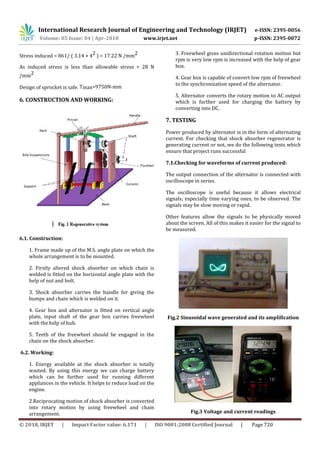
6.1. Construction:
1. Frame made up of the M.S. angle plate on which the
whole arrangement is to be mounted.
2. Firstly altered shock absorber on which chain is
welded is fitted on the horizontal angle plate with the
help of nut and bolt.
3. Shock absorber carries the handle for giving the
bumps and chain which is welded on it.
4. Gear box and alternator is fitted on vertical angle
plate, input shaft of the gear box carries freewheel
with the help of hub.
5. Teeth of the freewheel should be engaged in the
chain on the shock absorber.
6.2. Working:
1. Energy available at the shock absorber is totally
wasted. By using this energy we can charge battery
which can be further used for running different
appliances in the vehicle. It helps to reduce load on the
engine.
2.Reciprocating motion of shock absorber is converted
into rotary motion by using freewheel and chain
arrangement.
3. Freewheel gives unidirectional rotation motion but
rpm is very low rpm is increased with the help of gear
box.
4. Gear box is capable of convert low rpm of freewheel
to the synchronization speed of the alternator.
5. Alternator converts the rotary motion to AC output
which is further used for charging the battery by
converting into DC.
7. TESTING
Power produced by alternator is in the form of alternating
current. For checking that shock absorber regenerator is
generating current or not, we do the following tests which
ensure that project runs successful
7.1.Checking for waveforms of current produced:
The output connection of the alternator is connected with
oscilloscope in series.
The oscilloscope is useful because it allows electrical
signals; especially time varying ones, to be observed. The
signals may be slow moving or rapid.
Other features allow the signals to be physically moved
about the screen. All of this makes it easier for the signal to
be measured.
Fig.2 Sinusoidal wave generated and its amplification
Fig.3 Voltage and current readings
International Research Journal of Engineering and Technology (IRJET) e-ISSN: 2395-0056
Volume: 05 Issue: 04 | Apr-2018 www.irjet.net p-ISSN: 2395-0072
© 2018, IRJET | Impact Factor value: 6.171 | ISO 9001:2008 Certified Journal | Page 721
7.2.Testing for power generated:
Voltage and current is measured by using multi meter and
power is calculated as follows;
V = 29.06V, I= 1.244 A;
Power = V× I
Power = 36.15VA =36.15 Watt
Fig.4 Testing Setup
8. CONCLUSION
The vibration energy of vehicle suspension system is
wasted in the form of heat energy. By using regenerative
system the wasted energy is converted into the useful
energy like electrical energy and some amount fuel
consumption is reduced. All types regenerative suspension
are commonly electromagnetic suspension. From the
appearance of full performance including oscillation guide
capacity, regenerative efficiency and application
reliability. By using advanced technology regenerative
system can became important in vehicle manufacturing
industry.
By using regenerative system electrical energy is
produced. When vehicle come through a rough road that
time more energy is created as compare to smooth road
through alternator. Battery is connected to alternator and
charges the battery.
9. REFERENCES
[1] “Selection of Energy Storage System for a
Regenerative Dynamic Dynamometer .’’ Larry Weng
Geoff Walker Zhao Yang Dong Andrew Simpson David
Finn.
[2] “Review on Energy-Regenerative Suspension
Systems for Vehicles” Zhang Jin-qiu, PengZhi- zhao,
Zhang Lei, Zhang Yu.
[3] “Design and Analysis of an Active and Energy
Regenerative Suspension” Jun Yin , Xinbo Chen Jianqin
Li .
[4] “Harvesting Energy from the Vibration of
Suspension of a Passenger Vehicle” MohdAzman
Abdullah , JazliFirdausJamil.
[5] “Design, Fabrication and Testing of Regenerative
Shock Absorber” Dr. S Gopalakann 275634481
www.researchgate.net
[6] “Design of electromagnet ic shock absorbers”
Gupta A, Jendrzejczyk J A, Mulcahy T M and Hull J R
International Journal of Mechanics &Material Design,
Volume 3, Number 3.
[7]“Design and characterization of Electromagnetic
Energy harvester for vehicle suspensions” Lei Zuo,
Brian Scully, JurgenShestani and Yu Zhou Journal of
Smart Materials and Structures Volume 19, Number 4.
[8] “Energy harvesting, ride comfort, and road
handling of regenerative vehicle suspensions” Pei-
Sheng Zhang and Lei Zuo, ASME Journal of Vibration
and Acoustics, 2012.
[9]”Mechanics magazine and journal of the mechanics
institute’’,volume2

IRJET- Regenerative Suspension System

  • 1.
    International Research Journalof Engineering and Technology (IRJET) e-ISSN: 2395-0056 Volume: 05 Issue: 04 | Apr-2018 www.irjet.net p-ISSN: 2395-0072 © 2018, IRJET | Impact Factor value: 6.171 | ISO 9001:2008 Certified Journal | Page 717 Regenerative Suspension System Prof.P.B.Magade1, Manoj Narute2, Suraj Kinhale3, Mahesh Kutwal4, Yogesh Marakad5 1,2,3,4,5 Dept. of Mechanical Engineering, Zeal College of Engineering and Research Narhe, Pune, Maharashtra, India -----------------------------------------------------------------------------***---------------------------------------------------------------------------- Abstract: In India capacity of power consumption is increased because industrialization and standard of human life is incrcreased. Now a days vehicle became a basic need of human hence the production of vehicles as well as demand of vehicles are increasing. Hence number of vehicles on road are increased. Therefore accidents are increasing. One of the best way to minimize the accidents is to install the speed breakers in front of school, hospital, temple, railway crossing etc. Due to speed breaker rider maintain minimum speed and chances of accidents are reduced. Speed breaker oppose the vehicle and impact force is created in suspension system. By using impact force power is generated with the help of dynamo and alternator. The generated power is used to charge the battery. About 100- 400 watts power is generated with the help of middle size vehicles like car, taxies etc. Key words: Speed breakers, Impact Energy , Regenerative suspension system, Alternator, Dynamo and Battery 1. INTRODUCTION The number of vehicles are travelled on a road. The road may be rough or smooth. On rough road more vibrations are created as compare to smooth road. These vibrations are not used for any purpose and vibrations are wasted. Vibrations are commonly wasted in forms of thermal energy.. By using regenerative suspension system 100-400 watts average power is generated with the help of middle size vehicles. Middle-size passenger vehicle needs 180 to 200 watts power for various processes like fuel ignition and injection processes. Also the middle size vehicles requires 250 to 260 watts power for lighting system like head light, front light, main lamp etc. The total need of power of middle size vehicles for various requirement is about 180 to 400 watts. By using regenerative suspension system it is possible that to charge the battery of vehicle. Therefore load on the vehicle engine is reduced and the requirement of fuel is reduced at certain level. Thus by using regenerative suspension system charging of battery as well as fuel consumption is reduced.[5] 2. LITERATURE SURVEY Larry Weng ,Geoff Walker et.al[1] have researched on energy storage system for regenerative dynamometers. In this paper, various types of dynamometers have been researched. One of those is regenerative dynamometer. In this mechanical energy is converted into electrical energy for charging the battery. Zhang Jin-qiu, PengZhi-zhao et.al[2] studied on energy conversion system in suspension system. The regenerative suspension systems have attracted much attention in recent years for the improvement of vibrating attenuating performance and reduction of energy dissipation. Jun Yin ,Xinbo Chen et.al[3] have researched on how to design and analyze regenerative suspension system. From this paper we come to know that how to design the kinematics of this system. To achieve better suspension performance. The regenerative suspension system should be controlled in consider of the kinematics and dynamics of the system. The advantage of regenerative suspension system is demonstrated by comparison with suspension performance of passive suspension system. MohdAzman Abdullah , JazliFirdausJamil et.al[4] have studied and developed a device to harvest vibrational energy . Based on the frequency and amplitude of potential vibrations a device is designed and developed. This device is further assembled in a passenger vehicle.[4] 3. OBJECTIVES 1. To generate the reciprocating motion as a prime input. 2. To convert reciprocating motion into rotary motion by rack and pinion. 3. To magnify the rotary motion using chain drive. 4. To store the kinetic energy using flywheel. 5. To transfer the energy to dynamo and to generate electricity. 6. To light up the indicator lamps attached to system as final output. 7. To conserve the vibrational energy which is being dissipated as heat. 4. DESIGN CALCULATION The various steps for designing are as follows: 4.1.Nomenclature: m = Mass of the flywheel k = Radius of gyration
  • 2.
    International Research Journalof Engineering and Technology (IRJET) e-ISSN: 2395-0056 Volume: 05 Issue: 04 | Apr-2018 www.irjet.net p-ISSN: 2395-0072 © 2018, IRJET | Impact Factor value: 6.171 | ISO 9001:2008 Certified Journal | Page 718 I = Mass moment of inertia Pd=Diameter pitch m=Module A = Addendum B = Deddendum Pc = Circular Pitch ρ = Density of concrete K1= Load factor K2= Factor for distance regulation K3=Factor for center distance of sprocket K4=Factor for position of sprocket K5=Lubrication factor K6=Rating factor T1 = Tension in tight side T2 = Tension in slack side Dact =Actual diameter of shaft Tmax= Maximum torque on shaft 4.2.Calculation: Let the force put by human hand on rack = 30 kg.[9] 30x10 =300 N In one minute rack will go up & down 30 times . Now pinion has 24 number of teeth so in 1 minute pinion Rpm will be 15 because only 12 teeth will come in contact at a time only with rack. Now, Gear-1, teeth = 44 and Rpm = 15 Gear-2, teeth = 18 Gear teeth ratio = 18:44 =1:2.4 Speed of gear-2 = 2.4x15 = 36 Rpm Rpm of flywheel is 85 Rpm. Diameter of flywheel = 350mm = 0.350 m Width of flywheel = 80mm =0.080 m .‘. Volume of flywheel = π x r2 x b = 0.007696 m3. Flywheel is filled with concrete inside. ρ = 2400 kg/m3. .’. Mass of flywheel = 0.007696 x 2400 = 18.47 kg The mean kinetic energy of the flywheel, E =1/2 .I .ω2 =1/2m.k2.ω2 = 0.6293 N-mm Velocity ratio = 50 : 350 = 1 : 7 Speed of dynamo pulley = 85 x 7 = 595 Rpm. Purchase 500 Rpm standard dynamo from the market, which produce 10 watts power at full speed. Torque transmitted by shaft, T = π/16 x τ x d3 Select permissible shear stress (τ) from design data book ( V.B. Bhandari) τ = 70 N/mm2 Thus, 9750 = π /16 x d3 x 70 d=8.91mm Taking factor of safety = 1.8 Dact = 8.9 x 1.8 = 16 mm Select diameter of shaft = 20 mm. For 20mm shaft diameter take standard bearing. Spherical ball or deep groove ball bearing = 20mm Spur gear terminology, Take the gear of teeth, T = 24 D = 65mm b= 25mm. Calculate spur gear terminology and check whether it can bear load. Pd = T/D = 24/65 = 0.37 mm. m = D/T = 65/24 = 2.70mm. Pc = πD/T = π x 65/24 = 8.50 mm. A = 1/Pd= 1/0.37 = 2.70mm. B = 1.157/Pd = 1.157/0.37 = 3.13 mm. Root diameter = T-2/Pd = 22/0.37 = 59.45 mm. Base circle = D x Cos(Pd x A) = 65 x cos(0.37x2.70) = 64.99mm.
  • 3.
    International Research Journalof Engineering and Technology (IRJET) e-ISSN: 2395-0056 Volume: 05 Issue: 04 | Apr-2018 www.irjet.net p-ISSN: 2395-0072 © 2018, IRJET | Impact Factor value: 6.171 | ISO 9001:2008 Certified Journal | Page 719 Pc = 3.1416/Pd = 8.49mm. Thickness = 3.1416D/2N = 1.57/Pd = 4.24mm. By using the Lewis equation find the maximum load tooth can bear. Lewis equation Wt = ςw x b x Pc x y The permissible working stress (ςw ) in Lewis equation depends upon the gear material and may be obtained by Barth formulae. ςw = ςo x Cv ςo is allowable static stress at elastic limit of the material. From design data book(V. B. Bhandari) ςo = 455mpa Cv = 4.5/4.5+v = 4.5/4.5+ 3.40 = 0.57 V = πDN/60 = π x 0.065 x 1000/60 = 3.40 m/s ςw = ςo x Cv ςw = 455 x 0.57 = 259.35 Y is known as Lewis form factor or tooth form factor. Y = 0.154 – 0.912/T --------------- ( for 20 degree full depth involute system.) Y = 0.154 – 0.912/24 = 0.116. Wt = ςw x b x Pc x y Wt = 259.35 x 25 x 8.49 x 0.116 = 6385 N =651 kg. Putting 30 kg load on gear so design of our gear is safe. 4.3.Design of chain &sprocket: Transmission Ratio = Z2 / Z1 = 44/18 = 2.44 Select number of teeth on pinion sprocket as 18 teeth. Z1 = 18 teeth 4.4.Selection of pitch of sprocket: The pitch is decided on the basis of Rpm of sprocket. Rpm of pinion sprocket is variable in normal condition it is = 36 rpm For this Rpm value select pitch of sprocket as 15mm from table. P = 15mm 4.5.Calculation of minimum center distance between sprockets: Transmission ratio= Z2 / Z1 = 44/18 = 2.44 which is less than 5 Minimum center distance = C + (80 to 150 mm) Where C = (Dc1 + Dc2)/2 C = 120 mm Minimum center distance = 120 + (80 to 150 mm ) = 280 mm 4.6.Calculation of values of constants K1 = 1.25 K2 = 1.25 K3 =0.8 K4 = 1 K5 = 1.5 K6 = 1.0 4.7.Calculation of value of factor of safety : For pitch = 15 & speed of rotation of small sprocket = 36 rpm Factor of safety = 8.55 Calculation of value of allowable bearing stress : For pitch = 15 and speed of rotation of small sprocket = 36 rpm Allowable bearing stress = 2.87 kg / cm2 = 2.87 × 981 / 100 =28 N /mm2 For horizontal position coefficient of sag K = 6 T1/T2 = e  T1/T2 = e0.35 x 2.971 T1 = 2.80T2 T = ( T1 – T2 ) X R 9750 = ( 2.80 T2 – T2 ) X 85 T2 = 63.72 N T1 = 2.80 X 63.72 T1 = 178.43 N So tension in tight side = 178.43 N Stress = force / area
  • 4.
    International Research Journalof Engineering and Technology (IRJET) e-ISSN: 2395-0056 Volume: 05 Issue: 04 | Apr-2018 www.irjet.net p-ISSN: 2395-0072 © 2018, IRJET | Impact Factor value: 6.171 | ISO 9001:2008 Certified Journal | Page 720 Stress induced = 861/ ( 3.14 × 42 ) = 17.22 N /mm2 As induced stress is less than allowable stress = 28 N /mm2 Design of sprocket is safe. Tmax=9750N-mm 6. CONSTRUCTION AND WORKING: 6.1. Construction: 1. Frame made up of the M.S. angle plate on which the whole arrangement is to be mounted. 2. Firstly altered shock absorber on which chain is welded is fitted on the horizontal angle plate with the help of nut and bolt. 3. Shock absorber carries the handle for giving the bumps and chain which is welded on it. 4. Gear box and alternator is fitted on vertical angle plate, input shaft of the gear box carries freewheel with the help of hub. 5. Teeth of the freewheel should be engaged in the chain on the shock absorber. 6.2. Working: 1. Energy available at the shock absorber is totally wasted. By using this energy we can charge battery which can be further used for running different appliances in the vehicle. It helps to reduce load on the engine. 2.Reciprocating motion of shock absorber is converted into rotary motion by using freewheel and chain arrangement. 3. Freewheel gives unidirectional rotation motion but rpm is very low rpm is increased with the help of gear box. 4. Gear box is capable of convert low rpm of freewheel to the synchronization speed of the alternator. 5. Alternator converts the rotary motion to AC output which is further used for charging the battery by converting into DC. 7. TESTING Power produced by alternator is in the form of alternating current. For checking that shock absorber regenerator is generating current or not, we do the following tests which ensure that project runs successful 7.1.Checking for waveforms of current produced: The output connection of the alternator is connected with oscilloscope in series. The oscilloscope is useful because it allows electrical signals; especially time varying ones, to be observed. The signals may be slow moving or rapid. Other features allow the signals to be physically moved about the screen. All of this makes it easier for the signal to be measured. Fig.2 Sinusoidal wave generated and its amplification Fig.3 Voltage and current readings
  • 5.
    International Research Journalof Engineering and Technology (IRJET) e-ISSN: 2395-0056 Volume: 05 Issue: 04 | Apr-2018 www.irjet.net p-ISSN: 2395-0072 © 2018, IRJET | Impact Factor value: 6.171 | ISO 9001:2008 Certified Journal | Page 721 7.2.Testing for power generated: Voltage and current is measured by using multi meter and power is calculated as follows; V = 29.06V, I= 1.244 A; Power = V× I Power = 36.15VA =36.15 Watt Fig.4 Testing Setup 8. CONCLUSION The vibration energy of vehicle suspension system is wasted in the form of heat energy. By using regenerative system the wasted energy is converted into the useful energy like electrical energy and some amount fuel consumption is reduced. All types regenerative suspension are commonly electromagnetic suspension. From the appearance of full performance including oscillation guide capacity, regenerative efficiency and application reliability. By using advanced technology regenerative system can became important in vehicle manufacturing industry. By using regenerative system electrical energy is produced. When vehicle come through a rough road that time more energy is created as compare to smooth road through alternator. Battery is connected to alternator and charges the battery. 9. REFERENCES [1] “Selection of Energy Storage System for a Regenerative Dynamic Dynamometer .’’ Larry Weng Geoff Walker Zhao Yang Dong Andrew Simpson David Finn. [2] “Review on Energy-Regenerative Suspension Systems for Vehicles” Zhang Jin-qiu, PengZhi- zhao, Zhang Lei, Zhang Yu. [3] “Design and Analysis of an Active and Energy Regenerative Suspension” Jun Yin , Xinbo Chen Jianqin Li . [4] “Harvesting Energy from the Vibration of Suspension of a Passenger Vehicle” MohdAzman Abdullah , JazliFirdausJamil. [5] “Design, Fabrication and Testing of Regenerative Shock Absorber” Dr. S Gopalakann 275634481 www.researchgate.net [6] “Design of electromagnet ic shock absorbers” Gupta A, Jendrzejczyk J A, Mulcahy T M and Hull J R International Journal of Mechanics &Material Design, Volume 3, Number 3. [7]“Design and characterization of Electromagnetic Energy harvester for vehicle suspensions” Lei Zuo, Brian Scully, JurgenShestani and Yu Zhou Journal of Smart Materials and Structures Volume 19, Number 4. [8] “Energy harvesting, ride comfort, and road handling of regenerative vehicle suspensions” Pei- Sheng Zhang and Lei Zuo, ASME Journal of Vibration and Acoustics, 2012. [9]”Mechanics magazine and journal of the mechanics institute’’,volume2