International Research Journal of Engineering and Technology (IRJET) e-ISSN: 2395-0056
Volume: 07 Issue: 01 | Jan 2020 www.irjet.net p-ISSN: 2395-0072
© 2020, IRJET | Impact Factor value: 7.34 | ISO 9001:2008 Certified Journal | Page 1153
Analysis of Music Recommendation System using Machine Learning
Algorithms
Prachi Singh1, Mr. Pankaj K. Singh2, Mr. Amit Ganguli3, Mr. Ajit Shrivastava4
1M.Tech Scholar, Department of CSE, Sagar Institute of Science, Technology & Research Bhopal, (M.P.), India
2,3Assistant Professor, Department of CSE, Sagar Institute of Science, Technology & Research Bhopal, (M.P.), India
4Professor & Head, Department of CSE, Sagar Institute of Science, Technology & Research Bhopal, (M.P.), India
-----------------------------------------------------------------------***--------------------------------------------------------------------
ABSTRACT:- Today’s World is known as Data World.
Generation of Data is abundant in volume. Demand of
useful data is every-where every business domain works
upon data this day. Data mining played very important
roles from last decade now this data mining is migrated to
Machine Learning. Machine Learning comes by Artificial
Intelligence and Mathematical Statistics. Machine learning
is categorized into supervised, unsupervised and
reinforcement. Supervised machine is using the learning
algorithm to detect the discovery that is clearly due to the
examples supplied to produce general interpretation,
which then predicts future scenarios or events. In this
Dissertation explains with the advancement of technology
in music players, especially in intelligent cell phones, users
have access to large archives. The quick and easy selection
of favourite music in these large archives becomes one of
the biggest problems for users. For example, choosing
music in a silent forest is different from a crowded street or
feelings of listening to music in the morning of a working
day are different from a holiday afternoon. In this paper, a
system is designed that it collects users' reference
information such as weather, temperature, geographic
location, etc., and according to their weighted composition,
it recommends a suitable music that is currently available
to the user. Here we analyse the music portal KKBOX in this
work we analyse the different dependent attributes their
behaviour and others. Finally, we apply two algorithms
Random Forest & XGBClassifier.
Keywords: Classification Algorithm, Machine Learning, Deep
Learning, Decision Tree & Random Forest, ensemble
Techniques, CNN.
1. INTRODUCTION
In some previous years we all are talking about machine
intelligent programs, and what this factor for our health
issues, richness. Now days , machine related intelligent
learnt program possibly pledge to protect growth of
population, address worldwide challenges such as
environment change, and add much of income to the
world’s economy through expanding potency; so that it
also essentially make changes in the nature of work, and
Size, or define, do the choices in everyday life. Between
these extremes, there is a potentially variable technology,
which brings both its opportunities and challenges, and
whose risks and benefits are needed to navigate because it
is used to become more central to everyday activities.
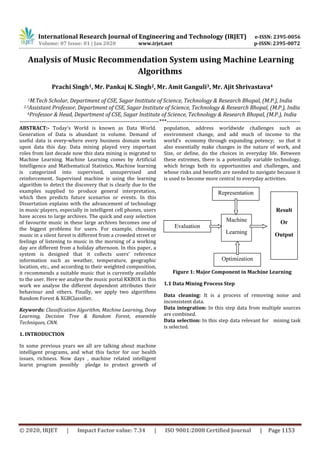
Figure 1: Major Component in Machine Learning
1.1 Data Mining Process Step
Data cleaning: It is a process of removing noise and
inconsistent data.
Data integration: In this step data from multiple sources
are combined.
Data selection: In this step data relevant for mining task
is selected.
Machine
Learning
Representation
Evaluation
Optimization
Result
Or
Output
International Research Journal of Engineering and Technology (IRJET) e-ISSN: 2395-0056
Volume: 07 Issue: 01 | Jan 2020 www.irjet.net p-ISSN: 2395-0072
© 2020, IRJET | Impact Factor value: 7.34 | ISO 9001:2008 Certified Journal | Page 1154
Figure 2: Process of Data Mining
Data transformation: In this step data will be transformed
into form that is appropriate for mining.
Data mining: In this step some intelligent methods are
applied for extracting data patterns.
Pattern evaluation: In this step we concentrate upon
important patterns representing knowledge based on some
measure are identified.
Knowledge presentation: In this step visualization and
knowledge representation techniques are used to present
the mined knowledge to the user.
1.2 Data Mining Techniques
Data mining Algorithms is categorized into different which
is given below:
Classification
Classification is the frequently (most commonly) applied
data mining mechanism, which explains a set of pre-
classified examples to develop a (procedure) model that
can (identifies or categories) classify the population
(Dataset) of records at large.
Clustering
Clustering can be said as to find out of similar classes of
objects. By using clustering mechanism, we can further find
out dense and sparse (n Dimensional Space) regions in
object space and can discover overall distribution trends
(pattern) and relation among many coordinate points
(correlations) among data attributes.
Association
Clustering Association play very important roles when we
have abundant data with similar properties means with the
above mechanism, we can divide the data which has similar
properties associated with another object.
2. LITERATURE SURVEY
According to the paper, personalized music
recommendation system (PMRS) based on the
convolutional neural networks (CNN) approach. The CNN
approach classifies music based on the audio signal beats of
the music into different genres. In PMRS, we propose a
collaborative filtering (CF) recommendation algorithm to
combine the output of the CNN with the log files to
recommend music to the user. The log file contains the
history of all users who use the PMRS. The PMRS extracts
the user’s history from the log file and recommends music
under each genre. We use the million-song dataset (MSD)
to evaluate the PMRS. To show the working of the PMRS,
we developed a mobile application (an Android version).
We used the confidence score metrics for different music
genre to check the performance of the PMRS. [1].
The personalized music recommender supports the user-
favorite songs stored in a huge music database. In order to
predict only user-favorite songs, managing user
preferences information and genre classification are
necessary. In our study, a very short feature vector,
obtained from low dimensional projection and already
developed audio features, is used for music genre
classification problem. We applied a distance metric
learning algorithm in order to reduce the dimensionality of
feature vector with a little performance degradation. We
propose the system about the automatic management of
the user preferences and genre classification in the
personalized music system. [2].
3. PROBLEM IDENTIFICATION
When we studied many Product Recommendation System
related papers, we found that many techniques are
available to find the prediction. We read number of
research papers and find that every algorithm has some
specification in terms of their performance. Author decided
that he will give an algorithm which has better Accuracy.
Since we know that deep learning or neural network gives
better result in terms of performance so we will apply
Random Forest & SGDCClassifier for better performance.
International Research Journal of Engineering and Technology (IRJET) e-ISSN: 2395-0056
Volume: 07 Issue: 01 | Jan 2020 www.irjet.net p-ISSN: 2395-0072
© 2020, IRJET | Impact Factor value: 7.34 | ISO 9001:2008 Certified Journal | Page 1155
4. Block Diagram & Methodology
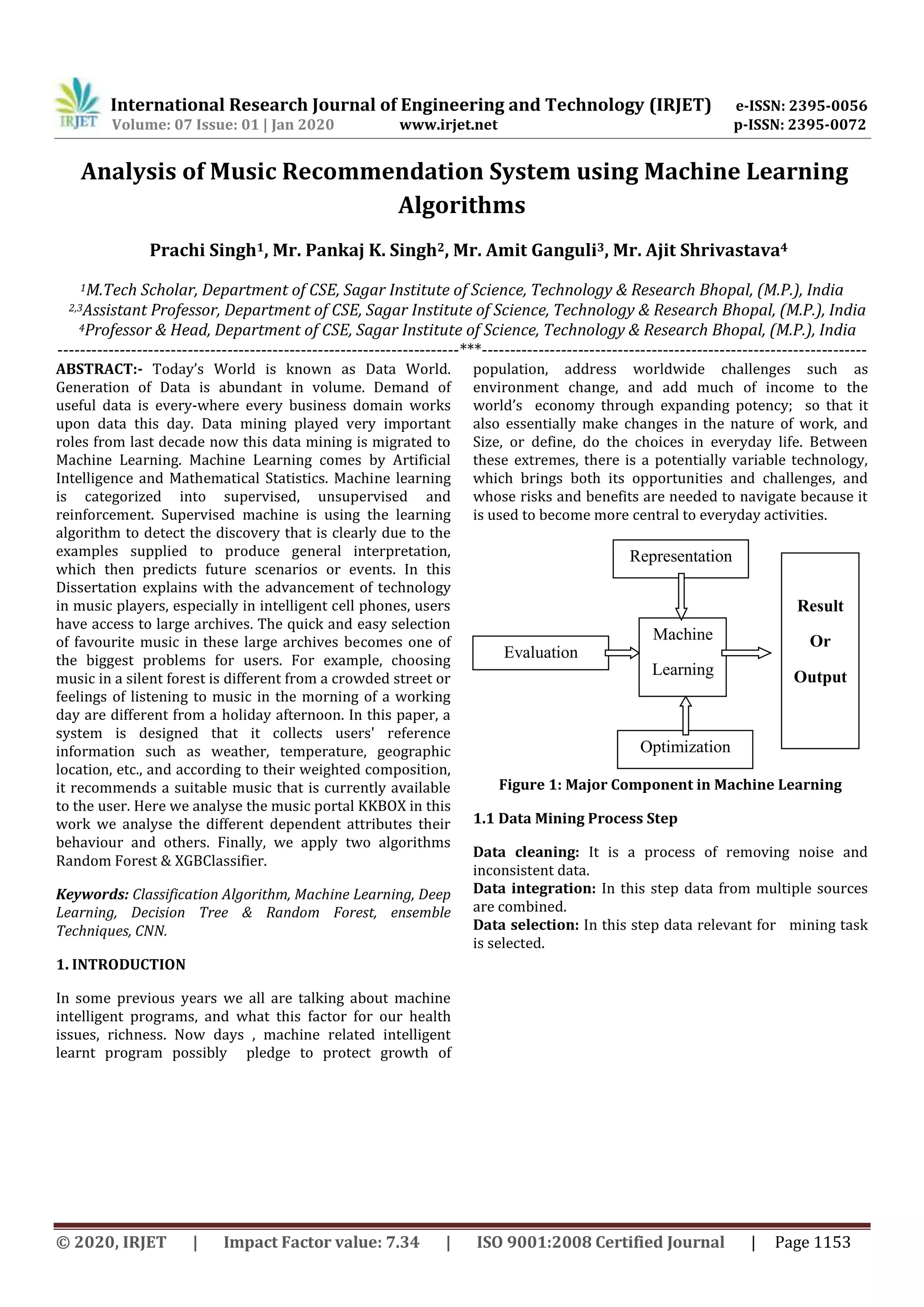
Figure 6: Block Diagram of Flow of Operation
5. Experimental Result
We used python programming Language to implement our
logic we used number of libraries like NumPy, pandas,
tweepy, matplotlib, seaborn and many more. This project is
divided into two parts in first part we fetch data in another
part we will process our data our overall process is given
below:
Table01: Comparison of Different Algorithms
Explanation: In the above Table we compare to Different
Algorithms with two different Dataset Splits.
Figure 3: Graph Comparison
Explanation: By the analysis of above graph we can say
that splitting of training and testing data may change the
accuracy which is given above in terms of graphical values.
We split our data into three different slot 70-30,80-20 &
75-25 . In every split we found the different values.
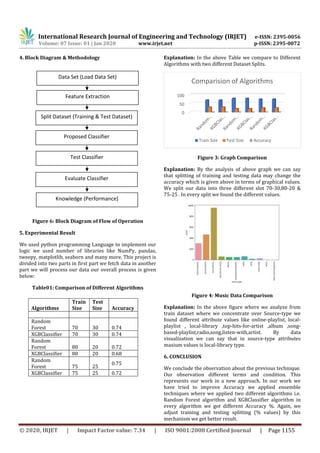
Figure 4: Music Data Comparison
Explanation: In the above figure where we analyze from
train dataset where we concentrate over Source-type we
found different attribute values like online-playlist, local-
playlist , local-library ,top-hits-for-artist ,album ,song-
based-playlist,radio,song,listen-with,artist. By data
visualization we can say that in source-type attributes
maxium values is local-library type.
6. CONCLUSION
We conclude the observation about the previous technique.
Our observation different terms and condition. This
represents our work in a new approach. In our work we
have tried to improve Accuracy we applied ensemble
techniques where we applied two different algorithms i.e.
Random Forest algorithm and XGBClassifier algorithm in
every algorithm we got different Accuracy %. Again, we
adjust training and testing splitting (% values) by this
mechanism we get better result.
0
50
100
Comparision of Algorithms
Train Size Test Size Accuracy
Algorithms
Train
Size
Test
Size Accuracy
Random
Forest 70 30 0.74
XGBClassifier 70 30 0.74
Random
Forest 80 20 0.72
XGBClassifier 80 20 0.68
Random
Forest 75 25
0.75
XGBClassifier 75 25 0.72
Data Set (Load Data Set)
Feature Extraction
Split Dataset (Training & Test Dataset)
Proposed Classifier
Test Classifier
Evaluate Classifier
Knowledge (Performance)
International Research Journal of Engineering and Technology (IRJET) e-ISSN: 2395-0056
Volume: 07 Issue: 01 | Jan 2020 www.irjet.net p-ISSN: 2395-0072
© 2020, IRJET | Impact Factor value: 7.34 | ISO 9001:2008 Certified Journal | Page 1156
REFERENCES
[1] Z. Hyung, J. S. Park, and K. Lee, “Utilizing context-
relevant keywords extracted from a large collection of
user-generated documents for music discovery,” Info.
Processing and Management, vol. 53, no. 5, pp. 1185-1200,
2017.
[2] J. B. Schafer, D. Frankowski, J. Herlocker, and S. Sen,
“Collaborative filtering recommender systems, ”The
Adaptive Web: Methods and Strategies of Web
Personalization, pp. 291-324, 2007.
[3] M. J. Pazzani and D. Billsus, “Content based
recommendation systems,” The Adaptive Web: Methods
and Strategies of Web Personalization, pp. 325-341, 2007.
[4] E. J. Humphrey, J. P. Bello, and Y. LeCun, “Moving beyond
feature design: deep architectures and automatic feature
learning in music informatics,” in Proc. 13th Int’l Conf.
Music Info. Retrieval, pp. 403-408, October 2012.
[5] C. W. Hsu, and C. J. Lin, “A comparison of methods for
multiclass support vector machines,”IEEE Tran. Neural
Networks, vol. 13, no. 2, pp. 415-425, 2002.
[6] R. E. Fan, K. W. Chang, C. J. Hsieh, X. R. Wang, and C. J.
Lin, “LIBLINEAR: a library for large linear classification,” J.
Machine Learning Research, vol. 9, pp. 1871-1874,2008. [7]
A. V. Oord, S. Dieleman, and B. Schrauwen, “Deep content-
based music recommendation,” in Proc. 26th Int'l Conf.
Neural Info. Process. Systems, pp. 2643-2651, December
2013.
[8] J. Salamon, and J. P. Bello, “Deep convolutional neural
networks and data augmentation for environmental sound
classification,” IEEE Sig. Processing Letters, vol. 24, no. 3,
pp. 279-283, March 2017.
[9] A. Krizhevsky, I. Sutskever, and G. E. Hinton, “Imagenet
classification with deep convolutional neural networks,”
Advances in Neural Info.Processing Sys,pp. 1097-
1105,2012.
[10] R. Jozefowicz, W. Zaremba, and I. Sutskever, “An
empirical exploration of recurrent network architectures,”
inInt’l Conf. Machine Learning,pp. 2342-2350, June 2015.
[11] J. S. Downie, “Music information retrieval,” Annual
Review of Information Science and Technology, 37:295-
340, 2003.
[12] R. Typke, F. Wiering, and R. Veltkamp, “A survey of
music infonnation retrieval systems,” Proc. ISMIR, pp. 153-
160, 2005
[13] D. Jang, C.-J. Song, S. Shin, S.-J. Park, S.-J. Jang, S.-P. Lee,
“Implementation of a matching engine for a practical
query-bysinging/humming system,” Proc. ISSPIT, pp. 258-
263, 2011
[14] S. W. Hainsworth and M. D. Macleod, “Particle filtering
applied to musical tempo tracking,” EURASIP J. Applied
Signal Processing, vol. 15, pp. 2385-2395, 2004
[15] S. Jo and C. D. Yoo, “Melody extraction from
polyphonic audio based on particle filter,” Proc. ISMIR, pp.
357-362, 2010

IRJET- Analysis of Music Recommendation System using Machine Learning Algorithms

  • 1.
    International Research Journalof Engineering and Technology (IRJET) e-ISSN: 2395-0056 Volume: 07 Issue: 01 | Jan 2020 www.irjet.net p-ISSN: 2395-0072 © 2020, IRJET | Impact Factor value: 7.34 | ISO 9001:2008 Certified Journal | Page 1153 Analysis of Music Recommendation System using Machine Learning Algorithms Prachi Singh1, Mr. Pankaj K. Singh2, Mr. Amit Ganguli3, Mr. Ajit Shrivastava4 1M.Tech Scholar, Department of CSE, Sagar Institute of Science, Technology & Research Bhopal, (M.P.), India 2,3Assistant Professor, Department of CSE, Sagar Institute of Science, Technology & Research Bhopal, (M.P.), India 4Professor & Head, Department of CSE, Sagar Institute of Science, Technology & Research Bhopal, (M.P.), India -----------------------------------------------------------------------***-------------------------------------------------------------------- ABSTRACT:- Today’s World is known as Data World. Generation of Data is abundant in volume. Demand of useful data is every-where every business domain works upon data this day. Data mining played very important roles from last decade now this data mining is migrated to Machine Learning. Machine Learning comes by Artificial Intelligence and Mathematical Statistics. Machine learning is categorized into supervised, unsupervised and reinforcement. Supervised machine is using the learning algorithm to detect the discovery that is clearly due to the examples supplied to produce general interpretation, which then predicts future scenarios or events. In this Dissertation explains with the advancement of technology in music players, especially in intelligent cell phones, users have access to large archives. The quick and easy selection of favourite music in these large archives becomes one of the biggest problems for users. For example, choosing music in a silent forest is different from a crowded street or feelings of listening to music in the morning of a working day are different from a holiday afternoon. In this paper, a system is designed that it collects users' reference information such as weather, temperature, geographic location, etc., and according to their weighted composition, it recommends a suitable music that is currently available to the user. Here we analyse the music portal KKBOX in this work we analyse the different dependent attributes their behaviour and others. Finally, we apply two algorithms Random Forest & XGBClassifier. Keywords: Classification Algorithm, Machine Learning, Deep Learning, Decision Tree & Random Forest, ensemble Techniques, CNN. 1. INTRODUCTION In some previous years we all are talking about machine intelligent programs, and what this factor for our health issues, richness. Now days , machine related intelligent learnt program possibly pledge to protect growth of population, address worldwide challenges such as environment change, and add much of income to the world’s economy through expanding potency; so that it also essentially make changes in the nature of work, and Size, or define, do the choices in everyday life. Between these extremes, there is a potentially variable technology, which brings both its opportunities and challenges, and whose risks and benefits are needed to navigate because it is used to become more central to everyday activities. Figure 1: Major Component in Machine Learning 1.1 Data Mining Process Step Data cleaning: It is a process of removing noise and inconsistent data. Data integration: In this step data from multiple sources are combined. Data selection: In this step data relevant for mining task is selected. Machine Learning Representation Evaluation Optimization Result Or Output
  • 2.
    International Research Journalof Engineering and Technology (IRJET) e-ISSN: 2395-0056 Volume: 07 Issue: 01 | Jan 2020 www.irjet.net p-ISSN: 2395-0072 © 2020, IRJET | Impact Factor value: 7.34 | ISO 9001:2008 Certified Journal | Page 1154 Figure 2: Process of Data Mining Data transformation: In this step data will be transformed into form that is appropriate for mining. Data mining: In this step some intelligent methods are applied for extracting data patterns. Pattern evaluation: In this step we concentrate upon important patterns representing knowledge based on some measure are identified. Knowledge presentation: In this step visualization and knowledge representation techniques are used to present the mined knowledge to the user. 1.2 Data Mining Techniques Data mining Algorithms is categorized into different which is given below: Classification Classification is the frequently (most commonly) applied data mining mechanism, which explains a set of pre- classified examples to develop a (procedure) model that can (identifies or categories) classify the population (Dataset) of records at large. Clustering Clustering can be said as to find out of similar classes of objects. By using clustering mechanism, we can further find out dense and sparse (n Dimensional Space) regions in object space and can discover overall distribution trends (pattern) and relation among many coordinate points (correlations) among data attributes. Association Clustering Association play very important roles when we have abundant data with similar properties means with the above mechanism, we can divide the data which has similar properties associated with another object. 2. LITERATURE SURVEY According to the paper, personalized music recommendation system (PMRS) based on the convolutional neural networks (CNN) approach. The CNN approach classifies music based on the audio signal beats of the music into different genres. In PMRS, we propose a collaborative filtering (CF) recommendation algorithm to combine the output of the CNN with the log files to recommend music to the user. The log file contains the history of all users who use the PMRS. The PMRS extracts the user’s history from the log file and recommends music under each genre. We use the million-song dataset (MSD) to evaluate the PMRS. To show the working of the PMRS, we developed a mobile application (an Android version). We used the confidence score metrics for different music genre to check the performance of the PMRS. [1]. The personalized music recommender supports the user- favorite songs stored in a huge music database. In order to predict only user-favorite songs, managing user preferences information and genre classification are necessary. In our study, a very short feature vector, obtained from low dimensional projection and already developed audio features, is used for music genre classification problem. We applied a distance metric learning algorithm in order to reduce the dimensionality of feature vector with a little performance degradation. We propose the system about the automatic management of the user preferences and genre classification in the personalized music system. [2]. 3. PROBLEM IDENTIFICATION When we studied many Product Recommendation System related papers, we found that many techniques are available to find the prediction. We read number of research papers and find that every algorithm has some specification in terms of their performance. Author decided that he will give an algorithm which has better Accuracy. Since we know that deep learning or neural network gives better result in terms of performance so we will apply Random Forest & SGDCClassifier for better performance.
  • 3.
    International Research Journalof Engineering and Technology (IRJET) e-ISSN: 2395-0056 Volume: 07 Issue: 01 | Jan 2020 www.irjet.net p-ISSN: 2395-0072 © 2020, IRJET | Impact Factor value: 7.34 | ISO 9001:2008 Certified Journal | Page 1155 4. Block Diagram & Methodology Figure 6: Block Diagram of Flow of Operation 5. Experimental Result We used python programming Language to implement our logic we used number of libraries like NumPy, pandas, tweepy, matplotlib, seaborn and many more. This project is divided into two parts in first part we fetch data in another part we will process our data our overall process is given below: Table01: Comparison of Different Algorithms Explanation: In the above Table we compare to Different Algorithms with two different Dataset Splits. Figure 3: Graph Comparison Explanation: By the analysis of above graph we can say that splitting of training and testing data may change the accuracy which is given above in terms of graphical values. We split our data into three different slot 70-30,80-20 & 75-25 . In every split we found the different values. Figure 4: Music Data Comparison Explanation: In the above figure where we analyze from train dataset where we concentrate over Source-type we found different attribute values like online-playlist, local- playlist , local-library ,top-hits-for-artist ,album ,song- based-playlist,radio,song,listen-with,artist. By data visualization we can say that in source-type attributes maxium values is local-library type. 6. CONCLUSION We conclude the observation about the previous technique. Our observation different terms and condition. This represents our work in a new approach. In our work we have tried to improve Accuracy we applied ensemble techniques where we applied two different algorithms i.e. Random Forest algorithm and XGBClassifier algorithm in every algorithm we got different Accuracy %. Again, we adjust training and testing splitting (% values) by this mechanism we get better result. 0 50 100 Comparision of Algorithms Train Size Test Size Accuracy Algorithms Train Size Test Size Accuracy Random Forest 70 30 0.74 XGBClassifier 70 30 0.74 Random Forest 80 20 0.72 XGBClassifier 80 20 0.68 Random Forest 75 25 0.75 XGBClassifier 75 25 0.72 Data Set (Load Data Set) Feature Extraction Split Dataset (Training & Test Dataset) Proposed Classifier Test Classifier Evaluate Classifier Knowledge (Performance)
  • 4.
    International Research Journalof Engineering and Technology (IRJET) e-ISSN: 2395-0056 Volume: 07 Issue: 01 | Jan 2020 www.irjet.net p-ISSN: 2395-0072 © 2020, IRJET | Impact Factor value: 7.34 | ISO 9001:2008 Certified Journal | Page 1156 REFERENCES [1] Z. Hyung, J. S. Park, and K. Lee, “Utilizing context- relevant keywords extracted from a large collection of user-generated documents for music discovery,” Info. Processing and Management, vol. 53, no. 5, pp. 1185-1200, 2017. [2] J. B. Schafer, D. Frankowski, J. Herlocker, and S. Sen, “Collaborative filtering recommender systems, ”The Adaptive Web: Methods and Strategies of Web Personalization, pp. 291-324, 2007. [3] M. J. Pazzani and D. Billsus, “Content based recommendation systems,” The Adaptive Web: Methods and Strategies of Web Personalization, pp. 325-341, 2007. [4] E. J. Humphrey, J. P. Bello, and Y. LeCun, “Moving beyond feature design: deep architectures and automatic feature learning in music informatics,” in Proc. 13th Int’l Conf. Music Info. Retrieval, pp. 403-408, October 2012. [5] C. W. Hsu, and C. J. Lin, “A comparison of methods for multiclass support vector machines,”IEEE Tran. Neural Networks, vol. 13, no. 2, pp. 415-425, 2002. [6] R. E. Fan, K. W. Chang, C. J. Hsieh, X. R. Wang, and C. J. Lin, “LIBLINEAR: a library for large linear classification,” J. Machine Learning Research, vol. 9, pp. 1871-1874,2008. [7] A. V. Oord, S. Dieleman, and B. Schrauwen, “Deep content- based music recommendation,” in Proc. 26th Int'l Conf. Neural Info. Process. Systems, pp. 2643-2651, December 2013. [8] J. Salamon, and J. P. Bello, “Deep convolutional neural networks and data augmentation for environmental sound classification,” IEEE Sig. Processing Letters, vol. 24, no. 3, pp. 279-283, March 2017. [9] A. Krizhevsky, I. Sutskever, and G. E. Hinton, “Imagenet classification with deep convolutional neural networks,” Advances in Neural Info.Processing Sys,pp. 1097- 1105,2012. [10] R. Jozefowicz, W. Zaremba, and I. Sutskever, “An empirical exploration of recurrent network architectures,” inInt’l Conf. Machine Learning,pp. 2342-2350, June 2015. [11] J. S. Downie, “Music information retrieval,” Annual Review of Information Science and Technology, 37:295- 340, 2003. [12] R. Typke, F. Wiering, and R. Veltkamp, “A survey of music infonnation retrieval systems,” Proc. ISMIR, pp. 153- 160, 2005 [13] D. Jang, C.-J. Song, S. Shin, S.-J. Park, S.-J. Jang, S.-P. Lee, “Implementation of a matching engine for a practical query-bysinging/humming system,” Proc. ISSPIT, pp. 258- 263, 2011 [14] S. W. Hainsworth and M. D. Macleod, “Particle filtering applied to musical tempo tracking,” EURASIP J. Applied Signal Processing, vol. 15, pp. 2385-2395, 2004 [15] S. Jo and C. D. Yoo, “Melody extraction from polyphonic audio based on particle filter,” Proc. ISMIR, pp. 357-362, 2010