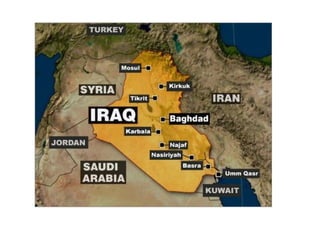
IRAQ
 
After WWI the  ____________ took over the territory of the Ottoman Turks and established the country of ______  They made the ruler someone that was friendly to them but in the ______ he was overthrown by some military leaders.  British  Iraq 1950’s
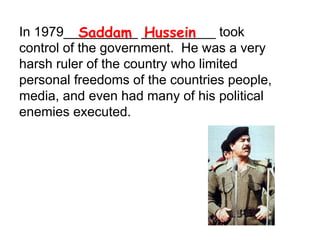
In 1979__________ __________ took control of the government.  He was a very harsh ruler of the country who limited personal freedoms of the countries people, media, and even had many of his political enemies executed.  Saddam  Hussein
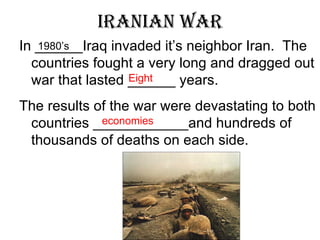
Iranian War In ______Iraq invaded it’s neighbor Iran.  The countries fought a very long and dragged out war that lasted ______ years. The results of the war were devastating to both countries ____________and hundreds of thousands of deaths on each side.  1980’s Eight economies
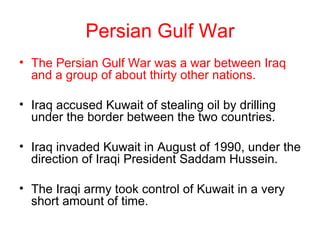
Persian Gulf War The Persian Gulf War was a war between Iraq and a group of about thirty other nations. Iraq accused Kuwait of stealing oil by drilling under the border between the two countries. Iraq invaded Kuwait in August of 1990, under the direction of Iraqi President Saddam Hussein. The Iraqi army took control of Kuwait in a very short amount of time.
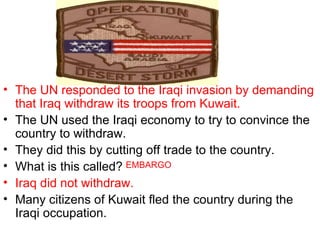
The UN responded to the Iraqi invasion by demanding that Iraq withdraw its troops from Kuwait. The UN used the Iraqi economy to try to convince the country to withdraw. They did this by cutting off trade to the country. What is this called?  Iraq did not withdraw. Many citizens of Kuwait fled the country during the Iraqi occupation. EMBARGO
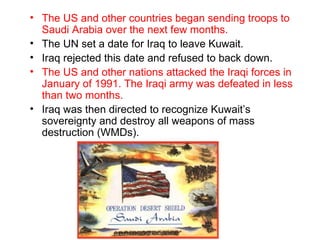
The US and other countries began sending troops to Saudi Arabia over the next few months. The UN set a date for Iraq to leave Kuwait. Iraq rejected this date and refused to back down. The US and other nations attacked the Iraqi forces in January of 1991. The Iraqi army was defeated in less than two months. Iraq was then directed to recognize Kuwait’s sovereignty and destroy all weapons of mass destruction (WMDs).
In 1990 Iraq invaded _______________.  Because of the strategic oil reserves of this small country, the invasion alarmed countries throughout the world.  Saddam boasted of his supply of WMD’s or _____________________ and he had even used them on the second largest ethnic group in the country the_____ that lived in the Northern part of the country and in his war with _______. Kuwait   Weapons of Mass Destruction Persian Gulf War Kurds IRAN
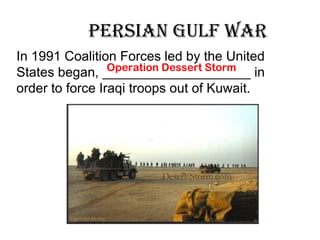
In 1991 Coalition Forces led by the United States began, ____________________ in order to force Iraqi troops out of Kuwait.  Operation Dessert Storm   Persian Gulf War
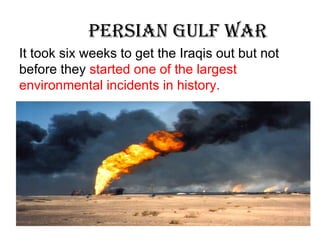
It took six weeks to get the Iraqis out but not before they  started one of the largest environmental incidents in history. Persian Gulf War Kurds
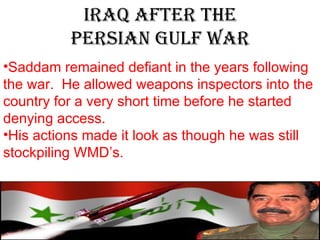
Iraq after the Persian Gulf War Saddam remained defiant in the years following the war.  He allowed weapons inspectors into the country for a very short time before he started denying access. His actions made it look as though he was still stockpiling WMD’s.
Iraq War II After the events of 911, officials in the US government feared connections between the Hussein regime and al-Qaeda. They were afraid that Iraq was continuing to build WMD’s such as chemical or biological weapons. The UN sent inspectors to Iraq to check for WMD’s but were either refused entry into the country, or access to facilities that could be used for making or storing them. In 2002, the US Congress passed an Iraq War resolution that authorized the president to go forward with a war in Iraq. Operation Iraqi Freedom
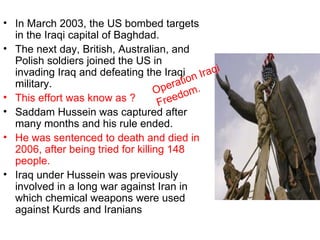
In March 2003, the US bombed targets in the Iraqi capital of Baghdad. The next day, British, Australian, and Polish soldiers joined the US in invading Iraq and defeating the Iraqi military. This effort was know as ? Saddam Hussein was captured after many months and his rule ended. He was sentenced to death and died in 2006, after being tried for killing 148 people. Iraq under Hussein was previously involved in a long war against Iran in which chemical weapons were used against Kurds and Iranians Operation Iraqi Freedom.
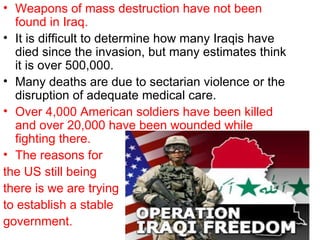
Weapons of mass destruction have not been found in Iraq. It is difficult to determine how many Iraqis have died since the invasion, but many estimates think it is over 500,000. Many deaths are due to sectarian violence or the disruption of adequate medical care. Over 4,000 American soldiers have been killed and over 20,000 have been wounded while fighting there. The reasons for  the US still being  there is we are trying  to establish a stable  government.
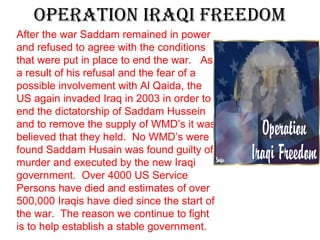
After the war Saddam remained in power and refused to agree with the conditions that were put in place to end the war.  As a result of his refusal and the fear of a possible involvement with Al Qaida, the US again invaded Iraq in 2003 in order to end the dictatorship of Saddam Hussein and to remove the supply of WMD’s it was believed that they held.  No WMD’s were found Saddam Husain was found guilty of murder and executed by the new Iraqi government.  Over 4000 US Service Persons have died and estimates of over 500,000 Iraqis have died since the start of the war.  The reason we continue to fight is to help establish a stable government. Operation Iraqi Freedom
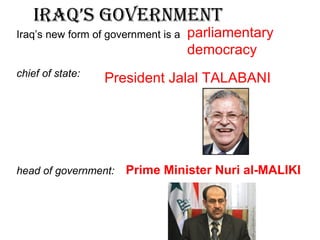
Iraq’s new form of government is a chief of state: head of government: parliamentary democracy Iraq’s Government President Jalal TALABANI Prime Minister Nuri al-MALIKI
The Impact of Oil and Middle East Wars Countries in North Africa and the Persian Gulf export more oil than most other countries in the world. The control of oil reserves has been an issue in many of the wars fought in the Middle East during the 20 th  century. Many countries have been involved in wars in the Middle East.
The Impact of Oil and Middle East Wars If this region of the world did not have such a vast supply of oil, or if the rest of the modern world did not depend on it so much, there would be much less conflict in the region. OPEC stands for what??? OPEC has a great deal of power on world events due to its control of the oil supply. Following the unsuccessful Yom Kippur War in 1973, they tried to get the US to stop supporting Israel by creating and OIL EMBARGO which caused gas shortages across the country. ORANIZATION of PETROLEM EXPORTING COUNTRIES
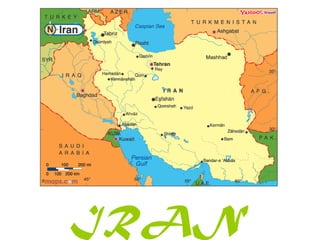
IRAN
IRAN
Iran under shah reza pahlavi (1953-1979)
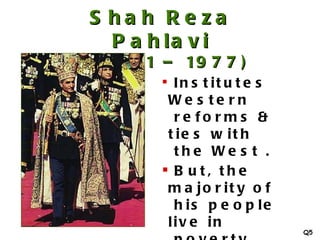
Shah Reza Pahlavi (r. 1941 – 1977) Institutes Western  reforms & ties with  the West . But, the majority of  his people live in  poverty. Brutal suppression of  dissidents     SAVAK Q5
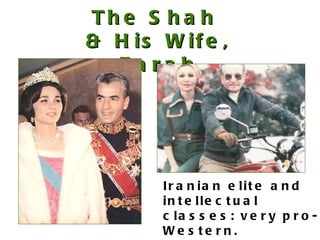
The Shah  & His Wife, Farah Iranian elite and intellectual classes: very pro-Western.
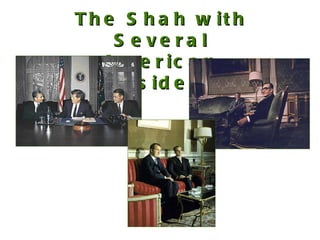
The Shah with Several American Presidents
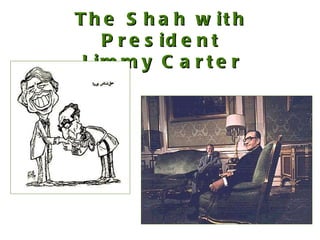
The Shah with President Jimmy Carter
The Iranian Revolution
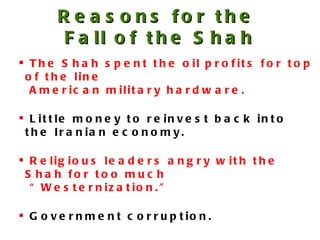
Reasons for the  Fall of the Shah The Shah spent the oil profits for top of the line   American military hardware. Little money to reinvest back into the Iranian economy. Religious leaders angry with the Shah for too much   “Westernization.” Government corruption. The Shah’s constitutional violations of the basic human   rights of his citizens.
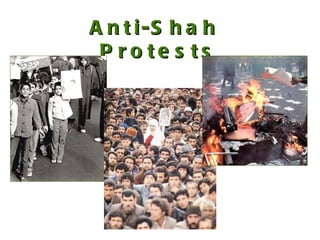
Anti-Shah  Protests
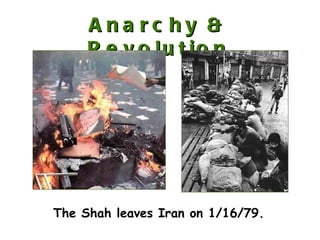
Anarchy & Revolution The Shah leaves Iran on 1/16/79.
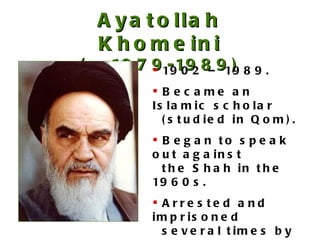
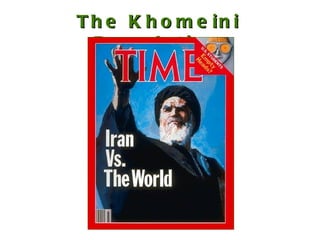
Ayatollah Khomeini (r. 1979-1989) 1902 – 1989. Became an Islamic scholar   (studied in Qom). Began to speak out against    the Shah in the 1960s. Arrested and imprisoned    several times by the Shah. Deported in 1978 & went    to France.
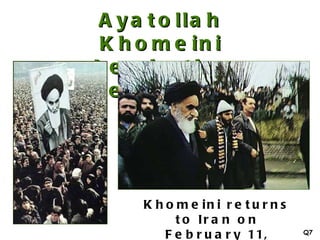
Ayatollah Khomeini Leads the Revolution Khomeini returns to Iran on February 11, 1979. Q7
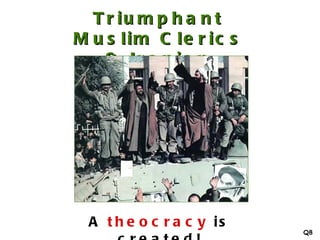
Triumphant Muslim Clerics & Iranian Soldiers Q8 A  theocracy  is created!
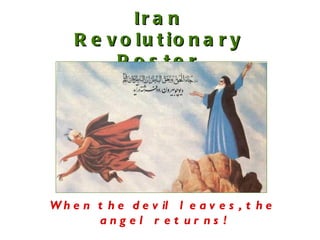
Iran Revolutionary Poster When the devil leaves, the angel returns!
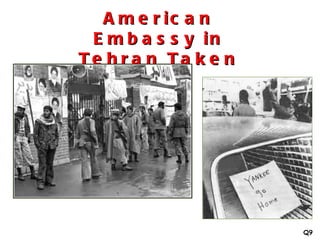
American Embassy in Tehran Taken Over Q9
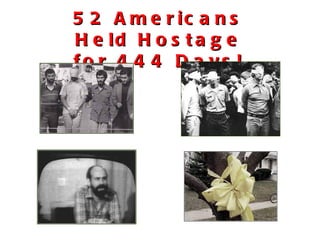
52 Americans Held Hostage for 444 Days!
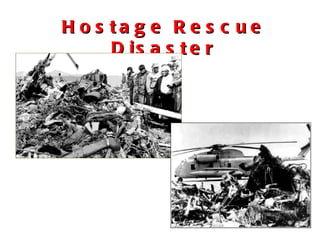
Hostage Rescue Disaster
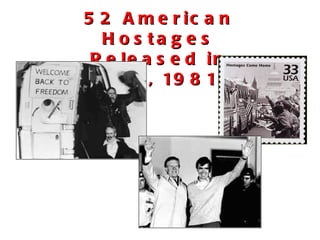
52 American Hostages Released in Jan., 1981
The Islamic Republic of Iran
The Khomeini Revolution
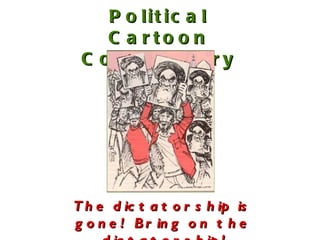
Political Cartoon Commentary The dictatorship is gone!  Bring on the dictatorship!
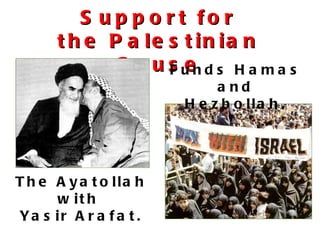
Support for the Palestinian Cause The Ayatollah with  Yasir Arafat. Funds Hamas and Hezbollah.
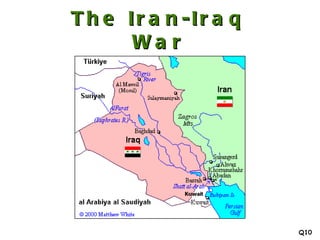
The Iran-Iraq War (1980-1988)
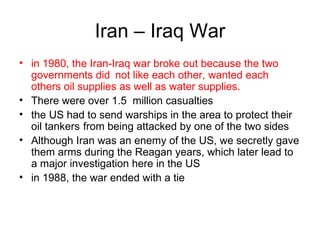
Iran – Iraq War in 1980, the Iran-Iraq war broke out because the two governments did  not like each other, wanted each others oil supplies as well as water supplies. There were over 1.5  million casualties the US had to send warships in the area to protect their oil tankers  from being attacked by one of the two sides Although Iran was an enemy of the US, we secretly gave them arms during the Reagan years, which later lead to a major investigation here in the US in 1988, the war ended with a tie
The Iran-Iraq War (1980-1988) Q10
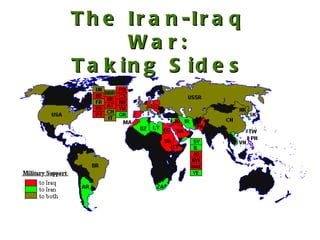
The Iran-Iraq War: Taking Sides
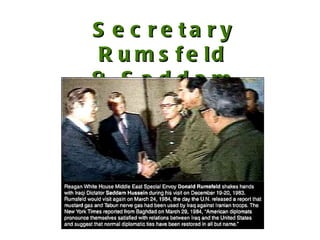
Secretary Rumsfeld & Saddam Hussein:  1983
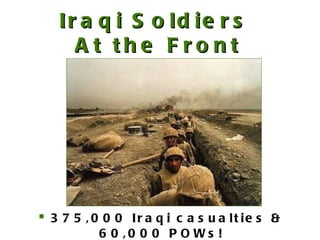
Iraqi Soldiers  At the Front 375,000 Iraqi casualties & 60,000 POWs!
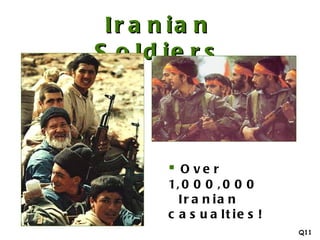
Iranian Soldiers Q11 Over 1,000,000   Iranian casualties!
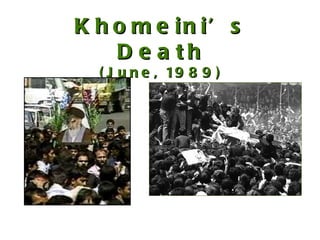
Khomeini’s Death (June, 1989)
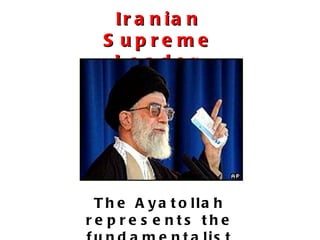
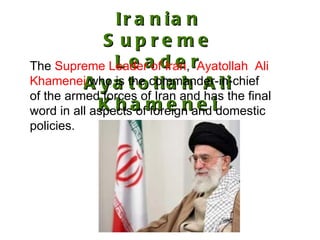
Iranian Supreme Leader Ayatollah Ali Khamenei The Ayatollah represents the fundamentalist Mullahs.
Iranian Supreme Leader Ayatollah Ali Khamenei The  Supreme Leader of Iran ,  Ayatollah  Ali Khamenei  who is the commander-in-chief of the armed forces of Iran and has the final word in all aspects of foreign and domestic policies.
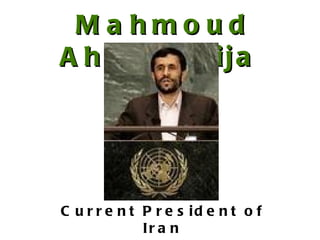
Mahmoud Ahmadinijad  Current President of Iran
Mahmoud Ahmadinijad  He became president on August 6, 2005 after winning the presidential election by popular vote.  He is the highest directly elected official in the country; however, according to the of  Constitution of Iran , he has much less power than the Supreme Leader.  This division of power would signify a ____________ form of government. He has said Iran's nuclear program is for peaceful purposes and has refused to end enrichment despite United Nations Security Council resolutions. He has called for the dissolution of the  state of Israel  and its government, which he does not regard as legitimate or representative of the population, and for free elections in the region. He believes that the  Palestinians  need a stronger voice in the region's future. One of his most controversial statements was one in which, according to the initial IRNA translation, he called for Israel to be " wiped off the map ," though the interpretation of this quote is highly questionable.   He has also been condemned for describing the  Holocaust  s a myth which has led to accusations of  anti-semitism.  PARLIMENTARY
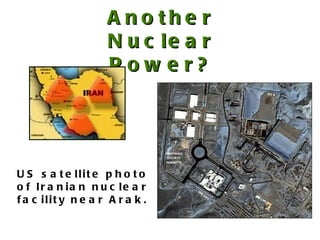
Another Nuclear Power? US satellite photo of Iranian nuclear facility near Arak.