THE WAR
FOR
RESOURCES
GULF WAR (JAN-FEB 1991)
THE GULF WAR
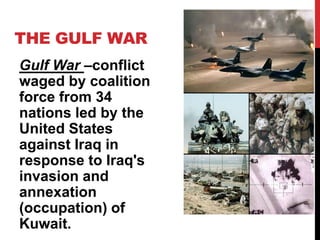
Gulf War –conflict
waged by coalition
force from 34
nations led by the
United States
against Iraq in
response to Iraq's
invasion and
annexation
(occupation) of
Kuwait.
BACKGROUND
Iraq claimed that Kuwait territory
historically belongs to them.
Iraq accused Kuwait of exceeding its
OPEC quotas for oil production. The
United Arab Emirates and Kuwait were
consistently overproducing oil. Iraq
was interested in keeping price about
18$/barrel. But Kuwait and UAE kept
to overproducing it, so price dropped
to 10$. Iraq losses estimated to be 7
billion dollars a year.
Kuwait reserves estimated to be 10%
of the world's reserves. Iraq - 3-4%
IRAQ
INTERVENTION

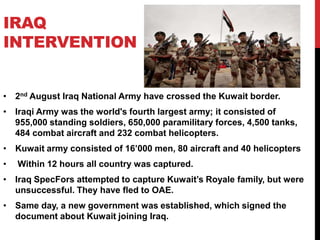
• 2nd August Iraq National Army have crossed the Kuwait border.
• Iraqi Army was the world's fourth largest army; it consisted of
955,000 standing soldiers, 650,000 paramilitary forces, 4,500 tanks,
484 combat aircraft and 232 combat helicopters.
• Kuwait army consisted of 16’000 men, 80 aircraft and 40 helicopters
•

Within 12 hours all country was captured.

• Iraq SpecFors attempted to capture Kuwait’s Royale family, but were
unsuccessful. They have fled to OAE.
• Same day, a new government was established, which signed the
document about Kuwait joining Iraq.
WORLD’S REACTION
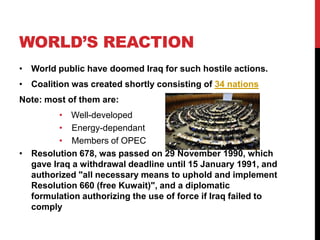
• World public have doomed Iraq for such hostile actions.

• Coalition was created shortly consisting of 34 nations
Note: most of them are:
• Well-developed
• Energy-dependant
• Members of OPEC
• Resolution 678, was passed on 29 November 1990, which
gave Iraq a withdrawal deadline until 15 January 1991, and
authorized "all necessary means to uphold and implement
Resolution 660 (free Kuwait)", and a diplomatic
formulation authorizing the use of force if Iraq failed to
comply
ECONOMIC EFFECTS
• Oil supplies were constantly delayed/stopped/lost.

• Oil price growth massively
• Other economical sectors were negatively affected
by this conflict
• The tensity in the region made all non-Arab civilians,
religious minorities and foreigners targets of
religious radicals, including Americans.
• The USA investments in the oil sector were under
threat of withdrawl, meaning that investors/firms
were willing to quit the area.
KUWAIT
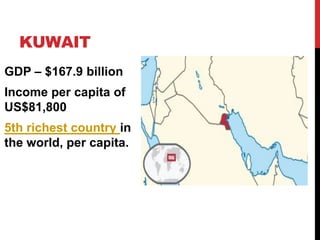
GDP – $167.9 billion
Income per capita of
US$81,800
5th richest country in
the world, per capita.
THE REASONS FOR
INTERVENTION
(OFFICIAL VERSION)
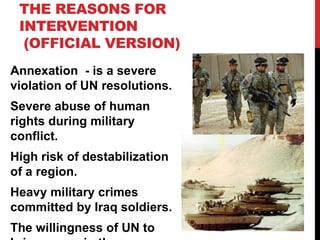
Annexation - is a severe
violation of UN resolutions.
Severe abuse of human
rights during military
conflict.
High risk of destabilization
of a region.
Heavy military crimes
committed by Iraq soldiers.
The willingness of UN to
THE REASONS OF INTERVENTION
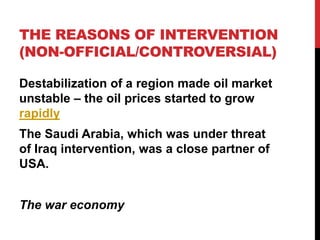
(NON-OFFICIAL/CONTROVERSIAL)
Destabilization of a region made oil market
unstable – the oil prices started to grow
rapidly
The Saudi Arabia, which was under threat
of Iraq intervention, was a close partner of
USA.
The war economy
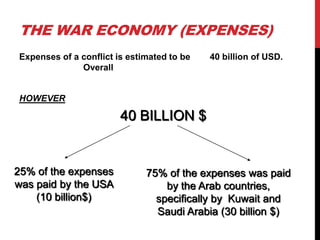
THE WAR ECONOMY (EXPENSES)
Expenses of a conflict is estimated to be
Overall

40 billion of USD.

HOWEVER

40 BILLION $

25% of the expenses
was paid by the USA
(10 billion$)

75% of the expenses was paid
by the Arab countries,
specifically by Kuwait and
Saudi Arabia (30 billion $)
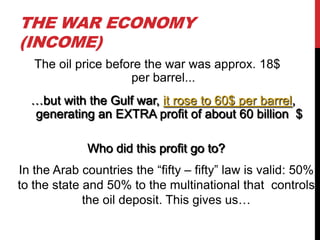
THE WAR ECONOMY
(INCOME)
The oil price before the war was approx. 18$
per barrel...
…but with the Gulf war, it rose to 60$ per barrel,
generating an EXTRA profit of about 60 billion $
Who did this profit go to?
In the Arab countries the “fifty – fifty” law is valid: 50%
to the state and 50% to the multinational that controls
the oil deposit. This gives us…
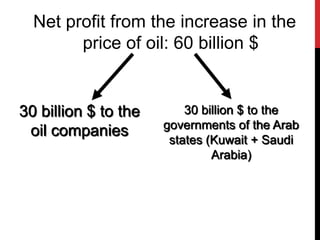
Net profit from the increase in the
price of oil: 60 billion $

30 billion $ to the
oil companies

30 billion $ to the
governments of the Arab
states (Kuwait + Saudi
Arabia)
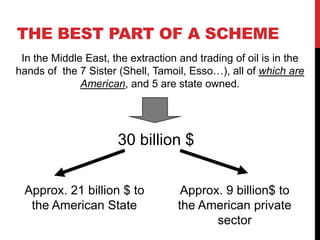
THE BEST PART OF A SCHEME
In the Middle East, the extraction and trading of oil is in the
hands of the 7 Sister (Shell, Tamoil, Esso…), all of which are
American, and 5 are state owned.

30 billion $
Approx. 21 billion $ to
the American State

Approx. 9 billion$ to
the American private
sector
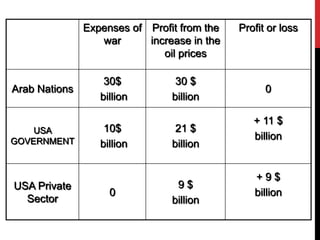
Expenses of Profit from the
war
increase in the
oil prices
Arab Nations

USA
GOVERNMENT

USA Private
Sector

30$
billion
10$
billion

0

30 $
billion
21 $
billion

9$
billion

Profit or loss

0
+ 11 $
billion

+9$
billion
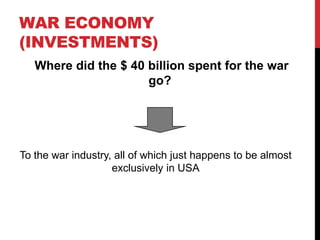
WAR ECONOMY
(INVESTMENTS)
Where did the $ 40 billion spent for the war
go?

To the war industry, all of which just happens to be almost
exclusively in USA
CONCLUSION
• The willingness of UN, led by US, to free
Iraq is economically based.
• Most of the OPEC countries have
supported financially all of the Gulf war
operations. Meaning that this little-scale
conflict could affect world markets of oil.
• Today world is VERY dependant on
crude oil.
QUESTIONS
• Which resource caused the conflict?
• Who were the main battlefield players?
• How much oil Kuwait have in
possession?
• What price of oil was in 1990-1991?
• What price of oil was in 1989?

Gulf war presentation

  • 1.
  • 2.
    THE GULF WAR GulfWar –conflict waged by coalition force from 34 nations led by the United States against Iraq in response to Iraq's invasion and annexation (occupation) of Kuwait.
  • 3.
    BACKGROUND Iraq claimed thatKuwait territory historically belongs to them. Iraq accused Kuwait of exceeding its OPEC quotas for oil production. The United Arab Emirates and Kuwait were consistently overproducing oil. Iraq was interested in keeping price about 18$/barrel. But Kuwait and UAE kept to overproducing it, so price dropped to 10$. Iraq losses estimated to be 7 billion dollars a year. Kuwait reserves estimated to be 10% of the world's reserves. Iraq - 3-4%
  • 4.
    IRAQ INTERVENTION • 2nd AugustIraq National Army have crossed the Kuwait border. • Iraqi Army was the world's fourth largest army; it consisted of 955,000 standing soldiers, 650,000 paramilitary forces, 4,500 tanks, 484 combat aircraft and 232 combat helicopters. • Kuwait army consisted of 16’000 men, 80 aircraft and 40 helicopters • Within 12 hours all country was captured. • Iraq SpecFors attempted to capture Kuwait’s Royale family, but were unsuccessful. They have fled to OAE. • Same day, a new government was established, which signed the document about Kuwait joining Iraq.
  • 5.
    WORLD’S REACTION • Worldpublic have doomed Iraq for such hostile actions. • Coalition was created shortly consisting of 34 nations Note: most of them are: • Well-developed • Energy-dependant • Members of OPEC • Resolution 678, was passed on 29 November 1990, which gave Iraq a withdrawal deadline until 15 January 1991, and authorized "all necessary means to uphold and implement Resolution 660 (free Kuwait)", and a diplomatic formulation authorizing the use of force if Iraq failed to comply
  • 6.
    ECONOMIC EFFECTS • Oilsupplies were constantly delayed/stopped/lost. • Oil price growth massively • Other economical sectors were negatively affected by this conflict • The tensity in the region made all non-Arab civilians, religious minorities and foreigners targets of religious radicals, including Americans. • The USA investments in the oil sector were under threat of withdrawl, meaning that investors/firms were willing to quit the area.
  • 7.
    KUWAIT GDP – $167.9billion Income per capita of US$81,800 5th richest country in the world, per capita.
  • 8.
    THE REASONS FOR INTERVENTION (OFFICIALVERSION) Annexation - is a severe violation of UN resolutions. Severe abuse of human rights during military conflict. High risk of destabilization of a region. Heavy military crimes committed by Iraq soldiers. The willingness of UN to
  • 9.
    THE REASONS OFINTERVENTION (NON-OFFICIAL/CONTROVERSIAL) Destabilization of a region made oil market unstable – the oil prices started to grow rapidly The Saudi Arabia, which was under threat of Iraq intervention, was a close partner of USA. The war economy
  • 10.
    THE WAR ECONOMY(EXPENSES) Expenses of a conflict is estimated to be Overall 40 billion of USD. HOWEVER 40 BILLION $ 25% of the expenses was paid by the USA (10 billion$) 75% of the expenses was paid by the Arab countries, specifically by Kuwait and Saudi Arabia (30 billion $)
  • 11.
    THE WAR ECONOMY (INCOME) Theoil price before the war was approx. 18$ per barrel... …but with the Gulf war, it rose to 60$ per barrel, generating an EXTRA profit of about 60 billion $ Who did this profit go to? In the Arab countries the “fifty – fifty” law is valid: 50% to the state and 50% to the multinational that controls the oil deposit. This gives us…
  • 12.
    Net profit fromthe increase in the price of oil: 60 billion $ 30 billion $ to the oil companies 30 billion $ to the governments of the Arab states (Kuwait + Saudi Arabia)
  • 13.
    THE BEST PARTOF A SCHEME In the Middle East, the extraction and trading of oil is in the hands of the 7 Sister (Shell, Tamoil, Esso…), all of which are American, and 5 are state owned. 30 billion $ Approx. 21 billion $ to the American State Approx. 9 billion$ to the American private sector
  • 14.
    Expenses of Profitfrom the war increase in the oil prices Arab Nations USA GOVERNMENT USA Private Sector 30$ billion 10$ billion 0 30 $ billion 21 $ billion 9$ billion Profit or loss 0 + 11 $ billion +9$ billion
  • 15.
    WAR ECONOMY (INVESTMENTS) Where didthe $ 40 billion spent for the war go? To the war industry, all of which just happens to be almost exclusively in USA
  • 16.
    CONCLUSION • The willingnessof UN, led by US, to free Iraq is economically based. • Most of the OPEC countries have supported financially all of the Gulf war operations. Meaning that this little-scale conflict could affect world markets of oil. • Today world is VERY dependant on crude oil.
  • 17.
    QUESTIONS • Which resourcecaused the conflict? • Who were the main battlefield players? • How much oil Kuwait have in possession? • What price of oil was in 1990-1991? • What price of oil was in 1989?