The Islamic Revolution in Iran
Background and Aftermath
Course Title: Social Change
Course No: 4101
By
Tanmay Mondal
History of Iran
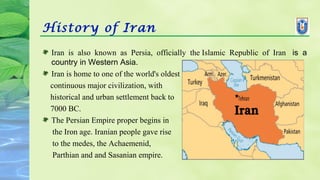
Iran is also known as Persia, officially the Islamic Republic of Iran is a
country in Western Asia.
Iran is home to one of the world's oldest
continuous major civilization, with
historical and urban settlement back to
7000 BC.
The Persian Empire proper begins in
the Iron age. Iranian people gave rise
to the medes, the Achaemenid,
Parthian and and Sasanian empire.
History of Iran
The Muslim conquest of Persia (633–654) ended the Sasanian Empire and is a
turning point in Iranian history.
Islamization of Iran took place during the eighth to tenth centuries, leading to
the eventual decline of Zoroastrianism in Iran as well as many of its
dependencies.
Iran, with its long history of early cultures and empires, had suffered
particularly hard during the late Middle Ages and the early modern period.
Many invasions of nomadic tribes, whose leaders became rulers in this country,
affected it negatively. [Baten,2016]
Background 1906-1977 [Pahlavi dynasty]
The Pahlavi dynasty was the ruling house of the imperial state of Iran from
1925 until 1979, when the 2,500 years of continuous Persian monarchy was
overthrown and abolished as a result of the Iranian Revolution.
Pahlavi dynasty
The dynasty was founded by Reza Shah Pahlavi in 1925. whose reign lasted
until 1941 when he was forced to abdicate by the Allies after the Anglo-Soviet
invasion of Iran.
He was succeeded by his son, Mohammad Reza Shah Pahlavi, the last Shah of
Iran.
…Cont’d
Reza Shah
The Pahlavi dynasty was known for its autocracy, its focus
on modernization and Westernization and for its disregard for religious and
democratic measures in Iran's constitution.
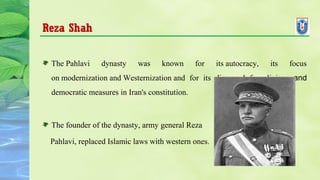
The founder of the dynasty, army general Reza
Pahlavi, replaced Islamic laws with western ones.
Reza Shah
Reza Shah determined to modernized and centralize the operations of Iran.
Using the western model of industrial development .
The new laws were-
 Forbade traditional Islamic clothing.
 separation of the sexes and veiling of women (hijab).
 Women who resisted his ban on public hijab had their chadors forcibly
removed and torn.
In 1935 rebellion by pious Shi’a crushed on his orders with dozen kills and
hundreds injured, rupturing the relation between Shah and pious Shi'a.
…Cont’d
The Last Shah Comes to Power
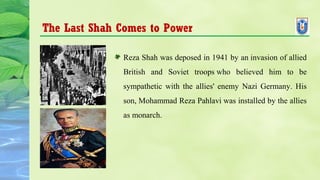
Reza Shah was deposed in 1941 by an invasion of allied
British and Soviet troops who believed him to be
sympathetic with the allies' enemy Nazi Germany. His
son, Mohammad Reza Pahlavi was installed by the allies
as monarch.
The Last Shah Comes to Power
Its purpose was to secure Iranian oil fields and ensure Allied supply lines for
the USSR, fighting against Axis forces on the Eastern Front.
The UK and USSR left Iran in 1946 and Iran became independent in 1948.
Prince Pahlavi (later crowned shah) reigned until the 1979 revolution with one
brief interruption.
…Cont’d
The Rise of Ayatollah Khomeini
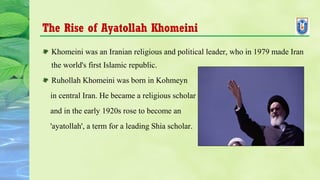
Khomeini was an Iranian religious and political leader, who in 1979 made Iran
the world's first Islamic republic.
Ruhollah Khomeini was born in Kohmeyn
in central Iran. He became a religious scholar
and in the early 1920s rose to become an
'ayatollah', a term for a leading Shia scholar.
The Rise of Ayatollah Khomeini
He first came to political prominence in 1963 when he led opposition to the
Shah and his program of reforms known as the "White Revolution“.
Which aimed to break up landholdings owned by some Shi’a clergy, allow
women to vote and religious minorities to hold office, and grant women legal
equality in marital issues.
Khomeini declared that the Shah had "embarked on the destruction of Islam in
Iran“ and publicly denounced the Shah as a "wretched miserable man."
…Cont’d
The Rise of Ayatollah Khomeini
 Khomeini's arrest on June 5, 1963, three days of major riots erupted
throughout Iran.
 Khomeini was detained and kept under house arrest for 8 months. After his
release he continued his agitation against the Shah, condemning the regimes‘s
close cooperation with Israel and its "capitulations“.
In November 1964, Khomeini was re-arrested and sent into exile where he
remained for 14 years until the revolution.
…Cont’d
Prior to the Revolution [1970-1977]
 Several events in the 1970s set the stage for the 1979 revolution:
 In October 1971, the 2,500th anniversary of the founding of the Persian 
Empire was held at the site of Persepolis .
Prior to the Revolution [1970-1977]
 By late 1974 the increase of inflation and waste and an "accelerating gap"
between the rich and poor, the city and the country. Shah spent hundreds of
millions of dollars on buying military weapon from America.
[Graham,1980]
 In 1976, the Shah declared economic austerity measures to dampen inflation
and waste. The resulting unemployment disproportionately affected the
thousands of recent poor and unskilled migrants to the cities.
…Cont’d
Prior to the Revolution [1970-1977]
 In 1977 the Iranian people saw the death of the very popular and influential
modernist Islamist leader Ali Shariati, allegedly at the hands of SAVAK,
removing a potential revolutionary rival to Khomeini.
 Finally, in October Khomeini's son Mostafa died. Though the cause appeared
to be a heart attack, anti-Shah groups blamed SAVAK poisoning and
proclaimed him a 'martyr.'
[Moin,2000]
…Cont’d
The Iranian Revolution of 1979
 The Iranian Revolution is considered the 3rd
greatest revolution in history.
With many other problems, there was much opposition against the Mohammad
Reza Shah, and how he used the secret police SAVAK, to control the country.
Strong Shi’i opposition was lead against the Shah, and the country came close
to a situation of civil war.
The opposition was lead by Ayatollah Khomeini, who lived in exile in Iraq and
later in France. His massages were duplicated and spread all around the
country from there.
The Iranian Revolution of 1979[Black
Friday]
Black Friday the name given to 8 September 1978
because of the shootings in Jaleh Square in Tehran.
Between 84-88 people were killed in the incident and 205
were injured.
The deaths were described as the pivotal event in the
Iranian Revolution that ended any “hope to compromise”
between the protest movement and regime of Mohammad
Reza Shah.
The Iranian Revolution of 1979
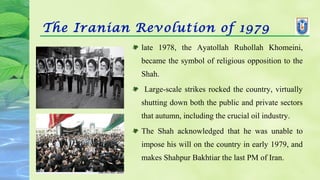
late 1978, the Ayatollah Ruhollah Khomeini,
became the symbol of religious opposition to the
Shah.
Large-scale strikes rocked the country, virtually
shutting down both the public and private sectors
that autumn, including the crucial oil industry.
The Shah acknowledged that he was unable to
impose his will on the country in early 1979, and
makes Shahpur Bakhtiar the last PM of Iran.
The Iranian Revolution of 1979
 Khomeini labels Shahpur Bakhtiar the enemy.
January 16 the Shah left the country, after urging the military to remain loyal to
the new regime.
The Shah said he was going on ‘holiday’. He never returned and died in 1980.
The first phase of the revolution was now complete.
…Cont’d
The Iranian Revolution of 1979
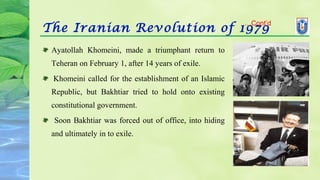
Ayatollah Khomeini, made a triumphant return to
Teheran on February 1, after 14 years of exile.
Khomeini called for the establishment of an Islamic
Republic, but Bakhtiar tried to hold onto existing
constitutional government.
Soon Bakhtiar was forced out of office, into hiding
and ultimately in to exile.
…Cont’d
Aftermath of the Revolution
[Consolidation of power by Khomeini]
From early 1979 to either 1982 or 1983 Iran was in a "revolutionary crisis
mode.
After the system of despotic monarchy had been overthrown, the economy and
the apparatus of government had collapsed, military and security forces were in
disarray.
Yet, by 1982 Khomeini and his supporters had crushed the rival factions,
defeated local rebellions and consolidated power.
Aftermath of the Revolution [Hostage Crisis]
The Iran hostage crisis was a diplomatic standoff
between Iran and the USA.
52 American diplomats and citizens were held
hostage for 444 days from 4th
November, 1979, to
January 20, 1981.
It occulted after a group of Iranian collage students
belonging to the Muslim Student Followers of the
Imam’s Line, took over the USA embassy in Tehran.
Aftermath of the Revolution [Invasion of
Iraq]
Saddam Hussein invaded Iran in 22 September, 1980,
and ending on 20 August 1988.
Iraq wanted to replace Iran as a dominant Persian Gulf
State, and worried that the 1979 revolution would lead
Iraq’s Shi’ite majority to rebel against the Ba’athist
government.
Iraq planned to annex the oil-rich Khuzestan Province
and the east bank of Shatt al-Arab.
Aftermath of the Revolution
[Establishment of Islamic republic government]
On 30 and 31 March,1979 a referendum was held over whether to replace the
monarchy with an "Islamic Republic".
In June 1979 the Freedom Movement released its draft constitution for the
Islamic Republic that it had been working on since Khomeini was in exile.
Khomeini now rejected the constitution – its correctness notwithstanding – and
Khomeini declared that the new government should be based "100% on Islam.
The Impact of The Revolution
Effect on Women
Effect on Economy
Effects on Religious Freedom
Social Changes
Islamic Sharia law become the new court system.
Impact on International Relationship.
Conclusion
The Revolution in 1979 were considered as of the most influential revolution in
modern era. It over through 2500 years of Monarchy and established new system
of ruling the revolution make Iran as Islamic republic from monarchy and brings
many constitutional changes according to Islamic Sharia law.
References
 Abrahamain, E.(1993). Khomeinism :  Essays  on  the  Islamic  Republic.  California:  University  of 
California Press.
 Benard,  Cheryl  &  Khalilzad,  Zalmay  (1984). "The  Government  of  God"  –  Iran's  Islamic  Republic. 
Columbia University Press.
 Abrahamian, E. (1982). Iran: Between two revolutions. New Jersey: Princeton University Press.
 Keddie, Nikki (2003). Modern Iran: Roots and Results of Revolution. Yale University Press.
 Arjomand, Said Amir (1988). Turban for the Crown: The Islamic Revolution in Iran. Oxford University 
Press.
 Graham, R. (1978). Iran: The Illusion of Power. Oxon: Tylor and Francis Group.

Islamic Revolution in Iran: Background and Aftermath

  • 1.
    The Islamic Revolutionin Iran Background and Aftermath Course Title: Social Change Course No: 4101 By Tanmay Mondal
  • 2.
    History of Iran Iranis also known as Persia, officially the Islamic Republic of Iran is a country in Western Asia. Iran is home to one of the world's oldest continuous major civilization, with historical and urban settlement back to 7000 BC. The Persian Empire proper begins in the Iron age. Iranian people gave rise to the medes, the Achaemenid, Parthian and and Sasanian empire.
  • 3.
    History of Iran TheMuslim conquest of Persia (633–654) ended the Sasanian Empire and is a turning point in Iranian history. Islamization of Iran took place during the eighth to tenth centuries, leading to the eventual decline of Zoroastrianism in Iran as well as many of its dependencies. Iran, with its long history of early cultures and empires, had suffered particularly hard during the late Middle Ages and the early modern period. Many invasions of nomadic tribes, whose leaders became rulers in this country, affected it negatively. [Baten,2016]
  • 4.
    Background 1906-1977 [Pahlavidynasty] The Pahlavi dynasty was the ruling house of the imperial state of Iran from 1925 until 1979, when the 2,500 years of continuous Persian monarchy was overthrown and abolished as a result of the Iranian Revolution.
  • 5.
    Pahlavi dynasty The dynastywas founded by Reza Shah Pahlavi in 1925. whose reign lasted until 1941 when he was forced to abdicate by the Allies after the Anglo-Soviet invasion of Iran. He was succeeded by his son, Mohammad Reza Shah Pahlavi, the last Shah of Iran. …Cont’d
  • 6.
    Reza Shah The Pahlavidynasty was known for its autocracy, its focus on modernization and Westernization and for its disregard for religious and democratic measures in Iran's constitution. The founder of the dynasty, army general Reza Pahlavi, replaced Islamic laws with western ones.
  • 7.
    Reza Shah Reza Shahdetermined to modernized and centralize the operations of Iran. Using the western model of industrial development . The new laws were-  Forbade traditional Islamic clothing.  separation of the sexes and veiling of women (hijab).  Women who resisted his ban on public hijab had their chadors forcibly removed and torn. In 1935 rebellion by pious Shi’a crushed on his orders with dozen kills and hundreds injured, rupturing the relation between Shah and pious Shi'a. …Cont’d
  • 8.
    The Last ShahComes to Power Reza Shah was deposed in 1941 by an invasion of allied British and Soviet troops who believed him to be sympathetic with the allies' enemy Nazi Germany. His son, Mohammad Reza Pahlavi was installed by the allies as monarch.
  • 9.
    The Last ShahComes to Power Its purpose was to secure Iranian oil fields and ensure Allied supply lines for the USSR, fighting against Axis forces on the Eastern Front. The UK and USSR left Iran in 1946 and Iran became independent in 1948. Prince Pahlavi (later crowned shah) reigned until the 1979 revolution with one brief interruption. …Cont’d
  • 10.
    The Rise ofAyatollah Khomeini Khomeini was an Iranian religious and political leader, who in 1979 made Iran the world's first Islamic republic. Ruhollah Khomeini was born in Kohmeyn in central Iran. He became a religious scholar and in the early 1920s rose to become an 'ayatollah', a term for a leading Shia scholar.
  • 11.
    The Rise ofAyatollah Khomeini He first came to political prominence in 1963 when he led opposition to the Shah and his program of reforms known as the "White Revolution“. Which aimed to break up landholdings owned by some Shi’a clergy, allow women to vote and religious minorities to hold office, and grant women legal equality in marital issues. Khomeini declared that the Shah had "embarked on the destruction of Islam in Iran“ and publicly denounced the Shah as a "wretched miserable man." …Cont’d
  • 12.
    The Rise ofAyatollah Khomeini  Khomeini's arrest on June 5, 1963, three days of major riots erupted throughout Iran.  Khomeini was detained and kept under house arrest for 8 months. After his release he continued his agitation against the Shah, condemning the regimes‘s close cooperation with Israel and its "capitulations“. In November 1964, Khomeini was re-arrested and sent into exile where he remained for 14 years until the revolution. …Cont’d
  • 13.
    Prior to theRevolution [1970-1977]  Several events in the 1970s set the stage for the 1979 revolution:  In October 1971, the 2,500th anniversary of the founding of the Persian  Empire was held at the site of Persepolis .
  • 14.
    Prior to theRevolution [1970-1977]  By late 1974 the increase of inflation and waste and an "accelerating gap" between the rich and poor, the city and the country. Shah spent hundreds of millions of dollars on buying military weapon from America. [Graham,1980]  In 1976, the Shah declared economic austerity measures to dampen inflation and waste. The resulting unemployment disproportionately affected the thousands of recent poor and unskilled migrants to the cities. …Cont’d
  • 15.
    Prior to theRevolution [1970-1977]  In 1977 the Iranian people saw the death of the very popular and influential modernist Islamist leader Ali Shariati, allegedly at the hands of SAVAK, removing a potential revolutionary rival to Khomeini.  Finally, in October Khomeini's son Mostafa died. Though the cause appeared to be a heart attack, anti-Shah groups blamed SAVAK poisoning and proclaimed him a 'martyr.' [Moin,2000] …Cont’d
  • 16.
    The Iranian Revolutionof 1979  The Iranian Revolution is considered the 3rd greatest revolution in history. With many other problems, there was much opposition against the Mohammad Reza Shah, and how he used the secret police SAVAK, to control the country. Strong Shi’i opposition was lead against the Shah, and the country came close to a situation of civil war. The opposition was lead by Ayatollah Khomeini, who lived in exile in Iraq and later in France. His massages were duplicated and spread all around the country from there.
  • 17.
    The Iranian Revolutionof 1979[Black Friday] Black Friday the name given to 8 September 1978 because of the shootings in Jaleh Square in Tehran. Between 84-88 people were killed in the incident and 205 were injured. The deaths were described as the pivotal event in the Iranian Revolution that ended any “hope to compromise” between the protest movement and regime of Mohammad Reza Shah.
  • 18.
    The Iranian Revolutionof 1979 late 1978, the Ayatollah Ruhollah Khomeini, became the symbol of religious opposition to the Shah. Large-scale strikes rocked the country, virtually shutting down both the public and private sectors that autumn, including the crucial oil industry. The Shah acknowledged that he was unable to impose his will on the country in early 1979, and makes Shahpur Bakhtiar the last PM of Iran.
  • 19.
    The Iranian Revolutionof 1979  Khomeini labels Shahpur Bakhtiar the enemy. January 16 the Shah left the country, after urging the military to remain loyal to the new regime. The Shah said he was going on ‘holiday’. He never returned and died in 1980. The first phase of the revolution was now complete. …Cont’d
  • 20.
    The Iranian Revolutionof 1979 Ayatollah Khomeini, made a triumphant return to Teheran on February 1, after 14 years of exile. Khomeini called for the establishment of an Islamic Republic, but Bakhtiar tried to hold onto existing constitutional government. Soon Bakhtiar was forced out of office, into hiding and ultimately in to exile. …Cont’d
  • 21.
    Aftermath of theRevolution [Consolidation of power by Khomeini] From early 1979 to either 1982 or 1983 Iran was in a "revolutionary crisis mode. After the system of despotic monarchy had been overthrown, the economy and the apparatus of government had collapsed, military and security forces were in disarray. Yet, by 1982 Khomeini and his supporters had crushed the rival factions, defeated local rebellions and consolidated power.
  • 22.
    Aftermath of theRevolution [Hostage Crisis] The Iran hostage crisis was a diplomatic standoff between Iran and the USA. 52 American diplomats and citizens were held hostage for 444 days from 4th November, 1979, to January 20, 1981. It occulted after a group of Iranian collage students belonging to the Muslim Student Followers of the Imam’s Line, took over the USA embassy in Tehran.
  • 23.
    Aftermath of theRevolution [Invasion of Iraq] Saddam Hussein invaded Iran in 22 September, 1980, and ending on 20 August 1988. Iraq wanted to replace Iran as a dominant Persian Gulf State, and worried that the 1979 revolution would lead Iraq’s Shi’ite majority to rebel against the Ba’athist government. Iraq planned to annex the oil-rich Khuzestan Province and the east bank of Shatt al-Arab.
  • 24.
    Aftermath of theRevolution [Establishment of Islamic republic government] On 30 and 31 March,1979 a referendum was held over whether to replace the monarchy with an "Islamic Republic". In June 1979 the Freedom Movement released its draft constitution for the Islamic Republic that it had been working on since Khomeini was in exile. Khomeini now rejected the constitution – its correctness notwithstanding – and Khomeini declared that the new government should be based "100% on Islam.
  • 25.
    The Impact ofThe Revolution Effect on Women Effect on Economy Effects on Religious Freedom Social Changes Islamic Sharia law become the new court system. Impact on International Relationship.
  • 26.
    Conclusion The Revolution in1979 were considered as of the most influential revolution in modern era. It over through 2500 years of Monarchy and established new system of ruling the revolution make Iran as Islamic republic from monarchy and brings many constitutional changes according to Islamic Sharia law.
  • 27.
    References  Abrahamain, E.(1993).Khomeinism :  Essays  on  the  Islamic  Republic.  California:  University  of  California Press.  Benard,  Cheryl  &  Khalilzad,  Zalmay  (1984). "The  Government  of  God"  –  Iran's  Islamic  Republic.  Columbia University Press.  Abrahamian, E. (1982). Iran: Between two revolutions. New Jersey: Princeton University Press.  Keddie, Nikki (2003). Modern Iran: Roots and Results of Revolution. Yale University Press.  Arjomand, Said Amir (1988). Turban for the Crown: The Islamic Revolution in Iran. Oxford University  Press.  Graham, R. (1978). Iran: The Illusion of Power. Oxon: Tylor and Francis Group.