IOT AND CLOUD
COMPUTING
Etesh Agarwal
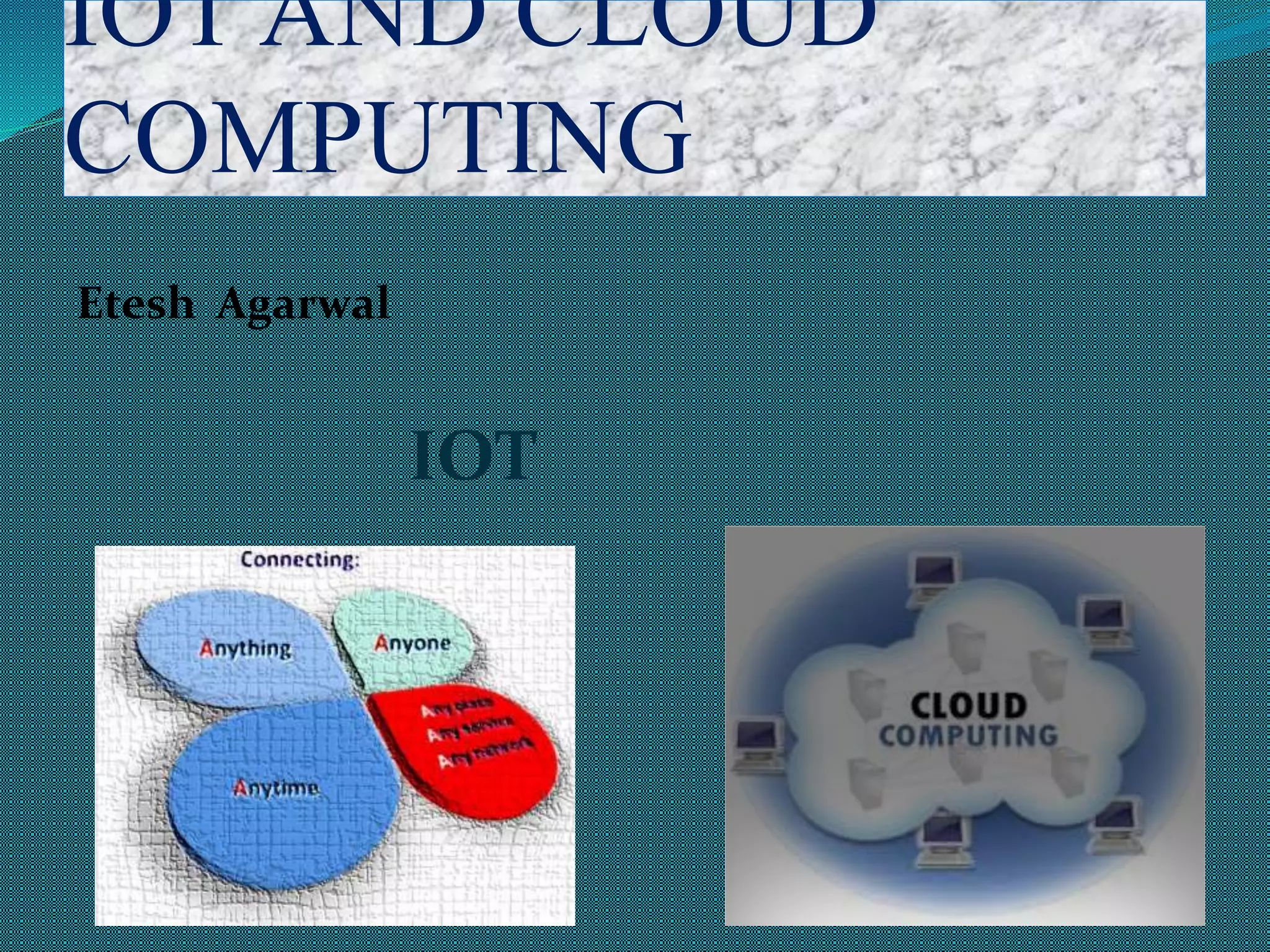
IOT
Plan Of
Presentation
What is Internet of Things?
How IoT Works?
Current Status & Future Prospect of IoT
 Criticisms & Controversies of IoT
What is Cloud Computing?
How cloud computing works?
Benefits of cloud computing ?
References
Abstract
• The Internet of Things (IoT) is generally thought of
as connecting thingsto the Internet and using that
connection to provide some kind of useful remote
monitoring or control of those things.
• The IoT creates an intelligent, invisible network
fabric that can be sensed, controlled and
programmed.
• IoT enabled products employ embedded technology
that allows them to communicate, directly or
indirectly, with each other or the Internet..
Introduction
The vision of the Internet of Things has evolved due to a
convergence of multiple technologies, ranging from
wireless communication to the Internet and from
embedded systems. (e.g embedded systems, wireless
sensor networks, control systems ,automation)
The Internet of Things (IoT) is the interconnection of
uniquely identifiable embedded computing devices within
the existing Internet infrastructure.
IoT is expected to offer advanced connectivity of devices,
systems, and services that goes beyond machine-to-
machine communications (M2M) and covers a variety of
protocols, domains, and applications.
Basic
Technologies
• Communication and cooperation: Objects have the ability
to network with Internet resources or even with each other.
• Addressability: Within an Internet of Things, objects can
be located and addressed.
• Identification: Objects are uniquely identifiable.
E.g: RFID, NFC (Near Field Communication).
• Sensing: Objects collect information about their
surroundings with the help of different sensors.
• Localization: Smart things are aware of their
physical location, or can be located.
• User interfaces: Smart objects can communicate with
people
 in an appropriate manner (for example via a smartphone).
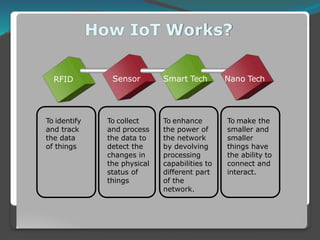
How IoT Works?
7
RFID Sensor Smart Tech Nano Tech
To identify
and track
the data
of things
To collect
and process
the data to
detect the
changes in
the physical
status of
things
To enhance
the power of
the network
by devolving
processing
capabilities to
different part
of the
network.
To make the
smaller and
smaller
things have
the ability to
connect and
interact.
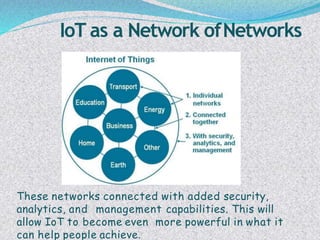
IoT as a Network ofNetworks
These networks connected with added security,
analytics, and management capabilities. This will
allow IoT to become even more powerful in what it
can help people achieve.
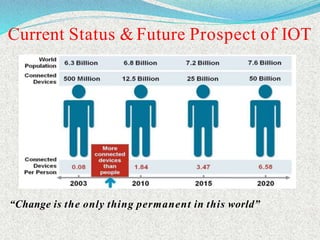
Current Status & Future Prospect of IOT
“Change is the only thing permanent in this world”
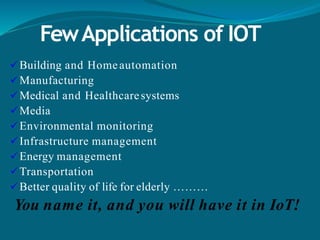
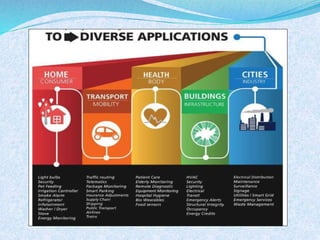
FewApplications of IOT
Building and Homeautomation
Manufacturing
Medical and Healthcaresystems
Media
Environmental monitoring
Infrastructure management
Energy management
Transportation
Better quality of life for elderly ………
You name it, and you will have it in IoT!
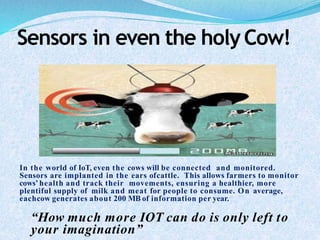
Sensors in even the holyCow!
In the world of IoT, even the cows will be connected and monitored.
Sensors are implanted in the ears ofcattle. This allows farmers to monitor
cows’ health and track their movements, ensuring a healthier, more
plentiful supply of milk and meat for people to consume. On average,
eachcow generates about 200 MB of information per year.
“How much more IOT can do is only left to
your imagination”
TECHNOLOGICAL CHALLENGES OF IoT
At present IoT is faced with many challenges, such as:
 Scalability
 Technological Standardization
 Inter operability
 Discovery
 Software complexity
 Data volumes and interpretation
 Power Supply
 Interaction and short range communication
 Wireless communication
 Fault tolerance
Conclusion
IoT is at a stage where disparate networks and a
multitude of sensors must come together and
interoperate under a common set of standards. This
effort will require businesses, governments, standards
organizations, and academia to work together toward a
common goal. IoT represents the next evolution of the
Internet. IoT has the potential to change the world as we
know it today for the better. How quickly we get there is
up to us.
.
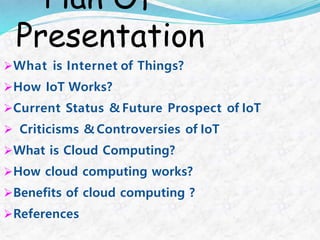
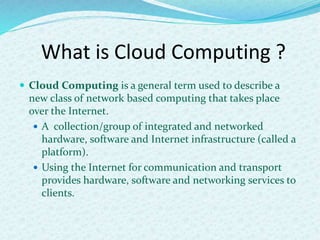
What is Cloud Computing ?
 Cloud Computing is a general term used to describe a
new class of network based computing that takes place
over the Internet.
 A collection/group of integrated and networked
hardware, software and Internet infrastructure (called a
platform).
 Using the Internet for communication and transport
provides hardware, software and networking services to
clients.
An Internet connection is necessary for
cloud computing
The cloud is actually a bunch of
computer servers that store and
transmit data
These servers are very large and can
hold massive amounts of data
The servers can be housed anywhere in
the world
A user accesses the data through a
log-in
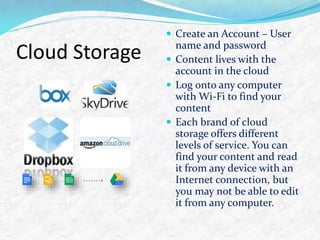
 Create an Account – User
name and password
 Content lives with the
account in the cloud
 Log onto any computer
with Wi-Fi to find your
content
 Each brand of cloud
storage offers different
levels of service. You can
find your content and read
it from any device with an
Internet connection, but
you may not be able to edit
it from any computer.
Cloud Storage
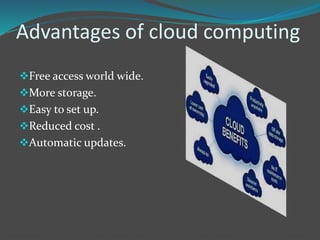
Advantages of cloud computing
Free access world wide.
More storage.
Easy to set up.
Reduced cost .
Automatic updates.
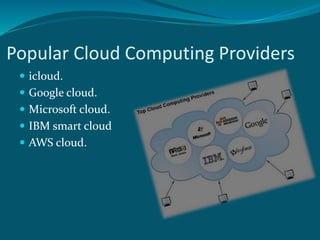
Popular Cloud Computing Providers
 icloud.
 Google cloud.
 Microsoft cloud.
 IBM smart cloud
 AWS cloud.
Final Words
 Cloud computing is a relatively new technology
that will become by each passing day. It
offers many advantages that could immediately
benefit you and your business – be aware,
however, that initial developments come with
frequent drawbacks. If you wait a while, the
service will likely develop more fully as
problems are ironed out. Plus, cost will go down
as more people adopt the technology, which is
great news for any frugal-minded
businessperson.
References
 https://en.wikipedia.org/wiki/InternetofThings
 Book- Fundamentals of IOT By- Davis Hanes
 https://en.wikipedia.org/wiki/cloudcomputing
 Book -Cloud computing By- A Shrivastava and J
Suresh.
Iot and cloud computing

Iot and cloud computing

  • 1.
  • 2.
    Plan Of Presentation What isInternet of Things? How IoT Works? Current Status & Future Prospect of IoT  Criticisms & Controversies of IoT What is Cloud Computing? How cloud computing works? Benefits of cloud computing ? References
  • 3.
    Abstract • The Internetof Things (IoT) is generally thought of as connecting thingsto the Internet and using that connection to provide some kind of useful remote monitoring or control of those things. • The IoT creates an intelligent, invisible network fabric that can be sensed, controlled and programmed. • IoT enabled products employ embedded technology that allows them to communicate, directly or indirectly, with each other or the Internet..
  • 4.
    Introduction The vision ofthe Internet of Things has evolved due to a convergence of multiple technologies, ranging from wireless communication to the Internet and from embedded systems. (e.g embedded systems, wireless sensor networks, control systems ,automation) The Internet of Things (IoT) is the interconnection of uniquely identifiable embedded computing devices within the existing Internet infrastructure. IoT is expected to offer advanced connectivity of devices, systems, and services that goes beyond machine-to- machine communications (M2M) and covers a variety of protocols, domains, and applications.
  • 5.
    Basic Technologies • Communication andcooperation: Objects have the ability to network with Internet resources or even with each other. • Addressability: Within an Internet of Things, objects can be located and addressed. • Identification: Objects are uniquely identifiable. E.g: RFID, NFC (Near Field Communication). • Sensing: Objects collect information about their surroundings with the help of different sensors. • Localization: Smart things are aware of their physical location, or can be located. • User interfaces: Smart objects can communicate with people  in an appropriate manner (for example via a smartphone).
  • 6.
    How IoT Works? 7 RFIDSensor Smart Tech Nano Tech To identify and track the data of things To collect and process the data to detect the changes in the physical status of things To enhance the power of the network by devolving processing capabilities to different part of the network. To make the smaller and smaller things have the ability to connect and interact.
  • 7.
    IoT as aNetwork ofNetworks These networks connected with added security, analytics, and management capabilities. This will allow IoT to become even more powerful in what it can help people achieve.
  • 8.
    Current Status &Future Prospect of IOT “Change is the only thing permanent in this world”
  • 9.
    FewApplications of IOT Buildingand Homeautomation Manufacturing Medical and Healthcaresystems Media Environmental monitoring Infrastructure management Energy management Transportation Better quality of life for elderly ……… You name it, and you will have it in IoT!
  • 10.
    Sensors in eventhe holyCow! In the world of IoT, even the cows will be connected and monitored. Sensors are implanted in the ears ofcattle. This allows farmers to monitor cows’ health and track their movements, ensuring a healthier, more plentiful supply of milk and meat for people to consume. On average, eachcow generates about 200 MB of information per year. “How much more IOT can do is only left to your imagination”
  • 11.
    TECHNOLOGICAL CHALLENGES OFIoT At present IoT is faced with many challenges, such as:  Scalability  Technological Standardization  Inter operability  Discovery  Software complexity  Data volumes and interpretation  Power Supply  Interaction and short range communication  Wireless communication  Fault tolerance
  • 13.
    Conclusion IoT is ata stage where disparate networks and a multitude of sensors must come together and interoperate under a common set of standards. This effort will require businesses, governments, standards organizations, and academia to work together toward a common goal. IoT represents the next evolution of the Internet. IoT has the potential to change the world as we know it today for the better. How quickly we get there is up to us.
  • 14.
  • 15.
    What is CloudComputing ?  Cloud Computing is a general term used to describe a new class of network based computing that takes place over the Internet.  A collection/group of integrated and networked hardware, software and Internet infrastructure (called a platform).  Using the Internet for communication and transport provides hardware, software and networking services to clients.
  • 16.
    An Internet connectionis necessary for cloud computing The cloud is actually a bunch of computer servers that store and transmit data These servers are very large and can hold massive amounts of data The servers can be housed anywhere in the world A user accesses the data through a log-in
  • 17.
     Create anAccount – User name and password  Content lives with the account in the cloud  Log onto any computer with Wi-Fi to find your content  Each brand of cloud storage offers different levels of service. You can find your content and read it from any device with an Internet connection, but you may not be able to edit it from any computer. Cloud Storage
  • 18.
    Advantages of cloudcomputing Free access world wide. More storage. Easy to set up. Reduced cost . Automatic updates.
  • 19.
    Popular Cloud ComputingProviders  icloud.  Google cloud.  Microsoft cloud.  IBM smart cloud  AWS cloud.
  • 20.
    Final Words  Cloudcomputing is a relatively new technology that will become by each passing day. It offers many advantages that could immediately benefit you and your business – be aware, however, that initial developments come with frequent drawbacks. If you wait a while, the service will likely develop more fully as problems are ironed out. Plus, cost will go down as more people adopt the technology, which is great news for any frugal-minded businessperson.
  • 21.
    References  https://en.wikipedia.org/wiki/InternetofThings  Book-Fundamentals of IOT By- Davis Hanes  https://en.wikipedia.org/wiki/cloudcomputing  Book -Cloud computing By- A Shrivastava and J Suresh.