Industry 4.0 and Industrial Internet of Things
Introduction:
Sensing & Actuation
Dr. Sudip Misra
Professor
Department of Computer Science and Engineering
Indian Institute of Technology Kharagpur
Email: smisra@sit.iitkgp.ernet.in
Website: http://cse.iitkgp.ac.in/~smisra/
Research Lab: cse.iitkgp.ac.in/~smisra/swan/
Industry 4.0 and Industrial Internet of Things
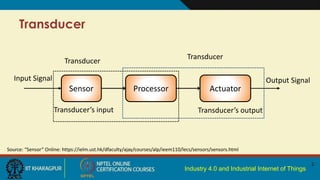
Transducer
2
Transducer’s output
Sensor Processor Actuator
Input Signal Output Signal
Transducer’s input
Transducer
Transducer
Source: “Sensor” Online: https://ielm.ust.hk/dfaculty/ajay/courses/alp/ieem110/lecs/sensors/sensors.html
Industry 4.0 and Industrial Internet of Things
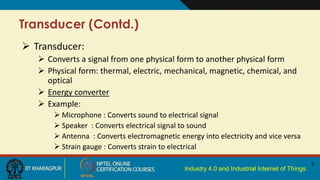
Transducer (Contd.)
 Transducer:
 Converts a signal from one physical form to another physical form
 Physical form: thermal, electric, mechanical, magnetic, chemical, and
optical
 Energy converter
 Example:
 Microphone : Converts sound to electrical signal
 Speaker : Converts electrical signal to sound
 Antenna : Converts electromagnetic energy into electricity and vice versa
 Strain gauge : Converts strain to electrical
3
Industry 4.0 and Industrial Internet of Things
Definition of Sensor
 The characteristic of any device or material to detect the
presence of a particular physical quantity
 The output of sensor is signal, which is converted to human
readable form
4
Industry 4.0 and Industrial Internet of Things
Sensor
 Performs some function of input by sensing or feeling the
physical changes in the characteristic of a system in response
to stimuli
 Input: Physical parameter or stimuli
 Example: Temperature, light, gas, pressure, and sound
 Output: Response to stimuli
5
Industry 4.0 and Industrial Internet of Things
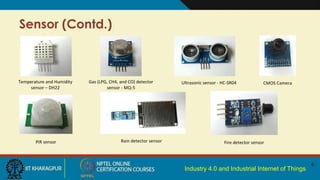
Sensor (Contd.)
6
Temperature and Humidity
sensor – DH22
Gas (LPG, CH4, and CO) detector
sensor - MQ-5
Ultrasonic sensor - HC-SR04 CMOS Camera
PIR sensor Rain detector sensor Fire detector sensor
Industry 4.0 and Industrial Internet of Things
Sensor Characteristics
 Static characteristics
 After steady state condition, how the output of a sensor change in
response to an input change
 Dynamic characteristics
 The properties of the system’s transient response to an input
7
Industry 4.0 and Industrial Internet of Things
Static characteristics
 Accuracy
 Represents the correctness of the output compared to a superior
system
 The different between the standard and the measured value
 Range
 Gives the highest and the lowest value of the physical quantity within
which the sensor can actually sense
 Beyond this value there is no sensing or no kind of response
8
Industry 4.0 and Industrial Internet of Things
Static Characteristics (Contd.)
 Resolution
 Provides the smallest change in the input that a sensor is capable of
sensing
 Resolution is an important specification towards selection of sensors.
 Higher the resolution better the precision
 Errors
 The difference between the standard value and the value produced by
sensor
9
Industry 4.0 and Industrial Internet of Things
Static Characteristics (Contd.)
 Sensitivity
 Sensitivity indicates ratio of incremental change in the response of
the system with respect to incremental change in input parameter.
 It can be found from slope of output characteristic curve of a sensor
 Linearity
 The deviation of sensor value curve from a particular straight line
10
Industry 4.0 and Industrial Internet of Things
Sensor Characteristics (Contd.)
 Drift
 The difference in the measurements of sensor from a specific reading
when kept at that value for a long period of time
 Repeatability
 The deviation between measurements in a sequence under same
conditions
11
Source : “Sensor”, Hong Kong University of Science and Technology, online: https://ielm.ust.hk/dfaculty/ajay/courses/alp/ieem110/lecs/sensors/sensors.html
Source: “Repeatability”, MIT, Online: https://ocw.mit.edu/courses/mechanical-engineering/2-693-principles-of-oceanographic-instrument-systems-sensors-and-
measurements-13-998-spring-2004/
Industry 4.0 and Industrial Internet of Things
Dynamic Characteristics
How well a sensor responds to changes in its input
 Zero order system
 Output shows a response to the input signal with no delay
 Does not include energy-storing elements
 Example: Potentiometer measures linear and rotary displacements
12
Industry 4.0 and Industrial Internet of Things
Dynamic Characteristics (Contd.)
 First order system
 When the output approaches its final value gradually
 Consists of an energy storage and dissipation element
 Second order system
 Complex output response
 The output response of sensor oscillates before steady state
13
Industry 4.0 and Industrial Internet of Things
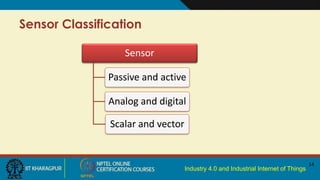
Sensor Classification
14
Sensor
Passive and active
Analog and digital
Scalar and vector
Industry 4.0 and Industrial Internet of Things
Passive Sensor
15
 Cannot independently sense the input
 Example: Accelerometer, soil moisture, water-level, and
temperature sensors
Industry 4.0 and Industrial Internet of Things
Active Sensor
16
 Independently sense the input
 Example: Radar, sounder, and laser altimeter sensors
Industry 4.0 and Industrial Internet of Things
Analog Sensor
17
 The response or output of the sensor is some continuous
function of its input parameter
 Example: Temperature sensor, LDR, analog pressure sensor, and
Analog Hall effect/Magnetic Sensor
 A LDR shows continuous variation in its resistance as a function of
intensity of light falling on it
Industry 4.0 and Industrial Internet of Things
Digital Sensor
18
 Responses in binary nature
 Designs to overcome the disadvantages of analog sensors
 Along with the analog sensor it also comprises of extra
electronics for bit conversion
 Example: Passive infrared (PIR) sensor and digital
temperature sensor (DS1620)
Industry 4.0 and Industrial Internet of Things
Scalar Sensor
19
 Detects the input parameter only based on its magnitude
 The response of the sensor is a function of magnitude of the
input parameter
 Not affected by the direction of the input parameter
 Example: Temperature, gas, strain, color, and smoke sensors
Industry 4.0 and Industrial Internet of Things
Vector Sensor
20
 The response of the sensor depends on the magnitude of the
direction and orientation of input parameter
 Example : Accelerometer, gyroscope, magnetic field, and
motion detector sensors
Industry 4.0 and Industrial Internet of Things
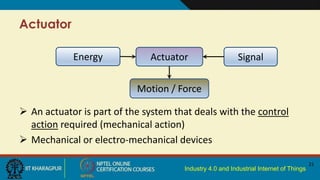
Actuator
 An actuator is part of the system that deals with the control
action required (mechanical action)
 Mechanical or electro-mechanical devices
21
ActuatorEnergy Signal
Motion / Force
Industry 4.0 and Industrial Internet of Things
Actuator (Contd.)
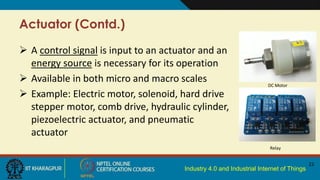
 A control signal is input to an actuator and an
energy source is necessary for its operation
 Available in both micro and macro scales
 Example: Electric motor, solenoid, hard drive
stepper motor, comb drive, hydraulic cylinder,
piezoelectric actuator, and pneumatic
actuator
22
DC Motor
Relay
Industry 4.0 and Industrial Internet of Things
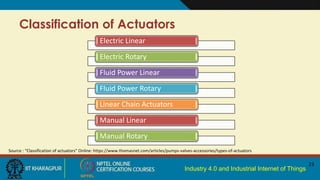
Classification of Actuators
23
Source : “Classification of actuators” Online: https://www.thomasnet.com/articles/pumps-valves-accessories/types-of-actuators
Electric Linear
Electric Rotary
Fluid Power Linear
Fluid Power Rotary
Linear Chain Actuators
Manual Linear
Manual Rotary
Industry 4.0 and Industrial Internet of Things
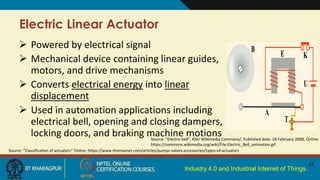
Electric Linear Actuator
24
 Powered by electrical signal
 Mechanical device containing linear guides,
motors, and drive mechanisms
 Converts electrical energy into linear
displacement
 Used in automation applications including
electrical bell, opening and closing dampers,
locking doors, and braking machine motionsSource: “Electric bell”, ЮК/ Wikimedia Commons/, Published date: 18 February 2008, Online:
https://commons.wikimedia.org/wiki/File:Electric_Bell_animation.gif
Source: “Classification of actuators” Online: https://www.thomasnet.com/articles/pumps-valves-accessories/types-of-actuators
Industry 4.0 and Industrial Internet of Things
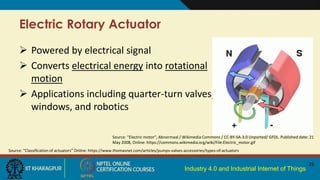
Electric Rotary Actuator
25
 Powered by electrical signal
 Converts electrical energy into rotational
motion
 Applications including quarter-turn valves,
windows, and robotics
Source: “Electric motor”, Abnormaal / Wikimedia Commons / CC-BY-SA-3.0 Unported/ GFDL. Published date: 21
May 2008, Online: https://commons.wikimedia.org/wiki/File:Electric_motor.gif
Source: “Classification of actuators” Online: https://www.thomasnet.com/articles/pumps-valves-accessories/types-of-actuators
Industry 4.0 and Industrial Internet of Things
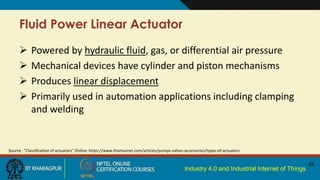
Fluid Power Linear Actuator
26
 Powered by hydraulic fluid, gas, or differential air pressure
 Mechanical devices have cylinder and piston mechanisms
 Produces linear displacement
 Primarily used in automation applications including clamping
and welding
Source : “Classification of actuators” Online: https://www.thomasnet.com/articles/pumps-valves-accessories/types-of-actuators
Industry 4.0 and Industrial Internet of Things
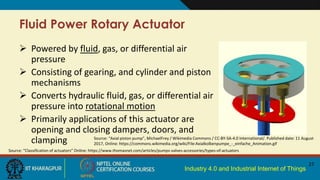
Fluid Power Rotary Actuator
27
 Powered by fluid, gas, or differential air
pressure
 Consisting of gearing, and cylinder and piston
mechanisms
 Converts hydraulic fluid, gas, or differential air
pressure into rotational motion
 Primarily applications of this actuator are
opening and closing dampers, doors, and
clamping
Source: “Classification of actuators” Online: https://www.thomasnet.com/articles/pumps-valves-accessories/types-of-actuators
Source: “Axial piston pump”, MichaelFrey / Wikimedia Commons / CC-BY-SA-4.0 International/. Published date: 11 August
2017, Online: https://commons.wikimedia.org/wiki/File:Axialkolbenpumpe_-_einfache_Animation.gif
Industry 4.0 and Industrial Internet of Things
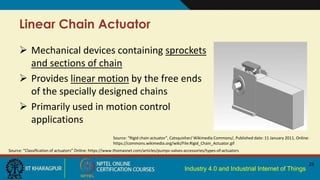
Linear Chain Actuator
28
 Mechanical devices containing sprockets
and sections of chain
 Provides linear motion by the free ends
of the specially designed chains
 Primarily used in motion control
applications
Source: “Classification of actuators” Online: https://www.thomasnet.com/articles/pumps-valves-accessories/types-of-actuators
Source: “Rigid chain actuator”, Catsquisher/ Wikimedia Commons/, Published date: 11 January 2011, Online:
https://commons.wikimedia.org/wiki/File:Rigid_Chain_Actuator.gif
Industry 4.0 and Industrial Internet of Things
Manual Linear Actuator
29
 Provides linear displacement through the translation of
manually rotated screws or gears
 Consists of gearboxes, and hand operated knobs or wheels
 Primarily used for manipulating tools and workpieces
Source: “Classification of actuators” Online: https://www.thomasnet.com/articles/pumps-valves-accessories/types-of-actuators
Industry 4.0 and Industrial Internet of Things
Manual Rotary Actuator
30
 Provides rotary output through the translation of manually
rotated screws, levers, or gears
 Consists of hand operated knobs, levers, handwheels, and
gearboxes
 Primarily used for the operation of valves
Source: “Classification of actuators” Online: https://www.thomasnet.com/articles/pumps-valves-accessories/types-of-actuators
Industry 4.0 and Industrial Internet of Things
References
1. Sensor. Online: https://ielm.ust.hk/dfaculty/ajay/courses/alp/ieem110/lecs/sensors/sensors.html
2. Repeatability of Sensor. Online: https://ocw.mit.edu/courses/mechanical-engineering/2-693-principles-of-
oceanographic-instrument-systems-sensors-and-measurements-13-998-spring-2004/
3. Classification of actuators. Online URL: https://www.thomasnet.com/articles/pumps-valves-accessories/types-
of-actuators
4. “Electric bell”, ЮК/ Wikimedia Commons/, Published date: 18 February 2008, Online:
https://commons.wikimedia.org/wiki/File:Electric_Bell_animation.gif
5. “Electric motor”, Abnormaal / Wikimedia Commons / CC-BY-SA-3.0 Unported/ GFDL/, Published date: 21 May
2008, Online: https://commons.wikimedia.org/wiki/File:Electric_motor.gif
6. “Axial piston pump”, MichaelFrey / Wikimedia Commons / CC-BY-SA-4.0 International/, Published date: 11
August 2017, Online: https://commons.wikimedia.org/wiki/File:Axialkolbenpumpe_-_einfache_Animation.gif
7. “Rigid chain actuator”, Catsquisher/ Wikimedia Commons/, Published date: 11 January 2011, Online:
https://commons.wikimedia.org/wiki/File:Rigid_Chain_Actuator.gif
31
Industry 4.0 and Industrial Internet of Things
32

IoT sensing and actuation

  • 1.
    Industry 4.0 andIndustrial Internet of Things Introduction: Sensing & Actuation Dr. Sudip Misra Professor Department of Computer Science and Engineering Indian Institute of Technology Kharagpur Email: smisra@sit.iitkgp.ernet.in Website: http://cse.iitkgp.ac.in/~smisra/ Research Lab: cse.iitkgp.ac.in/~smisra/swan/
  • 2.
    Industry 4.0 andIndustrial Internet of Things Transducer 2 Transducer’s output Sensor Processor Actuator Input Signal Output Signal Transducer’s input Transducer Transducer Source: “Sensor” Online: https://ielm.ust.hk/dfaculty/ajay/courses/alp/ieem110/lecs/sensors/sensors.html
  • 3.
    Industry 4.0 andIndustrial Internet of Things Transducer (Contd.)  Transducer:  Converts a signal from one physical form to another physical form  Physical form: thermal, electric, mechanical, magnetic, chemical, and optical  Energy converter  Example:  Microphone : Converts sound to electrical signal  Speaker : Converts electrical signal to sound  Antenna : Converts electromagnetic energy into electricity and vice versa  Strain gauge : Converts strain to electrical 3
  • 4.
    Industry 4.0 andIndustrial Internet of Things Definition of Sensor  The characteristic of any device or material to detect the presence of a particular physical quantity  The output of sensor is signal, which is converted to human readable form 4
  • 5.
    Industry 4.0 andIndustrial Internet of Things Sensor  Performs some function of input by sensing or feeling the physical changes in the characteristic of a system in response to stimuli  Input: Physical parameter or stimuli  Example: Temperature, light, gas, pressure, and sound  Output: Response to stimuli 5
  • 6.
    Industry 4.0 andIndustrial Internet of Things Sensor (Contd.) 6 Temperature and Humidity sensor – DH22 Gas (LPG, CH4, and CO) detector sensor - MQ-5 Ultrasonic sensor - HC-SR04 CMOS Camera PIR sensor Rain detector sensor Fire detector sensor
  • 7.
    Industry 4.0 andIndustrial Internet of Things Sensor Characteristics  Static characteristics  After steady state condition, how the output of a sensor change in response to an input change  Dynamic characteristics  The properties of the system’s transient response to an input 7
  • 8.
    Industry 4.0 andIndustrial Internet of Things Static characteristics  Accuracy  Represents the correctness of the output compared to a superior system  The different between the standard and the measured value  Range  Gives the highest and the lowest value of the physical quantity within which the sensor can actually sense  Beyond this value there is no sensing or no kind of response 8
  • 9.
    Industry 4.0 andIndustrial Internet of Things Static Characteristics (Contd.)  Resolution  Provides the smallest change in the input that a sensor is capable of sensing  Resolution is an important specification towards selection of sensors.  Higher the resolution better the precision  Errors  The difference between the standard value and the value produced by sensor 9
  • 10.
    Industry 4.0 andIndustrial Internet of Things Static Characteristics (Contd.)  Sensitivity  Sensitivity indicates ratio of incremental change in the response of the system with respect to incremental change in input parameter.  It can be found from slope of output characteristic curve of a sensor  Linearity  The deviation of sensor value curve from a particular straight line 10
  • 11.
    Industry 4.0 andIndustrial Internet of Things Sensor Characteristics (Contd.)  Drift  The difference in the measurements of sensor from a specific reading when kept at that value for a long period of time  Repeatability  The deviation between measurements in a sequence under same conditions 11 Source : “Sensor”, Hong Kong University of Science and Technology, online: https://ielm.ust.hk/dfaculty/ajay/courses/alp/ieem110/lecs/sensors/sensors.html Source: “Repeatability”, MIT, Online: https://ocw.mit.edu/courses/mechanical-engineering/2-693-principles-of-oceanographic-instrument-systems-sensors-and- measurements-13-998-spring-2004/
  • 12.
    Industry 4.0 andIndustrial Internet of Things Dynamic Characteristics How well a sensor responds to changes in its input  Zero order system  Output shows a response to the input signal with no delay  Does not include energy-storing elements  Example: Potentiometer measures linear and rotary displacements 12
  • 13.
    Industry 4.0 andIndustrial Internet of Things Dynamic Characteristics (Contd.)  First order system  When the output approaches its final value gradually  Consists of an energy storage and dissipation element  Second order system  Complex output response  The output response of sensor oscillates before steady state 13
  • 14.
    Industry 4.0 andIndustrial Internet of Things Sensor Classification 14 Sensor Passive and active Analog and digital Scalar and vector
  • 15.
    Industry 4.0 andIndustrial Internet of Things Passive Sensor 15  Cannot independently sense the input  Example: Accelerometer, soil moisture, water-level, and temperature sensors
  • 16.
    Industry 4.0 andIndustrial Internet of Things Active Sensor 16  Independently sense the input  Example: Radar, sounder, and laser altimeter sensors
  • 17.
    Industry 4.0 andIndustrial Internet of Things Analog Sensor 17  The response or output of the sensor is some continuous function of its input parameter  Example: Temperature sensor, LDR, analog pressure sensor, and Analog Hall effect/Magnetic Sensor  A LDR shows continuous variation in its resistance as a function of intensity of light falling on it
  • 18.
    Industry 4.0 andIndustrial Internet of Things Digital Sensor 18  Responses in binary nature  Designs to overcome the disadvantages of analog sensors  Along with the analog sensor it also comprises of extra electronics for bit conversion  Example: Passive infrared (PIR) sensor and digital temperature sensor (DS1620)
  • 19.
    Industry 4.0 andIndustrial Internet of Things Scalar Sensor 19  Detects the input parameter only based on its magnitude  The response of the sensor is a function of magnitude of the input parameter  Not affected by the direction of the input parameter  Example: Temperature, gas, strain, color, and smoke sensors
  • 20.
    Industry 4.0 andIndustrial Internet of Things Vector Sensor 20  The response of the sensor depends on the magnitude of the direction and orientation of input parameter  Example : Accelerometer, gyroscope, magnetic field, and motion detector sensors
  • 21.
    Industry 4.0 andIndustrial Internet of Things Actuator  An actuator is part of the system that deals with the control action required (mechanical action)  Mechanical or electro-mechanical devices 21 ActuatorEnergy Signal Motion / Force
  • 22.
    Industry 4.0 andIndustrial Internet of Things Actuator (Contd.)  A control signal is input to an actuator and an energy source is necessary for its operation  Available in both micro and macro scales  Example: Electric motor, solenoid, hard drive stepper motor, comb drive, hydraulic cylinder, piezoelectric actuator, and pneumatic actuator 22 DC Motor Relay
  • 23.
    Industry 4.0 andIndustrial Internet of Things Classification of Actuators 23 Source : “Classification of actuators” Online: https://www.thomasnet.com/articles/pumps-valves-accessories/types-of-actuators Electric Linear Electric Rotary Fluid Power Linear Fluid Power Rotary Linear Chain Actuators Manual Linear Manual Rotary
  • 24.
    Industry 4.0 andIndustrial Internet of Things Electric Linear Actuator 24  Powered by electrical signal  Mechanical device containing linear guides, motors, and drive mechanisms  Converts electrical energy into linear displacement  Used in automation applications including electrical bell, opening and closing dampers, locking doors, and braking machine motionsSource: “Electric bell”, ЮК/ Wikimedia Commons/, Published date: 18 February 2008, Online: https://commons.wikimedia.org/wiki/File:Electric_Bell_animation.gif Source: “Classification of actuators” Online: https://www.thomasnet.com/articles/pumps-valves-accessories/types-of-actuators
  • 25.
    Industry 4.0 andIndustrial Internet of Things Electric Rotary Actuator 25  Powered by electrical signal  Converts electrical energy into rotational motion  Applications including quarter-turn valves, windows, and robotics Source: “Electric motor”, Abnormaal / Wikimedia Commons / CC-BY-SA-3.0 Unported/ GFDL. Published date: 21 May 2008, Online: https://commons.wikimedia.org/wiki/File:Electric_motor.gif Source: “Classification of actuators” Online: https://www.thomasnet.com/articles/pumps-valves-accessories/types-of-actuators
  • 26.
    Industry 4.0 andIndustrial Internet of Things Fluid Power Linear Actuator 26  Powered by hydraulic fluid, gas, or differential air pressure  Mechanical devices have cylinder and piston mechanisms  Produces linear displacement  Primarily used in automation applications including clamping and welding Source : “Classification of actuators” Online: https://www.thomasnet.com/articles/pumps-valves-accessories/types-of-actuators
  • 27.
    Industry 4.0 andIndustrial Internet of Things Fluid Power Rotary Actuator 27  Powered by fluid, gas, or differential air pressure  Consisting of gearing, and cylinder and piston mechanisms  Converts hydraulic fluid, gas, or differential air pressure into rotational motion  Primarily applications of this actuator are opening and closing dampers, doors, and clamping Source: “Classification of actuators” Online: https://www.thomasnet.com/articles/pumps-valves-accessories/types-of-actuators Source: “Axial piston pump”, MichaelFrey / Wikimedia Commons / CC-BY-SA-4.0 International/. Published date: 11 August 2017, Online: https://commons.wikimedia.org/wiki/File:Axialkolbenpumpe_-_einfache_Animation.gif
  • 28.
    Industry 4.0 andIndustrial Internet of Things Linear Chain Actuator 28  Mechanical devices containing sprockets and sections of chain  Provides linear motion by the free ends of the specially designed chains  Primarily used in motion control applications Source: “Classification of actuators” Online: https://www.thomasnet.com/articles/pumps-valves-accessories/types-of-actuators Source: “Rigid chain actuator”, Catsquisher/ Wikimedia Commons/, Published date: 11 January 2011, Online: https://commons.wikimedia.org/wiki/File:Rigid_Chain_Actuator.gif
  • 29.
    Industry 4.0 andIndustrial Internet of Things Manual Linear Actuator 29  Provides linear displacement through the translation of manually rotated screws or gears  Consists of gearboxes, and hand operated knobs or wheels  Primarily used for manipulating tools and workpieces Source: “Classification of actuators” Online: https://www.thomasnet.com/articles/pumps-valves-accessories/types-of-actuators
  • 30.
    Industry 4.0 andIndustrial Internet of Things Manual Rotary Actuator 30  Provides rotary output through the translation of manually rotated screws, levers, or gears  Consists of hand operated knobs, levers, handwheels, and gearboxes  Primarily used for the operation of valves Source: “Classification of actuators” Online: https://www.thomasnet.com/articles/pumps-valves-accessories/types-of-actuators
  • 31.
    Industry 4.0 andIndustrial Internet of Things References 1. Sensor. Online: https://ielm.ust.hk/dfaculty/ajay/courses/alp/ieem110/lecs/sensors/sensors.html 2. Repeatability of Sensor. Online: https://ocw.mit.edu/courses/mechanical-engineering/2-693-principles-of- oceanographic-instrument-systems-sensors-and-measurements-13-998-spring-2004/ 3. Classification of actuators. Online URL: https://www.thomasnet.com/articles/pumps-valves-accessories/types- of-actuators 4. “Electric bell”, ЮК/ Wikimedia Commons/, Published date: 18 February 2008, Online: https://commons.wikimedia.org/wiki/File:Electric_Bell_animation.gif 5. “Electric motor”, Abnormaal / Wikimedia Commons / CC-BY-SA-3.0 Unported/ GFDL/, Published date: 21 May 2008, Online: https://commons.wikimedia.org/wiki/File:Electric_motor.gif 6. “Axial piston pump”, MichaelFrey / Wikimedia Commons / CC-BY-SA-4.0 International/, Published date: 11 August 2017, Online: https://commons.wikimedia.org/wiki/File:Axialkolbenpumpe_-_einfache_Animation.gif 7. “Rigid chain actuator”, Catsquisher/ Wikimedia Commons/, Published date: 11 January 2011, Online: https://commons.wikimedia.org/wiki/File:Rigid_Chain_Actuator.gif 31
  • 32.
    Industry 4.0 andIndustrial Internet of Things 32