Sensor Cloud
Presented By
Debjyoti Ghosh
M.Tech 3rd Semester
Dept. of Computer Science & Engineering
University of Calcutta16-01-2017
1
Contents
 Introduction
 Wireless Sensor Network
 Cloud Computing
 Why Sensor Cloud?
 General Architecture
 Detailed Architecture
 Pros and Cons
 Application Scenario
 Conclusion
 References
16-01-2017
2
Introduction
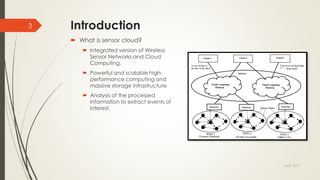
 What is sensor cloud?
 Integrated version of Wireless
Sensor Networks and Cloud
Computing.
 Powerful and scalable high-
performance computing and
massive storage infrastructure
 Analysis of the processed
information to extract events of
interest.
16-01-2017
3
Wireless Sensor Network
 A wireless sensor network (WSN) consists of spatially distributed autonomous
sensors to monitor physical or environmental conditions .
 Monitors temperature, sound, pressure, etc.
 Used in healthcare, military, critical infrastructure monitoring, environment
monitoring, and manufacturing.
16-01-2017
4
Cloud Computing
 Provides shared computer processing resources and data to computers
and other devices on demand.
 Infrastructure as a service(IaaS)
 Software as a service(SaaS)
 Platform as a service(PaaS)
16-01-2017
5
Why Sensor Cloud?
 Sensors are limited in energy, processing power, memory, and
communication bandwidth.
 WSNs have been designed to support a specific application service in
mind.
 Sensor data used for specific applications cannot be easily shared among
different groups of users.
 Cloud computing platform dynamically provisions, configures, and
reconfigures the servers when needed by users.
16-01-2017
6
General Architecture
16-01-2017
7
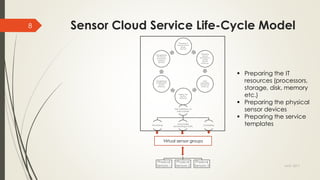
Sensor Cloud Service Life-Cycle Model
Preparing IT
resources and
sensor
devices
Preparing
service
templates to
create
service
instances
Users
requesting
the service
instances
Utilising the
service
instances
Unregistering/
Deleting the
service
instances
Unregidtering
the service
template or
physical
services
User interface via
web crawler
Monitoring
Automated
provisioning of Data
Controlling
Virtual sensor groups
Physical
Sensors 1
Physical
Sensors 2
Physical
Sensors 3
 Preparing the IT
resources (processors,
storage, disk, memory
etc.)
 Preparing the physical
sensor devices
 Preparing the service
templates
16-01-2017
8
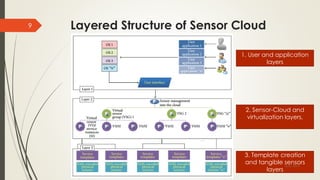
Layered Structure of Sensor Cloud
1. User and application
layers
2. Sensor-Cloud and
virtualization layers,
3. Template creation
and tangible sensors
layers
16-01-2017
9
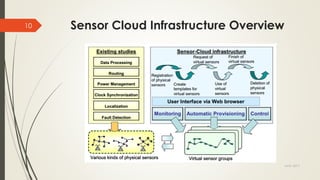
Sensor Cloud Infrastructure Overview
16-01-2017
10
Design Considerations
 Virtualization
 Each virtual sensor is created from one or more physical sensors which is dependent on the user
application area.
 A virtual sensor group is created from one or more virtual sensors.
 Users can create virtual sensor groups and freely use the virtual sensors included the groups as if
they owned sensors.
 Users can activate or inactivate their virtual sensors, check their status, and set the frequency of
data collection from them.
 Standardization & Automation
 Each physical sensor provides its own functions for control and data collection.
 Standard like Sensor Model Language/SML mechanism enables users to access sensors without
concern for the differences among the physical sensors.
 Sensor-Cloud infrastructure translates the standard functions for the virtual sensors into specific
functions for the different kinds of physical sensors.
 Automation (in terms of response of data), improves the service delivery time and reduces the
cost.
 Sensor-Cloud infrastructure is an on demand service delivery and supports the full lifecycle of
service delivery from the registration of physical sensors through creating templates, requesting of
virtual sensors, provisioning, starting and finishing to use virtual sensors, and deleting the physical
sensors.
16-01-2017
11
Design Considerations
16-01-2017
12
Design Considerations
 Monitoring
 The users can check the status and the availability of the virtual sensors by the
monitoring mechanism of Sensor-Cloud infrastructure.
 Grouping
 There are many kinds of physical sensors, each application does not have to use
all of them.
 Each application uses some types of sensors or when the sensors which match
certain constrains (such as a location).
 Sensor-Cloud infrastructure can provide virtual sensors as virtual sensor groups.
Users can control each virtual sensor and virtual sensor groups.
 For example, a user can set the access control and the frequency of data collection
for virtual sensor groups. Sensor-Cloud infrastructure prepares typical virtual sensor
groups and users can create new virtual sensor groups by selecting virtual sensors.
16-01-2017
13
Entities Involved
 Sensor Owner:
 Owns has physical sensors which are deployed over the area of interest.
 One of the possible advantages for sensor owner could be rental fees for using the
physical sensors. The fees reflects the actual usage of the physical sensors.
 A sensor owner registers the physical sensors with their properties to Sensor-Cloud
infrastructure. The owner deletes the registration of them when s/he quits sharing them.
 Sensor-Cloud Administrator:
 The actor who manages the Sensor-Cloud Infrastructure service.
 Manages the IT resources for the virtual sensors, monitoring, and the user interfaces.
 Prepares the templates for the virtual sensors and for some typical virtual sensor groups.
 End User:
 An actor with one or more applications or services that use the sensor data.
 Requests the use of virtual sensors or virtual sensor groups that satisfy the requirements from
the templates.
 These templates are easily configurable, sharable, and removable and easily can be
created.

16-01-2017
14
16-01-2017
15
System Architecture
16-01-2017
16
Components in Architecture
 Portal server:
 When a user logs into the portal from a Web browser, the user’s role (end user, sensor
owner or Sensor-Cloud administrator) determinates the available operations.
 Shows the end users the menus for logging in, logging out, requesting for provisioning or
destroying virtual sensor groups, monitoring their virtual sensors, controlling them, creating
templates of virtual sensor groups and checking their usage-related charges.
 Gives sensor owners the menus for logging in, logging out, registering or deleting physical
sensors, and checking the usage-related rental fees. One of the menus or Sensor-Cloud
administrators is for creating, modifying, and deleting the templates for virtual sensors or
virtual sensor groups.
 Provisioning Server:
 Provisioning server provisions the virtual sensor groups for the requests from the portal
server.
 It contains a workflow engine and predefined workflows. It executes the workflows in the
proper order.
 First, it checks and reserves the IT resource pool when it receives a request for
provisioning. It retrieves the templates of virtual sensors and virtual sensor groups,
 Then provisions the virtual sensor groups including virtual sensors on the existing or a new
virtual server.
 After provisioning, the provisioning server updates the definitions of the virtual sensor
groups. The virtual servers are provisioned with the agents for monitoring. 16-01-2017
17
Components in Architecture
 Virtual Sensor Group:
 A virtual sensor group is automatically provisioned on a virtual server by the
provisioning server.
 Each virtual sensor group is owned by end user and has one or more virtual sensors.
The end user can control the virtual sensors.
 For example, they can activate or inactivate their virtual sensors, set the
frequency of data collection from them, and check their status. The virtual
sensor groups are controlled directly or form a Web browser.
 Monitoring Server:
 The monitoring server receives the data about virtual sensors from the agents in the
virtual servers and the servers.
 It stores the received data in a database.
 The monitoring information for the virtual sensors is available using a Web browser.
The Sensor-Cloud administrators are also able to monitor the status of the servers.
16-01-2017
18
Component Flow
 1) Login: A end user logs in the portal on a Web browser.
 2) Select the templates of virutal sensor group: The portal asks the database the
list of the templates of virual sensors and virtual sensor groups. A end user selects
the required templates from the list.
 3) Request the virutal sensor group: A end user requests the virtual sensor groups
by selecting the templates on the portal. The portal calls the provisioning server
with the input parameters (such as the template IDs, the virtual group names, and
user ID).
 4) Reserve IT resource: The provisioning server first try to reserve the IT resource for
the virtual sensor groups. If there is no spare resource on the existing virtual servers,
it automatically provisions a new virtual server with a monitoring agent, and
reserves the IT resource.
 5) Get the templates and Provision: The provisioning server gets the templates of
the virtual sensor group and the virtual sensors from the repository. It provisions the
virtual sensor groups on the selected virtual server.
 6) Notify the completion: The provisioning server notifies the end user of the
completion of provisioning the requested virtual sensor group by e-mail. It also
adds the new records to the definition of the virtual sensor groups.
16-01-2017
19
Pros
 Analysis
 Scalability
 Collaboration
 Visualization
 Free Provisioning of Increased Data storage and Processing Power
 Dynamic Provisioning of Services
 Automation
 Flexibility
 Quick Response Time
 Resource Optimization
16-01-2017
20
Cons
 Implementation Cost & Maintenance
 Overload of creating the Template or Virtual Sensor Group
 A continuous data connectivity is needed between end users and Sensor-
Cloud server.
 Sensor-Cloud infrastructure is vulnerable and more prone to sophisticated
distributed intrusion attacks like DDOS (distribute denial of service) and XSS
(cross-site scripting).
16-01-2017
21
Application Scenario
 A. Transport Monitoring
Transport monitoring system includes basic management systems like traffic signal control,
navigation, automatic number plate recognition, toll collection, emergency vehicle
notification, dynamic traffic light etc.
 C. Military Use
Sensor networks are used in the military for Monitoring friendly forces, equipment and
ammunition, Battlefield surveillance, Reconnaissance of opposing forces, Targeting, Battle
damage assessment and Nuclear, biological and chemical attack detection
reconnaissance etc.
 C. Weather Forecasting
Weather forecasting is the application to predict the state of the atmosphere for a future
time and a given location. Weather monitoring and forecasting system typically includes-
Data collection, Data assimilation, Numerical weather prediction and Forecast
presentation.
 D. Health Care
Sensor networks are also widely used in health care area. In some modern hospital sensor
networks are constructed to monitor patient physiological data, to control the drug
administration track and monitor patients and doctors and inside a hospital.
16-01-2017
22
Conclusion
 The communication among sensor nodes using Internet is a challenging
task since sensor nodes contain limited band width, memory and small size
batteries.
 The issues of storage capacity may be overcome by widely used cloud
computing technique.
 The Sensor-Cloud architecture enables the sensor data to be categorized,
stored, and processed in such a way that it becomes cost-effective, timely
available, and easily accessible.
 Integrating the existing sensors with cloud will enable an open, extensible,
scalable, interoperable, and easy to use, reconstructible network of sensors
for numerous applications.
16-01-2017
23
References
 [1] “Sensor-Cloud,” [Online]. Available: http://sensorcloud.com/system-overview.
 [2] Atif Alamri, Wasai Shadab Ansari, Mohammad Mehedi Hassan, M. Shamim Hossain,
Abdulhameed Alelaiwi, M. Anwar Hossain, “A Survey on Sensor-Cloud: Architecture,
Applications, and Approaches,” International Journal of Distributed Sensor Networks, 2013.
 [3] “Wireless sensor network - Wikipedia, the free encyclopedia,” [Online]. Available:
http://en.wikipedia.org/wiki/Wireless_sensor_network.
 [4] S. K. Dash, J. P. Sahoo, S. Mohapatra, and S. P. Pati,, “Sensor-cloud: assimilation of
wireless sensor network and the cloud,” Advances in Computer Science and Information
Technology Networks and Communications, Spinger, vol. 84, pp. 455-464, 2012.
 [5] M. Yuriyama and T. Kushida, “Sensor-cloud infrastructure physical sensor management
with virtualized sensors on cloud computing,” Proceedings of the IEEE 13th International
Conference on Network-Based Information Systems (NBiS ’10), pp. 1-8, September 2010.
 [6] Dash, S.K., Mohapatra, S., Pattanaik, P.K.: A Survey on Applications of Sensor Network
using Cloud Computing. International Journal of Computer Science and Emerging
Technologies 2(4), 50–55 (2010)
16-01-2017
24
Thank You
16-01-2017
25

Sensor Cloud

  • 1.
    Sensor Cloud Presented By DebjyotiGhosh M.Tech 3rd Semester Dept. of Computer Science & Engineering University of Calcutta16-01-2017 1
  • 2.
    Contents  Introduction  WirelessSensor Network  Cloud Computing  Why Sensor Cloud?  General Architecture  Detailed Architecture  Pros and Cons  Application Scenario  Conclusion  References 16-01-2017 2
  • 3.
    Introduction  What issensor cloud?  Integrated version of Wireless Sensor Networks and Cloud Computing.  Powerful and scalable high- performance computing and massive storage infrastructure  Analysis of the processed information to extract events of interest. 16-01-2017 3
  • 4.
    Wireless Sensor Network A wireless sensor network (WSN) consists of spatially distributed autonomous sensors to monitor physical or environmental conditions .  Monitors temperature, sound, pressure, etc.  Used in healthcare, military, critical infrastructure monitoring, environment monitoring, and manufacturing. 16-01-2017 4
  • 5.
    Cloud Computing  Providesshared computer processing resources and data to computers and other devices on demand.  Infrastructure as a service(IaaS)  Software as a service(SaaS)  Platform as a service(PaaS) 16-01-2017 5
  • 6.
    Why Sensor Cloud? Sensors are limited in energy, processing power, memory, and communication bandwidth.  WSNs have been designed to support a specific application service in mind.  Sensor data used for specific applications cannot be easily shared among different groups of users.  Cloud computing platform dynamically provisions, configures, and reconfigures the servers when needed by users. 16-01-2017 6
  • 7.
  • 8.
    Sensor Cloud ServiceLife-Cycle Model Preparing IT resources and sensor devices Preparing service templates to create service instances Users requesting the service instances Utilising the service instances Unregistering/ Deleting the service instances Unregidtering the service template or physical services User interface via web crawler Monitoring Automated provisioning of Data Controlling Virtual sensor groups Physical Sensors 1 Physical Sensors 2 Physical Sensors 3  Preparing the IT resources (processors, storage, disk, memory etc.)  Preparing the physical sensor devices  Preparing the service templates 16-01-2017 8
  • 9.
    Layered Structure ofSensor Cloud 1. User and application layers 2. Sensor-Cloud and virtualization layers, 3. Template creation and tangible sensors layers 16-01-2017 9
  • 10.
    Sensor Cloud InfrastructureOverview 16-01-2017 10
  • 11.
    Design Considerations  Virtualization Each virtual sensor is created from one or more physical sensors which is dependent on the user application area.  A virtual sensor group is created from one or more virtual sensors.  Users can create virtual sensor groups and freely use the virtual sensors included the groups as if they owned sensors.  Users can activate or inactivate their virtual sensors, check their status, and set the frequency of data collection from them.  Standardization & Automation  Each physical sensor provides its own functions for control and data collection.  Standard like Sensor Model Language/SML mechanism enables users to access sensors without concern for the differences among the physical sensors.  Sensor-Cloud infrastructure translates the standard functions for the virtual sensors into specific functions for the different kinds of physical sensors.  Automation (in terms of response of data), improves the service delivery time and reduces the cost.  Sensor-Cloud infrastructure is an on demand service delivery and supports the full lifecycle of service delivery from the registration of physical sensors through creating templates, requesting of virtual sensors, provisioning, starting and finishing to use virtual sensors, and deleting the physical sensors. 16-01-2017 11
  • 12.
  • 13.
    Design Considerations  Monitoring The users can check the status and the availability of the virtual sensors by the monitoring mechanism of Sensor-Cloud infrastructure.  Grouping  There are many kinds of physical sensors, each application does not have to use all of them.  Each application uses some types of sensors or when the sensors which match certain constrains (such as a location).  Sensor-Cloud infrastructure can provide virtual sensors as virtual sensor groups. Users can control each virtual sensor and virtual sensor groups.  For example, a user can set the access control and the frequency of data collection for virtual sensor groups. Sensor-Cloud infrastructure prepares typical virtual sensor groups and users can create new virtual sensor groups by selecting virtual sensors. 16-01-2017 13
  • 14.
    Entities Involved  SensorOwner:  Owns has physical sensors which are deployed over the area of interest.  One of the possible advantages for sensor owner could be rental fees for using the physical sensors. The fees reflects the actual usage of the physical sensors.  A sensor owner registers the physical sensors with their properties to Sensor-Cloud infrastructure. The owner deletes the registration of them when s/he quits sharing them.  Sensor-Cloud Administrator:  The actor who manages the Sensor-Cloud Infrastructure service.  Manages the IT resources for the virtual sensors, monitoring, and the user interfaces.  Prepares the templates for the virtual sensors and for some typical virtual sensor groups.  End User:  An actor with one or more applications or services that use the sensor data.  Requests the use of virtual sensors or virtual sensor groups that satisfy the requirements from the templates.  These templates are easily configurable, sharable, and removable and easily can be created.  16-01-2017 14
  • 15.
  • 16.
  • 17.
    Components in Architecture Portal server:  When a user logs into the portal from a Web browser, the user’s role (end user, sensor owner or Sensor-Cloud administrator) determinates the available operations.  Shows the end users the menus for logging in, logging out, requesting for provisioning or destroying virtual sensor groups, monitoring their virtual sensors, controlling them, creating templates of virtual sensor groups and checking their usage-related charges.  Gives sensor owners the menus for logging in, logging out, registering or deleting physical sensors, and checking the usage-related rental fees. One of the menus or Sensor-Cloud administrators is for creating, modifying, and deleting the templates for virtual sensors or virtual sensor groups.  Provisioning Server:  Provisioning server provisions the virtual sensor groups for the requests from the portal server.  It contains a workflow engine and predefined workflows. It executes the workflows in the proper order.  First, it checks and reserves the IT resource pool when it receives a request for provisioning. It retrieves the templates of virtual sensors and virtual sensor groups,  Then provisions the virtual sensor groups including virtual sensors on the existing or a new virtual server.  After provisioning, the provisioning server updates the definitions of the virtual sensor groups. The virtual servers are provisioned with the agents for monitoring. 16-01-2017 17
  • 18.
    Components in Architecture Virtual Sensor Group:  A virtual sensor group is automatically provisioned on a virtual server by the provisioning server.  Each virtual sensor group is owned by end user and has one or more virtual sensors. The end user can control the virtual sensors.  For example, they can activate or inactivate their virtual sensors, set the frequency of data collection from them, and check their status. The virtual sensor groups are controlled directly or form a Web browser.  Monitoring Server:  The monitoring server receives the data about virtual sensors from the agents in the virtual servers and the servers.  It stores the received data in a database.  The monitoring information for the virtual sensors is available using a Web browser. The Sensor-Cloud administrators are also able to monitor the status of the servers. 16-01-2017 18
  • 19.
    Component Flow  1)Login: A end user logs in the portal on a Web browser.  2) Select the templates of virutal sensor group: The portal asks the database the list of the templates of virual sensors and virtual sensor groups. A end user selects the required templates from the list.  3) Request the virutal sensor group: A end user requests the virtual sensor groups by selecting the templates on the portal. The portal calls the provisioning server with the input parameters (such as the template IDs, the virtual group names, and user ID).  4) Reserve IT resource: The provisioning server first try to reserve the IT resource for the virtual sensor groups. If there is no spare resource on the existing virtual servers, it automatically provisions a new virtual server with a monitoring agent, and reserves the IT resource.  5) Get the templates and Provision: The provisioning server gets the templates of the virtual sensor group and the virtual sensors from the repository. It provisions the virtual sensor groups on the selected virtual server.  6) Notify the completion: The provisioning server notifies the end user of the completion of provisioning the requested virtual sensor group by e-mail. It also adds the new records to the definition of the virtual sensor groups. 16-01-2017 19
  • 20.
    Pros  Analysis  Scalability Collaboration  Visualization  Free Provisioning of Increased Data storage and Processing Power  Dynamic Provisioning of Services  Automation  Flexibility  Quick Response Time  Resource Optimization 16-01-2017 20
  • 21.
    Cons  Implementation Cost& Maintenance  Overload of creating the Template or Virtual Sensor Group  A continuous data connectivity is needed between end users and Sensor- Cloud server.  Sensor-Cloud infrastructure is vulnerable and more prone to sophisticated distributed intrusion attacks like DDOS (distribute denial of service) and XSS (cross-site scripting). 16-01-2017 21
  • 22.
    Application Scenario  A.Transport Monitoring Transport monitoring system includes basic management systems like traffic signal control, navigation, automatic number plate recognition, toll collection, emergency vehicle notification, dynamic traffic light etc.  C. Military Use Sensor networks are used in the military for Monitoring friendly forces, equipment and ammunition, Battlefield surveillance, Reconnaissance of opposing forces, Targeting, Battle damage assessment and Nuclear, biological and chemical attack detection reconnaissance etc.  C. Weather Forecasting Weather forecasting is the application to predict the state of the atmosphere for a future time and a given location. Weather monitoring and forecasting system typically includes- Data collection, Data assimilation, Numerical weather prediction and Forecast presentation.  D. Health Care Sensor networks are also widely used in health care area. In some modern hospital sensor networks are constructed to monitor patient physiological data, to control the drug administration track and monitor patients and doctors and inside a hospital. 16-01-2017 22
  • 23.
    Conclusion  The communicationamong sensor nodes using Internet is a challenging task since sensor nodes contain limited band width, memory and small size batteries.  The issues of storage capacity may be overcome by widely used cloud computing technique.  The Sensor-Cloud architecture enables the sensor data to be categorized, stored, and processed in such a way that it becomes cost-effective, timely available, and easily accessible.  Integrating the existing sensors with cloud will enable an open, extensible, scalable, interoperable, and easy to use, reconstructible network of sensors for numerous applications. 16-01-2017 23
  • 24.
    References  [1] “Sensor-Cloud,”[Online]. Available: http://sensorcloud.com/system-overview.  [2] Atif Alamri, Wasai Shadab Ansari, Mohammad Mehedi Hassan, M. Shamim Hossain, Abdulhameed Alelaiwi, M. Anwar Hossain, “A Survey on Sensor-Cloud: Architecture, Applications, and Approaches,” International Journal of Distributed Sensor Networks, 2013.  [3] “Wireless sensor network - Wikipedia, the free encyclopedia,” [Online]. Available: http://en.wikipedia.org/wiki/Wireless_sensor_network.  [4] S. K. Dash, J. P. Sahoo, S. Mohapatra, and S. P. Pati,, “Sensor-cloud: assimilation of wireless sensor network and the cloud,” Advances in Computer Science and Information Technology Networks and Communications, Spinger, vol. 84, pp. 455-464, 2012.  [5] M. Yuriyama and T. Kushida, “Sensor-cloud infrastructure physical sensor management with virtualized sensors on cloud computing,” Proceedings of the IEEE 13th International Conference on Network-Based Information Systems (NBiS ’10), pp. 1-8, September 2010.  [6] Dash, S.K., Mohapatra, S., Pattanaik, P.K.: A Survey on Applications of Sensor Network using Cloud Computing. International Journal of Computer Science and Emerging Technologies 2(4), 50–55 (2010) 16-01-2017 24
  • 25.