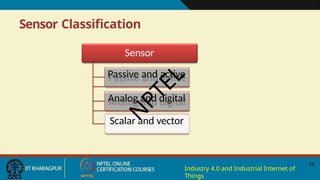
Introduction:
Sensing &
Actuation
Dr. SudipMisra
Professor
Department of Computer Science and Engineering
Indian Institute of Technology Kharagpur
Email: smisra@sit.iitkgp.ernet.in
Website: http://cse.iitkgp.ac.in/~smisra/
Research Lab:
cse.iitkgp.ac.in/~smisra/swan/
Indu
N
P
T
E
L
2.
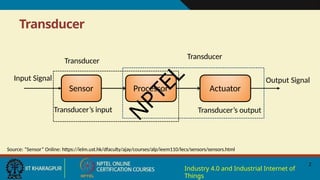
Transducer
Transducer’s output
Sensor ProcessorActuator
Input Signal Output Signal
Transducer’s input
Transducer
2
Industry 4.0 and Industrial Internet of
Things
Transducer
Source: “Sensor” Online: https://ielm.ust.hk/dfaculty/ajay/courses/alp/ieem110/lecs/sensors/sensors.html
N
P
T
E
L
3.
Transducer (Contd.)
3
Industry 4.0and Industrial Internet of
Things
Transducer:
Converts a signal from one physical form to another physical form
Physical form: thermal, electric, mechanical, magnetic, chemical, and
optical
Energy converter
Example:
Microphone : Converts sound to electrical signal
Speaker : Converts electrical signal to sound
Antenna : Converts electromagnetic energy into electricity and vice
versa
Strain gauge : Converts strain to electrical
N
P
T
E
L
4.
Definition of
Sensor
4
Industry 4.0and Industrial Internet of
Things
The characteristic of any device or material to detect the
presence of a particular physical quantity
The output of sensor is signal, which is converted to human
readable form
N
P
T
E
L
5.
Sensor
5
Industry 4.0 andIndustrial Internet of
Things
Performs some function of input by sensing or feeling the
physical changes in the characteristic of a system in response
to stimuli
Input: Physical parameter or stimuli
Example: Temperature, light, gas, pressure, and sound
Output: Response to stimuli
N
P
T
E
L
6.
Sensor (Contd.)
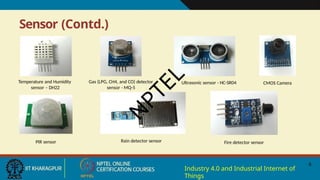
Temperature andHumidity
sensor – DH22
Gas (LPG, CH4, and CO) detector
sensor - MQ-5
Ultrasonic sensor - HC-SR04 CMOS Camera
PIR sensor Rain detector sensor Fire detector sensor
N
P
T
E
L
6
Industry 4.0 and Industrial Internet of
Things
7.
Sensor Characteristics
7
Industry 4.0and Industrial Internet of
Things
Static characteristics
After steady state condition, how the output of a sensor change in
response to an input change
Dynamic characteristics
The properties of the system’s transient response to an input
N
P
T
E
L
8.
Static characteristics
8
Industry 4.0and Industrial Internet of
Things
Accuracy
Represents the correctness of the output compared to a superior
system
The different between the standard and the measured value
Range
Gives the highest and the lowest value of the physical quantity within
which the sensor can actually sense
Beyond this value there is no sensing or no kind of response
N
P
T
E
L
9.
Static Characteristics (Contd.)
9
Industry4.0 and Industrial Internet of
Things
Resolution
Provides the smallest change in the input that a sensor is capable of
sensing
Resolution is an important specification towards selection of
sensors.
Higher the resolution better the precision
Errors
The difference between the standard value and the value produced by
sensor
N
P
T
E
L
10.
Static Characteristics (Contd.)
10
Industry4.0 and Industrial Internet of
Things
Sensitivity
Sensitivity indicates ratio of incremental change in the response of
the system with respect to incremental change in input parameter.
It can be found from slope of output characteristic curve of a
sensor
Linearity
The deviation of sensor value curve from a particular straight line
N
P
T
E
L
11.
Sensor Characteristics (Contd.)
11
Industry4.0 and Industrial Internet of
Things
Drift
The difference in the measurements of sensor from a specific reading
when kept at that value for a long period of time
Repeatability
The deviation between measurements in a sequence under same
conditions
Source : “Sensor”, Hong Kong University of Science and Technology, online: https://ielm.ust.hk/dfaculty/ajay/courses/alp/ieem110/lecs/sensors/sensors.html
Source: “Repeatability”, MIT, Online: https://ocw.mit.edu/courses/mechanical-engineering/2-693-principles-of-oceanographic-instrument-systems-sensors-and-
measurements-13-998-spring-2004/
N
P
T
E
L
12.
Dynamic Characteristics
12
Industry 4.0and Industrial Internet of
Things
How well a sensor responds to changes in its input
Zero order system
Output shows a response to the input signal with no delay
Does not include energy-storing elements
Example: Potentiometer measures linear and rotary displacements
N
P
T
E
L
13.
Dynamic Characteristics (Contd.)
13
Industry4.0 and Industrial Internet of
Things
First order system
When the output approaches its final value gradually
Consists of an energy storage and dissipation element
Second order system
Complex output response
The output response of sensor oscillates before steady state
N
P
T
E
L
Passive Sensor
15
Industry 4.0and Industrial Internet of
Things
Cannot independently sense the input
Example: Accelerometer, soil moisture, water-level, and
temperature sensors
N
P
T
E
L
16.
Active Sensor
16
Industry 4.0and Industrial Internet of
Things
Independently sense the input
Example: Radar, sounder, and laser altimeter sensors
N
P
T
E
L
17.
Analog Sensor
17
Industry 4.0and Industrial Internet of
Things
The response or output of the sensor is some continuous
function of its input parameter
Example: Temperature sensor, LDR, analog pressure sensor, and
Analog Hall effect/Magnetic Sensor
A LDR shows continuous variation in its resistance as a function of
intensity of light falling on it
N
P
T
E
L
18.
Digital Sensor
18
Industry 4.0and Industrial Internet of
Things
Responses in binary nature
Designs to overcome the disadvantages of analog sensors
Along with the analog sensor it also comprises of extra
electronics for bit conversion
Example: Passive infrared (PIR) sensor and digital
temperature sensor (DS1620)
N
P
T
E
L
19.
Scalar Sensor
19
Industry 4.0and Industrial Internet of
Things
Detects the input parameter only based on its magnitude
The response of the sensor is a function of magnitude of the
input parameter
Not affected by the direction of the input parameter
Example: Temperature, gas, strain, color, and smoke sensors
N
P
T
E
L
20.
Vector Sensor
20
Industry 4.0and Industrial Internet of
Things
The response of the sensor depends on the magnitude of the
direction and orientation of input parameter
Example : Accelerometer, gyroscope, magnetic field, and
motion detector sensors
N
P
T
E
L
21.
Actuator
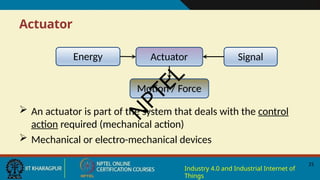
Actuator
Energy Signal
Motion /Force
An actuator is part of the system that deals with the control
action required (mechanical action)
Mechanical or electro-mechanical devices
N
P
T
E
L
21
Industry 4.0 and Industrial Internet of
Things
22.
Actuator (Contd.)
Acontrol signal is input to an actuator and an
energy source is necessary for its operation
Available in both micro and macro scales
Example: Electric motor, solenoid, hard drive
stepper motor, comb drive, hydraulic cylinder,
piezoelectric actuator, and pneumatic
actuator
DC Motor
22
Industry 4.0 and Industrial Internet of
Things
Relay
N
P
T
E
L
23.
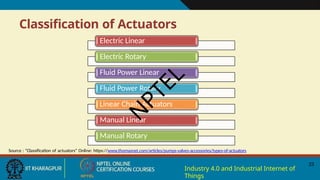
Classification of Actuators
Source: “Classification of actuators” Online: https://www.thomasnet.com/articles/pumps-valves-accessories/types-of-actuators
Electric Linear
Electric Rotary
Fluid Power Linear
Fluid Power Rotary
Linear Chain Actuators
Manual Linear
Manual Rotary
23
Industry 4.0 and Industrial Internet of
Things
N
P
T
E
L
24.
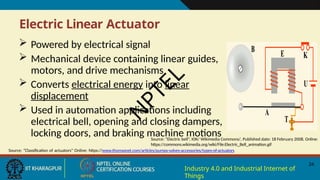
Electric Linear Actuator
Powered by electrical signal
Mechanical device containing linear guides,
motors, and drive mechanisms
Converts electrical energy into linear
displacement
Used in automation applications including
electrical bell, opening and closing dampers,
locking doors, and braking machine motions
Source: “Electric bell”, ЮК/ Wikimedia Commons/, Published date: 18 February 2008, Online:
https://commons.wikimedia.org/wiki/File:Electric_Bell_animation.gif
Source: “Classification of actuators” Online: https://www.thomasnet.com/articles/pumps-valves-accessories/types-of-actuators
24
Industry 4.0 and Industrial Internet of
Things
N
P
T
E
L
25.
Electric Rotary Actuator
,
Powered by electrical signal
Converts electrical energy into rotational
motion
Applications including quarter-turn valves
windows, and robotics
Source: “Electric motor”, Abnormaal / Wikimedia Commons / CC-BY-SA-3.0 Unported/ GFDL. Published date: 21
May 2008, Online: https://commons.wikimedia.org/wiki/File:Electric_motor.gif
Source: “Classification of actuators” Online: https://www.thomasnet.com/articles/pumps-valves-accessories/types-of-actuators
25
Industry 4.0 and Industrial Internet of
Things
N
P
T
E
L
26.
Fluid Power LinearActuator
Source: “Classification of actuators” Online: https://www.thomasnet.com/articles/pumps-valves-accessories/types-of-actuators
26
Industry 4.0 and Industrial Internet of
Things
Powered by hydraulic fluid, gas, or differential air pressure
Mechanical devices have cylinder and piston mechanisms
Produces linear displacement
Primarily used in automation applications including clamping
and welding
N
P
T
E
L
27.
Fluid Power RotaryActuator
Powered by fluid, gas, or differential air
pressure
Consisting of gearing, and cylinder and piston
mechanisms
Converts hydraulic fluid, gas, or differential air
pressure into rotational motion
Primarily applications of this actuator are
opening and closing dampers, doors, and
clamping Source: “Axial piston pump”, MichaelFrey / Wikimedia Commons / CC-BY-SA-4.0 International/. Published date: 11 August
2017, Online: https://commons.wikimedia.org/wiki/File:Axialkolbenpumpe_-_einfache_Animation.gif
Source: “Classification of actuators” Online: https://www.thomasnet.com/articles/pumps-valves-accessories/types-of-actuators
27
Industry 4.0 and Industrial Internet of
Things
N
P
T
E
L
28.
Linear Chain Actuator
Mechanical devices containing sprockets
and sections of chain
Provides linear motion by the free ends
of the specially designed chains
Primarily used in motion control
applications
Source: “Rigid chain actuator”, Catsquisher/ Wikimedia Commons/, Published date: 11 January 2011, Online:
https://commons.wikimedia.org/wiki/File:Rigid_Chain_Actuator.gif
Source: “Classification of actuators” Online: https://www.thomasnet.com/articles/pumps-valves-accessories/types-of-actuators
28
Industry 4.0 and Industrial Internet of
Things
N
P
T
E
L
29.
Manual Linear Actuator
Source:“Classification of actuators” Online: https://www.thomasnet.com/articles/pumps-valves-accessories/types-of-actuators
29
Industry 4.0 and Industrial Internet of
Things
Provides linear displacement through the translation of
manually rotated screws or gears
Consists of gearboxes, and hand operated knobs or
wheels
Primarily used for manipulating tools and workpieces
N
P
T
E
L
30.
Manual Rotary Actuator
Source:“Classification of actuators” Online: https://www.thomasnet.com/articles/pumps-valves-accessories/types-of-actuators
30
Industry 4.0 and Industrial Internet of
Things
Provides rotary output through the translation of manually
rotated screws, levers, or gears
Consists of hand operated knobs, levers, handwheels, and
gearboxes
Primarily used for the operation of valves
N
P
T
E
L
31.
References
31
Industry 4.0 andIndustrial Internet of
Things
1.
2.
3.
4.
5.
6.
7.
Sensor. Online: https://ielm.ust.hk/dfaculty/ajay/courses/alp/ieem110/lecs/sensors/sensors.html
Repeatability of Sensor. Online: https://ocw.mit.edu/courses/mechanical-engineering/2-693-principles-of-
oceanographic-instrument-systems-sensors-and-measurements-13-998-spring-2004/
Classification of actuators. Online URL: https://www.thomasnet.com/articles/pumps-valves-accessories/types-
of-actuators
“Electric bell”, ЮК/ Wikimedia Commons/, Published date: 18 February 2008, Online:
https://commons.wikimedia.org/wiki/File:Electric_Bell_animation.gif
“Electric motor”, Abnormaal / Wikimedia Commons / CC-BY-SA-3.0 Unported/ GFDL/, Published date: 21 May
2008, Online: https://commons.wikimedia.org/wiki/File:Electric_motor.gif
“Axial piston pump”, MichaelFrey / Wikimedia Commons / CC-BY-SA-4.0 International/, Published date: 11
August 2017, Online: https://commons.wikimedia.org/wiki/File:Axialkolbenpumpe_-_einfache_Animation.gif
“Rigid chain actuator”, Catsquisher/ Wikimedia Commons/, Published date: 11 January 2011, Online:
https://commons.wikimedia.org/wiki/File:Rigid_Chain_Actuator.gif
N
P
T
E
L
Introduction:
IoT Connectivity –Part
I
Industry 4.0 and Industrial Internet of Things1
Dr. Sudip Misra
Professor
Department of Computer Science and Engineering
Indian Institute of Technology Kharagpur
Email: smisra@sit.iitkgp.ernet.in
Website: http://cse.iitkgp.ac.in/~smisra/
Research Lab:
cse.iitkgp.ac.in/~smisra/swan/
N
P
T
E
L
34.
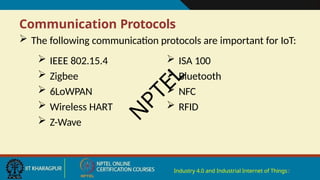
Communication Protocols
Industry 4.0and Industrial Internet of Things2
The following communication protocols are important for IoT:
IEEE 802.15.4
Zigbee
6LoWPAN
Wireless HART
Z-Wave
ISA 100
Bluetooth
NFC
RFID
N
P
T
E
L
Introduction to IEEE802.15.4
Industry 4.0 and Industrial Internet of Things4
This standard provides a framework meant for lower layers (MAC
and PHY) for a wireless personal area network (WPAN).
PHY defines frequency band, transmission power, and modulation
scheme of the link.
MAC defines issues such as medium access and flow control
(frames).
This standard is used for low power, low cost (manufacturing and
operation), and low speed communication between neighboring
devices (< ~75m).
Source: What’s The Difference Between IEEE 802.15.4 And ZigBee Wireless? Fenzel, L.
N
P
T
E
L
37.
Features of IEEE802.15.4
Industry 4.0 and Industrial Internet of Things5
This standard utilizes DSSS (direct sequence spread spectrum)
coding scheme to transmit information.
DSSS uses phase shift keying modulation to encode
information.
BPSK - 868/915 MHz, data transmission rate 20/40 kbps respectively.
OQPSK - 2.4 GHz, data transmission rate 250 kbps.
DSSS scheme makes the standard highly tolerant to noise and
interference and thereby improving link reliability.
Source: What’s The Difference Between IEEE 802.15.4 And ZigBee Wireless? Fenzel, L.
N
P
T
E
L
38.
Features of IEEE802.15.4 (contd.)
Industry 4.0 and Industrial Internet of Things6
The preferable nature of transmission is line of sight (LOS).
The standard range of transmission - 10 to 75m.
The transmission of data uses CSMA-CA (carrier sense
multiple access with collision avoidance) scheme.
Transmissions occur in infrequent short packets for duty cycle
(<1 %), thus reducing consumption of power.
Star network topology and peer-to-peer network topology is
included.
Source: What’s The Difference Between IEEE 802.15.4 And ZigBee Wireless? Fenzel, L.
N
P
T
E
L
39.
Variants of IEEE802.15.4
Industry 4.0 and Industrial Internet of Things7
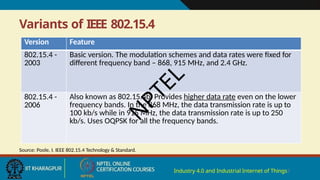
Version Feature
802.15.4 -
2003
Basic version. The modulation schemes and data rates were fixed for
different frequency band – 868, 915 MHz, and 2.4 GHz.
802.15.4 -
2006
Also known as 802.15.4b. Provides higher data rate even on the lower
frequency bands. In the 868 MHz, the data transmission rate is up to
100 kb/s while in 915 MHz, the data transmission rate is up to 250
kb/s. Uses OQPSK for all the frequency bands.
Source: Poole, I. IEEE 802.15.4 Technology & Standard.
N
P
T
E
L
40.
Variants of IEEE802.15.4 (contd.)
Industry 4.0 and Industrial Internet of Things8
Version Feature
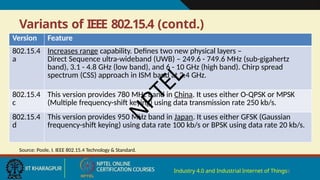
802.15.4
a
Increases range capability. Defines two new physical layers –
Direct Sequence ultra-wideband (UWB) – 249.6 - 749.6 MHz (sub-gigahertz
band), 3.1 - 4.8 GHz (low band), and 6 - 10 GHz (high band). Chirp spread
spectrum (CSS) approach in ISM band at 2.4 GHz.
802.15.4
c
This version provides 780 MHz band in China. It uses either O-QPSK or MPSK
(Multiple frequency-shift keying) using data transmission rate 250 kb/s.
802.15.4
d
This version provides 950 MHz band in Japan. It uses either GFSK (Gaussian
frequency-shift keying) using data rate 100 kb/s or BPSK using data rate 20 kb/s.
Source: Poole, I. IEEE 802.15.4 Technology & Standard.
N
P
T
E
L
41.
Variants of IEEE802.15.4 (contd.)
Industry 4.0 and Industrial Internet of Things9
Version Feature
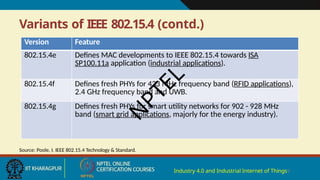
802.15.4e Defines MAC developments to IEEE 802.15.4 towards ISA
SP100.11a application (industrial applications).
802.15.4f Defines fresh PHYs for 433 MHz frequency band (RFID applications),
2.4 GHz frequency band and UWB.
802.15.4g Defines fresh PHYs for smart utility networks for 902 - 928 MHz
band (smart grid applications, majorly for the energy industry).
Source: Poole, I. IEEE 802.15.4 Technology & Standard.
N
P
T
E
L
Introduction to Zigbee
Industry4.0 and Industrial Internet of Things11
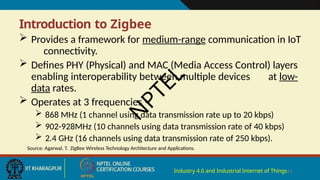
Provides a framework for medium-range communication in IoT
connectivity.
Defines PHY (Physical) and MAC (Media Access Control) layers
enabling interoperability between multiple devices at low-
data rates.
Operates at 3 frequencies –
868 MHz (1 channel using data transmission rate up to 20 kbps)
902-928MHz (10 channels using data transmission rate of 40 kbps)
2.4 GHz (16 channels using data transmission rate of 250 kbps).
Source: Agarwal, T. ZigBee Wireless Technology Architecture and Applications.
N
P
T
E
L
44.
Features of Zigbee
Industry4.0 and Industrial Internet of Things12
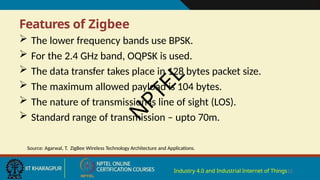
The lower frequency bands use BPSK.
For the 2.4 GHz band, OQPSK is used.
The data transfer takes place in 128 bytes packet size.
The maximum allowed payload is 104 bytes.
The nature of transmission is line of sight (LOS).
Standard range of transmission – upto 70m.
Source: Agarwal, T. ZigBee Wireless Technology Architecture and Applications.
N
P
T
E
L
45.
Features of Zigbee(contd.)
Industry 4.0 and Industrial Internet of Things13
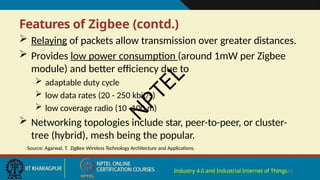
Relaying of packets allow transmission over greater distances.
Provides low power consumption (around 1mW per Zigbee
module) and better efficiency due to
adaptable duty cycle
low data rates (20 - 250 kbit/s)
low coverage radio (10 -100 m)
Networking topologies include star, peer-to-peer, or cluster-
tree (hybrid), mesh being the popular.
Source: Agarwal, T. ZigBee Wireless Technology Architecture and Applications.
N
P
T
E
L
46.
Features of Zigbee(contd.)
Industry 4.0 and Industrial Internet of Things14
The Zigbee protocol defines three types of nodes:
Coordinators - Initializing, maintaining and controlling the network. There
is one and only one per network.
Routers - Connected to the coordinator or other routers. Have zero or
more children nodes. Contribute in multi hop routing.
End devices - Do not contribute in routing.
Star topology has no router, one coordinator, and zero or more
end devices.
In mesh and tree topologies, one coordinator maintains
several
routers and end devices. Source: Agarwal, T. ZigBee Wireless Technology Architecture and Applications.
N
P
T
E
L
47.
Features of Zigbee(contd.)
Industry 4.0 and Industrial Internet of Things15
Each cluster in a cluster-tree network involves a coordinator
through several leaf nodes.
Coordinators are linked to parent coordinator that initiates
the entire network.
ZigBee standard comes in two variants:
ZigBee
ZigBee Pro - offers scalability, security, and improved performance
utilizing many-to-one routing scheme.
Source: Agarwal, T. ZigBee Wireless Technology Architecture and Applications.
N
P
T
E
L
Introduction to 6LoWPAN
Industry4.0 and Industrial Internet of Things17
6LoWPAN is IPv6 over Low-Power Wireless Personal Area
Networks.
It optimizes IPv6 packet transmission in low power and lossy
network (LLN) such as IEEE 802.15.4.
Operates at 2 frequencies:
2400–2483.5 MHz (worldwide)
902–929 MHz (North America)
It uses 802.15.4 standard in unslotted CSMA/CA mode.
Source: Olsson, J. 6LoWPAN demystified.
N
P
T
E
L
50.
Features of 6LoWPAN
Industry4.0 and Industrial Internet of Things18
6LowPAN converts the data format to be fit with the IEEE 802.15.4
lower layer system.
IPv6 involves MTU (maximum transmission unit) of 1280 bytes in
length, while the IEEE 802.15.4 packet size is 127 bytes.
Hence a supplementary adaptation layer is introduced between
MAC and network layer that provides:
Packet fragmentation & packet reassembly
Compression of header
Routing of data link layer. Source: Olsson, J. 6LoWPAN demystified.
N
P
T
E
L
51.
Features of 6LoWPAN(contd.)
Industry 4.0 and Industrial Internet of Things19
Fragmentation is required to fit the intact IPv6 packet into a
distinct IEEE 802.15.4 frame (> ~106 bytes).
The fragmentation header allows 2048 bytes packet size with
fragmentation.
Using fragmentation and reassembly, 128-byte IPv6 frames are
transmitted over IEEE 802.15.4 radio channel into several
smaller segments.
Every fragment includes a header.
Source: Sulthana, M. R. A Novel Location Based Routing Protocol For 6LoWPAN.
N
P
T
E
L
52.
Features of 6LoWPAN(contd.)
Industry 4.0 and Industrial Internet of Things20
Header compression reduces the transmission overhead and
allows efficient transmission of payload.
IPv6 addresses are compressed in 6LoWPAN:
8-byte UDP header
40-byte IPv6 header
Stateless auto configuration allows any device to create the IPv6
address automatically devoid of external dealing using a
DHCP server.
Source: Sulthana, M. R. A Novel Location Based Routing Protocol For 6LoWPAN.
N
P
T
E
L
53.
Features of 6LoWPAN(contd.)
Industry 4.0 and Industrial Internet of Things21
Data link layer routing is classified into two schemes:
mesh-under - utilizes link layer address to forward data packets.
route-over - utilizes network layer IP address.
Provides link layer security (AES-128) from IEEE 802.15.4 such as
authentication of link and encryption.
Source: Sulthana, M. R. A Novel Location Based Routing Protocol For 6LoWPAN.
N
P
T
E
L
Introduction to WirelessHART
Industry 4.0 and Industrial Internet of Things23
WirelessHART is based on HART (Highway Addressable Remote
Transducer).
It is the first international industrial wireless standard (IEC 62591),
based upon the standard IEEE 802.15.4.
Functions in the 2.4GHz ISM band using data rate of up to 250
kb/s.
11 to 26 channels are supported, with a gap of 5MHz between two
adjacent channels.
The same channel can’t be used consecutively.
Source: Feng, A. WirelessHART- Made Easy.
N
P
T
E
L
56.
Features of WirelessHART
Industry 4.0 and Industrial Internet of Things24
Exploits IEEE 802.15.4 accustomed DSSS coding scheme.
A WirelessHART node follows channel hopping every time it
sends a packet.
Modulation technique used is offset quadrature phase shift
keying (OQPSK).
Transmission Power is around 10dBm (adjustable in discrete
steps).
Source: Feng, A. WirelessHART- Made Easy.
N
P
T
E
L
57.
Features of WirelessHART (contd.)
Industry 4.0 and Industrial Internet of Things25
Maximum payload allowed is 127 bytes.
It employs TDMA (time division multiple access) that allots
distinct time slot of 10ms for each transmission.
TDMA technology is used to provide collision free and
deterministic communications.
A sequence of 100 consecutive time slots per second is grouped
into a super frame.
Slot sizes and the super frame length are fixed.
Source: Salman, T. and Jain, R. (2017). A Survey of Protocols and Standards for Internet of Things.
N
P
T
E
L
58.
Features of WirelessHART (contd.)
Industry 4.0 and Industrial Internet of Things26
The devices support multiple super frames with differing
numbers of timeslots.
At least one super frame is always enabled while additional
super frames are enabled and disabled according to the demand
of bandwidth.
For any message, communication occurs in the alloted timeslot
and frequency channel.
Supports both star and mesh topologies.
Source: Salman, T. and Jain, R. (2017). A Survey of Protocols and Standards for Internet of Things.
N
P
T
E
L
59.
References
Industry 4.0 andIndustrial Internet of Things27
1. Fenzel, L. (2013). What’s The Difference Between IEEE 802.15.4 And ZigBee Wireless? Online. URL: https:
//www.electronicdesign.com/what-s-difference-between/what-s-difference-between-ieee-802154-and-zigbee-
wireless.
2. Poole, I. IEEE 802.15.4 Technology & Standard. Online. URL: https://www.radio-electronics.com/info/wireless/ieee-802-
15-4/wireless-standard-technology.php
3. Agarwal, T. ZigBee Wireless Technology Architecture and Applications. Online. URL: https://www.elprocus.com/what-
is-zigbee-technology-architecture-and-its-applications.
4. Acosta, G. (2018). The ZigBee Protocol. Online. URL: https://www.netguru.co/codestories/the-zigbee-protocol
5. Olsson, J. (2014). 6LoWPAN demystified. Texas Instruments, 13.
6. Sulthana, M. R. (2015). A Novel Location Based Routing Protocol For 6LoWPAN.
7. Feng, A. (2011). WirelessHART- Made Easy. Online. URL: https://www.awiatech.com/category/wirelesshart-blog/
8. Salman, T. and Jain, R. (2017). A Survey of Protocols and Standards for Internet of Things. Advanced Computing and
Communications, 1(1).
9. Ishaq, I., Carels, D., Teklemariam, G. K., Hoebeke, J., Abeele, F. V. D., Poorter, E. D., ... & Demeester, P. (2013). IETF
standardization in the field of the internet of things (IoT): a survey. Journal of Sensor and Actuator Networks, 2(2), 235-
287.
N
P
T
E
L
Introduction:
IoT Connectivity –Part 2
Industry 4.0 and Industrial Internet of Things1
Dr. Sudip Misra
Professor
Department of Computer Science and Engineering
Indian Institute of Technology Kharagpur
Email: smisra@sit.iitkgp.ernet.in
Website: http://cse.iitkgp.ac.in/~smisra/
Research Lab:
cse.iitkgp.ac.in/~smisra/swan/
N
P
T
E
L
Introduction to Z-Wave
Industry4.0 and Industrial Internet of Things3
Z-wave is a low power radio communication technology primarily used for
home automation and security systems.
It was designed as a simpler and cheaper alternative to Zigbee for small
to medium range connectivity.
It operates on the unlicensed part of the industrial, scientific and medical
(ISM) band: 908.42 MHz in the US & 868.42 MHz in Europe, avoiding any
interference with the 2.4Ghz band(Wi-Fi, Bluetooth and others).
Z-wave uses a Mesh Network Topology to communicate among the
devices, supporting up to 232 nodes in a network.
Source: Paul Lamkin. April 26, 2018. Z-Wave explained: What is Z-Wave and why is it important for your smart home
N
P
T
E
L
64.
Features of Z-Wave
Industry4.0 and Industrial Internet of Things4
A Z-wave network has 2 device categories: Controller and Slave
The Controller is a central entity which sets up the Z-wave network
and manages other slave devices in the network.
Each logical Z-wave network has 1 Home (Network) ID and multiple
unique Node IDs for the devices in the network.
The Network ID is of length 4 Bytes and Node ID is of length 1 Byte.
The nodes can communicate only within their home network
It offers a data rate of up to 100kbps and an average
communication range of 30 meters.
Source: Paul Lamkin. April 26, 2018. Z-Wave explained: What is Z-Wave and why is it important for your smart home
N
P
T
E
L
65.
Features of Z-Wave(contd.)
Industry 4.0 and Industrial Internet of Things5
It uses source routed network mesh topology using 1 primary
controller.
Z-wave considers only static devices in the network due to its source
routed network topology.
The devices communicate with one another only when they are in
range.
Messages are routed through different nodes in case of any
obstruction due to interior layout and other household appliances.
These obstructions are called radio dead-spots and can be bypassed
using a process called Healing.
Source: Paul Lamkin. April 26, 2018. Z-Wave explained: What is Z-Wave and why is it important for your smart home
N
P
T
E
L
66.
Application
Industry 4.0 andIndustrial Internet of Things6
Primarily used in Home/Office Automation
Systems for Smart Energy Management
System for Smart Security and Surveillance
Voice control enabled applications
Appliances automation and control
Source: Applications of Z-wave technology, (March 2018)
N
P
T
E
L
Introduction to ISA100.11a
ISA 100.11a is a Standard for wireless network technology
developed by the International Society of Automation(ISA).
The primary focus of the technology is the implementation of
automation in the industrial environment.
The protocol stack of ISA 100.11a is in compliance with IoT.
It is based on the IEEE 802.15.4 protocol along with other
wireless networks.
Industry 4.0 and Industrial Internet of Things8
Source: ISA100 Wireless tutorial | What is ISA100 Wireless
N
P
T
E
L
69.
Features of ISA100.11a
Industry 4.0 and Industrial Internet of Things9
It supports multiple devices working on different protocols to interact in a
single network, simultaneously.
It is an open standard which enables interoperability and communication
between different devices.
It uses the IPv6 based technology and adds the associated benefits such as
increased address space and security.
128 bits AES encryption security.
Hence, it offers essential scalability and reliability for industrial network.
It supports 2 network topologies for operation: 1)Star and 2)Mesh.
Uses TDMA/CSMA schemes for resource sharing, collision avoidance.
Source: ISA100 Wireless tutorial | What is ISA100 Wireless?
N
P
T
E
L
70.
Application
Industry 4.0 andIndustrial Internet of Things10
It is primarily used for automation in large scale complex
industries.
Wireless monitoring of the industrial network and
devices.
Process monitoring and control automation in the industrial
environment with large and complex setups.
N
P
T
E
L
Introduction to Bluetooth
Industry4.0 and Industrial Internet of Things12
A short range wireless communication technology.
Its is aimed at replacing the cables with wireless medium to
communicate between portable devices.
It is based on Ad-hoc technology, also known as Ad-hoc
Piconets.
Network can be established between 2 to 8 Bluetooth
devices.
Source: Bluetooth Basics (March 31, 2018)
N
P
T
E
L
73.
Features of
Bluetooth
Industry 4.0and Industrial Internet of Things13
It is a low cost wireless communication technology.
Low power consumption.
Bluetooth technology uses the unlicensed industrial, scientific and
medical (ISM) band at 2.4 to 2.485 GHZ.
Supports 1Mbps and 3Mbps data rate for version 1.2 and 2.0,
respectively.
The operating range: 1 meter for Class 3 radios, 10 meters for
Class 2 radios, and 100 meters for Class 1 radios.
Source: Bluetooth Basics (March 31, 2018)
N
P
T
E
L
74.
Application
Industry 4.0 andIndustrial Internet of Things14
Bluetooth is suitable for a network of devices with smaller
radius.
Connectivity with desktop and laptop peripherals
Wireless connectivity between mobile phones and other portable
devices.
Multimedia transfer between devices
Automobiles use Bluetooth for connecting with multimedia and
navigation devices.
GPS devices are connected with the end user.
Source: Tarun Agarwal. April 11, 2016. How does Bluetooth work?
N
P
T
E
L
Introduction to RFID
Industry4.0 and Industrial Internet of Things16
RFID stands for “radio-frequency identification” .
An RFID system consists of RFID tag, RFID reader and RFID
software.
RFID tag stores digitally encoded data, which is read by a RFID
reader.
RFID tag data can be read outside the line-of-sight, as compared
to traditional barcodes and QR codes.
Source: RFID Radio Frequency Identification Technology Tutorial
N
P
T
E
L
77.
Features of RFID
Industry4.0 and Industrial Internet of Things17
RFID tag consists of an integrated circuit and an antenna,
covered with a protective material.
Tags can be classified as passive or active.
Active tags use their own power supply for operation and data
transfer.
Passive tags have to be powered by a reader inductively in
order to transmit data.
Source: RFID Radio Frequency Identification Technology Tutorial
N
P
T
E
L
78.
Application
Industry 4.0 andIndustrial Internet of Things18
Store product tracking.
Asset and baggage tracking.
Supply chain management.
Livestock tracking and management.
Automobile tracking.
Authentication and access control
N
P
T
E
L
Introduction to NFC
Industry4.0 and Industrial Internet of Things20
Near field communication, or NFC, has been derived from radio-frequency
identification (RFID).
NFC works within close proximity without any physical contact between the
devices unlike RFID which has a longer range of communication.
A NFC device can be any of the two types: 1) Active and 2) Passive.
An Active type of device can both read and transmit data.
A Passive device can only transmit data but cannot read from other NFC
devices.
Source: NFC Near Field Communication Tutorial | NFC Tutorial (2016)
N
P
T
E
L
81.
Features of NFC
Industry4.0 and Industrial Internet of Things21
NFC operates at 13.56 MHz frequency.
The communication range of NFC devices is less then 10
centimeters.
Data rate supported are 106, 212 or 424 Kbps (kilobits per
second).
Two communication modes are supported between two
devices: Active-Active or Active-Passive mode.
Source: NFC Near Field Communication Tutorial | NFC Tutorial (2016)
N
P
T
E
L
82.
Application
Industry 4.0 andIndustrial Internet of Things22
Banking and payments using NFC enabled smartphones,
transaction cards.
Tracking goods.
Data Communication between smart phones.
Security and authentication using NFC enabled ID cards.
Low-power home automation systems.
N
P
T
E
L
83.
References
Industry 4.0 andIndustrial Internet of Things23
1. ISA 100, Wireless Systems for Automation. Online. URL: https://www.isa.org/isa100/.
2. Renee Bassett. May 23, 2013. Understanding ISA100 Wireless Technology. Online. URL: https:
//www.automationworld.com/article/technologies/networking-connectivity/wireless/understanding-isa100-
wireless-technology.
3. ISA100 Wireless tutorial | What is ISA100 Wireless?. Online. URL: http://www.rfwireless-
world.com/Tutorials/ISA100-wireless-tutorial.html.
4. Melanie Pinola. March 31, 2018. Bluetooth Basics. Online. URL: https://www.lifewire.com/what-is-bluetooth-
2377412.
5. Tarun Agarwal. April 11, 2016. How does Bluetooth work?. Online. URL: https://www.elprocus.com/how-does-
bluetooth-work/#comments.
6. Tarun Agarwal. March 22, 2017. Tutorial on Different Types of Bluetooth Technology, Working and Its
Applications.
Online. URL: https://www.efxkits.us/different-types-bluetooth-technology-working-applications/.
7. Feb 23, 2016. NFC Near Field Communication Tutorial | NFC Tutorial. Online. URL: http://www.rfwireless-
world.com/Tutorials/NFC-Near-Field-Communication-tutorial.html.
8. Ian Poole. RFID Radio Frequency Identification Technology Tutorial. Online. URL: https://www.radio-
electronics.com/info/wireless/radio-frequency-identification-rfid/technology-tutorial-basics.php.
N
P
T
E
L
Introduction:
IoT Networking- PartI
Industry 4.0 and Industrial Internet of Things 1
Dr. Sudip Misra
Professor
Department of Computer Science and Engineering
Indian Institute of Technology Kharagpur
Email: smisra@sit.iitkgp.ernet.in
Website: http://cse.iitkgp.ac.in/~smisra/
Research Lab:
cse.iitkgp.ac.in/~smisra/swan/
N
P
T
E
L
86.
Introduction
Industry 4.0 andIndustrial Internet of Things 2
Characteristics of IoT devices
Low processing power
Small in size
Energy constraints
Networks of IoT devices
Low throughput
High packet loss
Tiny (useful) payload size
Frequent topology change
Classical Internet is not meant for constrained IoT devices.
N
P
T
E
L
Introduction
4
Introduction to Internetof
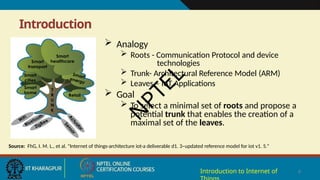
Analogy
Roots - Communication Protocol and device
technologies
Trunk- Architectural Reference Model (ARM)
Leaves – IoT Applications
Goal
To select a minimal set of roots and propose a
potential trunk that enables the creation of a
maximal set of the leaves.
Source: FhG, I. M. L., et al. "Internet of things-architecture iot-a deliverable d1. 3–updated reference model for iot v1. 5."
N
P
T
E
L
89.
Enabling Classical Internetfor IoT Devices
Industry 4.0 and Industrial Internet of Things5
Proprietary non-IP based solution
Vendor specific gateways
Vendor specific APIs
Internet Engineering Task Force (IETF) IP based solution
Three work groups
IPv6 over Low power Wireless Personal Area Networks (6LoWPAN)
Routing Over Low power and Lossy networks (ROLL)
Constrained RESTful Environments (CoRE)
Source: I. Ishaq, et al. , "IETF standardization in the field of the internet of things (IoT): a survey", J. of Sens. and Act. Netw. 2, vol. 2 (2013):
235-287.
N
P
T
E
L
90.
Proprietary non-IP basedsolution
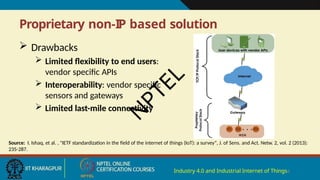
Drawbacks
Limited flexibility to end users:
vendor specific APIs
Interoperability: vendor specific
sensors and gateways
Limited last-mile connectivity
Source: I. Ishaq, et al. , "IETF standardization in the field of the internet of things (IoT): a survey", J. of Sens. and Act. Netw. 2, vol. 2 (2013):
235-287.
Industry 4.0 and Industrial Internet of Things6
N
P
T
E
L
91.
IETF IP basedsolution
Industry 4.0 and Industrial Internet of Things7
Three work groups
IPv6 over Low power Wireless Personal Area Networks (6LoWPAN)
By header compression and encapsulation it allows IPv6 packets to transmit
and receive over IEEE 802.15.4 based networks.
Routing Over Low power and Lossy networks (ROLL)
New routing protocol optimized for saving storage and energy.
Constrained RESTful Environments (CoRE)
Extend the Integration of the IoT devices from network to service level.
N
P
T
E
L
CoRE
Industry 4.0 andIndustrial Internet of Things9
Provides a platform for applications meant for constrained
IoT devices.
This framework views sensor and actuator resources
as web resources.
The framework is limited to applications which
Monitor basic sensors
Supervise actuators
CoAP includes a mechanism for service discovery.
N
P
T
E
L
94.
CoRE: Service Discovery
Industry4.0 and Industrial Internet of Things10
IoT devices (act as mini web servers) register their resources to
Resource Directory (RD) using Registration Interface (RI).
RD, a logical network node, stores the information about a
specific set of IoT devices.
RI supports Representational State Transfer (REST) based
protocol such as HTTP (and CoAP- optimized for IoT).
IoT client uses Lookup interface for discovery of IoT
devices.
N
P
T
E
L
IoT Network QoS
Industry4.0 and Industrial Internet of Things12
Quality-of-service (QoS) of IoT network is the ability to
guarantee intended service to IoT applications through
controlling the heterogeneous traffic generated by IoT devices.
QoS policies for IoT Network includes
Resource utilization
Data timeliness
Data availability
Data delivery
Source: Rayes, A., & Salam, S. (2016), "Internet of Things from hype to reality: the road to digitization", Springer.
N
P
T
E
L
97.
Resource utilization
Industry 4.0and Industrial Internet of Things13
Requires control on the storage and bandwidth for data
reception and transmission.
QoS policies for resource utilization:
Resource limit policy
Controls the amount of message buffering
Useful for memory constrained IoT devices
Time filter policy
Controls the data sampling rate (interarrival time) to avoid buffer
overflow
Controls network bandwidth, memory, and processing power
Source: Rayes, A., & Salam, S. (2016), "Internet of Things from hype to reality: the road to digitization", Springer.
N
P
T
E
L
98.
Data timeliness
Industry 4.0and Industrial Internet of Things14
Measure of the freshness of particular information at the receiver end
Important in case of healthcare, industrial and military applications
Data timeliness policies for IoT network include
Deadline policy
Provides maximum interarrival time of data
Drops the stale data; notify the missed deadline to the application end
Latency budget policy
Latency budget is the maximum time difference between the data transmission
and reception from source end to the receiver end.
Provides priority to applications having higher urgency
Source: Rayes, A., & Salam, S. (2016), "Internet of Things from hype to reality: the road to digitization", Springer.
N
P
T
E
L
99.
Data availability
Industry 4.0and Industrial Internet of Things15
Measure of the amount of valid data provided by the sender/producer to
receiver/consumer
QoS policies for data availability in IoT network include
Durability policy
Controls the degree of data persistence transmitted by the sender
Data persistence ensures the availability of the data to the receiver even
after sender is unavailable
Lifespan policy
Controls the duration for which transmitted data is valid
History policy
Controls the number of previous data instances available for the
receiver.
Source: Rayes, A., & Salam, S. (2016), "Internet of Things from hype to reality: the road to digitization", Springer.
N
P
T
E
L
100.
Data delivery
Industry 4.0and Industrial Internet of Things16
Measure of successful reception of reliable data from sender
to receiver
QoS policies for data delivery include
Reliability policy
Controls the reliability level associated with the data distribution
Transport priority
Allows transmission of data according to its priority level
Source: Rayes, A., & Salam, S. (2016), "Internet of Things from hype to reality: the road to digitization", Springer.
N
P
T
E
L
Introduction:
IoT Networking -Part 2
Industry 4.0 and Industrial Internet of Things1
Dr. Sudip Misra
Professor
Department of Computer Science and Engineering
Indian Institute of Technology Kharagpur
Email: smisra@sit.iitkgp.ernet.in
Website: http://cse.iitkgp.ac.in/~smisra/
Research Lab:
cse.iitkgp.ac.in/~smisra/swan/
N
P
T
E
L
103.
Requirements of IoTNetwork
Industry 4.0 and Industrial Internet of Things2
Coverage
High throughput
Low latency
Ultra reliability
High power efficiency
N
P
T
E
L
MQT
T
Industry 4.0 andIndustrial Internet of Things4
Message Queue Telemetry Transport
Introduced by IBM and standardized by Organization for the
Advancement of Structured Information Standards (OASIS) in
2013
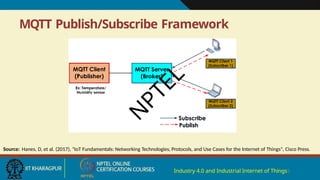
Works on Publish/Subscribe framework on top of TCP/IP
architecture
Advantages
Reliable, Lightweight, and cost-effective protocol
N
P
T
E
L
106.
MQTT Publish/Subscribe Framework
Source:Hanes, D, et al. (2017), "IoT Fundamentals: Networking Technologies, Protocols, and Use Cases for the Internet of Things", Cisco Press.
Industry 4.0 and Industrial Internet of Things5
N
P
T
E
L
107.
MQTT QoS
Industry 4.0and Industrial Internet of Things6
QoS of MQTT protocol is maintained for two transactions
First transaction: Publishing client MQTT Server
Second transaction: MQTT Server Subscribing Client
Client on each transaction sets the QoS level
For the first transaction, publishing client sets the QoS level
For second transaction, client subscriber sets the QoS level
Source: Hanes, D, et al. (2017), "IoT Fundamentals: Networking Technologies, Protocols, and Use Cases for the Internet of Things", Cisco Press.
N
P
T
E
L
108.
MQTT QoS Levels
Industry4.0 and Industrial Internet of Things7
Supports 3-level of QoS
QoS 0:
Also known as “at most once” delivery
Best effort and unacknowledged data service
Publisher transmits the message one time to server and server
transmits it once to subscriber
No retry is performed
Source: Hanes, D, et al. (2017), "IoT Fundamentals: Networking Technologies, Protocols, and Use Cases for the Internet of Things", Cisco Press.
N
P
T
E
L
109.
MQTT QoS Levels
Industry4.0 and Industrial Internet of Things8
QoS 1:
Also known as “at least once” delivery
Message delivery between the publisher, server and then between server
and subscribers occurs at least once.
Retry is performed until acknowledgement of message is recieved
QoS 2:
Also known as “exactly once” delivery
This QoS level is used when neither packet loss or duplication of message
is allowed
Retry is performed until the message is delivered exactly once
N
P
T
E
L
CoAP
Industry 4.0 andIndustrial Internet of Things10
Constrained Application Protocol
CoAP was designed by IETF Constrained RESTful Environment
(CoRE) working group to enable application with lightweight
RESTful (HTTP) interface
Works on Request/Response framework based on the UDP
architecture, including Datagram Transport Layer Security
(DTLS) secure transport protocol
Source: Hanes, D, et al. (2017), "IoT Fundamentals: Networking Technologies, Protocols, and Use Cases for the Internet of Things", Cisco Press.
N
P
T
E
L
112.
CoAP
Industry 4.0 andIndustrial Internet of Things11
CoAP defines four types of messages
CON: Conformable
NON: Non-conformable
RST: Reset
ACK: Acknowledgement
For conformable type message, the recipient must explicitly either
acknowledge or reject the message.
In case of non-conformable type message, the recipient
sends reset message if it can’t process the message.
Source: Hanes, D, et al. (2017), "IoT Fundamentals: Networking Technologies, Protocols, and Use Cases for the Internet of Things", Cisco
Press.
N
P
T
E
L
113.
CoAP
Industry 4.0 andIndustrial Internet of Things12
Utilizes GET, PUT, OBSERVE, PUSH, and DELETE messages
requests to retrieve, create, initiate, update, and delete
subscription respectively.
Supports caching capabilities to improve the response time
and reduce bandwidth consumption.
Uses IP multicast to support data requests sent to a group of
devices.
Specialized for machine-to-machine (M2M) communication.
Source: Hanes, D, et al. (2017), "IoT Fundamentals: Networking Technologies, Protocols, and Use Cases for the Internet of Things",
Cisco Press.
N
P
T
E
L
XMPP
Industry 4.0 andIndustrial Internet of Things14
Extensible Messaging and Presence Protocol
Supports Publish/Subscribe messaging framework on top of
TCP protocol
The communication protocol is based on Extensive Markup
Language (XML).
Uses Datagram Transport Layer Security (DTLS) secure
transport protocol
Source: Rayes, A., & Salam, S. (2016), "Internet of Things from hype to reality: the road to digitization", Springer.
N
P
T
E
L
116.
XMPP
Industry 4.0 andIndustrial Internet of Things15
XMPP model is decentralized, no central server is required.
Advantages of XMPP
Interoperability: Supports interoperability between heterogeneous
networks
Extensibility: Supports privacy lists, multi-user chat, and
publish/subscribe chat status notifications
Flexibility: Supports customized markup language defined by different
organizations according to their needs
Source: H. Wang et. al., "A Lightweight XMPP Publish/Subscribe Scheme for Resource-Constrained IoT Devices," IEEE Access, vol. 5, pp.
16393-16405, 2017.
N
P
T
E
L
AMQP
Industry 4.0 andIndustrial Internet of Things17
Advance Message Queuing Protocol
Optimized for financial applications
Binary message-oriented protocol on top of TCP
Supports Publish/Subscribe framework for both
Point-to-point (P2P)
Multipoint communication
Source: Rayes, A., & Salam, S. (2016), "Internet of Things from hype to reality: the road to digitization", Springer.
N
P
T
E
L
119.
AMQP
Industry 4.0 andIndustrial Internet of Things18
Uses token-based mechanism for flow control
Ensures no buffer overflow at the receiving end
Message delivery guarantee services:
At least once: Guarantees message delivery but may do so multiple
times
At most once: Each message is delivered once or never
Exactly once: No message drop and delivered once one
Source: Rayes, A., & Salam, S. (2016), "Internet of Things from hype to reality: the road to digitization", Springer.
N
P
T
E
L
IEEE 1888
Industry 4.0and Industrial Internet of Things20
Energy-efficient network control protocol
Defines a generalized data exchange protocol
between network components over the IPv4/v6-based
network.
Universal Resource Identifiers (URIs) based data
identification
Applications: Environmental monitoring, energy saving, and
central management systems.
Source: Rayes, A., & Salam, S. (2016), "Internet of Things from hype to reality: the road to digitization", Springer.
N
P
T
E
L
DDS RTPS
Industry 4.0and Industrial Internet of Things22
Distributed Data Service Real Time Publish and Subscribe
Supports Publish/Subscribe framework and on top of UDP
transport layer protocol.
Data-centric and binary protocol
Data is termed as “topics”.
The users/listeners may subscribe to their particular topic of
interest
Source: Rayes, A., & Salam, S. (2016), "Internet of Things from hype to reality: the road to digitization", Springer.
N
P
T
E
L
124.
DDS RTPS
Industry 4.0and Industrial Internet of Things23
A single topic may have multiple speakers of different
priorities
Supports enlisted QoS for data distribution
Data persistence
Delivery deadline
Reliability
Data freshness
Applications: Military, Industrial, and healthcare
monitoring
Source: Rayes, A., & Salam, S. (2016), "Internet of Things from hype to reality: the road to digitization", Springer.
N
P
T
E
L