Uniform Cost Search for
Optimal Path
AI Lab
School of Computer Engineering
Dr Hitesh Mohapatra
Associate Professor
KIIT University
Assignment 4: Uniform Cost Search for
Optimal Path
• Objective:
• Implement Uniform Cost Search for a weighted graph.
• Problem Statement: Given a weighted graph (e.g., a transportation network with travel costs),
find the minimum-cost path between two nodes.
• Tasks:
1. Represent the graph as an adjacency list.
2. Implement Uniform Cost Search to find the optimal path.
3. Compare it with BFS for unweighted graphs.
Definition
• Uniform Cost Search (UCS) is a popular search algorithm used
in artificial intelligence (AI) for finding the least cost path in a
graph.
• It is a variant of Dijkstra's algorithm and is particularly useful
when all edges of the graph have different weights, and the
goal is to find the path with the minimum total cost from a start
node to a goal node.
Key Concepts of Uniform Cost Search
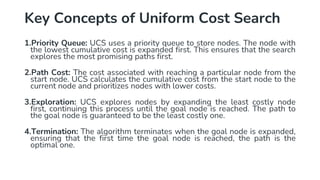
1.Priority Queue: UCS uses a priority queue to store nodes. The node with
the lowest cumulative cost is expanded first. This ensures that the search
explores the most promising paths first.
2.Path Cost: The cost associated with reaching a particular node from the
start node. UCS calculates the cumulative cost from the start node to the
current node and prioritizes nodes with lower costs.
3.Exploration: UCS explores nodes by expanding the least costly node
first, continuing this process until the goal node is reached. The path to
the goal node is guaranteed to be the least costly one.
4.Termination: The algorithm terminates when the goal node is expanded,
ensuring that the first time the goal node is reached, the path is the
optimal one.
How Does Uniform Cost Search Work?
1.Initialization: UCS starts with the root node. It is added to the priority queue with a
cumulative cost of zero since no steps have been taken yet.
2.Node Expansion: The node with the lowest path cost is removed from the priority
queue. This node is then expanded, and its neighbors are explored.
3.Exploring Neighbors: For each neighbor of the expanded node, the algorithm calculates
the total cost from the start node to the neighbor through the current node. If a neighbor
node is not in the priority queue, it is added to the queue with the calculated cost. If the
neighbor is already in the queue but a lower cost path to this neighbor is found, the cost
is updated in the queue.
4.Goal Check: After expanding a node, the algorithm checks if it has reached the goal
node. If the goal is reached, the algorithm returns the total cost to reach this node and
the path taken.
5.Repetition: This process repeats until the priority queue is empty or the goal is reached.
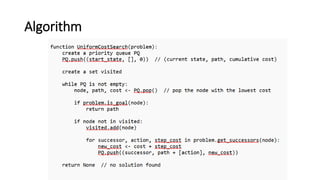
Algorithm
Implementation with
Python
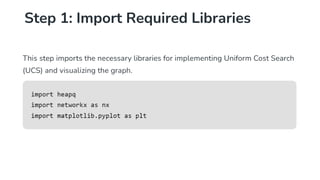
Step 1: Import Required Libraries
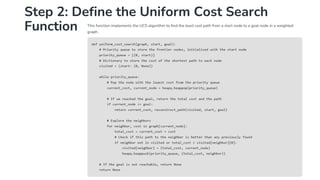
Step 2: Define the Uniform Cost Search
Function
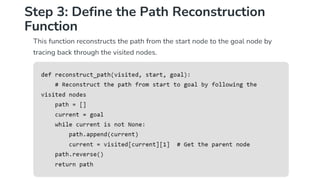
Step 3: Define the Path Reconstruction
Function
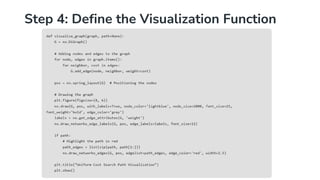
Step 4: Define the Visualization Function
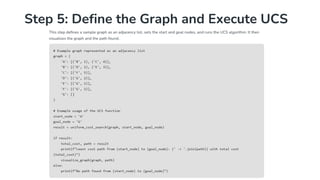
Step 5: Define the Graph and Execute UCS
Applications of UCS in AI
Uniform Cost Search is widely applicable in various fields within AI:
1.Pathfinding in Maps: Determining the shortest route between two
locations on a map, considering different costs for different paths.
2.Network Routing: Finding the least-cost route in a communication or
data network.
3.Puzzle Solving: Solving puzzles where each move has a cost associated
with it, such as the sliding tiles puzzle.
4.Resource Allocation: Tasks that involve distributing resources efficiently,
where costs are associated with different allocation strategies.
Advantages of Uniform Cost Search
• Optimality: UCS is guaranteed to find the least cost path to the
goal state if the cost of each step exceeds zero.
• Completeness: This algorithm is complete; it will find a
solution if one exists.
Challenges with UCS
• Space Complexity: The main drawback of UCS is its space
complexity. The priority queue can grow significantly,
especially if many nodes are being expanded.
• Time Complexity: The time it takes to find the least cost path
can be considerable, especially if the state space is large.
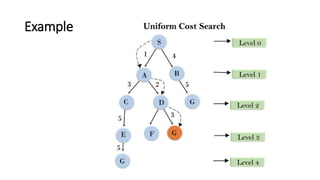
Example
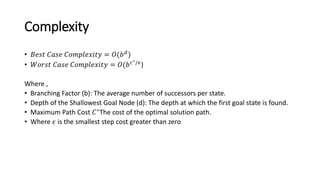
Complexity
• 𝐵𝑒𝑠𝑡 𝐶𝑎𝑠𝑒 𝐶𝑜𝑚𝑝𝑙𝑒𝑥𝑖𝑡𝑦 = 𝑂(𝑏𝑑
)
• 𝑊𝑜𝑟𝑠𝑡 𝐶𝑎𝑠𝑒 𝐶𝑜𝑚𝑝𝑙𝑒𝑥𝑖𝑡𝑦 = 𝑂(𝑏𝑐∗/𝜖)
Where ,
• Branching Factor (b): The average number of successors per state.
• Depth of the Shallowest Goal Node (d): The depth at which the first goal state is found.
• Maximum Path Cost 𝐶∗
The cost of the optimal solution path.
• Where 𝜖 is the smallest step cost greater than zero
Conclusion
• Uniform Cost Search is a powerful algorithm in AI for situations
where paths have different costs and the goal is to minimize
the total cost.
• Its application across various domains showcases its versatility
and effectiveness.
• However, understanding its computational requirements is
crucial for practical implementations, especially in scenarios
with large data sets or limited computational resources
https://github.com/hm18818/AI-with-
Python/blob/main/Uniform%20Cost%20Search%2
0(UCS)%20in%20AI

Uniform-Cost Search Algorithm in the AI Environment

  • 1.
    Uniform Cost Searchfor Optimal Path AI Lab School of Computer Engineering Dr Hitesh Mohapatra Associate Professor KIIT University
  • 2.
    Assignment 4: UniformCost Search for Optimal Path • Objective: • Implement Uniform Cost Search for a weighted graph. • Problem Statement: Given a weighted graph (e.g., a transportation network with travel costs), find the minimum-cost path between two nodes. • Tasks: 1. Represent the graph as an adjacency list. 2. Implement Uniform Cost Search to find the optimal path. 3. Compare it with BFS for unweighted graphs.
  • 3.
    Definition • Uniform CostSearch (UCS) is a popular search algorithm used in artificial intelligence (AI) for finding the least cost path in a graph. • It is a variant of Dijkstra's algorithm and is particularly useful when all edges of the graph have different weights, and the goal is to find the path with the minimum total cost from a start node to a goal node.
  • 4.
    Key Concepts ofUniform Cost Search 1.Priority Queue: UCS uses a priority queue to store nodes. The node with the lowest cumulative cost is expanded first. This ensures that the search explores the most promising paths first. 2.Path Cost: The cost associated with reaching a particular node from the start node. UCS calculates the cumulative cost from the start node to the current node and prioritizes nodes with lower costs. 3.Exploration: UCS explores nodes by expanding the least costly node first, continuing this process until the goal node is reached. The path to the goal node is guaranteed to be the least costly one. 4.Termination: The algorithm terminates when the goal node is expanded, ensuring that the first time the goal node is reached, the path is the optimal one.
  • 5.
    How Does UniformCost Search Work? 1.Initialization: UCS starts with the root node. It is added to the priority queue with a cumulative cost of zero since no steps have been taken yet. 2.Node Expansion: The node with the lowest path cost is removed from the priority queue. This node is then expanded, and its neighbors are explored. 3.Exploring Neighbors: For each neighbor of the expanded node, the algorithm calculates the total cost from the start node to the neighbor through the current node. If a neighbor node is not in the priority queue, it is added to the queue with the calculated cost. If the neighbor is already in the queue but a lower cost path to this neighbor is found, the cost is updated in the queue. 4.Goal Check: After expanding a node, the algorithm checks if it has reached the goal node. If the goal is reached, the algorithm returns the total cost to reach this node and the path taken. 5.Repetition: This process repeats until the priority queue is empty or the goal is reached.
  • 6.
  • 7.
  • 8.
    Step 1: ImportRequired Libraries
  • 9.
    Step 2: Definethe Uniform Cost Search Function
  • 10.
    Step 3: Definethe Path Reconstruction Function
  • 11.
    Step 4: Definethe Visualization Function
  • 12.
    Step 5: Definethe Graph and Execute UCS
  • 13.
    Applications of UCSin AI Uniform Cost Search is widely applicable in various fields within AI: 1.Pathfinding in Maps: Determining the shortest route between two locations on a map, considering different costs for different paths. 2.Network Routing: Finding the least-cost route in a communication or data network. 3.Puzzle Solving: Solving puzzles where each move has a cost associated with it, such as the sliding tiles puzzle. 4.Resource Allocation: Tasks that involve distributing resources efficiently, where costs are associated with different allocation strategies.
  • 14.
    Advantages of UniformCost Search • Optimality: UCS is guaranteed to find the least cost path to the goal state if the cost of each step exceeds zero. • Completeness: This algorithm is complete; it will find a solution if one exists.
  • 15.
    Challenges with UCS •Space Complexity: The main drawback of UCS is its space complexity. The priority queue can grow significantly, especially if many nodes are being expanded. • Time Complexity: The time it takes to find the least cost path can be considerable, especially if the state space is large.
  • 16.
  • 17.
    Complexity • 𝐵𝑒𝑠𝑡 𝐶𝑎𝑠𝑒𝐶𝑜𝑚𝑝𝑙𝑒𝑥𝑖𝑡𝑦 = 𝑂(𝑏𝑑 ) • 𝑊𝑜𝑟𝑠𝑡 𝐶𝑎𝑠𝑒 𝐶𝑜𝑚𝑝𝑙𝑒𝑥𝑖𝑡𝑦 = 𝑂(𝑏𝑐∗/𝜖) Where , • Branching Factor (b): The average number of successors per state. • Depth of the Shallowest Goal Node (d): The depth at which the first goal state is found. • Maximum Path Cost 𝐶∗ The cost of the optimal solution path. • Where 𝜖 is the smallest step cost greater than zero
  • 18.
    Conclusion • Uniform CostSearch is a powerful algorithm in AI for situations where paths have different costs and the goal is to minimize the total cost. • Its application across various domains showcases its versatility and effectiveness. • However, understanding its computational requirements is crucial for practical implementations, especially in scenarios with large data sets or limited computational resources
  • 19.