Introduction to Edge and Fog
Computing
Dr. Hitesh Mohapatra
Associate Professor
KIIT University
School of Computer Engineering
Contents
• Edge Computing:
o Definition and architecture of edge computing
o Benefits of edge computing: Low latency, bandwidth optimization
o Examples of edge computing: IoT, autonomous systems
o Comparison with cloud computing
• Fog Computing:
o Introduction to fog computing and its architecture
o Role of fog computing in handling distributed cloud resources
o Use cases: Smart grids, connected vehicles, industrial IoT
o Comparison of edge, fog, and cloud computing
• Edge & Fog Computing in Mobile Cloud:
o How mobile cloud benefits from edge and fog computing
o Real-time applications in healthcare, retail, and smart cities
o Future trends in edge and fog computing
What is Edge Computing?
• Edge computing is a distributed computing paradigm that brings
computation and data storage closer to the sources of data.
• Reduces latency and bandwidth use by processing data near the
"edge" of the network instead of in a centralized cloud.
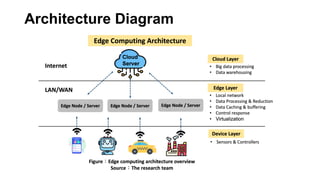
Edge Computing Architecture
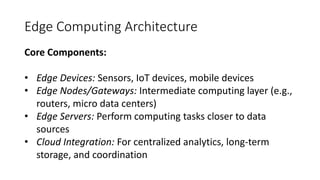
Core Components:
• Edge Devices: Sensors, IoT devices, mobile devices
• Edge Nodes/Gateways: Intermediate computing layer (e.g.,
routers, micro data centers)
• Edge Servers: Perform computing tasks closer to data
sources
• Cloud Integration: For centralized analytics, long-term
storage, and coordination
Architecture Diagram
Benefits of Edge Computing
• Low Latency:
• Faster response times by processing data near the source
• Crucial for real-time applications (e.g., self-driving cars)
• Bandwidth Optimization:
• Reduces data transfer to cloud by processing locally
• Efficient use of network resources
Cont.
• Improved Reliability:
• Edge systems can continue to operate even with
intermittent connectivity.
• Enhanced Privacy & Security:
• Sensitive data can be processed locally, reducing
exposure.
• Scalability:
• Easier to scale with localized resources as needed.
Real-World Examples of Edge Computing
• Internet of Things (IoT):
• Smart homes, industrial IoT (IIoT)
• Autonomous Systems:
• Self-driving cars, drones
• Retail:
• Smart shelves, in-store analytics
• Healthcare:
• Remote patient monitoring, wearable devices
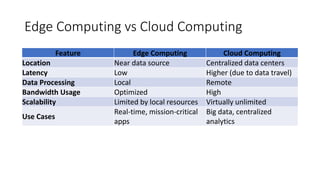
Edge Computing vs Cloud Computing
Feature Edge Computing Cloud Computing
Location Near data source Centralized data centers
Latency Low Higher (due to data travel)
Data Processing Local Remote
Bandwidth Usage Optimized High
Scalability Limited by local resources Virtually unlimited
Use Cases
Real-time, mission-critical
apps
Big data, centralized
analytics
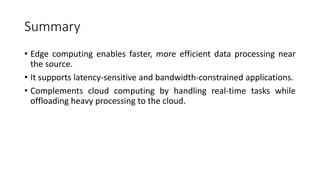
Summary
• Edge computing enables faster, more efficient data processing near
the source.
• It supports latency-sensitive and bandwidth-constrained applications.
• Complements cloud computing by handling real-time tasks while
offloading heavy processing to the cloud.
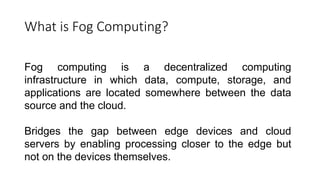
What is Fog Computing?
Fog computing is a decentralized computing
infrastructure in which data, compute, storage, and
applications are located somewhere between the data
source and the cloud.
Bridges the gap between edge devices and cloud
servers by enabling processing closer to the edge but
not on the devices themselves.
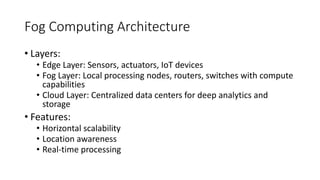
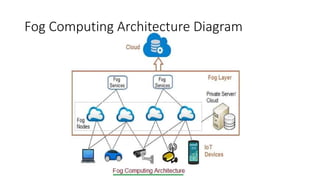
Fog Computing Architecture
• Layers:
• Edge Layer: Sensors, actuators, IoT devices
• Fog Layer: Local processing nodes, routers, switches with compute
capabilities
• Cloud Layer: Centralized data centers for deep analytics and
storage
• Features:
• Horizontal scalability
• Location awareness
• Real-time processing
Fog Computing Architecture Diagram
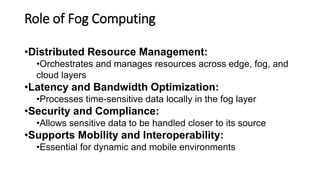
Role of Fog Computing
•Distributed Resource Management:
•Orchestrates and manages resources across edge, fog, and
cloud layers
•Latency and Bandwidth Optimization:
•Processes time-sensitive data locally in the fog layer
•Security and Compliance:
•Allows sensitive data to be handled closer to its source
•Supports Mobility and Interoperability:
•Essential for dynamic and mobile environments
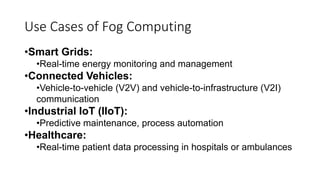
Use Cases of Fog Computing
•Smart Grids:
•Real-time energy monitoring and management
•Connected Vehicles:
•Vehicle-to-vehicle (V2V) and vehicle-to-infrastructure (V2I)
communication
•Industrial IoT (IIoT):
•Predictive maintenance, process automation
•Healthcare:
•Real-time patient data processing in hospitals or ambulances
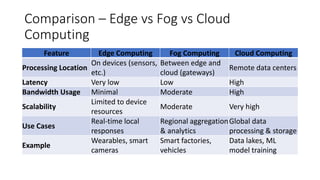
Comparison – Edge vs Fog vs Cloud
Computing
Feature Edge Computing Fog Computing Cloud Computing
Processing Location
On devices (sensors,
etc.)
Between edge and
cloud (gateways)
Remote data centers
Latency Very low Low High
Bandwidth Usage Minimal Moderate High
Scalability
Limited to device
resources
Moderate Very high
Use Cases
Real-time local
responses
Regional aggregation
& analytics
Global data
processing & storage
Example
Wearables, smart
cameras
Smart factories,
vehicles
Data lakes, ML
model training
Summary
• Fog computing extends cloud capabilities closer to the data
source.
• It complements both edge and cloud computing by offering a
middle layer for processing and analytics.
• Ideal for applications requiring both responsiveness and
distributed coordination.
How Mobile Cloud Benefits from Edge and
Fog Computing ?
1. Reduced Latency:
• Edge and fog layers process data closer to mobile devices.
• Enables faster response times for real-time applications like AR/VR, mobile gaming, and video streaming.
2. Improved Bandwidth Efficiency:
• Fog computing pre-processes or filters data before sending it to the cloud.
• Reduces data load over mobile networks, improving performance and lowering costs.
3. Enhanced Reliability:
• Local edge/fog nodes ensure continued operation even when cloud connectivity is weak or intermittent (e.g., remote areas, in-transit
scenarios).
4. Better Scalability for Mobile Apps:
• Offloads compute-intensive tasks (e.g., video rendering, ML inference) from smartphones to nearby fog/edge servers.
• Enables lightweight mobile clients with powerful backend support.
5. Context-Aware Services:
• Fog nodes can use location, device, and usage context to deliver personalized, real-time services to mobile users.
6. Energy Efficiency:
• Reduces energy consumption on mobile devices by minimizing the need for continuous communication with distant cloud servers.
Scenario:
You have IoT sensors generating temperature data.
Instead of sending all data to the cloud, an edge device filters only the
anomalous data (e.g., temperature > threshold) and sends that for
further processing.
Solution:
1. https://github.com/hm18818/Code-for-Network/blob/main/Edge%20Computing%20Simulation.ipynb
2. https://github.com/hm18818/Code-for-Network/blob/main/Monitoring%20air%20quality.ipynb
3. https://github.com/hm18818/Code-for-
Network/blob/main/Multiple%20sensors%20generating%20air%20quality%20(PM2.5)%20readings.ipynb

Introduction to Edge and Fog Computing.pdf

  • 1.
    Introduction to Edgeand Fog Computing Dr. Hitesh Mohapatra Associate Professor KIIT University School of Computer Engineering
  • 2.
    Contents • Edge Computing: oDefinition and architecture of edge computing o Benefits of edge computing: Low latency, bandwidth optimization o Examples of edge computing: IoT, autonomous systems o Comparison with cloud computing • Fog Computing: o Introduction to fog computing and its architecture o Role of fog computing in handling distributed cloud resources o Use cases: Smart grids, connected vehicles, industrial IoT o Comparison of edge, fog, and cloud computing • Edge & Fog Computing in Mobile Cloud: o How mobile cloud benefits from edge and fog computing o Real-time applications in healthcare, retail, and smart cities o Future trends in edge and fog computing
  • 3.
    What is EdgeComputing? • Edge computing is a distributed computing paradigm that brings computation and data storage closer to the sources of data. • Reduces latency and bandwidth use by processing data near the "edge" of the network instead of in a centralized cloud.
  • 4.
    Edge Computing Architecture CoreComponents: • Edge Devices: Sensors, IoT devices, mobile devices • Edge Nodes/Gateways: Intermediate computing layer (e.g., routers, micro data centers) • Edge Servers: Perform computing tasks closer to data sources • Cloud Integration: For centralized analytics, long-term storage, and coordination
  • 5.
  • 6.
    Benefits of EdgeComputing • Low Latency: • Faster response times by processing data near the source • Crucial for real-time applications (e.g., self-driving cars) • Bandwidth Optimization: • Reduces data transfer to cloud by processing locally • Efficient use of network resources
  • 7.
    Cont. • Improved Reliability: •Edge systems can continue to operate even with intermittent connectivity. • Enhanced Privacy & Security: • Sensitive data can be processed locally, reducing exposure. • Scalability: • Easier to scale with localized resources as needed.
  • 8.
    Real-World Examples ofEdge Computing • Internet of Things (IoT): • Smart homes, industrial IoT (IIoT) • Autonomous Systems: • Self-driving cars, drones • Retail: • Smart shelves, in-store analytics • Healthcare: • Remote patient monitoring, wearable devices
  • 9.
    Edge Computing vsCloud Computing Feature Edge Computing Cloud Computing Location Near data source Centralized data centers Latency Low Higher (due to data travel) Data Processing Local Remote Bandwidth Usage Optimized High Scalability Limited by local resources Virtually unlimited Use Cases Real-time, mission-critical apps Big data, centralized analytics
  • 10.
    Summary • Edge computingenables faster, more efficient data processing near the source. • It supports latency-sensitive and bandwidth-constrained applications. • Complements cloud computing by handling real-time tasks while offloading heavy processing to the cloud.
  • 11.
    What is FogComputing? Fog computing is a decentralized computing infrastructure in which data, compute, storage, and applications are located somewhere between the data source and the cloud. Bridges the gap between edge devices and cloud servers by enabling processing closer to the edge but not on the devices themselves.
  • 12.
    Fog Computing Architecture •Layers: • Edge Layer: Sensors, actuators, IoT devices • Fog Layer: Local processing nodes, routers, switches with compute capabilities • Cloud Layer: Centralized data centers for deep analytics and storage • Features: • Horizontal scalability • Location awareness • Real-time processing
  • 13.
  • 14.
    Role of FogComputing •Distributed Resource Management: •Orchestrates and manages resources across edge, fog, and cloud layers •Latency and Bandwidth Optimization: •Processes time-sensitive data locally in the fog layer •Security and Compliance: •Allows sensitive data to be handled closer to its source •Supports Mobility and Interoperability: •Essential for dynamic and mobile environments
  • 15.
    Use Cases ofFog Computing •Smart Grids: •Real-time energy monitoring and management •Connected Vehicles: •Vehicle-to-vehicle (V2V) and vehicle-to-infrastructure (V2I) communication •Industrial IoT (IIoT): •Predictive maintenance, process automation •Healthcare: •Real-time patient data processing in hospitals or ambulances
  • 16.
    Comparison – Edgevs Fog vs Cloud Computing Feature Edge Computing Fog Computing Cloud Computing Processing Location On devices (sensors, etc.) Between edge and cloud (gateways) Remote data centers Latency Very low Low High Bandwidth Usage Minimal Moderate High Scalability Limited to device resources Moderate Very high Use Cases Real-time local responses Regional aggregation & analytics Global data processing & storage Example Wearables, smart cameras Smart factories, vehicles Data lakes, ML model training
  • 17.
    Summary • Fog computingextends cloud capabilities closer to the data source. • It complements both edge and cloud computing by offering a middle layer for processing and analytics. • Ideal for applications requiring both responsiveness and distributed coordination.
  • 18.
    How Mobile CloudBenefits from Edge and Fog Computing ? 1. Reduced Latency: • Edge and fog layers process data closer to mobile devices. • Enables faster response times for real-time applications like AR/VR, mobile gaming, and video streaming. 2. Improved Bandwidth Efficiency: • Fog computing pre-processes or filters data before sending it to the cloud. • Reduces data load over mobile networks, improving performance and lowering costs. 3. Enhanced Reliability: • Local edge/fog nodes ensure continued operation even when cloud connectivity is weak or intermittent (e.g., remote areas, in-transit scenarios). 4. Better Scalability for Mobile Apps: • Offloads compute-intensive tasks (e.g., video rendering, ML inference) from smartphones to nearby fog/edge servers. • Enables lightweight mobile clients with powerful backend support. 5. Context-Aware Services: • Fog nodes can use location, device, and usage context to deliver personalized, real-time services to mobile users. 6. Energy Efficiency: • Reduces energy consumption on mobile devices by minimizing the need for continuous communication with distant cloud servers.
  • 19.
    Scenario: You have IoTsensors generating temperature data. Instead of sending all data to the cloud, an edge device filters only the anomalous data (e.g., temperature > threshold) and sends that for further processing. Solution: 1. https://github.com/hm18818/Code-for-Network/blob/main/Edge%20Computing%20Simulation.ipynb 2. https://github.com/hm18818/Code-for-Network/blob/main/Monitoring%20air%20quality.ipynb 3. https://github.com/hm18818/Code-for- Network/blob/main/Multiple%20sensors%20generating%20air%20quality%20(PM2.5)%20readings.ipynb