Engineering Solutions
IT Solutions
www.rgbsi.com
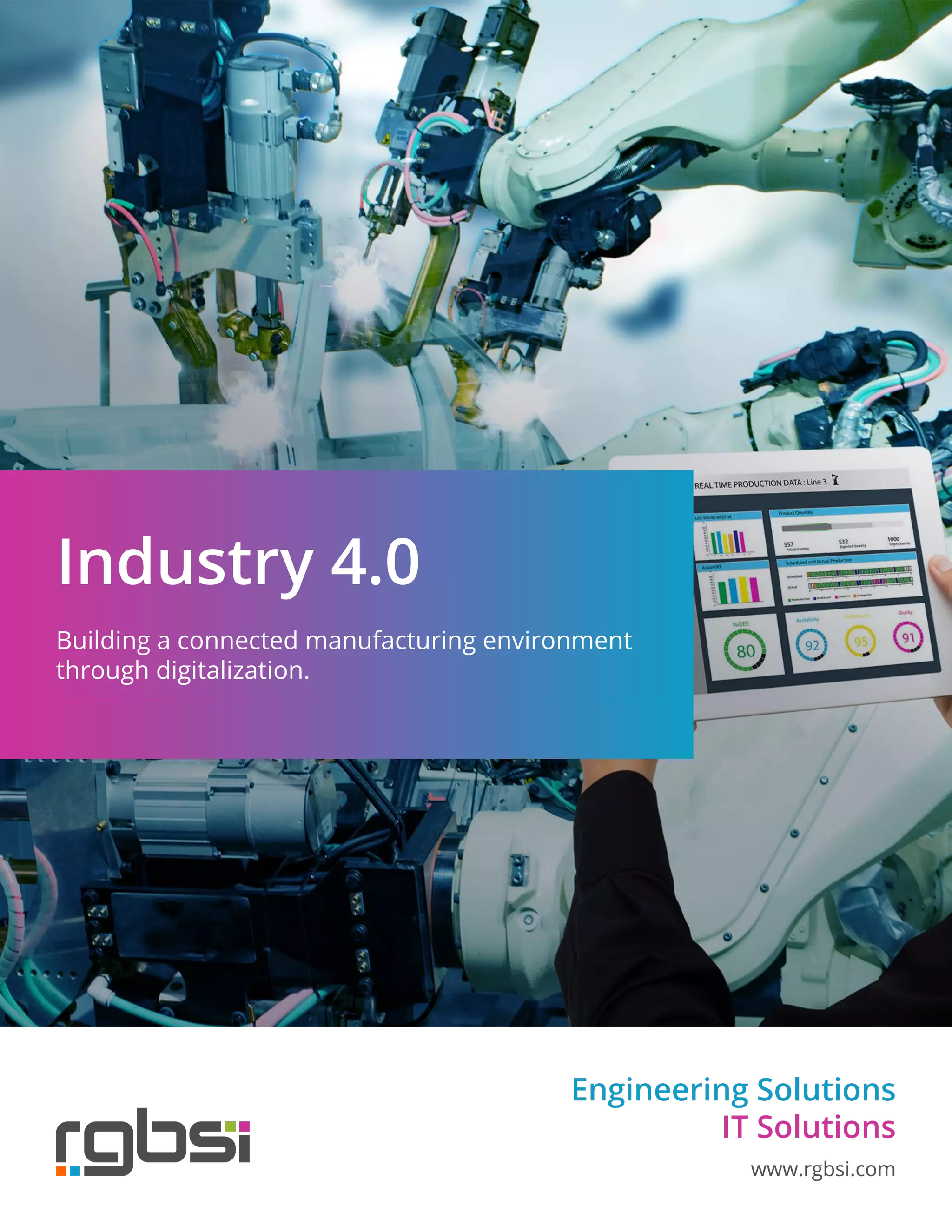
Industry 4.0
Building a connected manufacturing environment
through digitalization.
RGBSI © Copyright 2020. All Rights Reserved | Industry 4.0 2
Overview
What is Industry 4.0?
Industry 4.0 is the continued application of advanced
computing technology to global industries. As part of
Industry 4.0, the gradual integration of conventional
engineering methods and technological practices
are used to digitize the state of manufacturing.
This transforms organizational processes for more
holistic decision making, which results in more
scalable operations and revenue growth.
Fill Skills Gap
Industry 4.0 in manufacturing allows manufacturers
to use technology as a closure for skills gaps. This
practiceallowsmanufacturerstocapitalizeonhuman
expertise in conjunction with advanced technology
investments to amplify levels of productivity.
Customer Experience
Companies are using Industry 4.0 to meet growing
customer requirements. Application of advanced
technology in manufacturing conveys modern
manufacturing practices for a more customer-
centric approach to business.
Collaborative Manufacturing
Industry 4.0 technologies support a secure
communication infrastructure that can be entrusted
with critical aspects of manufacturing such as
production. Application enables streamlined
communication across all stakeholders in the
supply chain irrespective of location or time zone.
Knowledge sharing is possible in real time during all
phases of product design and development. Industry 4.0:
The continued application of
advanced computing technology to
global industry
RGBSI © Copyright 2020. All Rights Reserved | Industry 4.0 3
Industry 4.0 Technologies
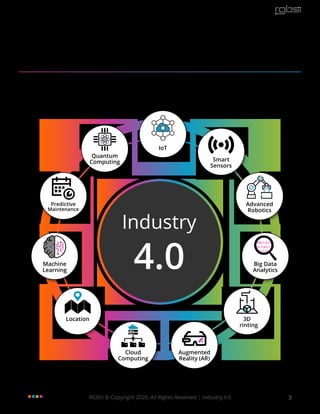
11 Disruptive Technologies in Manufacturing
These technologies are the digital drivers of modern manufacturing. They work together to enable smart
automation and connected manufacturing environments.
RGBSI © Copyright 2020. All Rights Reserved | Industry 4.0 4
Internet of Things:
[IoT]
The application of advanced computing technology
to networked electronic devices with embedded
sensors.
Smart Sensors:
A device that uses a transducer to collect a specific
type of data from a physical environment (outside or
inside).
Advanced Robotics:
A combination of sophisticated programming
and powerful hardware that makes use of sensor
technology to interact with the real world around it.
Big Data Analytics:
The use of advanced computing technologies on huge
data sets to discover valuable correlations, patterns
trends, and preferences for better business decisions.
3D Printing:
The manufacturing of objects by computer controlled
robots that deposit layers of material to form an object
from a computer-aided design (CAD).
Augmented Reality:
[AR]
The use of advanced computing and a combination
of optical hardware components to overlay digital
images or 3D models onto the physical world.
Cloud Computing:
The use of high bandwidth networks to perform
computing tasks on a networked server rather than a
local machine.
Location Tracking:
The application of advanced computing technologies
to locate, track, and record the movement of people
and objects.
Machine Learning:
[ML]
The application of algorithms and statistical models
used in advanced computing to perform a specific
task without programmed instructions.
Predictive Maintenance:
The continuous or periodic monitoring and evaluation
of the condition of industrial equipment while it is in
use.
Quantum Computing:
A sophisticated mix of hardware and software
that performs predictive calculations based on the
probability of information received instead of after
the fact calculations via traditional computers.
RGBSI © Copyright 2020. All Rights Reserved | Industry 4.0 5
IoT
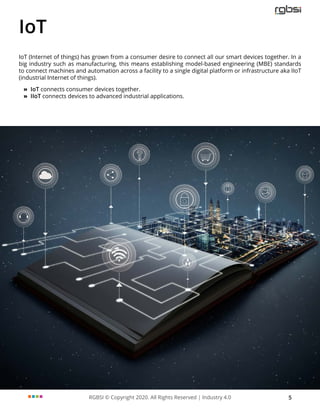
IoT (Internet of things) has grown from a consumer desire to connect all our smart devices together. In a
big industry such as manufacturing, this means establishing model-based engineering (MBE) standards
to connect machines and automation across a facility to a single digital platform or infrastructure aka IIoT
(industrial Internet of things).
»
» IoT connects consumer devices together.
»
» IIoT connects devices to advanced industrial applications.
RGBSI © Copyright 2020. All Rights Reserved | Industry 4.0 6
IoT
IoT refers to the ever growing network of physical
objects that have a unique IP address (like your
phones and computers) and wireless hardware for
Internet connectivity. It also refers to the network
between these IoT connected devices, objects,
and systems. Sometimes, these objects or devices
communicate with other related devices and act on
the information they get from one another.
IoT Applications in Industry 4.0
In Industry 4.0, IoT devices are deployed to monitor
and control electronic, mechanical, and electrical
systems used in various types of industrial facilities
(smart factories, assembly lines, and manufacturing
facilities as example), as well as for building
automation systems. This is known as the Industrial
Internet of Things (IIoT).
IIoT
The concept of IIoT is the same as IoT, just
with a more niche focus. Instead of connecting
consumer devices, the interconnected sensors,
instrumentation, and other networked devices work
with advanced industrial computing applications
like manufacturing and energy management. In IIoT,
a network of sensors collect critical production data
and sends it to cloud software to parse through the
data and return valuable insights about the quality
and efficiency of manufacturing operations.
IIoT Applications in Industry 4.0
In Industry 4.0, industrial companies use IIoT
platforms (consisting of hardware and software) to
connect devices and equipment used for different
processes in their facilities. It is used for supply
chain management and optimization. By using IIoT
platforms companies gain strategic awareness in
the form of insight, control, and data visibility across
their entire supply chain. By leveraging this data in
real-time, companies can adjust to changing market
conditions and deliver products and services to
market more efficiently, more lucratively, and at a
higher rate of quality than competitors.
IoT connects consumer devices together.
IIoT connects devices to advanced industrial applications.
RGBSI © Copyright 2020. All Rights Reserved | Industry 4.0 7
Smart sensors collect data, take measurements, and send data to
central cloud computing platforms for information analysis.
Smart Sensors
A smart sensor is a device that uses a transducer to collect a specific type of data from a physical environment
(outside or inside). It takes that information and uses computing resources that are built in to the sensor to
perform a predefined and programmed function on the specified type of data it is collecting. It then passes
that data on via a networked connection.
Smart Sensors Application In Industry 4.0
Smart sensors are synonymous with Industry 4.0. They monitor different industrial processes, collect data,
take measurements, and transmit data to cloud computing platforms for information analysis. Examples
of smart sensors include:
»
» Level sensors: i.e. gas gauge to communicate the amount of fuel left in a vehicle.
»
» Temperature sensors: i.e. thermostat to control the temperature of a building.
»
» Pressure sensors: i.e. hydraulic brakes to control a vehicle’s stopping distance.
»
» Infrared sensors: i.e. night vision technology to create visibility when there is no visible light.
»
» Proximity sensors: i.e. LCD backlight dimming when a smartphone is raised to an ear.
RGBSI © Copyright 2020. All Rights Reserved | Industry 4.0 8
Types of Smart Sensors
Level sensors
Level sensors are used for real-time measurement
of containers, bins and tanks, feeding real-time
information to inventory management systems and
process control systems. They are used in everything
from waste management to irrigation to diesel fuel
gauging and more.
Temperature sensors
Temperature sensors are also very commonly used
in industrial settings. Perhaps the simplest example
is using temperature smart sensors to connect to
a piece of machinery or industrial equipment. It is
connected to and IIoT cloud computing platform
and can detect when the machine or equipment is
overheating and needs maintenance or to be shut
down.
Pressure sensors
Pressure sensors are used to monitor pipelines and
alert a centralized computing system to leaks or
irregularities that alert overseers that maintenance
and repair is needed.
Infrared sensors
Infrared smart sensors are equally multi-purpose
and are used across very different industries. They
are used in medicine to track biological functions
such as blood flow during surgery, they are used
in architecture, engineering, and construction
to monitor heat leaks in buildings and industrial
facilities. They are also used in wearables for health
and fitness.
Proximity sensors
Proximity sensors are used in retail to detect
customer location and track crowd flow. Different
retail outlets leverage this technology to ping the
smartphones of customers wandering around with
coupons for deals on products that may be in their
periphery.
RGBSI © Copyright 2020. All Rights Reserved | Industry 4.0 9
Advanced Robotics
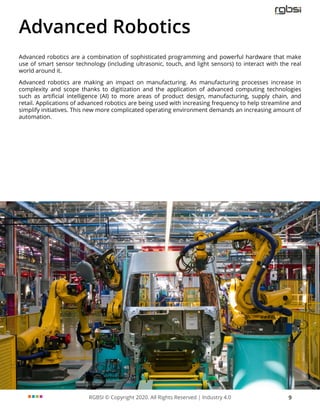
Advanced robotics are a combination of sophisticated programming and powerful hardware that make
use of smart sensor technology (including ultrasonic, touch, and light sensors) to interact with the real
world around it.
Advanced robotics are making an impact on manufacturing. As manufacturing processes increase in
complexity and scope thanks to digitization and the application of advanced computing technologies
such as artificial intelligence (AI) to more areas of product design, manufacturing, supply chain, and
retail. Applications of advanced robotics are being used with increasing frequency to help streamline and
simplify initiatives. This new more complicated operating environment demands an increasing amount of
automation.
RGBSI © Copyright 2020. All Rights Reserved | Industry 4.0 10
Job Market Transitions
The transformation of traditional labor into
robotic optimized labor will continue to transition
moving into the future. It is debatable whether
or not advanced robotics are a cause for concern
in displacing manufacturing jobs. Robotics can
also change the job market positively by opening
up opportunities that demand different types of
skillsets.
Advanced Robotics
Application in Industry 4.0
Industry 4.0 uses advanced robotics to increase
productivity by taking over manual tasks and
accomplishing them faster, which is known as the
factory of the future. Advanced robots can do this
because they have the ability to adjust themselves
and course correct when procedures and processes
change. Conventional robots in an industrial setting
do not have this type of adaptability.
In addition, use of advanced robots offer another
advantage over conventional robots in that they
are easier to set up and configure on an assembly
line from the beginning of their implementation.
Advanced robots can also take advantage of
simulation software to learn how to perform an
array of tasks. On the assembly line, manufacturers
improve quality, reliability, and precision by closing
skills gaps with technology.
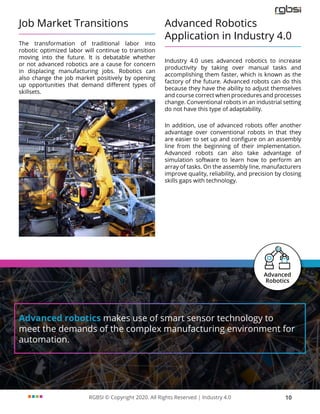
Advanced robotics makes use of smart sensor technology to
meet the demands of the complex manufacturing environment for
automation.
RGBSI © Copyright 2020. All Rights Reserved | Industry 4.0 11
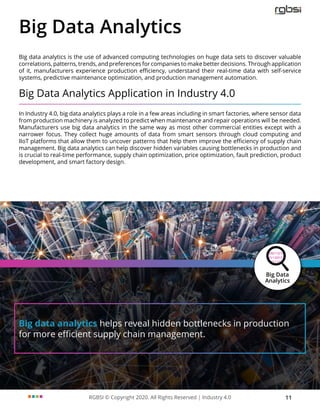
Big data analytics helps reveal hidden bottlenecks in production
for more efficient supply chain management.
Big Data Analytics
Big data analytics is the use of advanced computing technologies on huge data sets to discover valuable
correlations, patterns, trends, and preferences for companies to make better decisions. Through application
of it, manufacturers experience production efficiency, understand their real-time data with self-service
systems, predictive maintenance optimization, and production management automation.
Big Data Analytics Application in Industry 4.0
In Industry 4.0, big data analytics plays a role in a few areas including in smart factories, where sensor data
from production machinery is analyzed to predict when maintenance and repair operations will be needed.
Manufacturers use big data analytics in the same way as most other commercial entities except with a
narrower focus. They collect huge amounts of data from smart sensors through cloud computing and
IIoT platforms that allow them to uncover patterns that help them improve the efficiency of supply chain
management. Big data analytics can help discover hidden variables causing bottlenecks in production and
is crucial to real-time performance, supply chain optimization, price optimization, fault prediction, product
development, and smart factory design.
RGBSI © Copyright 2020. All Rights Reserved | Industry 4.0 12
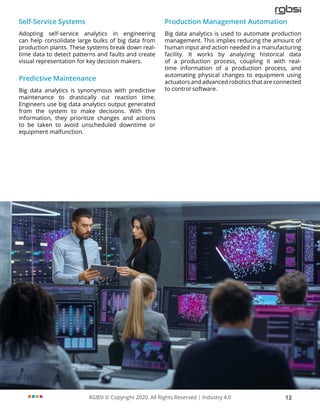
Self-Service Systems
Adopting self-service analytics in engineering
can help consolidate large bulks of big data from
production plants. These systems break down real-
time data to detect patterns and faults and create
visual representation for key decision makers.
Predictive Maintenance
Big data analytics is synonymous with predictive
maintenance to drastically cut reaction time.
Engineers use big data analytics output generated
from the system to make decisions. With this
information, they prioritize changes and actions
to be taken to avoid unscheduled downtime or
equipment malfunction.
Production Management Automation
Big data analytics is used to automate production
management. This implies reducing the amount of
human input and action needed in a manufacturing
facility. It works by analyzing historical data
of a production process, coupling it with real-
time information of a production process, and
automating physical changes to equipment using
actuators and advanced robotics that are connected
to control software.
RGBSI © Copyright 2020. All Rights Reserved | Industry 4.0 13
3D Printing
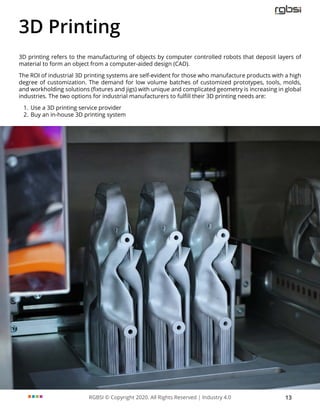
3D printing refers to the manufacturing of objects by computer controlled robots that deposit layers of
material to form an object from a computer-aided design (CAD).
The ROI of industrial 3D printing systems are self-evident for those who manufacture products with a high
degree of customization. The demand for low volume batches of customized prototypes, tools, molds,
and workholding solutions (fixtures and jigs) with unique and complicated geometry is increasing in global
industries. The two options for industrial manufacturers to fulfill their 3D printing needs are:
1. Use a 3D printing service provider
2. Buy an in-house 3D printing system
RGBSI © Copyright 2020. All Rights Reserved | Industry 4.0 14
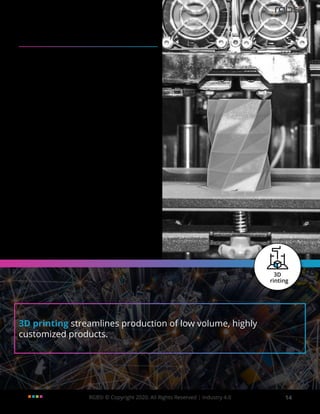
3D printing streamlines production of low volume, highly
customized products.
3D Printing Applications in
Industry 4.0
In Industry 4.0, powerful 3D software known as
generative design is used by companies in aerospace
and automotive industries to redesign products with
lessmaterialandmorecomplexgeometrytoimprove
efficiency. These 3D models partially generated by
generative design software (which uses elements
of AI) have geometry of such a complicated nature
that they cannot be manufactured using traditional
methods of manufacturing.
3D printing systems are heavily adopted in the pre-
production phase of manufacturing. This allows
manufacturers to mitigate risk for production tooling
without jeopardizing the design change. In addition,
such technology is applicable for in-machinery
usages. Low volume, highly customized products
are considered as the sweet spot in 3D printing.
Product scalability will began to shift as 3D printing
enables digital transformation and product
innovation. With flexibility, 3D printing can facilitate
knowledge sharing across the supply chain and
between companies of different areas of expertise.
This will enable collaborative manufacturing with
production capacities.
RGBSI © Copyright 2020. All Rights Reserved | Industry 4.0 15
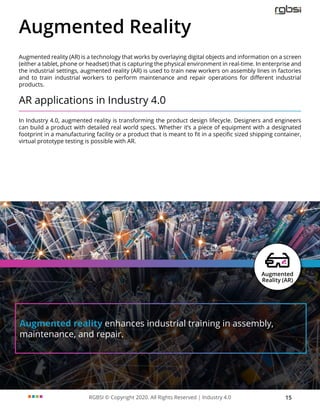
Augmented reality enhances industrial training in assembly,
maintenance, and repair.
Augmented Reality
Augmented reality (AR) is a technology that works by overlaying digital objects and information on a screen
(either a tablet, phone or headset) that is capturing the physical environment in real-time. In enterprise and
the industrial settings, augmented reality (AR) is used to train new workers on assembly lines in factories
and to train industrial workers to perform maintenance and repair operations for different industrial
products.
AR applications in Industry 4.0
In Industry 4.0, augmented reality is transforming the product design lifecycle. Designers and engineers
can build a product with detailed real world specs. Whether it’s a piece of equipment with a designated
footprint in a manufacturing facility or a product that is meant to fit in a specific sized shipping container,
virtual prototype testing is possible with AR.
RGBSI © Copyright 2020. All Rights Reserved | Industry 4.0 16
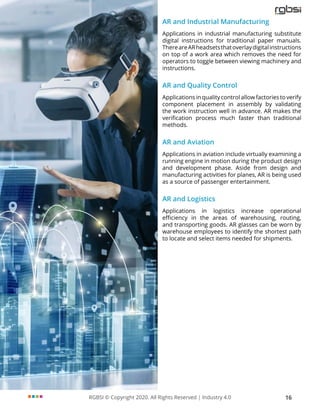
AR and Industrial Manufacturing
Applications in industrial manufacturing substitute
digital instructions for traditional paper manuals.
ThereareARheadsetsthatoverlaydigitalinstructions
on top of a work area which removes the need for
operators to toggle between viewing machinery and
instructions.
AR and Quality Control
Applications in quality control allow factories to verify
component placement in assembly by validating
the work instruction well in advance. AR makes the
verification process much faster than traditional
methods.
AR and Aviation
Applications in aviation include virtually examining a
running engine in motion during the product design
and development phase. Aside from design and
manufacturing activities for planes, AR is being used
as a source of passenger entertainment.
AR and Logistics
Applications in logistics increase operational
efficiency in the areas of warehousing, routing,
and transporting goods. AR glasses can be worn by
warehouse employees to identify the shortest path
to locate and select items needed for shipments.
RGBSI © Copyright 2020. All Rights Reserved | Industry 4.0 17
Cloud Computing
Cloud computing is the use of hardware and software to deliver a service over a network which is usually
the Internet. Smartphones are an example of advanced computing hardware with many cloud computing
applications. Email service providers are examples of using cloud computing for message storage.
Cloud computing applications streamline certain managerial and operational processes. For example, cloud
computing applications centralize data storage, bandwidth, and processing which means that individual
users don’t have to personally install applications on their laptops or workstations. Users simply access
them from the cloud. There is also a real-time exchange of information in cloud applications.
A top concern for businesses is that the cloud presents greater security risks because a third party control
the server where the data is stored. In contrast to this belief, the cloud comes with its own set of security
advantages such as triggering on-going updates which improves infrastructure security. Although different,
cloud computing mitigates risk in a different way than local hosting and provide several operational benefits.
It reduces the expense of employing someone to manage a local server, improves scalability, and enhances
reliability. Information stored through cloud computing is rarely lost.
RGBSI © Copyright 2020. All Rights Reserved | Industry 4.0 18
Cloud Computing
Application in Industry 4.0
In Industry 4.0, companies with collaborative
supply chains benefit from using the cloud in
several ways. The real-time visibility of centralized
information by multiple parties along the supply
chain allows management to take a more proactive
approach. If conditions change or a problem arises,
organizations can nimbly react to ensure and tweak
efficiencies while reducing risk of reoccurring issues.
Cloud computing is vital to every other technology
in Industry 4.0. The other technologies managed by
cloud computing infrastructure differ dependent on
industry.
Cloud computing enables efficient supply chain
communication and presents opportunity to unlock
the full potential of disruptive technologies. On an
industry-wide scale, it is important for companies to
adopt cloud computing as it is the foundation for all
Industry 4.0 driven innovation.
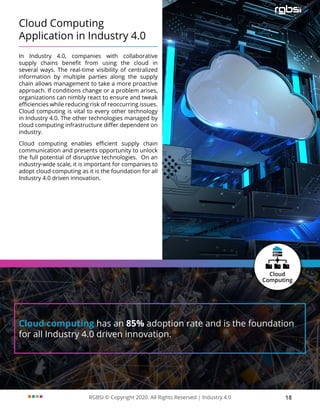
Cloud computing has an 85% adoption rate and is the foundation
for all Industry 4.0 driven innovation.
RGBSI © Copyright 2020. All Rights Reserved | Industry 4.0 19
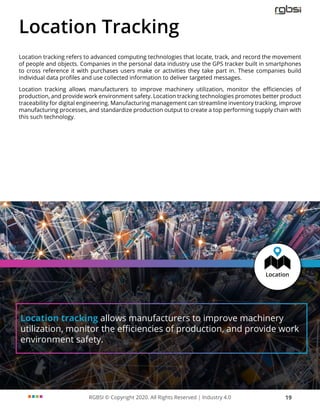
Location tracking allows manufacturers to improve machinery
utilization, monitor the efficiencies of production, and provide work
environment safety.
Location Tracking
Location tracking refers to advanced computing technologies that locate, track, and record the movement
of people and objects. Companies in the personal data industry use the GPS tracker built in smartphones
to cross reference it with purchases users make or activities they take part in. These companies build
individual data profiles and use collected information to deliver targeted messages.
Location tracking allows manufacturers to improve machinery utilization, monitor the efficiencies of
production, and provide work environment safety. Location tracking technologies promotes better product
traceability for digital engineering. Manufacturing management can streamline inventory tracking, improve
manufacturing processes, and standardize production output to create a top performing supply chain with
this such technology.
RGBSI © Copyright 2020. All Rights Reserved | Industry 4.0 20
Location Tracking
Applications in Industry 4.0
In Industry 4.0, location tracking technology such as
GPS is used to keep track of industrial assets such as
mining or construction equipment in architecture,
engineering, and construction. Location tracking
creates manufacturing efficiencies and promotes
worker safety.
As part of the larger Industry 4.0 ecosystem. Location
tracking keeps tabs on important industrial assets.
Indoor positioning technology allows location
information to be fed into asset tracking workflows
to monitor equipment and personnel that are either
outdoors, at construction sites, or inside a smart
factory. Location tracking allows decision makers
to improve workflow, keep track of inventory,
and standardize production and manufacturing
processes.
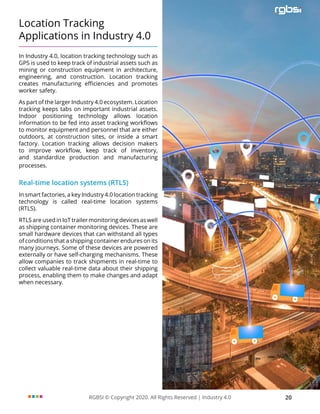
Real-time location systems (RTLS)
In smart factories, a key Industry 4.0 location tracking
technology is called real-time location systems
(RTLS).
RTLS are used in IoT trailer monitoring devices as well
as shipping container monitoring devices. These are
small hardware devices that can withstand all types
of conditions that a shipping container endures on its
many journeys. Some of these devices are powered
externally or have self-charging mechanisms. These
allow companies to track shipments in real-time to
collect valuable real-time data about their shipping
process, enabling them to make changes and adapt
when necessary.
RGBSI © Copyright 2020. All Rights Reserved | Industry 4.0 21
Machine Learning
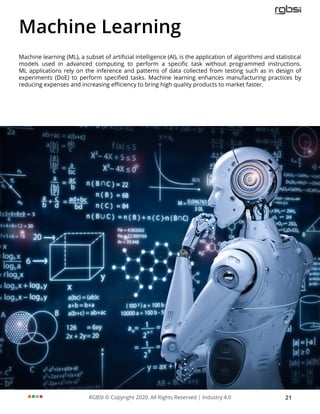
Machine learning (ML), a subset of artificial intelligence (AI), is the application of algorithms and statistical
models used in advanced computing to perform a specific task without programmed instructions.
ML applications rely on the inference and patterns of data collected from testing such as in design of
experiments (DoE) to perform specified tasks. Machine learning enhances manufacturing practices by
reducing expenses and increasing efficiency to bring high quality products to market faster.
RGBSI © Copyright 2020. All Rights Reserved | Industry 4.0 22
Machine Learning
Applications in Industry 4.0
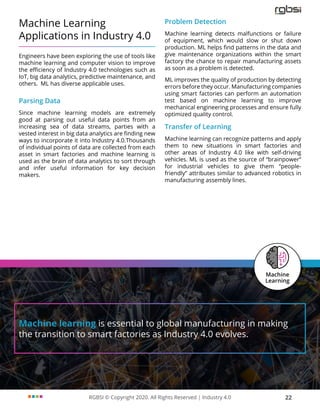
Engineers have been exploring the use of tools like
machine learning and computer vision to improve
the efficiency of Industry 4.0 technologies such as
IoT, big data analytics, predictive maintenance, and
others. ML has diverse applicable uses.
Parsing Data
Since machine learning models are extremely
good at parsing out useful data points from an
increasing sea of data streams, parties with a
vested interest in big data analytics are finding new
ways to incorporate it into Industry 4.0.Thousands
of individual points of data are collected from each
asset in smart factories and machine learning is
used as the brain of data analytics to sort through
and infer useful information for key decision
makers.
Problem Detection
Machine learning detects malfunctions or failure
of equipment, which would slow or shut down
production. ML helps find patterns in the data and
give maintenance organizations within the smart
factory the chance to repair manufacturing assets
as soon as a problem is detected.
ML improves the quality of production by detecting
errors before they occur. Manufacturing companies
using smart factories can perform an automation
test based on machine learning to improve
mechanical engineering processes and ensure fully
optimized quality control.
Transfer of Learning
Machine learning can recognize patterns and apply
them to new situations in smart factories and
other areas of Industry 4.0 like with self-driving
vehicles. ML is used as the source of “brainpower”
for industrial vehicles to give them “people-
friendly” attributes similar to advanced robotics in
manufacturing assembly lines.
Machine learning is essential to global manufacturing in making
the transition to smart factories as Industry 4.0 evolves.
RGBSI © Copyright 2020. All Rights Reserved | Industry 4.0 23
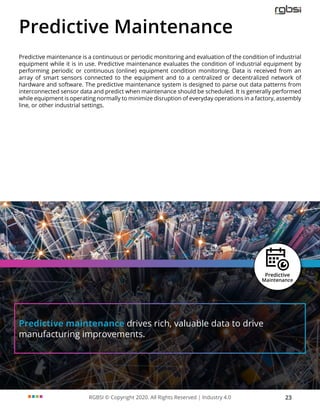
Predictive maintenance drives rich, valuable data to drive
manufacturing improvements.
Predictive Maintenance
Predictive maintenance is a continuous or periodic monitoring and evaluation of the condition of industrial
equipment while it is in use. Predictive maintenance evaluates the condition of industrial equipment by
performing periodic or continuous (online) equipment condition monitoring. Data is received from an
array of smart sensors connected to the equipment and to a centralized or decentralized network of
hardware and software. The predictive maintenance system is designed to parse out data patterns from
interconnected sensor data and predict when maintenance should be scheduled. It is generally performed
while equipment is operating normally to minimize disruption of everyday operations in a factory, assembly
line, or other industrial settings.
RGBSI © Copyright 2020. All Rights Reserved | Industry 4.0 24
Predictive Maintenance
Applications in Industry 4.0
The main function of predictive maintenance for
Industry 4.0 is to prevent asset failure with far more
accuracy and far less downtime. Prior to predictive
maintenance, machine operators and factory
managers would schedule inspection, maintenance
and repair operations of machine parts on a regular
basis to prevent downtime without sensor-driven,
real-time data.
Adoption of predictive maintenance is advantageous
for manufacturers as it helps extend equipment
lifecycle by detecting mechanical irregularities of
machinery early on. Deployment of predictive
maintenance drives rich, valuable data to drive
manufacturing improvements.
Benefits of Predictive Maintenance
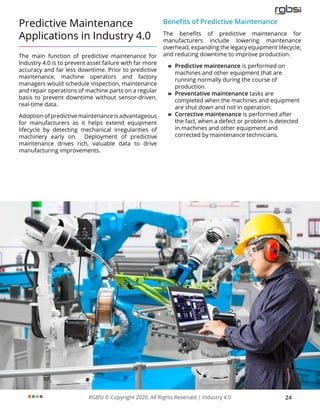
The benefits of predictive maintenance for
manufacturers include lowering maintenance
overhead, expanding the legacy equipment lifecycle,
and reducing downtime to improve production.
»
» Predictive maintenance is performed on 		
machines and other equipment that are 		
running normally during the course of 		
production.
»
» Preventative maintenance tasks are 			
completed when the machines and equipment
are shut down and not in operation.
»
» Corrective maintenance is performed after 		
the fact, when a defect or problem is detected
in machines and other equipment and 		
corrected by maintenance technicians.
RGBSI © Copyright 2020. All Rights Reserved | Industry 4.0 25
Quantum Computing
There are two types of computing: classical computing and quantum computing. The first type, classical
computing, sends information in binary bits. These bits carry a value of either 0 or 1. The second type,
quantum computing, sends information in quantum bits. These quantum bits are referred to as qubits.
There is opportunity for complex problem solving with quantum computing where traditional computing
systems lag because of silo task-doing capacity restrictions.
Qubits are analogous to classical binary bits but are primarily differentiated by their ability to be in a
superposition of both 0 and 1 states at the same time, whereas classical bits are either in a 0 state or a 1
state.
This doubling of efficiency per qubit compared to classical bits is why adding qubits to a quantum computer
increases its computing power exponentially versus adding classical bits to a classical computer, which
does not.
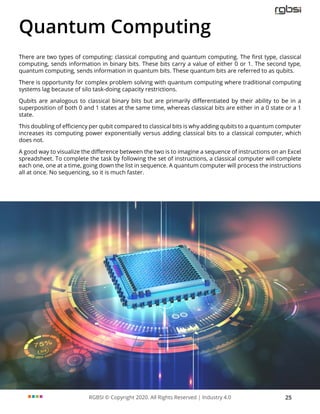
A good way to visualize the difference between the two is to imagine a sequence of instructions on an Excel
spreadsheet. To complete the task by following the set of instructions, a classical computer will complete
each one, one at a time, going down the list in sequence. A quantum computer will process the instructions
all at once. No sequencing, so it is much faster.
RGBSI © Copyright 2020. All Rights Reserved | Industry 4.0 26
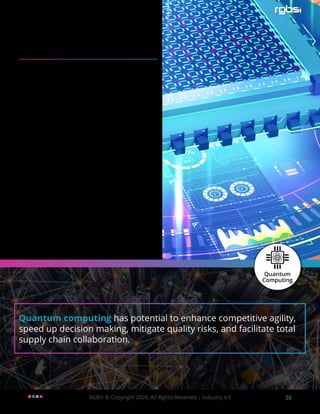
Quantum computing has potential to enhance competitive agility,
speed up decision making, mitigate quality risks, and facilitate total
supply chain collaboration.
Quantum Computing
Potential Applications in
Industry 4.0
To be clear, there are no applications of quantum
computing in use at this time in Industry 4.0. And
no quantum computer does anything that remotely
resembles practical work. But big tech is anticipating
a quantum computing age.
Quantum computing has the potential to enhance
value-driven conclusions from massive data sets. It
could assist machine learning (ML) by driving artificial
intelligence (AI) to process the unanalyzed data. This
could help industry segments make sense of it all
and aide more comprehensive decision making.
Integrating quantum computing with Industry 4.0
disrupting technologies can potentially enhance
competitive agility, speed up decision making,
mitigate product quality risks, and facilitate total
supply chain collaboration.
RGBSI © Copyright 2020. All Rights Reserved | Industry 4.0 27
Conclusion
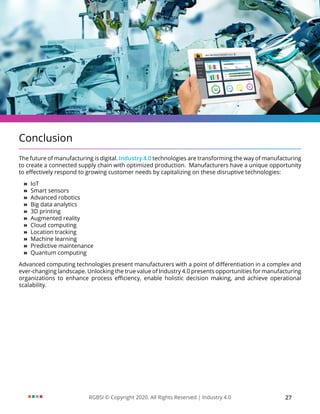
The future of manufacturing is digital. Industry 4.0 technologies are transforming the way of manufacturing
to create a connected supply chain with optimized production. Manufacturers have a unique opportunity
to effectively respond to growing customer needs by capitalizing on these disruptive technologies:
»
» IoT
»
» Smart sensors
»
» Advanced robotics
»
» Big data analytics
»
» 3D printing
»
» Augmented reality
»
» Cloud computing
»
» Location tracking
»
» Machine learning
»
» Predictive maintenance
»
» Quantum computing
Advanced computing technologies present manufacturers with a point of differentiation in a complex and
ever-changing landscape. Unlocking the true value of Industry 4.0 presents opportunities for manufacturing
organizations to enhance process efficiency, enable holistic decision making, and achieve operational
scalability.
RGBSI © Copyright 2020. All Rights Reserved | Industry 4.0 28
1200 Stephenson Hwy
Troy, MI 48083
+1 248.589.1135
moreinfo@rgbsi.com
For more information, visit www.rgbsi.com
About RGBSI
RGBSI delivers high quality workforce management,
engineering, quality lifecycle management, and IT
solutions to global organizations through its unique
engagement models. Working across industries,
RGBSI provides continued support to businesses
of all sizes with its diversified portfolio of products
and services. RGBSI leverages its industry expertise
in engineering and IT to fill employment gaps for
employers and offers a full range of business
solutions to improve client operations worldwide.
RGBSI is ISO 9001:2015 and AS9100:2008 Rev D
certified, as well as a Minority Business Enterprise.
Engineering & IT Solutions
RGBSI works with clients to unlock the full potential
of their products and enable future innovation. By
pairing modern technology with design expertise,
RGBSI helps companies elevate fundamental
engineering principles in accommodation of
growing product complexity requirements.
ENGINEERING SERVICES:
»
» Research: supply chain investigation, 			
competitive benchmarking, warranty systems
»
» Product design & development: 2D & 3D 		
modeling CAD customization & design 		
automation, CAD conversions, animations, 		
reverse engineering, concept sketch 			
proposals, embedded systems
»
» Simulation: FEA, CFD
»
» Advanced manufacturing: CAM services: 		
CNC & CMM programming, collaborative 		
manufacturing & testing, RFID integration/		
asset tracking, digital factories & layout 		
design, additive manufacturing
»
» Automation: digital thread, model-based 		
engineering, robotics & automation, tooling, 		
IoT
»
» Support activities: work package outsourcing,
technical communication & translations, 		
compliance services.
IT SERVICES:
»
» IT consulting
»
» Application development
»
» ERP
»
» Infrastructure
»
» Project management
»
» Business intelligence
Learn more
Learn more

RGBSI Industry 4.0 Whitepaper - 3.10.20.pdf

  • 1.
    Engineering Solutions IT Solutions www.rgbsi.com Industry4.0 Building a connected manufacturing environment through digitalization.
  • 2.
    RGBSI © Copyright2020. All Rights Reserved | Industry 4.0 2 Overview What is Industry 4.0? Industry 4.0 is the continued application of advanced computing technology to global industries. As part of Industry 4.0, the gradual integration of conventional engineering methods and technological practices are used to digitize the state of manufacturing. This transforms organizational processes for more holistic decision making, which results in more scalable operations and revenue growth. Fill Skills Gap Industry 4.0 in manufacturing allows manufacturers to use technology as a closure for skills gaps. This practiceallowsmanufacturerstocapitalizeonhuman expertise in conjunction with advanced technology investments to amplify levels of productivity. Customer Experience Companies are using Industry 4.0 to meet growing customer requirements. Application of advanced technology in manufacturing conveys modern manufacturing practices for a more customer- centric approach to business. Collaborative Manufacturing Industry 4.0 technologies support a secure communication infrastructure that can be entrusted with critical aspects of manufacturing such as production. Application enables streamlined communication across all stakeholders in the supply chain irrespective of location or time zone. Knowledge sharing is possible in real time during all phases of product design and development. Industry 4.0: The continued application of advanced computing technology to global industry
  • 3.
    RGBSI © Copyright2020. All Rights Reserved | Industry 4.0 3 Industry 4.0 Technologies 11 Disruptive Technologies in Manufacturing These technologies are the digital drivers of modern manufacturing. They work together to enable smart automation and connected manufacturing environments.
  • 4.
    RGBSI © Copyright2020. All Rights Reserved | Industry 4.0 4 Internet of Things: [IoT] The application of advanced computing technology to networked electronic devices with embedded sensors. Smart Sensors: A device that uses a transducer to collect a specific type of data from a physical environment (outside or inside). Advanced Robotics: A combination of sophisticated programming and powerful hardware that makes use of sensor technology to interact with the real world around it. Big Data Analytics: The use of advanced computing technologies on huge data sets to discover valuable correlations, patterns trends, and preferences for better business decisions. 3D Printing: The manufacturing of objects by computer controlled robots that deposit layers of material to form an object from a computer-aided design (CAD). Augmented Reality: [AR] The use of advanced computing and a combination of optical hardware components to overlay digital images or 3D models onto the physical world. Cloud Computing: The use of high bandwidth networks to perform computing tasks on a networked server rather than a local machine. Location Tracking: The application of advanced computing technologies to locate, track, and record the movement of people and objects. Machine Learning: [ML] The application of algorithms and statistical models used in advanced computing to perform a specific task without programmed instructions. Predictive Maintenance: The continuous or periodic monitoring and evaluation of the condition of industrial equipment while it is in use. Quantum Computing: A sophisticated mix of hardware and software that performs predictive calculations based on the probability of information received instead of after the fact calculations via traditional computers.
  • 5.
    RGBSI © Copyright2020. All Rights Reserved | Industry 4.0 5 IoT IoT (Internet of things) has grown from a consumer desire to connect all our smart devices together. In a big industry such as manufacturing, this means establishing model-based engineering (MBE) standards to connect machines and automation across a facility to a single digital platform or infrastructure aka IIoT (industrial Internet of things). » » IoT connects consumer devices together. » » IIoT connects devices to advanced industrial applications.
  • 6.
    RGBSI © Copyright2020. All Rights Reserved | Industry 4.0 6 IoT IoT refers to the ever growing network of physical objects that have a unique IP address (like your phones and computers) and wireless hardware for Internet connectivity. It also refers to the network between these IoT connected devices, objects, and systems. Sometimes, these objects or devices communicate with other related devices and act on the information they get from one another. IoT Applications in Industry 4.0 In Industry 4.0, IoT devices are deployed to monitor and control electronic, mechanical, and electrical systems used in various types of industrial facilities (smart factories, assembly lines, and manufacturing facilities as example), as well as for building automation systems. This is known as the Industrial Internet of Things (IIoT). IIoT The concept of IIoT is the same as IoT, just with a more niche focus. Instead of connecting consumer devices, the interconnected sensors, instrumentation, and other networked devices work with advanced industrial computing applications like manufacturing and energy management. In IIoT, a network of sensors collect critical production data and sends it to cloud software to parse through the data and return valuable insights about the quality and efficiency of manufacturing operations. IIoT Applications in Industry 4.0 In Industry 4.0, industrial companies use IIoT platforms (consisting of hardware and software) to connect devices and equipment used for different processes in their facilities. It is used for supply chain management and optimization. By using IIoT platforms companies gain strategic awareness in the form of insight, control, and data visibility across their entire supply chain. By leveraging this data in real-time, companies can adjust to changing market conditions and deliver products and services to market more efficiently, more lucratively, and at a higher rate of quality than competitors. IoT connects consumer devices together. IIoT connects devices to advanced industrial applications.
  • 7.
    RGBSI © Copyright2020. All Rights Reserved | Industry 4.0 7 Smart sensors collect data, take measurements, and send data to central cloud computing platforms for information analysis. Smart Sensors A smart sensor is a device that uses a transducer to collect a specific type of data from a physical environment (outside or inside). It takes that information and uses computing resources that are built in to the sensor to perform a predefined and programmed function on the specified type of data it is collecting. It then passes that data on via a networked connection. Smart Sensors Application In Industry 4.0 Smart sensors are synonymous with Industry 4.0. They monitor different industrial processes, collect data, take measurements, and transmit data to cloud computing platforms for information analysis. Examples of smart sensors include: » » Level sensors: i.e. gas gauge to communicate the amount of fuel left in a vehicle. » » Temperature sensors: i.e. thermostat to control the temperature of a building. » » Pressure sensors: i.e. hydraulic brakes to control a vehicle’s stopping distance. » » Infrared sensors: i.e. night vision technology to create visibility when there is no visible light. » » Proximity sensors: i.e. LCD backlight dimming when a smartphone is raised to an ear.
  • 8.
    RGBSI © Copyright2020. All Rights Reserved | Industry 4.0 8 Types of Smart Sensors Level sensors Level sensors are used for real-time measurement of containers, bins and tanks, feeding real-time information to inventory management systems and process control systems. They are used in everything from waste management to irrigation to diesel fuel gauging and more. Temperature sensors Temperature sensors are also very commonly used in industrial settings. Perhaps the simplest example is using temperature smart sensors to connect to a piece of machinery or industrial equipment. It is connected to and IIoT cloud computing platform and can detect when the machine or equipment is overheating and needs maintenance or to be shut down. Pressure sensors Pressure sensors are used to monitor pipelines and alert a centralized computing system to leaks or irregularities that alert overseers that maintenance and repair is needed. Infrared sensors Infrared smart sensors are equally multi-purpose and are used across very different industries. They are used in medicine to track biological functions such as blood flow during surgery, they are used in architecture, engineering, and construction to monitor heat leaks in buildings and industrial facilities. They are also used in wearables for health and fitness. Proximity sensors Proximity sensors are used in retail to detect customer location and track crowd flow. Different retail outlets leverage this technology to ping the smartphones of customers wandering around with coupons for deals on products that may be in their periphery.
  • 9.
    RGBSI © Copyright2020. All Rights Reserved | Industry 4.0 9 Advanced Robotics Advanced robotics are a combination of sophisticated programming and powerful hardware that make use of smart sensor technology (including ultrasonic, touch, and light sensors) to interact with the real world around it. Advanced robotics are making an impact on manufacturing. As manufacturing processes increase in complexity and scope thanks to digitization and the application of advanced computing technologies such as artificial intelligence (AI) to more areas of product design, manufacturing, supply chain, and retail. Applications of advanced robotics are being used with increasing frequency to help streamline and simplify initiatives. This new more complicated operating environment demands an increasing amount of automation.
  • 10.
    RGBSI © Copyright2020. All Rights Reserved | Industry 4.0 10 Job Market Transitions The transformation of traditional labor into robotic optimized labor will continue to transition moving into the future. It is debatable whether or not advanced robotics are a cause for concern in displacing manufacturing jobs. Robotics can also change the job market positively by opening up opportunities that demand different types of skillsets. Advanced Robotics Application in Industry 4.0 Industry 4.0 uses advanced robotics to increase productivity by taking over manual tasks and accomplishing them faster, which is known as the factory of the future. Advanced robots can do this because they have the ability to adjust themselves and course correct when procedures and processes change. Conventional robots in an industrial setting do not have this type of adaptability. In addition, use of advanced robots offer another advantage over conventional robots in that they are easier to set up and configure on an assembly line from the beginning of their implementation. Advanced robots can also take advantage of simulation software to learn how to perform an array of tasks. On the assembly line, manufacturers improve quality, reliability, and precision by closing skills gaps with technology. Advanced robotics makes use of smart sensor technology to meet the demands of the complex manufacturing environment for automation.
  • 11.
    RGBSI © Copyright2020. All Rights Reserved | Industry 4.0 11 Big data analytics helps reveal hidden bottlenecks in production for more efficient supply chain management. Big Data Analytics Big data analytics is the use of advanced computing technologies on huge data sets to discover valuable correlations, patterns, trends, and preferences for companies to make better decisions. Through application of it, manufacturers experience production efficiency, understand their real-time data with self-service systems, predictive maintenance optimization, and production management automation. Big Data Analytics Application in Industry 4.0 In Industry 4.0, big data analytics plays a role in a few areas including in smart factories, where sensor data from production machinery is analyzed to predict when maintenance and repair operations will be needed. Manufacturers use big data analytics in the same way as most other commercial entities except with a narrower focus. They collect huge amounts of data from smart sensors through cloud computing and IIoT platforms that allow them to uncover patterns that help them improve the efficiency of supply chain management. Big data analytics can help discover hidden variables causing bottlenecks in production and is crucial to real-time performance, supply chain optimization, price optimization, fault prediction, product development, and smart factory design.
  • 12.
    RGBSI © Copyright2020. All Rights Reserved | Industry 4.0 12 Self-Service Systems Adopting self-service analytics in engineering can help consolidate large bulks of big data from production plants. These systems break down real- time data to detect patterns and faults and create visual representation for key decision makers. Predictive Maintenance Big data analytics is synonymous with predictive maintenance to drastically cut reaction time. Engineers use big data analytics output generated from the system to make decisions. With this information, they prioritize changes and actions to be taken to avoid unscheduled downtime or equipment malfunction. Production Management Automation Big data analytics is used to automate production management. This implies reducing the amount of human input and action needed in a manufacturing facility. It works by analyzing historical data of a production process, coupling it with real- time information of a production process, and automating physical changes to equipment using actuators and advanced robotics that are connected to control software.
  • 13.
    RGBSI © Copyright2020. All Rights Reserved | Industry 4.0 13 3D Printing 3D printing refers to the manufacturing of objects by computer controlled robots that deposit layers of material to form an object from a computer-aided design (CAD). The ROI of industrial 3D printing systems are self-evident for those who manufacture products with a high degree of customization. The demand for low volume batches of customized prototypes, tools, molds, and workholding solutions (fixtures and jigs) with unique and complicated geometry is increasing in global industries. The two options for industrial manufacturers to fulfill their 3D printing needs are: 1. Use a 3D printing service provider 2. Buy an in-house 3D printing system
  • 14.
    RGBSI © Copyright2020. All Rights Reserved | Industry 4.0 14 3D printing streamlines production of low volume, highly customized products. 3D Printing Applications in Industry 4.0 In Industry 4.0, powerful 3D software known as generative design is used by companies in aerospace and automotive industries to redesign products with lessmaterialandmorecomplexgeometrytoimprove efficiency. These 3D models partially generated by generative design software (which uses elements of AI) have geometry of such a complicated nature that they cannot be manufactured using traditional methods of manufacturing. 3D printing systems are heavily adopted in the pre- production phase of manufacturing. This allows manufacturers to mitigate risk for production tooling without jeopardizing the design change. In addition, such technology is applicable for in-machinery usages. Low volume, highly customized products are considered as the sweet spot in 3D printing. Product scalability will began to shift as 3D printing enables digital transformation and product innovation. With flexibility, 3D printing can facilitate knowledge sharing across the supply chain and between companies of different areas of expertise. This will enable collaborative manufacturing with production capacities.
  • 15.
    RGBSI © Copyright2020. All Rights Reserved | Industry 4.0 15 Augmented reality enhances industrial training in assembly, maintenance, and repair. Augmented Reality Augmented reality (AR) is a technology that works by overlaying digital objects and information on a screen (either a tablet, phone or headset) that is capturing the physical environment in real-time. In enterprise and the industrial settings, augmented reality (AR) is used to train new workers on assembly lines in factories and to train industrial workers to perform maintenance and repair operations for different industrial products. AR applications in Industry 4.0 In Industry 4.0, augmented reality is transforming the product design lifecycle. Designers and engineers can build a product with detailed real world specs. Whether it’s a piece of equipment with a designated footprint in a manufacturing facility or a product that is meant to fit in a specific sized shipping container, virtual prototype testing is possible with AR.
  • 16.
    RGBSI © Copyright2020. All Rights Reserved | Industry 4.0 16 AR and Industrial Manufacturing Applications in industrial manufacturing substitute digital instructions for traditional paper manuals. ThereareARheadsetsthatoverlaydigitalinstructions on top of a work area which removes the need for operators to toggle between viewing machinery and instructions. AR and Quality Control Applications in quality control allow factories to verify component placement in assembly by validating the work instruction well in advance. AR makes the verification process much faster than traditional methods. AR and Aviation Applications in aviation include virtually examining a running engine in motion during the product design and development phase. Aside from design and manufacturing activities for planes, AR is being used as a source of passenger entertainment. AR and Logistics Applications in logistics increase operational efficiency in the areas of warehousing, routing, and transporting goods. AR glasses can be worn by warehouse employees to identify the shortest path to locate and select items needed for shipments.
  • 17.
    RGBSI © Copyright2020. All Rights Reserved | Industry 4.0 17 Cloud Computing Cloud computing is the use of hardware and software to deliver a service over a network which is usually the Internet. Smartphones are an example of advanced computing hardware with many cloud computing applications. Email service providers are examples of using cloud computing for message storage. Cloud computing applications streamline certain managerial and operational processes. For example, cloud computing applications centralize data storage, bandwidth, and processing which means that individual users don’t have to personally install applications on their laptops or workstations. Users simply access them from the cloud. There is also a real-time exchange of information in cloud applications. A top concern for businesses is that the cloud presents greater security risks because a third party control the server where the data is stored. In contrast to this belief, the cloud comes with its own set of security advantages such as triggering on-going updates which improves infrastructure security. Although different, cloud computing mitigates risk in a different way than local hosting and provide several operational benefits. It reduces the expense of employing someone to manage a local server, improves scalability, and enhances reliability. Information stored through cloud computing is rarely lost.
  • 18.
    RGBSI © Copyright2020. All Rights Reserved | Industry 4.0 18 Cloud Computing Application in Industry 4.0 In Industry 4.0, companies with collaborative supply chains benefit from using the cloud in several ways. The real-time visibility of centralized information by multiple parties along the supply chain allows management to take a more proactive approach. If conditions change or a problem arises, organizations can nimbly react to ensure and tweak efficiencies while reducing risk of reoccurring issues. Cloud computing is vital to every other technology in Industry 4.0. The other technologies managed by cloud computing infrastructure differ dependent on industry. Cloud computing enables efficient supply chain communication and presents opportunity to unlock the full potential of disruptive technologies. On an industry-wide scale, it is important for companies to adopt cloud computing as it is the foundation for all Industry 4.0 driven innovation. Cloud computing has an 85% adoption rate and is the foundation for all Industry 4.0 driven innovation.
  • 19.
    RGBSI © Copyright2020. All Rights Reserved | Industry 4.0 19 Location tracking allows manufacturers to improve machinery utilization, monitor the efficiencies of production, and provide work environment safety. Location Tracking Location tracking refers to advanced computing technologies that locate, track, and record the movement of people and objects. Companies in the personal data industry use the GPS tracker built in smartphones to cross reference it with purchases users make or activities they take part in. These companies build individual data profiles and use collected information to deliver targeted messages. Location tracking allows manufacturers to improve machinery utilization, monitor the efficiencies of production, and provide work environment safety. Location tracking technologies promotes better product traceability for digital engineering. Manufacturing management can streamline inventory tracking, improve manufacturing processes, and standardize production output to create a top performing supply chain with this such technology.
  • 20.
    RGBSI © Copyright2020. All Rights Reserved | Industry 4.0 20 Location Tracking Applications in Industry 4.0 In Industry 4.0, location tracking technology such as GPS is used to keep track of industrial assets such as mining or construction equipment in architecture, engineering, and construction. Location tracking creates manufacturing efficiencies and promotes worker safety. As part of the larger Industry 4.0 ecosystem. Location tracking keeps tabs on important industrial assets. Indoor positioning technology allows location information to be fed into asset tracking workflows to monitor equipment and personnel that are either outdoors, at construction sites, or inside a smart factory. Location tracking allows decision makers to improve workflow, keep track of inventory, and standardize production and manufacturing processes. Real-time location systems (RTLS) In smart factories, a key Industry 4.0 location tracking technology is called real-time location systems (RTLS). RTLS are used in IoT trailer monitoring devices as well as shipping container monitoring devices. These are small hardware devices that can withstand all types of conditions that a shipping container endures on its many journeys. Some of these devices are powered externally or have self-charging mechanisms. These allow companies to track shipments in real-time to collect valuable real-time data about their shipping process, enabling them to make changes and adapt when necessary.
  • 21.
    RGBSI © Copyright2020. All Rights Reserved | Industry 4.0 21 Machine Learning Machine learning (ML), a subset of artificial intelligence (AI), is the application of algorithms and statistical models used in advanced computing to perform a specific task without programmed instructions. ML applications rely on the inference and patterns of data collected from testing such as in design of experiments (DoE) to perform specified tasks. Machine learning enhances manufacturing practices by reducing expenses and increasing efficiency to bring high quality products to market faster.
  • 22.
    RGBSI © Copyright2020. All Rights Reserved | Industry 4.0 22 Machine Learning Applications in Industry 4.0 Engineers have been exploring the use of tools like machine learning and computer vision to improve the efficiency of Industry 4.0 technologies such as IoT, big data analytics, predictive maintenance, and others. ML has diverse applicable uses. Parsing Data Since machine learning models are extremely good at parsing out useful data points from an increasing sea of data streams, parties with a vested interest in big data analytics are finding new ways to incorporate it into Industry 4.0.Thousands of individual points of data are collected from each asset in smart factories and machine learning is used as the brain of data analytics to sort through and infer useful information for key decision makers. Problem Detection Machine learning detects malfunctions or failure of equipment, which would slow or shut down production. ML helps find patterns in the data and give maintenance organizations within the smart factory the chance to repair manufacturing assets as soon as a problem is detected. ML improves the quality of production by detecting errors before they occur. Manufacturing companies using smart factories can perform an automation test based on machine learning to improve mechanical engineering processes and ensure fully optimized quality control. Transfer of Learning Machine learning can recognize patterns and apply them to new situations in smart factories and other areas of Industry 4.0 like with self-driving vehicles. ML is used as the source of “brainpower” for industrial vehicles to give them “people- friendly” attributes similar to advanced robotics in manufacturing assembly lines. Machine learning is essential to global manufacturing in making the transition to smart factories as Industry 4.0 evolves.
  • 23.
    RGBSI © Copyright2020. All Rights Reserved | Industry 4.0 23 Predictive maintenance drives rich, valuable data to drive manufacturing improvements. Predictive Maintenance Predictive maintenance is a continuous or periodic monitoring and evaluation of the condition of industrial equipment while it is in use. Predictive maintenance evaluates the condition of industrial equipment by performing periodic or continuous (online) equipment condition monitoring. Data is received from an array of smart sensors connected to the equipment and to a centralized or decentralized network of hardware and software. The predictive maintenance system is designed to parse out data patterns from interconnected sensor data and predict when maintenance should be scheduled. It is generally performed while equipment is operating normally to minimize disruption of everyday operations in a factory, assembly line, or other industrial settings.
  • 24.
    RGBSI © Copyright2020. All Rights Reserved | Industry 4.0 24 Predictive Maintenance Applications in Industry 4.0 The main function of predictive maintenance for Industry 4.0 is to prevent asset failure with far more accuracy and far less downtime. Prior to predictive maintenance, machine operators and factory managers would schedule inspection, maintenance and repair operations of machine parts on a regular basis to prevent downtime without sensor-driven, real-time data. Adoption of predictive maintenance is advantageous for manufacturers as it helps extend equipment lifecycle by detecting mechanical irregularities of machinery early on. Deployment of predictive maintenance drives rich, valuable data to drive manufacturing improvements. Benefits of Predictive Maintenance The benefits of predictive maintenance for manufacturers include lowering maintenance overhead, expanding the legacy equipment lifecycle, and reducing downtime to improve production. » » Predictive maintenance is performed on machines and other equipment that are running normally during the course of production. » » Preventative maintenance tasks are completed when the machines and equipment are shut down and not in operation. » » Corrective maintenance is performed after the fact, when a defect or problem is detected in machines and other equipment and corrected by maintenance technicians.
  • 25.
    RGBSI © Copyright2020. All Rights Reserved | Industry 4.0 25 Quantum Computing There are two types of computing: classical computing and quantum computing. The first type, classical computing, sends information in binary bits. These bits carry a value of either 0 or 1. The second type, quantum computing, sends information in quantum bits. These quantum bits are referred to as qubits. There is opportunity for complex problem solving with quantum computing where traditional computing systems lag because of silo task-doing capacity restrictions. Qubits are analogous to classical binary bits but are primarily differentiated by their ability to be in a superposition of both 0 and 1 states at the same time, whereas classical bits are either in a 0 state or a 1 state. This doubling of efficiency per qubit compared to classical bits is why adding qubits to a quantum computer increases its computing power exponentially versus adding classical bits to a classical computer, which does not. A good way to visualize the difference between the two is to imagine a sequence of instructions on an Excel spreadsheet. To complete the task by following the set of instructions, a classical computer will complete each one, one at a time, going down the list in sequence. A quantum computer will process the instructions all at once. No sequencing, so it is much faster.
  • 26.
    RGBSI © Copyright2020. All Rights Reserved | Industry 4.0 26 Quantum computing has potential to enhance competitive agility, speed up decision making, mitigate quality risks, and facilitate total supply chain collaboration. Quantum Computing Potential Applications in Industry 4.0 To be clear, there are no applications of quantum computing in use at this time in Industry 4.0. And no quantum computer does anything that remotely resembles practical work. But big tech is anticipating a quantum computing age. Quantum computing has the potential to enhance value-driven conclusions from massive data sets. It could assist machine learning (ML) by driving artificial intelligence (AI) to process the unanalyzed data. This could help industry segments make sense of it all and aide more comprehensive decision making. Integrating quantum computing with Industry 4.0 disrupting technologies can potentially enhance competitive agility, speed up decision making, mitigate product quality risks, and facilitate total supply chain collaboration.
  • 27.
    RGBSI © Copyright2020. All Rights Reserved | Industry 4.0 27 Conclusion The future of manufacturing is digital. Industry 4.0 technologies are transforming the way of manufacturing to create a connected supply chain with optimized production. Manufacturers have a unique opportunity to effectively respond to growing customer needs by capitalizing on these disruptive technologies: » » IoT » » Smart sensors » » Advanced robotics » » Big data analytics » » 3D printing » » Augmented reality » » Cloud computing » » Location tracking » » Machine learning » » Predictive maintenance » » Quantum computing Advanced computing technologies present manufacturers with a point of differentiation in a complex and ever-changing landscape. Unlocking the true value of Industry 4.0 presents opportunities for manufacturing organizations to enhance process efficiency, enable holistic decision making, and achieve operational scalability.
  • 28.
    RGBSI © Copyright2020. All Rights Reserved | Industry 4.0 28 1200 Stephenson Hwy Troy, MI 48083 +1 248.589.1135 moreinfo@rgbsi.com For more information, visit www.rgbsi.com About RGBSI RGBSI delivers high quality workforce management, engineering, quality lifecycle management, and IT solutions to global organizations through its unique engagement models. Working across industries, RGBSI provides continued support to businesses of all sizes with its diversified portfolio of products and services. RGBSI leverages its industry expertise in engineering and IT to fill employment gaps for employers and offers a full range of business solutions to improve client operations worldwide. RGBSI is ISO 9001:2015 and AS9100:2008 Rev D certified, as well as a Minority Business Enterprise. Engineering & IT Solutions RGBSI works with clients to unlock the full potential of their products and enable future innovation. By pairing modern technology with design expertise, RGBSI helps companies elevate fundamental engineering principles in accommodation of growing product complexity requirements. ENGINEERING SERVICES: » » Research: supply chain investigation, competitive benchmarking, warranty systems » » Product design & development: 2D & 3D modeling CAD customization & design automation, CAD conversions, animations, reverse engineering, concept sketch proposals, embedded systems » » Simulation: FEA, CFD » » Advanced manufacturing: CAM services: CNC & CMM programming, collaborative manufacturing & testing, RFID integration/ asset tracking, digital factories & layout design, additive manufacturing » » Automation: digital thread, model-based engineering, robotics & automation, tooling, IoT » » Support activities: work package outsourcing, technical communication & translations, compliance services. IT SERVICES: » » IT consulting » » Application development » » ERP » » Infrastructure » » Project management » » Business intelligence Learn more Learn more