IOT IN MANUFACTURING
Dr. Suhas Deshmukh
1
Outline
• Safe work practices and workplace safety
• An understanding of the Seven Deadly Wastes
• Industrial Standardized Quality Systems.
• Troubleshooting industrial processes and equipment.
Prerequisites
• Existing manufacturing paradigms and their limitations
• Industrial revolutions 1, 2, 3 and 4
• Digital manufacturing
Todays Session
2
Safe Work Practices and Workplace Safety: Guidelines
•Wear appropriate PPE for the
task (e.g., gloves, goggles,
helmets).
•Ensure PPE is in good condition
and properly fitted.
Personal Protective
Equipment (PPE):
•Keep work areas clean and free
of hazards.
•Properly dispose of waste
materials.
Workplace
Cleanliness:
•Ensure all machinery and
equipment are well-maintained
and in good working order.
•Follow operating instructions
and safety guidelines.
•Use safety guards and devices
as required.
Machinery and
Equipment:
•Properly label and store
chemicals.
•Use appropriate containers for
handling and storing chemicals.
•Be aware of Material Safety Data
Sheets (MSDS) for information
on chemical hazards.
Chemical
Safety:
•Know the location of emergency
exits, fire extinguishers, and first
aid kits.
•Participate in regular emergency
drills.
•Report any accidents or
incidents immediately.
Emergency
Procedures:
•Arrange workstations to
promote good posture and
reduce strain.
•Take regular breaks to avoid
repetitive strain injuries.
Ergonomics:
•Ensure electrical equipment is
properly grounded.
•Avoid overloading electrical
outlets.
•Report any electrical hazards
immediately.
Electrical
Safety:
•Use appropriate fall protection
equipment when working at
heights.
•Ensure ladders and scaffolding
are secure and in good
condition.
Fall Prevention:
•Use proper lifting techniques to
avoid back injuries.
•Use mechanical aids or get
assistance for heavy loads.
Safe Lifting
Practices:
3
Safe Work Practices and Workplace Safety : Implementation
Training and Education:
• Provide regular training on safety
practices and procedures.
• Ensure employees understand
the importance of following
safety guidelines.
Safety Audits and Inspections:
• Conduct regular safety audits
and inspections to identify and
address potential hazards.
• Involve employees in safety
inspections and encourage them
to report hazards.
Safety Culture:
• Promote a culture of safety where
employees feel responsible for
their own safety and the safety of
others.
• Recognize and reward safe
behavior.
4
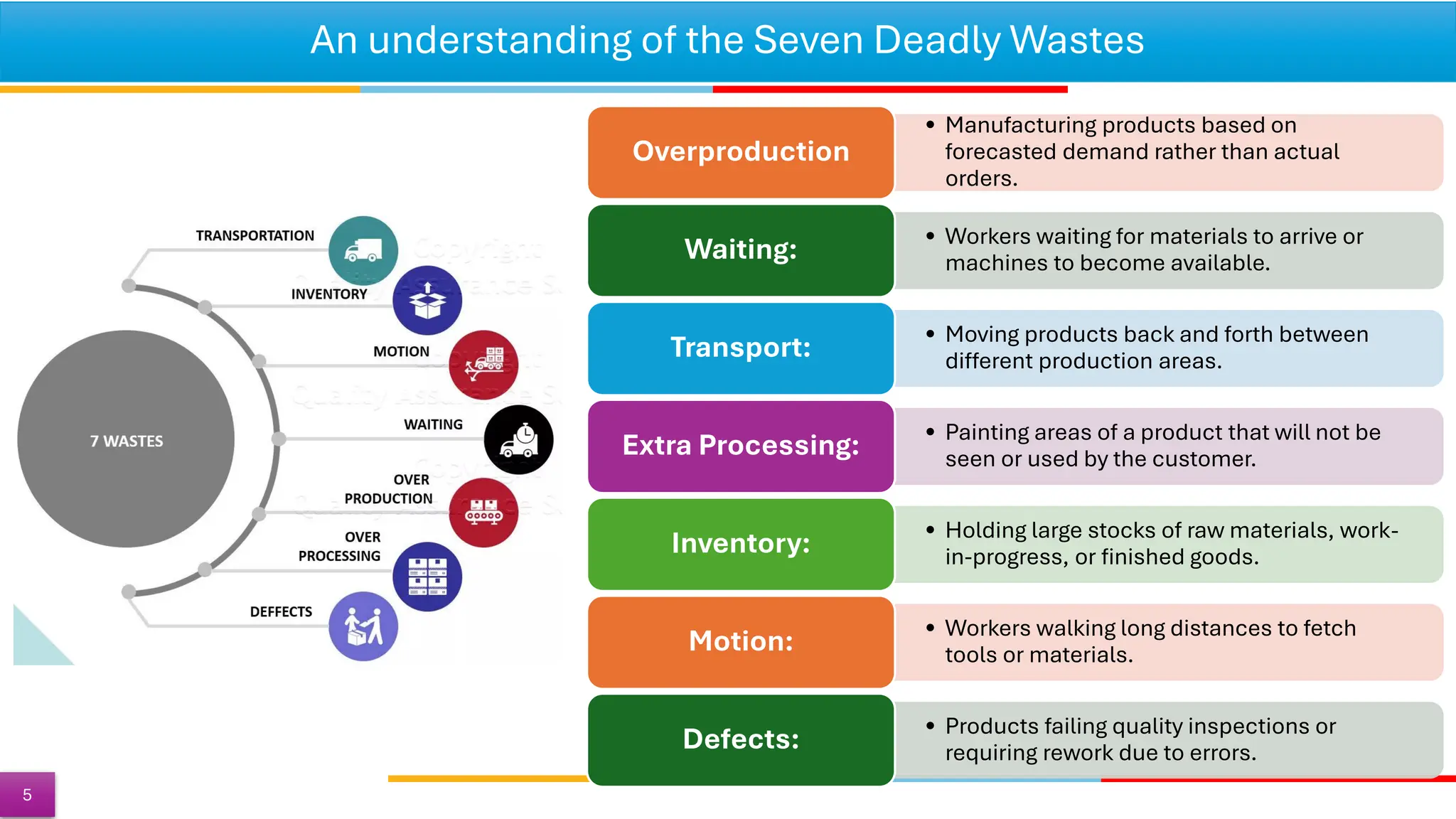
An understanding of the Seven Deadly Wastes
• Manufacturing products based on
forecasted demand rather than actual
orders.
Overproduction
• Workers waiting for materials to arrive or
machines to become available.
Waiting:
• Moving products back and forth between
different production areas.
Transport:
• Painting areas of a product that will not be
seen or used by the customer.
Extra Processing:
• Holding large stocks of raw materials, work-
in-progress, or finished goods.
Inventory:
• Workers walking long distances to fetch
tools or materials.
Motion:
• Products failing quality inspections or
requiring rework due to errors.
Defects:
5
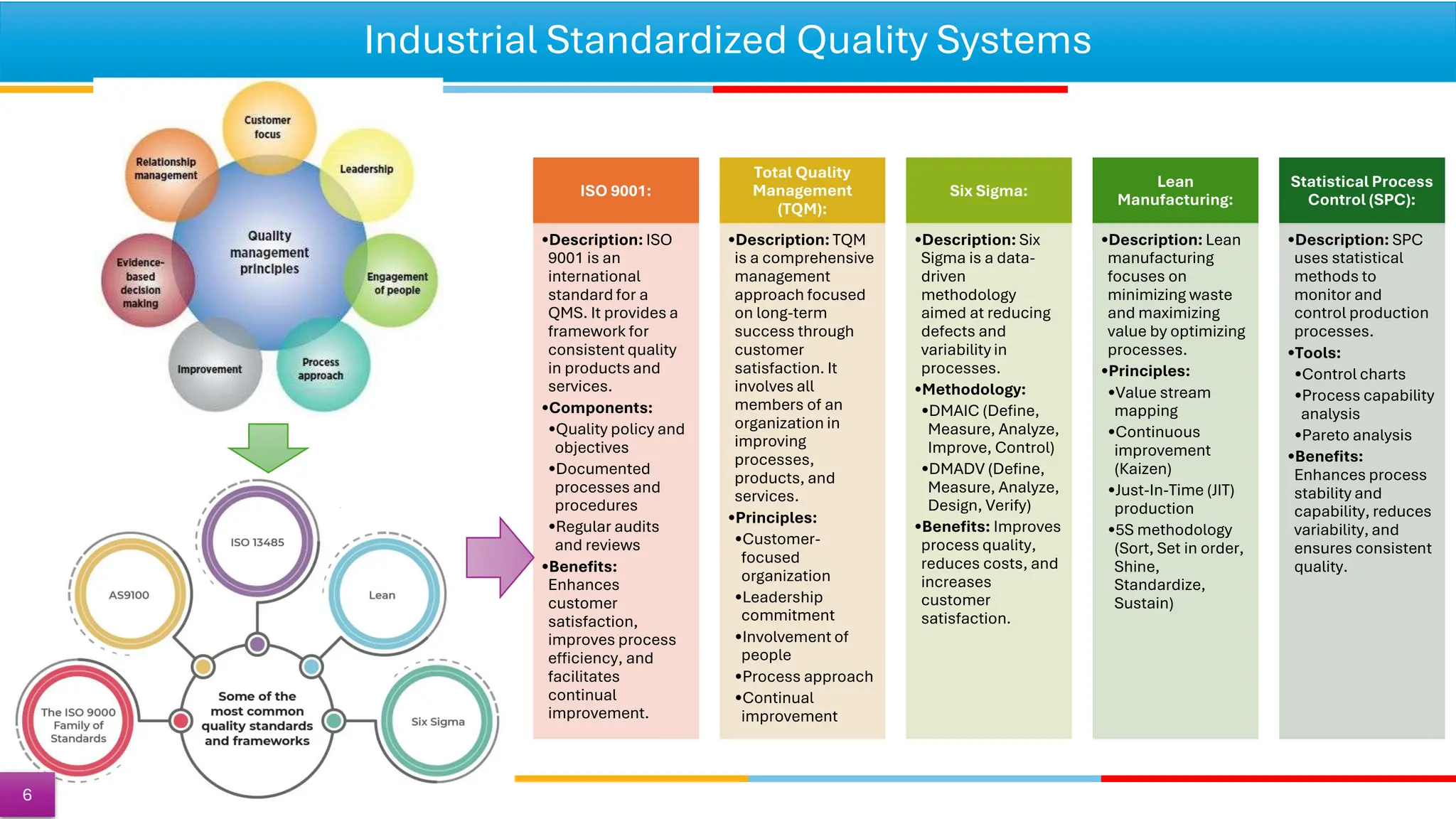
Industrial Standardized Quality Systems
ISO 9001:
•Description: ISO
9001 is an
international
standard for a
QMS. It provides a
framework for
consistent quality
in products and
services.
•Components:
•Quality policy and
objectives
•Documented
processes and
procedures
•Regular audits
and reviews
•Benefits:
Enhances
customer
satisfaction,
improves process
efficiency, and
facilitates
continual
improvement.
Total Quality
Management
(TQM):
•Description: TQM
is a comprehensive
management
approach focused
on long-term
success through
customer
satisfaction. It
involves all
members of an
organization in
improving
processes,
products, and
services.
•Principles:
•Customer-
focused
organization
•Leadership
commitment
•Involvement of
people
•Process approach
•Continual
improvement
Six Sigma:
•Description: Six
Sigma is a data-
driven
methodology
aimed at reducing
defects and
variability in
processes.
•Methodology:
•DMAIC (Define,
Measure, Analyze,
Improve, Control)
•DMADV (Define,
Measure, Analyze,
Design, Verify)
•Benefits: Improves
process quality,
reduces costs, and
increases
customer
satisfaction.
Lean
Manufacturing:
•Description: Lean
manufacturing
focuses on
minimizing waste
and maximizing
value by optimizing
processes.
•Principles:
•Value stream
mapping
•Continuous
improvement
(Kaizen)
•Just-In-Time (JIT)
production
•5S methodology
(Sort, Set in order,
Shine,
Standardize,
Sustain)
Statistical Process
Control (SPC):
•Description: SPC
uses statistical
methods to
monitor and
control production
processes.
•Tools:
•Control charts
•Process capability
analysis
•Pareto analysis
•Benefits:
Enhances process
stability and
capability, reduces
variability, and
ensures consistent
quality.
6
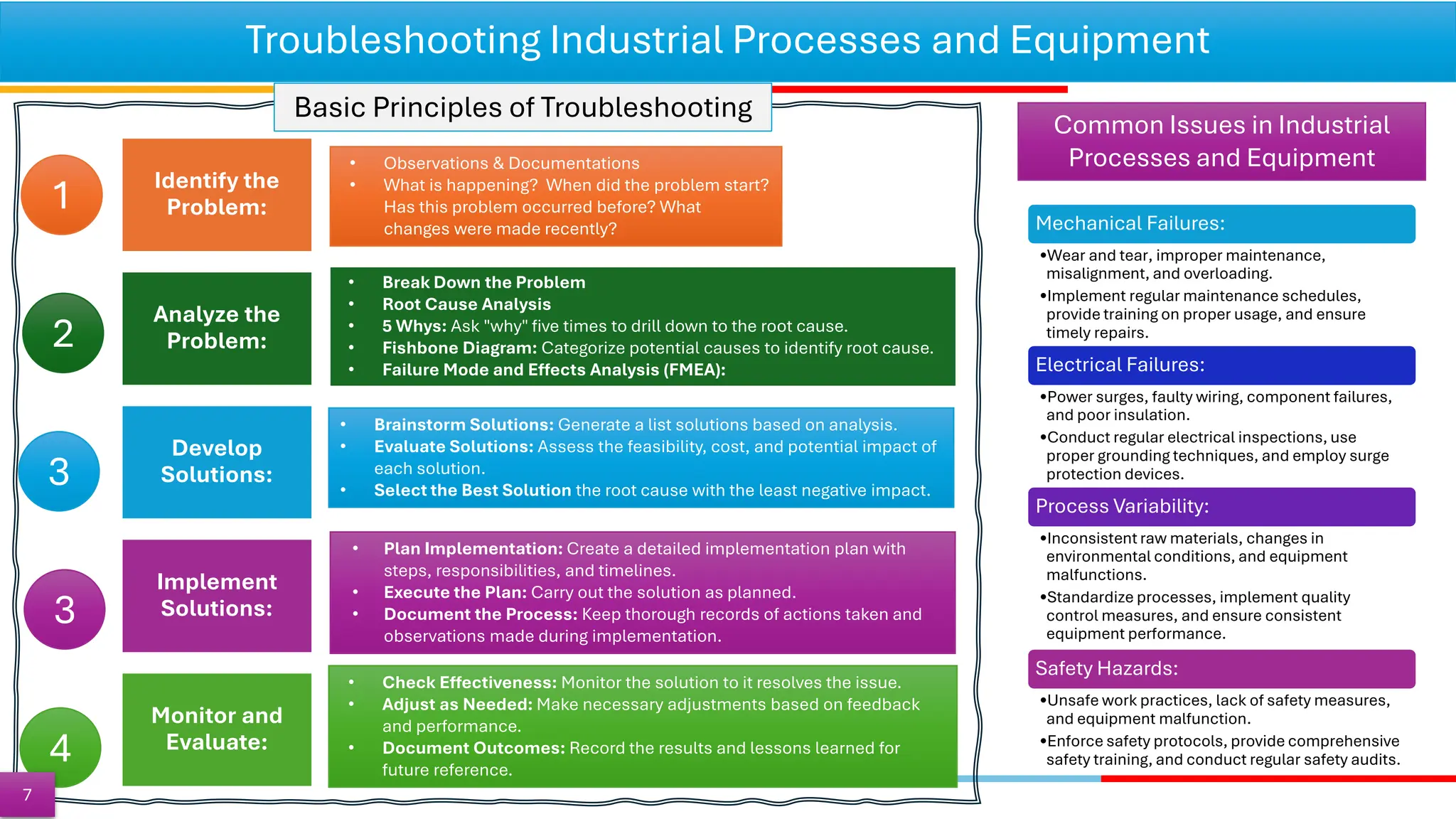
Troubleshooting Industrial Processes and Equipment
Identify the
Problem:
Analyze the
Problem:
Develop
Solutions:
Implement
Solutions:
Monitor and
Evaluate:
• Observations & Documentations
• What is happening? When did the problem start?
Has this problem occurred before? What
changes were made recently?
• Break Down the Problem
• Root Cause Analysis
• 5 Whys: Ask "why" five times to drill down to the root cause.
• Fishbone Diagram: Categorize potential causes to identify root cause.
• Failure Mode and Effects Analysis (FMEA):
• Brainstorm Solutions: Generate a list solutions based on analysis.
• Evaluate Solutions: Assess the feasibility, cost, and potential impact of
each solution.
• Select the Best Solution the root cause with the least negative impact.
• Plan Implementation: Create a detailed implementation plan with
steps, responsibilities, and timelines.
• Execute the Plan: Carry out the solution as planned.
• Document the Process: Keep thorough records of actions taken and
observations made during implementation.
• Check Effectiveness: Monitor the solution to it resolves the issue.
• Adjust as Needed: Make necessary adjustments based on feedback
and performance.
• Document Outcomes: Record the results and lessons learned for
future reference.
1
2
3
3
4
Mechanical Failures:
•Wear and tear, improper maintenance,
misalignment, and overloading.
•Implement regular maintenance schedules,
provide training on proper usage, and ensure
timely repairs.
Electrical Failures:
•Power surges, faulty wiring, component failures,
and poor insulation.
•Conduct regular electrical inspections, use
proper grounding techniques, and employ surge
protection devices.
Process Variability:
•Inconsistent raw materials, changes in
environmental conditions, and equipment
malfunctions.
•Standardize processes, implement quality
control measures, and ensure consistent
equipment performance.
Safety Hazards:
•Unsafe work practices, lack of safety measures,
and equipment malfunction.
•Enforce safety protocols, provide comprehensive
safety training, and conduct regular safety audits.
Basic Principles of Troubleshooting
Common Issues in Industrial
Processes and Equipment
7
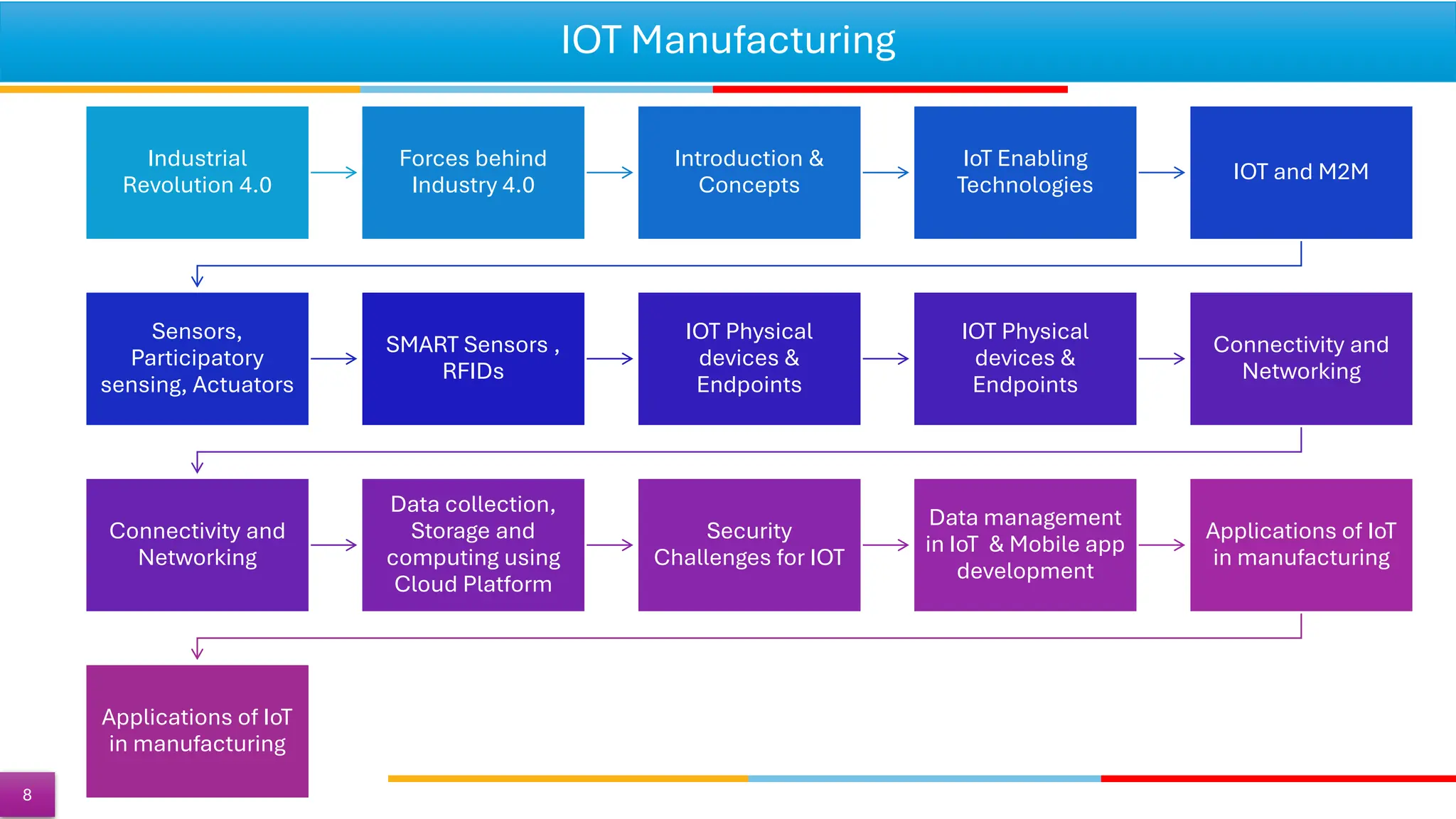
IOT Manufacturing
Industrial
Revolution 4.0
Forces behind
Industry 4.0
Introduction &
Concepts
IoT Enabling
Technologies
IOT and M2M
Sensors,
Participatory
sensing, Actuators
SMART Sensors ,
RFIDs
IOT Physical
devices &
Endpoints
IOT Physical
devices &
Endpoints
Connectivity and
Networking
Connectivity and
Networking
Data collection,
Storage and
computing using
Cloud Platform
Security
Challenges for IOT
Data management
in IoT & Mobile app
development
Applications of IoT
in manufacturing
Applications of IoT
in manufacturing
8
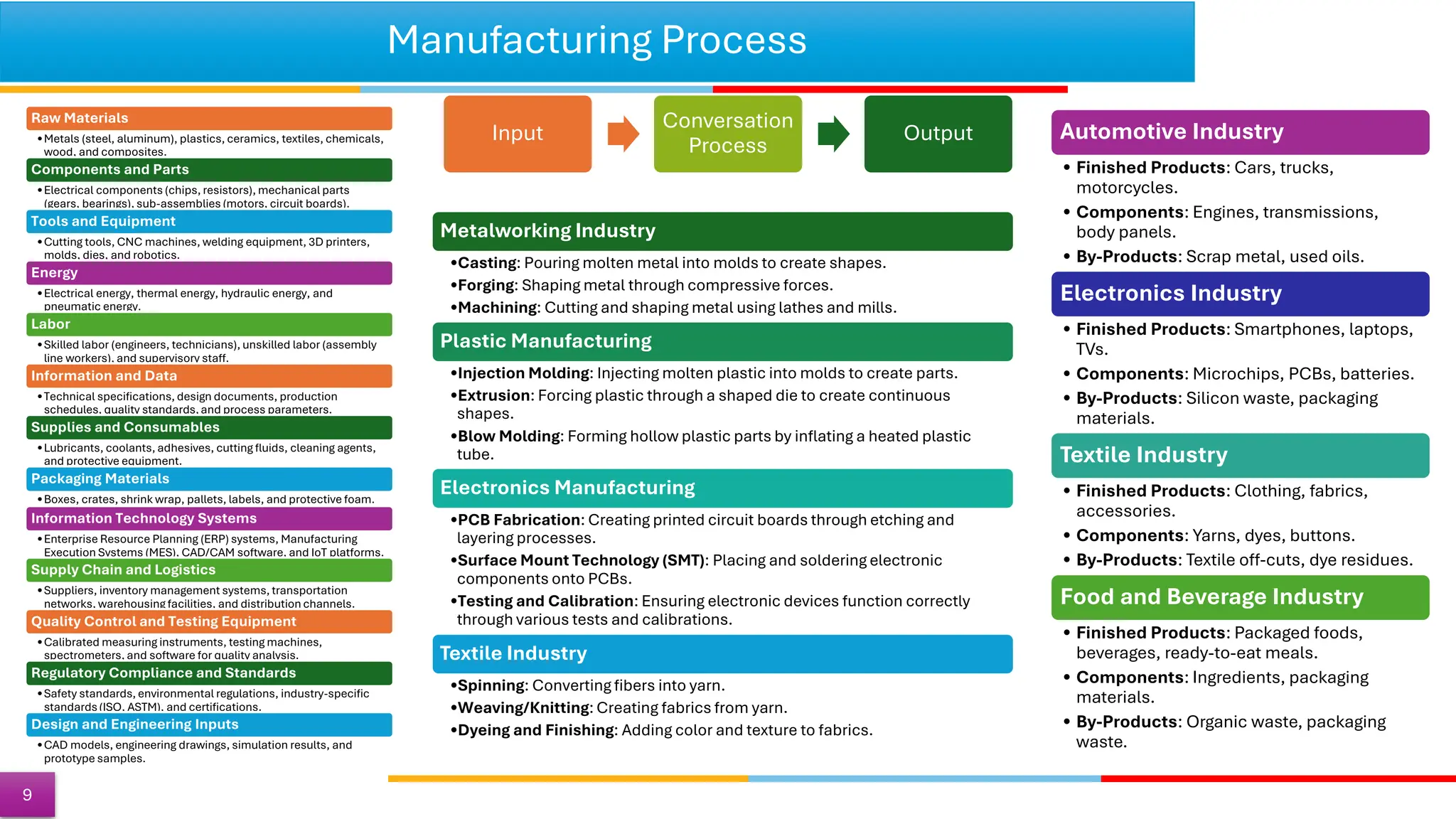
Manufacturing Process
Input
Conversation
Process
Output
Metalworking Industry
•Casting: Pouring molten metal into molds to create shapes.
•Forging: Shaping metal through compressive forces.
•Machining: Cutting and shaping metal using lathes and mills.
Plastic Manufacturing
•Injection Molding: Injecting molten plastic into molds to create parts.
•Extrusion: Forcing plastic through a shaped die to create continuous
shapes.
•Blow Molding: Forming hollow plastic parts by inflating a heated plastic
tube.
Electronics Manufacturing
•PCB Fabrication: Creating printed circuit boards through etching and
layering processes.
•Surface Mount Technology (SMT): Placing and soldering electronic
components onto PCBs.
•Testing and Calibration: Ensuring electronic devices function correctly
through various tests and calibrations.
Textile Industry
•Spinning: Converting fibers into yarn.
•Weaving/Knitting: Creating fabrics from yarn.
•Dyeing and Finishing: Adding color and texture to fabrics.
Automotive Industry
• Finished Products: Cars, trucks,
motorcycles.
• Components: Engines, transmissions,
body panels.
• By-Products: Scrap metal, used oils.
Electronics Industry
• Finished Products: Smartphones, laptops,
TVs.
• Components: Microchips, PCBs, batteries.
• By-Products: Silicon waste, packaging
materials.
Textile Industry
• Finished Products: Clothing, fabrics,
accessories.
• Components: Yarns, dyes, buttons.
• By-Products: Textile off-cuts, dye residues.
Food and Beverage Industry
• Finished Products: Packaged foods,
beverages, ready-to-eat meals.
• Components: Ingredients, packaging
materials.
• By-Products: Organic waste, packaging
waste.
9
Raw Materials
•Metals (steel, aluminum), plastics, ceramics, textiles, chemicals,
wood, and composites.
Components and Parts
•Electrical components (chips, resistors), mechanical parts
(gears, bearings), sub-assemblies (motors, circuit boards).
Tools and Equipment
•Cutting tools, CNC machines, welding equipment, 3D printers,
molds, dies, and robotics.
Energy
•Electrical energy, thermal energy, hydraulic energy, and
pneumatic energy.
Labor
•Skilled labor (engineers, technicians), unskilled labor (assembly
line workers), and supervisory staff.
Information and Data
•Technical specifications, design documents, production
schedules, quality standards,and process parameters.
Supplies and Consumables
•Lubricants, coolants, adhesives, cutting fluids, cleaning agents,
and protective equipment.
Packaging Materials
•Boxes, crates, shrink wrap, pallets, labels, and protective foam.
Information Technology Systems
•Enterprise Resource Planning (ERP) systems, Manufacturing
Execution Systems (MES), CAD/CAM software, and IoT platforms.
Supply Chain and Logistics
•Suppliers, inventory management systems, transportation
networks, warehousing facilities, and distribution channels.
Quality Control and Testing Equipment
•Calibrated measuring instruments, testing machines,
spectrometers, and software for quality analysis.
Regulatory Compliance and Standards
•Safety standards, environmental regulations, industry-specific
standards(ISO, ASTM), and certifications.
Design and Engineering Inputs
•CAD models, engineering drawings, simulation results, and
prototype samples.
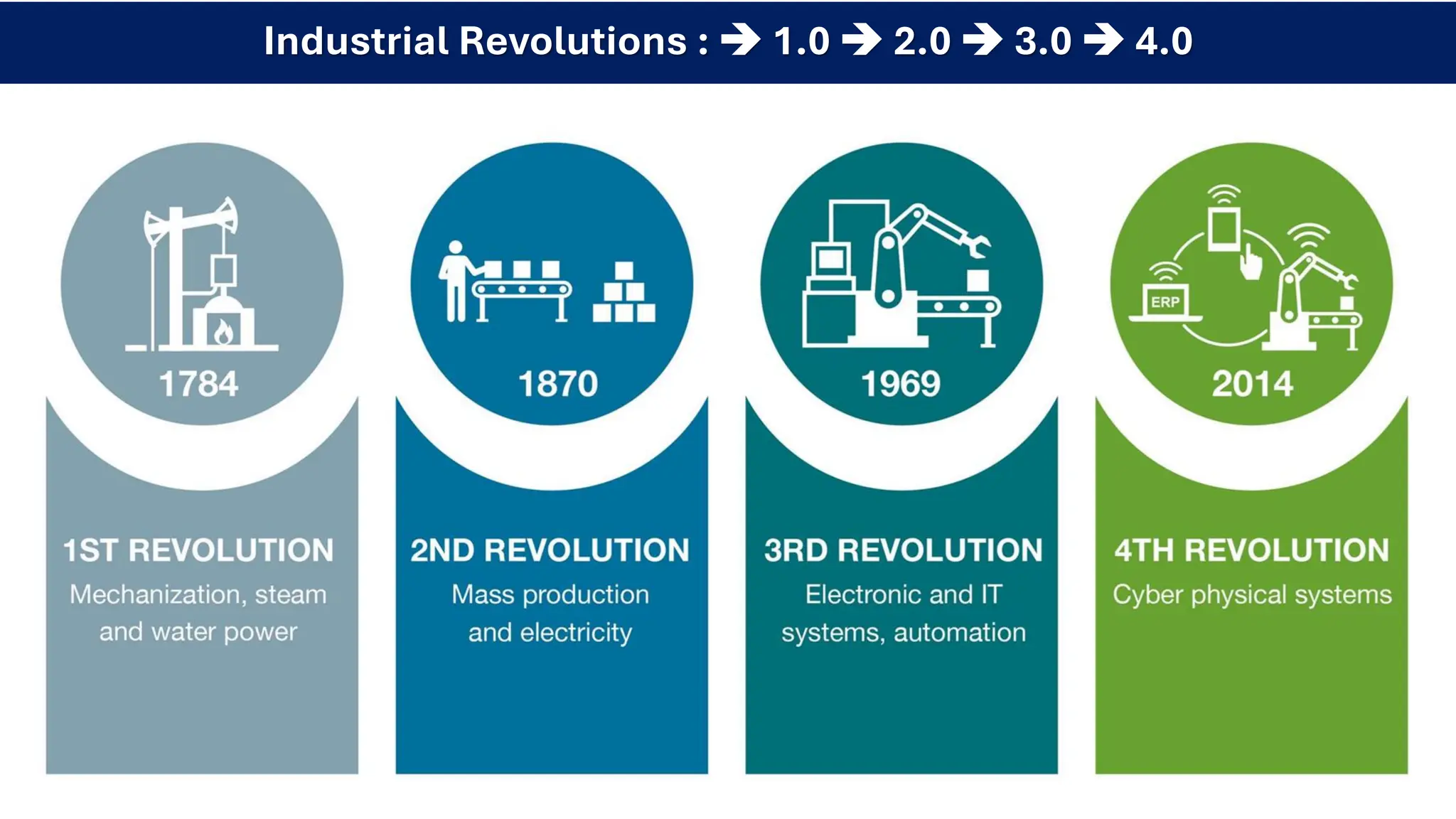
Industrial Revolutions : ➔ 1.0 ➔ 2.0 ➔ 3.0 ➔ 4.0
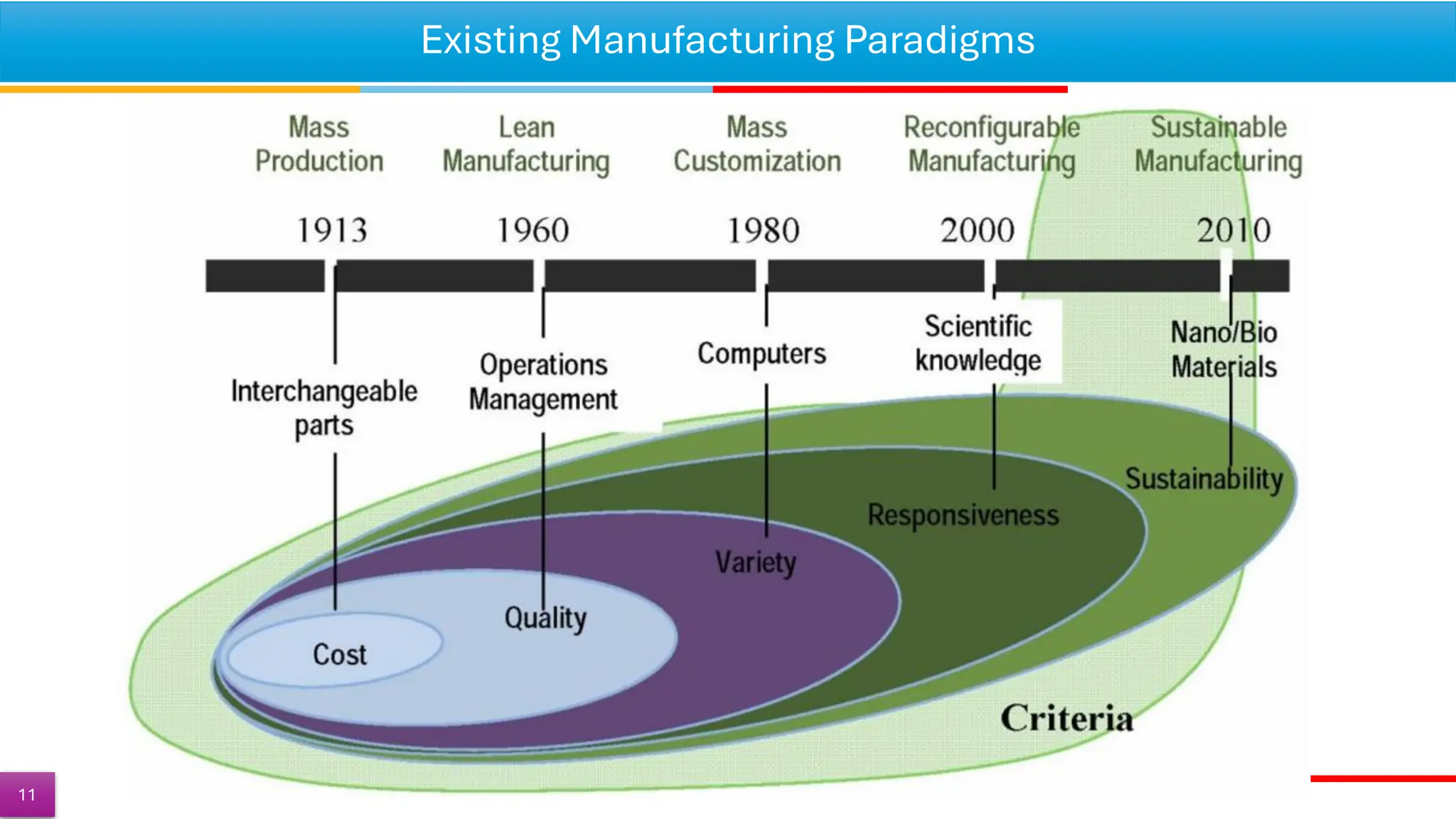
Existing Manufacturing Paradigms
11
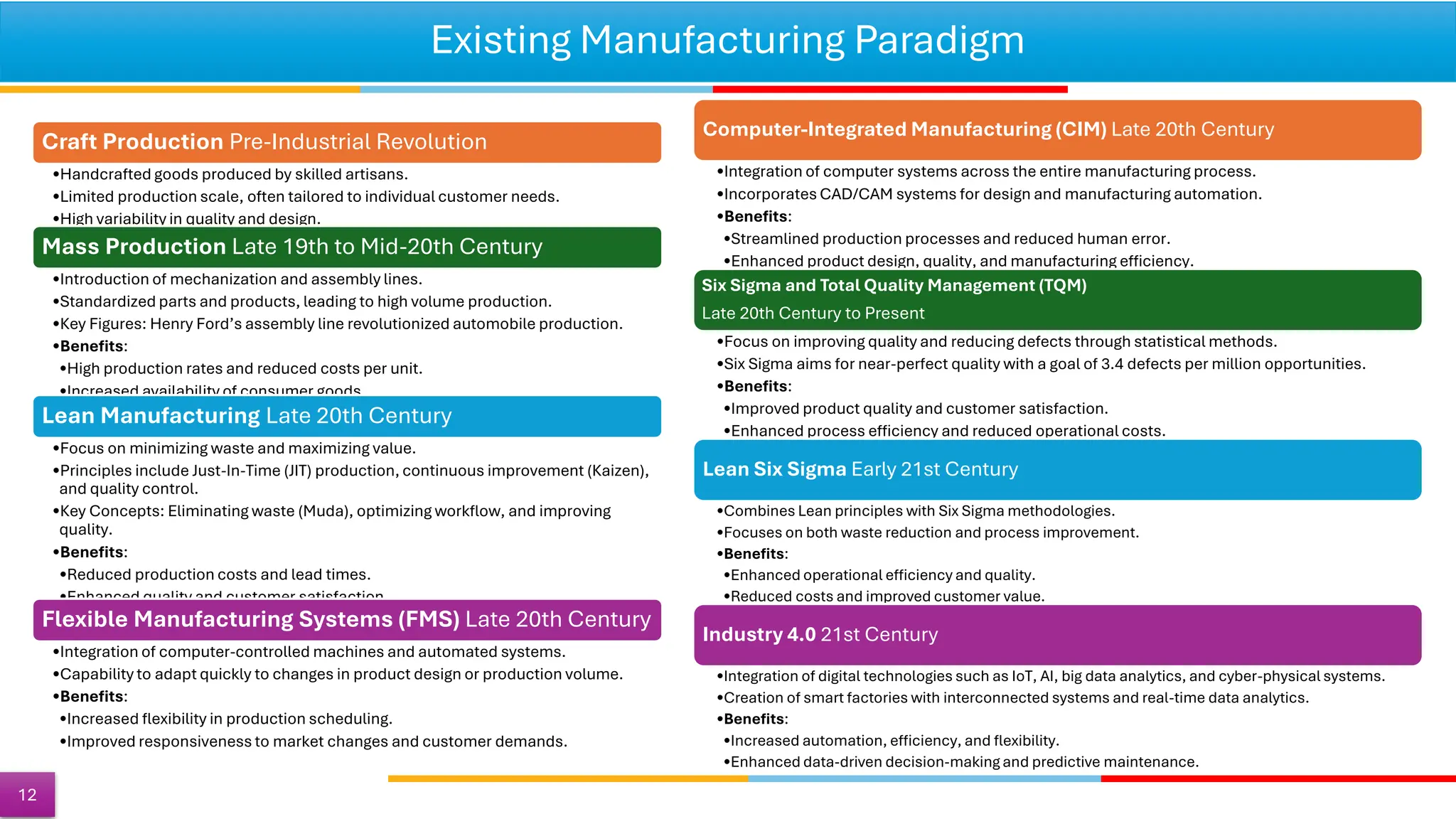
Existing Manufacturing Paradigm
Craft Production Pre-Industrial Revolution
•Handcrafted goods produced by skilled artisans.
•Limited production scale, often tailored to individual customer needs.
•High variability in quality and design.
Mass Production Late 19th to Mid-20th Century
•Introduction of mechanization and assembly lines.
•Standardized parts and products, leading to high volume production.
•Key Figures: Henry Ford’s assembly line revolutionized automobile production.
•Benefits:
•High production rates and reduced costs per unit.
•Increased availability of consumer goods.
Lean Manufacturing Late 20th Century
•Focus on minimizing waste and maximizing value.
•Principles include Just-In-Time (JIT) production, continuous improvement (Kaizen),
and quality control.
•Key Concepts: Eliminating waste (Muda), optimizing workflow, and improving
quality.
•Benefits:
•Reduced production costs and lead times.
•Enhanced quality and customer satisfaction.
Flexible Manufacturing Systems (FMS) Late 20th Century
•Integration of computer-controlled machines and automated systems.
•Capability to adapt quickly to changes in product design or production volume.
•Benefits:
•Increased flexibility in production scheduling.
•Improved responsiveness to market changes and customer demands.
Computer-Integrated Manufacturing (CIM) Late 20th Century
•Integration of computer systems across the entire manufacturing process.
•Incorporates CAD/CAM systems for design and manufacturing automation.
•Benefits:
•Streamlined production processes and reduced human error.
•Enhanced product design, quality, and manufacturing efficiency.
Six Sigma and Total Quality Management (TQM)
Late 20th Century to Present
•Focus on improving quality and reducing defects through statistical methods.
•Six Sigma aims for near-perfect quality with a goal of 3.4 defects per million opportunities.
•Benefits:
•Improved product quality and customer satisfaction.
•Enhanced process efficiency and reduced operational costs.
Lean Six Sigma Early 21st Century
•Combines Lean principles with Six Sigma methodologies.
•Focuses on both waste reduction and process improvement.
•Benefits:
•Enhanced operational efficiency and quality.
•Reduced costs and improved customer value.
Industry 4.0 21st Century
•Integration of digital technologies such as IoT, AI, big data analytics, and cyber-physical systems.
•Creation of smart factories with interconnected systems and real-time data analytics.
•Benefits:
•Increased automation, efficiency, and flexibility.
•Enhanced data-driven decision-making and predictive maintenance.
12
Existing Manufacturing Paradigm
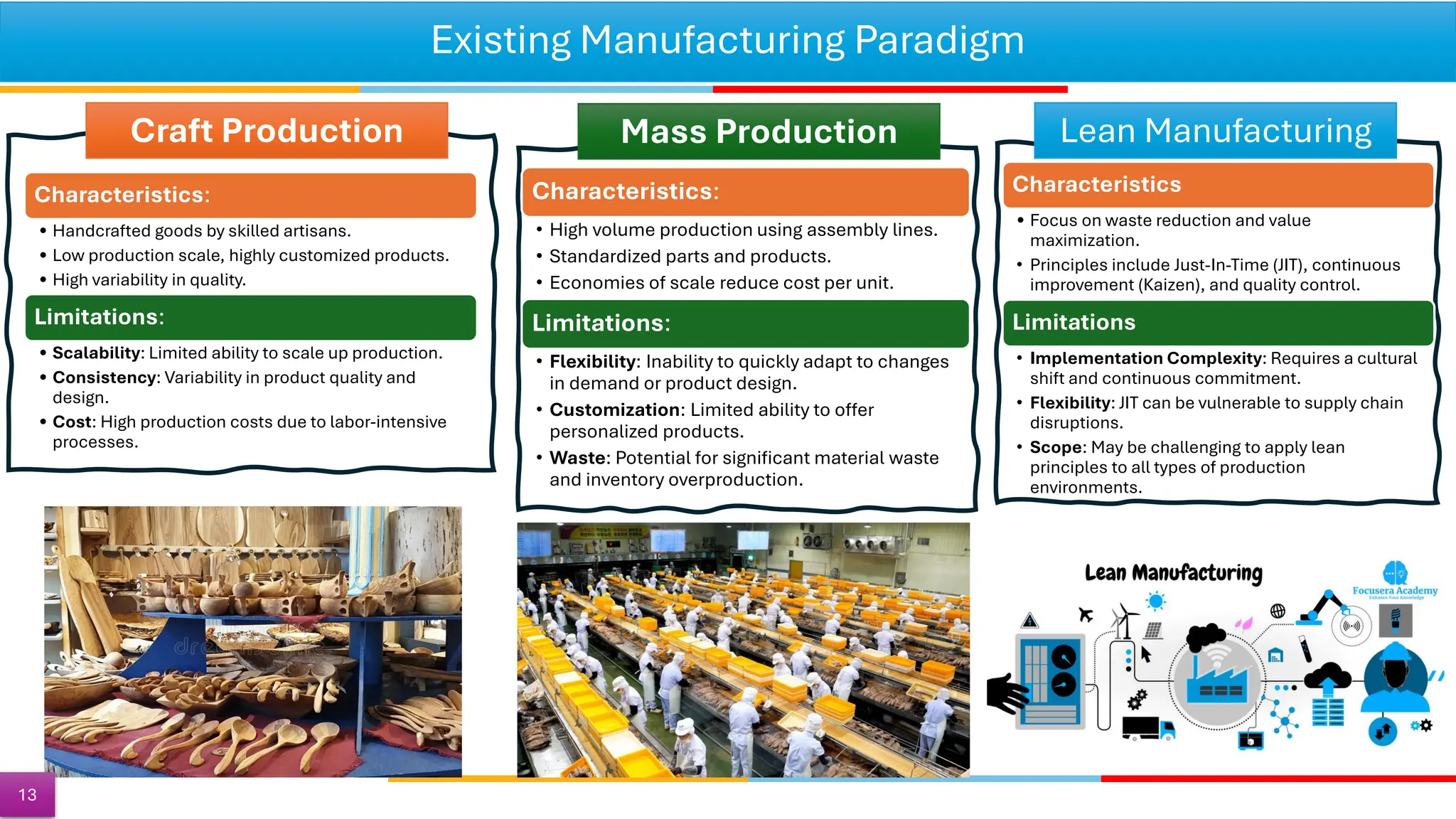
Characteristics:
• Handcrafted goods by skilled artisans.
• Low production scale, highly customized products.
• High variability in quality.
Limitations:
• Scalability: Limited ability to scale up production.
• Consistency: Variability in product quality and
design.
• Cost: High production costs due to labor-intensive
processes.
Craft Production
Characteristics:
• High volume production using assembly lines.
• Standardized parts and products.
• Economies of scale reduce cost per unit.
Limitations:
• Flexibility: Inability to quickly adapt to changes
in demand or product design.
• Customization: Limited ability to offer
personalized products.
• Waste: Potential for significant material waste
and inventory overproduction.
Mass Production
Characteristics
• Focus on waste reduction and value
maximization.
• Principles include Just-In-Time (JIT), continuous
improvement (Kaizen), and quality control.
Limitations
• Implementation Complexity: Requires a cultural
shift and continuous commitment.
• Flexibility: JIT can be vulnerable to supply chain
disruptions.
• Scope: May be challenging to apply lean
principles to all types of production
environments.
Lean Manufacturing
13
Existing Manufacturing Paradigm
Characteristics:
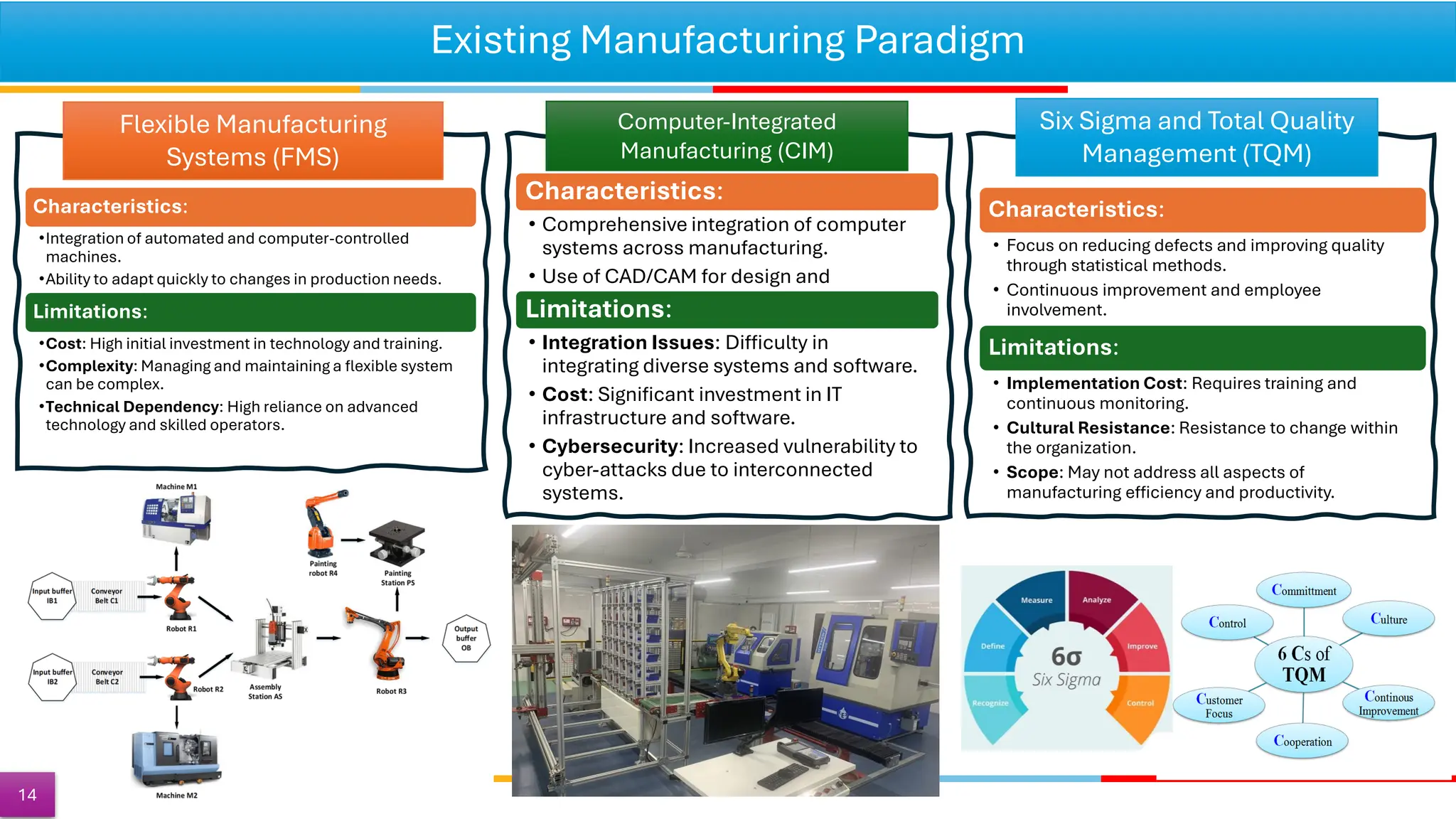
•Integration of automated and computer-controlled
machines.
•Ability to adapt quickly to changes in production needs.
Limitations:
•Cost: High initial investment in technology and training.
•Complexity: Managing and maintaining a flexible system
can be complex.
•Technical Dependency: High reliance on advanced
technology and skilled operators.
Flexible Manufacturing
Systems (FMS)
Characteristics:
• Focus on reducing defects and improving quality
through statistical methods.
• Continuous improvement and employee
involvement.
Limitations:
• Implementation Cost: Requires training and
continuous monitoring.
• Cultural Resistance: Resistance to change within
the organization.
• Scope: May not address all aspects of
manufacturing efficiency and productivity.
Computer-Integrated
Manufacturing (CIM)
Characteristics:
• Comprehensive integration of computer
systems across manufacturing.
• Use of CAD/CAM for design and
automation.
Limitations:
• Integration Issues: Difficulty in
integrating diverse systems and software.
• Cost: Significant investment in IT
infrastructure and software.
• Cybersecurity: Increased vulnerability to
cyber-attacks due to interconnected
systems.
Six Sigma and Total Quality
Management (TQM)
14
Existing Manufacturing Paradigm
Characteristics:
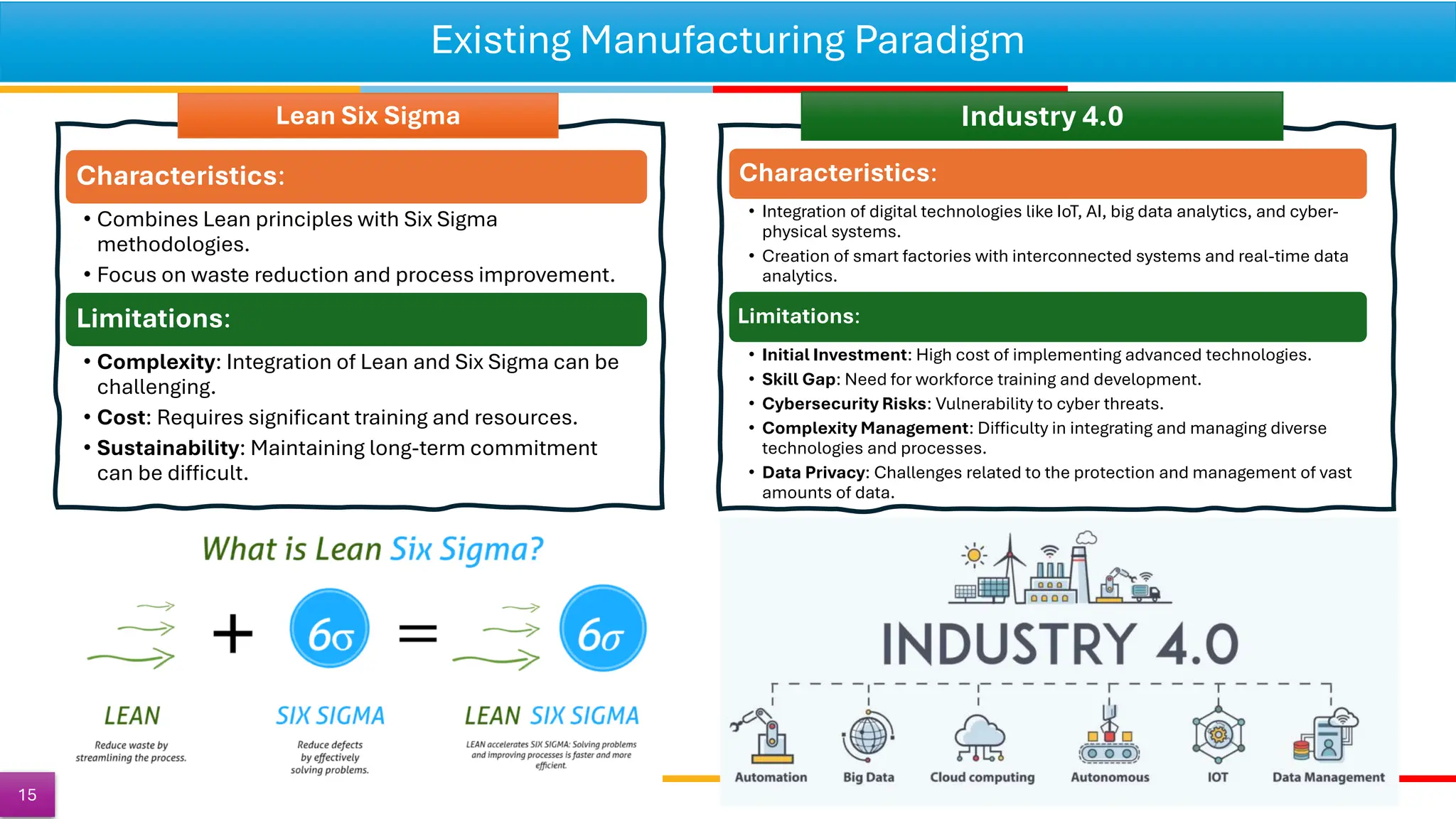
• Combines Lean principles with Six Sigma
methodologies.
• Focus on waste reduction and process improvement.
Limitations:
• Complexity: Integration of Lean and Six Sigma can be
challenging.
• Cost: Requires significant training and resources.
• Sustainability: Maintaining long-term commitment
can be difficult.
Lean Six Sigma Industry 4.0
Characteristics:
• Integration of digital technologies like IoT, AI, big data analytics, and cyber-
physical systems.
• Creation of smart factories with interconnected systems and real-time data
analytics.
Limitations:
• Initial Investment: High cost of implementing advanced technologies.
• Skill Gap: Need for workforce training and development.
• Cybersecurity Risks: Vulnerability to cyber threats.
• Complexity Management: Difficulty in integrating and managing diverse
technologies and processes.
• Data Privacy: Challenges related to the protection and management of vast
amounts of data.
15
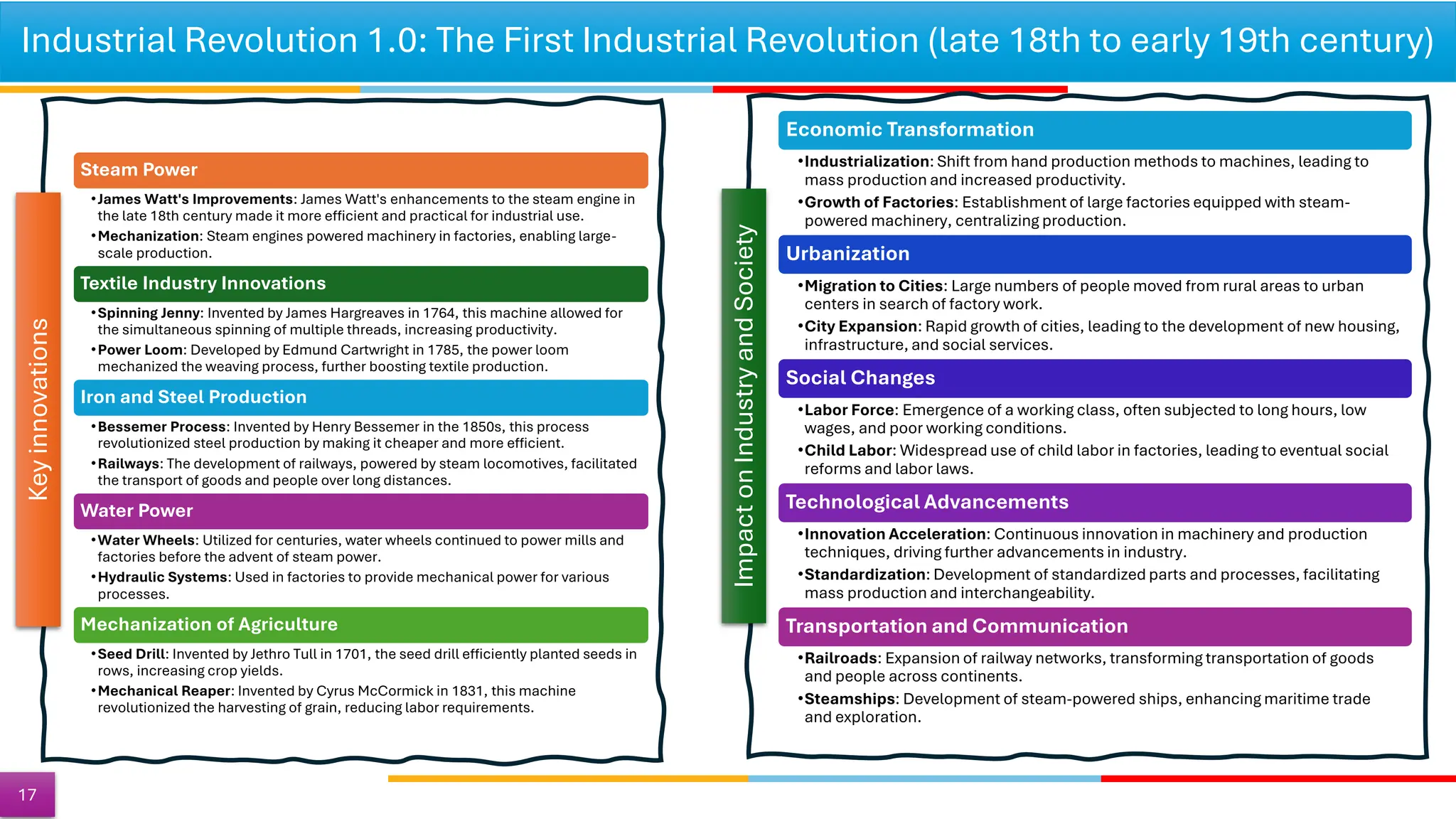
Industrial Revolution 1.0: The First Industrial Revolution (late 18th to early 19th century)
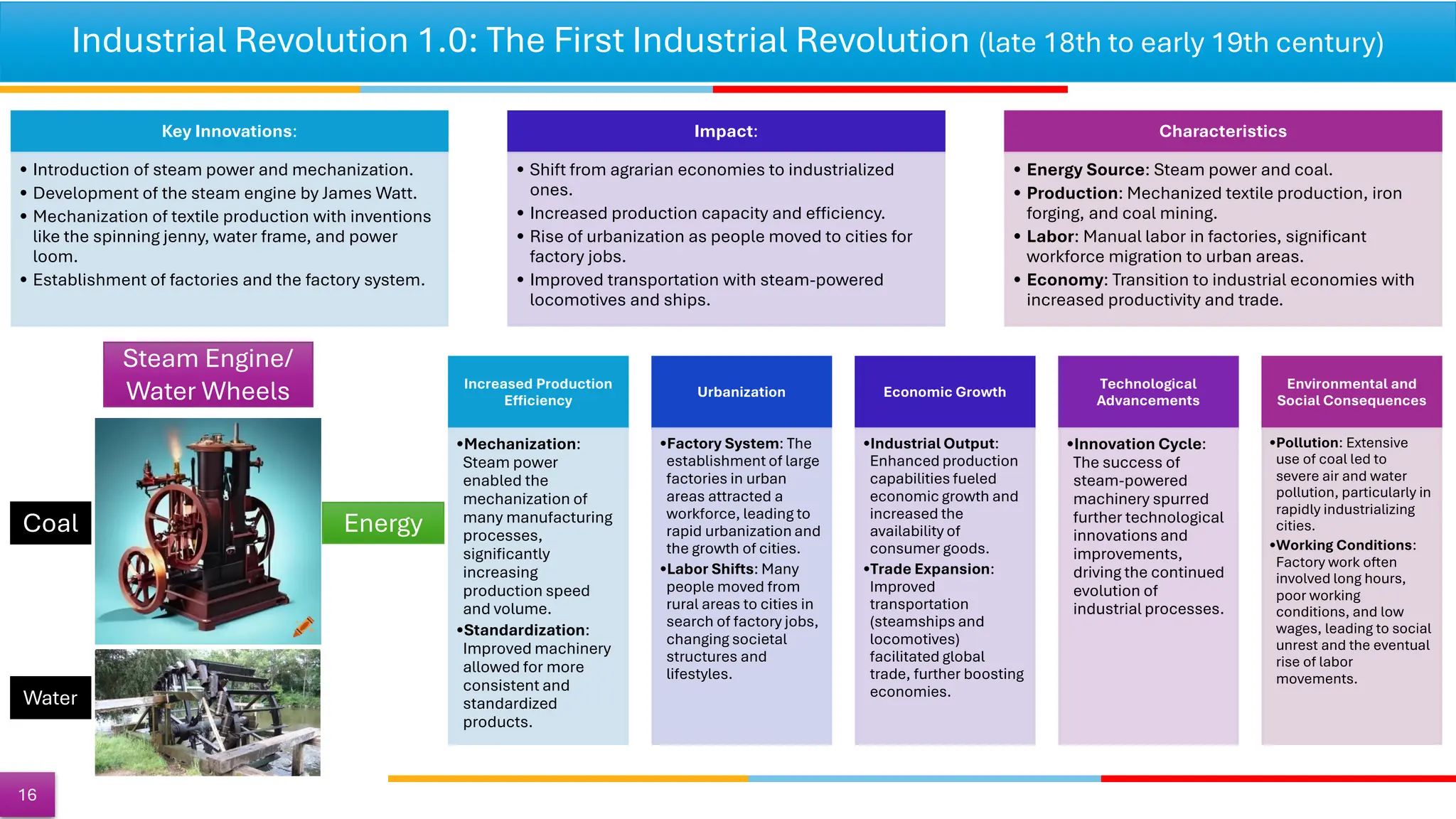
Key Innovations:
• Introduction of steam power and mechanization.
• Development of the steam engine by James Watt.
• Mechanization of textile production with inventions
like the spinning jenny, water frame, and power
loom.
• Establishment of factories and the factory system.
Impact:
• Shift from agrarian economies to industrialized
ones.
• Increased production capacity and efficiency.
• Rise of urbanization as people moved to cities for
factory jobs.
• Improved transportation with steam-powered
locomotives and ships.
Characteristics
• Energy Source: Steam power and coal.
• Production: Mechanized textile production, iron
forging, and coal mining.
• Labor: Manual labor in factories, significant
workforce migration to urban areas.
• Economy: Transition to industrial economies with
increased productivity and trade.
16
Coal Energy
Steam Engine/
Water Wheels Increased Production
Efficiency
•Mechanization:
Steam power
enabled the
mechanization of
many manufacturing
processes,
significantly
increasing
production speed
and volume.
•Standardization:
Improved machinery
allowed for more
consistent and
standardized
products.
Urbanization
•Factory System: The
establishment of large
factories in urban
areas attracted a
workforce, leading to
rapid urbanization and
the growth of cities.
•Labor Shifts: Many
people moved from
rural areas to cities in
search of factory jobs,
changing societal
structures and
lifestyles.
Economic Growth
•Industrial Output:
Enhanced production
capabilities fueled
economic growth and
increased the
availability of
consumer goods.
•Trade Expansion:
Improved
transportation
(steamships and
locomotives)
facilitated global
trade, further boosting
economies.
Technological
Advancements
•Innovation Cycle:
The success of
steam-powered
machinery spurred
further technological
innovations and
improvements,
driving the continued
evolution of
industrial processes.
Environmental and
Social Consequences
•Pollution: Extensive
use of coal led to
severe air and water
pollution, particularly in
rapidly industrializing
cities.
•Working Conditions:
Factory work often
involved long hours,
poor working
conditions, and low
wages, leading to social
unrest and the eventual
rise of labor
movements.
Water
Industrial Revolution 1.0: The First Industrial Revolution (late 18th to early 19th century)
17
Steam Power
•James Watt's Improvements: James Watt's enhancements to the steam engine in
the late 18th century made it more efficient and practical for industrial use.
•Mechanization: Steam engines powered machinery in factories, enabling large-
scale production.
Textile Industry Innovations
•Spinning Jenny: Invented by James Hargreaves in 1764, this machine allowed for
the simultaneous spinning of multiple threads, increasing productivity.
•Power Loom: Developed by Edmund Cartwright in 1785, the power loom
mechanized the weaving process, further boosting textile production.
Iron and Steel Production
•Bessemer Process: Invented by Henry Bessemer in the 1850s, this process
revolutionized steel production by making it cheaper and more efficient.
•Railways: The development of railways, powered by steam locomotives, facilitated
the transport of goods and people over long distances.
Water Power
•Water Wheels: Utilized for centuries, water wheels continued to power mills and
factories before the advent of steam power.
•Hydraulic Systems: Used in factories to provide mechanical power for various
processes.
Mechanization of Agriculture
•Seed Drill: Invented by Jethro Tull in 1701, the seed drill efficiently planted seeds in
rows, increasing crop yields.
•Mechanical Reaper: Invented by Cyrus McCormick in 1831, this machine
revolutionized the harvesting of grain, reducing labor requirements.
Key
innovations
Economic Transformation
•Industrialization: Shift from hand production methods to machines, leading to
mass production and increased productivity.
•Growth of Factories: Establishment of large factories equipped with steam-
powered machinery, centralizing production.
Urbanization
•Migration to Cities: Large numbers of people moved from rural areas to urban
centers in search of factory work.
•City Expansion: Rapid growth of cities, leading to the development of new housing,
infrastructure, and social services.
Social Changes
•Labor Force: Emergence of a working class, often subjected to long hours, low
wages, and poor working conditions.
•Child Labor: Widespread use of child labor in factories, leading to eventual social
reforms and labor laws.
Technological Advancements
•Innovation Acceleration: Continuous innovation in machinery and production
techniques, driving further advancements in industry.
•Standardization: Development of standardized parts and processes, facilitating
mass production and interchangeability.
Transportation and Communication
•Railroads: Expansion of railway networks, transforming transportation of goods
and people across continents.
•Steamships: Development of steam-powered ships, enhancing maritime trade
and exploration.
Impact
on
Industry
and
Society
Technologies Developed During the First Industrial Revolution (Industry 1.0)
18
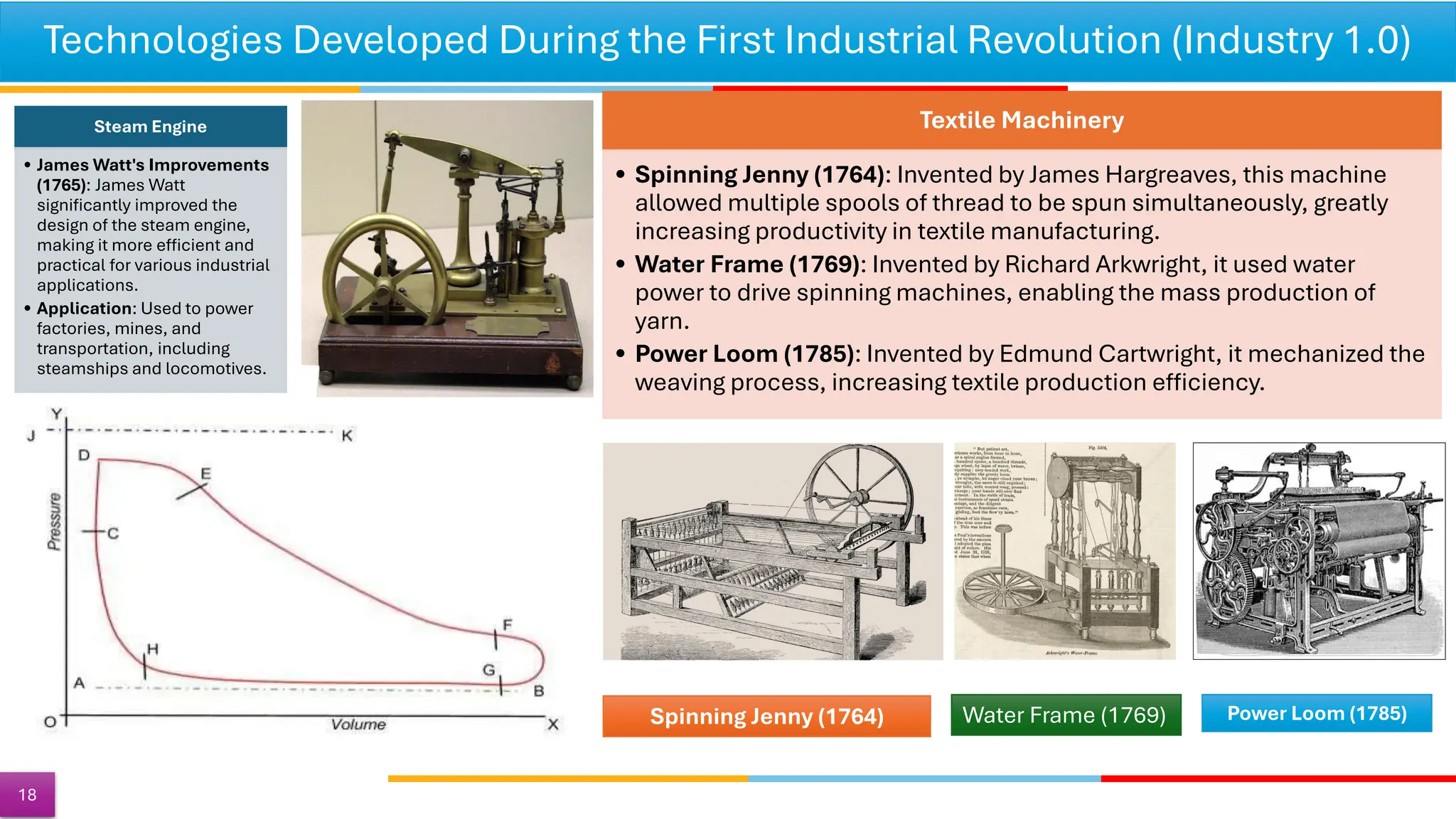
Steam Engine
• James Watt's Improvements
(1765): James Watt
significantly improved the
design of the steam engine,
making it more efficient and
practical for various industrial
applications.
• Application: Used to power
factories, mines, and
transportation, including
steamships and locomotives.
Textile Machinery
• Spinning Jenny (1764): Invented by James Hargreaves, this machine
allowed multiple spools of thread to be spun simultaneously, greatly
increasing productivity in textile manufacturing.
• Water Frame (1769): Invented by Richard Arkwright, it used water
power to drive spinning machines, enabling the mass production of
yarn.
• Power Loom (1785): Invented by Edmund Cartwright, it mechanized the
weaving process, increasing textile production efficiency.
Spinning Jenny (1764) Water Frame (1769) Power Loom (1785)
Technologies Developed During the First Industrial Revolution (Industry 1.0)
19
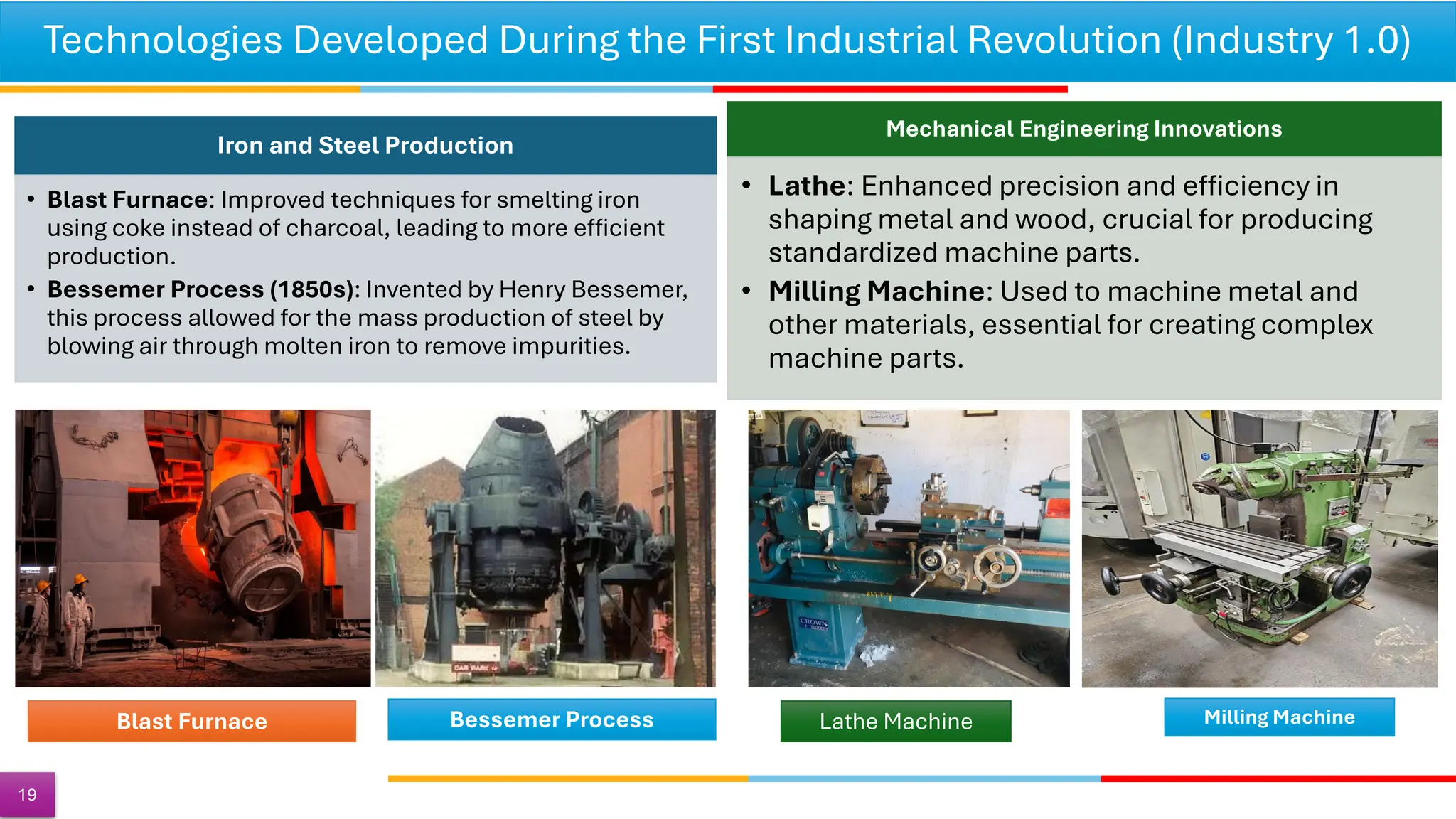
Iron and Steel Production
• Blast Furnace: Improved techniques for smelting iron
using coke instead of charcoal, leading to more efficient
production.
• Bessemer Process (1850s): Invented by Henry Bessemer,
this process allowed for the mass production of steel by
blowing air through molten iron to remove impurities.
Mechanical Engineering Innovations
• Lathe: Enhanced precision and efficiency in
shaping metal and wood, crucial for producing
standardized machine parts.
• Milling Machine: Used to machine metal and
other materials, essential for creating complex
machine parts.
Blast Furnace Lathe Machine Milling Machine
Bessemer Process
Technologies Developed During the First Industrial Revolution (Industry 1.0)
20
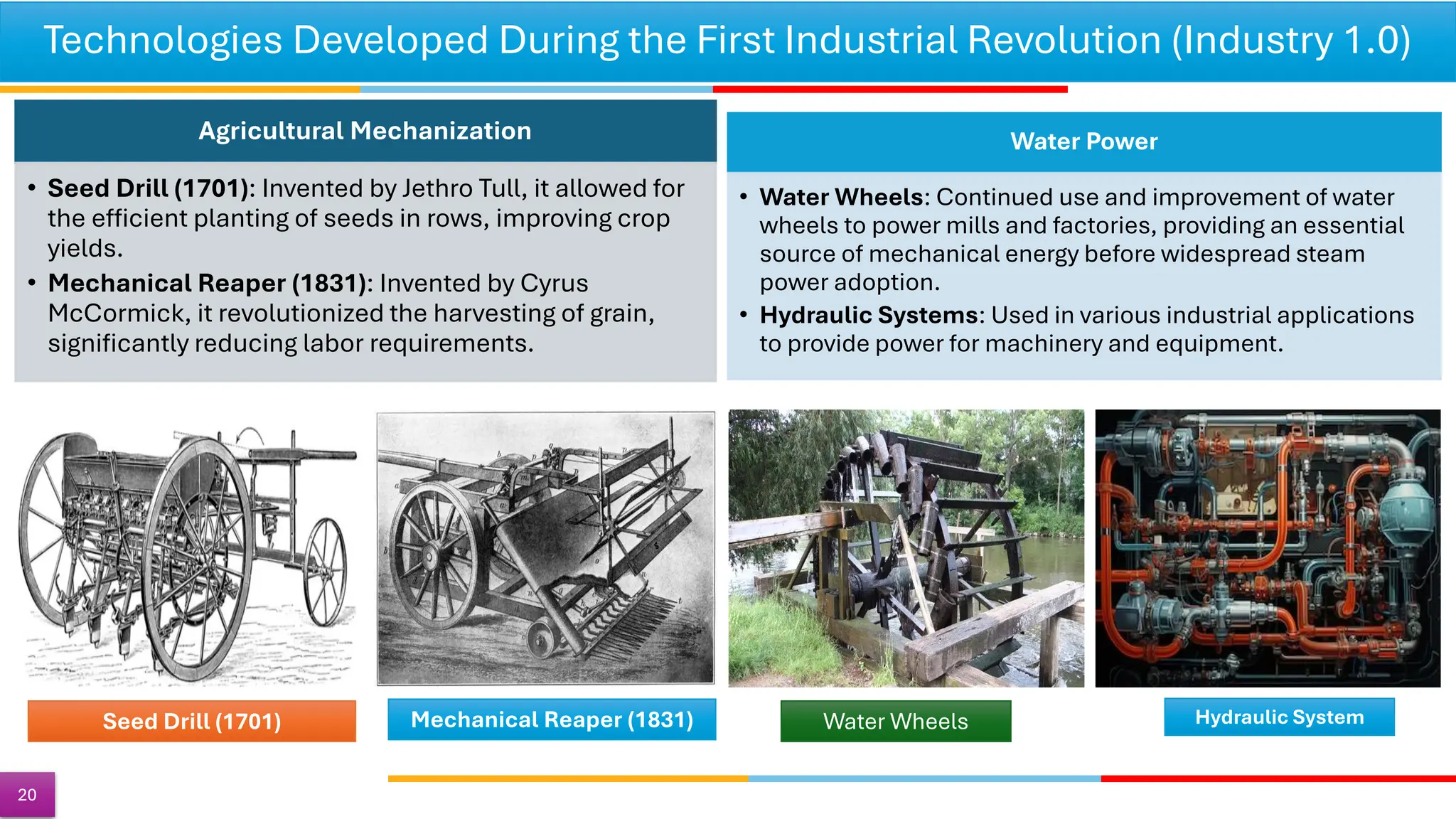
Agricultural Mechanization
• Seed Drill (1701): Invented by Jethro Tull, it allowed for
the efficient planting of seeds in rows, improving crop
yields.
• Mechanical Reaper (1831): Invented by Cyrus
McCormick, it revolutionized the harvesting of grain,
significantly reducing labor requirements.
Water Power
• Water Wheels: Continued use and improvement of water
wheels to power mills and factories, providing an essential
source of mechanical energy before widespread steam
power adoption.
• Hydraulic Systems: Used in various industrial applications
to provide power for machinery and equipment.
Seed Drill (1701) Water Wheels Hydraulic System
Mechanical Reaper (1831)
Technologies Developed During the First Industrial Revolution (Industry 1.0)
21
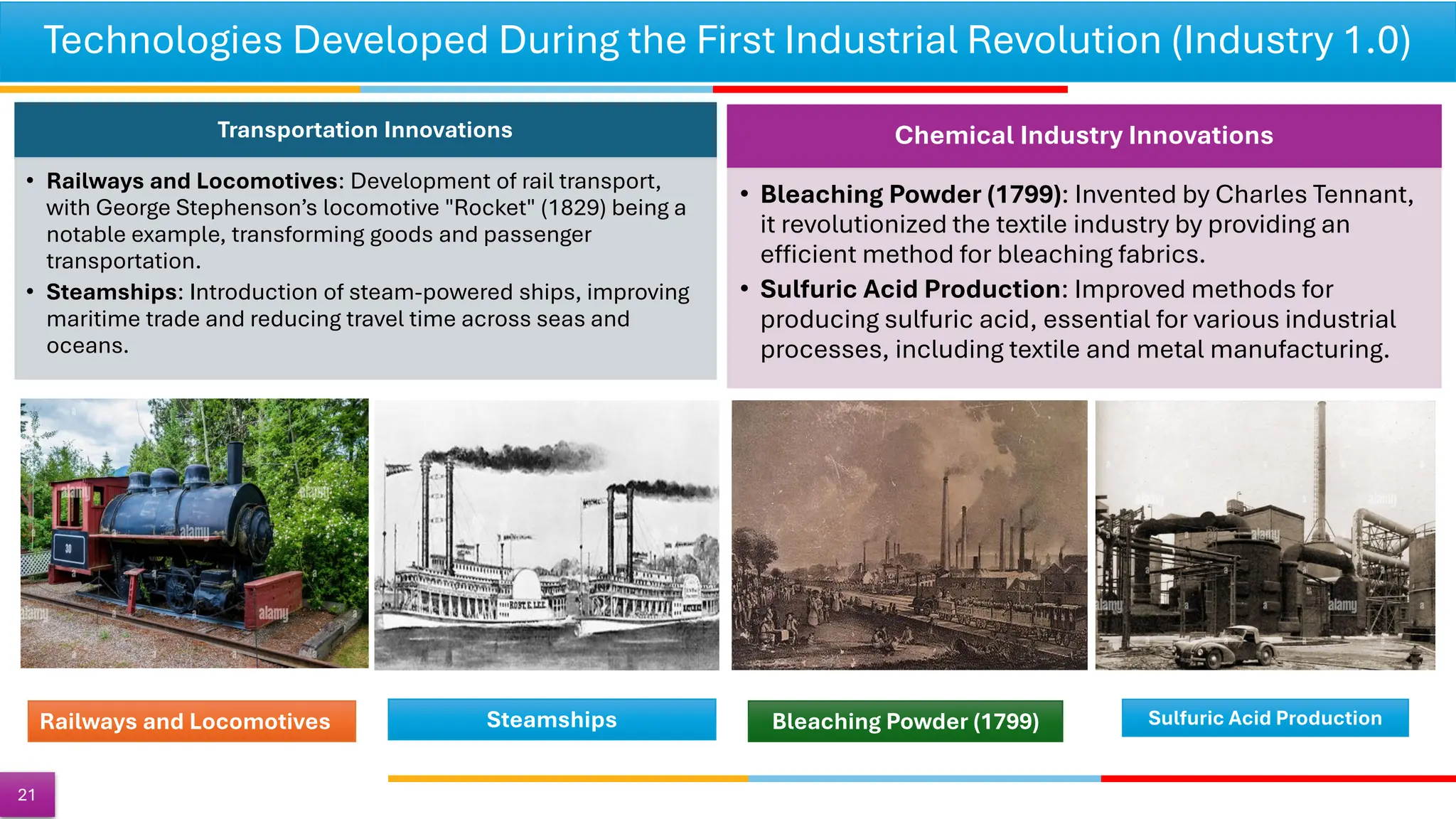
Transportation Innovations
• Railways and Locomotives: Development of rail transport,
with George Stephenson’s locomotive "Rocket" (1829) being a
notable example, transforming goods and passenger
transportation.
• Steamships: Introduction of steam-powered ships, improving
maritime trade and reducing travel time across seas and
oceans.
Chemical Industry Innovations
• Bleaching Powder (1799): Invented by Charles Tennant,
it revolutionized the textile industry by providing an
efficient method for bleaching fabrics.
• Sulfuric Acid Production: Improved methods for
producing sulfuric acid, essential for various industrial
processes, including textile and metal manufacturing.
Railways and Locomotives Bleaching Powder (1799) Sulfuric Acid Production
Steamships
Technologies Developed During the First Industrial Revolution (Industry 1.0)
22
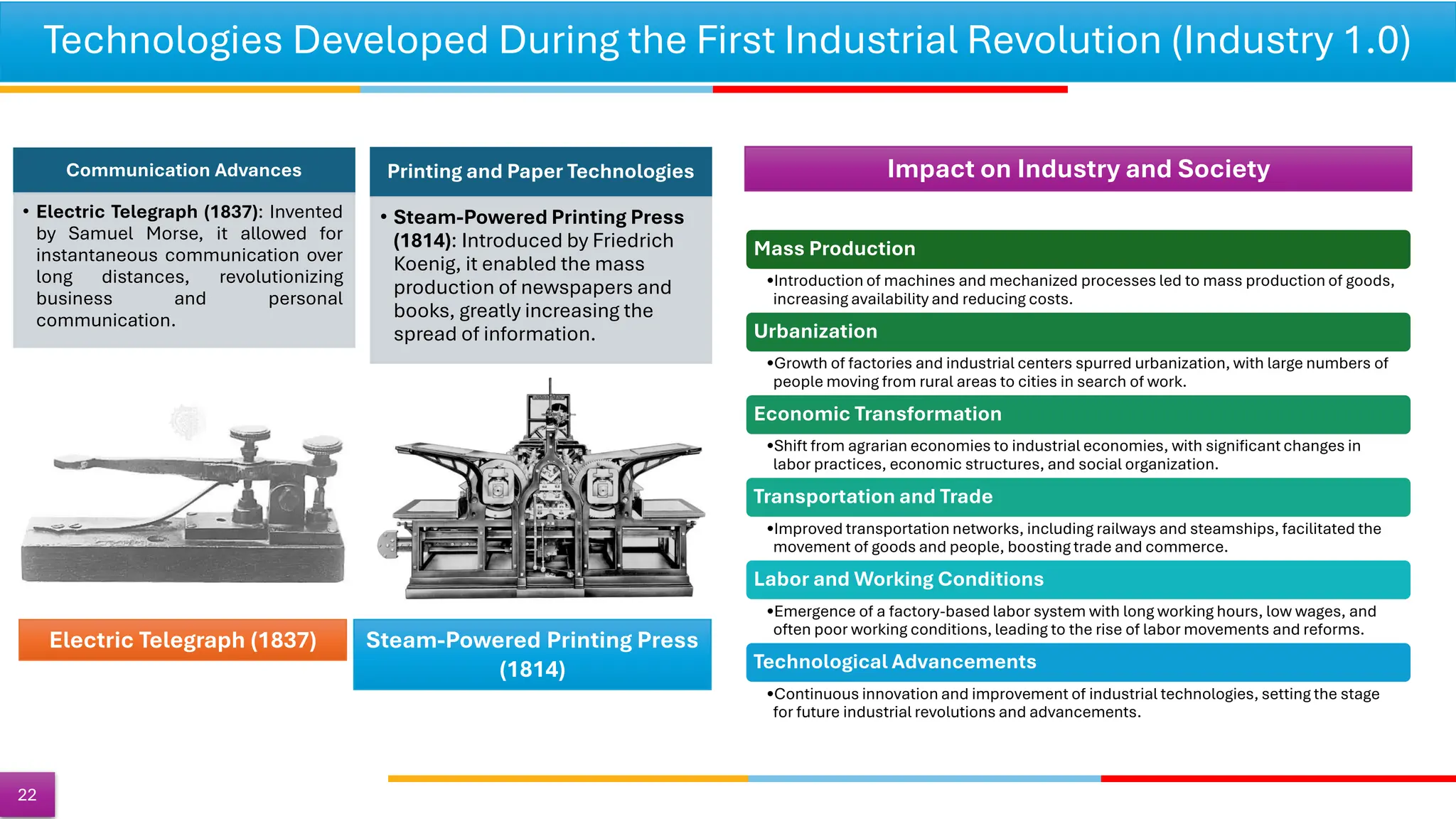
Communication Advances
• Electric Telegraph (1837): Invented
by Samuel Morse, it allowed for
instantaneous communication over
long distances, revolutionizing
business and personal
communication.
Printing and Paper Technologies
• Steam-Powered Printing Press
(1814): Introduced by Friedrich
Koenig, it enabled the mass
production of newspapers and
books, greatly increasing the
spread of information.
Electric Telegraph (1837) Steam-Powered Printing Press
(1814)
Mass Production
•Introduction of machines and mechanized processes led to mass production of goods,
increasing availability and reducing costs.
Urbanization
•Growth of factories and industrial centers spurred urbanization, with large numbers of
people moving from rural areas to cities in search of work.
Economic Transformation
•Shift from agrarian economies to industrial economies, with significant changes in
labor practices, economic structures, and social organization.
Transportation and Trade
•Improved transportation networks, including railways and steamships, facilitated the
movement of goods and people, boosting trade and commerce.
Labor and Working Conditions
•Emergence of a factory-based labor system with long working hours, low wages, and
often poor working conditions, leading to the rise of labor movements and reforms.
Technological Advancements
•Continuous innovation and improvement of industrial technologies, setting the stage
for future industrial revolutions and advancements.
Impact on Industry and Society
Industrial Revolution 2.0: The Second Industrial Revolution (late 19th to early 20th century)
23
Electricity
•Introduction: Electricity replaced steam as the primary source of power for factories.
•Impact: Enabled the creation of more efficient and flexible factory layouts. Electric motors
powered machinery, reducing reliance on large, central steam engines.
•Thomas Edison and Nikola Tesla: Pioneers in the development and commercialization of
electrical power systems, including the electric light bulb, AC (alternating current) power
systems, and electric grids.
Assembly Line and Mass Production
•Henry Ford: Introduced the moving assembly line in 1913, revolutionizing automobile
manufacturing.
•Impact: Dramatically reduced production time and costs, making products more affordable
and accessible to the general public. Enabled economies of scale.
Steel Production
•Bessemer Process: Developed by Henry Bessemer, this method allowed for the mass
production of steel by removing impurities from iron through oxidation.
•Impact: Made steel more affordable and widely available, leading to its use in construction,
shipbuilding, and manufacturing.
Chemical Industry
•Advancements: Development of new chemical processes and materials, such as synthetic
dyes, fertilizers, and plastics.
•Impact: Enhanced agricultural productivity and diversified industrial production.
Transportation
•Railroads: Expanded significantly, connecting remote areas and facilitating the movement
of goods and people.
•Automobiles: Mass production of cars made personal transportation more accessible.
•Ships: Transition from sail to steam-powered ships improved global trade efficiency.
Telecommunications
•Telegraph and Telephone: Inventions by Samuel Morse (telegraph) and Alexander Graham
Bell (telephone) revolutionized communication.
•Impact: Enabled rapid and reliable long-distance communication, essential for business
and personal use.
Key
innovations
Economic Growth
•Industrial Expansion: Significant growth in industrial output and productivity.
•Capital Investment: Increased investment in factories, machinery, and
infrastructure.
•Global Trade: Expansion of international trade networks and markets.
Urbanization
•Migration: Massive migration to urban centers as people sought employment in
factories.
•City Growth: Rapid expansion of cities and the development of urban
infrastructure.
Labor and Workforce
•Labor Conditions: Harsh working conditions in factories led to the rise of labor
unions and movements advocating for workers' rights.
•Child Labor: Widespread use of child labor, eventually leading to reforms and
regulations.
Social Changes
•Middle Class: Growth of a middle class with increased disposable income and
consumption.
•Education: Expansion of public education systems to meet the needs of an
industrialized society.
Technological Advancements
•Innovation: Continuous innovation in manufacturing processes and technologies.
•R&D: Increased focus on research and development to drive further
advancements.
Impact
on
Industry
and
Society
Technologies Developed During the Second Industrial Revolution (Industry 2.0)
24
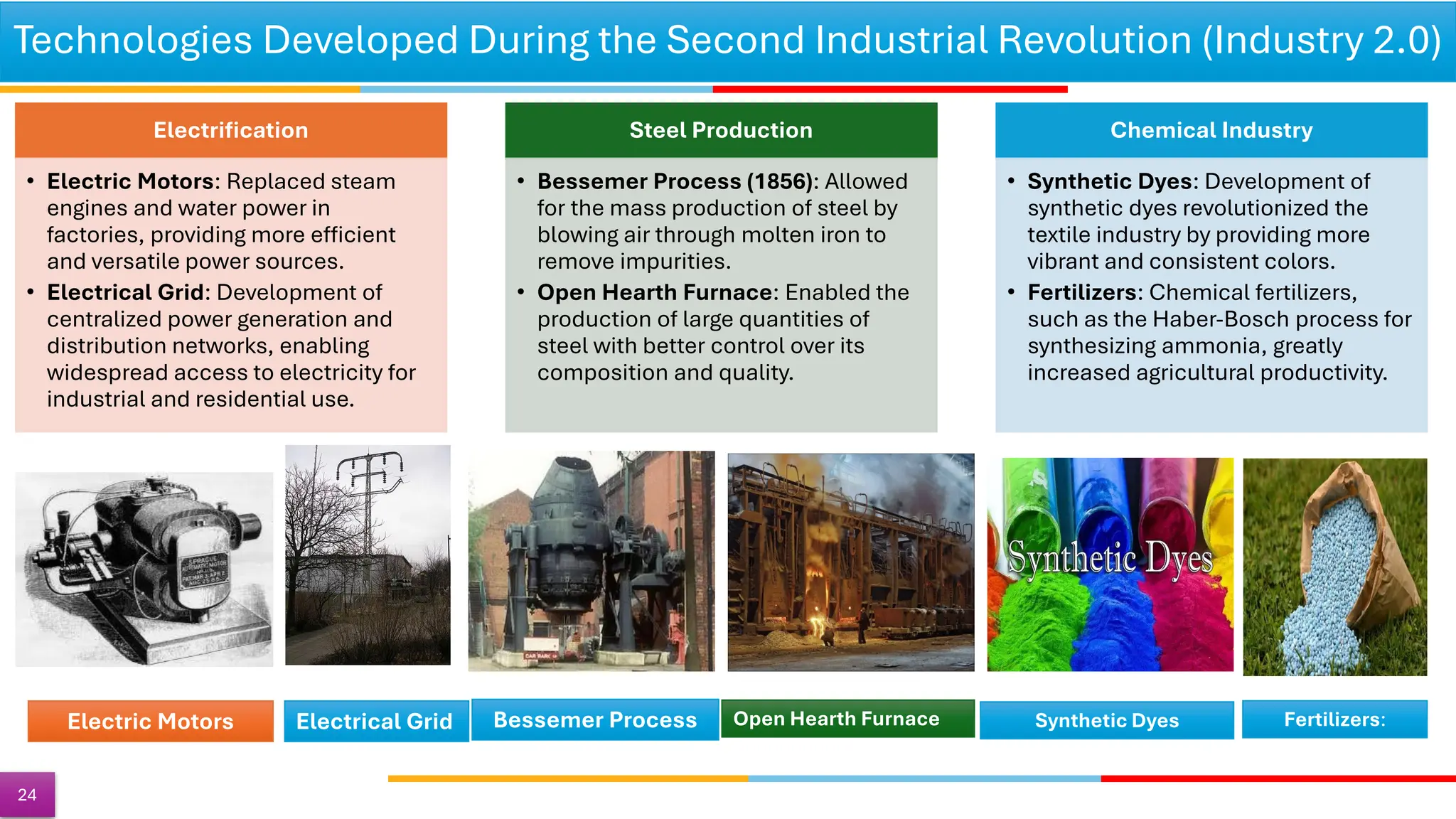
Electrification
• Electric Motors: Replaced steam
engines and water power in
factories, providing more efficient
and versatile power sources.
• Electrical Grid: Development of
centralized power generation and
distribution networks, enabling
widespread access to electricity for
industrial and residential use.
Steel Production
• Bessemer Process (1856): Allowed
for the mass production of steel by
blowing air through molten iron to
remove impurities.
• Open Hearth Furnace: Enabled the
production of large quantities of
steel with better control over its
composition and quality.
Chemical Industry
• Synthetic Dyes: Development of
synthetic dyes revolutionized the
textile industry by providing more
vibrant and consistent colors.
• Fertilizers: Chemical fertilizers,
such as the Haber-Bosch process for
synthesizing ammonia, greatly
increased agricultural productivity.
Electric Motors Open Hearth Furnace Synthetic Dyes
Electrical Grid Bessemer Process Fertilizers:
Technologies Developed During the Second Industrial Revolution (Industry 2.0)
25
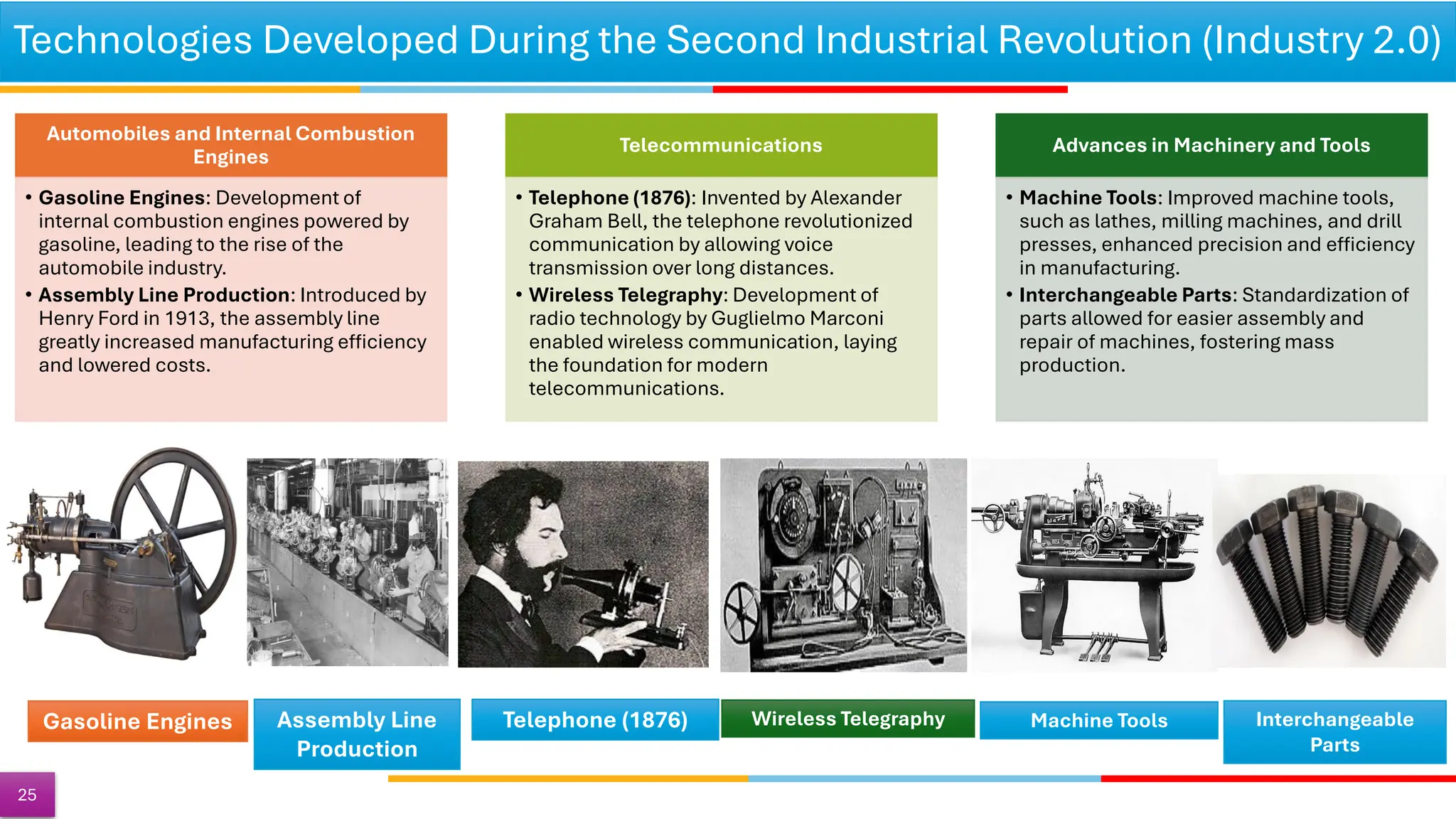
Automobiles and Internal Combustion
Engines
• Gasoline Engines: Development of
internal combustion engines powered by
gasoline, leading to the rise of the
automobile industry.
• Assembly Line Production: Introduced by
Henry Ford in 1913, the assembly line
greatly increased manufacturing efficiency
and lowered costs.
Telecommunications
• Telephone (1876): Invented by Alexander
Graham Bell, the telephone revolutionized
communication by allowing voice
transmission over long distances.
• Wireless Telegraphy: Development of
radio technology by Guglielmo Marconi
enabled wireless communication, laying
the foundation for modern
telecommunications.
Advances in Machinery and Tools
• Machine Tools: Improved machine tools,
such as lathes, milling machines, and drill
presses, enhanced precision and efficiency
in manufacturing.
• Interchangeable Parts: Standardization of
parts allowed for easier assembly and
repair of machines, fostering mass
production.
Gasoline Engines Wireless Telegraphy Machine Tools
Assembly Line
Production
Telephone (1876) Interchangeable
Parts
Technologies Developed During the Second Industrial Revolution (Industry 2.0)
26
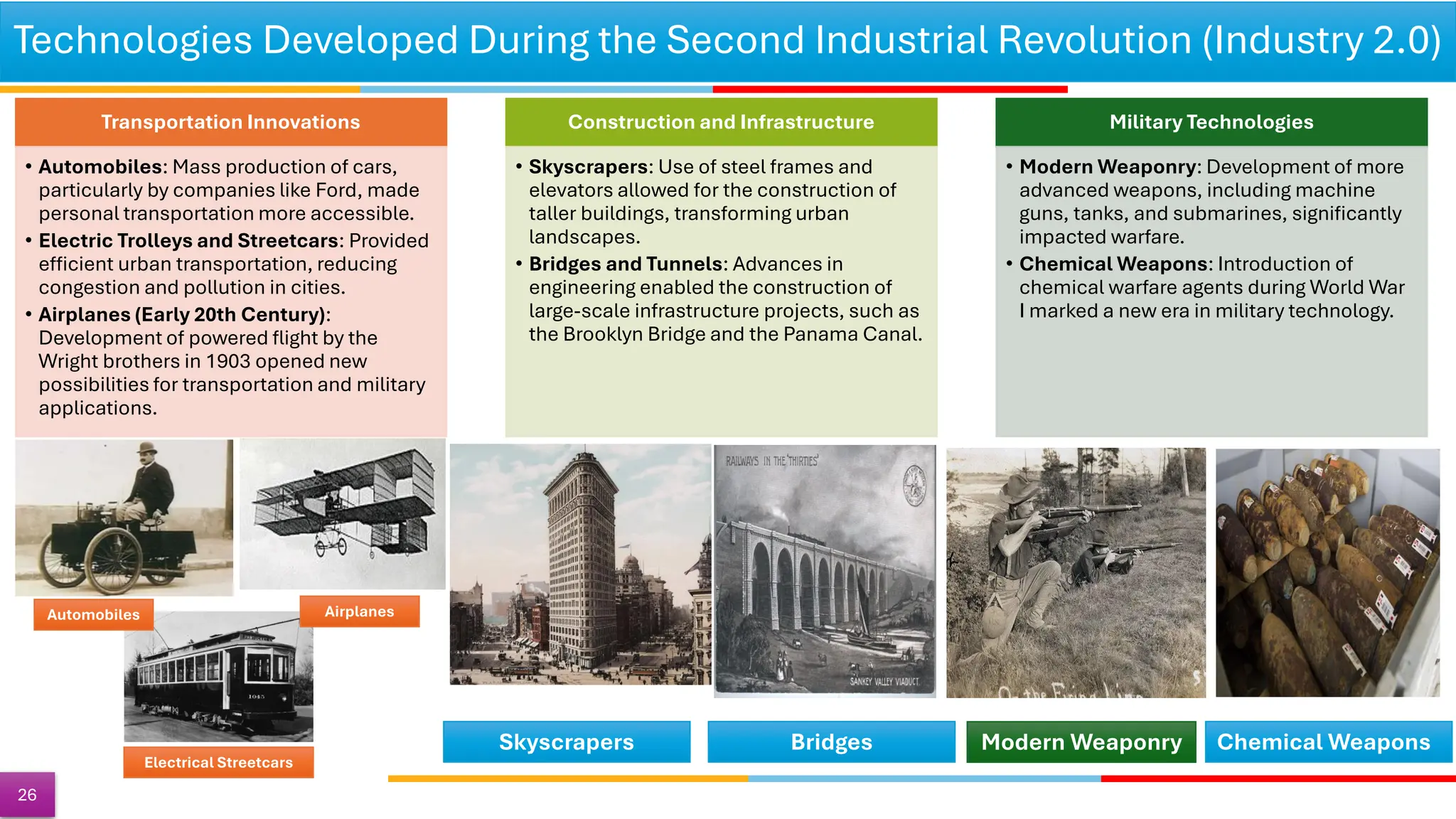
Transportation Innovations
• Automobiles: Mass production of cars,
particularly by companies like Ford, made
personal transportation more accessible.
• Electric Trolleys and Streetcars: Provided
efficient urban transportation, reducing
congestion and pollution in cities.
• Airplanes (Early 20th Century):
Development of powered flight by the
Wright brothers in 1903 opened new
possibilities for transportation and military
applications.
Construction and Infrastructure
• Skyscrapers: Use of steel frames and
elevators allowed for the construction of
taller buildings, transforming urban
landscapes.
• Bridges and Tunnels: Advances in
engineering enabled the construction of
large-scale infrastructure projects, such as
the Brooklyn Bridge and the Panama Canal.
Military Technologies
• Modern Weaponry: Development of more
advanced weapons, including machine
guns, tanks, and submarines, significantly
impacted warfare.
• Chemical Weapons: Introduction of
chemical warfare agents during World War
I marked a new era in military technology.
Modern Weaponry
Skyscrapers Chemical Weapons
Airplanes
Electrical Streetcars
Automobiles
Bridges
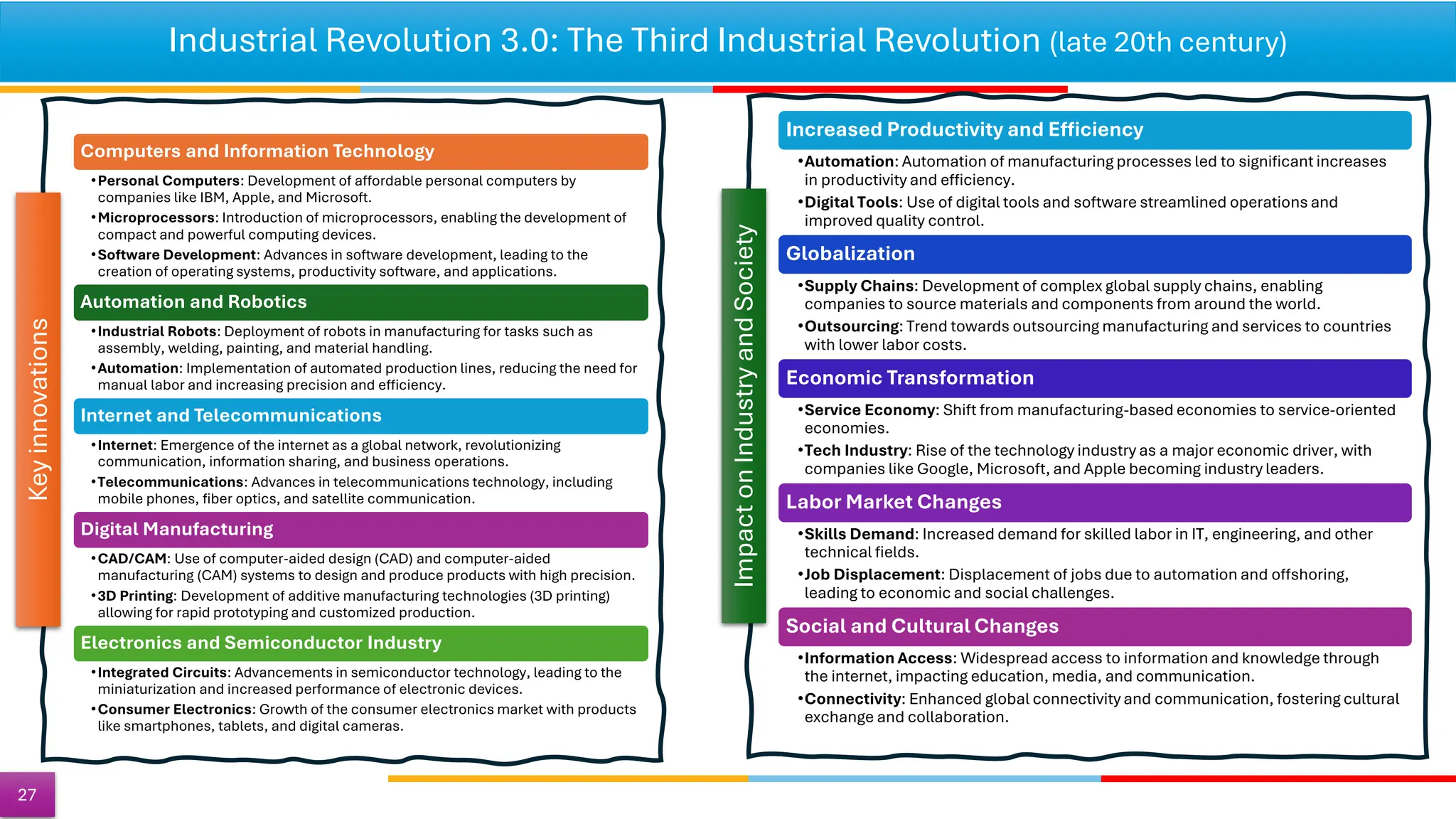
Industrial Revolution 3.0: The Third Industrial Revolution (late 20th century)
27
Computers and Information Technology
•Personal Computers: Development of affordable personal computers by
companies like IBM, Apple, and Microsoft.
•Microprocessors: Introduction of microprocessors, enabling the development of
compact and powerful computing devices.
•Software Development: Advances in software development, leading to the
creation of operating systems, productivity software, and applications.
Automation and Robotics
•Industrial Robots: Deployment of robots in manufacturing for tasks such as
assembly, welding, painting, and material handling.
•Automation: Implementation of automated production lines, reducing the need for
manual labor and increasing precision and efficiency.
Internet and Telecommunications
•Internet: Emergence of the internet as a global network, revolutionizing
communication, information sharing, and business operations.
•Telecommunications: Advances in telecommunications technology, including
mobile phones, fiber optics, and satellite communication.
Digital Manufacturing
•CAD/CAM: Use of computer-aided design (CAD) and computer-aided
manufacturing (CAM) systems to design and produce products with high precision.
•3D Printing: Development of additive manufacturing technologies (3D printing)
allowing for rapid prototyping and customized production.
Electronics and Semiconductor Industry
•Integrated Circuits: Advancements in semiconductor technology, leading to the
miniaturization and increased performance of electronic devices.
•Consumer Electronics: Growth of the consumer electronics market with products
like smartphones, tablets, and digital cameras.
Key
innovations
Increased Productivity and Efficiency
•Automation: Automation of manufacturing processes led to significant increases
in productivity and efficiency.
•Digital Tools: Use of digital tools and software streamlined operations and
improved quality control.
Globalization
•Supply Chains: Development of complex global supply chains, enabling
companies to source materials and components from around the world.
•Outsourcing: Trend towards outsourcing manufacturing and services to countries
with lower labor costs.
Economic Transformation
•Service Economy: Shift from manufacturing-based economies to service-oriented
economies.
•Tech Industry: Rise of the technology industry as a major economic driver, with
companies like Google, Microsoft, and Apple becoming industry leaders.
Labor Market Changes
•Skills Demand: Increased demand for skilled labor in IT, engineering, and other
technical fields.
•Job Displacement: Displacement of jobs due to automation and offshoring,
leading to economic and social challenges.
Social and Cultural Changes
•Information Access: Widespread access to information and knowledge through
the internet, impacting education, media, and communication.
•Connectivity: Enhanced global connectivity and communication, fostering cultural
exchange and collaboration.
Impact
on
Industry
and
Society
Technologies Developed During the Third Industrial Revolution (Industry 3.0)
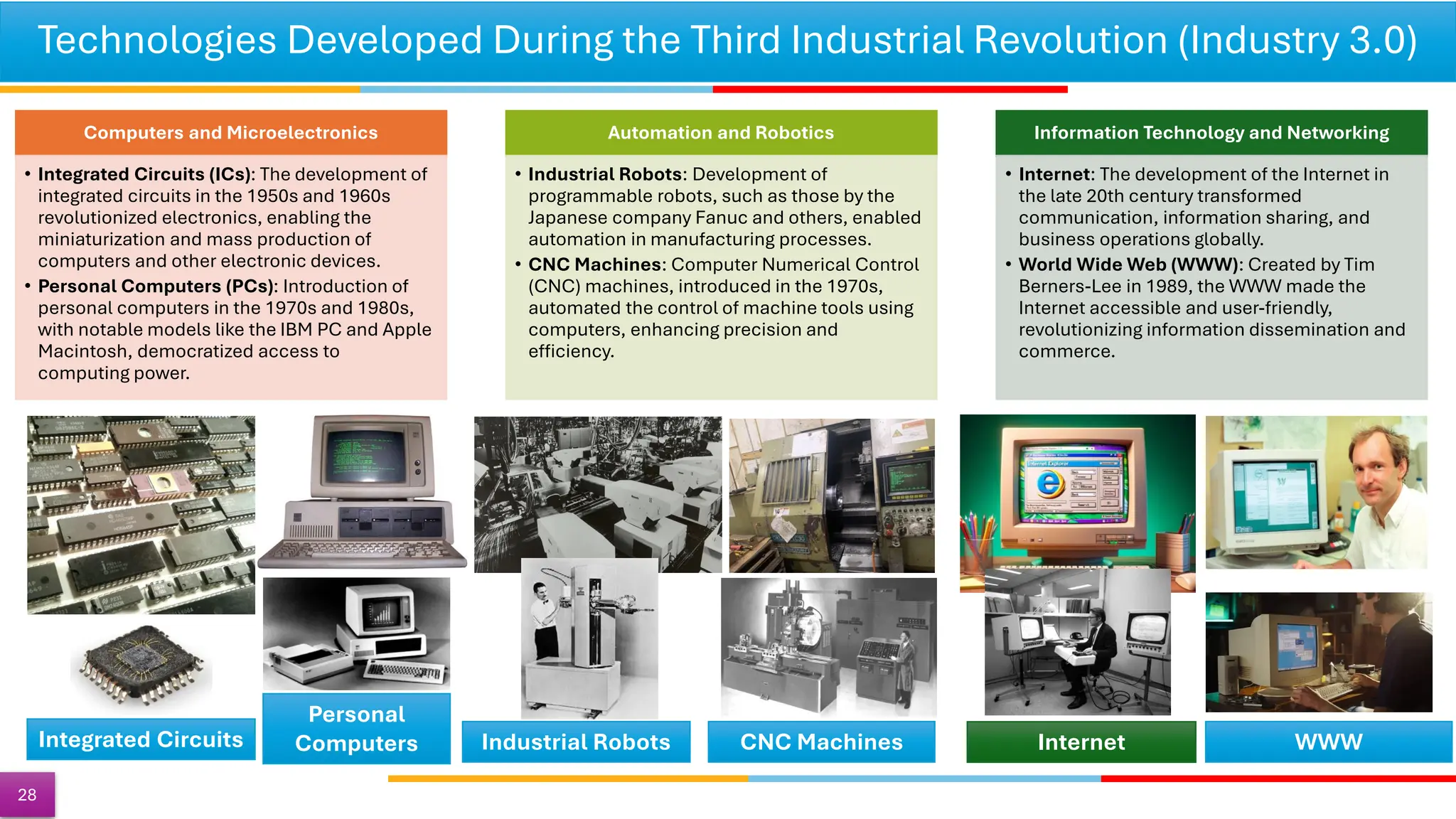
28
Computers and Microelectronics
• Integrated Circuits (ICs): The development of
integrated circuits in the 1950s and 1960s
revolutionized electronics, enabling the
miniaturization and mass production of
computers and other electronic devices.
• Personal Computers (PCs): Introduction of
personal computers in the 1970s and 1980s,
with notable models like the IBM PC and Apple
Macintosh, democratized access to
computing power.
Automation and Robotics
• Industrial Robots: Development of
programmable robots, such as those by the
Japanese company Fanuc and others, enabled
automation in manufacturing processes.
• CNC Machines: Computer Numerical Control
(CNC) machines, introduced in the 1970s,
automated the control of machine tools using
computers, enhancing precision and
efficiency.
Information Technology and Networking
• Internet: The development of the Internet in
the late 20th century transformed
communication, information sharing, and
business operations globally.
• World Wide Web (WWW): Created by Tim
Berners-Lee in 1989, the WWW made the
Internet accessible and user-friendly,
revolutionizing information dissemination and
commerce.
Internet
Industrial Robots WWW
CNC Machines
Integrated Circuits
Personal
Computers
Technologies Developed During the Third Industrial Revolution (Industry 3.0)
29
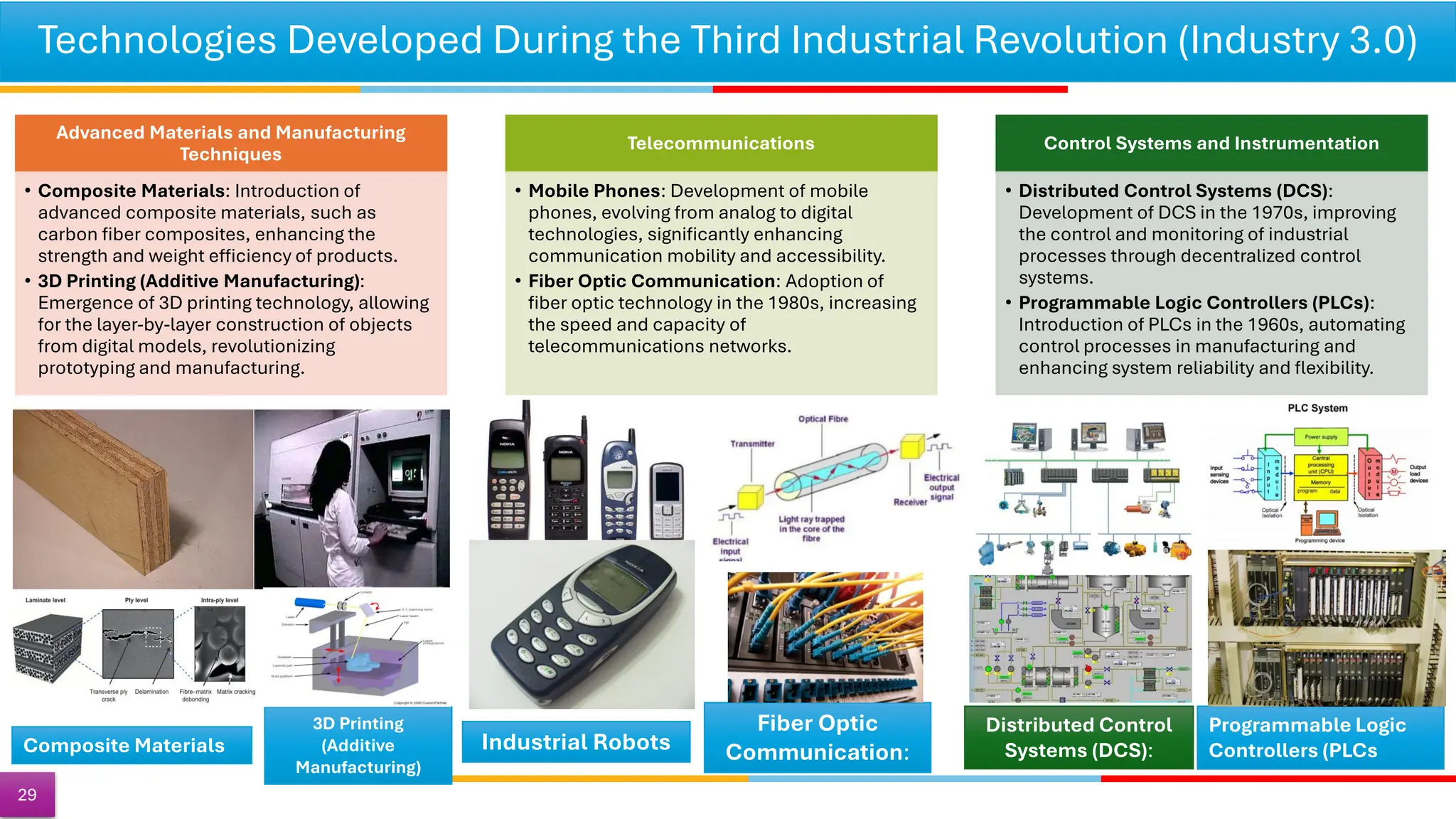
Advanced Materials and Manufacturing
Techniques
• Composite Materials: Introduction of
advanced composite materials, such as
carbon fiber composites, enhancing the
strength and weight efficiency of products.
• 3D Printing (Additive Manufacturing):
Emergence of 3D printing technology, allowing
for the layer-by-layer construction of objects
from digital models, revolutionizing
prototyping and manufacturing.
Telecommunications
• Mobile Phones: Development of mobile
phones, evolving from analog to digital
technologies, significantly enhancing
communication mobility and accessibility.
• Fiber Optic Communication: Adoption of
fiber optic technology in the 1980s, increasing
the speed and capacity of
telecommunications networks.
Control Systems and Instrumentation
• Distributed Control Systems (DCS):
Development of DCS in the 1970s, improving
the control and monitoring of industrial
processes through decentralized control
systems.
• Programmable Logic Controllers (PLCs):
Introduction of PLCs in the 1960s, automating
control processes in manufacturing and
enhancing system reliability and flexibility.
Distributed Control
Systems (DCS):
Industrial Robots
Programmable Logic
Controllers (PLCs
Fiber Optic
Communication:
Composite Materials
3D Printing
(Additive
Manufacturing)
Technologies Developed During the Third Industrial Revolution (Industry 3.0)
30
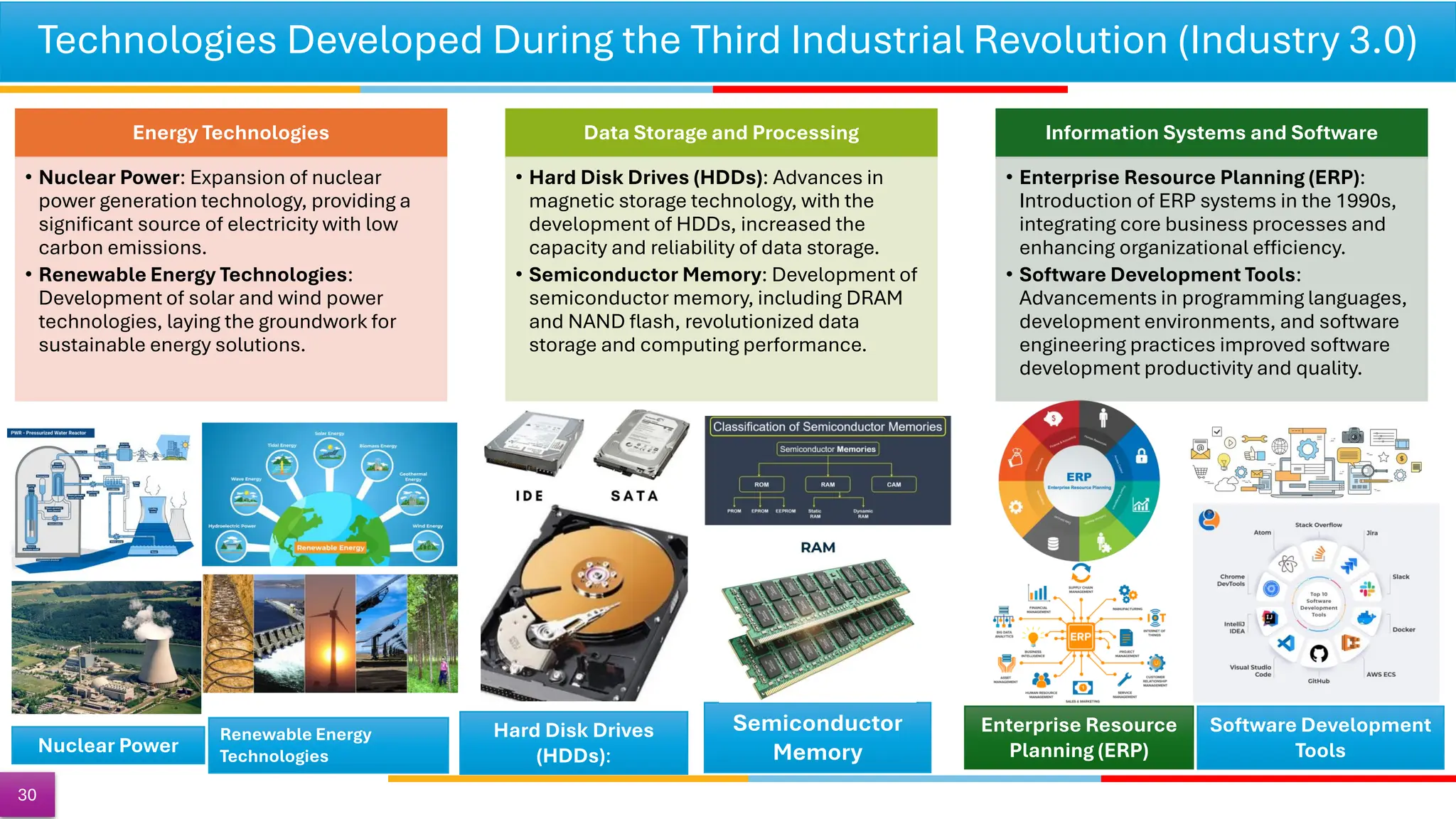
Energy Technologies
• Nuclear Power: Expansion of nuclear
power generation technology, providing a
significant source of electricity with low
carbon emissions.
• Renewable Energy Technologies:
Development of solar and wind power
technologies, laying the groundwork for
sustainable energy solutions.
Data Storage and Processing
• Hard Disk Drives (HDDs): Advances in
magnetic storage technology, with the
development of HDDs, increased the
capacity and reliability of data storage.
• Semiconductor Memory: Development of
semiconductor memory, including DRAM
and NAND flash, revolutionized data
storage and computing performance.
Information Systems and Software
• Enterprise Resource Planning (ERP):
Introduction of ERP systems in the 1990s,
integrating core business processes and
enhancing organizational efficiency.
• Software Development Tools:
Advancements in programming languages,
development environments, and software
engineering practices improved software
development productivity and quality.
Enterprise Resource
Planning (ERP)
Hard Disk Drives
(HDDs):
Software Development
Tools
Semiconductor
Memory
Nuclear Power
Renewable Energy
Technologies
Technologies Developed During the Third Industrial Revolution (Industry 3.0)
31
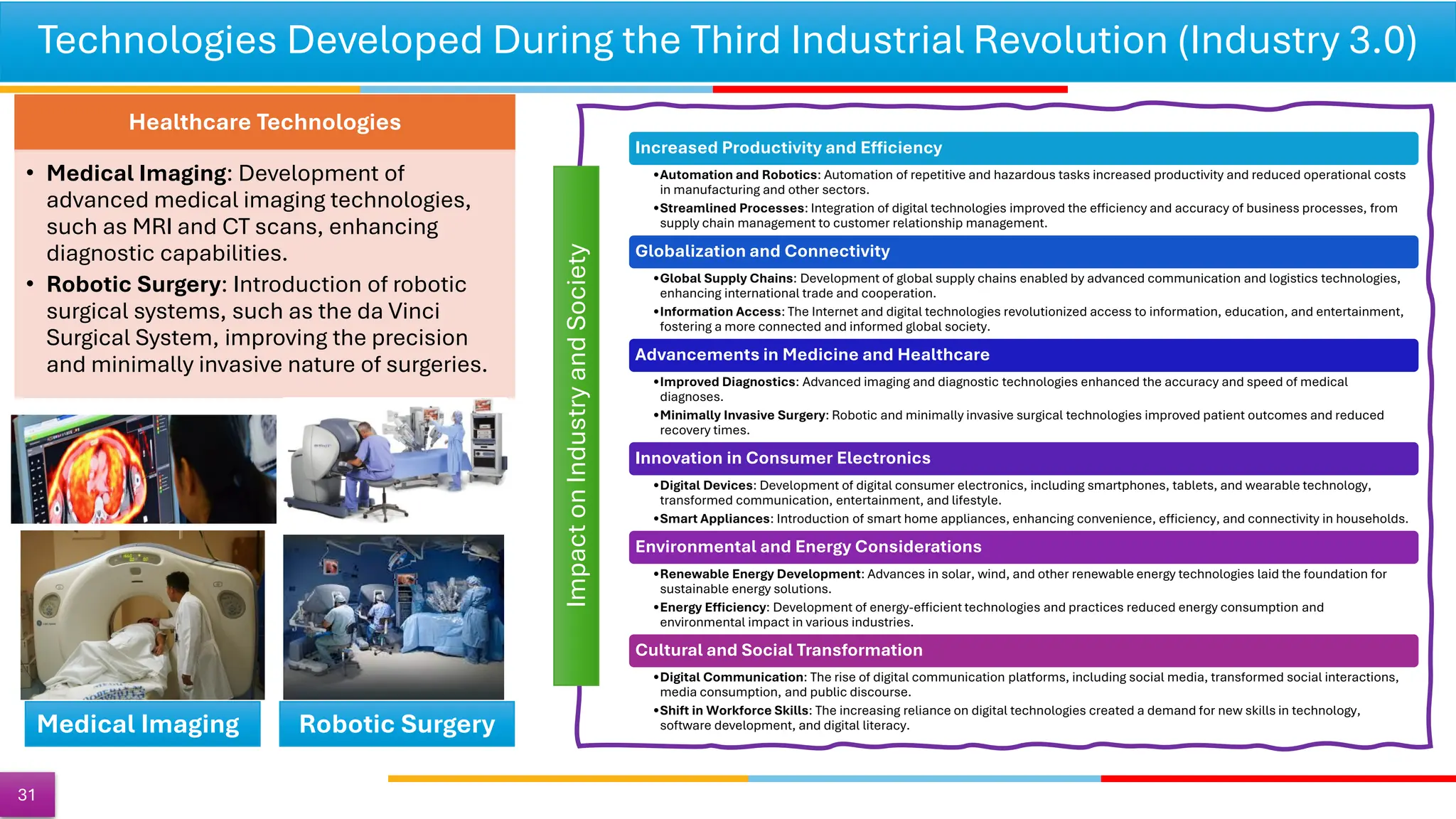
Healthcare Technologies
• Medical Imaging: Development of
advanced medical imaging technologies,
such as MRI and CT scans, enhancing
diagnostic capabilities.
• Robotic Surgery: Introduction of robotic
surgical systems, such as the da Vinci
Surgical System, improving the precision
and minimally invasive nature of surgeries.
Medical Imaging Robotic Surgery
Increased Productivity and Efficiency
•Automation and Robotics: Automation of repetitive and hazardous tasks increased productivity and reduced operational costs
in manufacturing and other sectors.
•Streamlined Processes: Integration of digital technologies improved the efficiency and accuracy of business processes, from
supply chain management to customer relationship management.
Globalization and Connectivity
•Global Supply Chains: Development of global supply chains enabled by advanced communication and logistics technologies,
enhancing international trade and cooperation.
•Information Access: The Internet and digital technologies revolutionized access to information, education, and entertainment,
fostering a more connected and informed global society.
Advancements in Medicine and Healthcare
•Improved Diagnostics: Advanced imaging and diagnostic technologies enhanced the accuracy and speed of medical
diagnoses.
•Minimally Invasive Surgery: Robotic and minimally invasive surgical technologies improved patient outcomes and reduced
recovery times.
Innovation in Consumer Electronics
•Digital Devices: Development of digital consumer electronics, including smartphones, tablets, and wearable technology,
transformed communication, entertainment, and lifestyle.
•Smart Appliances: Introduction of smart home appliances, enhancing convenience, efficiency, and connectivity in households.
Environmental and Energy Considerations
•Renewable Energy Development: Advances in solar, wind, and other renewable energy technologies laid the foundation for
sustainable energy solutions.
•Energy Efficiency: Development of energy-efficient technologies and practices reduced energy consumption and
environmental impact in various industries.
Cultural and Social Transformation
•Digital Communication: The rise of digital communication platforms, including social media, transformed social interactions,
media consumption, and public discourse.
•Shift in Workforce Skills: The increasing reliance on digital technologies created a demand for new skills in technology,
software development, and digital literacy.
Impact
on
Industry
and
Society
Industrial Revolution 4.0: The Fourth Industrial Revolution (late 21st century)
32
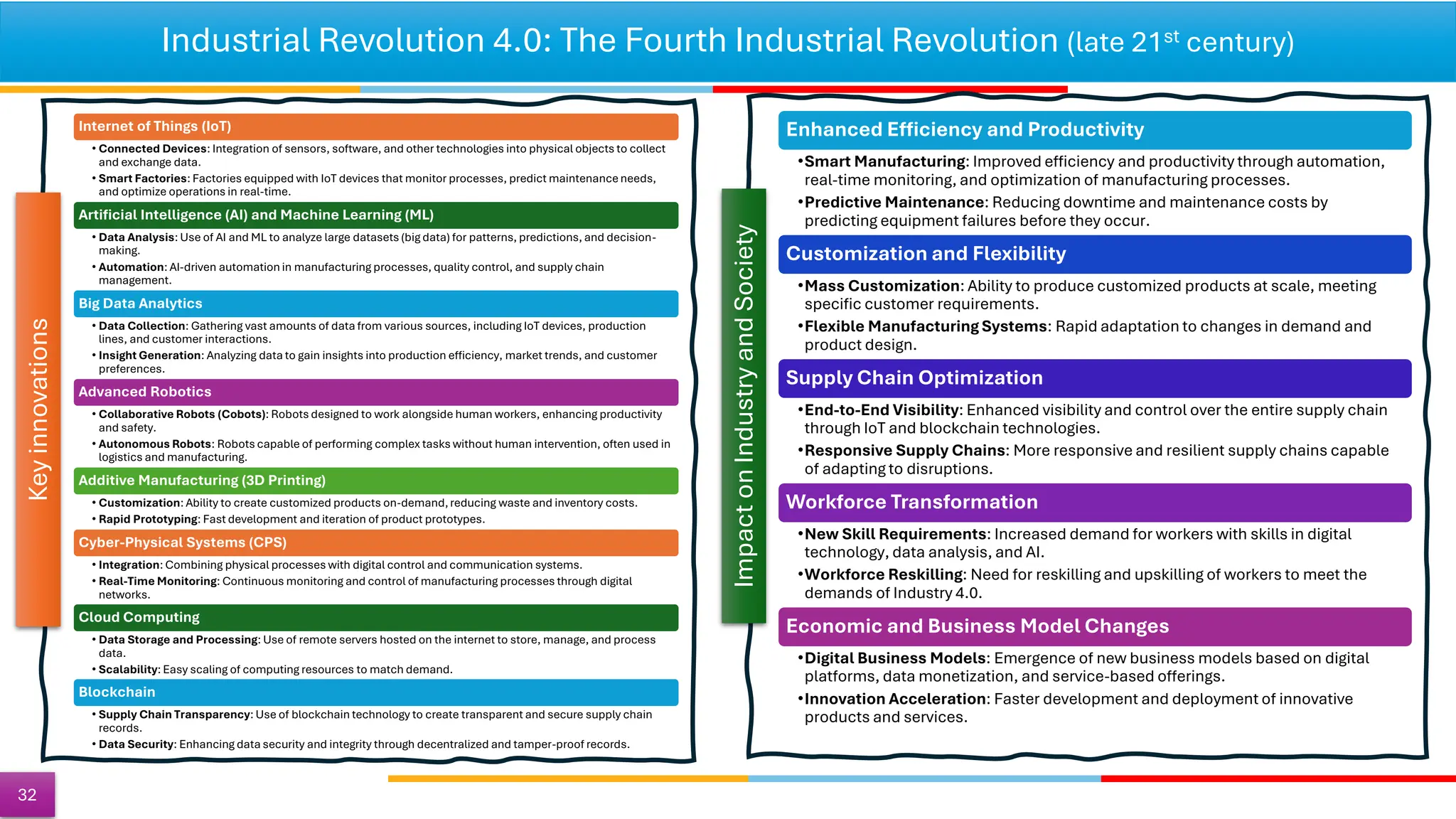
Internet of Things (IoT)
• Connected Devices: Integration of sensors, software, and other technologies into physical objects to collect
and exchange data.
• Smart Factories: Factories equipped with IoT devices that monitor processes, predict maintenance needs,
and optimize operations in real-time.
Artificial Intelligence (AI) and Machine Learning (ML)
• Data Analysis: Use of AI and ML to analyze large datasets (big data) for patterns, predictions, and decision-
making.
• Automation: AI-driven automation in manufacturing processes, quality control, and supply chain
management.
Big Data Analytics
• Data Collection: Gathering vast amounts of data from various sources, including IoT devices, production
lines, and customer interactions.
• Insight Generation: Analyzing data to gain insights into production efficiency, market trends, and customer
preferences.
Advanced Robotics
• Collaborative Robots (Cobots): Robots designed to work alongside human workers, enhancing productivity
and safety.
• Autonomous Robots: Robots capable of performing complex tasks without human intervention, often used in
logistics and manufacturing.
Additive Manufacturing (3D Printing)
• Customization: Ability to create customized products on-demand,reducing waste and inventory costs.
• Rapid Prototyping: Fast development and iteration of product prototypes.
Cyber-Physical Systems (CPS)
• Integration: Combining physical processes with digital control and communication systems.
• Real-Time Monitoring: Continuous monitoring and control of manufacturing processes through digital
networks.
Cloud Computing
• Data Storage and Processing: Use of remote servers hosted on the internet to store, manage, and process
data.
• Scalability: Easy scaling of computing resources to match demand.
Blockchain
• Supply Chain Transparency: Use of blockchain technology to create transparent and secure supply chain
records.
• Data Security: Enhancing data security and integrity through decentralized and tamper-proof records.
Key
innovations
Enhanced Efficiency and Productivity
•Smart Manufacturing: Improved efficiency and productivity through automation,
real-time monitoring, and optimization of manufacturing processes.
•Predictive Maintenance: Reducing downtime and maintenance costs by
predicting equipment failures before they occur.
Customization and Flexibility
•Mass Customization: Ability to produce customized products at scale, meeting
specific customer requirements.
•Flexible Manufacturing Systems: Rapid adaptation to changes in demand and
product design.
Supply Chain Optimization
•End-to-End Visibility: Enhanced visibility and control over the entire supply chain
through IoT and blockchain technologies.
•Responsive Supply Chains: More responsive and resilient supply chains capable
of adapting to disruptions.
Workforce Transformation
•New Skill Requirements: Increased demand for workers with skills in digital
technology, data analysis, and AI.
•Workforce Reskilling: Need for reskilling and upskilling of workers to meet the
demands of Industry 4.0.
Economic and Business Model Changes
•Digital Business Models: Emergence of new business models based on digital
platforms, data monetization, and service-based offerings.
•Innovation Acceleration: Faster development and deployment of innovative
products and services.
Impact
on
Industry
and
Society
Technologies Developed During the Fourth Industrial Revolution (Industry 4.0)
33
Internet of Things (IoT)
• Connected Devices: Integration of
sensors and network connectivity in
everyday objects, allowing for real-time
data collection, monitoring, and control.
• Industrial IoT (IIoT): Application of IoT in
industrial settings for predictive
maintenance, asset tracking, and
enhanced process efficiency.
Artificial Intelligence (AI) and Machine
Learning (ML)
• Predictive Analytics: Use of AI and ML
algorithms to analyze large datasets,
predict trends, and make data-driven
decisions.
• Automation: Implementation of AI-
driven automation in manufacturing
processes, enhancing productivity and
reducing human error.
Big Data and Analytics
• Data Mining: Techniques for extracting
valuable insights from vast amounts of
data, enabling informed decision-
making and process optimization.
• Real-Time Analytics: Processing and
analyzing data in real-time to improve
operational efficiency and respond
quickly to changes.
Data Mining
Predictive Analytics Real-Time Analytics
Automation
Connected
Devices Industrial IoT (IIoT)
Technologies Developed During the Fourth Industrial Revolution (Industry 4.0)
34
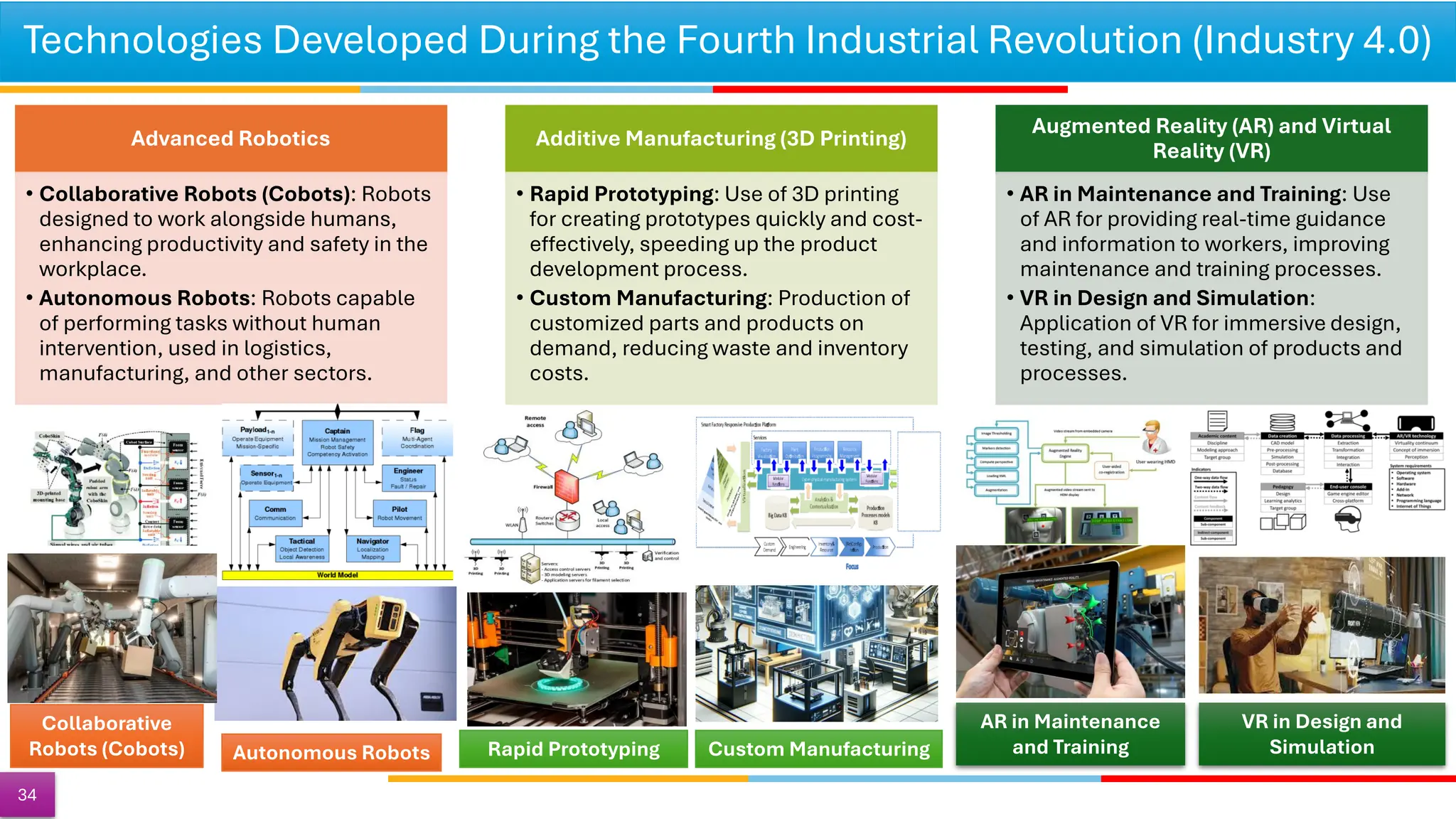
Advanced Robotics
• Collaborative Robots (Cobots): Robots
designed to work alongside humans,
enhancing productivity and safety in the
workplace.
• Autonomous Robots: Robots capable
of performing tasks without human
intervention, used in logistics,
manufacturing, and other sectors.
Additive Manufacturing (3D Printing)
• Rapid Prototyping: Use of 3D printing
for creating prototypes quickly and cost-
effectively, speeding up the product
development process.
• Custom Manufacturing: Production of
customized parts and products on
demand, reducing waste and inventory
costs.
Augmented Reality (AR) and Virtual
Reality (VR)
• AR in Maintenance and Training: Use
of AR for providing real-time guidance
and information to workers, improving
maintenance and training processes.
• VR in Design and Simulation:
Application of VR for immersive design,
testing, and simulation of products and
processes.
AR in Maintenance
and Training
Rapid Prototyping
VR in Design and
Simulation
Custom Manufacturing
Collaborative
Robots (Cobots) Autonomous Robots
Technologies Developed During the Fourth Industrial Revolution (Industry 4.0)
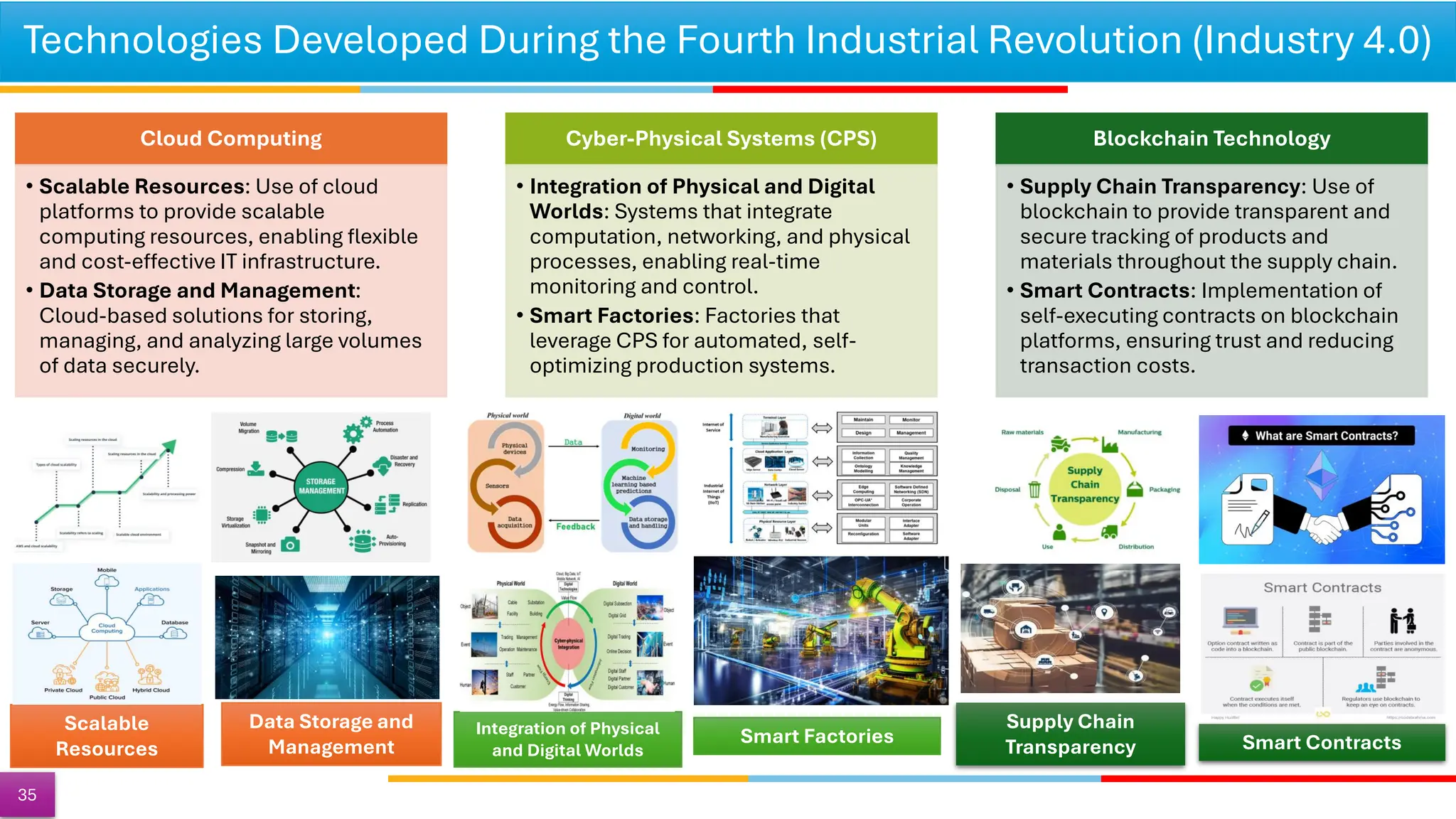
35
Cloud Computing
• Scalable Resources: Use of cloud
platforms to provide scalable
computing resources, enabling flexible
and cost-effective IT infrastructure.
• Data Storage and Management:
Cloud-based solutions for storing,
managing, and analyzing large volumes
of data securely.
Cyber-Physical Systems (CPS)
• Integration of Physical and Digital
Worlds: Systems that integrate
computation, networking, and physical
processes, enabling real-time
monitoring and control.
• Smart Factories: Factories that
leverage CPS for automated, self-
optimizing production systems.
Blockchain Technology
• Supply Chain Transparency: Use of
blockchain to provide transparent and
secure tracking of products and
materials throughout the supply chain.
• Smart Contracts: Implementation of
self-executing contracts on blockchain
platforms, ensuring trust and reducing
transaction costs.
Supply Chain
Transparency
Integration of Physical
and Digital Worlds Smart Contracts
Smart Factories
Scalable
Resources
Data Storage and
Management
Technologies Developed During the Fourth Industrial Revolution (Industry 4.0)
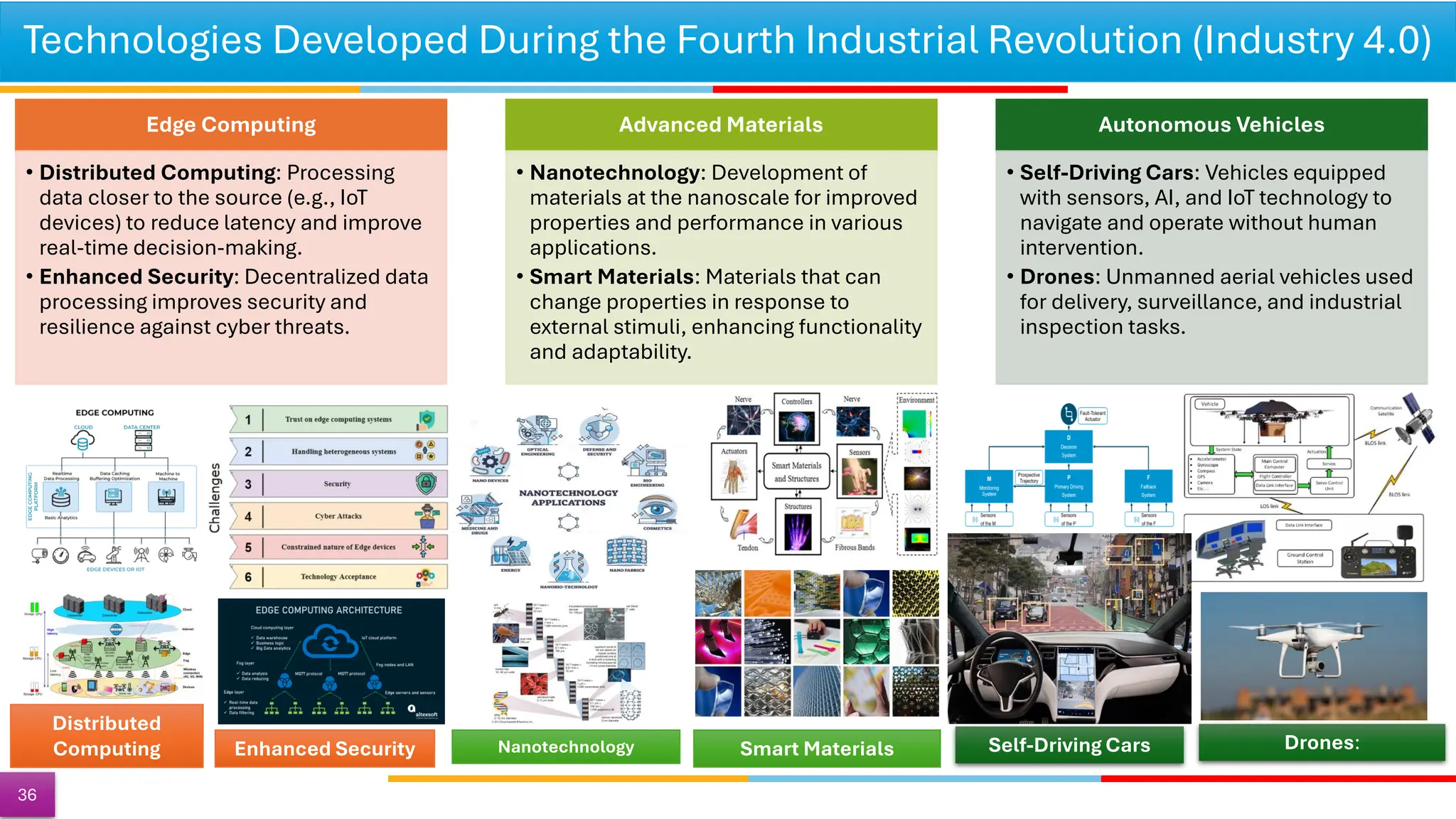
36
Edge Computing
• Distributed Computing: Processing
data closer to the source (e.g., IoT
devices) to reduce latency and improve
real-time decision-making.
• Enhanced Security: Decentralized data
processing improves security and
resilience against cyber threats.
Advanced Materials
• Nanotechnology: Development of
materials at the nanoscale for improved
properties and performance in various
applications.
• Smart Materials: Materials that can
change properties in response to
external stimuli, enhancing functionality
and adaptability.
Autonomous Vehicles
• Self-Driving Cars: Vehicles equipped
with sensors, AI, and IoT technology to
navigate and operate without human
intervention.
• Drones: Unmanned aerial vehicles used
for delivery, surveillance, and industrial
inspection tasks.
Self-Driving Cars
Nanotechnology Drones:
Smart Materials
Distributed
Computing Enhanced Security
Technologies Developed During the Fourth Industrial Revolution (Industry 4.0)
37
Smart Manufacturing
•Efficiency and Productivity: Enhanced efficiency and productivity through automation, real-time data analysis, and predictive
maintenance.
•Customization: Ability to produce customized products on demand, meeting specific customer needs and preferences.
Enhanced Connectivity
•Interconnected Systems: Seamless integration of systems and processes across the entire supply chain, enabling better
coordination and collaboration.
•Remote Monitoring and Control: Real-time monitoring and control of operations from remote locations, improving flexibility and
responsiveness.
Improved Decision-Making
•Data-Driven Insights: Use of big data and analytics to gain valuable insights, optimize processes, and make informed decisions.
•AI and ML Applications: Implementation of AI and ML for predictive maintenance, quality control, and process optimization.
Innovation and Product Development
•Rapid Prototyping: Use of 3D printing for quick and cost-effective prototyping, accelerating the product development cycle.
•Simulation and Testing: Application of AR and VR for virtual testing and simulation, reducing the need for physical prototypes and
trials.
Workforce Transformation
•Skill Requirements: Increased demand for skilled workers in areas such as data analysis, AI, IoT, and cybersecurity.
•Human-Robot Collaboration: Enhanced collaboration between humans and robots, improving safety and productivity in the
workplace.
Sustainability and Resource Efficiency
•Reduced Waste: Use of additive manufacturing and smart materials to minimize waste and improve resource efficiency.
•Energy Management: Implementation of smart energy management systems to optimize energy usage and reduce environmental
impact.
Economic and Social Changes
•New Business Models: Emergence of new business models based on digital technologies, such as subscription services, shared
economies, and platform-based businesses.
•Societal Impact: Transformations in how people live and work, driven by the pervasive influence of digital technologies.
Impact
on
Industry
and
Society
Digital manufacturing
Digital manufacturing is an integrated approach to manufacturing that uses digital technologies to improve product
design, production processes, and operations. It encompasses a wide range of technologies and practices that
leverage digital tools to enhance efficiency, reduce costs, and enable innovation in manufacturing.
38
Digital manufacturing
39
Key Components and Technologies
40
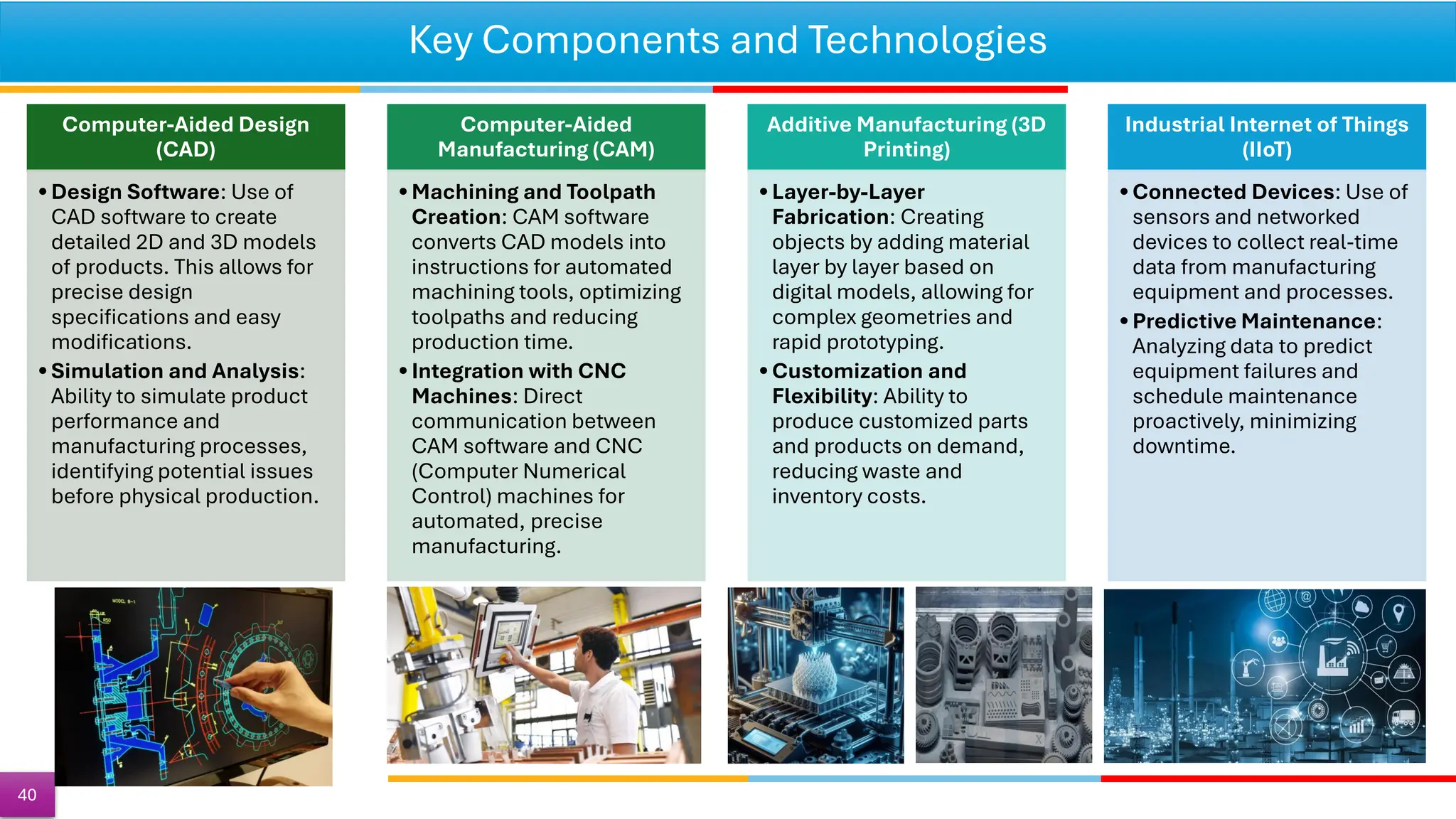
Computer-Aided Design
(CAD)
•Design Software: Use of
CAD software to create
detailed 2D and 3D models
of products. This allows for
precise design
specifications and easy
modifications.
•Simulation and Analysis:
Ability to simulate product
performance and
manufacturing processes,
identifying potential issues
before physical production.
Computer-Aided
Manufacturing (CAM)
•Machining and Toolpath
Creation: CAM software
converts CAD models into
instructions for automated
machining tools, optimizing
toolpaths and reducing
production time.
•Integration with CNC
Machines: Direct
communication between
CAM software and CNC
(Computer Numerical
Control) machines for
automated, precise
manufacturing.
Additive Manufacturing (3D
Printing)
•Layer-by-Layer
Fabrication: Creating
objects by adding material
layer by layer based on
digital models, allowing for
complex geometries and
rapid prototyping.
•Customization and
Flexibility: Ability to
produce customized parts
and products on demand,
reducing waste and
inventory costs.
Industrial Internet of Things
(IIoT)
•Connected Devices: Use of
sensors and networked
devices to collect real-time
data from manufacturing
equipment and processes.
•Predictive Maintenance:
Analyzing data to predict
equipment failures and
schedule maintenance
proactively, minimizing
downtime.
Key Components and Technologies
41
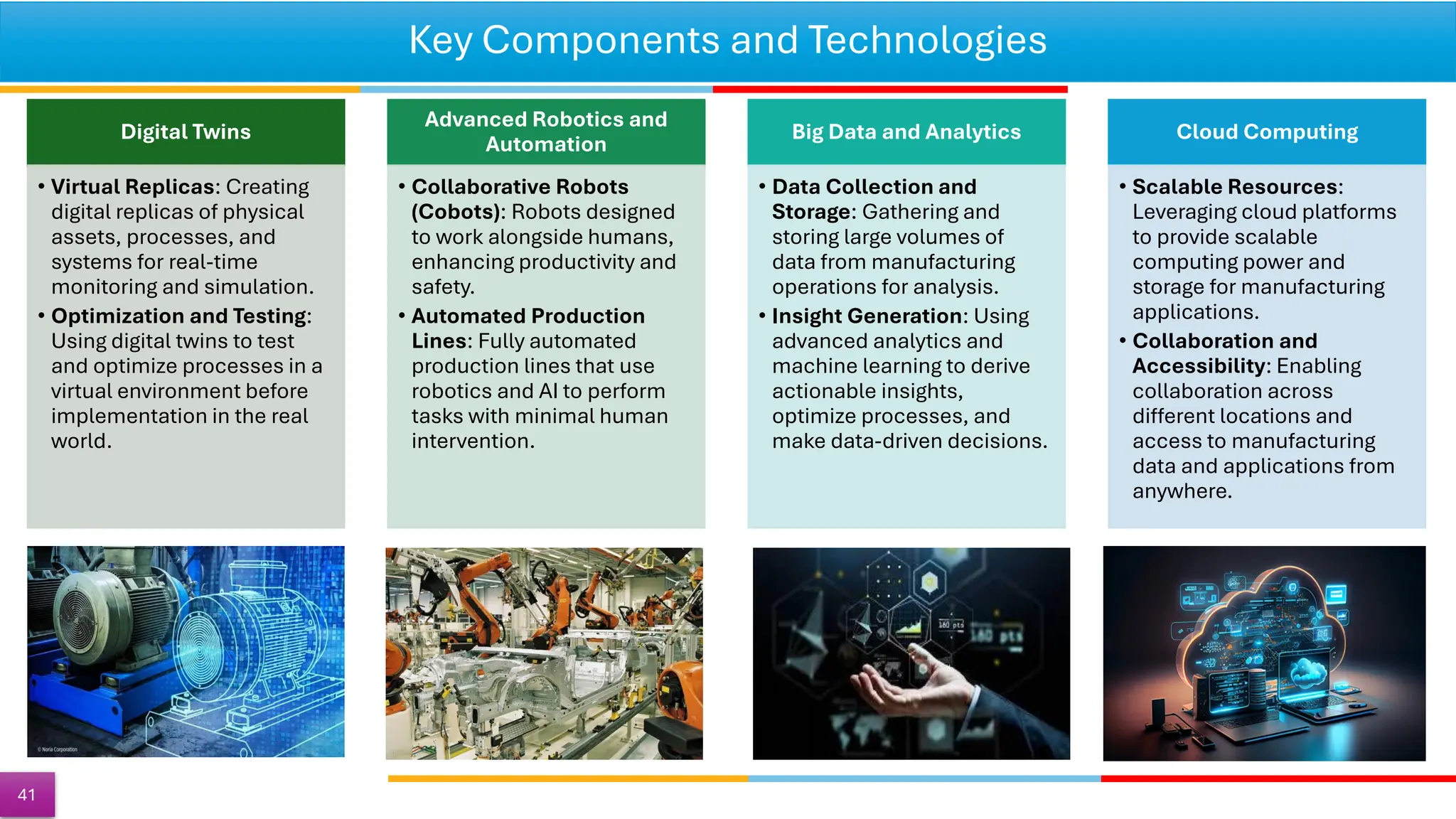
Digital Twins
• Virtual Replicas: Creating
digital replicas of physical
assets, processes, and
systems for real-time
monitoring and simulation.
• Optimization and Testing:
Using digital twins to test
and optimize processes in a
virtual environment before
implementation in the real
world.
Advanced Robotics and
Automation
• Collaborative Robots
(Cobots): Robots designed
to work alongside humans,
enhancing productivity and
safety.
• Automated Production
Lines: Fully automated
production lines that use
robotics and AI to perform
tasks with minimal human
intervention.
Big Data and Analytics
• Data Collection and
Storage: Gathering and
storing large volumes of
data from manufacturing
operations for analysis.
• Insight Generation: Using
advanced analytics and
machine learning to derive
actionable insights,
optimize processes, and
make data-driven decisions.
Cloud Computing
• Scalable Resources:
Leveraging cloud platforms
to provide scalable
computing power and
storage for manufacturing
applications.
• Collaboration and
Accessibility: Enabling
collaboration across
different locations and
access to manufacturing
data and applications from
anywhere.
Key Components and Technologies
42
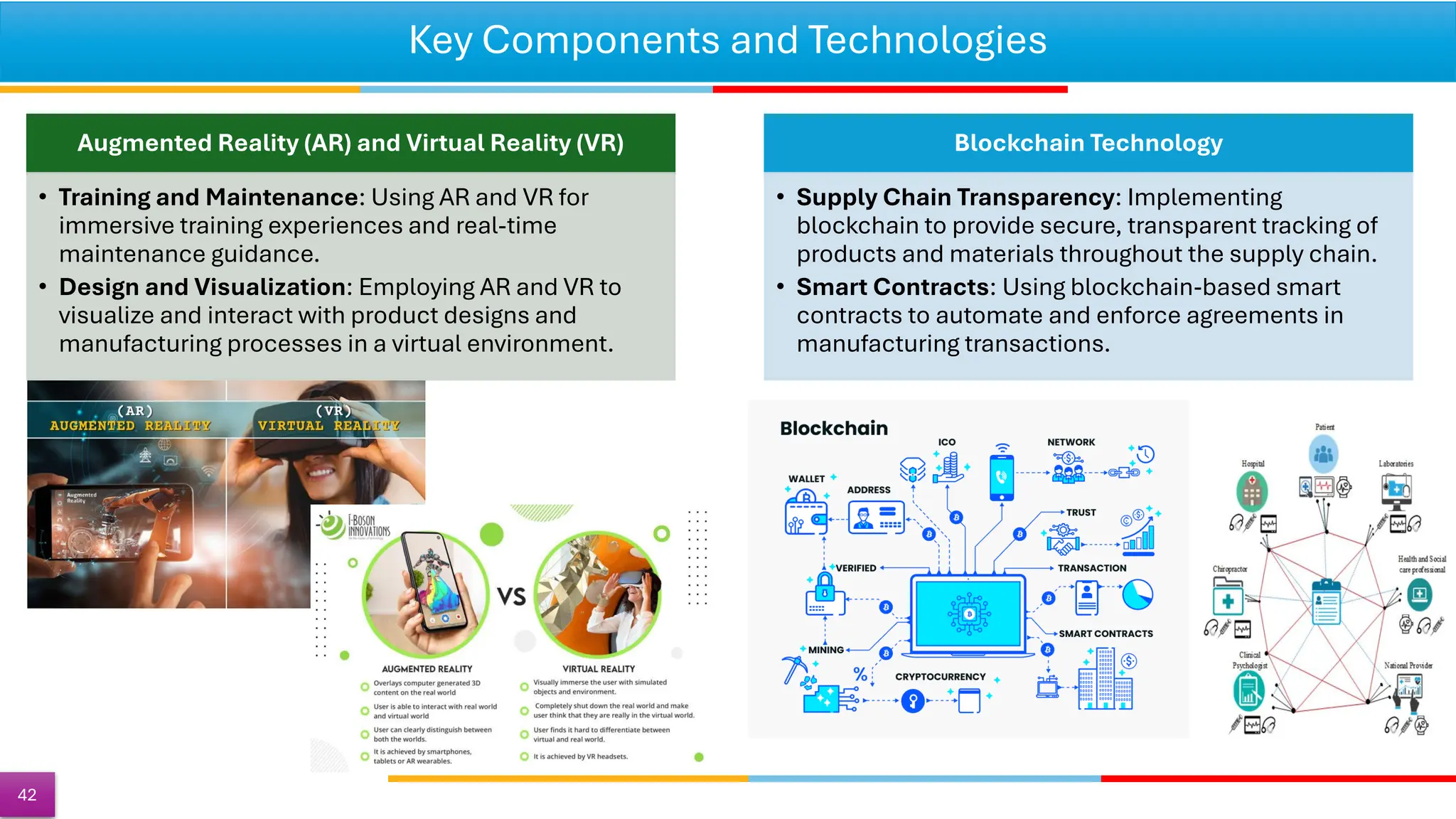
Augmented Reality (AR) and Virtual Reality (VR)
• Training and Maintenance: Using AR and VR for
immersive training experiences and real-time
maintenance guidance.
• Design and Visualization: Employing AR and VR to
visualize and interact with product designs and
manufacturing processes in a virtual environment.
Blockchain Technology
• Supply Chain Transparency: Implementing
blockchain to provide secure, transparent tracking of
products and materials throughout the supply chain.
• Smart Contracts: Using blockchain-based smart
contracts to automate and enforce agreements in
manufacturing transactions.
Benefits of Digital Manufacturing
43
Increased Efficiency
and Productivity
Automation: Reducing
manual labor and increasing
production speed through
automated processes.
Process Optimization:
Identifying and eliminating
inefficiencies in
manufacturing processes
using data-driven insights.
Improved Quality and
Consistency
Precision Manufacturing:
Achieving high precision and
consistency in product
manufacturing through
digital tools and automation.
Real-Time Monitoring:
Monitoring production
processes in real-time to
detect and address quality
issues immediately.
Cost Reduction
Resource Optimization:
Minimizing material waste
and optimizing the use of
resources through efficient
production processes.
Reduced Downtime:
Decreasing equipment
downtime and maintenance
costs through predictive
maintenance and real-time
monitoring.
Enhanced Flexibility
and Customization
On-Demand Production:
Enabling the production of
customized products on
demand, reducing the need
for large inventories.
Rapid Prototyping:
Accelerating the product
development cycle through
rapid prototyping and
iterative design.
Benefits of Digital Manufacturing
44
Better Decision-Making
Data-Driven Insights: Using data analytics to
make informed decisions, optimize
operations, and identify new opportunities.
Simulation and Testing: Testing and validating
designs and processes in a virtual
environment before implementation.
Improved Collaboration
Integrated Systems: Facilitating seamless
communication and collaboration across
different departments and locations through
integrated digital systems.
Global Accessibility: Enabling remote access
to manufacturing data and applications,
supporting collaboration across global teams.
Challenges of Digital Manufacturing
45
Cybersecurity
Data Security: Protecting
sensitive manufacturing
data from cyber threats
and ensuring the security
of connected devices and
networks.
Vulnerability
Management: Addressing
vulnerabilities in digital
systems to prevent
unauthorized access and
data breaches.
Integration
Complexity
System Integration:
Integrating new digital
technologies with existing
legacy systems can be
complex and require
significant investment.
Interoperability: Ensuring
that different digital tools
and systems can
communicate and work
together seamlessly.
Skill Requirements
Workforce Training:
Training employees to work
with new digital
technologies and tools.
Skill Shortages:
Addressing skill shortages
in areas such as data
analysis, AI, and advanced
manufacturing
technologies.
Initial Investment
Capital Costs: High initial
investment required for
implementing digital
manufacturing
technologies and
infrastructure.
Return on Investment
(ROI): Demonstrating the
long-term ROI of digital
manufacturing
investments to
stakeholders.
Data Management
Data Volume: Managing
and analyzing the large
volumes of data generated
by digital manufacturing
processes.
Data Quality: Ensuring the
accuracy and quality of
data used for decision-
making and process
optimization.
Examples of Digital Manufacturing
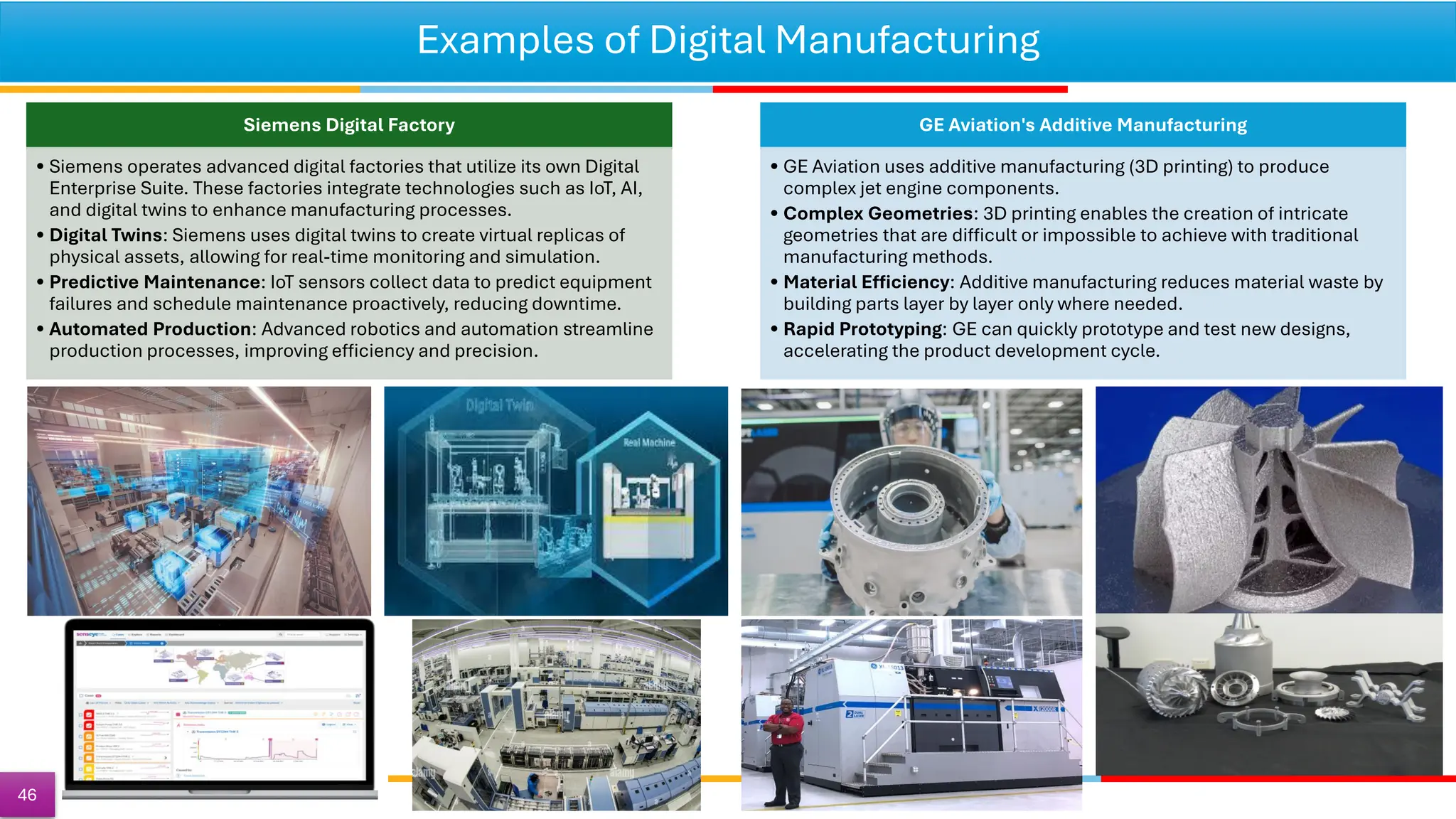
Siemens Digital Factory
• Siemens operates advanced digital factories that utilize its own Digital
Enterprise Suite. These factories integrate technologies such as IoT, AI,
and digital twins to enhance manufacturing processes.
• Digital Twins: Siemens uses digital twins to create virtual replicas of
physical assets, allowing for real-time monitoring and simulation.
• Predictive Maintenance: IoT sensors collect data to predict equipment
failures and schedule maintenance proactively, reducing downtime.
• Automated Production: Advanced robotics and automation streamline
production processes, improving efficiency and precision.
GE Aviation's Additive Manufacturing
• GE Aviation uses additive manufacturing (3D printing) to produce
complex jet engine components.
• Complex Geometries: 3D printing enables the creation of intricate
geometries that are difficult or impossible to achieve with traditional
manufacturing methods.
• Material Efficiency: Additive manufacturing reduces material waste by
building parts layer by layer only where needed.
• Rapid Prototyping: GE can quickly prototype and test new designs,
accelerating the product development cycle.
46
Examples of Digital Manufacturing
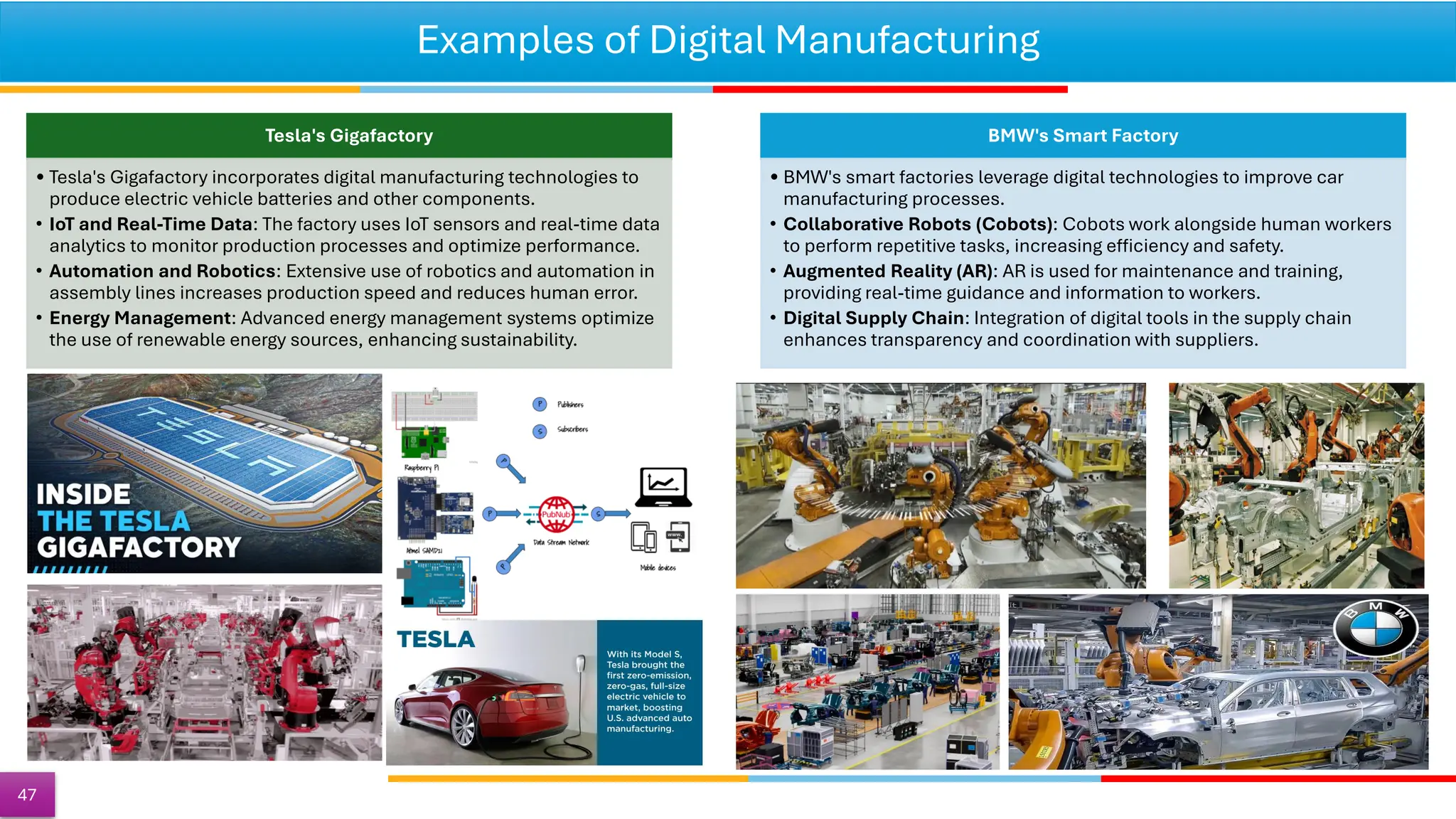
Tesla's Gigafactory
• Tesla's Gigafactory incorporates digital manufacturing technologies to
produce electric vehicle batteries and other components.
• IoT and Real-Time Data: The factory uses IoT sensors and real-time data
analytics to monitor production processes and optimize performance.
• Automation and Robotics: Extensive use of robotics and automation in
assembly lines increases production speed and reduces human error.
• Energy Management: Advanced energy management systems optimize
the use of renewable energy sources, enhancing sustainability.
BMW's Smart Factory
• BMW's smart factories leverage digital technologies to improve car
manufacturing processes.
• Collaborative Robots (Cobots): Cobots work alongside human workers
to perform repetitive tasks, increasing efficiency and safety.
• Augmented Reality (AR): AR is used for maintenance and training,
providing real-time guidance and information to workers.
• Digital Supply Chain: Integration of digital tools in the supply chain
enhances transparency and coordination with suppliers.
47
Examples of Digital Manufacturing
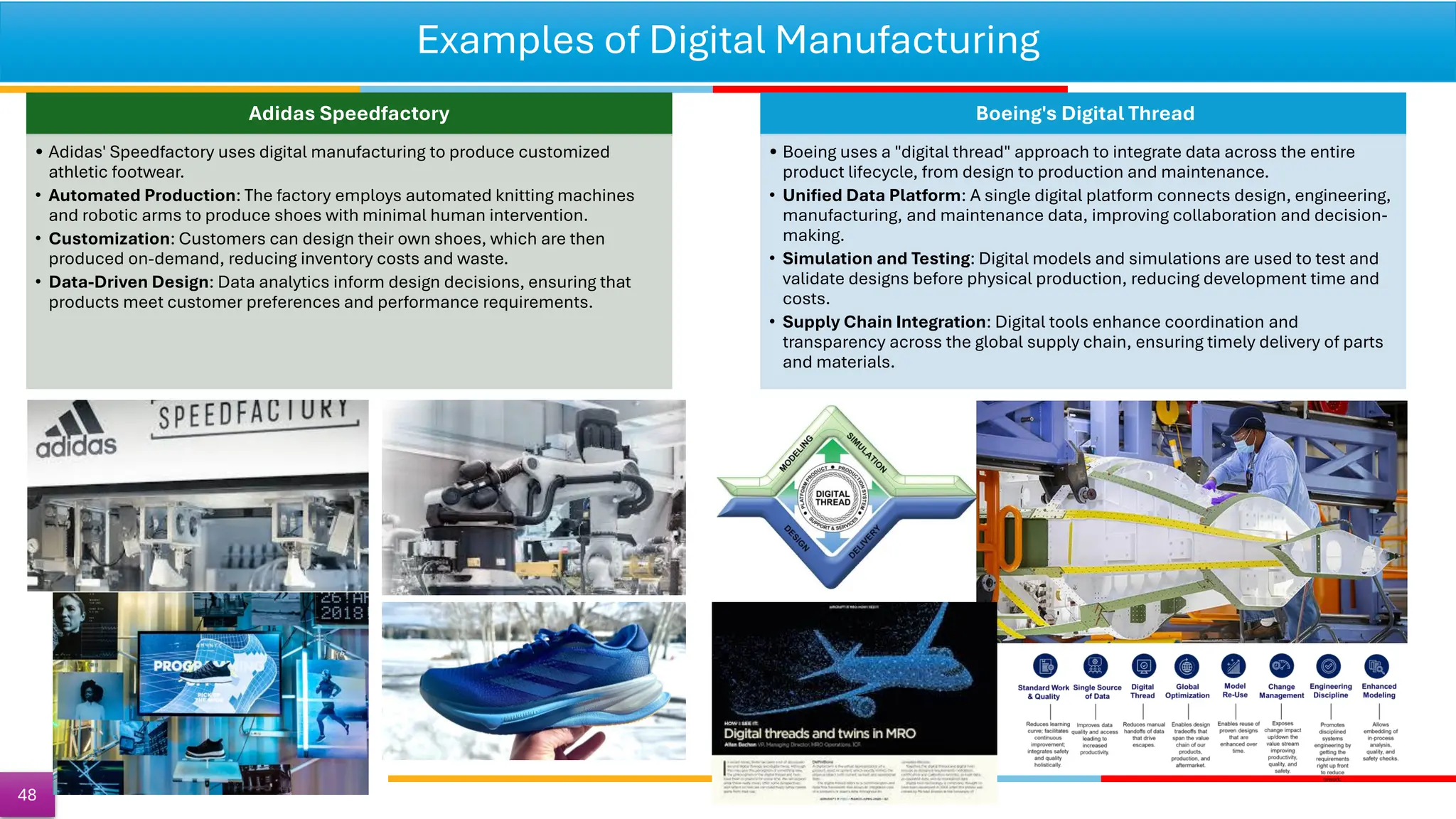
Adidas Speedfactory
• Adidas' Speedfactory uses digital manufacturing to produce customized
athletic footwear.
• Automated Production: The factory employs automated knitting machines
and robotic arms to produce shoes with minimal human intervention.
• Customization: Customers can design their own shoes, which are then
produced on-demand, reducing inventory costs and waste.
• Data-Driven Design: Data analytics inform design decisions, ensuring that
products meet customer preferences and performance requirements.
Boeing's Digital Thread
• Boeing uses a "digital thread" approach to integrate data across the entire
product lifecycle, from design to production and maintenance.
• Unified Data Platform: A single digital platform connects design, engineering,
manufacturing, and maintenance data, improving collaboration and decision-
making.
• Simulation and Testing: Digital models and simulations are used to test and
validate designs before physical production, reducing development time and
costs.
• Supply Chain Integration: Digital tools enhance coordination and
transparency across the global supply chain, ensuring timely delivery of parts
and materials.
48
Examples of Digital Manufacturing
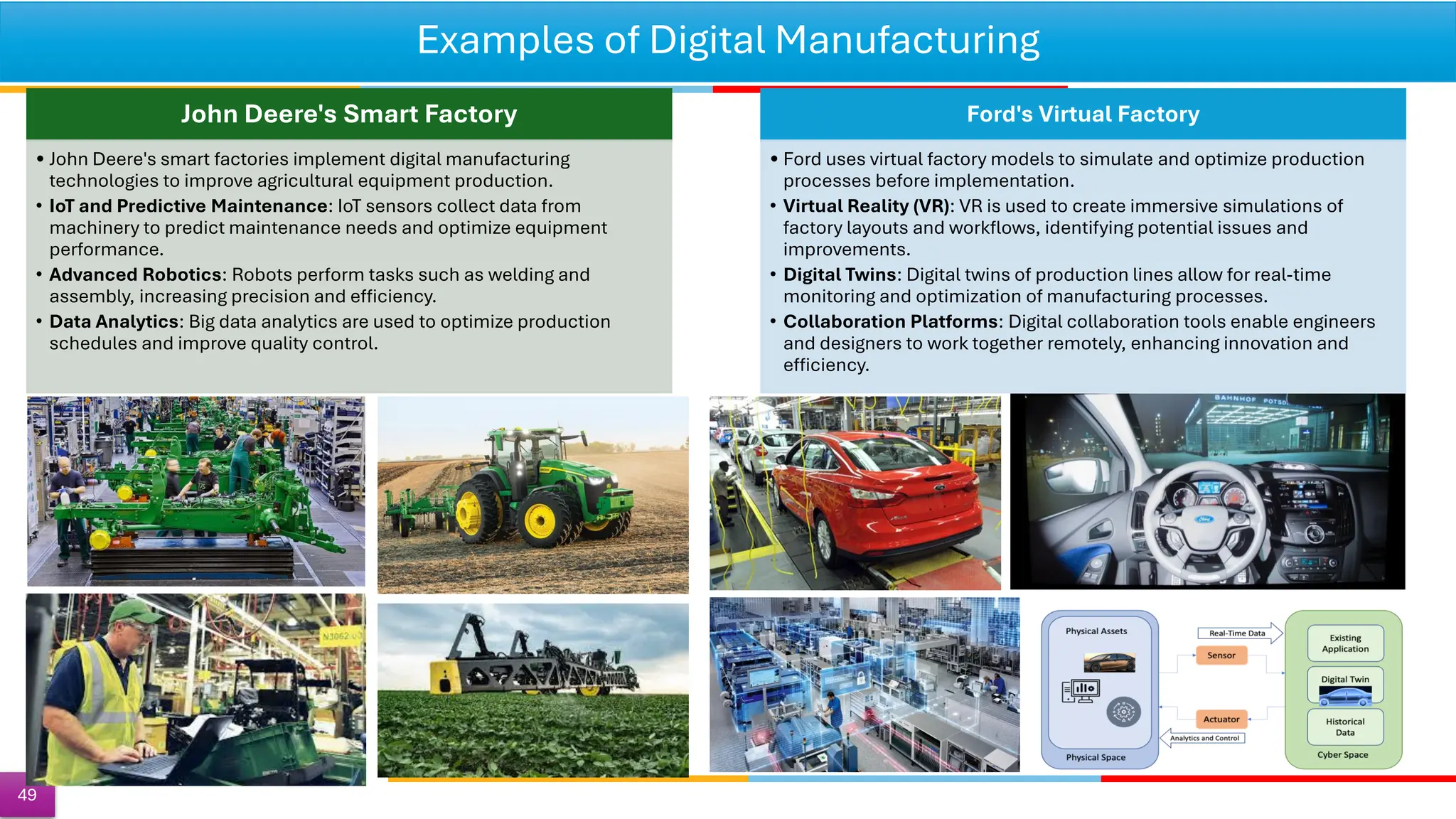
John Deere's Smart Factory
• John Deere's smart factories implement digital manufacturing
technologies to improve agricultural equipment production.
• IoT and Predictive Maintenance: IoT sensors collect data from
machinery to predict maintenance needs and optimize equipment
performance.
• Advanced Robotics: Robots perform tasks such as welding and
assembly, increasing precision and efficiency.
• Data Analytics: Big data analytics are used to optimize production
schedules and improve quality control.
Ford's Virtual Factory
• Ford uses virtual factory models to simulate and optimize production
processes before implementation.
• Virtual Reality (VR): VR is used to create immersive simulations of
factory layouts and workflows, identifying potential issues and
improvements.
• Digital Twins: Digital twins of production lines allow for real-time
monitoring and optimization of manufacturing processes.
• Collaboration Platforms: Digital collaboration tools enable engineers
and designers to work together remotely, enhancing innovation and
efficiency.
49
Examples of Digital Manufacturing
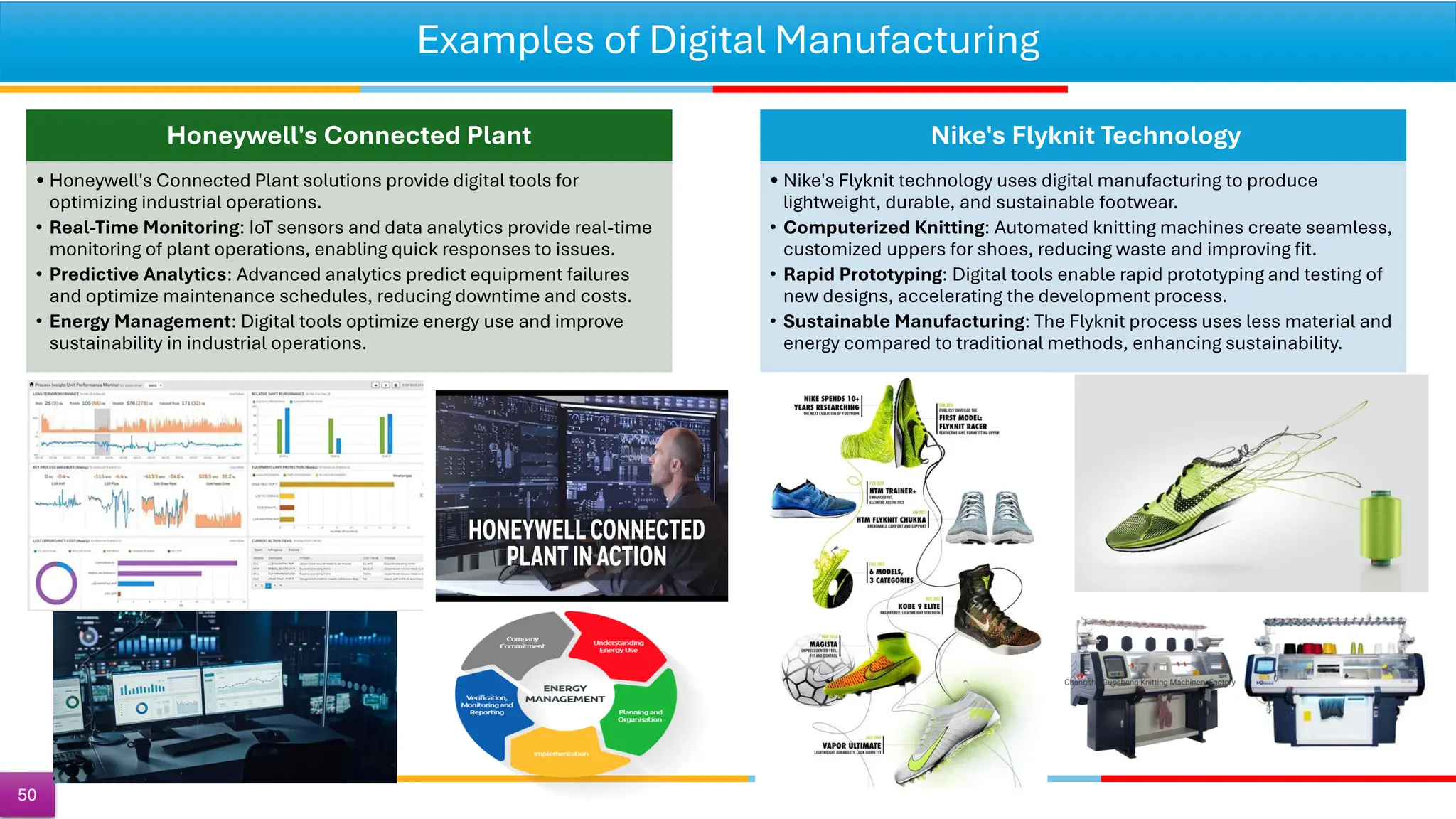
Honeywell's Connected Plant
• Honeywell's Connected Plant solutions provide digital tools for
optimizing industrial operations.
• Real-Time Monitoring: IoT sensors and data analytics provide real-time
monitoring of plant operations, enabling quick responses to issues.
• Predictive Analytics: Advanced analytics predict equipment failures
and optimize maintenance schedules, reducing downtime and costs.
• Energy Management: Digital tools optimize energy use and improve
sustainability in industrial operations.
Nike's Flyknit Technology
• Nike's Flyknit technology uses digital manufacturing to produce
lightweight, durable, and sustainable footwear.
• Computerized Knitting: Automated knitting machines create seamless,
customized uppers for shoes, reducing waste and improving fit.
• Rapid Prototyping: Digital tools enable rapid prototyping and testing of
new designs, accelerating the development process.
• Sustainable Manufacturing: The Flyknit process uses less material and
energy compared to traditional methods, enhancing sustainability.
50
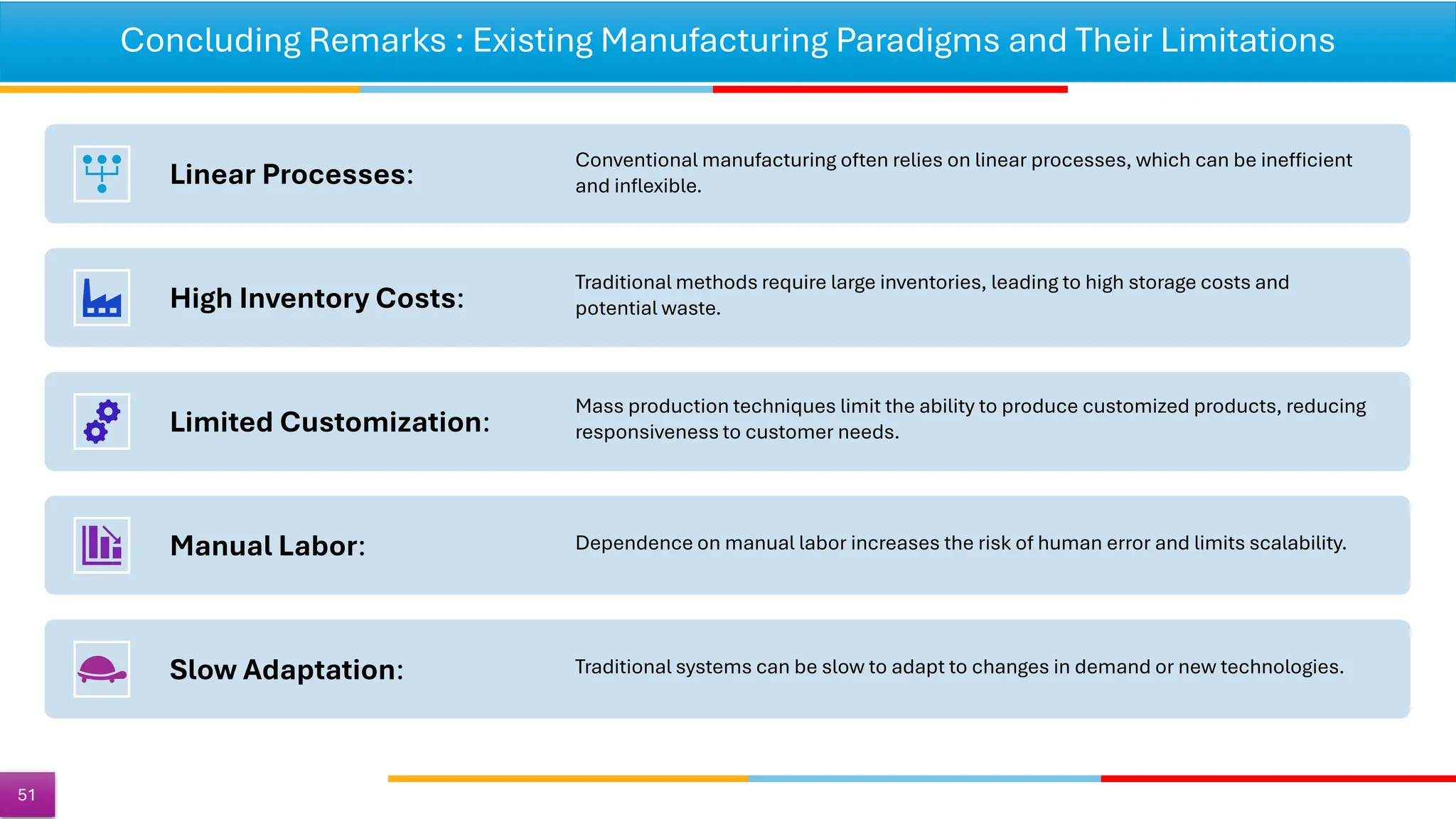
Concluding Remarks : Existing Manufacturing Paradigms and Their Limitations
51
Linear Processes:
Conventional manufacturing often relies on linear processes, which can be inefficient
and inflexible.
High Inventory Costs:
Traditional methods require large inventories, leading to high storage costs and
potential waste.
Limited Customization:
Mass production techniques limit the ability to produce customized products, reducing
responsiveness to customer needs.
Manual Labor: Dependence on manual labor increases the risk of human error and limits scalability.
Slow Adaptation: Traditional systems can be slow to adapt to changes in demand or new technologies.
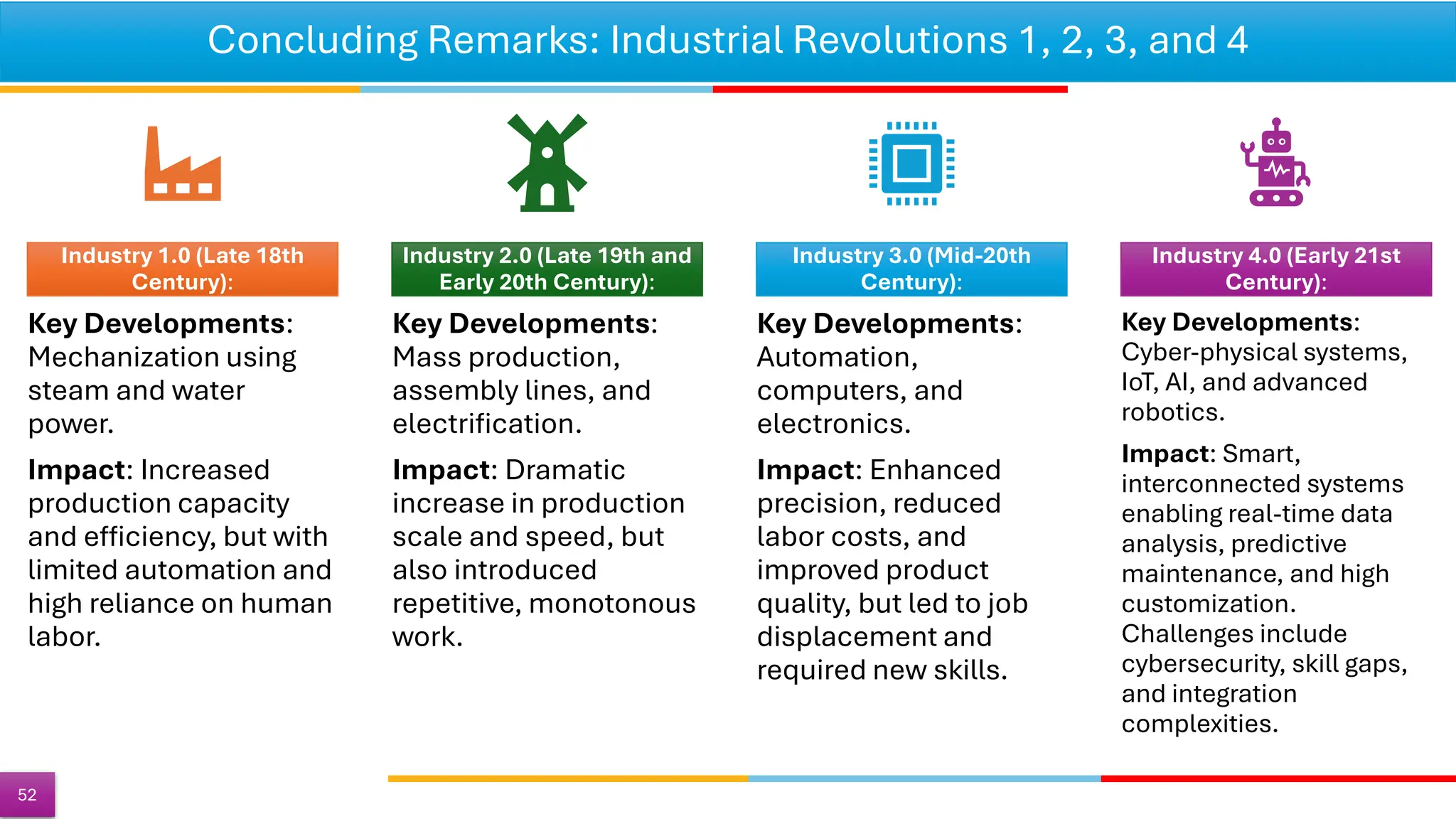
Concluding Remarks: Industrial Revolutions 1, 2, 3, and 4
52
Industry 1.0 (Late 18th
Century):
Key Developments:
Mechanization using
steam and water
power.
Impact: Increased
production capacity
and efficiency, but with
limited automation and
high reliance on human
labor.
Industry 2.0 (Late 19th and
Early 20th Century):
Key Developments:
Mass production,
assembly lines, and
electrification.
Impact: Dramatic
increase in production
scale and speed, but
also introduced
repetitive, monotonous
work.
Industry 3.0 (Mid-20th
Century):
Key Developments:
Automation,
computers, and
electronics.
Impact: Enhanced
precision, reduced
labor costs, and
improved product
quality, but led to job
displacement and
required new skills.
Industry 4.0 (Early 21st
Century):
Key Developments:
Cyber-physical systems,
IoT, AI, and advanced
robotics.
Impact: Smart,
interconnected systems
enabling real-time data
analysis, predictive
maintenance, and high
customization.
Challenges include
cybersecurity, skill gaps,
and integration
complexities.
Concluding Remarks: Digital Manufacturing
53
Key benefits include:
• Efficiency and Productivity: Automation and
real-time data analysis enhance efficiency
and reduce production time.
• Customization: Advanced technologies like
3D printing enable on-demand production of
customized products.
• Cost Reduction: Optimized processes and
predictive maintenance lower operational
costs and reduce waste.
• Flexibility: Digital tools enable quick
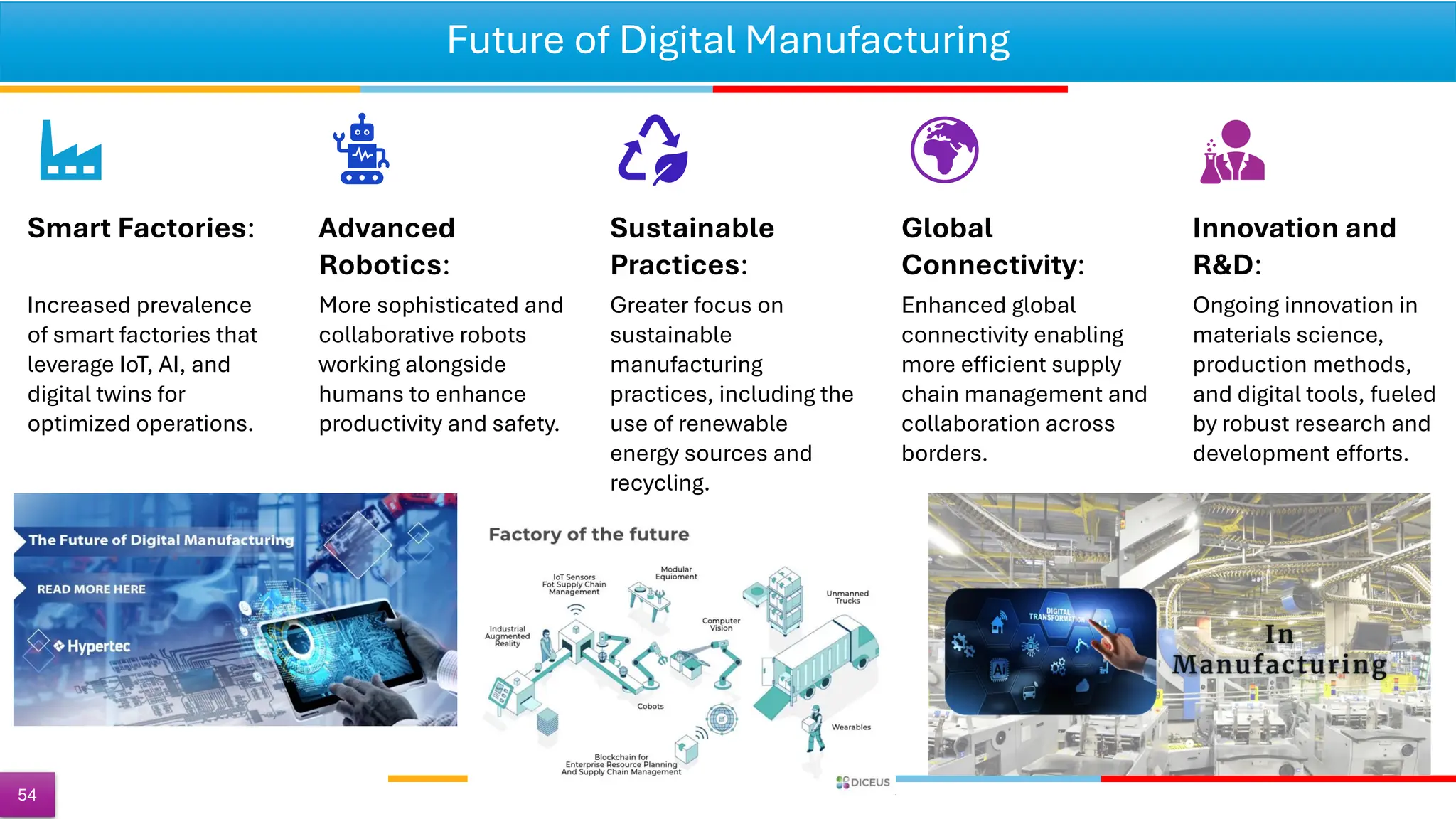
adaptation to changes in demand and
technological advancements.
• Quality and Consistency: Precision
manufacturing and real-time monitoring
improve product quality and consistency.
digital manufacturing also presents
challenges:
• Cybersecurity: Protecting sensitive
data and ensuring the security of
connected systems.
• Skill Requirements: Need for a
workforce skilled in digital
technologies and data analysis.
• Initial Investment: High initial costs
for implementing digital
infrastructure and technologies.
• Integration: Complexities in
integrating new digital tools with
existing systems.
Future of Digital Manufacturing
54
Smart Factories:
Increased prevalence
of smart factories that
leverage IoT, AI, and
digital twins for
optimized operations.
Advanced
Robotics:
More sophisticated and
collaborative robots
working alongside
humans to enhance
productivity and safety.
Sustainable
Practices:
Greater focus on
sustainable
manufacturing
practices, including the
use of renewable
energy sources and
recycling.
Global
Connectivity:
Enhanced global
connectivity enabling
more efficient supply
chain management and
collaboration across
borders.
Innovation and
R&D:
Ongoing innovation in
materials science,
production methods,
and digital tools, fueled
by robust research and
development efforts.
Next Class on 4th Aug 2024
Forces
behind
Industry
4.0
2.1
Forces behind Industry 4.0 (IoT, big data, cloud
computing, robotics, additive manufacturing and
artificial intelligence)
2.2
Connected Factories (What is connected factory and
criteria for connected factory)
2.3 How the current industry is different from Industry 4.0
55
References
• Text Book
• Internet of Things: A Hands-On Approach by Arshdeep Bahga, Vijay Madisetti, University Press Publication,
2015.
• References
• Zhang Y. and Tao F., “Optimization of Manufacturing Systems using the Internet of Things”, 1st Edition, 2017,
Academic Press (Elsevier), UK.
• IoT Fundamentals : Networking Technologies, Protocols, and Use Cases for the Internet of Things, 1/e by
David Hanes , cisco press
• Internet of Things and Data Analytics Handbook by Hwaiyu Geng © 2017 John Wiley & Sons, Inc.
• The Internet of Things: Key Applications and Protocols Olivier Hersent, David B. 2nd Edition, Wiley
Publication
• Internet of Things: Architecture and Design Principles Rajkamal. 1st Edition, Mc Graw Hill
56
IoT in Manufacturing: A Digital Transformation

IoT in Manufacturing: A Digital Transformation

  • 1.
    IOT IN MANUFACTURING Dr.Suhas Deshmukh 1
  • 2.
    Outline • Safe workpractices and workplace safety • An understanding of the Seven Deadly Wastes • Industrial Standardized Quality Systems. • Troubleshooting industrial processes and equipment. Prerequisites • Existing manufacturing paradigms and their limitations • Industrial revolutions 1, 2, 3 and 4 • Digital manufacturing Todays Session 2
  • 3.
    Safe Work Practicesand Workplace Safety: Guidelines •Wear appropriate PPE for the task (e.g., gloves, goggles, helmets). •Ensure PPE is in good condition and properly fitted. Personal Protective Equipment (PPE): •Keep work areas clean and free of hazards. •Properly dispose of waste materials. Workplace Cleanliness: •Ensure all machinery and equipment are well-maintained and in good working order. •Follow operating instructions and safety guidelines. •Use safety guards and devices as required. Machinery and Equipment: •Properly label and store chemicals. •Use appropriate containers for handling and storing chemicals. •Be aware of Material Safety Data Sheets (MSDS) for information on chemical hazards. Chemical Safety: •Know the location of emergency exits, fire extinguishers, and first aid kits. •Participate in regular emergency drills. •Report any accidents or incidents immediately. Emergency Procedures: •Arrange workstations to promote good posture and reduce strain. •Take regular breaks to avoid repetitive strain injuries. Ergonomics: •Ensure electrical equipment is properly grounded. •Avoid overloading electrical outlets. •Report any electrical hazards immediately. Electrical Safety: •Use appropriate fall protection equipment when working at heights. •Ensure ladders and scaffolding are secure and in good condition. Fall Prevention: •Use proper lifting techniques to avoid back injuries. •Use mechanical aids or get assistance for heavy loads. Safe Lifting Practices: 3
  • 4.
    Safe Work Practicesand Workplace Safety : Implementation Training and Education: • Provide regular training on safety practices and procedures. • Ensure employees understand the importance of following safety guidelines. Safety Audits and Inspections: • Conduct regular safety audits and inspections to identify and address potential hazards. • Involve employees in safety inspections and encourage them to report hazards. Safety Culture: • Promote a culture of safety where employees feel responsible for their own safety and the safety of others. • Recognize and reward safe behavior. 4
  • 5.
    An understanding ofthe Seven Deadly Wastes • Manufacturing products based on forecasted demand rather than actual orders. Overproduction • Workers waiting for materials to arrive or machines to become available. Waiting: • Moving products back and forth between different production areas. Transport: • Painting areas of a product that will not be seen or used by the customer. Extra Processing: • Holding large stocks of raw materials, work- in-progress, or finished goods. Inventory: • Workers walking long distances to fetch tools or materials. Motion: • Products failing quality inspections or requiring rework due to errors. Defects: 5
  • 6.
    Industrial Standardized QualitySystems ISO 9001: •Description: ISO 9001 is an international standard for a QMS. It provides a framework for consistent quality in products and services. •Components: •Quality policy and objectives •Documented processes and procedures •Regular audits and reviews •Benefits: Enhances customer satisfaction, improves process efficiency, and facilitates continual improvement. Total Quality Management (TQM): •Description: TQM is a comprehensive management approach focused on long-term success through customer satisfaction. It involves all members of an organization in improving processes, products, and services. •Principles: •Customer- focused organization •Leadership commitment •Involvement of people •Process approach •Continual improvement Six Sigma: •Description: Six Sigma is a data- driven methodology aimed at reducing defects and variability in processes. •Methodology: •DMAIC (Define, Measure, Analyze, Improve, Control) •DMADV (Define, Measure, Analyze, Design, Verify) •Benefits: Improves process quality, reduces costs, and increases customer satisfaction. Lean Manufacturing: •Description: Lean manufacturing focuses on minimizing waste and maximizing value by optimizing processes. •Principles: •Value stream mapping •Continuous improvement (Kaizen) •Just-In-Time (JIT) production •5S methodology (Sort, Set in order, Shine, Standardize, Sustain) Statistical Process Control (SPC): •Description: SPC uses statistical methods to monitor and control production processes. •Tools: •Control charts •Process capability analysis •Pareto analysis •Benefits: Enhances process stability and capability, reduces variability, and ensures consistent quality. 6
  • 7.
    Troubleshooting Industrial Processesand Equipment Identify the Problem: Analyze the Problem: Develop Solutions: Implement Solutions: Monitor and Evaluate: • Observations & Documentations • What is happening? When did the problem start? Has this problem occurred before? What changes were made recently? • Break Down the Problem • Root Cause Analysis • 5 Whys: Ask "why" five times to drill down to the root cause. • Fishbone Diagram: Categorize potential causes to identify root cause. • Failure Mode and Effects Analysis (FMEA): • Brainstorm Solutions: Generate a list solutions based on analysis. • Evaluate Solutions: Assess the feasibility, cost, and potential impact of each solution. • Select the Best Solution the root cause with the least negative impact. • Plan Implementation: Create a detailed implementation plan with steps, responsibilities, and timelines. • Execute the Plan: Carry out the solution as planned. • Document the Process: Keep thorough records of actions taken and observations made during implementation. • Check Effectiveness: Monitor the solution to it resolves the issue. • Adjust as Needed: Make necessary adjustments based on feedback and performance. • Document Outcomes: Record the results and lessons learned for future reference. 1 2 3 3 4 Mechanical Failures: •Wear and tear, improper maintenance, misalignment, and overloading. •Implement regular maintenance schedules, provide training on proper usage, and ensure timely repairs. Electrical Failures: •Power surges, faulty wiring, component failures, and poor insulation. •Conduct regular electrical inspections, use proper grounding techniques, and employ surge protection devices. Process Variability: •Inconsistent raw materials, changes in environmental conditions, and equipment malfunctions. •Standardize processes, implement quality control measures, and ensure consistent equipment performance. Safety Hazards: •Unsafe work practices, lack of safety measures, and equipment malfunction. •Enforce safety protocols, provide comprehensive safety training, and conduct regular safety audits. Basic Principles of Troubleshooting Common Issues in Industrial Processes and Equipment 7
  • 8.
    IOT Manufacturing Industrial Revolution 4.0 Forcesbehind Industry 4.0 Introduction & Concepts IoT Enabling Technologies IOT and M2M Sensors, Participatory sensing, Actuators SMART Sensors , RFIDs IOT Physical devices & Endpoints IOT Physical devices & Endpoints Connectivity and Networking Connectivity and Networking Data collection, Storage and computing using Cloud Platform Security Challenges for IOT Data management in IoT & Mobile app development Applications of IoT in manufacturing Applications of IoT in manufacturing 8
  • 9.
    Manufacturing Process Input Conversation Process Output Metalworking Industry •Casting:Pouring molten metal into molds to create shapes. •Forging: Shaping metal through compressive forces. •Machining: Cutting and shaping metal using lathes and mills. Plastic Manufacturing •Injection Molding: Injecting molten plastic into molds to create parts. •Extrusion: Forcing plastic through a shaped die to create continuous shapes. •Blow Molding: Forming hollow plastic parts by inflating a heated plastic tube. Electronics Manufacturing •PCB Fabrication: Creating printed circuit boards through etching and layering processes. •Surface Mount Technology (SMT): Placing and soldering electronic components onto PCBs. •Testing and Calibration: Ensuring electronic devices function correctly through various tests and calibrations. Textile Industry •Spinning: Converting fibers into yarn. •Weaving/Knitting: Creating fabrics from yarn. •Dyeing and Finishing: Adding color and texture to fabrics. Automotive Industry • Finished Products: Cars, trucks, motorcycles. • Components: Engines, transmissions, body panels. • By-Products: Scrap metal, used oils. Electronics Industry • Finished Products: Smartphones, laptops, TVs. • Components: Microchips, PCBs, batteries. • By-Products: Silicon waste, packaging materials. Textile Industry • Finished Products: Clothing, fabrics, accessories. • Components: Yarns, dyes, buttons. • By-Products: Textile off-cuts, dye residues. Food and Beverage Industry • Finished Products: Packaged foods, beverages, ready-to-eat meals. • Components: Ingredients, packaging materials. • By-Products: Organic waste, packaging waste. 9 Raw Materials •Metals (steel, aluminum), plastics, ceramics, textiles, chemicals, wood, and composites. Components and Parts •Electrical components (chips, resistors), mechanical parts (gears, bearings), sub-assemblies (motors, circuit boards). Tools and Equipment •Cutting tools, CNC machines, welding equipment, 3D printers, molds, dies, and robotics. Energy •Electrical energy, thermal energy, hydraulic energy, and pneumatic energy. Labor •Skilled labor (engineers, technicians), unskilled labor (assembly line workers), and supervisory staff. Information and Data •Technical specifications, design documents, production schedules, quality standards,and process parameters. Supplies and Consumables •Lubricants, coolants, adhesives, cutting fluids, cleaning agents, and protective equipment. Packaging Materials •Boxes, crates, shrink wrap, pallets, labels, and protective foam. Information Technology Systems •Enterprise Resource Planning (ERP) systems, Manufacturing Execution Systems (MES), CAD/CAM software, and IoT platforms. Supply Chain and Logistics •Suppliers, inventory management systems, transportation networks, warehousing facilities, and distribution channels. Quality Control and Testing Equipment •Calibrated measuring instruments, testing machines, spectrometers, and software for quality analysis. Regulatory Compliance and Standards •Safety standards, environmental regulations, industry-specific standards(ISO, ASTM), and certifications. Design and Engineering Inputs •CAD models, engineering drawings, simulation results, and prototype samples.
  • 10.
    Industrial Revolutions :➔ 1.0 ➔ 2.0 ➔ 3.0 ➔ 4.0
  • 11.
  • 12.
    Existing Manufacturing Paradigm CraftProduction Pre-Industrial Revolution •Handcrafted goods produced by skilled artisans. •Limited production scale, often tailored to individual customer needs. •High variability in quality and design. Mass Production Late 19th to Mid-20th Century •Introduction of mechanization and assembly lines. •Standardized parts and products, leading to high volume production. •Key Figures: Henry Ford’s assembly line revolutionized automobile production. •Benefits: •High production rates and reduced costs per unit. •Increased availability of consumer goods. Lean Manufacturing Late 20th Century •Focus on minimizing waste and maximizing value. •Principles include Just-In-Time (JIT) production, continuous improvement (Kaizen), and quality control. •Key Concepts: Eliminating waste (Muda), optimizing workflow, and improving quality. •Benefits: •Reduced production costs and lead times. •Enhanced quality and customer satisfaction. Flexible Manufacturing Systems (FMS) Late 20th Century •Integration of computer-controlled machines and automated systems. •Capability to adapt quickly to changes in product design or production volume. •Benefits: •Increased flexibility in production scheduling. •Improved responsiveness to market changes and customer demands. Computer-Integrated Manufacturing (CIM) Late 20th Century •Integration of computer systems across the entire manufacturing process. •Incorporates CAD/CAM systems for design and manufacturing automation. •Benefits: •Streamlined production processes and reduced human error. •Enhanced product design, quality, and manufacturing efficiency. Six Sigma and Total Quality Management (TQM) Late 20th Century to Present •Focus on improving quality and reducing defects through statistical methods. •Six Sigma aims for near-perfect quality with a goal of 3.4 defects per million opportunities. •Benefits: •Improved product quality and customer satisfaction. •Enhanced process efficiency and reduced operational costs. Lean Six Sigma Early 21st Century •Combines Lean principles with Six Sigma methodologies. •Focuses on both waste reduction and process improvement. •Benefits: •Enhanced operational efficiency and quality. •Reduced costs and improved customer value. Industry 4.0 21st Century •Integration of digital technologies such as IoT, AI, big data analytics, and cyber-physical systems. •Creation of smart factories with interconnected systems and real-time data analytics. •Benefits: •Increased automation, efficiency, and flexibility. •Enhanced data-driven decision-making and predictive maintenance. 12
  • 13.
    Existing Manufacturing Paradigm Characteristics: •Handcrafted goods by skilled artisans. • Low production scale, highly customized products. • High variability in quality. Limitations: • Scalability: Limited ability to scale up production. • Consistency: Variability in product quality and design. • Cost: High production costs due to labor-intensive processes. Craft Production Characteristics: • High volume production using assembly lines. • Standardized parts and products. • Economies of scale reduce cost per unit. Limitations: • Flexibility: Inability to quickly adapt to changes in demand or product design. • Customization: Limited ability to offer personalized products. • Waste: Potential for significant material waste and inventory overproduction. Mass Production Characteristics • Focus on waste reduction and value maximization. • Principles include Just-In-Time (JIT), continuous improvement (Kaizen), and quality control. Limitations • Implementation Complexity: Requires a cultural shift and continuous commitment. • Flexibility: JIT can be vulnerable to supply chain disruptions. • Scope: May be challenging to apply lean principles to all types of production environments. Lean Manufacturing 13
  • 14.
    Existing Manufacturing Paradigm Characteristics: •Integrationof automated and computer-controlled machines. •Ability to adapt quickly to changes in production needs. Limitations: •Cost: High initial investment in technology and training. •Complexity: Managing and maintaining a flexible system can be complex. •Technical Dependency: High reliance on advanced technology and skilled operators. Flexible Manufacturing Systems (FMS) Characteristics: • Focus on reducing defects and improving quality through statistical methods. • Continuous improvement and employee involvement. Limitations: • Implementation Cost: Requires training and continuous monitoring. • Cultural Resistance: Resistance to change within the organization. • Scope: May not address all aspects of manufacturing efficiency and productivity. Computer-Integrated Manufacturing (CIM) Characteristics: • Comprehensive integration of computer systems across manufacturing. • Use of CAD/CAM for design and automation. Limitations: • Integration Issues: Difficulty in integrating diverse systems and software. • Cost: Significant investment in IT infrastructure and software. • Cybersecurity: Increased vulnerability to cyber-attacks due to interconnected systems. Six Sigma and Total Quality Management (TQM) 14
  • 15.
    Existing Manufacturing Paradigm Characteristics: •Combines Lean principles with Six Sigma methodologies. • Focus on waste reduction and process improvement. Limitations: • Complexity: Integration of Lean and Six Sigma can be challenging. • Cost: Requires significant training and resources. • Sustainability: Maintaining long-term commitment can be difficult. Lean Six Sigma Industry 4.0 Characteristics: • Integration of digital technologies like IoT, AI, big data analytics, and cyber- physical systems. • Creation of smart factories with interconnected systems and real-time data analytics. Limitations: • Initial Investment: High cost of implementing advanced technologies. • Skill Gap: Need for workforce training and development. • Cybersecurity Risks: Vulnerability to cyber threats. • Complexity Management: Difficulty in integrating and managing diverse technologies and processes. • Data Privacy: Challenges related to the protection and management of vast amounts of data. 15
  • 16.
    Industrial Revolution 1.0:The First Industrial Revolution (late 18th to early 19th century) Key Innovations: • Introduction of steam power and mechanization. • Development of the steam engine by James Watt. • Mechanization of textile production with inventions like the spinning jenny, water frame, and power loom. • Establishment of factories and the factory system. Impact: • Shift from agrarian economies to industrialized ones. • Increased production capacity and efficiency. • Rise of urbanization as people moved to cities for factory jobs. • Improved transportation with steam-powered locomotives and ships. Characteristics • Energy Source: Steam power and coal. • Production: Mechanized textile production, iron forging, and coal mining. • Labor: Manual labor in factories, significant workforce migration to urban areas. • Economy: Transition to industrial economies with increased productivity and trade. 16 Coal Energy Steam Engine/ Water Wheels Increased Production Efficiency •Mechanization: Steam power enabled the mechanization of many manufacturing processes, significantly increasing production speed and volume. •Standardization: Improved machinery allowed for more consistent and standardized products. Urbanization •Factory System: The establishment of large factories in urban areas attracted a workforce, leading to rapid urbanization and the growth of cities. •Labor Shifts: Many people moved from rural areas to cities in search of factory jobs, changing societal structures and lifestyles. Economic Growth •Industrial Output: Enhanced production capabilities fueled economic growth and increased the availability of consumer goods. •Trade Expansion: Improved transportation (steamships and locomotives) facilitated global trade, further boosting economies. Technological Advancements •Innovation Cycle: The success of steam-powered machinery spurred further technological innovations and improvements, driving the continued evolution of industrial processes. Environmental and Social Consequences •Pollution: Extensive use of coal led to severe air and water pollution, particularly in rapidly industrializing cities. •Working Conditions: Factory work often involved long hours, poor working conditions, and low wages, leading to social unrest and the eventual rise of labor movements. Water
  • 17.
    Industrial Revolution 1.0:The First Industrial Revolution (late 18th to early 19th century) 17 Steam Power •James Watt's Improvements: James Watt's enhancements to the steam engine in the late 18th century made it more efficient and practical for industrial use. •Mechanization: Steam engines powered machinery in factories, enabling large- scale production. Textile Industry Innovations •Spinning Jenny: Invented by James Hargreaves in 1764, this machine allowed for the simultaneous spinning of multiple threads, increasing productivity. •Power Loom: Developed by Edmund Cartwright in 1785, the power loom mechanized the weaving process, further boosting textile production. Iron and Steel Production •Bessemer Process: Invented by Henry Bessemer in the 1850s, this process revolutionized steel production by making it cheaper and more efficient. •Railways: The development of railways, powered by steam locomotives, facilitated the transport of goods and people over long distances. Water Power •Water Wheels: Utilized for centuries, water wheels continued to power mills and factories before the advent of steam power. •Hydraulic Systems: Used in factories to provide mechanical power for various processes. Mechanization of Agriculture •Seed Drill: Invented by Jethro Tull in 1701, the seed drill efficiently planted seeds in rows, increasing crop yields. •Mechanical Reaper: Invented by Cyrus McCormick in 1831, this machine revolutionized the harvesting of grain, reducing labor requirements. Key innovations Economic Transformation •Industrialization: Shift from hand production methods to machines, leading to mass production and increased productivity. •Growth of Factories: Establishment of large factories equipped with steam- powered machinery, centralizing production. Urbanization •Migration to Cities: Large numbers of people moved from rural areas to urban centers in search of factory work. •City Expansion: Rapid growth of cities, leading to the development of new housing, infrastructure, and social services. Social Changes •Labor Force: Emergence of a working class, often subjected to long hours, low wages, and poor working conditions. •Child Labor: Widespread use of child labor in factories, leading to eventual social reforms and labor laws. Technological Advancements •Innovation Acceleration: Continuous innovation in machinery and production techniques, driving further advancements in industry. •Standardization: Development of standardized parts and processes, facilitating mass production and interchangeability. Transportation and Communication •Railroads: Expansion of railway networks, transforming transportation of goods and people across continents. •Steamships: Development of steam-powered ships, enhancing maritime trade and exploration. Impact on Industry and Society
  • 18.
    Technologies Developed Duringthe First Industrial Revolution (Industry 1.0) 18 Steam Engine • James Watt's Improvements (1765): James Watt significantly improved the design of the steam engine, making it more efficient and practical for various industrial applications. • Application: Used to power factories, mines, and transportation, including steamships and locomotives. Textile Machinery • Spinning Jenny (1764): Invented by James Hargreaves, this machine allowed multiple spools of thread to be spun simultaneously, greatly increasing productivity in textile manufacturing. • Water Frame (1769): Invented by Richard Arkwright, it used water power to drive spinning machines, enabling the mass production of yarn. • Power Loom (1785): Invented by Edmund Cartwright, it mechanized the weaving process, increasing textile production efficiency. Spinning Jenny (1764) Water Frame (1769) Power Loom (1785)
  • 19.
    Technologies Developed Duringthe First Industrial Revolution (Industry 1.0) 19 Iron and Steel Production • Blast Furnace: Improved techniques for smelting iron using coke instead of charcoal, leading to more efficient production. • Bessemer Process (1850s): Invented by Henry Bessemer, this process allowed for the mass production of steel by blowing air through molten iron to remove impurities. Mechanical Engineering Innovations • Lathe: Enhanced precision and efficiency in shaping metal and wood, crucial for producing standardized machine parts. • Milling Machine: Used to machine metal and other materials, essential for creating complex machine parts. Blast Furnace Lathe Machine Milling Machine Bessemer Process
  • 20.
    Technologies Developed Duringthe First Industrial Revolution (Industry 1.0) 20 Agricultural Mechanization • Seed Drill (1701): Invented by Jethro Tull, it allowed for the efficient planting of seeds in rows, improving crop yields. • Mechanical Reaper (1831): Invented by Cyrus McCormick, it revolutionized the harvesting of grain, significantly reducing labor requirements. Water Power • Water Wheels: Continued use and improvement of water wheels to power mills and factories, providing an essential source of mechanical energy before widespread steam power adoption. • Hydraulic Systems: Used in various industrial applications to provide power for machinery and equipment. Seed Drill (1701) Water Wheels Hydraulic System Mechanical Reaper (1831)
  • 21.
    Technologies Developed Duringthe First Industrial Revolution (Industry 1.0) 21 Transportation Innovations • Railways and Locomotives: Development of rail transport, with George Stephenson’s locomotive "Rocket" (1829) being a notable example, transforming goods and passenger transportation. • Steamships: Introduction of steam-powered ships, improving maritime trade and reducing travel time across seas and oceans. Chemical Industry Innovations • Bleaching Powder (1799): Invented by Charles Tennant, it revolutionized the textile industry by providing an efficient method for bleaching fabrics. • Sulfuric Acid Production: Improved methods for producing sulfuric acid, essential for various industrial processes, including textile and metal manufacturing. Railways and Locomotives Bleaching Powder (1799) Sulfuric Acid Production Steamships
  • 22.
    Technologies Developed Duringthe First Industrial Revolution (Industry 1.0) 22 Communication Advances • Electric Telegraph (1837): Invented by Samuel Morse, it allowed for instantaneous communication over long distances, revolutionizing business and personal communication. Printing and Paper Technologies • Steam-Powered Printing Press (1814): Introduced by Friedrich Koenig, it enabled the mass production of newspapers and books, greatly increasing the spread of information. Electric Telegraph (1837) Steam-Powered Printing Press (1814) Mass Production •Introduction of machines and mechanized processes led to mass production of goods, increasing availability and reducing costs. Urbanization •Growth of factories and industrial centers spurred urbanization, with large numbers of people moving from rural areas to cities in search of work. Economic Transformation •Shift from agrarian economies to industrial economies, with significant changes in labor practices, economic structures, and social organization. Transportation and Trade •Improved transportation networks, including railways and steamships, facilitated the movement of goods and people, boosting trade and commerce. Labor and Working Conditions •Emergence of a factory-based labor system with long working hours, low wages, and often poor working conditions, leading to the rise of labor movements and reforms. Technological Advancements •Continuous innovation and improvement of industrial technologies, setting the stage for future industrial revolutions and advancements. Impact on Industry and Society
  • 23.
    Industrial Revolution 2.0:The Second Industrial Revolution (late 19th to early 20th century) 23 Electricity •Introduction: Electricity replaced steam as the primary source of power for factories. •Impact: Enabled the creation of more efficient and flexible factory layouts. Electric motors powered machinery, reducing reliance on large, central steam engines. •Thomas Edison and Nikola Tesla: Pioneers in the development and commercialization of electrical power systems, including the electric light bulb, AC (alternating current) power systems, and electric grids. Assembly Line and Mass Production •Henry Ford: Introduced the moving assembly line in 1913, revolutionizing automobile manufacturing. •Impact: Dramatically reduced production time and costs, making products more affordable and accessible to the general public. Enabled economies of scale. Steel Production •Bessemer Process: Developed by Henry Bessemer, this method allowed for the mass production of steel by removing impurities from iron through oxidation. •Impact: Made steel more affordable and widely available, leading to its use in construction, shipbuilding, and manufacturing. Chemical Industry •Advancements: Development of new chemical processes and materials, such as synthetic dyes, fertilizers, and plastics. •Impact: Enhanced agricultural productivity and diversified industrial production. Transportation •Railroads: Expanded significantly, connecting remote areas and facilitating the movement of goods and people. •Automobiles: Mass production of cars made personal transportation more accessible. •Ships: Transition from sail to steam-powered ships improved global trade efficiency. Telecommunications •Telegraph and Telephone: Inventions by Samuel Morse (telegraph) and Alexander Graham Bell (telephone) revolutionized communication. •Impact: Enabled rapid and reliable long-distance communication, essential for business and personal use. Key innovations Economic Growth •Industrial Expansion: Significant growth in industrial output and productivity. •Capital Investment: Increased investment in factories, machinery, and infrastructure. •Global Trade: Expansion of international trade networks and markets. Urbanization •Migration: Massive migration to urban centers as people sought employment in factories. •City Growth: Rapid expansion of cities and the development of urban infrastructure. Labor and Workforce •Labor Conditions: Harsh working conditions in factories led to the rise of labor unions and movements advocating for workers' rights. •Child Labor: Widespread use of child labor, eventually leading to reforms and regulations. Social Changes •Middle Class: Growth of a middle class with increased disposable income and consumption. •Education: Expansion of public education systems to meet the needs of an industrialized society. Technological Advancements •Innovation: Continuous innovation in manufacturing processes and technologies. •R&D: Increased focus on research and development to drive further advancements. Impact on Industry and Society
  • 24.
    Technologies Developed Duringthe Second Industrial Revolution (Industry 2.0) 24 Electrification • Electric Motors: Replaced steam engines and water power in factories, providing more efficient and versatile power sources. • Electrical Grid: Development of centralized power generation and distribution networks, enabling widespread access to electricity for industrial and residential use. Steel Production • Bessemer Process (1856): Allowed for the mass production of steel by blowing air through molten iron to remove impurities. • Open Hearth Furnace: Enabled the production of large quantities of steel with better control over its composition and quality. Chemical Industry • Synthetic Dyes: Development of synthetic dyes revolutionized the textile industry by providing more vibrant and consistent colors. • Fertilizers: Chemical fertilizers, such as the Haber-Bosch process for synthesizing ammonia, greatly increased agricultural productivity. Electric Motors Open Hearth Furnace Synthetic Dyes Electrical Grid Bessemer Process Fertilizers:
  • 25.
    Technologies Developed Duringthe Second Industrial Revolution (Industry 2.0) 25 Automobiles and Internal Combustion Engines • Gasoline Engines: Development of internal combustion engines powered by gasoline, leading to the rise of the automobile industry. • Assembly Line Production: Introduced by Henry Ford in 1913, the assembly line greatly increased manufacturing efficiency and lowered costs. Telecommunications • Telephone (1876): Invented by Alexander Graham Bell, the telephone revolutionized communication by allowing voice transmission over long distances. • Wireless Telegraphy: Development of radio technology by Guglielmo Marconi enabled wireless communication, laying the foundation for modern telecommunications. Advances in Machinery and Tools • Machine Tools: Improved machine tools, such as lathes, milling machines, and drill presses, enhanced precision and efficiency in manufacturing. • Interchangeable Parts: Standardization of parts allowed for easier assembly and repair of machines, fostering mass production. Gasoline Engines Wireless Telegraphy Machine Tools Assembly Line Production Telephone (1876) Interchangeable Parts
  • 26.
    Technologies Developed Duringthe Second Industrial Revolution (Industry 2.0) 26 Transportation Innovations • Automobiles: Mass production of cars, particularly by companies like Ford, made personal transportation more accessible. • Electric Trolleys and Streetcars: Provided efficient urban transportation, reducing congestion and pollution in cities. • Airplanes (Early 20th Century): Development of powered flight by the Wright brothers in 1903 opened new possibilities for transportation and military applications. Construction and Infrastructure • Skyscrapers: Use of steel frames and elevators allowed for the construction of taller buildings, transforming urban landscapes. • Bridges and Tunnels: Advances in engineering enabled the construction of large-scale infrastructure projects, such as the Brooklyn Bridge and the Panama Canal. Military Technologies • Modern Weaponry: Development of more advanced weapons, including machine guns, tanks, and submarines, significantly impacted warfare. • Chemical Weapons: Introduction of chemical warfare agents during World War I marked a new era in military technology. Modern Weaponry Skyscrapers Chemical Weapons Airplanes Electrical Streetcars Automobiles Bridges
  • 27.
    Industrial Revolution 3.0:The Third Industrial Revolution (late 20th century) 27 Computers and Information Technology •Personal Computers: Development of affordable personal computers by companies like IBM, Apple, and Microsoft. •Microprocessors: Introduction of microprocessors, enabling the development of compact and powerful computing devices. •Software Development: Advances in software development, leading to the creation of operating systems, productivity software, and applications. Automation and Robotics •Industrial Robots: Deployment of robots in manufacturing for tasks such as assembly, welding, painting, and material handling. •Automation: Implementation of automated production lines, reducing the need for manual labor and increasing precision and efficiency. Internet and Telecommunications •Internet: Emergence of the internet as a global network, revolutionizing communication, information sharing, and business operations. •Telecommunications: Advances in telecommunications technology, including mobile phones, fiber optics, and satellite communication. Digital Manufacturing •CAD/CAM: Use of computer-aided design (CAD) and computer-aided manufacturing (CAM) systems to design and produce products with high precision. •3D Printing: Development of additive manufacturing technologies (3D printing) allowing for rapid prototyping and customized production. Electronics and Semiconductor Industry •Integrated Circuits: Advancements in semiconductor technology, leading to the miniaturization and increased performance of electronic devices. •Consumer Electronics: Growth of the consumer electronics market with products like smartphones, tablets, and digital cameras. Key innovations Increased Productivity and Efficiency •Automation: Automation of manufacturing processes led to significant increases in productivity and efficiency. •Digital Tools: Use of digital tools and software streamlined operations and improved quality control. Globalization •Supply Chains: Development of complex global supply chains, enabling companies to source materials and components from around the world. •Outsourcing: Trend towards outsourcing manufacturing and services to countries with lower labor costs. Economic Transformation •Service Economy: Shift from manufacturing-based economies to service-oriented economies. •Tech Industry: Rise of the technology industry as a major economic driver, with companies like Google, Microsoft, and Apple becoming industry leaders. Labor Market Changes •Skills Demand: Increased demand for skilled labor in IT, engineering, and other technical fields. •Job Displacement: Displacement of jobs due to automation and offshoring, leading to economic and social challenges. Social and Cultural Changes •Information Access: Widespread access to information and knowledge through the internet, impacting education, media, and communication. •Connectivity: Enhanced global connectivity and communication, fostering cultural exchange and collaboration. Impact on Industry and Society
  • 28.
    Technologies Developed Duringthe Third Industrial Revolution (Industry 3.0) 28 Computers and Microelectronics • Integrated Circuits (ICs): The development of integrated circuits in the 1950s and 1960s revolutionized electronics, enabling the miniaturization and mass production of computers and other electronic devices. • Personal Computers (PCs): Introduction of personal computers in the 1970s and 1980s, with notable models like the IBM PC and Apple Macintosh, democratized access to computing power. Automation and Robotics • Industrial Robots: Development of programmable robots, such as those by the Japanese company Fanuc and others, enabled automation in manufacturing processes. • CNC Machines: Computer Numerical Control (CNC) machines, introduced in the 1970s, automated the control of machine tools using computers, enhancing precision and efficiency. Information Technology and Networking • Internet: The development of the Internet in the late 20th century transformed communication, information sharing, and business operations globally. • World Wide Web (WWW): Created by Tim Berners-Lee in 1989, the WWW made the Internet accessible and user-friendly, revolutionizing information dissemination and commerce. Internet Industrial Robots WWW CNC Machines Integrated Circuits Personal Computers
  • 29.
    Technologies Developed Duringthe Third Industrial Revolution (Industry 3.0) 29 Advanced Materials and Manufacturing Techniques • Composite Materials: Introduction of advanced composite materials, such as carbon fiber composites, enhancing the strength and weight efficiency of products. • 3D Printing (Additive Manufacturing): Emergence of 3D printing technology, allowing for the layer-by-layer construction of objects from digital models, revolutionizing prototyping and manufacturing. Telecommunications • Mobile Phones: Development of mobile phones, evolving from analog to digital technologies, significantly enhancing communication mobility and accessibility. • Fiber Optic Communication: Adoption of fiber optic technology in the 1980s, increasing the speed and capacity of telecommunications networks. Control Systems and Instrumentation • Distributed Control Systems (DCS): Development of DCS in the 1970s, improving the control and monitoring of industrial processes through decentralized control systems. • Programmable Logic Controllers (PLCs): Introduction of PLCs in the 1960s, automating control processes in manufacturing and enhancing system reliability and flexibility. Distributed Control Systems (DCS): Industrial Robots Programmable Logic Controllers (PLCs Fiber Optic Communication: Composite Materials 3D Printing (Additive Manufacturing)
  • 30.
    Technologies Developed Duringthe Third Industrial Revolution (Industry 3.0) 30 Energy Technologies • Nuclear Power: Expansion of nuclear power generation technology, providing a significant source of electricity with low carbon emissions. • Renewable Energy Technologies: Development of solar and wind power technologies, laying the groundwork for sustainable energy solutions. Data Storage and Processing • Hard Disk Drives (HDDs): Advances in magnetic storage technology, with the development of HDDs, increased the capacity and reliability of data storage. • Semiconductor Memory: Development of semiconductor memory, including DRAM and NAND flash, revolutionized data storage and computing performance. Information Systems and Software • Enterprise Resource Planning (ERP): Introduction of ERP systems in the 1990s, integrating core business processes and enhancing organizational efficiency. • Software Development Tools: Advancements in programming languages, development environments, and software engineering practices improved software development productivity and quality. Enterprise Resource Planning (ERP) Hard Disk Drives (HDDs): Software Development Tools Semiconductor Memory Nuclear Power Renewable Energy Technologies
  • 31.
    Technologies Developed Duringthe Third Industrial Revolution (Industry 3.0) 31 Healthcare Technologies • Medical Imaging: Development of advanced medical imaging technologies, such as MRI and CT scans, enhancing diagnostic capabilities. • Robotic Surgery: Introduction of robotic surgical systems, such as the da Vinci Surgical System, improving the precision and minimally invasive nature of surgeries. Medical Imaging Robotic Surgery Increased Productivity and Efficiency •Automation and Robotics: Automation of repetitive and hazardous tasks increased productivity and reduced operational costs in manufacturing and other sectors. •Streamlined Processes: Integration of digital technologies improved the efficiency and accuracy of business processes, from supply chain management to customer relationship management. Globalization and Connectivity •Global Supply Chains: Development of global supply chains enabled by advanced communication and logistics technologies, enhancing international trade and cooperation. •Information Access: The Internet and digital technologies revolutionized access to information, education, and entertainment, fostering a more connected and informed global society. Advancements in Medicine and Healthcare •Improved Diagnostics: Advanced imaging and diagnostic technologies enhanced the accuracy and speed of medical diagnoses. •Minimally Invasive Surgery: Robotic and minimally invasive surgical technologies improved patient outcomes and reduced recovery times. Innovation in Consumer Electronics •Digital Devices: Development of digital consumer electronics, including smartphones, tablets, and wearable technology, transformed communication, entertainment, and lifestyle. •Smart Appliances: Introduction of smart home appliances, enhancing convenience, efficiency, and connectivity in households. Environmental and Energy Considerations •Renewable Energy Development: Advances in solar, wind, and other renewable energy technologies laid the foundation for sustainable energy solutions. •Energy Efficiency: Development of energy-efficient technologies and practices reduced energy consumption and environmental impact in various industries. Cultural and Social Transformation •Digital Communication: The rise of digital communication platforms, including social media, transformed social interactions, media consumption, and public discourse. •Shift in Workforce Skills: The increasing reliance on digital technologies created a demand for new skills in technology, software development, and digital literacy. Impact on Industry and Society
  • 32.
    Industrial Revolution 4.0:The Fourth Industrial Revolution (late 21st century) 32 Internet of Things (IoT) • Connected Devices: Integration of sensors, software, and other technologies into physical objects to collect and exchange data. • Smart Factories: Factories equipped with IoT devices that monitor processes, predict maintenance needs, and optimize operations in real-time. Artificial Intelligence (AI) and Machine Learning (ML) • Data Analysis: Use of AI and ML to analyze large datasets (big data) for patterns, predictions, and decision- making. • Automation: AI-driven automation in manufacturing processes, quality control, and supply chain management. Big Data Analytics • Data Collection: Gathering vast amounts of data from various sources, including IoT devices, production lines, and customer interactions. • Insight Generation: Analyzing data to gain insights into production efficiency, market trends, and customer preferences. Advanced Robotics • Collaborative Robots (Cobots): Robots designed to work alongside human workers, enhancing productivity and safety. • Autonomous Robots: Robots capable of performing complex tasks without human intervention, often used in logistics and manufacturing. Additive Manufacturing (3D Printing) • Customization: Ability to create customized products on-demand,reducing waste and inventory costs. • Rapid Prototyping: Fast development and iteration of product prototypes. Cyber-Physical Systems (CPS) • Integration: Combining physical processes with digital control and communication systems. • Real-Time Monitoring: Continuous monitoring and control of manufacturing processes through digital networks. Cloud Computing • Data Storage and Processing: Use of remote servers hosted on the internet to store, manage, and process data. • Scalability: Easy scaling of computing resources to match demand. Blockchain • Supply Chain Transparency: Use of blockchain technology to create transparent and secure supply chain records. • Data Security: Enhancing data security and integrity through decentralized and tamper-proof records. Key innovations Enhanced Efficiency and Productivity •Smart Manufacturing: Improved efficiency and productivity through automation, real-time monitoring, and optimization of manufacturing processes. •Predictive Maintenance: Reducing downtime and maintenance costs by predicting equipment failures before they occur. Customization and Flexibility •Mass Customization: Ability to produce customized products at scale, meeting specific customer requirements. •Flexible Manufacturing Systems: Rapid adaptation to changes in demand and product design. Supply Chain Optimization •End-to-End Visibility: Enhanced visibility and control over the entire supply chain through IoT and blockchain technologies. •Responsive Supply Chains: More responsive and resilient supply chains capable of adapting to disruptions. Workforce Transformation •New Skill Requirements: Increased demand for workers with skills in digital technology, data analysis, and AI. •Workforce Reskilling: Need for reskilling and upskilling of workers to meet the demands of Industry 4.0. Economic and Business Model Changes •Digital Business Models: Emergence of new business models based on digital platforms, data monetization, and service-based offerings. •Innovation Acceleration: Faster development and deployment of innovative products and services. Impact on Industry and Society
  • 33.
    Technologies Developed Duringthe Fourth Industrial Revolution (Industry 4.0) 33 Internet of Things (IoT) • Connected Devices: Integration of sensors and network connectivity in everyday objects, allowing for real-time data collection, monitoring, and control. • Industrial IoT (IIoT): Application of IoT in industrial settings for predictive maintenance, asset tracking, and enhanced process efficiency. Artificial Intelligence (AI) and Machine Learning (ML) • Predictive Analytics: Use of AI and ML algorithms to analyze large datasets, predict trends, and make data-driven decisions. • Automation: Implementation of AI- driven automation in manufacturing processes, enhancing productivity and reducing human error. Big Data and Analytics • Data Mining: Techniques for extracting valuable insights from vast amounts of data, enabling informed decision- making and process optimization. • Real-Time Analytics: Processing and analyzing data in real-time to improve operational efficiency and respond quickly to changes. Data Mining Predictive Analytics Real-Time Analytics Automation Connected Devices Industrial IoT (IIoT)
  • 34.
    Technologies Developed Duringthe Fourth Industrial Revolution (Industry 4.0) 34 Advanced Robotics • Collaborative Robots (Cobots): Robots designed to work alongside humans, enhancing productivity and safety in the workplace. • Autonomous Robots: Robots capable of performing tasks without human intervention, used in logistics, manufacturing, and other sectors. Additive Manufacturing (3D Printing) • Rapid Prototyping: Use of 3D printing for creating prototypes quickly and cost- effectively, speeding up the product development process. • Custom Manufacturing: Production of customized parts and products on demand, reducing waste and inventory costs. Augmented Reality (AR) and Virtual Reality (VR) • AR in Maintenance and Training: Use of AR for providing real-time guidance and information to workers, improving maintenance and training processes. • VR in Design and Simulation: Application of VR for immersive design, testing, and simulation of products and processes. AR in Maintenance and Training Rapid Prototyping VR in Design and Simulation Custom Manufacturing Collaborative Robots (Cobots) Autonomous Robots
  • 35.
    Technologies Developed Duringthe Fourth Industrial Revolution (Industry 4.0) 35 Cloud Computing • Scalable Resources: Use of cloud platforms to provide scalable computing resources, enabling flexible and cost-effective IT infrastructure. • Data Storage and Management: Cloud-based solutions for storing, managing, and analyzing large volumes of data securely. Cyber-Physical Systems (CPS) • Integration of Physical and Digital Worlds: Systems that integrate computation, networking, and physical processes, enabling real-time monitoring and control. • Smart Factories: Factories that leverage CPS for automated, self- optimizing production systems. Blockchain Technology • Supply Chain Transparency: Use of blockchain to provide transparent and secure tracking of products and materials throughout the supply chain. • Smart Contracts: Implementation of self-executing contracts on blockchain platforms, ensuring trust and reducing transaction costs. Supply Chain Transparency Integration of Physical and Digital Worlds Smart Contracts Smart Factories Scalable Resources Data Storage and Management
  • 36.
    Technologies Developed Duringthe Fourth Industrial Revolution (Industry 4.0) 36 Edge Computing • Distributed Computing: Processing data closer to the source (e.g., IoT devices) to reduce latency and improve real-time decision-making. • Enhanced Security: Decentralized data processing improves security and resilience against cyber threats. Advanced Materials • Nanotechnology: Development of materials at the nanoscale for improved properties and performance in various applications. • Smart Materials: Materials that can change properties in response to external stimuli, enhancing functionality and adaptability. Autonomous Vehicles • Self-Driving Cars: Vehicles equipped with sensors, AI, and IoT technology to navigate and operate without human intervention. • Drones: Unmanned aerial vehicles used for delivery, surveillance, and industrial inspection tasks. Self-Driving Cars Nanotechnology Drones: Smart Materials Distributed Computing Enhanced Security
  • 37.
    Technologies Developed Duringthe Fourth Industrial Revolution (Industry 4.0) 37 Smart Manufacturing •Efficiency and Productivity: Enhanced efficiency and productivity through automation, real-time data analysis, and predictive maintenance. •Customization: Ability to produce customized products on demand, meeting specific customer needs and preferences. Enhanced Connectivity •Interconnected Systems: Seamless integration of systems and processes across the entire supply chain, enabling better coordination and collaboration. •Remote Monitoring and Control: Real-time monitoring and control of operations from remote locations, improving flexibility and responsiveness. Improved Decision-Making •Data-Driven Insights: Use of big data and analytics to gain valuable insights, optimize processes, and make informed decisions. •AI and ML Applications: Implementation of AI and ML for predictive maintenance, quality control, and process optimization. Innovation and Product Development •Rapid Prototyping: Use of 3D printing for quick and cost-effective prototyping, accelerating the product development cycle. •Simulation and Testing: Application of AR and VR for virtual testing and simulation, reducing the need for physical prototypes and trials. Workforce Transformation •Skill Requirements: Increased demand for skilled workers in areas such as data analysis, AI, IoT, and cybersecurity. •Human-Robot Collaboration: Enhanced collaboration between humans and robots, improving safety and productivity in the workplace. Sustainability and Resource Efficiency •Reduced Waste: Use of additive manufacturing and smart materials to minimize waste and improve resource efficiency. •Energy Management: Implementation of smart energy management systems to optimize energy usage and reduce environmental impact. Economic and Social Changes •New Business Models: Emergence of new business models based on digital technologies, such as subscription services, shared economies, and platform-based businesses. •Societal Impact: Transformations in how people live and work, driven by the pervasive influence of digital technologies. Impact on Industry and Society
  • 38.
    Digital manufacturing Digital manufacturingis an integrated approach to manufacturing that uses digital technologies to improve product design, production processes, and operations. It encompasses a wide range of technologies and practices that leverage digital tools to enhance efficiency, reduce costs, and enable innovation in manufacturing. 38
  • 39.
  • 40.
    Key Components andTechnologies 40 Computer-Aided Design (CAD) •Design Software: Use of CAD software to create detailed 2D and 3D models of products. This allows for precise design specifications and easy modifications. •Simulation and Analysis: Ability to simulate product performance and manufacturing processes, identifying potential issues before physical production. Computer-Aided Manufacturing (CAM) •Machining and Toolpath Creation: CAM software converts CAD models into instructions for automated machining tools, optimizing toolpaths and reducing production time. •Integration with CNC Machines: Direct communication between CAM software and CNC (Computer Numerical Control) machines for automated, precise manufacturing. Additive Manufacturing (3D Printing) •Layer-by-Layer Fabrication: Creating objects by adding material layer by layer based on digital models, allowing for complex geometries and rapid prototyping. •Customization and Flexibility: Ability to produce customized parts and products on demand, reducing waste and inventory costs. Industrial Internet of Things (IIoT) •Connected Devices: Use of sensors and networked devices to collect real-time data from manufacturing equipment and processes. •Predictive Maintenance: Analyzing data to predict equipment failures and schedule maintenance proactively, minimizing downtime.
  • 41.
    Key Components andTechnologies 41 Digital Twins • Virtual Replicas: Creating digital replicas of physical assets, processes, and systems for real-time monitoring and simulation. • Optimization and Testing: Using digital twins to test and optimize processes in a virtual environment before implementation in the real world. Advanced Robotics and Automation • Collaborative Robots (Cobots): Robots designed to work alongside humans, enhancing productivity and safety. • Automated Production Lines: Fully automated production lines that use robotics and AI to perform tasks with minimal human intervention. Big Data and Analytics • Data Collection and Storage: Gathering and storing large volumes of data from manufacturing operations for analysis. • Insight Generation: Using advanced analytics and machine learning to derive actionable insights, optimize processes, and make data-driven decisions. Cloud Computing • Scalable Resources: Leveraging cloud platforms to provide scalable computing power and storage for manufacturing applications. • Collaboration and Accessibility: Enabling collaboration across different locations and access to manufacturing data and applications from anywhere.
  • 42.
    Key Components andTechnologies 42 Augmented Reality (AR) and Virtual Reality (VR) • Training and Maintenance: Using AR and VR for immersive training experiences and real-time maintenance guidance. • Design and Visualization: Employing AR and VR to visualize and interact with product designs and manufacturing processes in a virtual environment. Blockchain Technology • Supply Chain Transparency: Implementing blockchain to provide secure, transparent tracking of products and materials throughout the supply chain. • Smart Contracts: Using blockchain-based smart contracts to automate and enforce agreements in manufacturing transactions.
  • 43.
    Benefits of DigitalManufacturing 43 Increased Efficiency and Productivity Automation: Reducing manual labor and increasing production speed through automated processes. Process Optimization: Identifying and eliminating inefficiencies in manufacturing processes using data-driven insights. Improved Quality and Consistency Precision Manufacturing: Achieving high precision and consistency in product manufacturing through digital tools and automation. Real-Time Monitoring: Monitoring production processes in real-time to detect and address quality issues immediately. Cost Reduction Resource Optimization: Minimizing material waste and optimizing the use of resources through efficient production processes. Reduced Downtime: Decreasing equipment downtime and maintenance costs through predictive maintenance and real-time monitoring. Enhanced Flexibility and Customization On-Demand Production: Enabling the production of customized products on demand, reducing the need for large inventories. Rapid Prototyping: Accelerating the product development cycle through rapid prototyping and iterative design.
  • 44.
    Benefits of DigitalManufacturing 44 Better Decision-Making Data-Driven Insights: Using data analytics to make informed decisions, optimize operations, and identify new opportunities. Simulation and Testing: Testing and validating designs and processes in a virtual environment before implementation. Improved Collaboration Integrated Systems: Facilitating seamless communication and collaboration across different departments and locations through integrated digital systems. Global Accessibility: Enabling remote access to manufacturing data and applications, supporting collaboration across global teams.
  • 45.
    Challenges of DigitalManufacturing 45 Cybersecurity Data Security: Protecting sensitive manufacturing data from cyber threats and ensuring the security of connected devices and networks. Vulnerability Management: Addressing vulnerabilities in digital systems to prevent unauthorized access and data breaches. Integration Complexity System Integration: Integrating new digital technologies with existing legacy systems can be complex and require significant investment. Interoperability: Ensuring that different digital tools and systems can communicate and work together seamlessly. Skill Requirements Workforce Training: Training employees to work with new digital technologies and tools. Skill Shortages: Addressing skill shortages in areas such as data analysis, AI, and advanced manufacturing technologies. Initial Investment Capital Costs: High initial investment required for implementing digital manufacturing technologies and infrastructure. Return on Investment (ROI): Demonstrating the long-term ROI of digital manufacturing investments to stakeholders. Data Management Data Volume: Managing and analyzing the large volumes of data generated by digital manufacturing processes. Data Quality: Ensuring the accuracy and quality of data used for decision- making and process optimization.
  • 46.
    Examples of DigitalManufacturing Siemens Digital Factory • Siemens operates advanced digital factories that utilize its own Digital Enterprise Suite. These factories integrate technologies such as IoT, AI, and digital twins to enhance manufacturing processes. • Digital Twins: Siemens uses digital twins to create virtual replicas of physical assets, allowing for real-time monitoring and simulation. • Predictive Maintenance: IoT sensors collect data to predict equipment failures and schedule maintenance proactively, reducing downtime. • Automated Production: Advanced robotics and automation streamline production processes, improving efficiency and precision. GE Aviation's Additive Manufacturing • GE Aviation uses additive manufacturing (3D printing) to produce complex jet engine components. • Complex Geometries: 3D printing enables the creation of intricate geometries that are difficult or impossible to achieve with traditional manufacturing methods. • Material Efficiency: Additive manufacturing reduces material waste by building parts layer by layer only where needed. • Rapid Prototyping: GE can quickly prototype and test new designs, accelerating the product development cycle. 46
  • 47.
    Examples of DigitalManufacturing Tesla's Gigafactory • Tesla's Gigafactory incorporates digital manufacturing technologies to produce electric vehicle batteries and other components. • IoT and Real-Time Data: The factory uses IoT sensors and real-time data analytics to monitor production processes and optimize performance. • Automation and Robotics: Extensive use of robotics and automation in assembly lines increases production speed and reduces human error. • Energy Management: Advanced energy management systems optimize the use of renewable energy sources, enhancing sustainability. BMW's Smart Factory • BMW's smart factories leverage digital technologies to improve car manufacturing processes. • Collaborative Robots (Cobots): Cobots work alongside human workers to perform repetitive tasks, increasing efficiency and safety. • Augmented Reality (AR): AR is used for maintenance and training, providing real-time guidance and information to workers. • Digital Supply Chain: Integration of digital tools in the supply chain enhances transparency and coordination with suppliers. 47
  • 48.
    Examples of DigitalManufacturing Adidas Speedfactory • Adidas' Speedfactory uses digital manufacturing to produce customized athletic footwear. • Automated Production: The factory employs automated knitting machines and robotic arms to produce shoes with minimal human intervention. • Customization: Customers can design their own shoes, which are then produced on-demand, reducing inventory costs and waste. • Data-Driven Design: Data analytics inform design decisions, ensuring that products meet customer preferences and performance requirements. Boeing's Digital Thread • Boeing uses a "digital thread" approach to integrate data across the entire product lifecycle, from design to production and maintenance. • Unified Data Platform: A single digital platform connects design, engineering, manufacturing, and maintenance data, improving collaboration and decision- making. • Simulation and Testing: Digital models and simulations are used to test and validate designs before physical production, reducing development time and costs. • Supply Chain Integration: Digital tools enhance coordination and transparency across the global supply chain, ensuring timely delivery of parts and materials. 48
  • 49.
    Examples of DigitalManufacturing John Deere's Smart Factory • John Deere's smart factories implement digital manufacturing technologies to improve agricultural equipment production. • IoT and Predictive Maintenance: IoT sensors collect data from machinery to predict maintenance needs and optimize equipment performance. • Advanced Robotics: Robots perform tasks such as welding and assembly, increasing precision and efficiency. • Data Analytics: Big data analytics are used to optimize production schedules and improve quality control. Ford's Virtual Factory • Ford uses virtual factory models to simulate and optimize production processes before implementation. • Virtual Reality (VR): VR is used to create immersive simulations of factory layouts and workflows, identifying potential issues and improvements. • Digital Twins: Digital twins of production lines allow for real-time monitoring and optimization of manufacturing processes. • Collaboration Platforms: Digital collaboration tools enable engineers and designers to work together remotely, enhancing innovation and efficiency. 49
  • 50.
    Examples of DigitalManufacturing Honeywell's Connected Plant • Honeywell's Connected Plant solutions provide digital tools for optimizing industrial operations. • Real-Time Monitoring: IoT sensors and data analytics provide real-time monitoring of plant operations, enabling quick responses to issues. • Predictive Analytics: Advanced analytics predict equipment failures and optimize maintenance schedules, reducing downtime and costs. • Energy Management: Digital tools optimize energy use and improve sustainability in industrial operations. Nike's Flyknit Technology • Nike's Flyknit technology uses digital manufacturing to produce lightweight, durable, and sustainable footwear. • Computerized Knitting: Automated knitting machines create seamless, customized uppers for shoes, reducing waste and improving fit. • Rapid Prototyping: Digital tools enable rapid prototyping and testing of new designs, accelerating the development process. • Sustainable Manufacturing: The Flyknit process uses less material and energy compared to traditional methods, enhancing sustainability. 50
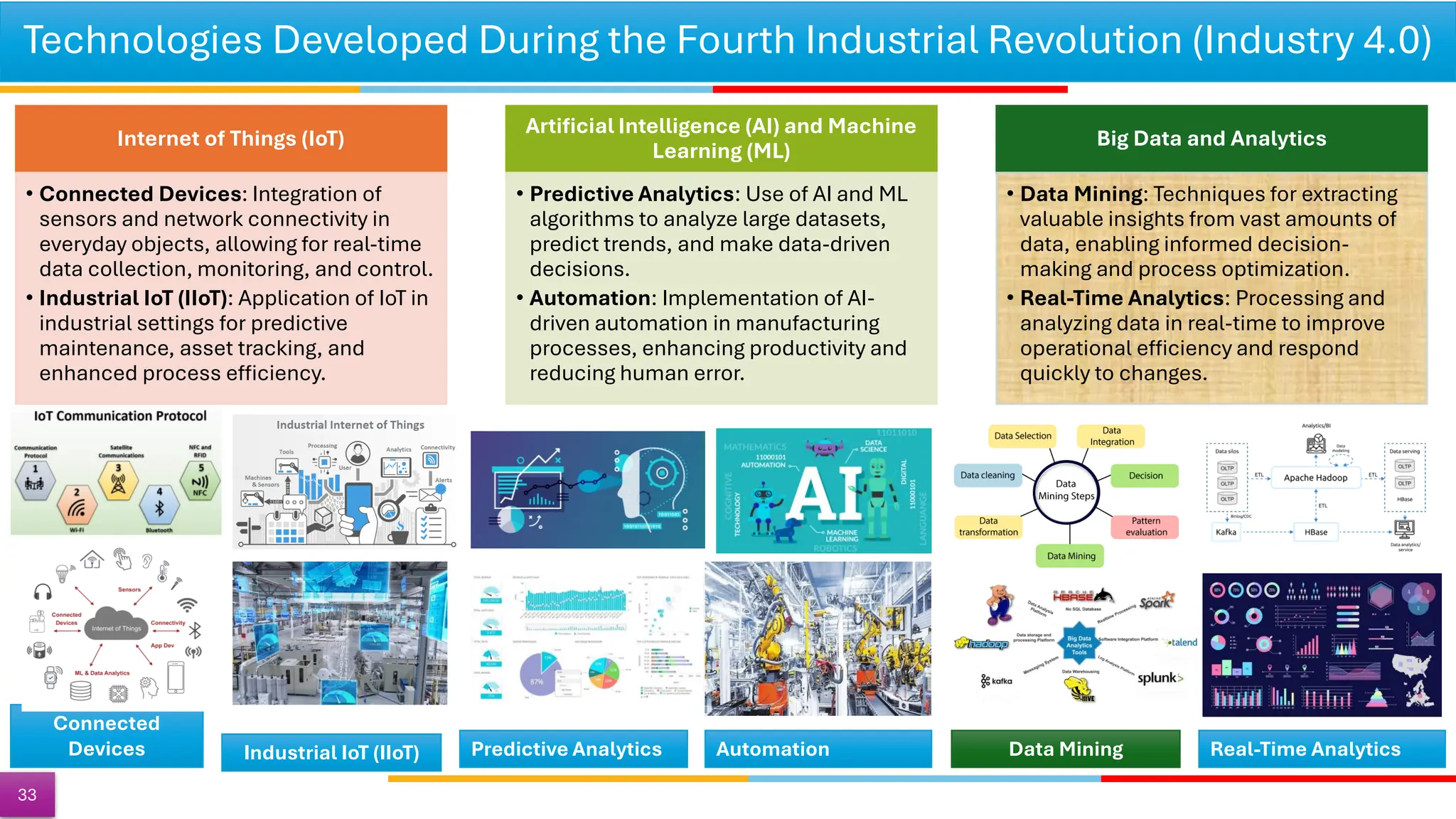
  • 51.
    Concluding Remarks :Existing Manufacturing Paradigms and Their Limitations 51 Linear Processes: Conventional manufacturing often relies on linear processes, which can be inefficient and inflexible. High Inventory Costs: Traditional methods require large inventories, leading to high storage costs and potential waste. Limited Customization: Mass production techniques limit the ability to produce customized products, reducing responsiveness to customer needs. Manual Labor: Dependence on manual labor increases the risk of human error and limits scalability. Slow Adaptation: Traditional systems can be slow to adapt to changes in demand or new technologies.
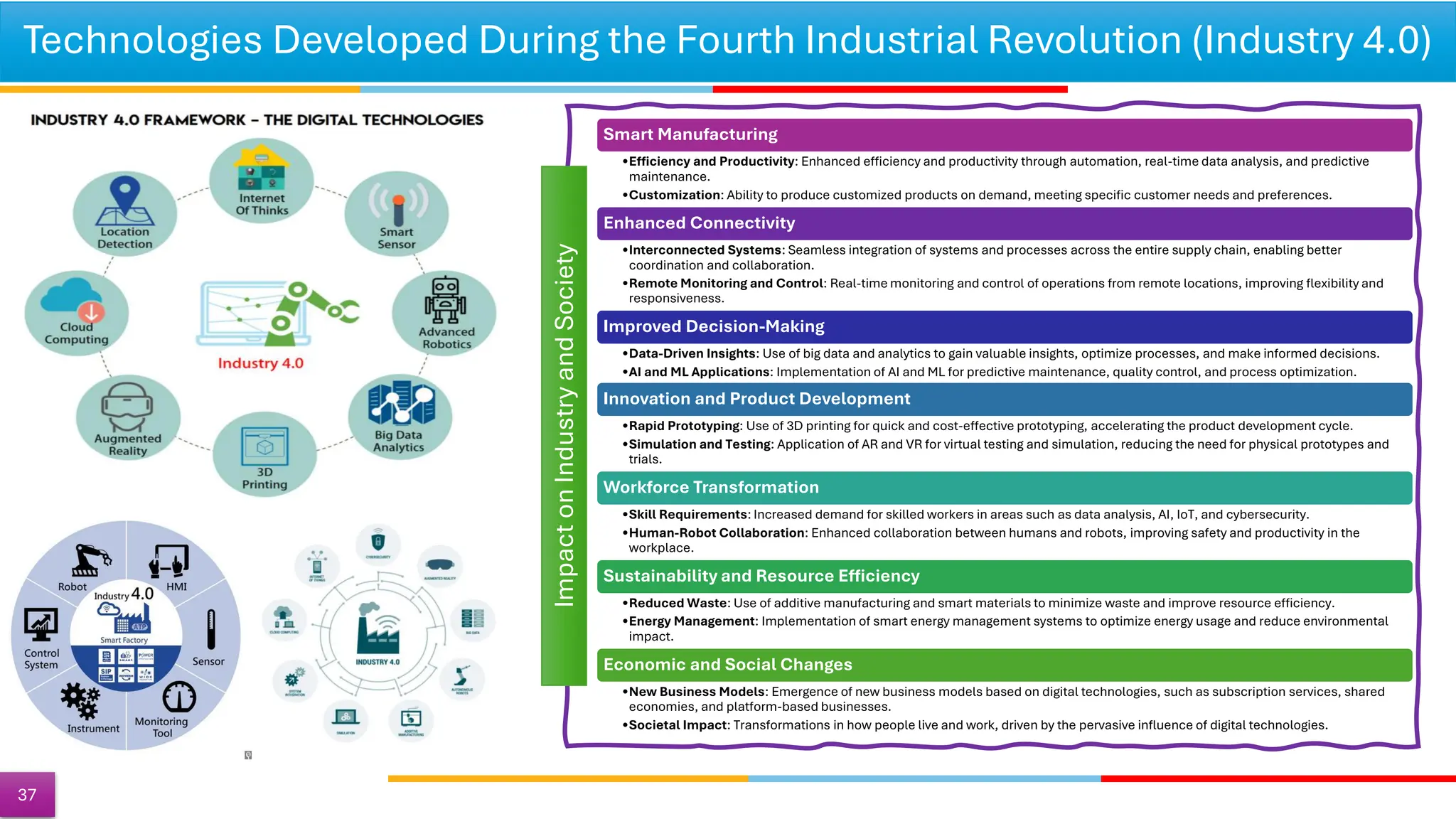
  • 52.
    Concluding Remarks: IndustrialRevolutions 1, 2, 3, and 4 52 Industry 1.0 (Late 18th Century): Key Developments: Mechanization using steam and water power. Impact: Increased production capacity and efficiency, but with limited automation and high reliance on human labor. Industry 2.0 (Late 19th and Early 20th Century): Key Developments: Mass production, assembly lines, and electrification. Impact: Dramatic increase in production scale and speed, but also introduced repetitive, monotonous work. Industry 3.0 (Mid-20th Century): Key Developments: Automation, computers, and electronics. Impact: Enhanced precision, reduced labor costs, and improved product quality, but led to job displacement and required new skills. Industry 4.0 (Early 21st Century): Key Developments: Cyber-physical systems, IoT, AI, and advanced robotics. Impact: Smart, interconnected systems enabling real-time data analysis, predictive maintenance, and high customization. Challenges include cybersecurity, skill gaps, and integration complexities.
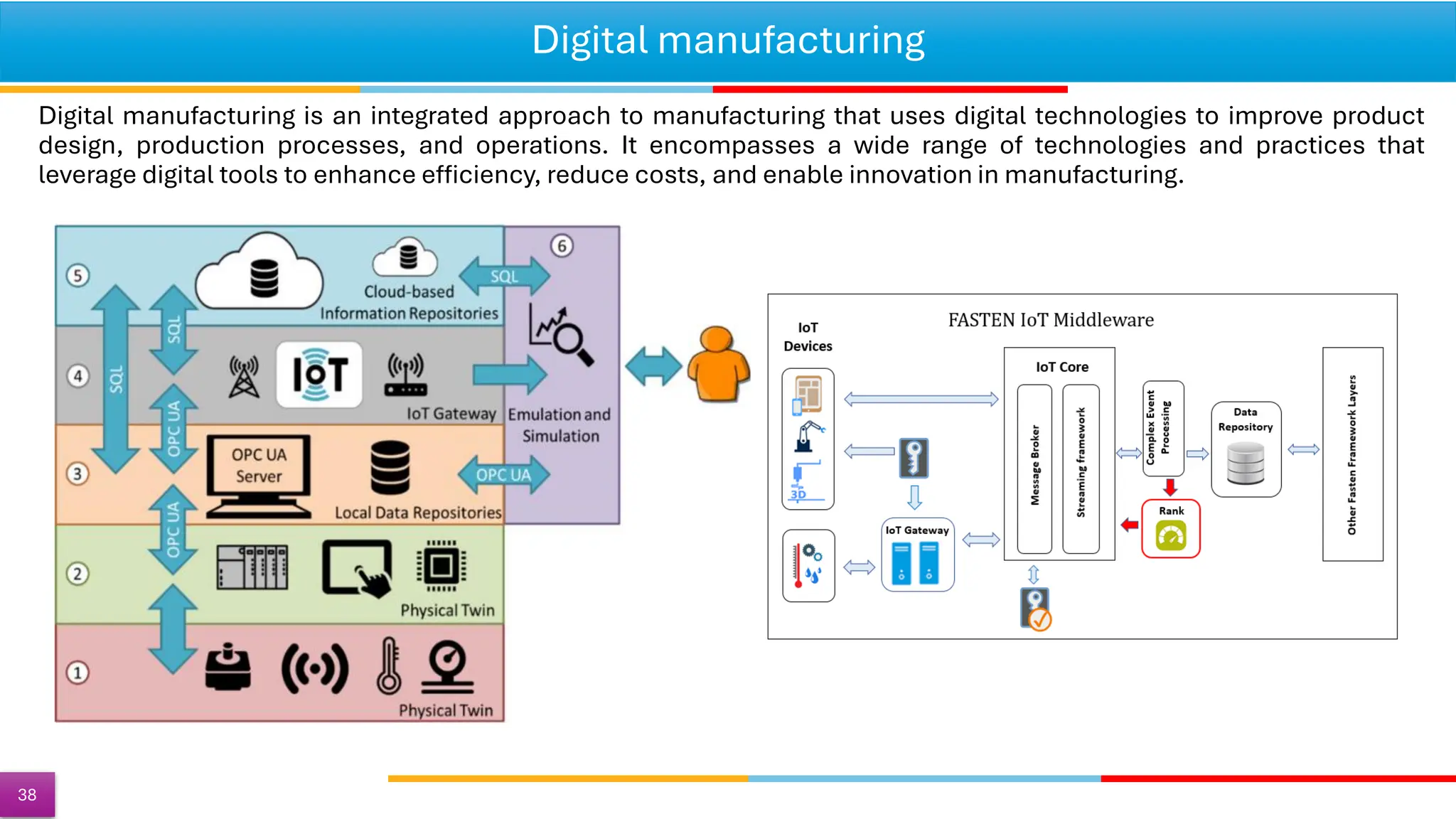
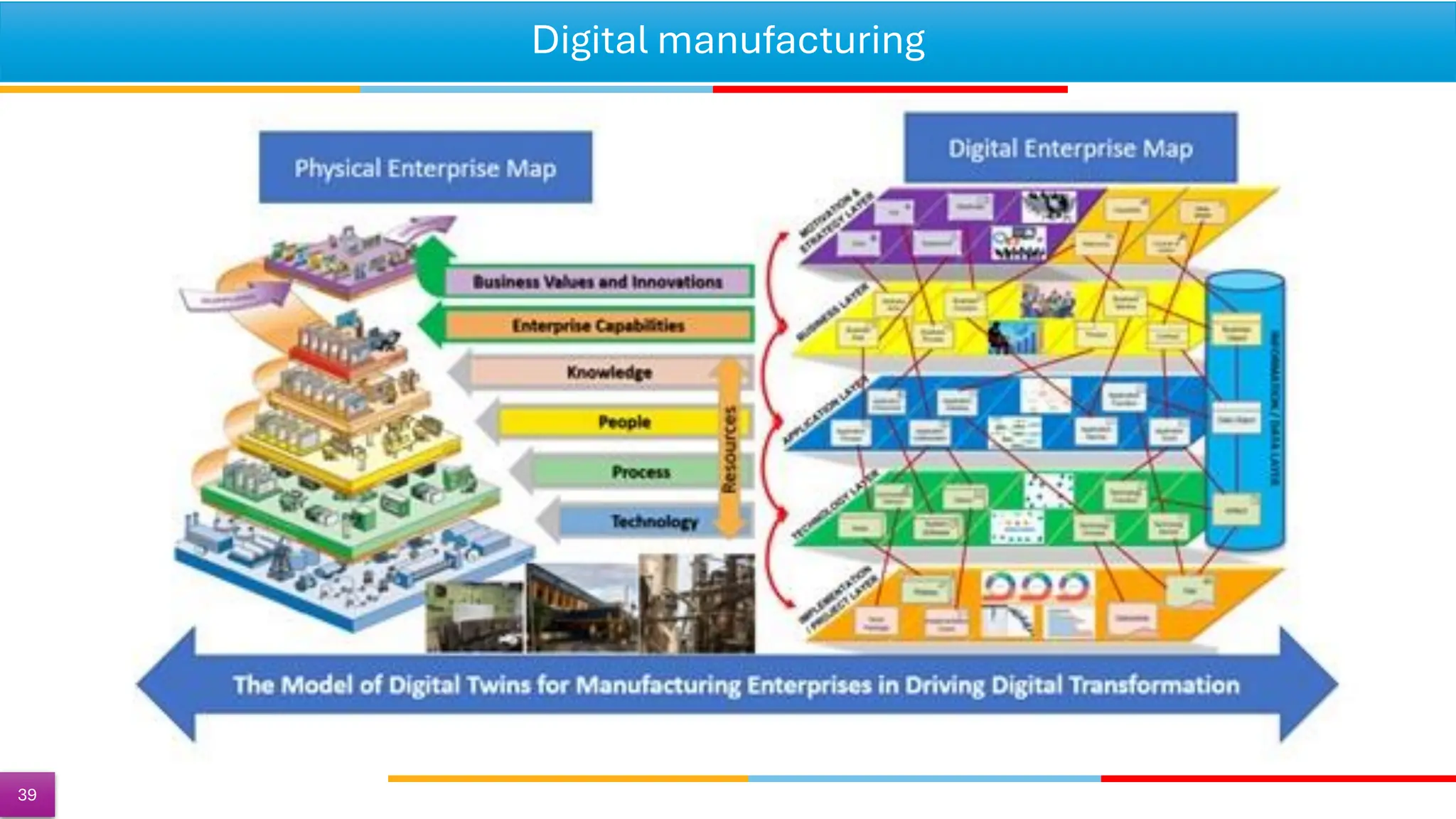
  • 53.
    Concluding Remarks: DigitalManufacturing 53 Key benefits include: • Efficiency and Productivity: Automation and real-time data analysis enhance efficiency and reduce production time. • Customization: Advanced technologies like 3D printing enable on-demand production of customized products. • Cost Reduction: Optimized processes and predictive maintenance lower operational costs and reduce waste. • Flexibility: Digital tools enable quick adaptation to changes in demand and technological advancements. • Quality and Consistency: Precision manufacturing and real-time monitoring improve product quality and consistency. digital manufacturing also presents challenges: • Cybersecurity: Protecting sensitive data and ensuring the security of connected systems. • Skill Requirements: Need for a workforce skilled in digital technologies and data analysis. • Initial Investment: High initial costs for implementing digital infrastructure and technologies. • Integration: Complexities in integrating new digital tools with existing systems.
  • 54.
    Future of DigitalManufacturing 54 Smart Factories: Increased prevalence of smart factories that leverage IoT, AI, and digital twins for optimized operations. Advanced Robotics: More sophisticated and collaborative robots working alongside humans to enhance productivity and safety. Sustainable Practices: Greater focus on sustainable manufacturing practices, including the use of renewable energy sources and recycling. Global Connectivity: Enhanced global connectivity enabling more efficient supply chain management and collaboration across borders. Innovation and R&D: Ongoing innovation in materials science, production methods, and digital tools, fueled by robust research and development efforts.
  • 55.
    Next Class on4th Aug 2024 Forces behind Industry 4.0 2.1 Forces behind Industry 4.0 (IoT, big data, cloud computing, robotics, additive manufacturing and artificial intelligence) 2.2 Connected Factories (What is connected factory and criteria for connected factory) 2.3 How the current industry is different from Industry 4.0 55
  • 56.
    References • Text Book •Internet of Things: A Hands-On Approach by Arshdeep Bahga, Vijay Madisetti, University Press Publication, 2015. • References • Zhang Y. and Tao F., “Optimization of Manufacturing Systems using the Internet of Things”, 1st Edition, 2017, Academic Press (Elsevier), UK. • IoT Fundamentals : Networking Technologies, Protocols, and Use Cases for the Internet of Things, 1/e by David Hanes , cisco press • Internet of Things and Data Analytics Handbook by Hwaiyu Geng © 2017 John Wiley & Sons, Inc. • The Internet of Things: Key Applications and Protocols Olivier Hersent, David B. 2nd Edition, Wiley Publication • Internet of Things: Architecture and Design Principles Rajkamal. 1st Edition, Mc Graw Hill 56