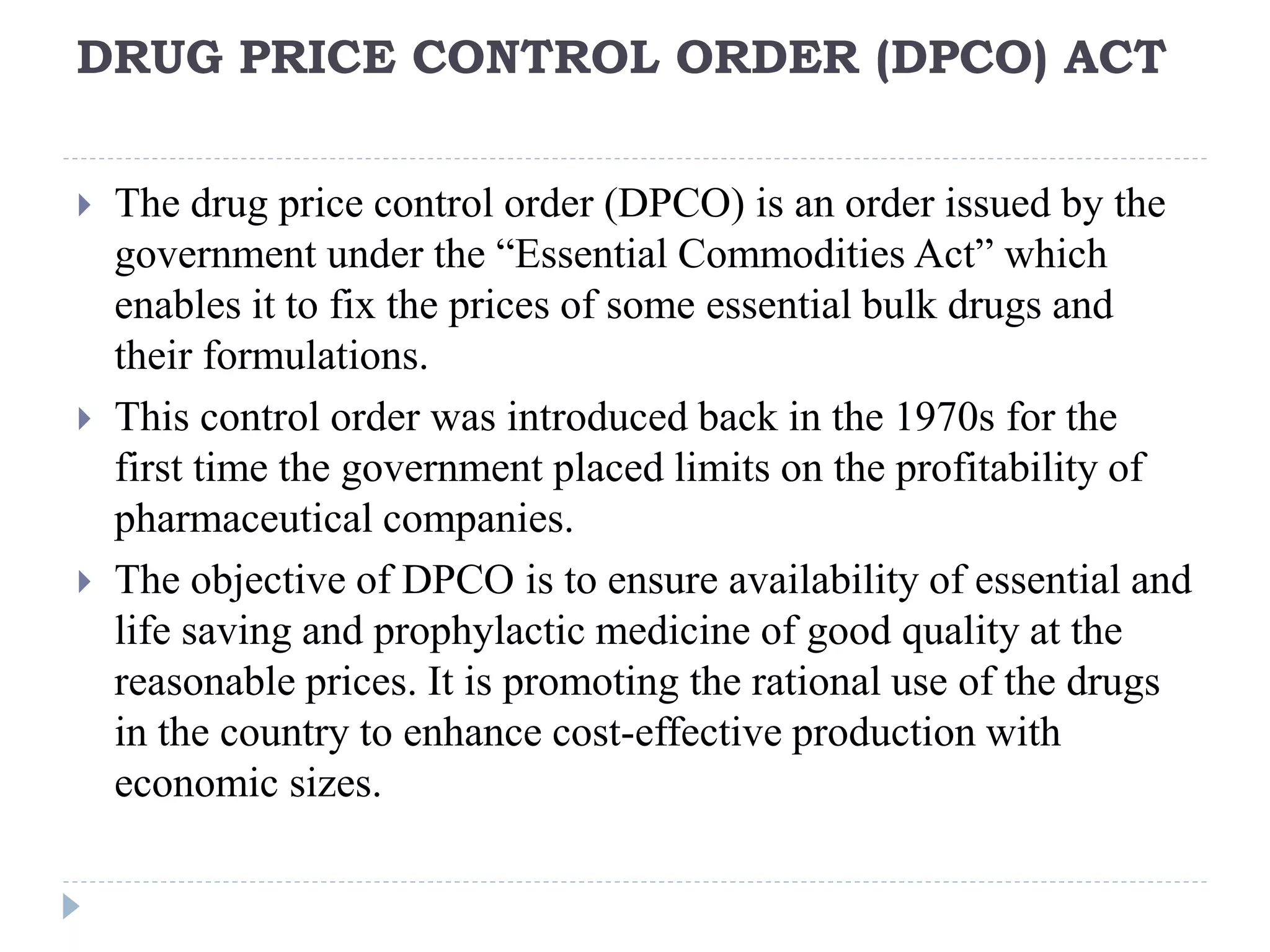
DPCO- DRUG PRICE CONTROL ORDER
BY: ANANT NAG
ID: MPH/10016/21
SEMINAR/ASSIGNMENT
CONTENT
 Introduction to DPCO
 Why it came into effect
 Why is it important
 Objectives
 The main features of DPCO 2013 are
 Impact of DPCO on pharma market
 Impact of DPCO on small scale pharmaceutical industry
 Impact of the DPCO on the large scale pharmaceutical
industry
 Conclusion
 References
DRUG PRICE CONTROL ORDER (DPCO) ACT
 The drug price control order (DPCO) is an order issued by the
government under the “Essential Commodities Act” which
enables it to fix the prices of some essential bulk drugs and
their formulations.
 This control order was introduced back in the 1970s for the
first time the government placed limits on the profitability of
pharmaceutical companies.
 The objective of DPCO is to ensure availability of essential and
life saving and prophylactic medicine of good quality at the
reasonable prices. It is promoting the rational use of the drugs
in the country to enhance cost-effective production with
economic sizes.
WHY IT CAME INTO EFFECT?
 Some pharma companies started to increase prices of their
products to get maximum ROI and it was affecting the normal
user. When it came in the eyes of the Government that the
pharmaceutical companies are raising their prices of most
selling products which should be affordable to the users.
 So that the government came in action and introduced an act
named Drug Price Control Order or DPCO which says that the
essential drug’s price should be in control.
WHY IS IT IMPORTANT?
 India is a branded generic market, which means that the doctors
prescribe the brand of each medicine to be consumed by
patients, rather than the underlying formulation. Despite the
availability of affordable brands, doctors in many cases
prescribe leading brands which are priced at a premium.
 As patients are ignorant about cheaper substitutes, they
sometimes switch to the low-cost equivalents of the expensive
drug brands recommended by their doctors. Patients have little
option in the choice, making it necessary for the state to
intervene and make essential drugs accessible to the needy at
reasonable prices.
Objectives:
 To ensure availability of essential and life-saving, and
prophylactic medicine of good quality at reasonable prices.
 To provide adequate opportunity for innovation and research-
oriented drug manufacturing.
 Allow fair competition to support the growth of the industry.
 To meet the goals of employment and shared economic
development of all.
The main features of DPCO 2013 are:
 It brought 348 drugs and their 652 formulations under price
control.
 The new policy uses a market-based pricing mechanism against
the prior proposed cost-plus method.
 Margins of wholesalers and retailers have been cut down to 8%
and 16%, respectively.
 To Monitor the M.R.P. of Non-scheduled formulations.
 Control over bulk drug and formulation manufacturers.
Impact of DPCO on Pharma Market:
 DPCO 2013 had a significant impact on the domestic business
of the Indian Pharmaceutical industry with industry growth in
M.A.T. terms decreasing growth to single digits in FY2014
from mid-double digits earlier.
 Along with low drug prices, it also resulted in trade-related
issues further impacting the overall supply chain. However, the
industry has recovered over the last two fiscals, with domestic
M.A.T. growth at 12-13% in FY2015 and FY2016.
 Though the pharma market shows a recovery, it is compelled
by volume and price growth in the non-DPCO portfolio and
W.P.I. linked price growth in the DPCO portfolio.
 Pharma companies have launched new products, including non-
DPCO combinations, to guard their margins alongside increased
penetration to support growth.
 DPCO might also influence the decision of the R&D companies to
significantly invest in the development of drugs that might come
under the DPCO scanner in the future and affect scale-ups,
expansions, and international quality.
 The I.P.M. growth has witnessed an unfavorable impact by price
controls, with the DPCO portfolio of I.P.M. continues to perform at
much slower growth than the non-DPCO portfolio. Approximately
17% of the I.P.M. is under DPCO, with DPCO drugs growing up to
7.7% F.Y. 2016 compared to 13.7% for the Non-DPCO portfolio. It
has reduced the overall I.P.M. growth to 12.6% for F.Y. 2016.
 Growth- MAT March 2016 IPM: 12.6% — Non-DPCO: 13.7%
DPCO: 7.7%
Impact of DPCO on Small Scale
Pharmaceutical Industry:
 DPCO proved as a boon to small-scale domestic
pharmaceutical industries. These companies already provide
essential drugs at an affordable and reasonable price against
large-scale pharma companies.
 The NPPA has put a total of 348 drugs and 652 formulations
under the pricing control. These drugs remain classified as life-
saving drugs- In this regard, the small domestic pharma
companies with reasonable prices of medicines have benefitted
as they produce generic drugs which remain significantly
cheaper than their bigger brand counterparts.
 The costs of the drugs sold on a small scale instead increased,
leading them to profitability.
Impact of the DPCO on the Large Scale
Pharmaceutical Industry:
 On the contrary, as per the report by Indian Pharmaceutical
Alliance (I.P.A.), the order made pharma companies such as
Lupin, Novartis, and SUN Pharma slash the prices of their
drugs by 50 to 80%.
 The reduced profitability is causing repel the big multinational
pharma companies to invest in the essential drugs market.
 The reduction in ceiling prices has been formulated for more
than 84% of the medicines found in India, out of which
medium and large-scale pharma companies manufacture 70%
of the medicines.
 Many companies discontinued popular drug brands.
 The larger-scale companies were also affected by
inadequate employment generation, export growth, R&D
development and expenditure, lack of new formulations,
and lack of investors.
 Excessive control on price has repealed the
pharmaceutical industry’s attention and slowed down
respective companies’ growth.
 Implementation of DPCO led to significant losses to
profit-making companies like Roche, Bayer, Novartis, and
Glenmark, which lost the market because of heavy
competition with generic drug suppliers and low-cost drug
manufacturers Aurobindo and Lupin.
 Stringent regulation of drug prices made drug
manufacturers shut down their R&D centers.
Conclusion:
 DPCO might not be a nuisance for pharma
companies if rolled out with explicit provisions. It also
needs to incorporate some changes and increase
some benefits to companies that consider the
companies’ profitability, especially those involved in
innovation-driven work.
 DPCO should improve patients’ access to essential
medicine and incentivize the pharma companies to
invest in innovation, quality, and expansion.
References:
 About Pharmaceutical Pricing Authority
 Frequently Asked Questions regarding price control
 About price control act
 Review from ICRA article
 National List of Essential Medicines 2015
 The revised ceiling price of 866 scheduled formulations
DPCO-Drug price control order

DPCO-Drug price control order

  • 1.
    DPCO- DRUG PRICECONTROL ORDER BY: ANANT NAG ID: MPH/10016/21 SEMINAR/ASSIGNMENT
  • 2.
    CONTENT  Introduction toDPCO  Why it came into effect  Why is it important  Objectives  The main features of DPCO 2013 are  Impact of DPCO on pharma market  Impact of DPCO on small scale pharmaceutical industry  Impact of the DPCO on the large scale pharmaceutical industry  Conclusion  References
  • 3.
    DRUG PRICE CONTROLORDER (DPCO) ACT  The drug price control order (DPCO) is an order issued by the government under the “Essential Commodities Act” which enables it to fix the prices of some essential bulk drugs and their formulations.  This control order was introduced back in the 1970s for the first time the government placed limits on the profitability of pharmaceutical companies.  The objective of DPCO is to ensure availability of essential and life saving and prophylactic medicine of good quality at the reasonable prices. It is promoting the rational use of the drugs in the country to enhance cost-effective production with economic sizes.
  • 4.
    WHY IT CAMEINTO EFFECT?  Some pharma companies started to increase prices of their products to get maximum ROI and it was affecting the normal user. When it came in the eyes of the Government that the pharmaceutical companies are raising their prices of most selling products which should be affordable to the users.  So that the government came in action and introduced an act named Drug Price Control Order or DPCO which says that the essential drug’s price should be in control.
  • 5.
    WHY IS ITIMPORTANT?  India is a branded generic market, which means that the doctors prescribe the brand of each medicine to be consumed by patients, rather than the underlying formulation. Despite the availability of affordable brands, doctors in many cases prescribe leading brands which are priced at a premium.  As patients are ignorant about cheaper substitutes, they sometimes switch to the low-cost equivalents of the expensive drug brands recommended by their doctors. Patients have little option in the choice, making it necessary for the state to intervene and make essential drugs accessible to the needy at reasonable prices.
  • 6.
    Objectives:  To ensureavailability of essential and life-saving, and prophylactic medicine of good quality at reasonable prices.  To provide adequate opportunity for innovation and research- oriented drug manufacturing.  Allow fair competition to support the growth of the industry.  To meet the goals of employment and shared economic development of all.
  • 7.
    The main featuresof DPCO 2013 are:  It brought 348 drugs and their 652 formulations under price control.  The new policy uses a market-based pricing mechanism against the prior proposed cost-plus method.  Margins of wholesalers and retailers have been cut down to 8% and 16%, respectively.  To Monitor the M.R.P. of Non-scheduled formulations.  Control over bulk drug and formulation manufacturers.
  • 8.
    Impact of DPCOon Pharma Market:  DPCO 2013 had a significant impact on the domestic business of the Indian Pharmaceutical industry with industry growth in M.A.T. terms decreasing growth to single digits in FY2014 from mid-double digits earlier.  Along with low drug prices, it also resulted in trade-related issues further impacting the overall supply chain. However, the industry has recovered over the last two fiscals, with domestic M.A.T. growth at 12-13% in FY2015 and FY2016.  Though the pharma market shows a recovery, it is compelled by volume and price growth in the non-DPCO portfolio and W.P.I. linked price growth in the DPCO portfolio.
  • 9.
     Pharma companieshave launched new products, including non- DPCO combinations, to guard their margins alongside increased penetration to support growth.  DPCO might also influence the decision of the R&D companies to significantly invest in the development of drugs that might come under the DPCO scanner in the future and affect scale-ups, expansions, and international quality.  The I.P.M. growth has witnessed an unfavorable impact by price controls, with the DPCO portfolio of I.P.M. continues to perform at much slower growth than the non-DPCO portfolio. Approximately 17% of the I.P.M. is under DPCO, with DPCO drugs growing up to 7.7% F.Y. 2016 compared to 13.7% for the Non-DPCO portfolio. It has reduced the overall I.P.M. growth to 12.6% for F.Y. 2016.  Growth- MAT March 2016 IPM: 12.6% — Non-DPCO: 13.7% DPCO: 7.7%
  • 10.
    Impact of DPCOon Small Scale Pharmaceutical Industry:  DPCO proved as a boon to small-scale domestic pharmaceutical industries. These companies already provide essential drugs at an affordable and reasonable price against large-scale pharma companies.  The NPPA has put a total of 348 drugs and 652 formulations under the pricing control. These drugs remain classified as life- saving drugs- In this regard, the small domestic pharma companies with reasonable prices of medicines have benefitted as they produce generic drugs which remain significantly cheaper than their bigger brand counterparts.  The costs of the drugs sold on a small scale instead increased, leading them to profitability.
  • 11.
    Impact of theDPCO on the Large Scale Pharmaceutical Industry:  On the contrary, as per the report by Indian Pharmaceutical Alliance (I.P.A.), the order made pharma companies such as Lupin, Novartis, and SUN Pharma slash the prices of their drugs by 50 to 80%.  The reduced profitability is causing repel the big multinational pharma companies to invest in the essential drugs market.  The reduction in ceiling prices has been formulated for more than 84% of the medicines found in India, out of which medium and large-scale pharma companies manufacture 70% of the medicines.
  • 12.
     Many companiesdiscontinued popular drug brands.  The larger-scale companies were also affected by inadequate employment generation, export growth, R&D development and expenditure, lack of new formulations, and lack of investors.  Excessive control on price has repealed the pharmaceutical industry’s attention and slowed down respective companies’ growth.  Implementation of DPCO led to significant losses to profit-making companies like Roche, Bayer, Novartis, and Glenmark, which lost the market because of heavy competition with generic drug suppliers and low-cost drug manufacturers Aurobindo and Lupin.  Stringent regulation of drug prices made drug manufacturers shut down their R&D centers.
  • 13.
    Conclusion:  DPCO mightnot be a nuisance for pharma companies if rolled out with explicit provisions. It also needs to incorporate some changes and increase some benefits to companies that consider the companies’ profitability, especially those involved in innovation-driven work.  DPCO should improve patients’ access to essential medicine and incentivize the pharma companies to invest in innovation, quality, and expansion.
  • 14.
    References:  About PharmaceuticalPricing Authority  Frequently Asked Questions regarding price control  About price control act  Review from ICRA article  National List of Essential Medicines 2015  The revised ceiling price of 866 scheduled formulations