Biosynthesis of catecholamines
Dr. Radhakrishna G Pillai
Department of Life Sciences
University of Calicut
Catecholamines
• Epinephrine/Adrenaline
• Norepinephrine/Noradrenaline
• Dopamine
• They are found within the CNS, PNS, and
adrenal glands.
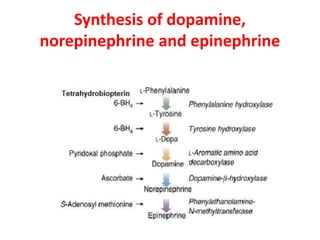
• Tyrosine is obtained from dietary protein and
is transported from the blood into the brain
• Each step in the formation of catecholamines
depends on a specific enzyme that acts as a
catalyst for that step
• Tyrosine hydroxylase is the rate limiting
enzyme in the pathway -it determines the
overall rate of dopamine and norepinephrine
formation
Synthesis of dopamine,
norepinephrine and epinephrine
Regulation of synthesis
• The level of catecholamines within the nerve terminal
– e.g., high catecholamine levels within the nerve terminal
tend to inhibit tyrosine hydroxylase, serving as a negative
feedback mechanism
• The rate of cell firing
– e.g., when neurons are activated and firing at a high rate,
such as during stress, tyrosine hydroxylase would be
stimulated
• These elegant mechanisms enable dopaminergic and
noradrenergic neurons to carefully control their rate
of neurotransmitter formation.
Catecholamine synthesis, release, and
inactivation
• Tyrosine hydroxylase catalyzes the rate-limiting step in catecholamine
synthesis
• Catecholamine formation can be increased ↑ by the administration
of a biochemical precursor (i.e., to be converted into a particular
neurotransmitter) such as
– L-DOPA (for the treatment of Parkinson’s disease)
• Catecholamine formation can be decreased ↓ by the drug, AMPT (α-
methyl-para-tyrosine)
• This compound blocks tyrosine hydroxylase, thus preventing overall
catecholamine synthesis and causing a general depletion of DA and
NE neurotransmitters
• AMPT treatment caused a return of depressive symptoms in patients
who had previously recovered following treatment with
antidepressants that act selectively on the noradrenergic system,
indicating that the depressed patients’ recovery depends on the
maintenance of adequate levels of catecholamines in the brain
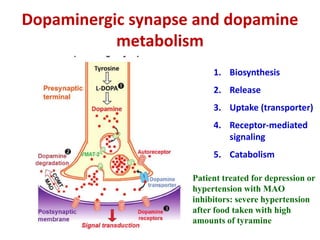
Dopaminergic synapse and dopamine
metabolism
1. Biosynthesis
2. Release
3. Uptake (transporter)
4. Receptor-mediated
signaling
5. Catabolism
Patient treated for depression or
hypertension with MAO
inhibitors: severe hypertension
after food taken with high
amounts of tyramine
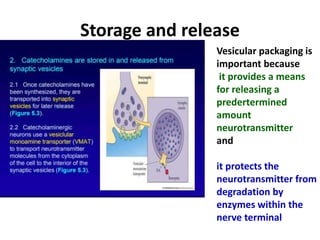
Storage and release
Vesicular packaging is
important because
it provides a means
for releasing a
predertermined
amount
neurotransmitter
and
it protects the
neurotransmitter from
degradation by
enzymes within the
nerve terminal
Release of catecholamines
• Normally occurs when a nerve impulse enters
the terminal and triggers one or more vesicles
to release their contents into the synaptic cleft
• Psychostimulants, such as amphetamine and
methamphetamine, can cause a release of
catecholamines independently of nerve cell
firing
• Catecholamine depletion: sedation and
depressive symptoms
• Catecholamine release: behavioral activation
1. Neuronal activity increase would enhance the
amount of TH and DBH at both mRNA and
protein levels
2. TH is modulated by end-product inhibition
(catecholamine competes with pterin cofactor)
3. Depolarization would activate TH activity
4. Activation of TH involves reversible
phosphorylation (PKA, PKC, CaMKs and cdk-like
kinase
Modulation of catecholamine
synthesis
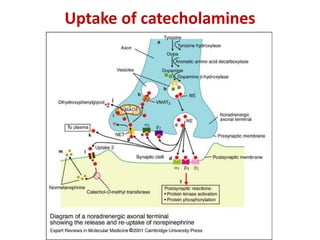
Uptake of catecholamines
Uptake transporters
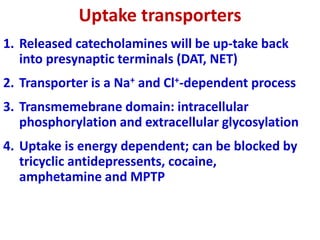
1. Released catecholamines will be up-take back
into presynaptic terminals (DAT, NET)
2. Transporter is a Na+ and Cl+-dependent process
3. Transmemebrane domain: intracellular
phosphorylation and extracellular glycosylation
4. Uptake is energy dependent; can be blocked by
tricyclic antidepressents, cocaine,
amphetamine and MPTP
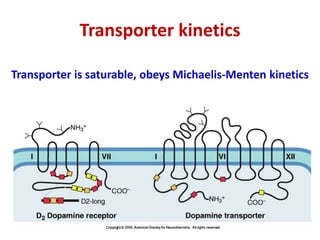
Transporter kinetics
Transporter is saturable, obeys Michaelis-Menten kinetics
Catecholamine inactivation
• occurs through a combination of reuptake and metabolism
• Reuptake by transporters: After the neurotransmitter
molecules are returned to the terminal through transporters,
some of them are re-packaged into the vesicles for re-release
while the remainder are broken down and eliminated
• transporters are necessary for the rapid removal of
catecholamines from the synaptic cleft
• transporter-blocking drugs enhance the synaptic transmission
of DA or NE by increasing the amount of neurotransmitter in
the synaptic cleft
• Tricyclic antidepressants: to inhibit the reuptake of both NE
and serotonin (5- HT) (i.e., reuptake blocker OR reuptake
inhibitor).
• Cocaine: to inhibit the reuptake of DA, NE, and 5-HT.
Metabolic breakdown
• There are two enzymes mainly involved in the breakdown of
catecholamines, catechol-O-methyltransferase (COMT) and
monoamine oxidase (MAO)
• In humans, dopamine has only one major metabolite,
homovanillic acid (HVA)
• Norepinephrine has two major metabolites, 3-methoxy-4-
hydroxyphenylglycol (MHPG) and vanillymandelic acid (VMA)
• Measurement of these metabolites in various fluid
compartments (i.e., blood, urine, and cerebrospinal fluid)
facilitate in determining the possible involvement of these
neurotransmitters in mental disorders such as schizophrenia
and depression
• MAO inhibitors: the treatment of depression
• COMT inhibitors: as a supplemental therapy to enhance the
effectiveness of L-DOPA in treating Parkinson’s disease.

Biosynthesis of catecholamines

  • 1.
    Biosynthesis of catecholamines Dr.Radhakrishna G Pillai Department of Life Sciences University of Calicut
  • 2.
    Catecholamines • Epinephrine/Adrenaline • Norepinephrine/Noradrenaline •Dopamine • They are found within the CNS, PNS, and adrenal glands.
  • 4.
    • Tyrosine isobtained from dietary protein and is transported from the blood into the brain • Each step in the formation of catecholamines depends on a specific enzyme that acts as a catalyst for that step • Tyrosine hydroxylase is the rate limiting enzyme in the pathway -it determines the overall rate of dopamine and norepinephrine formation
  • 5.
  • 6.
    Regulation of synthesis •The level of catecholamines within the nerve terminal – e.g., high catecholamine levels within the nerve terminal tend to inhibit tyrosine hydroxylase, serving as a negative feedback mechanism • The rate of cell firing – e.g., when neurons are activated and firing at a high rate, such as during stress, tyrosine hydroxylase would be stimulated • These elegant mechanisms enable dopaminergic and noradrenergic neurons to carefully control their rate of neurotransmitter formation.
  • 7.
    Catecholamine synthesis, release,and inactivation • Tyrosine hydroxylase catalyzes the rate-limiting step in catecholamine synthesis • Catecholamine formation can be increased ↑ by the administration of a biochemical precursor (i.e., to be converted into a particular neurotransmitter) such as – L-DOPA (for the treatment of Parkinson’s disease) • Catecholamine formation can be decreased ↓ by the drug, AMPT (α- methyl-para-tyrosine) • This compound blocks tyrosine hydroxylase, thus preventing overall catecholamine synthesis and causing a general depletion of DA and NE neurotransmitters • AMPT treatment caused a return of depressive symptoms in patients who had previously recovered following treatment with antidepressants that act selectively on the noradrenergic system, indicating that the depressed patients’ recovery depends on the maintenance of adequate levels of catecholamines in the brain
  • 8.
    Dopaminergic synapse anddopamine metabolism 1. Biosynthesis 2. Release 3. Uptake (transporter) 4. Receptor-mediated signaling 5. Catabolism Patient treated for depression or hypertension with MAO inhibitors: severe hypertension after food taken with high amounts of tyramine
  • 9.
    Storage and release Vesicularpackaging is important because it provides a means for releasing a predertermined amount neurotransmitter and it protects the neurotransmitter from degradation by enzymes within the nerve terminal
  • 10.
    Release of catecholamines •Normally occurs when a nerve impulse enters the terminal and triggers one or more vesicles to release their contents into the synaptic cleft • Psychostimulants, such as amphetamine and methamphetamine, can cause a release of catecholamines independently of nerve cell firing • Catecholamine depletion: sedation and depressive symptoms • Catecholamine release: behavioral activation
  • 11.
    1. Neuronal activityincrease would enhance the amount of TH and DBH at both mRNA and protein levels 2. TH is modulated by end-product inhibition (catecholamine competes with pterin cofactor) 3. Depolarization would activate TH activity 4. Activation of TH involves reversible phosphorylation (PKA, PKC, CaMKs and cdk-like kinase Modulation of catecholamine synthesis
  • 12.
  • 13.
    Uptake transporters 1. Releasedcatecholamines will be up-take back into presynaptic terminals (DAT, NET) 2. Transporter is a Na+ and Cl+-dependent process 3. Transmemebrane domain: intracellular phosphorylation and extracellular glycosylation 4. Uptake is energy dependent; can be blocked by tricyclic antidepressents, cocaine, amphetamine and MPTP
  • 14.
    Transporter kinetics Transporter issaturable, obeys Michaelis-Menten kinetics
  • 15.
    Catecholamine inactivation • occursthrough a combination of reuptake and metabolism • Reuptake by transporters: After the neurotransmitter molecules are returned to the terminal through transporters, some of them are re-packaged into the vesicles for re-release while the remainder are broken down and eliminated • transporters are necessary for the rapid removal of catecholamines from the synaptic cleft • transporter-blocking drugs enhance the synaptic transmission of DA or NE by increasing the amount of neurotransmitter in the synaptic cleft • Tricyclic antidepressants: to inhibit the reuptake of both NE and serotonin (5- HT) (i.e., reuptake blocker OR reuptake inhibitor). • Cocaine: to inhibit the reuptake of DA, NE, and 5-HT.
  • 16.
    Metabolic breakdown • Thereare two enzymes mainly involved in the breakdown of catecholamines, catechol-O-methyltransferase (COMT) and monoamine oxidase (MAO) • In humans, dopamine has only one major metabolite, homovanillic acid (HVA) • Norepinephrine has two major metabolites, 3-methoxy-4- hydroxyphenylglycol (MHPG) and vanillymandelic acid (VMA) • Measurement of these metabolites in various fluid compartments (i.e., blood, urine, and cerebrospinal fluid) facilitate in determining the possible involvement of these neurotransmitters in mental disorders such as schizophrenia and depression • MAO inhibitors: the treatment of depression • COMT inhibitors: as a supplemental therapy to enhance the effectiveness of L-DOPA in treating Parkinson’s disease.

Editor's Notes

  • #9 catechol- O -methyl transferase (COMT)
  • #13 NET- norepinephrine transporter
  • #14 DAT- dopamine transporter