Trace element-II
Binaya Tamang
UCMS
Department of Biochemistry
Iodine
• Iodine is an imperative micronutrient
• for the normal thyroid function necessary for the
normal growth and development of our brain
and body .
• inevitable micronutrient involved in the
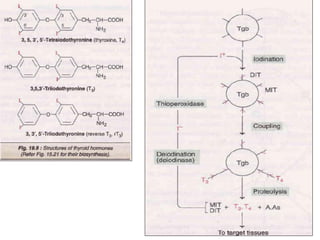
synthesis of thyroid hormones:
• Thyroxine (T4) and Triiodothronine (T3)
DISCOVERY
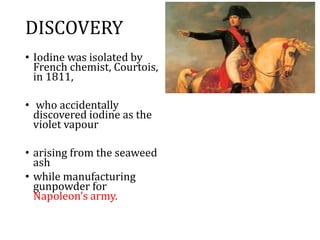
• Iodine was isolated by
French chemist, Courtois,
in 1811,
• who accidentally
discovered iodine as the
violet vapour
• arising from the seaweed
ash
• while manufacturing
gunpowder for
Napoleon’s army.
• In our human body,
approximately 15-20 mg of iodine is present,
of which 70-80 % is concentrated in the thyroid
gland
• Approximately 90% of the dietry iodine is
absorbed in the upper small intestine after being
converted into the iodide ion in the gut lumen.
• iodine deficiency may cause a mental and physical
disabilities, collectively called as iodine deficiency
disorders (IDD)
Affects all age group
• Iodine deficiency affects the populations of all
age group with
• pregnant woman and children forming most
vulnerable groups.
• Deficiency during childhood reduces somatic
growth, cognitive and motor function
• Salt is the food ingredient that is consumed by
the general population on the daily basis. If
fortified with the iodine it is called as Iodized salt
• Mainly, two organs i.e., thyroid gland and kidneys
are responsible for the clearance of iodine from
the plasma
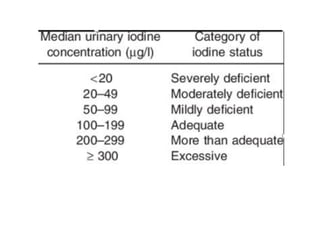
Urinary iodine concentration
• For a recent iodine intake,
• the most sensitive marker is urinary iodine
concentration (UIC)
• because 90% of the iodine absorbed by the body
eventually appears in urine
• and therefore, is the index of choice for
evaluating degree of iodine deficiency and its
correction
DIETARY SOURCES
• Seafoods, drinking water, vegetables, fruits
(grown on seaboard).
• High altitudes are deficient in iodine content in
water as well as soil.
• Plant and animal foods of these areas, therefore,
contain lesser amount of iodine.
• In these regions, iodine is added to drinking
water or to table salt.
Plasma iodine
• 4-10 mg/dl.
• Most of this is present as protein bound iodine
(PBI).
• RBC do not contain iodine.
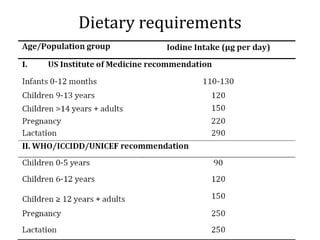
Dietary requirements
• Adults-100-150 μg/day
• Pregnant woman- 200 μg/day
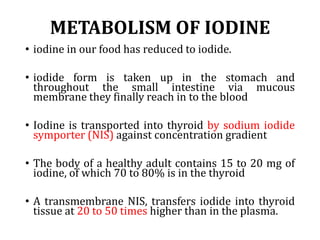
METABOLISM OF IODINE
• iodine in our food has reduced to iodide.
• iodide form is taken up in the stomach and
throughout the small intestine via mucous
membrane they finally reach in to the blood
• Iodine is transported into thyroid by sodium iodide
symporter (NIS) against concentration gradient
• The body of a healthy adult contains 15 to 20 mg of
iodine, of which 70 to 80% is in the thyroid
• A transmembrane NIS, transfers iodide into thyroid
tissue at 20 to 50 times higher than in the plasma.
Goitrogenic substances
Interferes with the production of thyroid
hormones
• Thiocynates
• Nitrates
• Perchlorates
• Drugs like thiouracil and thiourea
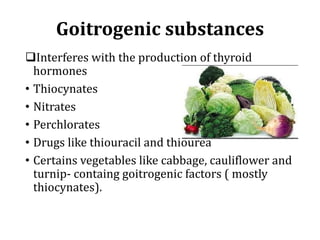
• Certains vegetables like cabbage, cauliflower and
turnip- containg goitrogenic factors ( mostly
thiocynates).
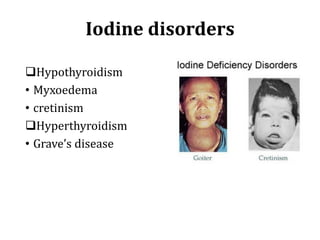
Iodine disorders
Hypothyroidism
• Myxoedema
• cretinism
Hyperthyroidism
• Grave’s disease
ZINC (Zn)
• Total content of zinc : 2g
• out of which 60% is in skeletal muscles and 30%
in bones.
• Highest concentration of zinc is seen in
hippocampus area of brain and prostatic
secretion.
• RBCs contain Zn ( 1.5 mg/dl) in association with
carbonic anhydrase.
dietary sources
• grains, beans, nuts, cheese, meat and shellfish.
• Zinc and copper will competitively inhibit each
other's absorption.
• So, zinc is therapeutically useful to reduce copper
absorption in Wilson's disease
Absorption
• Mainly in the duodenum
• Zn absorption appears to be dependent on
transport protein- metallothionein.
• Copper, calcium, cadmium, iron and phytate will
interfere with the absorption of zinc.
• In liver, zinc is stored.
• Zinc is excreted through pancreatic juice and to a
lesser extent through sweat.
FUNCTIONS
Essential component of several enzymes e.g.
• Carbonic anhydrase,
• alcohol dehydrogenase
• Alkaline phosphatase
• carboxy peptidase
• superoxide dismutase ( cytosolic)
Antioxidant since, the SOD protects from free
radicals
The storage and secretion of insulin from beta cells
of pancrease require Zn
• Zn is require to maintain normal level of vitamin
A in serum. Zn promotes the synthesis of retinol
binding protein.
• It is required for wound healing. Zn enhances cell
growth and division, besides stabilizing
biomembranes.
• Gusten, a zinc containing protein of saliva, is
important for taste sensation
• Zn is essential for proper reproduction function.
• Zinc deficiency also lowers spermatogenesis in
males and menstrual cycles are disturbed in
females.
• Prasad et al have shown that zinc deficiency
may lead to ā€˜dwarfism’ and ā€˜hypogonadism’.
• In such dwarfs, zinc concentration in plasma, red
blood cells, hair, urine and faeces was found to be
less than control subjects.
Clinical aspects
• Acrodermatitis enteropathica: is a rare inherited
metabolic disease of zinc deficiency caused by
defect in the absorption of Zn from the intestine.
• Zinc toxicity is often seen in welders due to
inhalation of zinc oxide fumes.
• Nausea, gastric ulcer, pancreatitis, anemia and
excessive salivation.
Deficiency
• growth retardation, poor wound healing, anemia,
loss of appetite, loss of taste sensation
• Neuropsychiatric of chronic alcoholism may be
partly due to Zinc deficiency.
Selenium
• In mammals, glutathione peroxidase (GP) is the
important selenium containing enzyme.
• Selenocystein is component.
• RBC contains good quantity of glutathione
peroxidase.
• 21 st amino acid.
• Protects the cell against the damage caused by H2O2.
• Thyroxin is converted to T3 by 5'-de-iodinase,
which is a selenium containing enzyme. In Se
deficiency, this enzyme becomes less active,
leading to hypothyroidism.
• Selenium acts as a nonspecific intracellular anti-
oxidant. This action of Se is complementary to
vitamin E.
• In Se deficiency, tissue vitamin E content is
depleted.
Keshan disease
• In Keshan province in China, the soil is deficient
in selenium. This leads to prevalence of Keshan
disease.
• It is characterized by multifocal myocardial
necrosis, cardiac arrhythmias and cardiac
enlargement.
Selenosis.
• Selenium toxicity is called selenosis.
• Selenium is present in metal polishes and anti-
rust compounds.
• symptoms include hair loss, falling of nails,
diarrhea, weight loss, and garlicky odor in
breath.
Thank You

Iodine, zinc and selenium

  • 1.
  • 2.
    Iodine • Iodine isan imperative micronutrient • for the normal thyroid function necessary for the normal growth and development of our brain and body . • inevitable micronutrient involved in the synthesis of thyroid hormones: • Thyroxine (T4) and Triiodothronine (T3)
  • 3.
    DISCOVERY • Iodine wasisolated by French chemist, Courtois, in 1811, • who accidentally discovered iodine as the violet vapour • arising from the seaweed ash • while manufacturing gunpowder for Napoleon’s army.
  • 4.
    • In ourhuman body, approximately 15-20 mg of iodine is present, of which 70-80 % is concentrated in the thyroid gland • Approximately 90% of the dietry iodine is absorbed in the upper small intestine after being converted into the iodide ion in the gut lumen. • iodine deficiency may cause a mental and physical disabilities, collectively called as iodine deficiency disorders (IDD)
  • 5.
    Affects all agegroup • Iodine deficiency affects the populations of all age group with • pregnant woman and children forming most vulnerable groups. • Deficiency during childhood reduces somatic growth, cognitive and motor function
  • 6.
    • Salt isthe food ingredient that is consumed by the general population on the daily basis. If fortified with the iodine it is called as Iodized salt • Mainly, two organs i.e., thyroid gland and kidneys are responsible for the clearance of iodine from the plasma
  • 7.
    Urinary iodine concentration •For a recent iodine intake, • the most sensitive marker is urinary iodine concentration (UIC) • because 90% of the iodine absorbed by the body eventually appears in urine • and therefore, is the index of choice for evaluating degree of iodine deficiency and its correction
  • 8.
    DIETARY SOURCES • Seafoods,drinking water, vegetables, fruits (grown on seaboard). • High altitudes are deficient in iodine content in water as well as soil. • Plant and animal foods of these areas, therefore, contain lesser amount of iodine. • In these regions, iodine is added to drinking water or to table salt.
  • 9.
    Plasma iodine • 4-10mg/dl. • Most of this is present as protein bound iodine (PBI). • RBC do not contain iodine.
  • 10.
    Dietary requirements • Adults-100-150μg/day • Pregnant woman- 200 μg/day
  • 11.
    METABOLISM OF IODINE •iodine in our food has reduced to iodide. • iodide form is taken up in the stomach and throughout the small intestine via mucous membrane they finally reach in to the blood • Iodine is transported into thyroid by sodium iodide symporter (NIS) against concentration gradient • The body of a healthy adult contains 15 to 20 mg of iodine, of which 70 to 80% is in the thyroid • A transmembrane NIS, transfers iodide into thyroid tissue at 20 to 50 times higher than in the plasma.
  • 13.
    Goitrogenic substances Interferes withthe production of thyroid hormones • Thiocynates • Nitrates • Perchlorates • Drugs like thiouracil and thiourea • Certains vegetables like cabbage, cauliflower and turnip- containg goitrogenic factors ( mostly thiocynates).
  • 15.
    Iodine disorders Hypothyroidism • Myxoedema •cretinism Hyperthyroidism • Grave’s disease
  • 16.
    ZINC (Zn) • Totalcontent of zinc : 2g • out of which 60% is in skeletal muscles and 30% in bones. • Highest concentration of zinc is seen in hippocampus area of brain and prostatic secretion. • RBCs contain Zn ( 1.5 mg/dl) in association with carbonic anhydrase.
  • 17.
    dietary sources • grains,beans, nuts, cheese, meat and shellfish. • Zinc and copper will competitively inhibit each other's absorption. • So, zinc is therapeutically useful to reduce copper absorption in Wilson's disease
  • 18.
    Absorption • Mainly inthe duodenum • Zn absorption appears to be dependent on transport protein- metallothionein. • Copper, calcium, cadmium, iron and phytate will interfere with the absorption of zinc. • In liver, zinc is stored. • Zinc is excreted through pancreatic juice and to a lesser extent through sweat.
  • 19.
    FUNCTIONS Essential component ofseveral enzymes e.g. • Carbonic anhydrase, • alcohol dehydrogenase • Alkaline phosphatase • carboxy peptidase • superoxide dismutase ( cytosolic) Antioxidant since, the SOD protects from free radicals The storage and secretion of insulin from beta cells of pancrease require Zn
  • 20.
    • Zn isrequire to maintain normal level of vitamin A in serum. Zn promotes the synthesis of retinol binding protein. • It is required for wound healing. Zn enhances cell growth and division, besides stabilizing biomembranes. • Gusten, a zinc containing protein of saliva, is important for taste sensation
  • 21.
    • Zn isessential for proper reproduction function. • Zinc deficiency also lowers spermatogenesis in males and menstrual cycles are disturbed in females. • Prasad et al have shown that zinc deficiency may lead to ā€˜dwarfism’ and ā€˜hypogonadism’. • In such dwarfs, zinc concentration in plasma, red blood cells, hair, urine and faeces was found to be less than control subjects.
  • 22.
    Clinical aspects • Acrodermatitisenteropathica: is a rare inherited metabolic disease of zinc deficiency caused by defect in the absorption of Zn from the intestine. • Zinc toxicity is often seen in welders due to inhalation of zinc oxide fumes. • Nausea, gastric ulcer, pancreatitis, anemia and excessive salivation.
  • 23.
    Deficiency • growth retardation,poor wound healing, anemia, loss of appetite, loss of taste sensation • Neuropsychiatric of chronic alcoholism may be partly due to Zinc deficiency.
  • 24.
    Selenium • In mammals,glutathione peroxidase (GP) is the important selenium containing enzyme. • Selenocystein is component. • RBC contains good quantity of glutathione peroxidase. • 21 st amino acid. • Protects the cell against the damage caused by H2O2.
  • 25.
    • Thyroxin isconverted to T3 by 5'-de-iodinase, which is a selenium containing enzyme. In Se deficiency, this enzyme becomes less active, leading to hypothyroidism. • Selenium acts as a nonspecific intracellular anti- oxidant. This action of Se is complementary to vitamin E. • In Se deficiency, tissue vitamin E content is depleted.
  • 26.
    Keshan disease • InKeshan province in China, the soil is deficient in selenium. This leads to prevalence of Keshan disease. • It is characterized by multifocal myocardial necrosis, cardiac arrhythmias and cardiac enlargement.
  • 27.
    Selenosis. • Selenium toxicityis called selenosis. • Selenium is present in metal polishes and anti- rust compounds. • symptoms include hair loss, falling of nails, diarrhea, weight loss, and garlicky odor in breath.
  • 28.