Activity 1
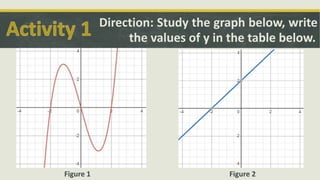
Direction: Study the graph below, write
the values of y in the table below.
Figure 1 Figure 2
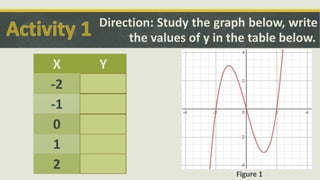
Figure 1
X Y
-2 0
-1 3
0 0
1 -3
2 0
Direction: Study the graph below, write
the values of y in the table below.
Direction: Study the graph below, write
the values of y in the table below.
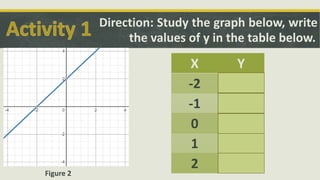
Figure 2
X Y
-2 0
-1 1
0 2
1 3
2 4
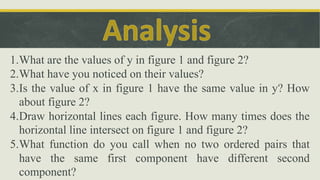
1.What are the values of y in figure 1 and figure 2?
2.What have you noticed on their values?
3.Is the value of x in figure 1 have the same value in y? How
about figure 2?
4.Draw horizontal lines each figure. How many times does the
horizontal line intersect on figure 1 and figure 2?
5.What function do you call when no two ordered pairs that
have the same first component have different second
component?
Activity 2
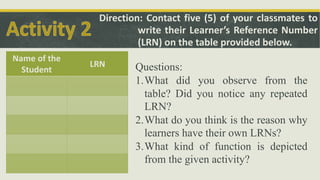
Direction: Contact five (5) of your classmates to
write their Learner’s Reference Number
(LRN) on the table provided below.
Name of the
Student
LRN Questions:
1.What did you observe from the
table? Did you notice any repeated
LRN?
2.What do you think is the reason why
learners have their own LRNs?
3.What kind of function is depicted
from the given activity?
Activity 3
I Can See Your Mind!!!
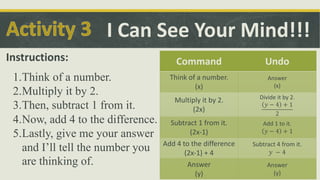
Instructions:
1.Think of a number.
2.Multiply it by 2.
3.Then, subtract 1 from it.
4.Now, add 4 to the difference.
5.Lastly, give me your answer
and I’ll tell the number you
are thinking of.
Command Undo
Think of a number.
(x)
Answer
(x)
Multiply it by 2.
(2x)
Divide it by 2.
𝑦 − 4 + 1
2
Subtract 1 from it.
(2x-1)
Add 1 to it.
𝑦 − 4 + 1
Add 4 to the difference
(2x-1) + 4
Subtract 4 from it.
𝑦 − 4
Answer
(y)
Answer
(y)
One-to-One and Inverse
Functions
Objectives
 Define and identify one-to-one and
inverse functions;
 Determine the inverse of a given
function;
 Show that two functions are inverses.
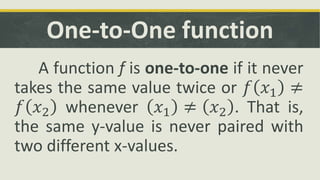
One-to-One function
A function f is one-to-one if it never
takes the same value twice or 𝑓 𝑥1 ≠
𝑓 𝑥2 whenever 𝑥1 ≠ 𝑥2 . That is,
the same y-value is never paired with
two different x-values.
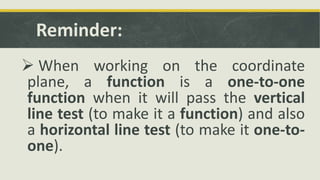
Reminder:
 When working on the coordinate
plane, a function is a one-to-one
function when it will pass the vertical
line test (to make it a function) and also
a horizontal line test (to make it one-to-
one).
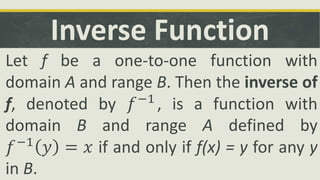
Inverse Function
Let f be a one-to-one function with
domain A and range B. Then the inverse of
f, denoted by 𝑓−1
, is a function with
domain B and range A defined by
𝑓−1
𝑦 = 𝑥 if and only if f(x) = y for any y
in B.
Showing that Two Functions are
Inverses
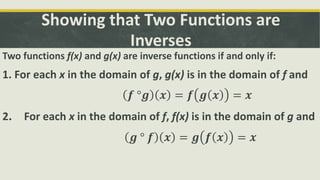
Two functions f(x) and g(x) are inverse functions if and only if:
1. For each x in the domain of g, g(x) is in the domain of f and
𝒇 °𝒈 𝒙 = 𝒇 𝒈 𝒙 = 𝒙
2. For each x in the domain of f, f(x) is in the domain of g and
𝒈 ° 𝒇 𝒙 = 𝒈 𝒇 𝒙 = 𝒙
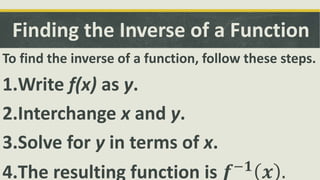
Finding the Inverse of a Function
To find the inverse of a function, follow these steps.
1.Write f(x) as y.
2.Interchange x and y.
3.Solve for y in terms of x.
4.The resulting function is 𝒇−𝟏
𝒙 .
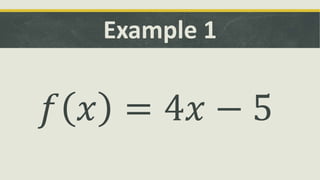
Example 1
𝑓 𝑥 = 4𝑥 − 5
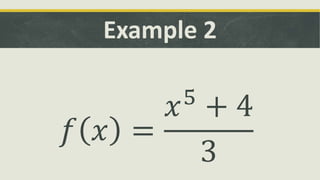
Example 2
𝑓 𝑥 =
𝑥5
+ 4
3
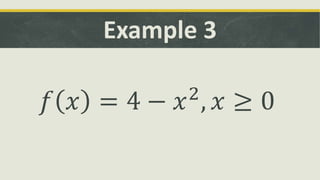
Example 3
𝑓 𝑥 = 4 − 𝑥2
, 𝑥 ≥ 0
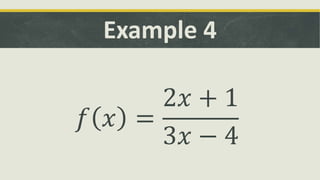
Example 4
𝑓 𝑥 =
2𝑥 + 1
3𝑥 − 4
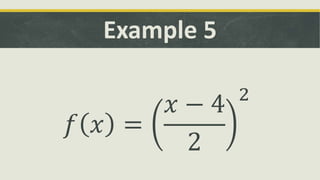
Example 5
𝑓 𝑥 =
𝑥 − 4
2
2
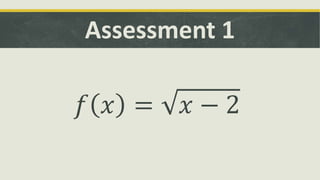
Assessment 1
𝑓 𝑥 = 𝑥 − 2
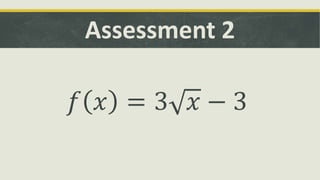
Assessment 2
𝑓 𝑥 = 3 𝑥 − 3

One-to-One and Inverse Functions.pptx

  • 1.
  • 2.
    Direction: Study thegraph below, write the values of y in the table below. Figure 1 Figure 2
  • 3.
    Figure 1 X Y -20 -1 3 0 0 1 -3 2 0 Direction: Study the graph below, write the values of y in the table below.
  • 4.
    Direction: Study thegraph below, write the values of y in the table below. Figure 2 X Y -2 0 -1 1 0 2 1 3 2 4
  • 5.
    1.What are thevalues of y in figure 1 and figure 2? 2.What have you noticed on their values? 3.Is the value of x in figure 1 have the same value in y? How about figure 2? 4.Draw horizontal lines each figure. How many times does the horizontal line intersect on figure 1 and figure 2? 5.What function do you call when no two ordered pairs that have the same first component have different second component?
  • 6.
  • 7.
    Direction: Contact five(5) of your classmates to write their Learner’s Reference Number (LRN) on the table provided below. Name of the Student LRN Questions: 1.What did you observe from the table? Did you notice any repeated LRN? 2.What do you think is the reason why learners have their own LRNs? 3.What kind of function is depicted from the given activity?
  • 8.
  • 9.
    I Can SeeYour Mind!!! Instructions: 1.Think of a number. 2.Multiply it by 2. 3.Then, subtract 1 from it. 4.Now, add 4 to the difference. 5.Lastly, give me your answer and I’ll tell the number you are thinking of. Command Undo Think of a number. (x) Answer (x) Multiply it by 2. (2x) Divide it by 2. 𝑦 − 4 + 1 2 Subtract 1 from it. (2x-1) Add 1 to it. 𝑦 − 4 + 1 Add 4 to the difference (2x-1) + 4 Subtract 4 from it. 𝑦 − 4 Answer (y) Answer (y)
  • 10.
  • 11.
    Objectives  Define andidentify one-to-one and inverse functions;  Determine the inverse of a given function;  Show that two functions are inverses.
  • 12.
    One-to-One function A functionf is one-to-one if it never takes the same value twice or 𝑓 𝑥1 ≠ 𝑓 𝑥2 whenever 𝑥1 ≠ 𝑥2 . That is, the same y-value is never paired with two different x-values.
  • 13.
    Reminder:  When workingon the coordinate plane, a function is a one-to-one function when it will pass the vertical line test (to make it a function) and also a horizontal line test (to make it one-to- one).
  • 14.
    Inverse Function Let fbe a one-to-one function with domain A and range B. Then the inverse of f, denoted by 𝑓−1 , is a function with domain B and range A defined by 𝑓−1 𝑦 = 𝑥 if and only if f(x) = y for any y in B.
  • 15.
    Showing that TwoFunctions are Inverses Two functions f(x) and g(x) are inverse functions if and only if: 1. For each x in the domain of g, g(x) is in the domain of f and 𝒇 °𝒈 𝒙 = 𝒇 𝒈 𝒙 = 𝒙 2. For each x in the domain of f, f(x) is in the domain of g and 𝒈 ° 𝒇 𝒙 = 𝒈 𝒇 𝒙 = 𝒙
  • 16.
    Finding the Inverseof a Function To find the inverse of a function, follow these steps. 1.Write f(x) as y. 2.Interchange x and y. 3.Solve for y in terms of x. 4.The resulting function is 𝒇−𝟏 𝒙 .
  • 17.
    Example 1 𝑓 𝑥= 4𝑥 − 5
  • 18.
    Example 2 𝑓 𝑥= 𝑥5 + 4 3
  • 19.
    Example 3 𝑓 𝑥= 4 − 𝑥2 , 𝑥 ≥ 0
  • 20.
    Example 4 𝑓 𝑥= 2𝑥 + 1 3𝑥 − 4
  • 21.
    Example 5 𝑓 𝑥= 𝑥 − 4 2 2
  • 22.
  • 23.
    Assessment 2 𝑓 𝑥= 3 𝑥 − 3