
INVESTIGATION OF EPIDEMIC  DR. N.C DAS
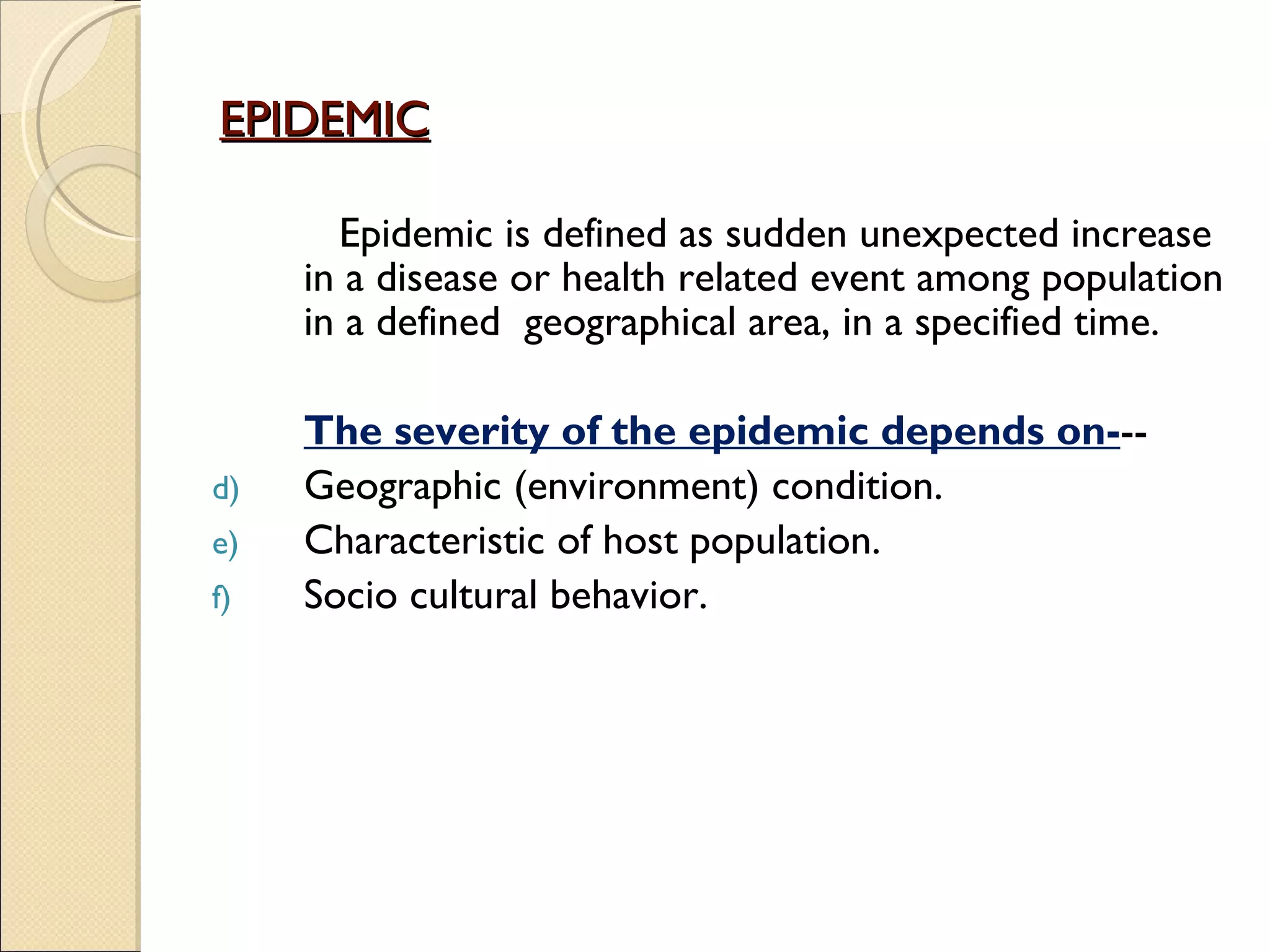
EPIDEMIC Epidemic is defined as sudden unexpected increase in a disease or health related event among population in a defined  geographical area, in a specified time. The severity of the epidemic depends on- -- Geographic (environment) condition. Characteristic of host population. Socio cultural behavior.
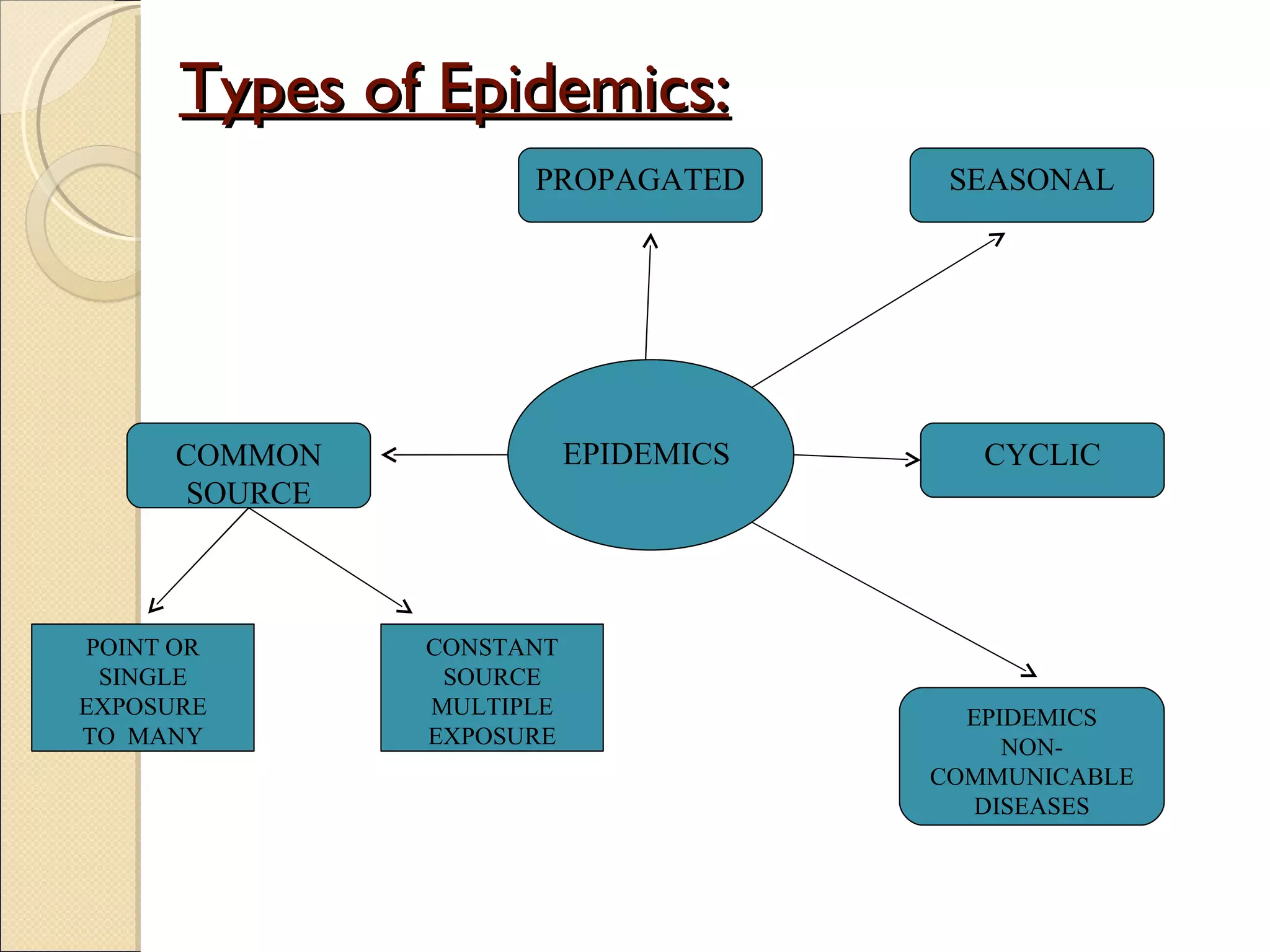
Types of Epidemics: EPIDEMICS EPIDEMICS NON-COMMUNICABLE DISEASES COMMON SOURCE CYCLIC SEASONAL PROPAGATED POINT OR SINGLE EXPOSURE TO  MANY CONSTANT SOURCE MULTIPLE EXPOSURE
WHY INVESTIGATE ? -  To define the magnitude in terms of time, place and person.  To identity source and possible cause.  Factors contributing to spread.  To make recommendation to prevent.
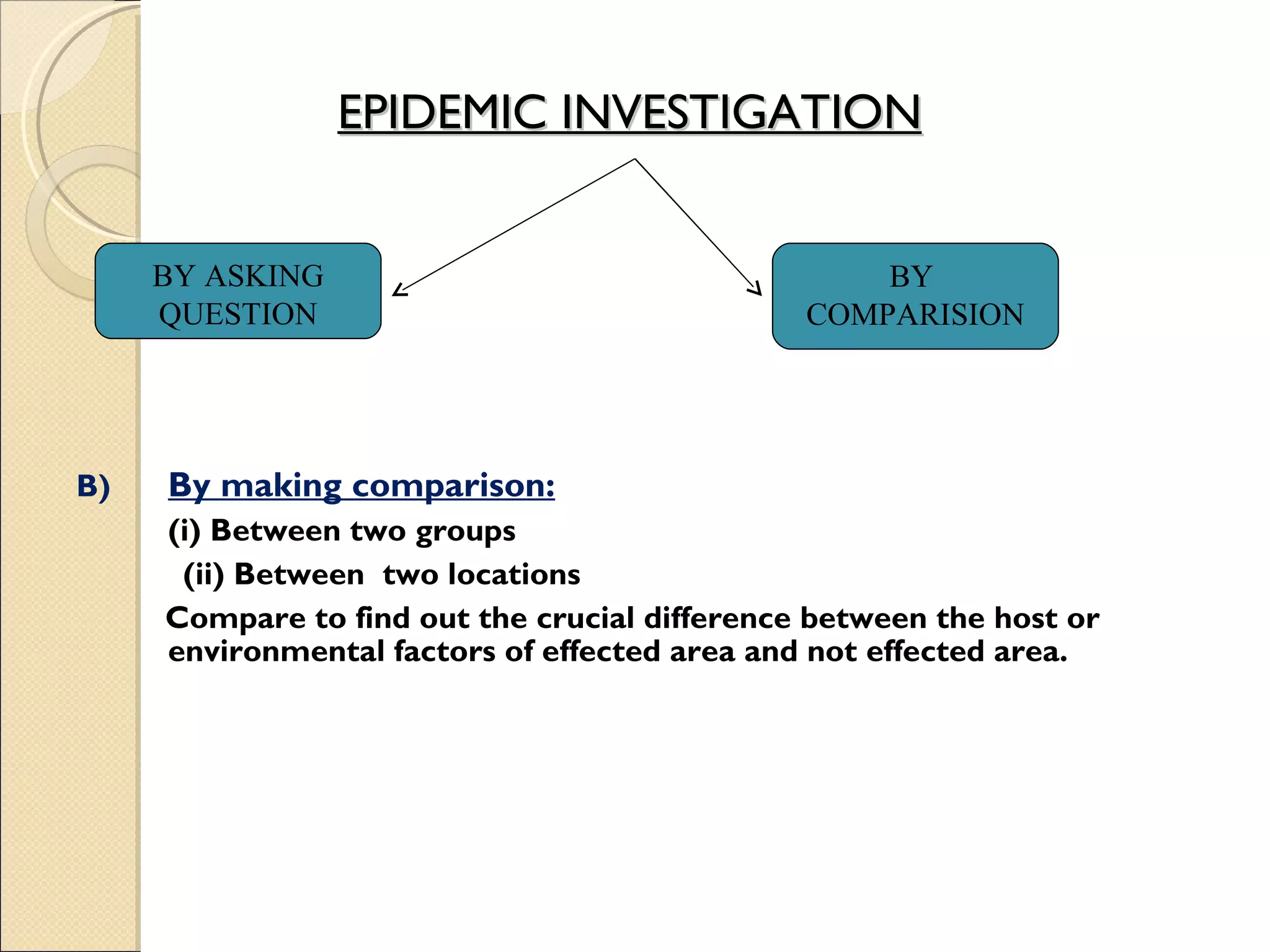
EPIDEMIC INVESTIGATION B) By making comparison: (i) Between two groups (ii) Between  two locations  Compare to find out the crucial difference between the host or environmental factors of effected area and not effected area.  BY ASKING QUESTION BY  COMPARISION
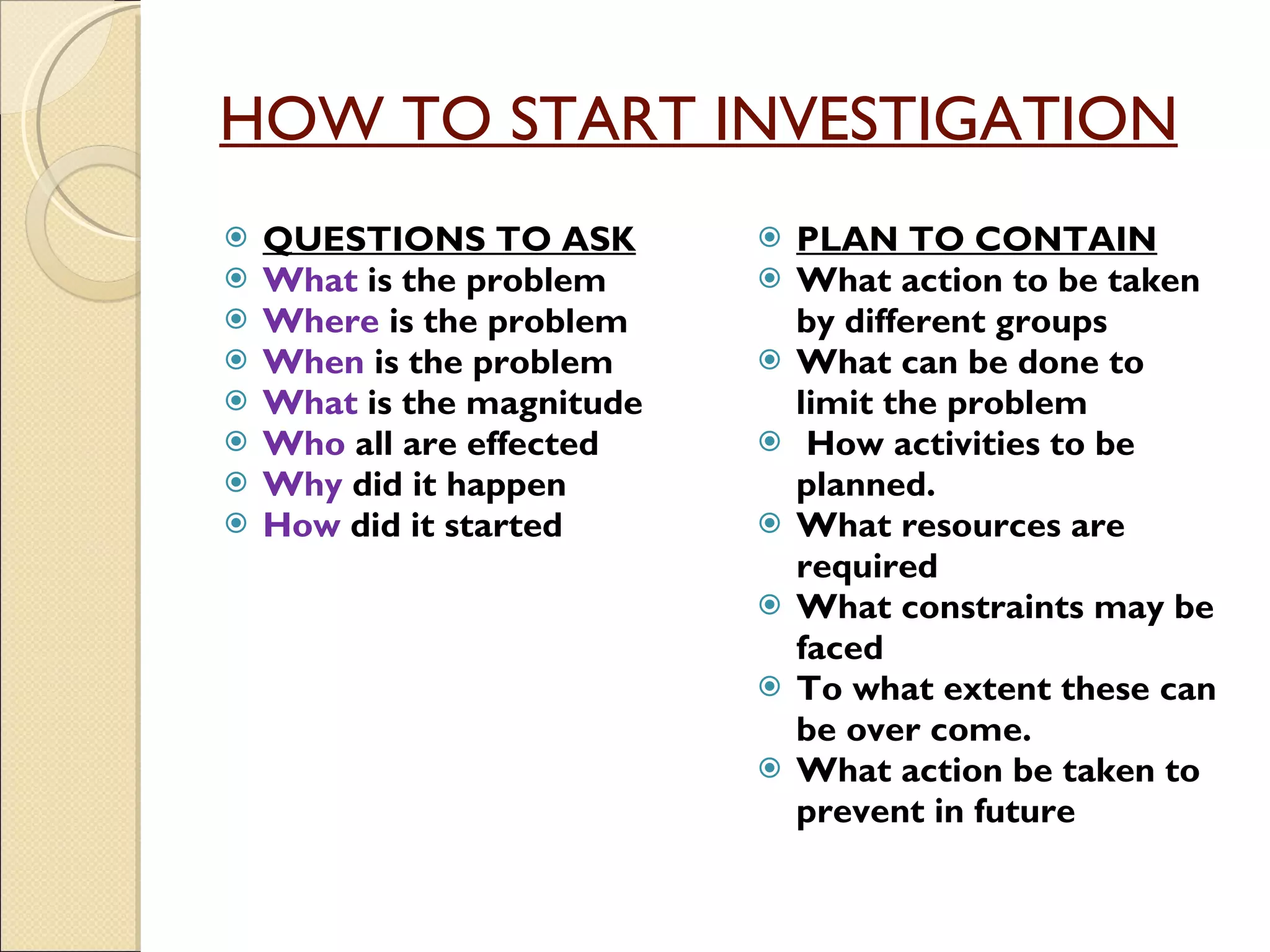
HOW TO START INVESTIGATION QUESTIONS TO ASK What  is the problem Where  is the problem When  is the problem What  is the magnitude Who  all are effected Why  did it happen How  did it started PLAN TO CONTAIN What action to be taken by different groups What can be done to limit the problem How activities to be planned. What resources are required What constraints may be faced To what extent these can be over come. What action be taken to prevent in future
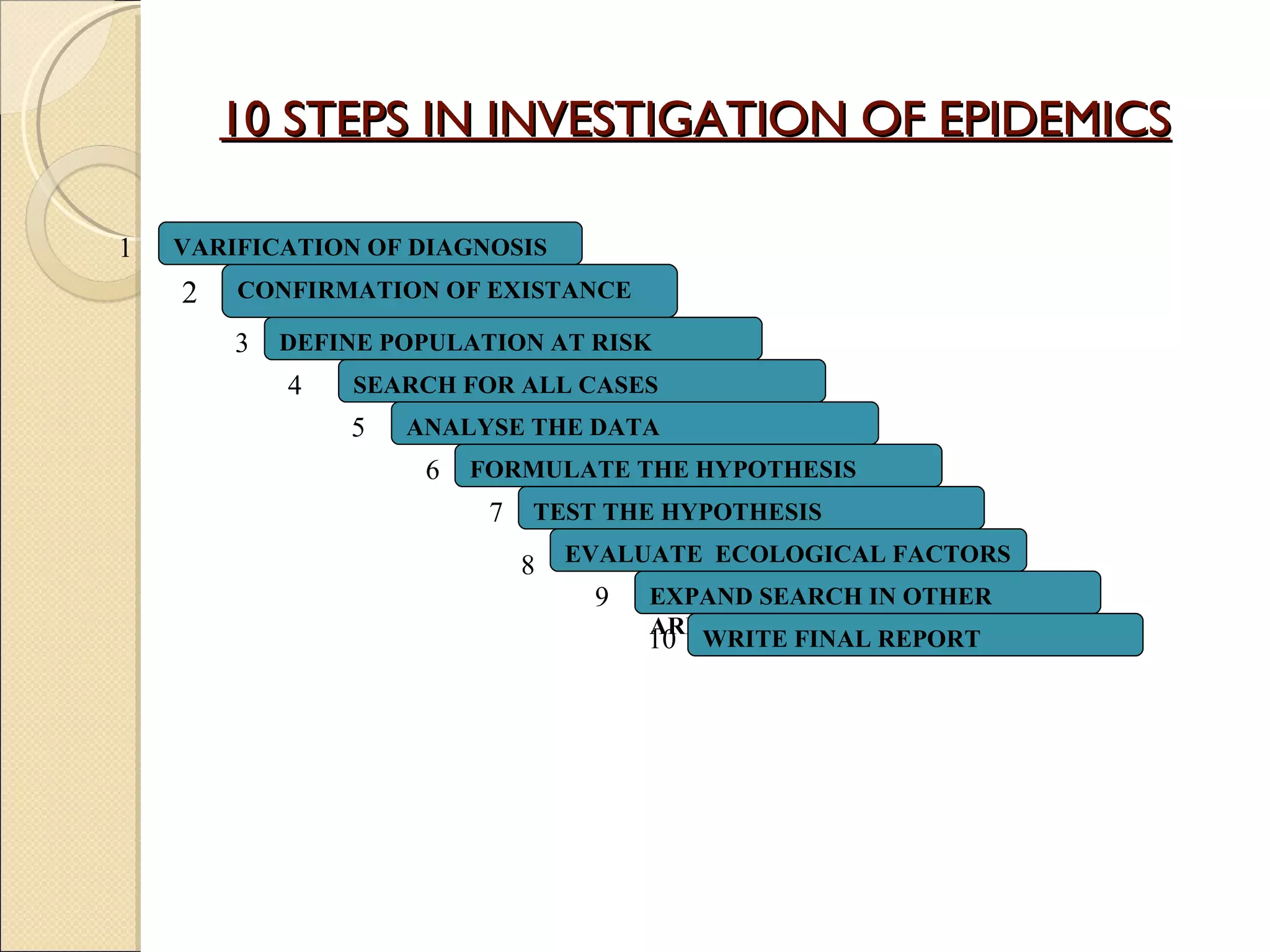
10 STEPS IN INVESTIGATION OF EPIDEMICS VARIFICATION OF DIAGNOSIS CONFIRMATION OF EXISTANCE DEFINE POPULATION AT RISK SEARCH FOR ALL CASES ANALYSE THE DATA FORMULATE THE HYPOTHESIS TEST THE HYPOTHESIS EVALUATE  ECOLOGICAL FACTORS EXPAND SEARCH IN OTHER  AREAS WRITE FINAL REPORT 1 2 3 4 5 6 7 8 9 10
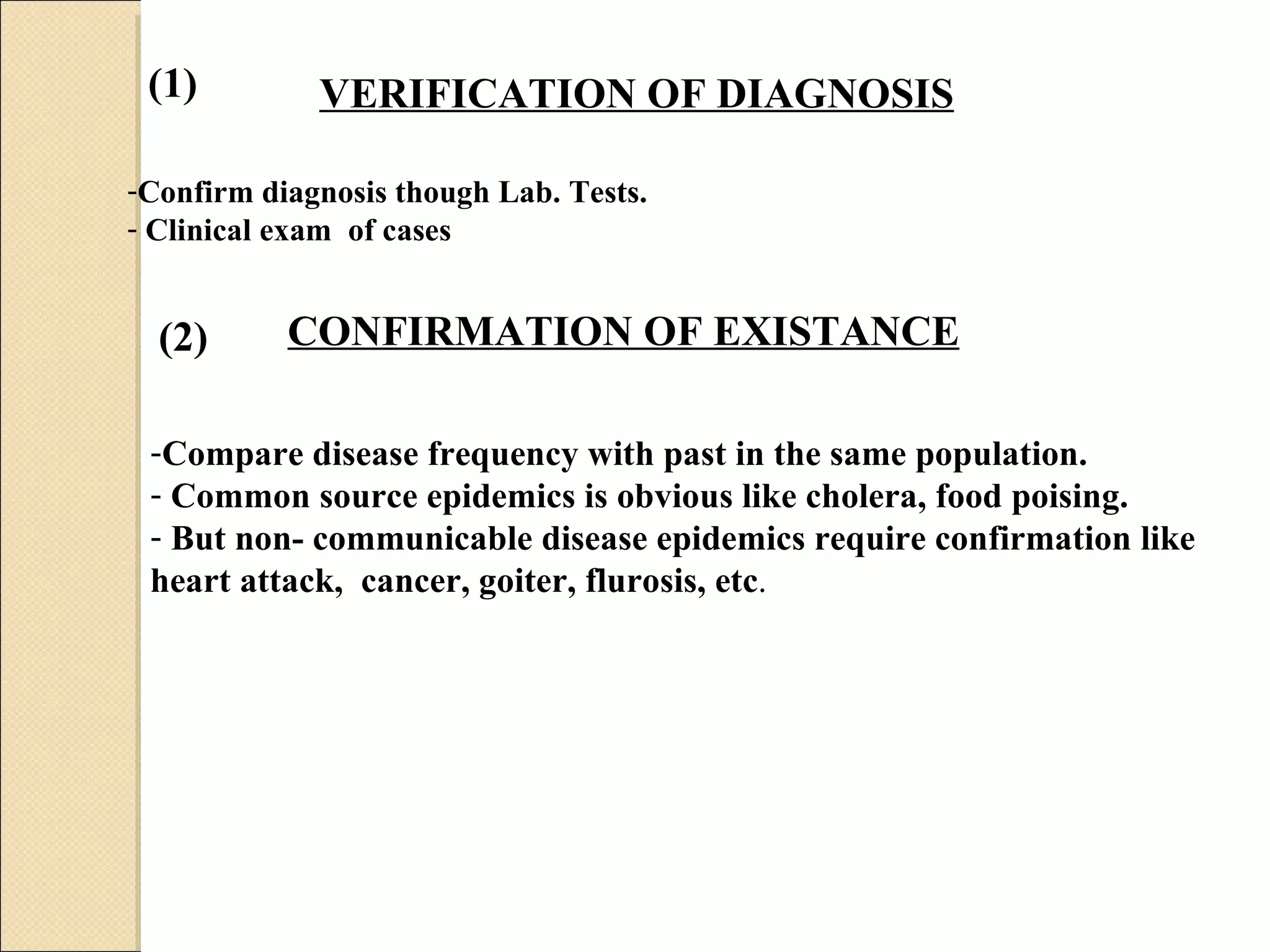
VERIFICATION OF DIAGNOSIS   Confirm diagnosis though Lab. Tests.  Clinical exam  of cases CONFIRMATION OF EXISTANCE   Compare disease frequency with past in the same population.  Common source epidemics is obvious like cholera, food poising. But non- communicable disease epidemics require confirmation like heart attack,  cancer, goiter, flurosis, etc .  (1) (2)
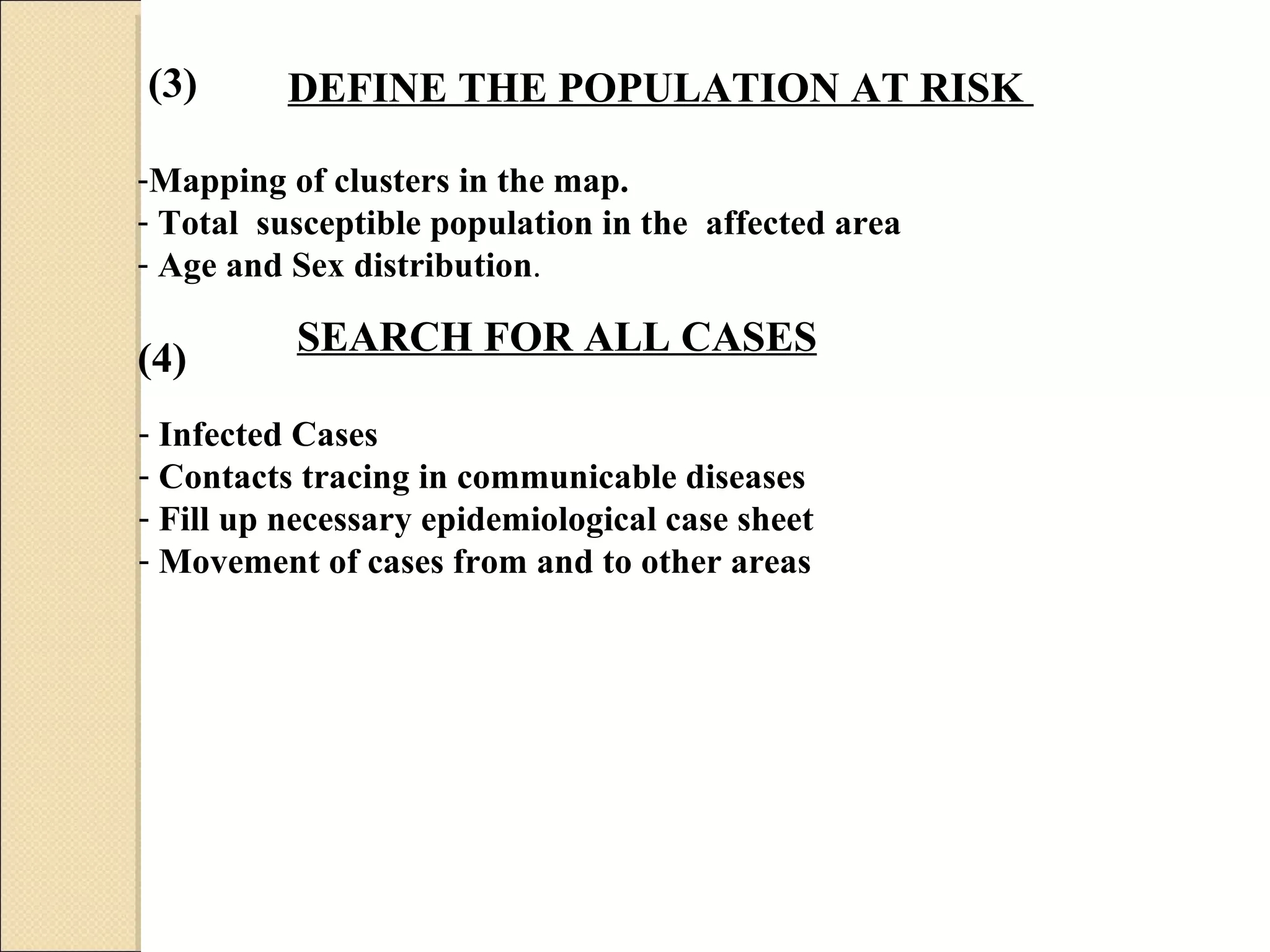
DEFINE THE POPULATION AT RISK  Mapping of clusters in the map. Total  susceptible population in the  affected area  Age and Sex distribution .  SEARCH FOR ALL CASES   Infected Cases  Contacts tracing in communicable diseases  Fill up necessary epidemiological case sheet  Movement of cases from and to other areas  (3) (4)
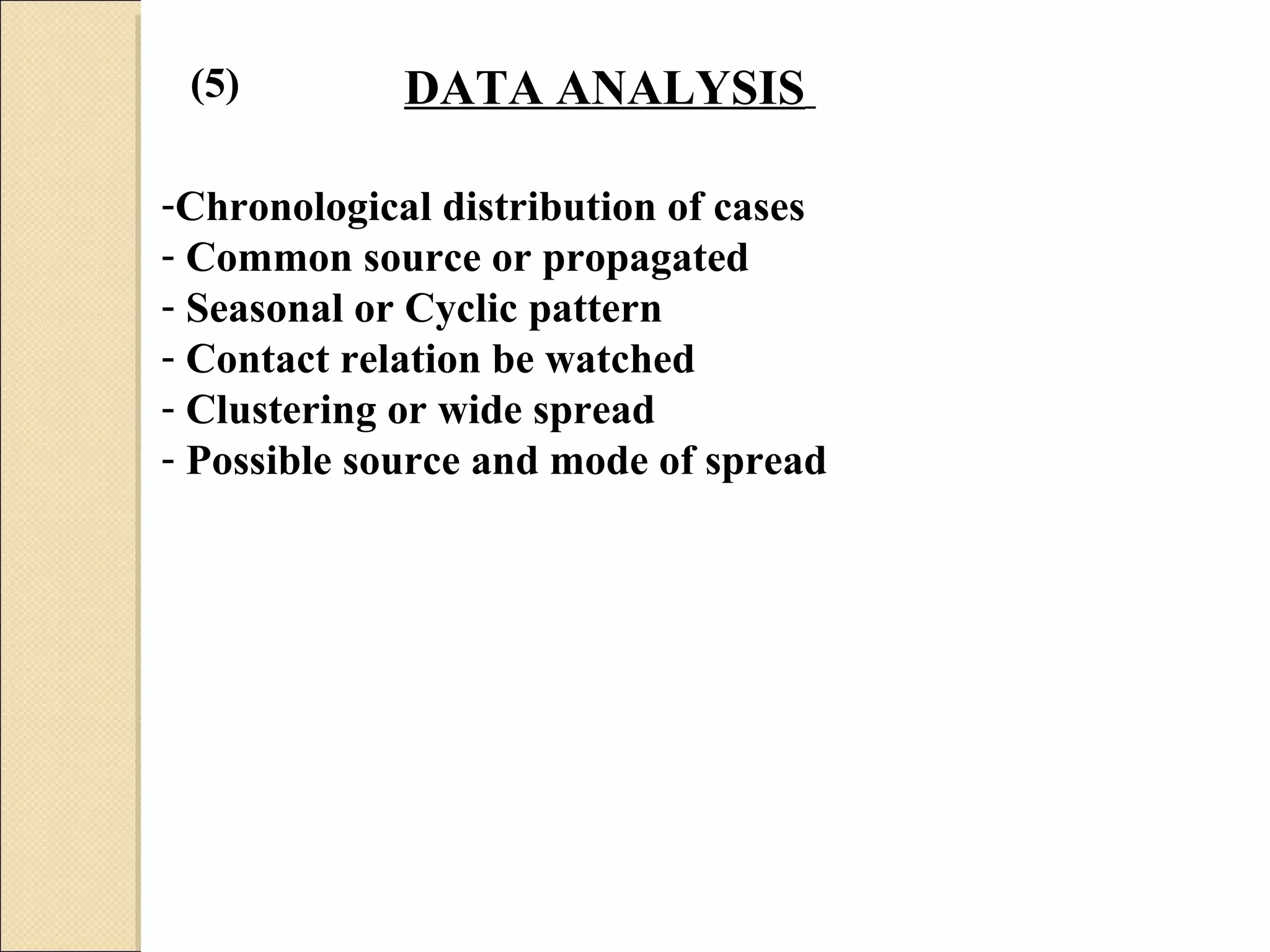
DATA ANALYSIS   Chronological distribution of cases  Common source or propagated Seasonal or Cyclic pattern  Contact relation be watched  Clustering or wide spread  Possible source and mode of spread   (5)
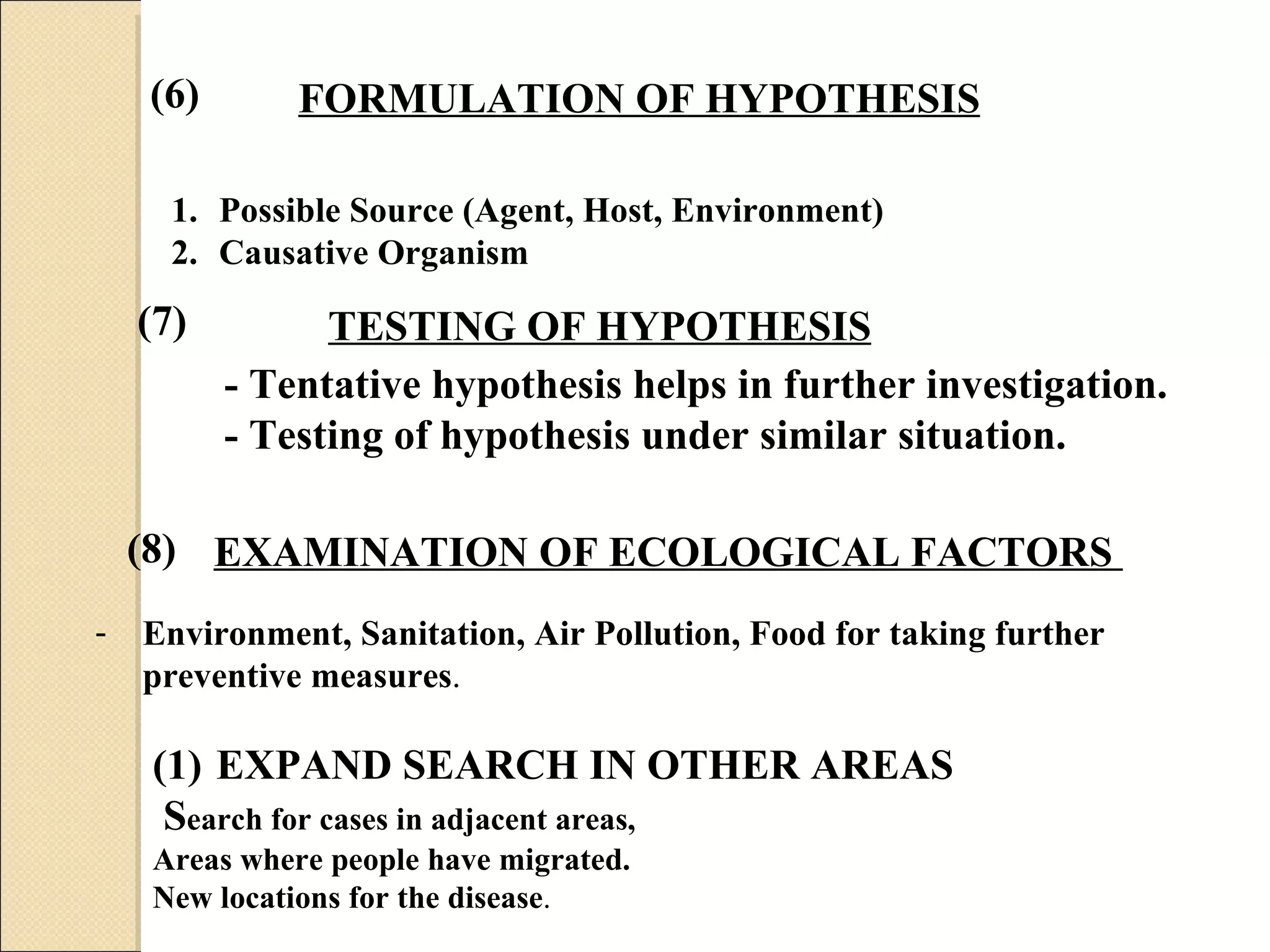
FORMULATION OF HYPOTHESIS   Possible Source (Agent, Host, Environment) Causative Organism EXAMINATION OF ECOLOGICAL FACTORS   Environment, Sanitation, Air Pollution, Food for taking further  preventive measures .  (6) - Tentative hypothesis helps in further investigation. - Testing of hypothesis   under similar situation. (7) (8) TESTING OF HYPOTHESIS EXPAND SEARCH IN OTHER AREAS S earch for cases in adjacent areas, Areas where people have migrated. New locations for the disease .
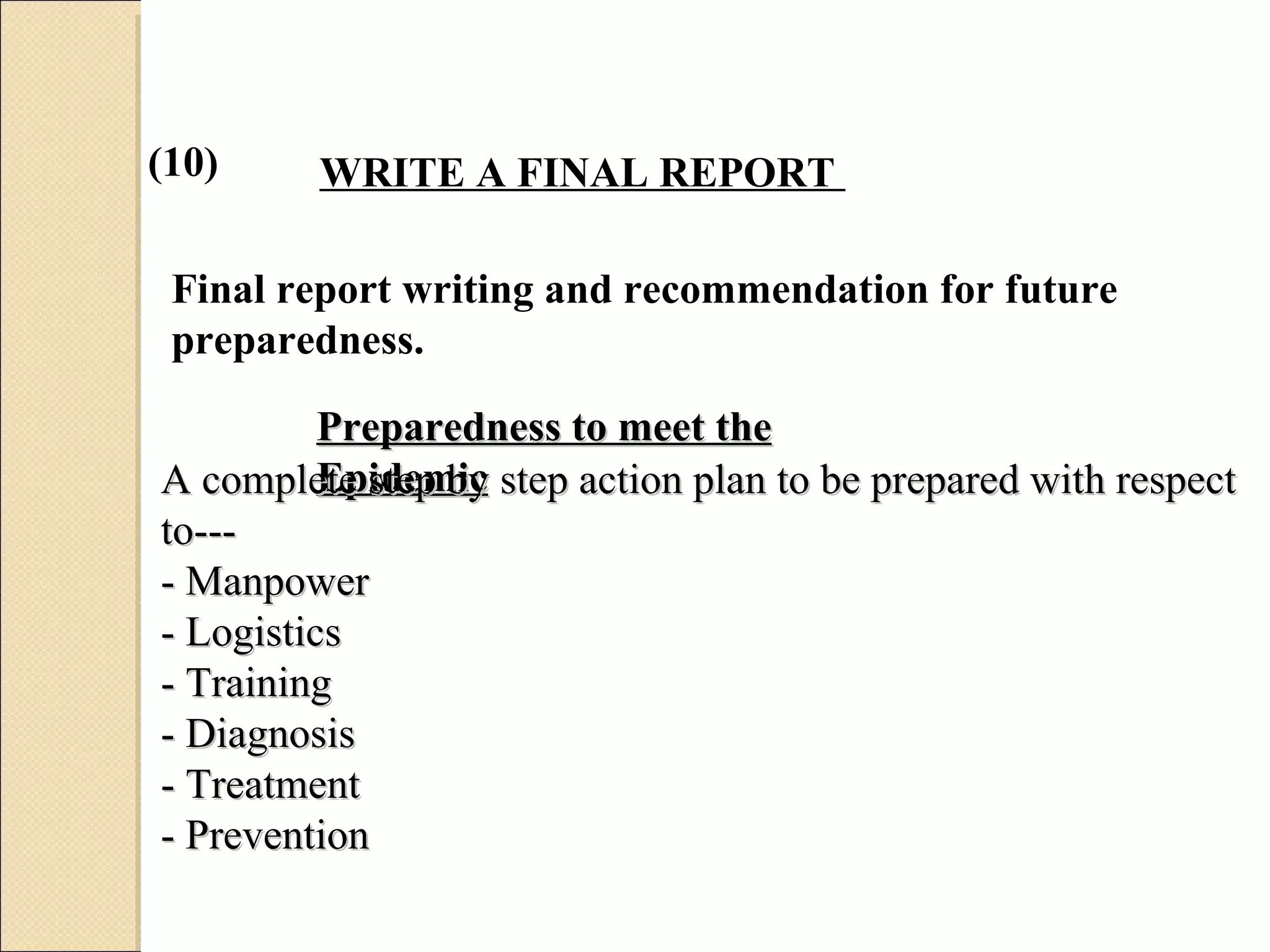
(10) WRITE A FINAL REPORT  Final report writing and recommendation for future preparedness. Preparedness to meet the Epidemic A complete step by step action plan to be prepared with respect to--- - Manpower - Logistics  - Training - Diagnosis  - Treatment  - Prevention
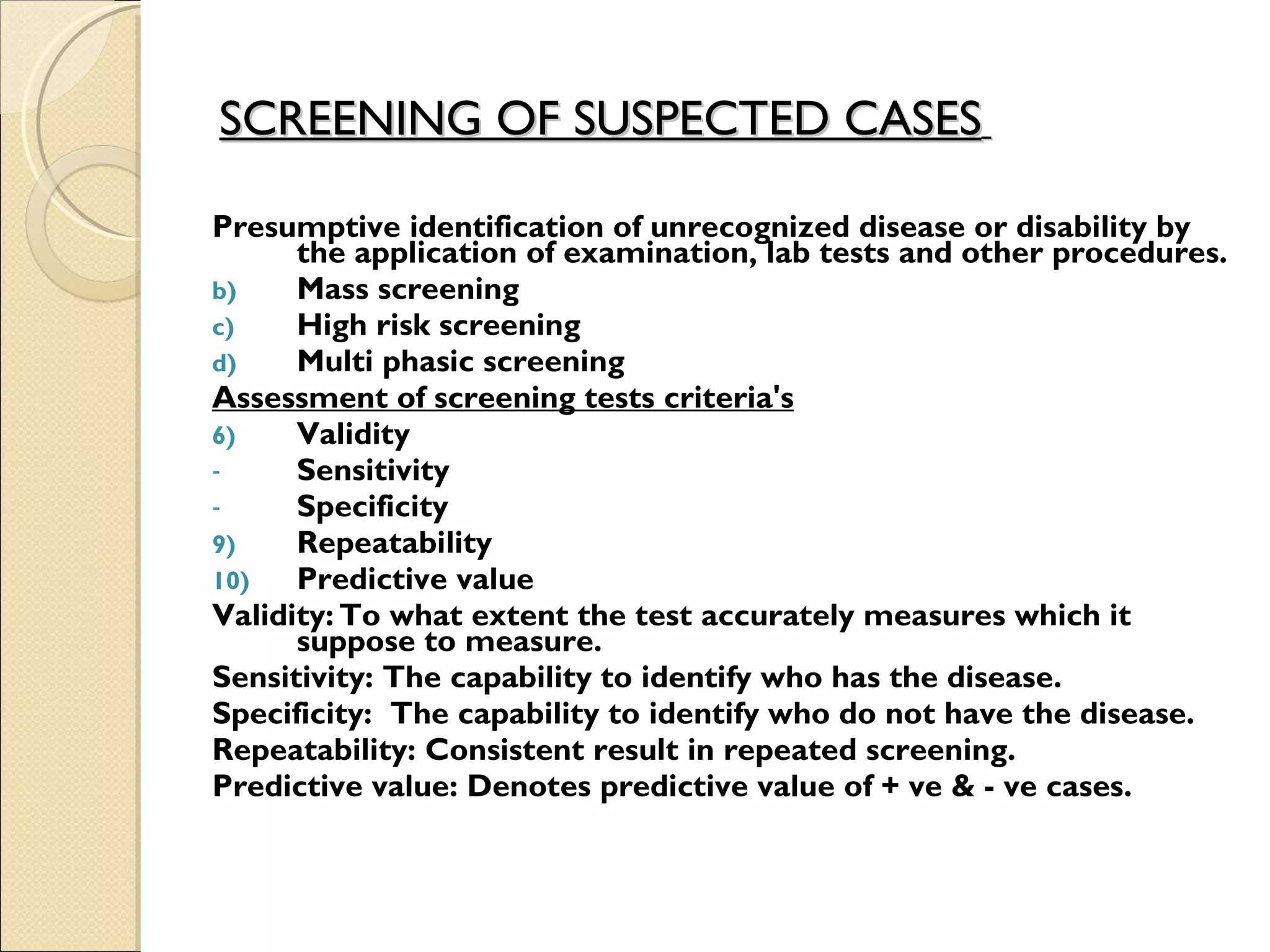
SCREENING OF SUSPECTED CASES   Presumptive identification of unrecognized disease or disability by the application of examination, lab tests and other procedures. Mass screening  High risk screening  Multi phasic screening Assessment of screening tests criteria's Validity  Sensitivity  Specificity  Repeatability  Predictive value Validity: To what extent the test accurately measures which it suppose to measure. Sensitivity: The capability to identify who has the disease. Specificity:  The capability to identify who do not have the disease. Repeatability: Consistent result in repeated screening. Predictive value: Denotes predictive value of + ve & - ve cases.
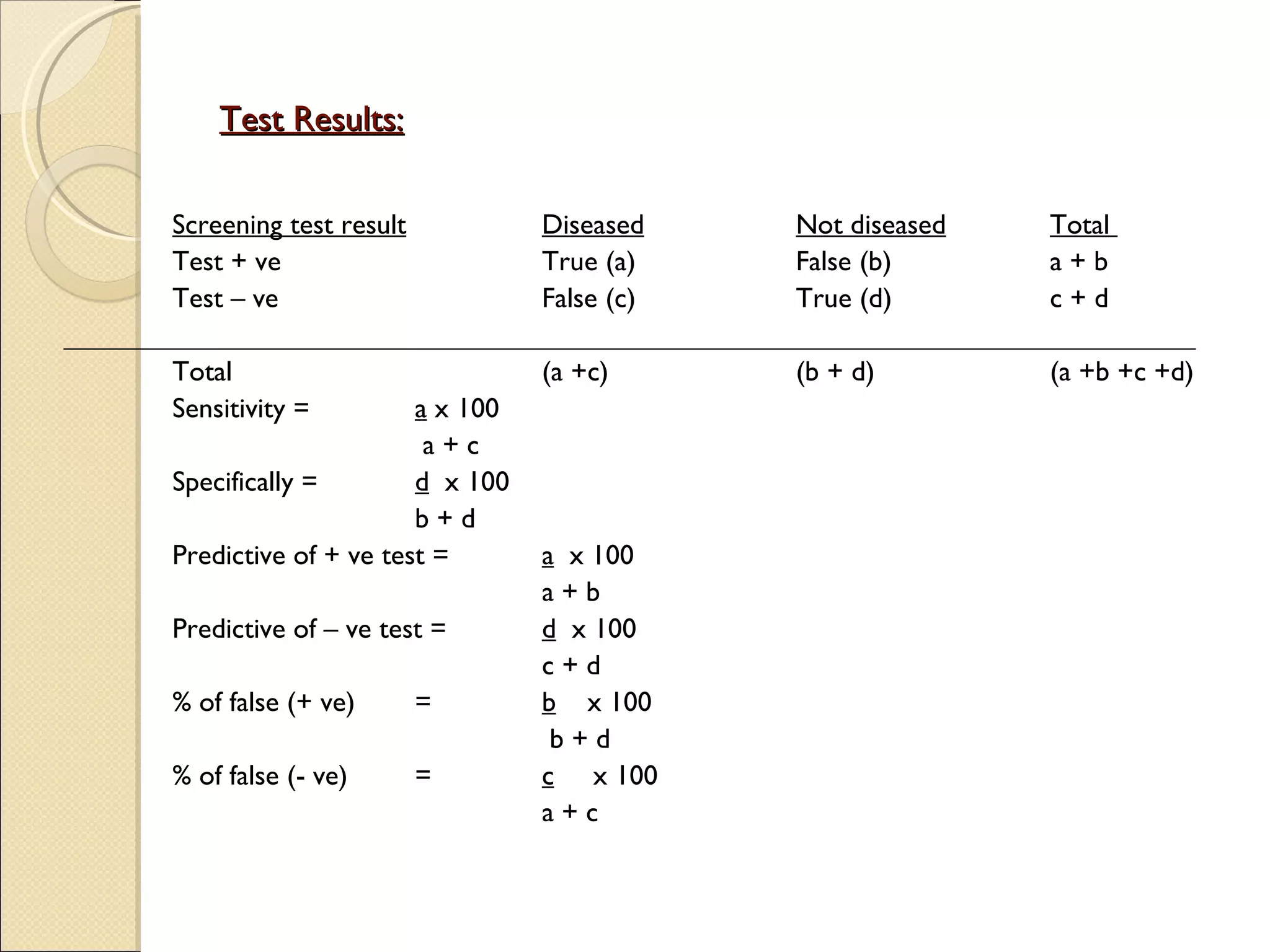
Test Results: Screening test result Diseased Not diseased Total  Test + ve True (a) False (b) a + b Test – ve False (c) True (d) c + d Total (a +c) (b + d) (a +b +c +d) Sensitivity =  a  x 100     a + c Specifically =  d   x 100   b + d Predictive of + ve test =  a   x 100   a + b Predictive of – ve test =  d   x 100   c + d % of false (+ ve) = b   x 100     b + d % of false (- ve) = c   x 100 a + c
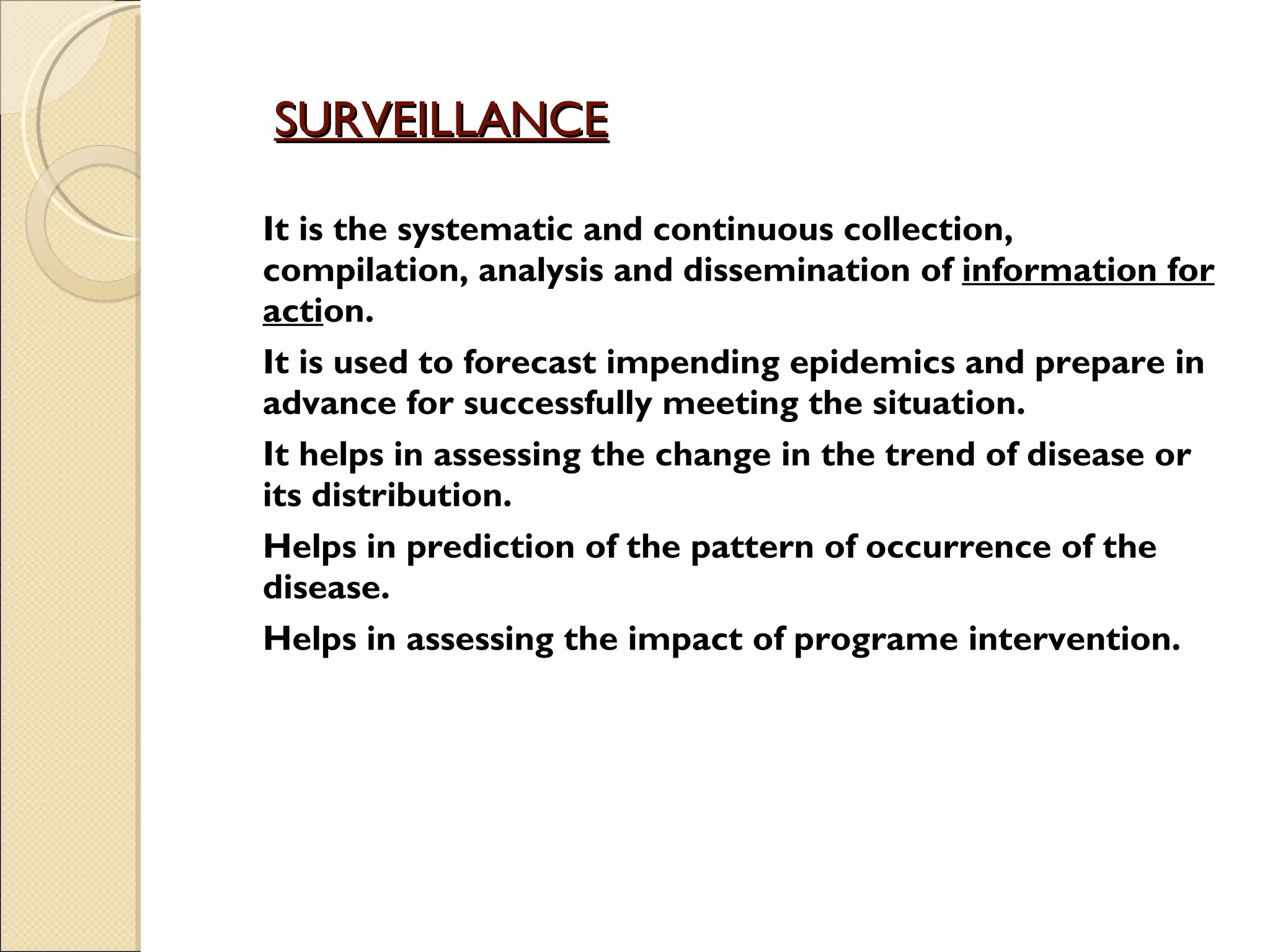
SURVEILLANCE   It is the systematic and continuous collection, compilation, analysis and dissemination of  information for acti on. It is used to forecast impending epidemics and prepare in advance for successfully meeting the situation. It helps in assessing the change in the trend of disease or its distribution.  Helps in prediction of the pattern of occurrence of the disease. Helps in assessing the impact of programe intervention.
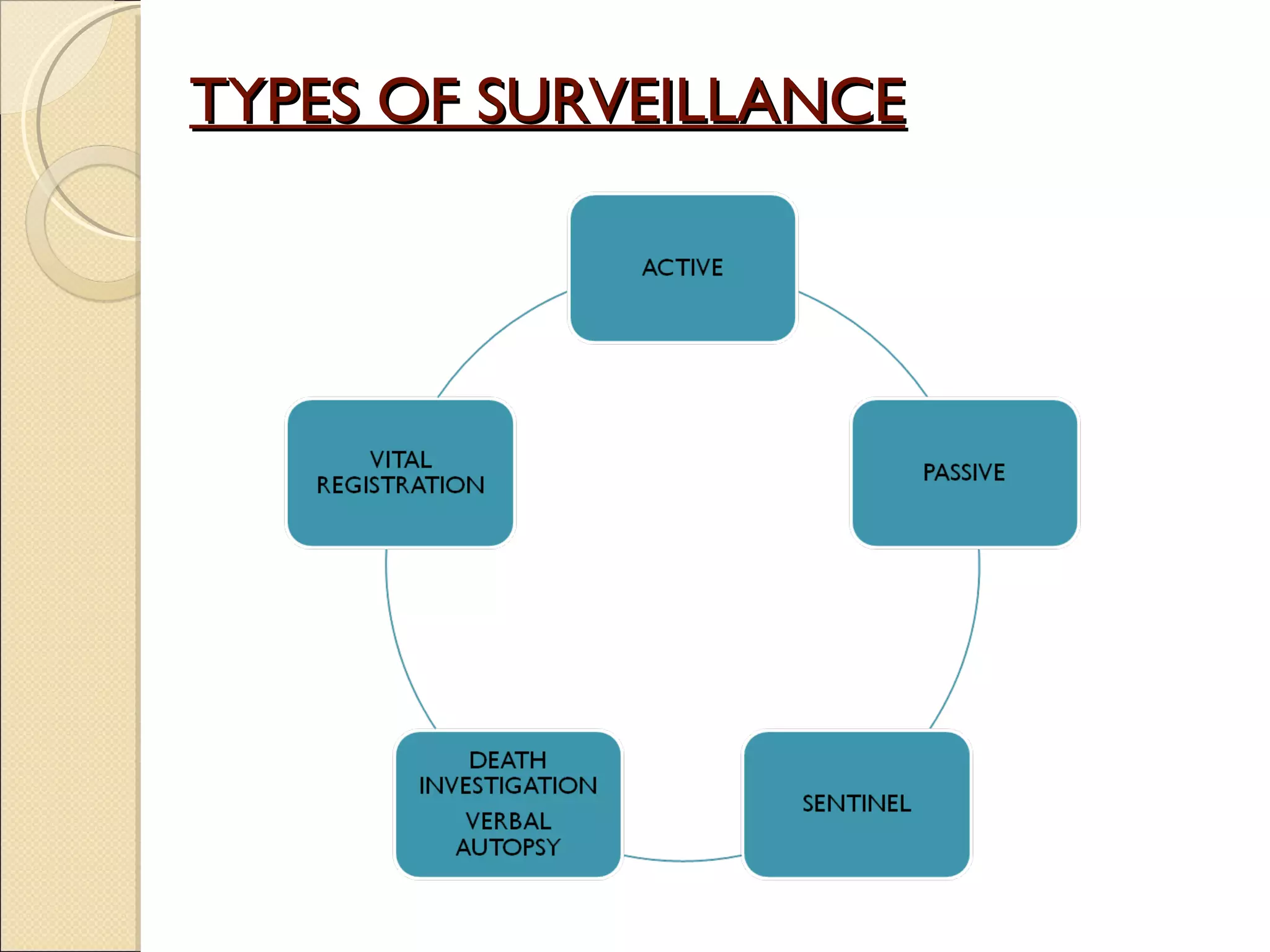
TYPES OF SURVEILLANCE
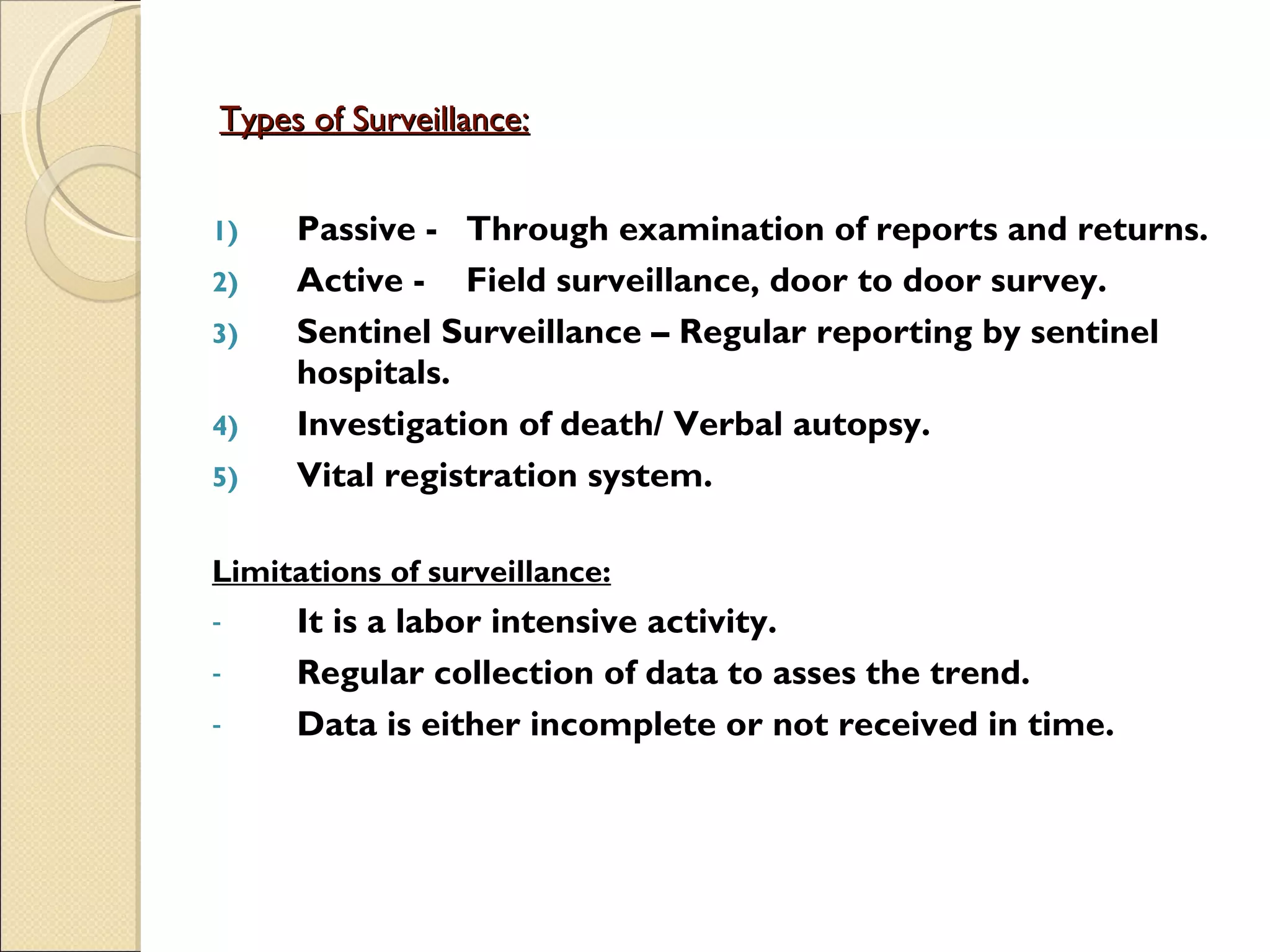
Types of Surveillance:   Passive - Through examination of reports and returns. Active - Field surveillance, door to door survey. Sentinel Surveillance – Regular reporting by sentinel hospitals. Investigation of death/ Verbal autopsy. Vital registration system. Limitations of surveillance: It is a labor intensive activity. Regular collection of data to asses the trend. Data is either incomplete or not received in time.
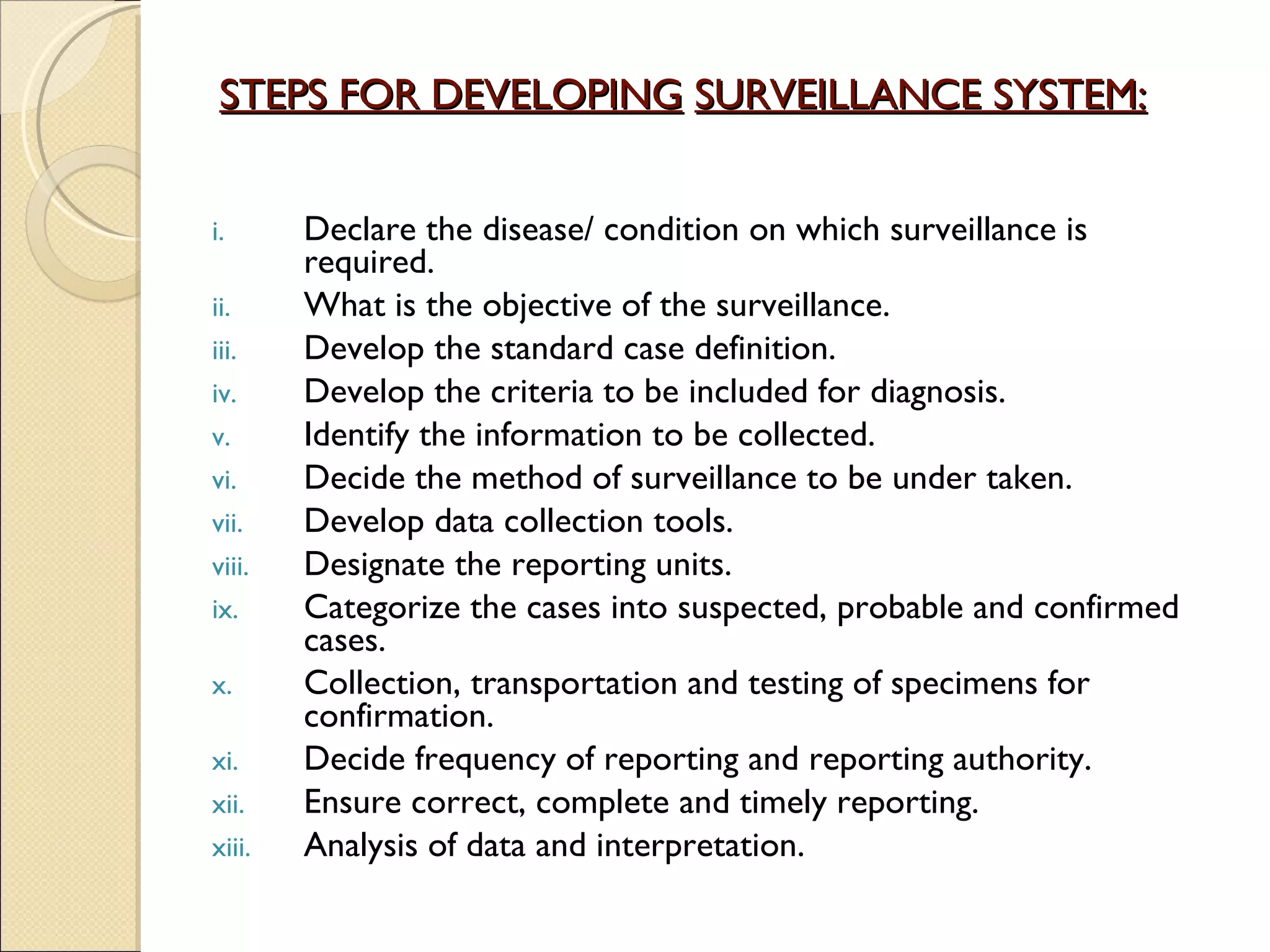
STEPS FOR DEVELOPING   SURVEILLANCE SYSTEM: Declare the disease/ condition on which surveillance is required. What is the objective of the surveillance.  Develop the standard case definition. Develop the criteria to be included for diagnosis. Identify the information to be collected. Decide the method of surveillance to be under taken. Develop data collection tools. Designate the reporting units. Categorize the cases into suspected, probable and confirmed cases. Collection, transportation and testing of specimens for confirmation.  Decide frequency of reporting and reporting authority. Ensure correct, complete and timely reporting. Analysis of data and interpretation.
Hospital Administration Made Easy http//hospiad.blogspot.com An effort solely to help students and aspirants in their attempt to become a successful Hospital Administrator. hospi ad DR. N. C. DAS

Inv.epidemics

  • 1.
  • 2.
    EPIDEMIC Epidemic isdefined as sudden unexpected increase in a disease or health related event among population in a defined geographical area, in a specified time. The severity of the epidemic depends on- -- Geographic (environment) condition. Characteristic of host population. Socio cultural behavior.
  • 3.
    Types of Epidemics:EPIDEMICS EPIDEMICS NON-COMMUNICABLE DISEASES COMMON SOURCE CYCLIC SEASONAL PROPAGATED POINT OR SINGLE EXPOSURE TO MANY CONSTANT SOURCE MULTIPLE EXPOSURE
  • 4.
    WHY INVESTIGATE ?- To define the magnitude in terms of time, place and person. To identity source and possible cause. Factors contributing to spread. To make recommendation to prevent.
  • 5.
    EPIDEMIC INVESTIGATION B)By making comparison: (i) Between two groups (ii) Between two locations Compare to find out the crucial difference between the host or environmental factors of effected area and not effected area. BY ASKING QUESTION BY COMPARISION
  • 6.
    HOW TO STARTINVESTIGATION QUESTIONS TO ASK What is the problem Where is the problem When is the problem What is the magnitude Who all are effected Why did it happen How did it started PLAN TO CONTAIN What action to be taken by different groups What can be done to limit the problem How activities to be planned. What resources are required What constraints may be faced To what extent these can be over come. What action be taken to prevent in future
  • 7.
    10 STEPS ININVESTIGATION OF EPIDEMICS VARIFICATION OF DIAGNOSIS CONFIRMATION OF EXISTANCE DEFINE POPULATION AT RISK SEARCH FOR ALL CASES ANALYSE THE DATA FORMULATE THE HYPOTHESIS TEST THE HYPOTHESIS EVALUATE ECOLOGICAL FACTORS EXPAND SEARCH IN OTHER AREAS WRITE FINAL REPORT 1 2 3 4 5 6 7 8 9 10
  • 8.
    VERIFICATION OF DIAGNOSIS Confirm diagnosis though Lab. Tests. Clinical exam of cases CONFIRMATION OF EXISTANCE Compare disease frequency with past in the same population. Common source epidemics is obvious like cholera, food poising. But non- communicable disease epidemics require confirmation like heart attack, cancer, goiter, flurosis, etc . (1) (2)
  • 9.
    DEFINE THE POPULATIONAT RISK Mapping of clusters in the map. Total susceptible population in the affected area Age and Sex distribution . SEARCH FOR ALL CASES Infected Cases Contacts tracing in communicable diseases Fill up necessary epidemiological case sheet Movement of cases from and to other areas (3) (4)
  • 10.
    DATA ANALYSIS Chronological distribution of cases Common source or propagated Seasonal or Cyclic pattern Contact relation be watched Clustering or wide spread Possible source and mode of spread (5)
  • 11.
    FORMULATION OF HYPOTHESIS Possible Source (Agent, Host, Environment) Causative Organism EXAMINATION OF ECOLOGICAL FACTORS Environment, Sanitation, Air Pollution, Food for taking further preventive measures . (6) - Tentative hypothesis helps in further investigation. - Testing of hypothesis under similar situation. (7) (8) TESTING OF HYPOTHESIS EXPAND SEARCH IN OTHER AREAS S earch for cases in adjacent areas, Areas where people have migrated. New locations for the disease .
  • 12.
    (10) WRITE AFINAL REPORT Final report writing and recommendation for future preparedness. Preparedness to meet the Epidemic A complete step by step action plan to be prepared with respect to--- - Manpower - Logistics - Training - Diagnosis - Treatment - Prevention
  • 13.
    SCREENING OF SUSPECTEDCASES Presumptive identification of unrecognized disease or disability by the application of examination, lab tests and other procedures. Mass screening High risk screening Multi phasic screening Assessment of screening tests criteria's Validity Sensitivity Specificity Repeatability Predictive value Validity: To what extent the test accurately measures which it suppose to measure. Sensitivity: The capability to identify who has the disease. Specificity: The capability to identify who do not have the disease. Repeatability: Consistent result in repeated screening. Predictive value: Denotes predictive value of + ve & - ve cases.
  • 14.
    Test Results: Screeningtest result Diseased Not diseased Total Test + ve True (a) False (b) a + b Test – ve False (c) True (d) c + d Total (a +c) (b + d) (a +b +c +d) Sensitivity = a x 100 a + c Specifically = d x 100 b + d Predictive of + ve test = a x 100 a + b Predictive of – ve test = d x 100 c + d % of false (+ ve) = b x 100 b + d % of false (- ve) = c x 100 a + c
  • 15.
    SURVEILLANCE It is the systematic and continuous collection, compilation, analysis and dissemination of information for acti on. It is used to forecast impending epidemics and prepare in advance for successfully meeting the situation. It helps in assessing the change in the trend of disease or its distribution. Helps in prediction of the pattern of occurrence of the disease. Helps in assessing the impact of programe intervention.
  • 16.
  • 17.
    Types of Surveillance: Passive - Through examination of reports and returns. Active - Field surveillance, door to door survey. Sentinel Surveillance – Regular reporting by sentinel hospitals. Investigation of death/ Verbal autopsy. Vital registration system. Limitations of surveillance: It is a labor intensive activity. Regular collection of data to asses the trend. Data is either incomplete or not received in time.
  • 18.
    STEPS FOR DEVELOPING SURVEILLANCE SYSTEM: Declare the disease/ condition on which surveillance is required. What is the objective of the surveillance. Develop the standard case definition. Develop the criteria to be included for diagnosis. Identify the information to be collected. Decide the method of surveillance to be under taken. Develop data collection tools. Designate the reporting units. Categorize the cases into suspected, probable and confirmed cases. Collection, transportation and testing of specimens for confirmation. Decide frequency of reporting and reporting authority. Ensure correct, complete and timely reporting. Analysis of data and interpretation.
  • 19.
    Hospital Administration MadeEasy http//hospiad.blogspot.com An effort solely to help students and aspirants in their attempt to become a successful Hospital Administrator. hospi ad DR. N. C. DAS