Epi-demio-logy
Dr Pallavi Potdar
Associate Prof.,
Community Medicine
D.Y. Patil Medical College Kolhapur
• What are the health problems in your
area?
• Where are they?
• Which problems are declining over time?
• Which are increasing?
John snow- London 19th
century
John snow- London 19th
century
Definition
• Study of distribution & determinants of health
related states or events in specified populations,
& the application of this study to the control of
health problems.
AIMS
• To describe distribution & magnitude of health problems
• To identify risk factors
• To provide data essential for
-planning,implementation,evaluation of services
Uses
• To study historically the rise & fall of disease in population
• Community diagnosis
• Planning & evaluation
• Evaluation of individuals risk & chances
• Syndrome identification
• Completing natural history of disease
• Searching for causes & risk factors
Tools of measurement
• Rates- death rate
• Ratios- sex ratio
• Proportions – no.of malnourished children x 100
total no. of children
Measurements in epidemiology
• Mortality
• Morbidity
• Disability
• Natality
• Environmental factors suspected of causing
disease
• Health care facilities
Mortality rates
no of deaths during yr.
1) Crude death rate=------------------------------x 1000
mid yr population
2) Specific death rates- due to TB ,age specific, sex
specific
3) Case fatality rate- total no of deaths due to particular disease x100
total no of cases due to same disease
Mortality rates
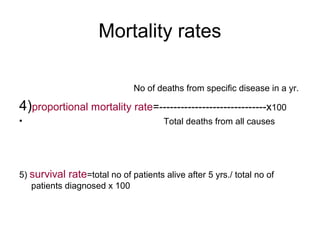
No of deaths from specific disease in a yr.
4)proportional mortality rate=------------------------------x100
• Total deaths from all causes
5) survival rate=total no of patients alive after 5 yrs./ total no of
patients diagnosed x 100
Morbidity
• Sickness/ illness
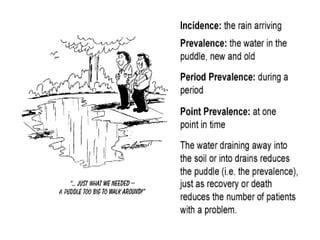
• Incidence-
• Prevalence
• prevalence= incidence x duration of disease
Exercise
• Duration of disease- 5 years
• 10 new cases per year
• Prevalence?
Epidemiologic methods
• 1) observational studies-
a) descriptive studies
b) analytical studies-
-ecological
-cross sectional
-case control
-cohort study
• 2) experimental studies-
randomised controlled trials
field trials
community trials
Descriptive epidemiology
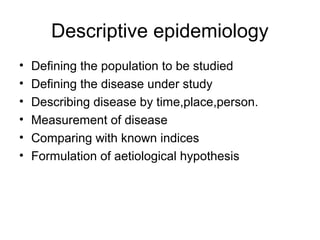
• Defining the population to be studied
• Defining the disease under study
• Describing disease by time,place,person.
• Measurement of disease
• Comparing with known indices
• Formulation of aetiological hypothesis
Descriptive epidemiology
• Time distribution- week, month, day, year
1) Short term fluctuation-epidemic
2) Periodic fluctuation- seasonal trend,
cyclic trend- e.g. influenza
3) Long term fluctuation
Descriptive epidemiology…..
• Place distribution- urban, rural
- national/ international
• Person distribution- age, sex, occupation,
marital status
Analytical study
• Case control study
• Cohort study
• To determine if there is association
between risk factor & disease
• Strenth of association.
Case control study
• Comparison studies
• Confounding factors
• Basic steps-
• selection of cases & controls
• Matching
• Measurment of exposure
• Analysis & interpretation
Selection of cases-
1) definition of case- a)diagnostic criteria
b)eligibility criteria-only
newly diagnosed cases selected.
Sources of cases-
selection of controls-
1) must be free from disease under study. not
been exposed to risk factor.
• Selection of controls-
• Matching-
process by which we select controls in such a
way that they are similar to cases with regard to
certain pertinent selected variables which are
known to influence outcome of disease & which
if not adequately matched 4 comparability could
confound results.
3)measurement of exposure-
By questionnaire,by interviews,from
hospital records,employment records.
4 ) Analysis-exposure rates,estimate
disease risk
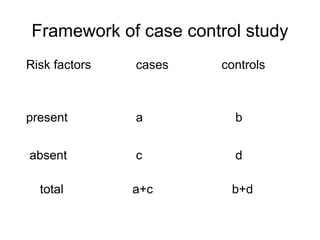
Framework of case control study
Risk factors cases controls
present a b
absent
total
c
a+c
d
b+d
smokers
Cases
33
Controls
55
Non-smokers 2 27
Total 35 82
1)Exposure rates =
Among cases = a/(a+c) =33/35=94.2%
Controls = b/(b+d) =
2)Estimation of risk –
Relative risk = incidence among exposed
incidence among non-
exposed
Cohort study
• Observational study
• Prospective / longitudinal / incidence/
forward looking study.
• Cause to effect
• Group of people sharing common
characteristic /experience within defined
period.
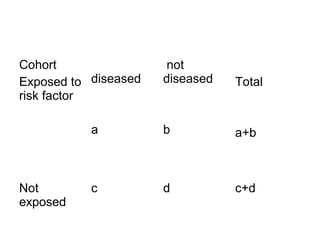
Cohort
Exposed to
risk factor
diseased
a
not
diseased
b
Total
a+b
Not
exposed
c d c+d
Cohort study…
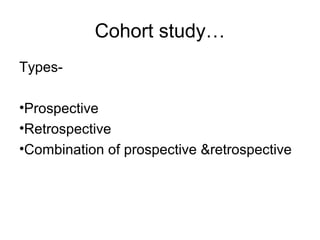
Types-
•Prospective
•Retrospective
•Combination of prospective &retrospective
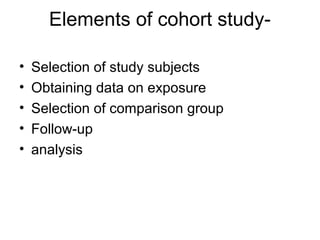
Elements of cohort study-
• Selection of study subjects
• Obtaining data on exposure
• Selection of comparison group
• Follow-up
• analysis
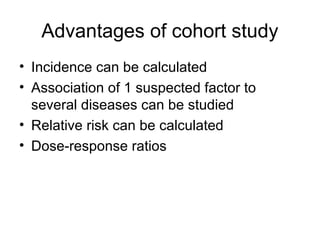
Advantages of cohort study
• Incidence can be calculated
• Association of 1 suspected factor to
several diseases can be studied
• Relative risk can be calculated
• Dose-response ratios
Disadvantages
• Large no of people involved
• Unsuitable for rare diseases
• Takes long time to complete study
• Expensive
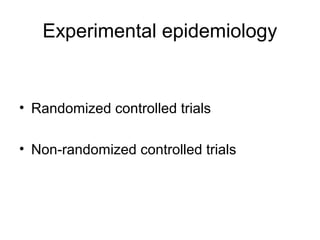
Experimental epidemiology
• Randomized controlled trials
• Non-randomized controlled trials
Randomized controlled trial
Basic steps-
1)Drawing protocol
2)Selection of reference population
3)Randomization-experimental,control gr.
4)Intervention
5)Followup
6)Assessment of outcome
7)reporting
Drawing protocol
• Aims & objectives
• Selection of study gr. & control gr.
• Sample size
• Methodology
Criteria 4 study/reference gr.
• Representative of population
• Must give informed consent
• Susceptible to disease
Bias
• Subject variation
• Observer bias
• Bias in evaluation
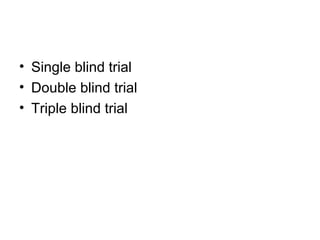
• Single blind trial
• Double blind trial
• Triple blind trial
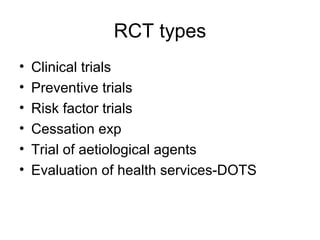
RCT types
• Clinical trials
• Preventive trials
• Risk factor trials
• Cessation exp
• Trial of aetiological agents
• Evaluation of health services-DOTS
NON-RANDOMIZED..
• Ethical,administrative reasons
• Cost
• Low incidence/prevalence-
• Less validity.
Association & causation
• Def- concurence of two variables more
often than would be expected by chance.
1)spurious association
2)indirect association
3)direct (causal) -----------a)one to one
b)multifactorial
Spurious association
• None actually associated.
Indirect association
• Confounding factors-
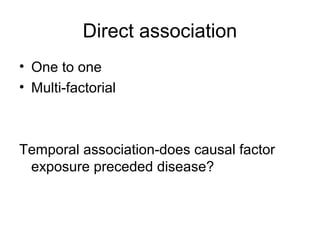
Direct association
• One to one
• Multi-factorial
Temporal association-does causal factor
exposure preceded disease?
Uses of epidemiology
• To study historically rise & fall of disease.
• Community diagnosis
• Planning, evaluation
• Evaluation of individuals risks, chances
• Syndrome identification
• Completing the natural history of disease
• Searching for causes, risk factors.
Infectious disease epidemiology
• Infection-the entry, development or
multiplication of infectious agent in body.
• Contamination-
• Infestation-
• Host-
• Epidemic-
• Endemic-
• Sporadic-
• Pandemic-
• Exotic-
• Zoonosis
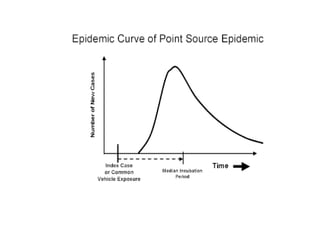
Epidemic
• Unusual occurrence in the community or
region of disease ,specific health related
behaviour or other health related events
clearly in excess of expected occurrence.

Epidemiology