Intelligence: A
Comprehensive
Overview
This presentationexplores the fascinating world of intelligence, delving into
its definition, measurement, and applications. We will examine the concept
of giftedness, explore various cognitive conditions that affect intelligence,
and discuss the history and limitations of intelligence tests.
2.
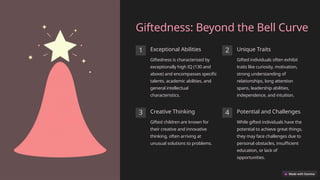
Giftedness: Beyond theBell Curve
1 Exceptional Abilities
Giftedness is characterized by
exceptionally high IQ (130 and
above) and encompasses specific
talents, academic abilities, and
general intellectual
characteristics.
2 Unique Traits
Gifted individuals often exhibit
traits like curiosity, motivation,
strong understanding of
relationships, long attention
spans, leadership abilities,
independence, and intuition.
3 Creative Thinking
Gifted children are known for
their creative and innovative
thinking, often arriving at
unusual solutions to problems.
4 Potential and Challenges
While gifted individuals have the
potential to achieve great things,
they may face challenges due to
personal obstacles, insufficient
education, or lack of
opportunities.
3.
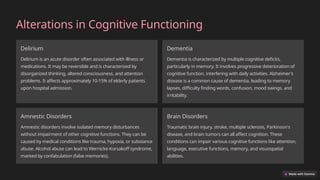
Alterations in CognitiveFunctioning
Delirium
Delirium is an acute disorder often associated with illness or
medications. It may be reversible and is characterized by
disorganized thinking, altered consciousness, and attention
problems. It affects approximately 10-15% of elderly patients
upon hospital admission.
Dementia
Dementia is characterized by multiple cognitive deficits,
particularly in memory. It involves progressive deterioration of
cognitive function, interfering with daily activities. Alzheimer's
disease is a common cause of dementia, leading to memory
lapses, difficulty finding words, confusion, mood swings, and
irritability.
Amnestic Disorders
Amnestic disorders involve isolated memory disturbances
without impairment of other cognitive functions. They can be
caused by medical conditions like trauma, hypoxia, or substance
abuse. Alcohol abuse can lead to Wernicke-Korsakoff syndrome,
marked by confabulation (false memories).
Brain Disorders
Traumatic brain injury, stroke, multiple sclerosis, Parkinson's
disease, and brain tumors can all affect cognition. These
conditions can impair various cognitive functions like attention,
language, executive functions, memory, and visuospatial
abilities.
4.
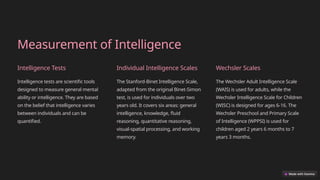
Measurement of Intelligence
IntelligenceTests
Intelligence tests are scientific tools
designed to measure general mental
ability or intelligence. They are based
on the belief that intelligence varies
between individuals and can be
quantified.
Individual Intelligence Scales
The Stanford-Binet Intelligence Scale,
adapted from the original Binet-Simon
test, is used for individuals over two
years old. It covers six areas: general
intelligence, knowledge, fluid
reasoning, quantitative reasoning,
visual-spatial processing, and working
memory.
Wechsler Scales
The Wechsler Adult Intelligence Scale
(WAIS) is used for adults, while the
Wechsler Intelligence Scale for Children
(WISC) is designed for ages 6-16. The
Wechsler Preschool and Primary Scale
of Intelligence (WPPSI) is used for
children aged 2 years 6 months to 7
years 3 months.
5.
Indian Adaptations
Binet-Kamat Test
TheBinet-Kamat Test of Intelligence is an Indian adaptation of
the Stanford-Binet scale, used to assess intelligence and
cognitive abilities of individuals between 3 and 22 years old.
Indian Child Intelligence Test (ICIT)
The ICIT is an Indian adaptation of the revised Amsterdam
Kinder Intelligence Test. It has nine sub-tests, some verbal,
some partially verbal, and some performance-oriented, and is
used for children aged 4 to 12 years.
6.
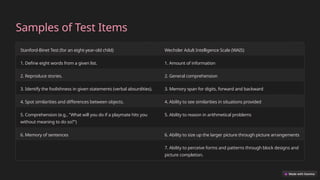
Samples of TestItems
Stanford-Binet Test (for an eight-year-old child) Wechsler Adult Intelligence Scale (WAIS)
1. Define eight words from a given list. 1. Amount of information
2. Reproduce stories. 2. General comprehension
3. Identify the foolishness in given statements (verbal absurdities). 3. Memory span for digits, forward and backward
4. Spot similarities and differences between objects. 4. Ability to see similarities in situations provided
5. Comprehension (e.g., "What will you do if a playmate hits you
without meaning to do so?")
5. Ability to reason in arithmetical problems
6. Memory of sentences 6. Ability to size up the larger picture through picture arrangements
7. Ability to perceive forms and patterns through block designs and
picture completion.
7.
Types of IntelligenceTests
Individual vs. Group Tests
Individual tests are administered to one person at a time by a
tester, allowing for direct observation of test-taking behavior
and serving a diagnostic purpose. Group tests, developed
during World War I, can be administered to large numbers
simultaneously, simplifying the examiner's role and making
scoring more objective.
Verbal, Non-verbal, and Performance Tests
Verbal tests require the use of language, while non-verbal
tests do not. Performance tests, involving motor responses,
are useful for individuals with hearing or speech impairments
or limited education. They can also supplement verbal test
results.
8.
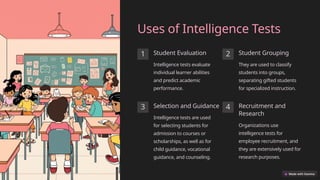
Uses of IntelligenceTests
1 Student Evaluation
Intelligence tests evaluate
individual learner abilities
and predict academic
performance.
2 Student Grouping
They are used to classify
students into groups,
separating gifted students
for specialized instruction.
3 Selection and Guidance
Intelligence tests are used
for selecting students for
admission to courses or
scholarships, as well as for
child guidance, vocational
guidance, and counseling.
4 Recruitment and
Research
Organizations use
intelligence tests for
employee recruitment, and
they are extensively used for
research purposes.
9.
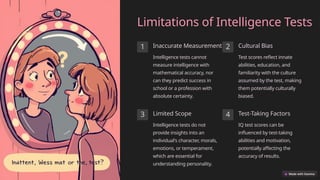
Limitations of IntelligenceTests
1 Inaccurate Measurement
Intelligence tests cannot
measure intelligence with
mathematical accuracy, nor
can they predict success in
school or a profession with
absolute certainty.
2 Cultural Bias
Test scores reflect innate
abilities, education, and
familiarity with the culture
assumed by the test, making
them potentially culturally
biased.
3 Limited Scope
Intelligence tests do not
provide insights into an
individual's character, morals,
emotions, or temperament,
which are essential for
understanding personality.
4 Test-Taking Factors
IQ test scores can be
influenced by test-taking
abilities and motivation,
potentially affecting the
accuracy of results.