Ishik University
Biology department
Education Psychology
By; Saman Khidir
Super adviser: Dr. Azad
Binet test
Contents.
1. Introduction.
2.Development.
-The original tests in the 1905 form include
-Historical use.
3. Revisions of the Stanford-Binetintelligence Scals.
-Timeline.
4. Stanford-Binetintelligence Scals: fifth edition.
-Reliability.
-Validity.
-Score classification.
5. Subtests and factors
6. Present use
1. Introduction.
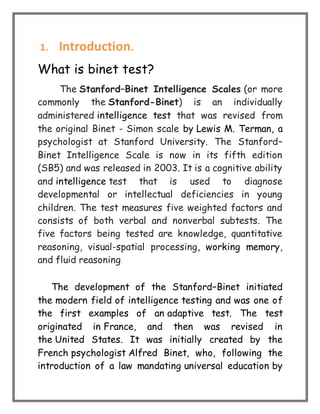
What is binet test?
The Stanford–Binet Intelligence Scales (or more
commonly the Stanford-Binet) is an individually
administered intelligence test that was revised from
the original Binet - Simon scale by Lewis M. Terman, a
psychologist at Stanford University. The Stanford–
Binet Intelligence Scale is now in its fifth edition
(SB5) and was released in 2003. It is a cognitive ability
and intelligence test that is used to diagnose
developmental or intellectual deficiencies in young
children. The test measures five weighted factors and
consists of both verbal and nonverbal subtests. The
five factors being tested are knowledge, quantitative
reasoning, visual-spatial processing, working memory,
and fluid reasoning.
The development of the Stanford–Binet initiated
the modern field of intelligence testing and was one of
the first examples of an adaptive test. The test
originated in France, and then was revised in
the United States. It was initially created by the
French psychologist Alfred Binet, who, following the
introduction of a law mandating universal education by
the French government, began developing a method of
identifying "slow" children for their placement
in special education programs (rather than removing
them to asylums as "sick").[1]
As Binet indicated, case
studies might be more detailed and helpful, but the
time required to test many people would be excessive.
In 1916, at Stanford University, the psychologist Lewis
Terman released a revised examination which became
known as the "Stanford–Binet test".
2.Development.
As discussed by Fancher & Rutherford in 2012, the
Stanford–Binet is a modified version of the Binet-Simon
Intelligence scale. The Binet-Simon scale was created by the
French psychologist Alfred Binet and his student Theodore
Simon. Due to changing education laws of the time, Binet had
been requested by a government commission to come up with a
way to detect children with significantly below-average
intelligence and mental retardation.
To create their test, Binet and Simon first created a
baseline of intelligence. A wide range of children were tested
on a broad spectrum of measures in an effort to discover a
clear indicator of intelligence. Failing to find a single
identifier of intelligence, Binet and Simon instead compared
children in each category by age. The children’s highest levels
of achievement were sorted by age and common levels of
achievement considered the normal level for that age. Because
this testing method merely compares a person's ability to the
common ability level of others their age, the general practices
of the test can easily be transferred to test different
populations, even if the measures used are
changed.
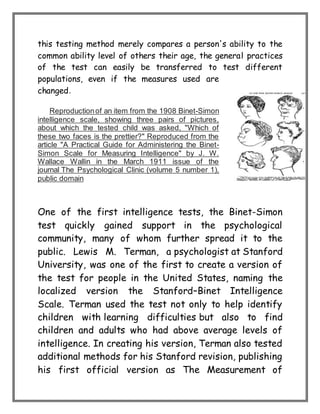
Reproductionof an item from the 1908 Binet-Simon
intelligence scale, showing three pairs of pictures,
about which the tested child was asked, "Which of
these two faces is the prettier?" Reproduced from the
article "A Practical Guide for Administering the Binet-
Simon Scale for Measuring Intelligence" by J. W.
Wallace Wallin in the March 1911 issue of the
journal The Psychological Clinic (volume 5 number 1),
public domain
One of the first intelligence tests, the Binet-Simon
test quickly gained support in the psychological
community, many of whom further spread it to the
public. Lewis M. Terman, a psychologist at Stanford
University, was one of the first to create a version of
the test for people in the United States, naming the
localized version the Stanford–Binet Intelligence
Scale. Terman used the test not only to help identify
children with learning difficulties but also to find
children and adults who had above average levels of
intelligence. In creating his version, Terman also tested
additional methods for his Stanford revision, publishing
his first official version as The Measurement of
Intelligence: An Explanation of and a Complete Guide
for the Use of the Stanford Revision and Extension of
the Binet-Simon Intelligence Scale (Fancher &
Rutherford, 2012) (Becker, 2003).
The original tests in the 1905 form include:
1. "Le Regard"
2. Prehension Provoked by a Tactile Stimulus
3. Prehension Provoked by a Visual Perception
4. Recognition of Food
5. Quest of Food Complicated by a Slight Mechanical Difficulty
6. Execution of Simple Commands and Imitation of Simple Gestures
7. Verbal Knowledge of Objects
8. Verbal Knowledge of Pictures
9. Naming of Designated Objects
10.Immediate Comparison of Two Lines of Unequal Lengths
11.Repetition of Three Figures
12.Comparison of Two Weights
13.Suggestibility
14.Verbal Definition of Known Objects
15.Repetition of Sentences of Fifteen Words
16.Comparison of Known Objects from Memory
17.Exercise of Memory on Pictures
18.Drawing a Design from Memory
19.Immediate Repetition of Figures
20.Resemblances of Several Known Objects Given from Memory
21.Comparison of Lengths
22.Five Weights to be Placed in Order
23.Gap in Weights
24.Exercise upon Rhymes
25.Verbal Gaps to be Filled
26.Synthesis of Three Words in One Sentence
27.Reply to an Abstract Question
28.Reversal of the Hands of a Clock
29.Paper Cutting
30.Definitions of Abstract Terms
Historical use.
One hindrance to widespread understanding of the test is its use of a
variety of different measures. In an effort to simplify the information
gained from the Binet-Simon test into a more comprehensible and
easier to understand form; German psychologist William Stern created
the now well-known Intelligence Quotient (IQ). By comparing the age a
child scored at to their biological age, a ratio is created to show the
rate of their mental progress as IQ. Terman quickly grasped the idea
for his Stanford revision with the adjustment of multiplying the ratios
by 100 to make them easier to read.
As also discussed by Leslie, in 2000, Terman was another of the main
forces in spreading intelligence testing in the United States (Becker,
2003). Terman quickly promoted the use of the Stanford–Binet for
schools across the United States where it saw a high rate of
acceptance. Terman’s work also had the attention of the U.S.
government, who recruited him to apply the ideas from his Stanford–
Binet test for military recruitment near the start of World War I.
With over 1.7 million military recruits taking a version of the test and
the acceptance of the test by the government, the Stanford–Binet saw
an increase in awareness and acceptance (Fancher & Rutherford, 2012).
Given the perceived importance of intelligence and with new ways to
measure intelligence, many influential individuals, including Terman,
began promoting controversial ideas to increase the nation's overall
intelligence. These ideas included things such as discouraging
individuals with low IQ from having children and granting important
positions based on high IQ scores. While there was significant
opposition, many institutions proceeded to adjust students' education
based on their IQ scores, often with a heavy influence on future
career possibilities (Leslie, 2000).
3. Revisions of the Stanford-Binet
intelligence Scals.
Since the first publication in 1916,
there have been four additional revised
editions of the Stanford–Binet
Intelligence Scales, the first of which
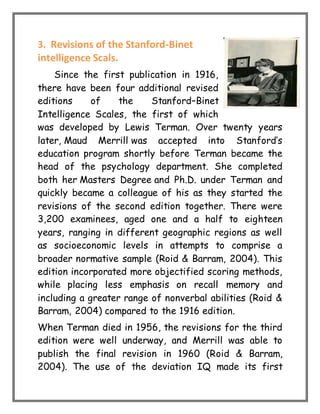
was developed by Lewis Terman. Over twenty years
later, Maud Merrill was accepted into Stanford’s
education program shortly before Terman became the
head of the psychology department. She completed
both her Masters Degree and Ph.D. under Terman and
quickly became a colleague of his as they started the
revisions of the second edition together. There were
3,200 examinees, aged one and a half to eighteen
years, ranging in different geographic regions as well
as socioeconomic levels in attempts to comprise a
broader normative sample (Roid & Barram, 2004). This
edition incorporated more objectified scoring methods,
while placing less emphasis on recall memory and
including a greater range of nonverbal abilities (Roid &
Barram, 2004) compared to the 1916 edition.
When Terman died in 1956, the revisions for the third
edition were well underway, and Merrill was able to
publish the final revision in 1960 (Roid & Barram,
2004). The use of the deviation IQ made its first
appearance in this third edition by replacing the ratio
IQ. While new features were added, there were no
newly created items included in this revision. Instead,
any items from the 1937 form that showed no
substantial change in difficulty from the 1930s to the
1950s were either eliminated or adjusted (Roid &
Barram, 2004).
Robert Thorndike was asked to take over after
Merrill’s retirement. With the help of Elizabeth Hagen
and Jerome Sattler, Thorndike produced the fourth
edition of the Stanford–Binet Intelligence Scale in
1986. This edition covers the ages two through twenty-
three and has some considerable changes compared to
its predecessors (Graham & Naglieri, 2003). This
edition was the first to use the fifteen subtests with
point scales in place of using the previous age scale
format. In an attempt to broaden cognitive ability, the
subtests were grouped and resulted in four area
scores, which improved flexibility for administration
and interpretation (Youngstrom, Glutting, & Watkins,
2003). The fourth edition is known for assessing
children that may be referred for gifted programs.
This edition includes a broad range of abilities which
provides more challenging items for those in their early
adolescent years, whereas other intelligence tests of
the time did not provide difficult enough items for the
older children (Laurent, Swerdlik, & Ryburn, 1992).
Gale Roid published the most recent edition of the
Stanford–Binet Intelligence Scale. Roid attended
Harvard University where he was a research assistant
to David McClelland. McClelland is well known for his
studies on the need for achievement. While the fifth
edition incorporates some of the classical traditions of
these scales, there were several significant changes
made.
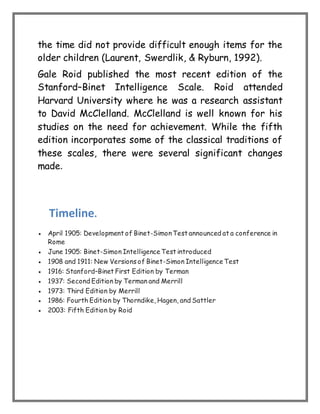
Timeline.
 April 1905: Development of Binet-SimonTest announced at a conference in
Rome
 June 1905: Binet-Simon Intelligence Test introduced
 1908 and 1911: New Versions of Binet-Simon Intelligence Test
 1916: Stanford–Binet First Edition by Terman
 1937: Second Edition by Terman and Merrill
 1973: Third Edition by Merrill
 1986: Fourth Edition by Thorndike, Hagen, and Sattler
 2003: Fifth Edition by Roid
4.Stanford-Binet intelligence Scals: fifth edition
Just as it was used when Binet first developed the IQ
test, the Stanford–Binet Intelligence Scale: Fifth Edition
(SB5) is based in the schooling process to assess intelligence.
It continuously and efficiently assesses all levels of ability in
individuals with a broader range in age. It is also capable of
measuring multiple dimensions of abilities (Ruf, 2003).
The SB5 can be administered to individuals as early as two
years of age. There are ten subsets included in this revision
including both verbal and nonverbal domains. Five factors are
also incorporated in this scale, which are directly related
to Cattell-Horn-Carroll (CHC) hierarchical model of cognitive
abilities. These factors include fluid reasoning, knowledge,
quantitative reasoning, visual-spatial processing, and working
memory (Bain & Allin, 2005). Many of the familiar picture
absurdities, vocabulary, memory for sentences, and verbal
absurdities still remain from the previous editions (Janzen,
Obrzut, & Marusiak, 2003) however with more modern
artwork and item content for the revised fifth edition.
For every verbal subtest that is used there is a nonverbal
counterpart across all factors. These nonverbal tasks consist
of making movement responses such as pointing or assembling
manipulatives (Bain & Allin, 2005). These counterparts have
been included in order to address the language-reduced
assessments in multicultural societies. Depending on age and
ability, administration can range from fifteen minutes to an
hour and fifteen minutes.
The fifth edition incorporated a new scoring system, which
can provide a wide range of information such as four
intelligence score composites, five factor indices, and ten
subtest scores. Additional scoring information includes
percentile ranks, age equivalents, and a change-sensitive score
(Janzen, Obrzut, & Marusiak, 2003). Extended IQ scores and
gifted composite scores are available with the SB5 in order to
optimize the assessment for gifted programs (Ruf, 2003). In
order to reduce errors and increase diagnostic precision,
scores are obtained electronically through the use of
computers now.
The standardization sample for the SB5 included 4,800
participants varying in age, sex, race/ethnicity, geographic
region, and socioeconomic level (Bain & Allin, 2005).
Reliability.
Several reliability tests have been performed on the SB5 including
split-half reliability, standard error of measurement, plotting of test
information curves, test-retest stability, and inter-scorer agreement.
On average, the IQ scores for this scale have been found to be quite
stable across time (Janzen, Obrzut, & Marusiak, 2003). Internal
consistency was tested by split-half reliability and was reported to be
substantial and comparable to other cognitive batteries (Bain & Allin,
2005). The median interscorer correlation was found to be .90 on
average (Janzen, Obrzut, & Marusiak, 2003). The SB5 has also been
found to have great precision at advanced levels of performance
meaning that the test is especially useful in testing children for
giftedness (Bain & Allin, 2005). There have only been a small amount of
practice effects and familiarity of testing procedures with retest
reliability; however, these have proven to be insignificant.
Readministration of the SB5 can occur in a six-month interval rather
than one year due to the small mean differences in reliability (Bain &
Allin, 2005).
Validity.
Content validity has been found based on the professional judgments
Roid received concerning fairness of items and item content as well as
items concerning the assessment of giftedness (Bain & Allin, 2005).
With an examination of age trends, construct validity was supported
along with empirical justification of a more substantial g loading for
the SB5 compared to previous editions. The potential for a variety of
comparisons, especially for within or across factors and
verbal/nonverbal domains, has been appreciated with the scores
received from the SB5 (Bain & Allin, 2005).
Score classification.
Main article: IQ classification
The test publisher includes suggested score classifications in the test
manual.
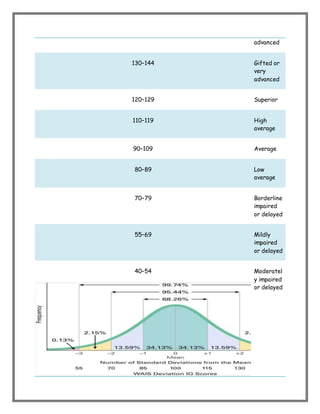
Stanford–Binet Fifth Edition (SB5) classification[2]
IQ Range ("deviation IQ") IQ
Classifica
tion
145–160 Very
gifted or
highly
advanced
130–144 Gifted or
very
advanced
120–129 Superior
110–119 High
average
90–109 Average
80–89 Low
average
70–79 Borderline
impaired
or delayed
55–69 Mildly
impaired
or delayed
40–54 Moderatel
y impaired
or delayed
5. Subtestsand factors
Fluid reasoning Knowledge Quantitative reasoning Visual-spatial
processing
Working memory
Early reasoning Vocabulary Non-verbal quantitative
reasoning (non-verbal)
Form board and
form patterns
(non-verbal)
Delayed response
(non-verbal)
Verbal absurdities Procedural
knowledge (non-
verbal)
Verbal quantitative
reasoning
Position and
direction
Block span (non-
verbal)
Verbal analogies Picture absurdities
(non-verbal)
Memory for
sentences
Object series
matrices (non-
verbal)
Last word
The classifications of scores used in the Fifth Edition differ from
those used in earlier versions of the test.
6. Present use.
Since its inception, the Stanford–Binet has been
revised several times. Currently, the test is in its fifth
edition, which is called the Stanford–Binet Intelligence
Scales, Fifth Edition, or SB5. According to the
publisher's website, "The SB5 was normed on
a stratified random sample of 4,800 individuals that
matches the 2000 U.S. Census". By administering the
Stanford–Binet test to large numbers of individuals
selected at random from different parts of the United
States, it has been found that the scores approximate
a normal distribution. The revised edition of the
Stanford–Binet over time has devised substantial
changes in the way the tests are presented. The test
has improved when looking at the introduction of a
more parallel form and more demonstrative standards.
For one, a non-verbal IQ component is included in the
present day tests whereas in the past, there was only a
verbal component. In fact, it now has equal balance of
verbal and non-verbal content in the tests. It is also
more animated than the other tests, providing the
test-takers with more colourful artwork, toys and
manipulatives. This allows the test to have a higher
range in the age of the test takers. This test is
purportedly useful in assessing the intellectual
capabilities of people ranging from young children all
the way to young adults. However, the test has come
under criticism for not being able to compare people of
different age categories, since each category gets a
different set of tests. Furthermore, very young
children tend to do poorly on the test due to the fact
that they are lacking in the concentration needed to
finish the test.

Binet test

  • 1.
    Ishik University Biology department EducationPsychology By; Saman Khidir Super adviser: Dr. Azad Binet test
  • 2.
    Contents. 1. Introduction. 2.Development. -The originaltests in the 1905 form include -Historical use. 3. Revisions of the Stanford-Binetintelligence Scals. -Timeline. 4. Stanford-Binetintelligence Scals: fifth edition. -Reliability. -Validity. -Score classification. 5. Subtests and factors 6. Present use
  • 3.
    1. Introduction. What isbinet test? The Stanford–Binet Intelligence Scales (or more commonly the Stanford-Binet) is an individually administered intelligence test that was revised from the original Binet - Simon scale by Lewis M. Terman, a psychologist at Stanford University. The Stanford– Binet Intelligence Scale is now in its fifth edition (SB5) and was released in 2003. It is a cognitive ability and intelligence test that is used to diagnose developmental or intellectual deficiencies in young children. The test measures five weighted factors and consists of both verbal and nonverbal subtests. The five factors being tested are knowledge, quantitative reasoning, visual-spatial processing, working memory, and fluid reasoning. The development of the Stanford–Binet initiated the modern field of intelligence testing and was one of the first examples of an adaptive test. The test originated in France, and then was revised in the United States. It was initially created by the French psychologist Alfred Binet, who, following the introduction of a law mandating universal education by
  • 4.
    the French government,began developing a method of identifying "slow" children for their placement in special education programs (rather than removing them to asylums as "sick").[1] As Binet indicated, case studies might be more detailed and helpful, but the time required to test many people would be excessive. In 1916, at Stanford University, the psychologist Lewis Terman released a revised examination which became known as the "Stanford–Binet test". 2.Development. As discussed by Fancher & Rutherford in 2012, the Stanford–Binet is a modified version of the Binet-Simon Intelligence scale. The Binet-Simon scale was created by the French psychologist Alfred Binet and his student Theodore Simon. Due to changing education laws of the time, Binet had been requested by a government commission to come up with a way to detect children with significantly below-average intelligence and mental retardation. To create their test, Binet and Simon first created a baseline of intelligence. A wide range of children were tested on a broad spectrum of measures in an effort to discover a clear indicator of intelligence. Failing to find a single identifier of intelligence, Binet and Simon instead compared children in each category by age. The children’s highest levels of achievement were sorted by age and common levels of achievement considered the normal level for that age. Because
  • 5.
    this testing methodmerely compares a person's ability to the common ability level of others their age, the general practices of the test can easily be transferred to test different populations, even if the measures used are changed. Reproductionof an item from the 1908 Binet-Simon intelligence scale, showing three pairs of pictures, about which the tested child was asked, "Which of these two faces is the prettier?" Reproduced from the article "A Practical Guide for Administering the Binet- Simon Scale for Measuring Intelligence" by J. W. Wallace Wallin in the March 1911 issue of the journal The Psychological Clinic (volume 5 number 1), public domain One of the first intelligence tests, the Binet-Simon test quickly gained support in the psychological community, many of whom further spread it to the public. Lewis M. Terman, a psychologist at Stanford University, was one of the first to create a version of the test for people in the United States, naming the localized version the Stanford–Binet Intelligence Scale. Terman used the test not only to help identify children with learning difficulties but also to find children and adults who had above average levels of intelligence. In creating his version, Terman also tested additional methods for his Stanford revision, publishing his first official version as The Measurement of
  • 6.
    Intelligence: An Explanationof and a Complete Guide for the Use of the Stanford Revision and Extension of the Binet-Simon Intelligence Scale (Fancher & Rutherford, 2012) (Becker, 2003). The original tests in the 1905 form include: 1. "Le Regard" 2. Prehension Provoked by a Tactile Stimulus 3. Prehension Provoked by a Visual Perception 4. Recognition of Food 5. Quest of Food Complicated by a Slight Mechanical Difficulty 6. Execution of Simple Commands and Imitation of Simple Gestures 7. Verbal Knowledge of Objects 8. Verbal Knowledge of Pictures 9. Naming of Designated Objects 10.Immediate Comparison of Two Lines of Unequal Lengths 11.Repetition of Three Figures 12.Comparison of Two Weights 13.Suggestibility 14.Verbal Definition of Known Objects 15.Repetition of Sentences of Fifteen Words 16.Comparison of Known Objects from Memory 17.Exercise of Memory on Pictures 18.Drawing a Design from Memory 19.Immediate Repetition of Figures 20.Resemblances of Several Known Objects Given from Memory 21.Comparison of Lengths 22.Five Weights to be Placed in Order 23.Gap in Weights 24.Exercise upon Rhymes 25.Verbal Gaps to be Filled 26.Synthesis of Three Words in One Sentence 27.Reply to an Abstract Question 28.Reversal of the Hands of a Clock 29.Paper Cutting 30.Definitions of Abstract Terms
  • 7.
    Historical use. One hindranceto widespread understanding of the test is its use of a variety of different measures. In an effort to simplify the information gained from the Binet-Simon test into a more comprehensible and easier to understand form; German psychologist William Stern created the now well-known Intelligence Quotient (IQ). By comparing the age a child scored at to their biological age, a ratio is created to show the rate of their mental progress as IQ. Terman quickly grasped the idea for his Stanford revision with the adjustment of multiplying the ratios by 100 to make them easier to read. As also discussed by Leslie, in 2000, Terman was another of the main forces in spreading intelligence testing in the United States (Becker, 2003). Terman quickly promoted the use of the Stanford–Binet for schools across the United States where it saw a high rate of acceptance. Terman’s work also had the attention of the U.S. government, who recruited him to apply the ideas from his Stanford– Binet test for military recruitment near the start of World War I. With over 1.7 million military recruits taking a version of the test and the acceptance of the test by the government, the Stanford–Binet saw an increase in awareness and acceptance (Fancher & Rutherford, 2012). Given the perceived importance of intelligence and with new ways to measure intelligence, many influential individuals, including Terman, began promoting controversial ideas to increase the nation's overall intelligence. These ideas included things such as discouraging individuals with low IQ from having children and granting important positions based on high IQ scores. While there was significant opposition, many institutions proceeded to adjust students' education based on their IQ scores, often with a heavy influence on future career possibilities (Leslie, 2000).
  • 8.
    3. Revisions ofthe Stanford-Binet intelligence Scals. Since the first publication in 1916, there have been four additional revised editions of the Stanford–Binet Intelligence Scales, the first of which was developed by Lewis Terman. Over twenty years later, Maud Merrill was accepted into Stanford’s education program shortly before Terman became the head of the psychology department. She completed both her Masters Degree and Ph.D. under Terman and quickly became a colleague of his as they started the revisions of the second edition together. There were 3,200 examinees, aged one and a half to eighteen years, ranging in different geographic regions as well as socioeconomic levels in attempts to comprise a broader normative sample (Roid & Barram, 2004). This edition incorporated more objectified scoring methods, while placing less emphasis on recall memory and including a greater range of nonverbal abilities (Roid & Barram, 2004) compared to the 1916 edition. When Terman died in 1956, the revisions for the third edition were well underway, and Merrill was able to publish the final revision in 1960 (Roid & Barram, 2004). The use of the deviation IQ made its first
  • 9.
    appearance in thisthird edition by replacing the ratio IQ. While new features were added, there were no newly created items included in this revision. Instead, any items from the 1937 form that showed no substantial change in difficulty from the 1930s to the 1950s were either eliminated or adjusted (Roid & Barram, 2004). Robert Thorndike was asked to take over after Merrill’s retirement. With the help of Elizabeth Hagen and Jerome Sattler, Thorndike produced the fourth edition of the Stanford–Binet Intelligence Scale in 1986. This edition covers the ages two through twenty- three and has some considerable changes compared to its predecessors (Graham & Naglieri, 2003). This edition was the first to use the fifteen subtests with point scales in place of using the previous age scale format. In an attempt to broaden cognitive ability, the subtests were grouped and resulted in four area scores, which improved flexibility for administration and interpretation (Youngstrom, Glutting, & Watkins, 2003). The fourth edition is known for assessing children that may be referred for gifted programs. This edition includes a broad range of abilities which provides more challenging items for those in their early adolescent years, whereas other intelligence tests of
  • 10.
    the time didnot provide difficult enough items for the older children (Laurent, Swerdlik, & Ryburn, 1992). Gale Roid published the most recent edition of the Stanford–Binet Intelligence Scale. Roid attended Harvard University where he was a research assistant to David McClelland. McClelland is well known for his studies on the need for achievement. While the fifth edition incorporates some of the classical traditions of these scales, there were several significant changes made. Timeline.  April 1905: Development of Binet-SimonTest announced at a conference in Rome  June 1905: Binet-Simon Intelligence Test introduced  1908 and 1911: New Versions of Binet-Simon Intelligence Test  1916: Stanford–Binet First Edition by Terman  1937: Second Edition by Terman and Merrill  1973: Third Edition by Merrill  1986: Fourth Edition by Thorndike, Hagen, and Sattler  2003: Fifth Edition by Roid
  • 11.
    4.Stanford-Binet intelligence Scals:fifth edition Just as it was used when Binet first developed the IQ test, the Stanford–Binet Intelligence Scale: Fifth Edition (SB5) is based in the schooling process to assess intelligence. It continuously and efficiently assesses all levels of ability in individuals with a broader range in age. It is also capable of measuring multiple dimensions of abilities (Ruf, 2003). The SB5 can be administered to individuals as early as two years of age. There are ten subsets included in this revision including both verbal and nonverbal domains. Five factors are also incorporated in this scale, which are directly related to Cattell-Horn-Carroll (CHC) hierarchical model of cognitive abilities. These factors include fluid reasoning, knowledge, quantitative reasoning, visual-spatial processing, and working memory (Bain & Allin, 2005). Many of the familiar picture absurdities, vocabulary, memory for sentences, and verbal absurdities still remain from the previous editions (Janzen, Obrzut, & Marusiak, 2003) however with more modern artwork and item content for the revised fifth edition. For every verbal subtest that is used there is a nonverbal counterpart across all factors. These nonverbal tasks consist of making movement responses such as pointing or assembling manipulatives (Bain & Allin, 2005). These counterparts have been included in order to address the language-reduced assessments in multicultural societies. Depending on age and ability, administration can range from fifteen minutes to an hour and fifteen minutes.
  • 12.
    The fifth editionincorporated a new scoring system, which can provide a wide range of information such as four intelligence score composites, five factor indices, and ten subtest scores. Additional scoring information includes percentile ranks, age equivalents, and a change-sensitive score (Janzen, Obrzut, & Marusiak, 2003). Extended IQ scores and gifted composite scores are available with the SB5 in order to optimize the assessment for gifted programs (Ruf, 2003). In order to reduce errors and increase diagnostic precision, scores are obtained electronically through the use of computers now. The standardization sample for the SB5 included 4,800 participants varying in age, sex, race/ethnicity, geographic region, and socioeconomic level (Bain & Allin, 2005). Reliability. Several reliability tests have been performed on the SB5 including split-half reliability, standard error of measurement, plotting of test information curves, test-retest stability, and inter-scorer agreement. On average, the IQ scores for this scale have been found to be quite stable across time (Janzen, Obrzut, & Marusiak, 2003). Internal consistency was tested by split-half reliability and was reported to be substantial and comparable to other cognitive batteries (Bain & Allin, 2005). The median interscorer correlation was found to be .90 on average (Janzen, Obrzut, & Marusiak, 2003). The SB5 has also been found to have great precision at advanced levels of performance meaning that the test is especially useful in testing children for giftedness (Bain & Allin, 2005). There have only been a small amount of practice effects and familiarity of testing procedures with retest
  • 13.
    reliability; however, thesehave proven to be insignificant. Readministration of the SB5 can occur in a six-month interval rather than one year due to the small mean differences in reliability (Bain & Allin, 2005). Validity. Content validity has been found based on the professional judgments Roid received concerning fairness of items and item content as well as items concerning the assessment of giftedness (Bain & Allin, 2005). With an examination of age trends, construct validity was supported along with empirical justification of a more substantial g loading for the SB5 compared to previous editions. The potential for a variety of comparisons, especially for within or across factors and verbal/nonverbal domains, has been appreciated with the scores received from the SB5 (Bain & Allin, 2005). Score classification. Main article: IQ classification The test publisher includes suggested score classifications in the test manual. Stanford–Binet Fifth Edition (SB5) classification[2] IQ Range ("deviation IQ") IQ Classifica tion 145–160 Very gifted or highly
  • 14.
    advanced 130–144 Gifted or very advanced 120–129Superior 110–119 High average 90–109 Average 80–89 Low average 70–79 Borderline impaired or delayed 55–69 Mildly impaired or delayed 40–54 Moderatel y impaired or delayed
  • 15.
    5. Subtestsand factors Fluidreasoning Knowledge Quantitative reasoning Visual-spatial processing Working memory Early reasoning Vocabulary Non-verbal quantitative reasoning (non-verbal) Form board and form patterns (non-verbal) Delayed response (non-verbal) Verbal absurdities Procedural knowledge (non- verbal) Verbal quantitative reasoning Position and direction Block span (non- verbal) Verbal analogies Picture absurdities (non-verbal) Memory for sentences Object series matrices (non- verbal) Last word The classifications of scores used in the Fifth Edition differ from those used in earlier versions of the test. 6. Present use. Since its inception, the Stanford–Binet has been revised several times. Currently, the test is in its fifth edition, which is called the Stanford–Binet Intelligence Scales, Fifth Edition, or SB5. According to the publisher's website, "The SB5 was normed on a stratified random sample of 4,800 individuals that matches the 2000 U.S. Census". By administering the Stanford–Binet test to large numbers of individuals selected at random from different parts of the United
  • 16.
    States, it hasbeen found that the scores approximate a normal distribution. The revised edition of the Stanford–Binet over time has devised substantial changes in the way the tests are presented. The test has improved when looking at the introduction of a more parallel form and more demonstrative standards. For one, a non-verbal IQ component is included in the present day tests whereas in the past, there was only a verbal component. In fact, it now has equal balance of verbal and non-verbal content in the tests. It is also more animated than the other tests, providing the test-takers with more colourful artwork, toys and manipulatives. This allows the test to have a higher range in the age of the test takers. This test is purportedly useful in assessing the intellectual capabilities of people ranging from young children all the way to young adults. However, the test has come under criticism for not being able to compare people of different age categories, since each category gets a different set of tests. Furthermore, very young children tend to do poorly on the test due to the fact that they are lacking in the concentration needed to finish the test.