COGNITIVE
PSYCHOLOGY II
INTELLIGENCE: CONCEPT,
RELATIONSHIP BETWEEN
COGNITION AND INTELLIGENCE,
MEASURING INTELLIGENCE.
NIVEDITA MENON. C
12/07/2021
INTELLIGENCE
THE CONCEPT OF INTELLIGENCE
 Latin verb ‘intellegere’ - the acquirement, processing and storage
of information.
 Intelligence has been defined in many ways:
• higher level abilities such as abstract reasoning, mental
representation, problem solving, and decision making
• the ability to learn
• emotional knowledge
• creativity
• adaptation to meet the demands of the environment effectively.
 Robert Sternberg (1997) defined intelligence as "the mental abilities
necessary for adaptation to, as well as shaping and selection of, any
environmental context.
 Intelligence involves different kinds of mental processes such as
problem-solving, logic, reasoning, and planning.
 We usually use the adjective intelligent to describe those with a
high mental capacity i.e., the ability to easily learn or understand
things or to deal with new situations.
 The intelligence levels of individual differ according to various
factors like genetics, education, experience. etc.
 There are different types of intelligence:
i. Linguistic Intelligence – involves speaking and write well.
ii. Mathematical Intelligence – involves ability in using logical
skills, i.e., mathematical skills to prove or solve problems.
iii. Music Intelligence – involves performing, understanding and
enjoying music.
iv. Business Intelligence – involves having corporate skills.
v. Interpersonal Intelligence – involves the ability to interact
with others effectively.
HISTORY OF INTELLIGENCE
 Dates back to the late 1800s to Sir Francis Galton’s works.
 Galton was interested in the concept of a gifted individual, so he
created a lab to measure reaction times and other physical
characteristics to test his hypothesis that intelligence is a general
mental ability that is a produce of biological evolution.
 Galton’s study of intelligence in the laboratory setting and his
theorization of the heritability of intelligence paved the way for
decades of future research and debate in this field.
 Some researchers argue that intelligence is a general ability,
whereas others make the assertion that intelligence is one’s
specific skills and talents.
 Psychologists insist that intelligence is genetic, or inherited, and
others claim that it is largely influenced by the surrounding
environment.
RELATIONSHIP BETWEEN COGNITION
AND INTELLIGENCE
 Cognition refers to the mental process of acquiring knowledge
and understanding through thought, experience, and senses.
 It involves complex mental actions such as gaining knowledge,
understanding, thinking, knowing, judging, and problem-solving.
 The processing of this information involves several stages.
 4 major steps/stages are involved
i. Transforming sensory input - when a person takes in
sensations from the world around him, the information he gains
through his five senses must first be transformed into signals
that his brain can understand.
ii. Reducing sensory information – every day a person faces an
endless number of sensory experiences. It is important that one’s
mind reduces their experience of the world down to the
fundamentals.
iii. Elaborating information - this is the opposite of reducing
information. When a person cannot recall information, the brain
sometimes fills in the missing data with whatever seems to fit.
iv. Storing and recovering information - memory, which is a
major aspect in cognition, helps in storing and recovering
information. Moreover, memory can be divided into two
categories as short-term memory and long-term memory.
 Cognitive scientists utilize a variety of techniques to objectively
measure processes related to contemplation, decision making and
action planning including reaction times, responses accuracies.
 For studying these processes, a variety of physiological measures
which allow conscious and subconscious processes of cognitive
activity to be presented and compared between and within
experimental conditions. are used such as;
• Electroencephalography (EEG)
• Electromyography (EMG)
• Functional Magnetic Resonance Imaging (fMRI)
• Magnetencephalography (MEG)
• Eye tracking
 Complex cognition is an essential feature of human
consciousness, yet not all aspects of cognition are consciously
experienced.
 For example, many decisions we make about choosing to do
something or retaining from doing something involve cognitive
processes related to weighing options and making comparisons to
other events in memory.
 However, cognition has been argued to not be involved in all the
actions we make such as reflexes that recoil your hand after
touching an extremely hot surface which operates on automatic
feedback loops between the effector and spinal cord.
INTELLIGENCE TESTING
 Since intelligence is an important individual difference
dimension, psychologists have invested substantial effort in
creating and improving measures of intelligence, and these tests
are now the most accurate of all psychological tests.
 The ability to accurately assess intelligence is one of the most
important contributions of psychology to everyday public life.
 It is important that intelligence tests be standardized on a regular
basis because the overall level of intelligence in a population may
change over time.
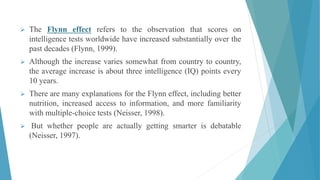
 The Flynn effect refers to the observation that scores on
intelligence tests worldwide have increased substantially over the
past decades (Flynn, 1999).
 Although the increase varies somewhat from country to country,
the average increase is about three intelligence (IQ) points every
10 years.
 There are many explanations for the Flynn effect, including better
nutrition, increased access to information, and more familiarity
with multiple-choice tests (Neisser, 1998).
 But whether people are actually getting smarter is debatable
(Neisser, 1997).
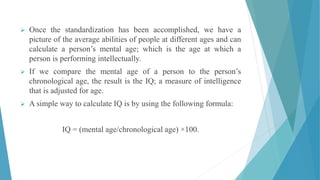
 Once the standardization has been accomplished, we have a
picture of the average abilities of people at different ages and can
calculate a person’s mental age; which is the age at which a
person is performing intellectually.
 If we compare the mental age of a person to the person’s
chronological age, the result is the IQ; a measure of intelligence
that is adjusted for age.
 A simple way to calculate IQ is by using the following formula:
IQ = (mental age/chronological age) ×100.
BINET-SIMON SCALE
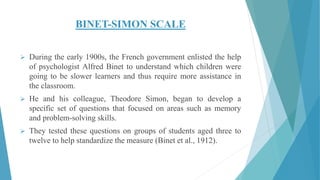
 During the early 1900s, the French government enlisted the help
of psychologist Alfred Binet to understand which children were
going to be slower learners and thus require more assistance in
the classroom.
 He and his colleague, Theodore Simon, began to develop a
specific set of questions that focused on areas such as memory
and problem-solving skills.
 They tested these questions on groups of students aged three to
twelve to help standardize the measure (Binet et al., 1912).
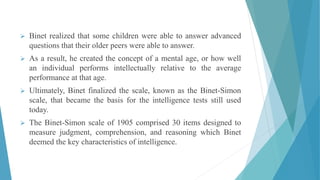
 Binet realized that some children were able to answer advanced
questions that their older peers were able to answer.
 As a result, he created the concept of a mental age, or how well
an individual performs intellectually relative to the average
performance at that age.
 Ultimately, Binet finalized the scale, known as the Binet-Simon
scale, that became the basis for the intelligence tests still used
today.
 The Binet-Simon scale of 1905 comprised 30 items designed to
measure judgment, comprehension, and reasoning which Binet
deemed the key characteristics of intelligence.
STANFORD-BINET INTELLIGENCE SCALE
 Stanford psychologist, Lewis Terman adapted the test for American
students, and published the Stanford-Binet Intelligence Scale in 1916.
 The Stanford-Binet Scale is a contemporary assessment which
measures intelligence according to 5 features of cognitive ability;
i. Fluid reasoning
ii. Knowledge
iii. Quantitative reasoning
iv. Visual-spatial processing
v. Working memory.
 Both verbal and nonverbal responses are measured.
 This test used a single number, referred to as the intelligence quotient
(IQ) to indicate an individual’s score.
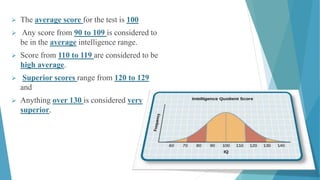
 The average score for the test is 100
 Any score from 90 to 109 is considered to
be in the average intelligence range.
 Score from 110 to 119 are considered to be
high average.
 Superior scores range from 120 to 129
and
 Anything over 130 is considered very
superior.
WECHSLER INTELLIGENCE SCALE FOR
CHILDREN (WISC) AND WECHSLER
ADULT INTELLIGENCE SCALE (WAIS)
 American psychologist David Wechsler developed a new tool due
to his dissatisfaction with the limitations of the Stanford-Binet
test.
 Wechsler believed that intelligence involved many different
mental abilities and felt that the Stanford-Binet scale too closely
reflected the idea of one general intelligence.
 Because of this, Wechsler created the Wechsler Intelligence Scale
for Children (WISC) and the Wechsler Adult Intelligence Scale
(WAIS) in 1955.
 The most up-to-date version is the WAIS-IV.
 The Wechsler Intelligence Scale for Children (WISC), is an IQ
test designed to measure intelligence and cognitive ability in
children between the ages of 6 and 16.
 It is currently in its fourth edition (WISC-V) released in 2014 by
Pearson.
 The Wechsler Adult Intelligence Scale (WAIS), is an IQ test
designed to measure cognitive ability in adults and older
adolescents. It includes verbal comprehension, perceptual
reasoning, working memory, and processing speed.
 The latest version of the Wechsler Adult Intelligence Scale
(WAIS-IV) was standardized on 2,200 healthy people between
the ages of 16 and 90 years.
CRITICISM OF INTELLIGENCE TESTING
 Criticisms have ranged from the claim that IQ tests are biased in
favor of white, middle-class people.
 Negative stereotypes about a person’s ethnicity, gender, or age
may cause the person to suffer stereotype threat, a burden of
doubt about his or her own abilities, which can create anxiety that
result in lower scores.
i. Cultural Specificity
 These tests were created by western psychologists who created
such tools to measure euro-centric values.
 But it is important to recognize that the majority of the world’s
population does not reside in Europe or North America, and as a
result, the cultural specificity of these tests is crucial.
 Different cultures hold different values and even have different
perceptions of intelligence.
 Although IQ tests might have high reliability and validity,
understanding the role of culture is important in forming the
bigger picture of an individual’s intelligence.
 IQ tests may accurately measure academic intelligence, but more
research must be done to discern whether they truly measure
practical intelligence, or even just general intelligence in all
cultures.
ii. Social and Environmental Factors
 Another important part of limitations is to consider is the social
and environmental context in which an individual lives and the IQ
test-related biases that develop as a result.
 These might help explain why some individuals have lower
scores than others.
 For example, the threat of social exclusion can greatly decrease
the expression of intelligence.
iii. Stereotype Threat
 Stereotype threat is a phenomenon in which people feel at risk of
conforming to stereotypes about their social group.
 Negative stereotypes can also create anxiety that result in lower
scores and even just recording your race can also result in
worsened performance.
 Stereotype threat is a real threat and can be detrimental to an
individual’s performance on these tests.
iii. Self-Fulfilling Prophecy
 Stereotype threat is closely related to the concept of a self-
fulfilling prophecy in which an individual’s expectations about
another person can result in the other person acting in ways that
conform to that very expectation.
 While an IQ score has many benefits in measuring intelligence, it
is critical to consider that just because someone has a lower score,
does not necessarily mean they are lower in intelligence.
 There are many factors that can worsen performance on these
tests, and the tests themselves might not even be accurately
measuring the very concept they are intended to.
EXTREMES OF INTELLIGENCE
 IQ scores are generally normally distributed.
 That is, roughly 95% of the population has IQ scores between 70
and 130. Individuals who fall outside this range represent the
extremes of intelligence.
 Those who have an IQ above 130 are considered to be gifted.
 Those individuals who have scores below 70 do so because of an
intellectual disability, marked by substantial developmental
delays, including motor, cognitive, and speech delays.
 Some of the time, these disabilities are the product of genetic
mutations.
 Down syndrome, for example, resulting from extra genetic
material from or a complete extra copy of the 21st chromosome,
is a common genetic cause of an intellectual disability. As such,
many individuals with down syndrome have below average IQ
scores.
 Savant syndrome is another example of an extreme of
intelligence.
 Despite having significant mental disabilities, these individuals
demonstrate certain abilities in some fields that are far above
average
 Such as incredible memorization, rapid mathematical or calendar
calculation ability, or advanced musical talent.
INTELLIGENCE TODAY
 Today, intelligence is generally understood as the ability to
understand and adapt to the environment by using inherited
abilities and learned knowledge.
 Many new intelligence tests have arisen, such as the University of
California Matrix Reasoning Task, that can be taken online and in
very little time, and new methods of scoring these tests have been
developed too.
 Admission into university and graduate schools rely on specific
aptitude and achievement tests, such as the SAT, ACT, and the
LSAT and thus these tests have become a huge part of our day to
day lives.

INTELLIGENCE PPT

  • 1.
    COGNITIVE PSYCHOLOGY II INTELLIGENCE: CONCEPT, RELATIONSHIPBETWEEN COGNITION AND INTELLIGENCE, MEASURING INTELLIGENCE. NIVEDITA MENON. C 12/07/2021
  • 2.
    INTELLIGENCE THE CONCEPT OFINTELLIGENCE  Latin verb ‘intellegere’ - the acquirement, processing and storage of information.  Intelligence has been defined in many ways: • higher level abilities such as abstract reasoning, mental representation, problem solving, and decision making • the ability to learn • emotional knowledge • creativity • adaptation to meet the demands of the environment effectively.
  • 3.
     Robert Sternberg(1997) defined intelligence as "the mental abilities necessary for adaptation to, as well as shaping and selection of, any environmental context.  Intelligence involves different kinds of mental processes such as problem-solving, logic, reasoning, and planning.  We usually use the adjective intelligent to describe those with a high mental capacity i.e., the ability to easily learn or understand things or to deal with new situations.  The intelligence levels of individual differ according to various factors like genetics, education, experience. etc.
  • 4.
     There aredifferent types of intelligence: i. Linguistic Intelligence – involves speaking and write well. ii. Mathematical Intelligence – involves ability in using logical skills, i.e., mathematical skills to prove or solve problems. iii. Music Intelligence – involves performing, understanding and enjoying music. iv. Business Intelligence – involves having corporate skills. v. Interpersonal Intelligence – involves the ability to interact with others effectively.
  • 5.
    HISTORY OF INTELLIGENCE Dates back to the late 1800s to Sir Francis Galton’s works.  Galton was interested in the concept of a gifted individual, so he created a lab to measure reaction times and other physical characteristics to test his hypothesis that intelligence is a general mental ability that is a produce of biological evolution.  Galton’s study of intelligence in the laboratory setting and his theorization of the heritability of intelligence paved the way for decades of future research and debate in this field.
  • 6.
     Some researchersargue that intelligence is a general ability, whereas others make the assertion that intelligence is one’s specific skills and talents.  Psychologists insist that intelligence is genetic, or inherited, and others claim that it is largely influenced by the surrounding environment.
  • 7.
    RELATIONSHIP BETWEEN COGNITION ANDINTELLIGENCE  Cognition refers to the mental process of acquiring knowledge and understanding through thought, experience, and senses.  It involves complex mental actions such as gaining knowledge, understanding, thinking, knowing, judging, and problem-solving.  The processing of this information involves several stages.  4 major steps/stages are involved
  • 8.
    i. Transforming sensoryinput - when a person takes in sensations from the world around him, the information he gains through his five senses must first be transformed into signals that his brain can understand. ii. Reducing sensory information – every day a person faces an endless number of sensory experiences. It is important that one’s mind reduces their experience of the world down to the fundamentals. iii. Elaborating information - this is the opposite of reducing information. When a person cannot recall information, the brain sometimes fills in the missing data with whatever seems to fit. iv. Storing and recovering information - memory, which is a major aspect in cognition, helps in storing and recovering information. Moreover, memory can be divided into two categories as short-term memory and long-term memory.
  • 9.
     Cognitive scientistsutilize a variety of techniques to objectively measure processes related to contemplation, decision making and action planning including reaction times, responses accuracies.  For studying these processes, a variety of physiological measures which allow conscious and subconscious processes of cognitive activity to be presented and compared between and within experimental conditions. are used such as; • Electroencephalography (EEG) • Electromyography (EMG) • Functional Magnetic Resonance Imaging (fMRI) • Magnetencephalography (MEG) • Eye tracking
  • 10.
     Complex cognitionis an essential feature of human consciousness, yet not all aspects of cognition are consciously experienced.  For example, many decisions we make about choosing to do something or retaining from doing something involve cognitive processes related to weighing options and making comparisons to other events in memory.  However, cognition has been argued to not be involved in all the actions we make such as reflexes that recoil your hand after touching an extremely hot surface which operates on automatic feedback loops between the effector and spinal cord.
  • 11.
    INTELLIGENCE TESTING  Sinceintelligence is an important individual difference dimension, psychologists have invested substantial effort in creating and improving measures of intelligence, and these tests are now the most accurate of all psychological tests.  The ability to accurately assess intelligence is one of the most important contributions of psychology to everyday public life.  It is important that intelligence tests be standardized on a regular basis because the overall level of intelligence in a population may change over time.
  • 12.
     The Flynneffect refers to the observation that scores on intelligence tests worldwide have increased substantially over the past decades (Flynn, 1999).  Although the increase varies somewhat from country to country, the average increase is about three intelligence (IQ) points every 10 years.  There are many explanations for the Flynn effect, including better nutrition, increased access to information, and more familiarity with multiple-choice tests (Neisser, 1998).  But whether people are actually getting smarter is debatable (Neisser, 1997).
  • 13.
     Once thestandardization has been accomplished, we have a picture of the average abilities of people at different ages and can calculate a person’s mental age; which is the age at which a person is performing intellectually.  If we compare the mental age of a person to the person’s chronological age, the result is the IQ; a measure of intelligence that is adjusted for age.  A simple way to calculate IQ is by using the following formula: IQ = (mental age/chronological age) ×100.
  • 14.
    BINET-SIMON SCALE  Duringthe early 1900s, the French government enlisted the help of psychologist Alfred Binet to understand which children were going to be slower learners and thus require more assistance in the classroom.  He and his colleague, Theodore Simon, began to develop a specific set of questions that focused on areas such as memory and problem-solving skills.  They tested these questions on groups of students aged three to twelve to help standardize the measure (Binet et al., 1912).
  • 15.
     Binet realizedthat some children were able to answer advanced questions that their older peers were able to answer.  As a result, he created the concept of a mental age, or how well an individual performs intellectually relative to the average performance at that age.  Ultimately, Binet finalized the scale, known as the Binet-Simon scale, that became the basis for the intelligence tests still used today.  The Binet-Simon scale of 1905 comprised 30 items designed to measure judgment, comprehension, and reasoning which Binet deemed the key characteristics of intelligence.
  • 16.
    STANFORD-BINET INTELLIGENCE SCALE Stanford psychologist, Lewis Terman adapted the test for American students, and published the Stanford-Binet Intelligence Scale in 1916.  The Stanford-Binet Scale is a contemporary assessment which measures intelligence according to 5 features of cognitive ability; i. Fluid reasoning ii. Knowledge iii. Quantitative reasoning iv. Visual-spatial processing v. Working memory.  Both verbal and nonverbal responses are measured.  This test used a single number, referred to as the intelligence quotient (IQ) to indicate an individual’s score.
  • 17.
     The averagescore for the test is 100  Any score from 90 to 109 is considered to be in the average intelligence range.  Score from 110 to 119 are considered to be high average.  Superior scores range from 120 to 129 and  Anything over 130 is considered very superior.
  • 18.
    WECHSLER INTELLIGENCE SCALEFOR CHILDREN (WISC) AND WECHSLER ADULT INTELLIGENCE SCALE (WAIS)  American psychologist David Wechsler developed a new tool due to his dissatisfaction with the limitations of the Stanford-Binet test.  Wechsler believed that intelligence involved many different mental abilities and felt that the Stanford-Binet scale too closely reflected the idea of one general intelligence.  Because of this, Wechsler created the Wechsler Intelligence Scale for Children (WISC) and the Wechsler Adult Intelligence Scale (WAIS) in 1955.  The most up-to-date version is the WAIS-IV.
  • 19.
     The WechslerIntelligence Scale for Children (WISC), is an IQ test designed to measure intelligence and cognitive ability in children between the ages of 6 and 16.  It is currently in its fourth edition (WISC-V) released in 2014 by Pearson.  The Wechsler Adult Intelligence Scale (WAIS), is an IQ test designed to measure cognitive ability in adults and older adolescents. It includes verbal comprehension, perceptual reasoning, working memory, and processing speed.  The latest version of the Wechsler Adult Intelligence Scale (WAIS-IV) was standardized on 2,200 healthy people between the ages of 16 and 90 years.
  • 20.
    CRITICISM OF INTELLIGENCETESTING  Criticisms have ranged from the claim that IQ tests are biased in favor of white, middle-class people.  Negative stereotypes about a person’s ethnicity, gender, or age may cause the person to suffer stereotype threat, a burden of doubt about his or her own abilities, which can create anxiety that result in lower scores.
  • 21.
    i. Cultural Specificity These tests were created by western psychologists who created such tools to measure euro-centric values.  But it is important to recognize that the majority of the world’s population does not reside in Europe or North America, and as a result, the cultural specificity of these tests is crucial.  Different cultures hold different values and even have different perceptions of intelligence.  Although IQ tests might have high reliability and validity, understanding the role of culture is important in forming the bigger picture of an individual’s intelligence.  IQ tests may accurately measure academic intelligence, but more research must be done to discern whether they truly measure practical intelligence, or even just general intelligence in all cultures.
  • 22.
    ii. Social andEnvironmental Factors  Another important part of limitations is to consider is the social and environmental context in which an individual lives and the IQ test-related biases that develop as a result.  These might help explain why some individuals have lower scores than others.  For example, the threat of social exclusion can greatly decrease the expression of intelligence.
  • 23.
    iii. Stereotype Threat Stereotype threat is a phenomenon in which people feel at risk of conforming to stereotypes about their social group.  Negative stereotypes can also create anxiety that result in lower scores and even just recording your race can also result in worsened performance.  Stereotype threat is a real threat and can be detrimental to an individual’s performance on these tests.
  • 24.
    iii. Self-Fulfilling Prophecy Stereotype threat is closely related to the concept of a self- fulfilling prophecy in which an individual’s expectations about another person can result in the other person acting in ways that conform to that very expectation.  While an IQ score has many benefits in measuring intelligence, it is critical to consider that just because someone has a lower score, does not necessarily mean they are lower in intelligence.  There are many factors that can worsen performance on these tests, and the tests themselves might not even be accurately measuring the very concept they are intended to.
  • 25.
    EXTREMES OF INTELLIGENCE IQ scores are generally normally distributed.  That is, roughly 95% of the population has IQ scores between 70 and 130. Individuals who fall outside this range represent the extremes of intelligence.  Those who have an IQ above 130 are considered to be gifted.  Those individuals who have scores below 70 do so because of an intellectual disability, marked by substantial developmental delays, including motor, cognitive, and speech delays.  Some of the time, these disabilities are the product of genetic mutations.
  • 26.
     Down syndrome,for example, resulting from extra genetic material from or a complete extra copy of the 21st chromosome, is a common genetic cause of an intellectual disability. As such, many individuals with down syndrome have below average IQ scores.  Savant syndrome is another example of an extreme of intelligence.  Despite having significant mental disabilities, these individuals demonstrate certain abilities in some fields that are far above average  Such as incredible memorization, rapid mathematical or calendar calculation ability, or advanced musical talent.
  • 27.
    INTELLIGENCE TODAY  Today,intelligence is generally understood as the ability to understand and adapt to the environment by using inherited abilities and learned knowledge.  Many new intelligence tests have arisen, such as the University of California Matrix Reasoning Task, that can be taken online and in very little time, and new methods of scoring these tests have been developed too.  Admission into university and graduate schools rely on specific aptitude and achievement tests, such as the SAT, ACT, and the LSAT and thus these tests have become a huge part of our day to day lives.