1
Coating Technologies
B.C. De Cooman
MDL
GIFT, POSTECH
2
Much of the success of coated sheet steel is due to a switch from uncoated
to coated sheet in the automotive industry and its increased use in the
building industry and household appliance manufacturing. By coating steel
via galvanizing or other coating technologies, the steel gains superior
corrosion resistance at a low cost without impacting the availability or
recycle-ability of the product. This has lead to its widespread use in
manufacturing. The session includes cosmetic and perforation corrosion
protection of sheet steel, the different types of metallic and organic
coatings for hot and cold rolled strip products, and the essentials of the
different coating technologies. Also included is the origin of the coating
microstructure and the importance of metallic and organic coatings on hot
and cold-rolled strip products.
Coating Technologies
Introduction to Coating Technologies for CRS
3
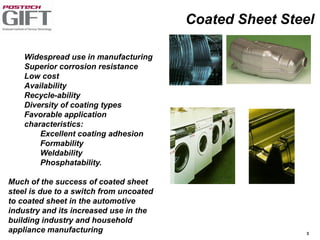
Widespread use in manufacturing
Superior corrosion resistance
Low cost
Availability
Recycle-ability
Diversity of coating types
Favorable application
characteristics:
Excellent coating adhesion
Formability
Weldability
Phosphatability.
Much of the success of coated sheet
steel is due to a switch from uncoated
to coated sheet in the automotive
industry and its increased use in the
building industry and household
appliance manufacturing
Coated Sheet Steel
4
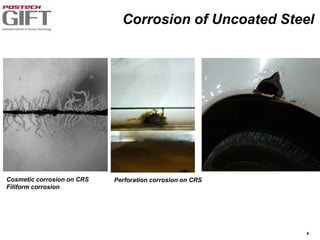
Cosmetic corrosion on CRS
Filiform corrosion
Perforation corrosion on CRS
Corrosion of Uncoated Steel
5
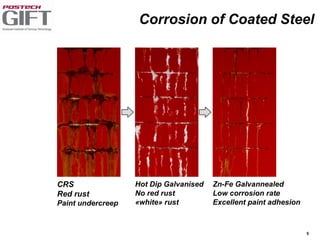
CRS
Red rust
Paint undercreep
Hot Dip Galvanised
No red rust
«white» rust
Zn-Fe Galvannealed
Low corrosion rate
Excellent paint adhesion
,
Corrosion of Coated Steel
6
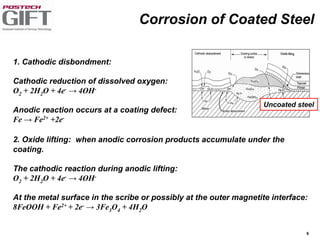
1. Cathodic disbondment:
Cathodic reduction of dissolved oxygen:
O2 + 2H2O + 4e- → 4OH-
Anodic reaction occurs at a coating defect:
Fe → Fe2+ +2e-
2. Oxide lifting: when anodic corrosion products accumulate under the
coating.
The cathodic reaction during anodic lifting:
O2 + 2H2O + 4e- → 4OH-
At the metal surface in the scribe or possibly at the outer magnetite interface:
8FeOOH + Fe2+ + 2e- → 3Fe3O4 + 4H2O
Uncoated steel
Corrosion of Coated Steel
7
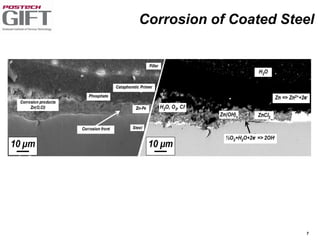
Corrosion of Coated Steel
8
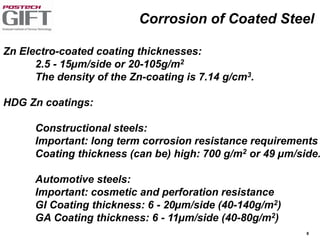
Zn Electro-coated coating thicknesses:
2.5 - 15µm/side or 20-105g/m2
The density of the Zn-coating is 7.14 g/cm3.
HDG Zn coatings:
Constructional steels:
Important: long term corrosion resistance requirements
Coating thickness (can be) high: 700 g/m2 or 49 µm/side.
Automotive steels:
Important: cosmetic and perforation resistance
GI Coating thickness: 6 - 20µm/side (40-140g/m2)
GA Coating thickness: 6 - 11µm/side (40-80g/m2)
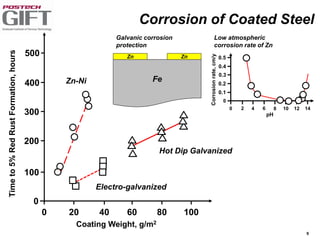
Corrosion of Coated Steel
9
Coating Weight, g/m2
Timeto5%RedRustFormation,hours
500
400
300
200
100
0
0 20 40 60 80 100
Electro-galvanized
Hot Dip Galvanized
Zn-Ni Fe
Zn Zn
Galvanic corrosion
protection
Low atmospheric
corrosion rate of Zn
pH
0 2 4 6 8 10 12 14
Corrosionrate,cm/y
0.5
0.4
0.3
0.2
0.1
0
Corrosion of Coated Steel
10
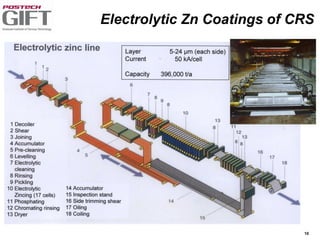
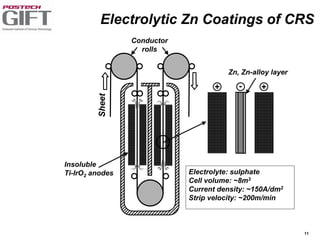
Electrolytic Zn Coatings of CRS
11
Sheet
Conductor
rolls
Electrolyte: sulphate
Cell volume: ~8m3
Current density: ~150A/dm2
Strip velocity: ~200m/min
Insoluble
Ti-IrO2 anodes
+ - +
Zn, Zn-alloy layer
Electrolytic Zn Coatings of CRS
12
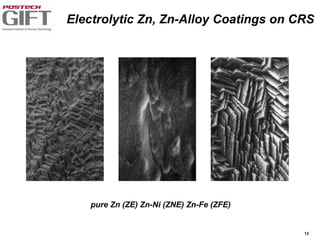
pure Zn (ZE) Zn-Ni (ZNE) Zn-Fe (ZFE)
Electrolytic Zn, Zn-Alloy Coatings on CRS
13
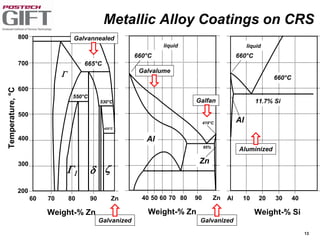
Weight-% Zn
Temperature,°C
500
800
700
600
300
400
200
60 70 80 90 Zn
Weight-% Zn
60 70 80 90 Zn5040
Al
Zn
95%
419°C
660°C
liquid
Weight-% Si
10 20 30 40Al
Al
660°C
11.7% Si
660°C
liquid
665°C
530°C
550°C
425°C

  
Galvalume
Galfan
Galvanized
Aluminized
Galvannealed
Galvanized
Metallic Alloy Coatings on CRS
14
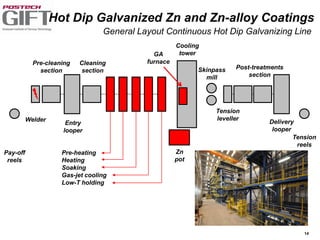
Hot Dip Galvanized Zn and Zn-alloy Coatings
General Layout Continuous Hot Dip Galvanizing Line
Pay-off
reels
Tension
reels
Welder
Pre-cleaning
section
Cleaning
section
Entry
looper
Post-treatments
section
Delivery
looper
Tension
leveller
Skinpass
mill
Cooling
tower
Zn
pot
GA
furnace
Pre-heating
Heating
Soaking
Gas-jet cooling
Low-T holding
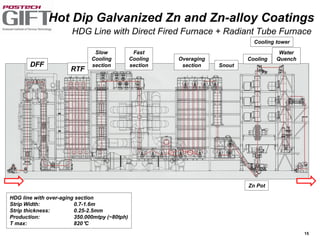
15
RTF
DFF
Slow
Cooling
section
Fast
Cooling
section
Overaging
section Snout
Zn Pot
Cooling
Water
Quench
HDG line with over-aging section
Strip Width: 0.7-1.6m
Strip thickness: 0.25-2.5mm
Production: 350.000mtpy (~80tph)
T max: 820°C
HDG Line with Direct Fired Furnace + Radiant Tube Furnace
Hot Dip Galvanized Zn and Zn-alloy Coatings
Cooling tower
16
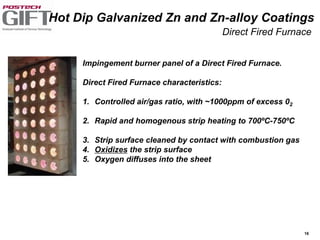
Direct Fired Furnace
Hot Dip Galvanized Zn and Zn-alloy Coatings
Impingement burner panel of a Direct Fired Furnace.
Direct Fired Furnace characteristics:
1. Controlled air/gas ratio, with ~1000ppm of excess 02
2. Rapid and homogenous strip heating to 700ºC-750ºC
3. Strip surface cleaned by contact with combustion gas
4. Oxidizes the strip surface
5. Oxygen diffuses into the sheet
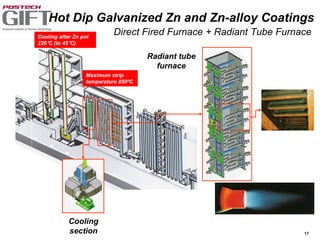
17
Radiant tube
furnace
Cooling
section
Direct Fired Furnace + Radiant Tube Furnace
Hot Dip Galvanized Zn and Zn-alloy Coatings
Maximum strip
temperature 850ºC
Cooling after Zn pot
220°C (to 45°C)
18
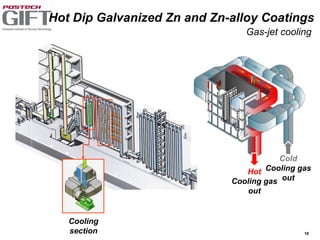
Cooling
section
Gas-jet cooling
Hot Dip Galvanized Zn and Zn-alloy Coatings
Hot
Cooling gas
out
Cold
Cooling gas
out
19
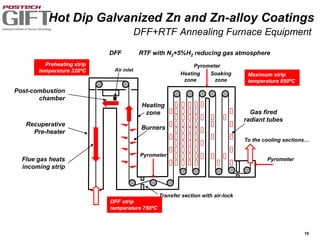
DFF+RTF Annealing Furnace Equipment
Hot Dip Galvanized Zn and Zn-alloy Coatings
Burners
RTF with N2+5%H2 reducing gas atmosphereDFF
Pyrometer
Recuperative
Pre-heater
Heating
zone
Flue gas heats
incoming strip
Pyrometer
Heating
zone
Soaking
zone
Post-combustion
chamber
Pyrometer
Air inlet
Gas fired
radiant tubes
Transfer section with air-lock
Maximum strip
temperature 850ºC
Preheating strip
temperature 320ºC
DFF strip
temperature 750ºC
To the cooling sections…
20
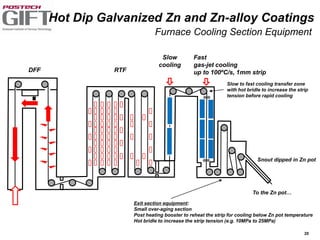
Furnace Cooling Section Equipment
Hot Dip Galvanized Zn and Zn-alloy Coatings
RTFDFF
Slow
cooling
Fast
gas-jet cooling
up to 100ºC/s, 1mm strip
To the Zn pot…
Snout dipped in Zn pot
Slow to fast cooling transfer zone
with hot bridle to increase the strip
tension before rapid cooling
Exit section equipment:
Small over-aging section
Post heating booster to reheat the strip for cooling below Zn pot temperature
Hot bridle to increase the strip tension (e.g. 10MPa to 25MPa)
21
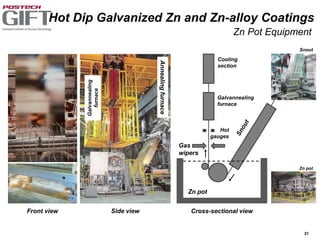
Hot
gauges
Galvannealing
furnace
Annealingfurnace
Galvannealing
furnace
Gas
wipers
Front view Side view Cross-sectional view
Zn pot
Cooling
section
Zn Pot Equipment
Hot Dip Galvanized Zn and Zn-alloy Coatings
Snout
Zn pot
22
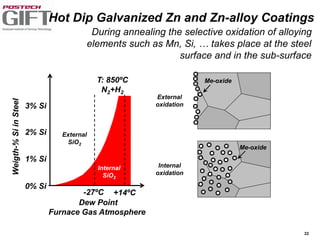
Hot Dip Galvanized Zn and Zn-alloy Coatings
During annealing the selective oxidation of alloying
elements such as Mn, Si, … takes place at the steel
surface and in the sub-surface
Dew Point
Furnace Gas Atmosphere
Weigth-%SiinSteel
T: 850ºC
N2+H2
-27ºC +14ºC
External
SiO2
Internal
SiO2
0% Si
1% Si
2% Si
3% Si
Me-oxide
Me-oxide
Internal
oxidation
External
oxidation
23
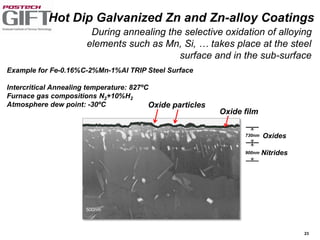
Hot Dip Galvanized Zn and Zn-alloy Coatings
During annealing the selective oxidation of alloying
elements such as Mn, Si, … takes place at the steel
surface and in the sub-surface
Example for Fe-0.16%C-2%Mn-1%Al TRIP Steel Surface
Intercritical Annealing temperature: 827ºC
Furnace gas compositions N2+10%H2
Atmosphere dew point: -30ºC Oxide particles
Oxide film
Oxides730nm
Nitrides900nm
500nm
24
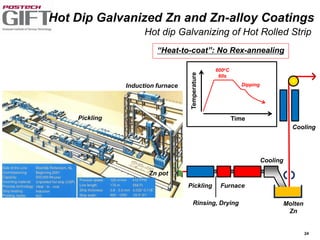
“Heat-to-coat”: No Rex-annealing
Pickling Furnace
Rinsing, Drying
Cooling
Molten
Zn
Cooling
600oC
60s
Dipping
Time
Temperature
Pickling
Induction furnace
Zn pot
Hot Dip Galvanized Zn and Zn-alloy Coatings
Hot dip Galvanizing of Hot Rolled Strip
25
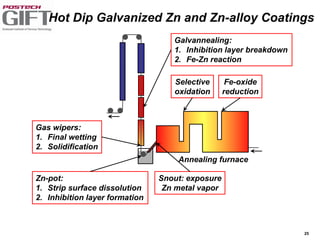
Fe-oxide
reduction
Selective
oxidation
Snout: exposure
Zn metal vapor
Zn-pot:
1. Strip surface dissolution
2. Inhibition layer formation
Galvannealing:
1. Inhibition layer breakdown
2. Fe-Zn reaction
Gas wipers:
1. Final wetting
2. Solidification
Annealing furnace
Hot Dip Galvanized Zn and Zn-alloy Coatings
26
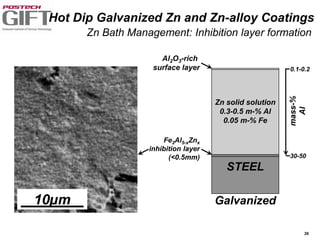
10µm
STEEL
Galvanized
Fe2Al5-xZnx
inhibition layer
(<0.5mm)
Zn solid solution
0.3-0.5 m-% Al
0.05 m-% Fe
Al2O3-rich
surface layer
mass-%
Al
30-50
0.1-0.2
Zn Bath Management: Inhibition layer formation
Hot Dip Galvanized Zn and Zn-alloy Coatings
27
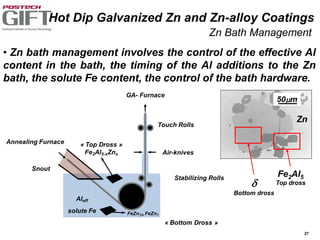
• Zn bath management involves the control of the effective Al
content in the bath, the timing of the Al additions to the Zn
bath, the solute Fe content, the control of the bath hardware.
FeZn13, FeZn7
« Top Dross »
Fe2Al5-xZnx
solute Fe
Aleff
« Bottom Dross »
Annealing Furnace
Stabilizing Rolls
Air-knives
Touch Rolls
GA- Furnace
Snout
50mm
Fe2Al5
Top dross
Bottom dross
Zn
Hot Dip Galvanized Zn and Zn-alloy Coatings
Zn Bath Management
28
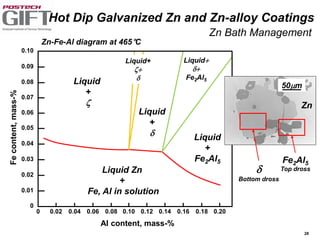
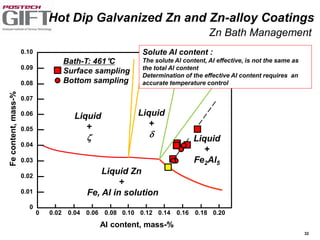
Zn-Fe-Al diagram at 465°C
Liquid
+

Liquid
+
 Liquid
+
Fe2Al5
Liquid Zn
+
Fe, Al in solution
Liquid+
+
Fe2Al5
Al content, mass-%
Fecontent,mass-%
0 0.02 0.04 0.06 0.08 0.10 0.12 0.14 0.16 0.18 0.20
0
0.01
0.02
0.03
0.04
0.05
0.06
0.07
0.08
0.09
0.10
Liquid+
+

50mm
Fe2Al5
Top dross
Bottom dross
Zn
Hot Dip Galvanized Zn and Zn-alloy Coatings
Zn Bath Management
29
Liquid
+

Liquid
+

Liquid
+
Fe2Al5
Liquid Zn
+
Fe, Al in solution
Al content, mass-%
Fecontent,mass-%
0 0.02 0.04 0.06 0.08 0.10 0.12 0.14 0.16 0.18 0.20
0
0.01
0.02
0.03
0.04
0.05
0.06
0.07
0.08
0.09
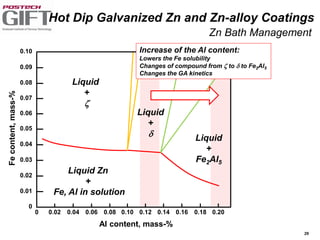
0.10 Increase of the Al content:
Lowers the Fe solubility
Changes of compound from  to  to Fe2Al5
Changes the GA kinetics
Hot Dip Galvanized Zn and Zn-alloy Coatings
Zn Bath Management
30
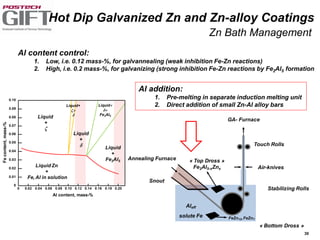
Al content control:
1. Low, i.e. 0.12 mass-%, for galvannealing (weak inhibition Fe-Zn reactions)
2. High, i.e. 0.2 mass-%, for galvanizing (strong inhibition Fe-Zn reactions by Fe2Al5 formation
FeZn13, FeZn7
« Top Dross »
Fe2Al5-xZnx
solute Fe
Aleff
« Bottom Dross »
Annealing Furnace
Stabilizing Rolls
Air-knives
Touch Rolls
GA- Furnace
Snout
Liquid
+

Liquid
+

Liquid
+
Fe2Al5
Liquid Zn
+
Fe, Al in solution
Liquid+
+
Fe2Al5
Al content, mass-%
Fecontent,mass-%
0 0.02 0.04 0.06 0.08 0.10 0.12 0.14 0.16 0.18 0.20
0
0.01
0.02
0.03
0.04
0.05
0.06
0.07
0.08
0.09
0.10
Liquid+
+

Al addition:
1. Pre-melting in separate induction melting unit
2. Direct addition of small Zn-Al alloy bars
Hot Dip Galvanized Zn and Zn-alloy Coatings
Zn Bath Management
31
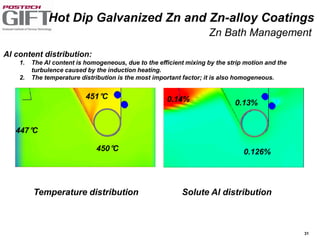
Al content distribution:
1. The Al content is homogeneous, due to the efficient mixing by the strip motion and the
turbulence caused by the induction heating.
2. The temperature distribution is the most important factor; it is also homogeneous.
451°C
450°C
447°C
0.13%
0.126%
0.14%
Temperature distribution Solute Al distribution
Hot Dip Galvanized Zn and Zn-alloy Coatings
Zn Bath Management
32
Liquid
+

Liquid
+
 Liquid
+
Fe2Al5
Liquid Zn
+
Fe, Al in solution
Al content, mass-%
Fecontent,mass-%
0 0.02 0.04 0.06 0.08 0.10 0.12 0.14 0.16 0.18 0.20
0
0.01
0.02
0.03
0.04
0.05
0.06
0.07
0.08
0.09
0.10
Bath-T: 461°C
Surface sampling
Bottom sampling
Solute Al content :
The solute Al content, Al effective, is not the same as
the total Al content
Determination of the effective Al content requires an
accurate temperature control
Hot Dip Galvanized Zn and Zn-alloy Coatings
Zn Bath Management
33
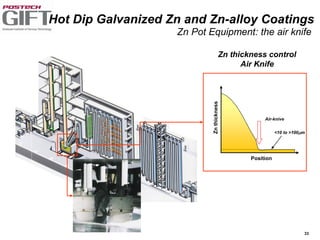
Position
Znthickness
Air-knive
<10 to >100mm
Zn thickness control
Air Knife
Hot Dip Galvanized Zn and Zn-alloy Coatings
Zn Pot Equipment: the air knife
34
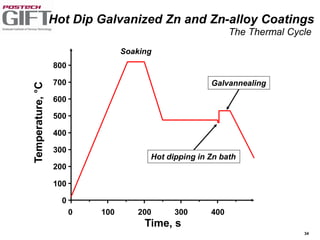
0 100 200 300 400
0
100
200
300
400
500
600
700
800
Temperature,°C
Time, s
Soaking
Hot dipping in Zn bath
Galvannealing
Hot Dip Galvanized Zn and Zn-alloy Coatings
The Thermal Cycle
35
Hot Dip Galvanized Zn and Zn-alloy Coatings
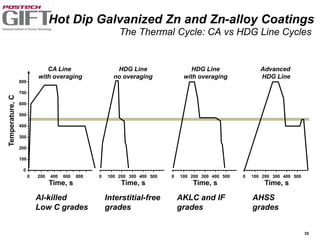
The Thermal Cycle: CA vs HDG Line Cycles
0 200 400 600 800
0
100
200
300
400
500
600
700
800
CA Line
with overaging
Temperature,C
Time, s
0 100 200 300 400 500
Time, s
0 100 200 300 400 500
Time, s
0 100 200 300 400 500
Time, s
HDG Line
no overaging
Advanced
HDG Line
HDG Line
with overaging
Al-killed
Low C grades
Interstitial-free
grades
AHSS
grades
AKLC and IF
grades
36
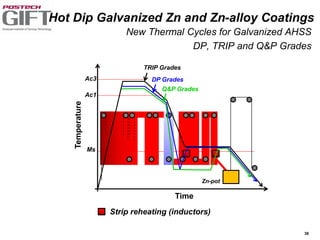
Zn-pot
Time
Temperature Ac3
Ac1
Ms
TRIP Grades
DP Grades
Q&P Grades
Hot Dip Galvanized Zn and Zn-alloy Coatings
New Thermal Cycles for Galvanized AHSS
DP, TRIP and Q&P Grades
Strip reheating (inductors)
37
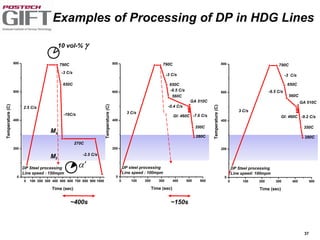
0 100 200 300 400 500 600
0
200
400
600
800
280C
350C
GA 510C
-0.4 C/s
DP steel processing
Line speed : 100mpm
-3 C/s
-7.6 C/s
650C
Temperature(C)
Time (sec)
3 C/s
790C
-6.5 C/s
GI: 460C
560C
0 100 200 300 400 500 600 700 800 900 1000
0
200
400
600
800
DP Steel processing
Line speed : 150mpm
-2.5 C/s
270C
-19C/s
Temperature(C)
Time (sec)
2.5 C/s
790C
-3 C/s
650C
0 100 200 300 400 500
0
200
400
600
800
280C
350C
GA 510C
DP Steel processing
Line speed: 100mpm
-3 C/s
-9.2 C/s
650C
Temperature(C)
Time (sec)
3 C/s
790C
-6.5 C/s
GI: 460C
560C
10 vol-% g
a‘
Ms
Mf
~400s ~150s
Examples of Processing of DP in HDG Lines
38
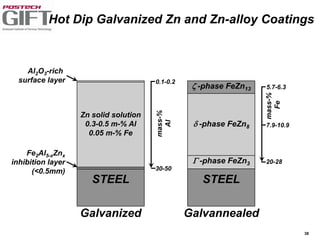
STEEL
Galvannealed
 -phase FeZn3
 -phase FeZn8
 -phase FeZn13 5.7-6.3
7.9-10.9
20-28
STEEL
Galvanized
Fe2Al5-xZnx
inhibition layer
(<0.5mm)
Zn solid solution
0.3-0.5 m-% Al
0.05 m-% Fe
Al2O3-rich
surface layer
mass-%
Al30-50
0.1-0.2
mass-%
Fe
Hot Dip Galvanized Zn and Zn-alloy Coatings
39
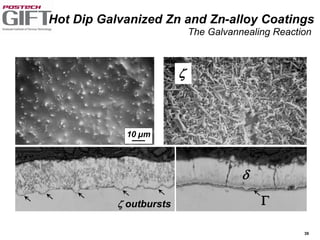


 outbursts
10 µm
Hot Dip Galvanized Zn and Zn-alloy Coatings
The Galvannealing Reaction
40
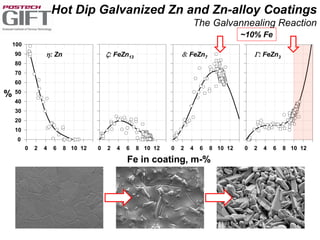
Hot Dip Galvanized Zn and Zn-alloy Coatings
The Galvannealing Reaction
0 2 4 6 8 10 12 0 2 4 6 8 10 120 2 4 6 8 10 12
0
10
20
30
40
50
60
70
80
90
100
Fe in coating, m-%
0 2 4 6 8 10 12
%
: Zn : FeZn13 : FeZn7 : FeZn3
~10% Fe
41
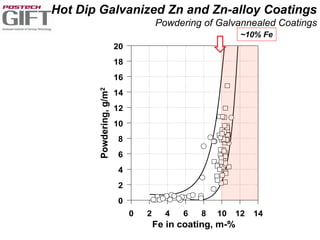
Fe in coating, m-%
0 2 4 6 8 10 12 14
Powdering,g/m2
0
2
4
6
8
10
12
14
16
18
20
Hot Dip Galvanized Zn and Zn-alloy Coatings
Powdering of Galvannealed Coatings
~10% Fe
42
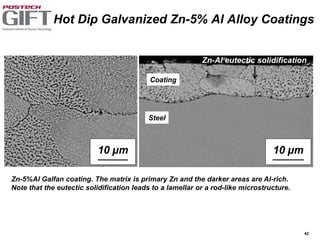
10 µm 10 µm
Steel
Coating
Zn-5%Al Galfan coating. The matrix is primary Zn and the darker areas are Al-rich.
Note that the eutectic solidification leads to a lamellar or a rod-like microstructure.
Hot Dip Galvanized Zn-5% Al Alloy Coatings
Zn-Al eutectic solidification
43
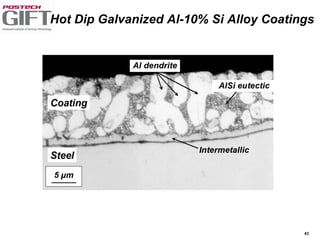
Hot Dip Galvanized Al-10% Si Alloy Coatings
44
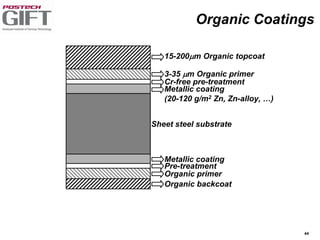
Sheet steel substrate
Metallic coating
(20-120 g/m2 Zn, Zn-alloy, …)
Cr-free pre-treatment
3-35 mm Organic primer
15-200mm Organic topcoat
Organic backcoat
Organic primer
Pre-treatment
Metallic coating
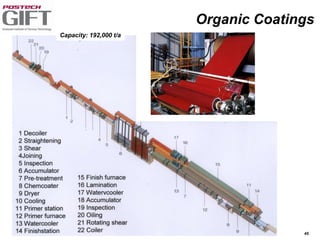
Organic Coatings
45
Capacity: 192,000 t/a
Organic Coatings
46
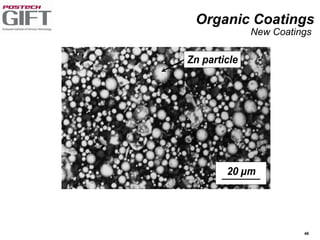
20 µm
Zn particle
Organic Coatings
New Coatings
47
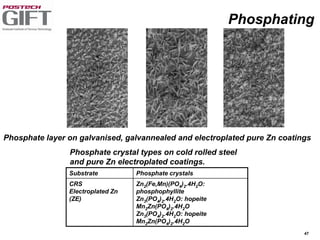
Phosphate layer on galvanised, galvannealed and electroplated pure Zn coatings
Phosphate crystal types on cold rolled steel
and pure Zn electroplated coatings.
Substrate Phosphate crystals
CRS
Electroplated Zn
(ZE)
Zn2(Fe,Mn)(PO4)2.4H2O:
phosphophyllite
Zn3(PO4)2.4H2O: hopeite
Mn2Zn(PO4)2.4H2O
Zn3(PO4)2.4H2O: hopeite
Mn2Zn(PO4)2.4H2O
Phosphating
48
• The cosmetic and perforation corrosion protection of
sheet steel, the different types metallic and organic
coatings for (hot and) cold rolled strip products, and
the essentials of the different coating technologies,
were presented.
• The origin of the coating microstructure, in particular
the structure of galvanized and galvannealed coatings,
was discussed.
• The importance of metallic and organic coatings on
the continue use of (hot and) cold rolled strip products
was emphasized.
Session Conclusions

Introduction to Steel Coating Technologies_BCDeCooman_2016

  • 1.
    1 Coating Technologies B.C. DeCooman MDL GIFT, POSTECH
  • 2.
    2 Much of thesuccess of coated sheet steel is due to a switch from uncoated to coated sheet in the automotive industry and its increased use in the building industry and household appliance manufacturing. By coating steel via galvanizing or other coating technologies, the steel gains superior corrosion resistance at a low cost without impacting the availability or recycle-ability of the product. This has lead to its widespread use in manufacturing. The session includes cosmetic and perforation corrosion protection of sheet steel, the different types of metallic and organic coatings for hot and cold rolled strip products, and the essentials of the different coating technologies. Also included is the origin of the coating microstructure and the importance of metallic and organic coatings on hot and cold-rolled strip products. Coating Technologies Introduction to Coating Technologies for CRS
  • 3.
    3 Widespread use inmanufacturing Superior corrosion resistance Low cost Availability Recycle-ability Diversity of coating types Favorable application characteristics: Excellent coating adhesion Formability Weldability Phosphatability. Much of the success of coated sheet steel is due to a switch from uncoated to coated sheet in the automotive industry and its increased use in the building industry and household appliance manufacturing Coated Sheet Steel
  • 4.
    4 Cosmetic corrosion onCRS Filiform corrosion Perforation corrosion on CRS Corrosion of Uncoated Steel
  • 5.
    5 CRS Red rust Paint undercreep HotDip Galvanised No red rust «white» rust Zn-Fe Galvannealed Low corrosion rate Excellent paint adhesion , Corrosion of Coated Steel
  • 6.
    6 1. Cathodic disbondment: Cathodicreduction of dissolved oxygen: O2 + 2H2O + 4e- → 4OH- Anodic reaction occurs at a coating defect: Fe → Fe2+ +2e- 2. Oxide lifting: when anodic corrosion products accumulate under the coating. The cathodic reaction during anodic lifting: O2 + 2H2O + 4e- → 4OH- At the metal surface in the scribe or possibly at the outer magnetite interface: 8FeOOH + Fe2+ + 2e- → 3Fe3O4 + 4H2O Uncoated steel Corrosion of Coated Steel
  • 7.
  • 8.
    8 Zn Electro-coated coatingthicknesses: 2.5 - 15µm/side or 20-105g/m2 The density of the Zn-coating is 7.14 g/cm3. HDG Zn coatings: Constructional steels: Important: long term corrosion resistance requirements Coating thickness (can be) high: 700 g/m2 or 49 µm/side. Automotive steels: Important: cosmetic and perforation resistance GI Coating thickness: 6 - 20µm/side (40-140g/m2) GA Coating thickness: 6 - 11µm/side (40-80g/m2) Corrosion of Coated Steel
  • 9.
    9 Coating Weight, g/m2 Timeto5%RedRustFormation,hours 500 400 300 200 100 0 020 40 60 80 100 Electro-galvanized Hot Dip Galvanized Zn-Ni Fe Zn Zn Galvanic corrosion protection Low atmospheric corrosion rate of Zn pH 0 2 4 6 8 10 12 14 Corrosionrate,cm/y 0.5 0.4 0.3 0.2 0.1 0 Corrosion of Coated Steel
  • 10.
  • 11.
    11 Sheet Conductor rolls Electrolyte: sulphate Cell volume:~8m3 Current density: ~150A/dm2 Strip velocity: ~200m/min Insoluble Ti-IrO2 anodes + - + Zn, Zn-alloy layer Electrolytic Zn Coatings of CRS
  • 12.
    12 pure Zn (ZE)Zn-Ni (ZNE) Zn-Fe (ZFE) Electrolytic Zn, Zn-Alloy Coatings on CRS
  • 13.
    13 Weight-% Zn Temperature,°C 500 800 700 600 300 400 200 60 7080 90 Zn Weight-% Zn 60 70 80 90 Zn5040 Al Zn 95% 419°C 660°C liquid Weight-% Si 10 20 30 40Al Al 660°C 11.7% Si 660°C liquid 665°C 530°C 550°C 425°C     Galvalume Galfan Galvanized Aluminized Galvannealed Galvanized Metallic Alloy Coatings on CRS
  • 14.
    14 Hot Dip GalvanizedZn and Zn-alloy Coatings General Layout Continuous Hot Dip Galvanizing Line Pay-off reels Tension reels Welder Pre-cleaning section Cleaning section Entry looper Post-treatments section Delivery looper Tension leveller Skinpass mill Cooling tower Zn pot GA furnace Pre-heating Heating Soaking Gas-jet cooling Low-T holding
  • 15.
    15 RTF DFF Slow Cooling section Fast Cooling section Overaging section Snout Zn Pot Cooling Water Quench HDGline with over-aging section Strip Width: 0.7-1.6m Strip thickness: 0.25-2.5mm Production: 350.000mtpy (~80tph) T max: 820°C HDG Line with Direct Fired Furnace + Radiant Tube Furnace Hot Dip Galvanized Zn and Zn-alloy Coatings Cooling tower
  • 16.
    16 Direct Fired Furnace HotDip Galvanized Zn and Zn-alloy Coatings Impingement burner panel of a Direct Fired Furnace. Direct Fired Furnace characteristics: 1. Controlled air/gas ratio, with ~1000ppm of excess 02 2. Rapid and homogenous strip heating to 700ºC-750ºC 3. Strip surface cleaned by contact with combustion gas 4. Oxidizes the strip surface 5. Oxygen diffuses into the sheet
  • 17.
    17 Radiant tube furnace Cooling section Direct FiredFurnace + Radiant Tube Furnace Hot Dip Galvanized Zn and Zn-alloy Coatings Maximum strip temperature 850ºC Cooling after Zn pot 220°C (to 45°C)
  • 18.
    18 Cooling section Gas-jet cooling Hot DipGalvanized Zn and Zn-alloy Coatings Hot Cooling gas out Cold Cooling gas out
  • 19.
    19 DFF+RTF Annealing FurnaceEquipment Hot Dip Galvanized Zn and Zn-alloy Coatings Burners RTF with N2+5%H2 reducing gas atmosphereDFF Pyrometer Recuperative Pre-heater Heating zone Flue gas heats incoming strip Pyrometer Heating zone Soaking zone Post-combustion chamber Pyrometer Air inlet Gas fired radiant tubes Transfer section with air-lock Maximum strip temperature 850ºC Preheating strip temperature 320ºC DFF strip temperature 750ºC To the cooling sections…
  • 20.
    20 Furnace Cooling SectionEquipment Hot Dip Galvanized Zn and Zn-alloy Coatings RTFDFF Slow cooling Fast gas-jet cooling up to 100ºC/s, 1mm strip To the Zn pot… Snout dipped in Zn pot Slow to fast cooling transfer zone with hot bridle to increase the strip tension before rapid cooling Exit section equipment: Small over-aging section Post heating booster to reheat the strip for cooling below Zn pot temperature Hot bridle to increase the strip tension (e.g. 10MPa to 25MPa)
  • 21.
    21 Hot gauges Galvannealing furnace Annealingfurnace Galvannealing furnace Gas wipers Front view Sideview Cross-sectional view Zn pot Cooling section Zn Pot Equipment Hot Dip Galvanized Zn and Zn-alloy Coatings Snout Zn pot
  • 22.
    22 Hot Dip GalvanizedZn and Zn-alloy Coatings During annealing the selective oxidation of alloying elements such as Mn, Si, … takes place at the steel surface and in the sub-surface Dew Point Furnace Gas Atmosphere Weigth-%SiinSteel T: 850ºC N2+H2 -27ºC +14ºC External SiO2 Internal SiO2 0% Si 1% Si 2% Si 3% Si Me-oxide Me-oxide Internal oxidation External oxidation
  • 23.
    23 Hot Dip GalvanizedZn and Zn-alloy Coatings During annealing the selective oxidation of alloying elements such as Mn, Si, … takes place at the steel surface and in the sub-surface Example for Fe-0.16%C-2%Mn-1%Al TRIP Steel Surface Intercritical Annealing temperature: 827ºC Furnace gas compositions N2+10%H2 Atmosphere dew point: -30ºC Oxide particles Oxide film Oxides730nm Nitrides900nm 500nm
  • 24.
    24 “Heat-to-coat”: No Rex-annealing PicklingFurnace Rinsing, Drying Cooling Molten Zn Cooling 600oC 60s Dipping Time Temperature Pickling Induction furnace Zn pot Hot Dip Galvanized Zn and Zn-alloy Coatings Hot dip Galvanizing of Hot Rolled Strip
  • 25.
    25 Fe-oxide reduction Selective oxidation Snout: exposure Zn metalvapor Zn-pot: 1. Strip surface dissolution 2. Inhibition layer formation Galvannealing: 1. Inhibition layer breakdown 2. Fe-Zn reaction Gas wipers: 1. Final wetting 2. Solidification Annealing furnace Hot Dip Galvanized Zn and Zn-alloy Coatings
  • 26.
    26 10µm STEEL Galvanized Fe2Al5-xZnx inhibition layer (<0.5mm) Zn solidsolution 0.3-0.5 m-% Al 0.05 m-% Fe Al2O3-rich surface layer mass-% Al 30-50 0.1-0.2 Zn Bath Management: Inhibition layer formation Hot Dip Galvanized Zn and Zn-alloy Coatings
  • 27.
    27 • Zn bathmanagement involves the control of the effective Al content in the bath, the timing of the Al additions to the Zn bath, the solute Fe content, the control of the bath hardware. FeZn13, FeZn7 « Top Dross » Fe2Al5-xZnx solute Fe Aleff « Bottom Dross » Annealing Furnace Stabilizing Rolls Air-knives Touch Rolls GA- Furnace Snout 50mm Fe2Al5 Top dross Bottom dross Zn Hot Dip Galvanized Zn and Zn-alloy Coatings Zn Bath Management
  • 28.
    28 Zn-Fe-Al diagram at465°C Liquid +  Liquid +  Liquid + Fe2Al5 Liquid Zn + Fe, Al in solution Liquid+ + Fe2Al5 Al content, mass-% Fecontent,mass-% 0 0.02 0.04 0.06 0.08 0.10 0.12 0.14 0.16 0.18 0.20 0 0.01 0.02 0.03 0.04 0.05 0.06 0.07 0.08 0.09 0.10 Liquid+ +  50mm Fe2Al5 Top dross Bottom dross Zn Hot Dip Galvanized Zn and Zn-alloy Coatings Zn Bath Management
  • 29.
    29 Liquid +  Liquid +  Liquid + Fe2Al5 Liquid Zn + Fe, Alin solution Al content, mass-% Fecontent,mass-% 0 0.02 0.04 0.06 0.08 0.10 0.12 0.14 0.16 0.18 0.20 0 0.01 0.02 0.03 0.04 0.05 0.06 0.07 0.08 0.09 0.10 Increase of the Al content: Lowers the Fe solubility Changes of compound from  to  to Fe2Al5 Changes the GA kinetics Hot Dip Galvanized Zn and Zn-alloy Coatings Zn Bath Management
  • 30.
    30 Al content control: 1.Low, i.e. 0.12 mass-%, for galvannealing (weak inhibition Fe-Zn reactions) 2. High, i.e. 0.2 mass-%, for galvanizing (strong inhibition Fe-Zn reactions by Fe2Al5 formation FeZn13, FeZn7 « Top Dross » Fe2Al5-xZnx solute Fe Aleff « Bottom Dross » Annealing Furnace Stabilizing Rolls Air-knives Touch Rolls GA- Furnace Snout Liquid +  Liquid +  Liquid + Fe2Al5 Liquid Zn + Fe, Al in solution Liquid+ + Fe2Al5 Al content, mass-% Fecontent,mass-% 0 0.02 0.04 0.06 0.08 0.10 0.12 0.14 0.16 0.18 0.20 0 0.01 0.02 0.03 0.04 0.05 0.06 0.07 0.08 0.09 0.10 Liquid+ +  Al addition: 1. Pre-melting in separate induction melting unit 2. Direct addition of small Zn-Al alloy bars Hot Dip Galvanized Zn and Zn-alloy Coatings Zn Bath Management
  • 31.
    31 Al content distribution: 1.The Al content is homogeneous, due to the efficient mixing by the strip motion and the turbulence caused by the induction heating. 2. The temperature distribution is the most important factor; it is also homogeneous. 451°C 450°C 447°C 0.13% 0.126% 0.14% Temperature distribution Solute Al distribution Hot Dip Galvanized Zn and Zn-alloy Coatings Zn Bath Management
  • 32.
    32 Liquid +  Liquid +  Liquid + Fe2Al5 Liquid Zn + Fe,Al in solution Al content, mass-% Fecontent,mass-% 0 0.02 0.04 0.06 0.08 0.10 0.12 0.14 0.16 0.18 0.20 0 0.01 0.02 0.03 0.04 0.05 0.06 0.07 0.08 0.09 0.10 Bath-T: 461°C Surface sampling Bottom sampling Solute Al content : The solute Al content, Al effective, is not the same as the total Al content Determination of the effective Al content requires an accurate temperature control Hot Dip Galvanized Zn and Zn-alloy Coatings Zn Bath Management
  • 33.
    33 Position Znthickness Air-knive <10 to >100mm Znthickness control Air Knife Hot Dip Galvanized Zn and Zn-alloy Coatings Zn Pot Equipment: the air knife
  • 34.
    34 0 100 200300 400 0 100 200 300 400 500 600 700 800 Temperature,°C Time, s Soaking Hot dipping in Zn bath Galvannealing Hot Dip Galvanized Zn and Zn-alloy Coatings The Thermal Cycle
  • 35.
    35 Hot Dip GalvanizedZn and Zn-alloy Coatings The Thermal Cycle: CA vs HDG Line Cycles 0 200 400 600 800 0 100 200 300 400 500 600 700 800 CA Line with overaging Temperature,C Time, s 0 100 200 300 400 500 Time, s 0 100 200 300 400 500 Time, s 0 100 200 300 400 500 Time, s HDG Line no overaging Advanced HDG Line HDG Line with overaging Al-killed Low C grades Interstitial-free grades AHSS grades AKLC and IF grades
  • 36.
    36 Zn-pot Time Temperature Ac3 Ac1 Ms TRIP Grades DPGrades Q&P Grades Hot Dip Galvanized Zn and Zn-alloy Coatings New Thermal Cycles for Galvanized AHSS DP, TRIP and Q&P Grades Strip reheating (inductors)
  • 37.
    37 0 100 200300 400 500 600 0 200 400 600 800 280C 350C GA 510C -0.4 C/s DP steel processing Line speed : 100mpm -3 C/s -7.6 C/s 650C Temperature(C) Time (sec) 3 C/s 790C -6.5 C/s GI: 460C 560C 0 100 200 300 400 500 600 700 800 900 1000 0 200 400 600 800 DP Steel processing Line speed : 150mpm -2.5 C/s 270C -19C/s Temperature(C) Time (sec) 2.5 C/s 790C -3 C/s 650C 0 100 200 300 400 500 0 200 400 600 800 280C 350C GA 510C DP Steel processing Line speed: 100mpm -3 C/s -9.2 C/s 650C Temperature(C) Time (sec) 3 C/s 790C -6.5 C/s GI: 460C 560C 10 vol-% g a‘ Ms Mf ~400s ~150s Examples of Processing of DP in HDG Lines
  • 38.
    38 STEEL Galvannealed  -phase FeZn3 -phase FeZn8  -phase FeZn13 5.7-6.3 7.9-10.9 20-28 STEEL Galvanized Fe2Al5-xZnx inhibition layer (<0.5mm) Zn solid solution 0.3-0.5 m-% Al 0.05 m-% Fe Al2O3-rich surface layer mass-% Al30-50 0.1-0.2 mass-% Fe Hot Dip Galvanized Zn and Zn-alloy Coatings
  • 39.
    39    outbursts 10 µm HotDip Galvanized Zn and Zn-alloy Coatings The Galvannealing Reaction
  • 40.
    40 Hot Dip GalvanizedZn and Zn-alloy Coatings The Galvannealing Reaction 0 2 4 6 8 10 12 0 2 4 6 8 10 120 2 4 6 8 10 12 0 10 20 30 40 50 60 70 80 90 100 Fe in coating, m-% 0 2 4 6 8 10 12 % : Zn : FeZn13 : FeZn7 : FeZn3 ~10% Fe
  • 41.
    41 Fe in coating,m-% 0 2 4 6 8 10 12 14 Powdering,g/m2 0 2 4 6 8 10 12 14 16 18 20 Hot Dip Galvanized Zn and Zn-alloy Coatings Powdering of Galvannealed Coatings ~10% Fe
  • 42.
    42 10 µm 10µm Steel Coating Zn-5%Al Galfan coating. The matrix is primary Zn and the darker areas are Al-rich. Note that the eutectic solidification leads to a lamellar or a rod-like microstructure. Hot Dip Galvanized Zn-5% Al Alloy Coatings Zn-Al eutectic solidification
  • 43.
    43 Hot Dip GalvanizedAl-10% Si Alloy Coatings
  • 44.
    44 Sheet steel substrate Metalliccoating (20-120 g/m2 Zn, Zn-alloy, …) Cr-free pre-treatment 3-35 mm Organic primer 15-200mm Organic topcoat Organic backcoat Organic primer Pre-treatment Metallic coating Organic Coatings
  • 45.
  • 46.
    46 20 µm Zn particle OrganicCoatings New Coatings
  • 47.
    47 Phosphate layer ongalvanised, galvannealed and electroplated pure Zn coatings Phosphate crystal types on cold rolled steel and pure Zn electroplated coatings. Substrate Phosphate crystals CRS Electroplated Zn (ZE) Zn2(Fe,Mn)(PO4)2.4H2O: phosphophyllite Zn3(PO4)2.4H2O: hopeite Mn2Zn(PO4)2.4H2O Zn3(PO4)2.4H2O: hopeite Mn2Zn(PO4)2.4H2O Phosphating
  • 48.
    48 • The cosmeticand perforation corrosion protection of sheet steel, the different types metallic and organic coatings for (hot and) cold rolled strip products, and the essentials of the different coating technologies, were presented. • The origin of the coating microstructure, in particular the structure of galvanized and galvannealed coatings, was discussed. • The importance of metallic and organic coatings on the continue use of (hot and) cold rolled strip products was emphasized. Session Conclusions