Flat Product Technology Group - Coated Confidential. Not for Circulation
Galvannealed Coating – Basics
Presented by-
Mohseen A. Kadarbhai
Sr. Manager, PTFP – Coated Technology
22-Aug-16
Flat Product Technology Group Confidential. Not for Circulation
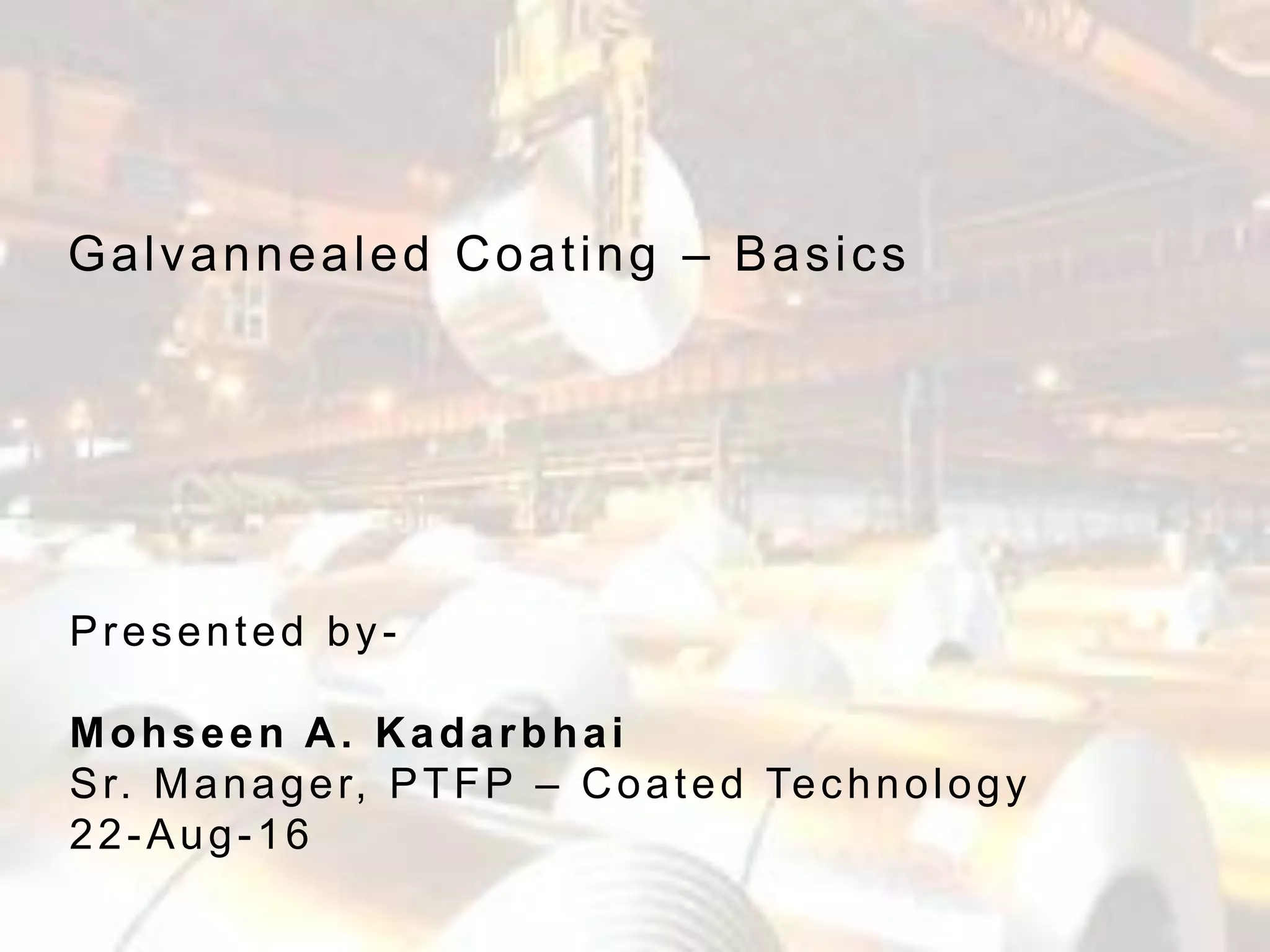
Attribute Sub attribute CR GI GA
Corrosion
Resistance
a) Perforation corrosion XX √√ ☺☺
b) Chipping corrosion XX √√ ☺☺
c) Scab corrosion XX √ ☺☺
Stamping a) Friction Coefficient √√ √√ √
b) Powdering ☺☺ √ X
Weldability a) Current level ☺☺ √ √√
b) Electrode Life ☺☺ X √√
Painting a) Adherence ☺☺ √ √√
XX- Very Poor
X- Poor
√ - Good
√√ - Very Good
☺- Excellent
WHY USE GA?
Making use of best of both worlds
It is not possible to make powdering zero in a GA coating. However, it is an ideal
solution to most of the subsequent customer end processes (especially welding) and
hence the preferred coated material over GI.
2
Confidential. Not for Circulation
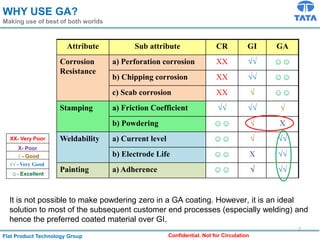
Welding
Electrolytic
cleaning
Continuous
Annealing
Zn Pot
dipping
Wiping
GA
Furnace
Skin Pass
Mill and TL
Roll Coater
Exit
inspection
and oiling
Zinc Coated
Galvannealed Sheet
Output
PROCESS FLOW AT CGL2
3
Confidential. Not for Circulation
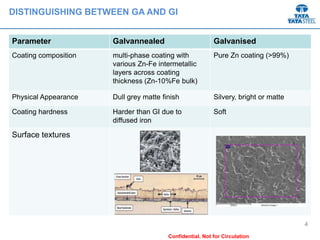
Parameter Galvannealed Galvanised
Coating composition multi-phase coating with
various Zn-Fe intermetallic
layers across coating
thickness (Zn-10%Fe bulk)
Pure Zn coating (>99%)
Physical Appearance Dull grey matte finish Silvery, bright or matte
Coating hardness Harder than GI due to
diffused iron
Soft
Surface textures
4
DISTINGUISHING BETWEEN GA AND GI
Confidential. Not for Circulation
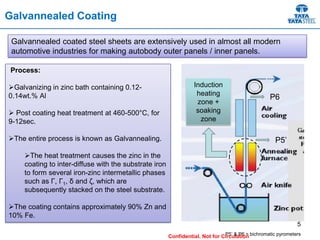
Galvannealed Coating
Galvannealed coated steel sheets are extensively used in almost all modern
automotive industries for making autobody outer panels / inner panels.
Process:
Galvanizing in zinc bath containing 0.12-
0.14wt.% Al
 Post coating heat treatment at 460-500°C, for
9-12sec.
The entire process is known as Galvannealing.
The heat treatment causes the zinc in the
coating to inter-diffuse with the substrate iron
to form several iron-zinc intermetallic phases
such as Γ, Γ1, δ and ζ, which are
subsequently stacked on the steel substrate.
The coating contains approximately 90% Zn and
10% Fe.
Induction
heating
zone +
soaking
zone
P5’
P6
P5’ & P6 = bichromatic pyrometers
5
Confidential. Not for Circulation
6
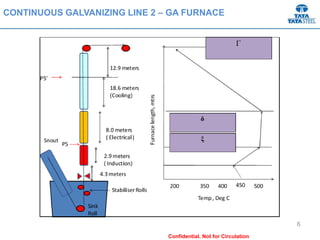
CONTINUOUS GALVANIZING LINE 2 – GA FURNACE
Confidential. Not for Circulation
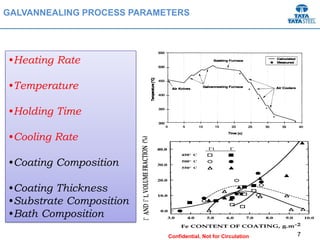
•Heating Rate
•Temperature
•Holding Time
•Cooling Rate
•Coating Composition
•Coating Thickness
•Substrate Composition
•Bath Composition
GALVANNEALING PROCESS PARAMETERS
7
Confidential. Not for Circulation
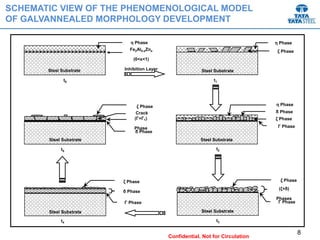
SCHEMATIC VIEW OF THE PHENOMENOLOGICAL MODEL
OF GALVANNEALED MORPHOLOGY DEVELOPMENT
t0
Fe2Al5-xZnx
(0<x<1)
Inhibition Layer
η Phase
Steel Substrate
δ Phase
t5
ζ Phase
Crack
(Γ+Γ1)
Phase
Steel Substrate
η Phase
ζ Phase
t1
Steel Substrate
δ Phase
η Phase
ζ Phase
t2
Γ Phase
Steel Substrate
t3
ζ Phase
(ζ+δ)
Phases
Γ Phase
Steel Substrate
t4
ζ Phase
δ Phase
Γ Phase
Steel Substrate
8
Flat Product Technology Group - Coated Confidential. Not for Circulation
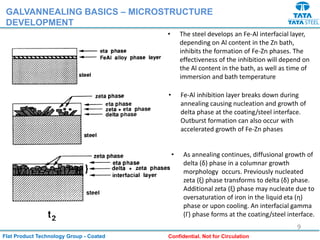
GALVANNEALING BASICS – MICROSTRUCTURE
DEVELOPMENT
• The steel develops an Fe-Al interfacial layer,
depending on Al content in the Zn bath,
inhibits the formation of Fe-Zn phases. The
effectiveness of the inhibition will depend on
the Al content in the bath, as well as time of
immersion and bath temperature
• Fe-Al inhibition layer breaks down during
annealing causing nucleation and growth of
delta phase at the coating/steel interface.
Outburst formation can also occur with
accelerated growth of Fe-Zn phases
• As annealing continues, diffusional growth of
delta (δ) phase in a columnar growth
morphology occurs. Previously nucleated
zeta (ξ) phase transforms to delta (δ) phase.
Additional zeta (ξ) phase may nucleate due to
oversaturation of iron in the liquid eta (η)
phase or upon cooling. An interfacial gamma
(Γ) phase forms at the coating/steel interface.
9
Flat Product Technology Group - Coated Confidential. Not for Circulation
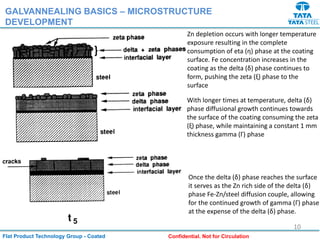
GALVANNEALING BASICS – MICROSTRUCTURE
DEVELOPMENT
• Zn depletion occurs with longer temperature
exposure resulting in the complete
consumption of eta (η) phase at the coating
surface. Fe concentration increases in the
coating as the delta (δ) phase continues to
form, pushing the zeta (ξ) phase to the
surface
• With longer times at temperature, delta (δ)
phase diffusional growth continues towards
the surface of the coating consuming the zeta
(ξ) phase, while maintaining a constant 1 mm
thickness gamma (Γ) phase
• Once the delta (δ) phase reaches the surface
it serves as the Zn rich side of the delta (δ)
phase Fe-Zn/steel diffusion couple, allowing
for the continued growth of gamma (Γ) phase
at the expense of the delta (δ) phase.
10
Flat Product Technology Group Confidential. Not for Circulation
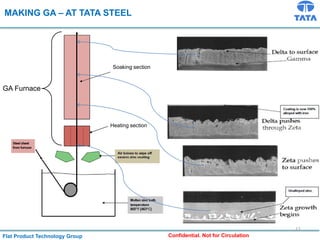
MAKING GA – AT TATA STEEL
Soaking section
Heating section
GA Furnace
11
Confidential. Not for Circulation
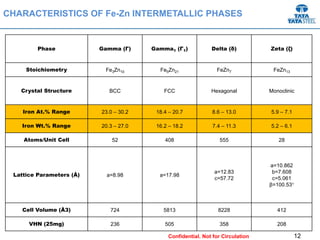
Phase Gamma (Γ) Gamma1 (Γ1) Delta (δ) Zeta (ζ)
Stoichiometry Fe3Zn10 Fe5Zn21 FeZn7 FeZn13
Crystal Structure BCC FCC Hexagonal Monoclinic
Iron At.% Range 23.0 – 30.2 18.4 – 20.7 8.6 – 13.0 5.9 – 7.1
Iron Wt.% Range 20.3 – 27.0 16.2 – 18.2 7.4 – 11.3 5.2 – 6.1
Atoms/Unit Cell 52 408 555 28
Lattice Parameters (Å) a=8.98 a=17.98
a=12.83
c=57.72
a=10.862
b=7.608
c=5.061
β=100.53°
Cell Volume (Å3) 724 5813 8228 412
VHN (25mg) 236 505 358 208
CHARACTERISTICS OF Fe-Zn INTERMETALLIC PHASES
12
Flat Product Technology Group Confidential. Not for Circulation
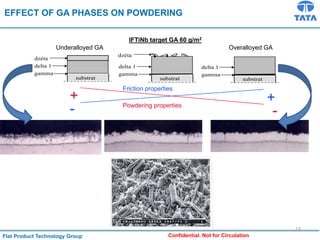
substrat
dzéta
delta 1
gamma
substrat
dzéta
delta 1
gamma
substrat
delta 1
gamma
Friction properties
Powdering properties
- -
+
+
Underalloyed GA Overalloyed GA
IFTiNb target GA 60 g/m2
EFFECT OF GA PHASES ON POWDERING
13
Flat Product Technology Group Confidential. Not for Circulation
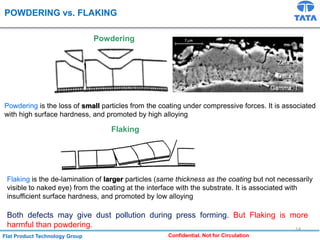
POWDERING vs. FLAKING
Powdering is the loss of small particles from the coating under compressive forces. It is associated
with high surface hardness, and promoted by high alloying
Flaking
Flaking is the de-lamination of larger particles (same thickness as the coating but not necessarily
visible to naked eye) from the coating at the interface with the substrate. It is associated with
insufficient surface hardness, and promoted by low alloying
Both defects may give dust pollution during press forming. But Flaking is more
harmful than powdering.
Powdering
14
Flat Product Technology Group Confidential. Not for Circulation
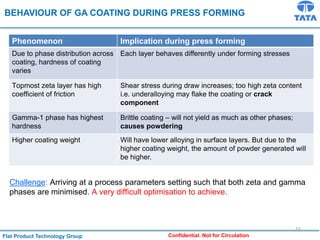
BEHAVIOUR OF GA COATING DURING PRESS FORMING
Phenomenon Implication during press forming
Due to phase distribution across
coating, hardness of coating
varies
Each layer behaves differently under forming stresses
Topmost zeta layer has high
coefficient of friction
Shear stress during draw increases; too high zeta content
i.e. underalloying may flake the coating or crack
component
Gamma-1 phase has highest
hardness
Brittle coating – will not yield as much as other phases;
causes powdering
Higher coating weight Will have lower alloying in surface layers. But due to the
higher coating weight, the amount of powder generated will
be higher.
Challenge: Arriving at a process parameters setting such that both zeta and gamma
phases are minimised. A very difficult optimisation to achieve.
15
Flat Product Technology Group Confidential. Not for Circulation
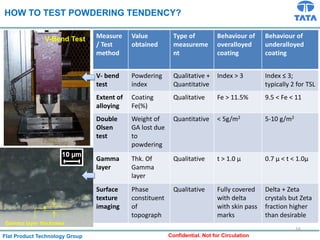
HOW TO TEST POWDERING TENDENCY?
Measure
/ Test
method
Value
obtained
Type of
measureme
nt
Behaviour of
overalloyed
coating
Behaviour of
underalloyed
coating
V- bend
test
Powdering
index
Qualitative +
Quantitative
Index > 3 Index ≤ 3;
typically 2 for TSL
Extent of
alloying
Coating
Fe(%)
Qualitative Fe > 11.5% 9.5 < Fe < 11
Double
Olsen
test
Weight of
GA lost due
to
powdering
Quantitative < 5g/m2 5-10 g/m2
Gamma
layer
Thk. Of
Gamma
layer
Qualitative t > 1.0 μ 0.7 μ < t < 1.0μ
Surface
texture
imaging
Phase
constituent
of
topograph
Qualitative Fully covered
with delta
with skin pass
marks
Delta + Zeta
crystals but Zeta
fraction higher
than desirable
V-Bend Test
Gamma layer thickness
16
Flat Product Technology Group Confidential. Not for Circulation
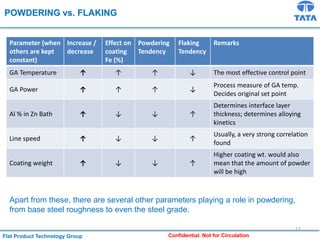
POWDERING vs. FLAKING
Parameter (when
others are kept
constant)
Increase /
decrease
Effect on
coating
Fe (%)
Powdering
Tendency
Flaking
Tendency
Remarks
GA Temperature ↑ ↑ ↑ ↓ The most effective control point
GA Power ↑ ↑ ↑ ↓
Process measure of GA temp.
Decides original set point
Al % in Zn Bath ↑ ↓ ↓ ↑
Determines interface layer
thickness; determines alloying
kinetics
Line speed ↑ ↓ ↓ ↑
Usually, a very strong correlation
found
Coating weight ↑ ↓ ↓ ↑
Higher coating wt. would also
mean that the amount of powder
will be high
Apart from these, there are several other parameters playing a role in powdering,
from base steel roughness to even the steel grade.
17
Flat Product Technology Group Confidential. Not for Circulation
18
THANK YOU

Galvannealed Coating – Basics - Tata Steel DigEca.pdf

  • 1.
    Flat Product TechnologyGroup - Coated Confidential. Not for Circulation Galvannealed Coating – Basics Presented by- Mohseen A. Kadarbhai Sr. Manager, PTFP – Coated Technology 22-Aug-16
  • 2.
    Flat Product TechnologyGroup Confidential. Not for Circulation Attribute Sub attribute CR GI GA Corrosion Resistance a) Perforation corrosion XX √√ ☺☺ b) Chipping corrosion XX √√ ☺☺ c) Scab corrosion XX √ ☺☺ Stamping a) Friction Coefficient √√ √√ √ b) Powdering ☺☺ √ X Weldability a) Current level ☺☺ √ √√ b) Electrode Life ☺☺ X √√ Painting a) Adherence ☺☺ √ √√ XX- Very Poor X- Poor √ - Good √√ - Very Good ☺- Excellent WHY USE GA? Making use of best of both worlds It is not possible to make powdering zero in a GA coating. However, it is an ideal solution to most of the subsequent customer end processes (especially welding) and hence the preferred coated material over GI. 2
  • 3.
    Confidential. Not forCirculation Welding Electrolytic cleaning Continuous Annealing Zn Pot dipping Wiping GA Furnace Skin Pass Mill and TL Roll Coater Exit inspection and oiling Zinc Coated Galvannealed Sheet Output PROCESS FLOW AT CGL2 3
  • 4.
    Confidential. Not forCirculation Parameter Galvannealed Galvanised Coating composition multi-phase coating with various Zn-Fe intermetallic layers across coating thickness (Zn-10%Fe bulk) Pure Zn coating (>99%) Physical Appearance Dull grey matte finish Silvery, bright or matte Coating hardness Harder than GI due to diffused iron Soft Surface textures 4 DISTINGUISHING BETWEEN GA AND GI
  • 5.
    Confidential. Not forCirculation Galvannealed Coating Galvannealed coated steel sheets are extensively used in almost all modern automotive industries for making autobody outer panels / inner panels. Process: Galvanizing in zinc bath containing 0.12- 0.14wt.% Al  Post coating heat treatment at 460-500°C, for 9-12sec. The entire process is known as Galvannealing. The heat treatment causes the zinc in the coating to inter-diffuse with the substrate iron to form several iron-zinc intermetallic phases such as Γ, Γ1, δ and ζ, which are subsequently stacked on the steel substrate. The coating contains approximately 90% Zn and 10% Fe. Induction heating zone + soaking zone P5’ P6 P5’ & P6 = bichromatic pyrometers 5
  • 6.
    Confidential. Not forCirculation 6 CONTINUOUS GALVANIZING LINE 2 – GA FURNACE
  • 7.
    Confidential. Not forCirculation •Heating Rate •Temperature •Holding Time •Cooling Rate •Coating Composition •Coating Thickness •Substrate Composition •Bath Composition GALVANNEALING PROCESS PARAMETERS 7
  • 8.
    Confidential. Not forCirculation SCHEMATIC VIEW OF THE PHENOMENOLOGICAL MODEL OF GALVANNEALED MORPHOLOGY DEVELOPMENT t0 Fe2Al5-xZnx (0<x<1) Inhibition Layer η Phase Steel Substrate δ Phase t5 ζ Phase Crack (Γ+Γ1) Phase Steel Substrate η Phase ζ Phase t1 Steel Substrate δ Phase η Phase ζ Phase t2 Γ Phase Steel Substrate t3 ζ Phase (ζ+δ) Phases Γ Phase Steel Substrate t4 ζ Phase δ Phase Γ Phase Steel Substrate 8
  • 9.
    Flat Product TechnologyGroup - Coated Confidential. Not for Circulation GALVANNEALING BASICS – MICROSTRUCTURE DEVELOPMENT • The steel develops an Fe-Al interfacial layer, depending on Al content in the Zn bath, inhibits the formation of Fe-Zn phases. The effectiveness of the inhibition will depend on the Al content in the bath, as well as time of immersion and bath temperature • Fe-Al inhibition layer breaks down during annealing causing nucleation and growth of delta phase at the coating/steel interface. Outburst formation can also occur with accelerated growth of Fe-Zn phases • As annealing continues, diffusional growth of delta (δ) phase in a columnar growth morphology occurs. Previously nucleated zeta (ξ) phase transforms to delta (δ) phase. Additional zeta (ξ) phase may nucleate due to oversaturation of iron in the liquid eta (η) phase or upon cooling. An interfacial gamma (Γ) phase forms at the coating/steel interface. 9
  • 10.
    Flat Product TechnologyGroup - Coated Confidential. Not for Circulation GALVANNEALING BASICS – MICROSTRUCTURE DEVELOPMENT • Zn depletion occurs with longer temperature exposure resulting in the complete consumption of eta (η) phase at the coating surface. Fe concentration increases in the coating as the delta (δ) phase continues to form, pushing the zeta (ξ) phase to the surface • With longer times at temperature, delta (δ) phase diffusional growth continues towards the surface of the coating consuming the zeta (ξ) phase, while maintaining a constant 1 mm thickness gamma (Γ) phase • Once the delta (δ) phase reaches the surface it serves as the Zn rich side of the delta (δ) phase Fe-Zn/steel diffusion couple, allowing for the continued growth of gamma (Γ) phase at the expense of the delta (δ) phase. 10
  • 11.
    Flat Product TechnologyGroup Confidential. Not for Circulation MAKING GA – AT TATA STEEL Soaking section Heating section GA Furnace 11
  • 12.
    Confidential. Not forCirculation Phase Gamma (Γ) Gamma1 (Γ1) Delta (δ) Zeta (ζ) Stoichiometry Fe3Zn10 Fe5Zn21 FeZn7 FeZn13 Crystal Structure BCC FCC Hexagonal Monoclinic Iron At.% Range 23.0 – 30.2 18.4 – 20.7 8.6 – 13.0 5.9 – 7.1 Iron Wt.% Range 20.3 – 27.0 16.2 – 18.2 7.4 – 11.3 5.2 – 6.1 Atoms/Unit Cell 52 408 555 28 Lattice Parameters (Å) a=8.98 a=17.98 a=12.83 c=57.72 a=10.862 b=7.608 c=5.061 β=100.53° Cell Volume (Å3) 724 5813 8228 412 VHN (25mg) 236 505 358 208 CHARACTERISTICS OF Fe-Zn INTERMETALLIC PHASES 12
  • 13.
    Flat Product TechnologyGroup Confidential. Not for Circulation substrat dzéta delta 1 gamma substrat dzéta delta 1 gamma substrat delta 1 gamma Friction properties Powdering properties - - + + Underalloyed GA Overalloyed GA IFTiNb target GA 60 g/m2 EFFECT OF GA PHASES ON POWDERING 13
  • 14.
    Flat Product TechnologyGroup Confidential. Not for Circulation POWDERING vs. FLAKING Powdering is the loss of small particles from the coating under compressive forces. It is associated with high surface hardness, and promoted by high alloying Flaking Flaking is the de-lamination of larger particles (same thickness as the coating but not necessarily visible to naked eye) from the coating at the interface with the substrate. It is associated with insufficient surface hardness, and promoted by low alloying Both defects may give dust pollution during press forming. But Flaking is more harmful than powdering. Powdering 14
  • 15.
    Flat Product TechnologyGroup Confidential. Not for Circulation BEHAVIOUR OF GA COATING DURING PRESS FORMING Phenomenon Implication during press forming Due to phase distribution across coating, hardness of coating varies Each layer behaves differently under forming stresses Topmost zeta layer has high coefficient of friction Shear stress during draw increases; too high zeta content i.e. underalloying may flake the coating or crack component Gamma-1 phase has highest hardness Brittle coating – will not yield as much as other phases; causes powdering Higher coating weight Will have lower alloying in surface layers. But due to the higher coating weight, the amount of powder generated will be higher. Challenge: Arriving at a process parameters setting such that both zeta and gamma phases are minimised. A very difficult optimisation to achieve. 15
  • 16.
    Flat Product TechnologyGroup Confidential. Not for Circulation HOW TO TEST POWDERING TENDENCY? Measure / Test method Value obtained Type of measureme nt Behaviour of overalloyed coating Behaviour of underalloyed coating V- bend test Powdering index Qualitative + Quantitative Index > 3 Index ≤ 3; typically 2 for TSL Extent of alloying Coating Fe(%) Qualitative Fe > 11.5% 9.5 < Fe < 11 Double Olsen test Weight of GA lost due to powdering Quantitative < 5g/m2 5-10 g/m2 Gamma layer Thk. Of Gamma layer Qualitative t > 1.0 μ 0.7 μ < t < 1.0μ Surface texture imaging Phase constituent of topograph Qualitative Fully covered with delta with skin pass marks Delta + Zeta crystals but Zeta fraction higher than desirable V-Bend Test Gamma layer thickness 16
  • 17.
    Flat Product TechnologyGroup Confidential. Not for Circulation POWDERING vs. FLAKING Parameter (when others are kept constant) Increase / decrease Effect on coating Fe (%) Powdering Tendency Flaking Tendency Remarks GA Temperature ↑ ↑ ↑ ↓ The most effective control point GA Power ↑ ↑ ↑ ↓ Process measure of GA temp. Decides original set point Al % in Zn Bath ↑ ↓ ↓ ↑ Determines interface layer thickness; determines alloying kinetics Line speed ↑ ↓ ↓ ↑ Usually, a very strong correlation found Coating weight ↑ ↓ ↓ ↑ Higher coating wt. would also mean that the amount of powder will be high Apart from these, there are several other parameters playing a role in powdering, from base steel roughness to even the steel grade. 17
  • 18.
    Flat Product TechnologyGroup Confidential. Not for Circulation 18 THANK YOU