Quail Production and Management
Introduction
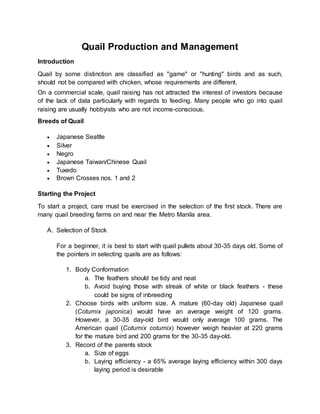
Quail by some distinction are classified as "game" or "hunting" birds and as such,
should not be compared with chicken, whose requirements are different.
On a commercial scale, quail raising has not attracted the interest of investors because
of the lack of data particularly with regards to feeding. Many people who go into quail
raising are usually hobbyists who are not income-conscious.
Breeds of Quail
 Japanese Seattle
 Silver
 Negro
 Japanese Taiwan/Chinese Quail
 Tuxedo
 Brown Crosses nos. 1 and 2
Starting the Project
To start a project, care must be exercised in the selection of the first stock. There are
many quail breeding farms on and near the Metro Manila area.
A. Selection of Stock
For a beginner, it is best to start with quail pullets about 30-35 days old. Some of
the pointers in selecting quails are as follows:
1. Body Conformation
a. The feathers should be tidy and neat
b. Avoid buying those with streak of white or black feathers - these
could be signs of inbreeding
2. Choose birds with uniform size. A mature (60-day old) Japanese quail
(Coturnix japonica) would have an average weight of 120 grams.
However, a 30-35 day-old bird would only average 100 grams. The
American quail (Coturnix coturnix) however weigh heavier at 220 grams
for the mature bird and 200 grams for the 30-35 day-old.
3. Record of the parents stock
a. Size of eggs
b. Laying efficiency - a 65% average laying efficiency within 300 days
laying period is desirable
c. Growth rate/body weight
B. Size of Flock
The size of the initial stock totally depends on the financial capacity of the
person. However, it is not advisable to start big. Quails are not easy to raise and
a beginner should first get the necessary experience before going into large
scale. Quails multiply rapidly and therefore expansion will not be a problem. A
beginner can start with 10-15 pullets.
Management
A. Housing and Equipment
One of the advantages in quail raising is the relatively small space that is
required. Commensurately, the cost of putting up a cage is less. The materials
commonly used in making quail cages are:
1. Plywood
2. ¼ inch mesh wire
3. 1 x 1 lumber to serve as framework
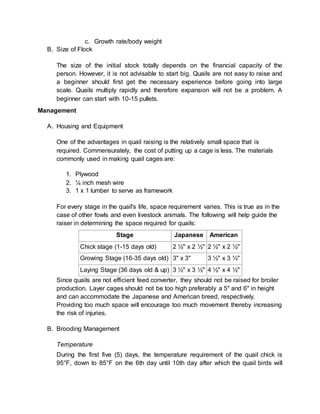
For every stage in the quail's life, space requirement varies. This is true as in the
case of other fowls and even livestock animals. The following will help guide the
raiser in determining the space required for quails:
Stage Japanese American
Chick stage (1-15 days old) 2 ½" x 2 ½" 2 ½" x 2 ½"
Growing Stage (16-35 days old) 3" x 3" 3 ½" x 3 ½"
Laying Stage (36 days old & up) 3 ½" x 3 ½" 4 ½" x 4 ½"
Since quails are not efficient feed converter, they should not be raised for broiler
production. Layer cages should not be too high preferably a 5" and 6" in height
and can accommodate the Japanese and American breed, respectively.
Providing too much space will encourage too much movement thereby increasing
the risk of injuries.
B. Brooding Management
Temperature
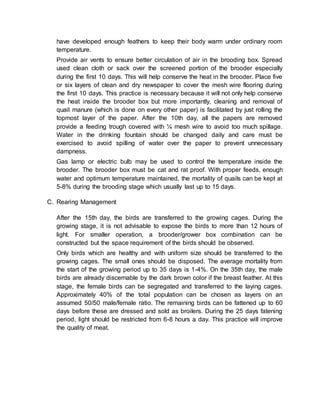
During the first five (5) days, the temperature requirement of the quail chick is
95°F, down to 85°F on the 6th day until 10th day after which the quail birds will
have developed enough feathers to keep their body warm under ordinary room
temperature.
Provide air vents to ensure better circulation of air in the brooding box. Spread
used clean cloth or sack over the screened portion of the brooder especially
during the first 10 days. This will help conserve the heat in the brooder. Place five
or six layers of clean and dry newspaper to cover the mesh wire flooring during
the first 10 days. This practice is necessary because it will not only help conserve
the heat inside the brooder box but more importantly, cleaning and removal of
quail manure (which is done on every other paper) is facilitated by just rolling the
topmost layer of the paper. After the 10th day, all the papers are removed
provide a feeding trough covered with ¼ mesh wire to avoid too much spillage.
Water in the drinking fountain should be changed daily and care must be
exercised to avoid spilling of water over the paper to prevent unnecessary
dampness.
Gas lamp or electric bulb may be used to control the temperature inside the
brooder. The brooder box must be cat and rat proof. With proper feeds, enough
water and optimum temperature maintained, the mortality of quails can be kept at
5-8% during the brooding stage which usually last up to 15 days.
C. Rearing Management
After the 15th day, the birds are transferred to the growing cages. During the
growing stage, it is not advisable to expose the birds to more than 12 hours of
light. For smaller operation, a brooder/grower box combination can be
constructed but the space requirement of the birds should be observed.
Only birds which are healthy and with uniform size should be transferred to the
growing cages. The small ones should be disposed. The average mortality from
the start of the growing period up to 35 days is 1-4%. On the 35th day, the male
birds are already discernable by the dark brown color if the breast feather. At this
stage, the female birds can be segregated and transferred to the laying cages.
Approximately 40% of the total population can be chosen as layers on an
assumed 50/50 male/female ratio. The remaining birds can be fattened up to 60
days before these are dressed and sold as broilers. During the 25 days fatening
period, light should be restricted from 6-8 hours a day. This practice will improve
the quality of meat.
D. Layer Management
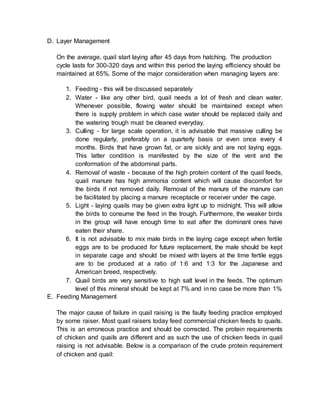
On the average, quail start laying after 45 days from hatching. The production
cycle lasts for 300-320 days and within this period the laying efficiency should be
maintained at 65%. Some of the major consideration when managing layers are:
1. Feeding - this will be discussed separately
2. Water - like any other bird, quail needs a lot of fresh and clean water.
Whenever possible, flowing water should be maintained except when
there is supply problem in which case water should be replaced daily and
the watering trough must be cleaned everyday.
3. Culling - for large scale operation, it is advisable that massive culling be
done regularly, preferably on a quarterly basis or even once every 4
months. Birds that have grown fat, or are sickly and are not laying eggs.
This latter condition is manifested by the size of the vent and the
conformation of the abdominal parts.
4. Removal of waste - because of the high protein content of the quail feeds,
quail manure has high ammonia content which will cause discomfort for
the birds if not removed daily. Removal of the manure of the manure can
be facilitated by placing a manure receptacle or receiver under the cage.
5. Light - laying quails may be given extra light up to midnight. This will allow
the birds to consume the feed in the trough. Furthermore, the weaker birds
in the group will have enough time to eat after the dominant ones have
eaten their share.
6. It is not advisable to mix male birds in the laying cage except when fertile
eggs are to be produced for future replacement, the male should be kept
in separate cage and should be mixed with layers at the time fertile eggs
are to be produced at a ratio of 1:6 and 1:3 for the Japanese and
American breed, respectively.
7. Quail birds are very sensitive to high salt level in the feeds. The optimum
level of this mineral should be kept at 7% and in no case be more than 1%
E. Feeding Management
The major cause of failure in quail raising is the faulty feeding practice employed
by some raiser. Most quail raisers today feed commercial chicken feeds to quails.
This is an erroneous practice and should be corrected. The protein requirements
of chicken and quails are different and as such the use of chicken feeds in quail
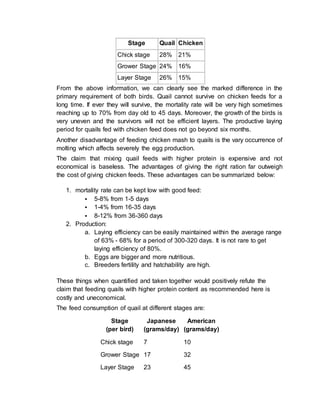
raising is not advisable. Below is a comparison of the crude protein requirement
of chicken and quail:
Stage Quail Chicken
Chick stage 28% 21%
Grower Stage 24% 16%
Layer Stage 26% 15%
From the above information, we can clearly see the marked difference in the
primary requirement of both birds. Quail cannot survive on chicken feeds for a
long time. If ever they will survive, the mortality rate will be very high sometimes
reaching up to 70% from day old to 45 days. Moreover, the growth of the birds is
very uneven and the survivors will not be efficient layers. The productive laying
period for quails fed with chicken feed does not go beyond six months.
Another disadvantage of feeding chicken mash to quails is the vary occurrence of
molting which affects severely the egg production.
The claim that mixing quail feeds with higher protein is expensive and not
economical is baseless. The advantages of giving the right ration far outweigh
the cost of giving chicken feeds. These advantages can be summarized below:
1. mortality rate can be kept low with good feed:
 5-8% from 1-5 days
 1-4% from 16-35 days
 8-12% from 36-360 days
2. Production:
a. Laying efficiency can be easily maintained within the average range
of 63% - 68% for a period of 300-320 days. It is not rare to get
laying efficiency of 80%.
b. Eggs are bigger and more nutritious.
c. Breeders fertility and hatchability are high.
These things when quantified and taken together would positively refute the
claim that feeding quails with higher protein content as recommended here is
costly and uneconomical.
The feed consumption of quail at different stages are:
Stage
(per bird)
Japanese
(grams/day)
American
(grams/day)
Chick stage 7 10
Grower Stage 17 32
Layer Stage 23 45
During the first 15 days, the feeds of the birds should be grounded to a fineness
enough to pass an ordinary window screen wire. Like chicken, quails are affected
by abrupt changes in feeding. Hence, it is not advisable to change feed abruptly.
F. Maintaining Health
There is no known morbid disease of quails. While they suffer from some
respiratory disorders, these do not spread fast and the mortality rate is very low.
Hence, it is not difficult to maintain the health of birds. Regular cleaning and
disinfection program, however, should be followed. Cages and broiler boxes
including the incubator and hatchery trays can be cleaned with pressurized water
then dried under the sun, spraying with disinfectant follows. Vitamin premix can
also be added to the feeds or the drinking water to promote growth and improve
the laying performance.
Marketing
A. Eggs
Eggs are the main product of quails. For small scale/backyard quail raising, this
can be placed in a basket and marketed fresh. For bigger operation, it is
advisable to pack eggs in carton boxes with individual dividers to protect the
quality of the eggs. Storing eggs in a cool dry place where air circulation is good
can keep eggs fresh for a period of seven days.
B. Broilers/stewers
The average feed conversion ratio of quail is 3:1. This poor feed conversion
efficiency makes broiler production uneconomical and therefore any broiler
produced should be treated secondary product in quail raising. The procedure in
dressing quail is the same as in chicken. The birds are bleed and scaled in hot
water (about 132-135 F) after that, the feathers are removed. Evisceration
follows. The dressed birds are then chilled and packed by the dozen or in kilos.
C. Prices
Broilers are more tender than stewers (culled layers). As such, the former are
sold at higher price. The selling price of these should be based on the cost of
production from day old to 60 plus the dressing, storage and related selling cost.
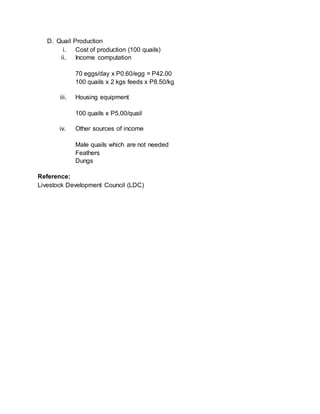
D. Quail Production
i. Cost of production (100 quails)
ii. Income computation
70 eggs/day x P0.60/egg = P42.00
100 quails x 2 kgs feeds x P8.50/kg
iii. Housing equipment
100 quails x P5.00/quail
iv. Other sources of income
Male quails which are not needed
Feathers
Dungs
Reference:
Livestock Development Council (LDC)

Quail Production and Management

  • 1.
    Quail Production andManagement Introduction Quail by some distinction are classified as "game" or "hunting" birds and as such, should not be compared with chicken, whose requirements are different. On a commercial scale, quail raising has not attracted the interest of investors because of the lack of data particularly with regards to feeding. Many people who go into quail raising are usually hobbyists who are not income-conscious. Breeds of Quail  Japanese Seattle  Silver  Negro  Japanese Taiwan/Chinese Quail  Tuxedo  Brown Crosses nos. 1 and 2 Starting the Project To start a project, care must be exercised in the selection of the first stock. There are many quail breeding farms on and near the Metro Manila area. A. Selection of Stock For a beginner, it is best to start with quail pullets about 30-35 days old. Some of the pointers in selecting quails are as follows: 1. Body Conformation a. The feathers should be tidy and neat b. Avoid buying those with streak of white or black feathers - these could be signs of inbreeding 2. Choose birds with uniform size. A mature (60-day old) Japanese quail (Coturnix japonica) would have an average weight of 120 grams. However, a 30-35 day-old bird would only average 100 grams. The American quail (Coturnix coturnix) however weigh heavier at 220 grams for the mature bird and 200 grams for the 30-35 day-old. 3. Record of the parents stock a. Size of eggs b. Laying efficiency - a 65% average laying efficiency within 300 days laying period is desirable
  • 2.
    c. Growth rate/bodyweight B. Size of Flock The size of the initial stock totally depends on the financial capacity of the person. However, it is not advisable to start big. Quails are not easy to raise and a beginner should first get the necessary experience before going into large scale. Quails multiply rapidly and therefore expansion will not be a problem. A beginner can start with 10-15 pullets. Management A. Housing and Equipment One of the advantages in quail raising is the relatively small space that is required. Commensurately, the cost of putting up a cage is less. The materials commonly used in making quail cages are: 1. Plywood 2. ¼ inch mesh wire 3. 1 x 1 lumber to serve as framework For every stage in the quail's life, space requirement varies. This is true as in the case of other fowls and even livestock animals. The following will help guide the raiser in determining the space required for quails: Stage Japanese American Chick stage (1-15 days old) 2 ½" x 2 ½" 2 ½" x 2 ½" Growing Stage (16-35 days old) 3" x 3" 3 ½" x 3 ½" Laying Stage (36 days old & up) 3 ½" x 3 ½" 4 ½" x 4 ½" Since quails are not efficient feed converter, they should not be raised for broiler production. Layer cages should not be too high preferably a 5" and 6" in height and can accommodate the Japanese and American breed, respectively. Providing too much space will encourage too much movement thereby increasing the risk of injuries. B. Brooding Management Temperature During the first five (5) days, the temperature requirement of the quail chick is 95°F, down to 85°F on the 6th day until 10th day after which the quail birds will
  • 3.
    have developed enoughfeathers to keep their body warm under ordinary room temperature. Provide air vents to ensure better circulation of air in the brooding box. Spread used clean cloth or sack over the screened portion of the brooder especially during the first 10 days. This will help conserve the heat in the brooder. Place five or six layers of clean and dry newspaper to cover the mesh wire flooring during the first 10 days. This practice is necessary because it will not only help conserve the heat inside the brooder box but more importantly, cleaning and removal of quail manure (which is done on every other paper) is facilitated by just rolling the topmost layer of the paper. After the 10th day, all the papers are removed provide a feeding trough covered with ¼ mesh wire to avoid too much spillage. Water in the drinking fountain should be changed daily and care must be exercised to avoid spilling of water over the paper to prevent unnecessary dampness. Gas lamp or electric bulb may be used to control the temperature inside the brooder. The brooder box must be cat and rat proof. With proper feeds, enough water and optimum temperature maintained, the mortality of quails can be kept at 5-8% during the brooding stage which usually last up to 15 days. C. Rearing Management After the 15th day, the birds are transferred to the growing cages. During the growing stage, it is not advisable to expose the birds to more than 12 hours of light. For smaller operation, a brooder/grower box combination can be constructed but the space requirement of the birds should be observed. Only birds which are healthy and with uniform size should be transferred to the growing cages. The small ones should be disposed. The average mortality from the start of the growing period up to 35 days is 1-4%. On the 35th day, the male birds are already discernable by the dark brown color if the breast feather. At this stage, the female birds can be segregated and transferred to the laying cages. Approximately 40% of the total population can be chosen as layers on an assumed 50/50 male/female ratio. The remaining birds can be fattened up to 60 days before these are dressed and sold as broilers. During the 25 days fatening period, light should be restricted from 6-8 hours a day. This practice will improve the quality of meat.
  • 4.
    D. Layer Management Onthe average, quail start laying after 45 days from hatching. The production cycle lasts for 300-320 days and within this period the laying efficiency should be maintained at 65%. Some of the major consideration when managing layers are: 1. Feeding - this will be discussed separately 2. Water - like any other bird, quail needs a lot of fresh and clean water. Whenever possible, flowing water should be maintained except when there is supply problem in which case water should be replaced daily and the watering trough must be cleaned everyday. 3. Culling - for large scale operation, it is advisable that massive culling be done regularly, preferably on a quarterly basis or even once every 4 months. Birds that have grown fat, or are sickly and are not laying eggs. This latter condition is manifested by the size of the vent and the conformation of the abdominal parts. 4. Removal of waste - because of the high protein content of the quail feeds, quail manure has high ammonia content which will cause discomfort for the birds if not removed daily. Removal of the manure of the manure can be facilitated by placing a manure receptacle or receiver under the cage. 5. Light - laying quails may be given extra light up to midnight. This will allow the birds to consume the feed in the trough. Furthermore, the weaker birds in the group will have enough time to eat after the dominant ones have eaten their share. 6. It is not advisable to mix male birds in the laying cage except when fertile eggs are to be produced for future replacement, the male should be kept in separate cage and should be mixed with layers at the time fertile eggs are to be produced at a ratio of 1:6 and 1:3 for the Japanese and American breed, respectively. 7. Quail birds are very sensitive to high salt level in the feeds. The optimum level of this mineral should be kept at 7% and in no case be more than 1% E. Feeding Management The major cause of failure in quail raising is the faulty feeding practice employed by some raiser. Most quail raisers today feed commercial chicken feeds to quails. This is an erroneous practice and should be corrected. The protein requirements of chicken and quails are different and as such the use of chicken feeds in quail raising is not advisable. Below is a comparison of the crude protein requirement of chicken and quail:
  • 5.
    Stage Quail Chicken Chickstage 28% 21% Grower Stage 24% 16% Layer Stage 26% 15% From the above information, we can clearly see the marked difference in the primary requirement of both birds. Quail cannot survive on chicken feeds for a long time. If ever they will survive, the mortality rate will be very high sometimes reaching up to 70% from day old to 45 days. Moreover, the growth of the birds is very uneven and the survivors will not be efficient layers. The productive laying period for quails fed with chicken feed does not go beyond six months. Another disadvantage of feeding chicken mash to quails is the vary occurrence of molting which affects severely the egg production. The claim that mixing quail feeds with higher protein is expensive and not economical is baseless. The advantages of giving the right ration far outweigh the cost of giving chicken feeds. These advantages can be summarized below: 1. mortality rate can be kept low with good feed:  5-8% from 1-5 days  1-4% from 16-35 days  8-12% from 36-360 days 2. Production: a. Laying efficiency can be easily maintained within the average range of 63% - 68% for a period of 300-320 days. It is not rare to get laying efficiency of 80%. b. Eggs are bigger and more nutritious. c. Breeders fertility and hatchability are high. These things when quantified and taken together would positively refute the claim that feeding quails with higher protein content as recommended here is costly and uneconomical. The feed consumption of quail at different stages are: Stage (per bird) Japanese (grams/day) American (grams/day) Chick stage 7 10 Grower Stage 17 32 Layer Stage 23 45
  • 6.
    During the first15 days, the feeds of the birds should be grounded to a fineness enough to pass an ordinary window screen wire. Like chicken, quails are affected by abrupt changes in feeding. Hence, it is not advisable to change feed abruptly. F. Maintaining Health There is no known morbid disease of quails. While they suffer from some respiratory disorders, these do not spread fast and the mortality rate is very low. Hence, it is not difficult to maintain the health of birds. Regular cleaning and disinfection program, however, should be followed. Cages and broiler boxes including the incubator and hatchery trays can be cleaned with pressurized water then dried under the sun, spraying with disinfectant follows. Vitamin premix can also be added to the feeds or the drinking water to promote growth and improve the laying performance. Marketing A. Eggs Eggs are the main product of quails. For small scale/backyard quail raising, this can be placed in a basket and marketed fresh. For bigger operation, it is advisable to pack eggs in carton boxes with individual dividers to protect the quality of the eggs. Storing eggs in a cool dry place where air circulation is good can keep eggs fresh for a period of seven days. B. Broilers/stewers The average feed conversion ratio of quail is 3:1. This poor feed conversion efficiency makes broiler production uneconomical and therefore any broiler produced should be treated secondary product in quail raising. The procedure in dressing quail is the same as in chicken. The birds are bleed and scaled in hot water (about 132-135 F) after that, the feathers are removed. Evisceration follows. The dressed birds are then chilled and packed by the dozen or in kilos. C. Prices Broilers are more tender than stewers (culled layers). As such, the former are sold at higher price. The selling price of these should be based on the cost of production from day old to 60 plus the dressing, storage and related selling cost.
  • 7.
    D. Quail Production i.Cost of production (100 quails) ii. Income computation 70 eggs/day x P0.60/egg = P42.00 100 quails x 2 kgs feeds x P8.50/kg iii. Housing equipment 100 quails x P5.00/quail iv. Other sources of income Male quails which are not needed Feathers Dungs Reference: Livestock Development Council (LDC)