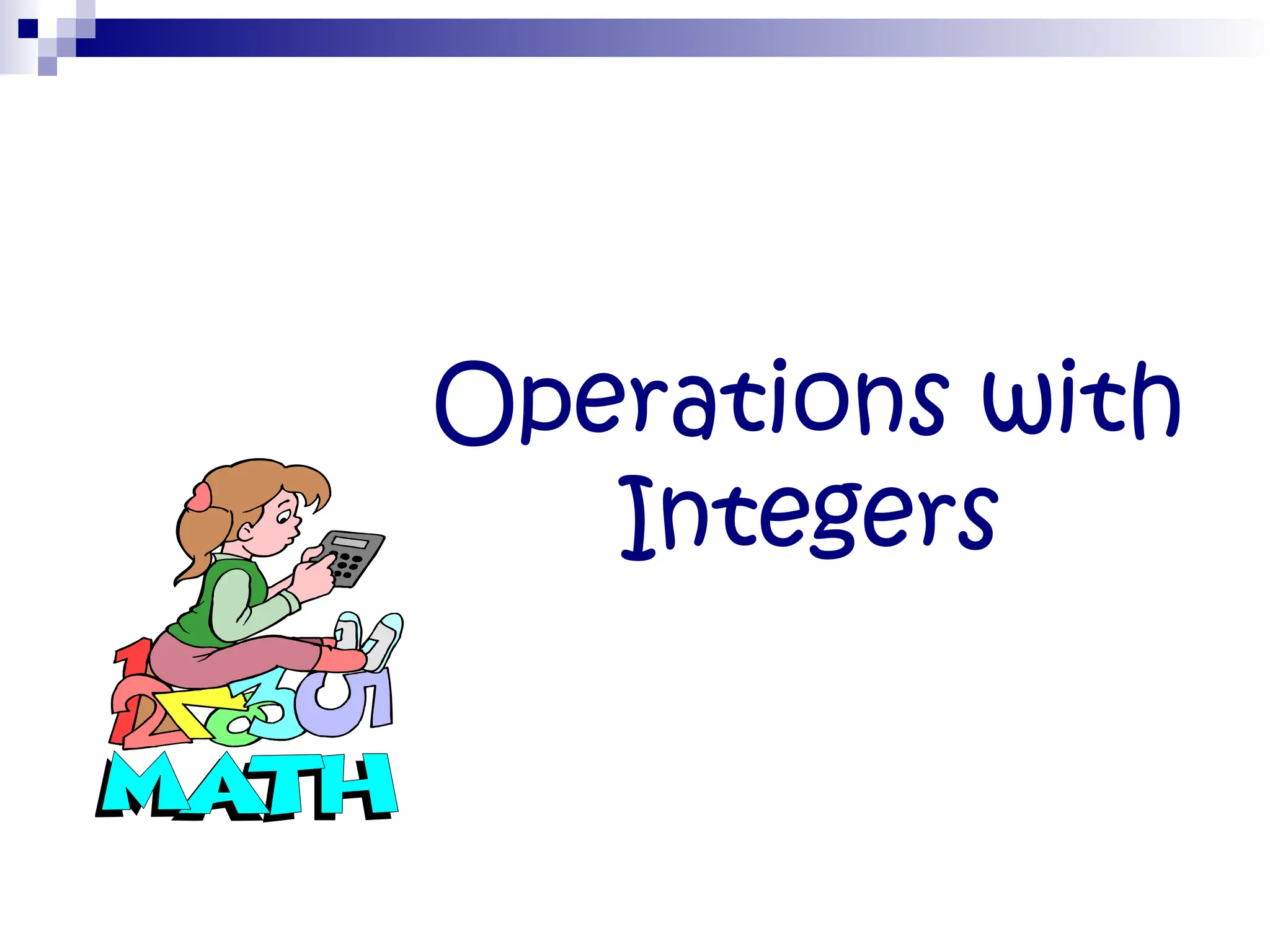
Operations with
Integers
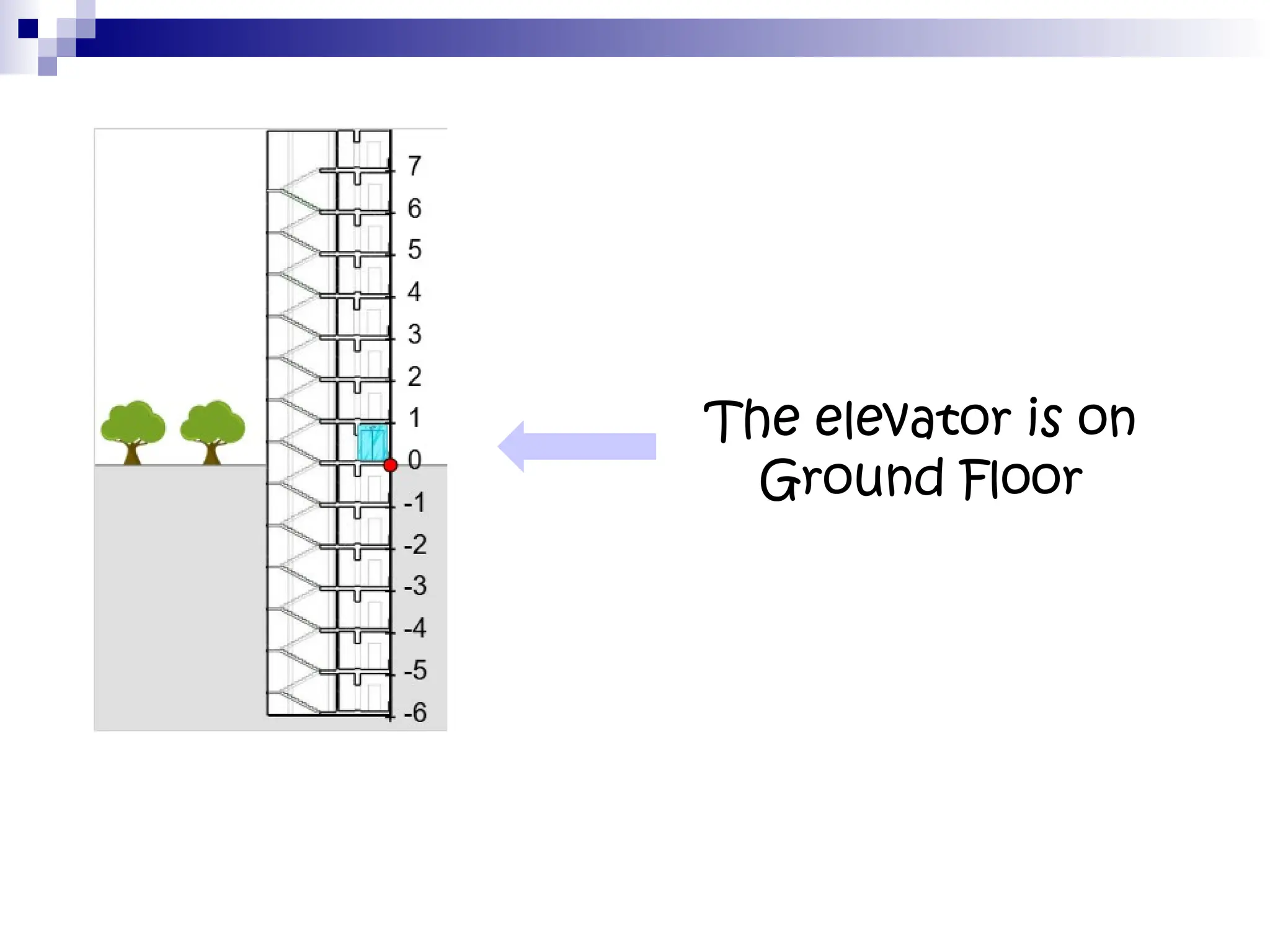
The elevator is on
Ground Floor
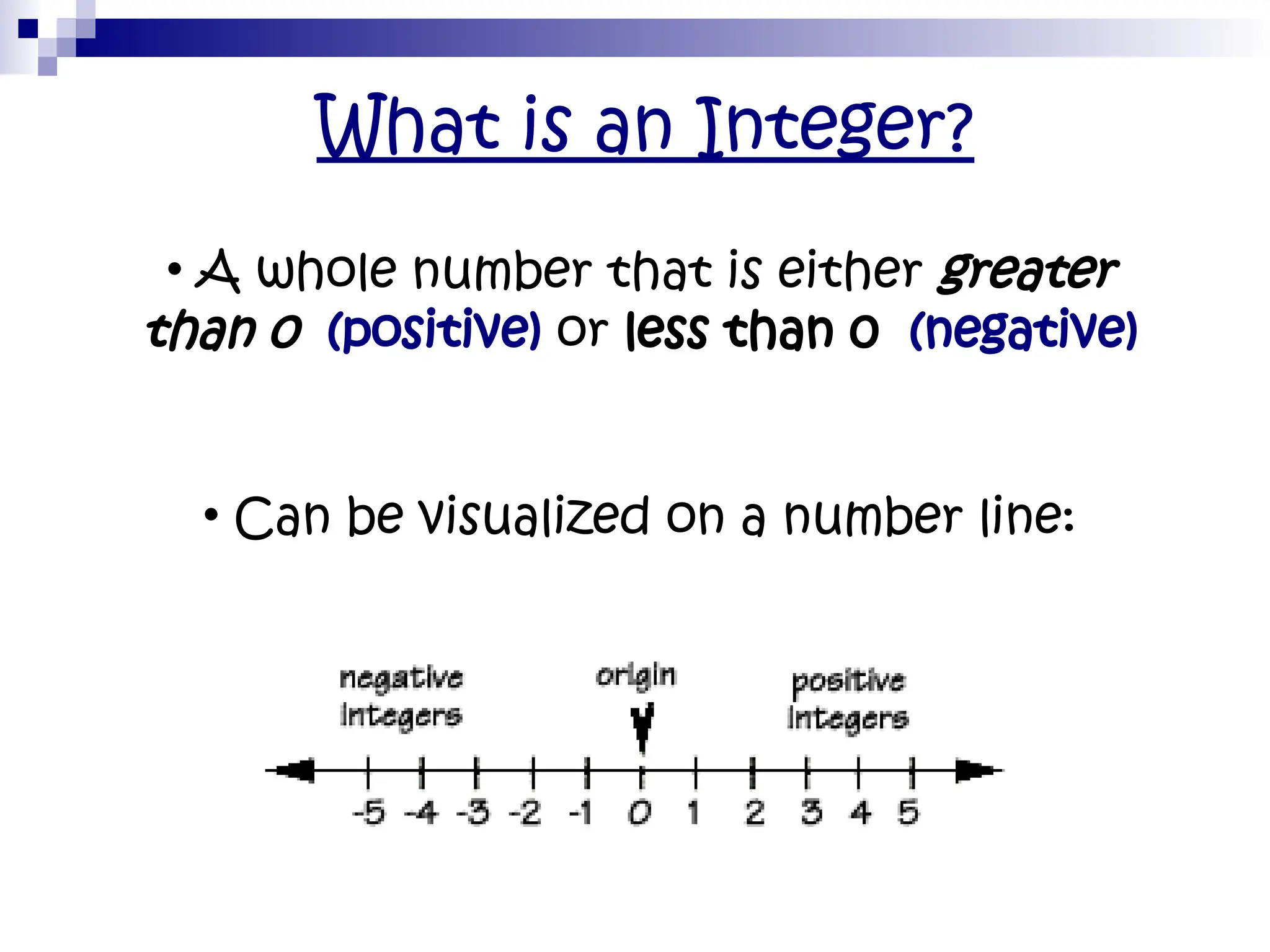
What is an Integer?
• A whole number that is either greater
than 0 (positive) or less than 0 (negative)
• Can be visualized on a number line:
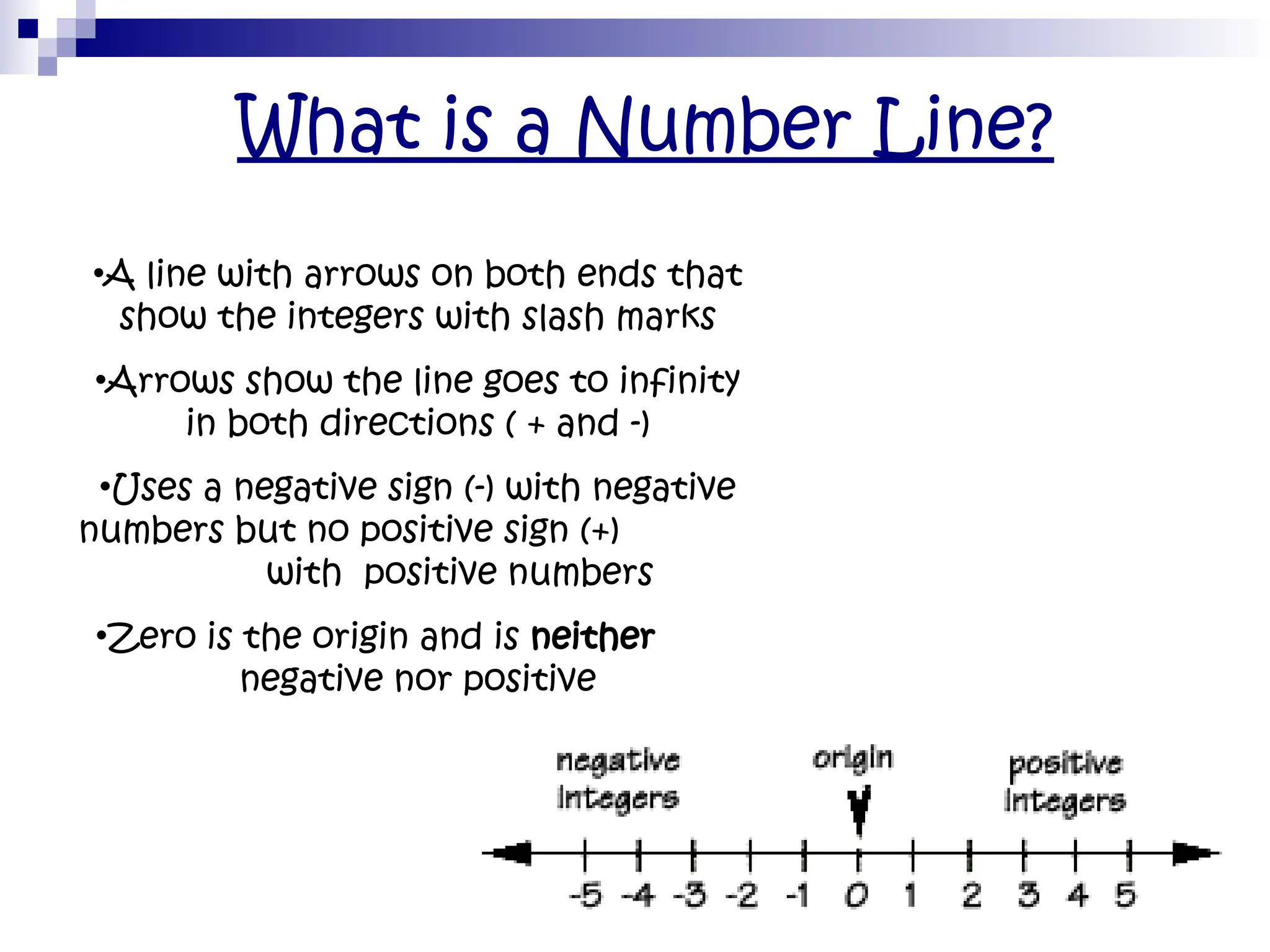
What is a Number Line?
•A line with arrows on both ends that
show the integers with slash marks
•Arrows show the line goes to infinity
in both directions ( + and -)
•Uses a negative sign (-) with negative
numbers but no positive sign (+)
with positive numbers
•Zero is the origin and is neither
negative nor positive
What are Opposites?
•Two integers the same distance from the
origin, but on different sides of zero
•Every positive integer has a negative
integer an equal distance from the origin
•Example: The opposite of 6 is -6
•Example: The opposite of -2 is 2
What is Absolute Value?
•Distance a number is from zero on a number
line (always a positive number)
•Indicated by two vertical lines | |
•Every number has an absolute value
•Opposites have the same absolute values
since they are the same distance from zero
•Example: |-5| = 5 and |5| = 5
•Example: |50| = 50 and |-50| = 50
What Can We Do to Integers?
•Integers are numbers, so we can add,
subtract, multiply, and divide them
•Each operation has different rules to follow
Adding Rules – Same Signs
•If the integers have the SAME signs:
ADD the numbers & keep the same sign!
•Positive + Positive = Positive Answer
•Negative + Negative = Negative Answer
• Examples: -3 + (-10) = ? ? = -13
• 6 + (8) = ? ? = 14
Adding (Same Signs) - Examples
#1. -3 + (-10)
Step 1: 13 Add the #s
Step 2: -13 Keep same sign (Both #s are
negative – Answer is negative!)
#2. 6 + (8)
Step 1: 14 Add the #s
Step 2: 14 Keep same sign (Both #s are
positive – Answer is positive!)
Adding Rules – Different Signs
•If the integers have the DIFFERENT signs:
SUBTRACT the numbers & use sign of the
BIGGER number!
•Bigger # is Positive = Positive Answer
•Bigger # is Negative = Negative Answer
• Examples: -13 + (7) = ? ? = -6
• 23 + (-8) = ? ? = 15
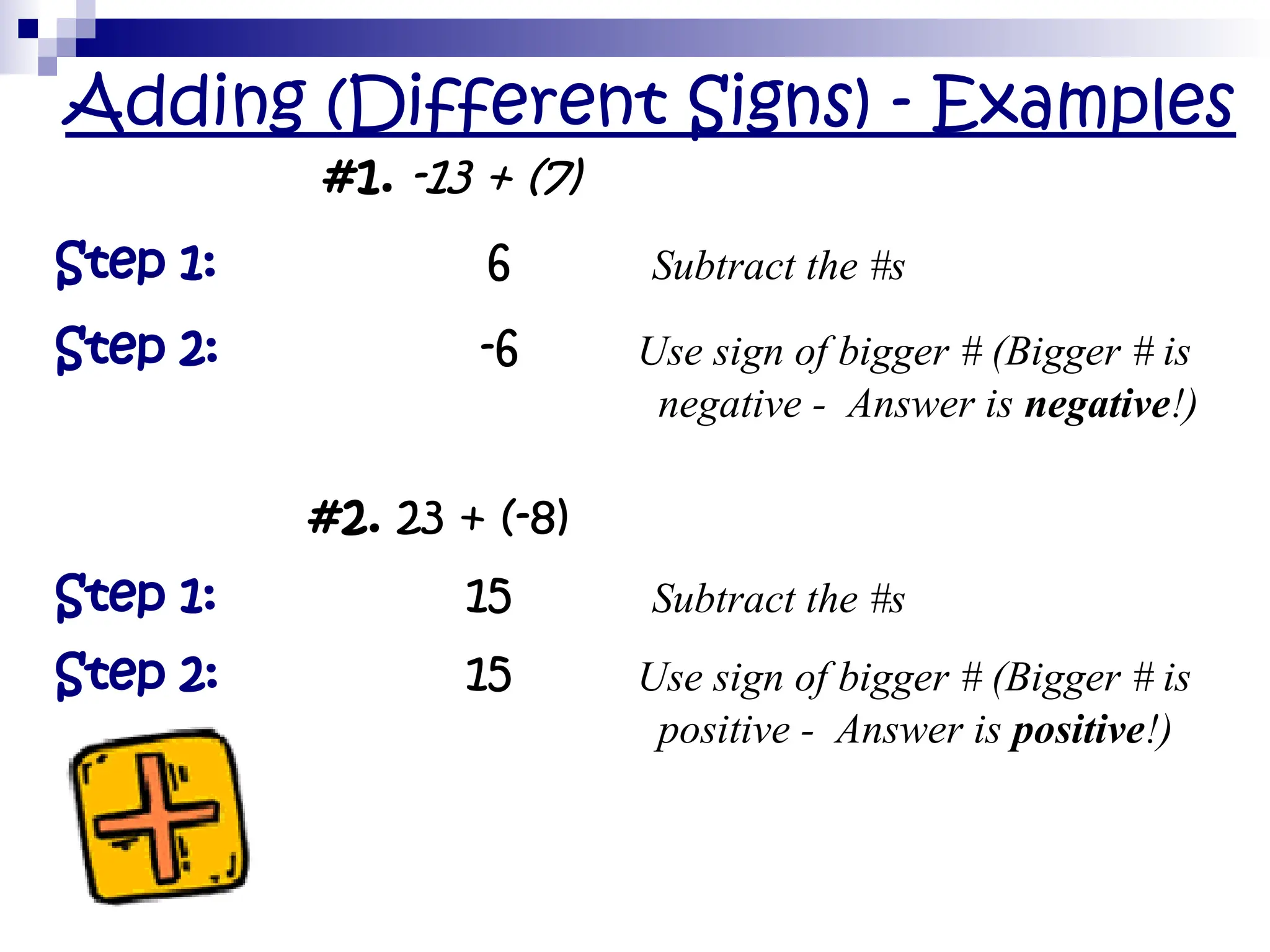
Adding (Different Signs) - Examples
#1. -13 + (7)
Step 1: 6 Subtract the #s
Step 2: -6 Use sign of bigger # (Bigger # is
negative - Answer is negative!)
#2. 23 + (-8)
Step 1: 15 Subtract the #s
Step 2: 15 Use sign of bigger # (Bigger # is
positive - Answer is positive!)
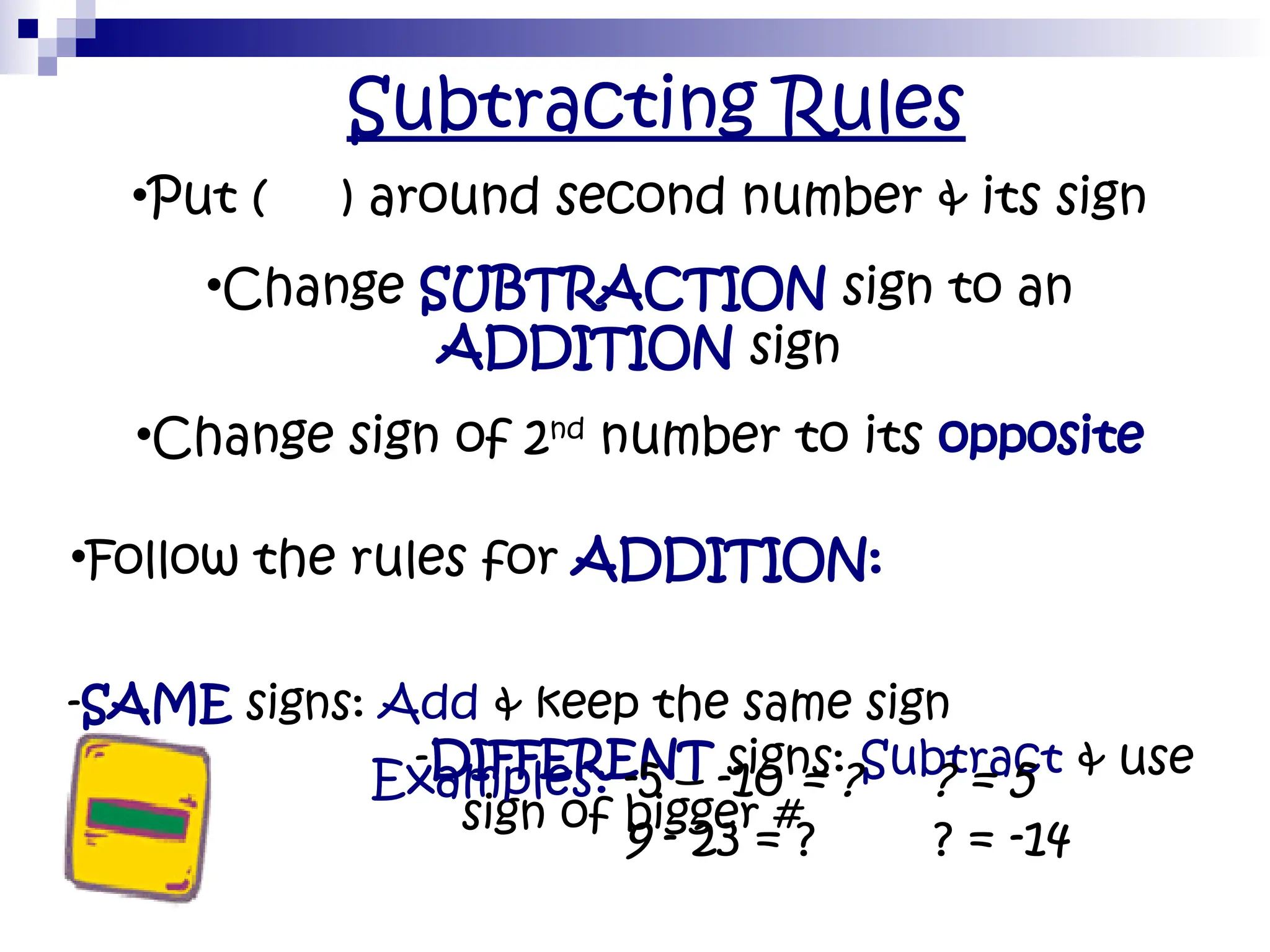
Subtracting Rules
•Put ( ) around second number & its sign
•Change SUBTRACTION sign to an
ADDITION sign
•Change sign of 2nd
number to its opposite
•Follow the rules for ADDITION:
-SAME signs: Add & keep the same sign
-DIFFERENT signs: Subtract & use
sign of bigger #
• Examples: -5 – -10 = ? ? = 5
• 9 - 23 = ? ? = -14
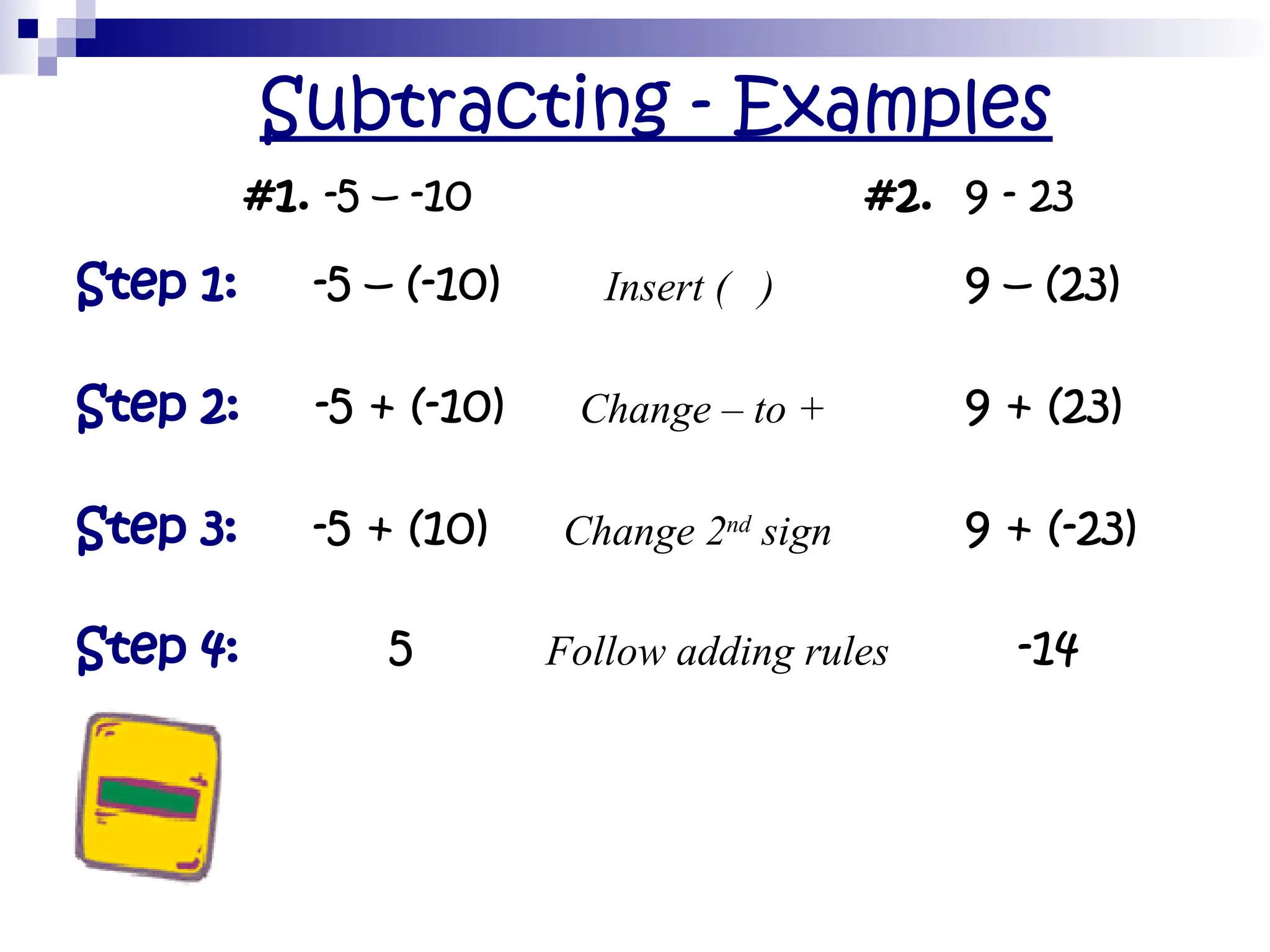
Subtracting - Examples
#1. -5 – -10 #2. 9 - 23
Step 1: -5 – (-10) Insert ( ) 9 – (23)
Step 2: -5 + (-10) Change – to + 9 + (23)
Step 3: -5 + (10) Change 2nd
sign 9 + (-23)
Step 4: 5 Follow adding rules -14 d
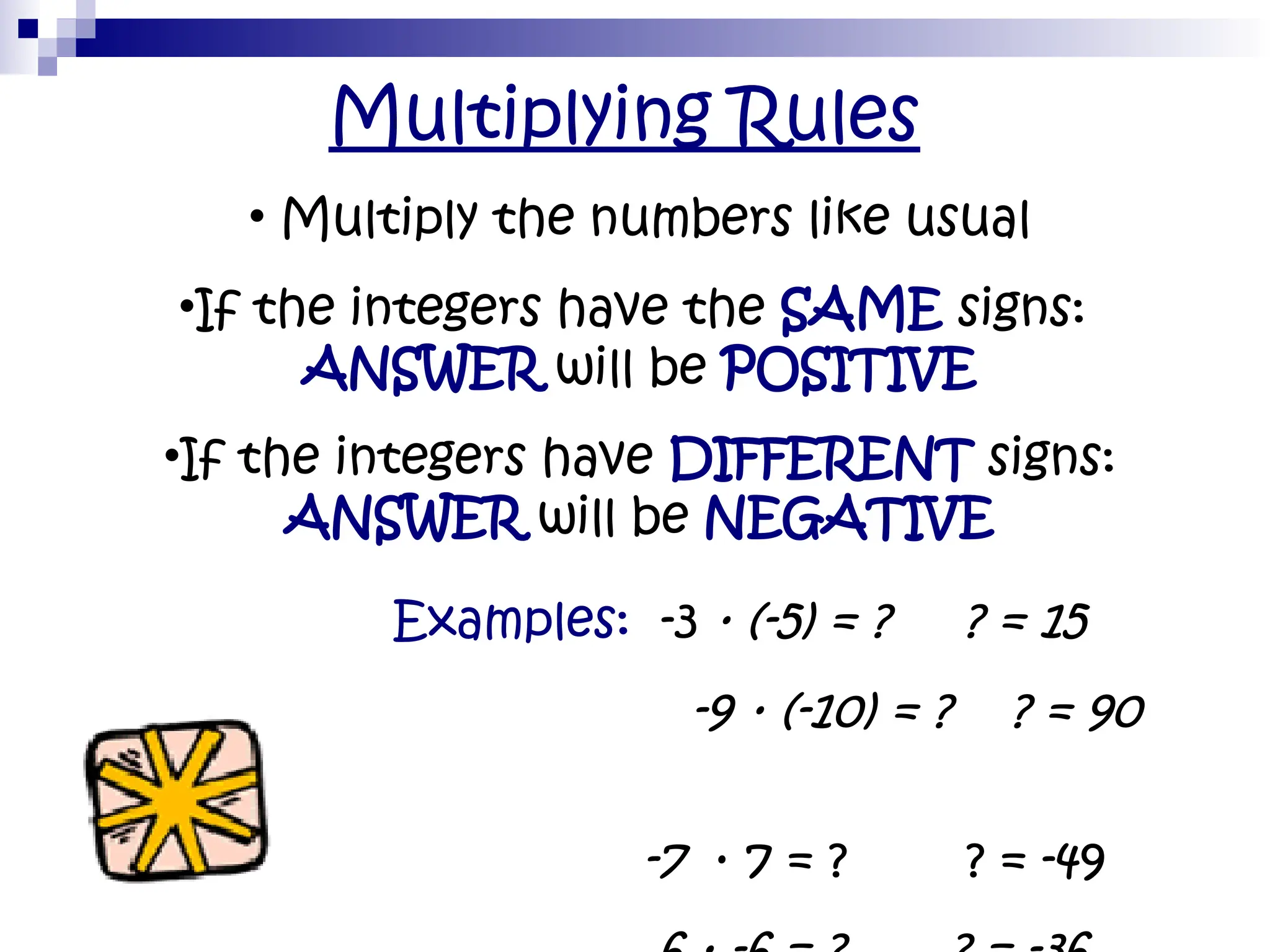
Multiplying Rules
• Multiply the numbers like usual
•If the integers have the SAME signs:
ANSWER will be POSITIVE
•If the integers have DIFFERENT signs:
ANSWER will be NEGATIVE
• Examples: -3 · (-5) = ? ? = 15
• -9 · (-10) = ? ? = 90
• -7 · 7 = ? ? = -49
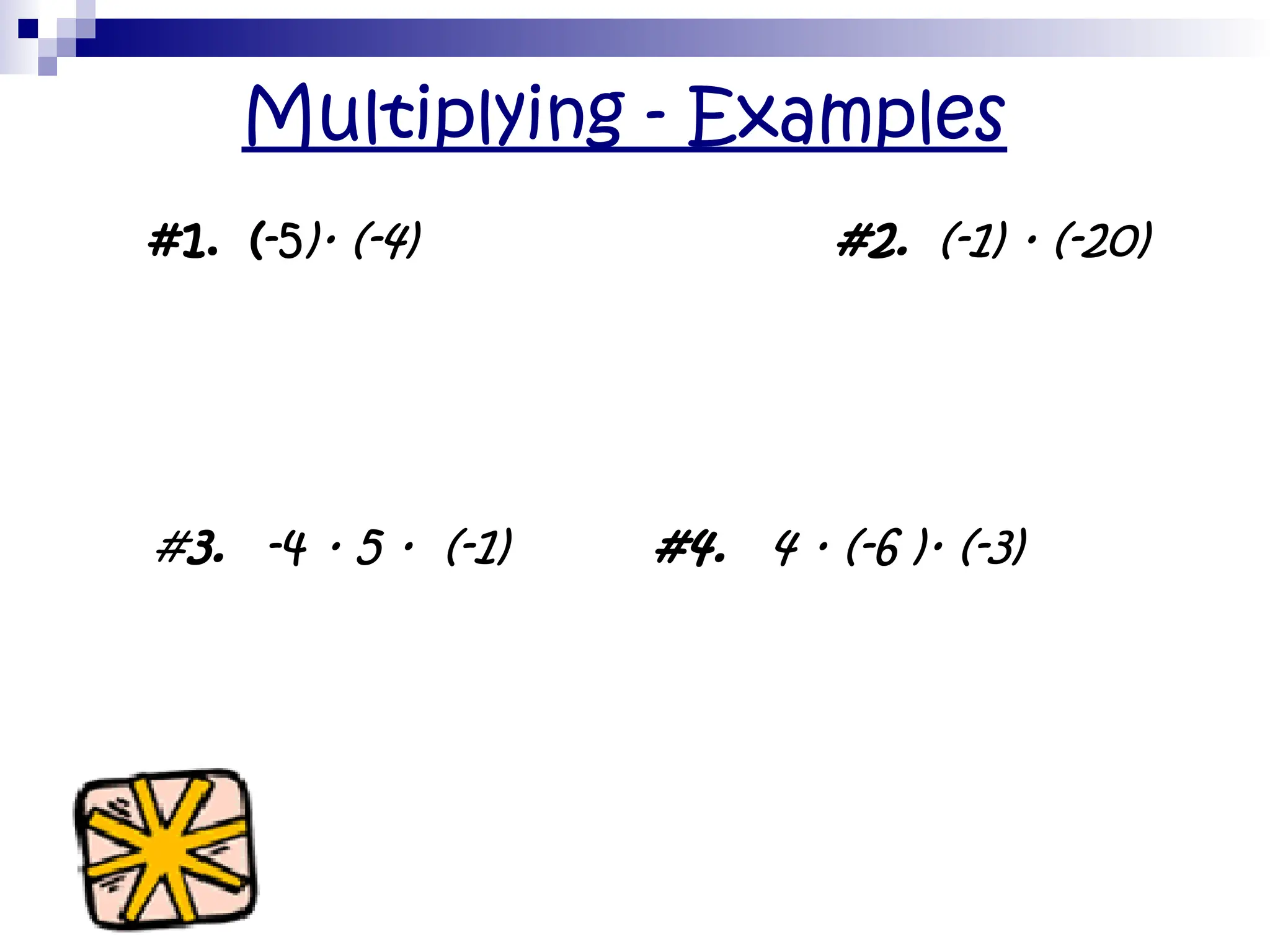
Multiplying - Examples
• #1. (-5)· (-4) #2. ((-1) · (-20)
•
#3. -4 · 5 · (-1) #4. (4 · (-6 )· (-3)
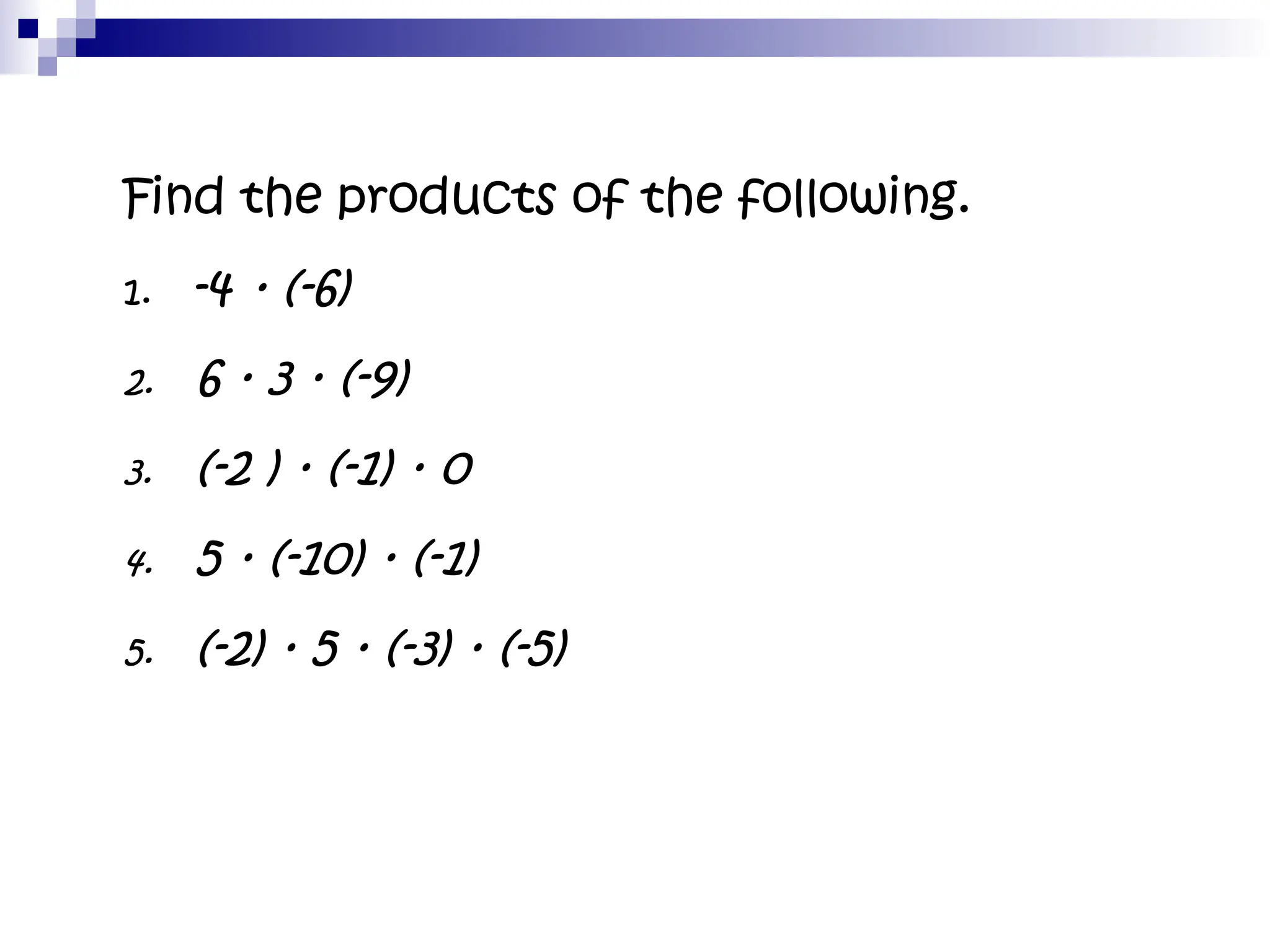
Find the products of the following.
1. -4 · (-6)
2. 6 · 3 · (-9)
3. (-2 ) · (-1) · 0
4. 5 · (-10) · (-1)
5. (-2) · 5 · (-3) · (-5)
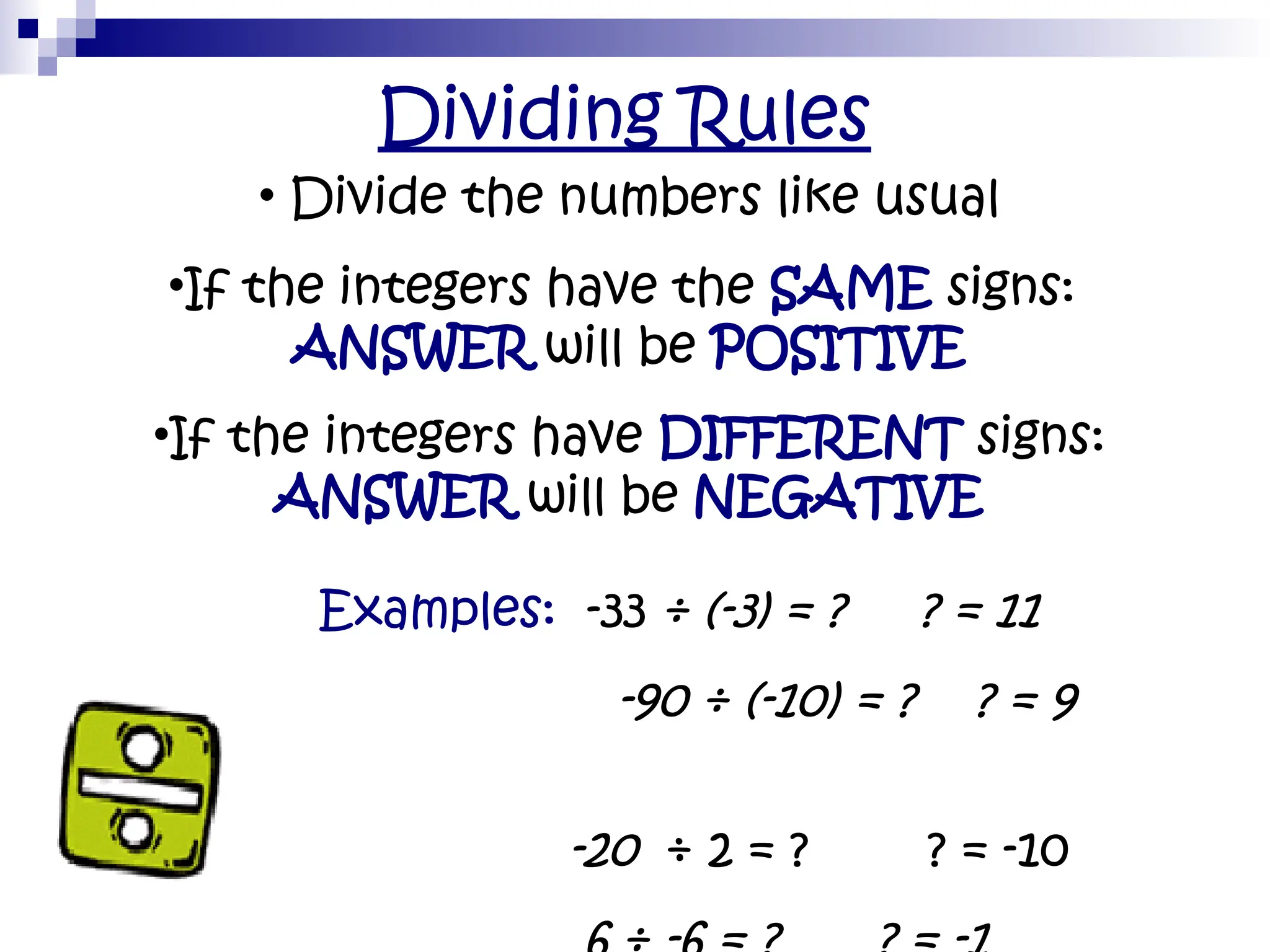
Dividing Rules
• Divide the numbers like usual
•If the integers have the SAME signs:
ANSWER will be POSITIVE
•If the integers have DIFFERENT signs:
ANSWER will be NEGATIVE
• Examples: -33 ÷ (-3) = ? ? = 11
• -90 ÷ (-10) = ? ? = 9
• -20 ÷ 2 = ? ? = -10
•
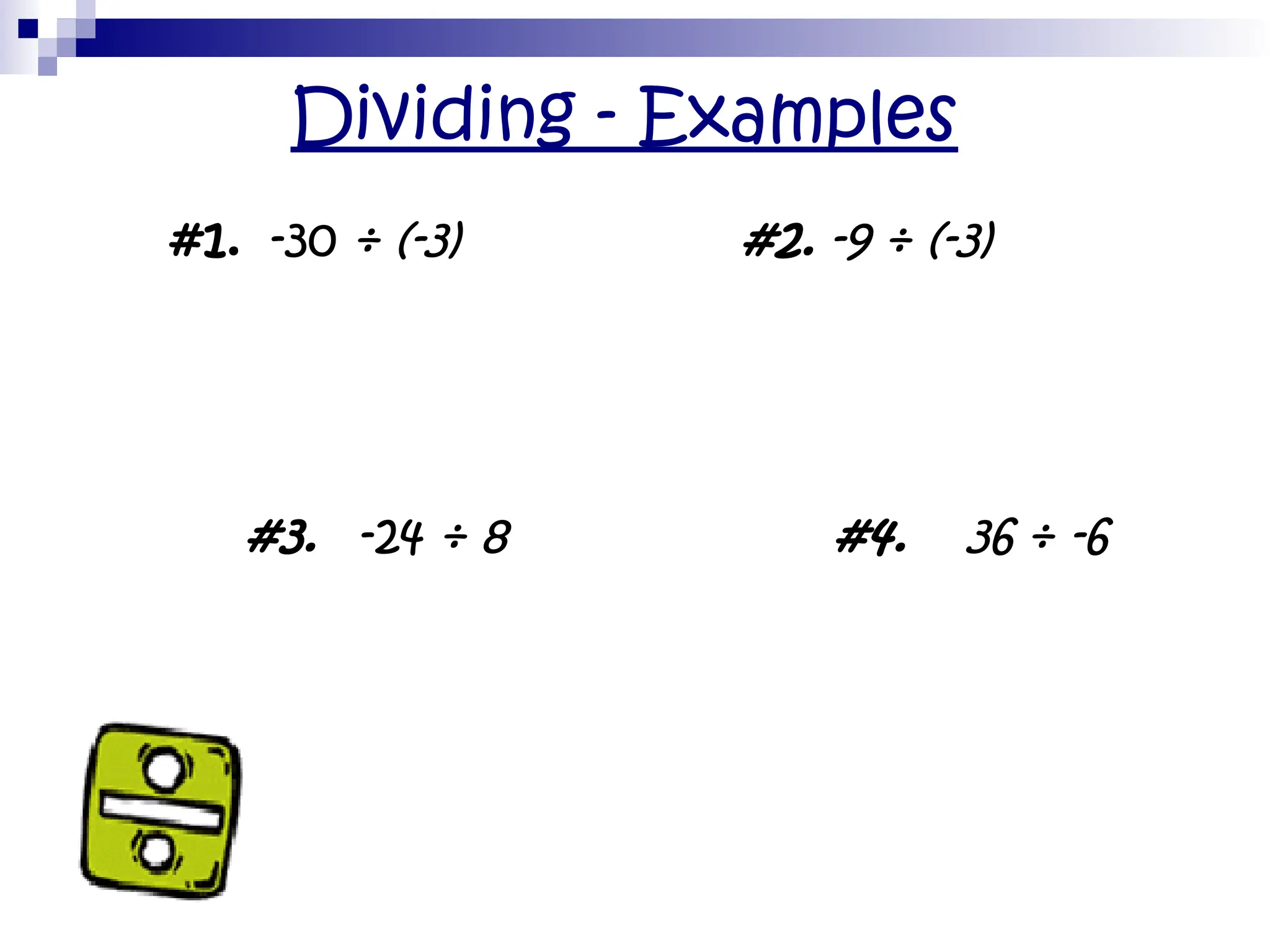
Dividing - Examples
• #1. -30 ÷ (-3) #2. -9 ÷ (-3)
•
#3. -24 ÷ 8 #4. 36 ÷ -6
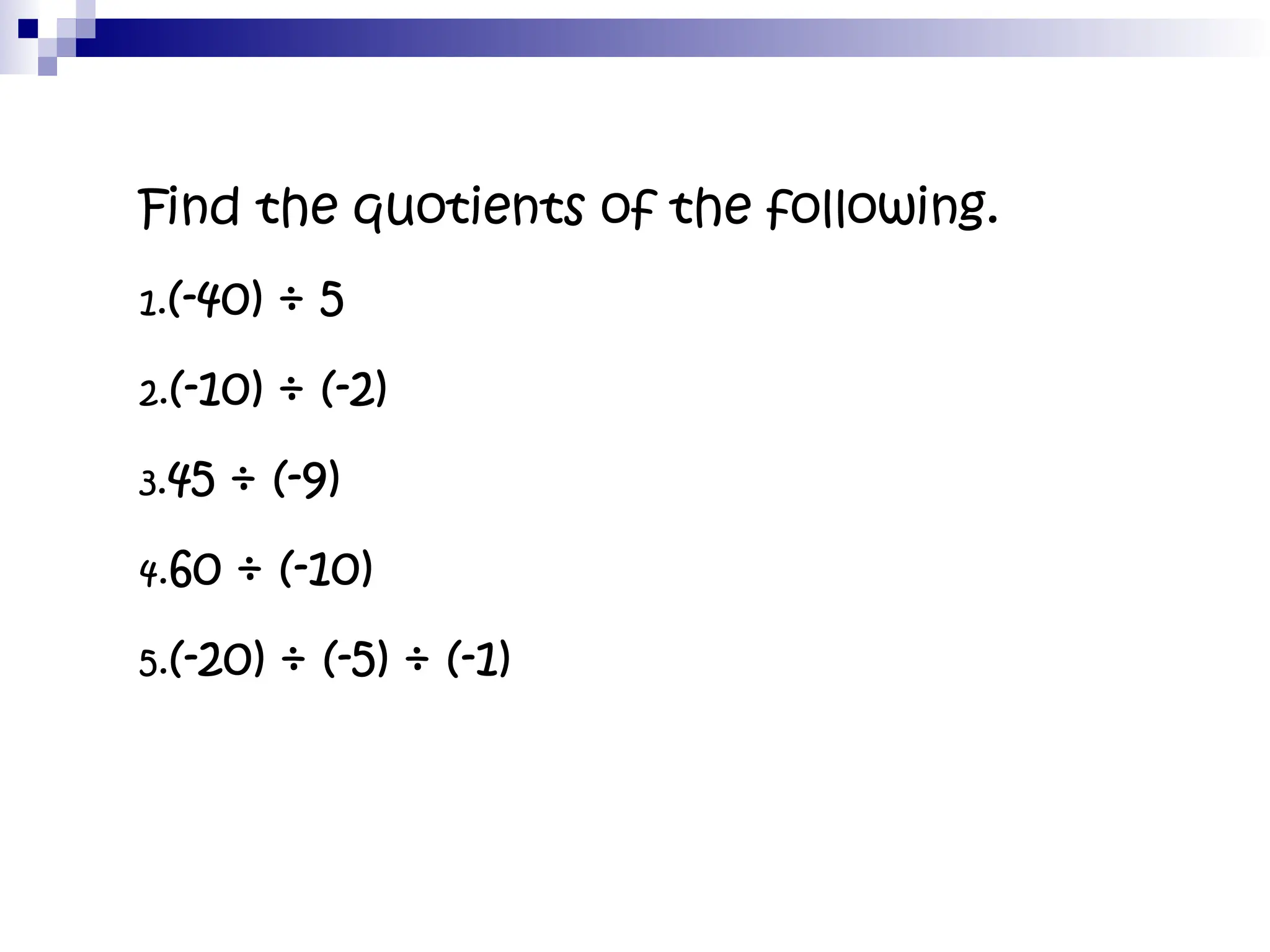
Find the quotients of the following.
1.(-40) ÷ 5
2.(-10) ÷ (-2)
3.45 ÷ (-9)
4.60 ÷ (-10)
5.(-20) ÷ (-5) ÷ (-1)
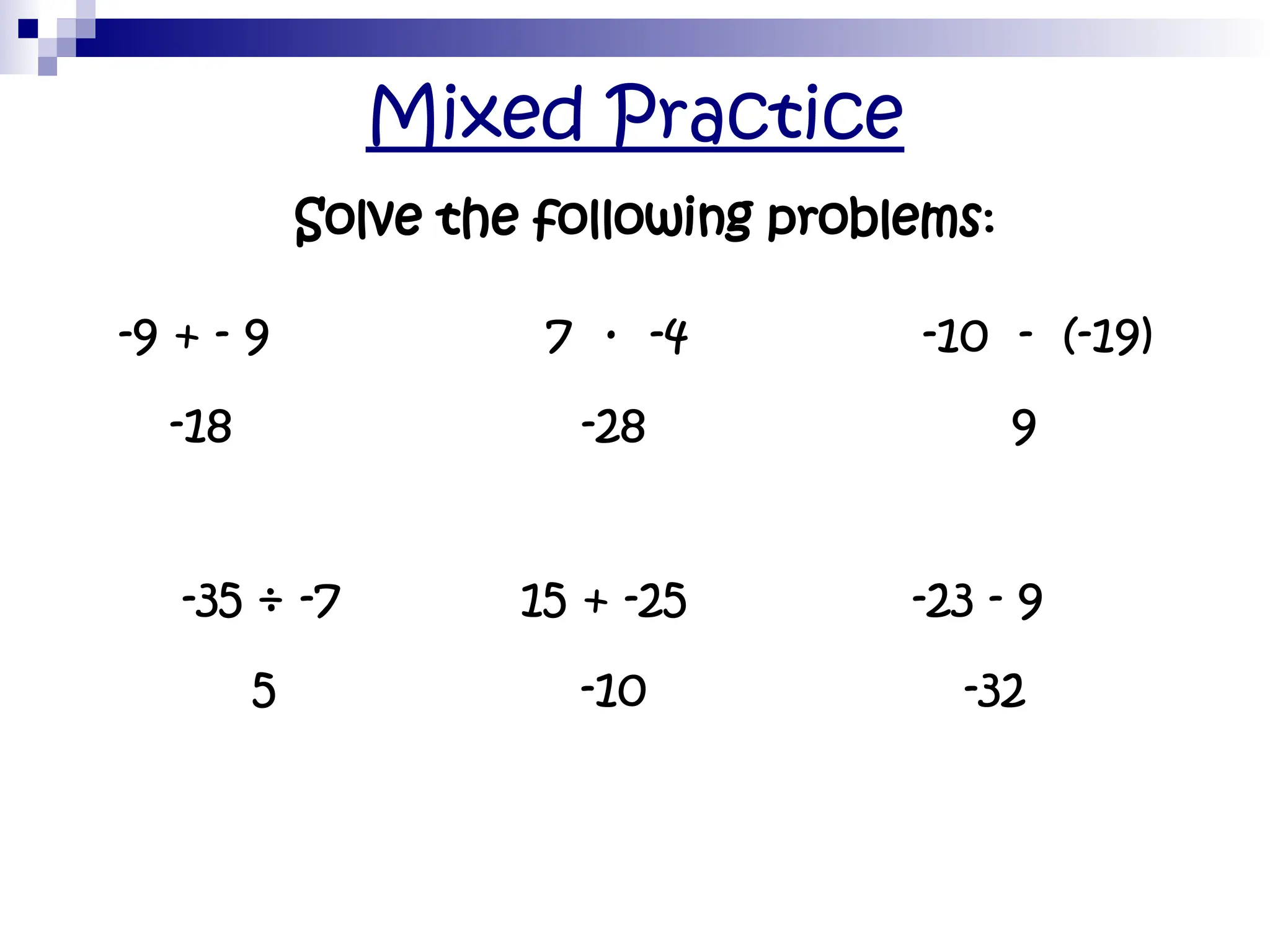
Mixed Practice
Solve the following problems:
-9 + - 9
-18
7 · -4
-28
-10 - (-19)
9
-35 ÷ -7
5
15 + -25
-10
-23 - 9
-32
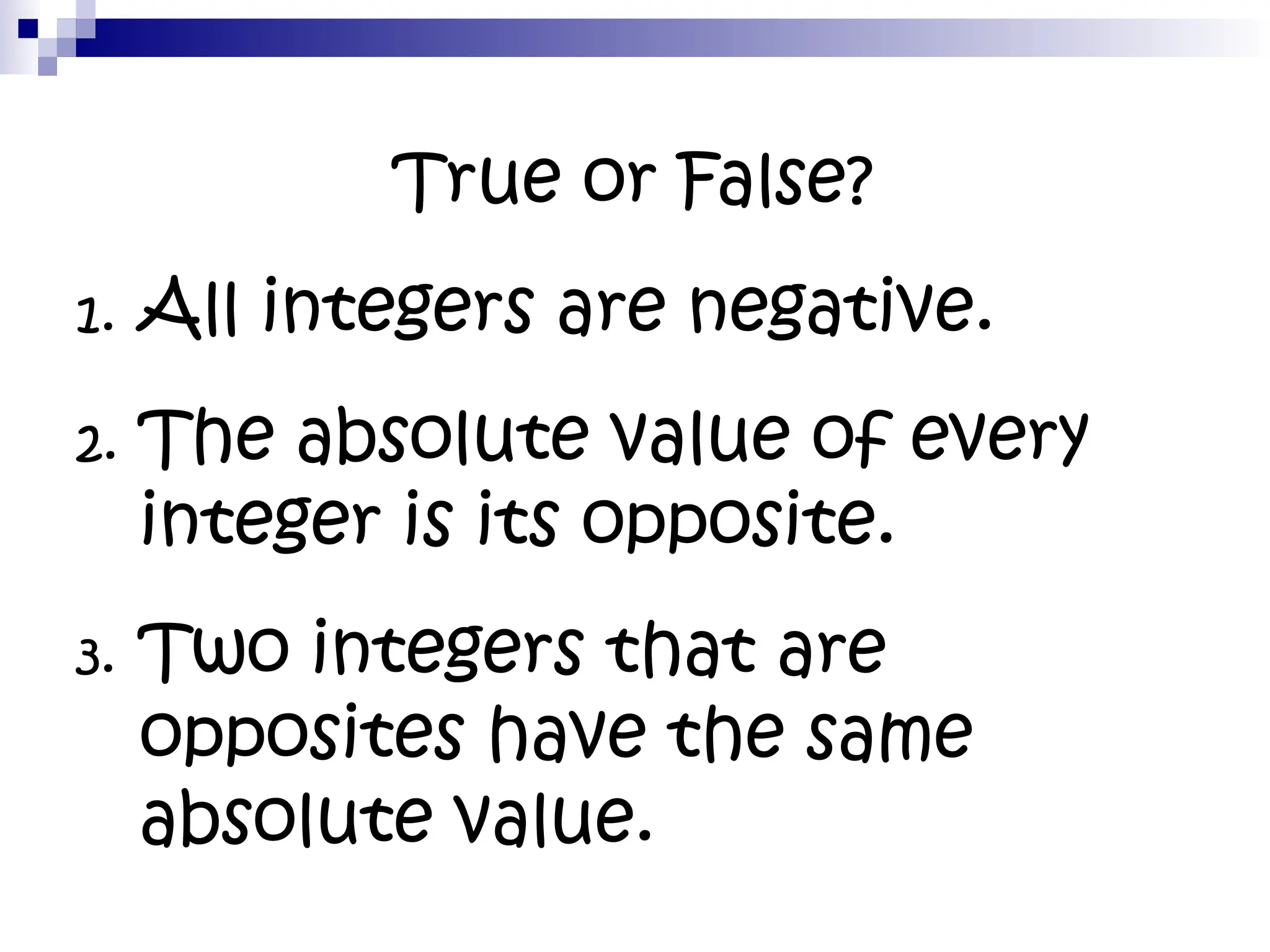
True or False?
1. All integers are negative.
2. The absolute value of every
integer is its opposite.
3. Two integers that are
opposites have the same
absolute value.
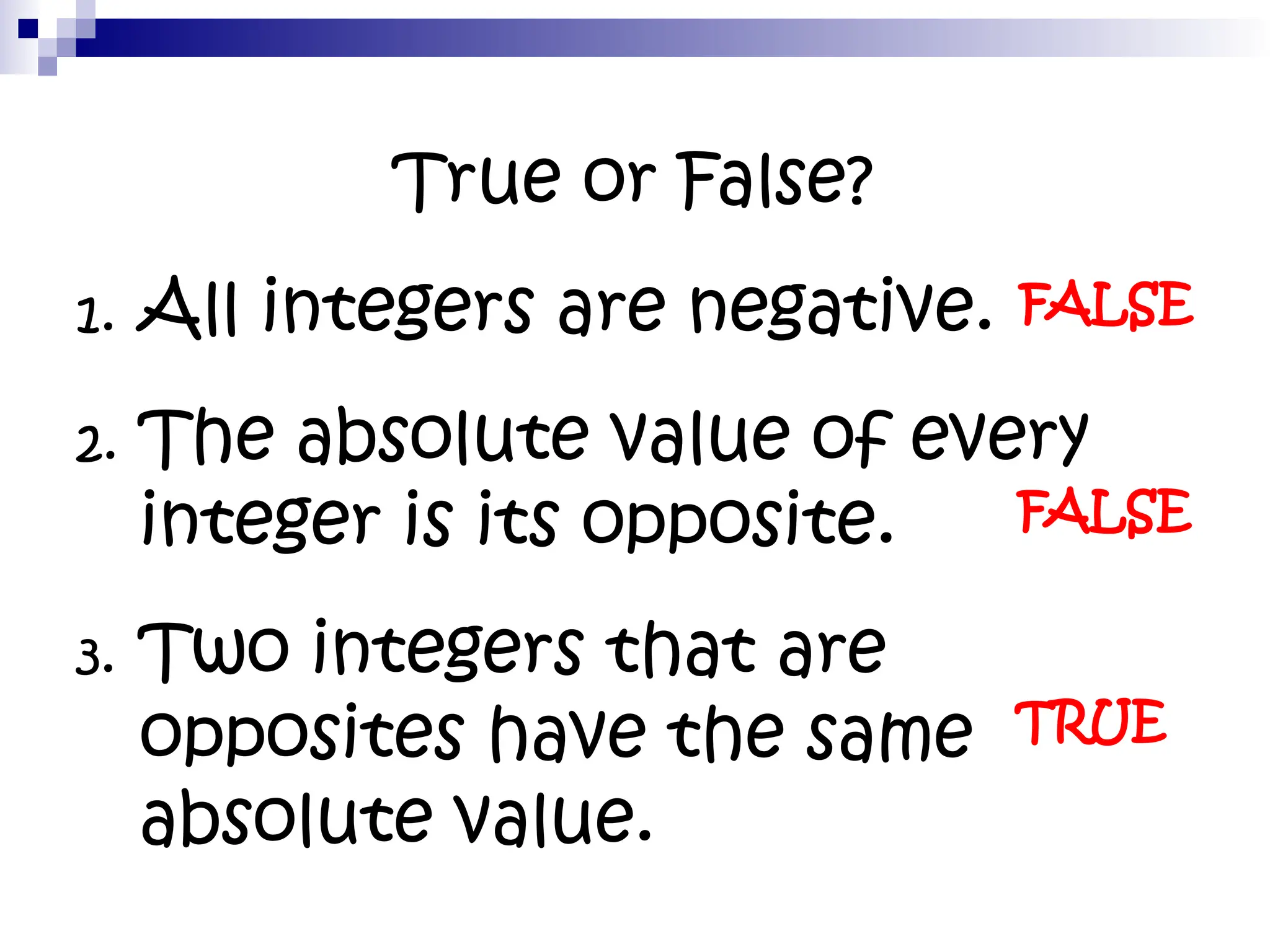
True or False?
1. All integers are negative.
2. The absolute value of every
integer is its opposite.
3. Two integers that are
opposites have the same
absolute value.
FALSE
FALSE
TRUE
True or False?
4. The opposite of an integer is
always negative.
5. The absolute value of a
positive integer is the integer
6. The absolute value of an
integer is always greater than
the integer.
Make up a puzzle
same as the one given
to you about ordering
of integers. Show one
possible solution.
Review
• Visit the website below for additional
information on integers:
http://www.math.com/school/subject1/ l
essons/S1U1L10GL.html
• Click on the signs below to review the
rules for each operation
101507911-Integers-3.ppt for Grade 7 Math

  • 1.
  • 2.
    The elevator ison Ground Floor
  • 3.
    What is anInteger? • A whole number that is either greater than 0 (positive) or less than 0 (negative) • Can be visualized on a number line:
  • 4.
    What is aNumber Line? •A line with arrows on both ends that show the integers with slash marks •Arrows show the line goes to infinity in both directions ( + and -) •Uses a negative sign (-) with negative numbers but no positive sign (+) with positive numbers •Zero is the origin and is neither negative nor positive
  • 5.
    What are Opposites? •Twointegers the same distance from the origin, but on different sides of zero •Every positive integer has a negative integer an equal distance from the origin •Example: The opposite of 6 is -6 •Example: The opposite of -2 is 2
  • 6.
    What is AbsoluteValue? •Distance a number is from zero on a number line (always a positive number) •Indicated by two vertical lines | | •Every number has an absolute value •Opposites have the same absolute values since they are the same distance from zero •Example: |-5| = 5 and |5| = 5 •Example: |50| = 50 and |-50| = 50
  • 7.
    What Can WeDo to Integers? •Integers are numbers, so we can add, subtract, multiply, and divide them •Each operation has different rules to follow
  • 8.
    Adding Rules –Same Signs •If the integers have the SAME signs: ADD the numbers & keep the same sign! •Positive + Positive = Positive Answer •Negative + Negative = Negative Answer • Examples: -3 + (-10) = ? ? = -13 • 6 + (8) = ? ? = 14
  • 9.
    Adding (Same Signs)- Examples #1. -3 + (-10) Step 1: 13 Add the #s Step 2: -13 Keep same sign (Both #s are negative – Answer is negative!) #2. 6 + (8) Step 1: 14 Add the #s Step 2: 14 Keep same sign (Both #s are positive – Answer is positive!)
  • 10.
    Adding Rules –Different Signs •If the integers have the DIFFERENT signs: SUBTRACT the numbers & use sign of the BIGGER number! •Bigger # is Positive = Positive Answer •Bigger # is Negative = Negative Answer • Examples: -13 + (7) = ? ? = -6 • 23 + (-8) = ? ? = 15
  • 11.
    Adding (Different Signs)- Examples #1. -13 + (7) Step 1: 6 Subtract the #s Step 2: -6 Use sign of bigger # (Bigger # is negative - Answer is negative!) #2. 23 + (-8) Step 1: 15 Subtract the #s Step 2: 15 Use sign of bigger # (Bigger # is positive - Answer is positive!)
  • 12.
    Subtracting Rules •Put () around second number & its sign •Change SUBTRACTION sign to an ADDITION sign •Change sign of 2nd number to its opposite •Follow the rules for ADDITION: -SAME signs: Add & keep the same sign -DIFFERENT signs: Subtract & use sign of bigger # • Examples: -5 – -10 = ? ? = 5 • 9 - 23 = ? ? = -14
  • 13.
    Subtracting - Examples #1.-5 – -10 #2. 9 - 23 Step 1: -5 – (-10) Insert ( ) 9 – (23) Step 2: -5 + (-10) Change – to + 9 + (23) Step 3: -5 + (10) Change 2nd sign 9 + (-23) Step 4: 5 Follow adding rules -14 d
  • 14.
    Multiplying Rules • Multiplythe numbers like usual •If the integers have the SAME signs: ANSWER will be POSITIVE •If the integers have DIFFERENT signs: ANSWER will be NEGATIVE • Examples: -3 · (-5) = ? ? = 15 • -9 · (-10) = ? ? = 90 • -7 · 7 = ? ? = -49
  • 15.
    Multiplying - Examples •#1. (-5)· (-4) #2. ((-1) · (-20) • #3. -4 · 5 · (-1) #4. (4 · (-6 )· (-3)
  • 16.
    Find the productsof the following. 1. -4 · (-6) 2. 6 · 3 · (-9) 3. (-2 ) · (-1) · 0 4. 5 · (-10) · (-1) 5. (-2) · 5 · (-3) · (-5)
  • 17.
    Dividing Rules • Dividethe numbers like usual •If the integers have the SAME signs: ANSWER will be POSITIVE •If the integers have DIFFERENT signs: ANSWER will be NEGATIVE • Examples: -33 ÷ (-3) = ? ? = 11 • -90 ÷ (-10) = ? ? = 9 • -20 ÷ 2 = ? ? = -10 •
  • 18.
    Dividing - Examples •#1. -30 ÷ (-3) #2. -9 ÷ (-3) • #3. -24 ÷ 8 #4. 36 ÷ -6
  • 19.
    Find the quotientsof the following. 1.(-40) ÷ 5 2.(-10) ÷ (-2) 3.45 ÷ (-9) 4.60 ÷ (-10) 5.(-20) ÷ (-5) ÷ (-1)
  • 20.
    Mixed Practice Solve thefollowing problems: -9 + - 9 -18 7 · -4 -28 -10 - (-19) 9 -35 ÷ -7 5 15 + -25 -10 -23 - 9 -32
  • 21.
    True or False? 1.All integers are negative. 2. The absolute value of every integer is its opposite. 3. Two integers that are opposites have the same absolute value.
  • 22.
    True or False? 1.All integers are negative. 2. The absolute value of every integer is its opposite. 3. Two integers that are opposites have the same absolute value. FALSE FALSE TRUE
  • 23.
    True or False? 4.The opposite of an integer is always negative. 5. The absolute value of a positive integer is the integer 6. The absolute value of an integer is always greater than the integer.
  • 24.
    Make up apuzzle same as the one given to you about ordering of integers. Show one possible solution.
  • 25.
    Review • Visit thewebsite below for additional information on integers: http://www.math.com/school/subject1/ l essons/S1U1L10GL.html • Click on the signs below to review the rules for each operation