Division
of
Fractions
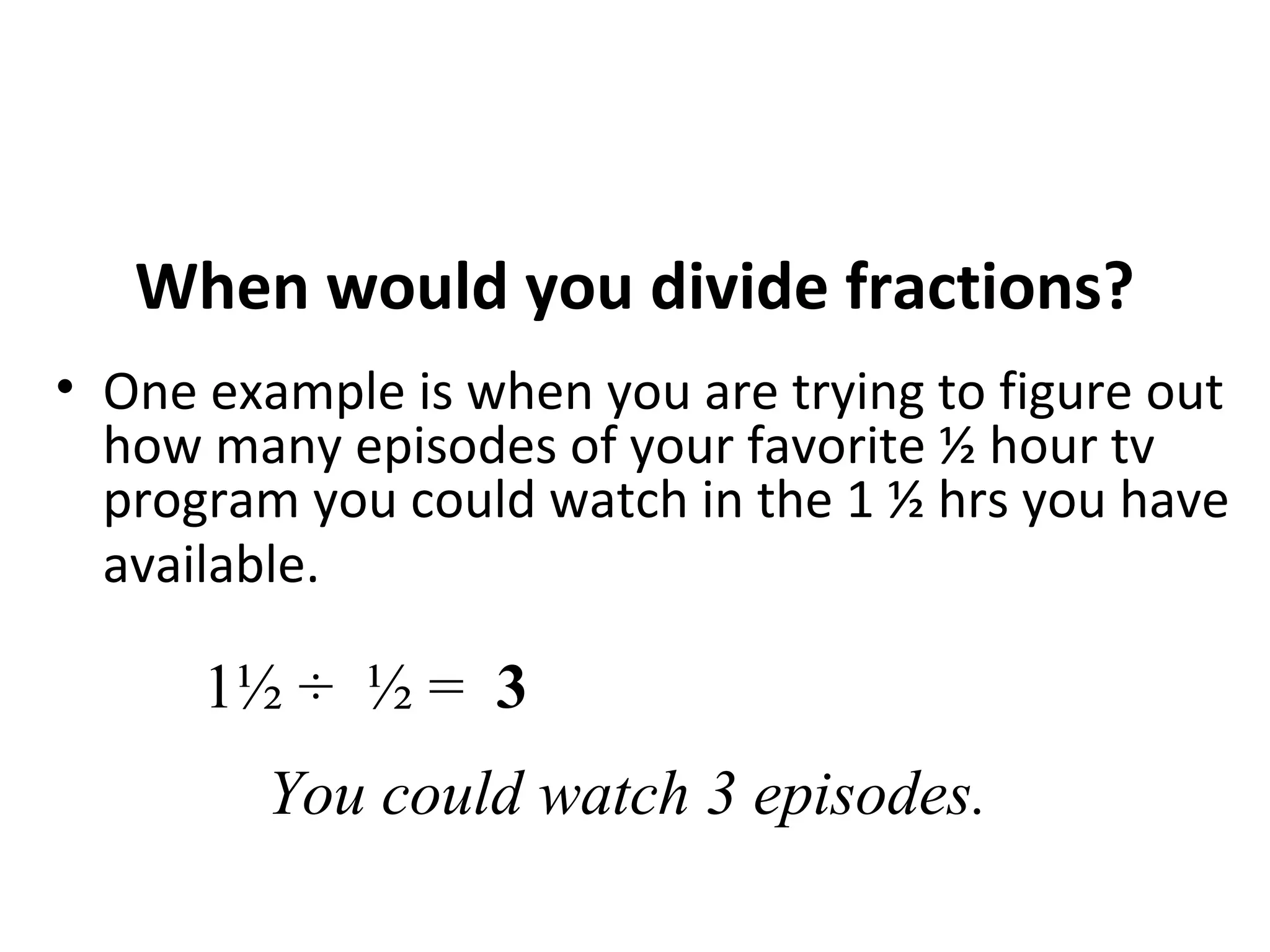
When would you divide fractions?
• One example is when you are trying to figure out
how many episodes of your favorite ½ hour tv
program you could watch in the 1 ½ hrs you have
available.
1½ ÷ ½ = 3
You could watch 3 episodes.
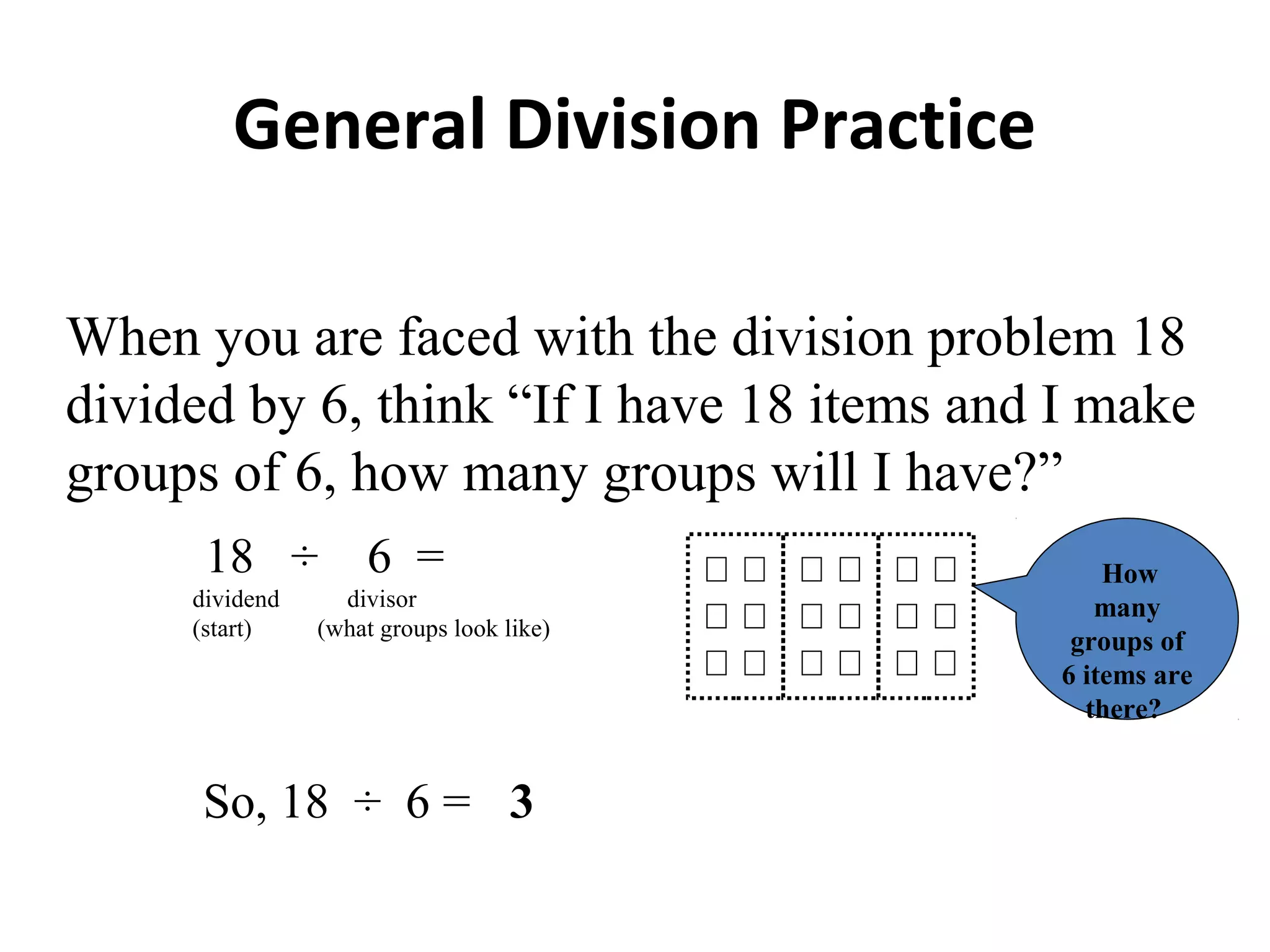
General Division Practice
When you are faced with the division problem 18
divided by 6, think “If I have 18 items and I make
groups of 6, how many groups will I have?”
18 ÷ 6 =
dividend divisor
(start) (what groups look like)
How
many
groups of
6 items are
there?
So, 18 ÷ 6 = 3
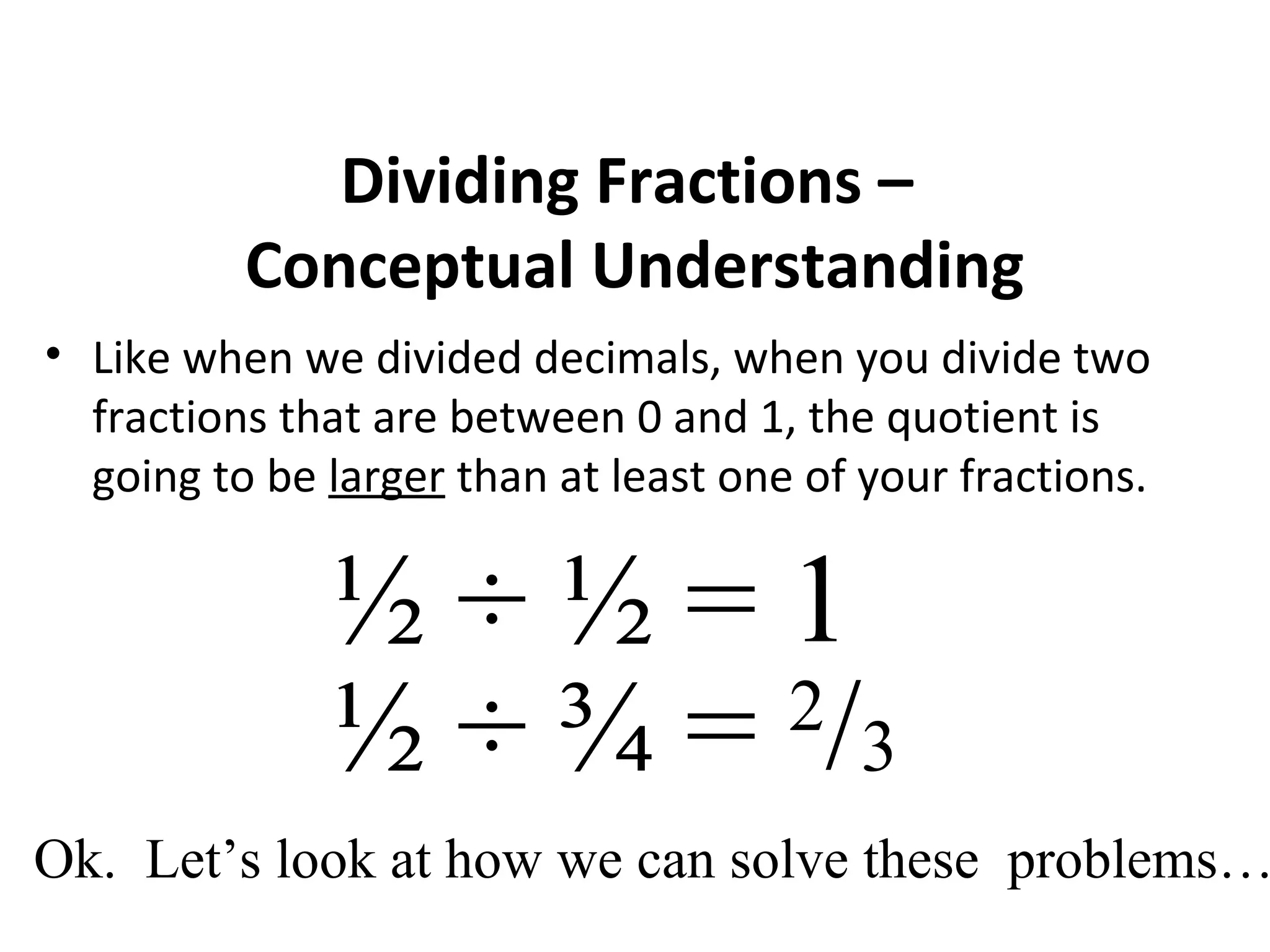
Dividing Fractions –
Conceptual Understanding
• Like when we divided decimals, when you divide two
fractions that are between 0 and 1, the quotient is
going to be larger than at least one of your fractions.
½ ÷ ½ = 1
½ ÷ ¾ = 2
/3
Ok. Let’s look at how we can solve these problems…
Dividing a Whole Number by a
Fraction
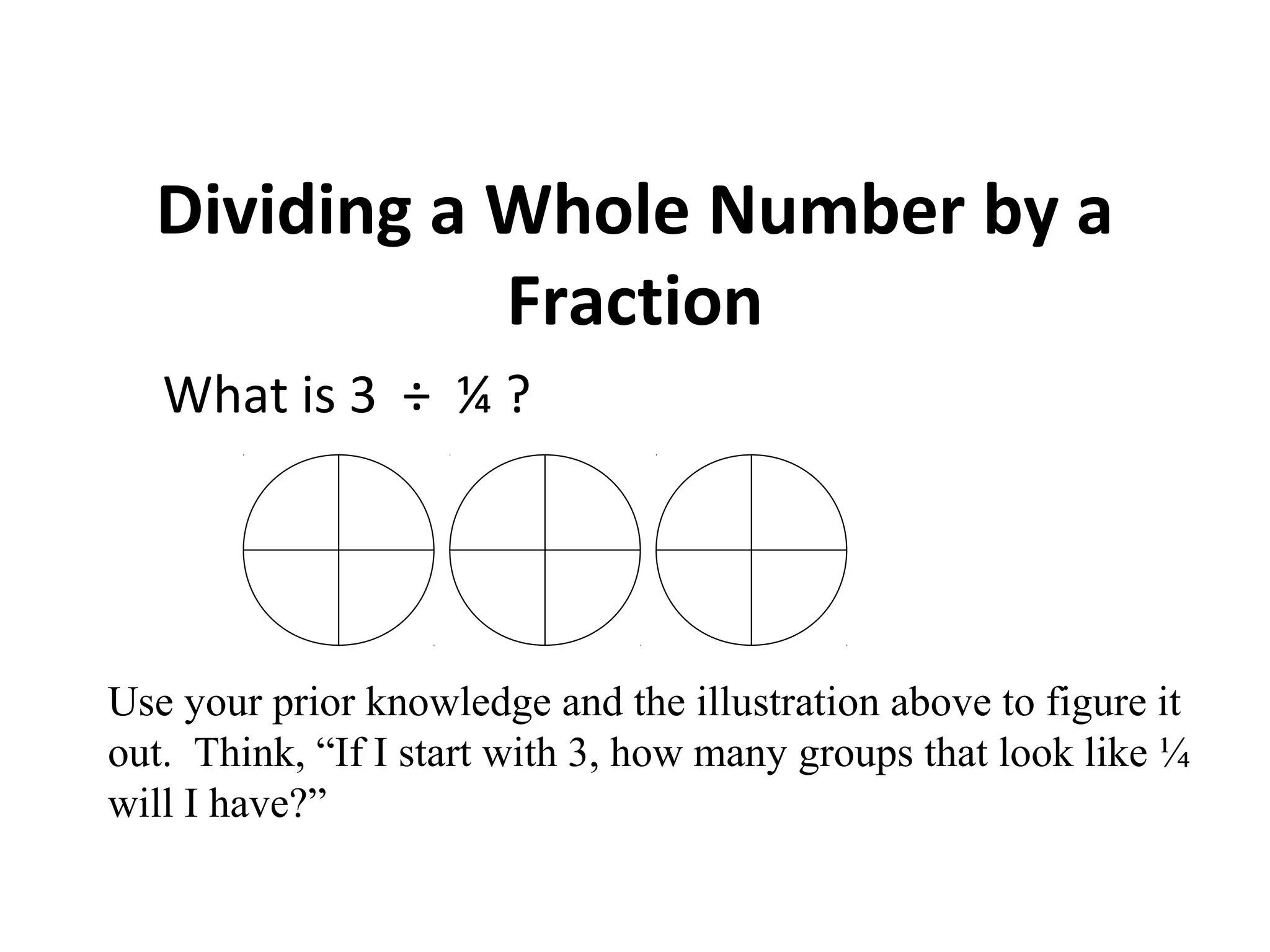
What is 3 ÷ ¼ ?
Use your prior knowledge and the illustration above to figure it
out. Think, “If I start with 3, how many groups that look like ¼
will I have?”
Dividing a Whole Number by a
Fraction
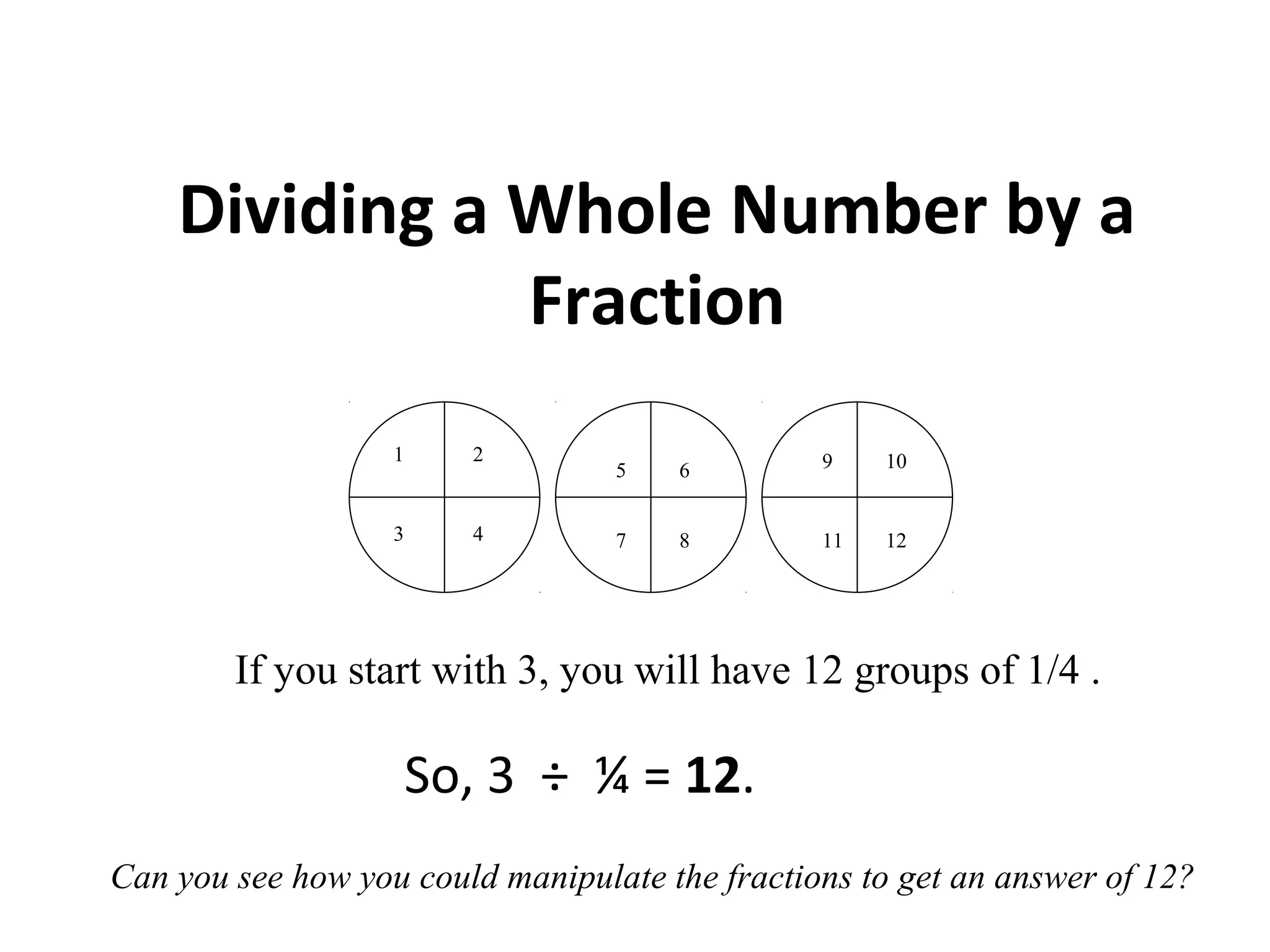
So, 3 ÷ ¼ = 12.
If you start with 3, you will have 12 groups of 1/4 .
1 2
3 4
5 6
7 11
10
12
9
8
Can you see how you could manipulate the fractions to get an answer of 12?
Dividing a Whole Number by a
Fraction
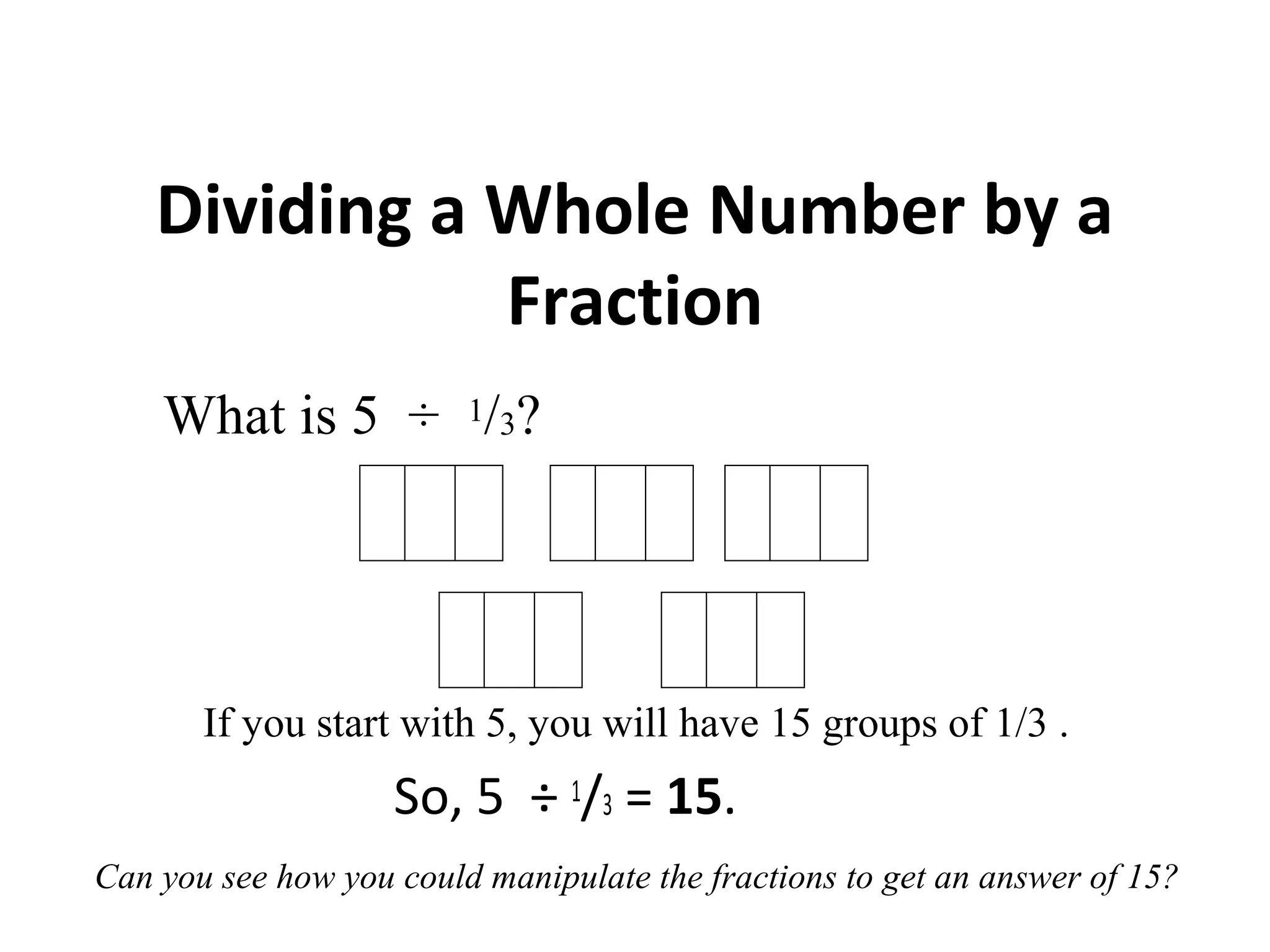
So, 5 ÷ 1/3 = 15.
If you start with 5, you will have 15 groups of 1/3 .
What is 5 ÷ 1/3?
Can you see how you could manipulate the fractions to get an answer of 15?
Dividing a Fraction by a Fraction
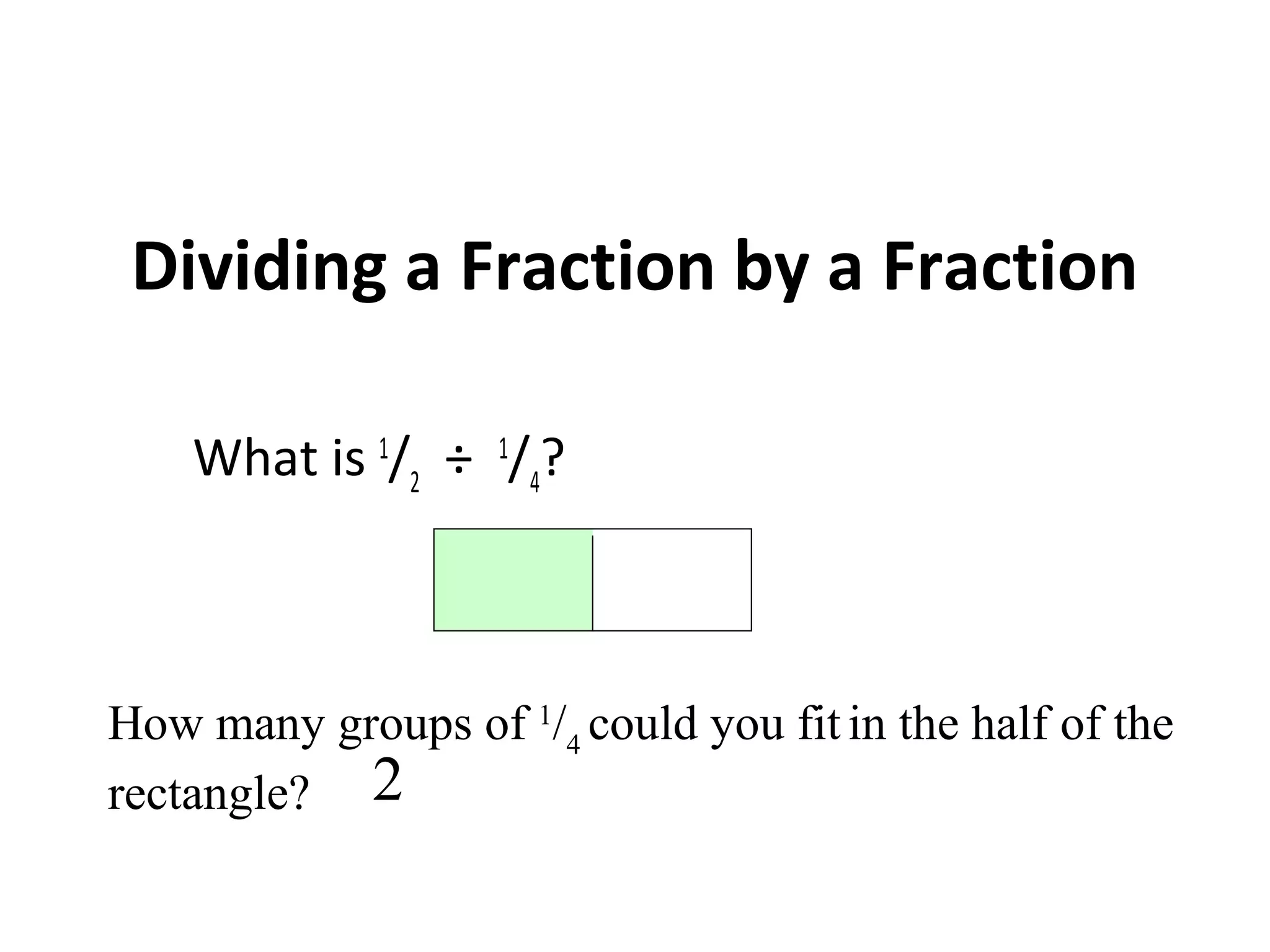
What is 1
/2
÷ 1
/4
?
How many groups of 1
/4
could you fit in the half of the
rectangle? 2
Dividing a Fraction by a Fraction
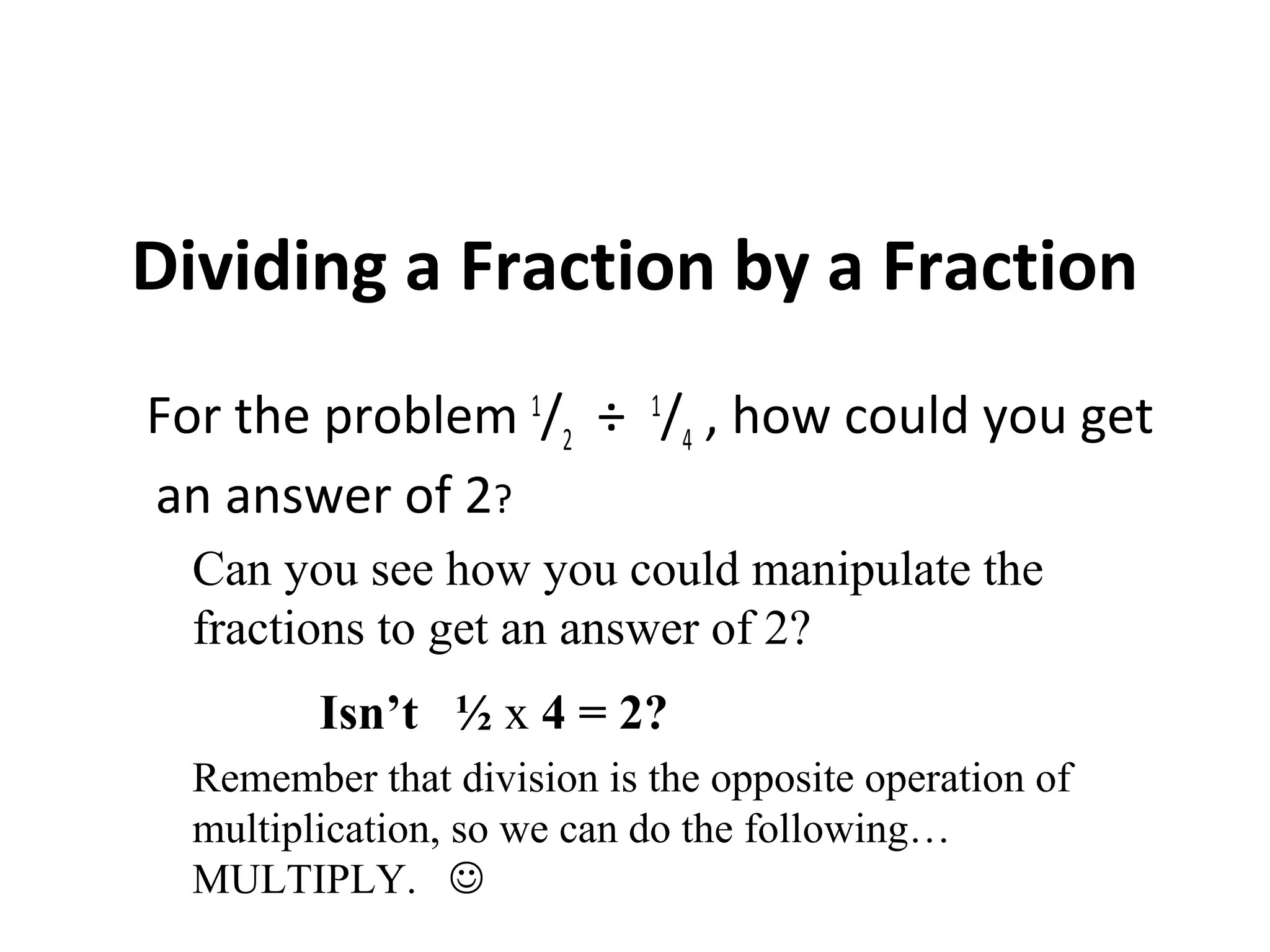
For the problem 1
/2
÷ 1
/4
, how could you get
an answer of 2?
Can you see how you could manipulate the
fractions to get an answer of 2?
Isn’t ½ x 4 = 2?
Remember that division is the opposite operation of
multiplication, so we can do the following…
MULTIPLY. 
Dividing a Fraction by a Fraction
x1
2
4
1
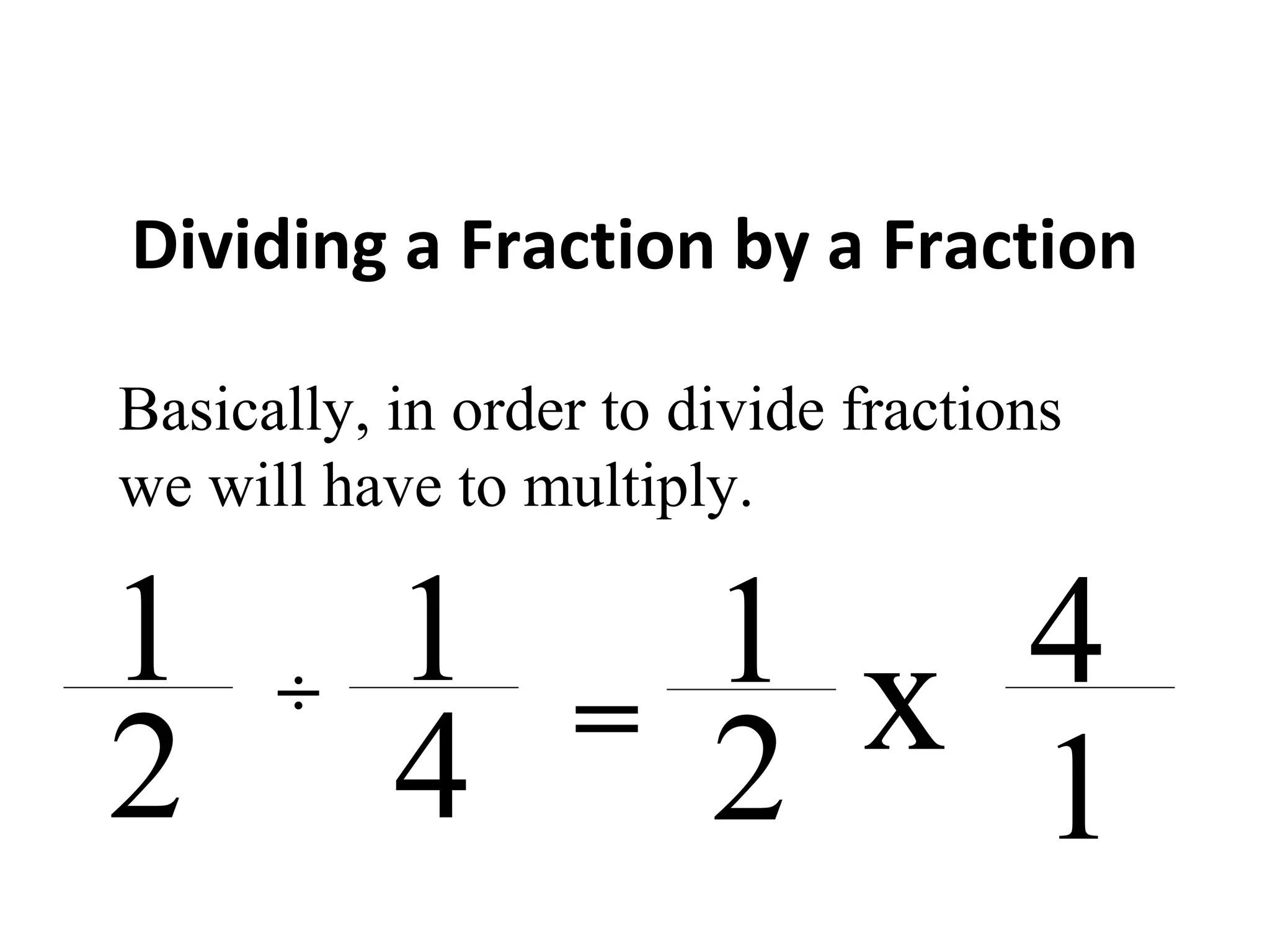
Basically, in order to divide fractions
we will have to multiply.
1
2
1
4
÷
=
Dividing a Fraction by a Fraction
x1
2
4
1
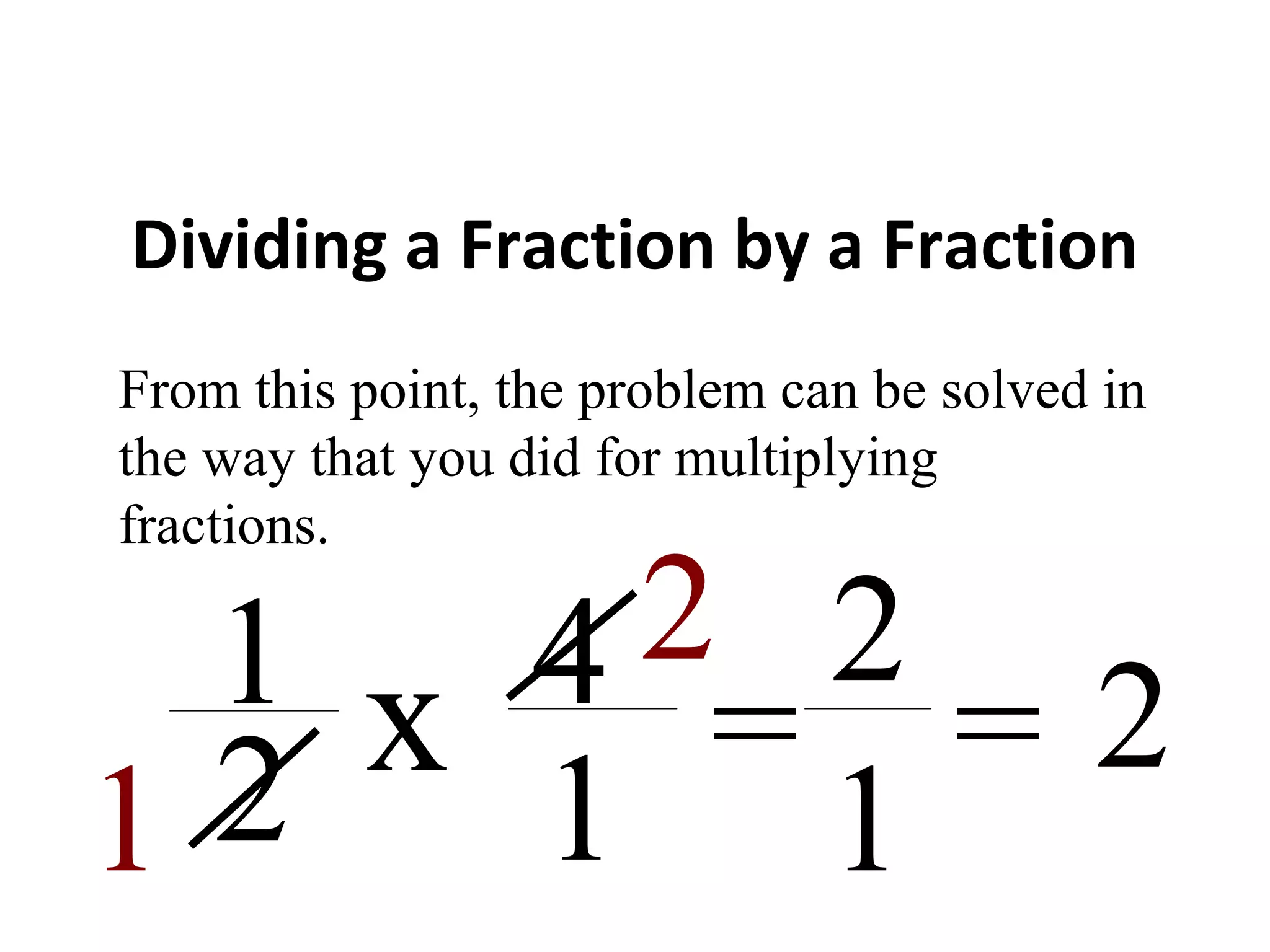
From this point, the problem can be solved in
the way that you did for multiplying
fractions.
1
2
=
2
1
= 2
How to Divide Fractions
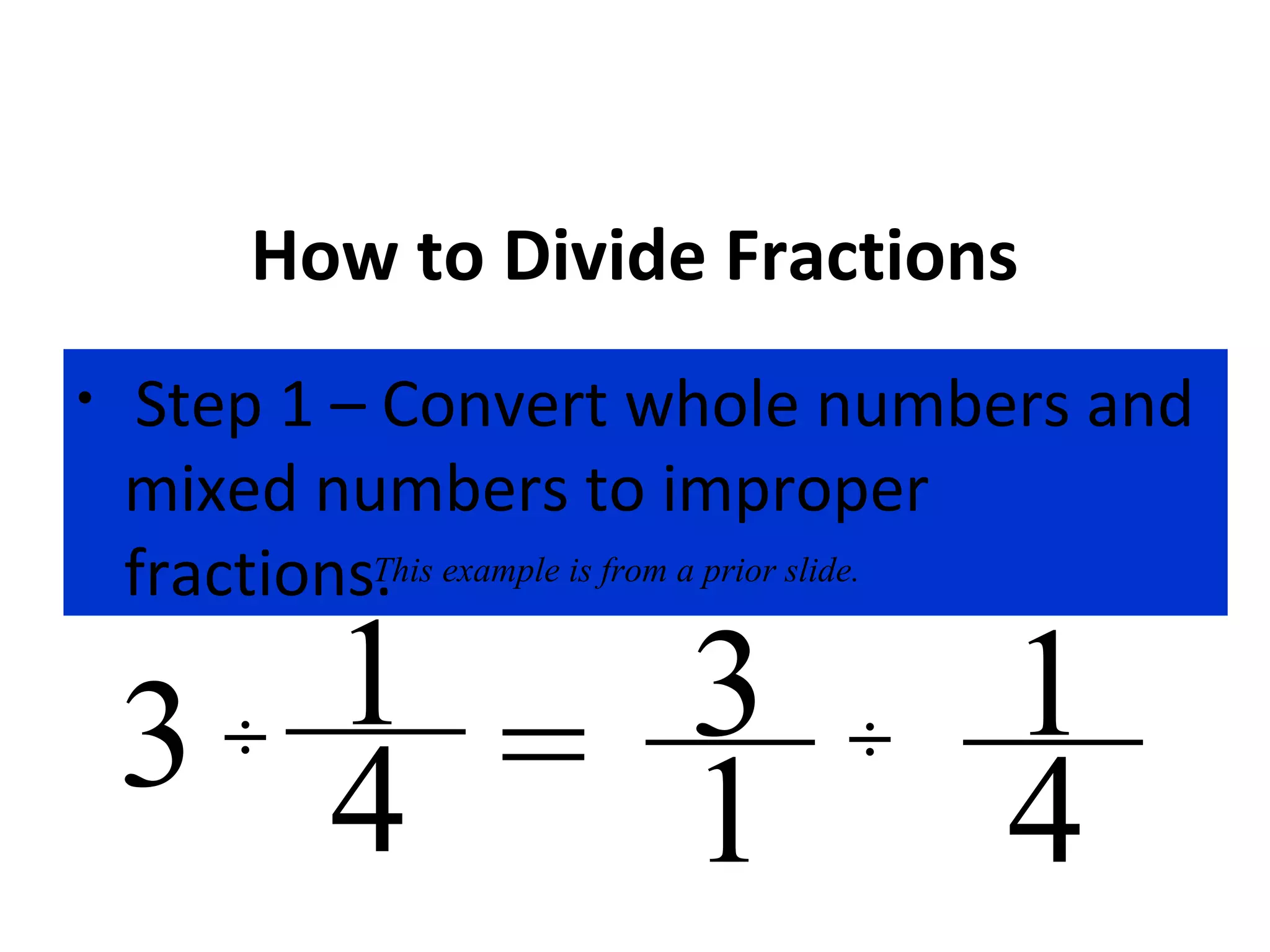
• Step 1 – Convert whole numbers and
mixed numbers to improper
fractions.
÷
4
3
1
1÷
43 =1
This example is from a prior slide.
How to Divide Fractions
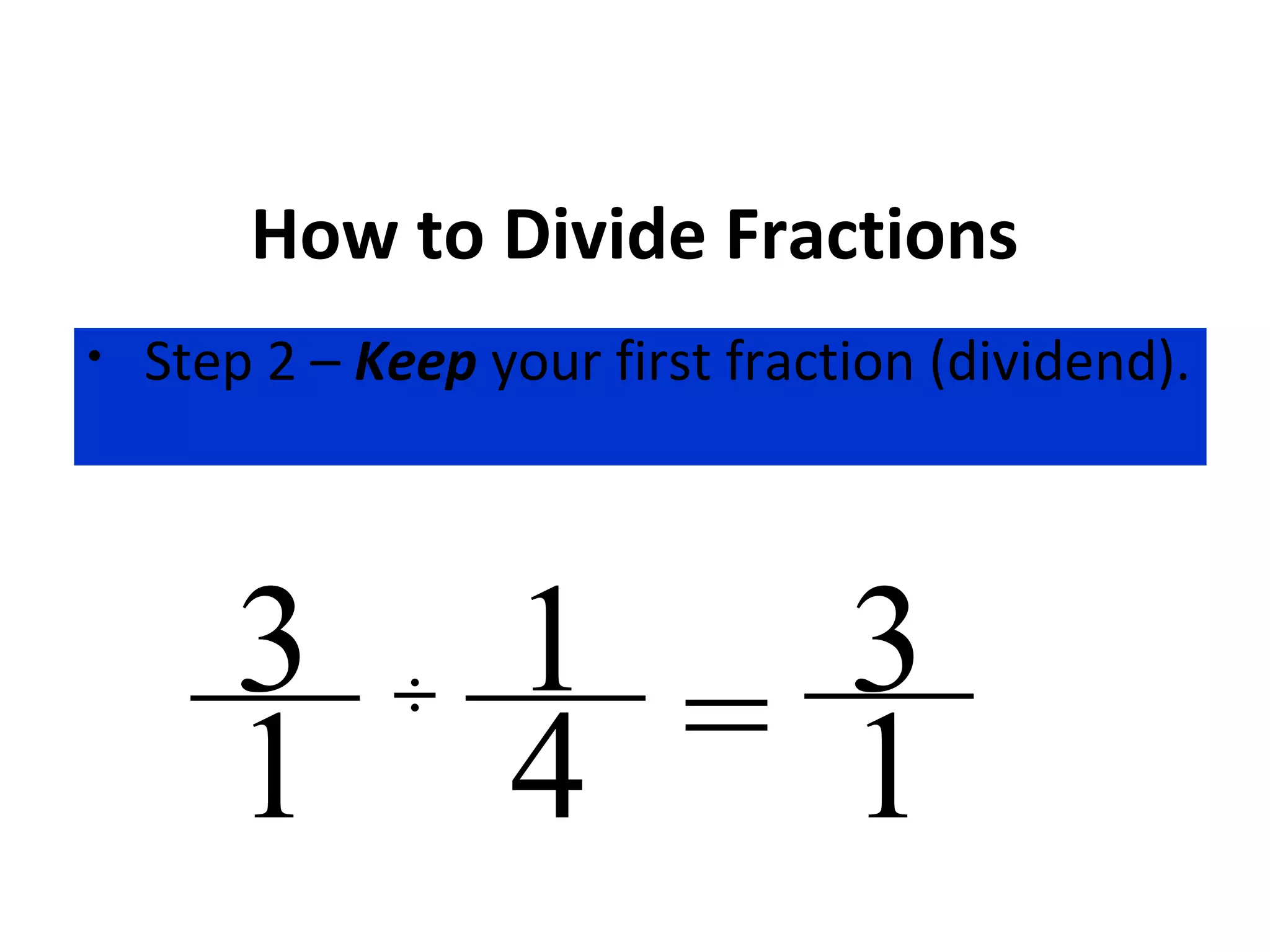
• Step 2 – Keep your first fraction (dividend).
÷
4
3
1
1 = 3
1
How to Divide Fractions
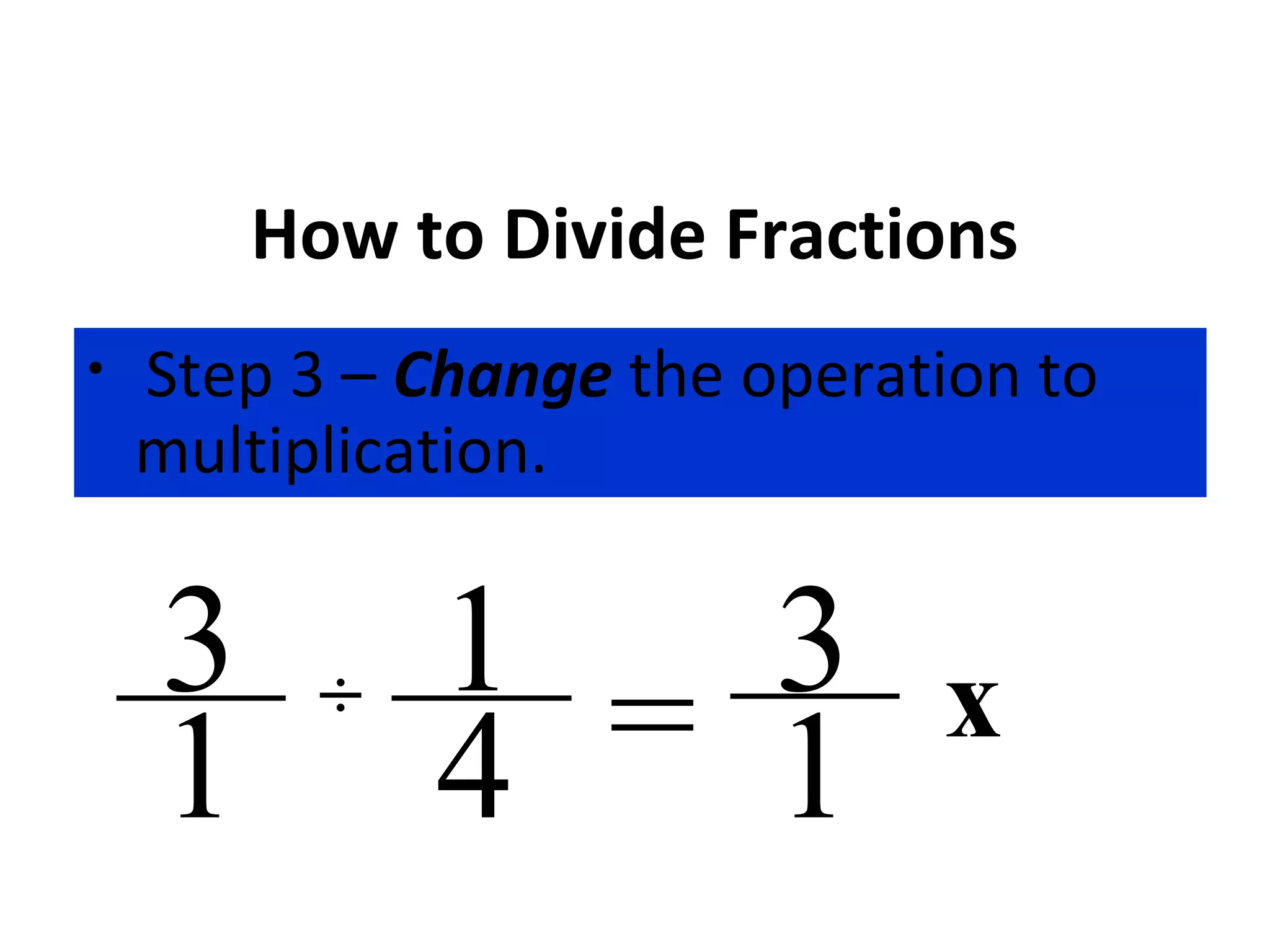
• Step 3 – Change the operation to
multiplication.
÷
4
3
1
1 = 3
1
x
How to Divide Fractions
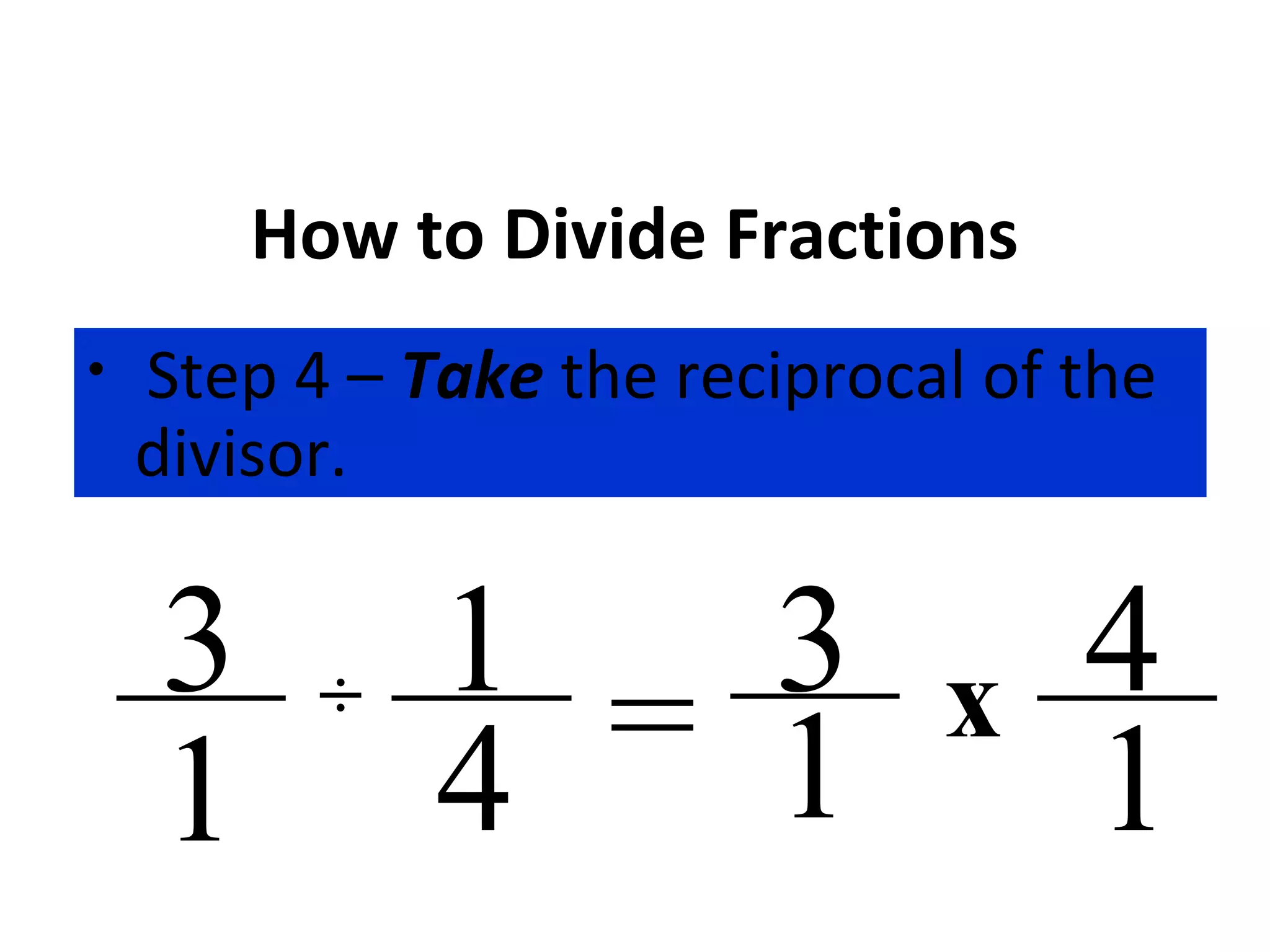
• Step 4 – Take the reciprocal of the
divisor.
÷
4
3
1
1 = 3
1
x
1
4
How to Divide Fractions
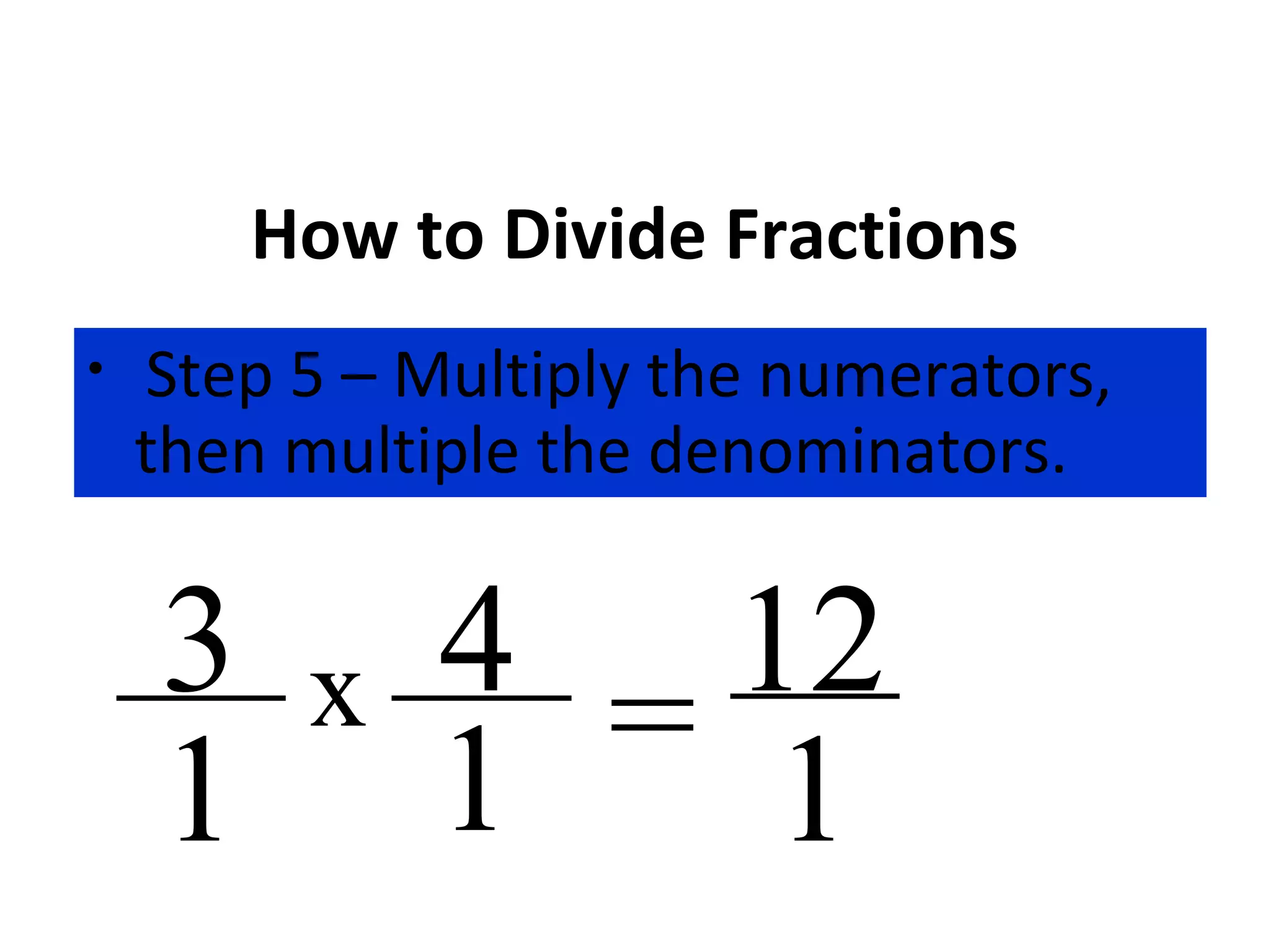
• Step 5 – Multiply the numerators,
then multiple the denominators.
x
1
3
1
4 = 12
1
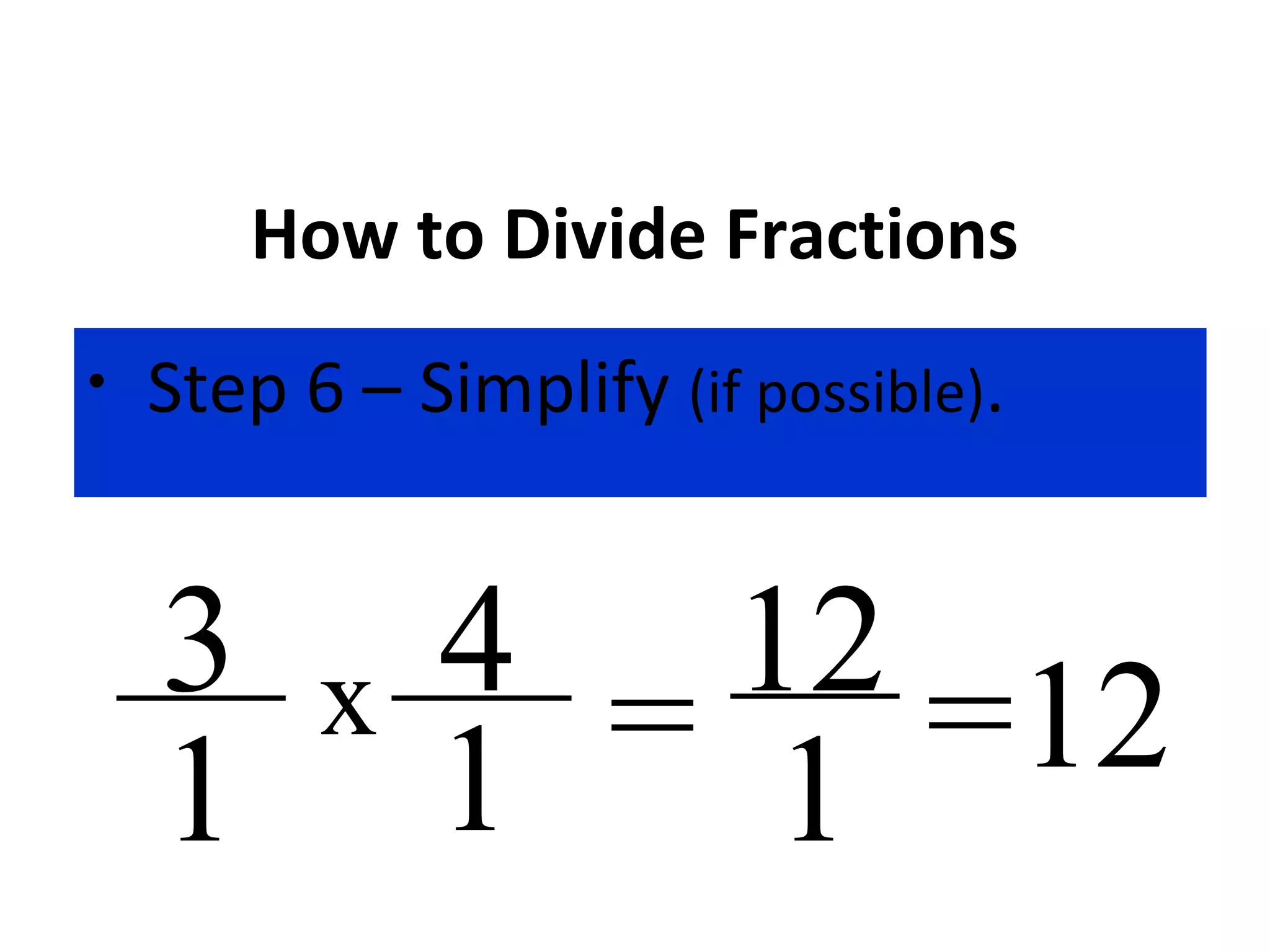
How to Divide Fractions
• Step 6 – Simplify (if possible).
x
1
3
1
4 = 12
1 =12
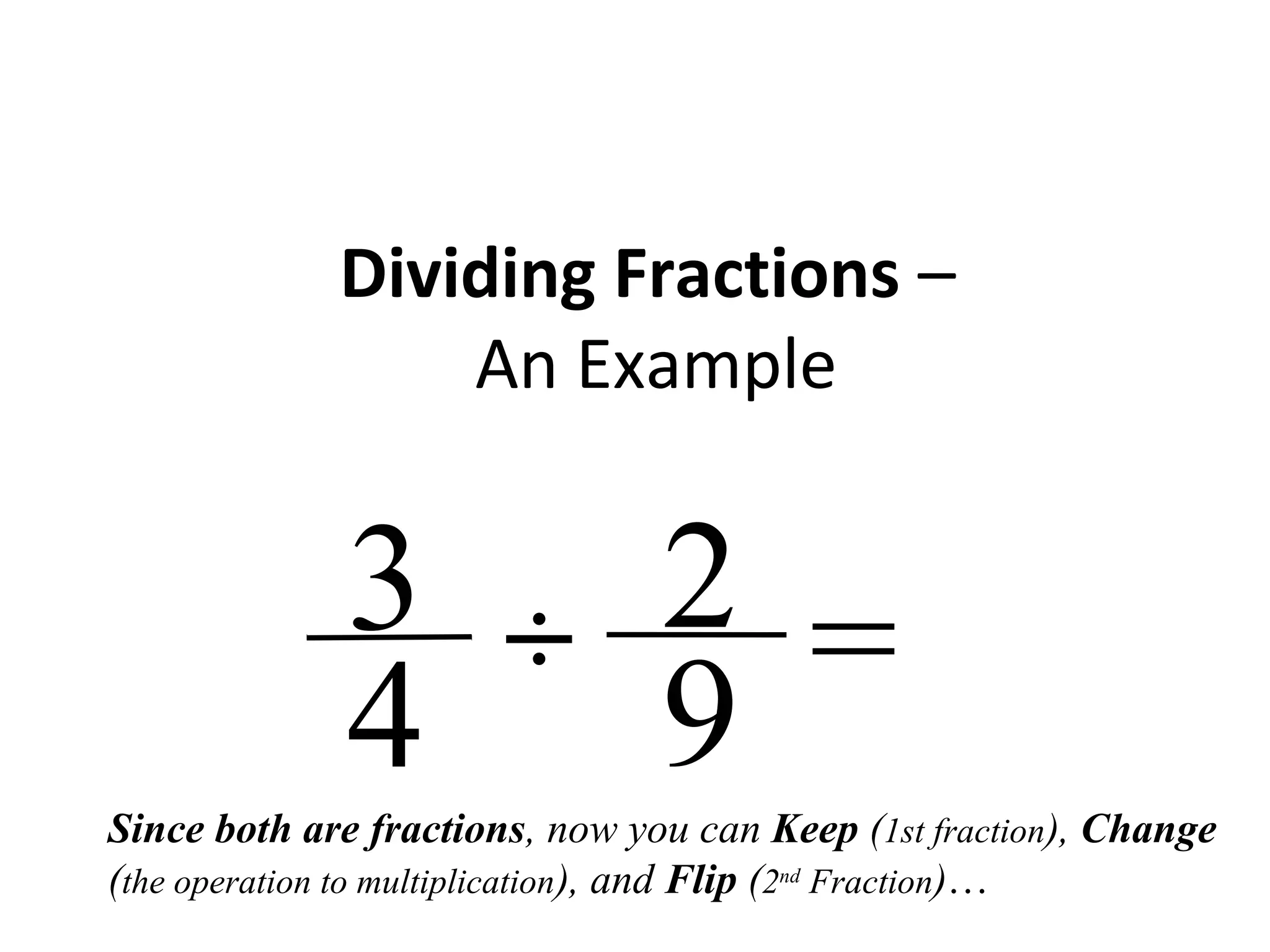
Dividing Fractions –
An Example
2
9
3
4 =÷
Since both are fractions, now you can Keep (1st fraction), Change
(the operation to multiplication), and Flip (2nd
Fraction)…
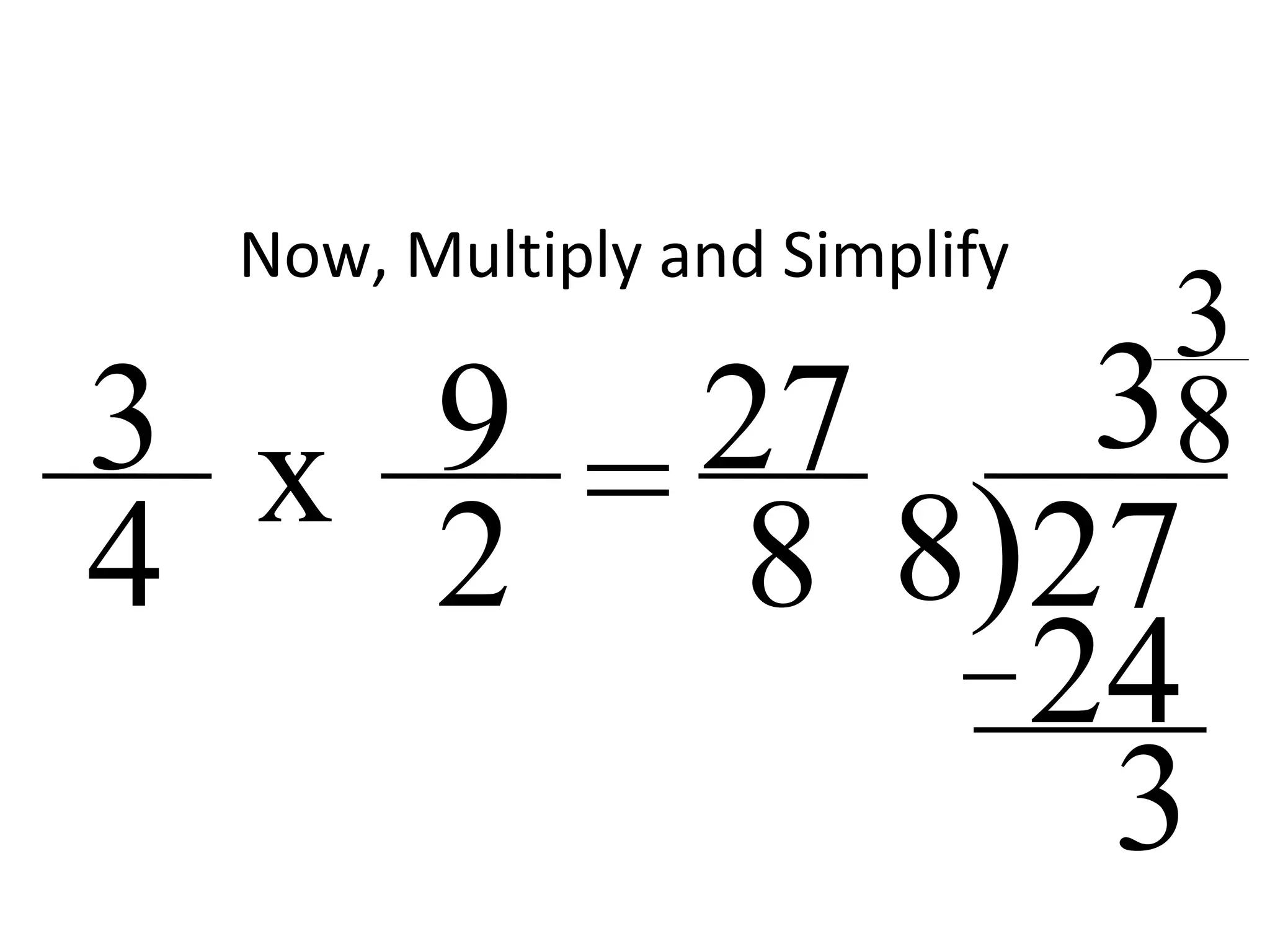
Now, Multiply and Simplify
9
2
3
4 = 27
8 8)27
3x
24
3
3
8
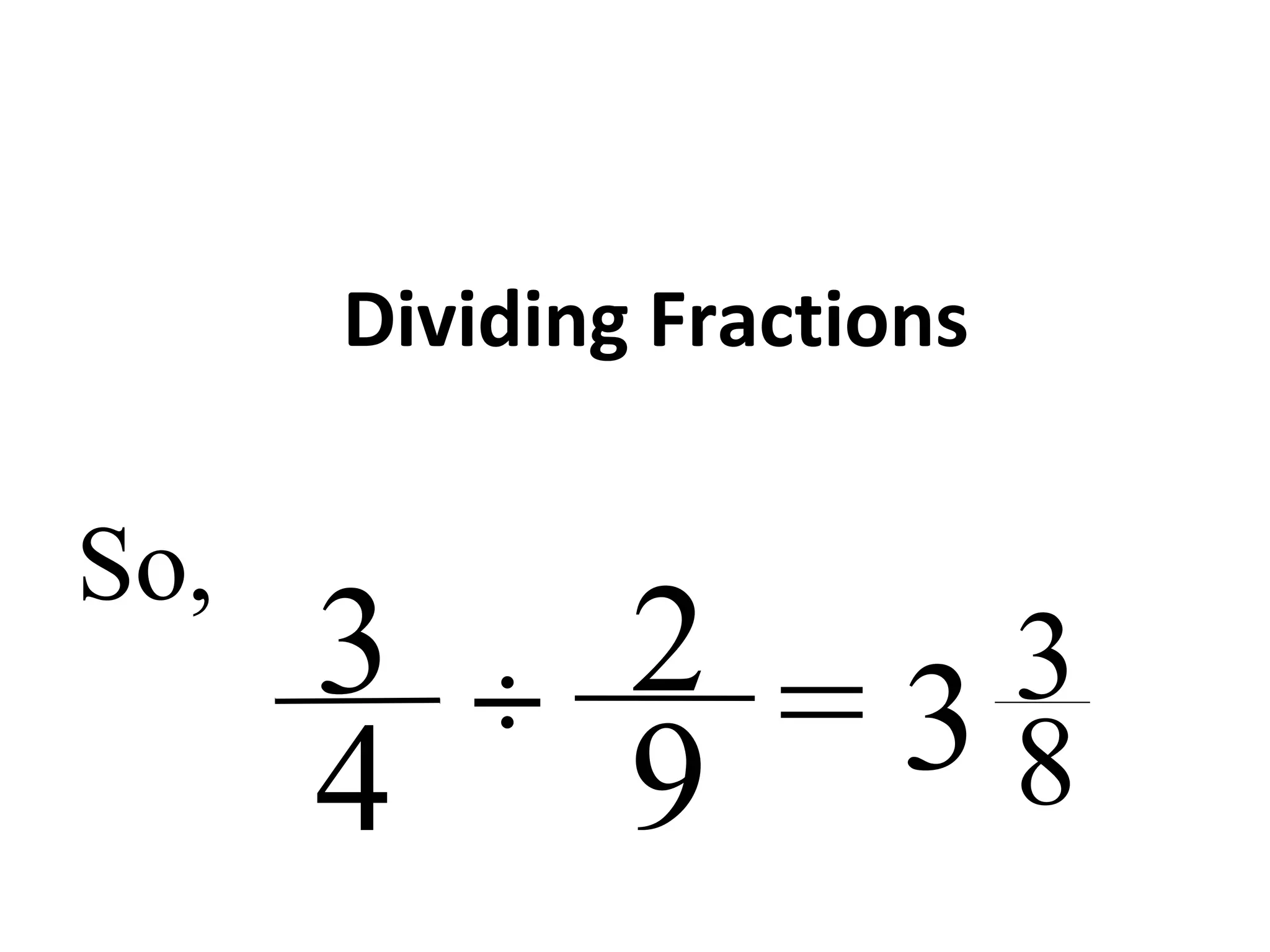
Dividing Fractions
2
9
3
4 =÷ 3 3
8
So,
Dividing Fractions –
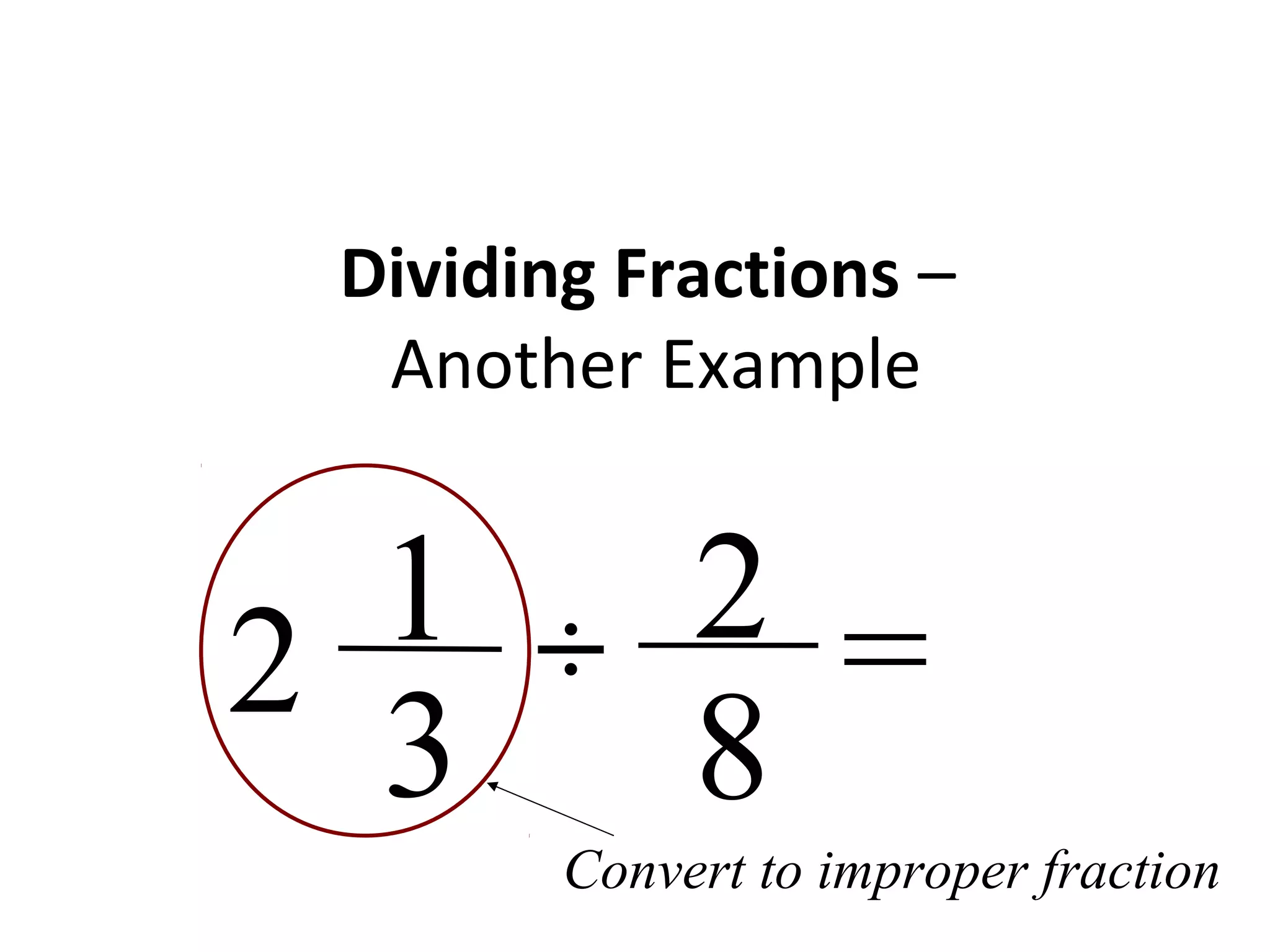
Another Example
2
8
1
3
=÷2
Convert to improper fraction
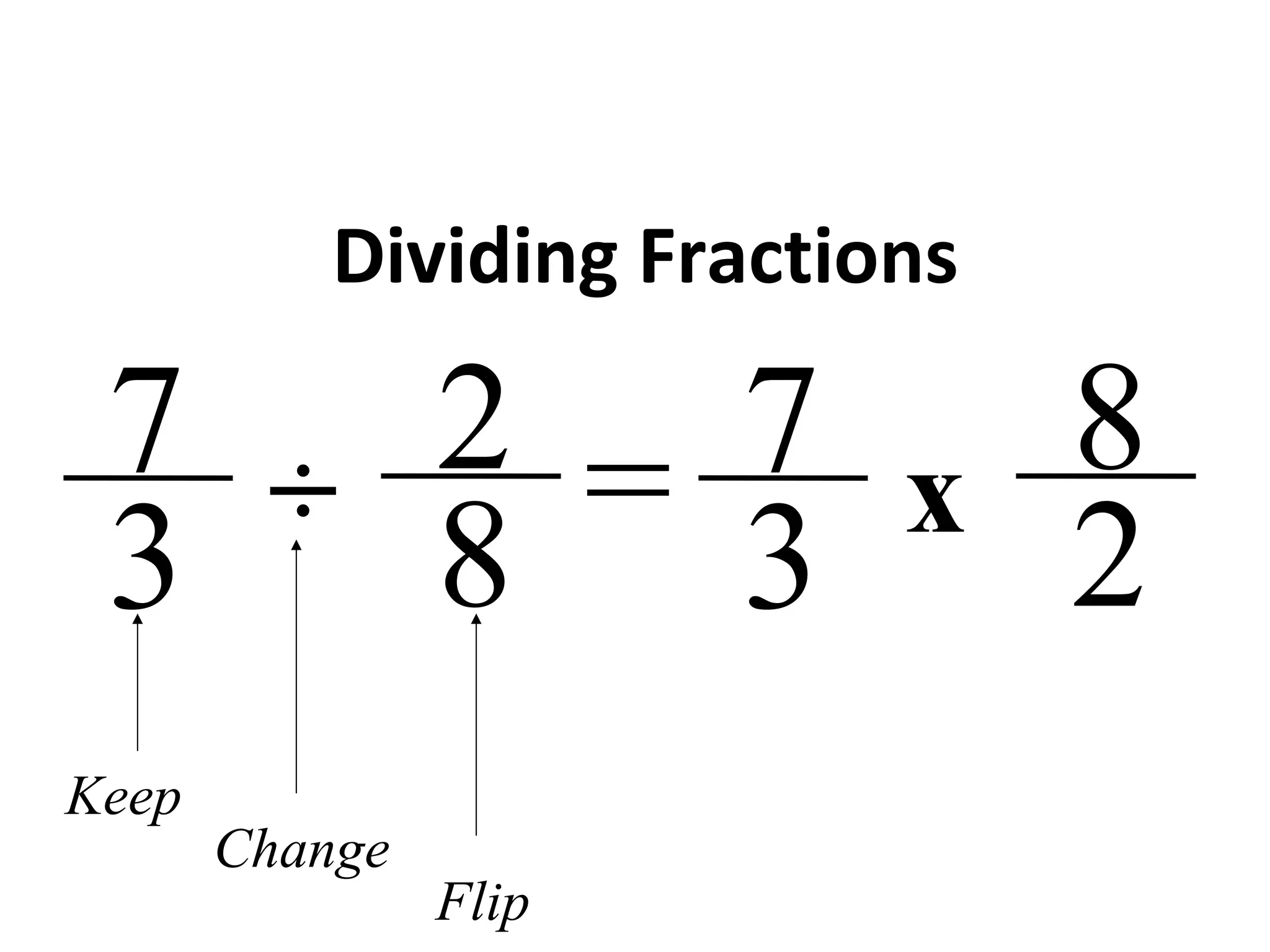
2
8
7
3 =÷
8
2
7
3 x
Keep
Change
Flip
Dividing Fractions
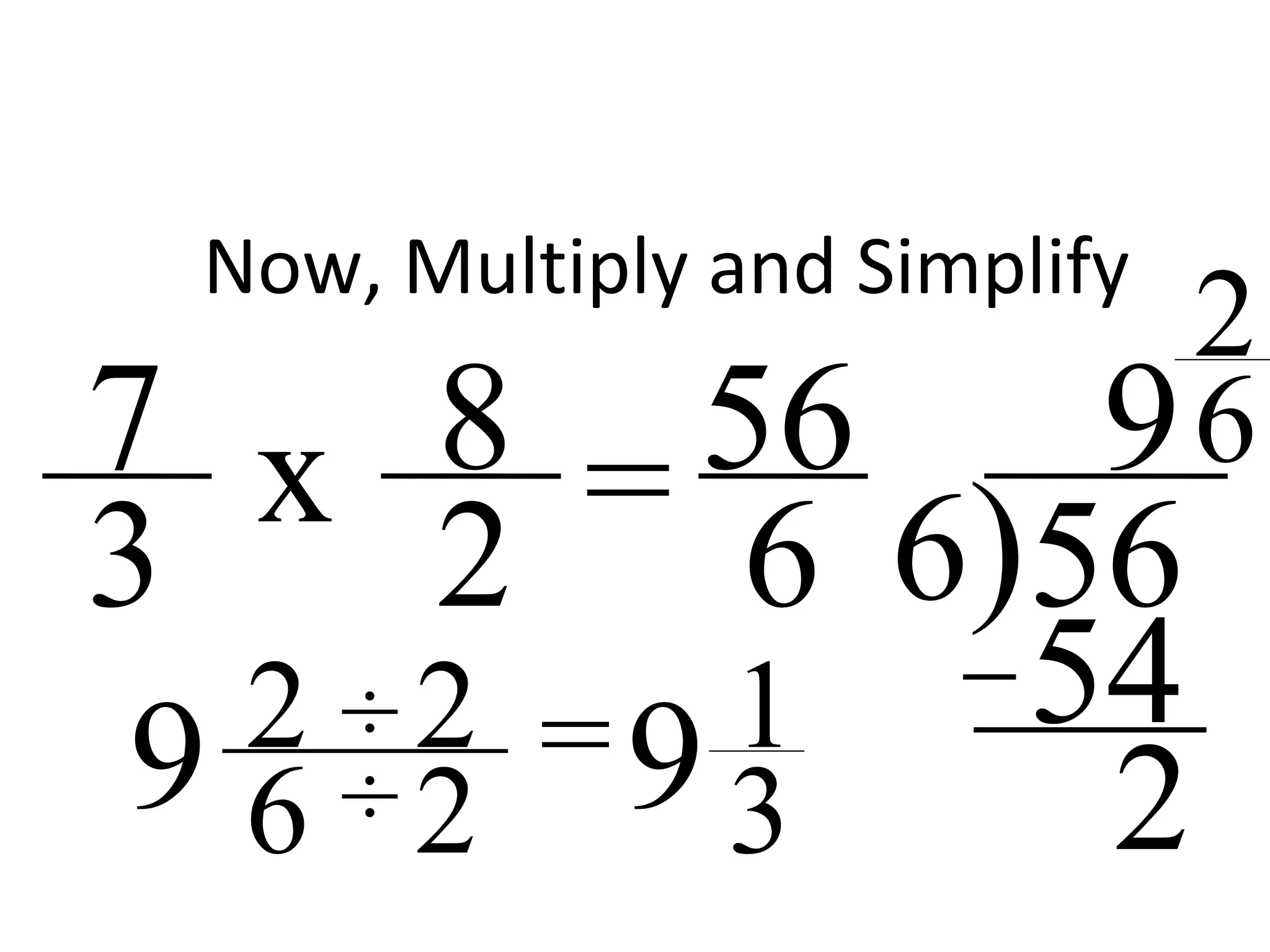
Now, Multiply and Simplify
8
2
7
3 = 56
6 6)56
9x
54
2
2
6
9 2
6
÷ 2
2
=9 1
3÷
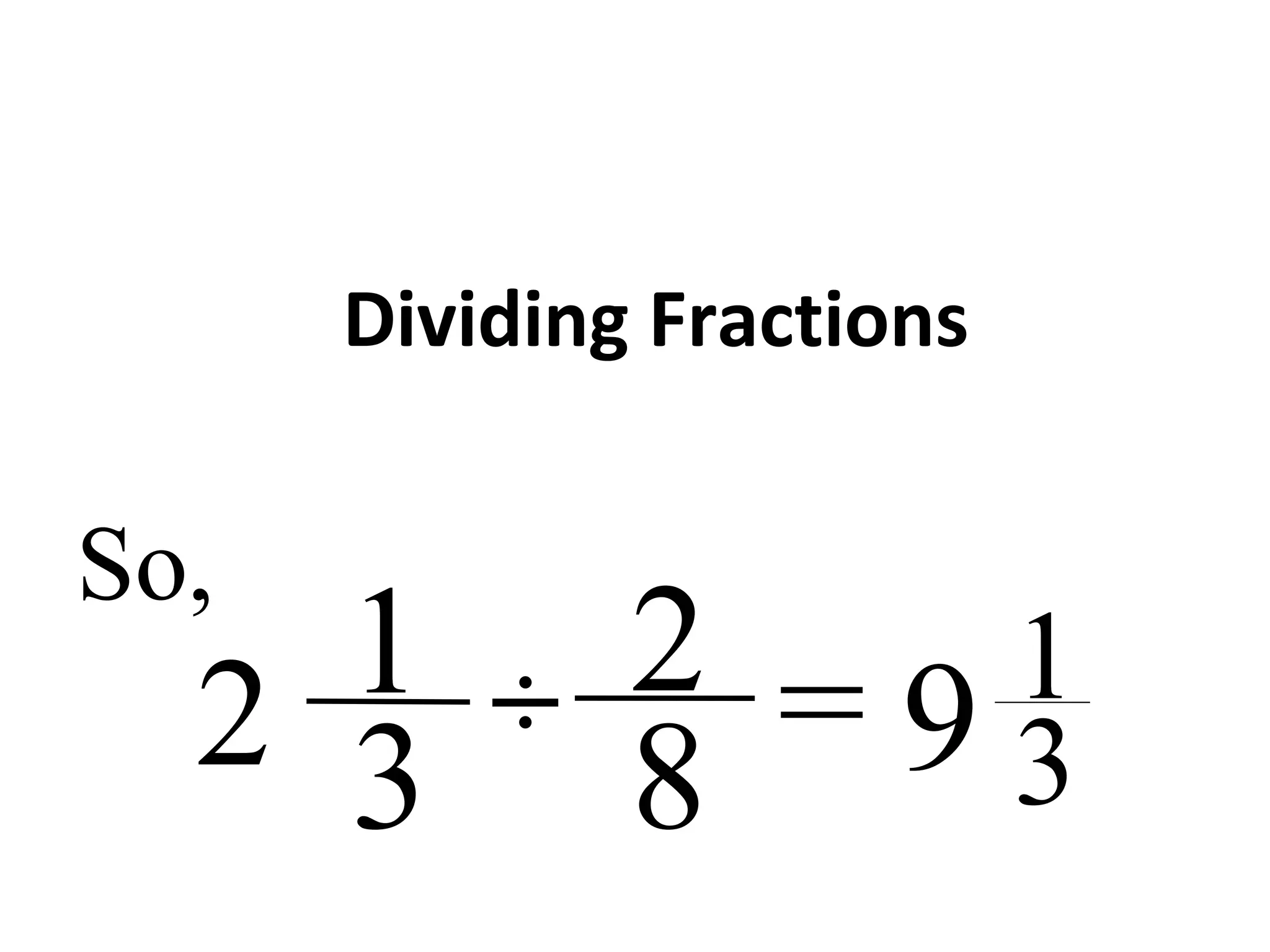
Dividing Fractions
2
8 =÷ 9 1
3
So,
1
32
Dividing Fractions –
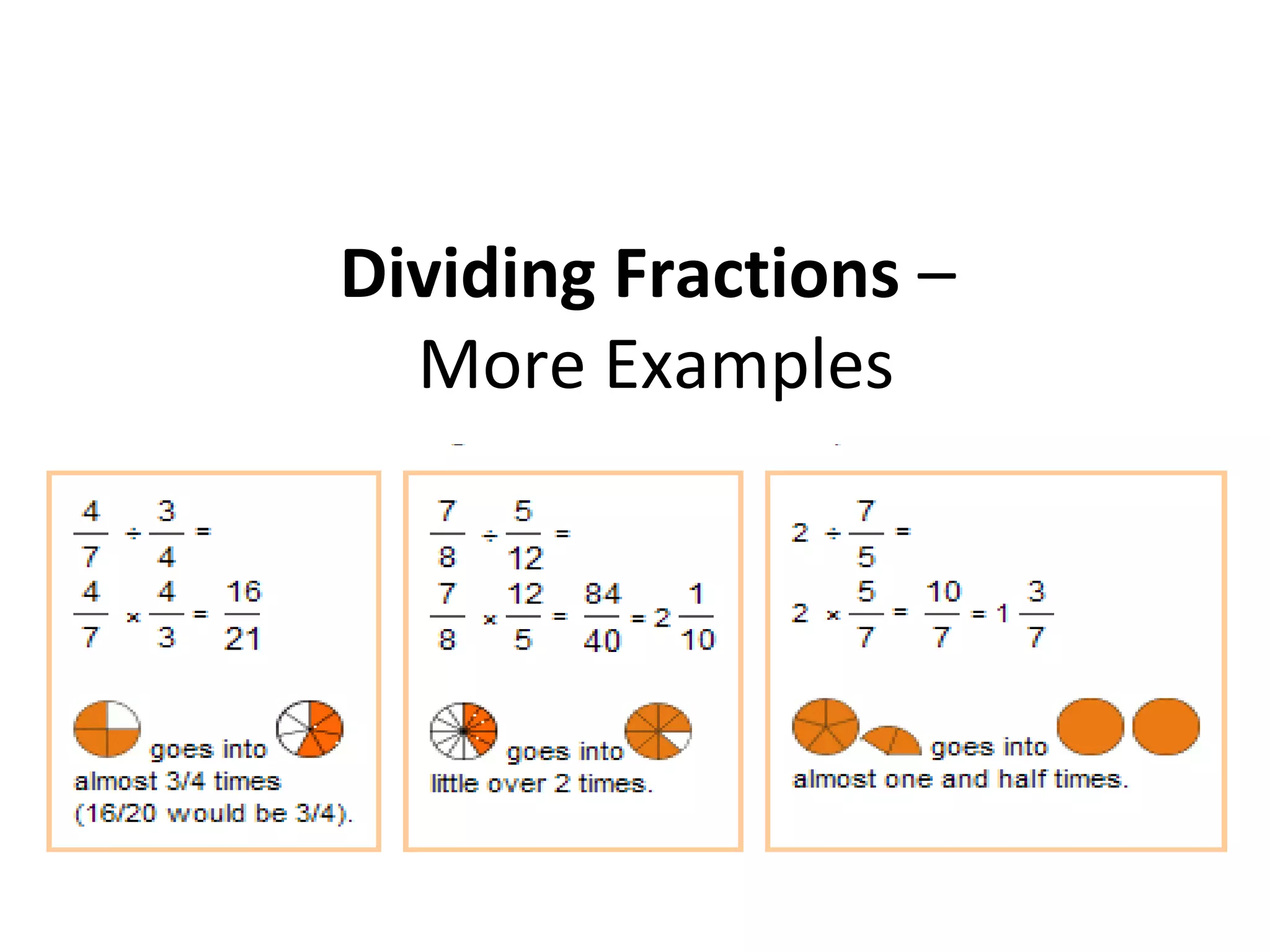
More Examples
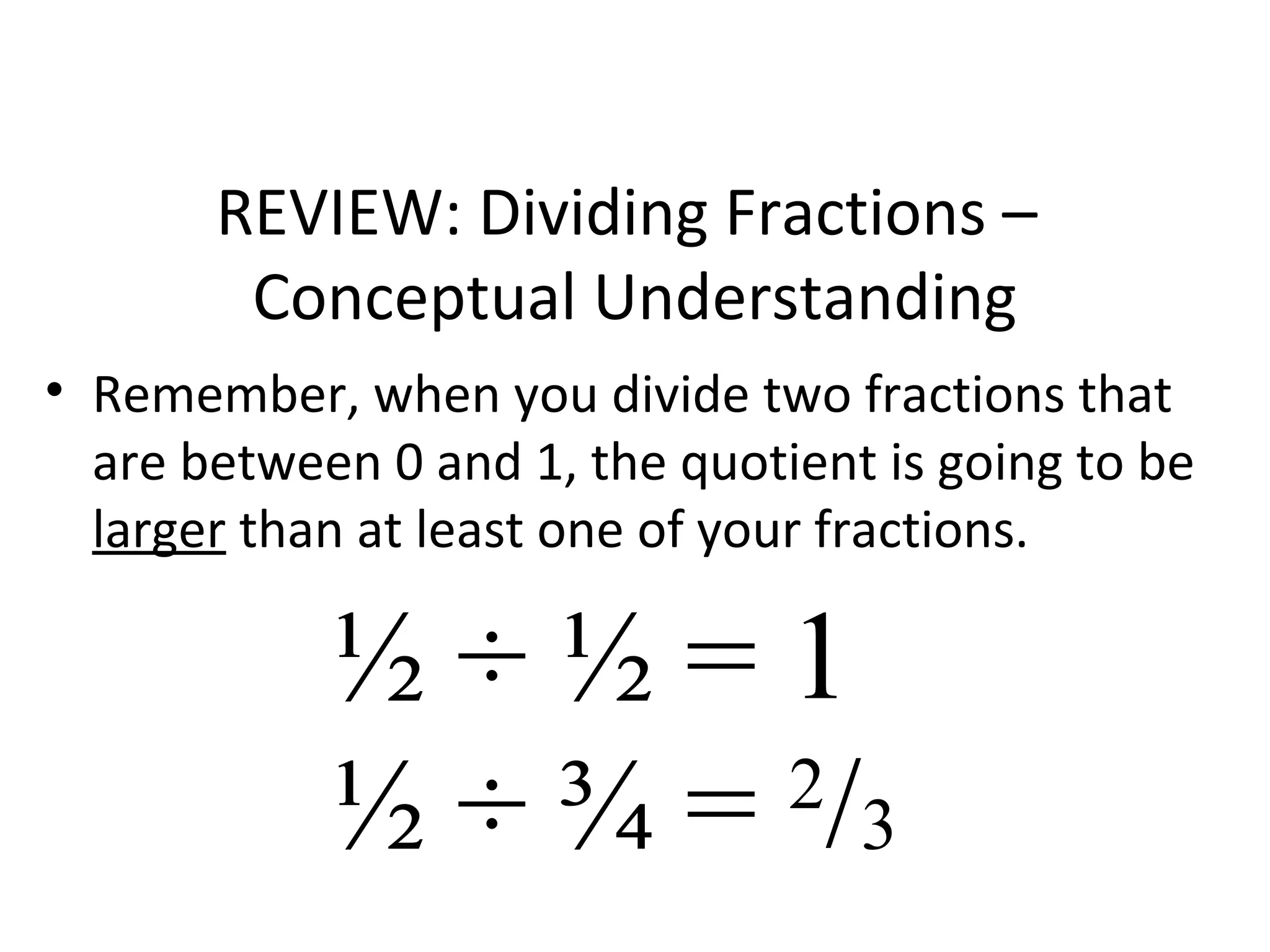
REVIEW: Dividing Fractions –
Conceptual Understanding
• Remember, when you divide two fractions that
are between 0 and 1, the quotient is going to be
larger than at least one of your fractions.
½ ÷ ½ = 1
½ ÷ ¾ = 2
/3
Edelstein, Carol Retrieved from http://www.google.com.ph/url?
sa=t&rct=j&q=&esrc=s&source=web&cd=1&cad=rja&ved=0CCgQFjAA&
url=http%3A%2F%2Fwww.understandmath4life.com%2FDocuments
%2FFractions%2520-%2520Dividing
%2520Fractions.ppt&ei=tylLUvOYDMXIiAfcjYDIDw&usg=AFQjCNHShyeL
0fTWc8DJCkeNsUFIgaVgaA&bvm=bv.53371865,d.aGc
Reference:

Dividing Fractions

  • 1.
  • 2.
    When would youdivide fractions? • One example is when you are trying to figure out how many episodes of your favorite ½ hour tv program you could watch in the 1 ½ hrs you have available. 1½ ÷ ½ = 3 You could watch 3 episodes.
  • 3.
    General Division Practice Whenyou are faced with the division problem 18 divided by 6, think “If I have 18 items and I make groups of 6, how many groups will I have?” 18 ÷ 6 = dividend divisor (start) (what groups look like) How many groups of 6 items are there? So, 18 ÷ 6 = 3
  • 4.
    Dividing Fractions – ConceptualUnderstanding • Like when we divided decimals, when you divide two fractions that are between 0 and 1, the quotient is going to be larger than at least one of your fractions. ½ ÷ ½ = 1 ½ ÷ ¾ = 2 /3 Ok. Let’s look at how we can solve these problems…
  • 5.
    Dividing a WholeNumber by a Fraction What is 3 ÷ ¼ ? Use your prior knowledge and the illustration above to figure it out. Think, “If I start with 3, how many groups that look like ¼ will I have?”
  • 6.
    Dividing a WholeNumber by a Fraction So, 3 ÷ ¼ = 12. If you start with 3, you will have 12 groups of 1/4 . 1 2 3 4 5 6 7 11 10 12 9 8 Can you see how you could manipulate the fractions to get an answer of 12?
  • 7.
    Dividing a WholeNumber by a Fraction So, 5 ÷ 1/3 = 15. If you start with 5, you will have 15 groups of 1/3 . What is 5 ÷ 1/3? Can you see how you could manipulate the fractions to get an answer of 15?
  • 8.
    Dividing a Fractionby a Fraction What is 1 /2 ÷ 1 /4 ? How many groups of 1 /4 could you fit in the half of the rectangle? 2
  • 9.
    Dividing a Fractionby a Fraction For the problem 1 /2 ÷ 1 /4 , how could you get an answer of 2? Can you see how you could manipulate the fractions to get an answer of 2? Isn’t ½ x 4 = 2? Remember that division is the opposite operation of multiplication, so we can do the following… MULTIPLY. 
  • 10.
    Dividing a Fractionby a Fraction x1 2 4 1 Basically, in order to divide fractions we will have to multiply. 1 2 1 4 ÷ =
  • 11.
    Dividing a Fractionby a Fraction x1 2 4 1 From this point, the problem can be solved in the way that you did for multiplying fractions. 1 2 = 2 1 = 2
  • 12.
    How to DivideFractions • Step 1 – Convert whole numbers and mixed numbers to improper fractions. ÷ 4 3 1 1÷ 43 =1 This example is from a prior slide.
  • 13.
    How to DivideFractions • Step 2 – Keep your first fraction (dividend). ÷ 4 3 1 1 = 3 1
  • 14.
    How to DivideFractions • Step 3 – Change the operation to multiplication. ÷ 4 3 1 1 = 3 1 x
  • 15.
    How to DivideFractions • Step 4 – Take the reciprocal of the divisor. ÷ 4 3 1 1 = 3 1 x 1 4
  • 16.
    How to DivideFractions • Step 5 – Multiply the numerators, then multiple the denominators. x 1 3 1 4 = 12 1
  • 17.
    How to DivideFractions • Step 6 – Simplify (if possible). x 1 3 1 4 = 12 1 =12
  • 18.
    Dividing Fractions – AnExample 2 9 3 4 =÷ Since both are fractions, now you can Keep (1st fraction), Change (the operation to multiplication), and Flip (2nd Fraction)…
  • 19.
    Now, Multiply andSimplify 9 2 3 4 = 27 8 8)27 3x 24 3 3 8
  • 20.
  • 21.
    Dividing Fractions – AnotherExample 2 8 1 3 =÷2 Convert to improper fraction
  • 22.
  • 23.
    Now, Multiply andSimplify 8 2 7 3 = 56 6 6)56 9x 54 2 2 6 9 2 6 ÷ 2 2 =9 1 3÷
  • 24.
  • 25.
  • 26.
    REVIEW: Dividing Fractions– Conceptual Understanding • Remember, when you divide two fractions that are between 0 and 1, the quotient is going to be larger than at least one of your fractions. ½ ÷ ½ = 1 ½ ÷ ¾ = 2 /3
  • 27.
    Edelstein, Carol Retrievedfrom http://www.google.com.ph/url? sa=t&rct=j&q=&esrc=s&source=web&cd=1&cad=rja&ved=0CCgQFjAA& url=http%3A%2F%2Fwww.understandmath4life.com%2FDocuments %2FFractions%2520-%2520Dividing %2520Fractions.ppt&ei=tylLUvOYDMXIiAfcjYDIDw&usg=AFQjCNHShyeL 0fTWc8DJCkeNsUFIgaVgaA&bvm=bv.53371865,d.aGc Reference: