2
Factors of a
Number
3
4
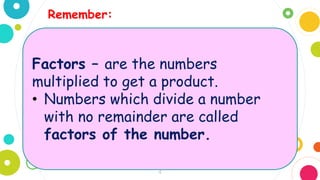
Factors – are the numbers
multiplied to get a product.
• Numbers which divide a number
with no remainder are called
factors of the number.
Remember:
5
Let’s Try:
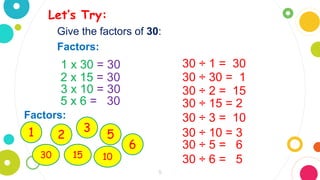
Give the factors of 30:
Factors:
1 x 30 = 30
2 x 15 = 30
1
30
2
15
Factors:
30 ÷ 1 = 30
30 ÷ 30 = 1
30 ÷ 2 = 15
30 ÷ 15 = 2
3 x 10 = 30
5 x 6 = 30
3
10
5
6
30 ÷ 3 = 10
30 ÷ 10 = 3
30 ÷ 5 = 6
30 ÷ 6 = 5
6
Let’s Try:
Give the factors of 26:
Factors:
1 x 26 = 26
2 x 13 = 26
1 26 2 13
Factors:
26 ÷1 = 26
26 ÷ 26 = 1
26 ÷ 2 = 13
26 ÷ 13 = 2
7
Let’s Try:
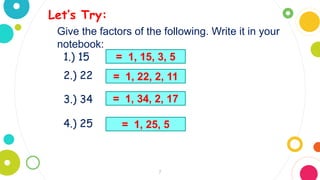
Give the factors of the following. Write it in your
notebook:
1.) 15
2.) 22
= 1, 15, 3, 5
3.) 34
4.) 25
= 1, 22, 2, 11
= 1, 34, 2, 17
= 1, 25, 5
Prime
Factorization
8
9
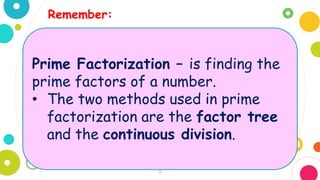
Prime Factorization – is finding the
prime factors of a number.
• The two methods used in prime
factorization are the factor tree
and the continuous division.
Remember:
10
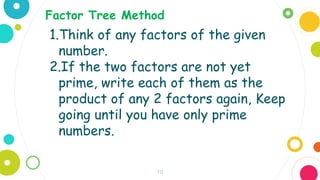
Factor Tree Method
1.Think of any factors of the given
number.
2.If the two factors are not yet
prime, write each of them as the
product of any 2 factors again, Keep
going until you have only prime
numbers.
11
Example:
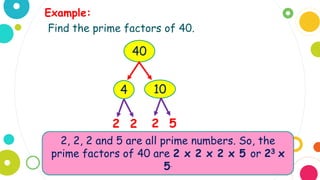
Find the prime factors of 40.
40
4 10
2 2 2 5
2, 2, 2 and 5 are all prime numbers. So, the
prime factors of 40 are 2 x 2 x 2 x 5 or 23 x
5.
12
Example:
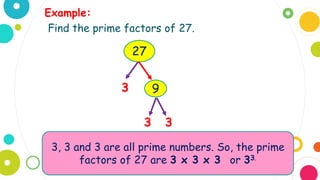
Find the prime factors of 27.
27
9
3
3 3
3, 3 and 3 are all prime numbers. So, the prime
factors of 27 are 3 x 3 x 3 or 33.
13
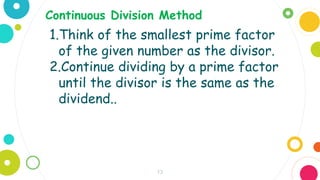
Continuous Division Method
1.Think of the smallest prime factor
of the given number as the divisor.
2.Continue dividing by a prime factor
until the divisor is the same as the
dividend..
14
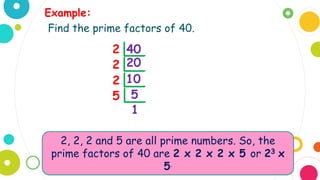
Example:
Find the prime factors of 40.
2, 2, 2 and 5 are all prime numbers. So, the
prime factors of 40 are 2 x 2 x 2 x 5 or 23 x
5.
40
2
20
2
10
2
5
5
1
15
Example:
Find the prime factors of 27.
27
3
9
3
3
3
1
3, 3 and 3 are all prime numbers. So, the prime
factors of 27 are 3 x 3 x 3 or 33.
16
1. Answer page 31.
17
1. Answer page 32-33 (10-18)
18
19
All for Thee, my
Jesus
All for Thee, Amen.
20

Prime Factorization.pptx

  • 2.
  • 3.
  • 4.
    4 Factors – arethe numbers multiplied to get a product. • Numbers which divide a number with no remainder are called factors of the number. Remember:
  • 5.
    5 Let’s Try: Give thefactors of 30: Factors: 1 x 30 = 30 2 x 15 = 30 1 30 2 15 Factors: 30 ÷ 1 = 30 30 ÷ 30 = 1 30 ÷ 2 = 15 30 ÷ 15 = 2 3 x 10 = 30 5 x 6 = 30 3 10 5 6 30 ÷ 3 = 10 30 ÷ 10 = 3 30 ÷ 5 = 6 30 ÷ 6 = 5
  • 6.
    6 Let’s Try: Give thefactors of 26: Factors: 1 x 26 = 26 2 x 13 = 26 1 26 2 13 Factors: 26 ÷1 = 26 26 ÷ 26 = 1 26 ÷ 2 = 13 26 ÷ 13 = 2
  • 7.
    7 Let’s Try: Give thefactors of the following. Write it in your notebook: 1.) 15 2.) 22 = 1, 15, 3, 5 3.) 34 4.) 25 = 1, 22, 2, 11 = 1, 34, 2, 17 = 1, 25, 5
  • 8.
  • 9.
    9 Prime Factorization –is finding the prime factors of a number. • The two methods used in prime factorization are the factor tree and the continuous division. Remember:
  • 10.
    10 Factor Tree Method 1.Thinkof any factors of the given number. 2.If the two factors are not yet prime, write each of them as the product of any 2 factors again, Keep going until you have only prime numbers.
  • 11.
    11 Example: Find the primefactors of 40. 40 4 10 2 2 2 5 2, 2, 2 and 5 are all prime numbers. So, the prime factors of 40 are 2 x 2 x 2 x 5 or 23 x 5.
  • 12.
    12 Example: Find the primefactors of 27. 27 9 3 3 3 3, 3 and 3 are all prime numbers. So, the prime factors of 27 are 3 x 3 x 3 or 33.
  • 13.
    13 Continuous Division Method 1.Thinkof the smallest prime factor of the given number as the divisor. 2.Continue dividing by a prime factor until the divisor is the same as the dividend..
  • 14.
    14 Example: Find the primefactors of 40. 2, 2, 2 and 5 are all prime numbers. So, the prime factors of 40 are 2 x 2 x 2 x 5 or 23 x 5. 40 2 20 2 10 2 5 5 1
  • 15.
    15 Example: Find the primefactors of 27. 27 3 9 3 3 3 1 3, 3 and 3 are all prime numbers. So, the prime factors of 27 are 3 x 3 x 3 or 33.
  • 16.
  • 17.
    17 1. Answer page32-33 (10-18)
  • 18.
  • 19.
    19 All for Thee,my Jesus All for Thee, Amen.
  • 20.