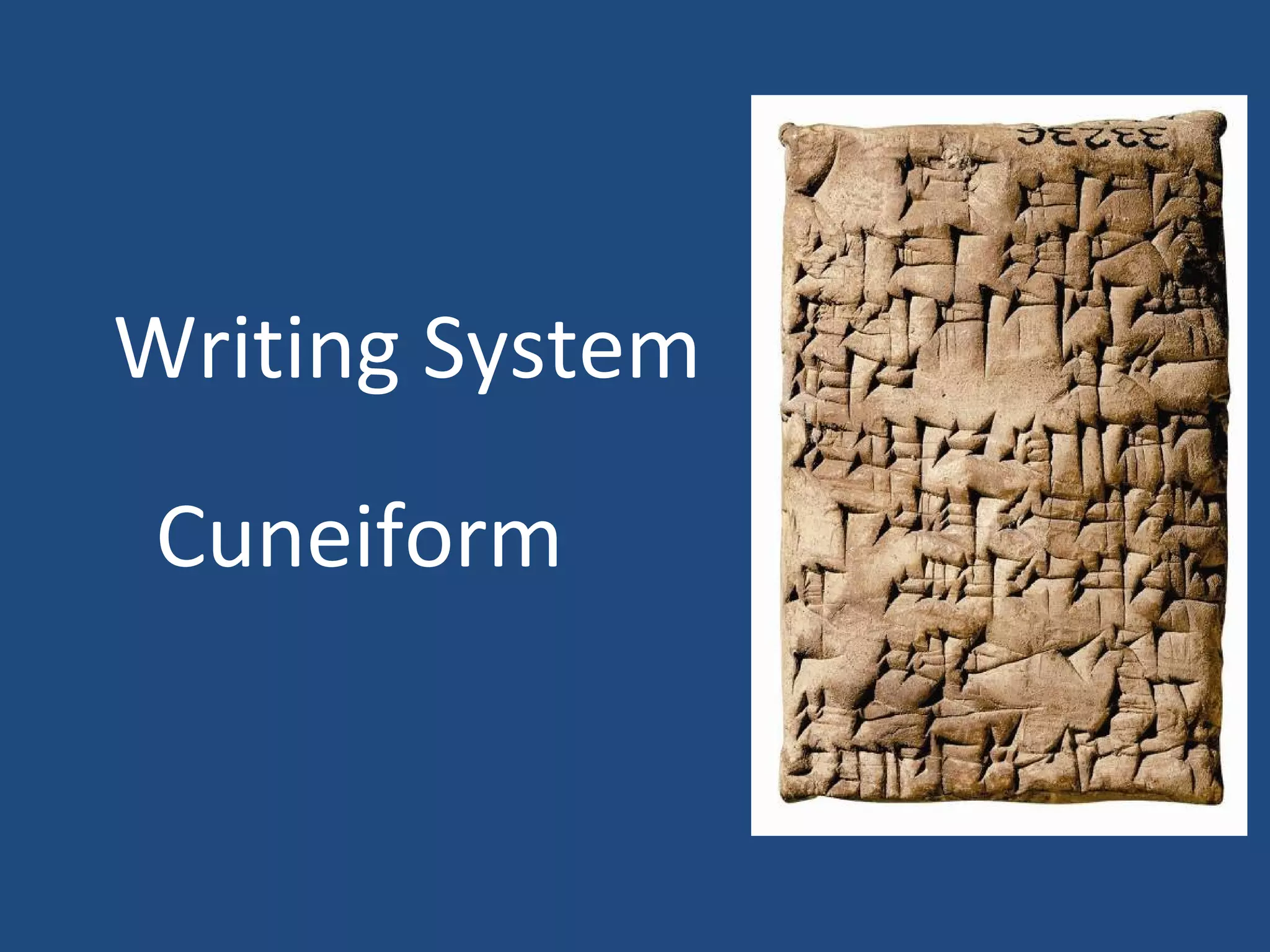
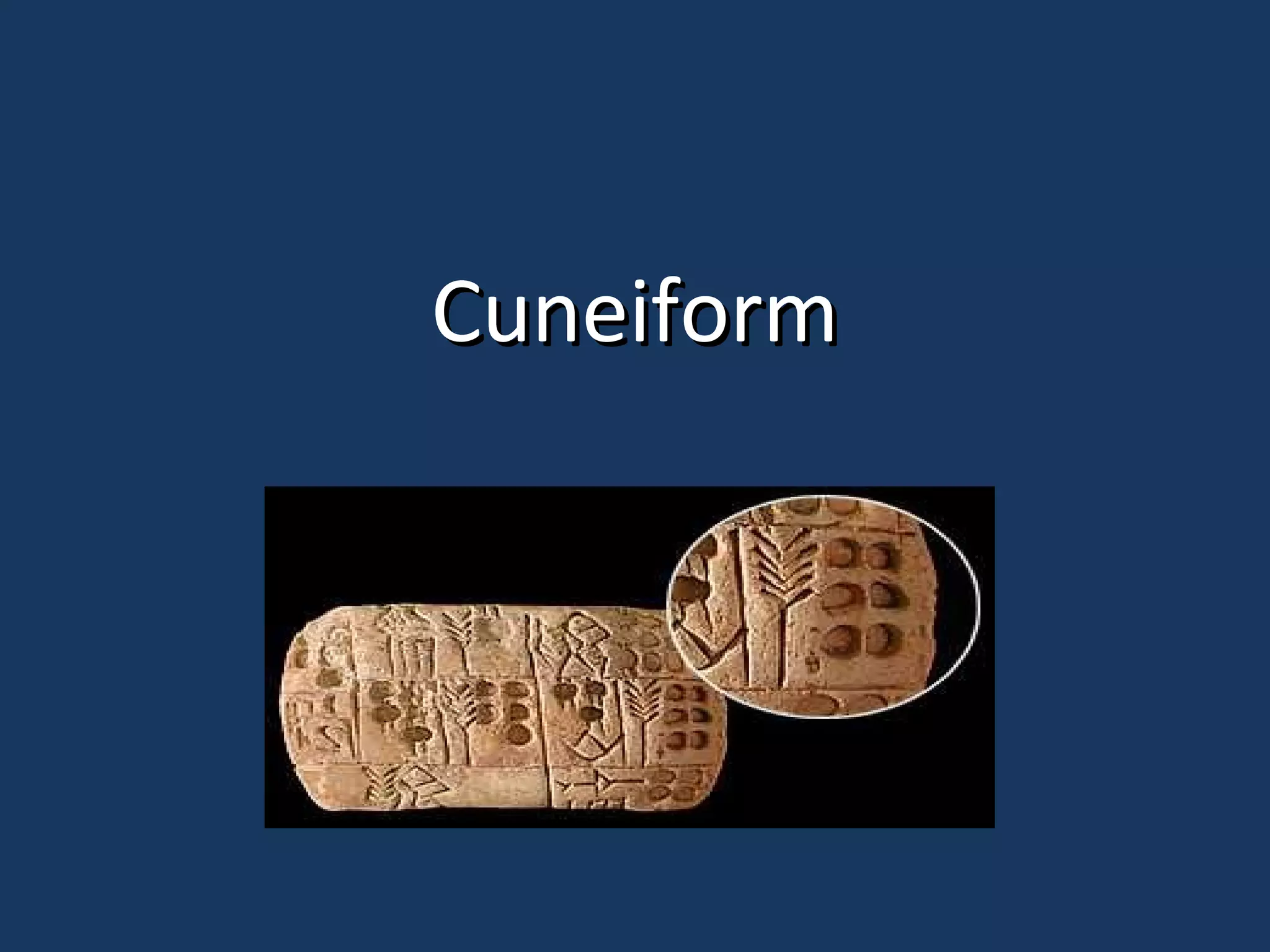
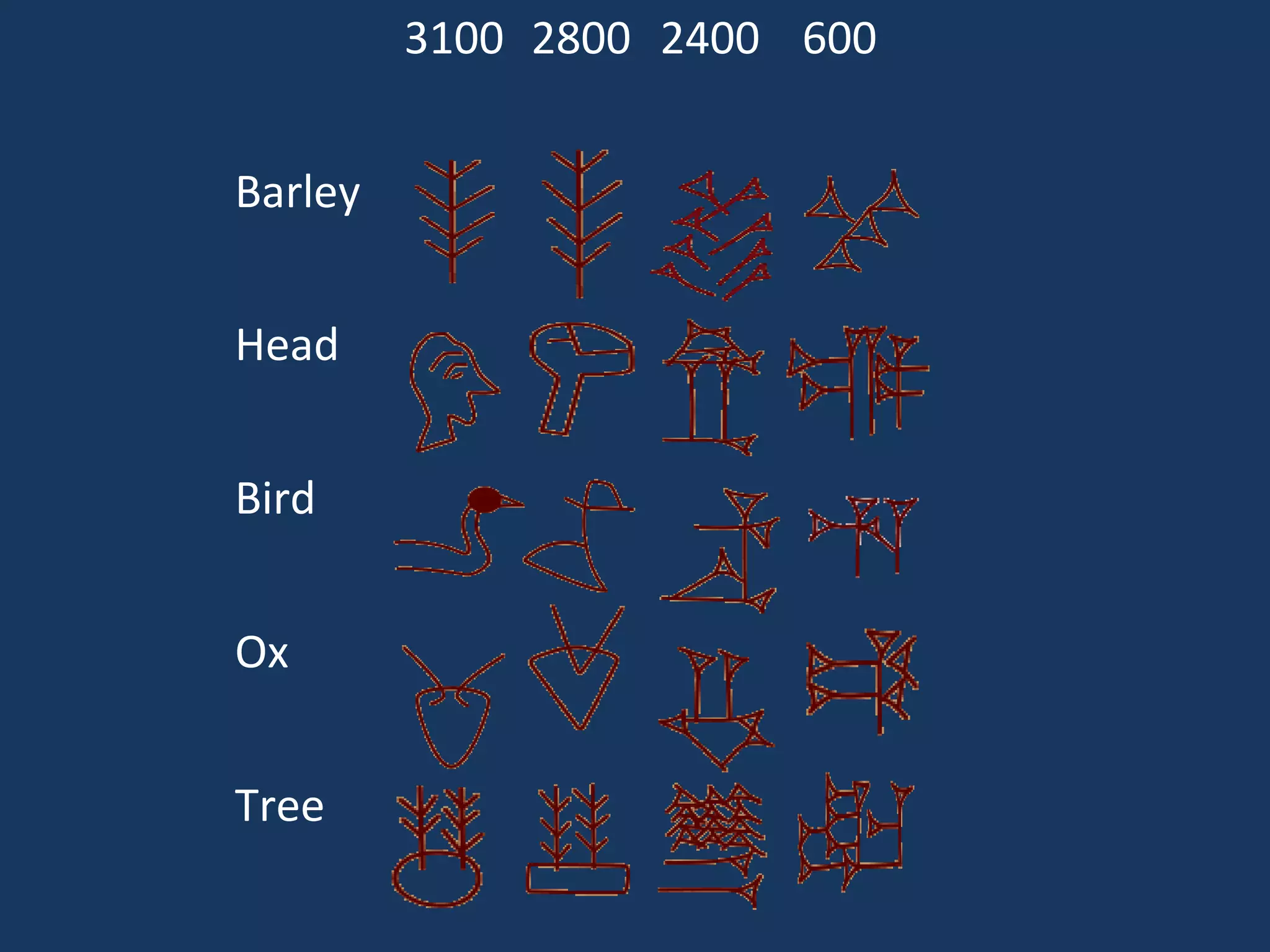
Early writing began as pictograms used by Mesopotamians to record crop amounts and taxes. Over time, these signs evolved into the script known as cuneiform, which was invented in southern Mesopotamia. Cuneiform was adopted by other groups like the Sumerians and Akkadians to record all sorts of administrative and cultural information. Scribes wrote cuneiform wedge-shaped signs onto clay tablets using reed tools, and the system developed over thousands of years, with signs changing orientation and taking on multiple meanings, including becoming representations of sounds.
Early WritingEarly Writing
•The earliest writing was based on pictograms.The earliest writing was based on pictograms.
• Pictograms were used to communicate basicPictograms were used to communicate basic
information about crops and taxes.information about crops and taxes.
• Over time, the need for writing changed andOver time, the need for writing changed and
the signs developed into a script we callthe signs developed into a script we call
cuneiform.cuneiform.
• Cuneiform is a writing system invented inCuneiform is a writing system invented in
southern Mesopotamia.southern Mesopotamia.
4.
Development of WritingDevelopmentof Writing
• Cuneiform was used by other people like theCuneiform was used by other people like the
Sumerians and Akkadians, because theySumerians and Akkadians, because they
needed to be able to record information butneeded to be able to record information but
they had not established a written form ofthey had not established a written form of
languagelanguage
• Cuneiform was used to record a variety ofCuneiform was used to record a variety of
information such as temple activities, businessinformation such as temple activities, business
and trade. Cuneiform was also used to writeand trade. Cuneiform was also used to write
stories, myths, and personal letters.stories, myths, and personal letters.
5.
The development ofWriting
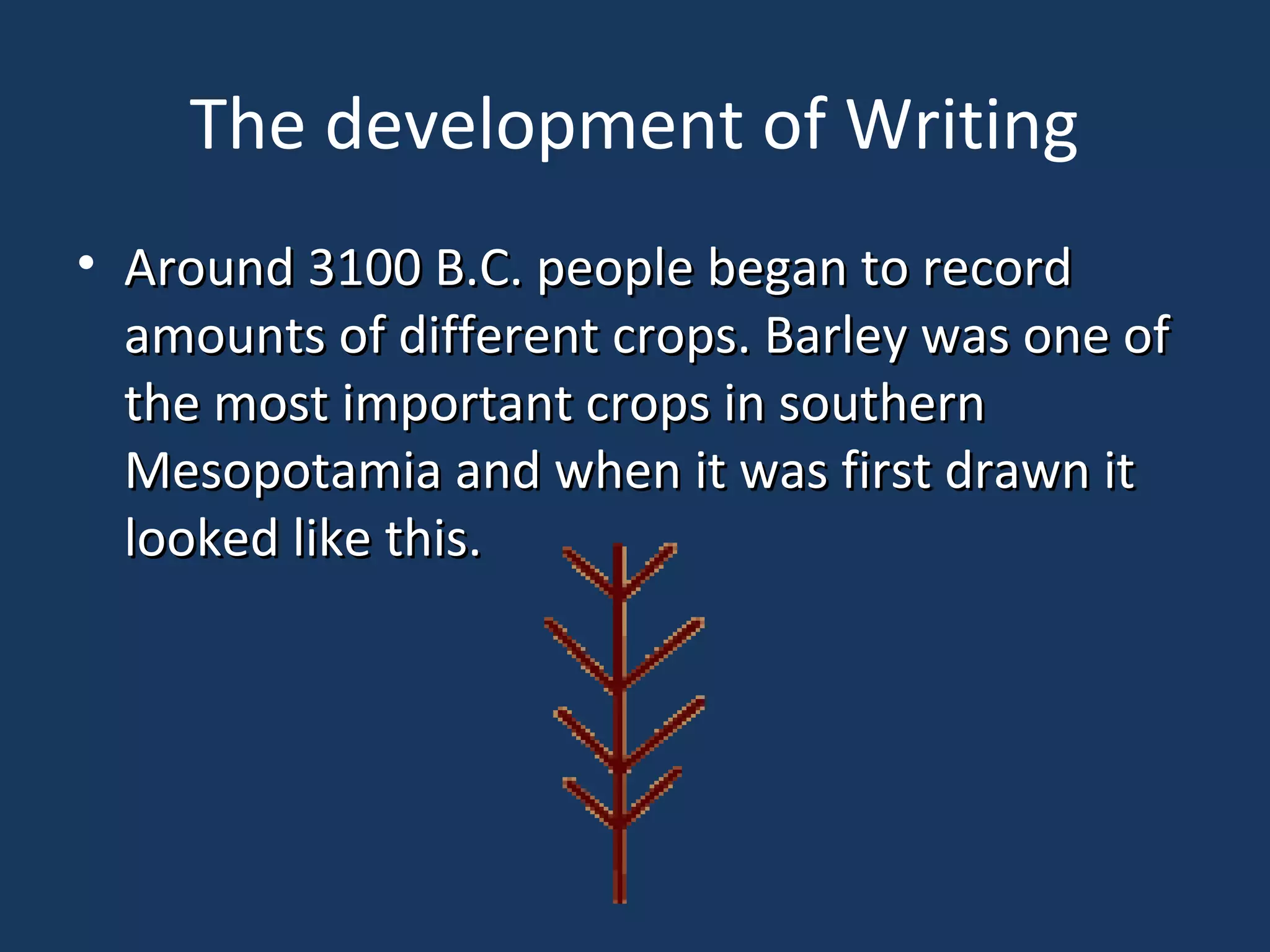
• Around 3100 B.C. people began to recordAround 3100 B.C. people began to record
amounts of different crops. Barley was one ofamounts of different crops. Barley was one of
the most important crops in southernthe most important crops in southern
Mesopotamia and when it was first drawn itMesopotamia and when it was first drawn it
looked like this.looked like this.
6.
Tools for writingToolsfor writing
• Scribes drew the sign on soft clay tabletsScribes drew the sign on soft clay tablets
using a pointed tool, probably made outusing a pointed tool, probably made out
of a reed.of a reed.
• For hundreds of years, the signs drawnFor hundreds of years, the signs drawn
on clay tablets hardly changed.on clay tablets hardly changed.
7.
Tools for Writing
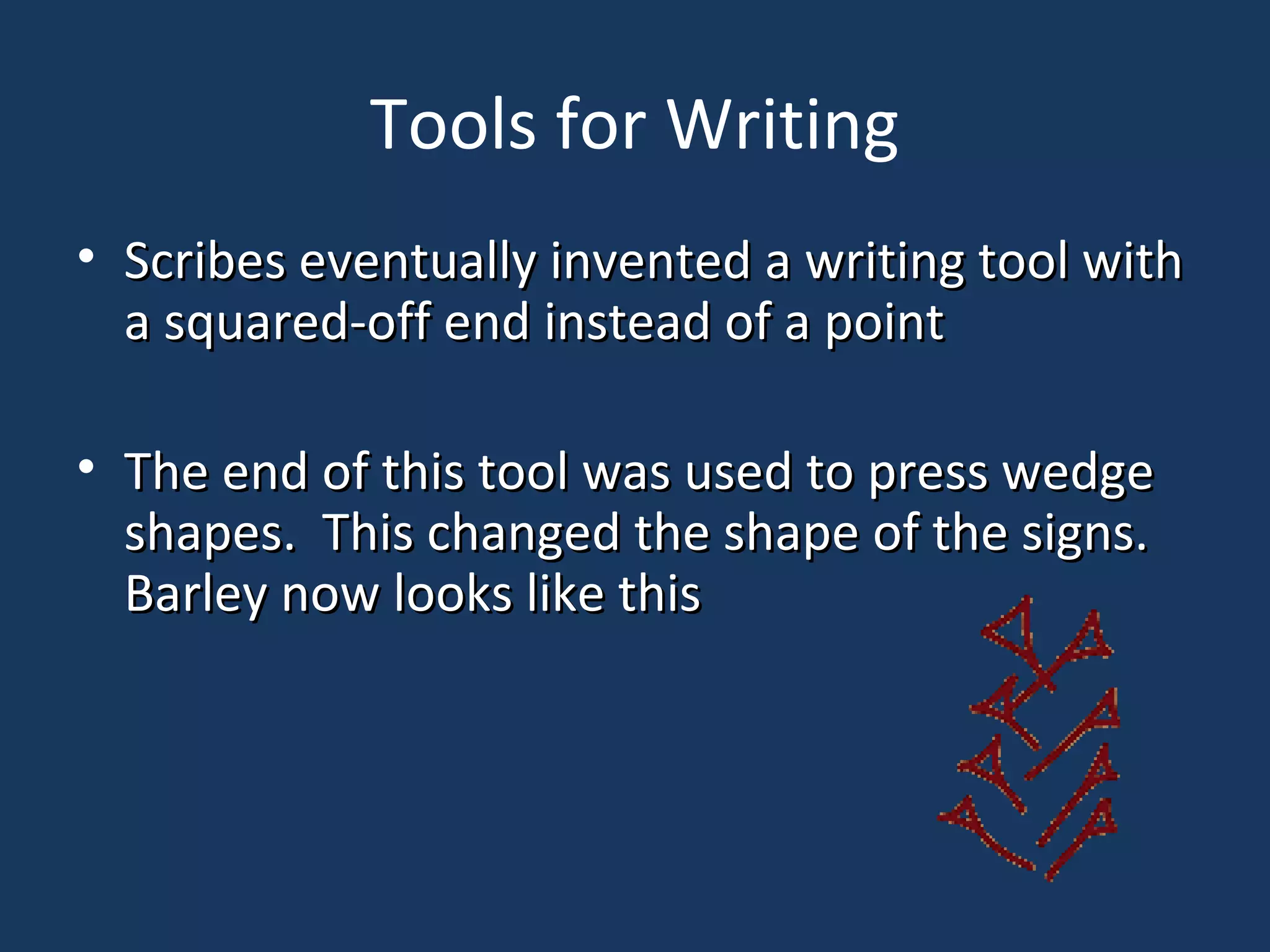
•Scribes eventually invented a writing tool withScribes eventually invented a writing tool with
a squared-off end instead of a pointa squared-off end instead of a point
• The end of this tool was used to press wedgeThe end of this tool was used to press wedge
shapes. This changed the shape of the signs.shapes. This changed the shape of the signs.
Barley now looks like thisBarley now looks like this
8.
The Scribes RoleTheScribes Role
• Farmers brought their barley to the templeFarmers brought their barley to the temple
stores. A record was kept of how much barleystores. A record was kept of how much barley
was received. When some of the barley waswas received. When some of the barley was
given to temple workers this was alsogiven to temple workers this was also
recorded on a tablet.recorded on a tablet.
• The barley sign usually had a number next toThe barley sign usually had a number next to
it to show how much barley was given to theit to show how much barley was given to the
temple or taken away.temple or taken away.
9.
How Signs ChangedHowSigns Changed
• Although the signs had changed overAlthough the signs had changed over
centuries there were more changes to come.centuries there were more changes to come.
Nobody can explain why the changesNobody can explain why the changes
happened.happened.
• The most ancient tablets have signs drawn inThe most ancient tablets have signs drawn in
boxes. Later, the signs were written in rows,boxes. Later, the signs were written in rows,
arranged in the order in which they werearranged in the order in which they were
read.read.
10.
How Signs ChangedHowSigns Changed
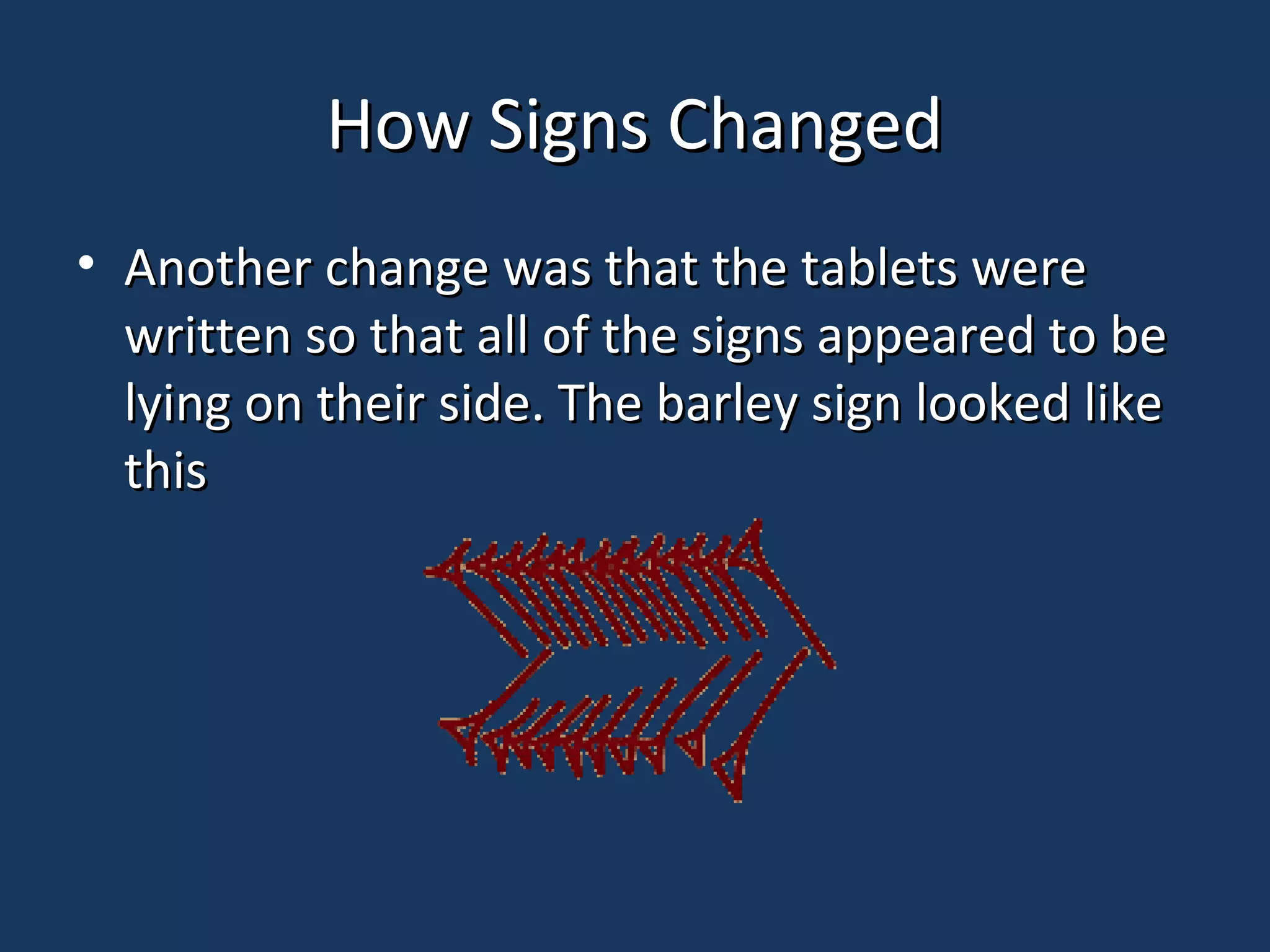
• Another change was that the tablets wereAnother change was that the tablets were
written so that all of the signs appeared to bewritten so that all of the signs appeared to be
lying on their side. The barley sign looked likelying on their side. The barley sign looked like
thisthis
11.
How Signs ChangedHowSigns Changed
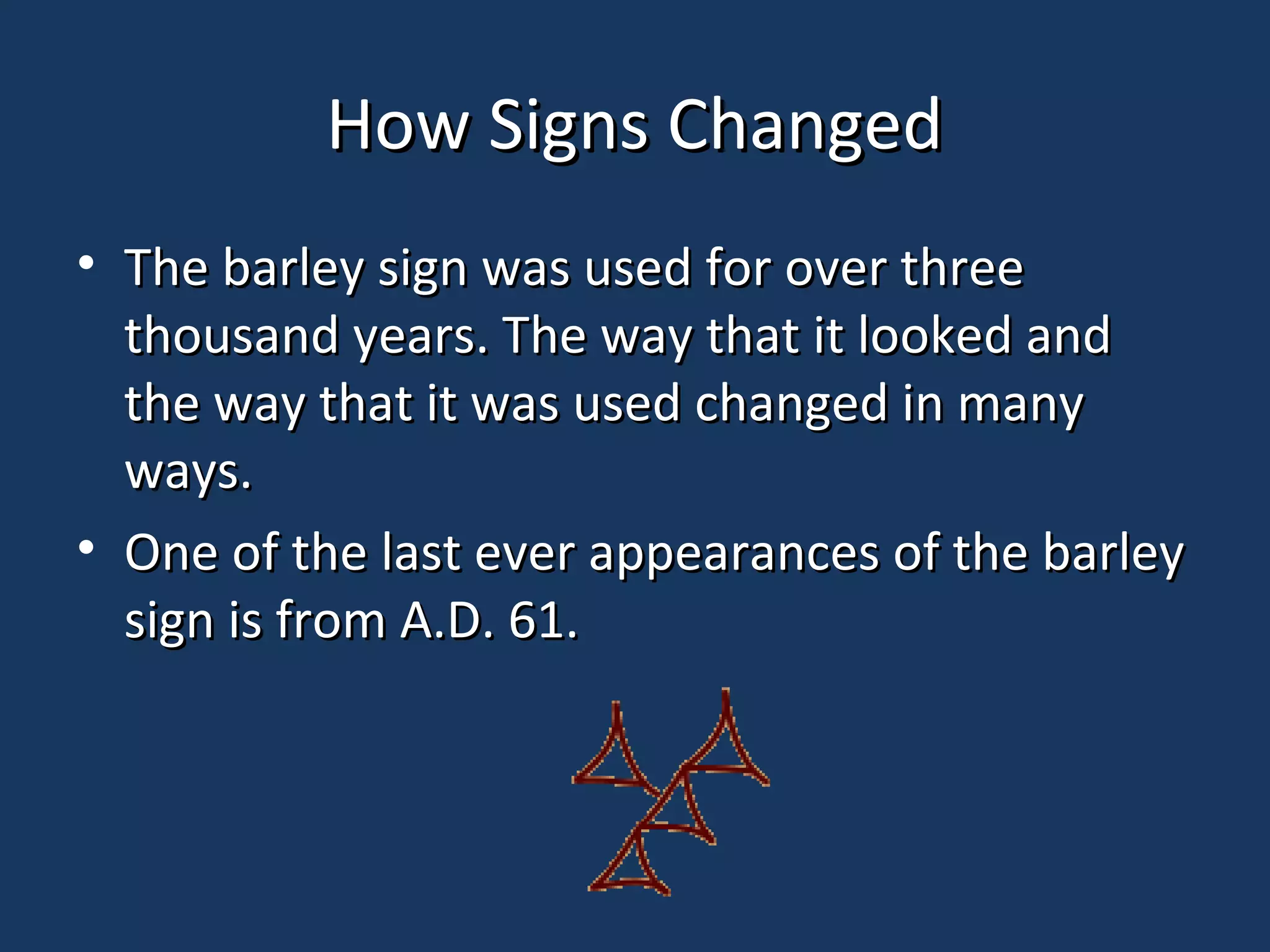
• The barley sign was used for over threeThe barley sign was used for over three
thousand years. The way that it looked andthousand years. The way that it looked and
the way that it was used changed in manythe way that it was used changed in many
ways.ways.
• One of the last ever appearances of the barleyOne of the last ever appearances of the barley
sign is from A.D. 61.sign is from A.D. 61.
12.
How Signs ChangedHowSigns Changed
• Not only the shape, but also the use of theNot only the shape, but also the use of the
sign had been changing. The barley sign couldsign had been changing. The barley sign could
now be used in two ways.now be used in two ways.
• It could also be used to represent a sound.It could also be used to represent a sound.
The Sumerian word for barley was 'she'. SoThe Sumerian word for barley was 'she'. So
the barley sign was used to represent thethe barley sign was used to represent the
sound 'she' in a word.sound 'she' in a word.
Questions:Questions:
1.1.What was earlywriting based on?What was early writing based on?
2.2.Where was Cuneiform invented?Where was Cuneiform invented?
3.3.Cuneiform script was used for what?Cuneiform script was used for what?
4.4.What was one of the most important crops inWhat was one of the most important crops in
Southern Mesopotamia?Southern Mesopotamia?
5.5.What items were used by scribes to recordWhat items were used by scribes to record
information?information?
6.6.How did signs and tools change over theHow did signs and tools change over the
years?years?
15.
Answers:Answers:
1.1. Pictograms-(Slide 2)Pictograms-(Slide2)
2.2. Southern Mesopotamia-(Slide 2)Southern Mesopotamia-(Slide 2)
3.3. Record information such as temple activities,Record information such as temple activities,
business and trade. Cuneiform was also used to writebusiness and trade. Cuneiform was also used to write
stories, myths, and personal letters. (Slide 3)stories, myths, and personal letters. (Slide 3)
4.4. Barley-(Slide 4)Barley-(Slide 4)
5.5. soft clay tablets using a pointed tool, probably madesoft clay tablets using a pointed tool, probably made
out of a reed. Later a squared tool was used insteadout of a reed. Later a squared tool was used instead
of a pointed tool. (Slide 5 and 6)of a pointed tool. (Slide 5 and 6)
6.6. Instead of signs in boxes they were drawn in rows,Instead of signs in boxes they were drawn in rows,
shapes of signs changed and signs could mean moreshapes of signs changed and signs could mean more
than one thing. (Slide 8-11)than one thing. (Slide 8-11)