Factors & Multiples

      P4 Math
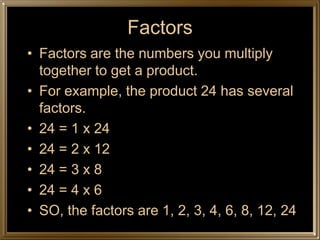
Factors
• Factors are the numbers you multiply
  together to get a product.
• For example, the product 24 has several
  factors.
• 24 = 1 x 24
• 24 = 2 x 12
• 24 = 3 x 8
• 24 = 4 x 6
• SO, the factors are 1, 2, 3, 4, 6, 8, 12, 24
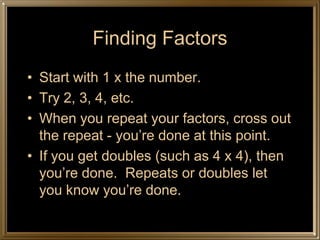
Finding Factors
• Start with 1 x the number.
• Try 2, 3, 4, etc.
• When you repeat your factors, cross out
  the repeat - you’re done at this point.
• If you get doubles (such as 4 x 4), then
  you’re done. Repeats or doubles let
  you know you’re done.
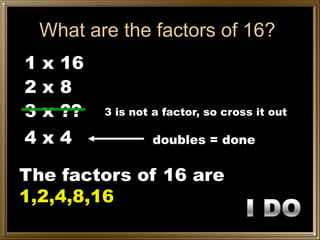
What are the factors of 16?
1 x 16
2x8
3 x ??   3 is not a factor, so cross it out

4x4              doubles = done

The factors of 16 are
1,2,4,8,16
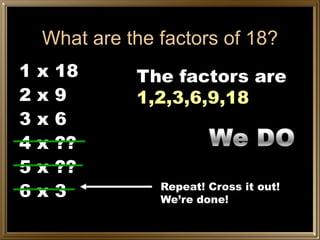
What are the factors of 18?
1   x   18    The factors are
2   x   9     1,2,3,6,9,18
3   x   6
4   x   ??
5   x   ??
6   x   3        Repeat! Cross it out!
                 We’re done!
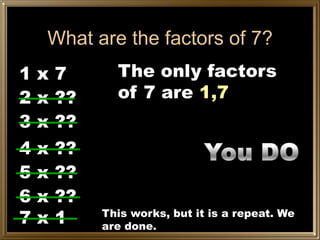
What are the factors of 7?
1x7            The only factors
2 x ??         of 7 are 1,7
3 x ??
4   x   ??
5   x   ??
6   x   ??
7   x   1    This works, but it is a repeat. We
             are done.
Multiples
• A multiple is formed by multiplying a
  given number by the counting numbers.
• The counting numbers are 1, 2, 3, 4, 5,
  6, etc.
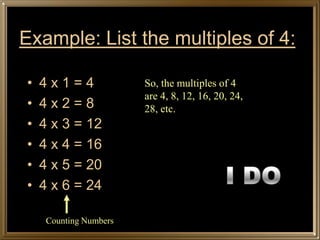
Example: List the multiples of 4:

•   4x1=4               So, the multiples of 4
                        are 4, 8, 12, 16, 20, 24,
•   4x2=8               28, etc.
•   4 x 3 = 12
•   4 x 4 = 16
•   4 x 5 = 20
•   4 x 6 = 24

     Counting Numbers
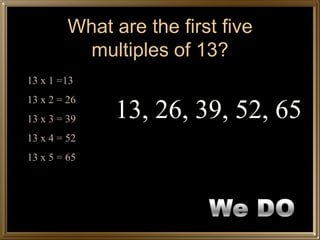
What are the first five
           multiples of 13?
13 x 1 =13
13 x 2 = 26
13 x 3 = 39   13, 26, 39, 52, 65
13 x 4 = 52
13 x 5 = 65
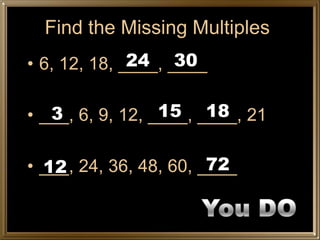
Find the Missing Multiples
              24 30
• 6, 12, 18, ____, ____

   3              15 18
• ___, 6, 9, 12, ____, ____, 21

  12                    72
• ___, 24, 36, 48, 60, ____
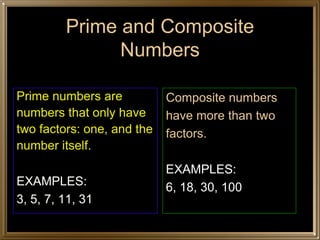
Prime and Composite
               Numbers

Prime numbers are           Composite numbers
numbers that only have      have more than two
two factors: one, and the   factors.
number itself.
                            EXAMPLES:
EXAMPLES:                   6, 18, 30, 100
3, 5, 7, 11, 31

Factors & multiples

  • 1.
  • 2.
    Factors • Factors arethe numbers you multiply together to get a product. • For example, the product 24 has several factors. • 24 = 1 x 24 • 24 = 2 x 12 • 24 = 3 x 8 • 24 = 4 x 6 • SO, the factors are 1, 2, 3, 4, 6, 8, 12, 24
  • 3.
    Finding Factors • Startwith 1 x the number. • Try 2, 3, 4, etc. • When you repeat your factors, cross out the repeat - you’re done at this point. • If you get doubles (such as 4 x 4), then you’re done. Repeats or doubles let you know you’re done.
  • 4.
    What are thefactors of 16? 1 x 16 2x8 3 x ?? 3 is not a factor, so cross it out 4x4 doubles = done The factors of 16 are 1,2,4,8,16
  • 5.
    What are thefactors of 18? 1 x 18 The factors are 2 x 9 1,2,3,6,9,18 3 x 6 4 x ?? 5 x ?? 6 x 3 Repeat! Cross it out! We’re done!
  • 6.
    What are thefactors of 7? 1x7 The only factors 2 x ?? of 7 are 1,7 3 x ?? 4 x ?? 5 x ?? 6 x ?? 7 x 1 This works, but it is a repeat. We are done.
  • 7.
    Multiples • A multipleis formed by multiplying a given number by the counting numbers. • The counting numbers are 1, 2, 3, 4, 5, 6, etc.
  • 8.
    Example: List themultiples of 4: • 4x1=4 So, the multiples of 4 are 4, 8, 12, 16, 20, 24, • 4x2=8 28, etc. • 4 x 3 = 12 • 4 x 4 = 16 • 4 x 5 = 20 • 4 x 6 = 24 Counting Numbers
  • 9.
    What are thefirst five multiples of 13? 13 x 1 =13 13 x 2 = 26 13 x 3 = 39 13, 26, 39, 52, 65 13 x 4 = 52 13 x 5 = 65
  • 10.
    Find the MissingMultiples 24 30 • 6, 12, 18, ____, ____ 3 15 18 • ___, 6, 9, 12, ____, ____, 21 12 72 • ___, 24, 36, 48, 60, ____
  • 11.
    Prime and Composite Numbers Prime numbers are Composite numbers numbers that only have have more than two two factors: one, and the factors. number itself. EXAMPLES: EXAMPLES: 6, 18, 30, 100 3, 5, 7, 11, 31