UNDERSTANDING NUMBERS

• NATURAL NUMBERS
  • WHOLE NUMBERS
 • INTEGER NUMBERS
• RATIONAL NUMBERS
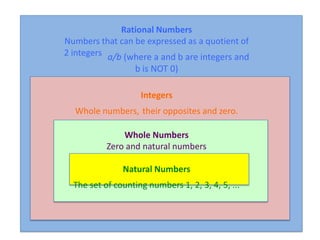
Rational Numbers
Numbers that can be expressed as a quotient of
2 integers a/b (where a and b are integers and
                   b is NOT 0)

                    Integers
  Whole numbers, their opposites and zero.

               Whole Numbers
           Zero and natural numbers

               Natural Numbers
  The set of counting numbers 1, 2, 3, 4, 5, ...
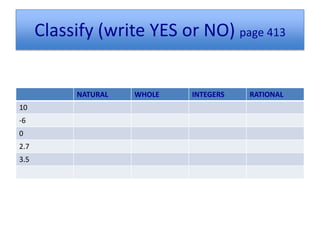
Classify (write YES or NO) page 413


           NATURAL   WHOLE   INTEGERS   RATIONAL
10
-6
0
2.7
3.5
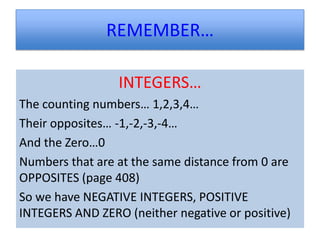
REMEMBER…

                 INTEGERS…
The counting numbers… 1,2,3,4…
Their opposites… -1,-2,-3,-4…
And the Zero…0
Numbers that are at the same distance from 0 are
OPPOSITES (page 408)
So we have NEGATIVE INTEGERS, POSITIVE
INTEGERS AND ZERO (neither negative or positive)
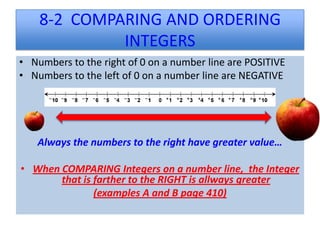
8-2 COMPARING AND ORDERING
             INTEGERS
• Numbers to the right of 0 on a number line are POSITIVE
• Numbers to the left of 0 on a number line are NEGATIVE


   Always the numbers to the right have greater value…

• When COMPARING Integers on a number line, the Integer
       that is farther to the RIGHT is allways greater
               (examples A and B page 410)
8-3 UNDERSTANDING RATIONAL
             NUMBERS
• Numbers expressed as fractions and decimals.
• Just as there are positive and negative
  integers, there are also positive and negative
  fractions and decimals.
• The greater the magnitude of a negative
  number, the less its value (because is farther
  to the left from 0).
How can we order and compare
         Rational Numbers?
• Sometimes it helps to write fractions as
  decimals.

• SOME TIPS…
1. If you have Rational Numbers as fractions
with different whole numbers… you can
compare the whole numbers and depending on
which one is farther to the left you can
determine which rational number is less
more TIPS…
2. If you have Rational Numbers as fractions with
the same whole numbers… you can transform
them into decimals. This way is going to be more
easy to locate the decimals on the number line or
just to compare the decimals.

3. If you have Rational Numbers as fractions and
others as decimals… you better transform all the
fractions into decimals and then you can compare.
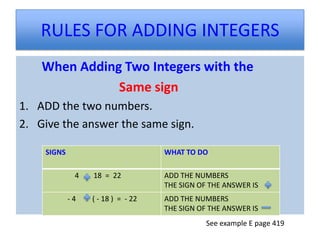
RULES FOR ADDING INTEGERS
    When Adding Two Integers with the
               Same sign
1. ADD the two numbers.
2. Give the answer the same sign.

    SIGNS                          WHAT TO DO

             4   18 = 22           ADD THE NUMBERS
                                   THE SIGN OF THE ANSWER IS
            -4   ( - 18 ) = - 22   ADD THE NUMBERS
                                   THE SIGN OF THE ANSWER IS
                                              See example E page 419
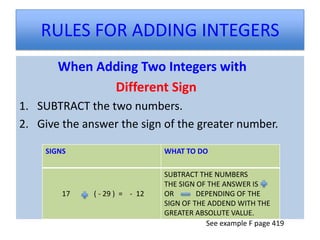
RULES FOR ADDING INTEGERS
        When Adding Two Integers with
               Different Sign
1. SUBTRACT the two numbers.
2. Give the answer the sign of the greater number.

     SIGNS                      WHAT TO DO

                                SUBTRACT THE NUMBERS
                                THE SIGN OF THE ANSWER IS
         17   ( - 29 ) = - 12   OR       DEPENDING OF THE
                                SIGN OF THE ADDEND WITH THE
                                GREATER ABSOLUTE VALUE.
                                           See example F page 419
IMPORTANT

It is important to understand the difference
 between a minus sign and a negative sign.
       They look the same, but one is an
operation between two numbers indicating
  subtraction and the other tells you that a
           number is negative.
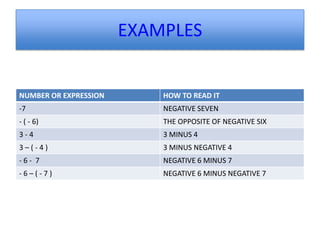
EXAMPLES


NUMBER OR EXPRESSION       HOW TO READ IT
-7                         NEGATIVE SEVEN
- ( - 6)                   THE OPPOSITE OF NEGATIVE SIX
3-4                        3 MINUS 4
3–(-4)                     3 MINUS NEGATIVE 4
-6- 7                      NEGATIVE 6 MINUS 7
-6–(-7)                    NEGATIVE 6 MINUS NEGATIVE 7
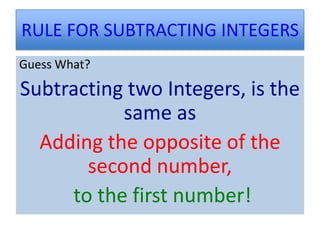
RULE FOR SUBTRACTING INTEGERS
Guess What?

Subtracting two Integers, is the
           same as
  Adding the opposite of the
       second number,
     to the first number!
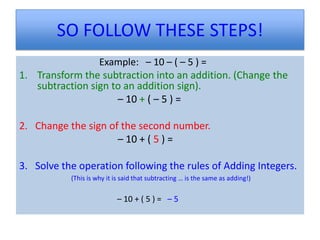
SO FOLLOW THESE STEPS!
                 Example: – 10 – ( – 5 ) =
1. Transform the subtraction into an addition. (Change the
   subtraction sign to an addition sign).
                     – 10 + ( – 5 ) =

2. Change the sign of the second number.
                     – 10 + ( 5 ) =

3. Solve the operation following the rules of Adding Integers.
           (This is why it is said that subtracting … is the same as adding!)


                           – 10 + ( 5 ) = – 5
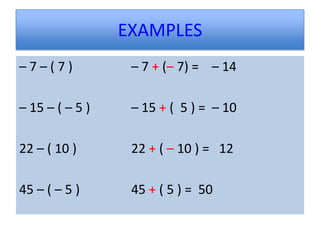
EXAMPLES
–7–(7)            – 7 + (– 7) = – 14

– 15 – ( – 5 )    – 15 + ( 5 ) = – 10

22 – ( 10 )       22 + ( – 10 ) = 12

45 – ( – 5 )      45 + ( 5 ) = 50
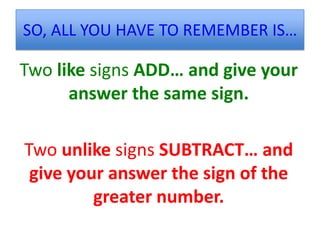
SO, ALL YOU HAVE TO REMEMBER IS…

Two like signs ADD… and give your
      answer the same sign.

Two unlike signs SUBTRACT… and
 give your answer the sign of the
         greater number.
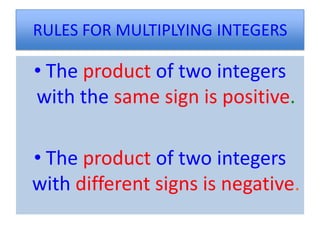
RULES FOR MULTIPLYING INTEGERS

• The product of two integers
with the same sign is positive.

• The product of two integers
with different signs is negative.
RULES FOR DIVIDING INTEGERS
•
    • The quotient of two integers
     with the same sign is positive.

    • The quotient of two integers
    with different signs is negative.

Understanding Integers

  • 1.
    UNDERSTANDING NUMBERS • NATURALNUMBERS • WHOLE NUMBERS • INTEGER NUMBERS • RATIONAL NUMBERS
  • 2.
    Rational Numbers Numbers thatcan be expressed as a quotient of 2 integers a/b (where a and b are integers and b is NOT 0) Integers Whole numbers, their opposites and zero. Whole Numbers Zero and natural numbers Natural Numbers The set of counting numbers 1, 2, 3, 4, 5, ...
  • 3.
    Classify (write YESor NO) page 413 NATURAL WHOLE INTEGERS RATIONAL 10 -6 0 2.7 3.5
  • 4.
    REMEMBER… INTEGERS… The counting numbers… 1,2,3,4… Their opposites… -1,-2,-3,-4… And the Zero…0 Numbers that are at the same distance from 0 are OPPOSITES (page 408) So we have NEGATIVE INTEGERS, POSITIVE INTEGERS AND ZERO (neither negative or positive)
  • 6.
    8-2 COMPARING ANDORDERING INTEGERS • Numbers to the right of 0 on a number line are POSITIVE • Numbers to the left of 0 on a number line are NEGATIVE Always the numbers to the right have greater value… • When COMPARING Integers on a number line, the Integer that is farther to the RIGHT is allways greater (examples A and B page 410)
  • 8.
    8-3 UNDERSTANDING RATIONAL NUMBERS • Numbers expressed as fractions and decimals. • Just as there are positive and negative integers, there are also positive and negative fractions and decimals. • The greater the magnitude of a negative number, the less its value (because is farther to the left from 0).
  • 9.
    How can weorder and compare Rational Numbers? • Sometimes it helps to write fractions as decimals. • SOME TIPS… 1. If you have Rational Numbers as fractions with different whole numbers… you can compare the whole numbers and depending on which one is farther to the left you can determine which rational number is less
  • 10.
    more TIPS… 2. Ifyou have Rational Numbers as fractions with the same whole numbers… you can transform them into decimals. This way is going to be more easy to locate the decimals on the number line or just to compare the decimals. 3. If you have Rational Numbers as fractions and others as decimals… you better transform all the fractions into decimals and then you can compare.
  • 12.
    RULES FOR ADDINGINTEGERS When Adding Two Integers with the Same sign 1. ADD the two numbers. 2. Give the answer the same sign. SIGNS WHAT TO DO 4 18 = 22 ADD THE NUMBERS THE SIGN OF THE ANSWER IS -4 ( - 18 ) = - 22 ADD THE NUMBERS THE SIGN OF THE ANSWER IS See example E page 419
  • 13.
    RULES FOR ADDINGINTEGERS When Adding Two Integers with Different Sign 1. SUBTRACT the two numbers. 2. Give the answer the sign of the greater number. SIGNS WHAT TO DO SUBTRACT THE NUMBERS THE SIGN OF THE ANSWER IS 17 ( - 29 ) = - 12 OR DEPENDING OF THE SIGN OF THE ADDEND WITH THE GREATER ABSOLUTE VALUE. See example F page 419
  • 15.
    IMPORTANT It is importantto understand the difference between a minus sign and a negative sign. They look the same, but one is an operation between two numbers indicating subtraction and the other tells you that a number is negative.
  • 16.
    EXAMPLES NUMBER OR EXPRESSION HOW TO READ IT -7 NEGATIVE SEVEN - ( - 6) THE OPPOSITE OF NEGATIVE SIX 3-4 3 MINUS 4 3–(-4) 3 MINUS NEGATIVE 4 -6- 7 NEGATIVE 6 MINUS 7 -6–(-7) NEGATIVE 6 MINUS NEGATIVE 7
  • 17.
    RULE FOR SUBTRACTINGINTEGERS Guess What? Subtracting two Integers, is the same as Adding the opposite of the second number, to the first number!
  • 18.
    SO FOLLOW THESESTEPS! Example: – 10 – ( – 5 ) = 1. Transform the subtraction into an addition. (Change the subtraction sign to an addition sign). – 10 + ( – 5 ) = 2. Change the sign of the second number. – 10 + ( 5 ) = 3. Solve the operation following the rules of Adding Integers. (This is why it is said that subtracting … is the same as adding!) – 10 + ( 5 ) = – 5
  • 19.
    EXAMPLES –7–(7) – 7 + (– 7) = – 14 – 15 – ( – 5 ) – 15 + ( 5 ) = – 10 22 – ( 10 ) 22 + ( – 10 ) = 12 45 – ( – 5 ) 45 + ( 5 ) = 50
  • 20.
    SO, ALL YOUHAVE TO REMEMBER IS… Two like signs ADD… and give your answer the same sign. Two unlike signs SUBTRACT… and give your answer the sign of the greater number.
  • 22.
    RULES FOR MULTIPLYINGINTEGERS • The product of two integers with the same sign is positive. • The product of two integers with different signs is negative.
  • 24.
    RULES FOR DIVIDINGINTEGERS • • The quotient of two integers with the same sign is positive. • The quotient of two integers with different signs is negative.