Decimals
Add, Subtract, Multiply & Divide
28.9 + 32.5
61.4
T- 91-901-568-0202
Email- nm.sspirit@gmail.com
By NM Spirit
Adding or Subtracting Decimals
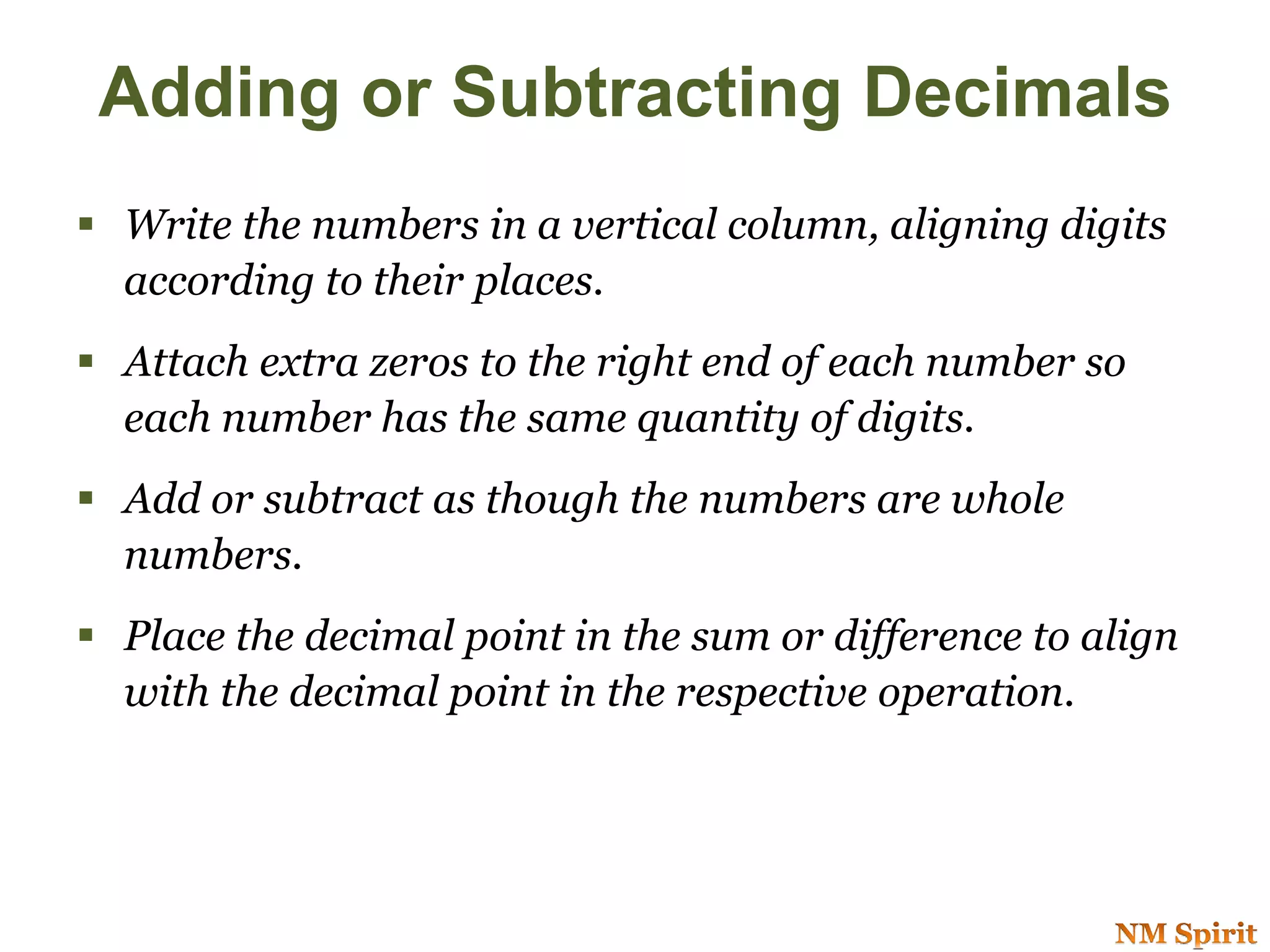
 Write the numbers in a vertical column, aligning digits
according to their places.
 Attach extra zeros to the right end of each number so
each number has the same quantity of digits.
 Add or subtract as though the numbers are whole
numbers.
 Place the decimal point in the sum or difference to align
with the decimal point in the respective operation.
Adding Decimals
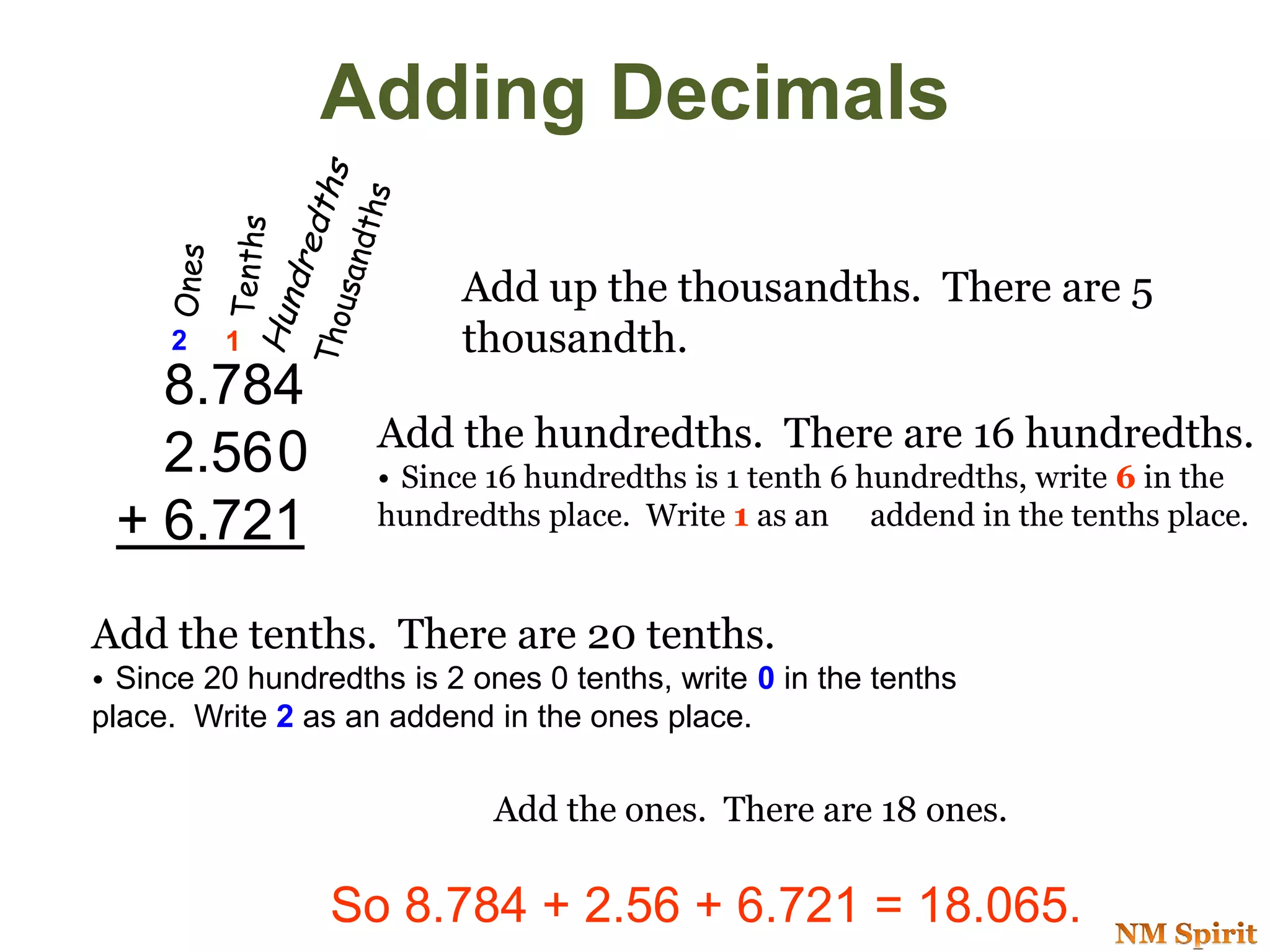
Add the ones. There are 18 ones.
Add the tenths. There are 20 tenths.
• Since 20 hundredths is 2 ones 0 tenths, write 0 in the tenths
place. Write 2 as an addend in the ones place.
8.784
2.560
+ 6.721
Add the hundredths. There are 16 hundredths.
• Since 16 hundredths is 1 tenth 6 hundredths, write 6 in the
hundredths place. Write 1 as an addend in the tenths place.
12
0
Add up the thousandths. There are 5
thousandth.
So 8.784 + 2.56 + 6.721 = 18.065.
Subtracting Decimals
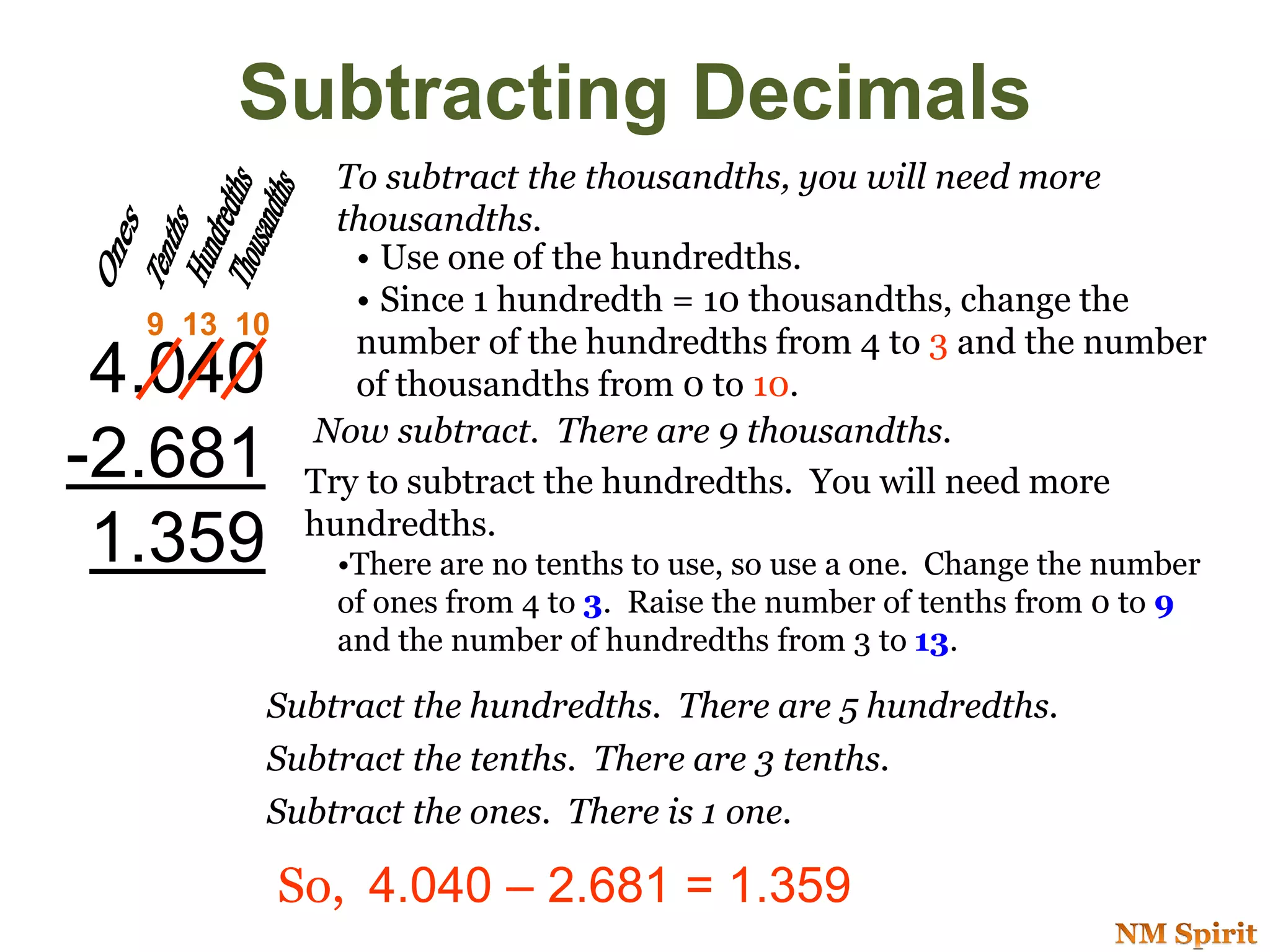
Try to subtract the hundredths. You will need more
hundredths.
•There are no tenths to use, so use a one. Change the number
of ones from 4 to 3. Raise the number of tenths from 0 to 9
and the number of hundredths from 3 to 13.
Now subtract. There are 9 thousandths.
4.040
-2.681
1.359
• Use one of the hundredths.
• Since 1 hundredth = 10 thousandths, change the
number of the hundredths from 4 to 3 and the number
of thousandths from 0 to 10.
To subtract the thousandths, you will need more
thousandths.
So, 4.040 – 2.681 = 1.359
Subtract the hundredths. There are 5 hundredths.
Subtract the tenths. There are 3 tenths.
Subtract the ones. There is 1 one.
9 13 10
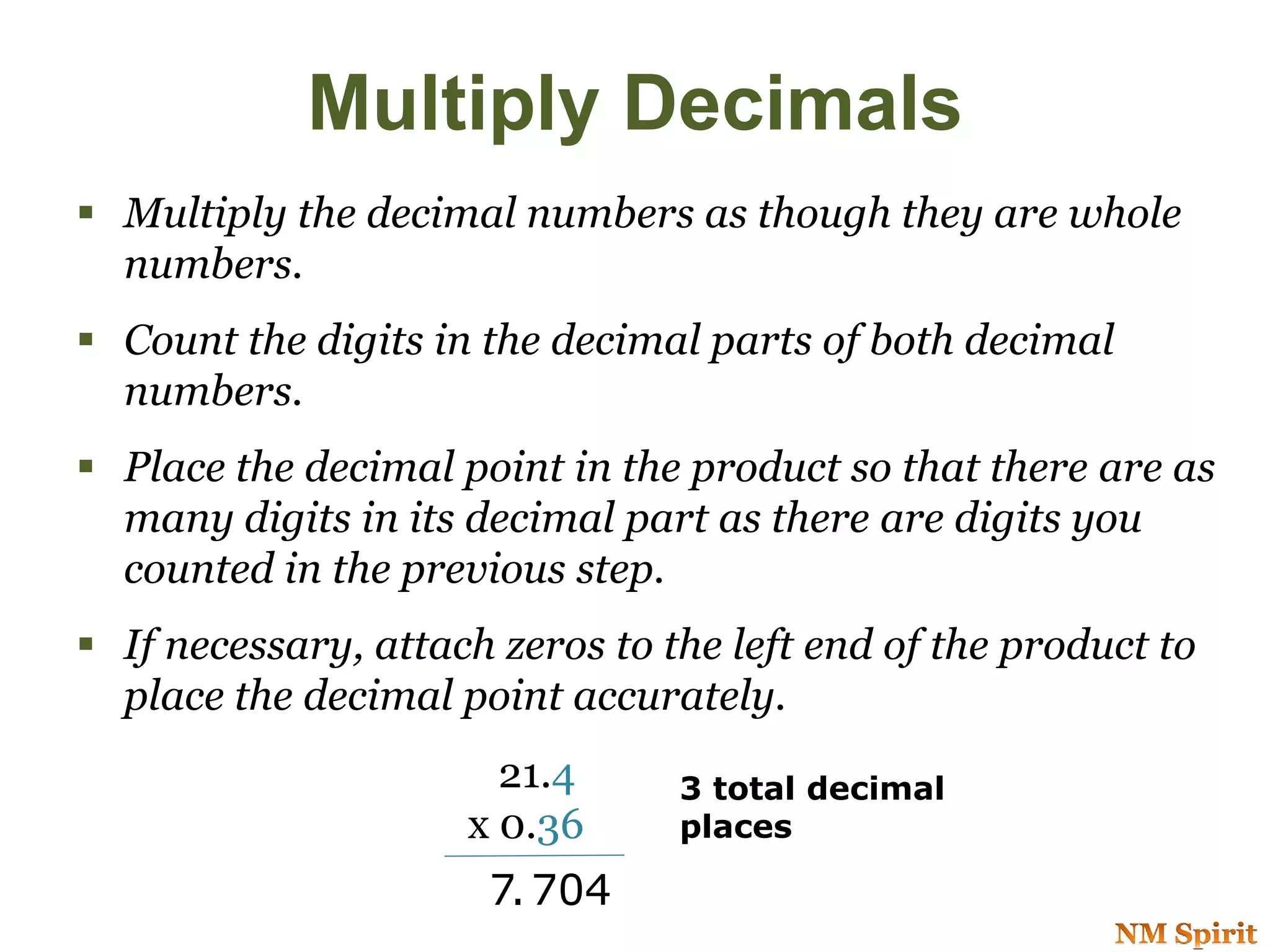
Multiply Decimals
 Multiply the decimal numbers as though they are whole
numbers.
 Count the digits in the decimal parts of both decimal
numbers.
 Place the decimal point in the product so that there are as
many digits in its decimal part as there are digits you
counted in the previous step.
 If necessary, attach zeros to the left end of the product to
place the decimal point accurately.
21.4
x 0.36
3 total decimal
places
7 704.
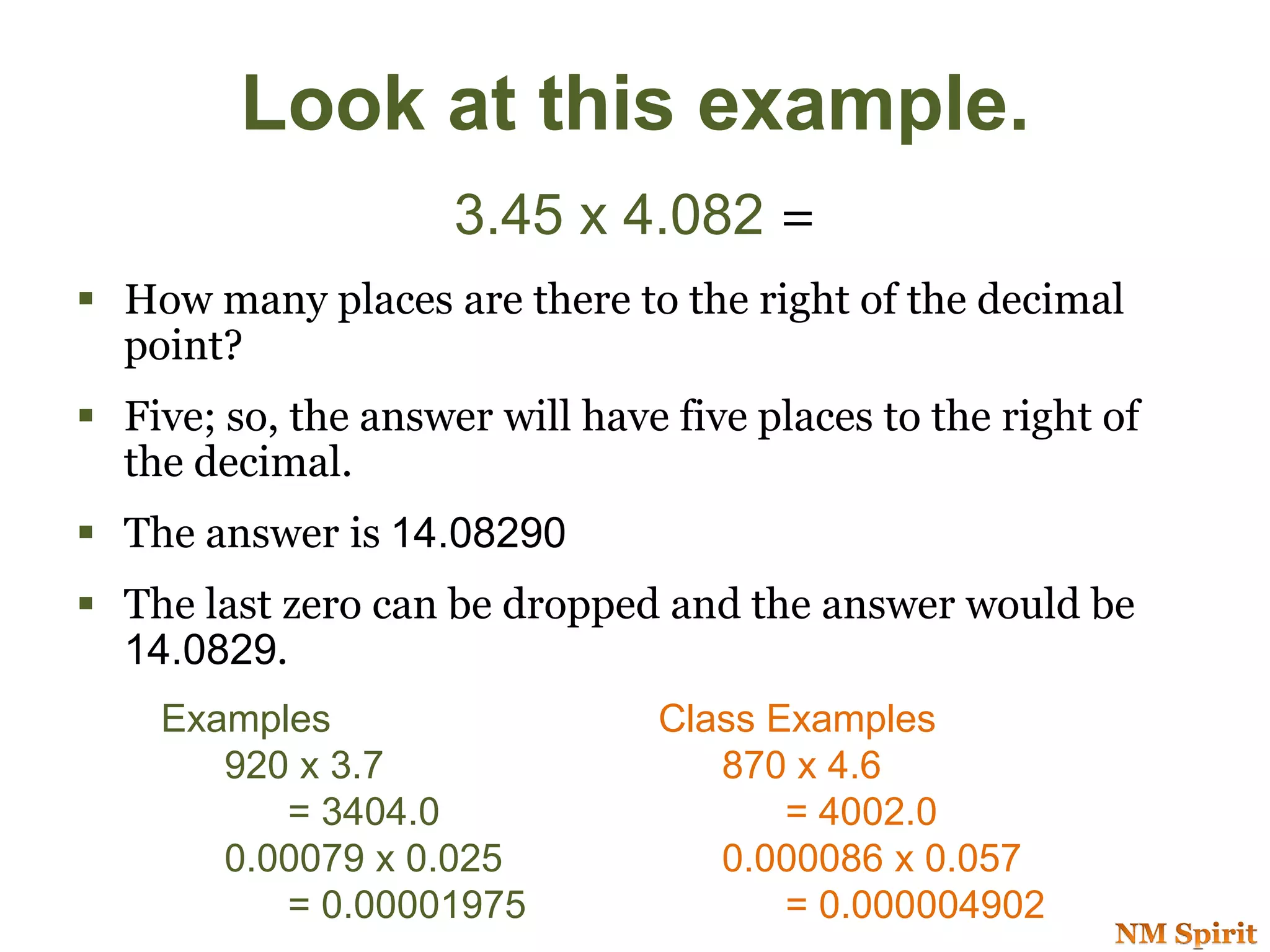
Look at this example.
3.45 x 4.082 =
 How many places are there to the right of the decimal
point?
 Five; so, the answer will have five places to the right of
the decimal.
 The answer is 14.08290
 The last zero can be dropped and the answer would be
14.0829.
Examples
920 x 3.7
= 3404.0
0.00079 x 0.025
= 0.00001975
Class Examples
870 x 4.6
= 4002.0
0.000086 x 0.057
= 0.000004902
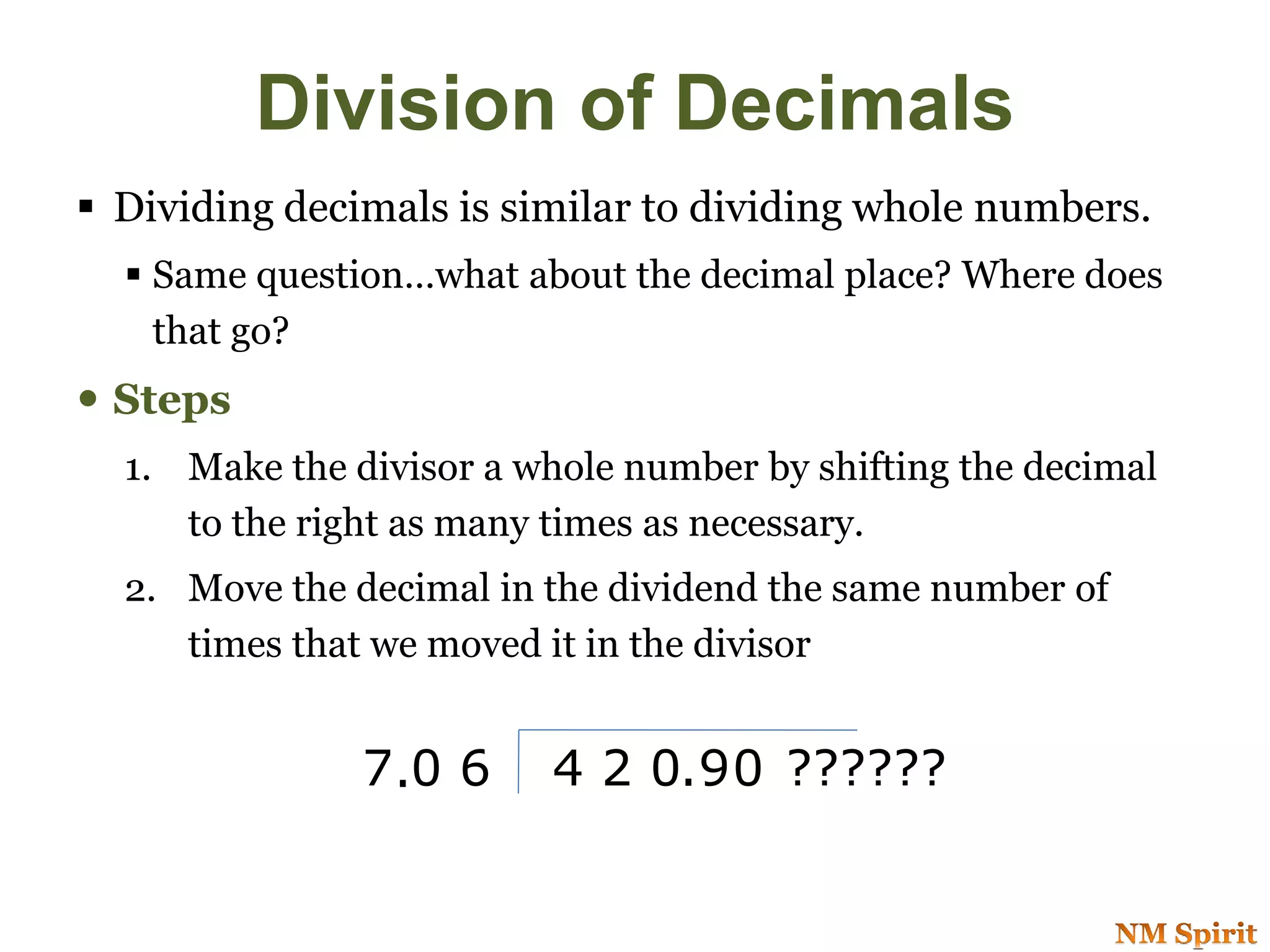
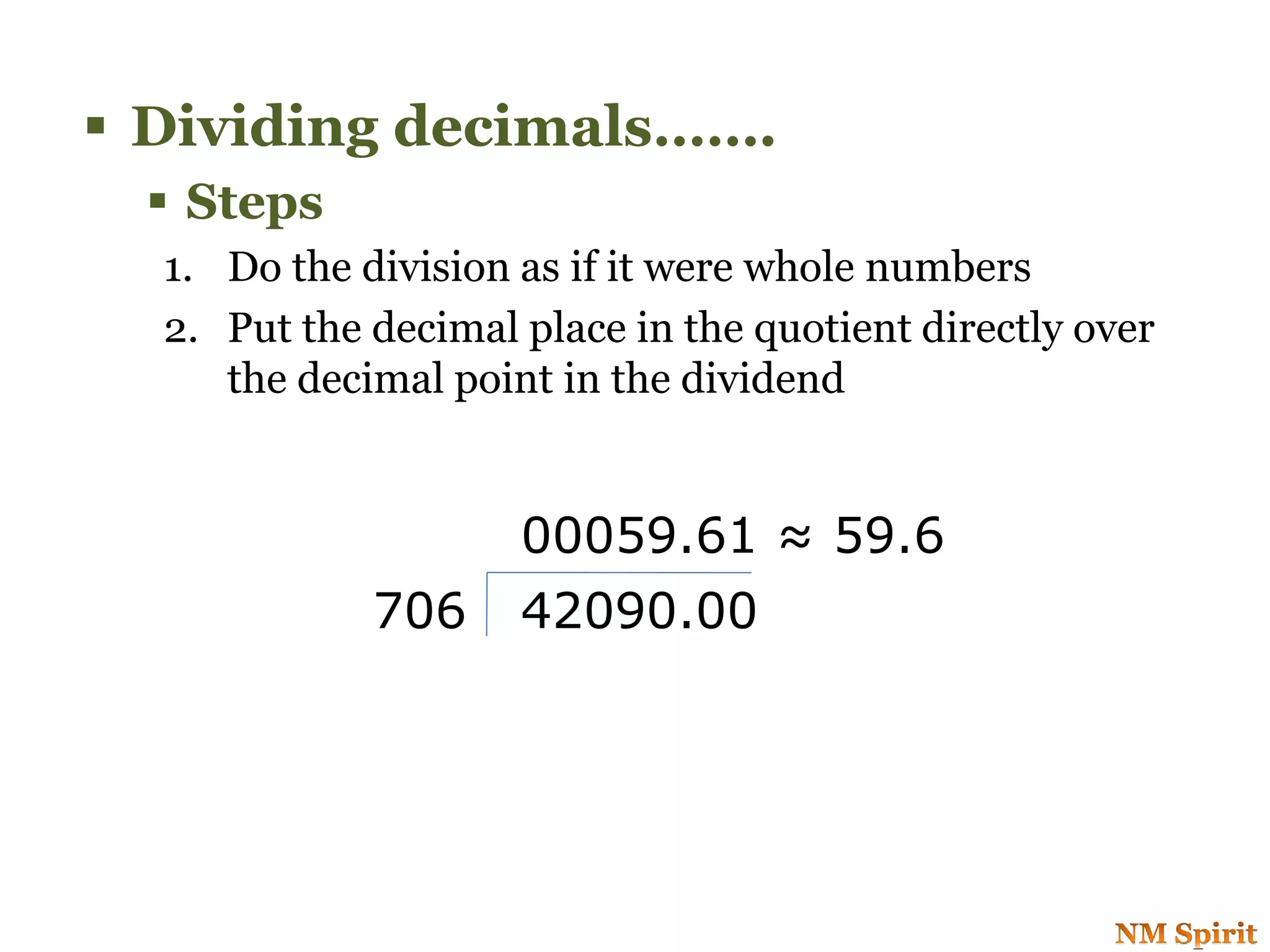
 Dividing decimals is similar to dividing whole numbers.
 Same question…what about the decimal place? Where does
that go?
 Steps
1. Make the divisor a whole number by shifting the decimal
to the right as many times as necessary.
2. Move the decimal in the dividend the same number of
times that we moved it in the divisor
7 0 6 4 2 0 9. . 0 ??????
Division of Decimals
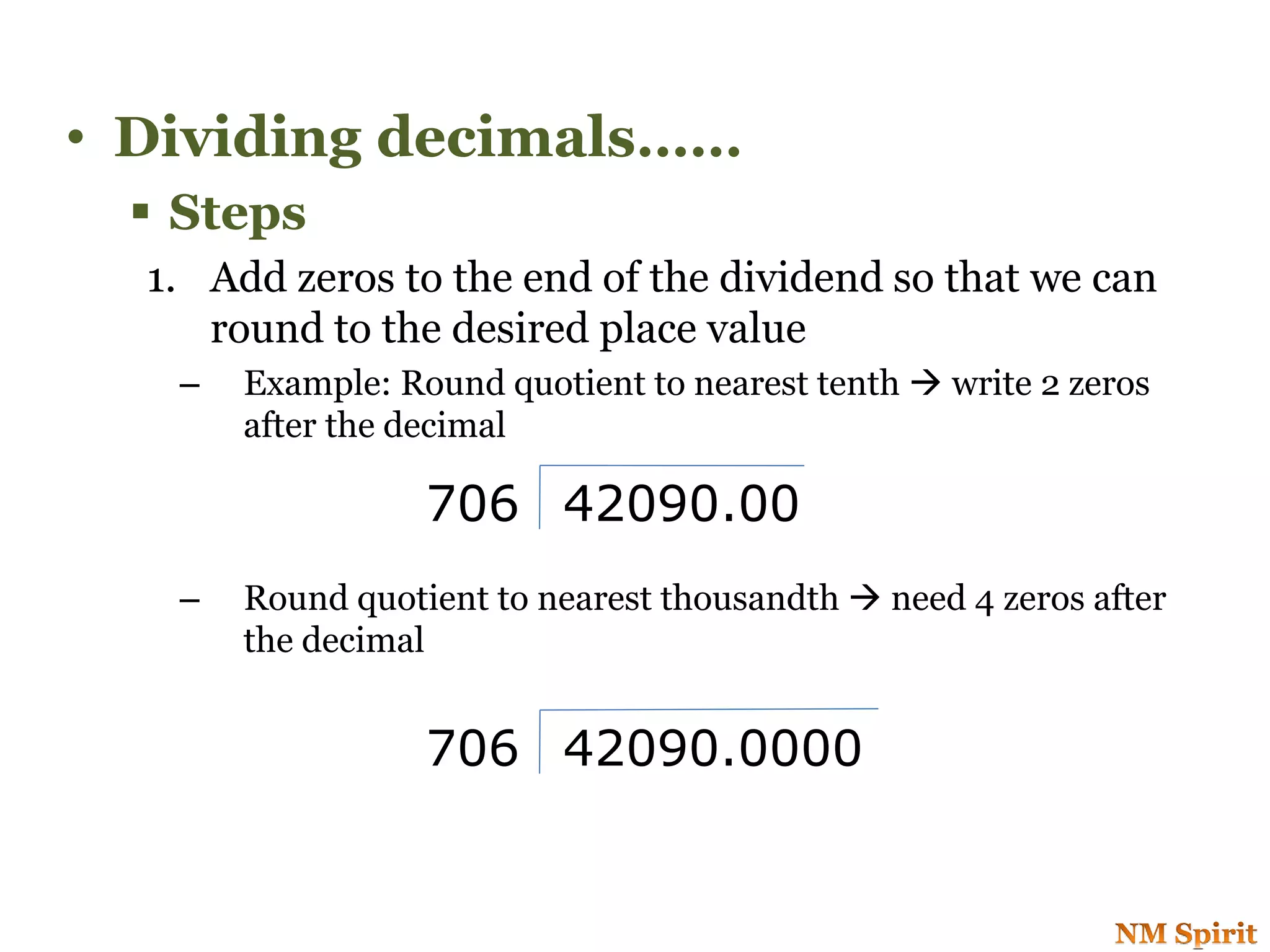
• Dividing decimals……
 Steps
1. Add zeros to the end of the dividend so that we can
round to the desired place value
– Example: Round quotient to nearest tenth  write 2 zeros
after the decimal
– Round quotient to nearest thousandth  need 4 zeros after
the decimal
706 42090.00
706 42090.0000
 Dividing decimals…….
 Steps
1. Do the division as if it were whole numbers
2. Put the decimal place in the quotient directly over
the decimal point in the dividend
706 42090.00
00059.61 ≈ 59.6
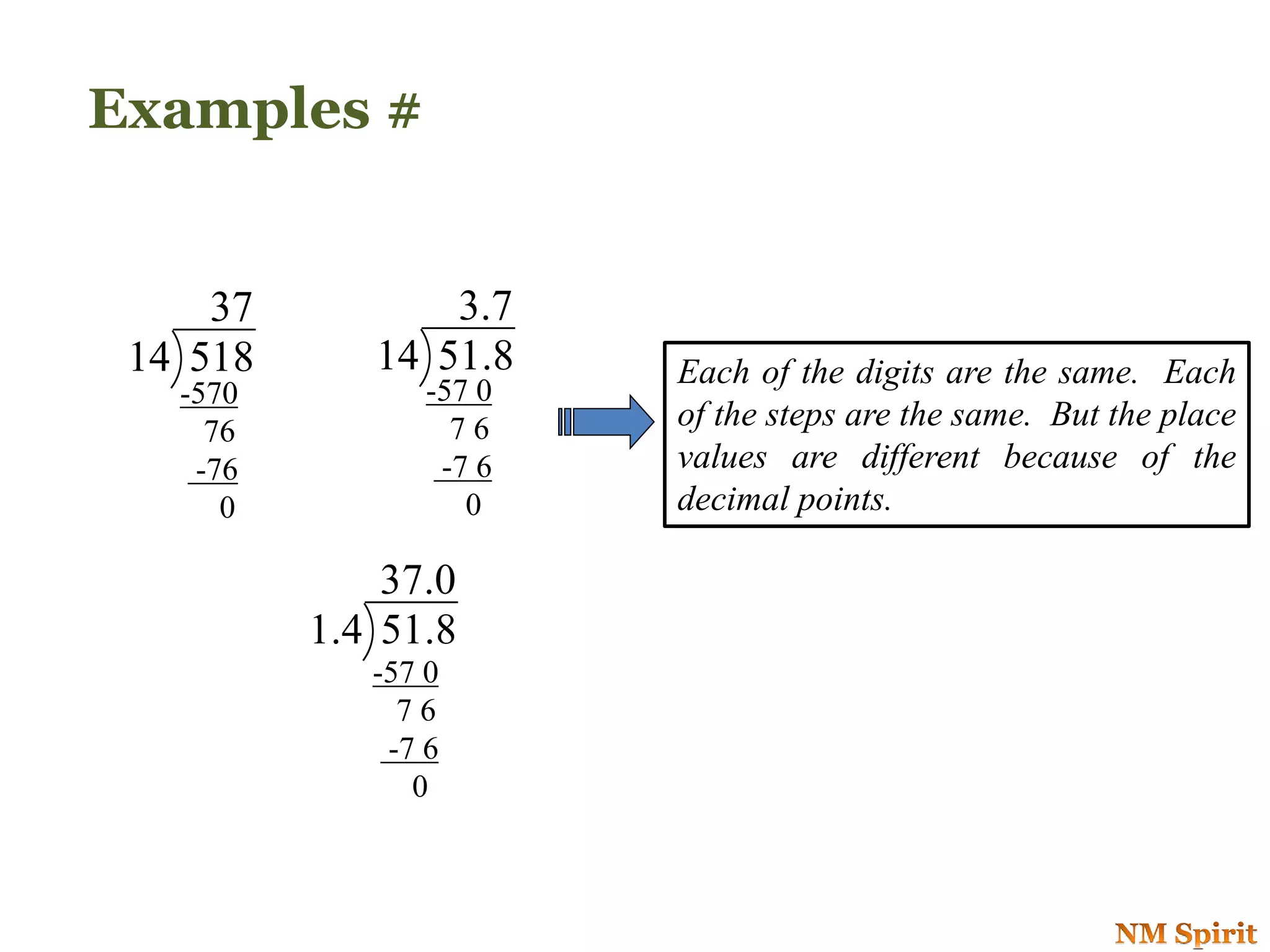
Each of the digits are the same. Each
of the steps are the same. But the place
values are different because of the
decimal points.
37
51814
7.3
8.5114
-570
76
-76
0
-57 0
7 6
-7 6
0
Examples #
0.37
8.514.1
-57 0
7 6
-7 6
0
Comparing & Converting
Fractions & Decimals
To convert a fraction  decimal
 Steps
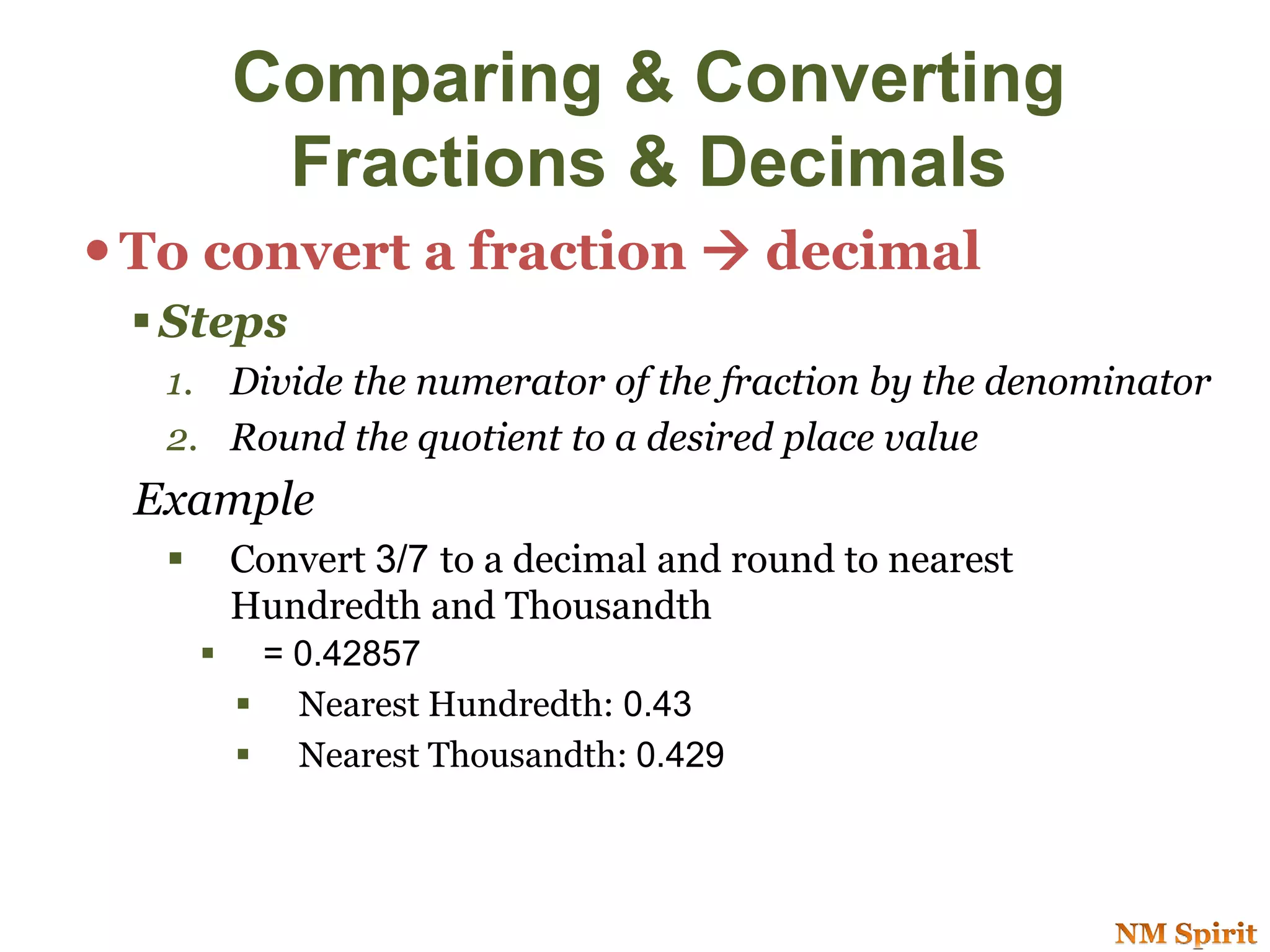
1. Divide the numerator of the fraction by the denominator
2. Round the quotient to a desired place value
Example
 Convert 3/7 to a decimal and round to nearest
Hundredth and Thousandth
 = 0.42857
 Nearest Hundredth: 0.43
 Nearest Thousandth: 0.429
To convert a decimal  fraction
 Steps
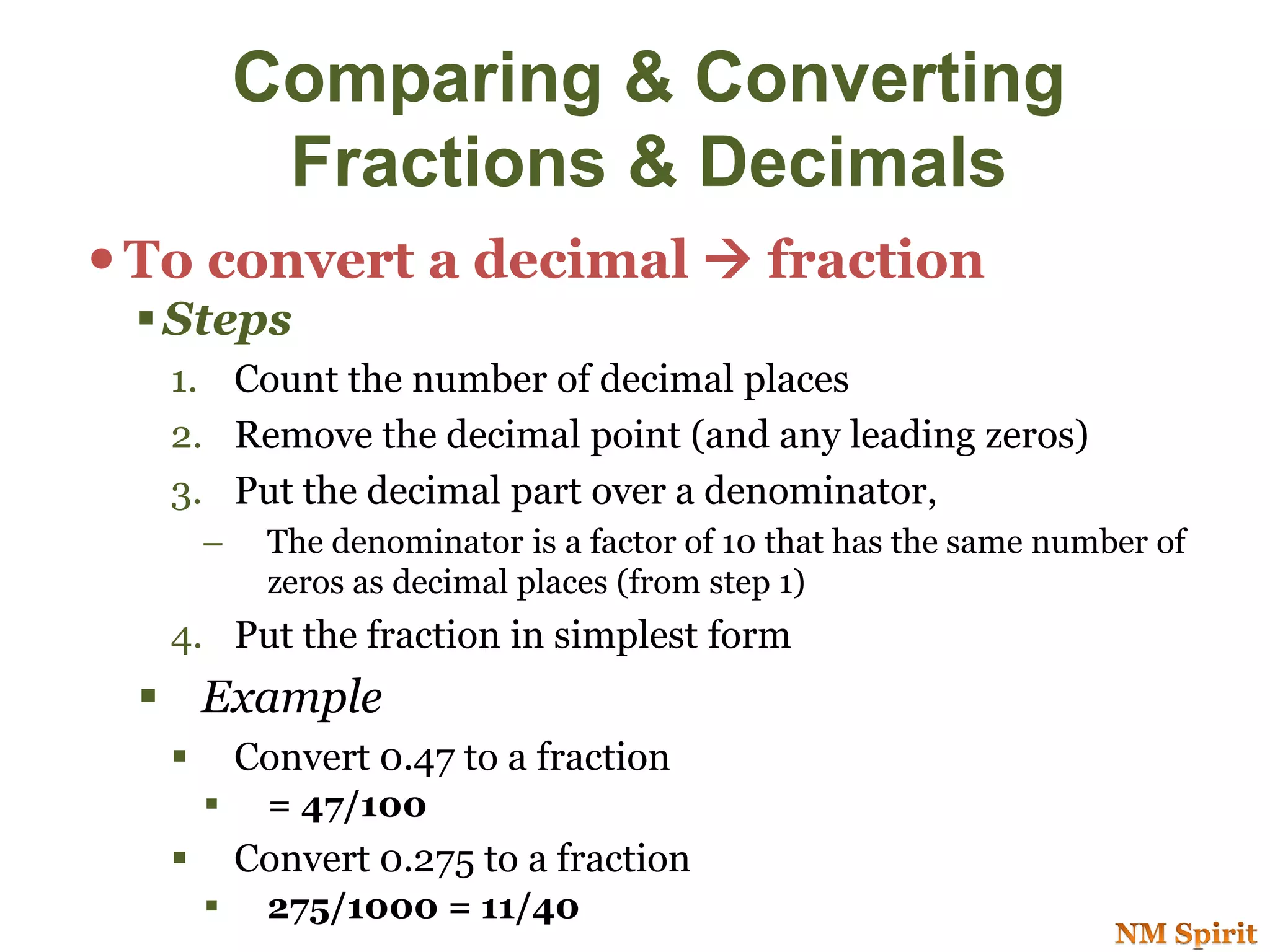
1. Count the number of decimal places
2. Remove the decimal point (and any leading zeros)
3. Put the decimal part over a denominator,
– The denominator is a factor of 10 that has the same number of
zeros as decimal places (from step 1)
4. Put the fraction in simplest form
 Example
 Convert 0.47 to a fraction
 = 47/100
 Convert 0.275 to a fraction
 275/1000 = 11/40
Comparing & Converting
Fractions & Decimals
The End
Call us for more
Information:
Email – nm.sspirit@gmail.com
91-901-568-
0202

Oprations Of Decimal Numbers

  • 1.
    Decimals Add, Subtract, Multiply& Divide 28.9 + 32.5 61.4 T- 91-901-568-0202 Email- nm.sspirit@gmail.com By NM Spirit
  • 2.
    Adding or SubtractingDecimals  Write the numbers in a vertical column, aligning digits according to their places.  Attach extra zeros to the right end of each number so each number has the same quantity of digits.  Add or subtract as though the numbers are whole numbers.  Place the decimal point in the sum or difference to align with the decimal point in the respective operation.
  • 3.
    Adding Decimals Add theones. There are 18 ones. Add the tenths. There are 20 tenths. • Since 20 hundredths is 2 ones 0 tenths, write 0 in the tenths place. Write 2 as an addend in the ones place. 8.784 2.560 + 6.721 Add the hundredths. There are 16 hundredths. • Since 16 hundredths is 1 tenth 6 hundredths, write 6 in the hundredths place. Write 1 as an addend in the tenths place. 12 0 Add up the thousandths. There are 5 thousandth. So 8.784 + 2.56 + 6.721 = 18.065.
  • 4.
    Subtracting Decimals Try tosubtract the hundredths. You will need more hundredths. •There are no tenths to use, so use a one. Change the number of ones from 4 to 3. Raise the number of tenths from 0 to 9 and the number of hundredths from 3 to 13. Now subtract. There are 9 thousandths. 4.040 -2.681 1.359 • Use one of the hundredths. • Since 1 hundredth = 10 thousandths, change the number of the hundredths from 4 to 3 and the number of thousandths from 0 to 10. To subtract the thousandths, you will need more thousandths. So, 4.040 – 2.681 = 1.359 Subtract the hundredths. There are 5 hundredths. Subtract the tenths. There are 3 tenths. Subtract the ones. There is 1 one. 9 13 10
  • 5.
    Multiply Decimals  Multiplythe decimal numbers as though they are whole numbers.  Count the digits in the decimal parts of both decimal numbers.  Place the decimal point in the product so that there are as many digits in its decimal part as there are digits you counted in the previous step.  If necessary, attach zeros to the left end of the product to place the decimal point accurately. 21.4 x 0.36 3 total decimal places 7 704.
  • 6.
    Look at thisexample. 3.45 x 4.082 =  How many places are there to the right of the decimal point?  Five; so, the answer will have five places to the right of the decimal.  The answer is 14.08290  The last zero can be dropped and the answer would be 14.0829. Examples 920 x 3.7 = 3404.0 0.00079 x 0.025 = 0.00001975 Class Examples 870 x 4.6 = 4002.0 0.000086 x 0.057 = 0.000004902
  • 7.
     Dividing decimalsis similar to dividing whole numbers.  Same question…what about the decimal place? Where does that go?  Steps 1. Make the divisor a whole number by shifting the decimal to the right as many times as necessary. 2. Move the decimal in the dividend the same number of times that we moved it in the divisor 7 0 6 4 2 0 9. . 0 ?????? Division of Decimals
  • 8.
    • Dividing decimals…… Steps 1. Add zeros to the end of the dividend so that we can round to the desired place value – Example: Round quotient to nearest tenth  write 2 zeros after the decimal – Round quotient to nearest thousandth  need 4 zeros after the decimal 706 42090.00 706 42090.0000
  • 9.
     Dividing decimals……. Steps 1. Do the division as if it were whole numbers 2. Put the decimal place in the quotient directly over the decimal point in the dividend 706 42090.00 00059.61 ≈ 59.6
  • 10.
    Each of thedigits are the same. Each of the steps are the same. But the place values are different because of the decimal points. 37 51814 7.3 8.5114 -570 76 -76 0 -57 0 7 6 -7 6 0 Examples # 0.37 8.514.1 -57 0 7 6 -7 6 0
  • 11.
    Comparing & Converting Fractions& Decimals To convert a fraction  decimal  Steps 1. Divide the numerator of the fraction by the denominator 2. Round the quotient to a desired place value Example  Convert 3/7 to a decimal and round to nearest Hundredth and Thousandth  = 0.42857  Nearest Hundredth: 0.43  Nearest Thousandth: 0.429
  • 12.
    To convert adecimal  fraction  Steps 1. Count the number of decimal places 2. Remove the decimal point (and any leading zeros) 3. Put the decimal part over a denominator, – The denominator is a factor of 10 that has the same number of zeros as decimal places (from step 1) 4. Put the fraction in simplest form  Example  Convert 0.47 to a fraction  = 47/100  Convert 0.275 to a fraction  275/1000 = 11/40 Comparing & Converting Fractions & Decimals
  • 13.
    The End Call usfor more Information: Email – nm.sspirit@gmail.com 91-901-568- 0202