Introduction to Portfolio Management Khader Shaik
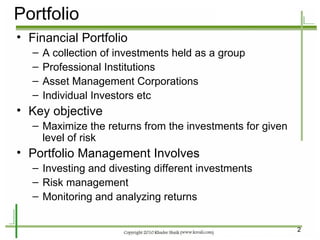
Portfolio Financial Portfolio A collection of investments held as a group Professional Institutions Asset Management Corporations Individual Investors etc Key objective Maximize the returns from the investments for given level of risk Portfolio Management Involves Investing and divesting different investments Risk management Monitoring and analyzing returns
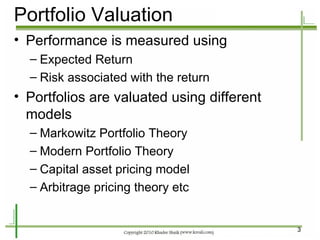
Portfolio Valuation Performance is measured using Expected Return Risk associated with the return Portfolios are valuated using different models Markowitz Portfolio Theory Modern Portfolio Theory Capital asset pricing model Arbitrage pricing theory etc
Portfolio Management Key Factors Continuous P&L Calculations Portfolio may contain different classes of products including derivatives Computing the RISK/Exposure is the key  Incorrect pricing/valuation would expose the Portfolio Incorrect Hedging would expose portfolio Most Portfolios are rebalanced almost everyday
Factors affect the P&L P&L Changes from the RISKs that were unhedged P&L Changes from the usage of imperfect Hedging Model P&L Changes from new trades during the day
Derivative Product Types & Exposure Linear Product Price of the product is directly dependent on the price of the underlying asset Hedge the product and forget Non-linear Product Price of the product is not directly dependent on the price of the underlying asset Rebalance the Hedge as frequent as necessary
Risk Management Risk The chance that an investment’s actual return will be different than expected Actual return may wipe some or total original investment Risk and Reward The greater the amount of risk, the greater the potential return Categories of Risk Market Risk Credit or Default Risk Operational Risk
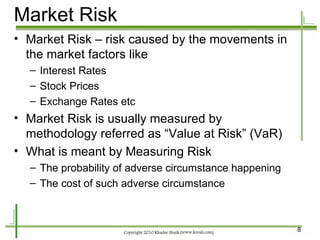
Market Risk Market Risk – risk caused by the movements in the market factors like Interest Rates Stock Prices Exchange Rates etc Market Risk is usually measured by methodology referred as “Value at Risk” (VaR) What is meant by Measuring Risk The probability of adverse circumstance happening The cost of such adverse circumstance
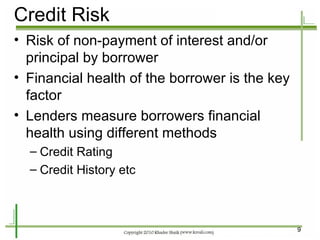
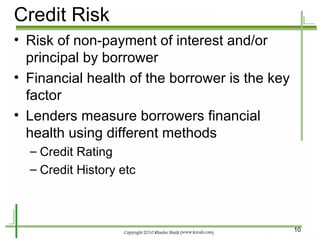
Credit Risk Risk of non-payment of interest and/or principal by borrower Financial health of the borrower is the key factor Lenders measure borrowers financial health using different methods Credit Rating Credit History etc
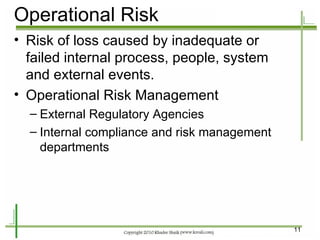
Operational Risk Risk of loss caused by inadequate or failed internal process, people, system and external events.  Operational Risk Management External Regulatory Agencies Internal compliance and risk management departments
VaR – Value at Risk VaR is used to measure a Market Risk of an Asset or Portfolio of Assets It is single number that summarizes the total risk in financial portfolio or asset It answers the question How bad things can go wrong? For example if VaR of a Portfolio is $2M, at 95% for 1 day 95% sure/confident that in ONE day portfolio cannot lose more than $2M

Introduction to Portfolio Management

  • 1.
    Introduction to PortfolioManagement Khader Shaik
  • 2.
    Portfolio Financial PortfolioA collection of investments held as a group Professional Institutions Asset Management Corporations Individual Investors etc Key objective Maximize the returns from the investments for given level of risk Portfolio Management Involves Investing and divesting different investments Risk management Monitoring and analyzing returns
  • 3.
    Portfolio Valuation Performanceis measured using Expected Return Risk associated with the return Portfolios are valuated using different models Markowitz Portfolio Theory Modern Portfolio Theory Capital asset pricing model Arbitrage pricing theory etc
  • 4.
    Portfolio Management KeyFactors Continuous P&L Calculations Portfolio may contain different classes of products including derivatives Computing the RISK/Exposure is the key Incorrect pricing/valuation would expose the Portfolio Incorrect Hedging would expose portfolio Most Portfolios are rebalanced almost everyday
  • 5.
    Factors affect theP&L P&L Changes from the RISKs that were unhedged P&L Changes from the usage of imperfect Hedging Model P&L Changes from new trades during the day
  • 6.
    Derivative Product Types& Exposure Linear Product Price of the product is directly dependent on the price of the underlying asset Hedge the product and forget Non-linear Product Price of the product is not directly dependent on the price of the underlying asset Rebalance the Hedge as frequent as necessary
  • 7.
    Risk Management RiskThe chance that an investment’s actual return will be different than expected Actual return may wipe some or total original investment Risk and Reward The greater the amount of risk, the greater the potential return Categories of Risk Market Risk Credit or Default Risk Operational Risk
  • 8.
    Market Risk MarketRisk – risk caused by the movements in the market factors like Interest Rates Stock Prices Exchange Rates etc Market Risk is usually measured by methodology referred as “Value at Risk” (VaR) What is meant by Measuring Risk The probability of adverse circumstance happening The cost of such adverse circumstance
  • 9.
    Credit Risk Riskof non-payment of interest and/or principal by borrower Financial health of the borrower is the key factor Lenders measure borrowers financial health using different methods Credit Rating Credit History etc
  • 10.
    Credit Risk Riskof non-payment of interest and/or principal by borrower Financial health of the borrower is the key factor Lenders measure borrowers financial health using different methods Credit Rating Credit History etc
  • 11.
    Operational Risk Riskof loss caused by inadequate or failed internal process, people, system and external events. Operational Risk Management External Regulatory Agencies Internal compliance and risk management departments
  • 12.
    VaR – Valueat Risk VaR is used to measure a Market Risk of an Asset or Portfolio of Assets It is single number that summarizes the total risk in financial portfolio or asset It answers the question How bad things can go wrong? For example if VaR of a Portfolio is $2M, at 95% for 1 day 95% sure/confident that in ONE day portfolio cannot lose more than $2M

Editor's Notes

  • #2 Derivatives Markets Copyright@2007 Orbitra LLC
  • #3 Derivatives Markets Copyright@2007 Orbitra LLC
  • #4 Derivatives Markets Copyright@2007 Orbitra LLC
  • #5 Derivatives Markets Copyright@2007 Orbitra LLC
  • #6 Derivatives Markets Copyright@2007 Orbitra LLC
  • #7 Derivatives Markets Copyright@2007 Orbitra LLC
  • #8 Derivatives Markets Copyright@2007 Orbitra LLC
  • #9 Derivatives Markets Copyright@2007 Orbitra LLC
  • #10 Derivatives Markets Copyright@2007 Orbitra LLC
  • #11 Derivatives Markets Copyright@2007 Orbitra LLC
  • #12 Derivatives Markets Copyright@2007 Orbitra LLC
  • #13 Derivatives Markets Copyright@2007 Orbitra LLC