1
Portfolio optimization:
Tracking Model
Konstantinos Kourtidis
Efthymios Nakas
Alban Mertiri
Gloriana Ziaj
Supervisor
Topaloglou Nikolas
2
Introduction
In the following project we will address the definition of risk as well as
the risks that the investors and the financial institutions face when they
choose to invest at an asset or create a portfolio. Also we will try to
create an optimized portfolio using the method of Tracking Model at the
Large Cap 25 provided the data of the last 15 years, period of 2000-2015,
and we will try to understand if the abovementioned method will help
us create a well-diversified portfolio.
Tracking Model as a method tries to create a portfolio that imitates and
mirrors the behavior of the index, where the portfolio operates.
Risks
Risk is simply the measurable possibility of either losing value or not
gaining value. In investment terms, risk is the uncertainty that an
investment will deliver its expected return.
Before you can make suitable recommendations that are in line with the
investment objectives of a client, you must understand the concept of
risk, the types of investment risk associated with various investment
vehicles and the amount of risk that a client is willing to assume. In
general, your clients must first understand that no investment is without
risk and that there is a trade-off between returns and the amount of risk
an investor is willing to assume in order to reach his or her financial
goals
The Risks the investors & financial institutions face are the following:
3
 Interest Rate Risk
Interest rate risk is the possibility that a fixed-rate debt instrument
will decline in value as a result of a rise in interest rates. Whenever
investors buy securities that offer a fixed rate of return, they are
exposing themselves to interest rate risk. This is true for bonds and
also for preferred stocks.
 Business Risk
Business risk is the measure of risk associated with a particular
security. It is also known as unsystematic risk and refers to the risk
associated with a specific issuer of a security. Generally speaking,
all businesses in the same industry have similar types of business
risk. But used more specifically, business risk refers to the
possibility that the issuer of a stock or a bond may go bankrupt or
be unable to pay the interest or principal in the case of bonds. A
common way to avoid unsystematic risk is to diversify - that is, to
buy mutual funds, which hold the securities of many different
companies.
 Credit Risk
This refers to the possibility that a particular bond issuer will not
be able to make expected interest rate payments and/or principal
repayment. Typically, the higher the credit risk, the higher the
interest rate on the bond.
 Taxability Risk
This applies to municipal bond offerings, and refers to the risk that
a security that was issued with tax-exempt status could potentially
lose that status prior to maturity. Since municipal bonds carry a
lower interest rate than fully taxable bonds, the bond holders
would end up with a lower after-tax yield than originally planned.
 Call Risk
Call risk is specific to bond issues and refers to the possibility that
a debt security will be called prior to maturity. Call risk usually
goes hand in hand with reinvestment risk, discussed below,
4
because the bondholder must find an investment that provides the
same level of income for equal risk. Call risk is most prevalent
when interest rates are falling, as companies trying to save money
will usually redeem bond issues with higher coupons and replace
them on the bond market with issues with lower interest rates. In a
declining interest rate environment, the investor is usually forced
to take on more risk in order to replace the same income stream.
 Inflationary Risk
Also known as purchasing power risk, inflationary risk is the
chance that the value of an asset or income will be eroded as
inflation shrinks the value of a country's currency. Put another
way, it is the risk that future inflation will cause the purchasing
power of cash flow from an investment to decline. The best way to
fight this type of risk is through appreciable investments, such as
stocks or convertible bonds, which have a growth component that
stays ahead of inflation over the long term.
 Liquidity Risk
Liquidity risk refers to the possibility that an investor may not be
able to buy or sell an investment as and when desired or in
sufficient quantities because opportunities are limited. A good
example of liquidity risk is selling real estate. In most cases, it will
be difficult to sell a property at any given moment should the need
arise, unlike government securities or blue chip stocks.
 Market Risk
Market risk, also called systematic risk, is a risk that will affect all
securities in the same manner. In other words, it is caused by some
factor that cannot be controlled by diversification. This is an
important point to consider when you are recommending mutual
funds, which are appealing to investors in large part because they
5
are a quick way to diversify. You must always ask yourself what
kind of diversification your client needs.
 Reinvestment Risk
In a declining interest rate environment, bondholders who have
bonds coming due or being called face the difficult task of
investing the proceeds in bond issues with equal or greater interest
rates than the redeemed bonds. As a result, they are often forced to
purchase securities that do not provide the same level of income,
unless they take on more credit or market risk and buy bonds with
lower credit ratings. This situation is known as reinvestment risk:
it is the risk that falling interest rates will lead to a decline in cash
flow from an investment when its principal and interest payments
are reinvested at lower rates.
 Social/Political / legislative Risk
Risk associated with the possibility of nationalization, unfavorable
government action or social changes resulting in a loss of value is
called social or political risk. Because the U.S. Congress has the
power to change laws affecting securities, any ruling that results in
adverse consequences is also known as legislative risk.
 Currency/Exchange Rate Risk
Currency or exchange rate risk is a form of risk that arises from the
change in price of one currency against another. The constant
fluctuations in the foreign currency in which an investment is
denominated vis-à-vis one's home currency may add risk to the
value of a security.
6
Risk measures used in portfolio optimization
Variance
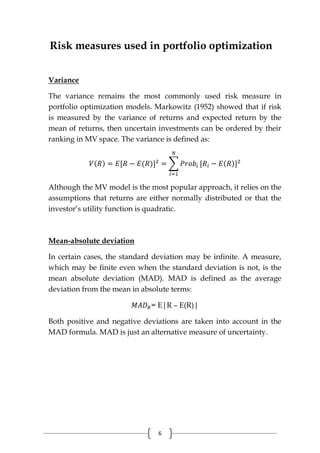
The variance remains the most commonly used risk measure in
portfolio optimization models. Markowitz (1952) showed that if risk
is measured by the variance of returns and expected return by the
mean of returns, then uncertain investments can be ordered by their
ranking in MV space. The variance is defined as:
( ) , ( )- ∑ , ( )-
Although the MV model is the most popular approach, it relies on the
assumptions that returns are either normally distributed or that the
investor’s utility function is quadratic.
Mean-absolute deviation
In certain cases, the standard deviation may be infinite. A measure,
which may be finite even when the standard deviation is not, is the
mean absolute deviation (MAD). MAD is defined as the average
deviation from the mean in absolute terms:
= E|R – E(R)|
Both positive and negative deviations are taken into account in the
MAD formula. MAD is just an alternative measure of uncertainty.
7
Value at Risk
Value-at-risk (VaR) since the mid-1990s has been used as a regulator-
approved valid approach for calculating capital reserves to cover
market risk. VaR is defined as the minimum level of loss at a given,
sufficiently high confidence level for a predefined time horizon. The
recommended confidence levels are 95% and 99%. More generally,
the confidence level of the VaR is denoted (1-ε) 100%. Losses larger
than VaR occur with probability ε, called tail probability. VaR at
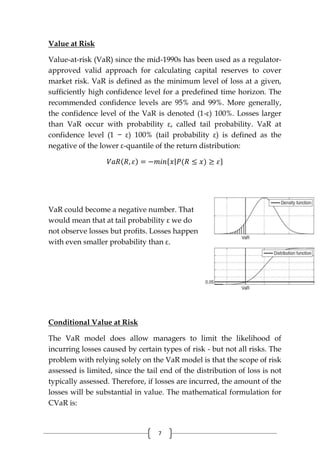
confidence level (1 − ε) 100% (tail probability ε) is defined as the
negative of the lower ε-quantile of the return distribution:
( ) * | ( ) +
VaR could become a negative number. That
would mean that at tail probability ε we do
not observe losses but profits. Losses happen
with even smaller probability than ε.
Conditional Value at Risk
The VaR model does allow managers to limit the likelihood of
incurring losses caused by certain types of risk - but not all risks. The
problem with relying solely on the VaR model is that the scope of risk
assessed is limited, since the tail end of the distribution of loss is not
typically assessed. Therefore, if losses are incurred, the amount of the
losses will be substantial in value. The mathematical formulation for
CVaR is:
8
∫ ( )
( ) {
( )
( )
( )
CVaR is superior to VaR because CVaR quantifies tail risk and has
been shown to be sub-additive. CVaR can capture the minimal
probability of a substantial loss for a strategy with an asymmetrical
risk profile, such as for writing options.
Results
First and foremost, the maximization that the model optimizes is
Using the Data that it is provided, transmuted into returns, and using
the General Algebraic Modeling System (GAMS) we observe that the
model is only feasible when ε ≥ 46. ε shows how close to the market we
are, where 0 is index itself.
This means that only a risk lover investor will create a portfolio, while
using this model. On the contrast, a risk neutral or a risk averse will
never invest.
9
In practice there is no portfolio since all the amount is invested in one
asset, in this case Jumbo.
The return of the portfolio is the return of the asset.
Using the backtesting method of the portfolio, we have 24 periods of 168
months. Starting from 1 to 168, we try to forecast the 169th observation.
Then, from 2 to 169, we forecast the 170th observation, and so on. We can
see that the returns of the portfolio coincide the returns of the Jumbo.
That makes sense since our weight to the Jumbo is 1.
0,00
0,20
0,40
0,60
0,80
1,00
1,20
1,40
1 2 3 4 5 6 7 8 9 10 11 12 13 14 15 16 17 18 19 20 21 22 23 24
portfolio
market
10
Conclusion
We can observe that, using this model in FTSE 25, the risk-neutral and
risk-averse investors and financial institutions do not have an incentive
to invest and create portfolios. So given the above statement, we can
reject the Tracking Model for the Greek Economy, since the objective
function is like this. This rejection is called Tracking error. Tracking
error is the difference between a portfolio's returns and
the benchmark or index it was meant to mimic or beat. Tracking error is
sometimes called active risk.
There are two ways to measure tracking error. The first is to subtract the
benchmark's cumulative returns from the portfolio's returns, as follows:
Returnp - Returni = Tracking Error
Where:
p = portfolio
i = index or benchmark
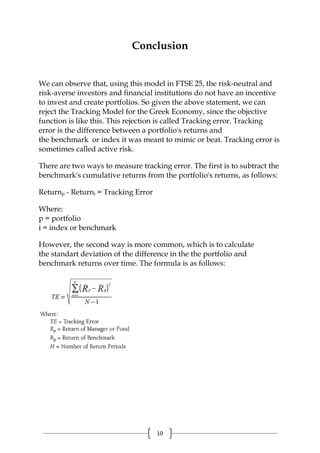
However, the second way is more common, which is to calculate
the standart deviation of the difference in the the portfolio and
benchmark returns over time. The formula is as follows:
11
Bibliography
 Different Risk Measures: Different Portfolio Compositions? A Paper Presented at The
11th Annual European Real Estate Society (ERES) Meeting Milan, Italy, June 2004 Peter
Byrne and Stephen Lee Centre for Real Estate Research The University of Reading
Business School Reading, RG6 6AW, UK
 Risk Measures, Risk Management, and Optimization Prof. Dr. Svetlozar (Zari) Rachev
Frey Family Foundation Chair-Professor, Applied Mathematics and Statistics, Stony
Brook University Chief Scientist, FinAnalytica
 Value at Risk and Conditional Value at Risk: A Comparison, DEBORAH KIDD, CFA
 Value-at-Risk vs. Conditional Value-at-Risk in Risk Management and Optimization
Sergey Sarykalin Gobal Fraud Risk Management, American Express, Phoenix, Arizona
85021
 Roy E. Bailey (2005). The Economics of Financial Markets. Cambridge University Press.
ISBN 0521612802.
 Marcelo Bianconi (2013). Financial Economics, Risk and Information (2nd Edition).World
Scientific. ISBN 9814355135.
 Zvi Bodie, Robert C. Merton and David Cleeton (2008). Financial Economics (2nd
Edition). Prentice Hall. ISBN 0131856154.
 http://www.investinganswers.com/financial-dictionary/mutual-funds-etfs/tracking-
error-4970

Project final

  • 1.
    1 Portfolio optimization: Tracking Model KonstantinosKourtidis Efthymios Nakas Alban Mertiri Gloriana Ziaj Supervisor Topaloglou Nikolas
  • 2.
    2 Introduction In the followingproject we will address the definition of risk as well as the risks that the investors and the financial institutions face when they choose to invest at an asset or create a portfolio. Also we will try to create an optimized portfolio using the method of Tracking Model at the Large Cap 25 provided the data of the last 15 years, period of 2000-2015, and we will try to understand if the abovementioned method will help us create a well-diversified portfolio. Tracking Model as a method tries to create a portfolio that imitates and mirrors the behavior of the index, where the portfolio operates. Risks Risk is simply the measurable possibility of either losing value or not gaining value. In investment terms, risk is the uncertainty that an investment will deliver its expected return. Before you can make suitable recommendations that are in line with the investment objectives of a client, you must understand the concept of risk, the types of investment risk associated with various investment vehicles and the amount of risk that a client is willing to assume. In general, your clients must first understand that no investment is without risk and that there is a trade-off between returns and the amount of risk an investor is willing to assume in order to reach his or her financial goals The Risks the investors & financial institutions face are the following:
  • 3.
    3  Interest RateRisk Interest rate risk is the possibility that a fixed-rate debt instrument will decline in value as a result of a rise in interest rates. Whenever investors buy securities that offer a fixed rate of return, they are exposing themselves to interest rate risk. This is true for bonds and also for preferred stocks.  Business Risk Business risk is the measure of risk associated with a particular security. It is also known as unsystematic risk and refers to the risk associated with a specific issuer of a security. Generally speaking, all businesses in the same industry have similar types of business risk. But used more specifically, business risk refers to the possibility that the issuer of a stock or a bond may go bankrupt or be unable to pay the interest or principal in the case of bonds. A common way to avoid unsystematic risk is to diversify - that is, to buy mutual funds, which hold the securities of many different companies.  Credit Risk This refers to the possibility that a particular bond issuer will not be able to make expected interest rate payments and/or principal repayment. Typically, the higher the credit risk, the higher the interest rate on the bond.  Taxability Risk This applies to municipal bond offerings, and refers to the risk that a security that was issued with tax-exempt status could potentially lose that status prior to maturity. Since municipal bonds carry a lower interest rate than fully taxable bonds, the bond holders would end up with a lower after-tax yield than originally planned.  Call Risk Call risk is specific to bond issues and refers to the possibility that a debt security will be called prior to maturity. Call risk usually goes hand in hand with reinvestment risk, discussed below,
  • 4.
    4 because the bondholdermust find an investment that provides the same level of income for equal risk. Call risk is most prevalent when interest rates are falling, as companies trying to save money will usually redeem bond issues with higher coupons and replace them on the bond market with issues with lower interest rates. In a declining interest rate environment, the investor is usually forced to take on more risk in order to replace the same income stream.  Inflationary Risk Also known as purchasing power risk, inflationary risk is the chance that the value of an asset or income will be eroded as inflation shrinks the value of a country's currency. Put another way, it is the risk that future inflation will cause the purchasing power of cash flow from an investment to decline. The best way to fight this type of risk is through appreciable investments, such as stocks or convertible bonds, which have a growth component that stays ahead of inflation over the long term.  Liquidity Risk Liquidity risk refers to the possibility that an investor may not be able to buy or sell an investment as and when desired or in sufficient quantities because opportunities are limited. A good example of liquidity risk is selling real estate. In most cases, it will be difficult to sell a property at any given moment should the need arise, unlike government securities or blue chip stocks.  Market Risk Market risk, also called systematic risk, is a risk that will affect all securities in the same manner. In other words, it is caused by some factor that cannot be controlled by diversification. This is an important point to consider when you are recommending mutual funds, which are appealing to investors in large part because they
  • 5.
    5 are a quickway to diversify. You must always ask yourself what kind of diversification your client needs.  Reinvestment Risk In a declining interest rate environment, bondholders who have bonds coming due or being called face the difficult task of investing the proceeds in bond issues with equal or greater interest rates than the redeemed bonds. As a result, they are often forced to purchase securities that do not provide the same level of income, unless they take on more credit or market risk and buy bonds with lower credit ratings. This situation is known as reinvestment risk: it is the risk that falling interest rates will lead to a decline in cash flow from an investment when its principal and interest payments are reinvested at lower rates.  Social/Political / legislative Risk Risk associated with the possibility of nationalization, unfavorable government action or social changes resulting in a loss of value is called social or political risk. Because the U.S. Congress has the power to change laws affecting securities, any ruling that results in adverse consequences is also known as legislative risk.  Currency/Exchange Rate Risk Currency or exchange rate risk is a form of risk that arises from the change in price of one currency against another. The constant fluctuations in the foreign currency in which an investment is denominated vis-à-vis one's home currency may add risk to the value of a security.
  • 6.
    6 Risk measures usedin portfolio optimization Variance The variance remains the most commonly used risk measure in portfolio optimization models. Markowitz (1952) showed that if risk is measured by the variance of returns and expected return by the mean of returns, then uncertain investments can be ordered by their ranking in MV space. The variance is defined as: ( ) , ( )- ∑ , ( )- Although the MV model is the most popular approach, it relies on the assumptions that returns are either normally distributed or that the investor’s utility function is quadratic. Mean-absolute deviation In certain cases, the standard deviation may be infinite. A measure, which may be finite even when the standard deviation is not, is the mean absolute deviation (MAD). MAD is defined as the average deviation from the mean in absolute terms: = E|R – E(R)| Both positive and negative deviations are taken into account in the MAD formula. MAD is just an alternative measure of uncertainty.
  • 7.
    7 Value at Risk Value-at-risk(VaR) since the mid-1990s has been used as a regulator- approved valid approach for calculating capital reserves to cover market risk. VaR is defined as the minimum level of loss at a given, sufficiently high confidence level for a predefined time horizon. The recommended confidence levels are 95% and 99%. More generally, the confidence level of the VaR is denoted (1-ε) 100%. Losses larger than VaR occur with probability ε, called tail probability. VaR at confidence level (1 − ε) 100% (tail probability ε) is defined as the negative of the lower ε-quantile of the return distribution: ( ) * | ( ) + VaR could become a negative number. That would mean that at tail probability ε we do not observe losses but profits. Losses happen with even smaller probability than ε. Conditional Value at Risk The VaR model does allow managers to limit the likelihood of incurring losses caused by certain types of risk - but not all risks. The problem with relying solely on the VaR model is that the scope of risk assessed is limited, since the tail end of the distribution of loss is not typically assessed. Therefore, if losses are incurred, the amount of the losses will be substantial in value. The mathematical formulation for CVaR is:
  • 8.
    8 ∫ ( ) () { ( ) ( ) ( ) CVaR is superior to VaR because CVaR quantifies tail risk and has been shown to be sub-additive. CVaR can capture the minimal probability of a substantial loss for a strategy with an asymmetrical risk profile, such as for writing options. Results First and foremost, the maximization that the model optimizes is Using the Data that it is provided, transmuted into returns, and using the General Algebraic Modeling System (GAMS) we observe that the model is only feasible when ε ≥ 46. ε shows how close to the market we are, where 0 is index itself. This means that only a risk lover investor will create a portfolio, while using this model. On the contrast, a risk neutral or a risk averse will never invest.
  • 9.
    9 In practice thereis no portfolio since all the amount is invested in one asset, in this case Jumbo. The return of the portfolio is the return of the asset. Using the backtesting method of the portfolio, we have 24 periods of 168 months. Starting from 1 to 168, we try to forecast the 169th observation. Then, from 2 to 169, we forecast the 170th observation, and so on. We can see that the returns of the portfolio coincide the returns of the Jumbo. That makes sense since our weight to the Jumbo is 1. 0,00 0,20 0,40 0,60 0,80 1,00 1,20 1,40 1 2 3 4 5 6 7 8 9 10 11 12 13 14 15 16 17 18 19 20 21 22 23 24 portfolio market
  • 10.
    10 Conclusion We can observethat, using this model in FTSE 25, the risk-neutral and risk-averse investors and financial institutions do not have an incentive to invest and create portfolios. So given the above statement, we can reject the Tracking Model for the Greek Economy, since the objective function is like this. This rejection is called Tracking error. Tracking error is the difference between a portfolio's returns and the benchmark or index it was meant to mimic or beat. Tracking error is sometimes called active risk. There are two ways to measure tracking error. The first is to subtract the benchmark's cumulative returns from the portfolio's returns, as follows: Returnp - Returni = Tracking Error Where: p = portfolio i = index or benchmark However, the second way is more common, which is to calculate the standart deviation of the difference in the the portfolio and benchmark returns over time. The formula is as follows:
  • 11.
    11 Bibliography  Different RiskMeasures: Different Portfolio Compositions? A Paper Presented at The 11th Annual European Real Estate Society (ERES) Meeting Milan, Italy, June 2004 Peter Byrne and Stephen Lee Centre for Real Estate Research The University of Reading Business School Reading, RG6 6AW, UK  Risk Measures, Risk Management, and Optimization Prof. Dr. Svetlozar (Zari) Rachev Frey Family Foundation Chair-Professor, Applied Mathematics and Statistics, Stony Brook University Chief Scientist, FinAnalytica  Value at Risk and Conditional Value at Risk: A Comparison, DEBORAH KIDD, CFA  Value-at-Risk vs. Conditional Value-at-Risk in Risk Management and Optimization Sergey Sarykalin Gobal Fraud Risk Management, American Express, Phoenix, Arizona 85021  Roy E. Bailey (2005). The Economics of Financial Markets. Cambridge University Press. ISBN 0521612802.  Marcelo Bianconi (2013). Financial Economics, Risk and Information (2nd Edition).World Scientific. ISBN 9814355135.  Zvi Bodie, Robert C. Merton and David Cleeton (2008). Financial Economics (2nd Edition). Prentice Hall. ISBN 0131856154.  http://www.investinganswers.com/financial-dictionary/mutual-funds-etfs/tracking- error-4970