Structured Products
Structured Financial Products Bond products created through the SECURITIZATION Referred to the collection of  Mortgage Backed Securities Asset Backed Securities Characteristics Assets are used a as collateral Assets have current and/or future cash flows Assets are Pooled Possible prepayment It is also referred as Mortgage Sector of Bond Market
Mortgage Loan secured by the collateral of some specified real estate property which obliges the borrower to make a predetermined series of payments Mortgage collateral Residential properties Commercial properties etc Mortgage Rate Interest rate of the loan Also referred as Contract Rate Mortgage Designs Structure of payments, rates and duration
Mortgage Structures Fixed Rate & Level Payments Fixed interest rate Fixed monthly payments Adjustable Rate Varying interest rate Balloon Growing Equity Reverse Mortgages etc
Fixed Rate, Level Pmnt Popular Design Interest and Principal amounts are included in monthly payments Monthly payments are calculated using the formula:
Mortgage Risks Interest Rate Risk Mortgages are usually are of long-term Credit Risk / Default Risk Borrower’s ability to pay back Prepayment Risk Mortgages can be paid back earlier than scheduled Mortgages are usually refinanced during low interest rates Force lender to lend the money for lower rates
Problems of Mortgages Illiquid – difficult sell the mortgage loans Funds held for almost unknown period of time Higher exposure to Credit Risk and Interest Rate Risk Statistically higher exposure to Prepayment Risk SECURITZATION IS THE SOLUTION
Mortgage Grades Confirming Mortgage /Prime Mortgage that is satisfy all the underwriting standards of Federal Agency (like Fannie Mae etc) Non-confirming Mortgage / Subprime Mortgage that does not satisfy the underwriting standards of Federal Agency
LTV Loan-to-Value ratio Ratio of the loan amount to the market value of the property Market values is appraisal value The lower the LTV the greater the protection The higher the LTV the greater the risk of default Borrower classes – ‘A’ to ‘D’ A class – prime B – D -> subprime borrowers
Securitization Process
Securitization Process of creating a new financial instruments by packaging cash flows from  pool of loans/receivables Securities are secured by underlying loans/receivables American Securitization Forum
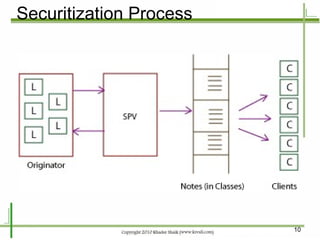
Securitization Process Originator – company that creates loans (mortgages vendor etc) Initial mortgage lender Borrowers – loan borrowers Cash flows SPV (Special Purpose Vehicle) / SPE (Special Purpose Entity) New Independent legal entity  Investors security holders
Purpose of Securitization Convert illiquid Mortgages into tradable instruments (capital markets) Replenish the funds of original investors (for further investments) Remove assets from balance sheet Efficient Lower finance cost comparing to other forms  Alternative to typical Debt and Equity Financing Credit enhancement Serve the demands of different type of investors
US MBS Market MBS are secured by Residential Mortgages (RMBS) Commercial Mortgages (CMBS) Agency MBS Issued by Federal Agencies Non-agency MBS Issued by private entities US outstanding MBS Market value – 6+ trillion
MBS Types MPS (Mortgage Passthrough Securities) OR Passthrough MBS OR Simply MBS Securities issued by creating shares from pool of one or more mortgages Mortgage in the pool called as SECURITIZED CMO (Collateralized Mortgage Obligation) Class of Bond created from the cash flows of MPS Derivative of MPS
MBS Types(2) Stripped MBS Interest and Principal of mortgage cash flows are separated to create SMBS Two types Interest Only (IO SMBS) Bond Principal Only (PO SMBS) Bond
MPS - Risk Prepayment Risk Mortgage prepayment (full or partial) will cause the uncertainty of cash flows Contraction Risk In case of lower market rate, prepayment may cause reduced life of loan Extension Risk In case of higher market rate, payments may slow down Investors lose the opportunity of higher interest
CMO Class of MBS that are referred as TRANCHES (Slices) Each Tranch is a different bond class Different maturity  Different coupon Usually cash flows from MPS are directed towards Tranches. Hence CMS are referred as derivatives.
Purpose of CMO Mitigate Prepayment Risk of MPS Create bonds of different classes to serve different needs Create bonds such as interest only and principal only
CMO Structures/Types Sequential Pay Tranches Accrual Tranches Floating-Rate Tranches Structured Interest Only Tranches Planned Amortization Class Tranches
CMO Structures/Types (2) Sequential-pay Tranch First tranch receives all principal prepayments until it is value is zero, then next tranch until its value is zero and so on Tranches are Retired sequentially Accrual Tranch Tranch that doesn’t take interest certain times and it uses that to payoff other earlier tranches It is also referred as Z-Bond
CMO Types (cont..) Floating Rate Tranch Tranch that has Floating Rate Coupon Floating Rate is tied to some index (usually LIBOR) Structured Interest Only Tranch Receives interest only Planned Amortization Class Tranch Cash flow patterns is scheduled in case of prepayment is in within certain band Amortization is pre-determined with prepayment limits
Actual CMO Freddie Mac Series 1706 Collateral is 7% MPS Total 17 tranches in structure 10 PAC tranches 3 scheduled tranches Floating Rate Reverse Floating Rate

Structured Products

  • 1.
  • 2.
    Structured Financial ProductsBond products created through the SECURITIZATION Referred to the collection of Mortgage Backed Securities Asset Backed Securities Characteristics Assets are used a as collateral Assets have current and/or future cash flows Assets are Pooled Possible prepayment It is also referred as Mortgage Sector of Bond Market
  • 3.
    Mortgage Loan securedby the collateral of some specified real estate property which obliges the borrower to make a predetermined series of payments Mortgage collateral Residential properties Commercial properties etc Mortgage Rate Interest rate of the loan Also referred as Contract Rate Mortgage Designs Structure of payments, rates and duration
  • 4.
    Mortgage Structures FixedRate & Level Payments Fixed interest rate Fixed monthly payments Adjustable Rate Varying interest rate Balloon Growing Equity Reverse Mortgages etc
  • 5.
    Fixed Rate, LevelPmnt Popular Design Interest and Principal amounts are included in monthly payments Monthly payments are calculated using the formula:
  • 6.
    Mortgage Risks InterestRate Risk Mortgages are usually are of long-term Credit Risk / Default Risk Borrower’s ability to pay back Prepayment Risk Mortgages can be paid back earlier than scheduled Mortgages are usually refinanced during low interest rates Force lender to lend the money for lower rates
  • 7.
    Problems of MortgagesIlliquid – difficult sell the mortgage loans Funds held for almost unknown period of time Higher exposure to Credit Risk and Interest Rate Risk Statistically higher exposure to Prepayment Risk SECURITZATION IS THE SOLUTION
  • 8.
    Mortgage Grades ConfirmingMortgage /Prime Mortgage that is satisfy all the underwriting standards of Federal Agency (like Fannie Mae etc) Non-confirming Mortgage / Subprime Mortgage that does not satisfy the underwriting standards of Federal Agency
  • 9.
    LTV Loan-to-Value ratioRatio of the loan amount to the market value of the property Market values is appraisal value The lower the LTV the greater the protection The higher the LTV the greater the risk of default Borrower classes – ‘A’ to ‘D’ A class – prime B – D -> subprime borrowers
  • 10.
  • 11.
    Securitization Process ofcreating a new financial instruments by packaging cash flows from pool of loans/receivables Securities are secured by underlying loans/receivables American Securitization Forum
  • 12.
    Securitization Process Originator– company that creates loans (mortgages vendor etc) Initial mortgage lender Borrowers – loan borrowers Cash flows SPV (Special Purpose Vehicle) / SPE (Special Purpose Entity) New Independent legal entity Investors security holders
  • 13.
    Purpose of SecuritizationConvert illiquid Mortgages into tradable instruments (capital markets) Replenish the funds of original investors (for further investments) Remove assets from balance sheet Efficient Lower finance cost comparing to other forms Alternative to typical Debt and Equity Financing Credit enhancement Serve the demands of different type of investors
  • 14.
    US MBS MarketMBS are secured by Residential Mortgages (RMBS) Commercial Mortgages (CMBS) Agency MBS Issued by Federal Agencies Non-agency MBS Issued by private entities US outstanding MBS Market value – 6+ trillion
  • 15.
    MBS Types MPS(Mortgage Passthrough Securities) OR Passthrough MBS OR Simply MBS Securities issued by creating shares from pool of one or more mortgages Mortgage in the pool called as SECURITIZED CMO (Collateralized Mortgage Obligation) Class of Bond created from the cash flows of MPS Derivative of MPS
  • 16.
    MBS Types(2) StrippedMBS Interest and Principal of mortgage cash flows are separated to create SMBS Two types Interest Only (IO SMBS) Bond Principal Only (PO SMBS) Bond
  • 17.
    MPS - RiskPrepayment Risk Mortgage prepayment (full or partial) will cause the uncertainty of cash flows Contraction Risk In case of lower market rate, prepayment may cause reduced life of loan Extension Risk In case of higher market rate, payments may slow down Investors lose the opportunity of higher interest
  • 18.
    CMO Class ofMBS that are referred as TRANCHES (Slices) Each Tranch is a different bond class Different maturity Different coupon Usually cash flows from MPS are directed towards Tranches. Hence CMS are referred as derivatives.
  • 19.
    Purpose of CMOMitigate Prepayment Risk of MPS Create bonds of different classes to serve different needs Create bonds such as interest only and principal only
  • 20.
    CMO Structures/Types SequentialPay Tranches Accrual Tranches Floating-Rate Tranches Structured Interest Only Tranches Planned Amortization Class Tranches
  • 21.
    CMO Structures/Types (2)Sequential-pay Tranch First tranch receives all principal prepayments until it is value is zero, then next tranch until its value is zero and so on Tranches are Retired sequentially Accrual Tranch Tranch that doesn’t take interest certain times and it uses that to payoff other earlier tranches It is also referred as Z-Bond
  • 22.
    CMO Types (cont..)Floating Rate Tranch Tranch that has Floating Rate Coupon Floating Rate is tied to some index (usually LIBOR) Structured Interest Only Tranch Receives interest only Planned Amortization Class Tranch Cash flow patterns is scheduled in case of prepayment is in within certain band Amortization is pre-determined with prepayment limits
  • 23.
    Actual CMO FreddieMac Series 1706 Collateral is 7% MPS Total 17 tranches in structure 10 PAC tranches 3 scheduled tranches Floating Rate Reverse Floating Rate

Editor's Notes

  • #2 Fixed Income Copyright@2007 Orbitra LLC
  • #3 Fixed Income Copyright@2007 Orbitra LLC
  • #4 Fixed Income Copyright@2007 Orbitra LLC
  • #5 Fixed Income Copyright@2007 Orbitra LLC
  • #6 Fixed Income Copyright@2007 Orbitra LLC
  • #7 Fixed Income Copyright@2007 Orbitra LLC
  • #8 Fixed Income Copyright@2007 Orbitra LLC
  • #9 Fixed Income Copyright@2007 Orbitra LLC
  • #10 Fixed Income Copyright@2007 Orbitra LLC
  • #12 Fixed Income Copyright@2007 Orbitra LLC
  • #13 Fixed Income Copyright@2007 Orbitra LLC
  • #14 Fixed Income Copyright@2007 Orbitra LLC
  • #15 Fixed Income Copyright@2007 Orbitra LLC
  • #16 Fixed Income Copyright@2007 Orbitra LLC
  • #17 Fixed Income Copyright@2007 Orbitra LLC
  • #18 Fixed Income Copyright@2007 Orbitra LLC
  • #19 Fixed Income Copyright@2007 Orbitra LLC
  • #20 Fixed Income Copyright@2007 Orbitra LLC
  • #21 Fixed Income Copyright@2007 Orbitra LLC