Understanding Politics
POL 102
BA Course (School Core undergraduate)
Fall Semester 2015
Dr. Azər Babayev
School of Public and International Affairs
(SPIA)
ADA University
WHAT IS POLITICS?
Problems with defining politics
• Politics is a loaded term – few people come to politics
without preconceptions
• It is also an essentially contested concept, seen
variously as
1) The art of government
2) Public affairs
3) Compromise and consensus
4) Distribution of power and resources
Problems with defining politics
• ‘Politics is not a science… but an art’ (Chancellor
Bismarck)
• Politics is understood as that which concerns the state
• To study politics is to study government – and the
exercise of authority
• This offers a highly restrictive view of politics – most
institutions and activities (businesses, schools, families)
are seen as ‘non-political’
Politics as the art of government
• Distinction between ‘the political’ and ‘the non-political’
coincides with the division between an essentially public
sphere of life and what can be thought of as a private
sphere.
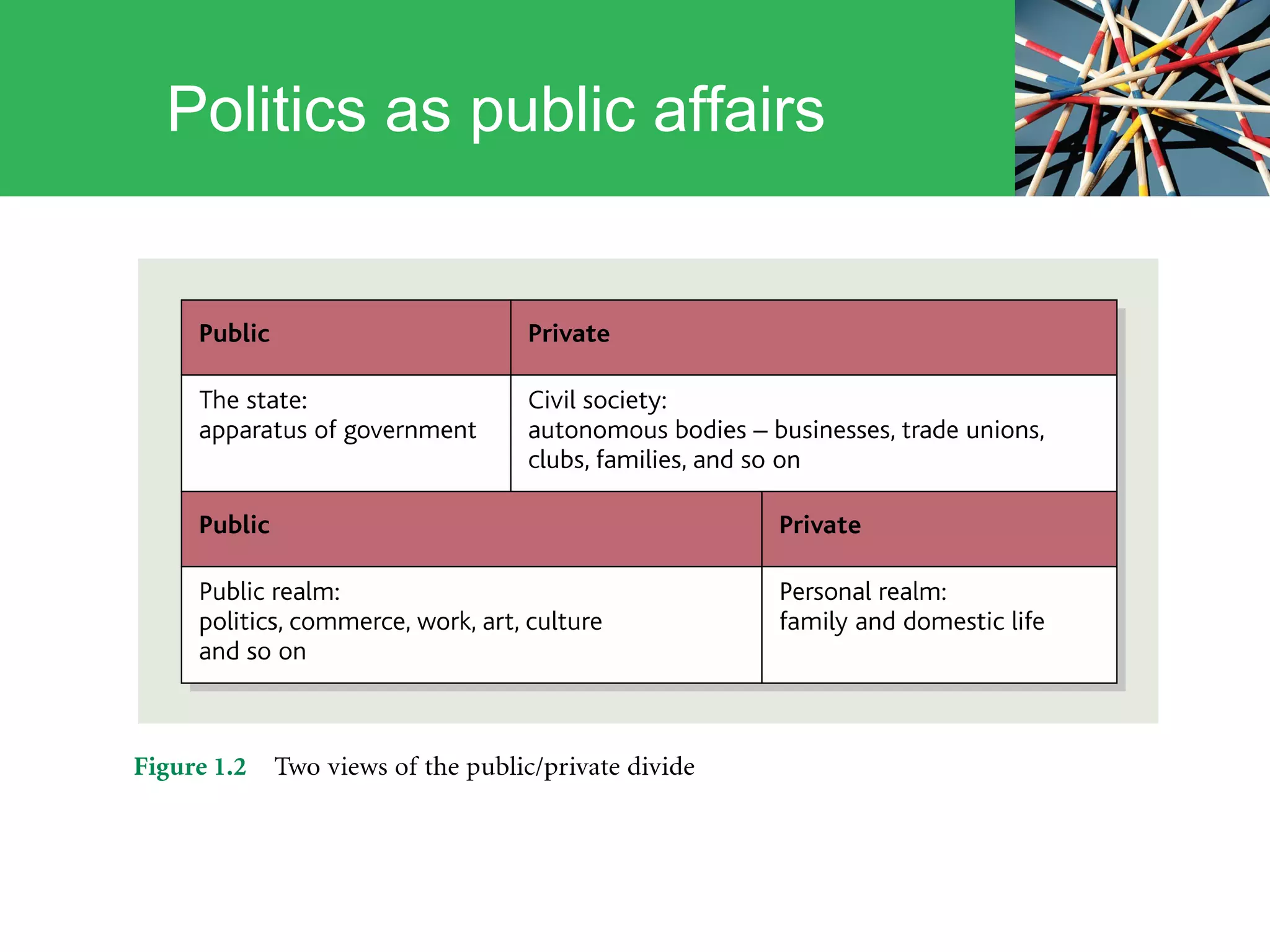
• Traditional division between public and private realm
conforms to division between state and civil society
• An alternative divide distinguishes between ‘the political’
and ‘the personal’
• Politics does not and should not infringe on personal
affairs (i.e. family and domestic life).
Politics as public affairs
• Politics is seen as a means of resolving conflict > by
compromise and negotiation rather than through force
• Based on faith in the efficacy of debate and discussion,
as well as on the belief that society is characterized by
consensus, rather than by irreconcilable conflict
• A failure to understand politics as a process of
compromise may have contributed to a growing popular
disenchantment with democratic politics across much of
the developed world.
Politics as compromise
and consensus
Politics as the distribution
of power and resources
• This view sees politics at work in all social activities and
in every corner of human existence
• All politics is, in essence, a struggle for power > power is
the same in politics as energy in physics
• Advocates of this view include feminists and Marxists
Politics as the distribution
of power and resources
• The philosophical tradition
• The empirical tradition
• Behaviouralism
• Rational-choice theory
• New institutionalism
• Critical approaches
Approaches to
the study of politics
• Concepts help us to classify objects by recognizing that
they have similar forms or similar properties.
• Models include a network of relationships that highlight
the meaning and significance of relevant empirical data
• Theories offer a systematic explanation of a body of
empirical data
Tools of political analysis
Tools of political analysis –
Levels of analysis
Tools of political analysis –
An example for model
• A distinction has traditionally been made between the
domestic and international realms of politics
• The state-based paradigm of politics has come under
pressure as a result of recent trends and developments,
including globalization
• The increase in transnational flows has expanded the
parameters and complexity of political activity
Politics in a global age
Thank you!
• Questions & comments?
Up next
• Political Ideas and Ideologies

What is politics

  • 1.
    Understanding Politics POL 102 BACourse (School Core undergraduate) Fall Semester 2015 Dr. Azər Babayev School of Public and International Affairs (SPIA) ADA University
  • 2.
  • 3.
    Problems with definingpolitics • Politics is a loaded term – few people come to politics without preconceptions • It is also an essentially contested concept, seen variously as 1) The art of government 2) Public affairs 3) Compromise and consensus 4) Distribution of power and resources
  • 4.
  • 5.
    • ‘Politics isnot a science… but an art’ (Chancellor Bismarck) • Politics is understood as that which concerns the state • To study politics is to study government – and the exercise of authority • This offers a highly restrictive view of politics – most institutions and activities (businesses, schools, families) are seen as ‘non-political’ Politics as the art of government
  • 6.
    • Distinction between‘the political’ and ‘the non-political’ coincides with the division between an essentially public sphere of life and what can be thought of as a private sphere. • Traditional division between public and private realm conforms to division between state and civil society • An alternative divide distinguishes between ‘the political’ and ‘the personal’ • Politics does not and should not infringe on personal affairs (i.e. family and domestic life). Politics as public affairs
  • 7.
  • 8.
    • Politics isseen as a means of resolving conflict > by compromise and negotiation rather than through force • Based on faith in the efficacy of debate and discussion, as well as on the belief that society is characterized by consensus, rather than by irreconcilable conflict • A failure to understand politics as a process of compromise may have contributed to a growing popular disenchantment with democratic politics across much of the developed world. Politics as compromise and consensus
  • 9.
    Politics as thedistribution of power and resources
  • 10.
    • This viewsees politics at work in all social activities and in every corner of human existence • All politics is, in essence, a struggle for power > power is the same in politics as energy in physics • Advocates of this view include feminists and Marxists Politics as the distribution of power and resources
  • 11.
    • The philosophicaltradition • The empirical tradition • Behaviouralism • Rational-choice theory • New institutionalism • Critical approaches Approaches to the study of politics
  • 12.
    • Concepts helpus to classify objects by recognizing that they have similar forms or similar properties. • Models include a network of relationships that highlight the meaning and significance of relevant empirical data • Theories offer a systematic explanation of a body of empirical data Tools of political analysis
  • 13.
    Tools of politicalanalysis – Levels of analysis
  • 14.
    Tools of politicalanalysis – An example for model
  • 15.
    • A distinctionhas traditionally been made between the domestic and international realms of politics • The state-based paradigm of politics has come under pressure as a result of recent trends and developments, including globalization • The increase in transnational flows has expanded the parameters and complexity of political activity Politics in a global age
  • 16.
    Politics in aglobal age
  • 17.
  • 18.
    Up next • PoliticalIdeas and Ideologies