


P o lit ic s a n d
 G o ve rna nc e
       W it h
C o n s t it u t io n
Meaning of

   The term political science is the
   systematic study of the state and the
   government
Meaning of

  Political Science is a social science
  regarding the practice and theory of
  politics, the analysis of political
  systems, and the study of political
  behavior.
Meaning of

   Political science is the study of
   politics.
         -public policy,
         -national politics,
         -political theory,
         -international relations.
Brief
History of
               The Ancient Greeks
  •   2,500 years ago, Greek civilization emerged
  •   city states (‘the polis’) the center of political life
  •   the polis was center of the universe
  •   ‘idiot’ - word to describe someone with no
      interest in politics
Brief
History of
               Plato (427-347 BC)
• Founder of a lyceum (school) for politics and law (first of its kind)
• philosopher whose pedagogy was based on a dialogue b/w
  student & teacher
• his political philosophy presented essentially in The Republic
• Deductive theory
• advocated a system of ‘enlightened dictatorship’ by
  ‘philosopher-kings’
Brief
History of
           Plato (427-347 BC)
 • Philosopher-Kings were selected from childhood
 • subjected to an incredibly intensive education in
   ethics, theoretical and practical politics, etc.
 • groomed to lead from a very early age
 • “who shall guard the guardians?” a key question
E T YM O L O G IC A
 L D E F IN IT IO N

                    Greek
 The word politics has its origins in Ancient
 Greece. All of the cities in Ancient Greece, such as
 Athens, Sparta, and Corinth, were referred to as
 city-states and the Greek word for a city-state was
 polis (πολις)
E T YM O L O G IC A
 L D E F IN IT IO N


  Latin word “Politicus “
   – an adjective used to describe anything “of
     the state”. 
SCOPE OF POLITICAL SCIENCE

  2. P o l i t i c a l
- e nT rh e oo y o f
     ti e b d r y
d o c t r in e s r e la t in g t o
t h e o r ig in , f o r m ,
b e h a v io r a n d p u r p o s e s
o f the s ta te .
SCOPE OF POLITICAL SCIENCE

2 . P u b lic
- m d t h i ndi s ta n d i o n
  Ae mo s ra t
t e c h n iq u e s u s e d in
a c tu a l ma na g e me nt o f
s t a t e a f f a ir s .
SCOPE OF POLITICAL SCIENCE


3 . P u b lic
l iL at wt i o n s u p o n
   mi a
g o ve rnme nt
a u t h o r it y .
FUNCTION AND IMPORTANCE
  OF POLITICAL SCIENCE
“ T h e f u n c t io n o f
  p o lit ic a l s c ie n c e is t o
  d is c o v e r t h e
  p r in c ip le s t h a t s h o u ld
  b e a d h e r e d t o in
  p u b lic a f f a ir s t h a t
  e v e n t u a lly w o u ld
  s e rve a s a mo d e l tha t
  c a n b e a p p lie d t o
GOALS IN THE STUDY OF
      POLITICAL SCIENCE
1. E d u c a t i o n f o r
   c it iz e n s h ip
 - t h e p r im a r y o b je c t iv e
 o f t h e p o lit ic a l s c ie n c e
 c u r r ic u lu m is t o e q u ip
 s t u d e n t s t o d is c h a r g e
 t h e o b lig a t io n s o f
 d e m o c r a t ic c it iz e n s h ip
GOALS IN THE STUDY OF
      POLITICAL SCIENCE
2 . A n e s s e n t ia l f a c t o r f o r
   s o c ia l t r a n s f o r m a t io n
   - P h ilo s o p h y in t e r p r e t s
   t h e w o r ld in v a r io u s
   w a y s , b u t t h e p o in t ,
   h o w e v e r , is t o c h a n g e
   it .
What is Politics?
What is Politics?
Man is a political animal
                                        -Aristotle

If this is true, then politics is not only
prevalent in our lives, but inevitable.

We must understand politics to
meaningfully participate in it.
What is Politics?
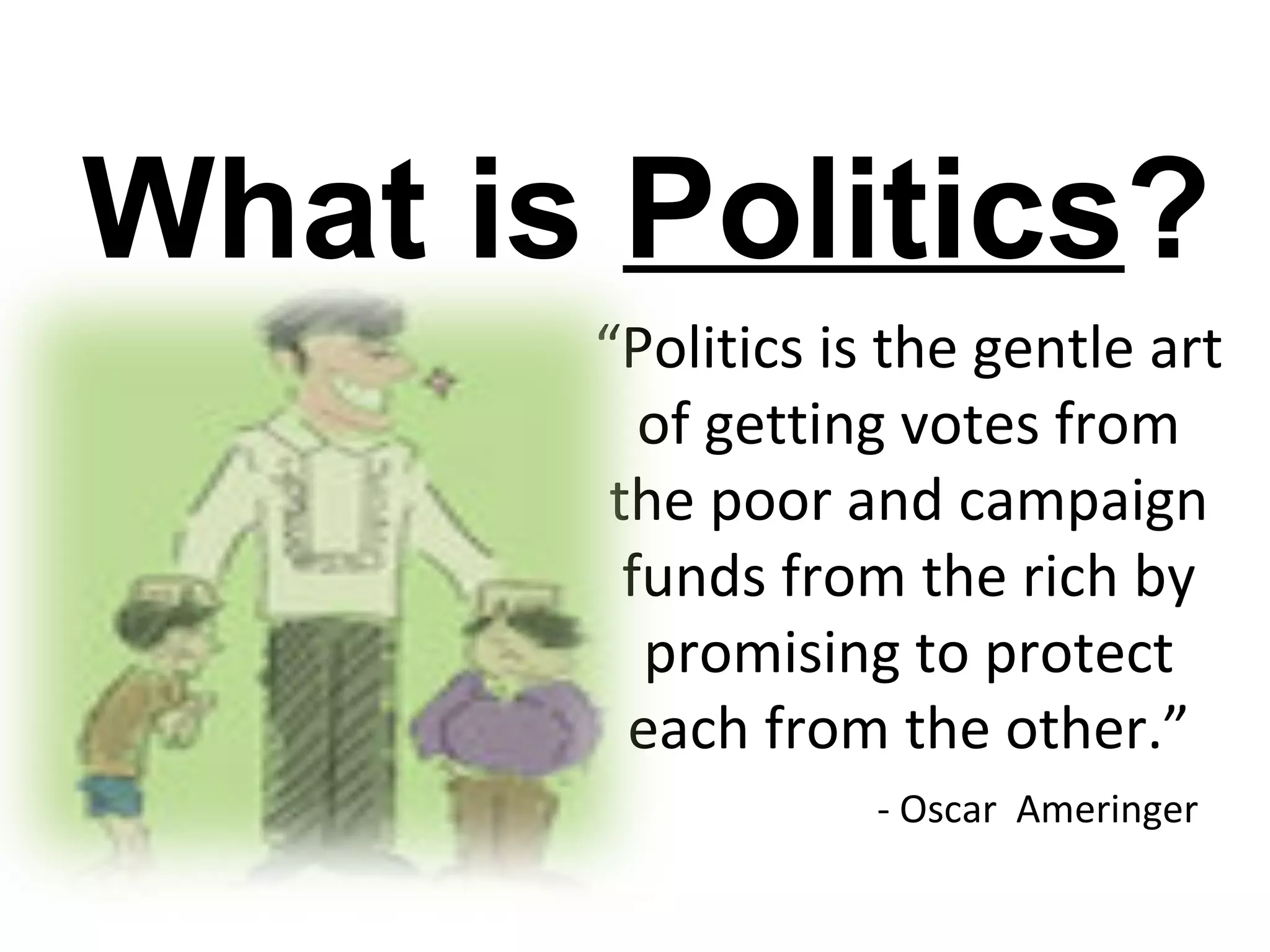
       “Politics is the gentle art
          of getting votes from
        the poor and campaign
         funds from the rich by
          promising to protect
         each from the other.”
                   - Oscar Ameringer
What is Politics?
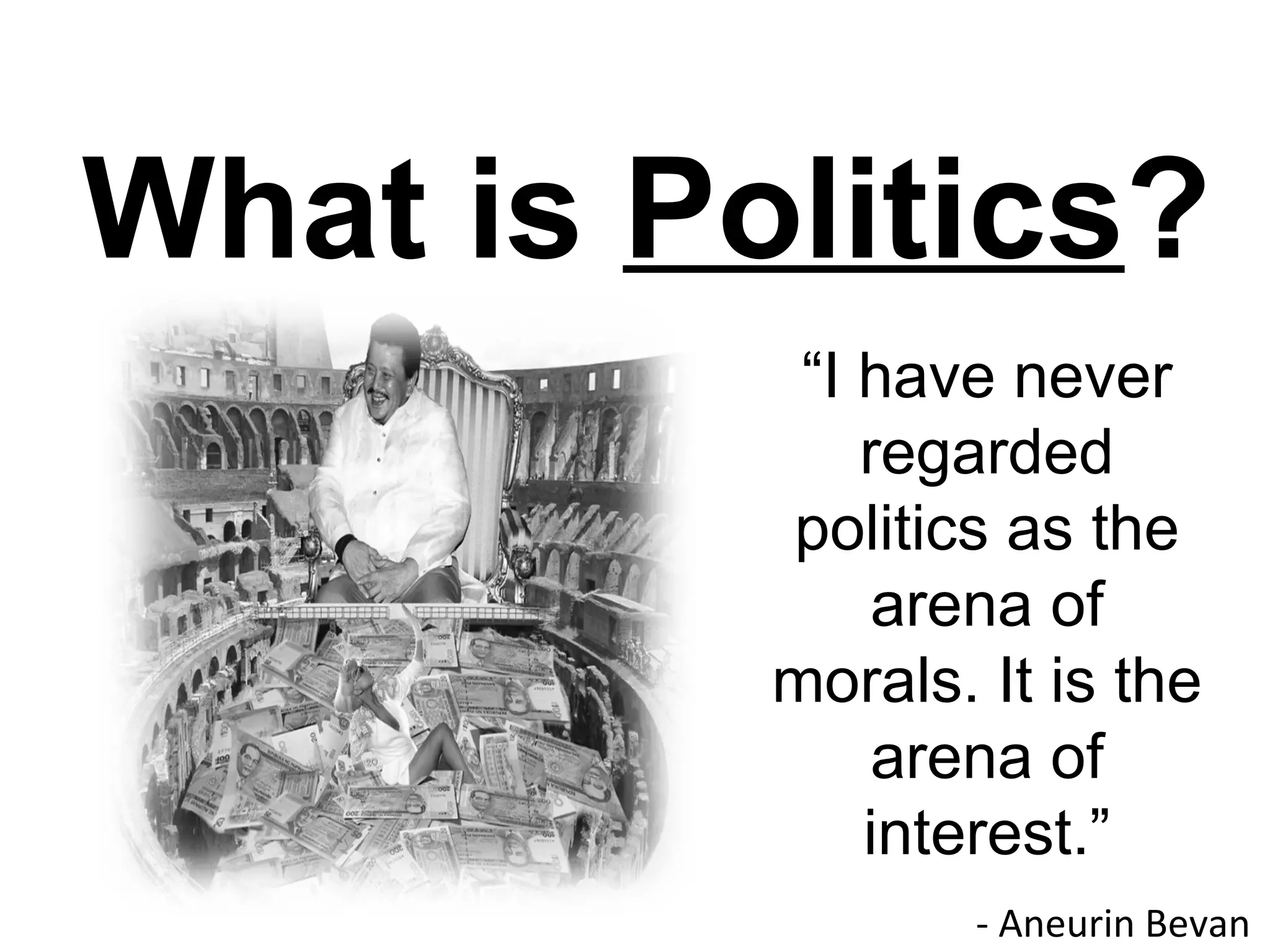
           “I have never
              regarded
          politics as the
               arena of
          morals. It is the
               arena of
              interest.”
                  - Aneurin Bevan
What is Politics?
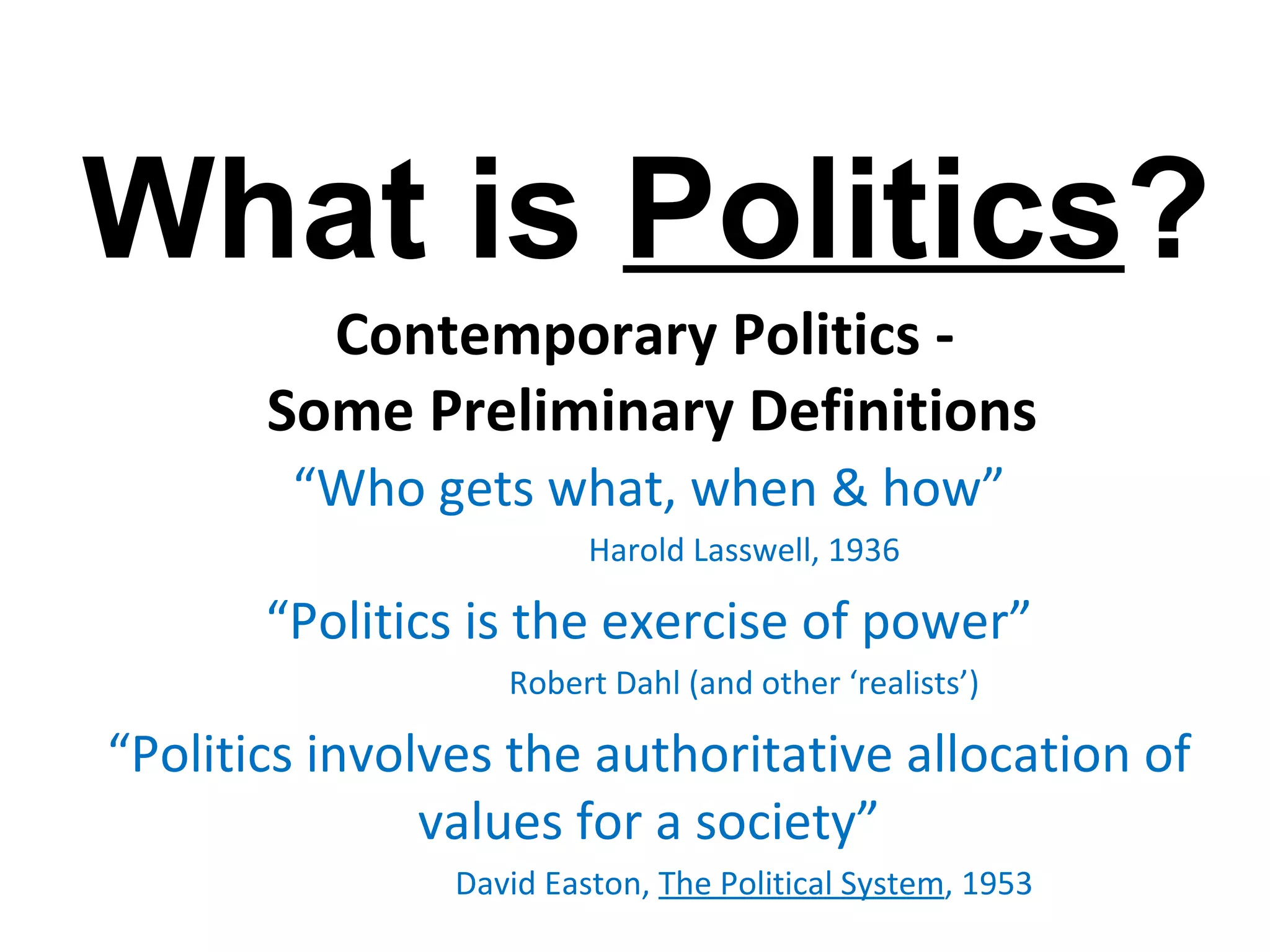
         Contemporary Politics -
       Some Preliminary Definitions
        “Who gets what, when & how”
                         Harold Lasswell, 1936

       “Politics is the exercise of power”
                   Robert Dahl (and other ‘realists’)

“Politics involves the authoritative allocation of
               values for a society”
                David Easton, The Political System, 1953
What is Politics?
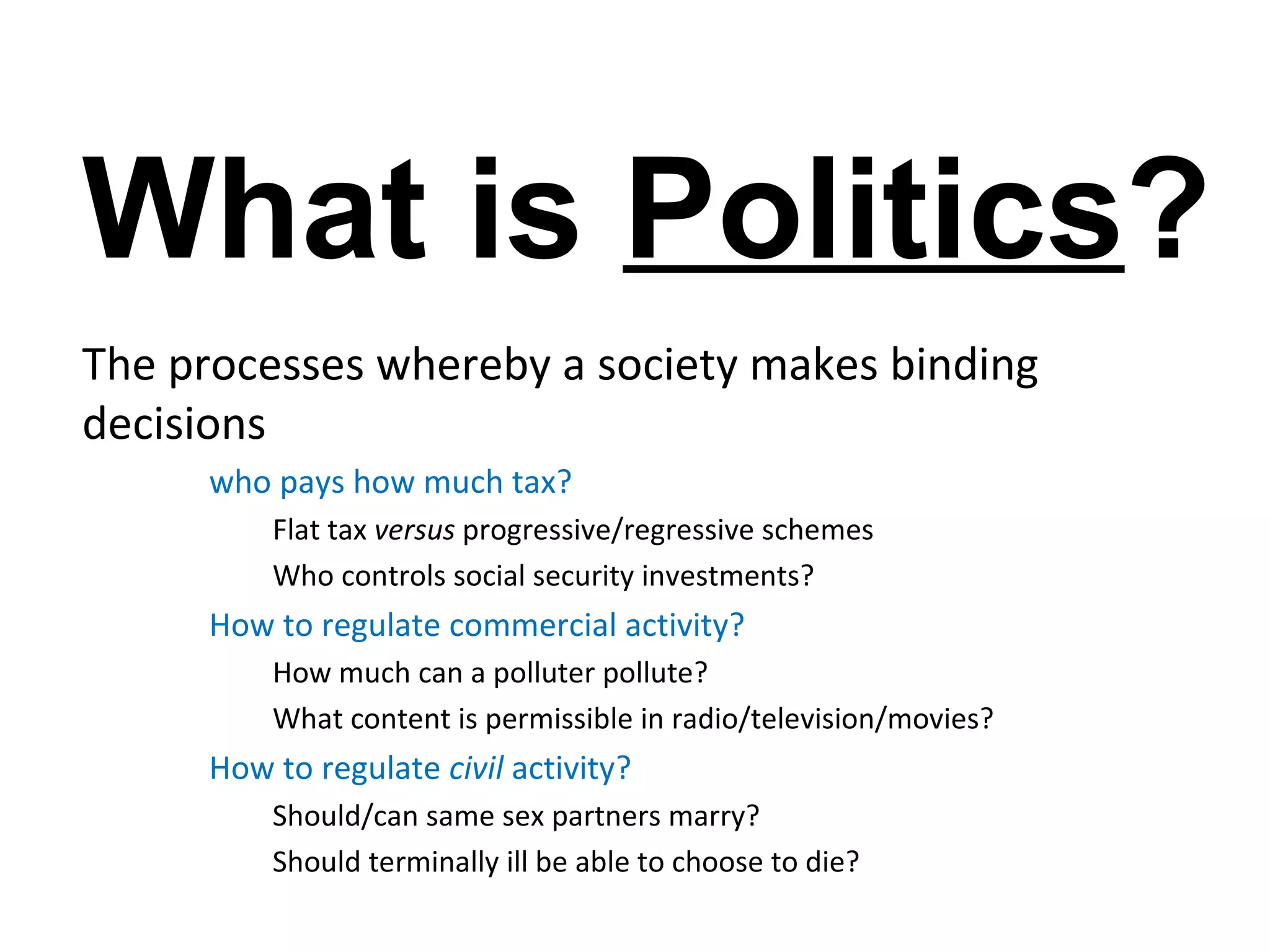
The processes whereby a society makes binding
decisions
     who pays how much tax?
         Flat tax versus progressive/regressive schemes
         Who controls social security investments?
     How to regulate commercial activity?
         How much can a polluter pollute?
         What content is permissible in radio/television/movies?
     How to regulate civil activity?
         Should/can same sex partners marry?
         Should terminally ill be able to choose to die?
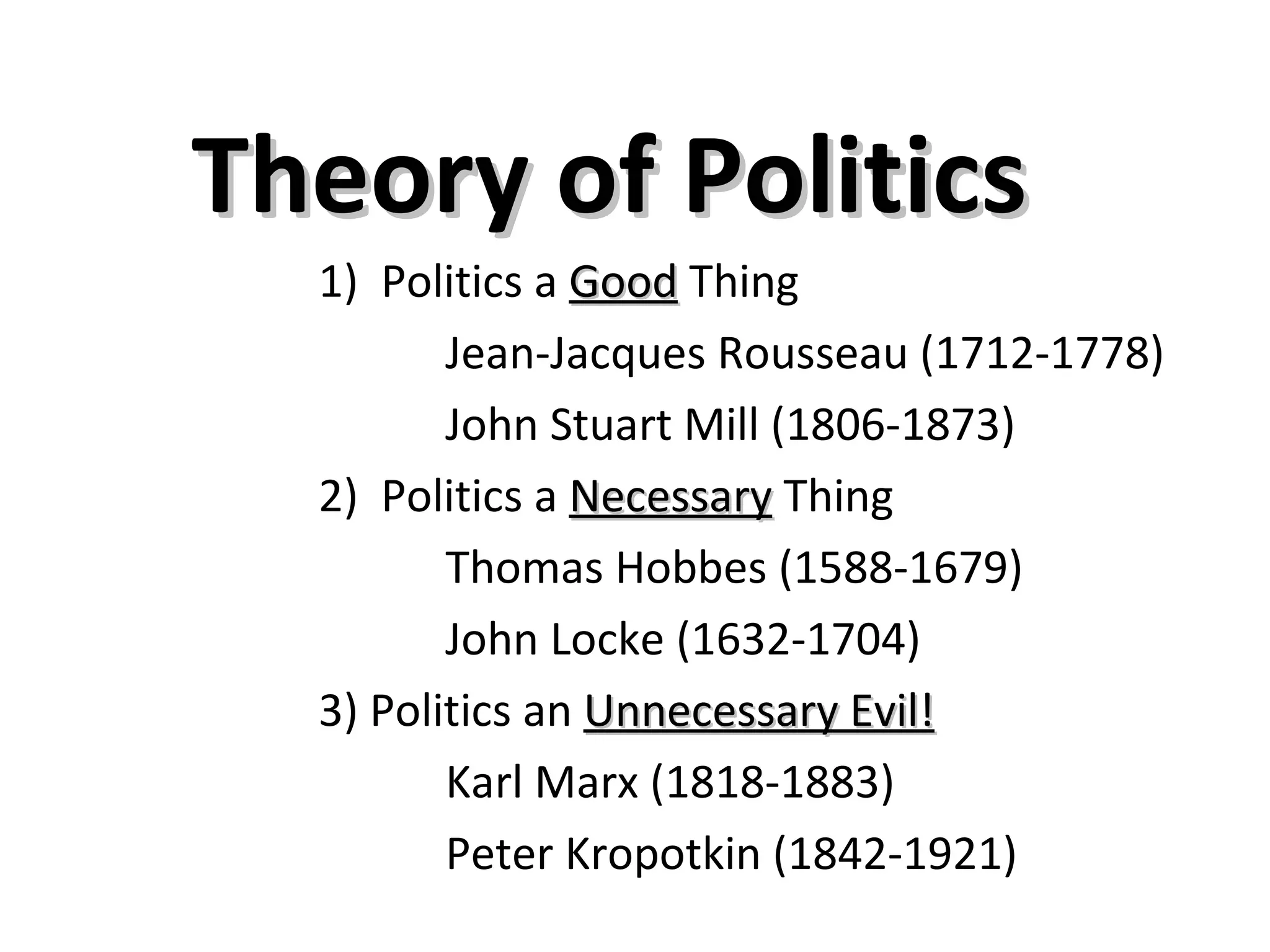
Theory of Politics
  1) Politics a Good Thing
         Jean-Jacques Rousseau (1712-1778)
         John Stuart Mill (1806-1873)
  2) Politics a Necessary Thing
         Thomas Hobbes (1588-1679)
         John Locke (1632-1704)
  3) Politics an Unnecessary Evil!
         Karl Marx (1818-1883)
         Peter Kropotkin (1842-1921)
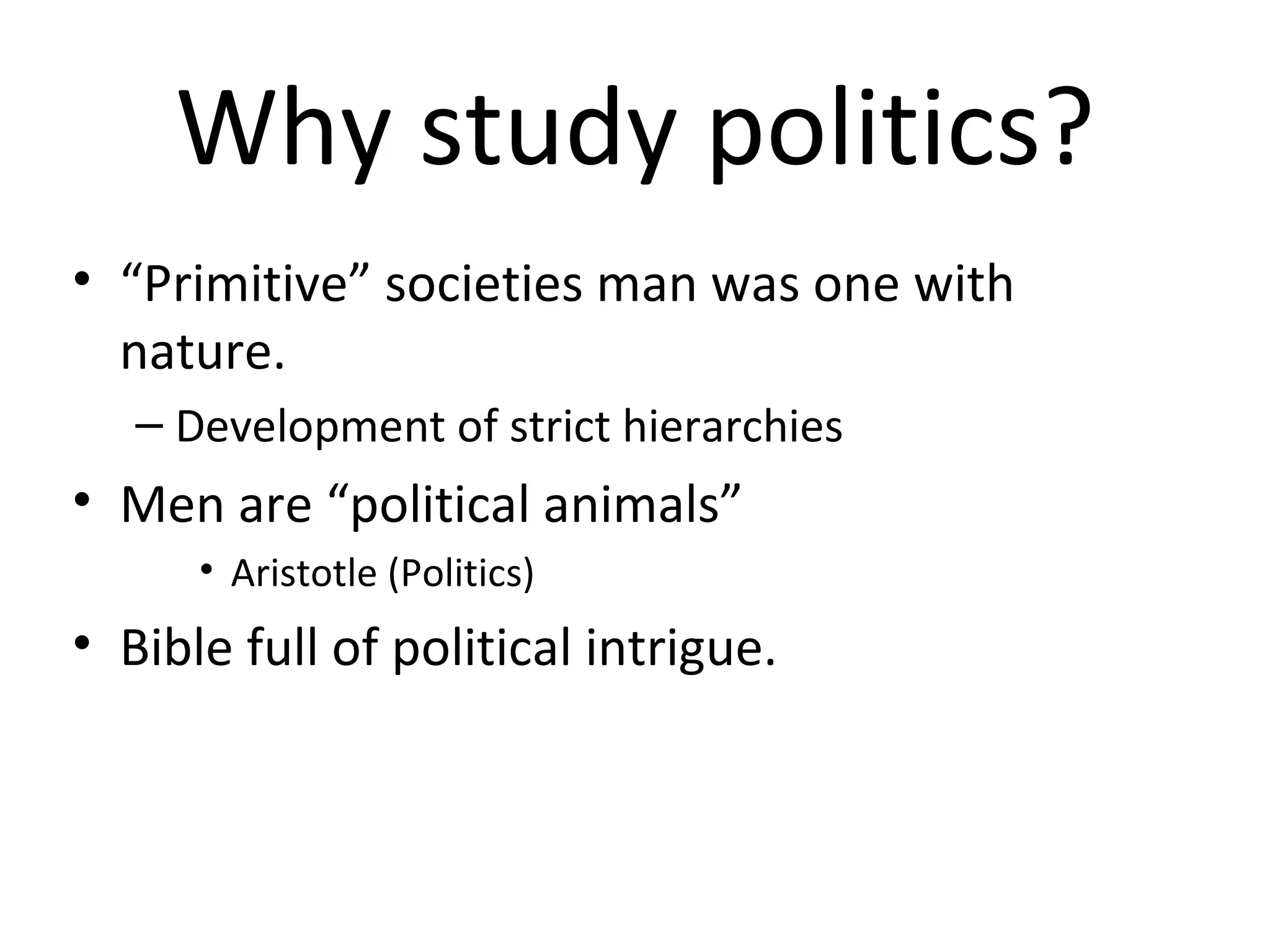
Why study politics?
• “Primitive” societies man was one with
  nature.
   – Development of strict hierarchies
• Men are “political animals”
      • Aristotle (Politics)
• Bible full of political intrigue.
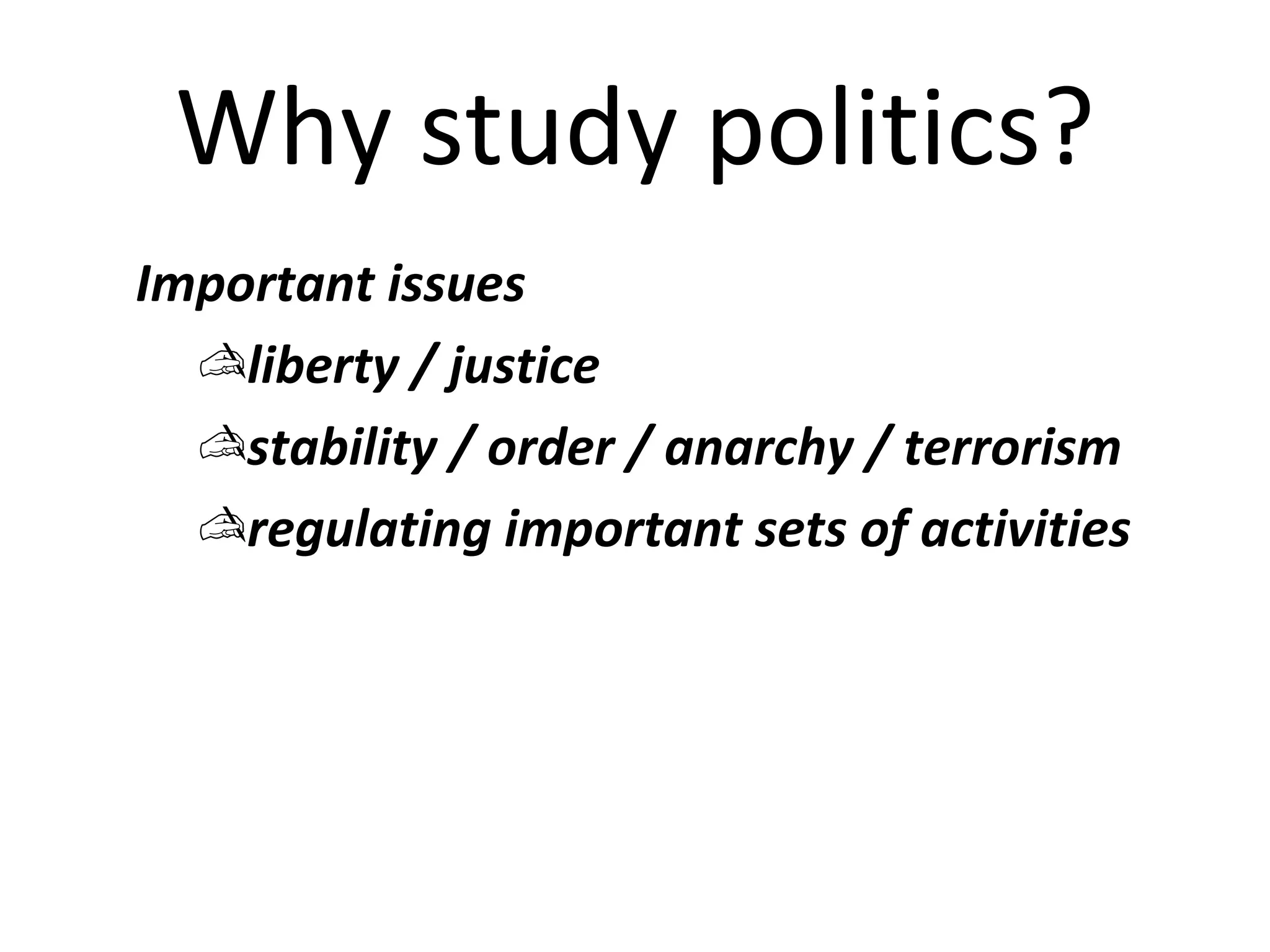
Why study politics?
Important issues
  liberty / justice
  stability / order / anarchy / terrorism
  regulating important sets of activities
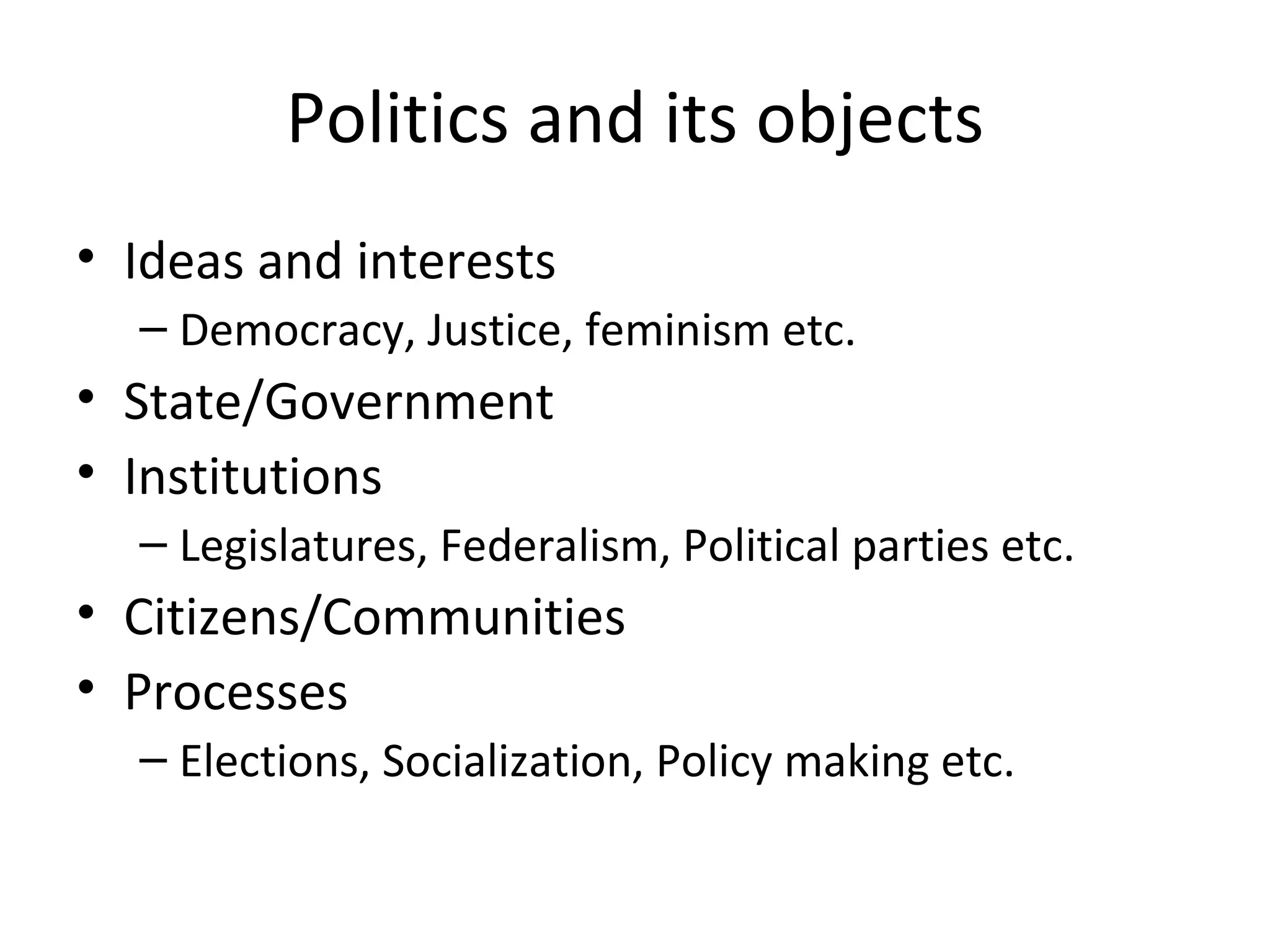
Politics and its objects
• Ideas and interests
  – Democracy, Justice, feminism etc.
• State/Government
• Institutions
  – Legislatures, Federalism, Political parties etc.
• Citizens/Communities
• Processes
  – Elections, Socialization, Policy making etc.
The Conciliation of Interests
• Politics is a complex activity.
• When interests are uniform, there are
  no politics.
• “The unique character of political
  activity lies…in its publicity.”
• People cannot opt out of politics.
• Politics presupposes an established
  order.
Is politics the only way
      to conciliate interests?
• Certainly, there are many ways to
  reconcile differences.
• Politics is a particular way of
  reconciling differences.
  – Tolerance, respect, support and
    compromise are the language of
    politics.
  – Politics itself admits differences.
Summary
• Politics is the conciliation of diverse
  interests in society
• Politics is a particular way of reconciling
  differences: it is a civilizing activity.
• Political predicaments arise when
  decisions have to be made and
  alternative solutions are mutually
  exclusive.
B. Concepts of State
  and Government
M E A N IN G O F S T A T E

• A s t a t e is a
  c o m m u n it y o f
  pe rs ons more or
  le s s n u m e r o u s ,
  p e r m a n e n t ly
  o c c u p y in g a d e f in it e
  p o r t io n o f t e r r it o r y ,
  in d e p e n d e n t o r
  e x t e r n a lly
ELEMENTS OF A STATE

1. P e o p l e
        - Th e
   ma s s of
   the
   p o p u la t io
   n liv in g
   w it h in t h e
   s ta te .
ELEMENTS OF A STATE

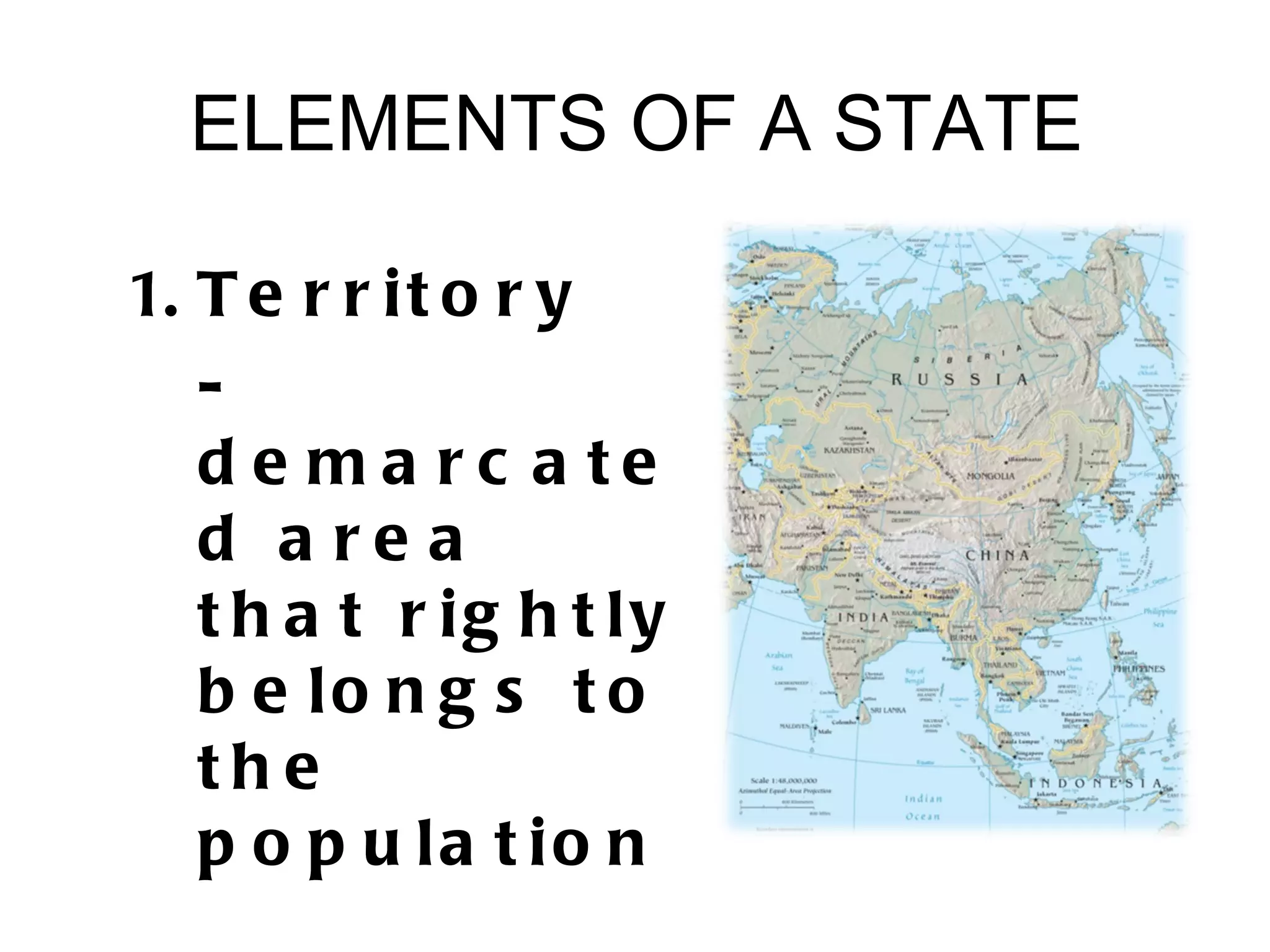
1. T e r r i t o r y
   -
   d e ma rc a te
   d a re a
   t h a t r ig h t ly
   b e lo n g s t o
   the
   p o p u la t io n
“ t e r r it o r y ”
• t e r r e s t r ia l, f lu v ia l,
  m a r it im e a n d a e r ia l
• s h o u ld b e p e r m a n e n t
  a n d la r g e e n o u g h t o b e
  s e lf -s u f f ic in g
ELEMENTS OF A STATE
1. G o v e r n m e n t
   - R e fe rs to
   the a g e nc y
   t o w h ic h t h e
   w ill o f t h e
   s t a t e is
   f o r m u la t e d ,
   e xpre s s e d,
   a n d c a r r ie d
   o ut.
ELEMENTS OF A STATE
1. S o v e r e i g n t y
- M a y b e d e f in e d a s
   the s u p re me p o w e r
   o f the s ta te to
   c omma nd a nd
   e n f o r c e o b e d ie n c e
   t o it s w ill f r o m t h e
   p e o p le w it h in it s
   ju r is d ic t io n a n d
   c o r o lla r y t o h a v e
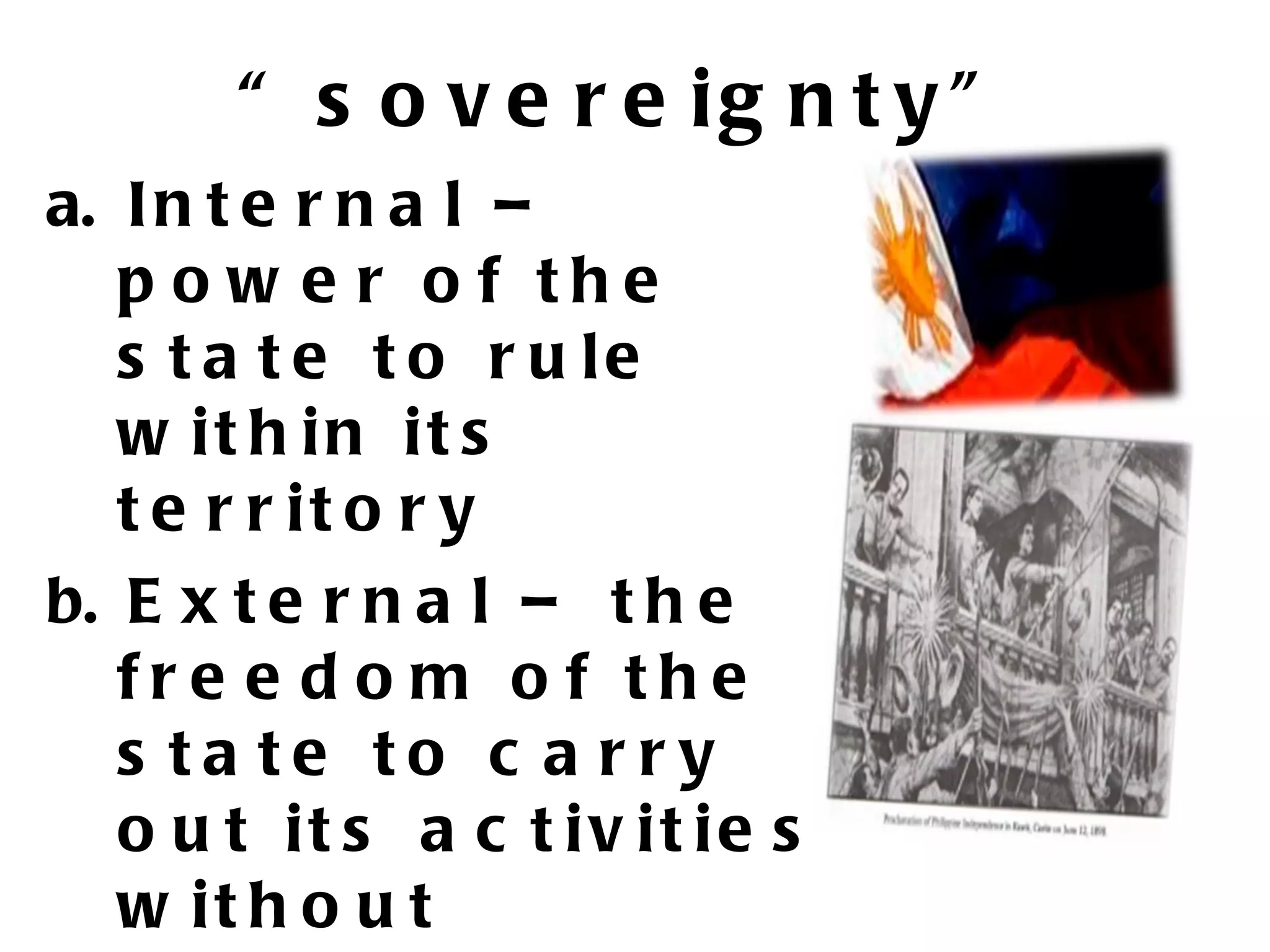
“ s o v e r e ig n t y ”
a. I n t e r n a l –
   p o w e r o f the
   s t a t e t o r u le
   w it h in it s
   t e r r it o r y
b. E x t e r n a l – t h e
   fre e d o m o f th e
   s ta te to c a rry
   o u t it s a c t iv it ie s
   w it h o u t
ORIGIN OF STATES

2. D i v i n e r i g h t t h e o r y - t h e
   s t a t e is o f d iv in e c r e a t io n
   a n d t h e r u le r is o r d a in e d b y
   G o d t o g o v e r n t h e p e o p le .
3. N e c e s s i t y o r f o r c e t h e o r y -
   s ta te s mus t ha ve b e e n
   c re a te d th ro u g h fo rc e b y
ORIGIN OF STATES

3 . P a t e r n a lis t ic t h e o r y -
   u n d e r t h e a u t h o r it y o f t h e
   fa the r o r m o the r.( s ta g e s .,
   n e x t s lid e )

4 . S o c ia l c o n t r a c t t h e o r y -
   t h e o r y ju s t if ie s t h e r ig h t o f
   t h e p e o p le t o r e v o lt
ORIGIN OF STATES

5 . C o n f lic t t h e o r y -
 The conflict theory looks at how certain social
 interactions occur through conflict. People engage
 in conflict everyday to gain more power then others
 in society.
NATURAL STAGES


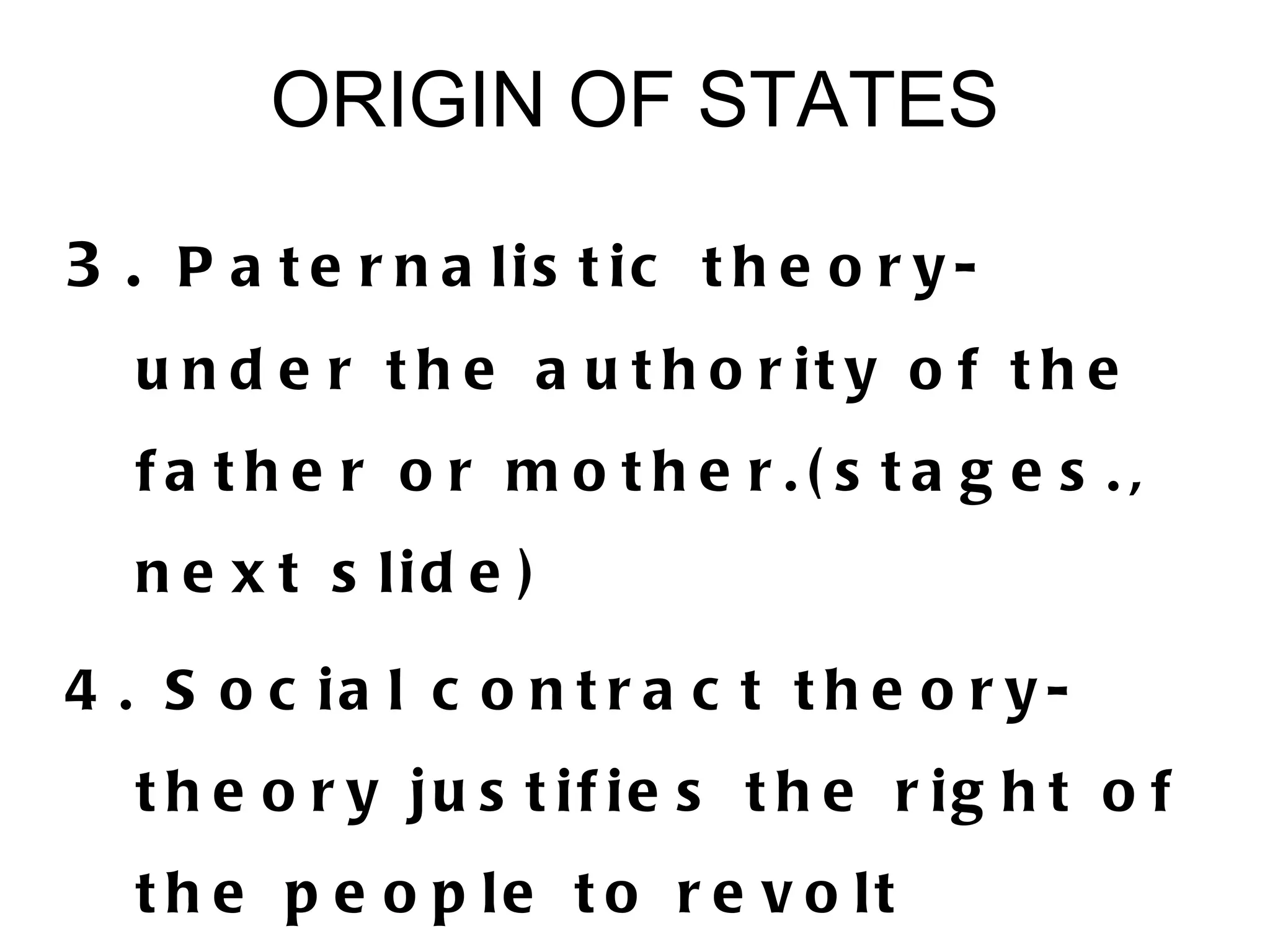
FAMILY

         CLAN


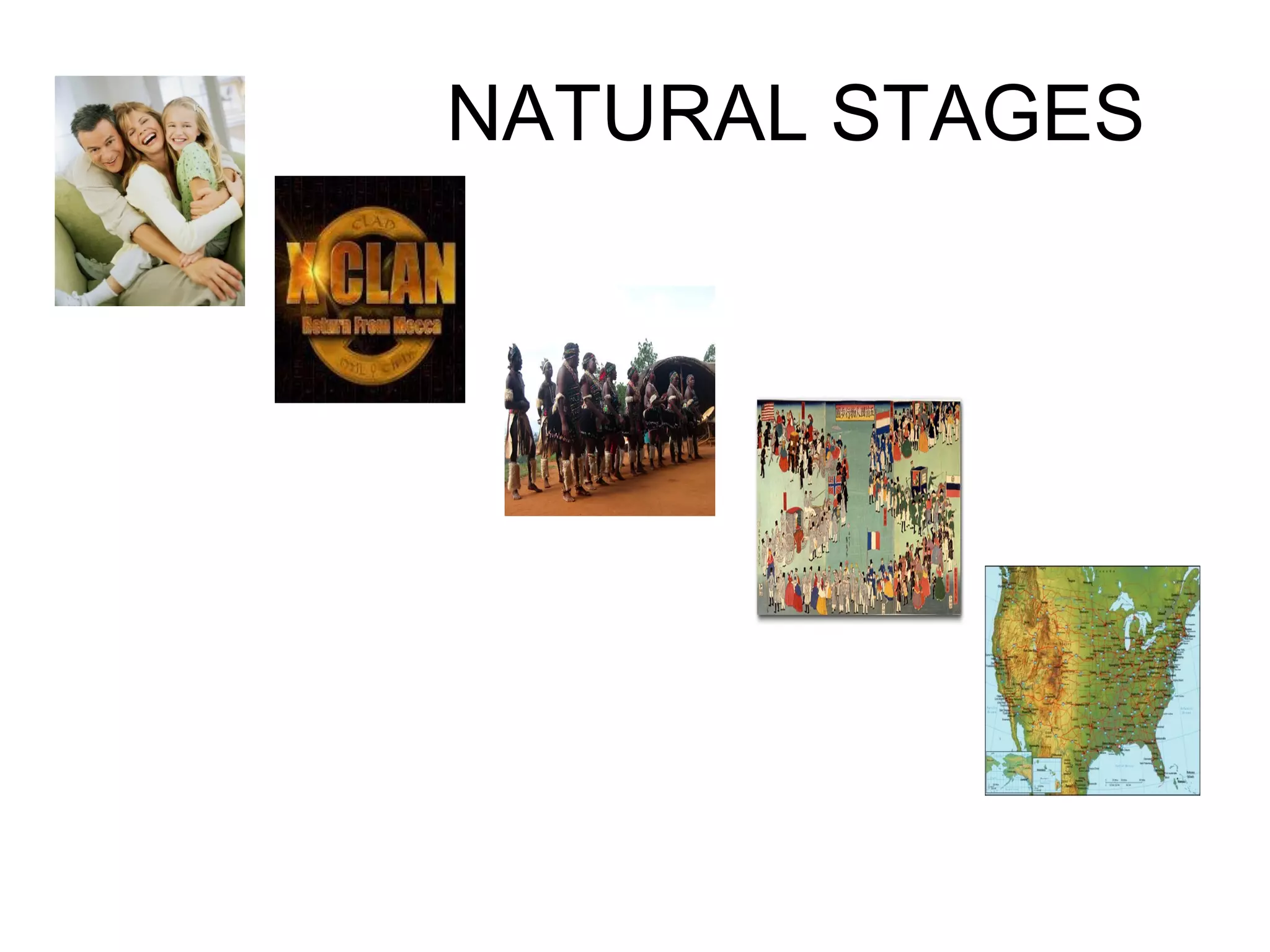
                  TRIBE


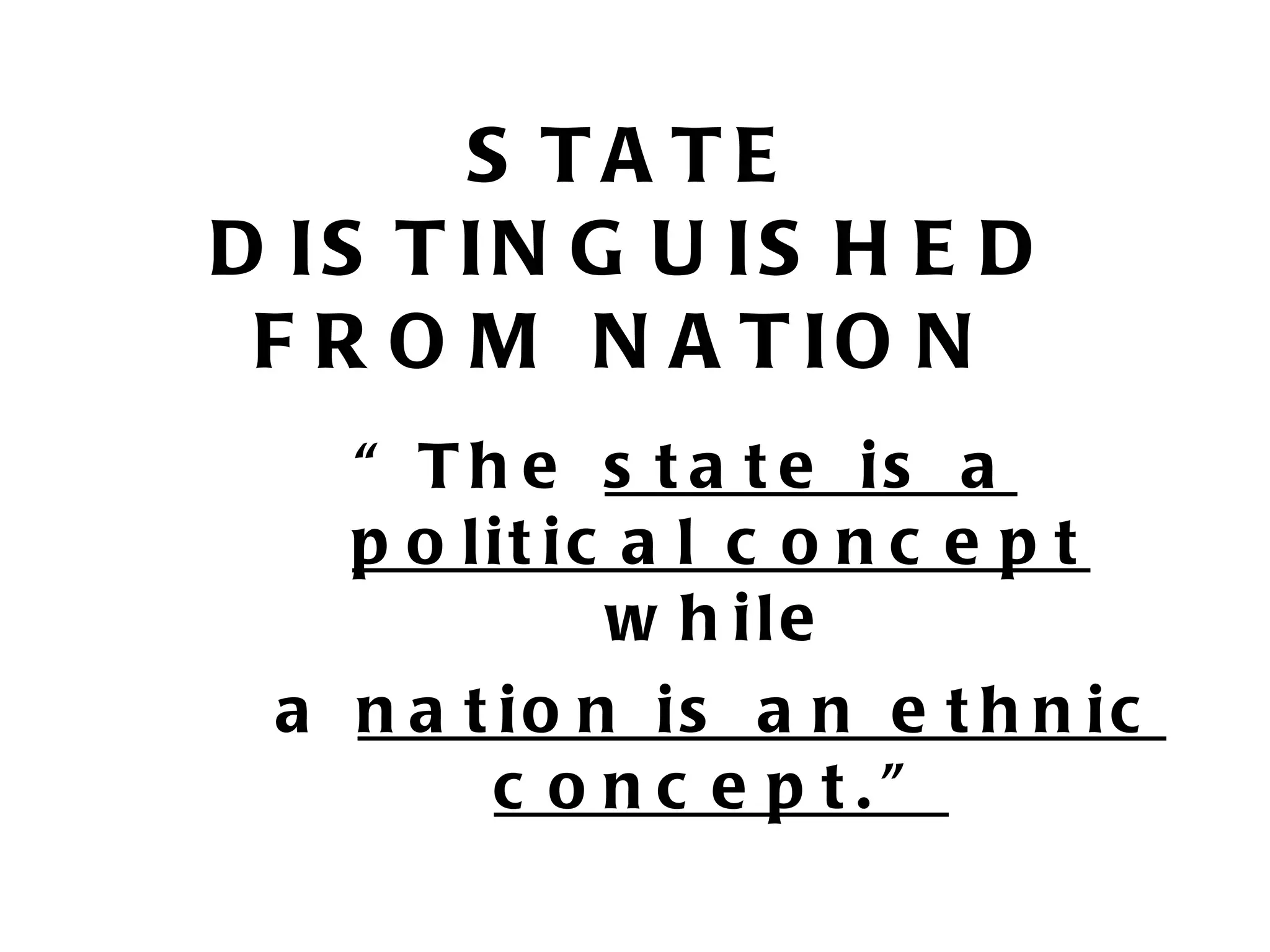
                          NATION


                                   STATE
S TA TE
D IS T IN G U IS H E D
 F R O M N A T IO N
   “ T h e s t a t e is a
   p o lit ic a l c o n c e p t
             w h ile
 a n a t io n is a n e t h n ic
         c o nc e p t.”
S TA TE
    D IS T IN G U IS H E D
     F R O M N A T IO N
“ A s t a t e is n o t s u b je c t
   to e x te rna l c o ntro l
 w h ile a n a t io n m a y o r
m a y n o t b e in d e p e n d e n t
  o f e x t e r n a l c o n t r o l. ”
S TA TE
      D IS T IN G U IS H E D
       F R O M N A T IO N
“     A s in g le s t a t e m a y
    c o n s is t o f o n e o r m o r e
    n a t io n s o r p e o p le a n d
    c o n v e r s e l y , a s in g l e
    n a t io n m a y b e m a d e u p
    o f s e ve ra l s ta te s .”
S TA TE
   D IS T IN G U IS H E D
F R O M G O VE R N M E N T
   “ …t h e y a r e u s u a l l y
 r e g a r d e d a s id e n t ic a l.
 A s o r d in a r ily , t h e a c t s
 o f the g o ve rnme nt a re
 the a c ts o f the s ta te .”
S TA TE
   D IS T IN G U IS H E D
F R O M G O VE R N M E N T
 “ A s t a t e c a n n o t e x is t
 w it h o u t a g o v e r n m e n t ,
   b u t it is p o s s ib le t o
   ha ve a g o ve rnme nt
     w it h o u t a s t a t e . ”
FORMS OF GOVERNMENT
Why must there be government?
• Purpose and necessity of government:

- Advancement of public welfare-protection
  and security of people; preservation of the
  state

- Consequence of absence- anarchy
“ f o r m s ” o f
 g o ve rnm e nt re fe r to
 t h e b a s ic r u le s b y
 w h ic h a n a t io n
 c a r r ie s o u t it s
 p o lic ie s
t h e r e i s n o s t a n d a r d
 fo r th e
 c la s s if ic a t io n o f
 g o ve rnme nts
a c t u a l
A S TO N U M B E R O F P E R S O N S
   E X E R C IS IN G S O V E R IE G N
     a . M O N P O WH Y S
               ARC ER –
         s u p r e m e a n d f in a l
         a u t h o r it y is in t h e
         h a n d s o f a s in g le
         pe rs on.
     b . A R IS T O C R A C Y-w h ic h
         p o lit ic a l p o w e r is
         e x e r c is e d b y
         p r iv ile g e d c la s s .
     c . D E M O C R A C Y -w h i c h
C L A S S IF IC A T IO N S O F
          MONARC HY

a . A b s o lu t e
    m o n a r c h y - w h ic h
    t h e r u le r r u le s b y
    d iv in e r ig h t .
b . L im it e d
    m o n a r c h y - w h ic h
    t h e r u le r r u le s in
    a c c o r d a n c e w it h
C L A S S IF IC A T IO N S O F
         DEMOC RAC Y

a . P u r e d e m o c r a c y-
    t h r o u g h p e o p le in
    a m a s s m e e t in g .
b . In d ir e c t
    d e m o c r a c y -s e l e c t
    body of pe rs ons
    c ho s e n b y the
    p e o p le t o a c t a s
A S TO E XTE N T O F P O WE R S
          E X E R C IS E D
    B Y TH E C E N TR A L O R
 N A T IO N A L G O V E R N M E N T
•   Un it a r y - c o n t r o l o f
    n a t io n a l a n d lo c a l a f f a ir s
    is e x e r c is e d b y t h e
    c e n t r a l o r n a t io n a l
    g o ve rnme nt
•   F e de r al – p o w e rs o f the
    g o v e r n m e n t a r e d iv id e d
    b e tw e e n to s e ts o f
    o rg a ns , o ne o f the
A S T O T H E R E L A T IO N S H IP
O F TH E B E TWE E N TH E
E X E C U T IV E A N D T H E
L E G IS L A T IV E B R A N C H E S O F
T H EP G O l i a R N M E a r y –
  a. a r V E m e n t N T
    le g is la t iv e a n d
    e x e c u t iv e b o d ie s a r e
    fu s e d to g e th e r

 c. P r e s i d e n t i a l – t h e
    e x e c u t iv e is
    c o n s t it u t io n a lly
T H A N K YO U F O R
L I S T E N aN G A o u ! G O D
        Th I n k y N D
            B LES S

Polsci lecture #1

  • 1.
    P o litic s a n d G o ve rna nc e W it h C o n s t it u t io n
  • 2.
    Meaning of The term political science is the systematic study of the state and the government
  • 3.
    Meaning of Political Science is a social science regarding the practice and theory of politics, the analysis of political systems, and the study of political behavior.
  • 4.
    Meaning of Political science is the study of politics. -public policy, -national politics, -political theory, -international relations.
  • 5.
    Brief History of The Ancient Greeks • 2,500 years ago, Greek civilization emerged • city states (‘the polis’) the center of political life • the polis was center of the universe • ‘idiot’ - word to describe someone with no interest in politics
  • 6.
    Brief History of Plato (427-347 BC) • Founder of a lyceum (school) for politics and law (first of its kind) • philosopher whose pedagogy was based on a dialogue b/w student & teacher • his political philosophy presented essentially in The Republic • Deductive theory • advocated a system of ‘enlightened dictatorship’ by ‘philosopher-kings’
  • 7.
    Brief History of Plato (427-347 BC) • Philosopher-Kings were selected from childhood • subjected to an incredibly intensive education in ethics, theoretical and practical politics, etc. • groomed to lead from a very early age • “who shall guard the guardians?” a key question
  • 8.
    E T YMO L O G IC A L D E F IN IT IO N Greek The word politics has its origins in Ancient Greece. All of the cities in Ancient Greece, such as Athens, Sparta, and Corinth, were referred to as city-states and the Greek word for a city-state was polis (πολις)
  • 9.
    E T YMO L O G IC A L D E F IN IT IO N Latin word “Politicus “ – an adjective used to describe anything “of the state”. 
  • 10.
    SCOPE OF POLITICALSCIENCE 2. P o l i t i c a l - e nT rh e oo y o f ti e b d r y d o c t r in e s r e la t in g t o t h e o r ig in , f o r m , b e h a v io r a n d p u r p o s e s o f the s ta te .
  • 11.
    SCOPE OF POLITICALSCIENCE 2 . P u b lic - m d t h i ndi s ta n d i o n Ae mo s ra t t e c h n iq u e s u s e d in a c tu a l ma na g e me nt o f s t a t e a f f a ir s .
  • 12.
    SCOPE OF POLITICALSCIENCE 3 . P u b lic l iL at wt i o n s u p o n mi a g o ve rnme nt a u t h o r it y .
  • 13.
    FUNCTION AND IMPORTANCE OF POLITICAL SCIENCE “ T h e f u n c t io n o f p o lit ic a l s c ie n c e is t o d is c o v e r t h e p r in c ip le s t h a t s h o u ld b e a d h e r e d t o in p u b lic a f f a ir s t h a t e v e n t u a lly w o u ld s e rve a s a mo d e l tha t c a n b e a p p lie d t o
  • 14.
    GOALS IN THESTUDY OF POLITICAL SCIENCE 1. E d u c a t i o n f o r c it iz e n s h ip - t h e p r im a r y o b je c t iv e o f t h e p o lit ic a l s c ie n c e c u r r ic u lu m is t o e q u ip s t u d e n t s t o d is c h a r g e t h e o b lig a t io n s o f d e m o c r a t ic c it iz e n s h ip
  • 15.
    GOALS IN THESTUDY OF POLITICAL SCIENCE 2 . A n e s s e n t ia l f a c t o r f o r s o c ia l t r a n s f o r m a t io n - P h ilo s o p h y in t e r p r e t s t h e w o r ld in v a r io u s w a y s , b u t t h e p o in t , h o w e v e r , is t o c h a n g e it .
  • 16.
  • 17.
    What is Politics? Manis a political animal -Aristotle If this is true, then politics is not only prevalent in our lives, but inevitable. We must understand politics to meaningfully participate in it.
  • 18.
    What is Politics? “Politics is the gentle art of getting votes from the poor and campaign funds from the rich by promising to protect each from the other.” - Oscar Ameringer
  • 20.
    What is Politics? “I have never regarded politics as the arena of morals. It is the arena of interest.” - Aneurin Bevan
  • 21.
    What is Politics? Contemporary Politics - Some Preliminary Definitions “Who gets what, when & how” Harold Lasswell, 1936 “Politics is the exercise of power” Robert Dahl (and other ‘realists’) “Politics involves the authoritative allocation of values for a society” David Easton, The Political System, 1953
  • 22.
    What is Politics? Theprocesses whereby a society makes binding decisions who pays how much tax? Flat tax versus progressive/regressive schemes Who controls social security investments? How to regulate commercial activity? How much can a polluter pollute? What content is permissible in radio/television/movies? How to regulate civil activity? Should/can same sex partners marry? Should terminally ill be able to choose to die?
  • 23.
    Theory of Politics 1) Politics a Good Thing Jean-Jacques Rousseau (1712-1778) John Stuart Mill (1806-1873) 2) Politics a Necessary Thing Thomas Hobbes (1588-1679) John Locke (1632-1704) 3) Politics an Unnecessary Evil! Karl Marx (1818-1883) Peter Kropotkin (1842-1921)
  • 24.
    Why study politics? •“Primitive” societies man was one with nature. – Development of strict hierarchies • Men are “political animals” • Aristotle (Politics) • Bible full of political intrigue.
  • 25.
    Why study politics? Importantissues liberty / justice stability / order / anarchy / terrorism regulating important sets of activities
  • 27.
    Politics and itsobjects • Ideas and interests – Democracy, Justice, feminism etc. • State/Government • Institutions – Legislatures, Federalism, Political parties etc. • Citizens/Communities • Processes – Elections, Socialization, Policy making etc.
  • 28.
    The Conciliation ofInterests • Politics is a complex activity. • When interests are uniform, there are no politics. • “The unique character of political activity lies…in its publicity.” • People cannot opt out of politics. • Politics presupposes an established order.
  • 29.
    Is politics theonly way to conciliate interests? • Certainly, there are many ways to reconcile differences. • Politics is a particular way of reconciling differences. – Tolerance, respect, support and compromise are the language of politics. – Politics itself admits differences.
  • 30.
    Summary • Politics isthe conciliation of diverse interests in society • Politics is a particular way of reconciling differences: it is a civilizing activity. • Political predicaments arise when decisions have to be made and alternative solutions are mutually exclusive.
  • 31.
    B. Concepts ofState and Government
  • 32.
    M E AN IN G O F S T A T E • A s t a t e is a c o m m u n it y o f pe rs ons more or le s s n u m e r o u s , p e r m a n e n t ly o c c u p y in g a d e f in it e p o r t io n o f t e r r it o r y , in d e p e n d e n t o r e x t e r n a lly
  • 33.
    ELEMENTS OF ASTATE 1. P e o p l e - Th e ma s s of the p o p u la t io n liv in g w it h in t h e s ta te .
  • 34.
    ELEMENTS OF ASTATE 1. T e r r i t o r y - d e ma rc a te d a re a t h a t r ig h t ly b e lo n g s t o the p o p u la t io n
  • 35.
    “ t er r it o r y ” • t e r r e s t r ia l, f lu v ia l, m a r it im e a n d a e r ia l • s h o u ld b e p e r m a n e n t a n d la r g e e n o u g h t o b e s e lf -s u f f ic in g
  • 36.
    ELEMENTS OF ASTATE 1. G o v e r n m e n t - R e fe rs to the a g e nc y t o w h ic h t h e w ill o f t h e s t a t e is f o r m u la t e d , e xpre s s e d, a n d c a r r ie d o ut.
  • 37.
    ELEMENTS OF ASTATE 1. S o v e r e i g n t y - M a y b e d e f in e d a s the s u p re me p o w e r o f the s ta te to c omma nd a nd e n f o r c e o b e d ie n c e t o it s w ill f r o m t h e p e o p le w it h in it s ju r is d ic t io n a n d c o r o lla r y t o h a v e
  • 38.
    “ s ov e r e ig n t y ” a. I n t e r n a l – p o w e r o f the s t a t e t o r u le w it h in it s t e r r it o r y b. E x t e r n a l – t h e fre e d o m o f th e s ta te to c a rry o u t it s a c t iv it ie s w it h o u t
  • 39.
    ORIGIN OF STATES 2.D i v i n e r i g h t t h e o r y - t h e s t a t e is o f d iv in e c r e a t io n a n d t h e r u le r is o r d a in e d b y G o d t o g o v e r n t h e p e o p le . 3. N e c e s s i t y o r f o r c e t h e o r y - s ta te s mus t ha ve b e e n c re a te d th ro u g h fo rc e b y
  • 40.
    ORIGIN OF STATES 3. P a t e r n a lis t ic t h e o r y - u n d e r t h e a u t h o r it y o f t h e fa the r o r m o the r.( s ta g e s ., n e x t s lid e ) 4 . S o c ia l c o n t r a c t t h e o r y - t h e o r y ju s t if ie s t h e r ig h t o f t h e p e o p le t o r e v o lt
  • 41.
    ORIGIN OF STATES 5. C o n f lic t t h e o r y - The conflict theory looks at how certain social interactions occur through conflict. People engage in conflict everyday to gain more power then others in society.
  • 42.
    NATURAL STAGES FAMILY CLAN TRIBE NATION STATE
  • 43.
    S TA TE DIS T IN G U IS H E D F R O M N A T IO N “ T h e s t a t e is a p o lit ic a l c o n c e p t w h ile a n a t io n is a n e t h n ic c o nc e p t.”
  • 44.
    S TA TE D IS T IN G U IS H E D F R O M N A T IO N “ A s t a t e is n o t s u b je c t to e x te rna l c o ntro l w h ile a n a t io n m a y o r m a y n o t b e in d e p e n d e n t o f e x t e r n a l c o n t r o l. ”
  • 45.
    S TA TE D IS T IN G U IS H E D F R O M N A T IO N “ A s in g le s t a t e m a y c o n s is t o f o n e o r m o r e n a t io n s o r p e o p le a n d c o n v e r s e l y , a s in g l e n a t io n m a y b e m a d e u p o f s e ve ra l s ta te s .”
  • 46.
    S TA TE D IS T IN G U IS H E D F R O M G O VE R N M E N T “ …t h e y a r e u s u a l l y r e g a r d e d a s id e n t ic a l. A s o r d in a r ily , t h e a c t s o f the g o ve rnme nt a re the a c ts o f the s ta te .”
  • 47.
    S TA TE D IS T IN G U IS H E D F R O M G O VE R N M E N T “ A s t a t e c a n n o t e x is t w it h o u t a g o v e r n m e n t , b u t it is p o s s ib le t o ha ve a g o ve rnme nt w it h o u t a s t a t e . ”
  • 48.
  • 49.
    Why must therebe government? • Purpose and necessity of government: - Advancement of public welfare-protection and security of people; preservation of the state - Consequence of absence- anarchy
  • 50.
    “ f or m s ” o f g o ve rnm e nt re fe r to t h e b a s ic r u le s b y w h ic h a n a t io n c a r r ie s o u t it s p o lic ie s t h e r e i s n o s t a n d a r d fo r th e c la s s if ic a t io n o f g o ve rnme nts a c t u a l
  • 51.
    A S TON U M B E R O F P E R S O N S E X E R C IS IN G S O V E R IE G N a . M O N P O WH Y S ARC ER – s u p r e m e a n d f in a l a u t h o r it y is in t h e h a n d s o f a s in g le pe rs on. b . A R IS T O C R A C Y-w h ic h p o lit ic a l p o w e r is e x e r c is e d b y p r iv ile g e d c la s s . c . D E M O C R A C Y -w h i c h
  • 52.
    C L AS S IF IC A T IO N S O F MONARC HY a . A b s o lu t e m o n a r c h y - w h ic h t h e r u le r r u le s b y d iv in e r ig h t . b . L im it e d m o n a r c h y - w h ic h t h e r u le r r u le s in a c c o r d a n c e w it h
  • 53.
    C L AS S IF IC A T IO N S O F DEMOC RAC Y a . P u r e d e m o c r a c y- t h r o u g h p e o p le in a m a s s m e e t in g . b . In d ir e c t d e m o c r a c y -s e l e c t body of pe rs ons c ho s e n b y the p e o p le t o a c t a s
  • 54.
    A S TOE XTE N T O F P O WE R S E X E R C IS E D B Y TH E C E N TR A L O R N A T IO N A L G O V E R N M E N T • Un it a r y - c o n t r o l o f n a t io n a l a n d lo c a l a f f a ir s is e x e r c is e d b y t h e c e n t r a l o r n a t io n a l g o ve rnme nt • F e de r al – p o w e rs o f the g o v e r n m e n t a r e d iv id e d b e tw e e n to s e ts o f o rg a ns , o ne o f the
  • 55.
    A S TO T H E R E L A T IO N S H IP O F TH E B E TWE E N TH E E X E C U T IV E A N D T H E L E G IS L A T IV E B R A N C H E S O F T H EP G O l i a R N M E a r y – a. a r V E m e n t N T le g is la t iv e a n d e x e c u t iv e b o d ie s a r e fu s e d to g e th e r c. P r e s i d e n t i a l – t h e e x e c u t iv e is c o n s t it u t io n a lly
  • 56.
    T H AN K YO U F O R L I S T E N aN G A o u ! G O D Th I n k y N D B LES S

Editor's Notes

  • #17 Learning Objectives: 1.) To clearly define what politics is about as a distinctly human activity and to deepen our appreciation for politics. 2.) To discern the proper locus, purpose, need and use for politics. 3.) To distinguish politics as but one means of achieving particular ends. 4.) To identify the conditions when politics becomes necessary. 5.) To offer an answer to the question: is politics good or bad?
  • #18 Learning Objectives: 1.) To clearly define what politics is about as a distinctly human activity and to deepen our appreciation for politics. 2.) To discern the proper locus, purpose, need and use for politics. 3.) To distinguish politics as but one means of achieving particular ends. 4.) To identify the conditions when politics becomes necessary. 5.) To offer an answer to the question: is politics good or bad?
  • #19 Learning Objectives: 1.) To clearly define what politics is about as a distinctly human activity and to deepen our appreciation for politics. 2.) To discern the proper locus, purpose, need and use for politics. 3.) To distinguish politics as but one means of achieving particular ends. 4.) To identify the conditions when politics becomes necessary. 5.) To offer an answer to the question: is politics good or bad?
  • #21 Learning Objectives: 1.) To clearly define what politics is about as a distinctly human activity and to deepen our appreciation for politics. 2.) To discern the proper locus, purpose, need and use for politics. 3.) To distinguish politics as but one means of achieving particular ends. 4.) To identify the conditions when politics becomes necessary. 5.) To offer an answer to the question: is politics good or bad?
  • #22 Learning Objectives: 1.) To clearly define what politics is about as a distinctly human activity and to deepen our appreciation for politics. 2.) To discern the proper locus, purpose, need and use for politics. 3.) To distinguish politics as but one means of achieving particular ends. 4.) To identify the conditions when politics becomes necessary. 5.) To offer an answer to the question: is politics good or bad?
  • #23 Learning Objectives: 1.) To clearly define what politics is about as a distinctly human activity and to deepen our appreciation for politics. 2.) To discern the proper locus, purpose, need and use for politics. 3.) To distinguish politics as but one means of achieving particular ends. 4.) To identify the conditions when politics becomes necessary. 5.) To offer an answer to the question: is politics good or bad?
  • #24 Learning Objectives: 1.) To clearly define what politics is about as a distinctly human activity and to deepen our appreciation for politics. 2.) To discern the proper locus, purpose, need and use for politics. 3.) To distinguish politics as but one means of achieving particular ends. 4.) To identify the conditions when politics becomes necessary. 5.) To offer an answer to the question: is politics good or bad?
  • #29 Note also that politics is properly located in society. Strictly speaking, politics is confined to the state. However, we can relax our conception of politics somewhat to see it in other areas.
  • #30 “ Diverse groups hold together, firstly, because they have a common interest in sheer survival and, secondly, because they practice politics.”  Crick, p. 24