POLITICS:
Power in Action
        by Shane Janagap
Politics: Power in Action

Organizational Politics
         - focused on the use of power to affect decision making
in an organization or on behaviors by members that are self-
serving and organizationally non-sanctioned.
Politics: Power in Action

Political Behavior
         - activities that are not required as part of a person’s
formal role in the organization but that influence, or attempt to
influence, the distribution of advantages and disadvantages
within the organization.
Politics: Power in Action

Legitimate political behavior
         - refers to normal everyday politics


Illegitimate political behavior
          - extreme political behavior that violates the implied
rules of the game
The Reality of Politics
Politics is a fact of life in organizations.
The Reality of Politics
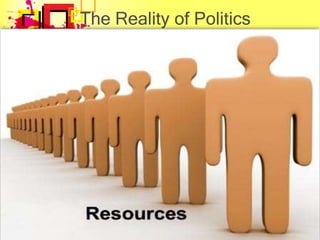
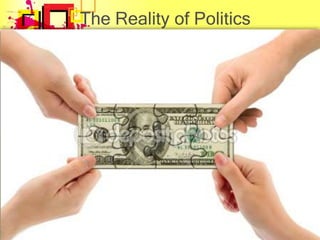
                                   Resources in organizations are
                                   also limited, which often turns
                                      potential conflict into real
                                               conflict.


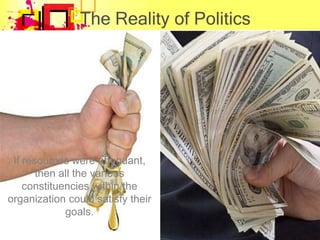
 If resources were abundant,
       then all the various
    constituencies within the
organization could satisfy their
             goals.
The Reality of Politics


Most of the “facts” that are used
to allocate the limited resources
are open to interpretation.
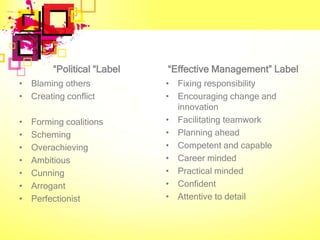
“Political “Label   “Effective Management” Label
• Blaming others             • Fixing responsibility
• Creating conflict          • Encouraging change and
                               innovation
•   Forming coalitions       • Facilitating teamwork
•   Scheming                 • Planning ahead
•   Overachieving            • Competent and capable
•   Ambitious                • Career minded
•   Cunning                  • Practical minded
•   Arrogant                 • Confident
•   Perfectionist            • Attentive to detail
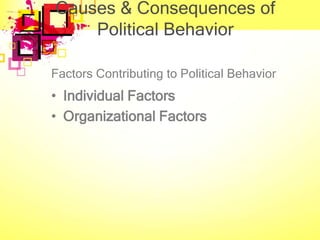
Causes & Consequences of
    Political Behavior

Factors Contributing to Political Behavior
• Individual Factors
• Organizational Factors
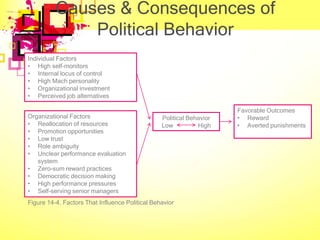
Causes & Consequences of
              Political Behavior
Individual Factors
• High self-monitors
• Internal locus of control
• High Mach personality
• Organizational investment
• Perceived job alternatives

                                                                      Favorable Outcomes
Organizational Factors                           Political Behavior   • Reward
• Reallocation of resources                      Low          High    • Averted punishments
• Promotion opportunities
• Low trust
• Role ambiguity
• Unclear performance evaluation
   system
• Zero-sum reward practices
• Democratic decision making
• High performance pressures
• Self-serving senior managers
Figure 14-4. Factors That Influence Political Behavior
Individual Factors
•   HIGH SELF-MONITORS
•   INTERNAL LOCUS OF CONTROL
•   HIGH MACH PERSONALITY
•   ORGANIZATIONAL INVESTMENT
•   PERCEIVED JOB ALTERNATIVES
Individual Factors


THE HIGH SELF MONITOR
  • More sensitive to social cues
  • Exhibits higher levels of social conformity, and
  • More likely to be skilled in political behavior
Individual Factors


INDIVIDUALS WITH AN INTERNAL LOCUS OF CONTROL
   • More prone to take a proactive stance
   • Attempt to manipulate situations in their favor
Individual Factors


HIGH MACHIAVELIAN PERSONALITY
   • Will to manipulate, and
   • Desire for power – is comfortable using politics as a
     means to further his or her self-interest
Individual Factors


ORGANIZATIONAL INVESTMENT
  • The more a person has invested in the organization in
    terms of expectations of increased future benefits, the
    more that person has to lose if forced out and the less
    likely he or she is to use illegitimate means.
Individual Factors


PERCEIVED JOB ALTERNATIVES
  • The more alternative job opportunities an individual has
    – due to a favorable job market or the possession of
    scarce skills or knowledge, a prominent reputation, or
    influential contacts outside the organization – the more
    likely that individual is to risk illegitimate political actions.
Organizational Factors
•   DECLINING RESOURCES
•   PROMOTION OPPORTUNITIES
•   LOW TRUST
•   ROLE AMBIGUITY
•   UNCLEAR PERFORMANCE EVALUATION SYSTEM
•   ZERO-SUM REWARD PRACTICES
•   DEMOCRATIC DECISION MAKING
•   HIGH PERFORMANCE PRESSURES
•   SELF-SERVING SENIOR MANAGERS
Organizational Factors


DECLINING RESOURCES
  • People may engage in political actions to safeguard
     what they have
  • Stimulate conflict and increase politicking
Organizational Factors


PROMOTION OPPORTUNITIES
  • Encourages people to compete for a limited resource
  • Try to positively influence the decision outcome
Organizational Factors


LOW TRUST
  • The higher the level of political behavior, and
  • The more likely that the political behavior will be of the
     illegitimate kind.
Organizational Factors


ROLE AMBIGUITY
  • Means that the prescribed behaviors of the employee
     are not clear.
Organizational Factors


UNCLEAR PERFORMANCE EVALUATION SYSTEM
  • Subjective performance criteria
  • Single outcome measure
  • The amount of time that elapses between an action and
    its appraisal
Organizational Factors


ZERO-SUM REWARD PRACTICES
  • Also called Win/Lose Approach
  • Treats the reward “pie” as fixed so that any gain one
    person or group achieves has to come at the expense of
    another person or group.
Organizational Factors


DEMOCRATIC DECISION MAKING
  • Managers in these organizations are being asked to
    behave more democratically.
  • They are told that they should allow employees to
    advise them on decisions and that they should rely to a
    greater extent on group input into the decision process
Organizational Factors


HIGH PERFORMANCE PRESSURES
   • The more pressure that employees feel to perform well,
     the more likely they are to engage in politicking.
Organizational Factors


SELF-SERVING SENIOR MANAGERS
• When employees see the people on top engaging in
  political behavior, especially when they do so successfully
  and are rewarded for it, a climate is created that supports
  politicking.
HOW DO PEOPLE RESPOND
  TO ORGANIZATIONAL
       POLITICS

Organizational politics

  • 1.
  • 2.
    Politics: Power inAction Organizational Politics - focused on the use of power to affect decision making in an organization or on behaviors by members that are self- serving and organizationally non-sanctioned.
  • 3.
    Politics: Power inAction Political Behavior - activities that are not required as part of a person’s formal role in the organization but that influence, or attempt to influence, the distribution of advantages and disadvantages within the organization.
  • 4.
    Politics: Power inAction Legitimate political behavior - refers to normal everyday politics Illegitimate political behavior - extreme political behavior that violates the implied rules of the game
  • 5.
    The Reality ofPolitics Politics is a fact of life in organizations.
  • 6.
  • 7.
    The Reality ofPolitics Resources in organizations are also limited, which often turns potential conflict into real conflict. If resources were abundant, then all the various constituencies within the organization could satisfy their goals.
  • 8.
    The Reality ofPolitics Most of the “facts” that are used to allocate the limited resources are open to interpretation.
  • 9.
    “Political “Label “Effective Management” Label • Blaming others • Fixing responsibility • Creating conflict • Encouraging change and innovation • Forming coalitions • Facilitating teamwork • Scheming • Planning ahead • Overachieving • Competent and capable • Ambitious • Career minded • Cunning • Practical minded • Arrogant • Confident • Perfectionist • Attentive to detail
  • 10.
    Causes & Consequencesof Political Behavior Factors Contributing to Political Behavior • Individual Factors • Organizational Factors
  • 11.
    Causes & Consequencesof Political Behavior Individual Factors • High self-monitors • Internal locus of control • High Mach personality • Organizational investment • Perceived job alternatives Favorable Outcomes Organizational Factors Political Behavior • Reward • Reallocation of resources Low High • Averted punishments • Promotion opportunities • Low trust • Role ambiguity • Unclear performance evaluation system • Zero-sum reward practices • Democratic decision making • High performance pressures • Self-serving senior managers Figure 14-4. Factors That Influence Political Behavior
  • 12.
    Individual Factors • HIGH SELF-MONITORS • INTERNAL LOCUS OF CONTROL • HIGH MACH PERSONALITY • ORGANIZATIONAL INVESTMENT • PERCEIVED JOB ALTERNATIVES
  • 13.
    Individual Factors THE HIGHSELF MONITOR • More sensitive to social cues • Exhibits higher levels of social conformity, and • More likely to be skilled in political behavior
  • 14.
    Individual Factors INDIVIDUALS WITHAN INTERNAL LOCUS OF CONTROL • More prone to take a proactive stance • Attempt to manipulate situations in their favor
  • 15.
    Individual Factors HIGH MACHIAVELIANPERSONALITY • Will to manipulate, and • Desire for power – is comfortable using politics as a means to further his or her self-interest
  • 16.
    Individual Factors ORGANIZATIONAL INVESTMENT • The more a person has invested in the organization in terms of expectations of increased future benefits, the more that person has to lose if forced out and the less likely he or she is to use illegitimate means.
  • 17.
    Individual Factors PERCEIVED JOBALTERNATIVES • The more alternative job opportunities an individual has – due to a favorable job market or the possession of scarce skills or knowledge, a prominent reputation, or influential contacts outside the organization – the more likely that individual is to risk illegitimate political actions.
  • 18.
    Organizational Factors • DECLINING RESOURCES • PROMOTION OPPORTUNITIES • LOW TRUST • ROLE AMBIGUITY • UNCLEAR PERFORMANCE EVALUATION SYSTEM • ZERO-SUM REWARD PRACTICES • DEMOCRATIC DECISION MAKING • HIGH PERFORMANCE PRESSURES • SELF-SERVING SENIOR MANAGERS
  • 19.
    Organizational Factors DECLINING RESOURCES • People may engage in political actions to safeguard what they have • Stimulate conflict and increase politicking
  • 20.
    Organizational Factors PROMOTION OPPORTUNITIES • Encourages people to compete for a limited resource • Try to positively influence the decision outcome
  • 21.
    Organizational Factors LOW TRUST • The higher the level of political behavior, and • The more likely that the political behavior will be of the illegitimate kind.
  • 22.
    Organizational Factors ROLE AMBIGUITY • Means that the prescribed behaviors of the employee are not clear.
  • 23.
    Organizational Factors UNCLEAR PERFORMANCEEVALUATION SYSTEM • Subjective performance criteria • Single outcome measure • The amount of time that elapses between an action and its appraisal
  • 24.
    Organizational Factors ZERO-SUM REWARDPRACTICES • Also called Win/Lose Approach • Treats the reward “pie” as fixed so that any gain one person or group achieves has to come at the expense of another person or group.
  • 25.
    Organizational Factors DEMOCRATIC DECISIONMAKING • Managers in these organizations are being asked to behave more democratically. • They are told that they should allow employees to advise them on decisions and that they should rely to a greater extent on group input into the decision process
  • 26.
    Organizational Factors HIGH PERFORMANCEPRESSURES • The more pressure that employees feel to perform well, the more likely they are to engage in politicking.
  • 27.
    Organizational Factors SELF-SERVING SENIORMANAGERS • When employees see the people on top engaging in political behavior, especially when they do so successfully and are rewarded for it, a climate is created that supports politicking.
  • 28.
    HOW DO PEOPLERESPOND TO ORGANIZATIONAL POLITICS