Earth and Life Science
with ma'am Bijasa
4th Quarter
Lesson Objectives:
a. Describe the general and unique
characteristics of the different organ
systems in representative animals.
b. Appreciate the functional relationships of
the different organ systems.
What happens when organisms
become more complex?
How do organisms made up of
billion, or even trillion of cells
get the raw materials needed
for each and every cell?
The answer is……
body systems.
Large, complex organisms
need many levels of
organization to ensure all
cells get what they need to
perform life functions.
The body of an animal is like a
well-organized machine capable
of performing different tasks.
The ability of the body to do all the things it
can do is due to the special internal and
external structures that work together in an
orderly manner.
The body system is a group
of
organ that work together
to
serve a common purpose.
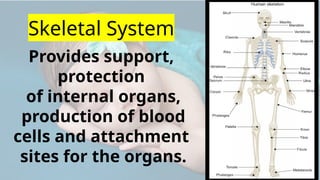
Skeletal System
Provides support,
protection
of internal organs,
production of blood
cells and attachment
sites for the organs.
Division of Skeletal System
 axial skeleton
 appendicular
skeleton
Muscular System
Provides
movement,
maintains posture
and produce heat.
Digestive System
Breaks down food
and absorbs
nutrients that are
important for
growth and
maintenance.
Circulatory System
Transport
nutrients, gases,
hormones and
waste through
the body.
Respiratory System
Provides gas
exchange
between the
blood and the
environment.
Respiratory System
Mammals and other organisms have
respiratory system that work
together with their circulatory
system. Gases are transported via
the bloodstream and are exchange
via diffusion.
Excretory System
Filters out
cellular waste,
toxins and
excess water or
nutrients.
Excretory System
Organisms have different
waste in the form of
nitrogenous waste which they
need to excrete.
Endocrine System
Relays chemical
messages through
the body that help
control
physiological
processes.
Endocrine System
It is a collection of glands that
produce hormones which regulate
metabolism, growth and
development, tissue function,
sexual function, sleep and mood
among other things.
Nervous System
Relays message
through the body
that direct behavior
and movement and
controls
physiological
processes.
Nervous System
The central nervous system(brain) is
responsible for data/information
processing which is gathered by the
peripheral nervous system
(nerves/neurons).Upon processing, the
CNS transmit the message again to the
PNS, which then convey message for
appropriate response.
Immune System
A complex network of
specific immune cells
and proteins that work
in synergy to protect the
body against foreign
invaders and harmful
toxic materials coming
from the environment.
Reproductive System
Produces sex
cells and sex
hormones that
allow
reproduction.
Integumentary System
Forms the external
covering of the body
and protects it from
many threats such
as infection,
abrasion and
radiation damage.
Thank you
for
listening!!!

organ system.pptx.................................