Introducing NetworksIntroducing Networks
Introduction to NetworkingIntroduction to Networking
• Network
– Term that describes the connection of two or more
computers by some type of medium, including:
• Wire cable
• Fiber-optic cable
• Infrared
• Radio equipment
Origin of NetworkingOrigin of Networking
• Difficult to place actual origin as many
devices have been networked throughout
history
• Today, networks include a wide variety of
computers and peripheral components
• Systems that are part of a network do not have
to be identical
Why Do We Use Networks?Why Do We Use Networks?
• Convenience
• People expect interoperability from electronic
devices
• Computer networks allow for the transfer of
files, data, and even shared applications
without copying anything to floppy disk
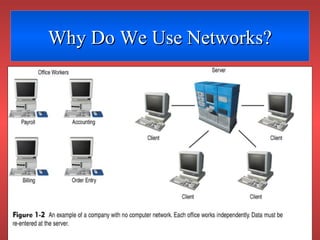
Why Do We Use Networks?Why Do We Use Networks?
Related TermsRelated Terms
• Media
– Refers to the wire cabling that form the connections in
most networks
– Some networks use wireless transmission media, such as
infrared or radio signals
– Cable, glass, or telephone lines that host the signal
from one computer to another on the network
• Electromagnetic interference (EMI)
– Electric noise that disrupts signals on cables
• Wireless
– Communications that are not conducted over physical
wires or cables
Client/Server NetworksClient/Server Networks
• Networks that have computers as servers and
computers that act as clients to those servers
• Server host that resources for the clients to use
and provide security
• A client is the computer that request resources
from the server.
Client/Server NetworksClient/Server Networks
• Types of servers on a network:
– Print server
– File server
– Database server
– Remote access server (RAS)
– Web server
Peer-to-PeerPeer-to-Peer
• When every computer on a network acts as both a
client and a server, the network is a peer-to-
peer network
• In a peer-to-peer network, all computers can
share resources with other computers
• Peer-to-peer networks are also known as
“workgroups”
LAN, WAN, MAN, SANLAN, WAN, MAN, SAN
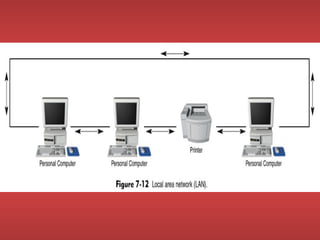
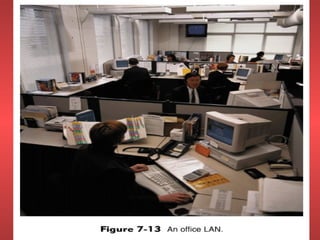
• A local area network (LAN) is contained within a company
or department and located in a single geographic area
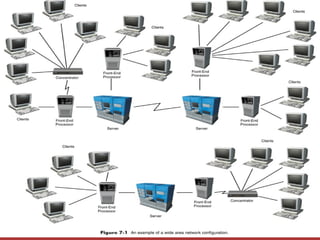
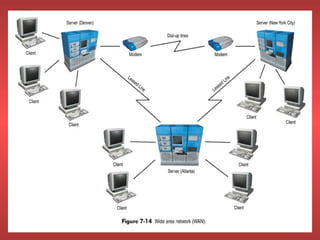
• A wide area network (WAN) spans multiple geographic
areas and is usually connected by common
telecommunication carriers
Or
a network that spans two or more geographically diverse
locations
• A metropolitan area network (MAN) is an intermediate
specification that defines networks confined to a fairly
restricted geographic area
LAN, WAN, MAN, SANLAN, WAN, MAN, SAN
• A storage area network (SAN) is refers to a series of storage
devices that are networked together to provide very fast data
storage for a network or subnetwork
Or
a subsystem of networked storage devices physically
separated from servers
Network Operating SystemNetwork Operating System
• Network operating system (NOS)
– Allows communication, security, and distribution
of data, files, and applications over a network
• End system
– The location and/or set of controls that the user
can manipulate to interact with a computer or a
network
NIC, Networking Hardware, andNIC, Networking Hardware, and
Networking SoftwareNetworking Software
• Network interface card (NIC)
– A device that allows a computer or other device to connect
to a network through the media
– Hardware device that transmits and receives electronic
signals on a network
• Networking hardware
- Describes all the physical components of a network, such as
the NIC, cable, hub, switch, router, and any related
connectors or devices
- a generic term that describes all the physical components of
a network
NIC, Networking Hardware, andNIC, Networking Hardware, and
Networking SoftwareNetworking Software
• Networking software
- The programs used to run a network

Introduction to network

  • 1.
  • 2.
    Introduction to NetworkingIntroductionto Networking • Network – Term that describes the connection of two or more computers by some type of medium, including: • Wire cable • Fiber-optic cable • Infrared • Radio equipment
  • 3.
    Origin of NetworkingOriginof Networking • Difficult to place actual origin as many devices have been networked throughout history • Today, networks include a wide variety of computers and peripheral components • Systems that are part of a network do not have to be identical
  • 4.
    Why Do WeUse Networks?Why Do We Use Networks? • Convenience • People expect interoperability from electronic devices • Computer networks allow for the transfer of files, data, and even shared applications without copying anything to floppy disk
  • 5.
    Why Do WeUse Networks?Why Do We Use Networks?
  • 6.
    Why Do WeUse Networks?Why Do We Use Networks?
  • 7.
    Related TermsRelated Terms •Media – Refers to the wire cabling that form the connections in most networks – Some networks use wireless transmission media, such as infrared or radio signals – Cable, glass, or telephone lines that host the signal from one computer to another on the network • Electromagnetic interference (EMI) – Electric noise that disrupts signals on cables • Wireless – Communications that are not conducted over physical wires or cables
  • 8.
    Client/Server NetworksClient/Server Networks •Networks that have computers as servers and computers that act as clients to those servers • Server host that resources for the clients to use and provide security • A client is the computer that request resources from the server.
  • 9.
    Client/Server NetworksClient/Server Networks •Types of servers on a network: – Print server – File server – Database server – Remote access server (RAS) – Web server
  • 11.
    Peer-to-PeerPeer-to-Peer • When everycomputer on a network acts as both a client and a server, the network is a peer-to- peer network • In a peer-to-peer network, all computers can share resources with other computers • Peer-to-peer networks are also known as “workgroups”
  • 12.
    LAN, WAN, MAN,SANLAN, WAN, MAN, SAN • A local area network (LAN) is contained within a company or department and located in a single geographic area • A wide area network (WAN) spans multiple geographic areas and is usually connected by common telecommunication carriers Or a network that spans two or more geographically diverse locations • A metropolitan area network (MAN) is an intermediate specification that defines networks confined to a fairly restricted geographic area
  • 13.
    LAN, WAN, MAN,SANLAN, WAN, MAN, SAN • A storage area network (SAN) is refers to a series of storage devices that are networked together to provide very fast data storage for a network or subnetwork Or a subsystem of networked storage devices physically separated from servers
  • 19.
    Network Operating SystemNetworkOperating System • Network operating system (NOS) – Allows communication, security, and distribution of data, files, and applications over a network • End system – The location and/or set of controls that the user can manipulate to interact with a computer or a network
  • 20.
    NIC, Networking Hardware,andNIC, Networking Hardware, and Networking SoftwareNetworking Software • Network interface card (NIC) – A device that allows a computer or other device to connect to a network through the media – Hardware device that transmits and receives electronic signals on a network • Networking hardware - Describes all the physical components of a network, such as the NIC, cable, hub, switch, router, and any related connectors or devices - a generic term that describes all the physical components of a network
  • 21.
    NIC, Networking Hardware,andNIC, Networking Hardware, and Networking SoftwareNetworking Software • Networking software - The programs used to run a network