1
OUTLINE
• Definition
• Burden
• The Epidemiological Transition
• Major risk factors
• Infection and non-communicable diseases
• Prevention & Control
• Summary
2
DEFINITION
NCD is a medical condition or disease,
which is not infectious which are
generally chronic in nature and have
relatively slow progression
Why NCDs Are
Important Public
Health Problems?
4
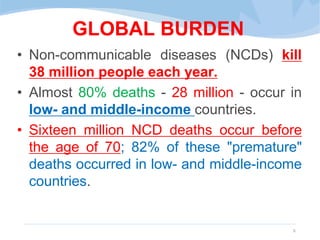
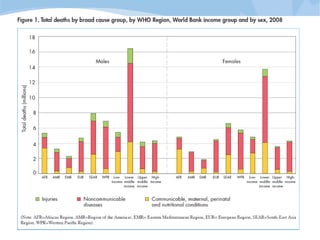
GLOBAL BURDEN
• Non-communicable diseases (NCDs) kill
38 million people each year.
• Almost 80% deaths - 28 million - occur in
low- and middle-income countries.
• Sixteen million NCD deaths occur before
the age of 70; 82% of these "premature"
deaths occurred in low- and middle-income
countries.
5
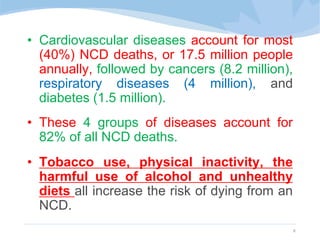
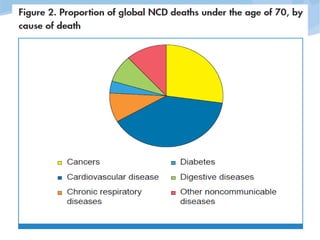
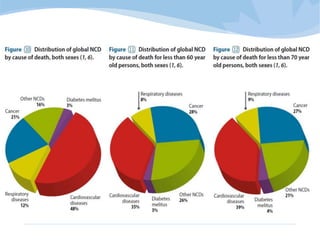
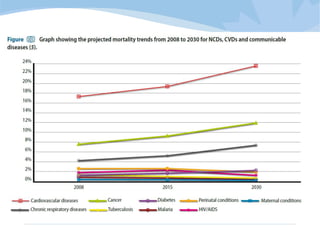
• Cardiovascular diseases account for most
(40%) NCD deaths, or 17.5 million people
annually, followed by cancers (8.2 million),
respiratory diseases (4 million), and
diabetes (1.5 million).
• These 4 groups of diseases account for
82% of all NCD deaths.
• Tobacco use, physical inactivity, the
harmful use of alcohol and unhealthy
diets all increase the risk of dying from an
NCD.
6
INDIAN
SCENARIO
12
• Every year, roughly 5.8 million Indians die
from heart and lung diseases, stroke,
cancer and diabetes.
• In other words, 1 in 4 Indians risks dying
from an NCD before they reach the age of
70.
• In 2015, India, like other developed
countries, had more deaths due to non-
communicable diseases.
13
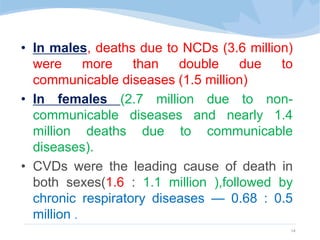
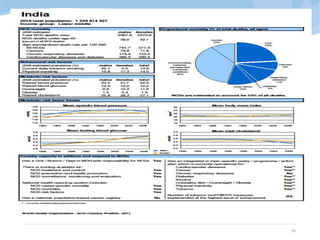
• In males, deaths due to NCDs (3.6 million)
were more than double due to
communicable diseases (1.5 million)
• In females (2.7 million due to non-
communicable diseases and nearly 1.4
million deaths due to communicable
diseases).
• CVDs were the leading cause of death in
both sexes(1.6 : 1.1 million ),followed by
chronic respiratory diseases — 0.68 : 0.5
million .
14
15
WHO IS AT RISK OF SUCH DISEASES?
• All age groups and all regions are affected
by NCDs.
• NCDs are often associated with older age
groups, but evidence shows that 16 million
of all deaths attributed to non-
communicable diseases (NCDs) occur
before the age of 70.
• Of these "premature" deaths, 82%
occurred in low- and middle-income
countries.
16
• All ages/genders are all vulnerable to
the risk factors, whether unhealthy diet,
physical inactivity, exposure to tobacco
or use of alcohol.
• These diseases are driven by forces
that include ageing, rapid unplanned
urbanization, and the globalization of
unhealthy lifestyles
17
18
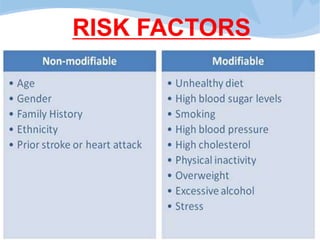
RISK FACTORS
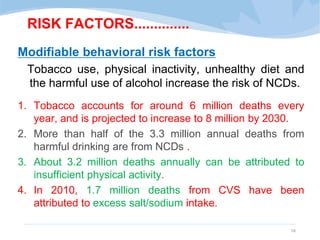
RISK FACTORS..............
Modifiable behavioral risk factors
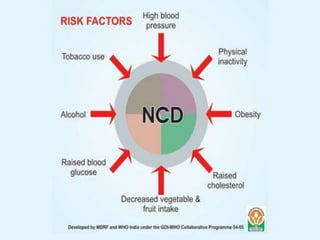
Tobacco use, physical inactivity, unhealthy diet and
the harmful use of alcohol increase the risk of NCDs.
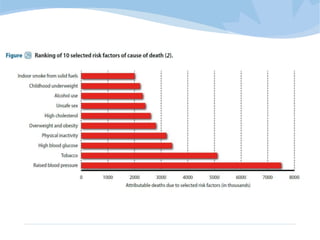
1. Tobacco accounts for around 6 million deaths every
year, and is projected to increase to 8 million by 2030.
2. More than half of the 3.3 million annual deaths from
harmful drinking are from NCDs .
3. About 3.2 million deaths annually can be attributed to
insufficient physical activity.
4. In 2010, 1.7 million deaths from CVS have been
attributed to excess salt/sodium intake.
19
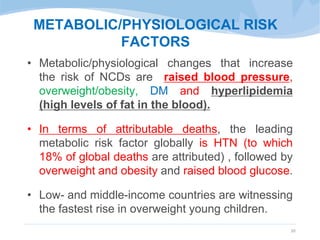
METABOLIC/PHYSIOLOGICAL RISK
FACTORS
• Metabolic/physiological changes that increase
the risk of NCDs are raised blood pressure,
overweight/obesity, DM and hyperlipidemia
(high levels of fat in the blood).
• In terms of attributable deaths, the leading
metabolic risk factor globally is HTN (to which
18% of global deaths are attributed) , followed by
overweight and obesity and raised blood glucose.
• Low- and middle-income countries are witnessing
the fastest rise in overweight young children.
20
21
22
Public Health Agency of Canada | Agence de la santĂŠ publique du Canada 23
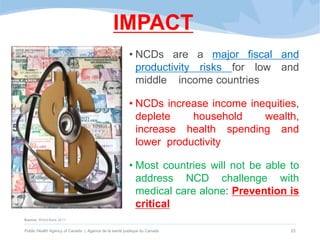
• NCDs are a major fiscal and
productivity risks for low and
middle income countries
• NCDs increase income inequities,
deplete household wealth,
increase health spending and
lower productivity
• Most countries will not be able to
address NCD challenge with
medical care alone: Prevention is
critical
IMPACT
Source: World Bank 2011.
23
24
• NCDs need a comprehensive
approach and it needs---
• MoH,finance,foreign, affairs,
education, agriculture, planning
and others, to work together to
reduce the risks associated with
NCDs, as well as promote the
interventions to prevent and control
them.
25
Contd…
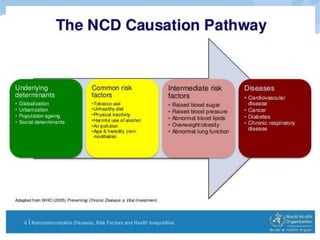
• An important way to reduce NCDs is to
focus on lessening the risk factors
associated with these diseases.
• Low-cost solutions exist to reduce the
common modifiable risk factors (mainly
tobacco use, unhealthy diet and
physical inactivity, and the harmful use
of alcohol) .
26
WHO RESPONSE.....
• In 2011 Under the banner of the WHO
more than 190 countries agreed to reduce
the NCD burden including a Global action
plan for the prevention and control of NCDs
2013-2020.
• This plan aims to reduce the number of
premature deaths from NCDs by 25% by
2025 through nine voluntary global targets.
27
• The targets will focus on addressing
main risk factors such as tobacco use,
harmful use of alcohol, unhealthy diet
and physical inactivity .
• The UN General Assembly will
convene a third high-level meeting on
NCDs in 2018 to take stock of
progress in attaining the global targets
by 2025.
28
NATIONAL PROGRAMME
FOR PREVENTION AND
CONTROL OF CANCER ,
DIABETES , CARDIOVA
SCULAR DISEASES &
STROKE (NPCDCS)
29
OBJECTIVES OF NPCDCS
1) Prevent and control common NCDs through
behaviour and life style changes,
2) Provide early diagnosis and management of
common NCDs,
3) Build capacity at various levels of health care for
prevention, diagnosis and treatment of common
NCDs,
4) Train human resource to cope with the increasing
burden of NCDs, and
5) Establish and develop capacity for palliative &
rehabilitative care
30
SUMMARY
• Non-communicable diseases are now the most
common cause of death world wide
• Increasing rates in low and middle income
countries because of change in lifestyles
(urbanisation)
• Key risk factors have very large effects
• Interventions are effective and can reduce
burden
• The need to combine results and have large
studies
31
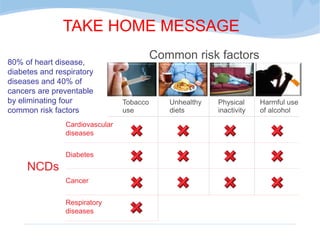
80% of heart disease,
diabetes and respiratory
diseases and 40% of
cancers are preventable
by eliminating four
common risk factors
NCDs
Common risk factors
Tobacco
use
Unhealthy
diets
Physical
inactivity
Harmful use
of alcohol
Cardiovascular
diseases
Diabetes
Cancer
Respiratory
diseases
TAKE HOME MESSAGE
?????????
?
33
Thank You

INTRODUCTION TO NCDs

  • 1.
  • 2.
    OUTLINE • Definition • Burden •The Epidemiological Transition • Major risk factors • Infection and non-communicable diseases • Prevention & Control • Summary 2
  • 3.
    DEFINITION NCD is amedical condition or disease, which is not infectious which are generally chronic in nature and have relatively slow progression
  • 4.
    Why NCDs Are ImportantPublic Health Problems? 4
  • 5.
    GLOBAL BURDEN • Non-communicablediseases (NCDs) kill 38 million people each year. • Almost 80% deaths - 28 million - occur in low- and middle-income countries. • Sixteen million NCD deaths occur before the age of 70; 82% of these "premature" deaths occurred in low- and middle-income countries. 5
  • 6.
    • Cardiovascular diseasesaccount for most (40%) NCD deaths, or 17.5 million people annually, followed by cancers (8.2 million), respiratory diseases (4 million), and diabetes (1.5 million). • These 4 groups of diseases account for 82% of all NCD deaths. • Tobacco use, physical inactivity, the harmful use of alcohol and unhealthy diets all increase the risk of dying from an NCD. 6
  • 12.
  • 13.
    • Every year,roughly 5.8 million Indians die from heart and lung diseases, stroke, cancer and diabetes. • In other words, 1 in 4 Indians risks dying from an NCD before they reach the age of 70. • In 2015, India, like other developed countries, had more deaths due to non- communicable diseases. 13
  • 14.
    • In males,deaths due to NCDs (3.6 million) were more than double due to communicable diseases (1.5 million) • In females (2.7 million due to non- communicable diseases and nearly 1.4 million deaths due to communicable diseases). • CVDs were the leading cause of death in both sexes(1.6 : 1.1 million ),followed by chronic respiratory diseases — 0.68 : 0.5 million . 14
  • 15.
  • 16.
    WHO IS ATRISK OF SUCH DISEASES? • All age groups and all regions are affected by NCDs. • NCDs are often associated with older age groups, but evidence shows that 16 million of all deaths attributed to non- communicable diseases (NCDs) occur before the age of 70. • Of these "premature" deaths, 82% occurred in low- and middle-income countries. 16
  • 17.
    • All ages/gendersare all vulnerable to the risk factors, whether unhealthy diet, physical inactivity, exposure to tobacco or use of alcohol. • These diseases are driven by forces that include ageing, rapid unplanned urbanization, and the globalization of unhealthy lifestyles 17
  • 18.
  • 19.
    RISK FACTORS.............. Modifiable behavioralrisk factors Tobacco use, physical inactivity, unhealthy diet and the harmful use of alcohol increase the risk of NCDs. 1. Tobacco accounts for around 6 million deaths every year, and is projected to increase to 8 million by 2030. 2. More than half of the 3.3 million annual deaths from harmful drinking are from NCDs . 3. About 3.2 million deaths annually can be attributed to insufficient physical activity. 4. In 2010, 1.7 million deaths from CVS have been attributed to excess salt/sodium intake. 19
  • 20.
    METABOLIC/PHYSIOLOGICAL RISK FACTORS • Metabolic/physiologicalchanges that increase the risk of NCDs are raised blood pressure, overweight/obesity, DM and hyperlipidemia (high levels of fat in the blood). • In terms of attributable deaths, the leading metabolic risk factor globally is HTN (to which 18% of global deaths are attributed) , followed by overweight and obesity and raised blood glucose. • Low- and middle-income countries are witnessing the fastest rise in overweight young children. 20
  • 21.
  • 22.
  • 23.
    Public Health Agencyof Canada | Agence de la santé publique du Canada 23 • NCDs are a major fiscal and productivity risks for low and middle income countries • NCDs increase income inequities, deplete household wealth, increase health spending and lower productivity • Most countries will not be able to address NCD challenge with medical care alone: Prevention is critical IMPACT Source: World Bank 2011. 23
  • 24.
  • 25.
    • NCDs needa comprehensive approach and it needs--- • MoH,finance,foreign, affairs, education, agriculture, planning and others, to work together to reduce the risks associated with NCDs, as well as promote the interventions to prevent and control them. 25
  • 26.
    Contd… • An importantway to reduce NCDs is to focus on lessening the risk factors associated with these diseases. • Low-cost solutions exist to reduce the common modifiable risk factors (mainly tobacco use, unhealthy diet and physical inactivity, and the harmful use of alcohol) . 26
  • 27.
    WHO RESPONSE..... • In2011 Under the banner of the WHO more than 190 countries agreed to reduce the NCD burden including a Global action plan for the prevention and control of NCDs 2013-2020. • This plan aims to reduce the number of premature deaths from NCDs by 25% by 2025 through nine voluntary global targets. 27
  • 28.
    • The targetswill focus on addressing main risk factors such as tobacco use, harmful use of alcohol, unhealthy diet and physical inactivity . • The UN General Assembly will convene a third high-level meeting on NCDs in 2018 to take stock of progress in attaining the global targets by 2025. 28
  • 29.
    NATIONAL PROGRAMME FOR PREVENTIONAND CONTROL OF CANCER , DIABETES , CARDIOVA SCULAR DISEASES & STROKE (NPCDCS) 29
  • 30.
    OBJECTIVES OF NPCDCS 1)Prevent and control common NCDs through behaviour and life style changes, 2) Provide early diagnosis and management of common NCDs, 3) Build capacity at various levels of health care for prevention, diagnosis and treatment of common NCDs, 4) Train human resource to cope with the increasing burden of NCDs, and 5) Establish and develop capacity for palliative & rehabilitative care 30
  • 31.
    SUMMARY • Non-communicable diseasesare now the most common cause of death world wide • Increasing rates in low and middle income countries because of change in lifestyles (urbanisation) • Key risk factors have very large effects • Interventions are effective and can reduce burden • The need to combine results and have large studies 31
  • 32.
    80% of heartdisease, diabetes and respiratory diseases and 40% of cancers are preventable by eliminating four common risk factors NCDs Common risk factors Tobacco use Unhealthy diets Physical inactivity Harmful use of alcohol Cardiovascular diseases Diabetes Cancer Respiratory diseases TAKE HOME MESSAGE
  • 33.
  • 34.