Non Communicable Diseases
(NCDs)
1
Dr. Nizam Uddin Ahmed
•Faculty, PHD, North South University
•Email: nizam1016@gmail.com
2
Outline
• Definition
• Non-communicable disease mortality
worldwide
• The Epidemiological Transition
• Major risk factors
• Infection and non-communicable diseases
• Prevention & Control
• Summary
Classifying deaths and
diseases (WHO)
• Communicable diseases [Group I]
– Those where death is directly due to the action of
a communicable agent
• Non-communicable diseases
– Diseases [Group II]
• Cancer, diseases of various organ systems (eg
respiratory, cardiovascular etc.), diabetes, mental health
etc.
– External causes (injuries, poisonings and
violence) [Group III]
What are NCDs?
• NCD is a medical condition or disease, which
is not infectious
• NCDs are diseases or medical conditions
with long duration and relatively slow
progression
• NCDs are usually called “Chronic Diseases”
Why NCDs Are Important in
Public Health?
• 65 million deaths that occurred globally in
2011
• 36 million – 63.2%, almost two thirds – were
due to NCDs
• 9 million death that occurred among people
under age 60
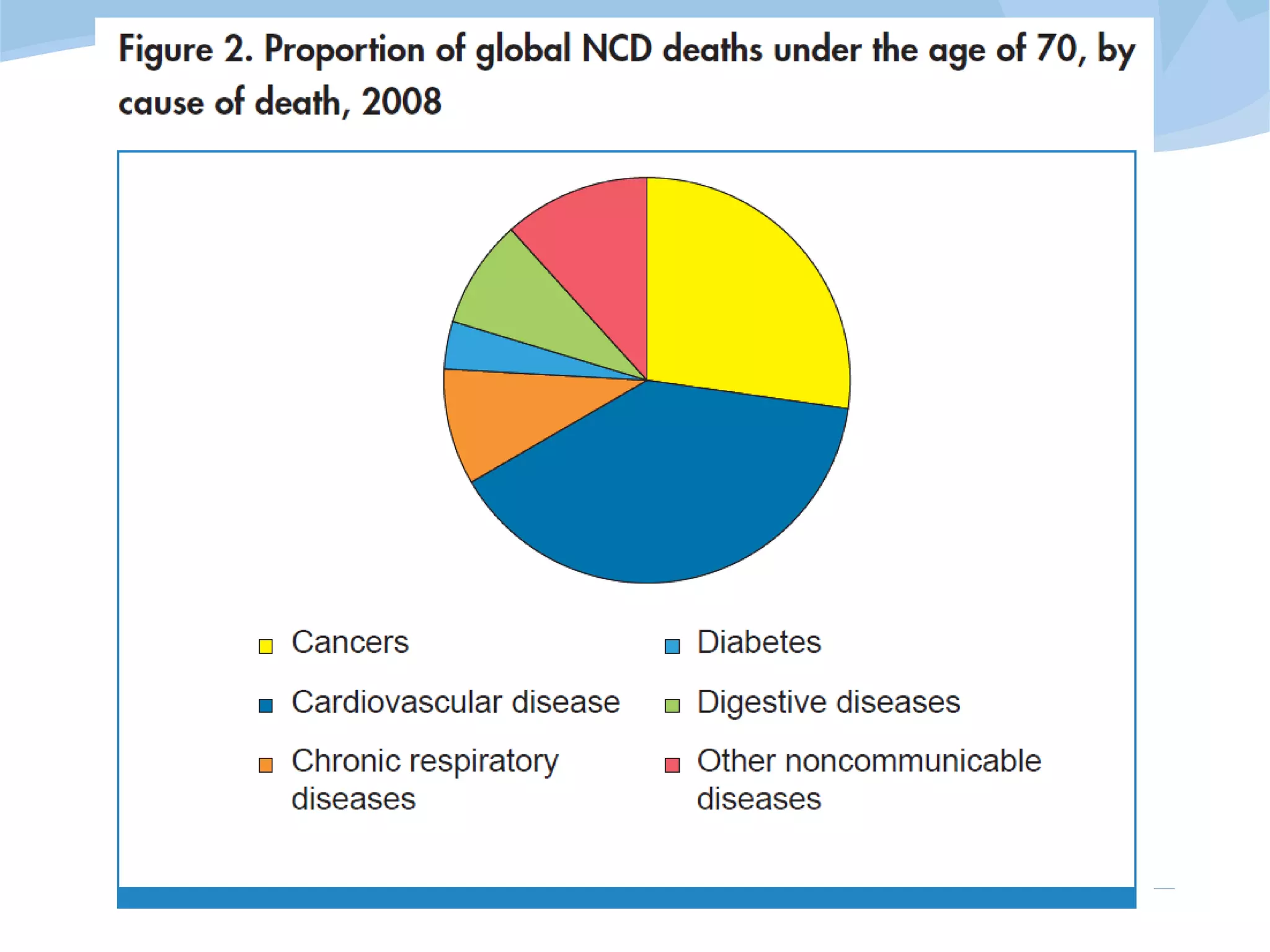
• mainly cardiovascular diseases, cancers,
diabetes and chronic lung diseases
7
8
Public Health Agency of Canada | Agence de la santé publique du Canada 14
1Except in sub-Saharan Africa.
NCDs are an increasing
global challenge…
Most significant cause of death (63%) worldwide1
Even in African nations, NCDs are rising rapidly, projected to exceed
communicable, maternal/perinatal, and nutritional diseases as the most
common causes of deaths by 2020
NCDs cause premature deaths under age 60:
13% in high income countries
29% in low middle income countries
Source: World Health Organization (WHO).
14
Public Health Agency of Canada | Agence de la santé publique du Canada 15
• NCDs represent a major fiscal and
productivity risks for the economies of
low, middle, and high income
countries
• NCDs increase income inequities,
deplete household wealth, increase
health spending and lower labour
productivity
• Most countries will not be able to
address NCD challenge with medical
care alone: Prevention is critical
…and their impacts extend beyond health.
Source: World Bank 2011.
15
16
The epidemiologic transition
(Omran, 1971)
Change in the balance of disease in
a population
from
communicable diseases
to
non-communicable disease
Urbanisation
19
Urbanisation
0
10
20
30
40
50
60
70
80
90
100
1950 1960 1970 1980 1990 2000 2010 2020 2030
Urbanpopulationas%oftotal
North America
Latin America & Caribbean
Europe
Oceania
Asia
Africa
WORLD
2007
20
Drivers of the epidemiological
transition in low and middle
income countries
• Population ageing
• Major socio-economic changes (especially
urbanisation)
– changes in risk factors such as diet, physical activity,
smoking etc.
Public Health
Agency of Canada
Agence de la santé
publique du Canada
The Cost…
22
Public Health Agency of Canada | Agence de la santé publique du Canada 23
…and NCD rates are
increasing at 14 percent each year.
Source: Centre for Chronic Disease Prevention and Control, Public Health Agency of Canada, using POHEM Model, Statistics Canada.
23
Public Health Agency of Canada | Agence de la santé publique du Canada 24
COSTS
Individual Household Employer Government
Health care
Out of pocket
drugs
Lost
productivity
Disability
Economic burden of NCDs
…and so is our
economy. NCDs
cost $190 billion
in 2010.
24
Canada’s declining deaths from heart disease due in part to an
increase in treatment.
Public Health Agency of Canada | Agence de la santé publique du Canada 25
Treating NCDs
is costly.
Source: Centre for Chronic Disease Prevention and Control, Public Health Agency of Canada, using data from OECD HEALTH DATA 2010; and CMAJ, July 7, 2009 - 1881 (1-2).
0
1
2
3
4
5
6
0
20
40
60
80
100
120
140
1996 1997 1998 1999 2000 2001 2002 2003 2004 2005 2006
Expenditures
on
cardiovascular
disease
medication
(Billion $)
Deaths per
100,000 pop.
(sdr)
Years
Deaths
Expenditures
25
Public Health Agency of Canada | Agence de la santé publique du Canada 26
…but the economic impact
goes beyond the health sector.
about twice
the direct
health care costs
Direct health care
costs in 2010 =
$68 billion
Indirect costs
due to income
and productivity
losses = $122 billion
estimated
Source: Centre for Chronic Disease Prevention and Control, Public Health
Agency of Canada, using data from the Canadian Institute for Health
Information and from the data of the Economic Burden of Illness in Canada,
1986, 1993, 1998.
26
Public Health
Agency of Canada
Agence de la santé
publique du Canada
The Cost-effectiveness
Options…
27
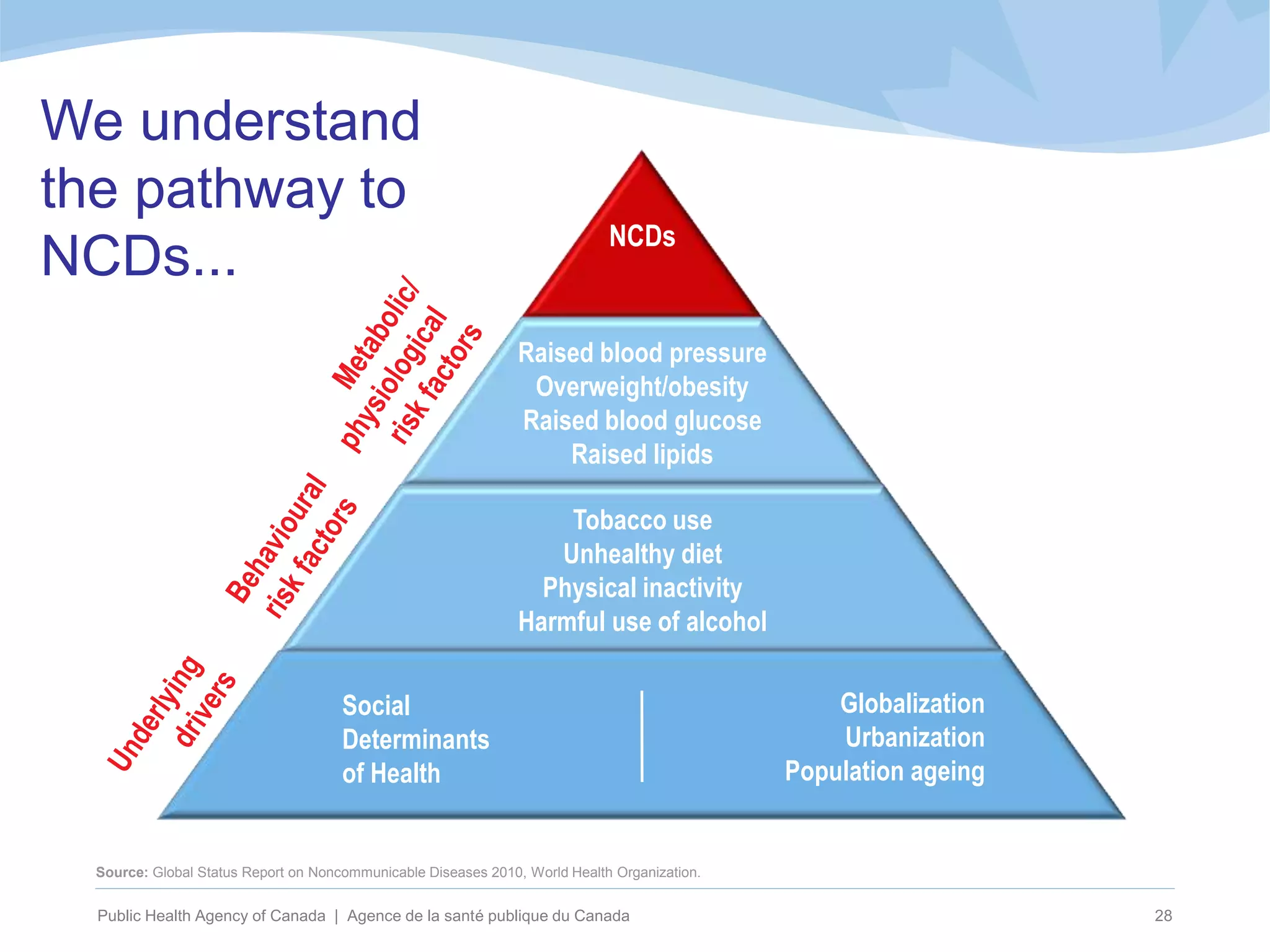
Source: Global Status Report on Noncommunicable Diseases 2010, World Health Organization.
Public Health Agency of Canada | Agence de la santé publique du Canada 28
NCDs
Raised blood pressure
Overweight/obesity
Raised blood glucose
Raised lipids
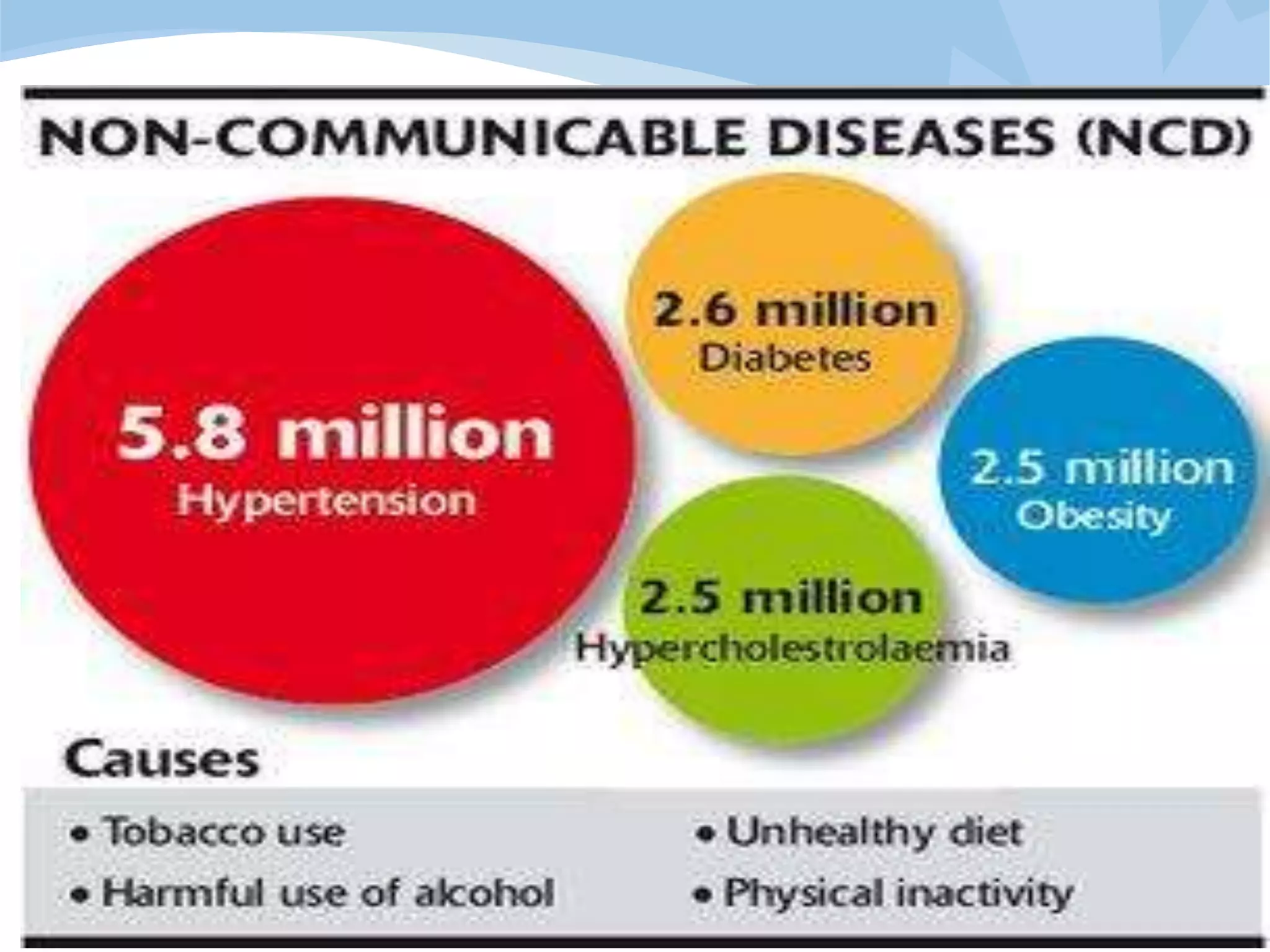
Tobacco use
Unhealthy diet
Physical inactivity
Harmful use of alcohol
Globalization
Urbanization
Population ageing
Social
Determinants
of Health
We understand
the pathway to
NCDs...
Public Health Agency of Canada | Agence de la santé publique du Canada
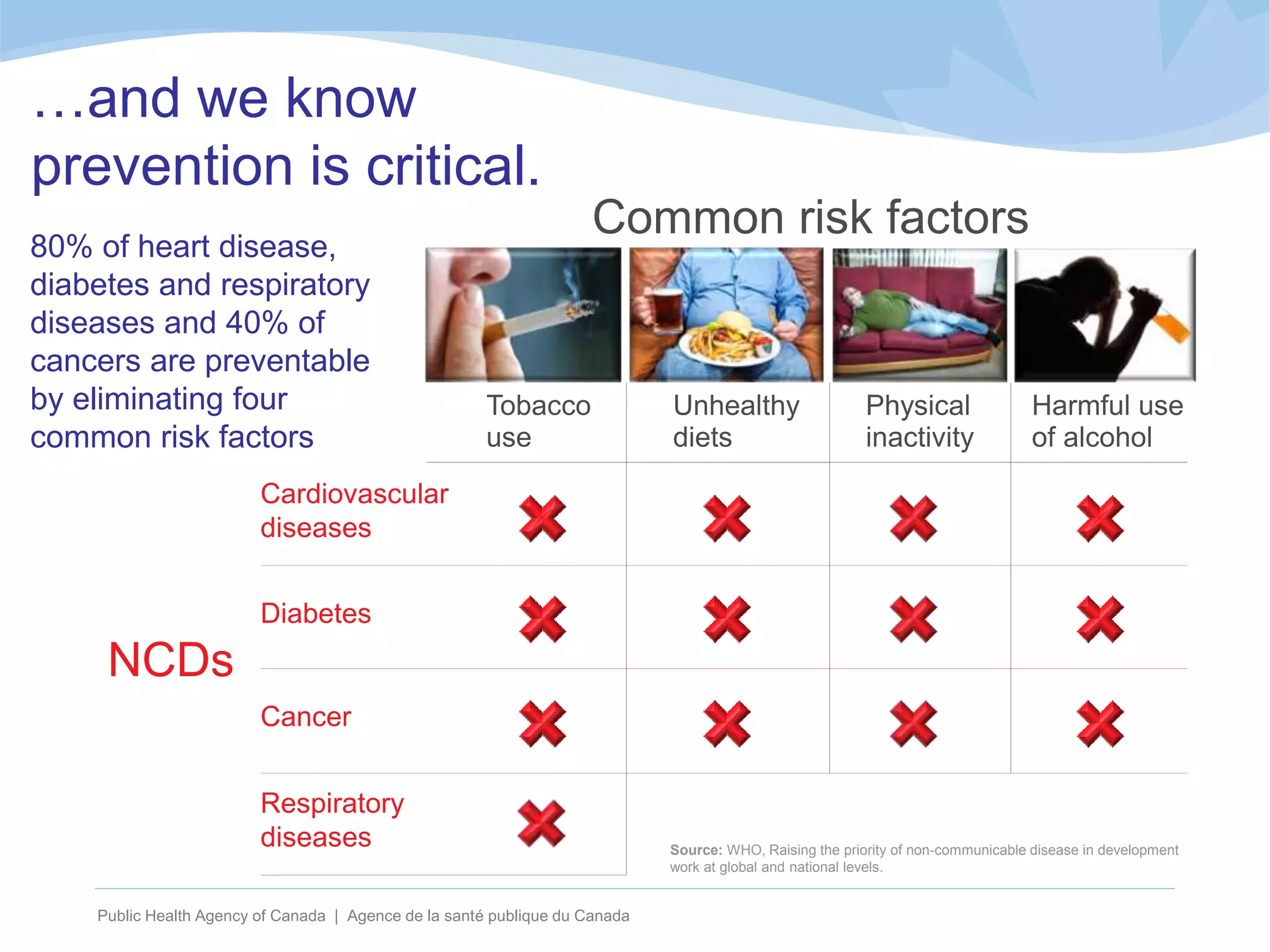
80% of heart disease,
diabetes and respiratory
diseases and 40% of
cancers are preventable
by eliminating four
common risk factors
NCDs
Common risk factors
Tobacco
use
Unhealthy
diets
Physical
inactivity
Harmful use
of alcohol
Cardiovascular
diseases
Diabetes
Cancer
Respiratory
diseases Source: WHO, Raising the priority of non-communicable disease in development
work at global and national levels.
…and we know
prevention is critical.
Public Health Agency of Canada | Agence de la santé publique du Canada
For every $1 invested in
labelling on cigarette packages
there is a saving of $52 for the
Canadian economy including $8
for Government1
For Worksite Health Promotion,
the Atlantic Health and Wellness
Institute found that returns per
dollar ranged from $1.64 to
$3.98 based on employee risk
factors after 3 months of
intervention2
Intervention for
prevention works...
Sources: 1Health Canada, 2011.
2Spencer & Associates, 2002.
30
Public Health Agency of Canada | Agence de la santé publique du Canada 31
Assessing results of nine
prevention approaches, a
study using OECD/WHO
model predict both the per
capita investment costs and
their likely outcomes in
improving population health.
Mainly, the study concluded
the best return for the
prevention dollar came from
a combination of several
interventions from public and
private sector sources.
… and healthy promotion
is everyone’s business.
Health Outcomes at the Population Level
(average effects per year)
School-based interventions
Mass media campaigns
Food advertising self-regulation
Food labelling
Worksite interventions
Food advertising regulation
Physician counselling
Fiscal measures
Physician-dietician counselling
0 10,000 20,000 30,000 40,000
Disability-
adjusted life
years
Life years
31
Public Health
Agency of Canada
Agence de la santé
publique du Canada
The Macroeconomic
options…
32
Actions by
many sectors
have an
impact on our
lifestyles
and health.
NCDs
Agri-food
Work
Places
Transport
Economic
Development
Education
Income
Urban
Planning
Environment
and
Sustainable
Development
Finance
Trade
Public Health
Agency of Canada
Agence de la santé
publique du Canada
34
Conclusions…
Summary
• Non-communicable diseases are now the
most common cause of death world wide
• Increasing rates in low and middle income
countries because of change in lifestyles
(urbanisation)
• Key risk factors have very large effects
• Interventions are effective and can reduce
burden
• The need to combine results and have large
studies 35
Group Work
• Group 1: What are causes of NCDs and how
to prevent and control?
• Group 2: Why Hypertension and Diabetics
are increasing and how to prevent and
control?
• Group 3: NCDs mortality is high, why major
programs are not in place?
• Group 4: What are major strategies of NCDs
prevention and control in Bangladesh?
36
Acknowledgements
• I would like to acknowledge all references
that are utilized for this presentation.
37

Non Communicable Disease: Prevention and Mangement

  • 1.
    Non Communicable Diseases (NCDs) 1 Dr.Nizam Uddin Ahmed •Faculty, PHD, North South University •Email: nizam1016@gmail.com
  • 2.
    2 Outline • Definition • Non-communicabledisease mortality worldwide • The Epidemiological Transition • Major risk factors • Infection and non-communicable diseases • Prevention & Control • Summary
  • 3.
    Classifying deaths and diseases(WHO) • Communicable diseases [Group I] – Those where death is directly due to the action of a communicable agent • Non-communicable diseases – Diseases [Group II] • Cancer, diseases of various organ systems (eg respiratory, cardiovascular etc.), diabetes, mental health etc. – External causes (injuries, poisonings and violence) [Group III]
  • 4.
    What are NCDs? •NCD is a medical condition or disease, which is not infectious • NCDs are diseases or medical conditions with long duration and relatively slow progression • NCDs are usually called “Chronic Diseases”
  • 5.
    Why NCDs AreImportant in Public Health? • 65 million deaths that occurred globally in 2011 • 36 million – 63.2%, almost two thirds – were due to NCDs • 9 million death that occurred among people under age 60 • mainly cardiovascular diseases, cancers, diabetes and chronic lung diseases
  • 7.
  • 8.
  • 14.
    Public Health Agencyof Canada | Agence de la santé publique du Canada 14 1Except in sub-Saharan Africa. NCDs are an increasing global challenge… Most significant cause of death (63%) worldwide1 Even in African nations, NCDs are rising rapidly, projected to exceed communicable, maternal/perinatal, and nutritional diseases as the most common causes of deaths by 2020 NCDs cause premature deaths under age 60: 13% in high income countries 29% in low middle income countries Source: World Health Organization (WHO). 14
  • 15.
    Public Health Agencyof Canada | Agence de la santé publique du Canada 15 • NCDs represent a major fiscal and productivity risks for the economies of low, middle, and high income countries • NCDs increase income inequities, deplete household wealth, increase health spending and lower labour productivity • Most countries will not be able to address NCD challenge with medical care alone: Prevention is critical …and their impacts extend beyond health. Source: World Bank 2011. 15
  • 16.
    16 The epidemiologic transition (Omran,1971) Change in the balance of disease in a population from communicable diseases to non-communicable disease
  • 17.
  • 19.
    19 Urbanisation 0 10 20 30 40 50 60 70 80 90 100 1950 1960 19701980 1990 2000 2010 2020 2030 Urbanpopulationas%oftotal North America Latin America & Caribbean Europe Oceania Asia Africa WORLD 2007
  • 20.
  • 21.
    Drivers of theepidemiological transition in low and middle income countries • Population ageing • Major socio-economic changes (especially urbanisation) – changes in risk factors such as diet, physical activity, smoking etc.
  • 22.
    Public Health Agency ofCanada Agence de la santé publique du Canada The Cost… 22
  • 23.
    Public Health Agencyof Canada | Agence de la santé publique du Canada 23 …and NCD rates are increasing at 14 percent each year. Source: Centre for Chronic Disease Prevention and Control, Public Health Agency of Canada, using POHEM Model, Statistics Canada. 23
  • 24.
    Public Health Agencyof Canada | Agence de la santé publique du Canada 24 COSTS Individual Household Employer Government Health care Out of pocket drugs Lost productivity Disability Economic burden of NCDs …and so is our economy. NCDs cost $190 billion in 2010. 24
  • 25.
    Canada’s declining deathsfrom heart disease due in part to an increase in treatment. Public Health Agency of Canada | Agence de la santé publique du Canada 25 Treating NCDs is costly. Source: Centre for Chronic Disease Prevention and Control, Public Health Agency of Canada, using data from OECD HEALTH DATA 2010; and CMAJ, July 7, 2009 - 1881 (1-2). 0 1 2 3 4 5 6 0 20 40 60 80 100 120 140 1996 1997 1998 1999 2000 2001 2002 2003 2004 2005 2006 Expenditures on cardiovascular disease medication (Billion $) Deaths per 100,000 pop. (sdr) Years Deaths Expenditures 25
  • 26.
    Public Health Agencyof Canada | Agence de la santé publique du Canada 26 …but the economic impact goes beyond the health sector. about twice the direct health care costs Direct health care costs in 2010 = $68 billion Indirect costs due to income and productivity losses = $122 billion estimated Source: Centre for Chronic Disease Prevention and Control, Public Health Agency of Canada, using data from the Canadian Institute for Health Information and from the data of the Economic Burden of Illness in Canada, 1986, 1993, 1998. 26
  • 27.
    Public Health Agency ofCanada Agence de la santé publique du Canada The Cost-effectiveness Options… 27
  • 28.
    Source: Global StatusReport on Noncommunicable Diseases 2010, World Health Organization. Public Health Agency of Canada | Agence de la santé publique du Canada 28 NCDs Raised blood pressure Overweight/obesity Raised blood glucose Raised lipids Tobacco use Unhealthy diet Physical inactivity Harmful use of alcohol Globalization Urbanization Population ageing Social Determinants of Health We understand the pathway to NCDs...
  • 29.
    Public Health Agencyof Canada | Agence de la santé publique du Canada 80% of heart disease, diabetes and respiratory diseases and 40% of cancers are preventable by eliminating four common risk factors NCDs Common risk factors Tobacco use Unhealthy diets Physical inactivity Harmful use of alcohol Cardiovascular diseases Diabetes Cancer Respiratory diseases Source: WHO, Raising the priority of non-communicable disease in development work at global and national levels. …and we know prevention is critical.
  • 30.
    Public Health Agencyof Canada | Agence de la santé publique du Canada For every $1 invested in labelling on cigarette packages there is a saving of $52 for the Canadian economy including $8 for Government1 For Worksite Health Promotion, the Atlantic Health and Wellness Institute found that returns per dollar ranged from $1.64 to $3.98 based on employee risk factors after 3 months of intervention2 Intervention for prevention works... Sources: 1Health Canada, 2011. 2Spencer & Associates, 2002. 30
  • 31.
    Public Health Agencyof Canada | Agence de la santé publique du Canada 31 Assessing results of nine prevention approaches, a study using OECD/WHO model predict both the per capita investment costs and their likely outcomes in improving population health. Mainly, the study concluded the best return for the prevention dollar came from a combination of several interventions from public and private sector sources. … and healthy promotion is everyone’s business. Health Outcomes at the Population Level (average effects per year) School-based interventions Mass media campaigns Food advertising self-regulation Food labelling Worksite interventions Food advertising regulation Physician counselling Fiscal measures Physician-dietician counselling 0 10,000 20,000 30,000 40,000 Disability- adjusted life years Life years 31
  • 32.
    Public Health Agency ofCanada Agence de la santé publique du Canada The Macroeconomic options… 32
  • 33.
    Actions by many sectors havean impact on our lifestyles and health. NCDs Agri-food Work Places Transport Economic Development Education Income Urban Planning Environment and Sustainable Development Finance Trade
  • 34.
    Public Health Agency ofCanada Agence de la santé publique du Canada 34 Conclusions…
  • 35.
    Summary • Non-communicable diseasesare now the most common cause of death world wide • Increasing rates in low and middle income countries because of change in lifestyles (urbanisation) • Key risk factors have very large effects • Interventions are effective and can reduce burden • The need to combine results and have large studies 35
  • 36.
    Group Work • Group1: What are causes of NCDs and how to prevent and control? • Group 2: Why Hypertension and Diabetics are increasing and how to prevent and control? • Group 3: NCDs mortality is high, why major programs are not in place? • Group 4: What are major strategies of NCDs prevention and control in Bangladesh? 36
  • 37.
    Acknowledgements • I wouldlike to acknowledge all references that are utilized for this presentation. 37