IRRIGATION METHODS
WATER RESOURCES ENGINEERING
Irrigation system
Following are two systems of Irrigation:
1. Gravity or Flow irrigation.
2. Lift Irrigation.
• 1. Gravity or Flow irrigation: In this system of
irrigation the water available at higher level is
conveyed to the agricultural land at lower level by
means of gravity.
• It can be further classified into the two types:
(i) Perennial irrigation and
(ii) Inundation irrigation.
(i) Perennial irrigation
• (i) Perennial irrigation: In which definite quantity
of water supplied continuously to the field as per
requirement of crops. In this this system it is
possible to rise the perennial crops like sugarcane
which requires water throughout the year. All
important irrigation system are perennial irrigation
systems. It is the most commonly used irrigation
system. The perennial irrigation is sub classified as;
(a) Indirect or storage irrigation (Tank or Dam
irrigation).
(b) Direct irrigation.
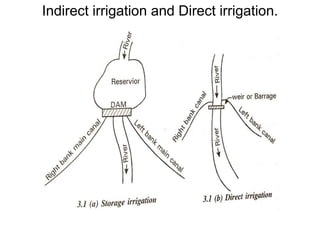
Indirect irrigation and Direct irrigation.
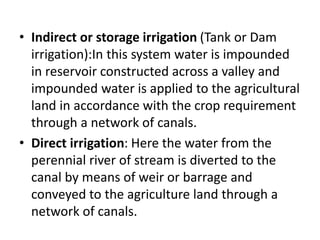
• Indirect or storage irrigation (Tank or Dam
irrigation):In this system water is impounded
in reservoir constructed across a valley and
impounded water is applied to the agricultural
land in accordance with the crop requirement
through a network of canals.
• Direct irrigation: Here the water from the
perennial river of stream is diverted to the
canal by means of weir or barrage and
conveyed to the agriculture land through a
network of canals.
Inundation or flood irrigation
• In this system of irrigation the flood water from
a river is diverted to the culturable land by
means of a canal. As the flood water contains
rich alluvial soil or silt, the fertility of land
increases and thus become an advantage to
the cultivators.
• This is possible during the flood season. So, this
system of irrigation depends completely on the
water level of the river. As there is no regulator
at the at the head of the canal, over irrigation
is possible resulting in damaging the crops.
Advantages
• The cost of inundation canal is less.
• As the water supplied by inundation canals
contains silt and fine sand, it helps to
improves the fertility of the soil of the
agriculture fields.
• Since inundation canal cannot supply water
throughout year, the problem of water logging
usually does not arise.
Disadvantages
• The water supply available from this system is
variable and reliable.
• Silting of the canal is most common trouble.
• As there are no head works the off-take point or
the head of the canal are liable to be damaged
during floods.
• These canals will have to be of large size to supply
the requirement of water within a limited time.
• The supply in these canals being only during the
floods, the supply is not regular which may cause
dissatisfaction among the farmers.
• Duty of water achieved for the inundation system
very low.
2. Lift Irrigation
• When available water is at lower level than
the agricultural land, the water has to be lifted
by pumps and other lifting device and thus
the method of irrigation is called lift irrigation.
• Ex: (a) Water lifted from underground sources.
Such as open well and tube wells.
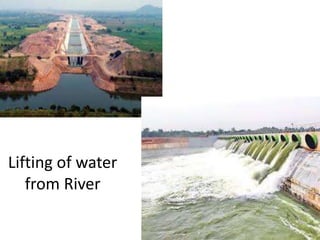
(b) water is lifted from river (which is at lower
level) to higher level of land.
Lifting of water
from River
Advantages
1. Well can be supply water whenever needed for irrigation purposes.
2. The wells are helpful in reducing the level of water table thus
minimizing the chances of water logging.
3. The well supply water directly to the field, thus reducing losses.
4. The wells gives more duty of water.
5. The cost of well irrigation project is less when compare to canal
irrigation which requires construction of many hydraulic structures like
dams or weir, etc.
6. Because of assured supply of water two or three crops can be grown in
a same field in a year.
7. Maintenance cost in flow irrigation is higher than lift irrigation.
8. Water of lift irrigation is cooler in hot season and warmer in cold season
which is favourable for growth of crops.
9. Loss of valuable land is higher in flow irrigation than lift irrigation as
flow irrigation covers a large area in canal network and reservoir area.
Disadvantages
• Water has to be lifted from well, this requires the use of
power. Thus, the well irrigation is depending on the
availability and efficient working of machines.
• In dry or winter season, water tables falls considerably
below the suction head, hence pump may fail to lift water
from the underground. But in flow irrigation of perennial
type or with stored reservoir, water is available all the
season of years.
• The quantity of water in case of lift irrigation depends
upon the ground water storage.
• The water in the well does not contains any useful salt
and fine salt and fine silt which are beneficial to the
growth of the crops. The canal water in this respect is
better.
• Yield of crop in flow irrigation is more than lift irrigation
water.
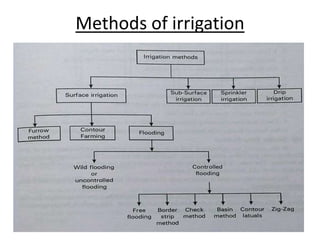
Methods of irrigation
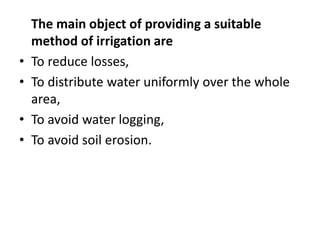
The main object of providing a suitable
method of irrigation are
• To reduce losses,
• To distribute water uniformly over the whole
area,
• To avoid water logging,
• To avoid soil erosion.
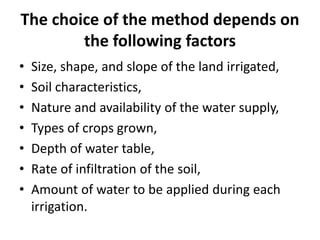
The choice of the method depends on
the following factors
• Size, shape, and slope of the land irrigated,
• Soil characteristics,
• Nature and availability of the water supply,
• Types of crops grown,
• Depth of water table,
• Rate of infiltration of the soil,
• Amount of water to be applied during each
irrigation.
Surface Irrigation
In all the surface methods of irrigation, water is
either ponded on the soil or allowed to
continuously over the soil surface for the
duration of irrigation.
Advantages:
• It helps in storing required amount of water in
the root-zone depth.
• Allows use of machinery for land preparation,
cultivation and harvesting
• It helps uniform application of water to fields. 4.
Amount of manual labour required is minimum.
Disadvantages:
• Water is lost in infiltration and deep
percolation.
• Less efficiency due to less control over the
water flow.
• Inferior quality crops with a low yield.
• Costly and time-consuming preparation of
land.
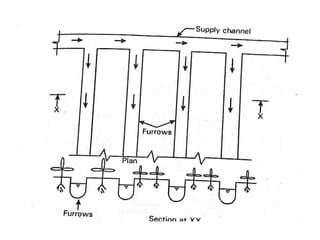
Furrow method
This method is useful for row crops such as
potatoes, sugarcane, tobacco, maize,
Groundnut, cotton, jowar, etc. Furrows are
small channels having a continuous and
almost uniform slopes in the direction of
irrigation.
Water from furrows infiltrates into the soil and
spreads laterally to saturates the root zones of
crops. Length of furrows may varies from
10metres to as much as 500metres.
FURROW METHOD
Row crops such as potatoes, cotton, sugarcane, vegetable etc. can be
irrigated by furrow method. Water is allowed to flow in furrow opened in
crop rows. It is suitable for sloppy lands where the furrows are made along
contours. The length of furrow is determined mostly by soil permeability.
It varies from 3 to 6 meters. In sandy and clay loams, the length is shorter
than in clay and clay loams. Water does not come in contact with the plant
stems. There is a great economy in use of water. Some times, even in
furrow irrigation the field is divided into beds having alternate rides and
furrows. On slopes of 1 to 3 percent, furrow irrigation with straight
furrows is quite successful. But on steeper slopes contour furrows, not
only check erosion but ensure uniform water penetration.
ADAPTATIONS
1) Medium and fine textured soils
2) Variable water supply
3) Farms with only small amount of equipment
FURROW METHOD
ADVANTAGES
1) High water efficiency
2) Can be used in any row crop
3) Relatively easy install
4) Not expensive to maintain
5) Adapted to most soils
DISADVANTAGES
1) Requirement of skilled labor is more
2) A hazard to operation of machinery
3) Drainage must be provided
Advantages
• Less water is required.
• Evaporation loss is less.
• Labour requirements for land preparation and
irrigation are less.
• It is suitable for row crops
Disadvantages
• Possibility of increased salinity between
furrows
• Adequate drainage needs to be provided
• Not suitable for very light soils having low
infiltration capacity
CONTOUR FARMING
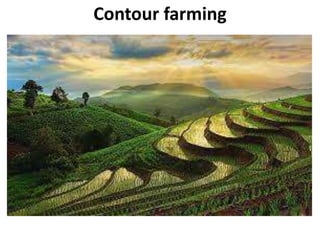
Contour farming
Contour farming
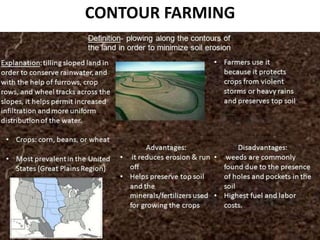
Contour farming, the practice of tilling sloped
land along lines of consistent elevation in
order to conserve rainwater and to
reduce soil losses from surface erosion.
These objectives are achieved by means of
furrows, crop rows, and wheel tracks across
slopes, all of which act as reservoirs to catch
and retain rainwater, thus permitting
increased infiltration and more uniform
distribution of the water.
FLOODING
It consist of opening a water channel in a plot or field so that water can flow
freely in all directions and cover the surface of the land in a continuous
sheet. It is the most inefficient method of irrigation as only about 20
percent of the water is actually used by plants. The rest being lost as a
runoff, seepage and evaporation. Water distribution is very uneven and
crop growth is not uniform. It is suitable for uneven land where the cost of
leveling is high and where a cheap and abundant supply of water is
available. It is unsuitable for crops that are sensitive to water logging. The
method is suitable where broadcast crops, particularly pastures, alfalfa,
peas and small grains are produced.
ADAPTATIONS
(1) An abundant supply of water
(2) Close growing crops
(3) Soils that do not erode easily
(4) Soils that is permeable
(5) Irregular topography
(6) Areas where water is cheap
FLOODING
ADVANTAGES
(1) Can be used on shallow soils
(2) Can be employed where expense of leveling is great
(3) Installation and operation costs are low
(4) System is not damaged by livestock and does not interfere with use of
farm implements
DISADVANTAGES
(1) Excessive loss of water by run of and deep percolation
(2) Excessive soil erosion on step land
(3) Fertilizers and FYM are eroded from the soil
Border strip method
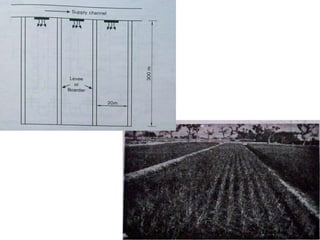
Border flooding. In this method, the land is divided into a number of
strips, separated by low levees called borders. The land areas confined
in each strip is of the order of 10 to 20 meters in width, and 100 to
400 meters in length, as shown in Fig. Ridges between borders should
be sufficiently high to prevent overtopping during irrigation. To
prevent water from concentrating on either side of the border, the
land should be leveled perpendicular to the flow. Water is made to
flow from the supply ditch into each strip. The water flows slowly
towards the lower end, and infiltrates into the soil as it advances.
When the advancing water reaches the lower end of the strip, the
supply of water to the strip is turned off. The border strip method is
suited to soils of moderately low to moderately high intake rates and
low erodibility. This method is suitable for all types of crops except
those which require prolonged flooding which, in this case, is difficult
to maintain because of the slope. This method, however, requires
preparation of land involving high initial cost.
Border strip method
Advantages:
• Utilizes large water streams safely.
• Requires less Laboure and time;
• low maintenance cost.
• Provides uniform wetting and efficient use of
water.
Disadvantages:
• Requires proper leveling.
• High initial cost.
• A large supply of water is needed.
BED OR BORDER METHOD
In this method the field is leveled and divided into small beds surrounded
by bunds of 15 to 30 cm high. Small irrigation channels are provided
between two adjacent rows of beds. The length of the bed varies from 30
meters for loamy soils to 90 meters for clayey soils. The width is so
adjusted as to permit the water to flow evenly and wet the land uniformly.
For high value crops, the beds may be still smaller especially where water
is costly and not very abundant. This method is adaptable to most soil
textures except sandy soils and is suitable for high value crops. It requires
leveled land. It is more efficient in the use of water and ensures its
uniform application. It is suitable for crops plant in lines. Through the
initial cost is high, requires less labor and low maintenance cost.
BED OR BORDER METHOD
ADAPTATIONS
(1) A large supply of water
(2) Most soil textures
(3) Soil at least 90 cm deep
(4) Suitable for close growing crops
ADVANTAGES
(1) Fairly large supply of water is needed
(2) Land must be leveled
(3) Suited only to soils that do not readily disperse
(4) Drainage must be provided
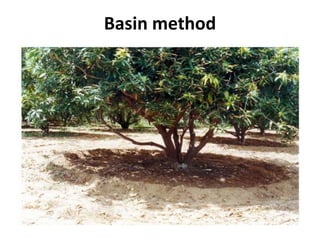
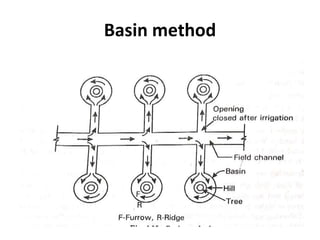
Basin method
• This method is frequently used to irrigate
orchards. Circular channel known as basin is
made for each tree. Sometimes two or more
trees placed in one basin and the each basin is
connected to field channel which is connected
to supply channel. When all the basins are
filled with water, the supply is stopped.
Basin method
Basin method
BASIN IRRIGATION
This method is suitable for orchids and other high value crops where the size
of the plot to be irrigated is very small. The basin may be square, rectangular
or circular shape. Basin irrigation also requires leveled land and not suitable
for all types of soil. It is also efficient in the use of water but its initial cost is
high.
BASIN IRRIGATION
ADAPTATIONS
1) Most soil texture
2) High value crops
3) Smooth topography
4) High water value/ha
ADVANTAGES
1) Varying supply of water
2) No water loss by run off
3) Rapid irrigation possible
4) No loss of fertilizers and organic manures
5) Satisfactory
DISADVANTAGES
1) If land is not leveled initial cost may be high
2) Suitable mainly for orchids, rice, jute, etc.
3) Except rice, not suitable for soils that disperse easily and readily from a
crust
Wild flooding
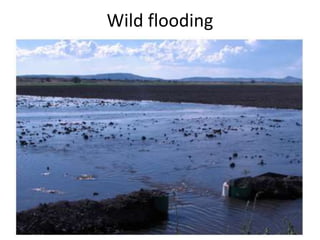
• It consists of applying water to the field
without any bunds to guide the flow of water
wetting the soil surface completely. Generally
it is practiced only when irrigation water is
abundant and where land levelling is not
followed.
• Sometimes it is also adopted in the initial
stages of land development. This method is
most commonly used for irrigation of crops
sown by broadcasting method viz., rice, low
value pastures, lawns and millets etc.
Advantages & Disadvantages
Advantages:
• 1. No land levelling & land shaping required
• 2. Low labour and land preparation costs
• 3. Less skill required by irrigator
Disadvantages:
• 1. Applied water is lost by deep percolation &
surface runoff
• 2. Low irrigation application efficiency
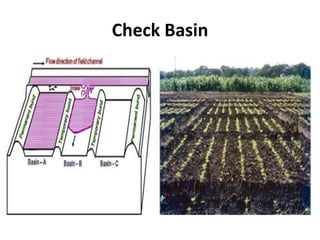
Check Basin
• The size of check basins may vary from one
meters square, used for growing vegetables
and other intensive cultivation, to as large as
one or two hectares or more, used for growing
rice under wet land conditions. The shape and
design of basins generally depends on the
topography of the area it is being designed for.
Check basins can be further divided into
rectangular and contour types.
Advantages:
1. Water can be applied uniformly.
2. Even small streams can be used for irrigation of
crops efficiently.
3. Simple and cheap when equipment is used for
constructing bunds
Disadvantages:
1. Unless the land is levelled, distribution of water in
plot is uneven.
2. Considerable area is lost under field channels and
bunds i.e. nearly 30% of area.
3. Bunds interfere in working of inter-cultivation
equipment
4. More labour is required for field layout and
irrigation
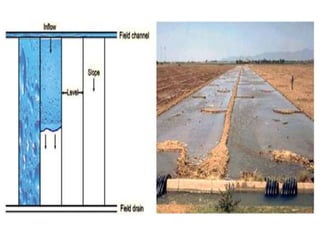
Border Irrigation Method
• In case of border irrigation, the field is divided into a
number of long parallel strips, generally 5 to 15 m in
width and 75 to 300 m in length separated by small
border ridges or low dykes of about 15 cm.
• Irrigation water is released into each strip connected
directly to irrigation channel situated at the upstream
end of the border strip. The sheet of water advances
towards the downstream (Fig30.6).After sufficient
water is applied to one strip, the irrigation stream is
turned into another strip. A specific requirement in
border irrigation is that the longitudinal slope must be
uniform, and the transverse slope must be zero or
negligible (< 0.03%). This method is suitable for
irrigating a wide variety of close growing crops such as
wheat, barley, groundnut, bajra and berseem.
Advantages:
1. Large water streams can be used safely
2. Provides uniform wetting of soil profile
3. Low labour requirement
Disadvantages:
1. Requires relatively large water streams for quick
advance of water to minimize deep percolation
losses at the upper end of the border strip.
2. Wastage of water by deep percolation in coarse
textured soils.
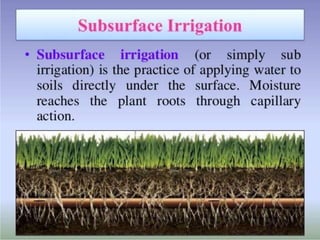
Sub surface irrigation
• Method of applying of water to fields below
the ground surface so that it is supplied
directly to the root zone of the plants is
known as sub surface irrigation. Here,
moisture reaches the roots through capillary
action.
SUBSURFACE METHOD
• Subsurface irrigation or sub-irrigation may be natural or artificial. Natural
sub surface irrigation is possible where an impervious layer exists below
the root zone. Water is allowed in to series of ditches dug up to the
impervious layer, which then moves laterally and wets root zone.
• In artificial sub surface irrigation, perforated or porous pipes are laid out
underground below the root zone and water is led into the pipes by
suitable means. In either case, the idea is to raise the water by capillary
movement. The method involves initial high cost, but maintenance is very
cheap. There is a risk of soil getting saline or alkaline and neighboring land
damaged due to heavy seepage.
• It is very efficient in the use of water as evaporation is cut off almost
completely. The plant roots do not suffer from logging, there is no loss of
agricultural land in laying out irrigation system and implements can be
worked out freely. This method is however rarely noticed in our country
but followed in other countries like Israel.
The condition which favors sub
surface irrigation are as follows
• Impervious sub soil at a depth of 2metres or
more.
• A very permeable subsoil
• A permeable loam or sandy loam surface soil
• Uniform topographic conditions.
• Moderate ground slopes.
Natural subsurface irrigation: In this method
water reaches below the land surface from
natural sources of water such as streams, ponds,
etc.
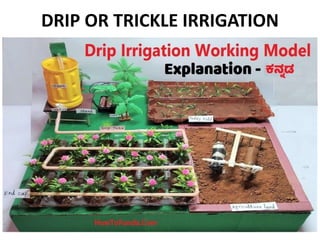
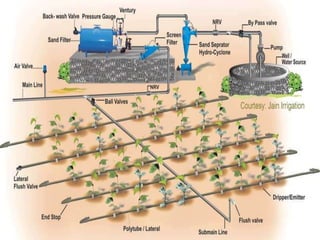
DRIP OR TRICKLE IRRIGATION
It involves slow application of water to the root zone. The drip irrigation
system consist of
1) Head
2) Main line and sub line
3) Lateral lines
4) Drip nozzles
The head consists of a pump to lift water and produce the desired
pressure (about 2.5 atmosphere) and to distribute water through nozzles.
A fertilizer tank for applying fertilizer solution directly to the field along
with the irrigation water and filter which cleans the suspended impurities
in irrigation water to prevent the blockage of holes and passage of drip
and nozzles.
DRIP OR TRICKLE IRRIGATION
• Mains and sub mains are normally of flexible material such as black PVC pipes.
Laterals are normally laid parallel to each other. Lateral lines can be up to
about 50 meters long and are usually 1.2 cm diameter black plastic tubing.
There is usually one lateral line for each crop row. By laying the main line along
the center line of the field, it is possible to irrigate either side of the field
alternately by shifting the laterals. A pressure drop of 10 percent is permitted
between the ends of lateral.
• Drip nozzles are also known as emitters or values and are fixed at regular
intervals in the laterals. These PVC values allow water to flow at the extremely
slow rates, ranging from 2 to 11 liters per hour and they are of different shapes
and design.
• The spacing between laterals is controlled by the row-to-row spacing of the
crop to be irrigated. Drip laterals laid on soil surface are buried underground at
the depth of 5 to 10 cm.
DRIP OR TRICKLE IRRIGATION
ADVANTAGES
1) The losses by drip irrigation and evaporation are minimized
2) Precise amount of water is applied to replenish the depleted soil moisture
at frequent intervals for optimum plant growth
3) The system enables the application of water fertilizers at an optimum rate
to the plant root system
4) The amount of water supplied to the soil is almost equal to the daily
consumptive use, thus maintaining a low moisture tension in soil
DISADVANTAGES
1) The initial cost of the drip irrigation for large-scale irrigation is its main
limitation.
2) The cost of the unit per hectare depends mainly on the spacing of the
crop.
3) For widely spaced crops like fruit trees, the system may be even more
economical than sprinkler.
SPRINKLER OR OVERHEAD
IRRIGATION
SPRINKLER OR OVERHEAD
IRRIGATION
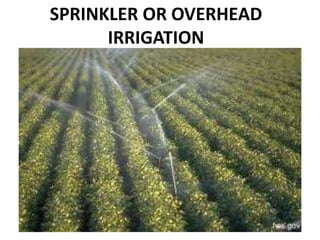
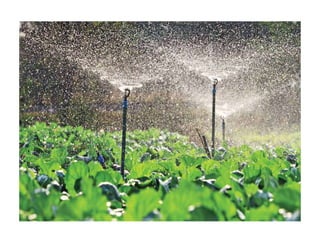
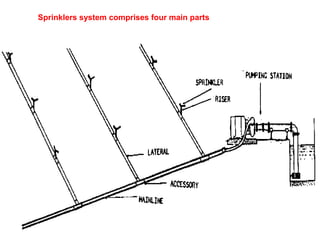
• This method consists of application of water to soil in the form of spray,
somewhat as rain. It is particularly useful for sandy soils because they
absorb water too fast. Soils that are too shallow, too steep or rolling can
be irrigated efficiently with sprinklers.
• This method is suitable for areas having uneven topography and where
erosion hazards are great.
• In sprinkler irrigation, water is conveyed under pressure through pipes to
the area to be irrigated where it is passed out through or sprinklers the
system comprises four main parts:
i. Power generator
ii. Pump
iii. Pipeline and
iv. Sprinkler
Sprinklers system comprises four main parts
SPRINKLER OR OVERHEAD
IRRIGATION
ADAPTATIONS
1) A dependable supply of water
2) Uneven topography
3) Shallow soils
4) Close growing crops
SPRINKLER OR OVERHEAD
IRRIGATION
ADVANTAGES
1) It ensures uniform distribution of water
2) It is adaptable to most kinds of soil
3) It offers no hindrance to the use of farm implements
4) Fertilizers material may be evenly applied through sprinklers. This is done by
drawing liquid fertilizer solution slowly in to the pipes on the suction side of
the pump so that the time of application varies from 10 to 30 minutes
5) Water losses are reduced to a minimum extent
6) More land can be irrigated
7) Costly land leveling operations are not necessary and
8) The amount of water can be controlled to meet the needs of young seedling
or mature crops.
SPRINKLER OR OVERHEAD
IRRIGATION
DISADVANTAGES
• The initial cost is rather very high.
• Any cost of power to provide pressure must be added to the irrigation
charges.
• Wind interferes with the distribution pattern, reducing spread or
increasing application rate near lateral pipe.
• There is often trouble from clogged nozzle or the failure of sprinklers to
revolve.
• The cost of operations and maintenance is very high. Labor requirement
for moving a pipe and related work approximately nearly one hour per
irrigation.
• It is suitable for high value crops.
THE END

irrigation methods.ppt

  • 1.
  • 2.
    Irrigation system Following aretwo systems of Irrigation: 1. Gravity or Flow irrigation. 2. Lift Irrigation. • 1. Gravity or Flow irrigation: In this system of irrigation the water available at higher level is conveyed to the agricultural land at lower level by means of gravity. • It can be further classified into the two types: (i) Perennial irrigation and (ii) Inundation irrigation.
  • 3.
    (i) Perennial irrigation •(i) Perennial irrigation: In which definite quantity of water supplied continuously to the field as per requirement of crops. In this this system it is possible to rise the perennial crops like sugarcane which requires water throughout the year. All important irrigation system are perennial irrigation systems. It is the most commonly used irrigation system. The perennial irrigation is sub classified as; (a) Indirect or storage irrigation (Tank or Dam irrigation). (b) Direct irrigation.
  • 4.
    Indirect irrigation andDirect irrigation.
  • 5.
    • Indirect orstorage irrigation (Tank or Dam irrigation):In this system water is impounded in reservoir constructed across a valley and impounded water is applied to the agricultural land in accordance with the crop requirement through a network of canals. • Direct irrigation: Here the water from the perennial river of stream is diverted to the canal by means of weir or barrage and conveyed to the agriculture land through a network of canals.
  • 6.
    Inundation or floodirrigation • In this system of irrigation the flood water from a river is diverted to the culturable land by means of a canal. As the flood water contains rich alluvial soil or silt, the fertility of land increases and thus become an advantage to the cultivators. • This is possible during the flood season. So, this system of irrigation depends completely on the water level of the river. As there is no regulator at the at the head of the canal, over irrigation is possible resulting in damaging the crops.
  • 7.
    Advantages • The costof inundation canal is less. • As the water supplied by inundation canals contains silt and fine sand, it helps to improves the fertility of the soil of the agriculture fields. • Since inundation canal cannot supply water throughout year, the problem of water logging usually does not arise.
  • 8.
    Disadvantages • The watersupply available from this system is variable and reliable. • Silting of the canal is most common trouble. • As there are no head works the off-take point or the head of the canal are liable to be damaged during floods. • These canals will have to be of large size to supply the requirement of water within a limited time. • The supply in these canals being only during the floods, the supply is not regular which may cause dissatisfaction among the farmers. • Duty of water achieved for the inundation system very low.
  • 9.
    2. Lift Irrigation •When available water is at lower level than the agricultural land, the water has to be lifted by pumps and other lifting device and thus the method of irrigation is called lift irrigation. • Ex: (a) Water lifted from underground sources. Such as open well and tube wells. (b) water is lifted from river (which is at lower level) to higher level of land.
  • 10.
  • 11.
    Advantages 1. Well canbe supply water whenever needed for irrigation purposes. 2. The wells are helpful in reducing the level of water table thus minimizing the chances of water logging. 3. The well supply water directly to the field, thus reducing losses. 4. The wells gives more duty of water. 5. The cost of well irrigation project is less when compare to canal irrigation which requires construction of many hydraulic structures like dams or weir, etc. 6. Because of assured supply of water two or three crops can be grown in a same field in a year. 7. Maintenance cost in flow irrigation is higher than lift irrigation. 8. Water of lift irrigation is cooler in hot season and warmer in cold season which is favourable for growth of crops. 9. Loss of valuable land is higher in flow irrigation than lift irrigation as flow irrigation covers a large area in canal network and reservoir area.
  • 12.
    Disadvantages • Water hasto be lifted from well, this requires the use of power. Thus, the well irrigation is depending on the availability and efficient working of machines. • In dry or winter season, water tables falls considerably below the suction head, hence pump may fail to lift water from the underground. But in flow irrigation of perennial type or with stored reservoir, water is available all the season of years. • The quantity of water in case of lift irrigation depends upon the ground water storage. • The water in the well does not contains any useful salt and fine salt and fine silt which are beneficial to the growth of the crops. The canal water in this respect is better. • Yield of crop in flow irrigation is more than lift irrigation water.
  • 13.
  • 14.
    The main objectof providing a suitable method of irrigation are • To reduce losses, • To distribute water uniformly over the whole area, • To avoid water logging, • To avoid soil erosion.
  • 15.
    The choice ofthe method depends on the following factors • Size, shape, and slope of the land irrigated, • Soil characteristics, • Nature and availability of the water supply, • Types of crops grown, • Depth of water table, • Rate of infiltration of the soil, • Amount of water to be applied during each irrigation.
  • 16.
    Surface Irrigation In allthe surface methods of irrigation, water is either ponded on the soil or allowed to continuously over the soil surface for the duration of irrigation. Advantages: • It helps in storing required amount of water in the root-zone depth. • Allows use of machinery for land preparation, cultivation and harvesting • It helps uniform application of water to fields. 4. Amount of manual labour required is minimum.
  • 17.
    Disadvantages: • Water islost in infiltration and deep percolation. • Less efficiency due to less control over the water flow. • Inferior quality crops with a low yield. • Costly and time-consuming preparation of land.
  • 18.
    Furrow method This methodis useful for row crops such as potatoes, sugarcane, tobacco, maize, Groundnut, cotton, jowar, etc. Furrows are small channels having a continuous and almost uniform slopes in the direction of irrigation. Water from furrows infiltrates into the soil and spreads laterally to saturates the root zones of crops. Length of furrows may varies from 10metres to as much as 500metres.
  • 20.
    FURROW METHOD Row cropssuch as potatoes, cotton, sugarcane, vegetable etc. can be irrigated by furrow method. Water is allowed to flow in furrow opened in crop rows. It is suitable for sloppy lands where the furrows are made along contours. The length of furrow is determined mostly by soil permeability. It varies from 3 to 6 meters. In sandy and clay loams, the length is shorter than in clay and clay loams. Water does not come in contact with the plant stems. There is a great economy in use of water. Some times, even in furrow irrigation the field is divided into beds having alternate rides and furrows. On slopes of 1 to 3 percent, furrow irrigation with straight furrows is quite successful. But on steeper slopes contour furrows, not only check erosion but ensure uniform water penetration. ADAPTATIONS 1) Medium and fine textured soils 2) Variable water supply 3) Farms with only small amount of equipment
  • 21.
    FURROW METHOD ADVANTAGES 1) Highwater efficiency 2) Can be used in any row crop 3) Relatively easy install 4) Not expensive to maintain 5) Adapted to most soils DISADVANTAGES 1) Requirement of skilled labor is more 2) A hazard to operation of machinery 3) Drainage must be provided
  • 22.
    Advantages • Less wateris required. • Evaporation loss is less. • Labour requirements for land preparation and irrigation are less. • It is suitable for row crops Disadvantages • Possibility of increased salinity between furrows • Adequate drainage needs to be provided • Not suitable for very light soils having low infiltration capacity
  • 23.
  • 24.
  • 25.
    Contour farming Contour farming,the practice of tilling sloped land along lines of consistent elevation in order to conserve rainwater and to reduce soil losses from surface erosion. These objectives are achieved by means of furrows, crop rows, and wheel tracks across slopes, all of which act as reservoirs to catch and retain rainwater, thus permitting increased infiltration and more uniform distribution of the water.
  • 26.
    FLOODING It consist ofopening a water channel in a plot or field so that water can flow freely in all directions and cover the surface of the land in a continuous sheet. It is the most inefficient method of irrigation as only about 20 percent of the water is actually used by plants. The rest being lost as a runoff, seepage and evaporation. Water distribution is very uneven and crop growth is not uniform. It is suitable for uneven land where the cost of leveling is high and where a cheap and abundant supply of water is available. It is unsuitable for crops that are sensitive to water logging. The method is suitable where broadcast crops, particularly pastures, alfalfa, peas and small grains are produced. ADAPTATIONS (1) An abundant supply of water (2) Close growing crops (3) Soils that do not erode easily (4) Soils that is permeable (5) Irregular topography (6) Areas where water is cheap
  • 27.
    FLOODING ADVANTAGES (1) Can beused on shallow soils (2) Can be employed where expense of leveling is great (3) Installation and operation costs are low (4) System is not damaged by livestock and does not interfere with use of farm implements DISADVANTAGES (1) Excessive loss of water by run of and deep percolation (2) Excessive soil erosion on step land (3) Fertilizers and FYM are eroded from the soil
  • 28.
    Border strip method Borderflooding. In this method, the land is divided into a number of strips, separated by low levees called borders. The land areas confined in each strip is of the order of 10 to 20 meters in width, and 100 to 400 meters in length, as shown in Fig. Ridges between borders should be sufficiently high to prevent overtopping during irrigation. To prevent water from concentrating on either side of the border, the land should be leveled perpendicular to the flow. Water is made to flow from the supply ditch into each strip. The water flows slowly towards the lower end, and infiltrates into the soil as it advances. When the advancing water reaches the lower end of the strip, the supply of water to the strip is turned off. The border strip method is suited to soils of moderately low to moderately high intake rates and low erodibility. This method is suitable for all types of crops except those which require prolonged flooding which, in this case, is difficult to maintain because of the slope. This method, however, requires preparation of land involving high initial cost.
  • 29.
    Border strip method Advantages: •Utilizes large water streams safely. • Requires less Laboure and time; • low maintenance cost. • Provides uniform wetting and efficient use of water. Disadvantages: • Requires proper leveling. • High initial cost. • A large supply of water is needed.
  • 31.
    BED OR BORDERMETHOD In this method the field is leveled and divided into small beds surrounded by bunds of 15 to 30 cm high. Small irrigation channels are provided between two adjacent rows of beds. The length of the bed varies from 30 meters for loamy soils to 90 meters for clayey soils. The width is so adjusted as to permit the water to flow evenly and wet the land uniformly. For high value crops, the beds may be still smaller especially where water is costly and not very abundant. This method is adaptable to most soil textures except sandy soils and is suitable for high value crops. It requires leveled land. It is more efficient in the use of water and ensures its uniform application. It is suitable for crops plant in lines. Through the initial cost is high, requires less labor and low maintenance cost.
  • 32.
    BED OR BORDERMETHOD ADAPTATIONS (1) A large supply of water (2) Most soil textures (3) Soil at least 90 cm deep (4) Suitable for close growing crops ADVANTAGES (1) Fairly large supply of water is needed (2) Land must be leveled (3) Suited only to soils that do not readily disperse (4) Drainage must be provided
  • 33.
    Basin method • Thismethod is frequently used to irrigate orchards. Circular channel known as basin is made for each tree. Sometimes two or more trees placed in one basin and the each basin is connected to field channel which is connected to supply channel. When all the basins are filled with water, the supply is stopped.
  • 34.
  • 35.
  • 36.
    BASIN IRRIGATION This methodis suitable for orchids and other high value crops where the size of the plot to be irrigated is very small. The basin may be square, rectangular or circular shape. Basin irrigation also requires leveled land and not suitable for all types of soil. It is also efficient in the use of water but its initial cost is high.
  • 37.
    BASIN IRRIGATION ADAPTATIONS 1) Mostsoil texture 2) High value crops 3) Smooth topography 4) High water value/ha ADVANTAGES 1) Varying supply of water 2) No water loss by run off 3) Rapid irrigation possible 4) No loss of fertilizers and organic manures 5) Satisfactory DISADVANTAGES 1) If land is not leveled initial cost may be high 2) Suitable mainly for orchids, rice, jute, etc. 3) Except rice, not suitable for soils that disperse easily and readily from a crust
  • 38.
  • 39.
    • It consistsof applying water to the field without any bunds to guide the flow of water wetting the soil surface completely. Generally it is practiced only when irrigation water is abundant and where land levelling is not followed. • Sometimes it is also adopted in the initial stages of land development. This method is most commonly used for irrigation of crops sown by broadcasting method viz., rice, low value pastures, lawns and millets etc.
  • 40.
    Advantages & Disadvantages Advantages: •1. No land levelling & land shaping required • 2. Low labour and land preparation costs • 3. Less skill required by irrigator Disadvantages: • 1. Applied water is lost by deep percolation & surface runoff • 2. Low irrigation application efficiency
  • 41.
  • 42.
    • The sizeof check basins may vary from one meters square, used for growing vegetables and other intensive cultivation, to as large as one or two hectares or more, used for growing rice under wet land conditions. The shape and design of basins generally depends on the topography of the area it is being designed for. Check basins can be further divided into rectangular and contour types.
  • 43.
    Advantages: 1. Water canbe applied uniformly. 2. Even small streams can be used for irrigation of crops efficiently. 3. Simple and cheap when equipment is used for constructing bunds Disadvantages: 1. Unless the land is levelled, distribution of water in plot is uneven. 2. Considerable area is lost under field channels and bunds i.e. nearly 30% of area. 3. Bunds interfere in working of inter-cultivation equipment 4. More labour is required for field layout and irrigation
  • 44.
    Border Irrigation Method •In case of border irrigation, the field is divided into a number of long parallel strips, generally 5 to 15 m in width and 75 to 300 m in length separated by small border ridges or low dykes of about 15 cm. • Irrigation water is released into each strip connected directly to irrigation channel situated at the upstream end of the border strip. The sheet of water advances towards the downstream (Fig30.6).After sufficient water is applied to one strip, the irrigation stream is turned into another strip. A specific requirement in border irrigation is that the longitudinal slope must be uniform, and the transverse slope must be zero or negligible (< 0.03%). This method is suitable for irrigating a wide variety of close growing crops such as wheat, barley, groundnut, bajra and berseem.
  • 46.
    Advantages: 1. Large waterstreams can be used safely 2. Provides uniform wetting of soil profile 3. Low labour requirement Disadvantages: 1. Requires relatively large water streams for quick advance of water to minimize deep percolation losses at the upper end of the border strip. 2. Wastage of water by deep percolation in coarse textured soils.
  • 47.
    Sub surface irrigation •Method of applying of water to fields below the ground surface so that it is supplied directly to the root zone of the plants is known as sub surface irrigation. Here, moisture reaches the roots through capillary action.
  • 48.
    SUBSURFACE METHOD • Subsurfaceirrigation or sub-irrigation may be natural or artificial. Natural sub surface irrigation is possible where an impervious layer exists below the root zone. Water is allowed in to series of ditches dug up to the impervious layer, which then moves laterally and wets root zone. • In artificial sub surface irrigation, perforated or porous pipes are laid out underground below the root zone and water is led into the pipes by suitable means. In either case, the idea is to raise the water by capillary movement. The method involves initial high cost, but maintenance is very cheap. There is a risk of soil getting saline or alkaline and neighboring land damaged due to heavy seepage. • It is very efficient in the use of water as evaporation is cut off almost completely. The plant roots do not suffer from logging, there is no loss of agricultural land in laying out irrigation system and implements can be worked out freely. This method is however rarely noticed in our country but followed in other countries like Israel.
  • 50.
    The condition whichfavors sub surface irrigation are as follows • Impervious sub soil at a depth of 2metres or more. • A very permeable subsoil • A permeable loam or sandy loam surface soil • Uniform topographic conditions. • Moderate ground slopes. Natural subsurface irrigation: In this method water reaches below the land surface from natural sources of water such as streams, ponds, etc.
  • 51.
    DRIP OR TRICKLEIRRIGATION
  • 53.
    DRIP OR TRICKLEIRRIGATION It involves slow application of water to the root zone. The drip irrigation system consist of 1) Head 2) Main line and sub line 3) Lateral lines 4) Drip nozzles The head consists of a pump to lift water and produce the desired pressure (about 2.5 atmosphere) and to distribute water through nozzles. A fertilizer tank for applying fertilizer solution directly to the field along with the irrigation water and filter which cleans the suspended impurities in irrigation water to prevent the blockage of holes and passage of drip and nozzles.
  • 54.
    DRIP OR TRICKLEIRRIGATION • Mains and sub mains are normally of flexible material such as black PVC pipes. Laterals are normally laid parallel to each other. Lateral lines can be up to about 50 meters long and are usually 1.2 cm diameter black plastic tubing. There is usually one lateral line for each crop row. By laying the main line along the center line of the field, it is possible to irrigate either side of the field alternately by shifting the laterals. A pressure drop of 10 percent is permitted between the ends of lateral. • Drip nozzles are also known as emitters or values and are fixed at regular intervals in the laterals. These PVC values allow water to flow at the extremely slow rates, ranging from 2 to 11 liters per hour and they are of different shapes and design. • The spacing between laterals is controlled by the row-to-row spacing of the crop to be irrigated. Drip laterals laid on soil surface are buried underground at the depth of 5 to 10 cm.
  • 55.
    DRIP OR TRICKLEIRRIGATION ADVANTAGES 1) The losses by drip irrigation and evaporation are minimized 2) Precise amount of water is applied to replenish the depleted soil moisture at frequent intervals for optimum plant growth 3) The system enables the application of water fertilizers at an optimum rate to the plant root system 4) The amount of water supplied to the soil is almost equal to the daily consumptive use, thus maintaining a low moisture tension in soil DISADVANTAGES 1) The initial cost of the drip irrigation for large-scale irrigation is its main limitation. 2) The cost of the unit per hectare depends mainly on the spacing of the crop. 3) For widely spaced crops like fruit trees, the system may be even more economical than sprinkler.
  • 56.
  • 58.
    SPRINKLER OR OVERHEAD IRRIGATION •This method consists of application of water to soil in the form of spray, somewhat as rain. It is particularly useful for sandy soils because they absorb water too fast. Soils that are too shallow, too steep or rolling can be irrigated efficiently with sprinklers. • This method is suitable for areas having uneven topography and where erosion hazards are great. • In sprinkler irrigation, water is conveyed under pressure through pipes to the area to be irrigated where it is passed out through or sprinklers the system comprises four main parts: i. Power generator ii. Pump iii. Pipeline and iv. Sprinkler
  • 59.
  • 60.
    SPRINKLER OR OVERHEAD IRRIGATION ADAPTATIONS 1)A dependable supply of water 2) Uneven topography 3) Shallow soils 4) Close growing crops
  • 61.
    SPRINKLER OR OVERHEAD IRRIGATION ADVANTAGES 1)It ensures uniform distribution of water 2) It is adaptable to most kinds of soil 3) It offers no hindrance to the use of farm implements 4) Fertilizers material may be evenly applied through sprinklers. This is done by drawing liquid fertilizer solution slowly in to the pipes on the suction side of the pump so that the time of application varies from 10 to 30 minutes 5) Water losses are reduced to a minimum extent 6) More land can be irrigated 7) Costly land leveling operations are not necessary and 8) The amount of water can be controlled to meet the needs of young seedling or mature crops.
  • 62.
    SPRINKLER OR OVERHEAD IRRIGATION DISADVANTAGES •The initial cost is rather very high. • Any cost of power to provide pressure must be added to the irrigation charges. • Wind interferes with the distribution pattern, reducing spread or increasing application rate near lateral pipe. • There is often trouble from clogged nozzle or the failure of sprinklers to revolve. • The cost of operations and maintenance is very high. Labor requirement for moving a pipe and related work approximately nearly one hour per irrigation. • It is suitable for high value crops.
  • 63.