Methods of Irrigation
Prepared by:-Er. Krishna Sedai
Agricultural Engineer
IOE, TU, Nepal
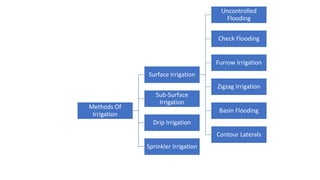
Methods Of
Irrigation
Surface Irrigation
Uncontrolled
Flooding
Check Flooding
Furrow Irrigation
Zigzag Irrigation
Basin Flooding
Contour Laterals
Sub-Surface
Irrigation
Drip Irrigation
Sprinkler Irrigation
Surface Irrigation
• Surface irrigation is the application of water by gravity flow to the
surface of the field.
• The practice of surface irrigation is thousands of years old. It
represents about 95 % of common irrigation activity today.
• Energy requirements for surface irrigation systems come from gravity.
This is a significant advantage in today's economy.
• Surface systems tend to be labour-intensive.
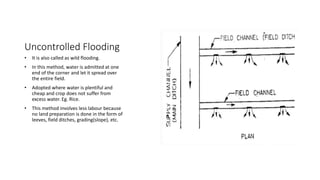
Uncontrolled Flooding
• It is also called as wild flooding.
• In this method, water is admitted at one
end of the corner and let it spread over
the entire field.
• Adopted where water is plentiful and
cheap and crop does not suffer from
excess water. Eg. Rice.
• This method involves less labour because
no land preparation is done in the form of
leeves, field ditches, grading(slope), etc.
Wild Flooding
Advantages
1. No other field layout become necessary
except the levelling and preparation of
impervious boundary bunds.
2. No land area is utilized for water
distribution. As a result, wastage of land
becomes minimum
3. Labour supervision is required for
application of water in the field.
4. Labour requirement is minimum.
Disadvantage
i.It is the most inefficient methods of
irrigation as only about 20 per cent of water
is actually used by plants and the rest is
being lost as run off, seepage and
evaporation.
ii. Levelling of land increases cost of
cultivation.
iii.This method is unsuitable for crops that
are sensitive to water logging.
iv. Crop growth is not uniform as the water
distribution by this method is very uneven.
v. There is a possibility of soil erosion.
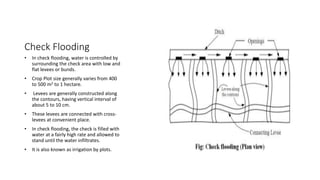
Check Flooding
• In check flooding, water is controlled by
surrounding the check area with low and
flat levees or bunds.
• Crop Plot size generally varies from 400
to 500 m2 to 1 hectare.
• Levees are generally constructed along
the contours, having vertical interval of
about 5 to 10 cm.
• These levees are connected with cross-
levees at convenient place.
• In check flooding, the check is filled with
water at a fairly high rate and allowed to
stand until the water infiltrates.
• It is also known as irrigation by plots.
Check Flooding
Advantages
• It is more efficient method of
irrigation that ensures uniform
application of water.
• It has good control on irrigation water
and high water application efficiency.
• Wastage of water and soil erosion is
reduced as there is bunds or leeves
around the plot area.
• Suitable for more permeable soils as
well as less permeable soils.
Disadvantages
• There are too many leeves aor bunds
or ridges which occupy the larger area
of land. It involves the wastage of
land.
• Land grading and shaping are
required.
• More labour is required for levelling of
the field.
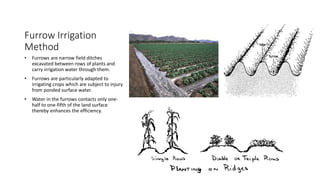
Furrow Irrigation
Method
• Furrows are narrow field ditches
excavated between rows of plants and
carry irrigation water through them.
• Furrows are particularly adapted to
irrigating crops which are subject to injury
from ponded surface water.
• Water in the furrows contacts only one-
half to one-fifth of the land surface
thereby enhances the efficiency.
Furrow irrigation Method
Advantages
• Less evaporation loss of water.
• Only 1/5th to ½ of the land
surface is wetted by water.
• Suitable for row crops like
tobacco, cotton, potatoes,
cauliflowers, etc.
• High water application and
distribution efficiency than
flooding method.
Disadvantages
• Difficulty of moving farm
equipments across the furrows.
• More skilled labour is required
than flooding method for land
preparation and levelling.
• Not suitable for sandy soils that
have high infiltration rate.
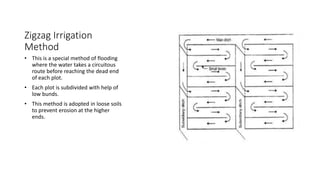
Zigzag Irrigation
Method
• This is a special method of flooding
where the water takes a circuitous
route before reaching the dead end
of each plot.
• Each plot is subdivided with help of
low bunds.
• This method is adopted in loose soils
to prevent erosion at the higher
ends.
Zigzag Method of Irrigation
Advantages
• Erosion of soil is avoided or
controlled.
• Irrigation water is better
controlled.
Disadvantages
• More time is required for
irrigation.
• Irrigation cost is higher as it
involves much labour.
• Much cultivable land is lost in
the form of leeves and field
ditches.
• Field levelling and grading is very
necessary.
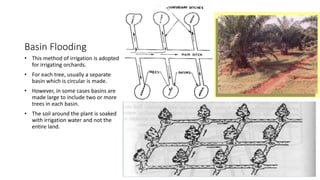
Basin Flooding
• This method of irrigation is adopted
for irrigating orchards.
• For each tree, usually a separate
basin which is circular is made.
• However, in some cases basins are
made large to include two or more
trees in each basin.
• The soil around the plant is soaked
with irrigation water and not the
entire land.
Basin Flooding
Advantages
• It is a good method for irrigating
orchard plants and also for all
types of soil.
• This method economize the water
considerably.
• Water application efficiency is
high.
• Two or more trees can be planted
in a basin.
Disadvantages
• Initial cost for preparing basin is
high.
• This method is not suitable for
irrigating field crops and some
orchard plants such as banana,
papaya, pineapple etc.
• Possibility of quick rise of ground
water table.
• Large discharge of irrigation water
is required.
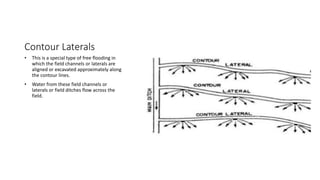
Contour Laterals
• This is a special type of free flooding in
which the field channels or laterals are
aligned or excavated approximately along
the contour lines.
• Water from these field channels or
laterals or field ditches flow across the
field.
Contour Laterals
Advantages
• Suitable if the land is irregular
and water is inexpensive and
abundantly available.
• Involves less labour because no
land preparation is done in the
form of leeves,grading,etc.
Disadvantages
• Non-uniform distribution of
water.
• Only one side of the channel can
be irrigated.
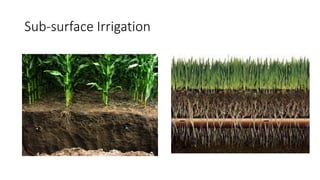
Sub-Surface Irrigation-The application of water to fields in this type of irrigation system is
below the ground surface so that it is supplied directly to the root zone of the plants. The main
advantages of these types of irrigation is reduction of evaporation losses and less hindrance to
cultivation works which takes place on the surface.
Natural sub-surface Irrigation
• Under favorable conditions of
topography and soil conditions, the
water table may be close enough
to the root zone of the field of
crops which gets its moisture due
to the upward capillary movement
of water from the water table. This
irrigation achieved naturally is
called Natural sub-surface
irrigation.
Artificial sub-surface Irrigation
• The concept of maintaining a
suitable water table just below the
root zone is obtained by providing
perforated pipes laid in a network
pattern below the soil surface at a
desired depth. This method of
irrigation is not very popular
because of the high expenses
involved, unsuitable distribution of
subsurface moisture in may cases,
and possibility of clogging of the
perforation of the pipes.
Sub-surface Irrigation
Drip/Trickle Irrigation
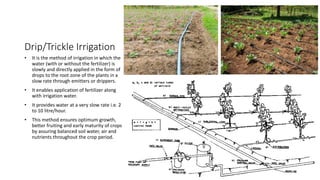
• It is the method of irrigation in which the
water (with or without the fertilizer) is
slowly and directly applied in the form of
drops to the root zone of the plants in a
slow rate through emitters or drippers.
• It enables application of fertilizer along
with irrigation water.
• It provides water at a very slow rate i.e. 2
to 10 litre/hour.
• This method ensures optimum growth,
better fruiting and early maturity of crops
by assuring balanced soil water, air and
nutrients throughout the crop period.
Drip or Trickle Irrigation Method
Advantages
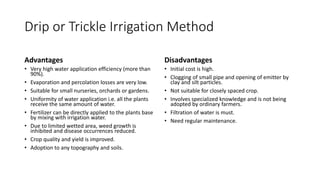
• Very high water application efficiency (more than
90%).
• Evaporation and percolation losses are very low.
• Suitable for small nurseries, orchards or gardens.
• Uniformity of water application i.e. all the plants
receive the same amount of water.
• Fertilizer can be directly applied to the plants base
by mixing with irrigation water.
• Due to limited wetted area, weed growth is
inhibited and disease occurrences reduced.
• Crop quality and yield is improved.
• Adoption to any topography and soils.
Disadvantages
• Initial cost is high.
• Clogging of small pipe and opening of emitter by
clay and silt particles.
• Not suitable for closely spaced crop.
• Involves specialized knowledge and is not being
adopted by ordinary farmers.
• Filtration of water is must.
• Need regular maintenance.
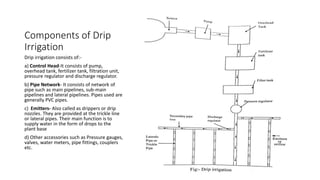
Components of Drip
Irrigation
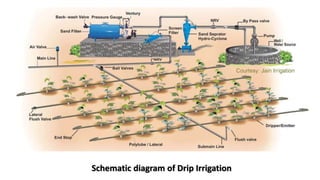
Drip irrigation consists of:-
a) Control Head-It consists of pump,
overhead tank, fertilizer tank, filtration unit,
pressure regulator and discharge regulator.
b) Pipe Network- It consists of network of
pipe such as main pipelines, sub-main
pipelines and lateral pipelines. Pipes used are
generally PVC pipes.
c) Emitters- Also called as drippers or drip
nozzles. They are provided at the trickle line
or lateral pipes. Their main function is to
supply water in the form of drops to the
plant base
d) Other accessories such as Pressure gauges,
valves, water meters, pipe fittings, couplers
etc.
Schematic diagram of Drip Irrigation
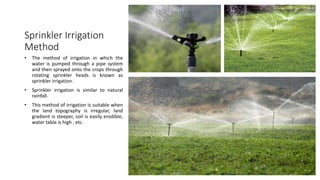
Sprinkler Irrigation
Method
• The method of irrigation in which the
water is pumped through a pipe system
and then sprayed onto the crops through
rotating sprinkler heads is known as
sprinkler irrigation.
• Sprinkler irrigation is similar to natural
rainfall.
• This method of irrigation is suitable when
the land topography is irregular, land
gradient is steeper, soil is easily erodible,
water table is high , etc.
Sprinkler Irrigation method
Advantages
• Land levelling is not required.
• Fertilizer can be uniformly applied by mixing
with water.
• Upto 80 % water application efficiency is
achieved.
• Optimum quantity of water is used compared
to other surface irrigation methods.
• It is less labour oriented.
• It saves time to irrigate the fields.
• Erosion of soil can be eliminated.
Disadvantages
• High initial cost.
• Clooging of nozzle.
• High energy consumption due to high
pressure requirement.
• Filtration of water is must.
• Needs periodic maintenance and supervision.
• Leaf surface may scorch or burn due to salt
contained in the water.
• High wind may distort sprinkler pattern.
• Not suitable for the crops that requires
frequent and larger depths of irrigation water
such as paddy.
Components of
Sprinkler Irrigation
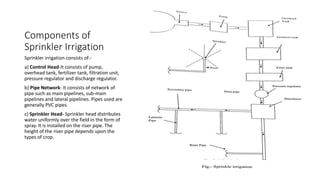
Sprinkler irrigation consists of:-
a) Control Head-It consists of pump,
overhead tank, fertilizer tank, filtration unit,
pressure regulator and discharge regulator.
b) Pipe Network- It consists of network of
pipe such as main pipelines, sub-main
pipelines and lateral pipelines. Pipes used are
generally PVC pipes.
c) Sprinkler Head- Sprinkler head distributes
water uniformly over the field in the form of
spray. It is installed on the riser pipe. The
height of the riser pipe depends upon the
types of crop.
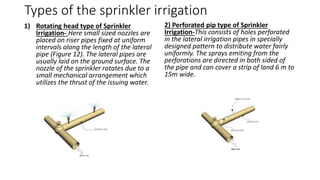
Types of the sprinkler irrigation
1) Rotating head type of Sprinkler
Irrigation- Here small sized nozzles are
placed on riser pipes fixed at uniform
intervals along the length of the lateral
pipe (Figure 12). The lateral pipes are
usually laid on the ground surface. The
nozzle of the sprinkler rotates due to a
small mechanical arrangement which
utilizes the thrust of the issuing water.
2) Perforated pip type of Sprinkler
Irrigation-This consists of holes perforated
in the lateral irrigation pipes in specially
designed pattern to distribute water fairly
uniformly. The sprays emiting from the
perforations are directed in both sided of
the pipe and can cover a strip of land 6 m to
15m wide.
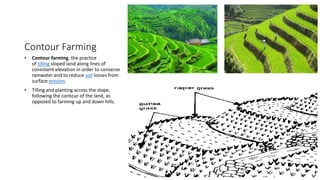
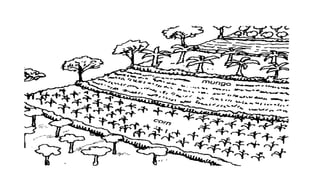
Contour Farming
• Contour farming, the practice
of tilling sloped land along lines of
consistent elevation in order to conserve
rainwater and to reduce soil losses from
surface erosion.
• Tilling and planting across the slope,
following the contour of the land, as
opposed to farming up and down hills.
Methods of Irrigation

Methods of Irrigation

  • 1.
    Methods of Irrigation Preparedby:-Er. Krishna Sedai Agricultural Engineer IOE, TU, Nepal
  • 2.
    Methods Of Irrigation Surface Irrigation Uncontrolled Flooding CheckFlooding Furrow Irrigation Zigzag Irrigation Basin Flooding Contour Laterals Sub-Surface Irrigation Drip Irrigation Sprinkler Irrigation
  • 3.
    Surface Irrigation • Surfaceirrigation is the application of water by gravity flow to the surface of the field. • The practice of surface irrigation is thousands of years old. It represents about 95 % of common irrigation activity today. • Energy requirements for surface irrigation systems come from gravity. This is a significant advantage in today's economy. • Surface systems tend to be labour-intensive.
  • 4.
    Uncontrolled Flooding • Itis also called as wild flooding. • In this method, water is admitted at one end of the corner and let it spread over the entire field. • Adopted where water is plentiful and cheap and crop does not suffer from excess water. Eg. Rice. • This method involves less labour because no land preparation is done in the form of leeves, field ditches, grading(slope), etc.
  • 5.
    Wild Flooding Advantages 1. Noother field layout become necessary except the levelling and preparation of impervious boundary bunds. 2. No land area is utilized for water distribution. As a result, wastage of land becomes minimum 3. Labour supervision is required for application of water in the field. 4. Labour requirement is minimum. Disadvantage i.It is the most inefficient methods of irrigation as only about 20 per cent of water is actually used by plants and the rest is being lost as run off, seepage and evaporation. ii. Levelling of land increases cost of cultivation. iii.This method is unsuitable for crops that are sensitive to water logging. iv. Crop growth is not uniform as the water distribution by this method is very uneven. v. There is a possibility of soil erosion.
  • 6.
    Check Flooding • Incheck flooding, water is controlled by surrounding the check area with low and flat levees or bunds. • Crop Plot size generally varies from 400 to 500 m2 to 1 hectare. • Levees are generally constructed along the contours, having vertical interval of about 5 to 10 cm. • These levees are connected with cross- levees at convenient place. • In check flooding, the check is filled with water at a fairly high rate and allowed to stand until the water infiltrates. • It is also known as irrigation by plots.
  • 7.
    Check Flooding Advantages • Itis more efficient method of irrigation that ensures uniform application of water. • It has good control on irrigation water and high water application efficiency. • Wastage of water and soil erosion is reduced as there is bunds or leeves around the plot area. • Suitable for more permeable soils as well as less permeable soils. Disadvantages • There are too many leeves aor bunds or ridges which occupy the larger area of land. It involves the wastage of land. • Land grading and shaping are required. • More labour is required for levelling of the field.
  • 8.
    Furrow Irrigation Method • Furrowsare narrow field ditches excavated between rows of plants and carry irrigation water through them. • Furrows are particularly adapted to irrigating crops which are subject to injury from ponded surface water. • Water in the furrows contacts only one- half to one-fifth of the land surface thereby enhances the efficiency.
  • 9.
    Furrow irrigation Method Advantages •Less evaporation loss of water. • Only 1/5th to ½ of the land surface is wetted by water. • Suitable for row crops like tobacco, cotton, potatoes, cauliflowers, etc. • High water application and distribution efficiency than flooding method. Disadvantages • Difficulty of moving farm equipments across the furrows. • More skilled labour is required than flooding method for land preparation and levelling. • Not suitable for sandy soils that have high infiltration rate.
  • 10.
    Zigzag Irrigation Method • Thisis a special method of flooding where the water takes a circuitous route before reaching the dead end of each plot. • Each plot is subdivided with help of low bunds. • This method is adopted in loose soils to prevent erosion at the higher ends.
  • 11.
    Zigzag Method ofIrrigation Advantages • Erosion of soil is avoided or controlled. • Irrigation water is better controlled. Disadvantages • More time is required for irrigation. • Irrigation cost is higher as it involves much labour. • Much cultivable land is lost in the form of leeves and field ditches. • Field levelling and grading is very necessary.
  • 12.
    Basin Flooding • Thismethod of irrigation is adopted for irrigating orchards. • For each tree, usually a separate basin which is circular is made. • However, in some cases basins are made large to include two or more trees in each basin. • The soil around the plant is soaked with irrigation water and not the entire land.
  • 13.
    Basin Flooding Advantages • Itis a good method for irrigating orchard plants and also for all types of soil. • This method economize the water considerably. • Water application efficiency is high. • Two or more trees can be planted in a basin. Disadvantages • Initial cost for preparing basin is high. • This method is not suitable for irrigating field crops and some orchard plants such as banana, papaya, pineapple etc. • Possibility of quick rise of ground water table. • Large discharge of irrigation water is required.
  • 14.
    Contour Laterals • Thisis a special type of free flooding in which the field channels or laterals are aligned or excavated approximately along the contour lines. • Water from these field channels or laterals or field ditches flow across the field.
  • 15.
    Contour Laterals Advantages • Suitableif the land is irregular and water is inexpensive and abundantly available. • Involves less labour because no land preparation is done in the form of leeves,grading,etc. Disadvantages • Non-uniform distribution of water. • Only one side of the channel can be irrigated.
  • 16.
    Sub-Surface Irrigation-The applicationof water to fields in this type of irrigation system is below the ground surface so that it is supplied directly to the root zone of the plants. The main advantages of these types of irrigation is reduction of evaporation losses and less hindrance to cultivation works which takes place on the surface. Natural sub-surface Irrigation • Under favorable conditions of topography and soil conditions, the water table may be close enough to the root zone of the field of crops which gets its moisture due to the upward capillary movement of water from the water table. This irrigation achieved naturally is called Natural sub-surface irrigation. Artificial sub-surface Irrigation • The concept of maintaining a suitable water table just below the root zone is obtained by providing perforated pipes laid in a network pattern below the soil surface at a desired depth. This method of irrigation is not very popular because of the high expenses involved, unsuitable distribution of subsurface moisture in may cases, and possibility of clogging of the perforation of the pipes.
  • 17.
  • 18.
    Drip/Trickle Irrigation • Itis the method of irrigation in which the water (with or without the fertilizer) is slowly and directly applied in the form of drops to the root zone of the plants in a slow rate through emitters or drippers. • It enables application of fertilizer along with irrigation water. • It provides water at a very slow rate i.e. 2 to 10 litre/hour. • This method ensures optimum growth, better fruiting and early maturity of crops by assuring balanced soil water, air and nutrients throughout the crop period.
  • 19.
    Drip or TrickleIrrigation Method Advantages • Very high water application efficiency (more than 90%). • Evaporation and percolation losses are very low. • Suitable for small nurseries, orchards or gardens. • Uniformity of water application i.e. all the plants receive the same amount of water. • Fertilizer can be directly applied to the plants base by mixing with irrigation water. • Due to limited wetted area, weed growth is inhibited and disease occurrences reduced. • Crop quality and yield is improved. • Adoption to any topography and soils. Disadvantages • Initial cost is high. • Clogging of small pipe and opening of emitter by clay and silt particles. • Not suitable for closely spaced crop. • Involves specialized knowledge and is not being adopted by ordinary farmers. • Filtration of water is must. • Need regular maintenance.
  • 20.
    Components of Drip Irrigation Dripirrigation consists of:- a) Control Head-It consists of pump, overhead tank, fertilizer tank, filtration unit, pressure regulator and discharge regulator. b) Pipe Network- It consists of network of pipe such as main pipelines, sub-main pipelines and lateral pipelines. Pipes used are generally PVC pipes. c) Emitters- Also called as drippers or drip nozzles. They are provided at the trickle line or lateral pipes. Their main function is to supply water in the form of drops to the plant base d) Other accessories such as Pressure gauges, valves, water meters, pipe fittings, couplers etc.
  • 21.
    Schematic diagram ofDrip Irrigation
  • 22.
    Sprinkler Irrigation Method • Themethod of irrigation in which the water is pumped through a pipe system and then sprayed onto the crops through rotating sprinkler heads is known as sprinkler irrigation. • Sprinkler irrigation is similar to natural rainfall. • This method of irrigation is suitable when the land topography is irregular, land gradient is steeper, soil is easily erodible, water table is high , etc.
  • 23.
    Sprinkler Irrigation method Advantages •Land levelling is not required. • Fertilizer can be uniformly applied by mixing with water. • Upto 80 % water application efficiency is achieved. • Optimum quantity of water is used compared to other surface irrigation methods. • It is less labour oriented. • It saves time to irrigate the fields. • Erosion of soil can be eliminated. Disadvantages • High initial cost. • Clooging of nozzle. • High energy consumption due to high pressure requirement. • Filtration of water is must. • Needs periodic maintenance and supervision. • Leaf surface may scorch or burn due to salt contained in the water. • High wind may distort sprinkler pattern. • Not suitable for the crops that requires frequent and larger depths of irrigation water such as paddy.
  • 24.
    Components of Sprinkler Irrigation Sprinklerirrigation consists of:- a) Control Head-It consists of pump, overhead tank, fertilizer tank, filtration unit, pressure regulator and discharge regulator. b) Pipe Network- It consists of network of pipe such as main pipelines, sub-main pipelines and lateral pipelines. Pipes used are generally PVC pipes. c) Sprinkler Head- Sprinkler head distributes water uniformly over the field in the form of spray. It is installed on the riser pipe. The height of the riser pipe depends upon the types of crop.
  • 25.
    Types of thesprinkler irrigation 1) Rotating head type of Sprinkler Irrigation- Here small sized nozzles are placed on riser pipes fixed at uniform intervals along the length of the lateral pipe (Figure 12). The lateral pipes are usually laid on the ground surface. The nozzle of the sprinkler rotates due to a small mechanical arrangement which utilizes the thrust of the issuing water. 2) Perforated pip type of Sprinkler Irrigation-This consists of holes perforated in the lateral irrigation pipes in specially designed pattern to distribute water fairly uniformly. The sprays emiting from the perforations are directed in both sided of the pipe and can cover a strip of land 6 m to 15m wide.
  • 26.
    Contour Farming • Contourfarming, the practice of tilling sloped land along lines of consistent elevation in order to conserve rainwater and to reduce soil losses from surface erosion. • Tilling and planting across the slope, following the contour of the land, as opposed to farming up and down hills.