IRRIGATION AND ITS METHOD 
PRESENTED BY: 
SULAKSHYA GAUR (121684) 
HARSHIT THAKUR (121689)
Introduction 
 Irrigation is the artificial application of water to the 
land or soil. 
 It is used to assist in the growing of agricultural 
crops, maintenance of landscapes, and revegetation of 
disturbed soils in dry areas and during periods of 
inadequate rainfall.
Necessity Of Irrigation 
 Insufficient rainfall 
 Uneven distribution of rainfall 
 Improvement of perennial crop 
 Development of agriculture in desert area
Benefits Of Irrigation 
 Increase in crop yield 
 Protection from famine 
 Cultivation of superior crops 
 Elimination of mixed cropping 
 Economic development 
 Hydro power generation 
 Domestic and industrial water supply
Ill Effects Of Irrigation 
 Rising of water table 
 Formation of marshy land 
 Dampness in weather 
 Loss of valuable lands
Methods Of Irrigation 
• Surface irrigation 
(a) Uncontrolled (or wild or free) flooding method 
(b) Border strip method 
(c) Check method 
(d) Basin method and 
(e) Furrow method. 
• Sub-surface irrigation 
• Sprinkler irrigation 
• Trickle(Drip) irrigation
Surface Irrigation 
• In all the surface methods of irrigation, water is 
either ponded on the soil or allowed to flow 
continuously over the soil surface for the duration of 
irrigation. 
• It does not result in high levels of performance. 
• This is mainly because of uncertain infiltration rates 
which are affected by year-to-year changes in the 
cropping pattern, cultivation practices, climatic 
factors, and many other factors
Uncontrolled Flooding 
• When water is applied to the cropland without any 
preparation of land and without any levees to guide or 
restrict the flow of water on the field, the method is 
called ‘uncontrolled’, wild or ‘free’ flooding. 
• Uncontrolled flooding generally results in excess 
irrigation at the inlet region of the field and insufficient 
irrigation at the outlet end. 
• Efficiency is reduced because of either deep 
percolation or flowing away of water from the field. 
• The advantage of this method is the low initial cost of 
land preparation.
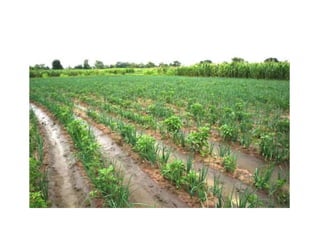
Border Strip Method 
• Border strip irrigation (or simply ‘border irrigation’) is 
a controlled surface flooding method of applying 
irrigation water. In this method, the farm is divided 
into a number of strips. These strips are separated by 
low levees (or borders). 
• The border strip method is suited to soils of 
moderately low to moderately high intake rates and 
low erodibility. 
• This method, however, requires preparation of land 
involving high initial cost.
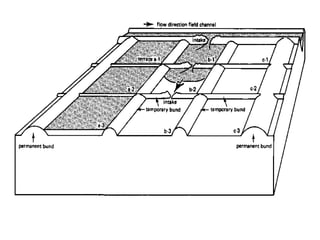
Check Method 
• The check method of irrigation is based on rapid 
application of irrigation water to a level or nearly level 
area completely enclosed by dikes. 
• In this method, the entire field is divided into a 
number of almost levelled plots (compartments or 
‘Kiaries’) surrounded by levees. 
• This method is suitable for a wide range of soils ranging 
from very permeable to heavy soils. 
• Loss of water through deep percolation (near the 
supply ditch) and surface runoff can be minimised and 
adequate irrigation of the entire farm can be achieved. 
Thus, application efficiency is higher for this method. 
• There is some loss of cultivable area which is occupied 
by the levees.
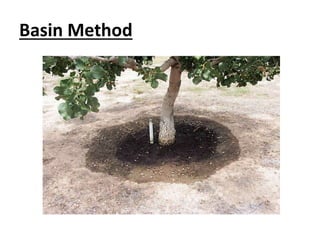
Basin Method
Furrow Method 
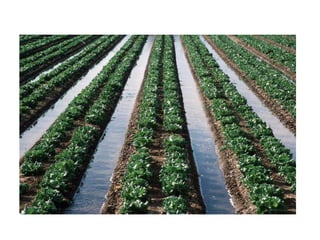
• An alternative to flooding the entire land surface is to 
construct small channels along the primary direction of 
the movement of water and letting the water flow 
through these channels which are termed ‘furrows’, 
‘creases’ or ‘corrugation’. 
• Furrows necessitate the wetting of only about half to 
one-fifth of the field surface. This reduces the 
evaporation loss considerably. 
• Furrows provide better on-farm water management 
capabilities for most of the surface irrigation conditions, 
and variable and severe topographical conditions. 
• Possibility of increased erosion 
• Furrow irrigation requires more labour than any other 
surface irrigation method.
Subsurface Irrigation 
Subsurface irrigation (or simply sub irrigation) is the 
practice of applying water to soils directly under the 
surface. Moisture reaches the plant roots through 
capillary action. The conditions which favor sub irrigation 
are as follows: 
•Impervious subsoil at a depth of 2 meters or more, 
•A very permeable subsoil 
•A permeable loam or sandy loam surface soil, 
•Uniform topographic conditions, and 
•Moderate ground slopes
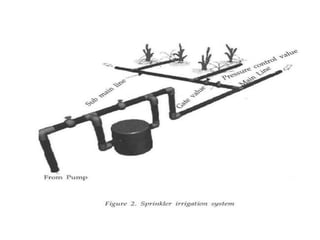
Sprinkler Irrigation 
Sprinkling is the method of applying water to the soil 
surface in the form of a spray which is somewhat 
similar to rain. 
Rotating sprinkler-head systems are commonly used for 
sprinkler irrigation. 
Each rotating sprinkler head applies water to a given 
area, size of which is governed by the nozzle size and 
the water pressure. Alternatively, perforated pipe can 
be used to deliver water through very small holes 
which are drilled at close intervals along a segment of 
the circumference of a pipe
Sprinklers have been used on all types of soils on 
lands of different topography and slopes, and for 
many crops. The following conditions are favorable for 
sprinkler irrigation: 
• Very previous soils which do not permit good 
distribution of water by surface methods, 
• Lands which have steep slopes and easily erodible 
soils, 
• Irrigation channels which are too small to distribute 
water efficiently by surface irrigation, and 
• Lands with shallow soils and undulating lands which 
prevent proper leveling required for surface methods 
of irrigation
Advantages 
• Low water loss (efficiency up to 80%) 
• Saving in fertilizer 
• Suitable for any topography 
• No soil erosion 
• Better seed germination, free aeration of root zone 
• Uniform application of water
Disadvantages 
• High initial cost, cannot adopt by ordinary farmers 
• Poor application efficiency in windy weather and 
high temperature 
• High evaporation losses 
• Water should be free of debris 
• Physical damage to crops by application of high 
intensity spray
Trickle (Drip) Irrigation 
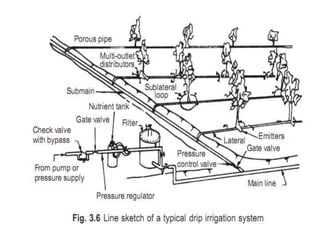
• Trickle irrigation system comprises main line, sub 
mains, laterals, valves (to control the flow), drippers or 
emitters , pressure gauges, water meters, filters , 
pumps, fertilizer tanks, vacuum breakers, and pressure 
regulators. 
• The drippers are designed to supply water at the 
desired rate (1 to 10 liters per hour) directly to the soil. 
Low pressure heads at the emitters are considered 
adequate as the soil capillary forces causes the emitted 
water to spread laterally and vertically.
Advantages: 
• Low water loss and hence saves water 
• Enhances plant growth and plant yield 
• Saves labor and energy 
• Control weed growth 
• No soil erosion 
• Improves fertilizer application efficiency
Disadvantages: 
• High skill in design, installation, and subsequent 
operation 
• Clogging of small conduits and openings in emitters 
due to sand, clay particles, debris, chemical 
precipitates and organic growth 
• Not suitable for closely planted crops such as wheat 
and other cereal grains
Quality of irrigation water 
• Irrigation water must not have direct or indirect 
undesirable effects on the health of human beings, 
animals, and plants. 
• The irrigation water must not damage the soil and 
not endanger the quality of surface and ground 
waters with which it comes into contact. 
• The presence of toxic substances in irrigation water 
may threaten the vegetation besides degrading the 
suitability of soil for future cultivation. 
• Surface water, ground water, and suitably treated 
waste waters are generally used for irrigation 
purposes
The various types of impurities, which make 
the water unfit for irrigation, are classified as: 
• Sediment concentration in water 
• Total concentration of soluble salts in water 
• Proportion of sodium ions to other ions 
• Concentration of potentially toxic elements 
present in water 
• Bacterial contamination
Bibliography 
• S.K.Garg, Irrigation Engineering and Hydraulic 
Structures. 
• Google Images.
Irrigation and its types

Irrigation and its types

  • 1.
    IRRIGATION AND ITSMETHOD PRESENTED BY: SULAKSHYA GAUR (121684) HARSHIT THAKUR (121689)
  • 2.
    Introduction  Irrigationis the artificial application of water to the land or soil.  It is used to assist in the growing of agricultural crops, maintenance of landscapes, and revegetation of disturbed soils in dry areas and during periods of inadequate rainfall.
  • 3.
    Necessity Of Irrigation  Insufficient rainfall  Uneven distribution of rainfall  Improvement of perennial crop  Development of agriculture in desert area
  • 4.
    Benefits Of Irrigation  Increase in crop yield  Protection from famine  Cultivation of superior crops  Elimination of mixed cropping  Economic development  Hydro power generation  Domestic and industrial water supply
  • 5.
    Ill Effects OfIrrigation  Rising of water table  Formation of marshy land  Dampness in weather  Loss of valuable lands
  • 6.
    Methods Of Irrigation • Surface irrigation (a) Uncontrolled (or wild or free) flooding method (b) Border strip method (c) Check method (d) Basin method and (e) Furrow method. • Sub-surface irrigation • Sprinkler irrigation • Trickle(Drip) irrigation
  • 7.
    Surface Irrigation •In all the surface methods of irrigation, water is either ponded on the soil or allowed to flow continuously over the soil surface for the duration of irrigation. • It does not result in high levels of performance. • This is mainly because of uncertain infiltration rates which are affected by year-to-year changes in the cropping pattern, cultivation practices, climatic factors, and many other factors
  • 8.
    Uncontrolled Flooding •When water is applied to the cropland without any preparation of land and without any levees to guide or restrict the flow of water on the field, the method is called ‘uncontrolled’, wild or ‘free’ flooding. • Uncontrolled flooding generally results in excess irrigation at the inlet region of the field and insufficient irrigation at the outlet end. • Efficiency is reduced because of either deep percolation or flowing away of water from the field. • The advantage of this method is the low initial cost of land preparation.
  • 9.
    Border Strip Method • Border strip irrigation (or simply ‘border irrigation’) is a controlled surface flooding method of applying irrigation water. In this method, the farm is divided into a number of strips. These strips are separated by low levees (or borders). • The border strip method is suited to soils of moderately low to moderately high intake rates and low erodibility. • This method, however, requires preparation of land involving high initial cost.
  • 11.
    Check Method •The check method of irrigation is based on rapid application of irrigation water to a level or nearly level area completely enclosed by dikes. • In this method, the entire field is divided into a number of almost levelled plots (compartments or ‘Kiaries’) surrounded by levees. • This method is suitable for a wide range of soils ranging from very permeable to heavy soils. • Loss of water through deep percolation (near the supply ditch) and surface runoff can be minimised and adequate irrigation of the entire farm can be achieved. Thus, application efficiency is higher for this method. • There is some loss of cultivable area which is occupied by the levees.
  • 13.
  • 14.
    Furrow Method •An alternative to flooding the entire land surface is to construct small channels along the primary direction of the movement of water and letting the water flow through these channels which are termed ‘furrows’, ‘creases’ or ‘corrugation’. • Furrows necessitate the wetting of only about half to one-fifth of the field surface. This reduces the evaporation loss considerably. • Furrows provide better on-farm water management capabilities for most of the surface irrigation conditions, and variable and severe topographical conditions. • Possibility of increased erosion • Furrow irrigation requires more labour than any other surface irrigation method.
  • 16.
    Subsurface Irrigation Subsurfaceirrigation (or simply sub irrigation) is the practice of applying water to soils directly under the surface. Moisture reaches the plant roots through capillary action. The conditions which favor sub irrigation are as follows: •Impervious subsoil at a depth of 2 meters or more, •A very permeable subsoil •A permeable loam or sandy loam surface soil, •Uniform topographic conditions, and •Moderate ground slopes
  • 17.
    Sprinkler Irrigation Sprinklingis the method of applying water to the soil surface in the form of a spray which is somewhat similar to rain. Rotating sprinkler-head systems are commonly used for sprinkler irrigation. Each rotating sprinkler head applies water to a given area, size of which is governed by the nozzle size and the water pressure. Alternatively, perforated pipe can be used to deliver water through very small holes which are drilled at close intervals along a segment of the circumference of a pipe
  • 18.
    Sprinklers have beenused on all types of soils on lands of different topography and slopes, and for many crops. The following conditions are favorable for sprinkler irrigation: • Very previous soils which do not permit good distribution of water by surface methods, • Lands which have steep slopes and easily erodible soils, • Irrigation channels which are too small to distribute water efficiently by surface irrigation, and • Lands with shallow soils and undulating lands which prevent proper leveling required for surface methods of irrigation
  • 20.
    Advantages • Lowwater loss (efficiency up to 80%) • Saving in fertilizer • Suitable for any topography • No soil erosion • Better seed germination, free aeration of root zone • Uniform application of water
  • 21.
    Disadvantages • Highinitial cost, cannot adopt by ordinary farmers • Poor application efficiency in windy weather and high temperature • High evaporation losses • Water should be free of debris • Physical damage to crops by application of high intensity spray
  • 22.
    Trickle (Drip) Irrigation • Trickle irrigation system comprises main line, sub mains, laterals, valves (to control the flow), drippers or emitters , pressure gauges, water meters, filters , pumps, fertilizer tanks, vacuum breakers, and pressure regulators. • The drippers are designed to supply water at the desired rate (1 to 10 liters per hour) directly to the soil. Low pressure heads at the emitters are considered adequate as the soil capillary forces causes the emitted water to spread laterally and vertically.
  • 24.
    Advantages: • Lowwater loss and hence saves water • Enhances plant growth and plant yield • Saves labor and energy • Control weed growth • No soil erosion • Improves fertilizer application efficiency
  • 25.
    Disadvantages: • Highskill in design, installation, and subsequent operation • Clogging of small conduits and openings in emitters due to sand, clay particles, debris, chemical precipitates and organic growth • Not suitable for closely planted crops such as wheat and other cereal grains
  • 26.
    Quality of irrigationwater • Irrigation water must not have direct or indirect undesirable effects on the health of human beings, animals, and plants. • The irrigation water must not damage the soil and not endanger the quality of surface and ground waters with which it comes into contact. • The presence of toxic substances in irrigation water may threaten the vegetation besides degrading the suitability of soil for future cultivation. • Surface water, ground water, and suitably treated waste waters are generally used for irrigation purposes
  • 27.
    The various typesof impurities, which make the water unfit for irrigation, are classified as: • Sediment concentration in water • Total concentration of soluble salts in water • Proportion of sodium ions to other ions • Concentration of potentially toxic elements present in water • Bacterial contamination
  • 28.
    Bibliography • S.K.Garg,Irrigation Engineering and Hydraulic Structures. • Google Images.