CHROMOSOMAL
ABNORMALITIES
By
Dr Samina Anjum
CAUSES OF BIRTH DEFECTS &
SPONTANEOUS ABORTIONS ARE
• Chromosomal abnormalities
• Genetic factors
INCIDENCE FOR MAJOR
CHROMOSOMAL ABNORMALITIES
• 50% of conceptions end in spontaneous abortions and
50% of these abortions have major chromosomal
abnormalities
• Thus approx. 25% of conceptuses have major
chromosomal defects
• Chromosomal abnormalities account for 7% of major
birth defects; Commonest is Turner’s syndrome
• Gene mutations account for an additional 8% cases
• A Karyotype refers to a full set of chromosomes from
an individual which can be compared to a "normal"
Karyotype for the species via genetic testing.
• Ploidy Is the number of sets of chromosomes in a
biological cell.
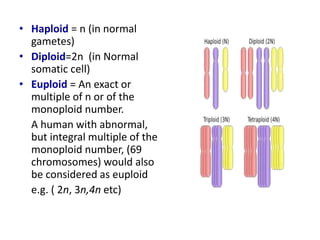
• Haploid = n (in normal
gametes)
• Diploid=2n (in Normal
somatic cell)
• Euploid = An exact or
multiple of n or of the
monoploid number.
A human with abnormal,
but integral multiple of the
monoploid number, (69
chromosomes) would also
be considered as euploid
e.g. ( 2n, 3n,4n etc)
POLYPLOID
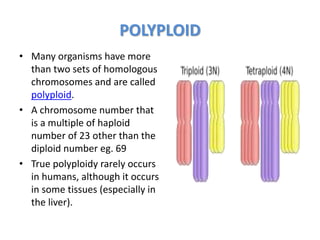
• Many organisms have more
than two sets of homologous
chromosomes and are called
polyploid.
• A chromosome number that
is a multiple of haploid
number of 23 other than the
diploid number eg. 69
• True polyploidy rarely occurs
in humans, although it occurs
in some tissues (especially in
the liver).
ANEUPLOID
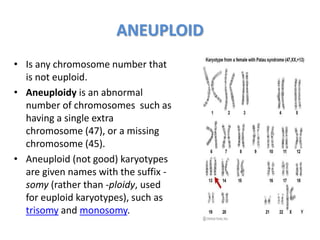
• Is any chromosome number that
is not euploid.
• Aneuploidy is an abnormal
number of chromosomes such as
having a single extra
chromosome (47), or a missing
chromosome (45).
• Aneuploid (not good) karyotypes
are given names with the suffix -
somy (rather than -ploidy, used
for euploid karyotypes), such as
trisomy and monosomy.
Therefore the distinction between aneuploidy
and polyploidy is:
Aneuploidy refers to a numerical change in
part of the chromosome set, whereas
polyploidy refers to a numerical change in the
whole set of chromosomes.
CHROMOSOMAL ABNORMALITIES
Can occur during meiotic or mitotic divisions
Two types:
• Numerical
• Structural
NUMERICAL CHROMOSOMAL
ABNORMALITIES
• Meiotic Non disjunction
• Mitotic Non disjunction
• Chromosomal translocations
MEIOTIC NON DISJUNCTION
• May involve autosomes or sex chromosomes
• In females incidence increases with age 35yrs or more.
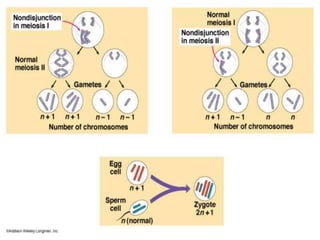
• Meiosis I: Two members of homologous chromosomes
fails to separate and both members of a pair move into
one cell.
• Meiosis II: When sister chromatids fail to separate.
MITOTIC NONDISJUNCTION
Mosaicism:
• Some cells have abnormal chromosomal
number and others have normal
• Occurs in the earliest cell divisions
• Affected individuals exhibit characteristics of
a particular syndrome for e.g. down
syndrome in1% cases
CHROMOSOMAL TRANSLOCATIONS
• When a portion of one chromosome is transferred to
another non homologous chromosome and a fusion gene
is created.
There are two main types of translocations:
• Balanced: An even exchange of material with no genetic
information is extra or missing, and individual is normal.
• Unbalanced: Where the exchange of genetic material is
unequal and part of one chromosome is lost & altered
phenotype is produced ( Down’s syndrome – 4% cases)
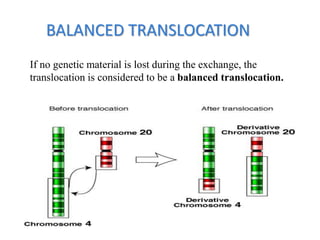
BALANCED TRANSLOCATION
If no genetic material is lost during the exchange, the
translocation is considered to be a balanced translocation.
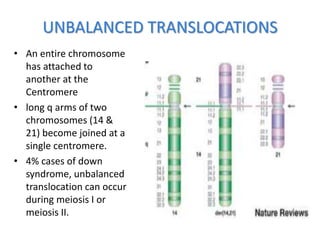
UNBALANCED TRANSLOCATIONS
• An entire chromosome
has attached to
another at the
Centromere
• long q arms of two
chromosomes (14 &
21) become joined at a
single centromere.
• 4% cases of down
syndrome, unbalanced
translocation can occur
during meiosis I or
meiosis II.
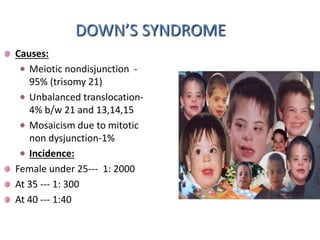
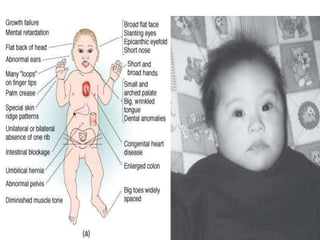
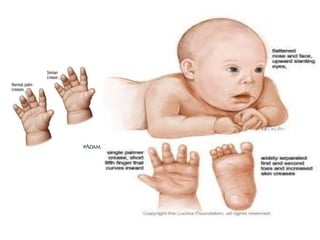
DOWN’S SYNDROME
Causes:
Meiotic nondisjunction -
95% (trisomy 21)
Unbalanced translocation-
4% b/w 21 and 13,14,15
Mosaicism due to mitotic
non dysjunction-1%
Incidence:
Female under 25--- 1: 2000
At 35 --- 1: 300
At 40 --- 1:40
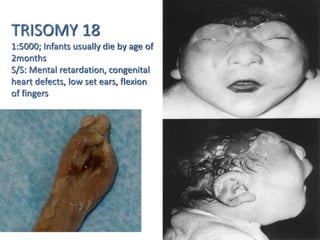
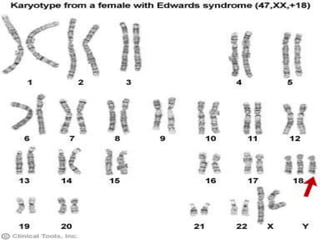
TRISOMY 18
1:5000; Infants usually die by age of
2months
S/S: Mental retardation, congenital
heart defects, low set ears, flexion
of fingers
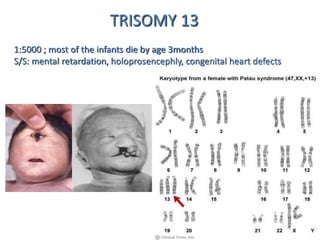
TRISOMY 13
1:5000 ; most of the infants die by age 3months
S/S: mental retardation, holoprosencephly, congenital heart defects
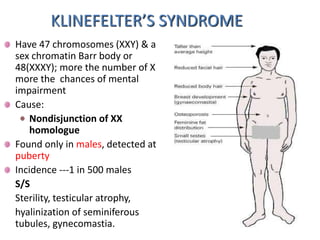
KLINEFELTER’S SYNDROME
Have 47 chromosomes (XXY) & a
sex chromatin Barr body or
48(XXXY); more the number of X
more the chances of mental
impairment
Cause:
Nondisjunction of XX
homologue
Found only in males, detected at
puberty
Incidence ---1 in 500 males
S/S
Sterility, testicular atrophy,
hyalinization of seminiferous
tubules, gynecomastia.
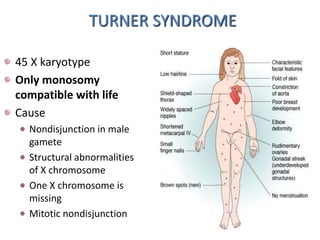
TURNER SYNDROME
45 X karyotype
Only monosomy
compatible with life
Cause
Nondisjunction in male
gamete
Structural abnormalities
of X chromosome
One X chromosome is
missing
Mitotic nondisjunction
STRUCTURAL ABNORMALITIES
• Occur when the chromosome's structure is
altered, this can take several forms:
Translocation, deletion or duplication of
chromosomes
• Chromosome breaks occur either as a result of
damage to DNA (by radiation or chemicals) or
as part of the mechanism of recombination.
• However, the total number of chromosomes is
usually normal.
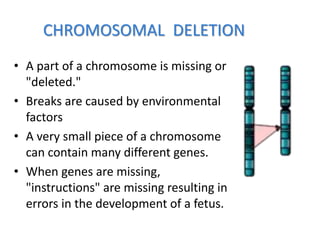
CHROMOSOMAL DELETION
• A part of a chromosome is missing or
"deleted."
• Breaks are caused by environmental
factors
• A very small piece of a chromosome
can contain many different genes.
• When genes are missing,
"instructions" are missing resulting in
errors in the development of a fetus.
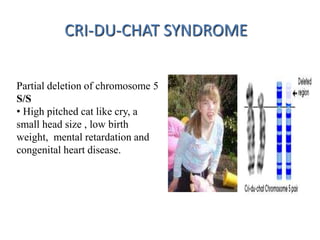
CRI-DU-CHAT SYNDROME
Partial deletion of chromosome 5
S/S
• High pitched cat like cry, a
small head size , low birth
weight, mental retardation and
congenital heart disease.
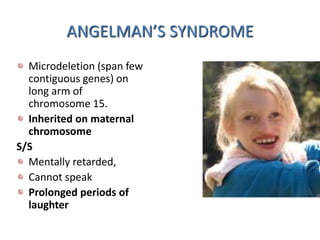
ANGELMAN’S SYNDROME
Microdeletion (span few
contiguous genes) on
long arm of
chromosome 15.
Inherited on maternal
chromosome
S/S
Mentally retarded,
Cannot speak
Prolonged periods of
laughter
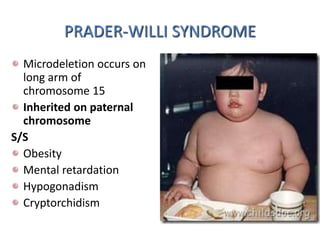
PRADER-WILLI SYNDROME
Microdeletion occurs on
long arm of
chromosome 15
Inherited on paternal
chromosome
S/S
Obesity
Mental retardation
Hypogonadism
Cryptorchidism
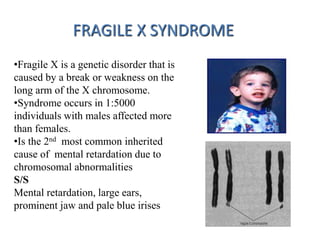
FRAGILE X SYNDROME
•Fragile X is a genetic disorder that is
caused by a break or weakness on the
long arm of the X chromosome.
•Syndrome occurs in 1:5000
individuals with males affected more
than females.
•Is the 2nd most common inherited
cause of mental retardation due to
chromosomal abnormalities
S/S
Mental retardation, large ears,
prominent jaw and pale blue irises
Genomic imprinting
• These syndromes depend on whether the
affected genetic material is inherited from the
mother or father they are also an example of
imprinting.
Chromosomal abnormalities.ppt

Chromosomal abnormalities.ppt

  • 1.
  • 2.
    CAUSES OF BIRTHDEFECTS & SPONTANEOUS ABORTIONS ARE • Chromosomal abnormalities • Genetic factors
  • 3.
    INCIDENCE FOR MAJOR CHROMOSOMALABNORMALITIES • 50% of conceptions end in spontaneous abortions and 50% of these abortions have major chromosomal abnormalities • Thus approx. 25% of conceptuses have major chromosomal defects • Chromosomal abnormalities account for 7% of major birth defects; Commonest is Turner’s syndrome • Gene mutations account for an additional 8% cases
  • 4.
    • A Karyotyperefers to a full set of chromosomes from an individual which can be compared to a "normal" Karyotype for the species via genetic testing. • Ploidy Is the number of sets of chromosomes in a biological cell.
  • 5.
    • Haploid =n (in normal gametes) • Diploid=2n (in Normal somatic cell) • Euploid = An exact or multiple of n or of the monoploid number. A human with abnormal, but integral multiple of the monoploid number, (69 chromosomes) would also be considered as euploid e.g. ( 2n, 3n,4n etc)
  • 6.
    POLYPLOID • Many organismshave more than two sets of homologous chromosomes and are called polyploid. • A chromosome number that is a multiple of haploid number of 23 other than the diploid number eg. 69 • True polyploidy rarely occurs in humans, although it occurs in some tissues (especially in the liver).
  • 7.
    ANEUPLOID • Is anychromosome number that is not euploid. • Aneuploidy is an abnormal number of chromosomes such as having a single extra chromosome (47), or a missing chromosome (45). • Aneuploid (not good) karyotypes are given names with the suffix - somy (rather than -ploidy, used for euploid karyotypes), such as trisomy and monosomy.
  • 8.
    Therefore the distinctionbetween aneuploidy and polyploidy is: Aneuploidy refers to a numerical change in part of the chromosome set, whereas polyploidy refers to a numerical change in the whole set of chromosomes.
  • 9.
    CHROMOSOMAL ABNORMALITIES Can occurduring meiotic or mitotic divisions Two types: • Numerical • Structural
  • 10.
    NUMERICAL CHROMOSOMAL ABNORMALITIES • MeioticNon disjunction • Mitotic Non disjunction • Chromosomal translocations
  • 11.
    MEIOTIC NON DISJUNCTION •May involve autosomes or sex chromosomes • In females incidence increases with age 35yrs or more. • Meiosis I: Two members of homologous chromosomes fails to separate and both members of a pair move into one cell. • Meiosis II: When sister chromatids fail to separate.
  • 13.
    MITOTIC NONDISJUNCTION Mosaicism: • Somecells have abnormal chromosomal number and others have normal • Occurs in the earliest cell divisions • Affected individuals exhibit characteristics of a particular syndrome for e.g. down syndrome in1% cases
  • 14.
    CHROMOSOMAL TRANSLOCATIONS • Whena portion of one chromosome is transferred to another non homologous chromosome and a fusion gene is created. There are two main types of translocations: • Balanced: An even exchange of material with no genetic information is extra or missing, and individual is normal. • Unbalanced: Where the exchange of genetic material is unequal and part of one chromosome is lost & altered phenotype is produced ( Down’s syndrome – 4% cases)
  • 15.
    BALANCED TRANSLOCATION If nogenetic material is lost during the exchange, the translocation is considered to be a balanced translocation.
  • 16.
    UNBALANCED TRANSLOCATIONS • Anentire chromosome has attached to another at the Centromere • long q arms of two chromosomes (14 & 21) become joined at a single centromere. • 4% cases of down syndrome, unbalanced translocation can occur during meiosis I or meiosis II.
  • 17.
    DOWN’S SYNDROME Causes: Meiotic nondisjunction- 95% (trisomy 21) Unbalanced translocation- 4% b/w 21 and 13,14,15 Mosaicism due to mitotic non dysjunction-1% Incidence: Female under 25--- 1: 2000 At 35 --- 1: 300 At 40 --- 1:40
  • 20.
    TRISOMY 18 1:5000; Infantsusually die by age of 2months S/S: Mental retardation, congenital heart defects, low set ears, flexion of fingers
  • 22.
    TRISOMY 13 1:5000 ;most of the infants die by age 3months S/S: mental retardation, holoprosencephly, congenital heart defects
  • 23.
    KLINEFELTER’S SYNDROME Have 47chromosomes (XXY) & a sex chromatin Barr body or 48(XXXY); more the number of X more the chances of mental impairment Cause: Nondisjunction of XX homologue Found only in males, detected at puberty Incidence ---1 in 500 males S/S Sterility, testicular atrophy, hyalinization of seminiferous tubules, gynecomastia.
  • 24.
    TURNER SYNDROME 45 Xkaryotype Only monosomy compatible with life Cause Nondisjunction in male gamete Structural abnormalities of X chromosome One X chromosome is missing Mitotic nondisjunction
  • 25.
    STRUCTURAL ABNORMALITIES • Occurwhen the chromosome's structure is altered, this can take several forms: Translocation, deletion or duplication of chromosomes • Chromosome breaks occur either as a result of damage to DNA (by radiation or chemicals) or as part of the mechanism of recombination. • However, the total number of chromosomes is usually normal.
  • 26.
    CHROMOSOMAL DELETION • Apart of a chromosome is missing or "deleted." • Breaks are caused by environmental factors • A very small piece of a chromosome can contain many different genes. • When genes are missing, "instructions" are missing resulting in errors in the development of a fetus.
  • 27.
    CRI-DU-CHAT SYNDROME Partial deletionof chromosome 5 S/S • High pitched cat like cry, a small head size , low birth weight, mental retardation and congenital heart disease.
  • 28.
    ANGELMAN’S SYNDROME Microdeletion (spanfew contiguous genes) on long arm of chromosome 15. Inherited on maternal chromosome S/S Mentally retarded, Cannot speak Prolonged periods of laughter
  • 29.
    PRADER-WILLI SYNDROME Microdeletion occurson long arm of chromosome 15 Inherited on paternal chromosome S/S Obesity Mental retardation Hypogonadism Cryptorchidism
  • 30.
    FRAGILE X SYNDROME •FragileX is a genetic disorder that is caused by a break or weakness on the long arm of the X chromosome. •Syndrome occurs in 1:5000 individuals with males affected more than females. •Is the 2nd most common inherited cause of mental retardation due to chromosomal abnormalities S/S Mental retardation, large ears, prominent jaw and pale blue irises
  • 31.
    Genomic imprinting • Thesesyndromes depend on whether the affected genetic material is inherited from the mother or father they are also an example of imprinting.

Editor's Notes

  • #17 s particular translocation is interesting because