GENE DISORDERS
Dr Ray
Dec
INTRODUCTION
•A genetic disorder is an illness caused by one or more
abnormalities in the genome, especially a condition that is
present from birth (congenital).
•Most genetic disorders are quite rare and affect one person
in every several thousands or millions.
•Genetic disorders may or may not be heritable, i.e., passed
down from the parents' genes.
CLASSIFICATION
• 1. Single gene disorders
• 2. Chromosomal disorders
• 3. Multifactorial disorders
SINGLE-GENE DISORDERS
• Mutations involving single genes typically follow one
of three patterns of inheritance:
autosomal dominant,
autosomal recessive,
X-linked.
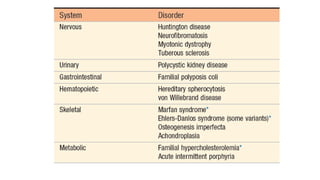
AUTOSOMAL DOMINANT DISORDERS
• Are manifested in the heterozygous state, so at least one parent of an
index case is usually affected;
• Both males and females are affected, and both can transmit the
condition.
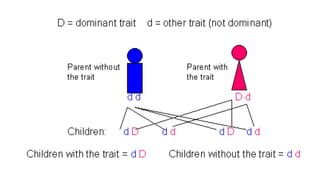
• When an affected person marries an unaffected one, every child has one
chance in two of having the disease.
• In this condition normal people have genotype d/d, affected
individual with mild disease have D/d and severely affected have
D/D which is often lethal. Most of those who survive are
In addition to these basic rules, autosomal dominant conditions are
characterized by the following:
i) With every autosomal dominant disorder, some proportion of patients do not
have affected parents. Such patients owe their disorder to new mutations
involving either the egg or the sperm from which they were derived.
• Their siblings are neither affected nor at increased risk for disease
development.
• The proportion of patients who develop the disease as a result of a new
mutation is related to the effect of the disease on reproductive capability.
• If a disease markedly reduces reproductive fitness, most cases would be
expected to result from new mutations.
• Many new mutations seem to occur in germ cells of relatively older fathers.
ii)Clinical features can be modified by variations in penetrance
and expressivity.
• Some individuals inherit the mutant gene but are
phenotypically normal. This is referred to as incomplete
penetrance. Penetrance is expressed in mathematical terms.
Thus, 50% penetrance indicates that 50% of those who carry
the gene express the trait.
• In contrast to penetrance, if a trait is seen in all individuals
carrying the mutant gene but is expressed differently among
individuals, the phenomenon is called variable expressivity.
iii) In many conditions the age at onset is delayed; symptoms
and signs may not appear until adulthood (as in Huntington
disease).
The biochemical mechanisms of autosomal
dominant disorders
• Depends upon the nature of the mutation and the type of
protein affected.
• Most mutations lead to the reduced production of a gene
product or give rise to a dysfunctional or inactive protein.
• Whether such a mutation gives rise to dominant or recessive
disease depends on whether the remaining copy of the gene
is capable of compensating for the loss.
• Thus, understanding the reasons why particular loss-of-
function mutations give rise to dominant vs. recessive disease
patterns requires an understanding of the biology.
Many autosomal dominant diseases arising from
deleterious mutations fall into one of a few familiar
patterns:
• 1. Those involved in regulation of complex
metabolic pathways that are subject to feedback
inhibition. Membrane receptors such as the low-
density lipoprotein (LDL) receptor provide one
such example; in familial hypercholesterolemia,
discussed later, a 50% loss of LDL receptors
results in a secondary elevation of cholesterol
that, in turn, predisposes to atherosclerosis in
affected heterozygotes.
• 2. Key structural proteins, such as collagen and cytoskeletal
elements of the red cell membrane (e.g., spectrin). The
biochemical mechanisms by which a 50% reduction in the
amounts of such proteins results in an abnormal phenotype
are not fully understood.
• In some cases, especially when the gene encodes one
subunit of a multimeric protein, the product of the mutant
allele can interfere with the assembly of a functionally normal
multimer.
• Less common than loss-of-function mutations are gain of-
function mutations, which can take two forms.
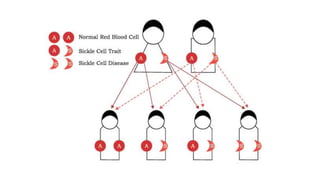
AUTOSOMAL RECESSIVE DISORDERS
• These make up the largest category of Mendelian disorders.
They occur when both alleles at a given gene locus are
mutated.
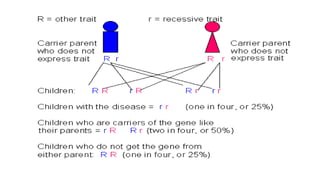
• These disorders are characterized by the following features:
(1) The trait does not usually affect the parents of the affected
individual, but siblings may show the disease; (2) siblings
have one chance in four of having the trait (i.e., the recurrence
risk is 25% for each birth); and (3) if the mutant gene occurs
with a low frequency in the population, there is a strong
likelihood that the affected individual (proband) is the product
of a consanguineous marriage.
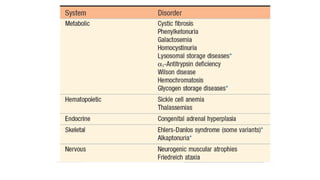
• Autosomal recessive disorders include almost all inborn errors
The following features generally apply to most autosomal
recessive disorders and distinguish them from autosomal
dominant diseases
• The expression of the defect tends to be more uniform than in
autosomal dominant disorders.
• Complete penetrance is common.
• Onset is frequently early in life.
• Although new mutations associated with recessive disorders do occur,
they are rarely detected clinically. Since the individual with a new
mutation is an asymptomatic heterozygote, several generations may
pass before the descendants of such a person mate with other
heterozygotes and produce affected offspring.
• Many of the mutated genes encode enzymes. In heterozygotes, equal
amounts of normal and defective enzyme are synthesized. Usually the
natural “margin of safety” ensures that cells with half the usual
complement of the enzyme function normally.
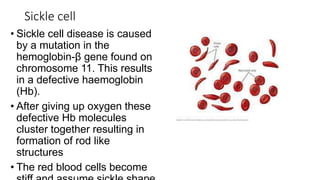
Sickle cell
• Sickle cell disease is caused
by a mutation in the
hemoglobin-β gene found on
chromosome 11. This results
in a defective haemoglobin
(Hb).
• After giving up oxygen these
defective Hb molecules
cluster together resulting in
formation of rod like
structures
• The red blood cells become
Other examples
• Individual with cystic fibrosis produce mucus that is
abnormally thick and sticky that can damage different organs
specially lungs resulting in chronic infections.
• Tay-Sachs disease is due to absence of an enzyme called
hexosaminidase A which results in a fatty substance
accumulation in nerve cells particularly affecting the brain. It is
a fatal disease manifest in childhood. One in 27 persons of
European Ashkenazi Jewish origin individuals carries the Tay-
Sachs gene.
• Phenylketonuria is caused by a mutation in phenylalanine
hydroxylase gene resulting in increase in phenylalanine in the
blood
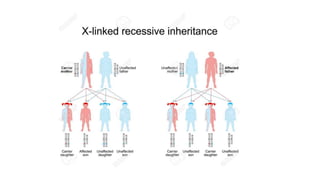
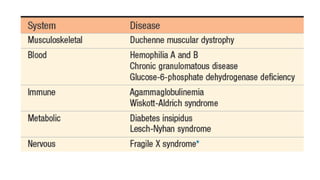
X-Linked Disorders
•X-linked recessive inheritance accounts for a small
number of well-defined clinical conditions.
•All sex-linked disorders are X-linked, and almost all are
recessive
•Mutations on X x-some
•M more affected than F
•Chance of passing on the disorder differ btn men and
women
• Sons of an affected man will not be affected, daughters will
(no male-male transmission).
• For an affected woman, there will be a 50% chance for boys
and girls
genex.pptx
genex.pptx

genex.pptx

  • 1.
  • 2.
    INTRODUCTION •A genetic disorderis an illness caused by one or more abnormalities in the genome, especially a condition that is present from birth (congenital). •Most genetic disorders are quite rare and affect one person in every several thousands or millions. •Genetic disorders may or may not be heritable, i.e., passed down from the parents' genes.
  • 3.
    CLASSIFICATION • 1. Singlegene disorders • 2. Chromosomal disorders • 3. Multifactorial disorders
  • 4.
    SINGLE-GENE DISORDERS • Mutationsinvolving single genes typically follow one of three patterns of inheritance: autosomal dominant, autosomal recessive, X-linked.
  • 5.
    AUTOSOMAL DOMINANT DISORDERS •Are manifested in the heterozygous state, so at least one parent of an index case is usually affected; • Both males and females are affected, and both can transmit the condition. • When an affected person marries an unaffected one, every child has one chance in two of having the disease. • In this condition normal people have genotype d/d, affected individual with mild disease have D/d and severely affected have D/D which is often lethal. Most of those who survive are
  • 7.
    In addition tothese basic rules, autosomal dominant conditions are characterized by the following: i) With every autosomal dominant disorder, some proportion of patients do not have affected parents. Such patients owe their disorder to new mutations involving either the egg or the sperm from which they were derived. • Their siblings are neither affected nor at increased risk for disease development. • The proportion of patients who develop the disease as a result of a new mutation is related to the effect of the disease on reproductive capability. • If a disease markedly reduces reproductive fitness, most cases would be expected to result from new mutations. • Many new mutations seem to occur in germ cells of relatively older fathers.
  • 8.
    ii)Clinical features canbe modified by variations in penetrance and expressivity. • Some individuals inherit the mutant gene but are phenotypically normal. This is referred to as incomplete penetrance. Penetrance is expressed in mathematical terms. Thus, 50% penetrance indicates that 50% of those who carry the gene express the trait. • In contrast to penetrance, if a trait is seen in all individuals carrying the mutant gene but is expressed differently among individuals, the phenomenon is called variable expressivity. iii) In many conditions the age at onset is delayed; symptoms and signs may not appear until adulthood (as in Huntington disease).
  • 9.
    The biochemical mechanismsof autosomal dominant disorders • Depends upon the nature of the mutation and the type of protein affected. • Most mutations lead to the reduced production of a gene product or give rise to a dysfunctional or inactive protein. • Whether such a mutation gives rise to dominant or recessive disease depends on whether the remaining copy of the gene is capable of compensating for the loss. • Thus, understanding the reasons why particular loss-of- function mutations give rise to dominant vs. recessive disease patterns requires an understanding of the biology.
  • 10.
    Many autosomal dominantdiseases arising from deleterious mutations fall into one of a few familiar patterns: • 1. Those involved in regulation of complex metabolic pathways that are subject to feedback inhibition. Membrane receptors such as the low- density lipoprotein (LDL) receptor provide one such example; in familial hypercholesterolemia, discussed later, a 50% loss of LDL receptors results in a secondary elevation of cholesterol that, in turn, predisposes to atherosclerosis in affected heterozygotes.
  • 11.
    • 2. Keystructural proteins, such as collagen and cytoskeletal elements of the red cell membrane (e.g., spectrin). The biochemical mechanisms by which a 50% reduction in the amounts of such proteins results in an abnormal phenotype are not fully understood. • In some cases, especially when the gene encodes one subunit of a multimeric protein, the product of the mutant allele can interfere with the assembly of a functionally normal multimer. • Less common than loss-of-function mutations are gain of- function mutations, which can take two forms.
  • 13.
    AUTOSOMAL RECESSIVE DISORDERS •These make up the largest category of Mendelian disorders. They occur when both alleles at a given gene locus are mutated. • These disorders are characterized by the following features: (1) The trait does not usually affect the parents of the affected individual, but siblings may show the disease; (2) siblings have one chance in four of having the trait (i.e., the recurrence risk is 25% for each birth); and (3) if the mutant gene occurs with a low frequency in the population, there is a strong likelihood that the affected individual (proband) is the product of a consanguineous marriage. • Autosomal recessive disorders include almost all inborn errors
  • 15.
    The following featuresgenerally apply to most autosomal recessive disorders and distinguish them from autosomal dominant diseases • The expression of the defect tends to be more uniform than in autosomal dominant disorders. • Complete penetrance is common. • Onset is frequently early in life. • Although new mutations associated with recessive disorders do occur, they are rarely detected clinically. Since the individual with a new mutation is an asymptomatic heterozygote, several generations may pass before the descendants of such a person mate with other heterozygotes and produce affected offspring. • Many of the mutated genes encode enzymes. In heterozygotes, equal amounts of normal and defective enzyme are synthesized. Usually the natural “margin of safety” ensures that cells with half the usual complement of the enzyme function normally.
  • 17.
    Sickle cell • Sicklecell disease is caused by a mutation in the hemoglobin-β gene found on chromosome 11. This results in a defective haemoglobin (Hb). • After giving up oxygen these defective Hb molecules cluster together resulting in formation of rod like structures • The red blood cells become
  • 19.
    Other examples • Individualwith cystic fibrosis produce mucus that is abnormally thick and sticky that can damage different organs specially lungs resulting in chronic infections. • Tay-Sachs disease is due to absence of an enzyme called hexosaminidase A which results in a fatty substance accumulation in nerve cells particularly affecting the brain. It is a fatal disease manifest in childhood. One in 27 persons of European Ashkenazi Jewish origin individuals carries the Tay- Sachs gene. • Phenylketonuria is caused by a mutation in phenylalanine hydroxylase gene resulting in increase in phenylalanine in the blood
  • 20.
    X-Linked Disorders •X-linked recessiveinheritance accounts for a small number of well-defined clinical conditions. •All sex-linked disorders are X-linked, and almost all are recessive •Mutations on X x-some •M more affected than F •Chance of passing on the disorder differ btn men and women • Sons of an affected man will not be affected, daughters will (no male-male transmission). • For an affected woman, there will be a 50% chance for boys and girls