
GENETIC   DISORDERS   (Introduction) Dr. Shahab Riaz
 
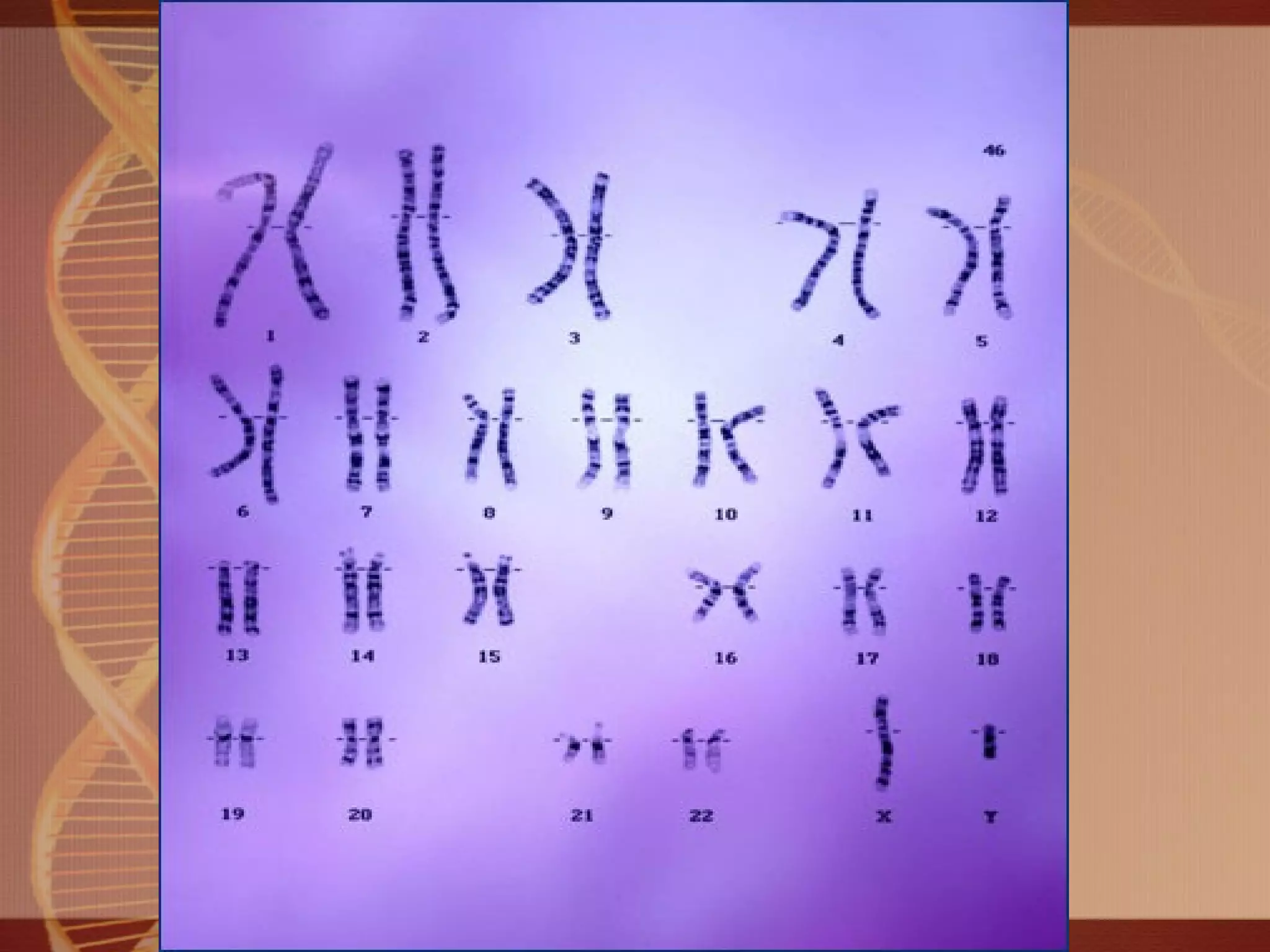
Chromosome: Greek  ( chroma , color) and ( soma , body) bcz strongly stained by particular  dyes   organized structure of  DNA  and  protein , found in  cells   single piece of coiled DNA containing many  genes ,  regulatory elements  and other  nucleotide sequences   In eukaryotes, nuclear chromosomes are packaged by proteins into a condensed structure called  chromatin   very long DNA molecules to fit into the  cell nucleus
 
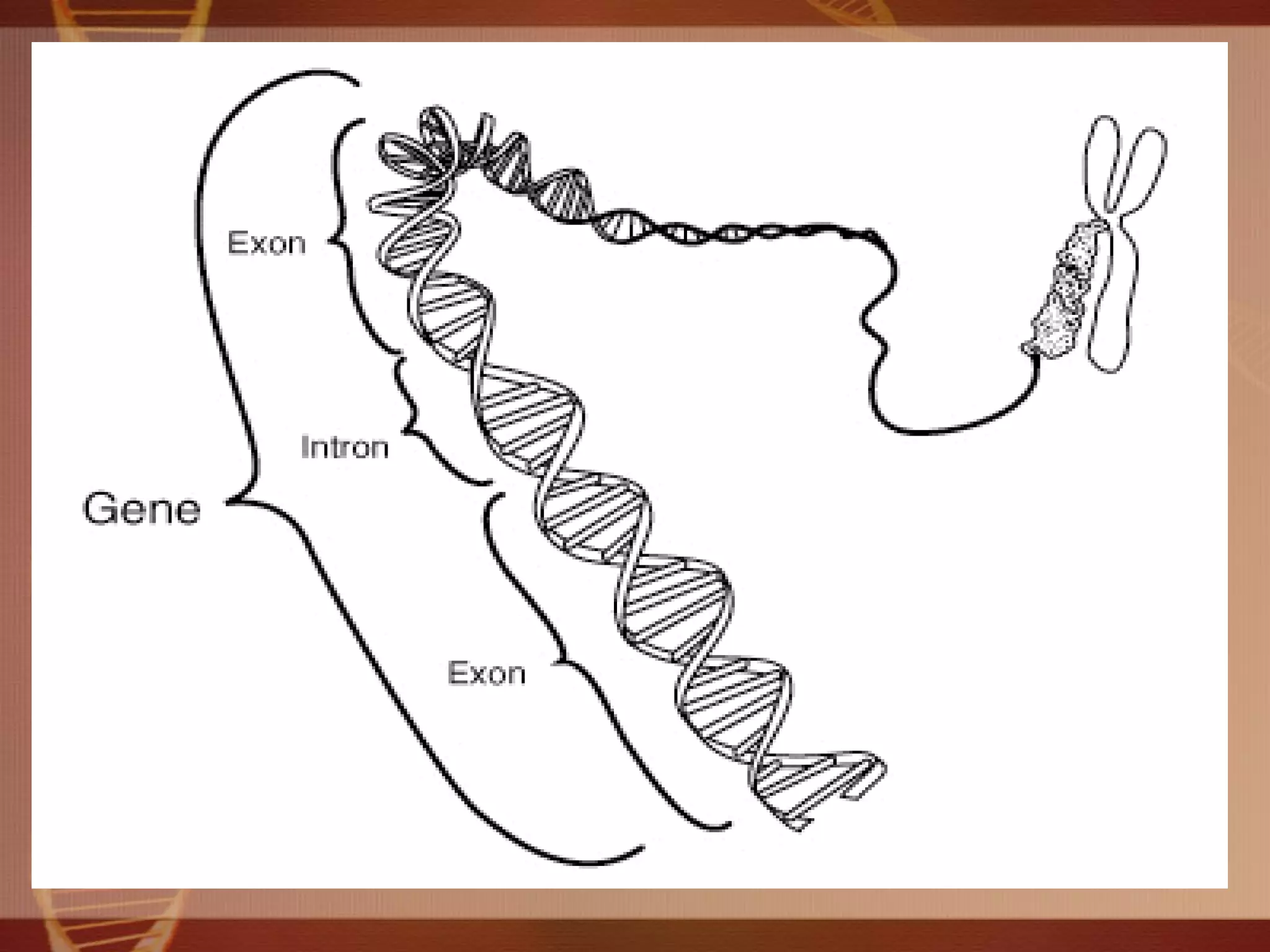
Gene: basic unit of  heredity  in a living  organism information to build and maintain the  cells  and pass genetic  traits  to offsprings In general terms, a gene is a segment of  nucleic acid  that, taken as a whole, specifies a trait
 
Gregor Mendel
History: Gregor Mendel  (1822–1884)   a  priest  and  scientist   In 1860s, studied inheritance in  pea plants  father of  genetics  for his study of the  inheritance  of certain  traits  in  pea  plants  hypothesized  a factor that conveys traits from parent to offspring   over 10 years of his life on one experiment   showed that the inheritance of these traits follows particular  laws   Mendel's work was not recognized until the turn of the 20th century  Didn’t use the term  gene , explained results in terms of inherited characteristics  dominant  and  recessive  traits, the distinction between a  heterozygote  and  homozygote ,  genotype  and  phenotype
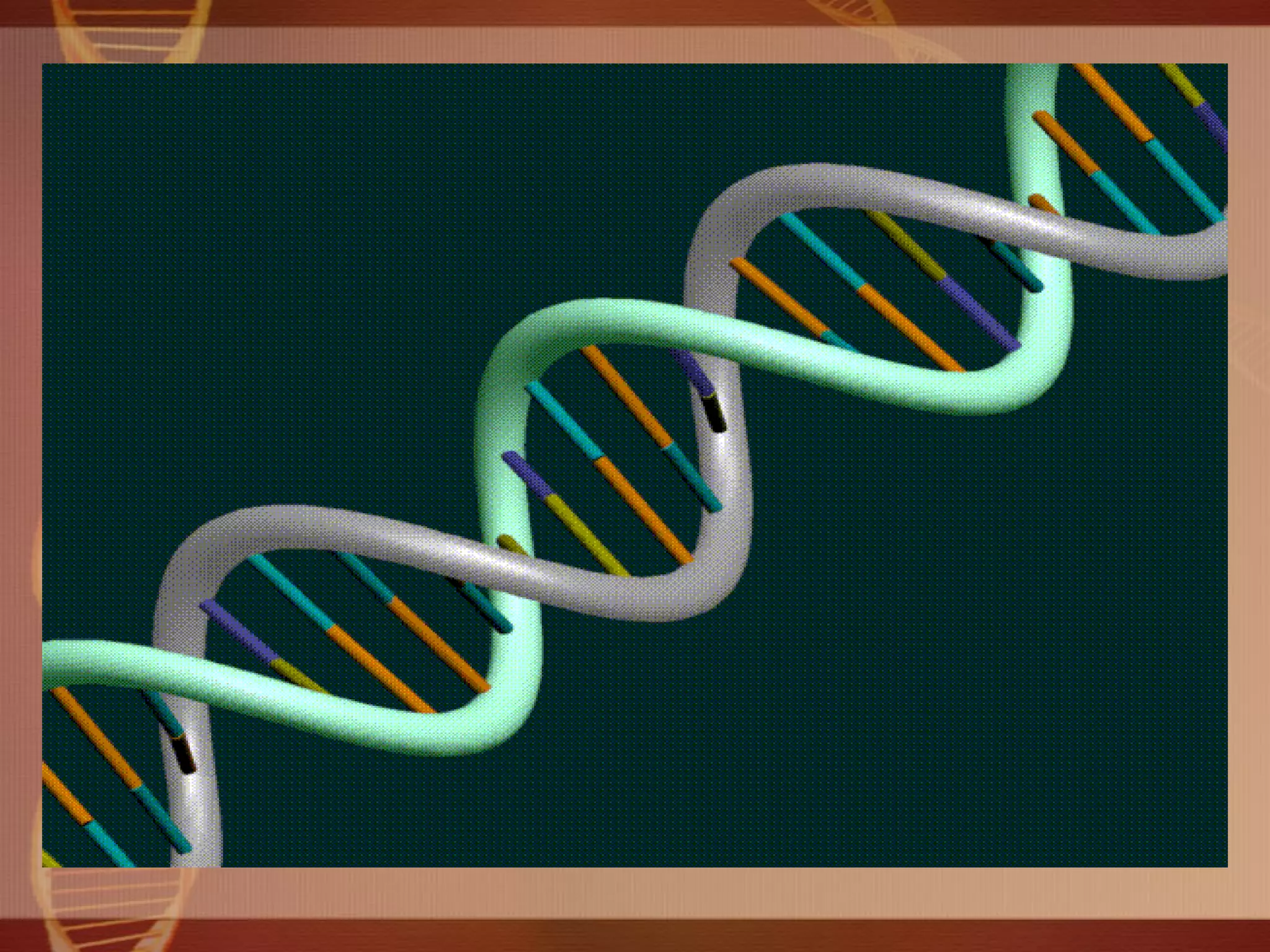
Deoxyribonucleic acid (DNA):   nucleic acid    genetic  instructions & the long-term storage of  information   blueprints , or a  code  for development and functioning  Construction of cellular  proteins  and  RNA  molecules  DNA segments that carry this genetic information are called  genes
DNA Structure: two long  polymers  of simple units called  nucleotides   backbones made of  sugars  and  phosphate  groups joined by  ester  bonds  two strands are  anti-parallel   Attached to each sugar is one of four types of molecules called  bases   sequence of these four bases along the backbone that encodes information


Messenger ribonucleic acid (mRNA) : molecule of  RNA  encoding a chemical "blueprint" for a  protein  product   mRNA is  transcribed  from a  DNA  template   carries coding information to the sites of  protein synthesis : the ” ribosomes ”   on RER the nucleic acid polymer is  translated  into a polymer of  amino acids : a “ protein” In mRNA as in DNA, sequence of  nucleotides  arranged into  codons  consisting of three bases each  Each codon encodes for a specific  amino acid   stop codons  terminate protein synthesis
Codon: Base triplet in mRNA transcribed by DNA If the base triplet in the DNA sequence is GCT  Then corresponding codon on the mRNA strand will be CGA   Transfer RNA (tRNA): mediates recognition of the codon  provides the corresponding amino acid  Ribosomal RNA (rRNA): central component of the ribosome's protein manufacturing machinery  Anti-Codon: sequence of three adjacent nucleotides in transfer RNA  binds to a corresponding codon in messenger RNA  designates a specific amino acid during protein synthesis
 
 
20 Amino Acids In Human Protein: Table of DNA Base Triplets, RNA Codons & Anticodons
GENETICS: Ancient Greek   genetikos , “genitive” and that from  genesis , “origin” science  of  heredity  and  variation  in living organisms living things inherit traits from their parents     prehistoric  times    improve crop plants and animals through  selective breeding   Modern genetics basis by Gregor Mendel
Genome: full set of  chromosomes  or genes in a  gamete   So a regular  somatic cell  contains two full sets of genomes  In  haploid   organisms , including  bacteria ,  viruses , and  mitochondria , a cell contains only a single set of the genome  Genomics: study of the  genomes  of organisms   entire  DNA sequence  of organisms and fine-scale  genetic mapping  efforts  Research of single genes does not fall into the definition of genomics
Importance of Genetics Life time frequency    670/1000 Classic genetic diseases + CVS diseases and cancer Some diseases have both environmental + genetic role (atherosclerosis / HTN) In medical practice    Iceberg of Genetic diseases    less severe 50% of spontaneous abortions    gross chromosomal abnormalities
Importance of Genetics 100,000 previously thought but actually approx 30,000 Different combinations    > 100,000 proteins Fully formed proteins can be sliced/stitched    > peptides than expected Avoiding intra-uterine diseases Thalassemia    inter-marriages Treatments of cancer    Genetic Level
Interesting Fact 99.9% of genomic DNA sequence of any two humans is the same 0.1% rest of the genome    accounts for the differences in features    approx. 3 million base pairs
Genetic Advancements
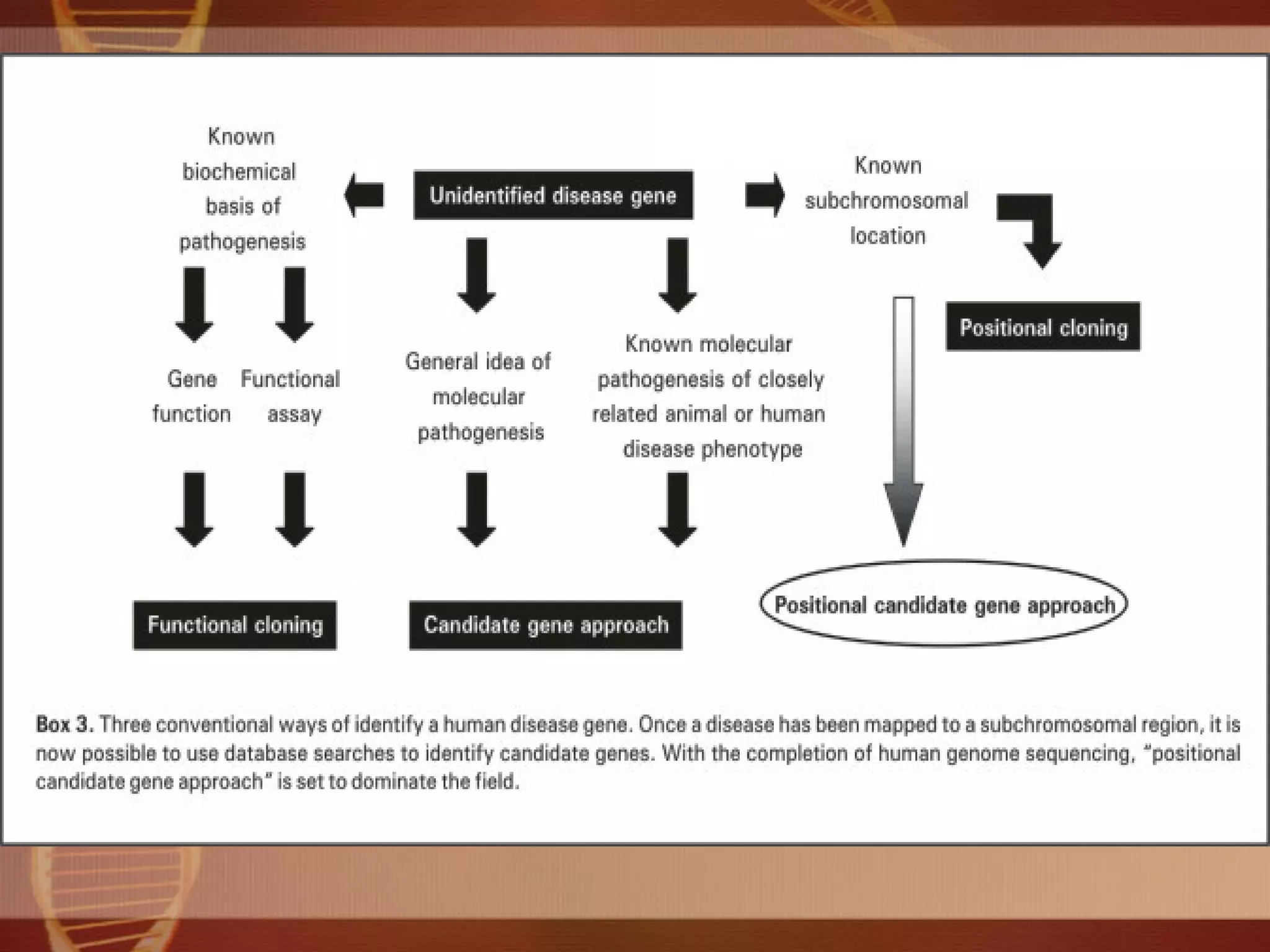
Molecular Basis of Human Diseases Two general strategies used to isolate involved genes Functional Cloning  or  Classical Approach: Abnormal gene product / protein known  Isolate normal gene and clone Determine molecular changes causing the disorder Positional Cloning  or  Candidate Gene Approach: In some diseases, multiple genes involved or no clue of defective product Ignores the phenotype or protein product Instead mapping disease phenotype to specific chromosome location Marker genes identified    Close proximity to disease locus Localized narrow limits    clone DNA from relevant site  in vitro  Identification of protein    aberrant protein encoded by mutant genes
 
Genetic Engineering Production of human biologically active agents Recombinant DNA technology  Improving crop technology  manufacture of synthetic human  insulin  through the use of modified  bacteria   manufacture of  erythropoietin  in hamster  ovary  cells  Growth hormone GM-CSF & G-CSF
Genetic Engineering Isolation of the genes of interest Insertion of the genes into a transfer  vector Transfer of the vector to the organism to be modified Transformation of the cells of the organism 5.  Selection of the genetically modified organism (GMO) from those that have not been successfully modified
 
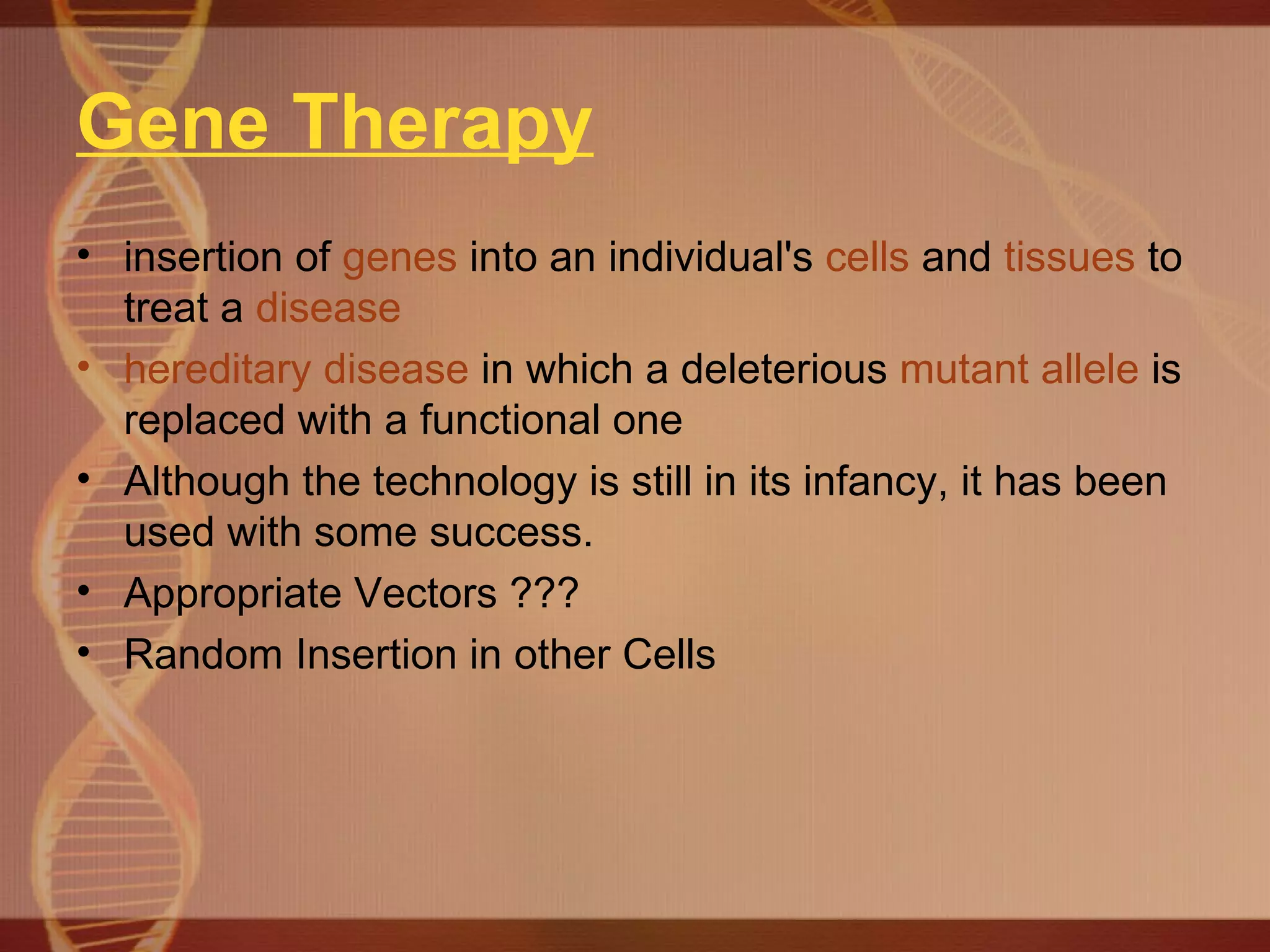
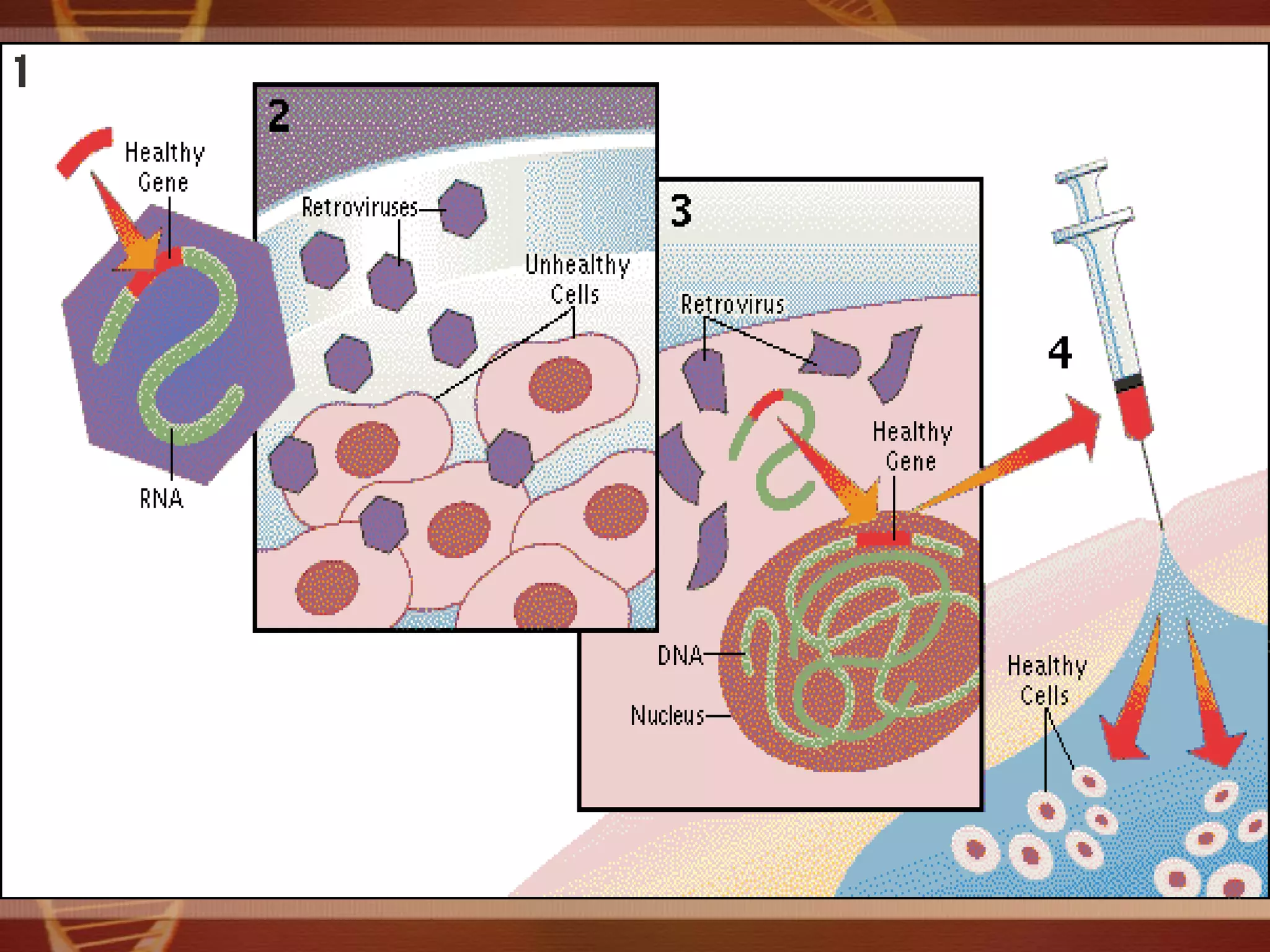
Gene Therapy insertion of  genes  into an individual's  cells  and  tissues  to treat a  disease   hereditary disease  in which a deleterious  mutant   allele  is replaced with a functional one  Although the technology is still in its infancy, it has been used with some success. Appropriate Vectors ??? Random Insertion in other Cells
 

Genetic disorders 1

  • 1.
  • 2.
    GENETIC DISORDERS (Introduction) Dr. Shahab Riaz
  • 3.
  • 4.
    Chromosome: Greek ( chroma , color) and ( soma , body) bcz strongly stained by particular  dyes organized structure of  DNA  and  protein , found in  cells single piece of coiled DNA containing many  genes ,  regulatory elements  and other  nucleotide sequences In eukaryotes, nuclear chromosomes are packaged by proteins into a condensed structure called  chromatin very long DNA molecules to fit into the  cell nucleus
  • 5.
  • 6.
    Gene: basic unitof  heredity  in a living  organism information to build and maintain the  cells  and pass genetic  traits  to offsprings In general terms, a gene is a segment of  nucleic acid  that, taken as a whole, specifies a trait
  • 7.
  • 8.
  • 9.
    History: Gregor Mendel (1822–1884) a priest  and scientist In 1860s, studied inheritance in  pea plants father of  genetics  for his study of the  inheritance  of certain traits  in  pea  plants hypothesized  a factor that conveys traits from parent to offspring over 10 years of his life on one experiment showed that the inheritance of these traits follows particular  laws Mendel's work was not recognized until the turn of the 20th century Didn’t use the term  gene , explained results in terms of inherited characteristics dominant  and  recessive  traits, the distinction between a  heterozygote and  homozygote ,  genotype  and  phenotype
  • 10.
    Deoxyribonucleic acid (DNA): nucleic acid   genetic  instructions & the long-term storage of  information blueprints , or a  code for development and functioning Construction of cellular proteins  and  RNA  molecules DNA segments that carry this genetic information are called  genes
  • 11.
    DNA Structure: twolong  polymers  of simple units called  nucleotides backbones made of  sugars  and  phosphate  groups joined by  ester  bonds two strands are anti-parallel Attached to each sugar is one of four types of molecules called  bases sequence of these four bases along the backbone that encodes information
  • 12.
  • 13.
  • 14.
  • 15.
    Messenger ribonucleic acid (mRNA): molecule of  RNA  encoding a chemical "blueprint" for a  protein  product mRNA is  transcribed  from a  DNA  template carries coding information to the sites of  protein synthesis : the ” ribosomes ” on RER the nucleic acid polymer is  translated  into a polymer of  amino acids : a “ protein” In mRNA as in DNA, sequence of  nucleotides  arranged into  codons  consisting of three bases each Each codon encodes for a specific  amino acid stop codons  terminate protein synthesis
  • 16.
    Codon: Base tripletin mRNA transcribed by DNA If the base triplet in the DNA sequence is GCT Then corresponding codon on the mRNA strand will be CGA Transfer RNA (tRNA): mediates recognition of the codon provides the corresponding amino acid Ribosomal RNA (rRNA): central component of the ribosome's protein manufacturing machinery Anti-Codon: sequence of three adjacent nucleotides in transfer RNA binds to a corresponding codon in messenger RNA designates a specific amino acid during protein synthesis
  • 17.
  • 18.
  • 19.
    20 Amino AcidsIn Human Protein: Table of DNA Base Triplets, RNA Codons & Anticodons
  • 20.
    GENETICS: Ancient Greek  genetikos , “genitive” and that from  genesis , “origin” science  of  heredity  and  variation  in living organisms living things inherit traits from their parents  prehistoric  times  improve crop plants and animals through selective breeding Modern genetics basis by Gregor Mendel
  • 21.
    Genome: full setof chromosomes  or genes in a  gamete So a regular  somatic cell  contains two full sets of genomes In  haploid   organisms , including  bacteria ,  viruses , and  mitochondria , a cell contains only a single set of the genome Genomics: study of the  genomes  of organisms entire  DNA sequence  of organisms and fine-scale  genetic mapping  efforts Research of single genes does not fall into the definition of genomics
  • 22.
    Importance of GeneticsLife time frequency  670/1000 Classic genetic diseases + CVS diseases and cancer Some diseases have both environmental + genetic role (atherosclerosis / HTN) In medical practice  Iceberg of Genetic diseases  less severe 50% of spontaneous abortions  gross chromosomal abnormalities
  • 23.
    Importance of Genetics100,000 previously thought but actually approx 30,000 Different combinations  > 100,000 proteins Fully formed proteins can be sliced/stitched  > peptides than expected Avoiding intra-uterine diseases Thalassemia  inter-marriages Treatments of cancer  Genetic Level
  • 24.
    Interesting Fact 99.9%of genomic DNA sequence of any two humans is the same 0.1% rest of the genome  accounts for the differences in features  approx. 3 million base pairs
  • 25.
  • 26.
    Molecular Basis ofHuman Diseases Two general strategies used to isolate involved genes Functional Cloning or Classical Approach: Abnormal gene product / protein known Isolate normal gene and clone Determine molecular changes causing the disorder Positional Cloning or Candidate Gene Approach: In some diseases, multiple genes involved or no clue of defective product Ignores the phenotype or protein product Instead mapping disease phenotype to specific chromosome location Marker genes identified  Close proximity to disease locus Localized narrow limits  clone DNA from relevant site in vitro Identification of protein  aberrant protein encoded by mutant genes
  • 27.
  • 28.
    Genetic Engineering Productionof human biologically active agents Recombinant DNA technology Improving crop technology manufacture of synthetic human  insulin  through the use of modified  bacteria manufacture of  erythropoietin  in hamster  ovary cells Growth hormone GM-CSF & G-CSF
  • 29.
    Genetic Engineering Isolationof the genes of interest Insertion of the genes into a transfer  vector Transfer of the vector to the organism to be modified Transformation of the cells of the organism 5. Selection of the genetically modified organism (GMO) from those that have not been successfully modified
  • 30.
  • 31.
    Gene Therapy insertionof  genes  into an individual's  cells  and  tissues  to treat a  disease hereditary disease  in which a deleterious  mutant   allele  is replaced with a functional one Although the technology is still in its infancy, it has been used with some success. Appropriate Vectors ??? Random Insertion in other Cells
  • 32.